


Abstract
Urban heating systems continue to rely heavily on fossil fuels, driving significant CO2 emissions and underscoring the need for scalable renewable alternatives. This study evaluates a solar-assisted aquifer thermal energy storage (ATES) system for sustainable urban heating, operating within a relatively deep aquifer. A numerical model of the Mannville aquifer is developed to simulate charge–discharge cycles in a relatively deep open-loop ATES system, examining subsurface temperature evolution, storage efficiency, and long-term thermal stability under Canadian climatic conditions. Modeling results indicate that such aquifers act as an effective thermal buffer for solar energy storage operations, smoothing seasonal temperature fluctuations and stabilizing heat production. Surplus solar thermal energy injected during low-demand periods significantly reduces long-term temperature decline and preserves thermal availability for winter extraction. Balancing contributions from solar and aquifer storage maintains system efficiency during peak demand while improving overall thermal management. The integrated approach enhances renewable energy utilization, reduces reliance on conventional heating systems, and strengthens the resilience of urban energy networks. Our findings demonstrate that coupling solar thermal input with geothermal heat storage in relatively deep aquifers offers a practical pathway for advancing sustainable urban heating in cold-climate regions. The modeling framework provides a foundation for optimizing seasonal storage strategies and guiding the design of hybrid solar–geothermal systems for large-scale urban applications.
1. Introduction
Heating and cooling represent one of the most carbon intensive components of the global energy system, accounting for approximately 40% of global energy demand between 2015 and 2019 and remaining heavily dependent on fossil fuels. Reducing greenhouse gas (GHG) emissions from this sector is therefore essential for meeting climate change mitigation targets [1,2]. In recent years, a diverse portfolio of renewable and low-carbon heating technologies, including solar thermal systems, biomass, waste heat recovery, direct-use geothermal and CO2-based geothermal concepts, and power-to-heat technologies such as heat pumps, has gained traction as viable alternatives to conventional fossil fuel-based heating [3,4,5]. District heating networks, which already supply many residential and commercial areas worldwide, offer a practical platform for integrating these sustainable heat sources through retrofits and hybrid system configurations [6].
Despite their promise, renewable heating technologies face persistent challenges. Solar thermal systems exhibit strong seasonal variability, with high energy availability during summer and limited access during winter when heating demand peaks [5,7]. Geothermal energy provides a stable baseload heat supply, but its long-term performance depends on careful reservoir management to avoid excessive subsurface thermal energy depletion and temperature decline. This mismatch between seasonal energy supply and demand remains a central barrier to the large-scale deployment of renewable heating systems due to their intermittent accessibility. Particularly in cold-climate regions such as Canada, urban areas receive approximately 5.3 GJ/m2 of annual global solar radiation while still experiencing severe winter heating load requirements [8,9,10].
Thermal energy storage (TES) has emerged as a critical strategy for synchronizing renewable heat supply with seasonal demand fluctuations. By storing surplus heat during low-demand periods and recovering it during winter, TES systems can significantly enhance the reliability and utilization of renewable heat sources [5,7,11,12]. Among TES technologies, borehole thermal energy storage (BTES) and aquifer thermal energy storage (ATES) have received increasing attention. BTES systems rely on conduction-dominated heat transfer within closed-loop borehole arrays, whereas ATES systems inject and extract heat directly from permeable aquifers, enabling convection-enhanced heat transport and significantly larger storage capacities. ATES offers several advantages, including high storage potential, minimal surface footprint, flexible operation, low operational costs, and promising profitability; however, it faces challenges such as the need for suitable aquifers near urban centers, geochemical risks (e.g., scaling and salt precipitation), temperature constraints, and optimization of storage-to-production ratios [5,13]. Heat stored in aquifers may originate from surplus geothermal heat, solar thermal energy, or industrial waste heat [14].
Canada’s Drake Landing Solar Community in Okotoks, Alberta, provides a notable example of successful seasonal TES deployment. The system uses 2293 m2 of flat plate solar collectors and a 144 borehole BTES field to store summer heat for winter use, reliably supplying space heating to 52 homes even under harsh winter conditions [11,12]. Beyond flat plate collectors, evacuated tube solar collectors offer improved performance during low-radiation periods and cold days, achieving fluid temperatures between 50 and 200 °C [15], making them well suited for Canadian climates.
Despite the maturity of ATES in parts of Europe, its application in Canada remains limited [16,17]. Existing Canadian studies have primarily focused on borehole thermal energy storage or deep geothermal heat extraction, with far fewer investigations examining shallow or intermediate-depth aquifers as seasonal storage reservoirs [18,19]. Unlike European settings, where shallow unconfined aquifers are commonly used for ATES, many Canadian sedimentary basins are characterized by deeper, confined formations with distinct permeability structures, stronger vertical confinement, and colder climatic conditions. These differences introduce uncertainties regarding plume migration, long-term thermal sustainability, and the performance of hybrid solar–ATES systems under Canadian climatic conditions. In particular, there is limited understanding of how aquifers can buffer seasonal fluctuations when coupled with solar thermal input and how such systems behave over multi-year charge–discharge cycles in cold regions [20].
Previous modeling efforts have generally evaluated single-well pairs or idealized aquifer conditions, often without incorporating real solar irradiation patterns, facility-specific heating demand, or multi-year cycling behavior. Moreover, few studies have examined how well configuration, particularly bottomhole spacing and drilling orientation, affects thermal recovery in aquifers typical of the Western Canadian Sedimentary Basin (WCSB). As a result, there is limited understanding of how solar-driven ATES systems perform in Canadian cold-climate environments, where both solar availability and heating demand exhibit strong seasonal contrasts.
Recent studies have further highlighted the growing interest in seasonal thermal storage systems that integrate solar energy with subsurface reservoirs [21,22,23,24]. In the Canadian context, emerging work on geothermal heat utilization and shallow subsurface energy storage has underscored the need for region-specific assessments that account for cold-climate seasonality, deeper confined aquifers, and regulatory considerations. Incorporating these recent findings strengthens the motivation for evaluating solar-assisted ATES in the Mannville Formation in Western Canada.
This study contributes to addressing these gaps by evaluating the feasibility of integrating evacuated tube solar collectors with a seasonal ATES system in Regina, Saskatchewan. The scope of this work is intentionally focused on a parametric numerical evaluation of subsurface thermal behavior within a specific geological model of the Mannville Group. The analysis compares thermal plume evolution and heat recovery performance across multiple well configurations under simplified operational boundary conditions. The study does not attempt to model full solar collector dynamics, hourly heating demand profiles, auxiliary heating systems, or techno-economic feasibility. Instead, it provides a controlled assessment of how well geometry and spacing influence the long-term performance of solar-assisted ATES in a deep confined aquifer.
The Mannville Group aquifer was selected due to its favorable permeability, historical use in the oil and gas industry, and its depth, sufficiently separated or distant from potable groundwater and shallow enough to reduce drilling costs. Using regional solar irradiation data and facility heating demand data, the study models seasonal heat injection and extraction to assess storage performance, thermal sustainability, and the potential for hybrid solar–geothermal heating in cold-climate urban environments. Although the Mannville Group exhibits geothermal temperatures characteristic of deep sedimentary aquifers, the present study does not model engineered geothermal heat extraction. Instead, the geothermal gradient provides the initial thermal conditions for the aquifer, while solar energy serves as the primary charging source for seasonal storage. These contributions differentiate the present study from prior ATES research and offer new insights relevant to the design and deployment of seasonal thermal storage systems in Canada.
2. Materials and Methods
2.1. Geological Setting
The study area lies within the WCSB, a large intracratonic basin extending across several western provinces and covering approximately two-thirds of southern Saskatchewan [25,26]. The basin thickens westward toward the Rocky Mountains and thins eastward until it pinches out at the Canadian Shield. The WCSB hosts significant geothermal potential suitable for direct-use heating and thermal energy storage applications [27].
A major sub-basin within the WCSB, the Williston Basin, underlies Saskatchewan and comprises five transgressive–regressive sequences from the Cambrian to the Tertiary. These sequences consist of alternating sandstone, carbonate, and shale units. Hydrostratigraphic studies identify three principal aquifer–aquitard systems: the Lower Paleozoic, Mississippian, and Mesozoic units. Within the Mesozoic succession, the Mannville Group represents the most permeable regional aquifer. It consists of interbedded sandstones and shales, with a maximum thickness of approximately 150 m, and is overlain by the thick Colorado–Lea Park aquitard, providing strong vertical confinement.
Since the 1990s, the Mannville Group has been widely used for water sourcing and as a disposal formation for oil and gas operations. Over the past decade, cumulative injection volumes have exceeded water production, indicating sustained pressure support and confirming the aquifer’s capacity to accommodate additional fluid circulation [28,29,30]. The Mannville Group was selected for this study because it combines several geological and operational attributes that are advantageous for solar-assisted ATES. The aquifer exhibits relatively high permeability and regional continuity, enabling convection-enhanced heat transport and large-volume storage. Its depth in the Regina area places it well below potable groundwater resources while remaining shallow enough to limit drilling and completion costs. The formation is bounded above and below by thick shale aquitards, providing strong vertical confinement that minimizes heat loss and supports long-term thermal retention. In addition, decades of oil-and-gas activity in the Mannville Group have generated extensive datasets on pressure, temperature, lithology, and hydraulic behavior, allowing for a well-constrained and realistic numerical model. These factors collectively make the Mannville Group an appropriate and representative candidate for evaluating the feasibility of solar-driven ATES in the Regina region.
2.2. Static Geological Model Construction
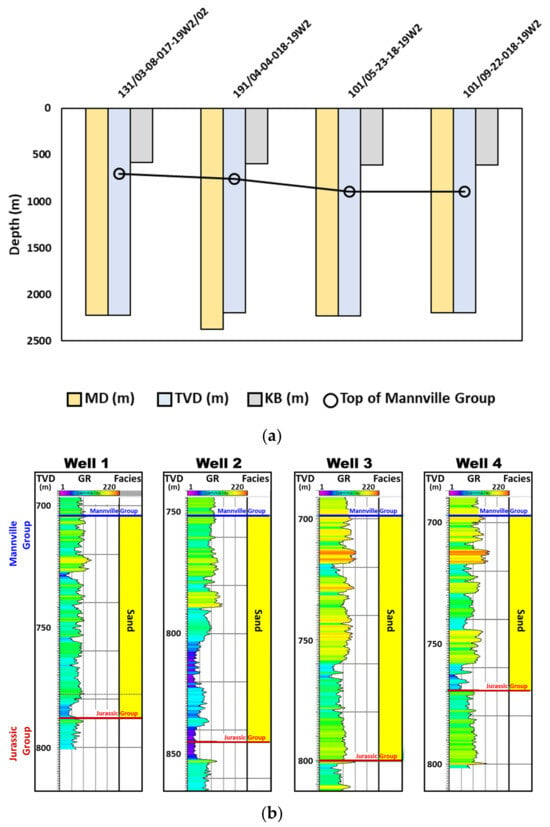
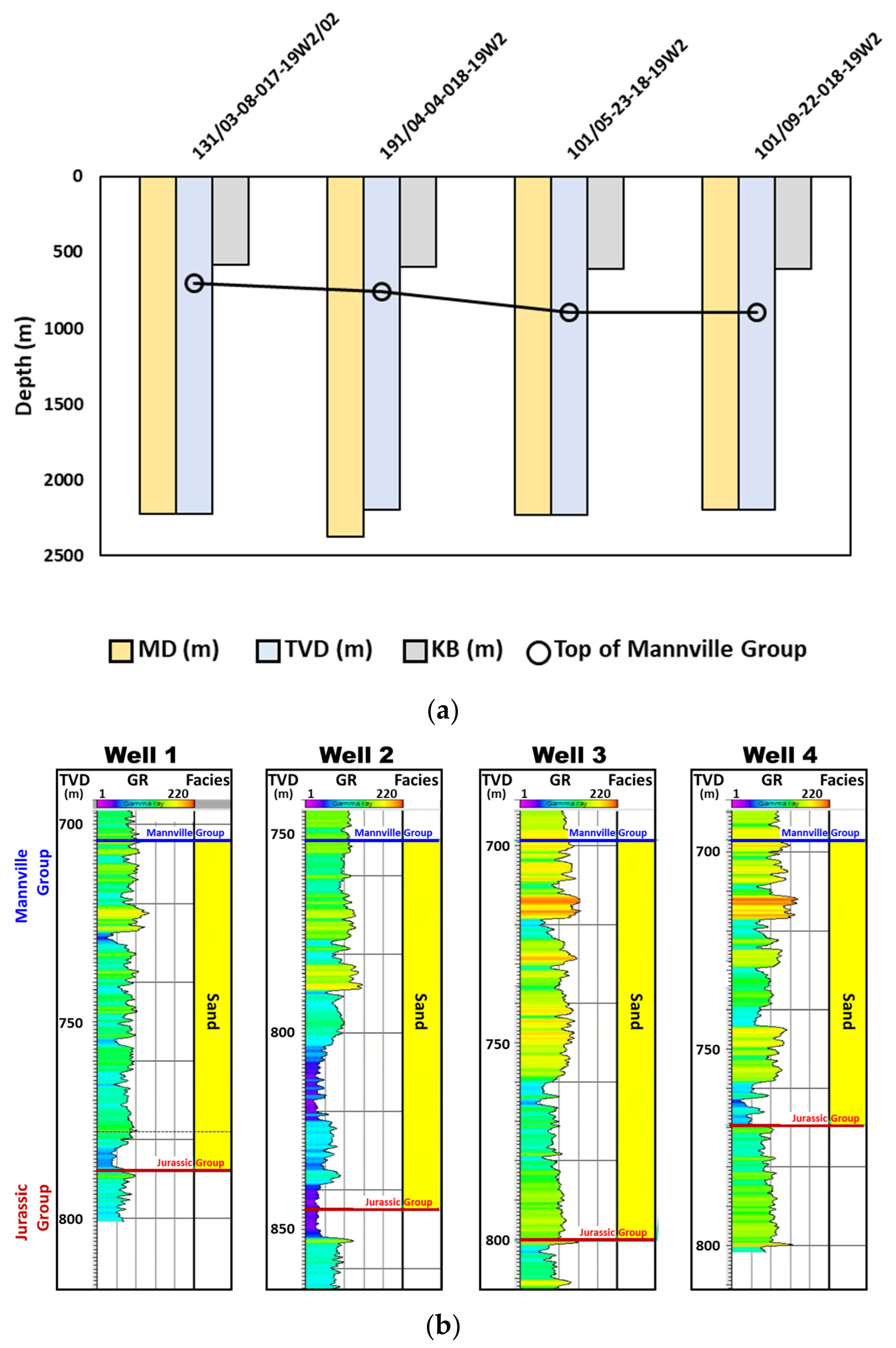
A static geological model of the Mannville Group was constructed using the Petrel v.2021 modeling software package (Schlumberger, Calgary, AB, Canada). Four wells located within the study area provided geological control. Figure 1 presents the unique well identifiers (UWIs), measured depth (MD), true vertical depth (TVD), Kelly bushing (KB) elevation, and the top of the Mannville Group for the four studied wells (panel a), together with their gamma-ray logs (panel b). The gamma-ray interpretations identify the Mannville and Jurassic formation boundaries, and these picks were subsequently used to construct the 3D horizons and structure maps.
Figure 1.
(a) Measured depth (MD), true vertical depth (TVD), Kelly bushing (KB) elevation, and the top of the Mannville Group for four wells in the study area, shown together with their corresponding unique well identifiers (UWIs). The figure summarizes key logistical details and target formation information for these wells within the Regina region, providing context for their selection and relevance to the Mannville interval. (b) Gamma-ray logs for the four studied wells, highlighting the identified horizons of the Mannville Group and the Jurassic Group, providing stratigraphic context for correlating formation tops across the study area.
The model domain covers a 25 km × 18 km region beneath the Regina region, Saskatchewan. The structural framework was built by correlating formation tops across the four wells and interpolating surfaces using Petrel’s horizon modeling tools. The Mannville Group was represented as a laterally continuous sandstone–shale package, with vertical extension above and below the aquifer to include the overlying and underlying shale aquitards.
Rock properties, including porosity, permeability, density, and thermal characteristics, were assigned using a combination of core data, well logs, and regional studies [28,29,30]. Porosity was estimated using density–porosity relationships for sandstone intervals. Permeability was calculated using the empirical correlation from [31]:
Permeability = (697.74 × porosity) − 28.964
Temperature distribution was assigned using a depth-dependent geothermal gradient:
Temperature = (0.027 × depth) + 26
The completed static model was exported from Petrel in CMG-compatible format for dynamic simulation.
2.3. Dynamic Flow and Heat Model
The dynamic behavior of groundwater flow and heat transport within the Mannville aquifer was simulated using the STARS simulator of the Computer Modelling Group (CMG v.2024.2) reservoir simulation platform. The static geological model exported from Petrel served as the foundation for the dynamic grid, which was discretized into a uniform mesh and ten vertical layers, with additional local grid refinement between wells. The model domain included the Mannville Group aquifer as well as the overlying and underlying shale aquitards to ensure realistic representation of vertical confinement and thermal insulation.
The regional geological model spans approximately 18 km × 25 km and therefore employs grid resolutions from 1 km × 1 km to 160 m × 160 m to maintain computational feasibility. Within the flow and heat transport model, the grid was locally refined in the area surrounding the storage–production doublets to resolve steep thermal and hydraulic gradients near the wells. This two-tier discretization ensures that the thermal plume shape is controlled by the refined local grid, while the coarse regional grid represents far-field boundaries without influencing near-well plume geometry. Although no additional global mesh-refinement tests were performed, the refined local grid provides adequate resolution for capturing the dominant advective and conductive processes governing plume evolution. Temporal accuracy was maintained using the simulator’s adaptive timestep control, which automatically reduces timestep size during periods of rapid thermal change and increases it during quasi-steady periods.
Fluid flow within the aquifer was governed by Darcy’s law, which relates volumetric flux to the pressure gradient, permeability, and fluid viscosity. Heat transport was modeled using the coupled advection–dispersion–conduction equation, allowing the simulator to capture both the advective movement of heat with the flowing groundwater and the conductive transfer of heat through the porous matrix. The effective thermal properties of the rock–fluid system were assigned based on regional data and literature values, ensuring that both the solid matrix and the fluid phase contributed appropriately to the overall heat capacity and thermal conductivity of the system (Table 1).
Table 1.
Wellbore dimensions and formation, and wellbore thermal properties.
The initial conditions were defined using a hydrostatic pressure distribution and a temperature profile derived from the regional geothermal gradient. The geothermal gradient was applied uniformly across the model, resulting in an initial temperature field that increased linearly with depth. The top and bottom boundaries were assigned hydraulically impermeable and thermally insulating conditions to represent the low-permeability shale aquitards that bound the aquifer. These boundary conditions ensured that injected heat remained contained within the storage interval and did not significantly dissipate into adjacent upper formations through convection.
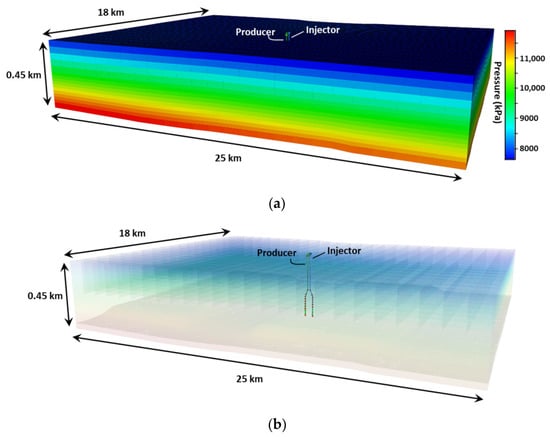
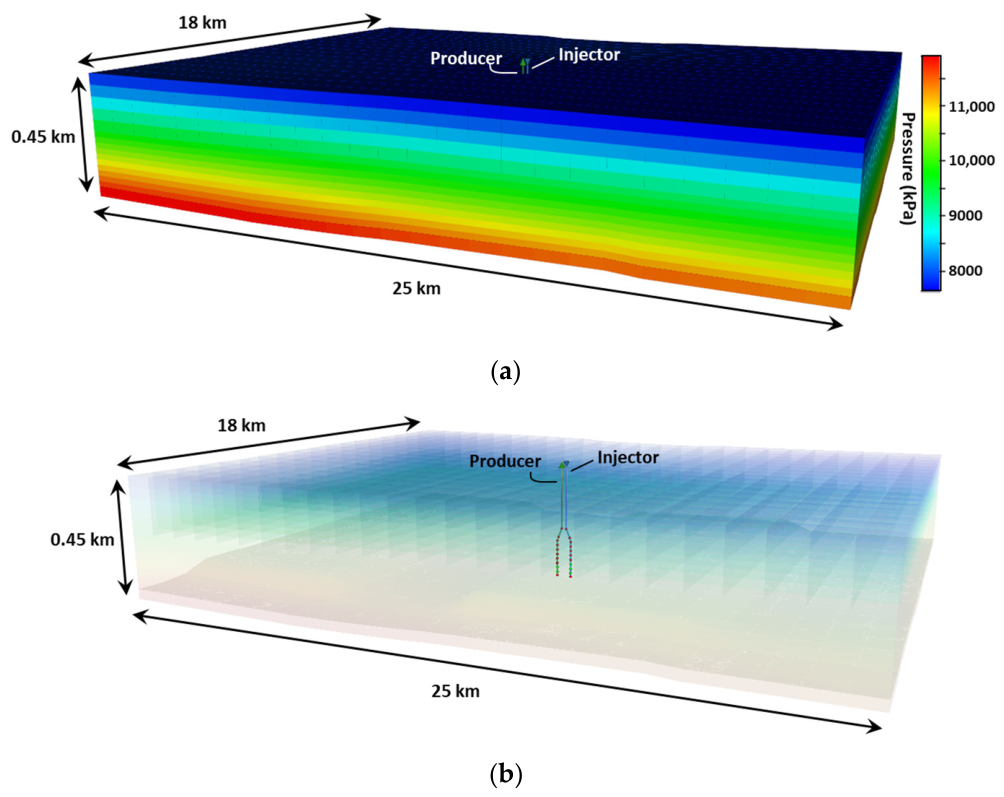
Well operations were implemented using specified flow rates and injection temperatures that varied seasonally according to the solar thermal input described in Section 2.4. The injection well introduced heated water into the aquifer during the designated storage months, while the production well extracted water during the heating season. The simulator accounted for temperature-dependent fluid viscosity, allowing the model to capture the influence of thermal variations on flow behavior. This coupling between thermal and hydraulic processes was essential for accurately predicting plume migration and the thermal response at the production well (Figure 2).
Figure 2.
(a) Regional reservoir model dimensions used in this study, showing the full model domain (25 km × 18 km × 0.45 km) representing the Mannville Group. The figure illustrates the lateral and vertical extent of the domain used for all eight ATES well-pair configurations. (b) Same regional model shown with partial transparency to visualize the injector and producer wells within the model grid. The labeled injection (storage) well and production well represent one conceptual ATES configuration; inter-well spacing varies across the eight scenarios evaluated in this study. The four wells studied earlier in Figure 1 provided geological control for model construction, but they were not used as the ATES injection or production wells.
To ensure numerical stability and convergence over the long simulation period, the model employed a fully implicit solution scheme with adaptive time stepping. The STARS simulator automatically adjusted time steps based on changes in pressure and temperature gradients, allowing for smaller steps during periods of rapid thermal or hydraulic change and larger steps during steady-state conditions. Convergence tolerances were set to ensure accurate mass and energy balances throughout the simulation. This approach allowed the model to capture both short-term operational dynamics and long-term thermal evolution without compromising computational efficiency. Adaptive time stepping was employed to ensure numerical stability and computational efficiency throughout the 14-year simulation period. CMG-STARS automatically adjusts the timestep size based on non-linear convergence criteria, including pressure and temperature residuals, changes in wellbore conditions, and the magnitude of thermal and hydraulic gradients. During periods of rapid change, such as the onset of injection, production, or seasonal switching, the timestep is reduced to capture steep thermal fronts and transient flow behavior. Conversely, during quasi-steady periods with minimal changes in reservoir conditions, the timestep increases to accelerate computation. In this study, timestep sizes typically ranged from minutes to hours during transient phases and from several days to weeks during stable periods. This adaptive approach ensures the accurate resolution of thermal plume evolution while maintaining reasonable computational cost [32]. The dynamic model provided a robust framework for evaluating the coupled flow and heat transport processes governing ATES performance in the Mannville Group. The integration of realistic geological structure, temperature-dependent fluid properties, and seasonally varying operational schedules enabled a detailed assessment of thermal plume development, reservoir warming, and long-term energy recovery under a range of well configurations.
Although field-scale validation data for solar-assisted ATES in the Mannville Group are not yet available, the modeling framework used in this study is grounded in well-established and experimentally validated thermal–hydraulic principles. The CMG-STARS simulator has been widely applied in geothermal, thermal recovery, and ATES studies, and its governing equations for coupled advection–dispersion–conduction heat transport have been benchmarked against laboratory experiments and analytical solutions in previous work [32]. The thermal and hydraulic properties assigned to the Mannville Group are derived from core measurements, well logs, and regional studies, ensuring consistency with independently measured datasets. Furthermore, the simulated plume geometries, temperature evolution, and seasonal recharge–discharge behavior align with patterns reported in documented ATES systems in Europe and North America. While site-specific field validation remains an important next step, the adopted modeling approach provides a robust and physically consistent basis for evaluating long-term thermal performance in a Canadian aquifer.
2.4. Solar Thermal Input Characterization
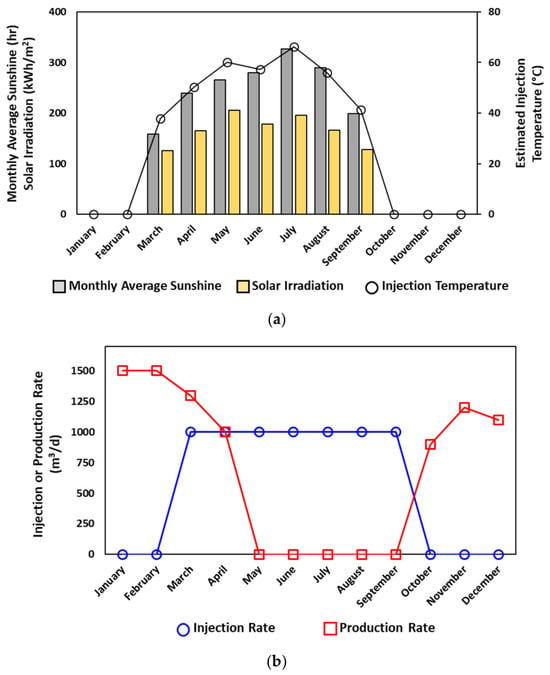
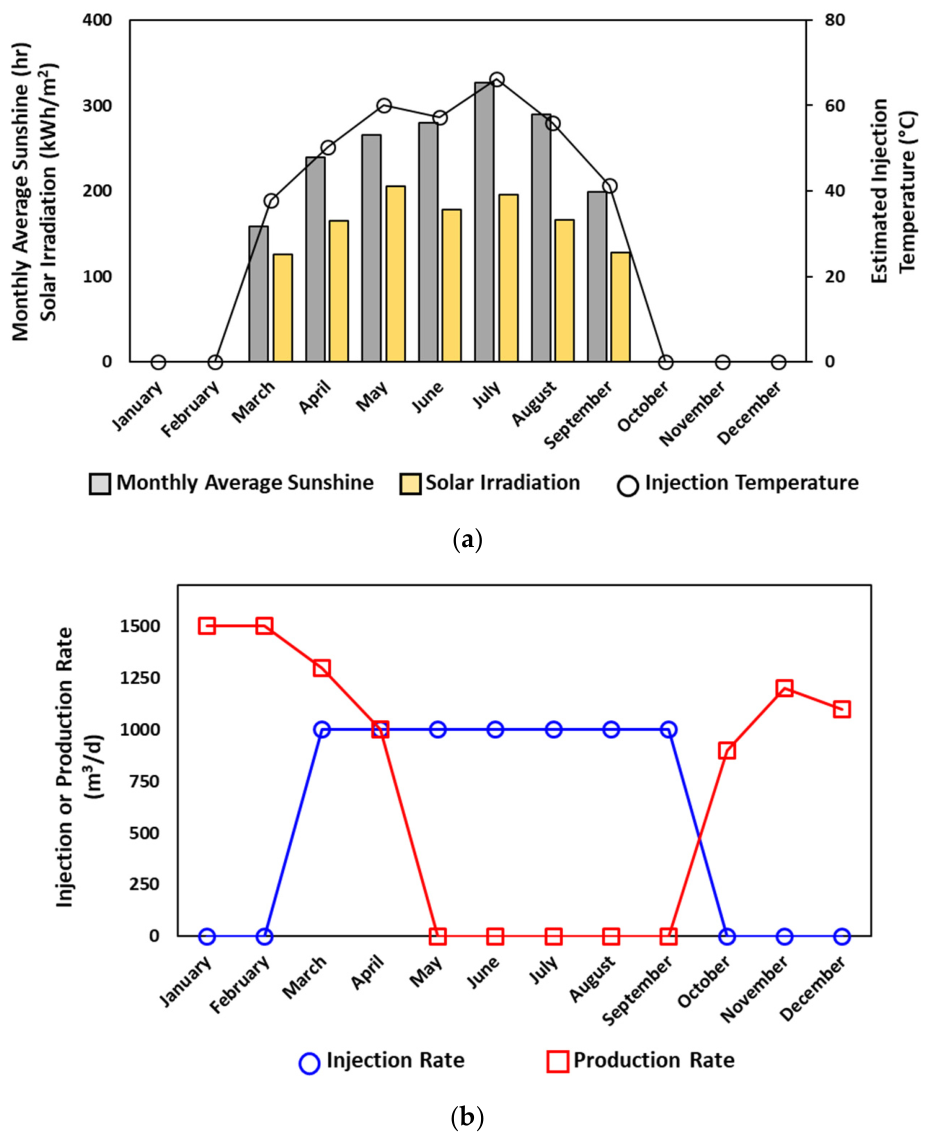
Solar thermal input and monthly injection temperatures were derived from solar irradiation data (kWh/m2) and scaled using the performance characteristics of evacuated tube collectors reported in [33]. Their pilot system, consisting of 25 evacuated tubes, achieved water temperatures of approximately 60 °C under solar radiation of 376.7 W/m2. Monthly average solar irradiation (kWh/m2) and sunshine hours for Regina were obtained from a publicly accessible database (https://online.tsol.de/en/ accessed on 15 October 2025) and are shown in Figure 3. The peak monthly injection temperature of 60 °C was assigned to May, which exhibited the highest monthly irradiation (205 kWh/m2), making it the month most likely to experience peak irradiance comparable to the conditions under which the reference system achieved ~60 °C. Injection temperatures for all other months were scaled proportionally to their relative irradiation and sunshine hours. A single representative injection temperature was applied for each month because seasonal ATES systems behave as large thermal masses, making hourly fluctuations in collector outlet temperature negligible at the multi-year scale.
Figure 3.
(a) Monthly solar irradiation profile and (b) corresponding storage and production flow rates for the base case scenario in the Mannville reservoir. The figure illustrates the seasonal variability in available solar energy and its integration with the operational charging (injection) and discharging (production) cycles of the solar-assisted geothermal system.
In contrast to several European countries, Canada does not currently impose explicit temperature limits for ATES injection. Provincial regulations in Saskatchewan and Alberta focus on groundwater protection, well integrity, and the isolation of potable aquifers, but they do not specify maximum allowable injection temperatures for deep, saline formations. Because the Mannville Group is a non-potable aquifer located well below the base of groundwater protection, the use of a 60 °C injection temperature is consistent with existing regulatory frameworks and with prior ATES modeling studies in deep sedimentary basins. The selected temperature therefore reflects both technical feasibility and the absence of temperature-specific regulatory constraints for deep ATES systems in Canada.
Injection and production flow rates were selected based on typical ATES operational ranges, the hydraulic properties of the Mannville Group, and numerical stability considerations. The rates of 900–1500 m3/day provided stable wellbore pressures and produced a measurable thermal plume over multi-year cycles.
Figure 3 summarizes monthly irradiation, estimated injection temperatures, and injection/production flow rates for the base case scenario.
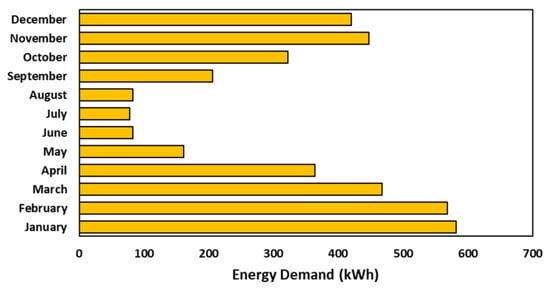
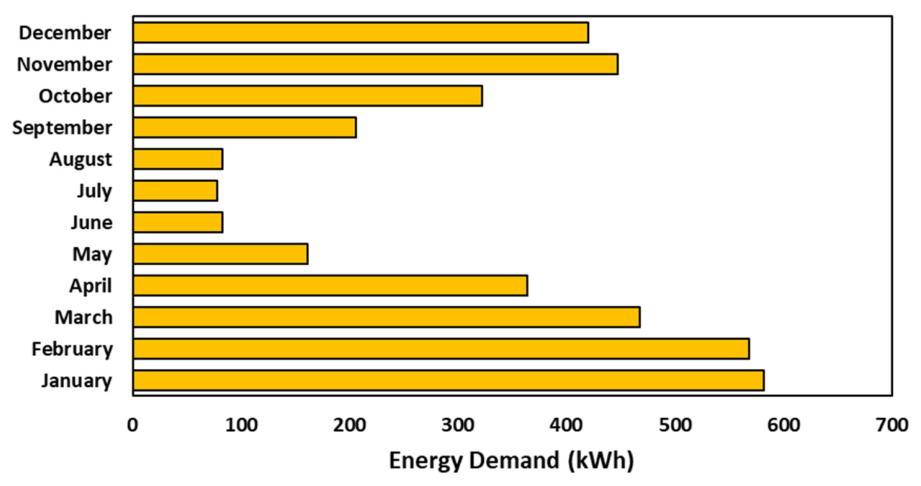
Heating demand data for a representative facility at the University of Regina were used to define the seasonal variations in heating and cooling requirements over a typical operational year (Figure 4).
Figure 4.
Monthly energy demand for a representative facility located within the studied region, illustrating seasonal variations in heating and cooling requirements over a typical operational year.
2.5. ATES System Configuration and Operation
This study focuses on the interaction of storage well, production well, and hot plume expansion relative to the two wells. The ATES system consists of one storage (i.e., injection) well and one production well, spaced apart (the base case assumes 400 m inter-well spacing) to explore the extension and impact of hot plume in the production well with the studied maximum spacing. Injection for charging the subsurface reservoir begins in Year 1, using solar-heated water at temperatures defined in Figure 3a. A constant injection flow rate of 1000 m3/day into the storage well was applied during months with sufficient solar radiation.
To allow the thermal plume to develop and expand within the aquifer, production was delayed until a year. Production was scheduled according to the facility’s heating demand, with pauses during months of low demand. Both storage and production operations continued for approximately 14 years, enabling the evaluation of long-term thermal sustainability and multi-year cycling behavior.
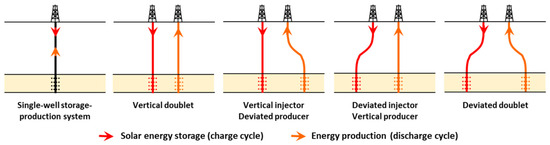
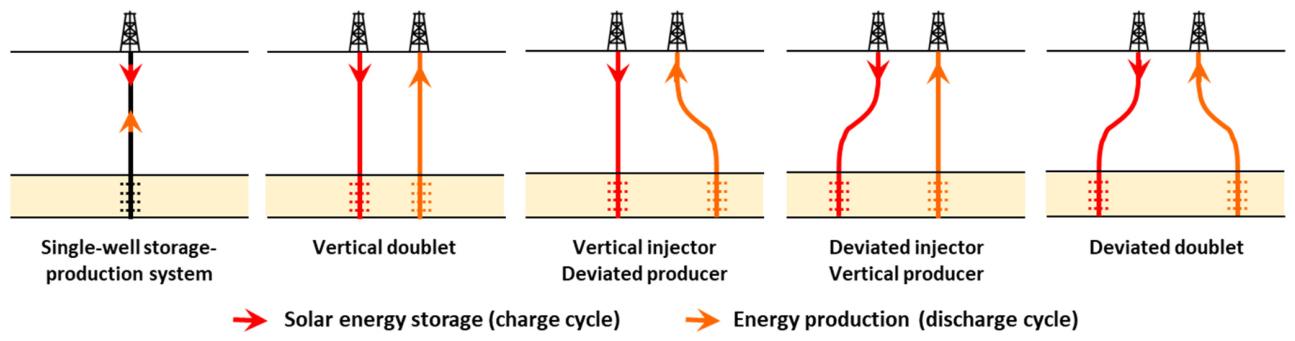
To quantify how well-pair geometry and bottomhole spacing influence subsurface thermal and hydraulic performance, eight configurations were defined and simulated. In this study, vertical and deviated refer to the drilling orientation of the injector and producer wells (Figure 5). The scenarios were selected to isolate the effects of bottomhole separation distance, relative injector–producer orientation, plume–well interaction, and hydraulic communication between wells. The evaluated configurations were: Case 1—a single-well storage–production system; Case 2—a deviated producer paired with a vertical injector separated by 504 m; Case 3—a deviated producer with a vertical injector separated by 318 m; Case 4—a vertical producer with a deviated injector separated by 502 m; Case 5—a vertical producer with a deviated injector separated by 333 m; Case 6—a vertical–vertical doublet with 178 m spacing; Case 7—a deviated–deviated doublet with 503 m spacing; and Case 8—a deviated–deviated doublet with 844 m spacing. Together, these configurations provide a controlled framework for evaluating how drilling orientation and well separation govern thermal drawdown, pressure evolution, and overall system performance.
Figure 5.
Schematic representation of the simulated well-pair configurations used to evaluate the influence of drilling trajectory, bottomhole spacing, and well geometry on thermal and hydraulic performance. The design space includes a single-well storage–production system, a vertical–vertical doublet, hybrid systems with a vertical storage well and a deviated producer or a deviated storage well and vertical producer, and fully deviated doublets.
2.6. Model Assumptions and Performance Metrics
The dynamic simulations conducted in this study rely on a set of physical, operational, and numerical assumptions that ensure internal consistency while reflecting the geological and engineering realities of the Mannville aquifer. The reservoir was treated as laterally homogeneous within each stratigraphic layer, with hydraulic and thermal properties assigned based on regional studies and well log interpretations. Although the Mannville Group exhibits local heterogeneity, the assumption of layer-averaged properties allows the model to capture large-scale thermal and hydraulic behavior over the 14-year simulation period. Fluid density was assumed constant, while viscosity was treated as temperature-dependent to account for the influence of thermal variations on flow behavior. Chemical reactions, mineral precipitation, and geomechanical deformation were not included, as the focus of this study was on solar-assisted thermal storage and recovery rather than long-term geochemical evolution. The model also assumed negligible regional groundwater flow, consistent with the confined nature of the aquifer and the presence of thick shale aquitards above and below the storage interval. Heat losses in surface pipeline and facilities were not considered, allowing the analysis to isolate subsurface thermal dynamics.
To evaluate the performance of the ATES system, several thermal and hydraulic metrics were monitored throughout the simulation. The evolution of the thermal plume was assessed using bottomhole and surface temperature tracking, which delineates the extent of meaningful thermal influence. Hot plume reach at the production well was monitored to determine the degree of plume interaction and the stability of produced temperatures over time. The energy content of the produced water was quantified using enthalpy calculations at both bottomhole and surface conditions, enabling an assessment of the harvested energy to be delivered to the surface facility. The storage efficiency and thermal recovery ratio were computed by comparing cumulative injected and produced heat, providing insight into the long-term sustainability of the system. These metrics collectively allowed for a detailed discussion and evaluation of how well configuration, spacing, and operational schedules influence the effectiveness of solar-driven ATES in a relatively deep aquifer.
3. Results
3.1. Thermal Response of the Aquifer in the Base Case
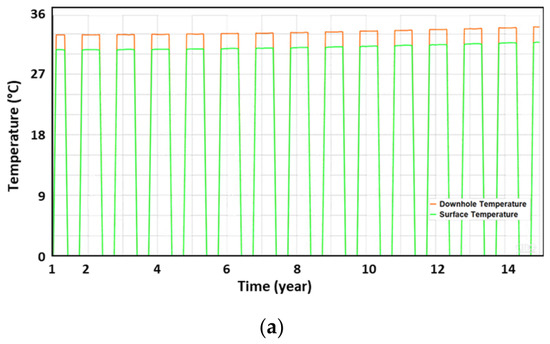
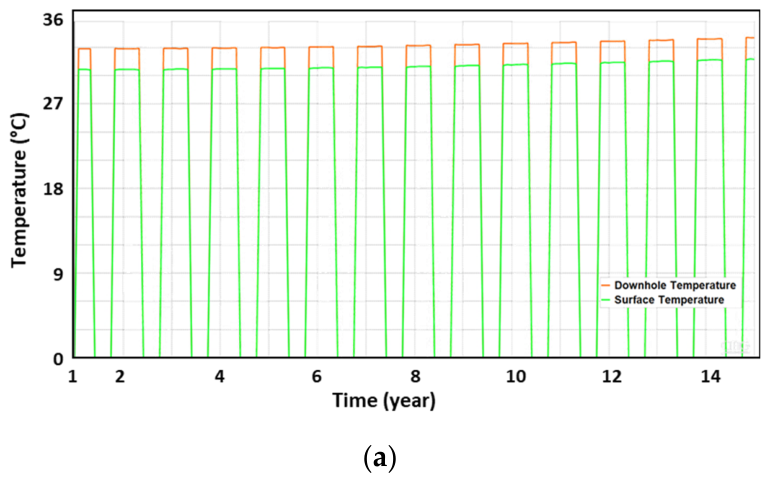
The base case simulation provides a clear picture of how seasonal injection of solar-heated water influences the thermal regime of the Mannville aquifer over the 14-year operational period. Figure 6a illustrates the evolution of both downhole and surface production temperatures. At the start of operations, the production well delivers water at approximately 32.8 °C at the bottomhole and 30.6 °C at the surface. As repeated cycles of heat injection accumulate within the reservoir, these temperatures gradually rise to 34 °C and 31.7 °C, respectively. Although heat storage is limited to seven months of the year and occasionally overlaps with production, the cumulative effect is a sustained solar-assisted warming of the reservoir. This demonstrates that even intermittent solar-driven storage can meaningfully elevate subsurface temperatures in a shallow aquifer.
Figure 6.
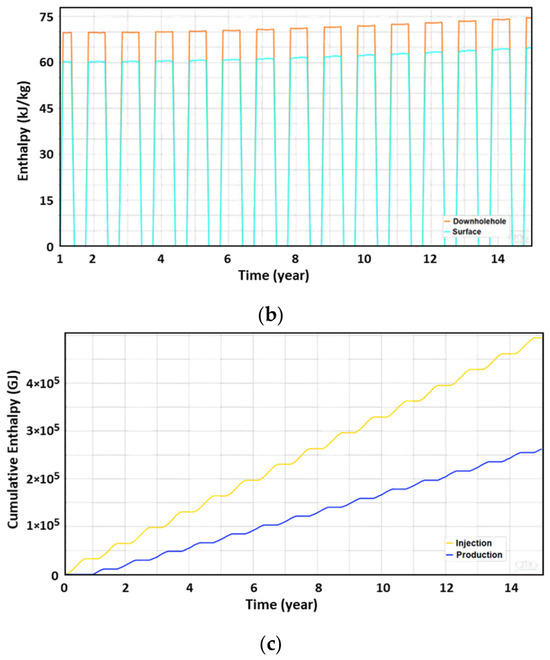
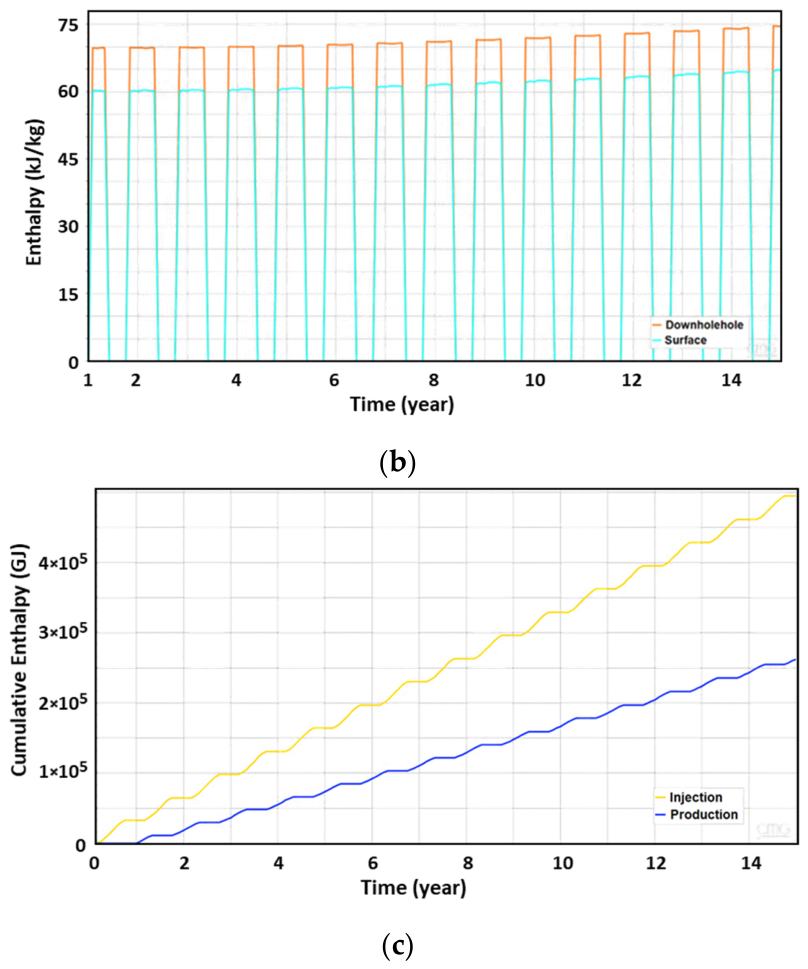
(a) Downhole and surface temperature variations for the base case configuration with 400 m well spacing, showing the thermal response to repeated solar–thermal energy storage cycles. (b) Evolution of reservoir fluid enthalpy at the bottomhole and at the surface, and (c) cumulative energy injected and produced over the 14-year period, illustrating long-term solar-charging efficiency and energy recovery performance, modified after [34].
Given a 400 m spacing with the storage well, the production well intersects with the edge of the hot plume, but it does not reach the hottest region. The plume expands asymmetrically, influenced by reservoir properties and operational timing, and the hottest zone remains closer to the storage well. This suggests that reducing the well spacing could increase the temperature of produced water. Unlike conventional geothermal doublets, which typically require large spacing to avoid thermal breakthrough, ATES systems benefit from closer spacing from the perspective of deploying one storage well and one production well because the reservoir is being charged and the heat is intended to be recovered at the highest temperature based on the seasonal demand.
The increase in reservoir temperature directly enhances the energy content of produced water. Figure 6b shows that the accessible enthalpy at the surface increases from approximately 60 kJ/kg at the start of operations to nearly 65 kJ/kg after 14 years. This rise occurs even though production rates remain constant, indicating that the reservoir becomes progressively more energy-rich as solar heat accumulates. The bottomhole enthalpy follows a similar trend, reflecting the gradual warming of the aquifer.
Cumulative energy trends are presented in Figure 6c. Over the 14-year period, the total injected energy is nearly twice the cumulative produced energy. This difference reflects that the intensity and availability of solar energy in the form of heat to be stored during summer can exceed the extraction of required heat during winter. Importantly, the reservoir does not exhibit thermal depletion; instead, its temperature increases steadily as additional solar energy is introduced. This behavior confirms that the Mannville Group can serve as a long-term thermal buffer, capable of storing surplus renewable solar heat without degrading thermal reservoir conditions.
3.2. Performance of Alternative Well Configurations
To evaluate how well geometry influences thermal and hydraulic performance, eight scenarios were simulated, including deviated doublets with large (844 m) and small (503 m) spacing, vertical doublets (178 m apart), hybrid vertical–deviated systems (318 m, 333 m, 502 m, 504 m), and a single-well storage–production system. These scenarios were designed to explore the effects of bottomhole spacing, well deviation, and operational constraints. Doublet systems allow overlapping storage and production, whereas the single-well system alternates between storage and extraction, resulting in distinct thermal and hydraulic behaviors. Table 2 summarizes monthly storage and production schedules, showing the month-by-month distribution of injection and production periods, including the solar-assisted charging cycles applied in each operational year of the simulations.
Table 2.
Monthly storage and production schedules for the single-well storage–production system (Case 1) and the two-well configurations (Cases 2–8), showing the month-by-month distribution of injection periods and production periods, including the solar-assisted charging cycles applied in each operational year of the simulations.
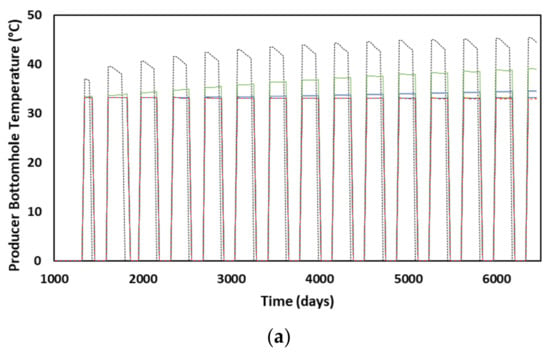
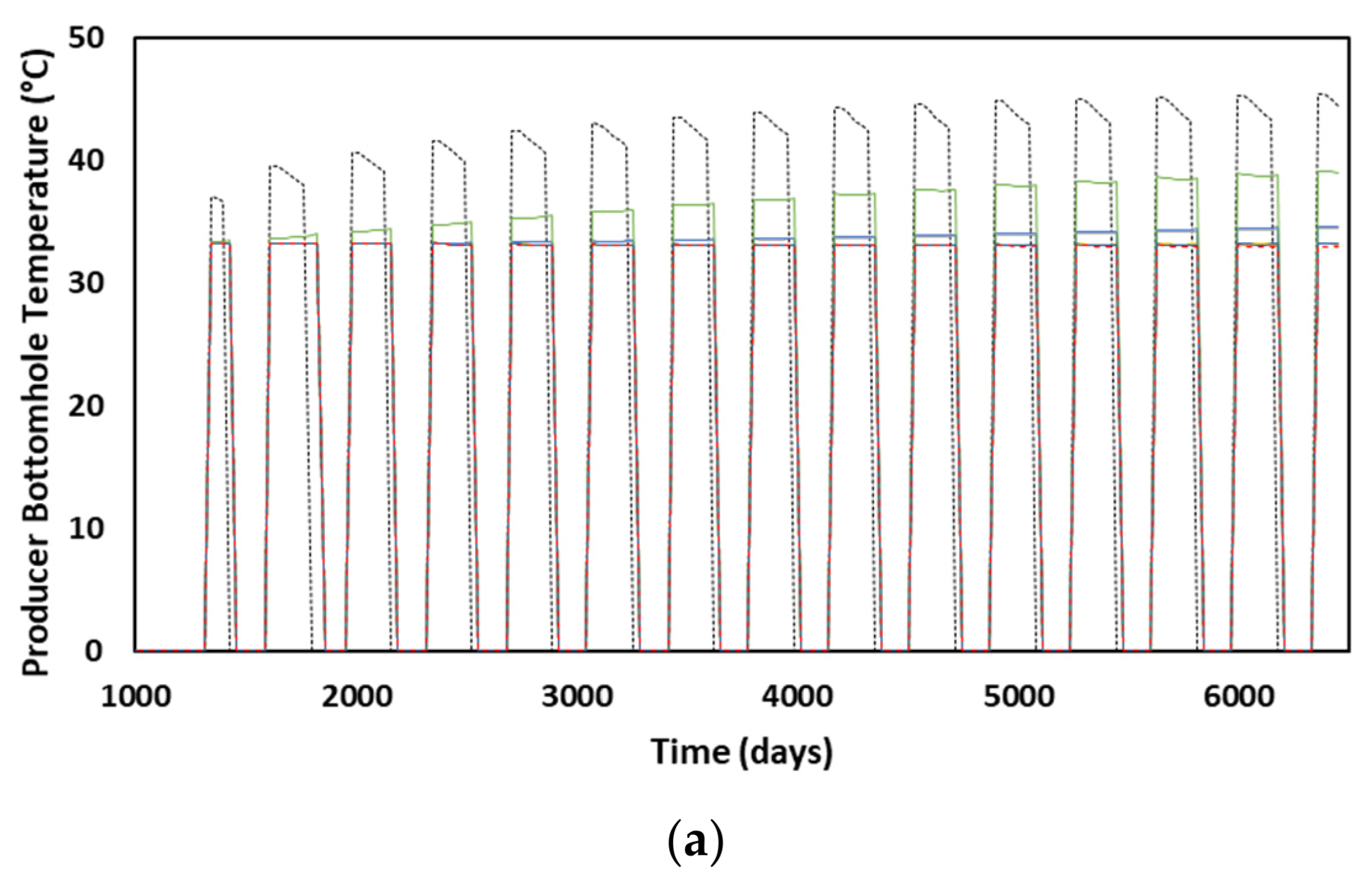
Bottomhole temperature trends for all eight scenarios are shown in Figure 7a. The single-well configuration exhibits the highest temperature increase, reaching approximately 46 °C after 14-year operation. This occurs because the same zone is repeatedly charged and discharged, leading to strong localized heating. However, this configuration also experiences the steepest temperature declines during production, caused by the direct mixing of hot and cold plumes. The vertical doublet system, with a bottomhole spacing of 178 m, shows the second highest temperature increase. Its performance is characterized by stable temperature growth without abrupt seasonal drops, indicating that the spacing is sufficient to prevent immediate cooling while still allowing effective energy withdrawal from the hot plume.
Figure 7.
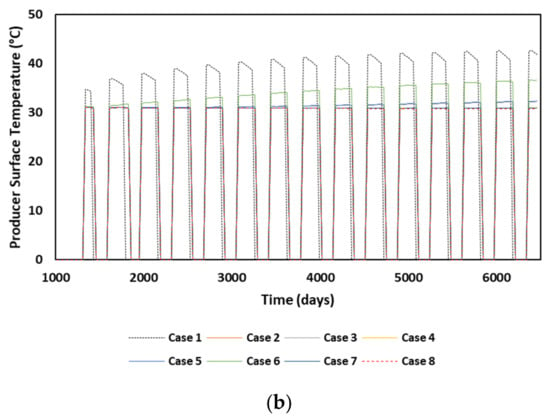
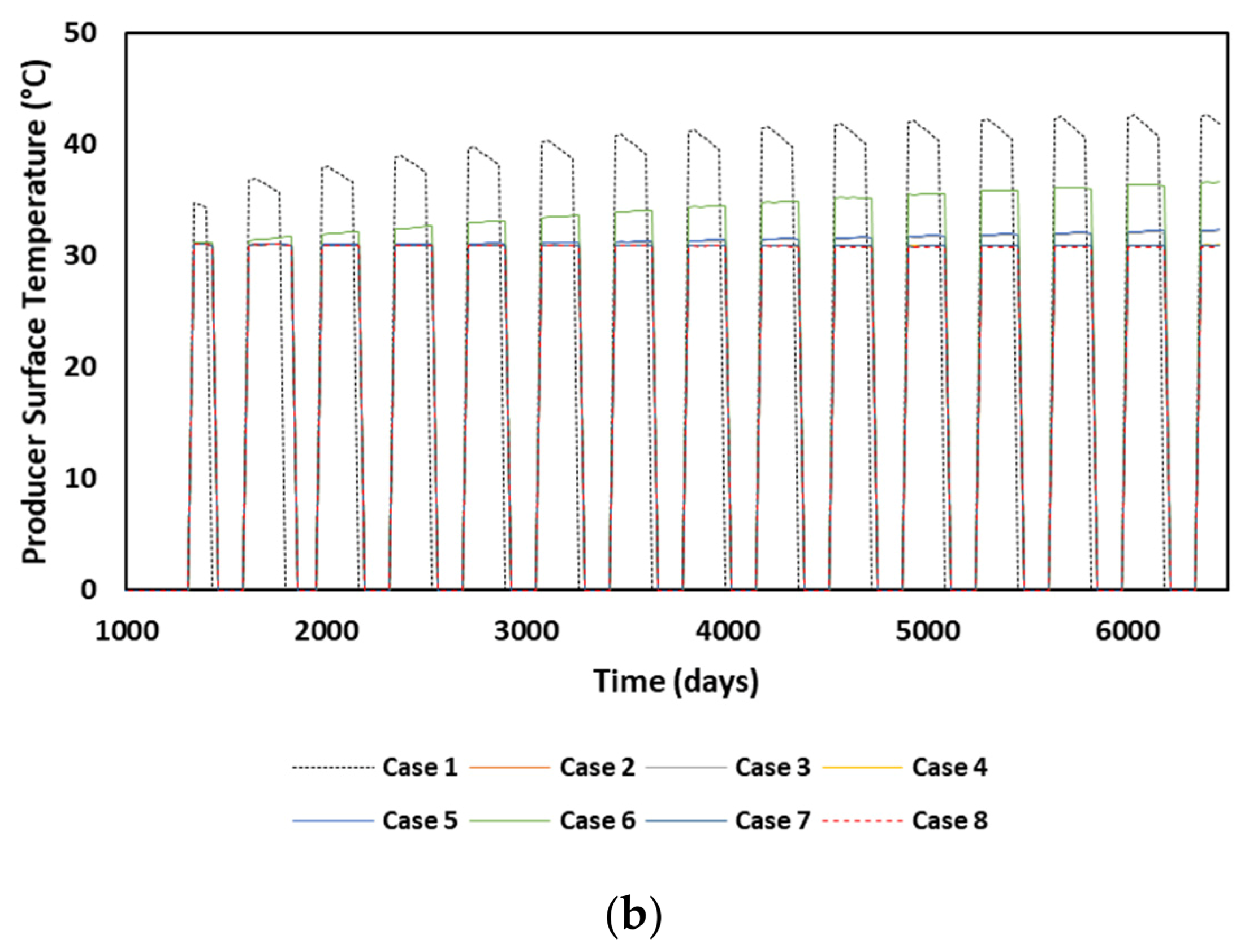
(a) Bottomhole temperature and (b) surface temperature at the producer for the eight simulated well-pair configurations, illustrating the influence of drilling trajectory, bottomhole spacing, and well geometry on thermal performance. Results are shown for Case 1 (single-well system), Case 2 (deviated producer–vertical injector, 504 m), Case 3 (deviated producer–vertical injector, 318 m), Case 4 (vertical producer–deviated injector, 502 m), Case 5 (vertical producer–deviated injector, 333 m), Case 6 (vertical–vertical doublet, 178 m), Case 7 (deviated–deviated doublet, 503 m), and Case 8 (deviated–deviated doublet, 844 m).
Scenarios with moderate bottomhole spacing (approximately 300–350 m) show earlier and more pronounced temperature increases than those with larger spacing (approximately 500–850 m). In the closer-spaced cases, the thermal plume approaches the production well more rapidly, enhancing heat recovery. In contrast, the farther-spaced scenarios exhibit delayed and less temperature gains because the plume expansion does not reach the production zone by the end of the operation. These results highlight the importance of optimizing well spacing to balance plume interaction and thermal stability.
Surface temperature trends mirror bottomhole behavior, as shown in Figure 7b. By end of 14-year operation, the single-well system produces water at approximately 43 °C, while the vertical doublet reaches 36.5 °C. Systems with moderate spacing produce water near 32 °C, and those with larger spacing remain closer to 31 °C. These differences reflect the degree of plume interaction and the effectiveness of stored heat capture and recovery, i.e., subsurface charge and discharge cycles.
An inspection of computed trends of produced enthalpy further illustrated these dynamics. The single-well system achieves the highest enthalpy values, reaching up to 111 kJ/kg, but also experiences abrupt declines during production cycles. The vertical doublet maintains stable enthalpy throughout the operational period, benefiting from consistent plume influence without sudden interruption from the extraction season from the production well. Deviated well scenarios show modest differences depending on spacing, with closer spacing yielding slightly higher enthalpy.
3.3. Evolution of Energy in Place and Cumulative Energy Production
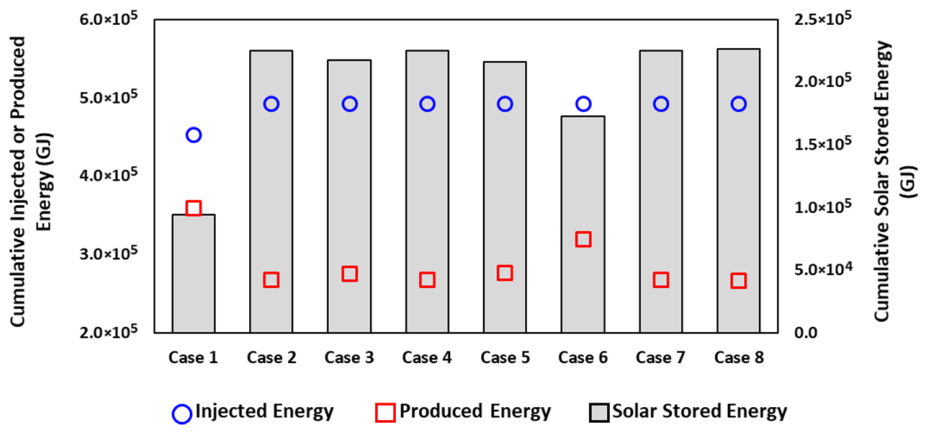
The single-well system exhibits the greatest energy in place (EIP) depletion because production occurs directly from the storage zone. Doublet systems show similar EIP trends, with the vertical doublet experiencing slightly greater reduction due to more effective heat extraction and replenishment (i.e., charge and discharge cycles). However, the overall changes in EIP remain small, indicating that most of the produced energy originates from stored solar heat rather than native geothermal energy. Cumulative energy production (Figure 8) reflects these patterns. The single-well system produces higher energy per unit mass, but it injects less total energy due to the operational constraint that storage and production cannot occur at the same time. The vertical doublet compensates for lower per mass enthalpy with more stable production and greater cumulative injection. Deviated well scenarios show small but measurable differences depending on spacing, though cumulative differences remain modest.
Figure 8.
Cumulative energy injected through the solar-assisted geothermal system and cumulative energy produced from the well pair over 14 years of operation for all eight simulated configurations. The results illustrate how drilling trajectory, bottomhole spacing, and well geometry influence long-term solar-stored energy uptake and geothermal energy recovery.
Thermal plume behavior varies significantly across scenarios. In the vertical doublet case, the plume consistently migrates toward the production well, enhancing heat recovery without causing significant thermal depletion due to the relatively optimum distance between the storage and production well. In the single-well system, the thermal plume remains localized, but it undergoes repeated disturbance, creating high peak temperatures and also steep declines. Deviated well scenarios indicate increasingly asymmetric plume geometries, which delay the convergence of the hot zone to the production well and consequently reduce the likelihood of highest thermal recovery. These patterns underscore the importance of understanding thermal plume migration pathways in shallow aquifers, where stratigraphic layering and permeability contrasts may influence heat transport.
3.4. Pressure Behavior and Hydraulic Performance
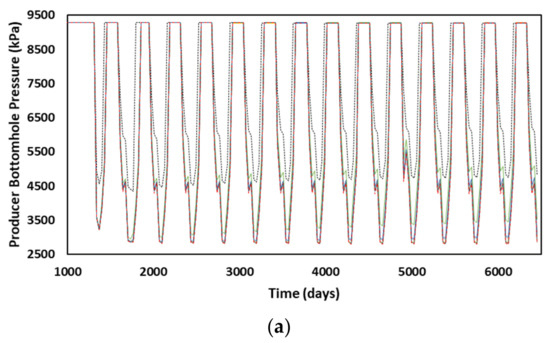
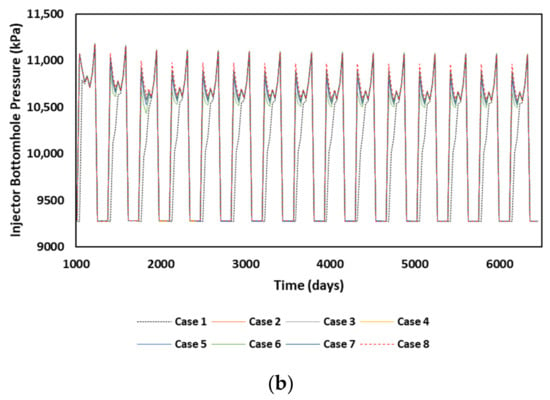
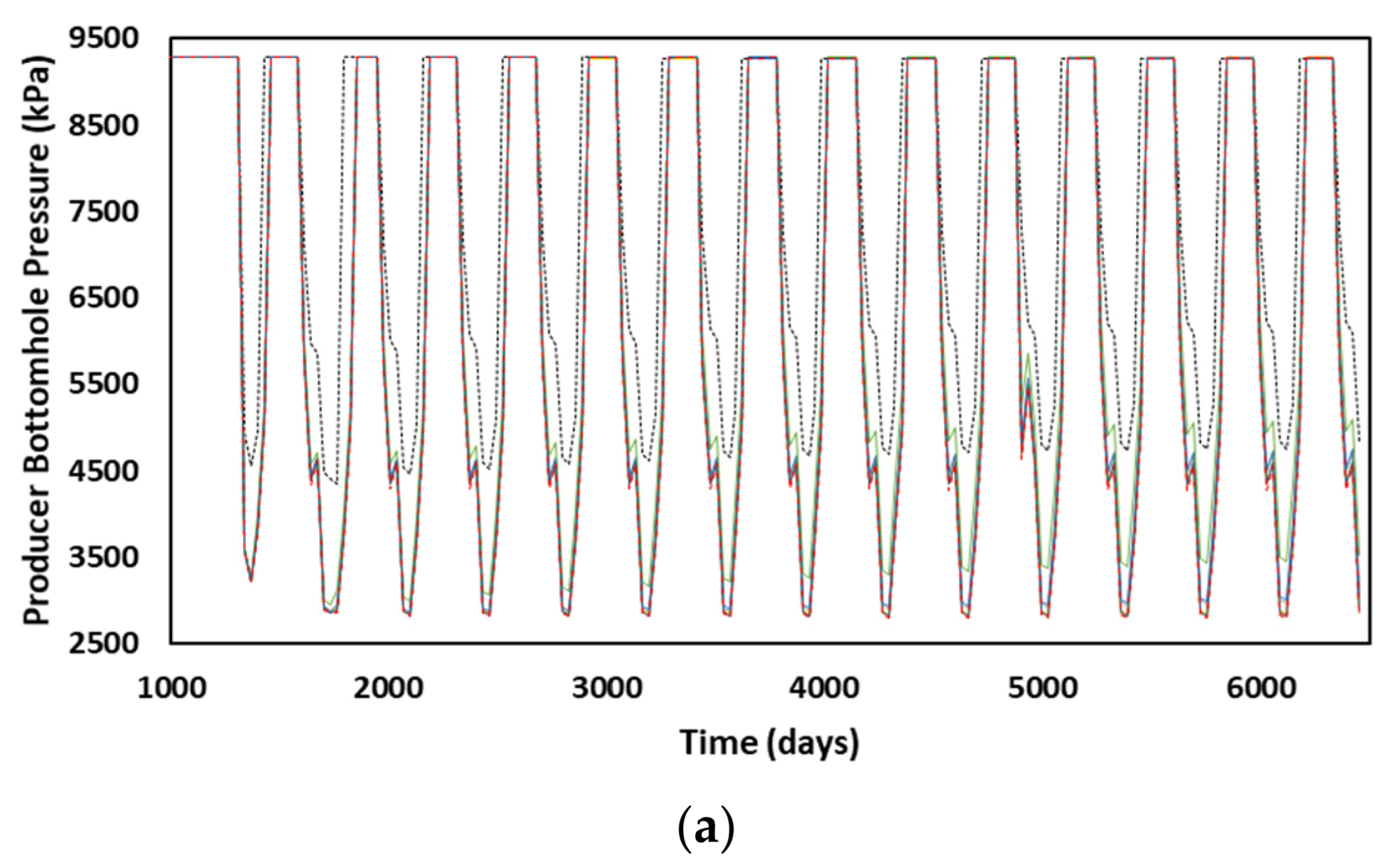
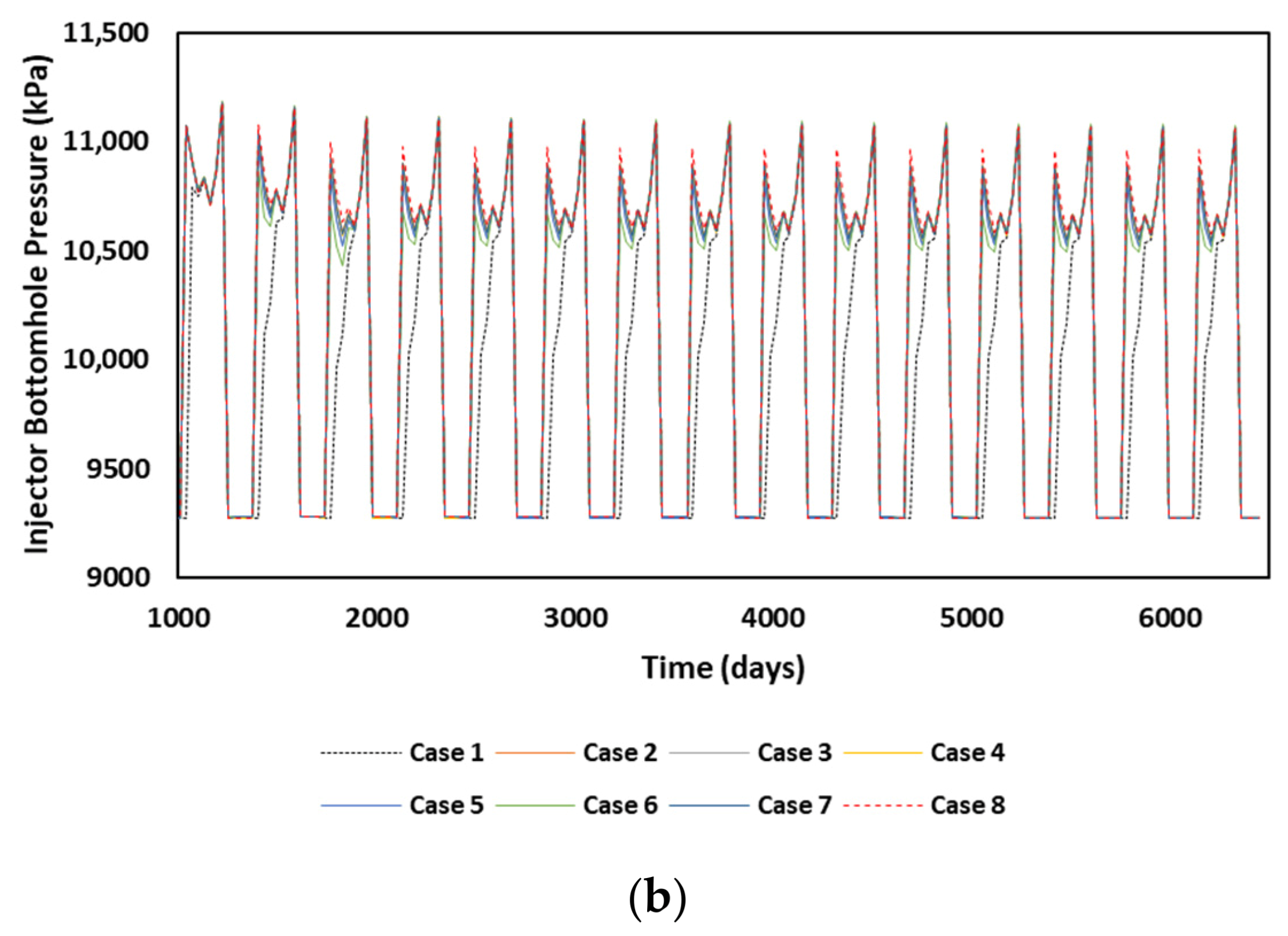
Pressure performance is shown in Figure 9. The single-well system maintains the most stable pressure because alternating storage and production naturally balance hydraulic loads. The vertical doublet system benefits from strong hydraulic communication between wells, which moderates pressure declines during production and reduces pressure spikes during storage. In contrast, deviated well scenarios with large spacing exhibit significant pressure drops at the production well and higher injection pressures at the storage well, reflecting weaker hydraulic connectivity. These results highlight the importance of well spacing not only for thermal performance, but also for operational pressure management.
Figure 9.
Bottomhole pressure variations at (a) the producer and (b) the injector. Results are shown for Case 1 (single-well system), Case 2 (deviated producer–vertical injector, 504 m), Case 3 (deviated producer–vertical injector, 318 m), Case 4 (vertical producer–deviated injector, 502 m), Case 5 (vertical producer–deviated injector, 333 m), Case 6 (vertical–vertical doublet, 178 m), Case 7 (deviated–deviated doublet, 503 m), and Case 8 (deviated–deviated doublet, 844 m).
4. Discussion
4.1. Subsurface Dynamics of Solar-Driven ATES
The results demonstrate that solar-driven aquifer thermal energy storage in the Mannville Group can meaningfully elevate subsurface temperatures and increase the energy content of produced water over multi-year cycles. Even with seasonal operation limited to seven months of injection, the system accumulates sufficient heat to shift baseline reservoir temperatures, consistent with long-term warming observed in European ATES systems. Extending this behavior to a cold-climate aquifer highlights the suitability of the Mannville Group as a robust thermal storage medium despite strong seasonal variability in solar availability.
From a thermodynamic perspective, the observed temperature and enthalpy trends also reflect changes in the exergy content of the stored and recovered heat. Because exergy increases with temperature difference relative to the ambient environment, the gradual warming of the aquifer enhances not only the quantity, but also the quality of recoverable energy. Irreversibilities arise primarily from conductive heat losses to surrounding formations, mixing between injected and native formation brine, and seasonal interruptions in injection and production. These mechanisms reduce the maximum theoretical exergy recovery in a manner consistent with ATES behavior in confined aquifers. The higher temperatures achieved in the single-well and closely spaced doublet configurations correspond to higher exergy availability, whereas larger well spacing delays plume interaction and results in lower-grade heat recovery. This thermodynamic interpretation supports the observation that well spacing and operational scheduling directly influence the usable energy quality delivered to surface heating systems.
Well configuration strongly influences thermal performance. The single-well storage–production system achieves the highest temperatures and enthalpy because the same zone is repeatedly charged and discharged, but this also produces steep seasonal temperature declines due to depletion of the hot plume. This trade-off reflects the inherent instability of single-well cycling. In contrast, the vertical doublet with 178 m spacing provides a more balanced response in which the production well remains close enough to the plume to benefit from elevated temperatures while avoiding abrupt cooling. This configuration maintains stable enthalpy and pressure behavior, reinforcing the established geothermal principles that moderate well spacing improves thermal recovery and operational reliability.
The higher temperature increase observed in the single-well system (Case 1) can be explained by its fundamentally different thermal–hydraulic behavior compared to doublet configurations. In a single-well storage–production system, all injected heat remains concentrated around the same wellbore, and the absence of a separate production well prevents advective transport of heat away from the injection zone. As a result, thermal energy accumulates locally over successive charging cycles, producing a compact, high-temperature plume with limited lateral spreading. In contrast, doublet systems continuously move heated water from the injector toward the producer, which enhances recoverability but also distributes heat over a larger volume of the aquifer. This advective spreading reduces peak temperatures near the injection well and leads to lower maximum temperature increases compared to the single-well case. The observed behavior is consistent with previous ATES studies showing that single-well systems favor thermal accumulation, whereas doublets favor thermal extraction and hydraulic efficiency.
The deviated well scenarios further illustrate the sensitivity of ATES performance to bottomhole separation. Large separations (>500 m) delay plume arrival and reduce thermal gains, whereas moderate separations (~300 m) promote earlier and stronger temperature increases. These results emphasize that optimal spacing must balance plume migration, reservoir permeability, and operational schedules. Although the model assumes laterally homogeneous properties, real formations may exhibit heterogeneity and anisotropy that influence plume geometry; future work should incorporate stochastic geological realizations to quantify this uncertainty.
Energy metrics support the observed trends. While the single-well system yields the highest energy per unit mass, its cumulative recovery is limited by the inability to inject during production months. Doublet systems, particularly the vertical configuration, offset lower per mass enthalpy with continuous seasonal storage and more stable production. The small changes in energy in place across doublet scenarios indicate that most recovered heat originates from stored solar energy rather than native geothermal heat, a desirable characteristic for sustainable seasonal storage.
It is important to note that, unlike shallow ATES systems in Europe where injection temperatures are limited to approximately 25 °C to protect potable groundwater, no comparable temperature restrictions currently exist for deep, saline aquifers in Canada. The Mannville Group lies far below the base of groundwater protection and is hydraulically isolated by thick shale aquitards, making higher injection temperatures permissible from both regulatory and environmental perspectives. The 60 °C injection temperature used in this study is therefore appropriate for a relatively deep aquifer system and reflects the operational flexibility available in Canadian sedimentary basins.
Moreover, the injection temperatures used in this study represent monthly averages derived from solar irradiation data and scaled using published collector performance characteristics. Although hourly solar variability can influence short-term collector outlet temperatures, such fluctuations are strongly damped by the large thermal mass of the aquifer. As a result, the long-term evolution of the subsurface temperature field is governed primarily by seasonal heat input, and the use of a single representative temperature per month provides an appropriate level of temporal resolution for a 14-year seasonal-storage analysis. Future work incorporating high-resolution irradiance data and detailed collector efficiency models could further refine short-term operational behavior, but it would not materially affect the seasonal-scale plume dynamics examined here.
Thermal plume behavior provides additional insight into system dynamics. In the vertical doublet, the plume reaches the production zone early in the operational period, enhancing recovery. In the single-well system, the plume remains localized, but it undergoes repeated disturbance, producing high peak temperatures and rapid declines. Deviated well scenarios show increasingly asymmetric plume geometries with larger spacing, reducing thermal capture efficiency. These patterns highlight the importance of understanding plume migration pathways in shallow, layered aquifers.
Pressure performance is equally important for ATES feasibility. The single-well system maintains the most stable pressures because alternating injection and production naturally balance hydraulic loads. The vertical doublet benefits from strong hydraulic communication, which moderates production drawdown and reduces injection pressure spikes. In contrast, deviated well scenarios with large spacing exhibit significant pressure drops at the producer and higher injection pressures at the storage well, reflecting weaker hydraulic connectivity. These findings underscore that well spacing governs both thermal and hydraulic behavior, with implications for regulatory limits on pressure increases to protect caprock integrity and prevent impacts on overlying potable water zones.
The thermodynamic behavior of the system also has practical implications for engineering design. Closer well spacing increases the likelihood that the production well intersects the high-temperature core of the plume, improving exergy recovery and reducing the need for auxiliary heating at the surface. Conversely, larger spacing reduces thermal interaction and yields lower-grade heat, which may be insufficient for direct use in district heating without heat pump assistance. The seasonal timing of injection and production also affects irreversibility. Uninterrupted summer charging minimizes conductive losses, while staggered winter extraction reduces thermal drawdown and preserves exergy. These considerations highlight the importance of optimizing well geometry, operational schedules, and integration with surface heat-exchange systems to maximize the thermodynamic efficiency of solar-assisted ATES in cold-climate environments.
4.2. Operational Strategies and Implications
In addition to well configuration and operational considerations, system performance can be further enhanced through smart scheduling and demand–response strategies. Because ATES systems operate over seasonal and sub-seasonal timescales, predictive control frameworks can optimize injection and production timing to align with periods of high solar availability, low heating demand, or favorable electricity prices. Data-driven approaches, including deep learning-based demand–response algorithms developed for renewable-based microgrids, have demonstrated strong potential for short-term operational optimization and load shifting [35]. Integrating such control strategies with solar-assisted ATES could reduce thermal irreversibilities, improve exergy recovery, and enhance system responsiveness to dynamic heating loads. These developments highlight the feasibility of managing ATES within modern smart-grid architectures and underscore the value of coupling subsurface storage with advanced operational control.
The implications for Canadian heating systems are notable. Prairie cities such as Regina experience extreme winter heating demand and rely heavily on natural gas. The demonstrated ability of solar-driven ATES to elevate aquifer temperatures over multi-year cycles suggests that relatively deep formations in WCSB can serve as reliable seasonal heat buffers. By storing surplus summer heat and recovering it during winter, ATES offers a pathway to reduce natural gas dependence in district heating networks. The Mannville Group’s permeability, confinement, and regional continuity make it a strong candidate for large scale deployment, and the vertical doublet configuration aligns well with institutional and district-scale heating infrastructure.
A comparison with other green heating and thermal storage technologies further clarifies the role of solar-assisted ATES in cold-climate regions. Traditional geothermal doublets rely on native geothermal gradients and therefore provide stable, but relatively low-temperature heat in WCSB, where formation temperatures at shallow depths are modest. In contrast, solar-assisted ATES actively elevates aquifer temperatures, increasing both the quantity and quality of recoverable heat. BTES systems, such as the Drake Landing Solar Community, have demonstrated excellent seasonal performance, but they require large surface footprints and rely on conduction-dominated heat transfer, which limits storage capacity and recovery rates. ATES benefits from convection-enhanced transport in permeable aquifers, enabling larger storage volumes and more rapid thermal response. Compared with other renewable heating options, such as biomass, waste heat recovery, or air-source heat pumps, the proposed hybrid ATES system offers the advantage of storing high-temperature solar heat during summer and delivering it during peak winter demand, reducing reliance on auxiliary heating. These distinctions highlight the complementary role of solar-assisted ATES within the broader portfolio of sustainable heating technologies and underscore the novelty of evaluating its performance in a deep confined aquifer under Canadian climatic conditions.
4.3. Limitations and Future Work
Despite promising results, several limitations remain. The simulations do not incorporate geological heterogeneity, anisotropy, regional groundwater flow, chemical reactions, or geomechanical effects, all of which may influence long-term performance. Future work should include uncertainty quantification, sensitivity analyses, economic modeling, and field-scale pilot testing to validate these findings.
The assumption of lateral homogeneity represents an important limitation of the present modeling framework. In reality, the Mannville Group exhibits spatial variations in permeability, porosity, and facies distribution that can influence both hydraulic connectivity and thermal plume evolution. Heterogeneous channel sands, shale drapes, and anisotropic bedding structures may cause preferential flow paths, asymmetric plume migration, or earlier-than-predicted thermal breakthrough at the production well. Conversely, low-permeability zones could restrict plume expansion and enhance local heat retention. By smoothing these features, the homogeneous model provides a first-order approximation of system behavior but does not capture the full range of possible outcomes. Incorporating stochastic geological realizations and heterogeneous property fields in future work would allow for uncertainty quantification and a more robust assessment of ATES performance under realistic subsurface conditions.
It is important to note that the solar-assisted ATES system has not yet been validated against field-scale measurements in the Mannville Group. Although the simulated thermal plume behavior is consistent with established ATES literature, site-specific pilot testing will be required to confirm plume migration, thermal recovery efficiency, and operational performance under real conditions. This represents a key direction for future work.
While the subsurface simulations provide insight into thermal plume evolution and well configuration performance, the broader energy system context is simplified in this study. The solar–thermal input is represented using monthly average injection temperatures rather than a full collector model with hourly variability, and the demand side is not explicitly modeled in terms of solar fraction, supply and return temperatures, or auxiliary heating requirements. Similarly, techno-economic considerations such as capital costs, pumping energy, collector area, and seasonal mismatch penalties are outside the present scope. As a result, the findings should be interpreted as demonstrating the subsurface technical feasibility of solar-assisted ATES in a deep confined aquifer, rather than providing a complete system-level design for urban heating. Future work integrating dynamic solar collector models, hourly building-load profiles, and economic optimization would enable a more comprehensive assessment of system-level performance.
5. Conclusions
This study demonstrates that solar-driven aquifer thermal energy storage in the Mannville Group can effectively elevate subsurface temperatures and enhance the energy content of produced water over multi-year operational cycles. Despite the highly seasonal nature of solar availability in Regina, the modeled system shows that repeated summer heat storage leads to a sustained increase in reservoir temperature, confirming the technical feasibility of ATES in cold-climate regions. The base case results indicate that, even with only seven months of annual heat storage, the aquifer gradually warms, and the enthalpy of produced water increases over time, enabling more efficient winter heat extraction.
The comparison of well configurations reveals that system geometry plays a decisive role in thermal and hydraulic performance. The single storage–production well achieves the highest localized temperatures and enthalpy values, but it experiences strong seasonal declines due to prompt depletion of the hot plume. In contrast, the vertical doublet configuration with 178 m spacing provides the most balanced performance, maintaining stable temperatures, consistent enthalpy, and favorable pressure behavior throughout the operational period. Deviated well scenarios highlight the sensitivity of ATES performance to bottomhole spacing. Moderate spacing near 300 m enhances hot plume interaction with production well and heat recovery, whereas larger spacing above 500 m delays thermal benefits and reduces production temperatures and enthalpy.
Energy metrics further confirm that the majority of recovered heat originates from stored solar energy rather than native geothermal heat, indicating that the system can operate sustainably without depleting the natural geothermal resource. Pressure trends show that both the single-well and vertical doublet configurations maintain stable hydraulic conditions, while deviated well systems with large spacing exhibit greater pressure drops and higher injection pressures at the storage well due to weaker hydraulic connectivity.
Practical implications of this work extend directly to the design and operation of seasonal heating systems in cold-climate regions. The results indicate that solar-assisted ATES can meaningfully elevate aquifer temperatures over multi-year cycles, improving both the quantity and quality of recoverable heat during winter. The vertical doublet configuration, in particular, offers a technically robust option for district-scale heating applications, balancing thermal recovery, hydraulic stability, and operational simplicity. These findings suggest that relatively deep aquifers within WCSB could serve as reliable seasonal heat buffers when coupled with solar thermal collectors, reducing reliance on natural gas and supporting the decarbonization of institutional and municipal heating networks.
Based on the comparative performance of the eight modeled configurations, the vertical doublet system (Case 4) emerges as the most suitable option for urban heating applications. Although the single-well system (Case 1) achieves the highest localized temperature increase, its strong thermal accumulation and limited recoverability make it less appropriate for continuous district-scale heat delivery. In contrast, the vertical doublet provides a favorable balance between thermal recovery efficiency, hydraulic stability, and operational simplicity. Its geometry promotes consistent plume capture at the production well, limits advective losses, and maintains stable outlet temperatures across multi-year cycles. These characteristics make the vertical doublet configuration the most technically robust and practically deployable option for solar-assisted ATES in cold-climate urban environments.
It is important to emphasize that this study represents a parametric numerical investigation rather than a full system-level design. The simulations do not incorporate geological heterogeneity, anisotropy, regional groundwater flow, or geochemical and geomechanical processes that may influence long-term performance. The model also does not include surface-system heat losses or operational constraints associated with real-world district heating infrastructure. Future research should address these limitations through field-scale pilot testing, uncertainty quantification, and techno-economic assessment. Evaluating integration strategies with heat pumps, district heating networks, and hybrid renewable systems would further clarify the role of solar-assisted ATES in broader energy transition pathways.
Overall, the findings demonstrate that the Mannville Group possesses the geological characteristics necessary to support solar-assisted ATES as a viable pathway for reducing winter heating demand in cold-climate Canadian cities. These results provide a foundation for future field-scale pilot testing aimed at integrating ATES into district heating networks and hybrid renewable energy systems across Western Canada. However, realizing a fully deployable system will require integrated modeling of solar collector performance, high-frequency heating demand, auxiliary heating, and techno-economic factors, which are beyond the scope of the present study.
Author Contributions
Conceptualization, M.K. and A.R.S.; methodology, M.K. and A.R.S.; software, M.K. and A.R.S.; validation, M.K. and A.R.S.; formal analysis, M.K. and A.R.S.; investigation, M.K. and A.R.S.; resources, A.R.S. and R.C.; data curation, M.K.; writing—original draft preparation, M.K. and A.R.S.; writing—review and editing, A.R.S., E.N. and R.C.; visualization, M.K.; supervision, A.R.S. and R.C.; funding acquisition, E.N. and R.C. All authors have read and agreed to the published version of the manuscript.
Funding
This research received no external funding.
Data Availability Statement
The original contributions presented in this study are included in the article. Further inquiries can be directed to the corresponding author.
Acknowledgments
We acknowledge Schlumberger for supplying the Petrel software package, and Computer Modelling Group Ltd. (CMG) for providing the CMG software suite. The authors of this paper would like to extend their sincere appreciation to Saskatchewan Geological Survey and geoLOGIC Systems Ltd. for their persistent support in providing geological data.
Conflicts of Interest
Schlumberger provided access to the Petrel software package v.2021 and Computer Modelling Group Ltd. (CMG) provided the CMG simulation suite v.2024.2 through a software donation to the University of Alberta. The Saskatchewan Geological Survey and geoLOGIC Systems Ltd. supported this work by providing geological data. These contributors were not involved in the study design, collection, analysis, interpretation, manuscript preparation, or the decision to submit this article for publication.
Abbreviations
The following abbreviations are used in this manuscript:
| ATES | Aquifer Thermal Energy Storage |
| BTES | Borehole Thermal Energy Storage |
| WCSB | Western Canadian Sedimentary Basin |
| EIP | Energy In Place |
| MD | Measured Depth |
| TVD | Total Vertical Depth |
| KB | Kelly Bushing |
| UWI | Unique Well Identifier |
| GHG | Greenhouse Gas |
| TES | Thermal Energy Storage |
References
- Khaleghi, K.; Rangriz Shokri, A.; Livescu, S.; Sepehrnoori, K. Design and Operational Strategies for Enhancing Thermal Output in Coaxial Closed-Loop Geothermal Systems. Processes 2025, 13, 3969. [Google Scholar] [CrossRef] [Scilit]
- Movahedzadeh, Z.; Rangriz Shokri, A.; Chalaturnyk, R.; Nickel, E.; Sacuta, N. Measurement, monitoring, verification and modelling at the Aquistore CO2 storage site. First Break 2021, 39, 69–75. [Google Scholar] [CrossRef] [Scilit]
- Rangriz Shokri, A.; Chalaturnyk, R. Feasibility and Operability of CO2 Circulation in a CO2 Storage-Enabled Geothermal System with Uncertainty Insights from Aquistore. Energies 2025, 18, 6031. [Google Scholar] [CrossRef] [Scilit]
- Beernink, S.; Hartog, N.; Vardon, P.J.; Bloemendal, M. Heat losses in ATES systems: The impact of processes, storage geometry and temperature. Geothermics 2024, 117, 102889. [Google Scholar] [CrossRef] [Scilit]
- Daniilidis, A.; Mindel, J.E.; De Oliveira Filho, F.; Guglielmetti, L. Techno-economic assessment and operational CO2 emissions of High-Temperature Aquifer Thermal Energy Storage (HT-ATES) using demand-driven and subsurface-constrained dimensioning. Energy 2022, 249, 123682. [Google Scholar] [CrossRef] [Scilit]
- Zwamborn, M.; Beernink, S.; Kleinlugtenbelt, R.; Oerlemans, P.; Pothof, I.; Star, K.; Dinkelman, D.; Van Bergen, F.; Bloemendal, M. HT-ATES systems in district heating networks, a Dutch benchmark study. In European Geothermal Congress 2022; European Geothermal Congress: Berlin, Germany, 2022; Available online: https://www.warmingup.info/documenten/ht-ates-systems-in-district-heating-networks-a-dutch-benchmark-study.pdf (accessed on 14 October 2025).
- Daniilidis, A.; Scholten, T.; Hooghiem, J.; De Persis, C.; Herber, R. Geochemical implications of production and storage control by coupling a direct-use geothermal system with heat networks. Appl. Energy 2017, 204, 254–270. [Google Scholar] [CrossRef] [Scilit]
- Shah, M.; Prajapati, M.; Yadav, K.; Sircar, A. A comprehensive review of geothermal energy storage: Methods and applications. J. Energy Storage 2024, 98, 113019. [Google Scholar] [CrossRef] [Scilit]
- Guelpa, E.; Verda, V. Thermal energy storage in district heating and cooling systems: A review. Appl. Energy 2019, 252, 113474. [Google Scholar] [CrossRef] [Scilit]
- Xu, J.; Wang, R.Z.; Li, Y. A review of available technologies for seasonal thermal energy storage. Sol. Energy 2014, 103, 610–638. [Google Scholar] [CrossRef] [Scilit]
- Mesquita, L.; McClenahan, D.; Thornton, J.; Carriere, J.; Wong, B. Drake Landing solar community: 10 years of operation. In ISES Solar World Congress 2017—IEA SHC International Conference on Solar Heating and Cooling for Buildings and Industry; International Solar Energy Society: Abu Dhabi, UAE, 2017; pp. 333–344. [Google Scholar] [CrossRef] [Scilit]
- Sibbitt, B.; McClenahan, D.; Djebbar, R.; Thornton, J.; Wong, B.; Carriere, J.; Kokko, J. The performance of a high solar fraction seasonal storage district heating system—Five years of operation. Energy Procedia 2012, 30, 856–865. [Google Scholar] [CrossRef] [Scilit]
- Talman, S.; Rangriz Shokri, A.R.; Chalaturnyk, R.; Nickel, E. Salt precipitation at an active CO2 injection site. In Gas Injection into Geological Formations and Related Topics; Scrivener Publishing LLC: Beverly, MA, USA, 2020; pp. 183–199. [Google Scholar]
- Vrijlandt, M.; Dinkelman, D.; Otero Rodriguez, G.J.; Koenen, M. ThermoGIS-HTO National High Temperature Aquifer Thermal Energy Storage Potential Tool; ThermoGIS-HTO; TNO: Utrecht, The Netherlands, 2023. [Google Scholar]
- Siuta-Olcha, A.; Cholewa, T.; Dopieralska-Howoruszko, K. Experimental studies of thermal performance of an evacuated tube heat pipe solar collector in Polish climatic conditions. Environ. Sci. Pollut. Res. 2020, 28, 14319–14328. [Google Scholar] [CrossRef] [Scilit]
- Vanhoudt, D.; Desmedt, J.; Van Bael, J.; Robeyn, N.; Hoes, H. An aquifer thermal storage system in a Belgian hospital: Long-term experimental evaluation of energy and cost savings. Energy Build. 2011, 43, 3657–3665. [Google Scholar] [CrossRef] [Scilit]
- Paksoy, H.O.; Andersson, O.; Abaci, S.; Evliya, H.; Turgut, B. Heating and cooling of a hospital using solar energy coupled with seasonal thermal energy storage in an aquifer. Renew. Energy 2000, 19, 117–122. [Google Scholar] [CrossRef] [Scilit]
- Welsch, B.; Rühaak, W.; Schulte, D.O.; Bär, K.; Sass, I. Characteristics of medium deep borehole thermal energy storage. Int. J. Energy Res. 2016, 40, 1855–1868. [Google Scholar] [CrossRef] [Scilit]
- Dickinson, J.S.; Buik, N.; Matthews, M.C.; Snijders, A. Aquifer thermal energy storage: Theoretical and operational analysis. Geotechnique 2009, 59, 249–260. [Google Scholar] [CrossRef] [Scilit]
- Al-Madhlom, Q.; Al-Ansari, N.; Laue, J.; Nordell, B.; Hussain, H.M. Site selection of aquifer thermal energy storage systems in shallow groundwater conditions. Water 2019, 11, 1393. [Google Scholar] [CrossRef] [Scilit]
- Burns, E.R.; Bershaw, J.; Williams, C.F.; Wells, R.; Uddenberg, M.; Scanlon, D.; Cladouhos, T.; Van Houten, B. Using saline or brackish aquifers as reservoirs for thermal energy storage, with example calculations for direct-use heating in the Portland Basin, Oregon, USA. Geothermics 2020, 88, 101877. [Google Scholar] [CrossRef] [Scilit]
- Sommer, W.; Valstar, J.; Leusbrock, I.; Grotenhuis, T.; Rijnaarts, H. Optimization and spatial pattern of large-scale aquifer thermal energy storage. Appl. Energy 2015, 137, 322–337. [Google Scholar] [CrossRef] [Scilit]
- Bakr, M.; van Oostrom, N.; Sommer, W. Efficiency of and interference among multiple Aquifer Thermal Energy Storage systems; A Dutch case study. Renew. Energy 2013, 60, 53–62. [Google Scholar] [CrossRef] [Scilit]
- Lee, K.S. A review on concepts, applications, and models of aquifer thermal energy storage systems. Energies 2010, 3, 1320–1334. [Google Scholar] [CrossRef] [Scilit]
- Jessop, A.M.; Vigrass, L.W. Geothermal measurements in a deep well at Regina, Saskatchewan. J. Volcanol. Geotherm. Res. 1989, 37, 151–166. [Google Scholar] [CrossRef] [Scilit]
- Majorowicz, J.; Grasby, S.E. Deep geothermal heating potential for the communities of the western Canadian sedimentary basin. Energies 2021, 14, 706. [Google Scholar] [CrossRef] [Scilit]
- Rangriz Shokri, A.; Vaisblat, N.; Wigston, A.; Champollion, Y.; Hickson, C.; Chalaturnyk, R. Improving the Competitiveness of Geothermal Energy Exploitation through Integrated CO2 Storage in the Western Canadian Sedimentary Basin. Geotherm. Rising 2022. [Google Scholar]
- Jellicoe, K. Quantifying Produced and Injected Water Volumes in Southeastern Saskatchewan. Master’s Thesis, University of Saskatchewan, Saskatoon, SK, Canada, 2020. Available online: https://harvest.usask.ca/server/api/core/bitstreams/52826cef-0fea-45b6-8651-7a5987774c62/content (accessed on 14 October 2025).
- Ufondu, L.S. Assessment of The Potential Heat Stored in The Deep Aquifers of the Williston Basin for Geothermal Energy Production. Master’s Thesis, University of Saskatchewan, Saskatoon, SK, Canada, 2017. Available online: https://harvest.usask.ca/server/api/core/bitstreams/dc56087a-203b-4dca-adb6-fa49de063d65/content (accessed on 14 October 2024).
- Woroniuk, B.W. Hydrogeology of the Intermediate Zone Between Deeper Anthropogenic Activities and Shallow Aquifers in Saskatchewan. Master’s Thesis, University of Saskatchewan, Saskatoon, SK, Canada, 2023. Available online: https://harvest.usask.ca/server/api/core/bitstreams/3a5a600f-212c-417d-91ce-d28c53f43f3c/content (accessed on 14 October 2025).
- Vigrass, L.; Jessop, A.; Brunskill, B. Regina geothermal project. In Summary of Investigations 2007; Saskatchewan Geological Survey: Saskatoon, SK, Canada, 2007; Volume 1, Available online: https://pubsaskdev.blob.core.windows.net/pubsask-prod/36428/36428-vigrass.pdf (accessed on 24 October 2025).
- Computer Modelling Group Ltd. STARS (Thermal & Advanced Processes Reservoir Simulator); Computer Modelling Group Ltd.: Calgary, AB, Canada, 2025. [Google Scholar]
- Shafieian, A.; Khiadani, M.; Nosrati, A. Thermal performance of an evacuated tube heat pipe solar water heating system in cold season. Appl. Therm. Eng. 2019, 149, 644–657. [Google Scholar] [CrossRef] [Scilit]
- Kamali, M.; Rangriz Shokri, A.; Nickel, E.; Movahedzadeh, Z.; Jia, N.; Veawab, A.; Narayanasamy, R.; Chalaturnyk, R. Leveraging Aquifer Thermal Storage in Shallow Aquifers with Sustainable Low Temperature Resources. In Proceedings of the ADIPEC, Abu Dhabi, United Arab Emirates, 3–6 November 2025. [Google Scholar] [CrossRef] [Scilit]
- Gharehveran, S.S.; Shirini, K.; Khavar, S.C.; Mousavi, S.H.; Abdolahi, A. Deep learning-based demand response for short-term operation of renewable-based microgrids. J. Supercomput. 2024, 80, 26002–26035. [Google Scholar] [CrossRef] [Scilit]

Disclaimer/Publisher’s Note: The statements, opinions and data contained in all publications are solely those of the individual author(s) and contributor(s) and not of MDPI and/or the editor(s). MDPI and/or the editor(s) disclaim responsibility for any injury to people or property resulting from any ideas, methods, instructions or products referred to in the content. |
© 2026 by the authors. Licensee MDPI, Basel, Switzerland. This article is an open access article distributed under the terms and conditions of the Creative Commons Attribution (CC BY) license.