Article

Environmentally Friendly Extraction Process of Pitanga Carotenoids via Ionic Liquids as a New Alternative Towards Azo Dye Replacement


by
Bruna V. Neves
1,
Leonardo M. de Souza Mesquita
2,
Pricila Nass
3,
Eduardo Jacob-Lopes
3,
Leila Q. Zepka
3,
Anna Rafaela Cavalcante Braga
1,4 and
Veridiana Vera De Rosso
1,*
1
Nutrition and Food Service Research Center, Universidade Federal de São Paulo (UNIFESP), Santos 11015-020, SP, Brazil
2
Department of Botany, Institute of Bioscience, University of São Paulo, Rua do Matão 277, São Paulo 05508-090, SP, Brazil
3
Department of Food Technology and Science, Federal University of Santa Maria (UFSM), Santa Maria 97105-900, RS, Brazil
4
Department of Chemical Engineering, Universidade Federal de São Paulo (UNIFESP), Campus Diadema, Diadema 09972-270, SP, Brazil
*
Author to whom correspondence should be addressed.
Processes 2026, 14(10), 1601; https://doi.org/10.3390/pr14101601
Submission received: 2 September 2024 / Revised: 23 April 2026 / Accepted: 29 April 2026 / Published: 15 May 2026
(This article belongs to the Special Issue New Advances in Green Extraction Technology for Natural Products)

Abstract

Replacing artificial dyes with natural pigments in foods, especially carotenoids, has proven to be technologically feasible. This study developed a high-performance pitanga carotenoid extraction process using ionic liquids (ILs) and a factorial design to identify a potential substitute for artificial azo dyes, specifically Allura Red AC and Sunset Yellow FCF. 1-Hexyl-3-methyl-imidazolium chloride [C6mim]Cl was the most efficient IL. The optimized process conditions included a solid–liquid ratio R(S/L) of 1:10 m/m, an IL to ethanol co-solvent ratio R(IL/E) of 1:1 m/m, ultrasound power of 350 W, and six extraction cycles of 7 min each. These conditions yielded a total carotenoid content of 100.40 ± 3.71 μg/g (dry matter), demonstrating effective pigment recovery and a concentration suitable for practical use as a natural colorant alternative to synthetic azo dyes. The reuse of ILs and carotenoid purification were achieved through solid-phase extraction (SPE) using XAD-7HXP adsorbent, resulting in recovery rates of 89.2–76.2% for [C6mim]Cl and 108.9–23.2% for carotenoids. The major carotenoids identified were all-trans-β-cryptoxanthin, all-trans-rubixanthin, and all-trans-lycopene, whose combined presence contributed to a yellowish-orange hue similar to that of Sunset Yellow FCF, as confirmed by CIELAB parameters. Additionally, the [C6mim]Cl carotenoid extract exhibited high antioxidant activity, with an antioxidant capacity of 23.54 µmol of α-tocopherol equivalent.

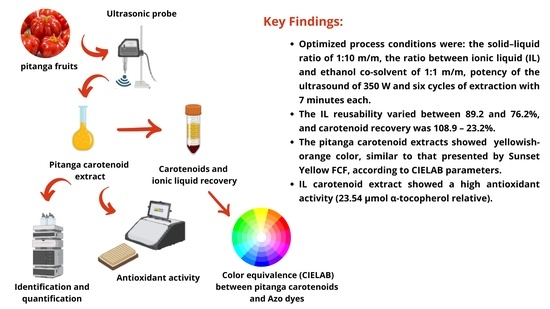
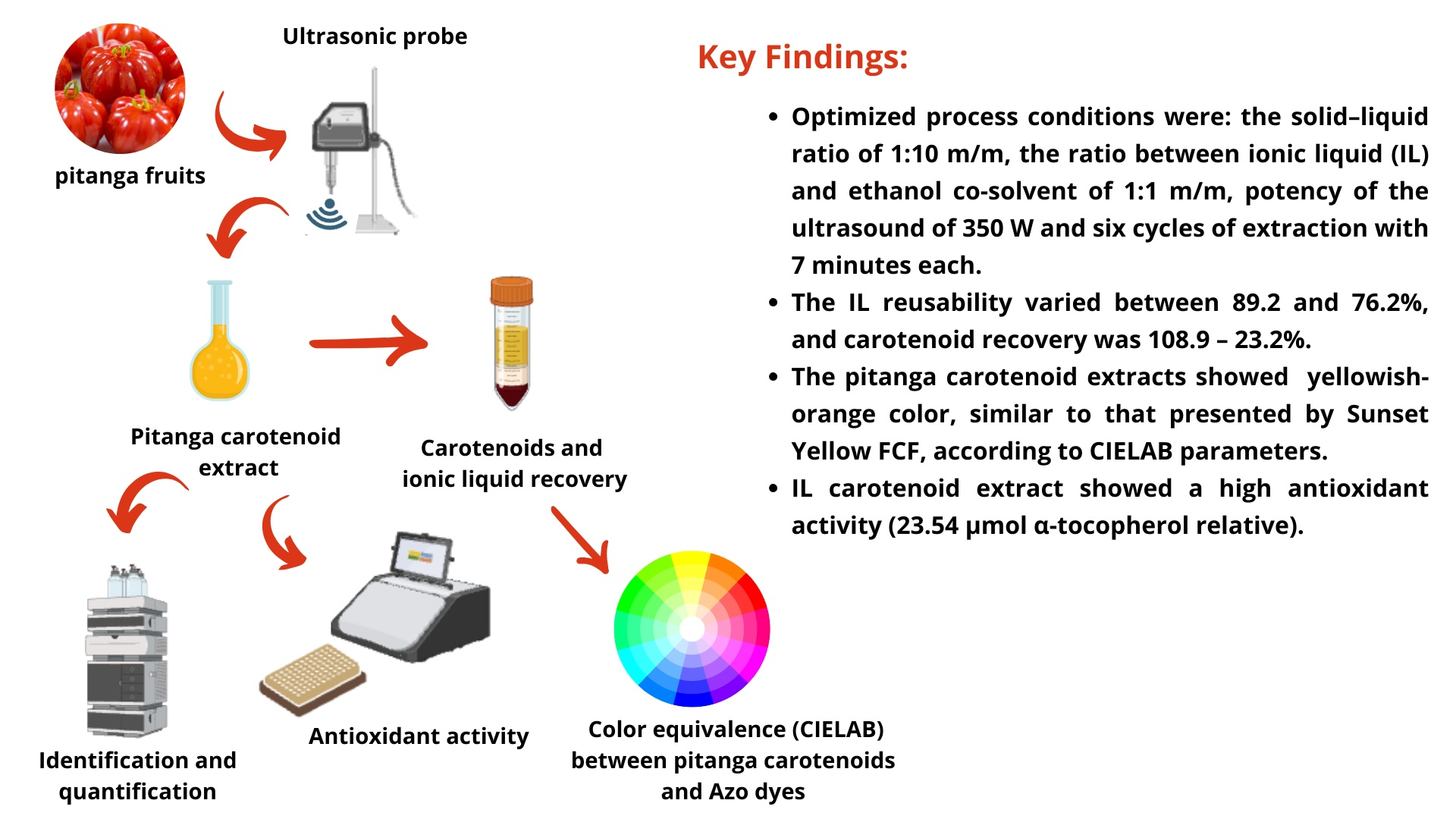
Graphical Abstract

1. Introduction

Color has played an important role in the development of different cultures around the world. Since the Upper Paleolithic period (40,000 BC), humans have used natural components to record facts about their lives on cave walls, giving rise to cave painting, or cave art. In ancient Egypt (1500 BC), plant extracts and wine were used to color sweets [1,2,3,4,5,6,7]. Until the mid-19th century, food coloring was done in a rudimentary way using ingredients obtained from nature, such as spices, plants, and animals, such as squid ink. Vivid colors were obtained from minerals, often containing lead, copper, and tin, which we now know are harmful to health.
With the onset of industrialization and urbanization, the industrialization of food became essential to support the modernization humanity was undergoing. At this time, the use of natural dyes became more complicated due to limited supply, high costs, inconsistent quality, and low stability. Therefore, the alternative was to use pigments made from heavy metals. Only in 1856 did William H. Perkin develop the synthesis of Malvein (purple aniline), and from that point on, the development of several synthetic aromatic dyes began [8,9]. A group of coal tar dyes called azo dyes quickly became important because of their structural diversity, resulting in a variety of vibrant colors.
These artificial colorings had excellent characteristics: they were inexpensive, widely available, stable, and uniform, and did not impart an unpleasant taste or odor. Mene synthesized the first azo dye in 1861 [10] using the diazotization of a primary aromatic amine and coupling, which resulted in a diazonium salt [11]. Thus, the use of azo dyes increased in the 20th century to the detriment of natural dyes [1]. Even with some notes on food safety in toxicology, some of these dyes were commercialized without further study. Furthermore, diffusion was expanded, and they were often used to mask the poor quality of the processed product. It was only in 1906 that the Food and Drug Administration (FDA) established the first food legislation to reduce the sale and consumption of adulterated, poisonous, or otherwise harmful foods [11]. Legislation was subsequently found in several countries worldwide regulating the use of additives, including food colorings.
Azo dyes display structural chemical variability, resulting in a wide spectrum of vibrant colors. They are inexpensive, readily available, stable, and uniform, with no unpleasant taste or odor, which makes them widely used in the food industry [12]. The use of Sunset Yellow FCF and Allura Red AC (Figure 1A,B) as food additives was assessed by the Joint FAO/WHO Expert Committee on Food Additives (JECFA) in 1964 and reevaluated in 2016 [13]. Allura Red AC has a new ADI—Acceptable Daily Intake of 0–7 mg/kg body weight/day—and a NOAEL—No Observed Adverse Effect Level of 695 mg/kg body weight/day. For Sunset Yellow FCF, the ADI is 0–4 mg/kg body weight/day, and the NOAEL is 375 mg/kg body weight/day. Although exposure estimation studies show that human exposure to azo dyes through oral intake remains below the ADI set by advisory bodies, the perceived risk associated with consuming these additives is high [13,14].
In a groundbreaking move, the U.S. Department of Health and Human Services (HHS) and the FDA recently announced comprehensive measures to phase out petroleum-based synthetic dyes from all foods sold in the United States. The plan details a nationwide shift toward natural color alternatives and includes revoking approval for citrus red N°. 2 and orange B, as well as removing six additional synthetic colorants—Fast Green FCF, Allura Red AC, Tartrazine Yellow, Sunset Yellow FCF, Brilliant Blue FCF, and Indigo Carmine—from the food supply by next year. The FDA also seeks to expedite the approval process for new natural color additives. In partnership with the National Institutes of Health (NIH), the agency will conduct thorough research on the potential impacts of food additives on children’s health. Additionally, the FDA has asked food companies to stop using Erythrosine Yellow before the previously set 2027–2028 deadline [15].
Consumer preference for natural products, including dyes, guides the main trends in developing new products. Therefore, the industry often uses the term “natural dye” as a marketing term for its products [16,17,18,19,20,21,22]. Currently, there is growing interest in natural dyes and pigments obtained through sustainable extraction methods that aim to recycle solvents, improve process efficiency, and match the exact color of their synthetic counterparts [7,21,22,23,24]. All these factors make replacing artificial colorings more challenging but increasingly necessary.
In this sense, aiming to replace synthetic dyes, carotenoids stand out among the natural or natural-identical dyes most used in the food industry [25,26,27]. They constitute a group of hydrophobic compounds widely distributed among plants, microorganisms, algae, and some animals, responsible for the nuances from yellow to red [28,29,30,31,32,33,34]. In this way, plant biomass rich in carotenoids is attractive for the development of extraction processes. As a promising source of carotenoids, Pitanga (Eugenia uniflora) stands out [35,36,37,38,39,40]. Pitanga is a fruit of Brazilian biodiversity with a distinctive, intense reddish-orange color. Due to the synergic combination of the main carotenoids all-trans-β-cryptoxanthin (2.56 mg/100 g) (Figure 1C), all-trans-lycopene (1.04 mg/100 g) (Figure 1D), all-trans-rubixanthin (0.55 mg/100 g) and 9-cis-rubixanthin (0.50 mg/100 g) [41] it is likely that a color equivalence with Allura Red AC and Sunset Yellow FCF can be established [42,43,44,45,46,47,48,49,50].
However, despite the promising color attributes of pitanga extracts, carotenoids are still predominantly extracted using conventional organic solvents (COSs) [50,51,52,53,54], which are often highly volatile and toxic, including acetone, chloroform, hexane, isopropanol, methanol, methylene chloride, and diethyl ether [55,56,57,58]. Nevertheless, the solvents used for extraction generate environmental contamination (water and air), health risks (chronic and acute toxicity and irritation), and safety risks (decomposition and explosion), in addition to residual effects on carotenoid extracts [28,55].
On the other hand, ionic liquids (ILs) have been identified as promising substitutes for these COS [59,60,61,62]. Studies show that the advantages are diverse, including more sustainable extraction processes [63], ILs are less polluting than petroleum-derived organic solvents and can be efficiently reused [64,65,66]. The ILs are promising sustainable alternatives [67,68,69], mainly due to their greater capacity to improve process efficiency, superior biocompatibility with several compounds being extracted, and possible reductions in the economic impact of the processes due to their reusability [59]. Additionally, our research group’s studies have revealed that carotenoids extracted via IL-mediated processes showed no toxicological impact in male Wistar rats. On the contrary, the findings presented promising anti-inflammatory and antioxidative responses in the liver, kidney, and adipose tissue [70,71]. This was not reported for animals supplemented with carotenoids extracted using acetone-ether mixtures.
Recent studies have successfully used various ionic liquids to extract carotenoids from bacterial [72,73] and microalgal biomass [74,75,76,77,78]. Natural extracts from sources such as fruits, vegetables, and microalgae display a wide range of colors due to the multiple carotenoids present in the same extract. Therefore, exploring carotenoid extraction from various sources is important for obtaining a broad spectrum of hues from yellow to red. Lycopene-rich extracts from tomato by-products show a deep red color [61], while fluorescent yellow extracts, similar to tartrazine yellow, have been obtained from pequi [79]. Extracts with shades from red to orange have also been produced from peach palm carotenoids [21]. However, a process that can produce a single extract covering the entire yellow-to-red color range has not yet been developed. Notably, pitanga carotenoids include yellow all-trans-β-cryptoxanthin and red all-trans-lycopene. In the food industry, pigment applications need a wide color palette, which can be achieved with individual or blended dyes. Given the urgent need for natural pigments [22,23,24,80,81] that provide stable yellow, orange, and red shades as alternatives to synthetic dyes, this work presents an innovative, integrated extraction platform based on ionic liquid (IL)–ethanolic systems for the recovery of carotenoids from pitanga.
The novelty of this study lies in replacing traditional volatile organic solvents with specially designed IL-based media and systematically screening different ILs while optimizing key extraction variables through factorial experimental design to enhance extraction efficiency. Moreover, unlike traditional methods, this work extends beyond extraction by demonstrating IL recovery and reuse, thereby promoting solvent recyclability and boosting the process’s sustainability. Simultaneously, carotenoid recovery yields were measured, and the quality of the extracts was validated by evaluating antioxidant activity and comparing color properties with commercial synthetic dyes Allura Red AC and Sunset Yellow FCF. This integrated approach positions IL-mediated extraction as a practical, sustainable, and high-performance alternative for producing natural colorants suitable for industrial use.

2. Materials and Methods

2.1. Samples

The pitanga fruit samples (Eugenia uniflora L.) were obtained from the Institute AuÁ Social and Environmental Entrepreneurship, which brings together family farmers from the Atlantic Forest region (23°53′14.6″ S, 48°00′16.4″ W). A total of 30 kg of fruit was processed for seed removal to obtain the edible portion, consisting of pulp and peel. Subsequently, the processed pitanga samples were frozen, lyophilized, and stored at −40 °C until use.

2.2. Chemicals

Methanol and methyl tert-butyl ether (MTBE)-both HPLC grade-were purchased from Merck (Darmstadt, Germany). The other reagents were all of analytical grade and obtained from Labsynth (Diadema, Brazil). The samples and solvents were filtered through Millipore (Billerica, MA, USA) membranes (0.22 and 0.45 μm) prior to HPLC analysis. The carotenoid standards—all-trans-β-carotene (purity 99.5%), all-trans-β-cryptoxanthin (purity 99.0%), all-trans-lutein (purity 98.0%), all-trans-lycopene (purity 98.5%), and all-trans-rubixanthin (99.3%)—were purchased from Sigma-Aldrich (Darmstadt, Germany) and DSM Nutrition Products (Basel, Switzerland). 1-Hexyl-3-methylimidazolium chloride ([C6mim]Cl) and 1-butyl-3-methylimidazolium tetrafluoroborate ([C4mim][BF4]) were purchased from Sigma-Aldrich (Darmstadt, Germany), both with >99% purity. For the synthesis of 1-butyl-3-methylimidazolium chloride-[C4mim]Cl-and 1-butyl-3-methylimidazolium hexafluorophosphate-[C4mim][PF6], the following chemicals were obtained from Sigma-Aldrich (Darmstadt, Germany): 1-chloro-butane (99.5%), 1-butyl-3-methylimidazole (>98.5%), hexafluorophosphate (>99%), and chloroform (>99.8%). The adsorbent material, Amberlite XAD7-HP, was acquired from Sigma-Aldrich (St. Louis, MO, USA).

2.3. Carotenoids Extraction from Pitanga and Total Carotenoid Quantification

2.3.1. Selection of the Ionic Liquid

Four different ILs were tested separately to determine the most effective for extracting carotenoids from pitanga pulp: [C4mim][BF4], [C6mim]Cl, [C4mim]Cl, and [C4mim][PF6]. An initial screening compared the total carotenoid yield in IL extracts and control extracts (acetone, petroleum ether, diethyl ether, and ethanol). The IL extraction solutions were prepared using a co-solvent ratio (RIL/E), representing the mass (g) of IL per mass (g) of ethanol (99%), fixed at 1:2. The extraction experiments used a solid–liquid ratio (R(S/L)) fixed at 1:3 (mass (g) of lyophilized fruit: mass of extraction solution (g)), with the number of extractions set to three. Homogenization was performed for 5 min using an ultrasonic probe at 70% amplitude (350 W and 20 kHz), following de Souza Mesquita [21].
The ultrasound amplitude was set at 70% based on preliminary screening experiments testing amplitudes from 50% to 90%. Lower amplitudes (<60%) resulted in reduced cavitation and, consequently, lower extraction efficiency, likely due to limited cell disruption and mass transfer. Conversely, amplitudes above 80% caused excessive localized heating and potential carotenoid degradation, due to intensified cavitation and radical formation. Therefore, a 70% amplitude was chosen as an optimal compromise between extraction efficiency and pigment stability and used to identify the most promising IL for further experiments. After obtaining the carotenoid-rich fraction, the extracts were transferred to an organic mixture (diethyl ether/petroleum ether, 2:1 v/v) and saponified with 10% methanolic KOH overnight at room temperature. The solution was then washed until alkali-free and concentrated to dryness using a rotary evaporator at temperatures below 37 °C under reduced pressure. All extractions were performed in triplicate.
It is important to highlight that this step was performed solely for analytical purposes, aiming to identify and quantify carotenoids. This procedure does not represent the proposed green downstream process. The development of a more sustainable purification approach aligned with the environmentally friendly extraction platform is detailed in Section 2.4.
All carotenoid extracts were redissolved in petroleum ether, and the total carotenoid was determined spectrophotometrically using the absorption coefficient of all-trans-β-cryptoxanthin ( A 1 c m 1 % = 2386 ) . The absorbance was measured at 450 nm. The total carotenoid yields extracted were expressed as means and standard deviations. The most commonly used organic solvents in conventional carotenoid extraction were chosen for comparison. Therefore, control extractions were performed under the same process conditions using acetone (99% v/v), petroleum ether (98.5% v/v), diethyl ether (99.9% v/v), and ethanol (99% v/v), enabling a direct comparison of extraction efficiency between traditional solvents and the proposed ionic liquid-based system. These solvents were selected because effective carotenoid extraction requires media with suitable hydrophobicity and strong solvating capacity for lipophilic compounds, as consistently documented in the literature. Nonpolar and moderately polar organic solvents have historically demonstrated high affinity for carotenoid structures due to their extended conjugated polyene chains, which provide a strong hydrophobic character. Hence, the chosen solvents are those most frequently used in prior studies and serve as an appropriate benchmark for comparison with the new extraction system.

2.3.2. Experimental Design to Maximize the Total Carotenoid Yield: Response Surface Methodology (RSM)

After selecting the most efficient IL to extract total pitanga carotenoids, two experimental designs were conducted. First, a fractional design with three central points (25–1) screened the significant parameters affecting total carotenoid yield. The evaluated parameters included the R(IL/E), extraction time, R(S/L), potency (watts, W%), and number of extraction cycles, as shown in Table S1. Each assay tested three values for each independent variable. The main effects were estimated by examining the difference in carotenoid extraction yield (expressed in µg of carotenoids per g of dry biomass) caused by changing each variable from a low (−1) to a high (+1) level. After data analysis, the most influential variables were tested further using a Central Composite Rotatable Design (CCRD; 23) with three replicates at the central point to optimize the extraction process. A total of 17 experiments were performed; Table S2 displays the actual and coded levels used in the CCRD. The results were statistically analyzed with a confidence level of 80% or higher. The primary response for process optimization was the total carotenoid yield. After analyzing the RSM results, optimal extraction conditions were identified, and the model was validated in triplicate. Protimiza© software (online version—https://experimental-design.protimiza.com.br/) was utilized to analyze the results and generate the response surface plots.

2.4. Carotenoids and Ionic Liquid Recovery

Solid-phase extraction (SPE) was used to separate the extracted carotenoids from the solvent and to recover the ionic liquid for reuse. The polymeric adsorbent XAD-7HP, a non-ionic, moderately polar resin with a high surface area, was selected for its affinity for hydrophobic organic compounds. Due to the lipophilic nature of carotenoids, they are primarily retained on the resin through hydrophobic interactions, while the ionic liquid remains in the liquid phase and can be recovered later. This method allows for efficient carotenoid isolation without using additional volatile organic solvents and supports the recyclability of the ionic liquid in the green process. To activate the adsorbent, it was blended with ethanol (1:3 m/m) under magnetic stirring for 30 min and then vacuum filtered. This process was repeated twice more, followed by three washes with deionized water for 30 min each at the same resin/water ratio (1:3 m/m) to condition the adsorbent [33]. The optimized carotenoid extract, containing IL, was mixed with the hydrated adsorbent (1:2 w:w) in a 50 mL Falcon tube, and deionized water was added until the total volume reached approximately 20 mL (the water used to remove the IL from the adsorbent without removing the still-adsorbed carotenoids). After centrifugation (4000 rpm, 10 min at 16 °C), the water containing the recovered IL was removed by vacuum evaporation, and the IL was recuperated. This operation was repeated six times until the complete removal of IL.
Then, the carotenoids were recovered by adding 35 mL of ethanol to the Amberlite, followed by centrifugation (4000 rpm, 10 min at 16 °C) and evaporation. This process was repeated three times to ensure complete removal of the carotenoids from the adsorbent material. The reusability of the same IL was evaluated in new extraction cycles. To evaluate the efficiency of this process, the recovered carotenoids were redissolved in petroleum ether, saponified, and analyzed by HPLC-PDA.

2.5. Identification and Quantification of Carotenoids

Carotenoid identification and quantification were performed using both IL-optimized and acetone extracts. These procedures were carried out in triplicate with a Shimadzu HPLC (Kyoto, Japan), equipped with quaternary pumps (model LC-20AD), an online degasser, and a Rheodyne injection valve (Rheodyne LCC, Rohnert Park, CA, USA) with a 20 μL loop. Chromatographic separation was achieved using a C30 YMC column (5 μm, 250 × 4.6 mm i.d., Waters, Wilmington, MA, USA) with a mobile phase gradient of MeOH/MTBE from 95:5 to 70:30 over 30 min, followed by 50:50 for 20 min and maintained for an additional 50 min. The flow rate was maintained at 0.9 mL/min, with the column temperature set at 22 °C. A PDA detector connected to the LC system (Shimadzu, model SPD-M20A) monitored UV-visible absorbance between 250 and 600 nm, with data collected at 450 nm, corresponding to the maximum absorbance peak for the pigments. Carotenoids were identified based on their elution order on the C30 column, co-chromatographic comparison with authentic standards, UV-visible spectra (λmax), spectral fine structure (%III/II), peak cis intensity (%AB/AII), and comparison with literature data. Quantification was performed using HPLC-PDA with an external calibration curve (six points, in duplicate) for all-trans-β-carotene (2–50 μg/mL), all-trans-rubixanthin (2–30 μg/mL), and all-trans-lycopene (2–15 μg/mL), following Biazotto et al. [38] and De Rosso & Mercadante [82]. Total carotenoid content is expressed in μg/g of dry matter.
Mass spectra were obtained using a single HPLC-PDA-MS/MS system for conclusive carotenoid identification. A Shimadzu America 8040 triple quadrupole mass spectrometer (Columbia, MD, USA) and an Atmospheric Pressure Chemical Ionization (APCI) source in positive mode.

2.6. Antioxidant Activity Assay

Ionic liquid and acetone extracts of carotenoids from pitanga were redissolved in petroleum ether (stock solution), and the total concentration was determined spectrophotometrically using the absorption coefficient of all-trans-β-cryptoxanthin (λ = 450 nm). To assess peroxyl radical deactivation capacity, five concentrations of each extract were prepared (30, 40, 77, 144, and 227 μM). For assay development, 100 μL of C11-BODIPY581/591 (178 nM in DMSO) was added to a 96-well microplate, followed by 25 μL of carotenoid solution, 25 μL of the blank (DMSO), or 25 μL of α-tocopherol as the standard. Finally, 100 μL of AIBN (175 mM in DMSO) was added [83]. The fluorescence decay of C11-BODIPY581/591 (λ excitation = 540 nm and λ emission = 600 nm) was monitored in kinetic mode, with readings every 2 min until the fluorescence value dropped to 50% or less of the initial fluorescence (approximately 3 h). The antioxidant activity (AA) of the carotenoid extracts, measured as peroxyl radical deactivation, was calculated using the α-tocopherol standard. The AA was determined using Equation (1), and the results are expressed relative to α-tocopherol:
AA = Iextract/Istandard
where Iextract is the curve inclination represented by the concentration of the carotenoid extract versus the area under the fluorescence decay curve as a function of time (net AUC); Istandard: is the curve inclination represented by α-tocopherol standard solution versus the area under the fluorescence decay curve, as a function of time (net AUC).

2.7. Color Equivalence Between Pitanga Carotenoid Extract and Allura Red and Sunset Yellow

The Commission Internationale de l’Eclairage’s (CIELAB) [84] parameters of lightness (L*), red (a*), and yellow (b*) were used for measuring the color changes in a Color Quest XE colorimeter (Hunter Lab., Reston, VA, USA) equipped with the light source D65 and observation angle of 10°. Equations (2)–(4) were used to calculate chroma* (C*), hue* (h*), and total color difference (ΔE*). To evaluate the color equivalence between pitanga carotenoid extracts and azo dyes, solutions were prepared in 99.8% ethanol at five concentrations. For pitanga carotenoid extracts obtained with acetone and IL, concentrations 25.1, 17.0, 12.5, 7.5, and 2.5 µg/mL were used, and 20.4, 17.0, 12.5, 7.5, and 2.5 µg/mL, respectively. Allura Red and Sunset Yellow FCF were dissolved in 99.8% v/v ethanol at five concentrations: 200, 150, 100, 75, and 50 µg/mL.
C * = a 2 + b 2
h * = a r c t a n   b * a *  
E * = ( Δ L 2 + Δ a 2 + Δ b 2

2.8. Statistical Analysis

All experiments were performed in triplicate, and the results are expressed as mean ± standard deviation (SD). For the experimental design analyses, including the fractional factorial design used to select the most significant independent variables for further testing, and the central composite design (CCD) used for process optimization, a confidence level of 90% (p < 0.10) was adopted. This criterion is commonly used in predictive modeling and response surface methodology studies to avoid excluding variables with potentially important effects during process optimization. For comparisons between treatments, especially in solvent screening experiments, statistical significance was evaluated at a 95% confidence level (p < 0.05). Differences among means were determined using one-way analysis of variance (ANOVA) followed by Tukey’s HSD post hoc test. All statistical analyses were conducted using STATISTICA 13.0 software.

3. Results and Discussion

3.1. Ionic Liquid Selection According to Carotenoid Extraction Efficiency

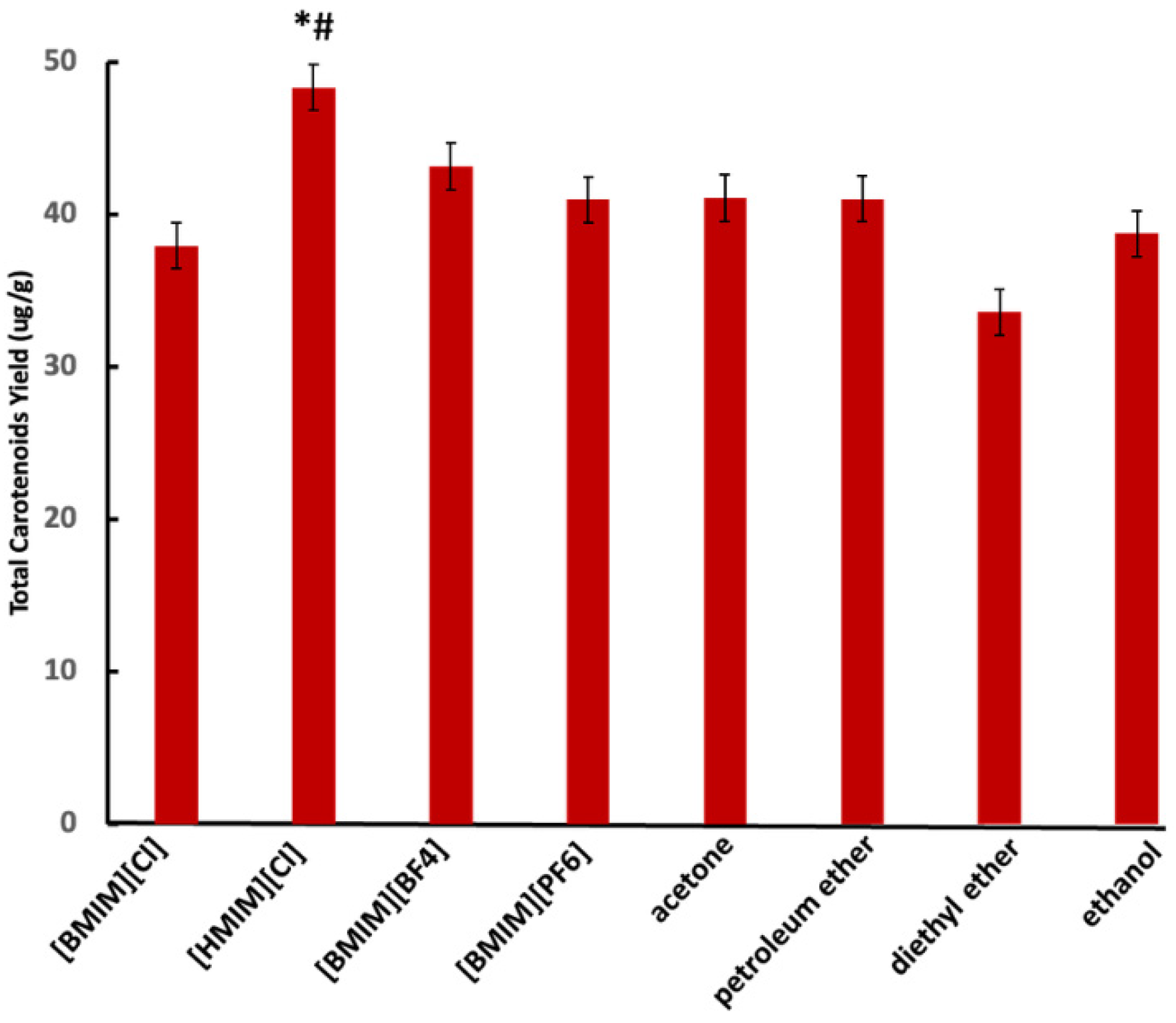
Figure 2 shows the total carotenoid yields obtained using four ionic liquids and the standard solvents. Among the ILs tested, [C6mim]Cl produced the highest extraction yield (48.33 ± 2.24 µg/g dry weight), which was statistically higher than all conventional organic solvents and ethanol. While [C4mim][BF4] and [C4mim][PF6] also exhibited competitive extraction performance, their yields were not significantly higher than those obtained with acetone or petroleum ether.
The better performance of [C6mim]Cl can be linked to the combined effect of its longer alkyl chain and chloride anion, which is similar to what happens when surfactants are used for the same purpose [85]. The C6 alkyl chain increases hydrophobic interactions with the polyene backbone of carotenoids, improving the solubilization of these lipophilic compounds. At the same time, the chloride anion may foster stronger hydrogen-bonding interactions with the plant matrix, aiding cell wall disruption and enhancing mass transfer. This balance between hydrophobic character and matrix interaction likely explains the higher recovery.
In contrast, [C4mim]-based ILs have shorter alkyl chains, which may decrease hydrophobic affinity for carotenoids, while the [PF6]− anion adds greater hydrophobicity but lower polarity, possibly limiting matrix penetration [86,87]. Therefore, although these ILs exhibited good extraction capability, they did not surpass [C6mim]Cl. Additionally, since [C4mim][PF6] has a lower laboratory synthesis yield and a higher cost, [C6mim]Cl was chosen as the most suitable ionic liquid for further optimization, balancing extraction efficiency and practical considerations (Figure 2).
Due to the high viscosity of IL compared to volatile organic solvents, ethanol is commonly used as a cosolvent. In this case, ethanol used in pitanga samples increases the mass transfer rate during solid–liquid extraction. The selection of the ideal IL for extracting a specific compound depends on its physicochemical properties, such as melting profile, solubility, viscoelasticity, low vapor pressure, and near non-flammability [68,87,88,89,90]. ILs exhibit significant self-organization through the formation of aggregates stabilized by hydrogen bonds across solid, liquid, and gas phases, and are best described as supramolecular nanostructures [60]. Therefore, physicochemical properties are better represented by these aggregates than by individual cations and anions, and ILs’ behavior as electrolytes is influenced by the transport properties and speciation of ionic clusters [60].
Hydrophobic ILs such as [C6mim]Cl are advantageous for pigment extraction, especially carotenoids. For example, [C4mim]Cl showed high efficiency in extracting carotenoids from tomato [66] and orange peel [65], while [C4mim][BF4] was more effective for peach palm fruit [21] and pequi [79].
The hydrophobic character of [C6mim]Cl plays a key role in enhancing its affinity toward non-polar carotenoids such as all-trans-lycopene and all-trans-rubixanthin present in pitanga fruit. This behavior is not solely governed by bulk hydrophobicity, but rather by a combination of dispersion interactions, π–π stacking between the imidazolium ring and conjugated polyene chains, and favorable solvation of highly unsaturated structures [91]. As a result, the IL provides a microenvironment that promotes the selective partitioning and stabilization of these pigments, leading to improved extraction efficiency, as evidenced in Figure 3B. Moreover, the chloride anion contributes to modulating the polarity of the system and can participate in weak specific interactions, which help balance solvation without inducing degradation of the carotenoid backbone, which also happens in cholinium chloride-based eutectic systems [92]. This is particularly relevant when compared to conventional organic solvents, where poor selectivity or excessive polarity may compromise pigment integrity.
In this sense, the selection of the IL investigated in this study, mainly the selected [C6mim]Cl, was therefore not arbitrary, but based on a multifactorial rationale, including: (i) its demonstrated ability to extract high amounts of carotenoids, (ii) its capacity to preserve pigment stability by minimizing oxidative and hydrolytic degradation pathways, and (iii) its potential for reusability within a circular extraction process. These attributes have been consistently discussed and demonstrated in previous studies from our research group, providing a solid foundation for its application in the present work. Importantly, the combination of these factors goes beyond extraction yield alone, reflecting a more integrated approach that considers performance, stability, and sustainability simultaneously. In this context, the IL system enables repeated extraction cycles without significant loss of performance, which is consistent with previous reports in the literature and also evaluated in Section 3.3. This reusability is a critical factor from a sustainability perspective, as it reduces solvent consumption, waste generation, and overall environmental burden, contributing to a lower process carbon footprint when compared to conventional volatile organic solvents [93].
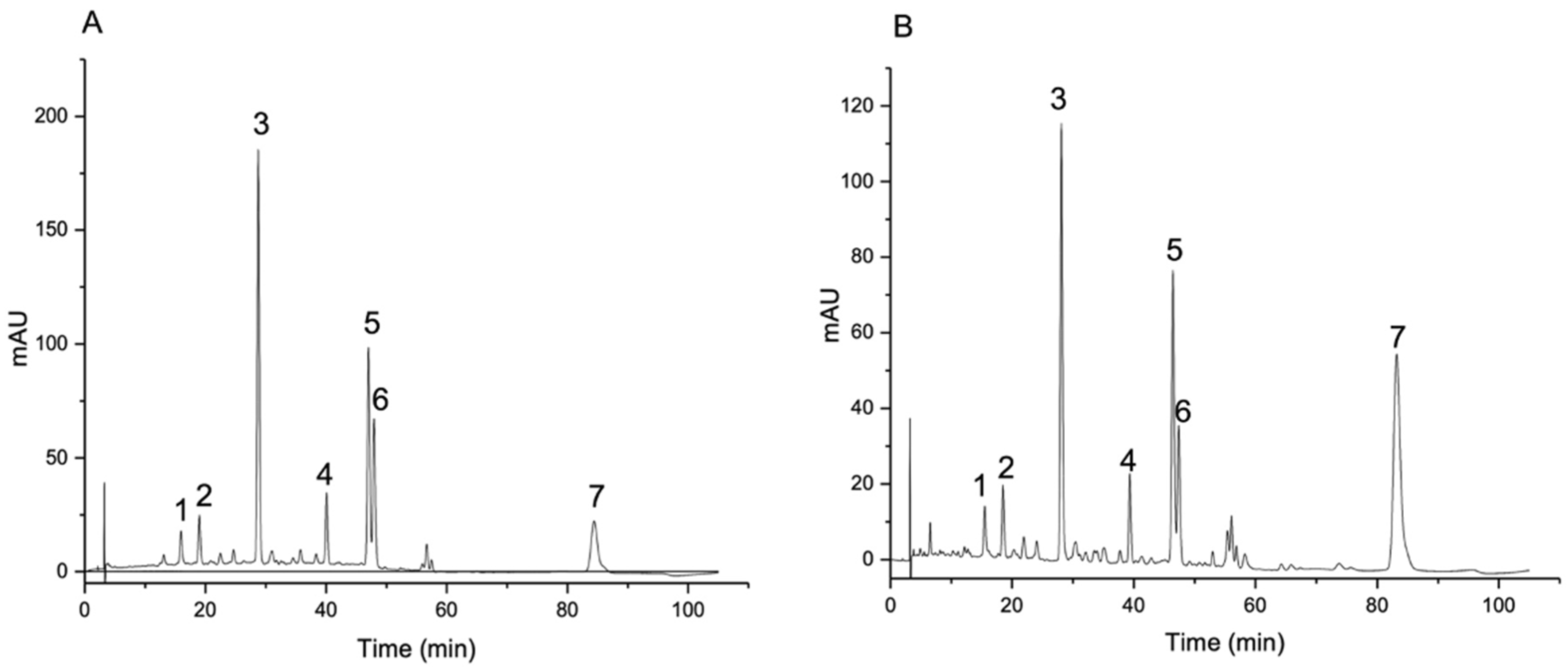
Still, in order to provide a comprehensive characterization of the studied biomass and to demonstrate that the use of the IL does not compromise the chemical composition of the carotenoid extract when compared to a conventional protocol, the carotenoid profiles obtained with [C6mim]Cl and acetone from pitanga were carefully evaluated. The results indicate that both extraction systems yield highly similar carotenoid profiles. As shown in Figure 3, the chromatograms obtained by HPLC-PDA-MS/MS exhibit comparable peak distribution and intensity patterns for the major compounds. Furthermore, the chromatographic behavior, UV–Vis spectra, and mass spectrometric features of the identified carotenoids are summarized in Table 1, confirming the consistency between both approaches. These findings reinforce that the IL-based extraction preserves the qualitative composition of carotenoids, supporting its suitability as an alternative to conventional organic solvents without compromising extract integrity.
It is essential to highlight that xanthophylls (like β-cryptoxanthin, zeaxanthin, lutein, and rubixanthin) are present in fruits esterified with fatty acids [37]. In this form, carotenoids are even more hydrophobic, so the extraction efficiency of [C6mim]Cl was more pronounced. A carotenoid saponification step was performed to facilitate chromatographic separation and peak identification [38].
The primary carotenoids identified in both acetone and [C6mim]Cl extracts are all-trans-β-cryptoxanthin (peak 3) and all-trans-lycopene (peak 7) (Table 1). The well-defined, separated peaks in both chromatograms confirm that the extracts mainly contain carotenoid compounds, with minimal co-extracted interfering substances. Overall, the chromatographic data support the conclusion that the proposed extraction system enhances carotenoid recovery while maintaining the characteristic composition of pitanga pigments.
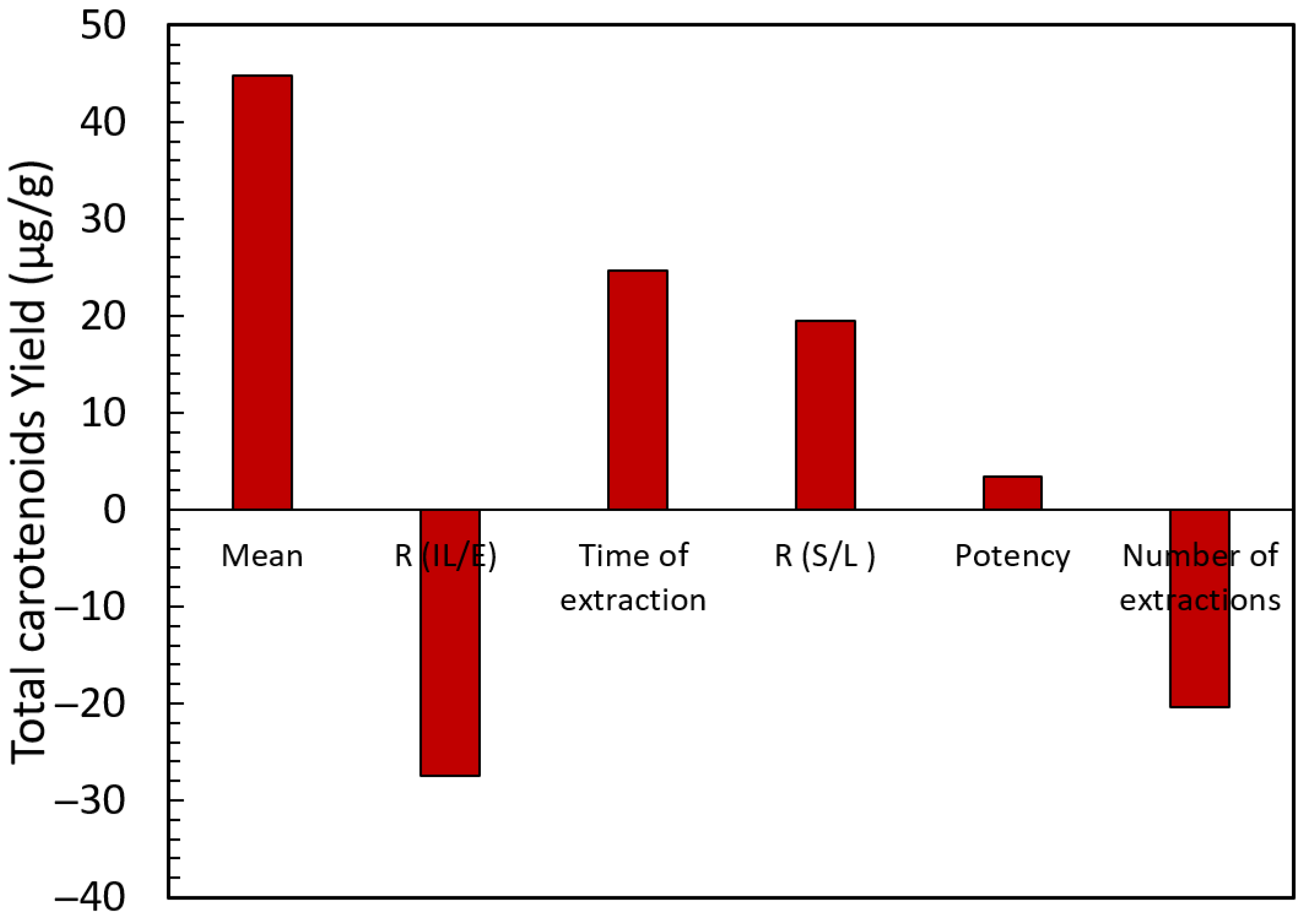
The extractions under different experimental conditions were carried out using a fractional 25–1 experimental design. For the fractional design, 19 tests were performed under the extraction conditions (Table S1), and the total carotenoid content ranged from 15.13 to 159.11 µg/g. Based on the analysis of the results, no variable showed a statistically significant effect on carotenoid yield. However, the trend of the effects is illustrated in Figure 4.

3.2. Optimization of the Extraction with Ionic Liquid

Fractional experimental design is employed to screen variables informed by the literature and the group’s prior experience [94]. The literature indicates that even when variables are not statistically significant, they can highlight a path to avoid trial and error, thereby reducing the number of variables tested and the total number of experiments [95,96]. Therefore, although none of the variables studied here showed a significant effect on total carotenoid yield at 85% confidence, the highest total carotenoid content was observed when the highest potency (450 W) was applied, the extraction time was 10 min, and the number of extractions was 4. Conversely, the lowest carotenoid concentration was observed when fewer extractions were performed. Consequently, the variables R(IL/E) and potency were fixed at 1:1 and 350 W, respectively. The Pareto chart (Figure S1) and effects table (Table S2) are included in the Supplementary Material.
For the Central Composite Design (CCD), the variables R(S/L) (X1), number of extractions (X2), and extraction time (X3) were evaluated, as shown in Table S3. The total carotenoid extract yield and the most abundant carotenoids in pitanga were used as responsive variables to develop the predictive model, utilizing the coded model to generate the contour surface. Terms that were not statistically significant were included in the lack of fit measure to calculate the R2 and F-ratio. In the CCD experiment (23 runs), the extraction yield of total carotenoids ranged from 22.95 to 236.11 µg/g, depending on the extraction conditions (Table S2). The main effects and interactions were estimated for carotenoid content, resulting in Equation (5):
T o t a l   c a r o t e n o i d s µ g g = 8420.72 2519.11 X 2 3602.61 X 3
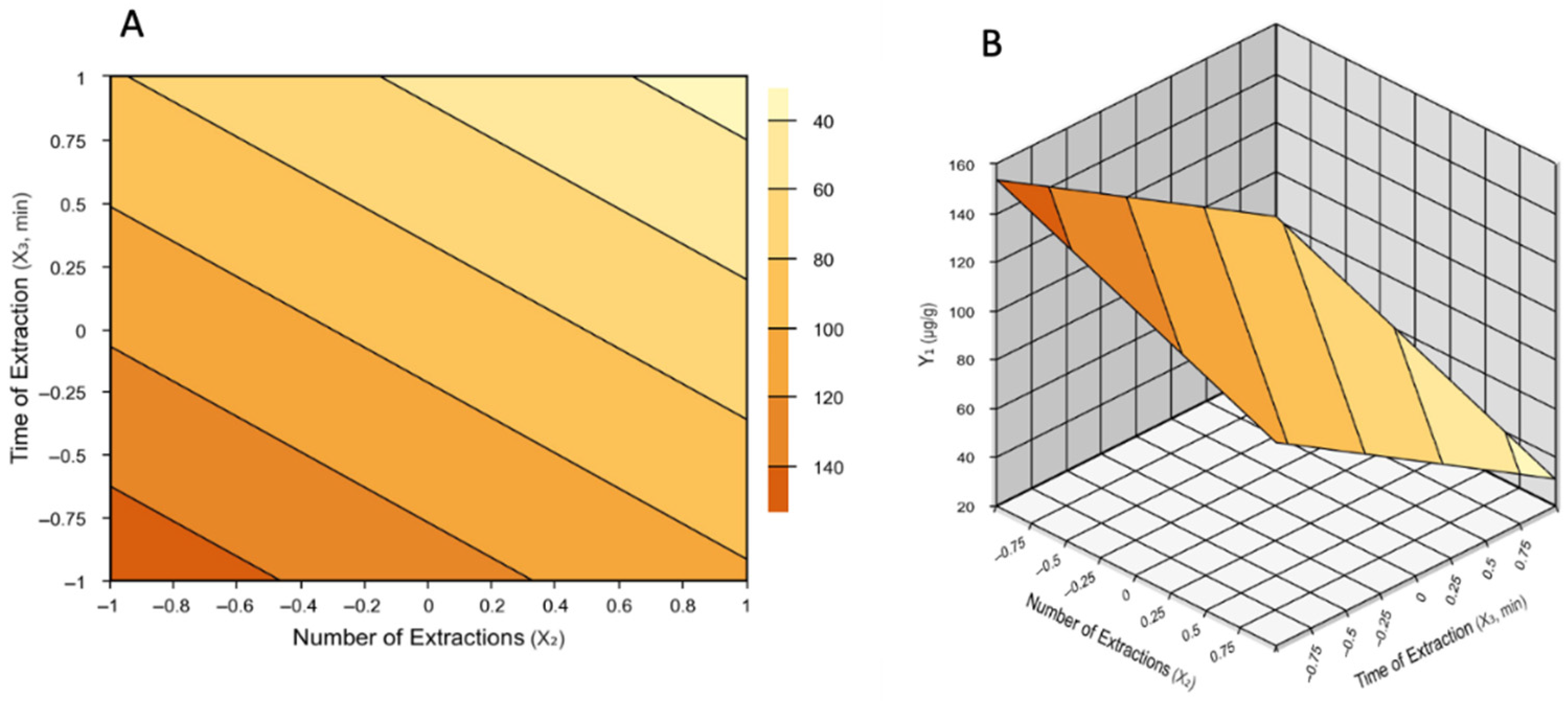
Additionally, Figure S2 provides further information on the experimental behavior compared with the predicted data from the model equation. According to the results from CCD (Figure 5), the variables selected for extracting pitanga carotenoids were [C6mim]Cl, an R(S/L) ratio of 1:10, an R(IL/E) ratio of 1:1 m/m, six consecutive extractions using the same biomass, and 7 min of extraction time (per cycle) under ultrasound homogenization (350 W). The CCD significantly increased the total carotenoid yield by 1.5 times compared to the fractional factorial design. An ANOVA test was performed to assess data adequacy and to verify the potential to develop a model that explains the responses. The model’s confidence was indicated by an R2 value of 0.75. The F value was approximately 1.8 times the tabulated F value for total carotenoid content, surpassing the 95% confidence threshold.
Validation experiments using the optimized method were conducted in triplicate, yielding a total carotenoid content of 100.40 μg/g ± 3.71 μg/g of dry matter, compared with 57.89 ± 13.64 μg/g obtained with exhaustive acetone extraction. The quantification of major carotenoids in the acetone and [C6mim]Cl extracts is shown in Table 2, where it is also evident that the IL-mediated process is more efficient than those performed with acetone.
Compared with acetone, [C6mim]Cl showed significant differences for all-trans-β-cryptoxanthin, all-trans-β-carotene, all-trans-rubixanthin, 9-cis-rubixanthin, and all-trans-lycopene; however, all-trans-lutein and all-trans-zeaxanthin did not differ significantly from the acetone-mediated process. The IL [C6mim]Cl extracted twice as much all-trans-lycopene as acetone; a similar effect was reported for tomato [66] and peach palm fruit [21] extracted using [C4mim]Cl and [C4mim[BF4], respectively. The structural specificities of the carotenes, specifically of the lycopene, such as ease of crystal formation, further organization in multilayers or aggregates, and storage at different locations in vegetable cells [97], can explain the high extractability promoted for [C6mim]Cl. In fruits, lycopene can appear in crystalline structures, while β-cryptoxanthin is dissolved in lipid droplets, indicating that the cellular vegetable matrix may influence the release or retention of carotenoids [97]. The longest alkyl chain length of [C6mim]Cl favors the electrostatic interactions and van der Waals forces with carotenoids, resulting in solvation and remotion from the food matrix mediated by ultrasonic assistance.

3.3. Carotenoids and Ionic Liquid Recoveries

Given the distinct melting points of ethanol (−114 °C) and [C6mim]Cl (−70 °C), storing the extract at −80 °C was initially considered a feasible strategy to selectively freeze, crystallize, and precipitate the ionic liquid while maintaining ethanol in the liquid phase. This approach could enable physical separation and recovery of the ionic liquid in its original state for subsequent reuse, as previously demonstrated by our research group [21]. However, the [C6mim]Cl–ethanol system containing pitanga carotenoids did not solidify at −80 °C after 180 min. This behavior is likely due to molecular interactions between ethanol and the ionic liquid, as well as solute effects that may depress or alter the system’s melting point. Considering this limitation, an alternative downstream recovery strategy was developed after extraction optimization, aiming to recover both pitanga carotenoids and [C6mim]Cl without the use of volatile organic solvents or potentially toxic reagents. Initially, a previously reported continuous-flow recovery system using a peristaltic pump and Amberlite XAD-7HP resin was tested [65] under continuous solvent flow, yielding ionic liquid recovery of less than 60%. In this configuration, ionic liquid recovery was below 60%, which was deemed insufficient for process sustainability.
Therefore, a batch solid-phase extraction (SPE) strategy using XAD-7HP was adopted, incorporating sequential solvent exchange. In this approach, water was first used to desorb and recover [C6mim]Cl, followed by ethanol to desorb and recover the carotenoids retained on the resin. Across six reuse cycles, [C6mim]Cl recovery ranged from 89.2% to 76.2%, while carotenoid recovery varied from 108.9% to 23.2%. The variability in ionic liquid recovery is attributed to adsorption–desorption dynamics within the porous resin matrix, as the efficiency of IL release from XAD-7HP can slightly fluctuate across cycles despite controlled operating conditions. Although freezing-induced precipitation at −80 °C has shown higher recovery efficiencies in other systems, such as 94% recovery of [C4mim][BF4] from Bactris gasipaes carotenoid extracts, with reuse for at least 10 cycles [21], this strategy was not effective for the present system. Continuous-flow SPE using XAD-7HP has also previously achieved approximately 60% IL recovery and 55% carotenoid purification in orange extracts [65].
Despite not achieving the highest absolute recovery compared to freezing-based separation, the batch SPE approach presents relevant advantages for industrial applications, particularly in food and natural colorant production [98]. The batch configuration provides greater flexibility for processing varying volumes and enables some control over operational parameters such as contact time, concentration, and temperature. It also simplifies process monitoring, resin maintenance, and cleaning between cycles, reducing material loss and improving overall cost-effectiveness.
As expected, recovery yields decreased over successive extraction cycles. After the third reuse cycle, carotenoid recovery decreased by approximately 40% compared to fresh solvent, while ionic liquid recovery declined by approximately 70% relative to the initial cycle [61]. Therefore, the variation observed after six extraction cycles is consistent with cumulative adsorption losses and operational handling effects inherent to reuse systems.

3.4. Antioxidant Activity

The antioxidant activity (AA) values for the acetone and [C6mim]Cl carotenoid extracts from pitanga were 13.94 and 23.54 µmol α-tocopherol relative, respectively. Figure S3 shows the antioxidant activity response for both carotenoid extracts. The efficiency of carotenoids as ROO scavengers varied considerably with their chemical structures. The type of terminal group influenced the -trans isomer configuration, the presence of oxygen substituents, and the chromophore extension [83]. The [C6mim]Cl carotenoid extract showed a higher concentration of all-trans-lycopene than the acetone extract, and the all-trans-lycopene standard showed the greatest antioxidant activity (8.67 ± 0.74 µmol α-tocopherol relative) than all-trans-β-cryptoxanthin (2.85 ± 0.29 µmol α-tocopherol relative) [83]. Acetone and [C6mim]Cl are not selective carotenoid solvents; other compounds may have been extracted simultaneously, resulting in synergistic AA.
Carotenoids extracted using ionic liquids have consistently shown superior antioxidant activity in comparison to those extracted using acetone. This heightened performance can be attributed to their ability to preserve the chemical structure of carotenoids while enabling selective extraction [97]. Ionic liquids, with their unique solvation properties [98], provide a gentler extraction environment, minimizing structural degradation or alteration of the natural compounds during extraction [99]. Preserving the molecular structure ensures that the antioxidant properties inherent in carotenoids remain intact, thereby enhancing antioxidant activity. This further supports the notion that the extraction performance facilitated by ionic liquids is associated with supramolecular arrangements that help preserve the structure of the extracted bioactive compounds [100]. Ionic liquids are known to establish structured supramolecular environments through hydrogen bonding, π–π interactions, and electrostatic forces [101]. These interactions may reduce carotenoid exposure to oxygen, light, and pro-oxidant species, thereby limiting oxidative degradation during extraction. In contrast, volatile organic solvents such as acetone provide a less structured medium and may facilitate greater pigment instability during processing.
Additionally, ionic liquids can be precisely engineered to selectively extract specific compounds, enabling targeted extraction of carotenoids while minimizing unwanted substances that might compromise their antioxidant potential [21]. This selectivity contributes significantly to the higher antioxidant activity observed in carotenoids extracted using ionic liquids compared to acetone-based extractions.

3.5. Color Equivalence Between Pitanga Carotenoid Extracts and Allura Red AC and Sunset Yellow FCF

The urgent need to replace synthetic pigments with natural alternatives stems from growing concerns about their health and environmental impacts. Synthetic pigments often contain harmful chemicals and additives, posing risks to human health when consumed [102]. Moreover, their production generates pollution and environmental degradation. As natural pigments are extracted using green solvents such as ionic liquids, carotenoids offer a safer, more sustainable option, meeting the demand for healthier, more eco-friendly alternatives across industries such as food, cosmetics, and pharmaceuticals.
In this sense, to achieve this goal, the color of the obtained extracts was measured using CIELAB parameters for the azo dyes Allura Red and Sunset Yellow, and pitanga carotenoids extracted with Acetone and [C6mim]Cl at five different concentrations, as shown in Table S4. The definition of a color appearance requires transforming the Cartesian coordinates a* (red/green intensity) and b* (yellow/blue intensity) into the cylindrical coordinates C* and h*, where C* represents chroma and h* represents hue. L* indicates lightness in this color space, and Allura red was less bright than the carotenoid extracted with [C6mim]Cl and acetone (Table S4).
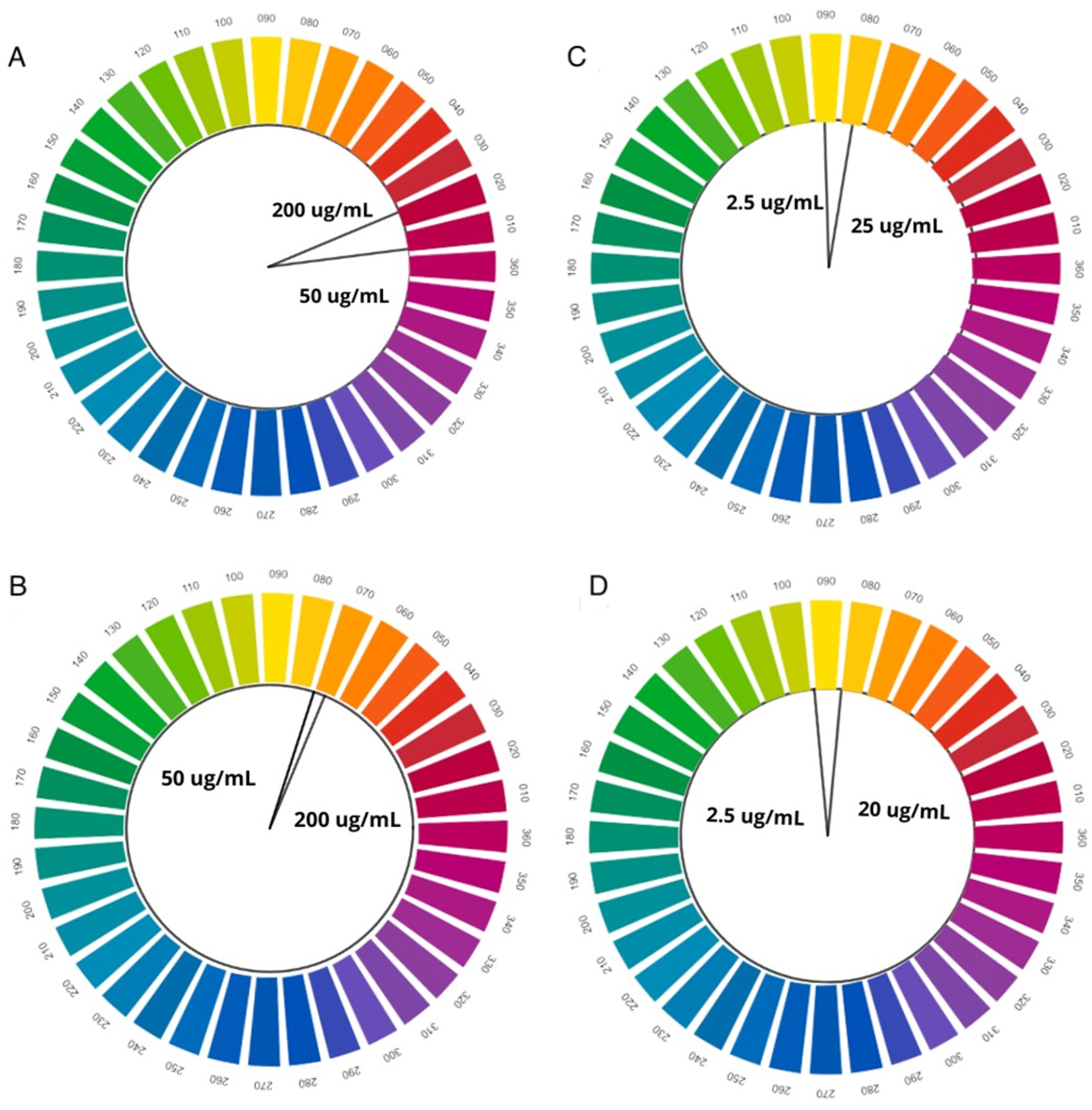
Furthermore, Allura red AC is reddish-blue, while Sunset yellow is yellowish-orange, and both carotenoid extracts are yellowish-orange. When the concentration of the Allura Red solutions decreases from 200 to 50 µg/mL, the hue angle shifts from 22° (red) to 5.72° (blue) (Figure 6A). For Sunset Yellow, the hue angle shifts from 70.6° (orange) to 72.2° (yellow) (Figure 6B). On the other hand, the concentration of carotenoids in both extracts (acetone and [C6mim]Cl) decreases, the hue angle shifts from orange to yellow, 81.7 to 91.7° for acetone (Figure 6C) and 87.1 to 97.3° for [C6mim]Cl (Figure 6D). The chroma* is responsible for the perceived color intensity and color saturation. The value of chroma* was on average twice as high for both carotenoid extracts as for Allura red, so it was observed to be a more saturated color in carotenoid solutions. The color saturation was similar, but at lower concentrations, the carotenoid extracts showed lower color saturation than Sunset Yellow; at higher concentrations, the carotenoid extracts showed greater color saturation than Sunset Yellow.
A color change (ΔE*) indicates the degree of color difference, and ΔE* ± 10.0 is perceived by the human eye [103,104]. The color difference between Allura red and acetone carotenoid extract was ΔE* = 63.05 (highest concentrations) and ΔE* = 28.26 (lowest concentrations). The results for color change were similar when we compared Allura red and [C6mim]Cl, ΔE* = 60.84 (highest concentrations) and ΔE* = 26.86 (lowest concentrations).
While ΔE* between sunset yellow and pitanga carotenoid extracts with Acetone and [C6mim]Cl was 24.26 and 22.11 (highest concentrations) and 9.25 and 10.42 (lowest concentrations). When comparing the change in color of pitanga carotenoid extracted with acetone and [C6mim]Cl, an ΔE* of 6.43 was observed. In this case, it is possible to predict that the replacement of Allura Red with pitanga carotenoid extract obtained with Acetone or [C6mim]Cl would be perceived visually by consumers. In contrast, the replacement of Sunset Yellow in pitanga carotenoid extracts could be less perceived, especially at lower concentrations. Similar results were reported for the replacement of tartrazine yellow with pequi carotenoid extract obtained using [C4mim][BF4], with a color difference ΔE* = 11.08 [104].

4. Conclusions

The increasing consumer demand for clean-label products and reduced use of synthetic colorants drives the development of efficient extraction methods for natural pigments. The optimized ionic liquid-based extraction technique produced a total carotenoid content of 100.40 ± 3.71 μg/g (dry matter), which is significantly higher than what was obtained through exhaustive acetone extraction (57.89 ± 13.64 μg/g). Notably, [C6mim]Cl enabled approximately twice the recovery of all-trans-lycopene compared to acetone, while the extraction of all-trans-zeaxanthin and all-trans-lutein showed no statistically significant differences.
The batch solid-phase recovery strategy enabled partial recycling of the ionic liquid over six reuse cycles, with [C6mim]Cl recovery ranging from 89.2% to 76.2% and carotenoid recovery from 108.9% to 23.2%. Additionally, the antioxidant activity of the [C6mim]Cl-based extract (23.54 µmol α-tocopherol equivalents) was significantly higher than that obtained with acetone (13.94 µmol α-tocopherol equivalents), indicating improved preservation or co-extraction of antioxidant compounds.
Overall, this study shows that pitanga carotenoids can be effectively extracted using an ionic liquid-based system, offering improved pigment recovery and antioxidant activity compared to traditional solvents. The chromatic matching with selected azo dyes supports the potential of pitanga carotenoid extracts as natural colorant alternatives. However, further comprehensive testing of pigment stability and long-term performance in food products is needed and will be explored in future research.

Supplementary Materials

The following supporting information can be downloaded at https://www.mdpi.com/article/10.3390/pr14101601/s1. Figure S1. Pareto chart on the total carotenoid yields using the fractional design; Figure S2. Graphical representation of predicted and experimental values of the total carotenoids yield (μg/g) from the equation obtained by the results of the central design composition; Figure S3. Fluorescence decay of C11–BODIPY581/591 induced by peroxyl radical generated from thermolysis decomposition of different concentrations of AIBN at 42 °C: Responses of extract concentrations (5 different concentrations 30–227 μM): (A) obtained by Acetone; (B) obtained by [C6mim]Cl; legend is lozenge = blank, square = 30 μM carotenoids, triangle = 60 μM carotenoids, ex = 91 μM carotenoids, asterisk = 121 μM carotenoids, circle = 174 μM carotenoids. Table S1. Real and coded values (in parentheses) and experimental and predictive values for total carotenoid content (µg/g) in the fractional factorial design (25−1) with three central points, used as independent variables as RIL/E (Ratio Ionic Liquid/Ethanol), time of extraction, RS/L (Ratiosolid/liquid), probe potency, number of extractions; Table S2. Estimation of the variable’s effects on the total carotenoid yields using the fractional design. Table S3. Real and coded values (in parentheses) and experimental and predictive values for total carotenoids yield in the Central Composite Rotatable Design (CCRD) 23. Table S4. Color parameters values L*, a*, b*, hue*, and chroma* of artificial azo dyes Allura Red and Sunset Yellow FCF, and pitanga carotenoid extracted with acetone and C6mim]Cl.

Author Contributions

Conceptualization, B.V.N. and V.V.D.R.; methodology, B.V.N., L.M.d.S.M., A.R.C.B. and V.V.D.R.; validation, V.V.D.R.; formal analysis, B.V.N., L.M.d.S.M. and P.N.; investigation, B.V.N., L.M.d.S.M., P.N., E.J.-L., L.Q.Z. and A.R.C.B.; writing—original draft preparation, A.R.C.B. and V.V.D.R.; writing—review and editing, A.R.C.B., E.J.-L., L.Q.Z. and V.V.D.R.; supervision, V.V.D.R.; project administration, V.V.D.R.; funding acquisition, V.V.D.R. All authors have read and agreed to the published version of the manuscript.

Funding

This work was supported by “Fundação de Amparo à Pesquisa do Estado de São Paulo—FA-PESP” through a grant (2021/02692-3). V.V. De Rosso acknowledges the National Council for Scientific and Technological Development (CNPq) for their financial support (fellowship 315378/2021-2). L.M. de Souza Mesquita acknowledges his scholarship (FAPESP 16/23242-8). Anna Rafaela Cavalcante Braga thanks the National Council for Scientific and Technological Development (CNPq) for the grant process nº 305518/2024-0.

Data Availability Statement

The original contributions presented in the study are included in the article/Supplementary Material, further inquiries can be directed to the corresponding author.

Conflicts of Interest

The authors declare no conflicts of interest.

References

  1. Downham, A.; Collins, P. Colouring Our Foods in the Last and next Millennium. Int. J. Food Sci. Technol. 2000, 35, 5–22. [Google Scholar] [CrossRef]
  2. Dias, S.; Castanheira, E.M.S.; Fortes, A.G.; Pereira, D.M.; Gonçalves, M.S.T. Natural Pigments of Anthocyanin and Betalain for Coloring Soy-Based Yogurt Alternative. Foods 2020, 9, 771. [Google Scholar] [CrossRef] [PubMed]
  3. Begum, H.; Yusoff, F.M.D.D.; Banerjee, S.; Khatoon, H.; Shariff, M. Availability and Utilization of Pigments from Microalgae. Crit. Rev. Food Sci. Nutr. 2016, 56, 2209–2222. [Google Scholar] [CrossRef]
  4. Delgado-Vargas, F.; Jiménez, A.R.; Paredes-López, O. Natural Pigments: Carotenoids, Anthocyanins, and Betalains—Characteristics, Biosynthesis, Processing, and Stability. Crit. Rev. Food Sci. Nutr. 2000, 40, 173–289. [Google Scholar] [CrossRef] [PubMed]
  5. Terra, A.L.M.; Moreira, J.B.; Costa, J.A.V.; de Morais, M.G. Development of PH Indicators from Nanofibers Containing Microalgal Pigment for Monitoring of Food Quality. Food Biosci. 2021, 44, 101387. [Google Scholar] [CrossRef]
  6. Saini, D.K.; Pabbi, S.; Shukla, P. Cyanobacterial Pigments: Perspectives and Biotechnological Approaches. Food Chem. Toxicol. 2018, 120, 616–624. [Google Scholar] [CrossRef]
  7. Cortez, R.; Luna-Vital, D.A.; Margulis, D.; Gonzalez de Mejia, E. Natural Pigments: Stabilization Methods of Anthocyanins for Food Applications. Compr. Rev. Food Sci. Food Saf. 2017, 16, 180–198. [Google Scholar] [CrossRef]
  8. Science History Institute. William Henry Perkin—Scientific Biography. Available online: https://digital.sciencehistory.org/works/c247ds13s (accessed on 20 March 2026).
  9. Olas, B.; Białecki, J.; Urbańska, K.; Bryś, M. The Effects of Natural and Synthetic Blue Dyes on Human Health: A Review of Current Knowledge and Therapeutic Perspectives. Adv. Nutr. 2021, 12, 2301–2311. [Google Scholar] [CrossRef] [PubMed]
  10. Morris, P.J.T.; Travis, A.S. A History of the International Dyestuff Industry. Am. Dyest. Report. 1992, 81, 59. [Google Scholar]
  11. Benkhaya, S.; M’rabet, S.; El Harfi, A. Classifications, Properties, Recent Synthesis and Applications of Azo Dyes. Heliyon 2020, 6, e03271. [Google Scholar] [CrossRef]
  12. Chung, K.-T. Azo Dyes and Human Health: A Review. J. Environ. Sci. Health Part C 2016, 34, 233–261. [Google Scholar] [CrossRef]
  13. Ramos-Souza, C.; Bandoni, D.H.; Bragotto, A.P.A.; De Rosso, V.V. Risk Assessment of Azo Dyes as Food Additives: Revision and Discussion of Data Gaps toward Their Improvement. Compr. Rev. Food Sci. Food Saf. 2023, 22, 380–407. [Google Scholar] [CrossRef]
  14. Rodrigues, P.d.S.; de Oliveira Rios, A.; Cladera-Olivera, F. Can the Intake of Synthetic Food Colour Amaranth (INS 123) Put the Health of Brazilian Consumers at Risk? Food Addit. Contam. Part A 2022, 39, 1222–1238. [Google Scholar] [CrossRef]
  15. Food and Drug Adminstration. HHS, FDA to Phase Out Petroleum-Based Synthetic Dyes in Nation’s Food Supply|FDA. Available online: https://www.fda.gov/news-events/press-announcements/hhs-fda-phase-out-petroleum-based-synthetic-dyes-nations-food-supply (accessed on 20 March 2026).
  16. Eamsiri, J.; Photinam, R.; Chookaew, S.; Khemthong, K.; Sajjabut, S.; Pewlong, W. Enhancing Shelf Life and Quality of Traditional Thai Pork Sausage (Num-Tub) Using Gamma Irradiation. Trends Sci. 2026, 23, 11854. [Google Scholar] [CrossRef]
  17. Showkat, B.; Moosavi-Nasab, M.; Khoshnoudi-Nia, S.; Naseri, M.; Mesbahi, G.-R.; Ramaswamy, H. Valorizing Fishery By-Products into Sustainable Low-Salt Fish Sauces and Powders: Nutritional, Microbial, and Safety Properties. Appl. Food Res. 2026, 6, 101752. [Google Scholar] [CrossRef]
  18. Nway, T.N.; Hom, N.Y.Z.N.; Joisiri, T.; Ketnawa, S.; Donlao, N. Development of Healthier Pomelo Peel Soft Candies: Utilizing Stevia and Erythritol as a Sugar Substitute and Natural Ingredients for Enhanced Flavor and Shelf-Life. Appl. Food Res. 2026, 6, 101798. [Google Scholar] [CrossRef]
  19. Öztürk, N.Z.; Başdoğan, H.; Apaydın, H.; Albaş, M.G.; Yıldız, E.; Guner, C.; Palabiyik, I. Clean-Label Noodle Reformulation Using Mineral Water: Nutritional Enrichment and Structural Insights. Food Humanit. 2026, 6, 101105. [Google Scholar] [CrossRef]
  20. Sun, Y.; Wang, J.; Kong, W.; Jia, Y. Exploration of Electrospinning Hemp/Polyacrylonitrile Composite Fiber Membrane and Dye Adsorption Capabilities. Sci. Rep. 2026, 16, 7960. [Google Scholar] [CrossRef] [PubMed]
  21. De Souza Mesquita, L.M.; Ventura, S.P.M.M.; Braga, A.R.C.C.R.C.; Pisani, L.P.; Dias, A.C.R.V.R.V.; De Rosso, V.V. Ionic Liquid-High Performance Extractive Approach to Recover Carotenoids from Bactris Gasipaes Fruits. Green Chem. 2019, 21, 2380–2391. [Google Scholar] [CrossRef]
  22. Liu, X.; Sun, H.; Leng, X. Coffee Silverskin Cellulose-Based Composite Film with Natural Pigments for Food Packaging: Physicochemical and Sensory Abilities. Foods 2023, 12, 2839. [Google Scholar] [CrossRef] [PubMed]
  23. Sharma, M.; Usmani, Z.; Gupta, V.K.; Bhat, R. Critical Reviews in Biotechnology Valorization of Fruits and Vegetable Wastes and By Products to Produce Natural Pigments. Crit. Rev. Biotechnol. 2021, 41, 535–563. [Google Scholar] [CrossRef]
  24. Buchweitz, M. Natural Solutions for Blue Colors in Food. In Handbook on Natural Pigments in Food and Beverages; Elsevier: Amsterdam, The Netherlands, 2016; pp. 355–384. [Google Scholar]
  25. Hndeya, A.G.; Sbhatu, D.B.; Gebreyohannes, G. Advances in Eco-Friendly Extraction of Fruit Bioactive Compounds: Technologies, Challenges and Future Directions. Anal. Sci. Adv. 2026, 7, e70071. [Google Scholar] [CrossRef] [PubMed]
  26. Plaza, M.; Marina, M.L. GREEN Extraction of Antioxidant Carotenoids from Fresh ORANGE PEEL USING CO2-Expanded Ethanol. Sep. Purif. Technol. 2026, 388, 136808. [Google Scholar] [CrossRef]
  27. Tarahi, M.; Singh, M.; Farahnaky, A.; Ghasemlou, M.; Dokouhaki, M. Plant-Based Delivery Systems for Bioactive Compounds: Mechanisms of Release and Functional Food Applications. Adv. Colloid Interface Sci. 2026, 350, 103787. [Google Scholar] [CrossRef]
  28. de Souza Mesquita, L.M.; Martins, M.; Pisani, L.P.; Ventura, S.P.M.; Rosso, V.V. Insights on the Use of Alternative Solvents and Technologies to Recover Bio-based Food Pigments. Compr. Rev. Food Sci. Food Saf. 2021, 20, 787–818. [Google Scholar] [CrossRef]
  29. Chhay, C.; Lohitnawin, M.; Wongphatcharachai, M.; Jariyahatthakij, P.; Jensen, A.N.; Srichana, P.; Jensen, L.T. Enhanced Lycopene Fortification in Eggs Using Poultry Feed Containing a Carotenoid-Oil Preparation Derived from Metabolically Engineered Baker’s Yeast. Sci. Rep. 2026, 16, 7354. [Google Scholar] [CrossRef]
  30. Ding, P.; Wang, R.; Noor, H.; Chen, Q.; Ji, B.; Tao, J.; Yan, X.; Li, X.; Lv, H.; Wu, X.; et al. Comparative Profiling of 72 Quinoa Varieties Reveals Superior Nutritional Quality, Bio-Active Petrochemicals, and Sensory Acceptability for Functional Leafy Vegetable Applications. BMC Plant Biol. 2025, 26, 80. [Google Scholar] [CrossRef] [PubMed]
  31. Marín, M.d.C.; Murakoshi, S.; Rozenberg, A.; Tanaka, T.; Konno, M.; Shihoya, W.; Nureki, O.; Béjà, O.; Inoue, K. Light-Harvesting by Antenna-Containing Xanthorhodopsin from an Antarctic Pseudanabaenaceae Cyanobacterium. Commun. Biol. 2025, 9, 28. [Google Scholar] [CrossRef]
  32. Castañeda-Rodríguez, R.; Ozuna, C. Phytochemicals and Biological Activities of Mexican Edible Flowers. In Bioactive Compounds in Edible Flowers; CRC Press: Boca Raton, FL, USA, 2025; pp. 35–59. [Google Scholar] [CrossRef]
  33. Butt, N.A.; Shaikh, F.; Sohail, S.M. Nutritional Aspects of Carrot By-Products. In Importance of Plant Based Byproducts: Nutritional and Functional Properties; Springer Nature: Cham, Switzerland, 2026; pp. 139–157. [Google Scholar]
  34. Zhang, R.; Wang, X.; Zhang, L. The Role of Microalgae Pigments in Sustainable Aquaculture: Nutritive Value and Techno-Functional Components. In Pigments from Microalgae Handbook—Volume III; Springer Nature: Cham, Switzerland, 2026; pp. 143–163. [Google Scholar]
  35. Bellaver, M.; dos Santos, C.R.G.; dos Santos Diniz Freitas, M.; Platt, G.M.; de Moura, N.F. Effect of Drying on Bioactive Compounds in Eugenia uniflora fruit pulp. J. Food Process Eng. 2024, 47, e14744. [Google Scholar] [CrossRef]
  36. Berni, P.; Zandoná, L.R.; Berilli, P.B.; Reguengo, L.; Bonhin, G.; Baldan, D.C.; Maróstica, M.R. Bioaccessibility of anthocyanins and bioactive compounds from Brazilian berries and their food matrix interaction: An in vitro gastrointestinal digestion study coupled to UHPLC-ESI-TQD-MS/MS analysis. J. Sci. Food Agric. 2026, 106, 3462–3477. [Google Scholar] [CrossRef]
  37. Santos, A.P.; Andreola, K.; Alvim, I.D.; de Moura, S.C.S.R.; Hubinger, M.D. Microencapsulation of Pitanga Extract (Eugenia uniflora L.) by Ionic Gelation: Effect of Wall Material and Fluidized Bed Drying. Food Res. Int. 2025, 209, 116304. [Google Scholar] [CrossRef] [PubMed]
  38. Soares, S.D.; de Souza Lima, A.; da Silva, C.T.C.; Numa, I.A.N.; Pastore, G.M. Promising Bioactive Compounds and Biological Activities of Native Brazilian Berries from Myrtaceae and Arecaceae Families. Eur. Food Res. Technol. 2024, 250, 2719–2743. [Google Scholar] [CrossRef]
  39. Biazotto, K.R.; de Souza Mesquita, L.M.; Neves, B.V.; Braga, A.R.C.; Tangerina, M.M.P.; Vilegas, W.; Mercadante, A.Z.; De Rosso, V.V. Brazilian Biodiversity Fruits: Discovering Bioactive Compounds from Underexplored Sources. J. Agric. Food Chem. 2019, 67, 1860–1876. [Google Scholar] [CrossRef] [PubMed]
  40. Filho, G.L.; De Rosso, V.V.; Meireles, M.A.A.; Rosa, P.T.V.; Oliveira, A.L.; Mercadante, A.Z.; Cabral, F.A. Supercritical CO2 Extraction of Carotenoids from Pitanga Fruits (Eugenia uniflora L.). J. Supercrit. Fluids 2008, 46, 33–39. [Google Scholar] [CrossRef]
  41. Piera, A.; Sainz-Urruela, C.; Espada, J.J.; Morales, V.; Vicente, G.; Bautista, L.F. One-Step Purification Process to Obtain Analytical Grade Phycoerythrin from Porphyridium sp. Using Hydrophobic Interaction Chromatography (HIC). Algal Res. 2026, 95, 104596. [Google Scholar] [CrossRef]
  42. Do Vale Silva, E.; Rosa da Silva, M.P.; Düsman, E.; de Oliveira, N.M.; Camara, O.P.; Lucchetta, L. Bioactive Potential of Functional Mate Tea (Ilex paraguariensis) Formulations with Brazilian Fruits: Cytotoxicity in Human Liver Tumor Cells. J. Toxicol. Environ. Health A 2025, 89, 465–475. [Google Scholar] [CrossRef]
  43. Josino Soares, D.; Walker, J.; Pignitter, M.; Walker, J.M.; Imboeck, J.M.; Ehrnhoefer-Ressler, M.M.; Montenegro Brasil, I.; Somoza, V. Pitanga (Eugenia uniflora L.) Fruit Juice and Two Major Constituents Thereof Exhibit Anti-Inflammatory Properties in Human Gingival and Oral Gum Epithelial Cells. Food Funct. 2014, 5, 2981–2988. [Google Scholar] [CrossRef]
  44. Gebhardt, B.; Müller-Maatsch, J. Considerations about the Sustainability of Food Colorants. In Handbook on Natural Pigments in Food and Beverages; Elsevier: Amsterdam, The Netherlands, 2024; pp. 61–71. [Google Scholar]
  45. Siddiquee, S.; Shafwanah, A.M.S. Toxicology and Analytical Methods for the Analysis of Allura Red (E129) in Food and Beverage Products: A Current Perspective. In Safety Issues in Beverage Production; Elsevier: Amsterdam, The Netherlands, 2020; pp. 335–357. [Google Scholar]
  46. Ahmed, A.; Singh Sankhla, M.; Verma, M.; Bhattu, M.; Sharma, A.; Santhosh, S.; Gautam, A.; Mishra, V.; Sharma, T. Food Color Toxicity in Forensic Science: Evaluating Safety Concerns; Springer: Cham, Switzerland, 2025; pp. 39–70. [Google Scholar]
  47. Cetinkaya, A.; Kaya, S.I.; Ozcelikay-Akyildiz, G.; Ozkan, S.A. Emerging Analytical Techniques in the Analysis of Food Dyes. In Green Chemistry in Food Analysis; Elsevier: Amsterdam, The Netherlands, 2024; pp. 221–258. [Google Scholar]
  48. Kumar, L.; Bharadvaja, N. Microorganisms: A Remedial Source for Dye Pollution. In Removal of Toxic Pollutants Through Microbiological and Tertiary Treatment; Elsevier: Amsterdam, The Netherlands, 2020; pp. 309–333. [Google Scholar]
  49. Bakthavachalu, P.; Kannan, S.M.; Qoronfleh, M.W. Food Color and Autism: A Meta-Analysis; Springer: Cham, Switzerland, 2020; pp. 481–504. [Google Scholar]
  50. Lu, H.T.; Li, W.; Mumford, K. Toxicity of Solvents Part II: Green Solvents. In Encyclopedia of Green Chemistry; Elsevier: Amsterdam, The Netherlands, 2025; pp. 93–102. [Google Scholar]
  51. Ražić, S.; Arsenijević, J.; Trtić-Petrović, T.; Meng, Y.; Anderson, J.L. Use of Unconventional Solvents for Sample Preparation in Environmental Analysis. In Comprehensive Sampling and Sample Preparation; Elsevier: Amsterdam, The Netherlands, 2025; pp. 643–681. [Google Scholar]
  52. Li, W.; Lu, H.T.; Mumford, K. Toxicity of Solvents Part I: Conventional Solvents. In Encyclopedia of Green Chemistry; Elsevier: Amsterdam, The Netherlands, 2025; pp. 84–92. [Google Scholar]
  53. Jimat, D.N.; Hasnuddin, M.H. Challenges, Toxicity and Socioeconomic and Environmental Impact Using Des; Springer: Singapore, 2026; pp. 123–129. [Google Scholar]
  54. dos Santos Silva, L.; da Silva, C.N.; Santos, W.O.; Buarque, F.S.; Ribeiro, B.D. Extraction of Phenolic Compounds from Plant Matrices Using Eutectic Solvents; Springer: Cham, Switzerland, 2026; pp. 227–256. [Google Scholar]
  55. Saini, R.K.; Keum, Y.-S. Carotenoid Extraction Methods: A Review of Recent Developments. Food Chem. 2018, 240, 90–103. [Google Scholar] [CrossRef]
  56. Tzima, S.; Georgiopoulou, I.; Louli, V.; Magoulas, K. Recent Advances in Supercritical CO2 Extraction of Pigments, Lipids and Bioactive Compounds from Microalgae. Molecules 2023, 28, 1410. [Google Scholar] [CrossRef]
  57. Mirheli, M.; Taghian Dinani, S. Extraction of β-Carotene Pigment from Carrot Processing Waste Using Ultrasonic-Shaking Incubation Method. J. Food Meas. Charact. 2018, 12, 1818–1828. [Google Scholar] [CrossRef]
  58. Martins, R.; Mouro, C.; Pontes, R.; Nunes, J.; Gouveia, I. Ultrasound-Assisted Extraction of Bioactive Pigments from Spirulina Platensis in Natural Deep Eutectic Solvents. Bioresour. Bioprocess. 2023, 10, 88. [Google Scholar] [CrossRef] [PubMed]
  59. de Souza Mesquita, L.M.; Murador, D.C.; de Rosso, V.V. Application of Ionic Liquid Solvents in the Food Industry. In Encyclopedia of Ionic Liquids; Springer: Singapore, 2019; pp. 72–87. [Google Scholar] [CrossRef]
  60. Garcia Martins, P.L.; Braga, A.R.; de Rosso, V.V.; Martins, P.L.G.; Braga, A.R.; de Rosso, V.V. Can Ionic Liquid Solvents Be Applied in the Food Industry? Trends Food Sci. Technol. 2017, 66, 117–124. [Google Scholar] [CrossRef]
  61. Hou, X.-D.; Liu, Q.-P.; Smith, T.J.; Li, N.; Zong, M.-H. Evaluation of Toxicity and Biodegradability of Cholinium Amino Acids Ionic Liquids. PLoS ONE 2013, 8, e59145. [Google Scholar] [CrossRef]
  62. Xiao, J.; Chen, G.; Li, N. Ionic Liquid Solutions as a Green Tool for the Extraction and Isolation of Natural Products. Molecules 2018, 23, 1765. [Google Scholar] [CrossRef]
  63. Cvjetko Bubalo, M.; Radošević, K.; Radojčić Redovniković, I.; Halambek, J.; Gaurina Srček, V. A Brief Overview of the Potential Environmental Hazards of Ionic Liquids. Ecotoxicol. Environ. Saf. 2014, 99, 1–12. [Google Scholar] [CrossRef] [PubMed]
  64. de Souza Mesquita, L.M.; Martins, M.; Maricato, É.; Nunes, C.; Quinteiro, P.S.G.N.; Dias, A.C.R.V.; Coutinho, J.A.P.; Pisani, L.P.; de Rosso, V.V.; Ventura, S.P.M. Ionic Liquid-Mediated Recovery of Carotenoids from the Bactris Gasipaes Fruit Waste and Their Application in Food-Packaging Chitosan Films. ACS Sustain. Chem. Eng. 2020, 8, 4085–4095. [Google Scholar] [CrossRef]
  65. Murador, D.C.; Braga, A.R.C.; Martins, P.L.G.; Mercadante, A.Z.; de Rosso, V. V Ionic Liquid Associated with Ultrasonic-Assisted Extraction: A New Approach to Obtain Carotenoids from Orange Peel. Food Res. Int. 2019, 126, 108653. [Google Scholar] [CrossRef] [PubMed]
  66. Garcia Martins, P.L.; de Rosso, V.V.; Martins, P.L.G.; de Rosso, V.V. Thermal and Light Stabilities and Antioxidant Activity of Carotenoids from Tomatoes Extracted Using an Ultrasound-Assisted Completely Solvent-Free Method. Food Res. Int. 2016, 82, 156–164. [Google Scholar] [CrossRef]
  67. Pietrusiak, P.; Pawłowska, B.; Bendová, M.; Biczak, R.; Feder-Kubis, J. Designing Safer Functionalized Ionic Liquids: Monoterpene-Derived Compounds for Greener Agrochemical Development. J. Agric. Food Chem. 2026, 74, 7152–7182. [Google Scholar] [CrossRef]
  68. Sousa, V.; Lüdtke, F.L.; Toledo Hijo, A.A.C.; Loureiro, L.; Dias, O.; Vicente, A.A.; Pinheiro, A.C.; Geada, P. Ionic Liquid-Based Nanoemulsion as a Promising Strategy to Enhance the Bioaccessibility of β-Carotene Obtained from Dunaliella Salina. Food Hydrocoll. 2026, 172, 112078. [Google Scholar] [CrossRef]
  69. Maity, A.; Modak, S.; Bera, N.; Bag, N.; Sarkar, N. Ultrafast Dynamics of Curcumin Inside Room-Temperature Ionic Liquid (RTIL)-Containing Microemulsions: A Triple-FRET Approach to White-Light Production. Langmuir 2026, 42, 5629–5638. [Google Scholar] [CrossRef]
  70. Santamarina, A.B.; de Souza Mesquita, L.M.; Casagrande, B.P.; Sertorio, M.N.; Vitor de Souza, D.; Mennitti, L.V.; Ribeiro, D.A.; Estadella, D.; Ventura, S.P.M.; de Rosso, V.V.; et al. Supplementation of Carotenoids from Peach Palm Waste (Bactris Gasipaes) Obtained with an Ionic Liquid Mediated Process Displays Kidney Anti-Inflammatory and Antioxidant Outcomes. Food Chem. X 2022, 13, 100245. [Google Scholar] [CrossRef]
  71. de Souza Mesquita, L.M.; Casagrande, B.P.; Santamarina, A.B.; Sertorio, M.N.; de Souza, D.V.; Mennitti, L.V.; Jucá, A.; Jamar, G.; Estadella, D.; Ribeiro, D.A.; et al. Carotenoids Obtained from an Ionic Liquid-Mediated Process Display Anti-Inflammatory Response in the Adipose Tissue-Liver Axis. Food Funct. 2021, 12, 8478–8491. [Google Scholar] [CrossRef]
  72. Mussagy, C.U.; Hucke, H.U.; Ramos, N.F.; Ribeiro, H.F.; Alves, M.B.; Mustafa, A.; Pereira, J.F.B.; Farias, F.O. Tailor-Made Solvents for Microbial Carotenoids Recovery. Appl. Microbiol. Biotechnol. 2024, 108, 234. [Google Scholar] [CrossRef]
  73. Silva, T.P.; Alves, L.; Salgado, F.; Roseiro, J.C.; Łukasik, R.M.; Paixão, S.M. Ionic Liquids toward Enhanced Carotenoid Extraction from Bacterial Biomass. Molecules 2024, 29, 4132. [Google Scholar] [CrossRef]
  74. Khoo, K.S.; Chong, Y.M.; Chang, W.S.; Yap, J.M.; Foo, S.C.; Khoiroh, I.; Lau, P.L.; Chew, K.W.; Ooi, C.W.; Show, P.L. Permeabilization of Chlorella Sorokiniana and Extraction of Lutein by Distillable CO2-Based Alkyl Carbamate Ionic Liquids. Sep. Purif. Technol. 2021, 256, 117471. [Google Scholar] [CrossRef]
  75. Bianchini, C.B.; Ramos-Souza, C.; Schappo, F.B.; Farina, M.; De Rosso, V.V.; Nunes, I.L. Ionic Liquid and Ultrasound as a Fast and Innovative Combination for Improved Extraction of Chlorella Sorokiniana-Derived Carotenoids. Algal Res. 2024, 82, 103650. [Google Scholar] [CrossRef]
  76. Telegina, T.A.; Biryukov, M.V.; Terekhova, I.V.; Vechtomova, Y.L.; Kritsky, M.S. Isolation and Characterization of Water-Soluble Chromoproteins from Arthrospira Platensis Cyanobacteria: C-Phycocyanin, Allophycocyanin, and Carotenoid- and Chlorophyll-Binding Proteins. Appl. Biochem. Microbiol. 2018, 54, 631–638. [Google Scholar] [CrossRef]
  77. Chini Zittelli, G.; Lauceri, R.; Faraloni, C.; Silva Benavides, A.M.; Torzillo, G. Valuable Pigments from Microalgae: Phycobiliproteins, Primary Carotenoids, and Fucoxanthin. Photochem. Photobiol. Sci. 2023, 22, 1733–1789. [Google Scholar] [CrossRef]
  78. Novoveská, L.; Ross, M.E.; Stanley, M.S.; Pradelles, R.; Wasiolek, V.; Sassi, J.-F. Microalgal Carotenoids: A Review of Production, Current Markets, Regulations, and Future Direction. Mar. Drugs 2019, 17, 640. [Google Scholar] [CrossRef]
  79. Ramos-Souza, C.; Nass, P.; Jacob-Lopes, E.; Zepka, L.Q.; Braga, A.R.C.; De Rosso, V.V.; Queiroz Zepka, L.; Rafaela Cavalcante Braga, A.; Vera De Rosso, V. Changing Despicable Me: Potential Replacement of Azo Dye Yellow Tartrazine for Pequi Carotenoids Employing Ionic Liquids as High-Performance Extractors. Food Res. Int. 2023, 174, 113593. [Google Scholar] [CrossRef]
  80. Cao, K.; Cui, Y.; Sun, F.; Zhang, H.; Fan, J.; Ge, B.; Cao, Y.; Wang, X.; Zhu, X.; Wei, Z.; et al. Metabolic Engineering and Synthetic Biology Strategies for Producing High-Value Natural Pigments in Microalgae. Biotechnol. Adv. 2023, 68, 108236. [Google Scholar] [CrossRef]
  81. Patsea, M.; Stefou, I.; Grigorakis, S.; Makris, D.P. Screening of Natural Sodium Acetate-Based Low-Transition Temperature Mixtures (LTTMs) for Enhanced Extraction of Antioxidants and Pigments from Red Vinification Solid Wastes. Environ. Process. 2017, 4, 123–135. [Google Scholar] [CrossRef]
  82. de Rosso, V.V.; Mercadante, A.Z. Identification and Quantification of Carotenoids, by HPLC-PDA-MS/MS, from Amazonian Fruits. J. Agric. Food Chem. 2007, 55, 5062–5072. [Google Scholar] [CrossRef]
  83. Rodrigues, E.; Mariutti, L.R.B.; Chisté, R.C.; Mercadante, A.Z. Development of a Novel Micro-Assay for Evaluation of Peroxyl Radical Scavenger Capacity: Application to Carotenoids and Structure–Activity Relationship. Food Chem. 2012, 135, 2103–2111. [Google Scholar] [CrossRef]
  84. International Commission on Illumination. CIELAB CIE Research Strategy 2023–2027, 2nd ed.; Commission Internationale de L’eclairage CIE Central Bureau: Vienna, Austria, 2025. [Google Scholar] [CrossRef]
  85. Samant, B.S.; Kaliappan, R. The Use of Surfactants in the Extraction of Active Ingredients from Natural Resources: A Comprehensive Review. RSC Adv. 2025, 15, 23569–23587. [Google Scholar] [CrossRef]
  86. Vicente, F.A.; Cardoso, I.S.; Sintra, T.E.; Lemus, J.; Marques, E.F.; Ventura, S.P.M.; Coutinho, J.A.P. Impact of Surface Active Ionic Liquids on the Cloud Points of Nonionic Surfactants and the Formation of Aqueous Micellar Two-Phase Systems. J. Phys. Chem. B 2017, 121, 8742–8755. [Google Scholar] [CrossRef]
  87. Toledo Hijo, A.A.C.; Maximo, G.J.; Costa, M.C.; Batista, E.A.C.; Meirelles, A.J.A. Applications of Ionic Liquids in the Food and Bioproducts Industries. ACS Sustain. Chem. Eng. 2016, 4, 5347–5369. [Google Scholar] [CrossRef]
  88. Petkovic, M.; Ferguson, J.L.; Gunaratne, H.Q.N.N.; Ferreira, R.; Leitão, M.C.; Seddon, K.R.; Rebelo, L.P.N.; Pereira, C.S. Novel Biocompatible Cholinium-Based Ionic Liquids—Toxicity and Biodegradability. Green Chem. 2010, 12, 643–664. [Google Scholar] [CrossRef]
  89. Sureshkumar, M.; Lee, C.-K. Biocatalytic Reactions in Hydrophobic Ionic Liquids. J. Mol. Catal. B Enzym. 2009, 60, 1–12. [Google Scholar] [CrossRef]
  90. Murador, D.C.; Salafia, F.; Zoccali, M.; Martins, P.L.G.; Ferreira, A.G.; Dugo, P.; Mondello, L.; de Rosso, V.V.; Giuffrida, D. Green Extraction Approaches for Carotenoids and Esters: Characterization of Native Composition from Orange Peel. Antioxidants 2019, 8, 613. [Google Scholar] [CrossRef]
  91. Wang, Y.-L.; Laaksonen, A.; Fayer, M.D. Hydrogen Bonding versus π–π Stacking Interactions in Imidazolium–Oxalatoborate Ionic Liquid. J. Phys. Chem. B 2017, 121, 7173–7179. [Google Scholar] [CrossRef]
  92. Pandey, A.; Rai, R.; Pal, M.; Pandey, S. How Polar Are Choline Chloride-Based Deep Eutectic Solvents? Phys. Chem. Chem. Phys. 2014, 16, 1559–1568. [Google Scholar] [CrossRef]
  93. de Souza Mesquita, L.M.; Contieri, L.S.; e Silva, F.A.; Bagini, R.H.; Bragagnolo, F.S.; Strieder, M.M.; Sosa, F.H.B.; Schaeffer, N.; Freire, M.G.; Ventura, S.P.M.; et al. Path2Green: Introducing 12 Green Extraction Principles and a Novel Metric for Assessing Sustainability in Biomass Valorization. Green Chem. 2024, 26, 10087–10106. [Google Scholar] [CrossRef] [PubMed]
  94. Braga, A.R.C.; Gomes, P.A.; Kalil, S.J. Formulation of Culture Medium with Agroindustrial Waste for β-Galactosidase Production from Kluyveromyces Marxianus ATCC 16045. Food Bioproc. Technol. 2012, 5, 1653–1663. [Google Scholar] [CrossRef]
  95. Moyaho, A.; Beristain-Castillo, E. Experimental Design: Basic Concepts. In Encyclopedia of Animal Behavior, 2nd ed.; Choe, J.C., Ed.; Academic Press: Oxford, UK, 2019; pp. 471–479. [Google Scholar]
  96. Rodrigues, M.I.; Iemma, A.F. Experimental Design and Process Optimization, 1st ed.; CRC Press: Boca Raton, FL, USA, 2014; Volume 1. [Google Scholar]
  97. Schweiggert, R.M.; Mezger, D.; Schimpf, F.; Steingass, C.B.; Carle, R. Influence of Chromoplast Morphology on Carotenoid Bioaccessibility of Carrot, Mango, Papaya, and Tomato. Food Chem. 2012, 135, 2736–2742. [Google Scholar] [CrossRef]
  98. Reyes-Garcés, N.; Gionfriddo, E.; Gómez-Ríos, G.A.; Alam, M.d.N.; Boyacı, E.; Bojko, B.; Singh, V.; Grandy, J.; Pawliszyn, J. Advances in Solid Phase Microextraction and Perspective on Future Directions. Anal. Chem. 2018, 90, 302–360. [Google Scholar] [CrossRef]
  99. Ventura, S.P.M.; e Silva, F.A.; Quental, M.V.; Mondal, D.; Freire, M.G.; Coutinho, J.A.P. Ionic-Liquid-Mediated Extraction and Separation Processes for Bioactive Compounds: Past, Present, and Future Trends. Chem. Rev. 2017, 117, 6984–7052. [Google Scholar] [CrossRef] [PubMed]
  100. Bogdanov, M.G. Ionic Liquids as Alternative Solvents for Extraction of Natural Products; Springer: Berlin/Heidelberg, Germany, 2014; pp. 127–166. [Google Scholar]
  101. Egorova, K.S.; Gordeev, E.G.; Ananikov, V.P. Biological Activity of Ionic Liquids and Their Application in Pharmaceutics and Medicine. Chem. Rev. 2017, 117, 7132–7189. [Google Scholar] [CrossRef]
  102. Wang, Y.-L.; Li, B.; Sarman, S.; Mocci, F.; Lu, Z.-Y.; Yuan, J.; Laaksonen, A.; Fayer, M.D. Microstructural and Dynamical Heterogeneities in Ionic Liquids. Chem. Rev. 2020, 120, 5798–5877. [Google Scholar] [CrossRef]
  103. Meléndez-Martínez, A.J.; Britton, G.; Vicario, I.M.; Heredia, F.J. Relationship between the Colour and the Chemical Structure of Carotenoid Pigments. Food Chem. 2007, 101, 1145–1150. [Google Scholar] [CrossRef]
  104. Fernández-Vázquez, R.; Stinco, C.M.; Meléndez-Martínez, A.J.; Heredia, F.J.; Vicario, I.M. Visual and instrumental evaluation of orange juice color: A consumers’ preference study. J. Sens. Stud. 2011, 26, 436–444. [Google Scholar] [CrossRef]
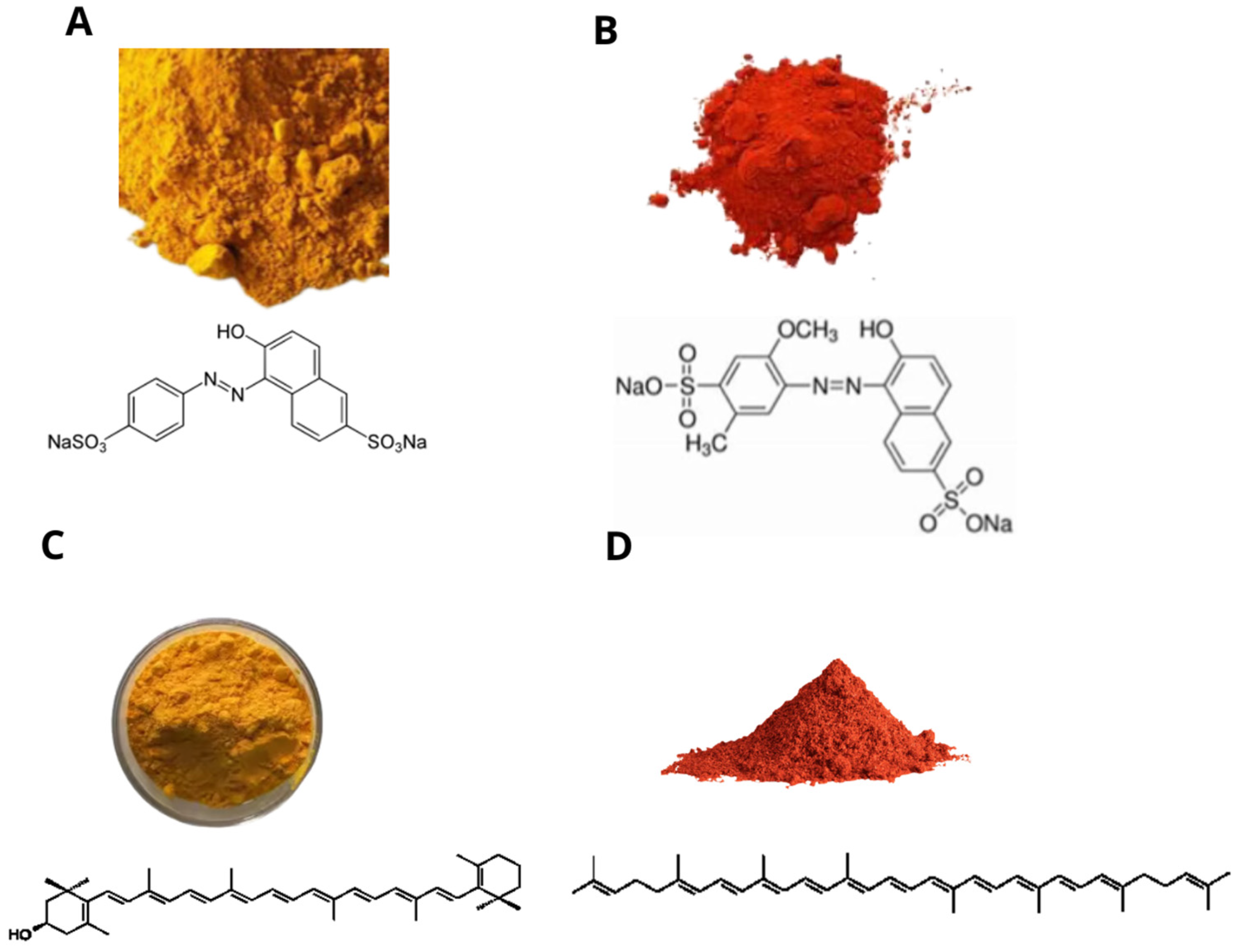
Figure 1. Chemical structure and color of the main pigments employed in this study. (A) Sunset yellow FCF; (B) Allura red AC; (C) all-trans-β-cryptoxanthin; and (D) all-trans-lycopene.
Processes 14 01601 g001
Figure 2. Extraction yield of carotenoids from pitanga obtained with ionic liquids and volatile organic solvents (*# represents significant differences between all evaluated solvents). [C4mim]Cl: 1-butyl-3-methylimidazolium chloride; [C6mim]Cl: 1-hexyl-3-methylimidazolium chloride; [C4mim][BF4]: 1-butyl-3-methylimidazolium tetrafluoborate; [C4mim][PF6]: 1-butyl-3-methylimidazolium hexafluorophosphate.
Processes 14 01601 g002
Figure 3. Chromatograms processed at 450 nm, obtained by HPLC-PDA-MS/MS, of the carotenoid extracts obtained with the conventional extraction using acetone (A) and with [C6mim]Cl (B). See the text for chromatographic conditions and peak characterization given in Table 1. Peak 1: all-trans-lutein; Peak 2: all-trans-zeaxanthin; Peak 3: all-trans-β-cryptoxanthin; Peak 4: all-trans-β-carotene; Peak 5: all-trans-rubixanthin; Peak 6: 9-cis-rubixanthin; Peak 7: all-trans-lycopene.
Processes 14 01601 g003
Figure 4. Estimation of the variable’s effects on the total carotenoid yields using the fractional factorial design.
Processes 14 01601 g004
Figure 5. Contour diagrams (A) and response surface (B) for total carotenoid yield (µg/g) as a function of the number of extractions and the extraction time (min).
Processes 14 01601 g005
Figure 6. Schematic representation of shifts in hue angle according to different solution concentrations: (A) Allura Red (200 µg/mL to 50 µg/mL); (B) Sunset Yellow (200 µg/mL to 50 µg/mL); (C) pitanga carotenoid extracted with Acetone (25 μg/mL to 2.5 µg/mL); (D) pitanga carotenoid extracted with [C6mim]Cl (20 µg/mL to 2.5 µg/mL).
Processes 14 01601 g006
Table 1. Chromatographic, UV/Vis, and mass spectrometry characteristics of pitanga carotenoids obtained from HPLC-PAD-MS/MS.
Peak aCarotenoidstR (min) bλ (max) c%III/II d%AB/II e[M + H]+MS/MS
(m/z)
1all-trans-lutein15.5418, 443, 471600569551 [M + H − 18]+,
533 [M + H − 18 − 18]+,
477 [M + H − 92]+,
463 [M + H − 106]+
2all-trans-zeaxanthin18.3423, 450, 476250569551 [M + H − 18]+,
533 [M + H − 18 − 18]+,
463 [M + H − 106]+
3all-trans-β-cryptoxanthin28.0423, 450, 476260553535 [M + H − 18+],
461 [M + H − 92]+
4all-trans-β-carotene39.5425, 451, 477250537444 [M + H − 92]+
5all-trans-rubixanthin46.9439, 463, 492360553535 [M + H − 18]+,
497 [M + H − 56]+,
461 [M + H − 92]+
69-cis-rubixanthin47.9350, 437, 460, 4883033553535 [M + H − 18]+,
497 [M + H − 56]+,
461 [M + H − 92]+
7all-trans-lycopene83.7447, 474, 505750537467 [M + H − 69]+,
444 [M + H − 92]+
a Numbered according to Figure 3 b tR: Retention time on the C30 column. c Linear gradient MEOH:MTBE. d Spectral fine structure: Ratio of the height of the longest wavelength absorption peak (III) and that of the middle absorption peak (II). e Ratio of the cis peak (AB) and the middle absorption peak (II).
Table 2. The major carotenoid content from Pitanga was extracted using Acetone (conventional solvent) and [C6mim]Cl under optimized conditions.
PeakCarotenoidsCarotenoid Content (μg/g)
Acetone[C6mim]Cl
1all-trans-lutein2.06 ± 0.09 a (3.55 ± 0.65%)2.08 ± 0.02 a (2.07 ± 0.02%)
2all-trans-zeaxanthin3.21 ± 1.01 a (5.54 ± 1.74%)3.30 ± 0.12 a (3.28 ± 0.11%)
3all-trans-β-cryptoxanthin14.05 ± 4.11 a (25.11 ± 7.09%)23.63 ± 1.44 b (23.53 ± 1.43%)
4all-trans-β-carotene2.54 ± 0.93 a (4.38 ± 1.61%)4.14 ± 0.14 b (4.13 ± 0.13%)
5all-trans-rubixanthin10.27 ± 0.62 a (17.74 ± 1.07%)19.22 ± 1.48 b (19.21 ± 1.46%)
69-cis-rubixanthin6.42 ± 1.28 a (11.09 ± 2.21%)9.64 ± 0.46 b (9.63 ± 0.45%)
7all-trans-lycopene19.34 ± 4.40 a (33.40 ± 0.65%)38.37 ± 2.43 b (38.56 ± 2.42%)
Total 57.89 ± 13.64 a100.40 ± 3.61 b
Means in the same line followed by different letters differed significantly (p < 0.05).
Disclaimer/Publisher’s Note: The statements, opinions and data contained in all publications are solely those of the individual author(s) and contributor(s) and not of MDPI and/or the editor(s). MDPI and/or the editor(s) disclaim responsibility for any injury to people or property resulting from any ideas, methods, instructions or products referred to in the content.