Article

Real-Time Lexicographic MPC with Online Correction for Intelligent Drill-Bit Rotary Valves in Mud-Pulse Telemetry


1
State Key Laboratory of Oil and Gas Reservoir Geology and Exploitation, Chengdu 610059, China
2
College of Energy Resources (Modern Industrial College of Shale Gas), Chengdu University of Technology, Chengdu 610059, China
3
No. 10 Oil Production Plant of PetroChina Changqing Oilfield Company, Qingyang 745000, China
*
Author to whom correspondence should be addressed.
Processes 2026, 14(10), 1589; https://doi.org/10.3390/pr14101589
Submission received: 24 March 2026 / Revised: 21 April 2026 / Accepted: 10 May 2026 / Published: 14 May 2026
(This article belongs to the Special Issue Applications of Intelligent Models in the Petroleum Industry)

Abstract

Reliable front-end pressure-pulse generation is critical to mud-pulse telemetry because waveform distortion introduced at the rotary valve propagates through the telemetry chain and reduces downstream recoverability. This paper targets accurate and computationally tractable control of an intelligent drill-bit rotary valve under actuator limits, parameter drift, and downhole-like disturbances. A control-oriented electromechanical–hydraulic grey-box model is established, and a real-time lexicographic model predictive control (MPC) framework with candidate pre-screening, move blocking, and online correction/compensation is developed and compared with proportional–integral–derivative (PID) control and conventional MPC. Under a sampling period of T s = 20 ms , the proposed controller reduces the step-tracking rise time from 2.18 s to 1.76 s and the steady-state pressure error from 0.1208 MPa to 0.0292 MPa relative to conventional MPC. In the pulse-output and mismatch–disturbance scenarios, it further maintains lower steady-state pressure error while reducing the cumulative input variation from 51.0 to 11.5 and from 121.5 to 19.5 , respectively. The observed 99th-percentile and worst-case MATLAB workstation execution times remain below one sampling period, while supplementary mismatch–disturbance sensitivity maps indicate a favorable accuracy–timing compromise within the tested numerical envelope. These results support the proposed method as a simulation-validated candidate for low-complexity rotary-valve control and motivate subsequent bench/hardware-in-the-loop (HIL) validation rather than field-qualified deployment claims.

1. Introduction

As unconventional oil and gas development extends toward long horizontal sections, high-temperature and high-pressure wells, and structurally complex reservoirs, drilling operations place increasingly stringent demands on stable downhole information acquisition, real-time transmission, and rapid response. Measurement while drilling (MWD) and logging while drilling (LWD) systems must deliver inclination, azimuth, tool-face angle, formation response, and key drilling parameters to the surface in a timely manner. Among available downhole telemetry technologies, mud-pulse transmission remains one of the most mature and widely deployed solutions.
In a mud-pulse telemetry chain, the intelligent drill-bit rotary valve is typically driven by an electric motor that rotates the valve core. By modulating the valve angle, the controller changes the throttling pressure drop and thereby generates identifiable pressure pulses in the drilling-fluid column. Open patent disclosures show that geometric changes in the rotary-valve opening directly modify the local pressure drop and the pulse-shaping process [1]. Mud-pulse channel-modeling studies further indicate that front-end waveform quality directly affects channel response and recoverability [2]. Fast simulation studies for downhole telemetry also show that chain modeling and controller design are tightly coupled [3]. Analyses of drill-string channel response similarly suggest that pressure-signal distortion degrades surface decoding quality [4]. Surface demodulation studies reach the same conclusion: front-end signal quality strongly influences downstream demodulation performance [5]. Therefore, the rotary valve is not merely an actuator; it is also a key waveform-shaping front-end in mud-pulse telemetry.
From an engineering perspective, the control performance of a rotary valve is commonly assessed through valve-angle tracking accuracy, pressure-pulse amplitude Δ P , carrier frequency f, and information coding rate R b . Public patent disclosures indicate that the additional pressure-drop amplitude generated by a pulse generator can reach 100–300 psi, i.e., approximately 0.69 2.07 MPa ; accordingly, the pressure-constraint window used in this paper is selected on the basis of that order of magnitude with an additional safety margin. Variable-forgetting-factor RLS equalization studies show that target-band recovery capability directly influences signal quality in time-varying telemetry channels [6]. Wavelet-network signal recovery results further show that multiscale band-energy distributions strongly affect the robust recovery of mud-pulse signals [7]. Fractional Fourier-transform equalization studies verify that phase and amplitude fidelity within a specific band are both important for decoding quality [8]. Similar evidence is provided by discrete Fourier-transform-based noise-suppression studies [9]. These observations imply that rotary-valve control errors are mapped onto pulse-waveform quality and waveform-level proxies associated with downstream recoverability rather than directly proving end-to-end decoding performance in the present study (Figure 1).
Compared with conventional surface actuators, precise control of downhole rotary valves is subject to much harsher environmental constraints. Public MWD tool specifications indicate that downhole tools may operate at approximately 175 °C and 20,000 psi while also withstanding strong shocks and broadband vibration; under high-flow erosion and a high static-pressure background, wear of the valve-core surface, variation in friction coefficients, and clearance evolution continuously alter the valve–fluid coupling characteristics. More specifically, pump noise and mechanical noise reduce the signal-to-noise ratio and increase synchronization difficulty; fluid inertia and time-varying loads induce valve-position lag and waveform distortion; changes in flow rate, density, and local throttling characteristics magnify model mismatch; and limited downhole computation and power budgets shrink the real-time margin of complex optimization algorithms. These factors make rotary-valve control strongly coupled, strongly disturbed, and inherently time varying.
Existing control strategies for complex actuators and related motor-drive systems form a reasonably clear technical spectrum. PID/PI control is structurally simple and inexpensive to implement, but it tends to suffer from overshoot, oscillation, and steady-state degradation under strong disturbances and parameter drift. Fuzzy control reduces dependence on an accurate plant model, yet the design of rule bases and membership functions remains highly heuristic and often lacks cross-condition consistency. Adaptive control can improve environmental adaptability through online estimation, but its performance depends strongly on excitation conditions and measurement noise. By contrast, conventional model predictive control, including FCS-MPC, explicitly handles input, state, and switching constraints. Studies on model predictive power control in the stationary two-phase frame show that cost-function design directly affects dynamic behavior and steady-state ripple [10]. Dual-vector model predictive current control with parameter identification further demonstrates that model mismatch can significantly degrade prediction quality [11]. Enhanced model predictive control for marine propulsion systems also indicates that robustness and computational burden must be considered jointly [12]. In addition, two-vector sequential model predictive control shows that sequential optimization structures can alleviate the tuning difficulty associated with conventional single weighted costs [13].
Table 1 condenses the most relevant related-work streams, the remaining rotary-valve-specific gaps, and the corresponding study scope.
Existing studies have reported control-oriented actuator models, sequential MPC structures, and disturbance-compensated predictive control in related electromechanical systems. The novelty of the present work is therefore not claimed at the level of inventing grey-box modelling or lexicographic MPC in general. Instead, it lies in their rotary-valve-specific integration for mud-pulse telemetry: (i) a control-oriented electromechanical–hydraulic model that explicitly retains clearance/wear effects and pressure-coupled loading; (ii) a low-complexity lexicographic decision structure tailored to finite candidate inputs and a 20 ms sampling budget; and (iii) a joint validation protocol that examines tracking, pulse-shaping, robustness to drift and disturbance, and algorithmic complexity within a single framework.
Against that background, this work formulates three verifiable hypotheses.
Hypothesis 1 (H1).
Lexicographic sequential evaluation is expected to reduce reliance on a single aggregated weighted cost by making the priority order among control objectives explicit.
Hypothesis 2 (H2).
Candidate pre-screening and move-blocking keep tail computation times below one sampling period under the adopted operating conditions.
Hypothesis 3 (H3).
Online correction and disturbance compensation improve performance under the tested parameter-mismatch and disturbance cases.
Accordingly, the paper contributes: (i) a control-oriented electromechanical–hydraulic grey-box prediction model with an explicit plant boundary; (ii) a real-time lexicographic MPC implementation with candidate pre-screening and reduced online search; and (iii) a simulation-based validation package covering tracking, pulse shaping, robustness proxies, and timing complexity. The remainder of this paper is organized as follows. Section 2 develops the grey-box model and the discrete prediction form. Section 3 presents the coupled estimation and decision layers of the improved MPC. Section 4 reports the simulation setup, evidence boundary, robustness discussion, and algorithmic implications. Section 5 concludes the paper and discusses the main limitations and future work.

2. Materials and Methods: Electromechanical–Hydraulic Grey-Box Modeling

2.1. Modeling Objective, Structural Composition, and Variable Definition

The modeling objective of this section is not a full high-fidelity reconstruction of the local downhole flow field, but a control-oriented grey-box description that remains interpretable, identifiable, and verifiable. To this end, the model retains the dominant mechanisms of mechanical motion, hydraulic throttling, hydrodynamic torque, and clearance-induced wear, while lumping unresolved high-frequency nonlinearities into bounded disturbance terms. Open patent disclosures indicate that geometric opening and wear can significantly affect the flow, leakage, and pressure-drop build-up process; therefore, the clearance variable g is explicitly introduced in the model.
The intelligent drill-bit rotary valve mainly consists of a drive motor, transmission components, a rotating valve core, a fixed valve seat, fluid passages, and sensing units. By regulating the motor output torque T m , the controller drives the valve core to rotate, which changes the valve angle θ , modifies the effective flow area A ( θ , g ) , and establishes an additional pressure drop p across the throttling pair. Here, p denotes the local additional pressure drop relative to the background circulation pressure, and its magnitude directly determines the mud-pulse amplitude. For controller design, the valve angle, angular speed, and additional pressure drop are selected as the primary state variables:
x ( t ) = θ ( t ) ω ( t ) p ( t ) , u ( t ) = T m ( t ) , y ( t ) = θ ( t ) p ( t ) .
If the actuator current is measurable, the relationship T m = K t i can also be used to map current limits into equivalent torque constraints.
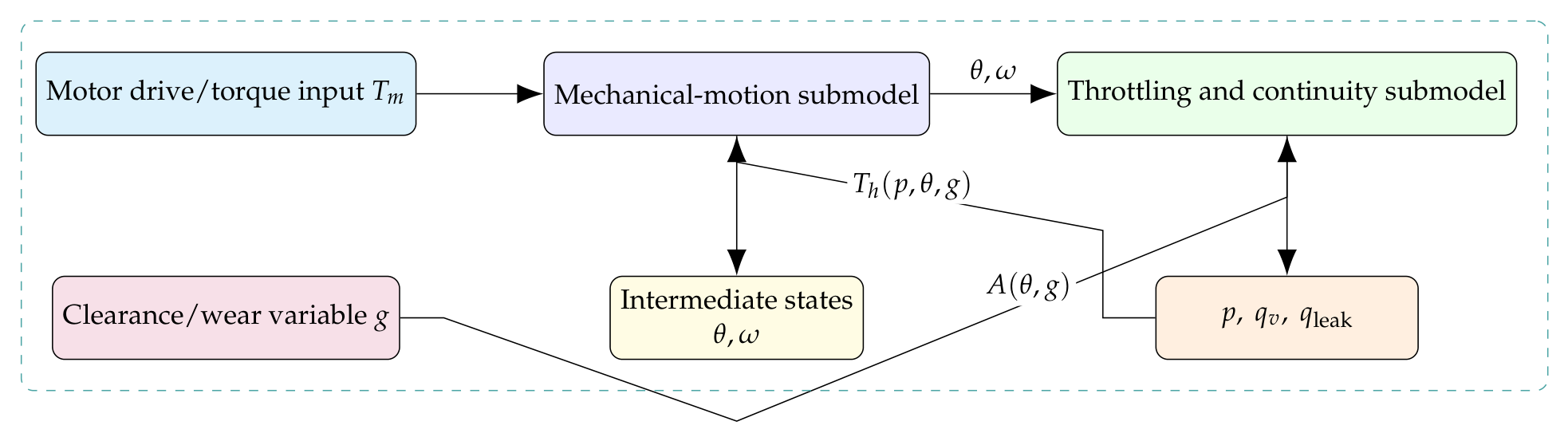
In this paper, the controlled object is the downhole rotary-valve actuation plant bounded by the motor torque input and the measured outputs y = [ θ , p ] T . It includes the motor–transmission–valve-core mechanics, the throttling/leakage hydraulics, and the slow wear-related clearance state g. The downstream mud channel and the surface demodulator are not included in the plant model in the present study; they are addressed only through waveform-based proxy metrics in the revised Results section. Accordingly, T m (or Δ T m ) is the manipulated variable, θ and p are the controlled outputs, ω is an internal state, q i n , d τ , and d p are exogenous disturbances, and g, C d , B e q , k h , and T p are slow-varying parameters updated or perturbed in the robustness analysis. The controlled-object boundary and main symbol definitions are summarized in Table 2 and Table 3, respectively, and the electromechanical–hydraulic coupling schematic is shown in Figure 2.

2.2. Mechanical Submodel

The mechanical submodel satisfies the basic kinematic relation
θ ˙ ( t ) = ω ( t ) .
Considering the motor driving torque, friction torque, hydrodynamic torque, and lumped external disturbance, the mechanical dynamics of the rotary-valve core can be written as
J ω ˙ ( t ) = T m ( t ) T f ( t ) T h ( t ) d τ ( t ) ,
where J is the equivalent rotational inertia and d τ ( t ) denotes unmodeled mechanical disturbance. To avoid oversimplifying friction as a purely viscous term, a grey-box friction expression better suited to the actuator layer is adopted:
T f ( t ) = B ω ( t ) + T c tanh ω ( t ) ε + k p p ( t ) sgn ω ( t ) + d τ , f ( t ) ,
where B is the viscous damping coefficient, T c is the equivalent Coulomb-friction amplitude, ε is the smoothing parameter, k p characterizes the effect of pressure drop on the friction load, and d τ , f ( t ) collects the remaining friction uncertainty. This expression captures low-speed nonsmooth behavior, pressure-load coupling, and unmodeled friction disturbance, and is therefore more representative of the downhole rotary-valve actuation layer than the simplified approximation T f B ω .
Equation (4) means that the torque required to rotate the valve increases not only with speed-dependent damping but also with low-speed friction and pressure-induced loading. This reflects the practical fact that the valve is harder to move near reversals and under higher pressure drops.

2.3. Hydraulic Submodel

The hydraulic submodel is jointly determined by the throttling flow, leakage flow, and fluid compressibility. Let p ( t ) denote the additional pressure drop across the rotary valve. The main throttling flow through the valve port is then written as
q v ( t ) = C d ( t ) A θ ( t ) , g ( t ) sgn p ( t ) 2 | p ( t ) | ρ ,
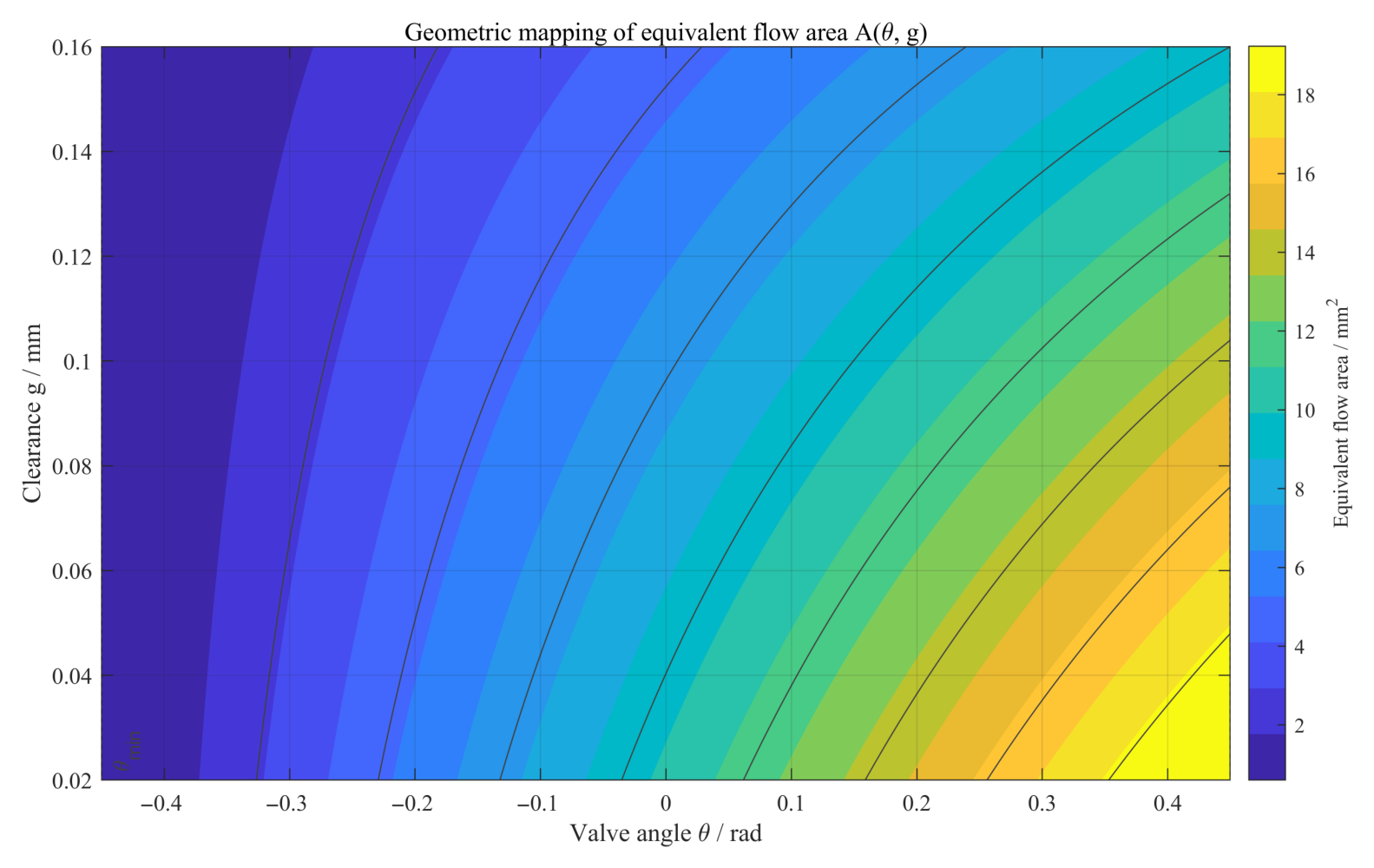
where C d ( t ) is the flow coefficient, ρ is the drilling-fluid density, and A ( θ , g ) is the equivalent throttling area jointly determined by the valve angle and the clearance. In the present study, A ( θ , g ) is implemented as a geometry-derived lookup surface over the admissible ( θ , g ) domain and evaluated online through bilinear interpolation. The corresponding static calibration route is illustrated later in Section 4.2. To account for leakage induced by long-term erosion and wear, a parametric leakage term is introduced as
To visualize the geometric relationship among valve angle, clearance, and equivalent throttling area in (5), Figure 3 presents a contour map of A ( θ , g ) over the operating range. This figure is intended to illustrate the direction of wear-induced equivalent-opening drift and the overall downward trend of flow capacity, rather than to replace the static calibration curves introduced later.
q leak ( t ) = q leak p ( t ) , g ( t ) ,
where g ( t ) = g 0 + Δ g ( t ) denotes the slow evolution of the throttling-pair clearance. In the simulations, q leak ( p , g ) is evaluated as a monotone pressure-driven leakage relation calibrated together with the nominal throttling map so that larger clearances produce both higher leakage and a reduced effective pressure build-up. Because wear significantly changes both the additional pressure drop and the leakage level, g is treated as a key slow-varying parameter in the pressure dynamics.
From the fluid-continuity relation, the local additional pressure drop satisfies
C p p ˙ ( t ) = q in ( t ) q v ( t ) q leak ( t ) + d p ( t ) ,
where q in ( t ) is the equivalent inflow entering the throttling control unit, d p ( t ) is the unmodeled pressure disturbance, and C p is the equivalent compressibility coefficient of the hydraulic chamber. Furthermore,
C p = V e β e ,
where V e is the equivalent chamber volume and β e is the equivalent bulk modulus. Compared with directly assuming a first-order pressure lag, (7) provides a more traceable derivation and is therefore better suited for later calibration and parameter identification.
Equation (7) states that the additional pressure rises when the equivalent inflow exceeds the throttling and leakage outflows, and falls otherwise. The model therefore keeps a direct physical connection between flow imbalance and pulse build-up.

2.4. Electromechanical Coupling and Unified Grey-Box Equations

The hydrodynamic torque originates from the pressure distribution acting on the throttling pair and valve core. Its rigorous expression can be written as
T h ( t ) = r t A eff ( θ , g ) p n d A ,
where r t is the equivalent moment arm and p n is the normal pressure distribution over the throttling pair. For online control and parameter-identification purposes, it can be approximated around the operating point as
T h ( t ) k h p ( t ) + k θ θ ( t ) θ 0 + d τ , h ( t ) ,
where k h is the equivalent coupling coefficient from pressure drop to hydrodynamic torque, k θ is the additional hydrodynamic-torque coefficient induced by valve-angle deviation, and d τ , h ( t ) is the residual hydrodynamic disturbance.
Equation (10) means that pressure build-up feeds back into the mechanical subsystem through an additional load torque, while the local valve position perturbs the same load around the operating point. This approximation keeps the dominant pressure–mechanics coupling visible without requiring a full CFD-resolution model during online control.
Combining the above terms, the unified continuous grey-box model of the intelligent drill-bit rotary valve can be written as
θ ˙ ( t ) = ω ( t ) ,
J ω ˙ ( t ) = T m ( t ) T f ( t ) T h ( t ) d τ ( t ) ,
C p p ˙ ( t ) = q in ( t ) q v ( t ) q leak ( t ) + d p ( t ) ,
q v ( t ) = C d ( t ) A θ ( t ) , g ( t ) sgn p ( t ) 2 | p ( t ) | ρ .
This model jointly describes the coupling among mechanical motion, hydraulic throttling, leakage flow, hydrodynamic torque, and slowly varying clearance, and is therefore suitable for control-oriented modeling that combines physical mechanisms with parameter identification.

2.5. Linearization, State-Space Formulation, and Validity Range

To construct a model predictive controller, the grey-box model is linearized around the operating point ( θ 0 , ω 0 , p 0 ) using a small-signal approximation. Let
Δ x = Δ θ Δ ω Δ p , Δ u = Δ T m , Δ ξ = Δ q in Δ g Δ C d ,
Then the linearized model becomes
Δ x ˙ ( t ) = A c Δ x ( t ) + B c Δ u ( t ) + E c Δ ξ ( t ) + D c d ( t ) , y ( t ) = C Δ x ( t ) ,
where
A c = 0 1 0 k θ J B eq J k h * J K θ 0 1 T p , B c = 0 1 J 0 , C = 1 0 0 0 0 1 .
Here, B eq denotes the equivalent damping coefficient and k h * the linearized hydrodynamic-torque coefficient, while
T p = C p q v p 0 + q leak p 0 , K θ = 1 C p q v θ 0 , K q = 1 C p .
This shows that the commonly used first-order pressure model is not an independent assumption, but rather a natural result of linearizing the continuity equation. When the downhole controller is computationally constrained and the rotary valve mainly operates in the low- to mid-frequency pulse-modulation range, the pressure channel in (16) can be retained as a first-order reduced model for MPC. For large-amplitude modulation or wide-range operating analysis, however, the nonlinear form in (5) should be preserved and handled by piecewise linearization or gain scheduling.
The applicability bounds of the present model should be stated explicitly in five aspects. First, friction is not reduced to a single viscous term; Coulomb friction and pressure-load coupling are retained through (4). Second, the hydrodynamic torque is not empirically imposed, but first described mechanistically by (9) and then approximated in a control-oriented form around the operating point. Third, the pressure dynamics are derived from continuity and compressibility relations rather than being directly postulated as a first-order lag. Fourth, the clearance g ( t ) and flow coefficient C d ( t ) are allowed to drift slowly so as to reflect erosion and wear. Fifth, under large-amplitude modulation, the dominant nonlinear throttling relationship should not be fully absorbed into a disturbance term, but instead retained and treated through segmentation or scheduling.

2.6. Discrete Prediction Model and Engineering Constraints

Considering the receding-horizon nature of MPC, (16) is discretized by a zero-order hold (ZOH) method, yielding
Δ x ( k + 1 ) = A d Δ x ( k ) + B d Δ T m ( k ) + E d Δ ξ ( k ) + D d d ( k ) , y ( k ) = C Δ x ( k ) .
where A d = e A c T s and B d = 0 T s e A c τ B c d τ . Compared with directly optimizing the absolute torque, using the torque increment Δ T m as the optimization variable is more effective in suppressing high-frequency switching and actuator shock.
In discrete time, the controller predicts how the current torque increment affects the next-step valve angle and pressure while enforcing actuator and safety limits. This is the model actually used by the receding-horizon decision layer at each 20 ms sample.
Consistent with the actuator-layer limits of the rotary valve, explicit constraints are imposed on the valve angle, angular speed, driving torque, torque increment, and additional pressure drop:
θ min θ ( k ) θ max , | ω ( k ) | ω max ,
T m , min T m ( k ) T m , max , Δ T m , min Δ T m ( k ) Δ T m , max ,
p min p ( k ) p max .
If the current is measurable, the following additional constraint can be imposed:
i min i ( k ) i max , T m ( k ) = K t i ( k ) .
These constraints correspond, respectively, to the mechanical travel limits of the valve core, the avoidance of overspeed impact, the actuator output capability, switching smoothness, and the safety window of the pressure pulse.

2.7. Parameter Sources, Identification, and Validation Route

To avoid repeating the validation discussion in both the modeling and results sections, only a principle-level summary of parameter sources and identification requirements is provided here. The inertia J, damping B, friction parameter T c , throttling-area function A ( θ , g ) , flow coefficient C d , and hydraulic compressibility parameters V e , β e all need to be obtained from CAD estimation, static calibration, free-decay identification, or step-response fitting. Details such as pressure-sensor placement, erosion-related measurement bias, the choice of online identification method, and the bench/swept-frequency validation procedure are deferred to Section 4.2, thereby forming a closed loop of modeling–control–validation.

3. Materials and Methods: Improved Real-Time Lexicographic MPC

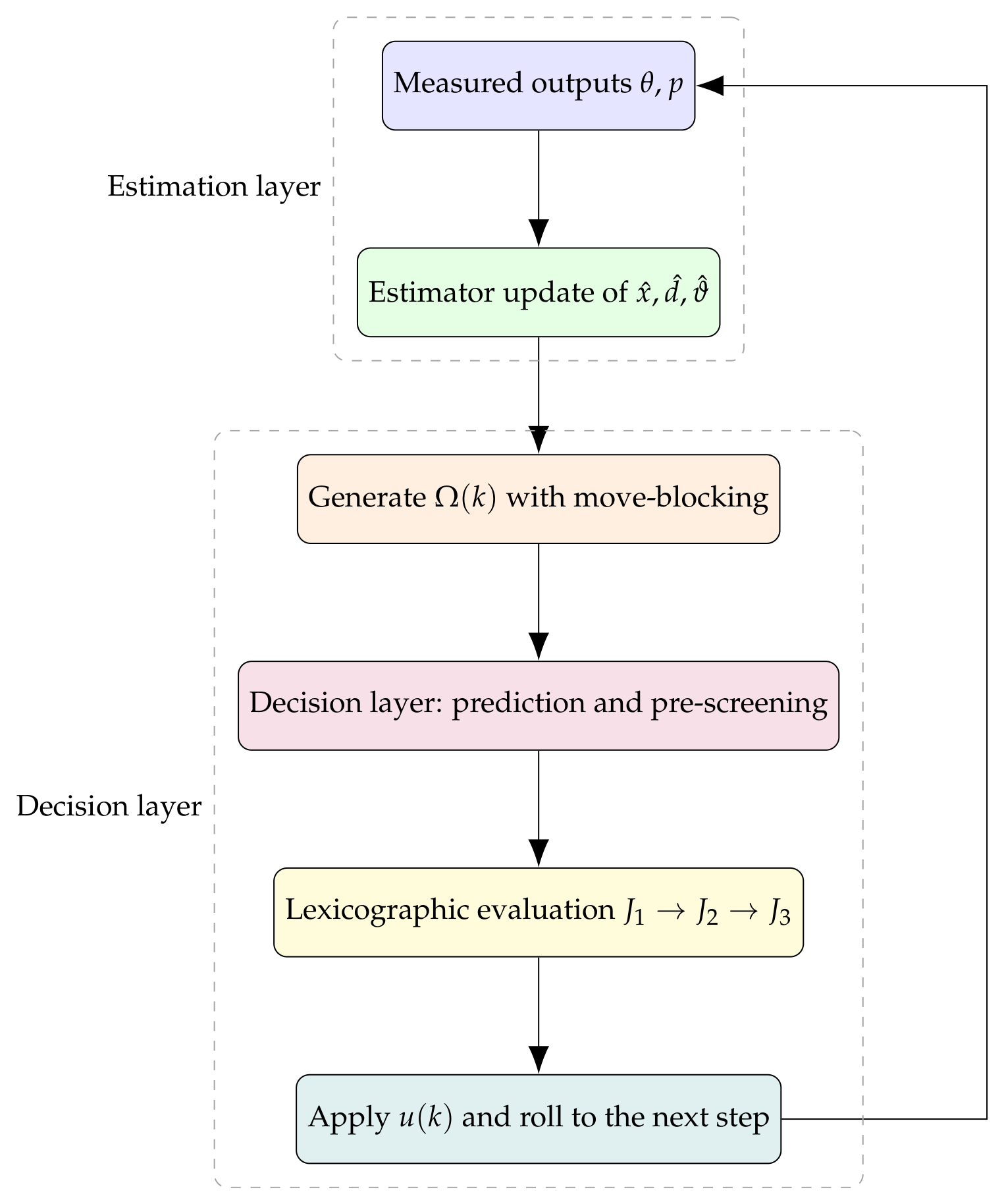
The control input is the equivalent driving torque or torque increment u, the outputs are the valve angle θ and the local additional pressure drop p, and the controller consists of an observer and a sequential (lexicographic) MPC. The estimation layer updates states, disturbances, and slowly varying parameters, while the decision layer performs receding-horizon optimization on the corrected discrete prediction model so as to simultaneously satisfy fast valve-angle tracking, low-ripple pressure-pulse shaping, and real-time feasibility for downhole implementation. Existing studies on sequential MPC indicate that such a structure reduces dependence on empirical weight tuning and is particularly suitable for industrial control problems with clearly prioritized objectives.

3.1. Control Architecture, Engineering Objectives, and Limitations of Standard MPC

For the engineering application of the rotary valve, the control targets are not expressed merely as abstract output-tracking goals, but are mapped to three verifiable classes of metrics:
  • Valve-position tracking performance: quantified by the steady-state angle error or the integral absolute error (IAE), requiring the valve core to reach the target accurately within a finite time;
  • Pulse-shaping quality: quantified by the additional-pressure amplitude error, RMS fluctuation, and peak-to-peak ripple, requiring the output pressure pulse to exhibit a better waveform-margin proxy associated with downstream decoding;
  • Actuation smoothness: quantified by the magnitudes of Δ u and Δ 2 u , requiring reduced high-frequency switching and mechanical shock.
The tracking errors and variation terms are defined as
e θ ( k ) = θ * ( k ) θ ( k ) , e p ( k ) = p * ( k ) p ( k ) ,
Δ p ( k ) = p ( k ) p ( k 1 ) , Δ u ( k ) = u ( k ) u ( k 1 ) , Δ 2 u ( k ) = Δ u ( k ) Δ u ( k 1 ) .
At each sampling instant, standard MPC predicts the future response over the horizon N p based on (19) and solves a single weighted cost over the control horizon N c . Although this method handles constraints explicitly, it still exhibits three shortcomings in the downhole rotary-valve scenario. First, valve tracking, pulse stability, and actuation smoothness typically rely on manually coordinated weights, which creates a substantial tuning burden. Second, multi-candidate enumeration or long prediction horizons can significantly increase the online computational cost. Third, when the model parameters drift or disturbances intensify, the prediction accuracy of a fixed model degrades rapidly. Studies on complex-vector disturbance observers with deadbeat predictive control show that online compensation can suppress harmonics and improve robustness. Weightless CCS model predictive control further shows that weakening empirical weight dependence can improve controller tunability [18]. Parameter-independent predictive current control highlights the need to reduce model dependence [19]. Low-complexity double-vector strategies demonstrate the direct real-time value of candidate-set reduction. Multi-voltage-vector model-free deadbeat control shows that updated reference vectors can improve dynamic quality. Enhanced model predictive control based on an adaptive super-twisting observer illustrates the advantage of online compensation under model mismatch. Together, these ideas provide transferable technical support for the two-layer control structure adopted here, as shown in Figure 4.

3.2. Estimation Layer: Joint Update of States, Disturbances, and Parameters

Because the damping, hydrodynamic-torque coupling coefficient, and pressure-channel time constant may drift during long-term downhole operation, joint estimation of states, disturbances, and parameters is introduced around the controller. The parameter vector to be updated is defined as
ϑ ^ ( k ) = B ^ eq ( k ) k ^ h ( k ) T ^ p ( k ) ,
The corrected prediction model is then written as
x ^ ( k + 1 ) = A ^ d ϑ ^ ( k ) x ^ ( k ) + B ^ d ϑ ^ ( k ) u ( k ) + E d d ^ ( k ) + L y ( k ) y ^ ( k ) ,
where d ^ ( k ) is the equivalent disturbance estimate and L is the output-error feedback gain. The disturbance update is written as
d ^ ( k + 1 ) = d ^ ( k ) + L d y ( k ) y ^ ( k ) .
To explicitly define the regressor and to prevent estimator divergence under transients and noisy measurements, a projection-based recursive least-squares (RLS) scheme is adopted for the slow-varying parameters:
ϑ ^ k = Π Θ ϑ ^ k 1 + K k y k y ^ k ,
K k = P k 1 ϕ k λ + ϕ k T P k 1 ϕ k , P k = λ 1 I K k ϕ k T P k 1 ,
where ϕ k is the regressor assembled from the measured or estimated valve speed, the additional pressure drop, the previous input increment, and the one-step output mismatch, i.e.,
ϕ k = ω ( k ) , p ( k ) , Δ u ( k 1 ) , y ( k ) y ^ ( k ) T ,
λ is the forgetting factor, and Π Θ { · } is the projection operator that enforces physically admissible parameter bounds. In the numerical implementation, the regressor is normalized before the update. This formulation keeps the update lightweight while preventing abrupt noise bursts or operating-point changes from driving the parameter estimates outside their feasible ranges.
From an implementation viewpoint, the estimation layer can also be extended to an augmented EKF or a sliding-mode observer (SMO), whose applicability is summarized in Table 4. Because the sampling period in this study is T s = 20 ms and the outer-loop dynamics of the rotary valve are dominated by low- to mid-frequency pulse modulation, the simulations prioritize the combination of output-error observation and projection RLS to balance drift rejection against online computational burden.

3.3. Decision Layer: Lexicographic Sequential MPC with Soft-Constraint Handling

After the estimation layer provides x ^ ( k ) , d ^ ( k ) , and ϑ ^ ( k ) , the decision layer performs receding-horizon optimization using the corrected discrete model. For better engineering interpretability, the constraints are divided into hard and soft categories.
The hard constraints directly correspond to the mechanical and actuator limits:
θ min θ ( k ) θ max , | ω ( k ) | ω max ,
u min u ( k ) u max , Δ u min Δ u ( k ) Δ u max .
The pressure safety window is also enforced as a hard constraint under normal conditions. When no candidate remains hard-feasible, a soft pressure constraint with slack variables is activated as a pragmatic feasibility-recovery mechanism:
p min s p ( k + i ) p ( k + i | k ) p max + s p ( k + i ) , s p ( k + i ) 0 .
The corresponding slack penalty is written as
J s ( m ) = ρ p s p ( m ) 2 2 ,
where ρ p is the pressure soft-constraint penalty coefficient. This fallback limits the magnitude of pressure-window violation and avoids infeasibility-induced optimization failure in the tested scenarios. It does not constitute a formal proof of recursive feasibility or closed-loop stability, and such a proof remains outside the scope of the present simulation study.
To support a reduced-weight-dependence claim rather than a fully weight-free claim, each stage objective is written in a dimensionless form normalized by the relevant physical constraint scale, instead of relying on a single strongly coupled set of empirical weights such as q θ , q p , and r 1 . For the mth candidate sequence,
J 1 ( m ) = i = 1 N p e θ , m ( k + i | k ) Δ θ max 2 + ω m ( k + i | k ) ω max 2 ,
J 2 ( m ) = i = 1 N p e p , m ( k + i | k ) Δ p max 2 + Δ p m ( k + i | k ) Δ p max 2 ,
J 3 ( m ) = j = 0 N c 1 Δ u m ( k + j | k ) Δ u max 2 + Δ 2 u m ( k + j | k ) Δ u max 2 .
where Δ θ max , Δ p max , and Δ u max denote the physical scales of the valve-angle excursion, additional pressure-drop excursion, and input increment, respectively. In other words, the lexicographic structure reduces the tuning burden of a single global weighted cost by assigning priorities across stages, while still retaining a small number of intra-stage numerical scaling factors for stability.
From an engineering viewpoint, J 1 protects primary valve-motion quality, J 2 refines pressure-pulse quality once acceptable motion candidates have been retained, and J 3 finally suppresses aggressive actuator movement among the remaining candidates. The three-stage structure therefore makes the controller priorities explicit instead of burying them in a single aggregated weight set.
Once the candidate sequences satisfy either the hard constraints or the softened feasible set, the optimal solution is selected using a tolerance-based lexicographic rule. Define
J 1 , min = min m Ω ( k ) J 1 ( m ) , J 2 , min = min m Ω 1 ( k ) J 2 ( m ) ,
Then the first- and second-stage near-optimal candidate sets are
Ω 1 ( k ) = m Ω ( k ) | J 1 ( m ) J 1 , min + ε 1 ,
Ω 2 ( k ) = m Ω 1 ( k ) | J 2 ( m ) J 2 , min + ε 2 ,
The final control sequence is determined by
m * = arg min m Ω 2 ( k ) J 3 ( m ) + J s ( m )
This formulation is consistent with the standard expression of lexicographic optimization MPC and addresses two common methodological questions: whether pre-screening removes the optimum and whether the method still contains hidden empirical weighting. In the present implementation, ε 1 = 0.03 and ε 2 = 0.02 are used as empirical near-optimality thresholds to balance control performance against online computational effort. Supplementary Figure S4 reports retained-set tolerance proxies that visualize the observed accuracy–timing trade-off. A full tolerance sweep over ( ε 1 , ε 2 ) is not included in the present simulation dataset; the added candidate-retention analysis is therefore interpreted as an empirical timing–retention proxy rather than a robustness-margin proof. The tolerances were selected empirically to balance near-optimality and online computation within the tested numerical envelope, and a systematic robustness-margin-based selection remains future work.

3.4. Candidate-Set Design and Online Complexity-Reduction Strategy

For downhole controllers with limited onboard computation and a fixed sampling period, the continuous input space is not optimized globally at every sampling instant. Instead, a finite candidate set is generated locally around the previous input:
Ω u ( k ) = u ( k 1 ) + δ i | δ i { Δ u max , 0 , Δ u max } .
To further reduce the search dimension, a move-blocking strategy is adopted over the prediction horizon: only the first N b input moves are optimized, and the remaining moves are held at the last optimized value, i.e.,
U m ( k ) = u m ( k | k ) , , u m ( k + N b 1 | k ) , u m ( k + N b 1 | k ) , , u m ( k + N c 1 | k ) .
Although the admissible control input is quantized into seven levels within [ u min , u max ] in the numerical implementation, the online search is carried out locally through the three incremental moves { Δ u max , 0 , Δ u max } around u ( k 1 ) and then clipped to the admissible seven-level grid. This strategy is especially suitable for a rotary valve with low-frequency dynamics, limited onboard resources, and explicit actuator constraints because it compresses the enumeration space without discarding hard feasibility checks. It should also be noted that FCS-type enumerative controllers remain sensitive to model mismatch, weight design, and search-space growth. Therefore, the present work adopts a compromise structure of “finite candidate set + sequential evaluation + move-blocking” to improve real-time implementability.
From an engineering implementation standpoint, the applicability of common low-complexity MPC variants is summarized in Table 5. Because the outer loop of the rotary valve is dominated by low- to mid-frequency pressure-pulse modulation and operates with a sampling period of about 20 ms , this work prioritizes a sequential lexicographic MPC with a finite candidate set rather than introducing more complex multi-vector duty allocation or an online QP solver.
Because discretization error is another common implementation concern, it should be emphasized that A d and B d in (19) are computed offline exactly under the ZOH assumption by means of the matrix exponential, and are then accessed online through lookup or direct use of the precomputed matrices, rather than being approximated by a forward-Euler scheme.

3.5. Algorithmic Steps, Complexity, and Real-Time Implementation

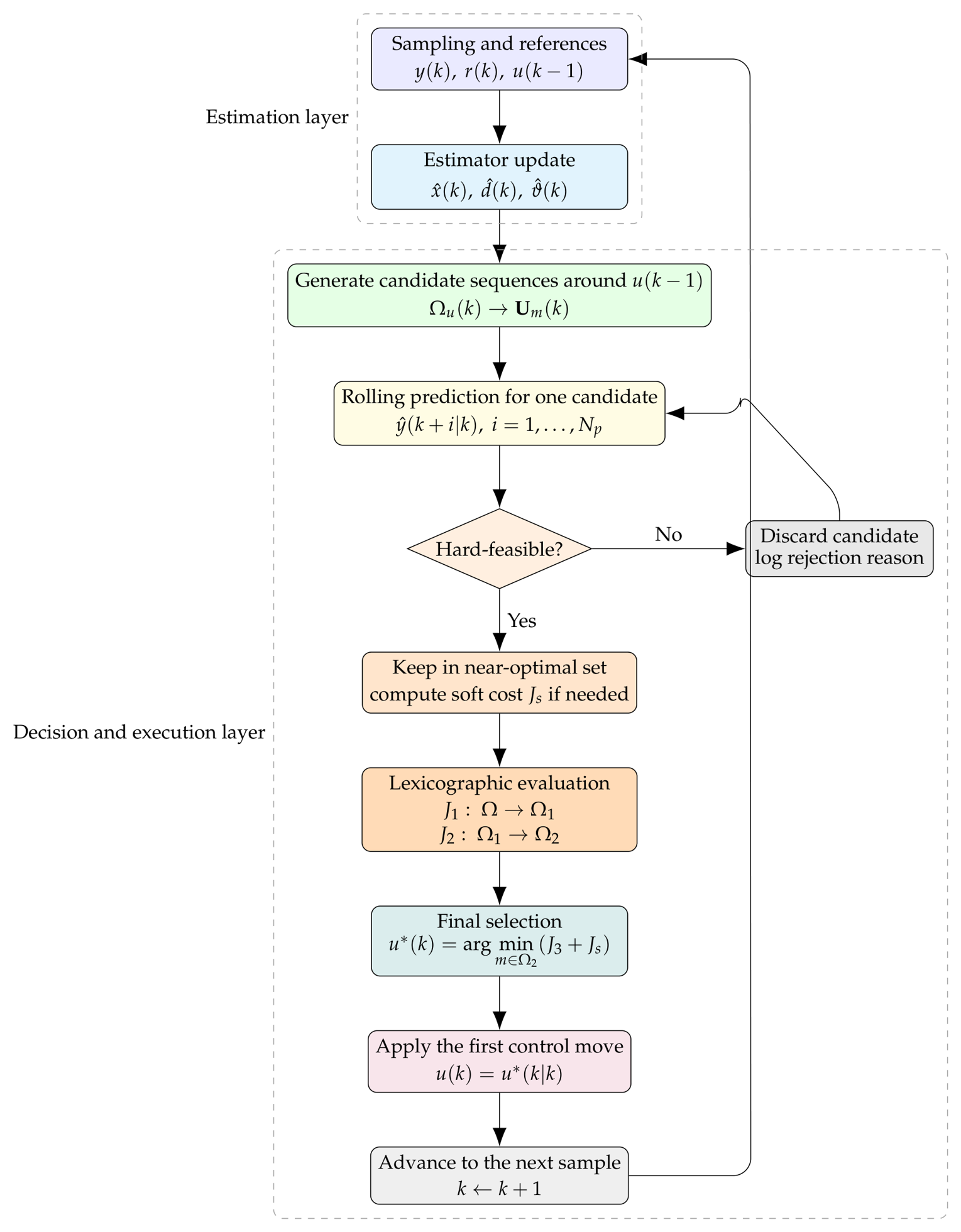
Combining the estimation and decision layers, Figure 5 expands the online solution flow of candidate generation, constraint filtering, lexicographic evaluation, and soft-constraint fallback in greater detail. Its role is complementary to Figure 4: the latter emphasizes the two-layer control architecture, whereas the former focuses on the per-sample solution procedure and data flow.
For scalability discussion, let the local branching factor be b = 3 because the online search uses the three incremental moves { Δ u max , 0 , Δ u max } , and let N b denote the move-blocking depth. The raw candidate upper bound is therefore
M raw b N b .
For one candidate, one N p -step rollout of an n x -state prediction model with precomputed A d and B d costs O ( N p n x 2 ) in the present matrix-based implementation. The resulting upper-bound scaling is summarized as
Conventional finite - set MPC : O M raw N p n x 2 ,
Adaptive MPC target baseline : O n ϑ 2 + M raw N p n x 2 ,
Proposed method : O n ϑ 2 + M h N p n x 2 + M 1 N p + M 2 N p + M 3 N c ,
with
M 3 M 2 M 1 M h M raw ,
and memory complexity
O N p n x + M h .
These expressions are intended as architecture-independent upper-bound scaling relations rather than as formal complexity theorems. They highlight that the dominant online cost remains candidate rollout and stage-wise filtering, whereas the parameter-update cost scales only with the small correction vector ϑ = [ B e q , k h , T p ] T . The controller-level complexity scaling used in this discussion is summarized in Table 6.
To make the adaptive-MPC reference formulation explicit rather than purely verbal, its single-objective formulation is written as
J A - MPC = i = 1 N p w θ e θ 2 ( k + i | k ) + w p e p 2 ( k + i | k ) + w ω ω 2 ( k + i | k ) + j = 0 N c 1 r 1 Δ u 2 ( k + j | k ) + r 2 Δ 2 u 2 ( k + j | k ) .
This reference formulation uses the same corrected prediction model and constraints as the proposed controller, but replaces the lexicographic decision layer with one weighted objective. It therefore separates the role of online correction from the role of staged decision filtering. It is retained as a reference formulation for complexity discussion, and it is excluded from the numerical KPI comparison because reproducible closed-loop trajectories under the same protocol are unavailable.
Combining the estimation and decision layers, the control algorithm can be summarized as follows:
  • At sampling instant k, acquire the valve-angle and additional-pressure measurements, and update x ^ ( k ) , d ^ ( k ) , and ϑ ^ ( k ) ;
  • Construct the candidate action set Ω u ( k ) around the previous input u ( k 1 ) and generate candidate control sequences through move-blocking;
  • Perform rolling prediction for each candidate sequence using A ^ d ( ϑ ^ ) , B ^ d ( ϑ ^ ) , and d ^ ( k ) ;
  • Discard a candidate if hard constraints are violated; if no hard-feasible candidate exists, activate the soft constraint and compute the slack cost;
  • Compute J 1 ( m ) and keep the near-optimal candidate set satisfying (39);
  • Compute J 2 ( m ) within the near-optimal set and keep the secondary near-optimal set satisfying (40);
  • Compute J 3 ( m ) + J s ( m ) for the remaining candidates and select the optimal one according to (41);
  • Apply the first control move of the optimal sequence to the rotary-valve system and advance to the next sampling instant.
To quantify real-time performance, the controller real-time load factor is defined as
η rt = t comp T s ,
where t comp is the single-step computation time. In addition to the average computation time, engineering evaluation should also report the worst-case execution time t wcet and the statistical distribution of the candidate-set size M ( k ) . Section 4 therefore further reports the 99 % percentile, WCET, and the evolution of M ( k ) to characterize complexity fluctuation and the real-time implementation boundary.
A stronger theoretical guarantee of robust constraint satisfaction may be obtained by incorporating tube-MPC-based constraint tightening, in which the state and input sets are tightened as X X E and U U K E , with E obtained from a disturbance bound. This extension is left for future work. Because the emphasis of this study is to construct a low-computation engineering control framework for the rotary-valve scenario, the primary implementation route adopted here is “disturbance observation + parameter correction + lexicographic MPC”.

4. Results and Discussion

4.1. Simulation Setup, Benchmark Controllers, and Statistical Protocol

To avoid relying solely on qualitative curve inspection, the simulation setup is summarized before the scenario-level results are discussed. The evaluation protocol is organized into four reproducible KPI dimensions: dynamics, steady state, constraint satisfaction, and real-time performance.
  • Dynamic performance: the 10– 90 % rise time t r , the ± 2 % settling time t s , the steady-state error, and IAE/ITAE are used to evaluate valve-angle tracking;
  • Pulse-shaping quality: the steady-state additional-pressure error, peak-to-peak ripple, ripple RMS, and target-band energy are used to characterize pressure-pulse quality;
  • Constraint satisfaction and actuation smoothness: the number of constraint violations, the maximum violation magnitude, | Δ u | , and | Δ 2 u | are used to evaluate actuator shock and constraint consistency;
  • Real-time performance: the mean computation time, the 99 % percentile, the worst-case execution time (WCET), and the real-time load factor η rt are used to assess online practicality within one sampling period.
The closed-loop rotary-valve simulation model is implemented in MATLAB R2022b. All verified controllers operate under the same sampling period T s = 20 ms , the same state/input constraints, and the same reference trajectories, so that the reported numerical differences come from the control-law structure rather than from inconsistent operating conditions. The present simulation dataset contains verified trajectories for PID, conventional MPC, and the proposed lexicographic MPC. The adaptive-MPC formulation is retained as a reference formulation for complexity discussion because it shares the corrected prediction model but uses a single weighted objective. Since reproducible closed-loop trajectories under the same protocol are unavailable, it is excluded from the numerical KPI comparison. The KPI definitions and their engineering meanings are summarized in Table 7.
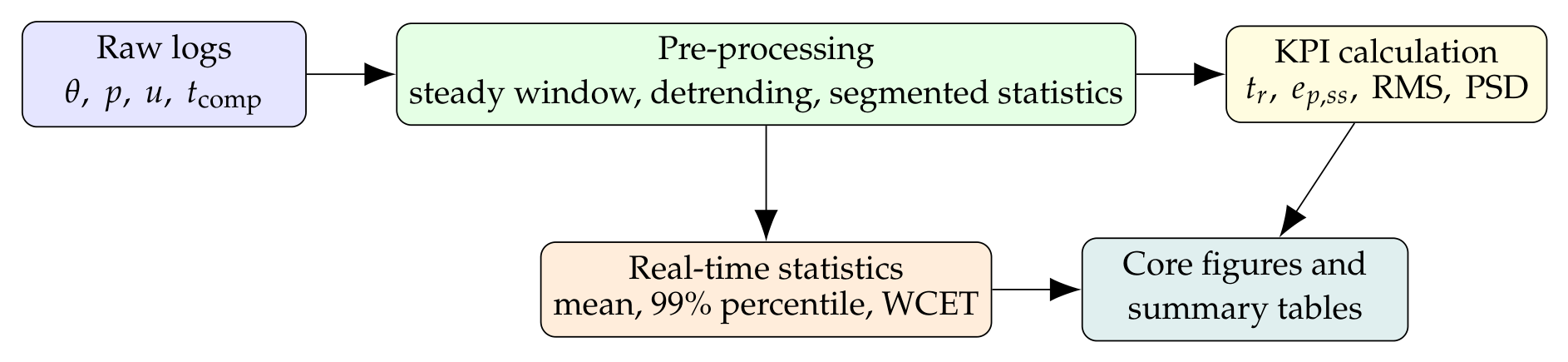
To keep the statistical definitions used in figures and tables consistent across scenarios, Figure 6 summarizes the unified KPI-processing workflow from raw logs to pre-processing, metric calculation, and summary output. Metrics such as t r , ripple RMS, target-band energy, the 99th percentile, and WCET are therefore computed using the same definitions for all controllers.
The simulation object adopts the discrete prediction model established in the previous section. The actuator-layer constraints are taken from the nominal parameter set: θ [ θ min , θ max ] , | ω | ω max , and u [ u min , u max ] , with an additional input-increment constraint applied to the proposed controller. Three representative scenarios are considered: a step valve-angle tracking scenario representing rapid downhole opening adjustment, a stable pressure-pulse output scenario representing continuous coded transmission, and a parameter-mismatch plus external-disturbance scenario representing common flow-rate fluctuation, structural wear, and load disturbance. Statistical post-processing is applied only to the existing verified trajectories. Only reproducible trajectory records in the present simulation dataset are reported.
The timing statistics are obtained on an Intel(R) Core(TM) i9-14900KF processor running MATLAB 9.13 (R2022b). The per-step computation time is measured by a unified timer at the entrance and exit of the controller solver, and then aggregated over all sampling steps into the mean, the 99 % percentile, and the worst-case execution time. These timing results should be interpreted as indicators of algorithmic complexity distribution and tail risk rather than as direct evidence of WCET certification on a downhole embedded platform [20]. The controller settings and evidence status are summarized in Table 8.

4.2. Parameter Sourcing, Identification Route, and Evidence Boundary

To reinforce the closure of the overall evidence chain, this section consolidates the parameter sources, identification means, and validation logic of both the model and controller. In general, rotary-valve studies should follow a four-level validation framework consisting of structural-parameter estimation, static calibration, dynamic identification, and statistical controller validation. In addition, drilling-fluid viscosity and hydraulic properties should incorporate temperature-, pressure-, and shear-rate-dependent corrections or uncertainty bounds [21]. The parameter identification routes are summarized in Table 9.
From the perspective of model validation, at least three steps should be carried out: (1) static Δ p θ and Δ p Q calibration to identify A ( θ , g ) and C d ; (2) valve-angle or torque step tests to fit key parameters such as J, B, and T p ; and (3) swept-frequency tests to obtain the magnitude and phase responses of the additional pressure drop, thereby marking the applicable frequency range of the model. In the present paper, these steps are described as the required identification route and as the evidence boundary of the current simulation study, not as already completed bench-validation tasks. For the downhole mud-pulse telemetry chain, pressure-sensor placement at the standpipe, sources of erosion-related error, and the interface to the decoding chain should also be documented in future bench/HIL work. The uncertainty ranges and sensitivity coverage are summarized in Table 10.
For online parameter identification, an augmented extended Kalman filter (EKF) can be used when field noise is significant and slow parameter drift must be tracked jointly with the states. When downhole computation is limited, recursive least squares (RLS) provides a lighter alternative for identifying the key parameters. The applicability of the two methods is summarized in Table 11.
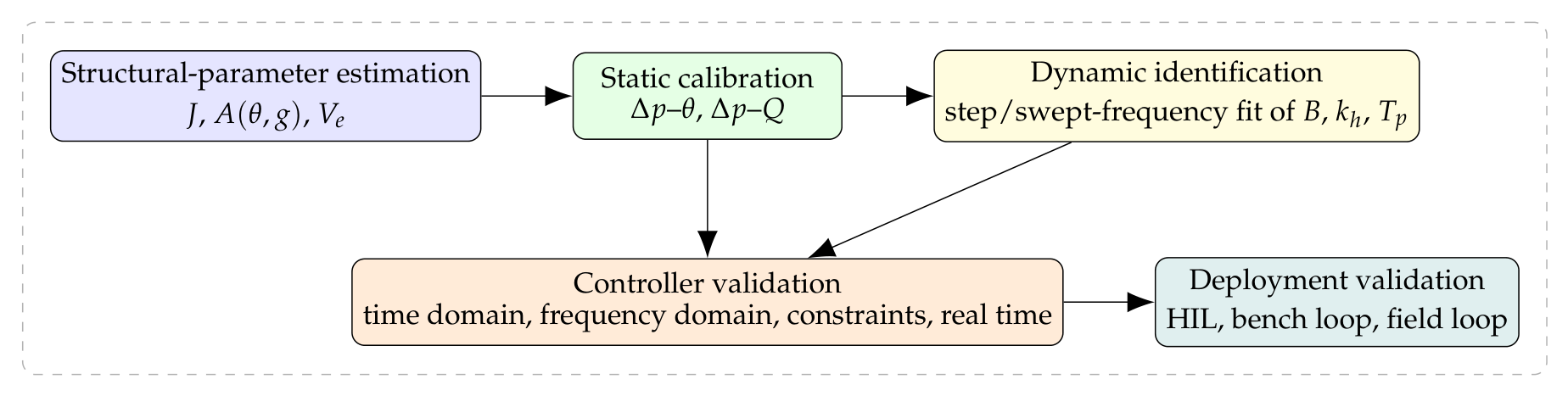
To further strengthen the evidence chain of parameter sourcing, calibration, identification, and control validation, Figure 7 presents the overall validation route of the model and controller. Figure 7 is intended to show what the present manuscript covers and what it does not yet cover: structural-parameter estimation, nominal calibration logic, dynamic-identification requirements, and simulation-based controller evaluation are discussed here, whereas bench/HIL deployment validation remains future work.
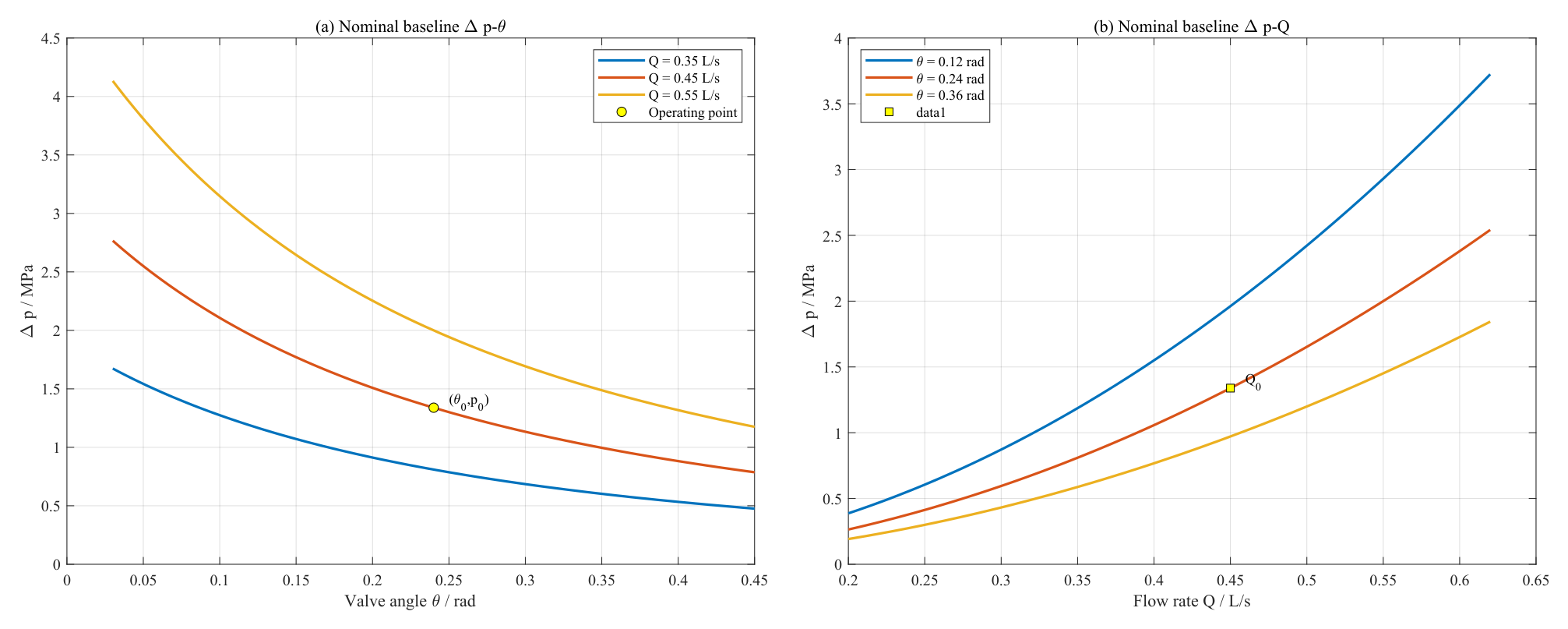
In the absence of bench measurements, Figure 8 and Figure 9 provide baseline plots generated from the nominal geometry, throttling equations, and linearized model. They are model-derived nominal baselines used for operating-point selection, uncertainty-range design, and controller-tuning reference; they are not bench-measured calibration or swept-frequency identification data. Their role is therefore to define the credibility boundary of the present simulation study rather than to claim completed hardware calibration.
Figure 8a shows that, for a given flow level, the additional pressure drop decreases monotonically as the valve angle increases and the equivalent flow area becomes larger. Figure 8b shows that, for a fixed valve angle, the additional pressure drop grows approximately quadratically with the flow rate. These model-derived curves are used to select the nominal operating point ( θ 0 , p 0 ) , to define admissible operating regions, and to motivate the uncertainty ranges later discussed in the robustness section; they are not treated as measured calibration evidence.
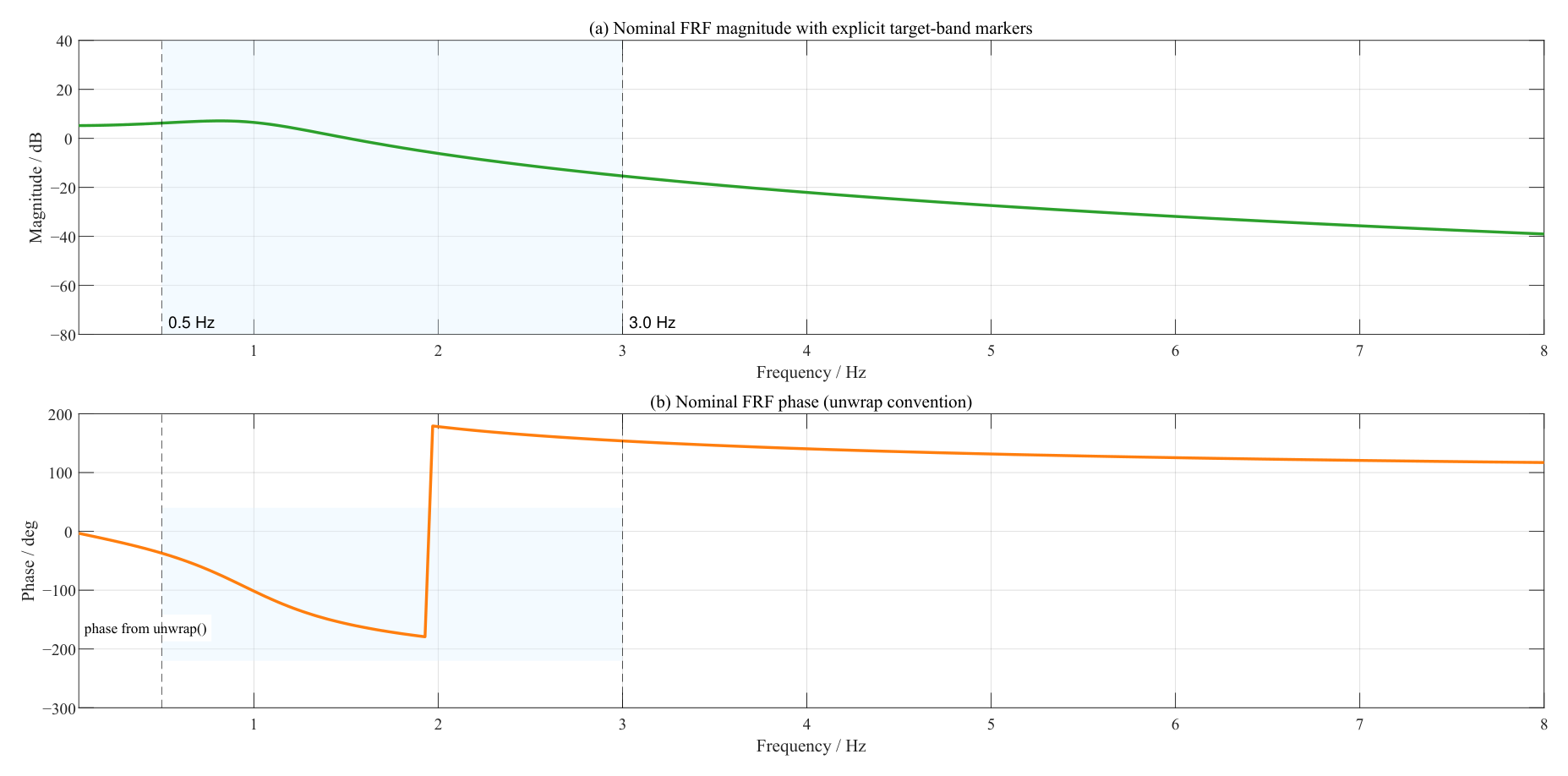
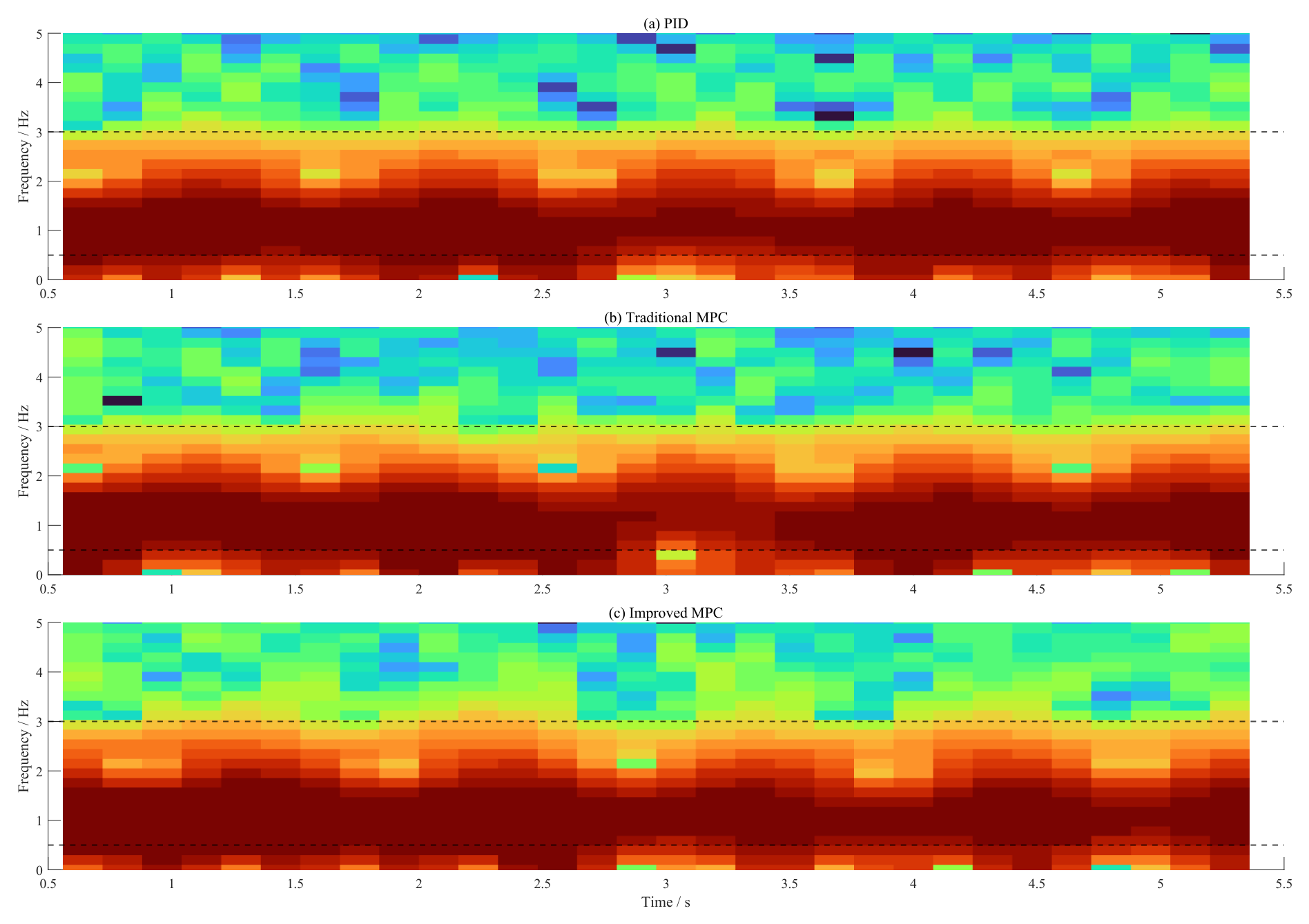
Figure 9 further gives the nominal magnitude and unwrapped-phase responses from the driving torque to the additional-pressure channel. The vertical dashed lines explicitly mark the target-band boundaries at 0.5 Hz and 3.0 Hz adopted in the pulse analysis. This model-derived baseline is used to define the controller target band and to explain the adopted small-signal validity range; it is not interpreted as a measured swept-frequency identification result. If future work extends the modulation band toward higher frequencies, the present baseline should be replaced by measured swept-frequency data so that the applicability boundary can be re-evaluated.

4.3. Step Valve-Angle Tracking Scenario

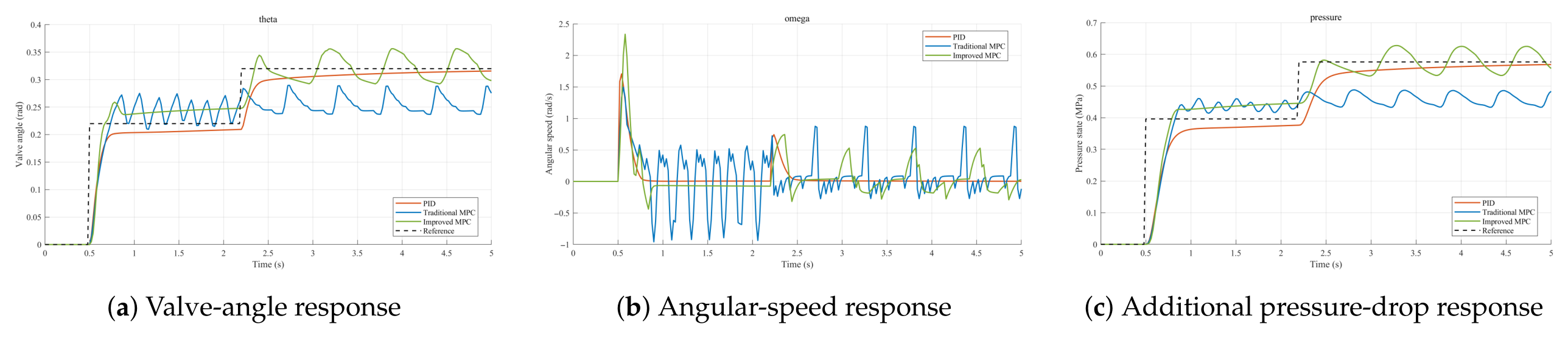
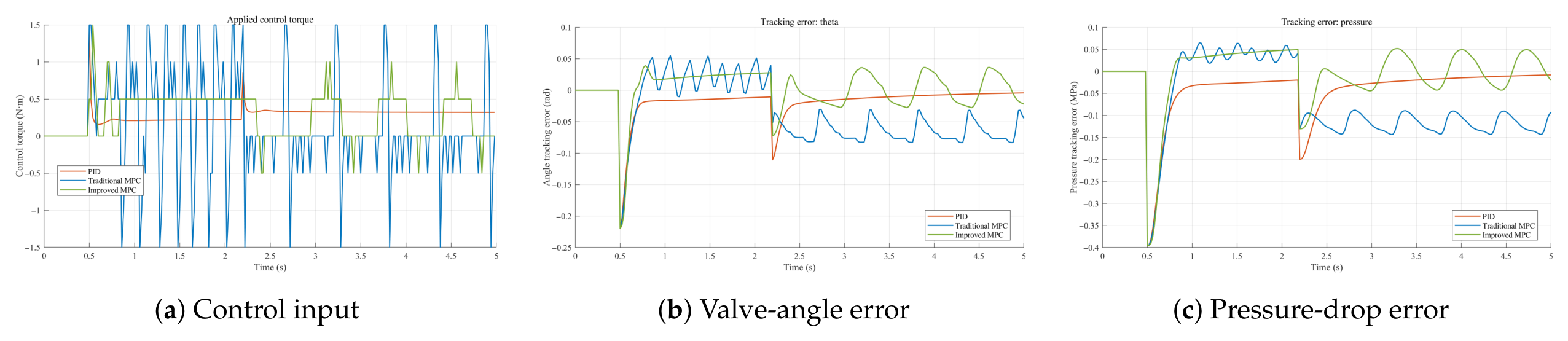
In this scenario, the reference valve angle jumps from 0 to 0.22 rad at 0.5 s and is then further raised to 0.32 rad at 2.2 s . Figure 10 and Figure 11 show that the improved MPC reduces the rise time from 2.18 s to 1.76 s relative to conventional MPC, lowers the steady-state pressure error from 0.1208 MPa to 0.0292 MPa , decreases the valve-angle IAE from 0.2424 to 0.1151 , and cuts | Δ u | from 113.0 to 17.0 .
The step case is still nominal and therefore does not fully expose the advantage of online correction; PID retains a local steady-state advantage because the operating condition is simple and the constraint activity is mild. The main implication of this scenario is therefore not that the proposed controller dominates every scalar KPI, but that it achieves a better accuracy–smoothness compromise once pressure coordination and actuator restraint are considered jointly.

4.4. Stable Pressure-Pulse Output Scenario

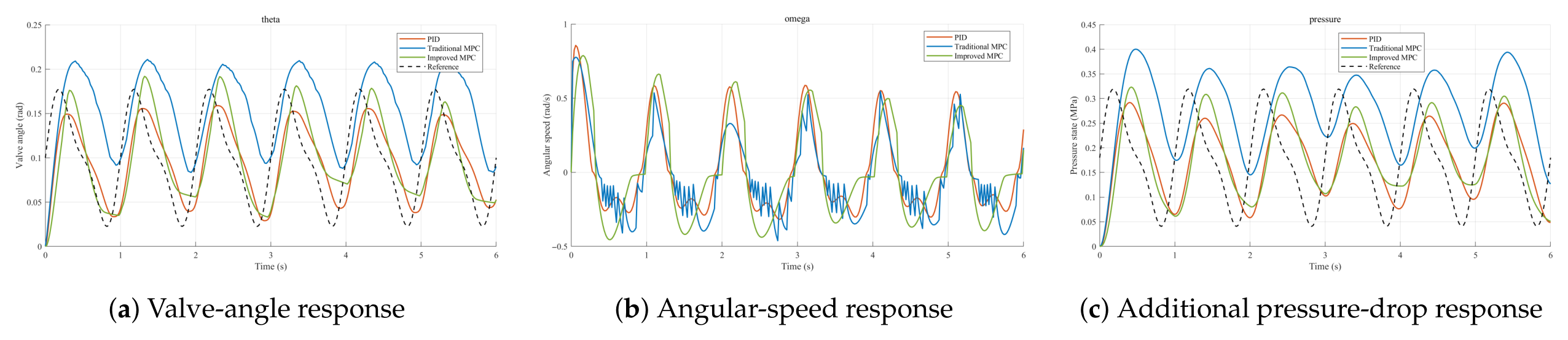
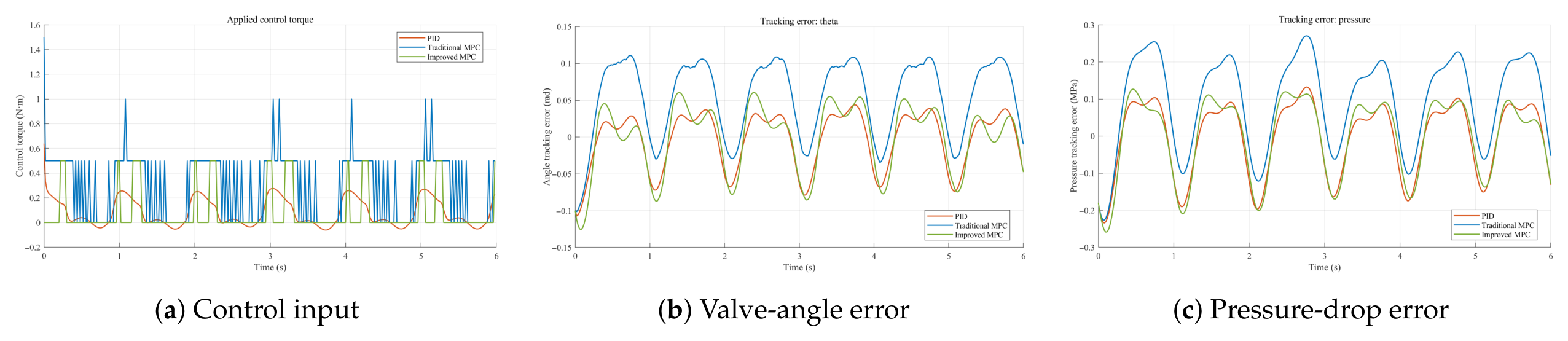
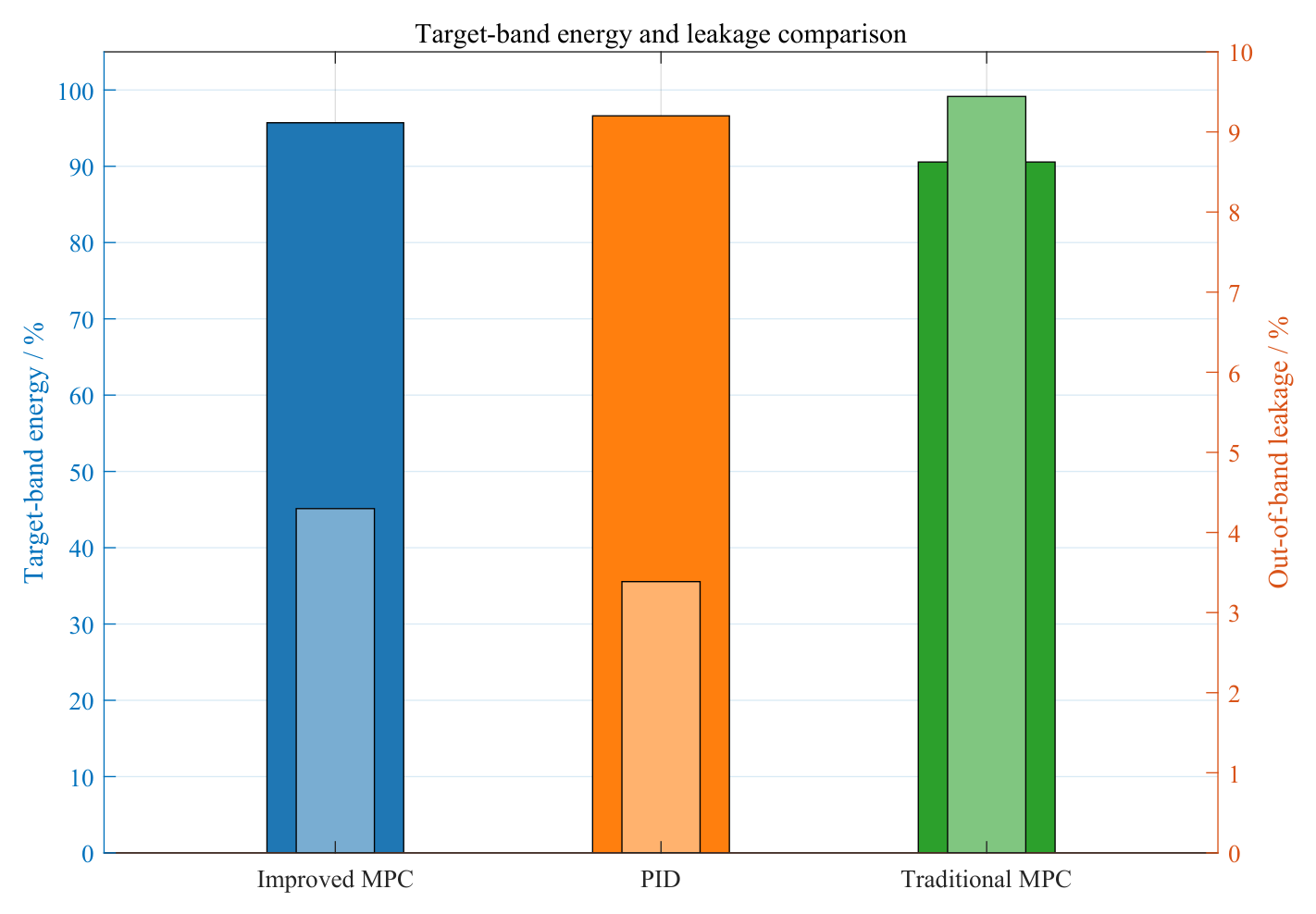
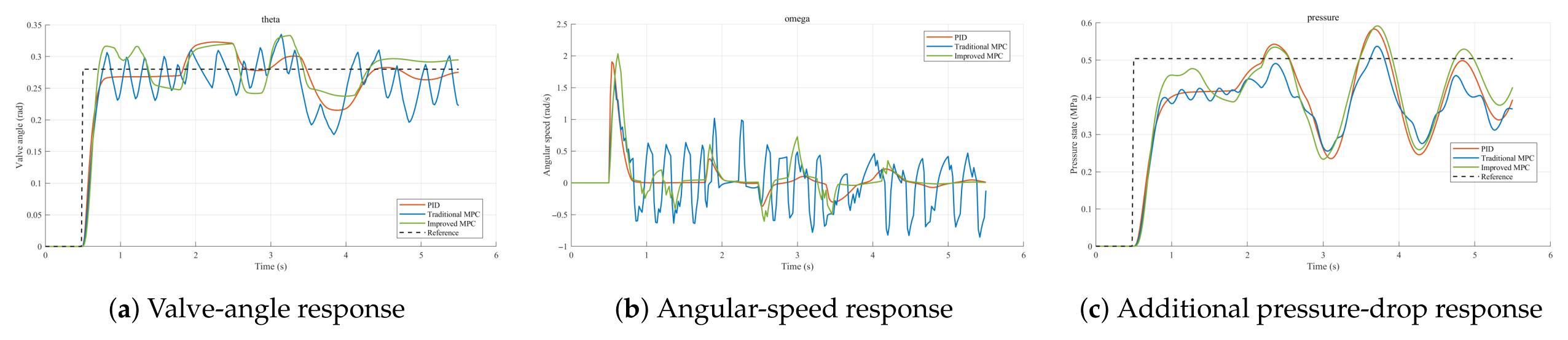
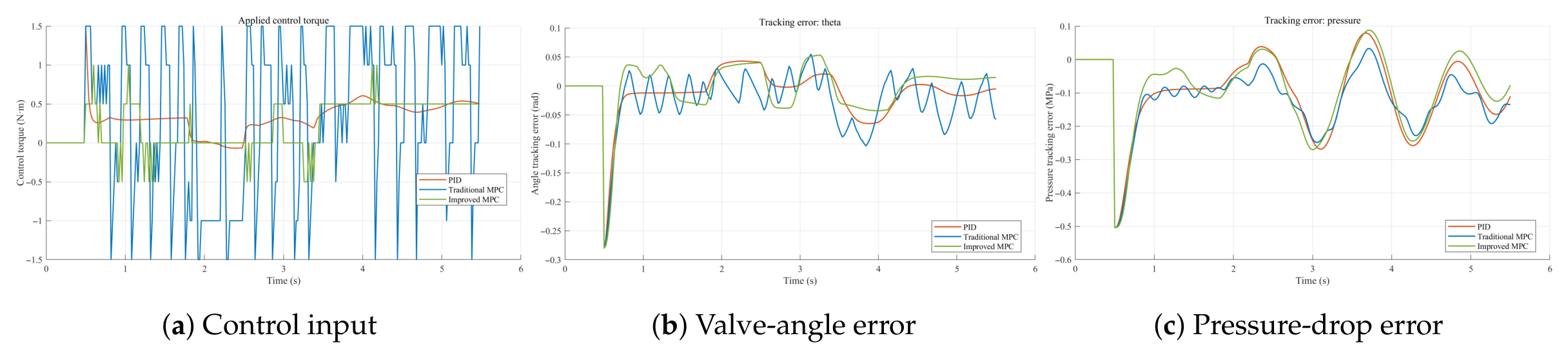
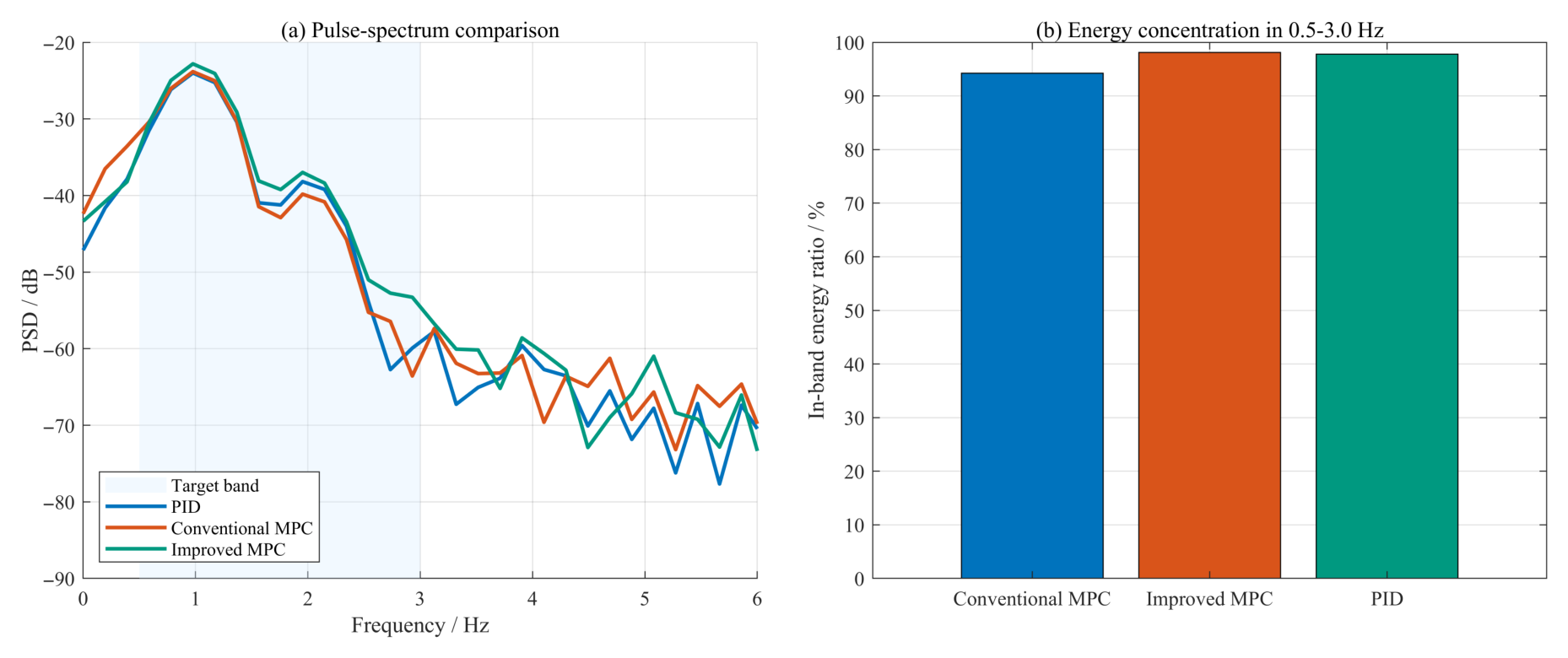
In the stable pressure-pulse output scenario, the pressure-drop reference is composed of a bias term plus two sinusoidal components to emulate continuous mud-pulse modulation. Across Figure 12, Figure 13, Figure 14, Figure 15 and Figure 16, the improved MPC shortens the valve-angle rise time to 0.18 s , lowers the steady-state pressure error to 0.0634 MPa , reduces the peak-to-peak ripple to 0.2541 MPa , and raises the target-band energy ratio to 98.11 % . Relative to conventional MPC, the steady-state pressure error decreases by about 54.97 % , the pressure-error IAE decreases from 0.8297 to 0.5473 , and the in-band to out-of-band energy ratio increases from 12.49 to 17.90 dB .
The trade-off is that the ripple RMS of the improved MPC ( 0.0873 MPa ) remains slightly higher than that of PID ( 0.0797 MPa ), so the proposed method should be interpreted as improving the overall pulse-shaping compromise rather than minimizing every ripple metric simultaneously. The time–frequency concentration and leakage results are used here only as waveform-level proxies associated with downstream decoding: no full mud-channel attenuation model, surface demodulator dynamics, BER metric, or synchronization-jitter test is included in the available simulation evidence, and Supplementary Figure S6 is provided only to document that proxy mapping explicitly.

4.5. Robustness Evidence Under Severe Mismatch and Output-Noise Proxy Analysis

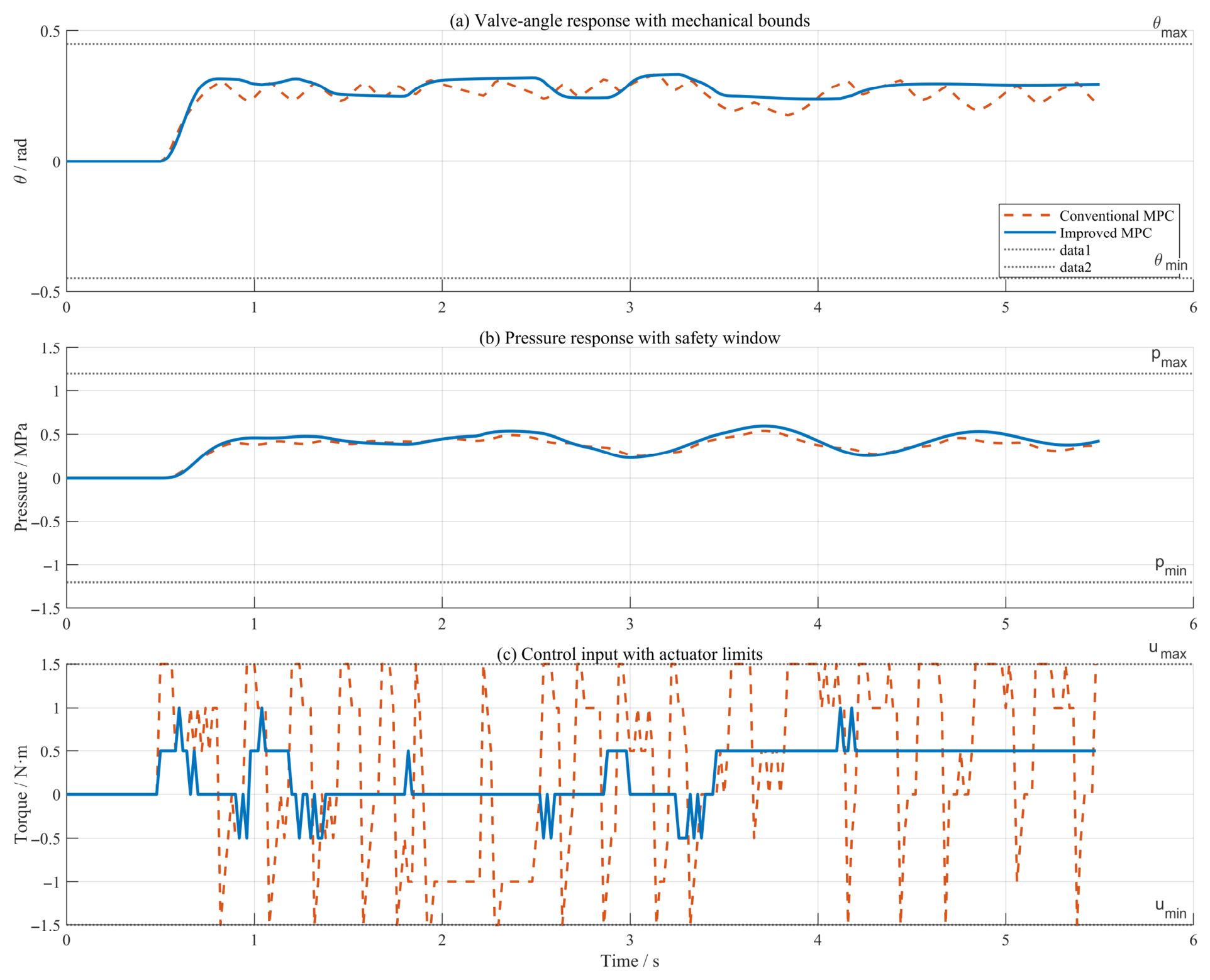
The available robustness trajectories correspond to a severe combined-mismatch case in which the effective inertia, damping coefficient, hydrodynamic-torque coefficient, and pressure-channel time constant are shifted from their nominal values while mechanical torque disturbance, inflow fluctuation, and an extra pressure disturbance are injected simultaneously. Under these tested conditions, the improved MPC shortens the rise time to 0.14 s , reduces the steady-state pressure error to 0.0606 MPa , lowers the pressure-error IAE to 0.5492 , and cuts | Δ u | to 19.5 , which is only about 16.0 % of the conventional-MPC value. Relative to conventional MPC, the steady-state pressure error decreases by about 48.83 % even though the conventional controller retains a slightly smaller ripple RMS.
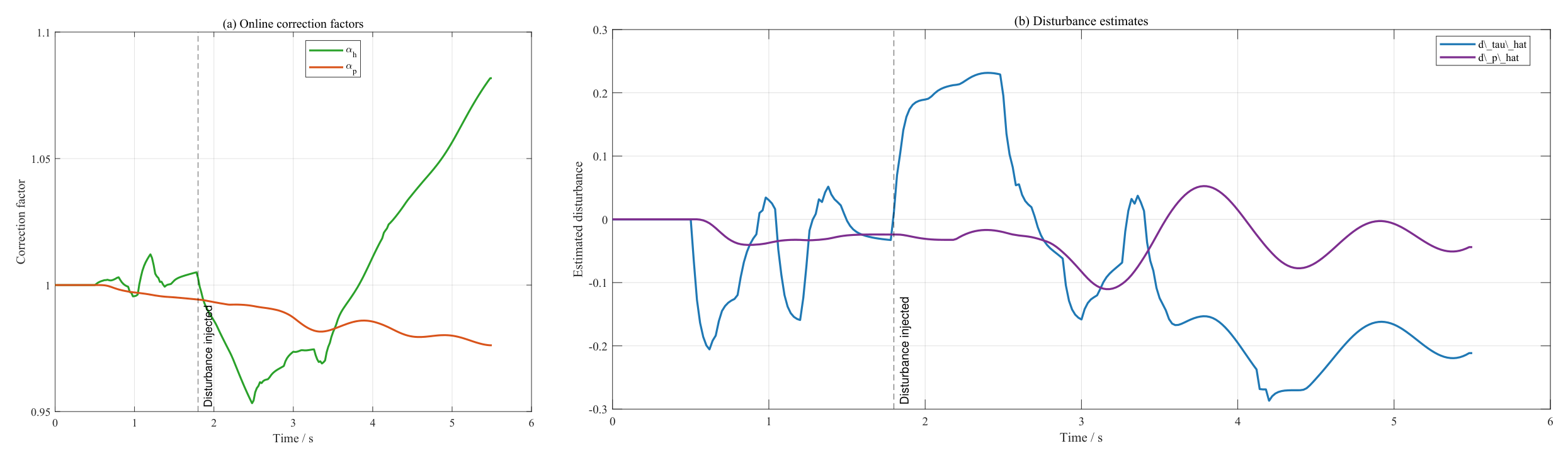
Figure 17 indicates that the controller continuity is maintained without repeated large pressure-window violations, while Figure 18, Figure 19 and Figure 20a,b show the dynamic responses, control/error comparison, correction factors, and disturbance estimates after disturbance injection. Supplementary Figure S3 adds the available two-dimensional sensitivity map over mismatch magnitude and disturbance intensity. Because only a qualitative sensitivity map is available in the present numerical dataset, that supplementary result is used for trend interpretation rather than for extracting quantitative robustness boundaries. Dedicated closed-loop measurement-noise injection over σ p and σ θ is outside the present trajectory dataset; therefore, the added noise-related evidence is limited to a descriptive pressure-envelope proxy rather than a closed-loop noise-injection test.
Dedicated closed-loop measurement-noise injection is outside the present trajectory dataset, but a derived descriptive proxy can still quantify how much pressure-error and ripple envelope is already occupied in the verified trajectories. For this purpose, the descriptive occupied envelope is defined as
Δ p occ = | e p , s s | + 3 RMS .
The resulting pressure-envelope proxy is summarized in Table 12, and the corresponding scenario-level statistics are summarized in Table 13. This derived metric supports descriptive interpretation only. It indicates how much output-side deviation is already present before hypothetical sensor noise is superposed. Smaller Δ p occ implies a larger residual measurement-noise headroom, but that headroom cannot be quantified exactly from the available summary tables because the corresponding pressure-window half-width is not tabulated.

4.6. Real-Time Complexity and Scalability

Table 13 reports only the controllers whose trajectories were numerically verified from the present simulation dataset: PID, conventional MPC, and the improved MPC. The adaptive-MPC formulation is retained as a reference formulation for complexity discussion because it shares the corrected prediction model but uses a single weighted objective. Since reproducible closed-loop trajectories under the same protocol are unavailable, it is excluded from the numerical KPI comparison. The proposed controller is not uniformly best in every nominal scalar metric, yet it consistently reduces steady-state pressure error and input variation relative to conventional MPC while keeping the observed MATLAB workstation execution times below one sampling period in all verified scenarios.
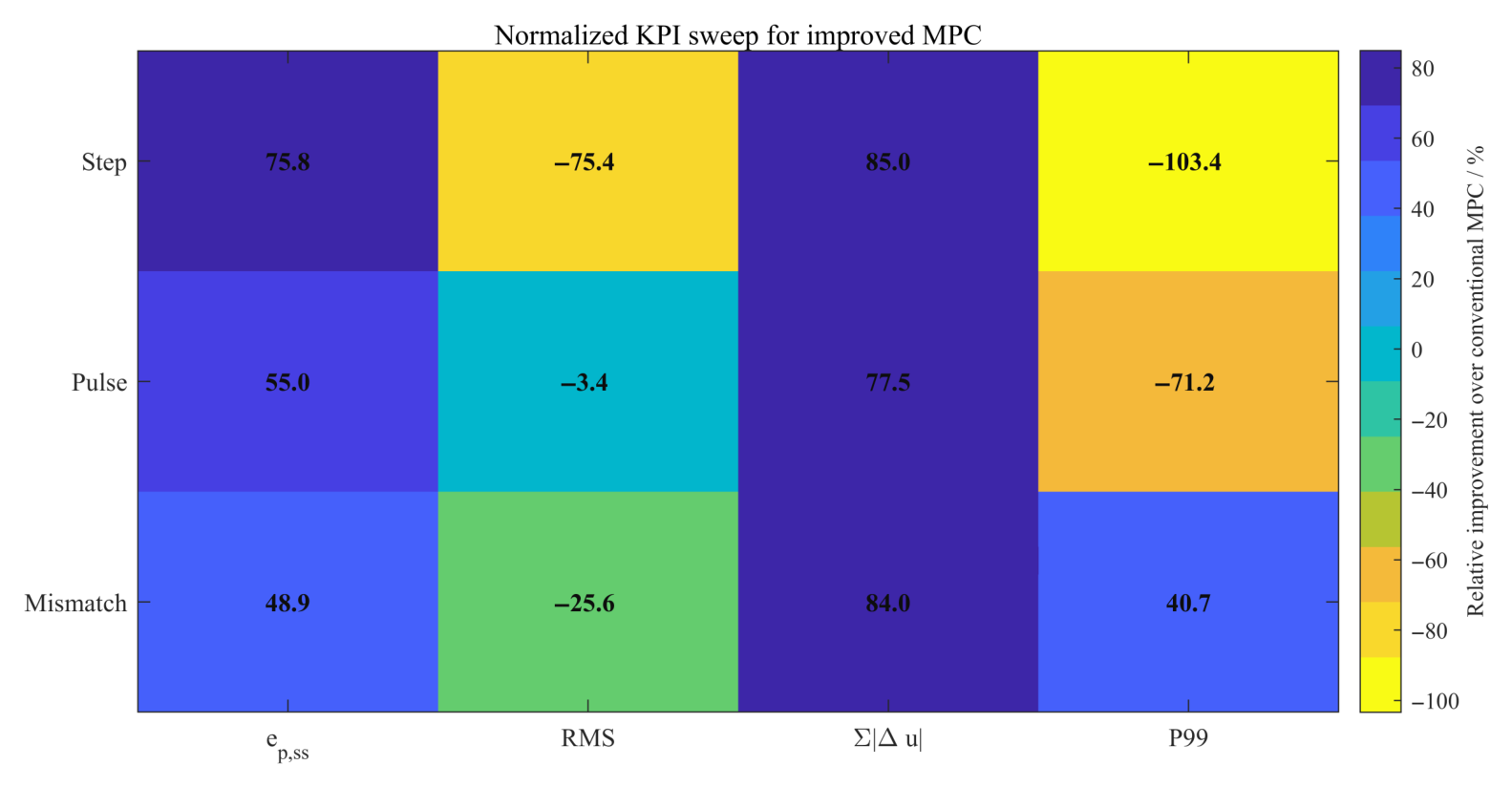
The numerical implementation settings are listed in Table 14, Table 15 and Table 16. To reduce the scanning burden caused by dense multi-panel summaries, Figure 21 reorganizes the key improvements of the improved MPC relative to conventional MPC into a single heatmap. The figure shows that the most stable gains appear in steady-state pressure error and | Δ u | , whereas the ripple RMS or the 99th-percentile computation time is not always absolutely minimal in nominal scenarios. Monte-Carlo distributions, ablation views, retained-set tolerance proxies, and candidate-rejection statistics are kept in Supplementary Figures S1, S2, S4 and S5 so that the main text remains focused on the strongest supporting evidence.
The available Monte-Carlo and ablation evidence is retained at the distribution level only. Supplementary Figure S1 shows that the improved MPC maintains a lower or near-lower distribution of steady-state pressure error than the other controllers shown in the supplementary distributions, while Supplementary Figure S2 shows that removing online correction most strongly worsens pressure regulation and removing pre-screening most strongly enlarges tail computation time. Because the present simulation dataset does not include the resampling scripts or raw trial tables needed for nonparametric hypothesis tests or confidence intervals, these observations are reported as distribution-level support rather than as formal statistical-significance claims.
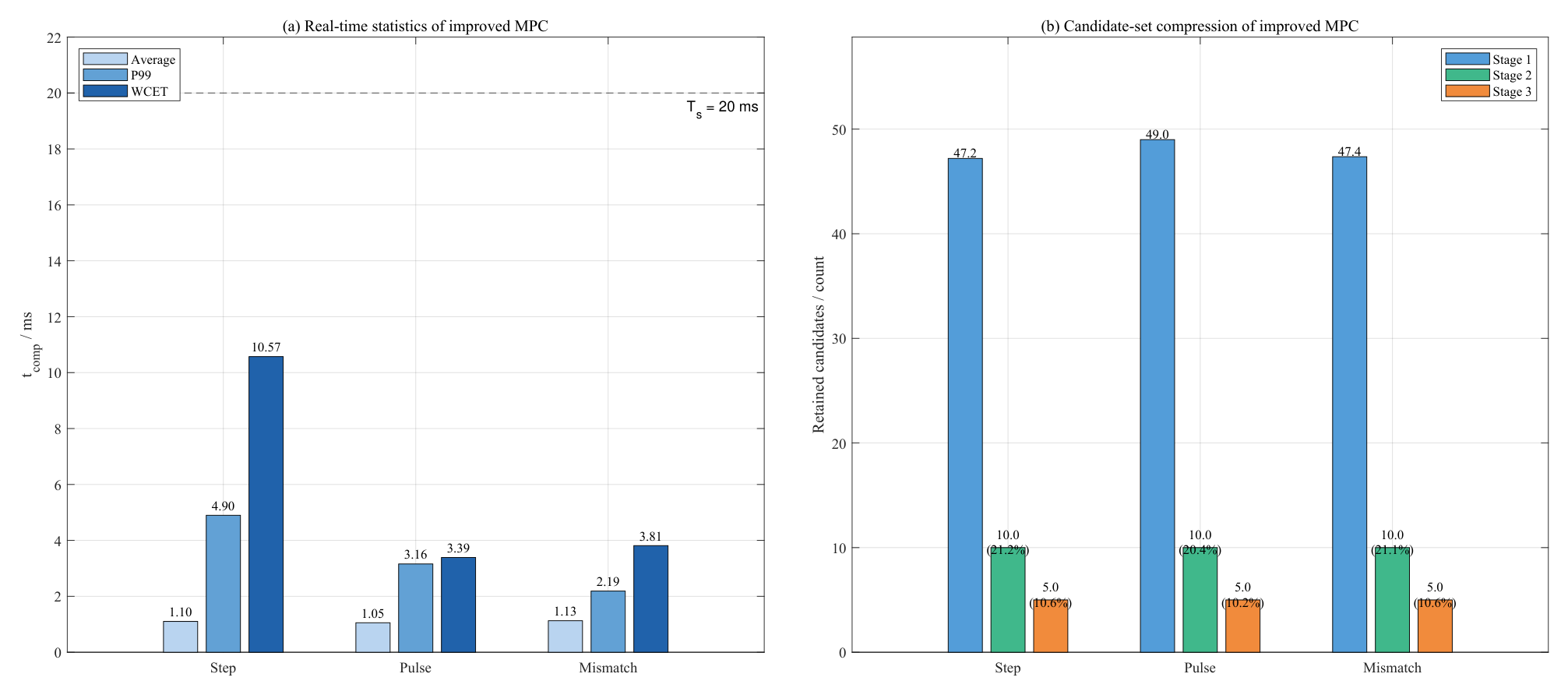
Figure 22 summarizes the mean computation time, the 99 % percentile, the WCET, and the mean candidate-set size at each stage for the improved MPC. The observed 99th-percentile times are 4.8981 ms , 3.1568 ms , and 2.1882 ms in the three verified scenarios, while the worst observed execution times are 10.5740 ms , 3.3891 ms , and 3.8136 ms . The mean number of Stage-1 candidates remains about 47–49 and is compressed to about 10 after Stage 1 filtering and to about 5 for the final selection stage, which is consistent with the upper-bound discussion of M h , M 1 , M 2 , and M 3 in Section 3.5.
To complement the MATLAB workstation timing data, an architecture-independent operation-count interpretation is added here. With n x = 3 , local branching factor b = 3 , and move-blocking depth N b , the dominant online cost remains candidate rollout and stage-wise evaluation rather than parameter updating. However, these counts do not include fixed-point scaling, cache behaviour, task scheduling, memory contention, or RTOS overhead on a target downhole processor. Certified WCET therefore remains a target-platform task rather than a conclusion of the present workstation-based timing study, and a full N p / N c horizon sweep is not included in the present simulation dataset.
Because a full tolerance sweep over ( ε 1 , ε 2 ) is not included in the present simulation dataset, the available candidate-compression data of Figure 22 are re-expressed here as a candidate-retention and timing proxy. The selected tolerances ε 1 = 0.03 and ε 2 = 0.02 are empirical near-optimality thresholds. Table 17 explains the retained-candidate ratios and timing behaviour for these selected values, but it does not establish global optimality or replace a full tolerance sensitivity sweep.
The available scenario summaries support only a descriptive scenario-level consistency analysis rather than a formal statistical-significance test. To avoid leaving the comparison purely verbal, Table 18 summarizes the relative change of the proposed controller against conventional MPC over the three verified scenarios. Negative values denote reductions relative to conventional MPC.

4.7. Telemetry-Chain Proxy Analysis and Engineering Implications

For telemetry-oriented descriptive quantification, the available in-band/out-of-band ratio is re-expressed as the spectral-purity index
SPI = 10 log 10 E target E out + ϵ num ,
where ϵ num is a small numerical constant used only to avoid a zero denominator. In the available pulse-output record, SPI coincides with the reported in-band-to-out-of-band energy ratio of that scenario. These metrics are telemetry-oriented waveform proxies and should not be interpreted as BER, synchronization-error, or channel-capacity results. The telemetry-oriented waveform proxy summary is given in Table 19.
Taken together, the results of Section 4 indicate that the engineering value of the proposed controller does not lie in achieving the absolute best value of every KPI in every nominal case. Instead, it lies in obtaining a more balanced compromise across fast valve-angle tracking, pressure-pulse shaping, input smoothness, disturbance tolerance, and online solvability. In the telemetry context, lower front-end control error and lower out-of-band leakage are interpreted only as improvements in waveform-level proxies associated with downstream decoding rather than as direct proof of better decoding performance.
The present waveform-proxy chain remains intentionally narrow. Supplementary Figure S6 documents the qualitative mapping from control error to waveform quality and then to decode-related proxies, but the present simulation dataset does not include a full mud-channel attenuation model, additive coloured pump-noise surrogate, surface demodulator dynamics, or BER computation. BER, synchronization-error statistics, and channel-capacity metrics are beyond the evidence scope of the present waveform-proxy analysis.
This limitation is also the reason why the analysis stops at proxy-level interpretation. Pump noise, channel attenuation, and demodulator dynamics are acknowledged explicitly as missing subsystems, and the HIL/bench route in the following subsection is tied directly to that gap.

4.8. Limitations and Future Validation Route

At the same time, the parameter-source and validation chain still relies mainly on nominal geometric relations, control-oriented baseline plots, available simulation figures, and closed-loop numerical statistics. Figure 8 and Figure 9 are still model-derived baselines rather than bench-measured curves, and the corresponding captions state that the key calibration baselines are not bench-measured calibration data. These derived metrics support descriptive interpretation only. They do not replace closed-loop noise-injection tests, full tolerance sweeps, BER-level telemetry validation, or target-platform WCET certification, which remain future work. The adaptive-MPC formulation is retained as a reference formulation for complexity discussion because it shares the corrected prediction model but uses a single weighted objective. Since reproducible closed-loop trajectories under the same protocol are unavailable, it is excluded from the numerical KPI comparison. The evidence should therefore be interpreted as simulation-based evidence for a rotary-valve-specific control integration, not as certification of hardware maturity.
From a reproducibility and deployment viewpoint, the KPI workflow and controller tables have been clarified, yet extrapolation to downhole hardware still requires caution. The reported mean time, 99 % percentile, and WCET reflect algorithmic timing on the MATLAB workstation implementation, and the observed timing suggests, rather than certifies, embedded feasibility. Fixed-point realization, RTOS scheduling, peripheral communication, and processor-specific WCET certification remain future tasks. Pump noise, sampling delay, quantization error, channel attenuation, and surface demodulation should also be integrated into the next bench/HIL stage before any decoding-level claim is strengthened.
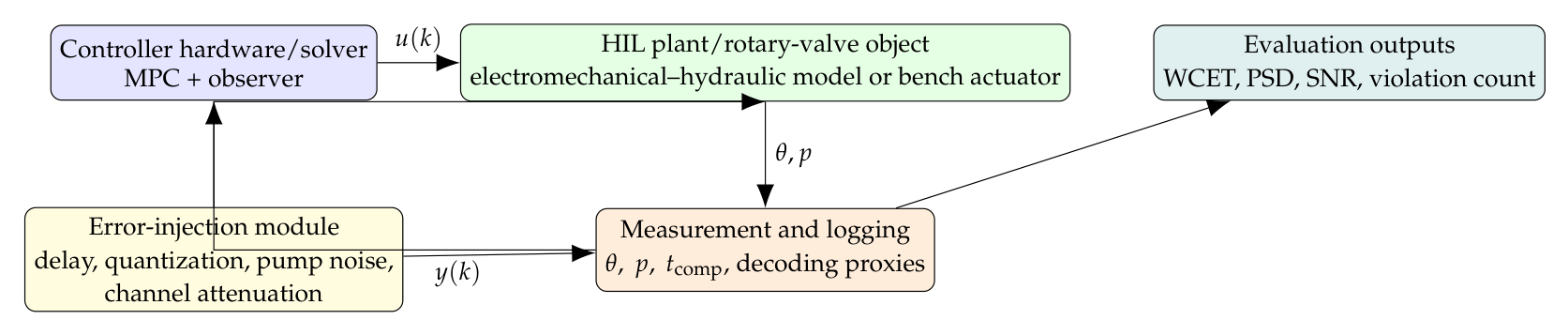
Figure 23 summarizes a deployment-oriented HIL/bench validation architecture. It places delay, quantization, pump-noise/channel modules, and WCET measurement points into the same closed-loop structure so that a unified interface is available for subsequent engineering validation.

5. Conclusions and Outlook

This study investigated real-time constrained control of an intelligent drill-bit rotary valve for mud-pulse telemetry by combining a control-oriented electromechanical–hydraulic grey-box model with online correction and a lexicographic MPC architecture.
Across the step-tracking, pulse-output, and severe-mismatch scenarios, the proposed controller reduced the steady-state pressure error from 0.1208 to 0.0292 MPa , from 0.1408 to 0.0634 MPa , and from 0.1184 to 0.0606 MPa relative to conventional MPC, while also lowering cumulative input variation from 113.0 to 17.0 , from 51.0 to 11.5 , and from 121.5 to 19.5 , respectively. The observed MATLAB workstation execution times remained below the 20 ms sampling period in all verified cases.
The main finding is not that the proposed method dominates every scalar KPI in every nominal condition, but that it provides a balanced compromise among pulse-shaping accuracy, pressure safety, disturbance tolerance, and online solvability within the tested numerical envelope. In addition to the verified scenario trajectories, the study includes descriptive analyses for pressure-envelope occupancy, candidate retention, cross-scenario effect-size consistency, and telemetry-oriented spectral purity.
The evidence remains simulation-based. Bench calibration curves, dedicated closed-loop measurement-noise injection, full tolerance sweeps, closed-loop adaptive-MPC trajectory benchmarking, target-processor WCET certification, a complete mud-pulse channel/demodulator model, BER-oriented validation, and formal recursive-feasibility/stability analysis remain future work.
Future work will therefore focus on bench/HIL validation, target-platform timing analysis, and telemetry-chain experiments using synchronization- and BER-oriented metrics.

Supplementary Materials

The supporting information can be downloaded at: https://www.mdpi.com/article/10.3390/pr14101589/s1, Figure S1: Monte-Carlo distributions; Figure S2: ablation comparison; Figure S3: mismatch–disturbance sensitivity map; Figure S4: retained-set tolerance proxy; Figure S5: candidate-rejection statistics; Figure S6: qualitative control-error-to-decoding proxy chain; Figure S7: data schema and reproducibility route.

Author Contributions

Conceptualization, X.D. and L.Y.; methodology, X.D. and Z.Z.; software, X.D.; validation, X.D., L.W., Z.Z., Y.J. and R.L.; formal analysis, X.D. and L.Y.; investigation, L.W., Z.Z., Y.J. and R.L.; resources, L.Y. and L.W.; data curation, X.D. and Z.Z.; writing—original draft preparation, X.D.; writing—review and editing, L.Y., L.W., Z.Z., Y.J. and R.L.; visualization, X.D.; supervision, L.Y.; project administration, L.Y.; funding acquisition, L.Y. and L.W. All authors have read and agreed to the published version of the manuscript.

Funding

This research was funded by the National Major Science and Technology Project for Deep Earth (DEEP) during the 14th Five-Year Plan Period of China (Grant No. 2024ZD1003504).

Data Availability Statement

The data and scripts supporting the reproducible figures and tables are available from the corresponding author upon reasonable request. Derived tables based on available simulation outputs are identified as descriptive analyses in the text. The current dataset does not include bench, HIL, or field measurements.

Acknowledgments

The authors acknowledge the support of the State Key Laboratory of Oil and Gas Reservoir Geology and Exploitation and the College of Energy Resources (Modern Industrial College of Shale Gas), Chengdu University of Technology.

Conflicts of Interest

Author Lingyun Wang was employed by the No. 10 Oil Production Plant of PetroChina Changqing Oilfield Company. The remaining authors declare that the research was conducted in the absence of any commercial or financial relationships that could be construed as a potential conflict of interest.

Abbreviations

The following abbreviations are used in this manuscript:
A-MPC    adaptive model predictive control
BERbit error rate
CADcomputer-aided design
EKFextended Kalman filter
FCS-MPCfinite-control-set model predictive control
HILhardware in the loop
IAEintegral absolute error
ITAEintegral time absolute error
KPIkey performance indicator
MPCmodel predictive control
MWDmeasurement while drilling
LWDlogging while drilling
PIDproportional–integral–derivative
PSDpower spectral density
QPquadratic programming
RMSroot mean square
RLSrecursive least squares
RTOSreal-time operating system
SMOsliding-mode observer
SNRsignal-to-noise ratio
WCETworst-case execution time
ZOHzero-order hold

References

  1. Liu, J.; Xu, M.; Switzer, D.A.; Logan, A.W. Downhole Telemetry Signal Modulation Using Pressure Pulses of Multiple Pulse Heights. U.S. Patent US20150330217A1, 19 November 2015. [Google Scholar]
  2. Jia, M.; Geng, Y.; Yan, Z.; Zeng, Q.; Wang, W.; Yue, Y. Channel Modelling and Characterization for Mud Pulse Telemetry. AEU-Int. J. Electron. Commun. 2023, 165, 154654. [Google Scholar] [CrossRef]
  3. Liang, H.; Yin, C.-C.; Su, Y.; Liu, Y.-H.; Li, J.; Gao, R.-Y.; Wang, L.-B. Fast Simulation of EM Telemetry in Vertical Drilling: A Semi-Analytical Finite-Element Method with Virtual Layering Technique. Pet. Sci. 2025, 22, 3304–3314. [Google Scholar] [CrossRef]
  4. Zhao, A.-S.; He, X.; Chen, H.; Wang, X.-M. Response Analyses on the Drill-String Channel for Logging While Drilling Telemetry. Pet. Sci. 2023, 20, 2796–2808. [Google Scholar] [CrossRef]
  5. Wang, W.; Yan, X. AI-Based Grey Wolf Chemical Optimization Approach for Energy-Efficient Downhole Telemetry Signal Demodulation toward Greener Subsurface Systems. Microchem. J. 2025, 220, 116394. [Google Scholar] [CrossRef]
  6. Jia, M.; Geng, Y.; Zeng, Q.; Wang, W.; Yue, Y. Widely Linear RLS Equalizer with Variable Forgetting Factor and UD Factorization for Mud Pulse Telemetry. AEU-Int. J. Electron. Commun. 2024, 183, 155367. [Google Scholar] [CrossRef]
  7. Zeng, Q.; Geng, Y.; Jiang, S.; Wang, W. WaveU-Net: Multi-Scale Wavelet Framework for Robust Recovery of Continuous Pressure Signals in Mud Pulse Telemetry. Digit. Signal Process. 2026, 173, 105853. [Google Scholar] [CrossRef]
  8. Zhang, J.; Sha, Z.; Wan, L.; Su, Y.; Zhu, J.; Qu, F. A Fractional Fourier Transform-Based Channel Estimation and Equalization Algorithm for Mud Pulse Telemetry. J. Mar. Sci. Eng. 2025, 13, 1468. [Google Scholar] [CrossRef]
  9. Zhang, J.; Sha, Z.; Tu, X.; Zhang, Z.; Zhu, J.; Wei, Y.; Qu, F. Noise Cancellation Method for Mud Pulse Telemetry Based on Discrete Fourier Transform. J. Mar. Sci. Eng. 2025, 13, 75. [Google Scholar] [CrossRef]
  10. Yao, X.; Huang, S.; Wang, J.; Ma, H.; Liu, T. Model Predictive Power Control of Permanent Magnet Synchronous Motor in Two-Phase Static Coordinate System. Trans. China Electrotech. Soc. 2021, 36, 60–67. [Google Scholar] [CrossRef]
  11. Yao, X.; Huang, S.; Wang, J.; Ma, H.; Liu, T.; Zhang, G. A Two-Vector-Based Model Predictive Current Control with Online Parameter Identification for PMSM Drives. Proc. Chin. Soc. Electr. Eng. 2023, 43, 9319–9329. [Google Scholar]
  12. Liu, T.; Yao, X.; Wang, J.; Kou, J. Enhanced Model Predictive Control for Induction Motor Drives in Marine Electric Power Propulsion System. J. Mar. Sci. Eng. 2024, 12, 378. [Google Scholar] [CrossRef]
  13. Liu, T.; Yao, X.; Wang, J.; Ma, C. Efficient Two-Vector-Based Sequential Model Predictive Control for IM Drives. IEEE J. Emerg. Sel. Top. Power Electron. 2024, 12, 903–912. [Google Scholar] [CrossRef]
  14. Zhai, C.; Deng, Y.; Li, W.; Xu, L.; Kang, Y.; Cao, H.; Liu, X.; Zhang, Z.; Zhang, Y. Complex Vector Disturbance Observer-Based Deadbeat Predictive Current Controller for PMSM Current Harmonics Suppression. IEEE Trans. Transp. Electrif. 2026; early access. [CrossRef]
  15. Wu, X.; Wang, Y.; Wang, N.; Xing, H.; Xie, W.; Lee, C.H.T. A Novel Double-Vector Model Predictive Current Control for PMSM with Low Computational Burden and Switching Frequency. IEEE Trans. Power Electron. 2025, 40, 11283–11295. [Google Scholar] [CrossRef]
  16. Li, X.; Yang, Y.; Sun, J.; Xiao, Y.; Fan, M.; Ni, K.; Hu, J.; Wen, H.; Yang, H.; Rodriguez, J. Multiple-Voltage-Vector Model-Free Predictive Deadbeat Control with Updated Reference Voltage Vector for PMSM Drive. IEEE Trans. Power Electron. 2025, 40, 6492–6505. [Google Scholar] [CrossRef]
  17. Zhang, Z.; Deng, Y.; Li, H.; Wang, J.; Liu, X.; Cao, H. Enhanced Model-Free Deadbeat Predictive Current Control for PMSM Drives Based on Generalized Adaptive Super-Twisting Observer. Control Eng. Pract. 2026, 166, 106611. [Google Scholar] [CrossRef]
  18. Zhang, Z.; Zhang, J.; Wu, Y.; Zhu, Z.; Chang, S. A Weighted-Free CCS Model Predictive Current Control with Implicit Modulation for DTP-PMSMs. IEEE Trans. Ind. Electron. 2025, 72, 3335–3345. [Google Scholar] [CrossRef]
  19. Zhang, X.; Cao, Y. A Simple Motor-Parameter-Free Model Predictive Current Control for PMSM Drive. IEEE Trans. Ind. Electron. 2025, 72, 3292–3302. [Google Scholar] [CrossRef]
  20. Wilhelm, R.; Engblom, J.; Ermedahl, A.; Holsti, N.; Thesing, S.; Whalley, D.; Bernat, G.; Ferdinand, C.; Heckmann, R.; Mitra, T.; et al. The Worst-Case Execution-Time Problem—Overview of Methods and Survey of Tools. ACM Trans. Embed. Comput. Syst. 2008, 7, 36. [Google Scholar] [CrossRef]
  21. American Petroleum Institute. Recommended Practice for the Rheology and Hydraulics of Oil-Well Systems: API Recommended Practice 13D; API Publishing Services: Washington, DC, USA, 2017. [Google Scholar]
Figure 1. Closed-loop control chain of the rotary valve in mud-pulse telemetry.
Processes 14 01589 g001
Figure 2. Electromechanical–hydraulic coupling and energy-flow schematic of the intelligent rotary valve. The dashed box denotes the controlled object used in this paper, namely the downhole actuation plant from the motor torque input T m to the measured outputs ( θ , p ) ; the downstream mud channel and surface demodulator are outside this boundary.
Processes 14 01589 g002
Figure 3. Model-derived contour map of the equivalent throttling area A ( θ , g ) . Positive θ increases the effective opening, whereas larger clearance g represents wear-induced geometric drift and higher leakage tendency. The plot is used to explain the controlled plant geometry and is not a bench-measured calibration surface.
Processes 14 01589 g003
Figure 4. Integrated control architecture with an estimation layer and a sequential MPC decision layer.
Processes 14 01589 g004
Figure 5. Detailed online solution workflow of the improved MPC.
Processes 14 01589 g005
Figure 6. Unified KPI-processing workflow used for all controllers. Raw logs { θ , p , u , t c o m p } are synchronized and pre-processed before time-domain, frequency-domain, constraint, and timing metrics are computed using the same definitions.
Processes 14 01589 g006
Figure 7. Validation route and evidence boundary of the present study. Structural estimation, nominal calibration, dynamic identification, and simulation-based controller evaluation are discussed here, whereas bench/HIL deployment validation remains future work.
Processes 14 01589 g007
Figure 8. Model-derived nominal (a) Δ p θ and (b) Δ p Q baselines used for operating-point selection and uncertainty-range design; these curves are not bench-measured calibration data.
Processes 14 01589 g008
Figure 9. Model-derived nominal magnitude and unwrapped-phase frequency-response baseline used to define the controller target band; this figure is not a measured swept-frequency identification result.
Processes 14 01589 g009
Figure 10. Main dynamic responses in the step valve-angle tracking scenario.
Processes 14 01589 g010
Figure 11. Control input and error comparison in the step valve-angle tracking scenario.
Processes 14 01589 g011
Figure 12. Main dynamic responses in the stable pressure-pulse output scenario.
Processes 14 01589 g012
Figure 13. Control input and error comparison in the stable pressure-pulse output scenario.
Processes 14 01589 g013
Figure 14. Spectrum and target-band (0.5–3.0 Hz) energy comparison in the pulse-output scenario.
Processes 14 01589 g014
Figure 15. Time–frequency energy distribution in the pulse-output scenario. The label “Traditional MPC” in the legacy figure denotes the conventional MPC baseline.
Processes 14 01589 g015
Figure 16. Out-of-band leakage and target-band energy ratio in the pulse-output scenario. The label “Traditional MPC” in the legacy figure denotes the conventional MPC baseline.
Processes 14 01589 g016
Figure 17. Overlay of key variables and constraint windows in the mismatch–disturbance scenario.
Processes 14 01589 g017
Figure 18. Main dynamic responses in the mismatch–disturbance scenario.
Processes 14 01589 g018
Figure 19. Control input and error comparison in the mismatch–disturbance scenario.
Processes 14 01589 g019
Figure 20. Trajectories of the online correction factors γ h and γ p and of the disturbance estimates d ^ τ and d ^ p in the mismatch–disturbance scenario.
Processes 14 01589 g020
Figure 21. Normalized KPI-improvement heatmap of the improved MPC relative to conventional MPC.
Processes 14 01589 g021
Figure 22. Real-time statistics and candidate-set compression of the improved MPC.
Processes 14 01589 g022
Figure 23. Planned HIL and bench-validation platform structure.
Processes 14 01589 g023
Table 1. Condensed related-work map and remaining rotary-valve-specific gaps.
Research Stream/Representative Refs.Main FocusRemaining Gap for Rotary-Valve Mud-Pulse ControlHow This Study Responds
Mud-pulse channel and drill-string responseChannel modelling and propagation responseDoes not model actuator-side valve dynamics or constrained front-end waveform generation.Introduces a control-oriented rotary-valve actuation plant model and waveform-oriented pressure-pulse control metrics.
Surface demodulation and signal recoveryDenoising, recovery, equalization, and target-band fidelityDoes not close the loop from valve-control errors to telemetry decoding.Limits the present claim to waveform-level proxies and identifies BER/synchronization metrics as future work.
Predictive motor/actuator control with identification [14]MPC, parameter identification, and disturbance compensationDoes not include rotary-valve hydraulics, clearance/wear drift, and pressure safety windows.Integrates grey-box hydraulic loading, wear/clearance terms, and online correction/compensation in one rotary-valve formulation.
Sequential and low-complexity MPC [15,16,17]Reduced tuning burden, candidate/vector reduction, and online implementationIs not tailored to finite candidate inputs and a 20 ms pressure-pulse control budget.Proposes finite-candidate lexicographic MPC with candidate pre-screening, move blocking, and complexity reporting.
Table 2. Controlled-object boundary and variables used in the MPC formulation.
CategorySymbolPhysical MeaningRole in ControlStatus
Manipulated variable T m , Δ T m Motor torque or torque incrementControl action generated by the controllerscheduled
Controlled outputs θ , p Valve angle and local pressure dropTracked outputs and safety-window variablesmeasured
Internal states θ , ω , p Valve angle, angular speed, and pressure dropPredicted states in the corrected MPC modelestimated
External disturbances q i n , d τ , d p Inflow fluctuation and lumped disturbancesExogenous uncertainty acting on the plantdisturbed
Slow-varying parameters g , C d , B e q ,
k h , T p
Clearance, discharge coefficient, damping, coupling, and time constantScheduled or corrected plant quantitiesscheduled
Inside plant modelMotor/drive mechanics, throttling leakage, pressure loading, and wear stateIncluded in the grey-box prediction modelinside
Outside plant modelMud channel,
surface demodulator,
telemetry receiverTransmission and downstream decoding chainProxy-level discussion onlyoutside
Table 3. Main symbols used in the plant and controller formulation.
SymbolMeaningRole/Unit
T m , Δ T m Motor torque and torque incrementManipulated variable
θ , ω , p Valve angle, angular speed, additional pressure dropStates/outputs
A ( θ , g ) Equivalent throttling areaGeometry-derived plant nonlinearity
q i n , q v , q leak Inflow, throttling flow, leakage flowHydraulic balance terms
g , C d Clearance/wear state and discharge coefficientSlow-varying plant parameters
B e q , k h , T p Equivalent damping, hydrodynamic-torque coefficient, pressure time constantCorrected prediction-model parameters
N p , N c , N b Prediction horizon, control horizon, move-blocking depthMPC structural settings
M ( k ) , M h ,
M 1 , M 2 , M 3
Candidate counts before and after filteringComplexity-tracking quantities
ε 1 ,
ε 2
Near-optimality tolerances for Stages 1 and 2Lexicographic retention thresholds
Table 4. Comparison of disturbance and parameter compensation schemes.
SchemeCore IdeaAdvantagesLimitationsInputs/Rate
Augmented EKF + feedforward compensationTreats disturbance d as an augmented random-walk state and jointly estimates ϑ , then updates the prediction model and feedforward termGood noise tolerance, can track slow drift, naturally coupled with MPCRequires covariance tuning and heavier matrix operationsSampling at T s or faster; measurements θ , p
Sliding-mode observer + adaptive gainRapidly estimates matched disturbances online and compensates them, while adapting gains to reduce chatteringStrong robustness and relatively low computational costBoundary-layer and gain design strongly affect accuracy; anti-chattering treatment is requiredSampling at T s ; measurements θ , p
Table 5. Comparison of low-complexity MPC variants for the rotary-valve scenario.
VariantAdvantagesLimitationsComplexityUse Case
FCS-MPC (enumerative)No QP solver is required and embedded implementation is straightforwardEnumeration grows with M and N p and remains sensitive to model mismatchMediumFeasible at roughly T s = 20 ms ; suitable for finite candidate inputs
Multi-/double-vector sequential MPCLower output ripple and naturally compatible with sequential evaluationRequires additional vector or duty-ratio allocation and is therefore more complexMedium–highMore suitable for high-dynamic drive scenarios
Fast QP-MPC (linear MPC)Smoother continuous control and access to embedded solversRelies on a linearized model and an online QP solverMediumCommon in low-frequency outer loops around 50– 200 Hz ; can be combined with acados/FORCES
Table 6. Controller-level complexity scaling used in the complexity discussion.
ControllerDecision StructureComplexity Upper BoundDependence on N p , N c , M ( k ) Practical Implication
PIDFixed feedback law O ( 1 ) Independent of N p , N c , and  M ( k ) Lowest online burden but no predictive constraint coordination.
Conventional MPCSingle weighted objective over all raw candidates O ( M raw N p n x 2 ) Grows directly with N p and the full candidate countSensitive to candidate explosion when the horizon or branching depth increases.
Adaptive-MPC reference formulationCorrected prediction model plus single weighted objective O ( n ϑ 2 +
M raw N p n x 2 )
Adds parameter-update cost but still evaluates all raw candidates.Retained only for complexity discussion because reproducible closed-loop trajectories under the same protocol are unavailable for numerical summary. It isolates online correction from staged decision filtering.
Proposed lexicographic MPCCorrected prediction model plus staged filtering and final smoothness selection O ( n ϑ 2 +
M h N p n x 2 + M 1 N p +
M 2 N p + M 3 N c )
Depends on the retained candidate counts rather than the full raw set alone.Candidate compression reduces tail-time risk while preserving explicit stage priorities.
Table 7. Simulation KPIs and their engineering meanings.
DimensionMain KPIsEngineering Meaning
Dynamic performance t r , t s , e θ , s s , IAE/ITAECharacterizes how fast the rotary valve moves from command tracking to stable holding, together with the accumulated tracking deviation
Pulse-shaping quality e p , s s , peak-to-peak ripple, ripple RMS, target-band energyCharacterizes pressure-pulse amplitude stability and the waveform proxies associated with downstream decoding
Constraints and actuation smoothnessviolation count, maximum violation magnitude, | Δ u | , | Δ 2 u | Characterizes actuator shock, constraint consistency, and lifetime friendliness
Real-time performancemean time, 99 % percentile, WCET, η rt Characterizes the ability of the control algorithm to complete online optimization within one sampling period
Table 8. Controller settings and evidence status in the present study.
ControllerDecision StructureModel Update, Constraints, and EvidenceMain Role
PIDNo pre-screening and no sequential evaluation.No online correction; same constraints and sampling period as the other verified controllers; reported numerically.Low-complexity baseline reflecting the capability of conventional servo control.
Conventional MPCSingle weighted MPC cost without pre-screening or sequential evaluation.No online correction; same constraints and sampling period as the proposed controller; reported numerically.Baseline for predictive constrained control with one global objective.
Adaptive MPCSame single weighted decision structure as conventional MPC.Uses the corrected prediction model and the same constraints/sampling budget as the proposed controller, but is retained only as a reference formulation for complexity discussion because reproducible closed-loop trajectories under the same protocol are unavailable.Reference formulation used to isolate the contribution of online correction from that of the lexicographic decision layer; excluded from the numerical KPI comparison.
Improved MPCCandidate pre-screening followed by sequential lexicographic evaluation.Includes online correction/compensation and shares the same constraints and sampling period; reported numerically.Full method of this work, used to validate reduced search burden and mismatch robustness.
Table 9. Parameter identification routes and current evidence status.
ParameterNominal StatusUnitIdentification RouteRequired ProtocolEvidence Status
JInternal nominal kg · m 2 CAD/inertia calculationRotor/drive inertia reconstruction or torque-step fitSimulation only; no bench identification curve.
BInternal nominal N · m · s
/ rad
Free-decay identificationFree-spin or no-load decay testSimulation only; no measured decay trace.
T c Internal nominal N · m Low-speed friction fitLow-speed reversal/stiction testModel term retained; no standalone bench curve.
k h Internal nominalLinearized fit/identificationPressure-loading or torque-balance fit near the operating pointCorrected online in simulation; no bench fit.
C d Internal nominal Δ p Q calibrationStatic flow/pressure calibrationRepresented only by model-derived nominal baselines.
A ( θ , g ) Geometry-derived lookup surface m 2 Structural geometry plus calibration logicStatic Δ p θ calibration over the admissible angle rangeModel-derived nominal map only.
V e Internal nominal m 3 Chamber estimationGeometry/volume estimateSimulation only.
β e Internal nominal Pa Fluid-property estimationMud-property characterizationSimulation only.
gNominal clearance state around g 0 m Manufacturing tolerance/wear estimateTolerance measurement or wear inspectionSlow-varying state only; no bench wear dataset.
T p Internal nominal; not tabulated s Step-response fit/continuity-model fitPressure step or swept-frequency fitCorrected online in simulation; no measured fit.
Table 10. Uncertainty ranges and sensitivity coverage.
ParameterUncertainty/Sensitivity CoverageEvidence SourceRemaining Gap
J , B , k h , T p Included in the present mismatch proxy up to 30 % with disturbance-intensity variation in Supplementary Figure S3.Available qualitative sensitivity map plus corrected-model runs.The present simulation dataset does not include a reproducible sweep script for regeneration or extension beyond the released grid.
T c Not swept separately in the present simulation dataset.Friction term retained in the grey-box model.No dedicated low-speed friction identification or tolerance study is reported.
C d Not swept separately; implicitly embedded in the nominal static baselines.Model-derived Δ p θ and Δ p Q baselines in the static-calibration plotBench calibration data are unavailable, so the credibility boundary remains simulation based.
A ( θ , g ) and gClearance and wear effects are represented qualitatively through the nominal map and robustness discussion.Figure 3 plus the nominal geometric model.No released numeric wear sweep or bench wear progression dataset is available.
V e , β e Not swept separately in the present simulation dataset.Internal nominal simulation set.Fluid-property uncertainty under realistic mud conditions remains to be characterized experimentally.
Static-calibration and FRF baselinesUsed for operating-point selection, uncertainty-range design, and controller-tuning reference.Model-derived nominal baselines, not bench-measured calibration curves.These figures define the evidence boundary of the present simulation study rather than completed hardware calibration.
Table 11. Comparison of online identification methods for key rotary-valve parameters.
MethodEstimated QuantitiesAdvantagesLimitationsComplexitySuitable Scenario
Augmented EKF x + { B , k h , T p } Stronger noise tolerance and able to track parameter driftMore complex tuning and covariance designMedium–highSignificant noise and joint estimation required
RLS { B , k h , T p } Lower computation and suitable for online implementationMore sensitive to excitation and regressor conditionsMediumLimited computation and slowly varying parameters
Table 12. Pressure-envelope proxy under hypothetical output noise.
ScenarioConventional MPC Δ p occ /MPaImproved MPC Δ p occ /MPaRelative ChangeInterpretation
Step tracking0.17600.1261 28.35 % Smaller occupied envelope despite a larger RMS value, because the steady-state pressure bias is much lower.
Pulse output0.39400.3253 17.44 % Leaves more output-side envelope before hypothetical measurement noise is superposed on the available waveform.
Mismatch + disturbance0.25250.2292 9.23 % Shows a narrower pressure-error envelope even in the severe mismatch case.
Table 13. Summary statistics for numerically verified controllers across the three scenarios.
Controller t r /s e p , ss
MPa
RMS
MPa
| Δ u | Viol.P99
ms
WCET
ms
Step tracking
PID1.840.01020.00133.999100.28332.2015
Conventional
MPC
2.180.12080.0184113.002.407837.0310
Improved
MPC
1.760.02920.032317.004.898110.5740
Pulse output
PID0.260.07290.07974.356500.07370.2172
Conventional
MPC
1.340.14080.084451.001.84374.1552
Improved
MPC
0.180.06340.087311.503.15683.3891
Mismatch + disturbance
PID0.200.08670.05964.608100.04910.1030
Conventional
MPC
0.200.11840.0447121.503.69263.7723
Improved
MPC
0.140.06060.056219.502.18823.8136
The adaptive-MPC formulation is retained as a reference formulation for complexity discussion because it shares the corrected prediction model but uses a single weighted objective. Since reproducible closed-loop trajectories under the same protocol are unavailable, it is excluded from the numerical KPI comparison.
Table 14. Sampling and horizon settings used in the numerical implementation.
SettingValue SummaryNote
Sampling period T s PID/conventional MPC/adaptive-MPC reference/improved MPC: 20 ms All controllers share the same sampling period.
Prediction horizon N p Conventional MPC/adaptive-MPC reference/improved MPC: 8The MPC-type controllers are defined on the same prediction horizon.
Control horizon N c Conventional MPC/adaptive-MPC reference/improved MPC: 4Shared control horizon in the implementation settings used in the simulations.
Admissible input levelsConventional MPC/adaptive-MPC reference/improved MPC: 7 levels in [ u min , u max ] The implementation uses the same quantized input grid for the three MPC-type controllers.
Table 15. Baseline controller gains and objective weights.
Setting/ControllerValueNote
PID main-loop gains (PID) { K p θ , K i θ , K d θ }
= ( 4.8 , 2.4 , 0.55 )
Low-complexity valve-angle reference loop.
PID pressure-loop gains (PID) { K p p , K i p }
= ( 0.85 , 0.45 )
Pressure-servo baseline.
Objective weights (conventional MPC) ( w θ , w ω , w p , w p s , w Δ u , w Δ 2 u )
= ( 120 , 2.5 , 50 , 30 , 0.10 , 0.03 )
One weighted objective over the raw candidate set.
Objective weights (adaptive-MPC reference)Defined reference formulation;
to be re-tuned on the corrected model
when scripts are available
No numerical values are reported because reproducible closed-loop trajectory data are unavailable for this comparator.
Intra-stage scales (improved MPC) ( w θ , w ω , w p , w p s , w Δ u , w Δ 2 u )
= ( 120 , 2.0 , 60 , 35 , 0.08 , 0.02 )
Lexicographic prioritization keeps only a small set of intra-stage scales.
Table 16. Online correction and lexicographic settings.
SettingValueNote
Retained scales
(improved MPC)
( M 1 , M 2 , M 3 )
= ( 10 , 5 , 1 )
Only the improved MPC uses stage-wise candidate retention.
Lexicographic tolerances
(improved MPC)
( ε 1 , ε 2 )
= ( 0.03 , 0.02 )
Empirical near-optimality thresholds; a full tolerance sweep is not included in the present simulation dataset.
Correction gains
(adaptive-MPC reference)
Same corrected-model
update law as the
proposed controller
(defined only)
States the intended update mechanism of the adaptive-MPC reference formulation.
Correction gains
(improved MPC)
( γ h , γ p , l τ , l p )
= ( 0.04 , 0.03 , 0.28 , 0.24 )
Hydrodynamic, pressure, and disturbance-estimation updates.
Table 17. Candidate-retention and timing proxy for the selected lexicographic tolerances.
ScenarioObserved M h Observed M 1 Observed M 2 M 1 / M h M 2 / M h P99/msWCET/ms
Step tracking47.210.05.0 21.2 % 10.6 % 4.898110.5740
Pulse output49.010.05.0 20.4 % 10.2 % 3.15683.3891
Mismatch + disturbance47.410.05.0 21.1 % 10.6 % 2.18823.8136
The observed stage counts in Figure 22 correspond to M h , M 1 , and M 2 ; the final selected control is one element after Stage 3. This proxy is descriptive and does not replace a full tolerance sensitivity sweep.
Table 18. Scenario-level descriptive effect-size consistency relative to conventional MPC.
MetricStepPulseMismatchMedian Relative ChangeDirection Consistency
e p , s s 75.8 % 55.0 % 48.8 % 55.0 % 3/3 lower
| Δ u | 85.0 % 77.5 % 84.0 % 84.0 % 3/3 lower
t r 19.3 % 86.6 % 30.0 % 30.0 % 3/3 lower
RMS + 75.5 % + 3.4 % + 25.7 % + 25.7 % 3/3 higher
Table 19. Telemetry-oriented waveform proxy summary from available simulation outputs.
MetricAvailable Numerical ProxyInterpretationLimitation
Steady-state pressure error e p , s s Pulse-output scenario: 0.1408 0.0634 MPa ; mismatch scenario: 0.1184 0.0606 MPa Smaller pressure bias leaves a larger waveform-amplitude reserve before any additional output perturbation is superposed.No full channel attenuation or standpipe transfer model is included.
Ripple RMS/peak-to-peak rippleImproved MPC pulse output: RMS = 0.0873 MPa , peak-to-peak ripple = 0.2541 MPa Quantifies waveform fluctuation and template distortion at the valve outlet only.No synchronization-error statistic is reported.
Target-band energy/SPIImproved MPC target-band energy ratio = 98.11 % ; SPI = 17.90 dB versus 12.49 dB for conventional MPCIndicates stronger concentration in the 0.5 3.0 Hz target band and a descriptive SPI gain of 5.41 dB in the available pulse outputs.These metrics are not BER, synchronization-error, or channel-capacity results.
Input smoothness | Δ u | Pulse-output scenario: 51.0 11.5 Lower input variation acts as a jitter-oriented actuator proxy for pulse-edge regularity.No demodulator model or timing-jitter statistic is included.
These telemetry-oriented waveform proxies support descriptive interpretation only. They should not be interpreted as synchronization-error or channel-capacity results.
Disclaimer/Publisher’s Note: The statements, opinions and data contained in all publications are solely those of the individual author(s) and contributor(s) and not of MDPI and/or the editor(s). MDPI and/or the editor(s) disclaim responsibility for any injury to people or property resulting from any ideas, methods, instructions or products referred to in the content.