Article

Green Deep Eutectic Solvent-Pretreated Lignin and CNC-Anchored ZnO Form High-Transmittance Films for UV Shielding and Food Preservation

1
Hubei Provincial Key Laboratory of Green Materials for Light Industry, Hubei University of Technology, Wuhan 430068, China
2
Hubei Key Laboratory of Agricultural Waste Resource Utilization, School of Chemical and Environmental Engineering, Wuhan Polytechnic University, Wuhan 430023, China
*
Authors to whom correspondence should be addressed.
Processes 2026, 14(10), 1528; https://doi.org/10.3390/pr14101528
Submission received: 28 February 2026 / Revised: 16 March 2026 / Accepted: 19 March 2026 / Published: 9 May 2026
(This article belongs to the Section Materials Processes)

Abstract

The application of lignin-based films is often restricted by traditional processing methods that rely on toxic organic solvents and harsh chemical reagents, which result in poor compatibility with the polymer matrix and difficulty balancing transparency, barrier, and toughness. Here, lignin was green-modified by ternary deep eutectic solvent (choline chloride-lactic acid-ethanol), and ZnO hybrids with cellulose nanocrystals (CNC) as anchor points were introduced to realize the stability and uniform dispersion of ZnO in the polyvinyl alcohol (PVA) matrix. The prepared composite film maintains a transmittance of about 78% at 800 nm while achieving a wide spectrum of ultraviolet shielding. The barrier properties of the film were markedly improved: the water vapor permeability (WVP) decreased to 0.24 × 10⁻⁷ g·m−1·h−1·Pa−1, and the oxygen permeability (OTR) to 6.98 cm3·m−2·24 h−1·0.1 MPa−1. In addition, the mechanical flexibility and durability of the material were significantly improved, as evidenced by a tensile strain of 109%. In the insurance experiment, compared with the blank film, the browning degree and weight loss of the composite film were relatively low. The scalable and low-solvent consumption route provides a practical idea for the application of lignin in food preservation.

1. Introduction

To reduce reliance on fossil fuels and mitigate their environmental impacts, it is crucial to produce chemicals and materials from renewable resources to replace petroleum-derived products [1,2]. Among potential alternatives, lignin is the most abundant natural aromatic biopolymer, accounting for 15–35% of lignocellulosic biomass, and is considered the only renewable resource capable of supplying polyphenols and other important chemical feedstocks [3,4]. Although the pulp and bioethanol industry produces nearly 100 million tons of lignin byproduct per year, about 98% of it is still burned as low-value energy, which highlights the urgency and potential of high-value utilization of lignin in sustainable polymer materials [5,6]. Structurally, lignin contains numerous aromatic, carboxyl, and hydroxyl groups that can act as radical scavengers to inhibit oxidative reactions, as well as chromophores capable of absorbing ultraviolet (UV) light [7]. Despite the great potential of lignin, the process by which it dissolves and forms homogeneous solutions and polymer membranes often depends on hazardous chemicals and complex processes [8], and lignin-based films reported to date often suffer from poor mechanical stability [9]. There is an urgent need to develop a simple and sustainable approach to meet broad application requirements such as separation and purification.
In recent years, researchers have focused on the application of green, low-toxic, renewable deep eutectic solvents (DES) to lignin modification [10]. Zou et al. prepared lignin particles using DES and incorporated them into PVA films, markedly improving UV shielding and mechanical strength [11]. Gebreyohannes et al. prepared lignin-based membranes by dissolving lignin in DES, which have good stability and molecular sieve permeability in a solvent environment [12]. In addition, studies have been conducted to extract lignin from reeds or other biomass using DES systems with different compositions and combine it with PVA to achieve efficient UV shielding performance [13]. The dynamic hydrogen bond network of DES can achieve precise regulation of the lignin depolymerization–reconstruction process [14]. In addition, the introduction of ethanol into the ChCl–lactic acid DES system can effectively reduce the viscosity and tune the polarity of the solvent system, thereby improving lignin solubility and facilitating the depolymerization–reconstruction process during lignin modification.
Zinc oxide (ZnO) is a multifunctional inorganic metal oxide, which is generally recognized as safe (Generally Recognized as Safe) by the US Food and Drug Administration (FDA), indicating that it has good safety [15]. Due to their high specific surface area and quantum size effect, ZnO nanoparticles exhibit excellent ultraviolet absorption, antibacterial activity, and good chemical and thermal stability [16]. Therefore, they are widely used in photocatalysis, food packaging, ultraviolet protection and antibacterial coatings. However, ZnO nanoparticles are prone to agglomeration, thus weakening their functional properties. A common solution to this problem is to modify its surface or load it into the polymer matrix to improve its dispersibility and interfacial compatibility [17,18].
In this work, DES-modified lignin (DESL) and ZnO nanoparticles anchored on cellulose nanocrystals (CNCs) were introduced into a polyvinyl alcohol (PVA) matrix to construct a multifunctional nanocomposite film featuring a dynamic hydrogen bond network. In particular, the abundant hydroxyl groups on CNC surfaces can interact with ZnO nanoparticles through hydrogen bonding or electrostatic interactions, enabling CNC to serve as effective anchoring sites that regulate nanoparticle dispersion in the polymer matrix. Mechanistically, DES-modified lignin interacts with PVA chains through hydrogen bonding, while the exposed lignin chromophores and phenolic hydroxyl groups contribute to ultraviolet shielding and radical scavenging activity. CNC/ZnO hybrids act as reinforcing fillers to achieve antibacterial effects through UV absorption and scattering and the generation of reactive oxygen species (ROS). These multi-scale synergistic effects endow the composite films with outstanding optical, mechanical, and antibacterial properties. The study proposes a multi-scale functionalization strategy grounded in lignin biorefining, not only opening a new pathway for converting “waste” into functional materials, but also providing a theoretical framework and technological prototype for developing carbon-neutral, intelligent packaging systems.

2. Experiments

2.1. Materials

Dealkalized lignin (DL; Macklin, Shanghai, China), polyvinyl alcohol (PVA, type 1788; 88% hydrolyzed), microcrystalline cellulose (MCC), zinc oxide nanoparticles (ZnO NPs), methanol (MeOH), ethanol (EtOH), 1,4-dioxane, acetone, 2,2-diphenyl-1-picrylhydrazyl (DPPH) radical, and choline chloride were purchased from Sinopharm Chemical Reagent Co., Ltd., shanghai, China.

2.2. Preparation of DES-Et Lignin

Choline chloride (8.4 g) and lactic acid (10.8 g) were heated at 80 °C to afford a clear liquid, after which ethanol (2.76 g) was added to obtain a DES with a molar ratio of 1:2:1. Lignin (1.32 g) was then introduced at room temperature and stirred to form a DES–lignin solution, which was added dropwise into deionized water (466 g) and stirred at 800 rpm for 30 min. The resulting product was collected by centrifugation, washed with water to neutrality, and redispersed in deionized water, named DES-Et.

2.3. Preparation of CNC/ZnO

According to the methods reported in previous studies [19], MCC (0.5 g) was prewetted with deionized water and then added to a ZnCl2/HCl solution (solid–liquid ratio 2.5 w/v). The mixture was refluxed at 80 °C for 1 h and quenched in an ice-water bath. After centrifugation, it was washed to neutral, ultrasonically dispersed, and then adjusted to pH 11. The mixture was transferred to a 100 mL autoclave and reacted at 100 °C for 10 h. The product was washed with water to neutrality and designated as CNC/ZnO.

2.4. Preparation of Lignin-Based Composite Film

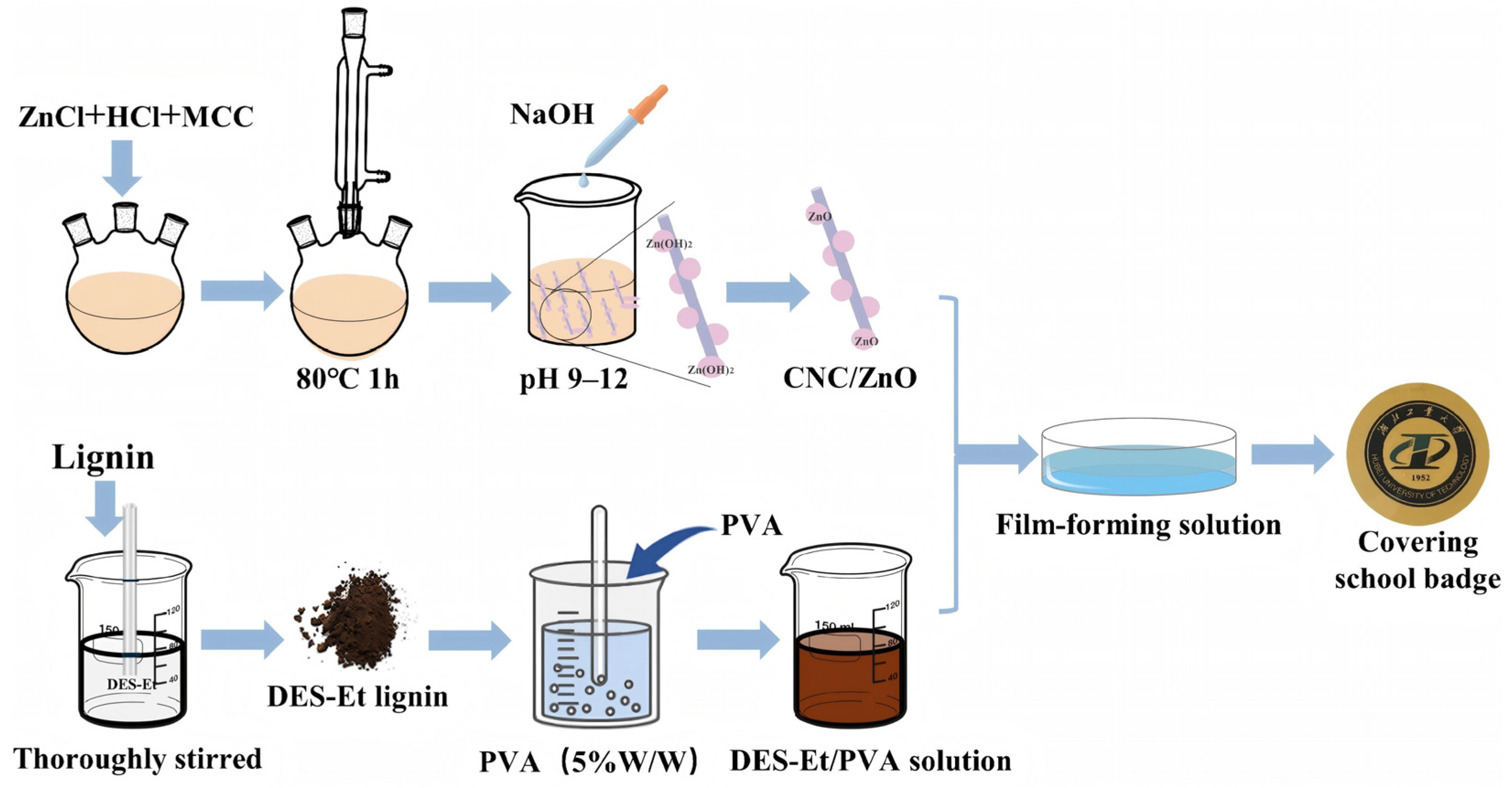
As shown in Figure 1, PVA (2.5 g) was dissolved in deionized water (50 mL) at 90 °C for 2 h, then DES-Et (4 wt% relative to PVA) and ZnO or CNC/ZnO (1 wt% relative to PVA) was added and stirred for 1 h. The homogeneous solution (15 mL per dish) was poured into the culture dish and dried at 40 °C for 24 h. The obtained films were designated as DES-Et/PVA, DES-Et/PVA-ZnO, and DES-Et/PVA-CNC/ZnO, respectively.

2.5. Characterization

The surface morphology of the film was examined by scanning electron microscopy. The crystalline structure of the film was analyzed using an X-ray diffractometer (XRD) (Bruker, Ettlingen, Germany) over a 2θ range of 10–80°. Atomic force microscopy (AFM) was employed to acquire surface topography of the film, and the root mean square roughness (Rq) and arithmetic average roughness (Ra) were calculated with NanoScope software 3.0. The transmittance of the film in the 200–800 nm wavelength range was measured using a UV-2600 spectrophotometer (Thermo Fishe, Waltham, MA, USA). The L*, a*, and b* values of the film surface were determined using a CR-10 Plus colorimeter (3nh, Shenzhen, China) (Supplementary Materials S1.1). The mechanical properties of the films were measured at room temperature using an Instron 1121 universal testing machine (Instron, Canton, MA, USA). Infrared absorption spectra of the films were collected over 4000–600 cm−1 using a Bruker Tensor 37 Fourier transform infrared spectrometer (Bruker, Ettlingen, Germany). Water vapor transmission of the film was determined by the gravimetric method (Supplementary Materials S1.2). The films (2 × 2 cm2) were immersed separately in methanol, ethanol, and 1,4-dioxane, and morphological changes were recorded at 2, 4, 6, 8, and 10 h, respectively. The water contact angle of the film was measured using a contact angle goniometer (Ramé-Hart, Dexter, NJ, USA). The antioxidant activity was evaluated by a DPPH radical scavenging assay (Supplementary Materials S1.3). The oxygen transmission rate of the films (50 cm2) was measured at 23 °C using an Ox-Tran system (Labthink, Jinan, China). Antibacterial activity was evaluated using Escherichia coli (Gram-negative) and Staphylococcus aureus (Gram-positive) as model strains (Supplementary Materials S1.4). All reported measurements were conducted in triplicate, and the values represent the mean ± standard deviation (n = 3).

2.6. Packaging Test

Apples were selected as a model food. Uniformly sized half-apple samples (n = 3 per group) were prepared, wrapped with different composite films (PVA, DES-Et/PVA, DES-Et/PVA-ZnO, DES-Et/PVA-CNC/ZnO), and stored at 8 °C and 85% relative humidity for 7 days. A blank control group (unwrapped) was also included. During storage, changes in appearance were recorded, and color parameters (L*, a*, b*) were measured at multiple positions using a CR-10 Plus colorimeter. All tests were performed in triplicate (n = 3), and data are presented as the mean ± standard deviation.

2.7. Recycling and Reprocessing of Composite Films

The recyclability of DES-Et/PVA-CNC/ZnO was evaluated using a dissolution–recasting strategy. The pristine film was cut into small pieces and completely dissolved in deionized water under magnetic stirring at room temperature to form a homogeneous solution. The resulting solution was recast under the same solution-casting conditions as the pristine film and dried at 40 °C for 24 h to obtain the recycled film (denoted as one cycle).

3. Results and Discussion

3.1. Microstructure of the Films

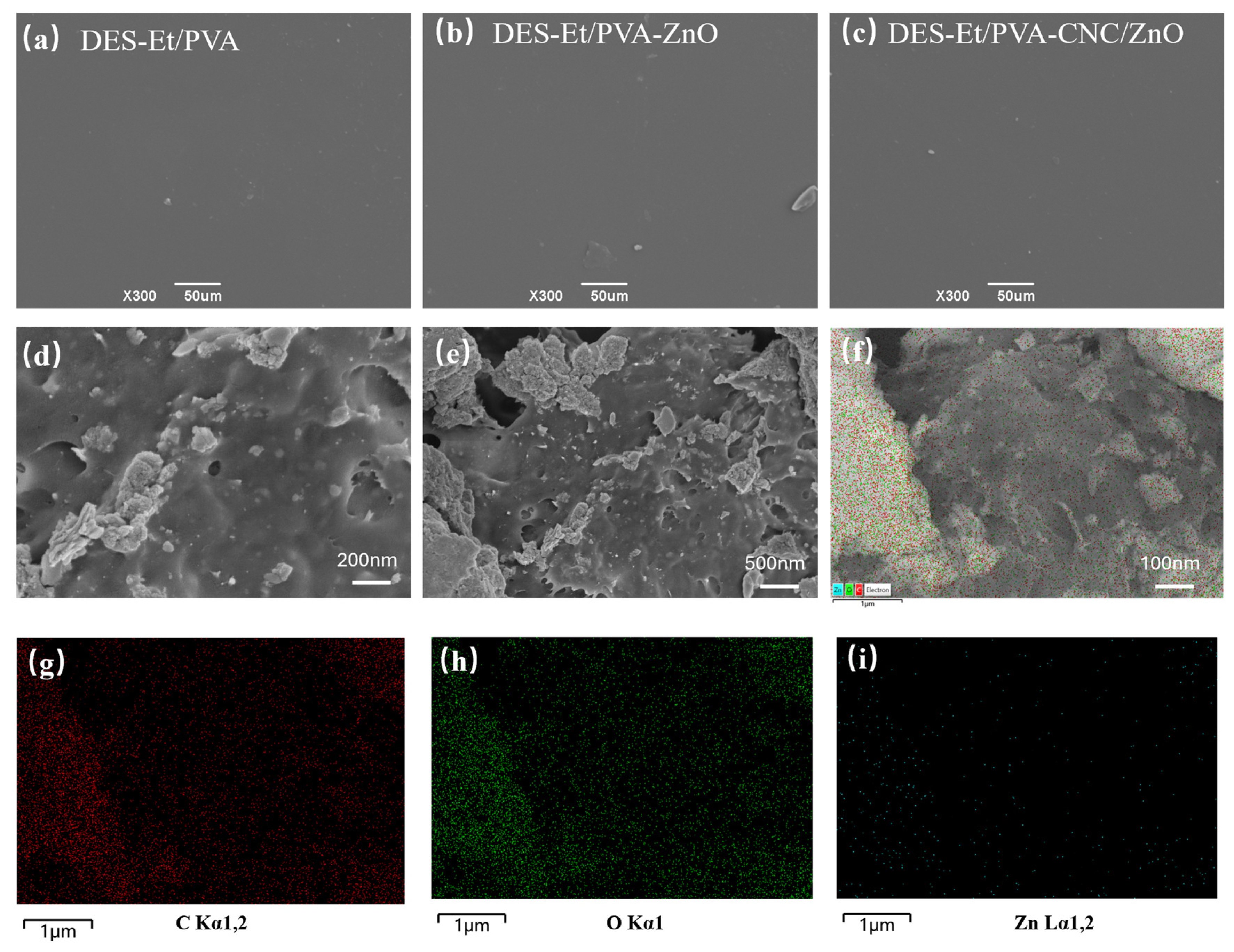
The surface morphology of the composite film and the dispersion state of the filler in the matrix are shown in Figure 2a–c and Figure S1. Compared with DES-Et/PVA, obvious particles/protrusions appeared on the surface of the film after the introduction of ZnO. On the contrary, the surface of DES-Et/PVA-CNC/ZnO was still relatively flat, indicating that ZnO loaded on CNC can reduce the tendency for agglomeration and achieve more uniform dispersion in the matrix. The above results further confirm the effectiveness of CNC as a carrier in regulating the dispersion of inorganic nanoparticles.
In contrast to pristine MCC with micron-scale long fibers and smooth surfaces, the cellulose phase in the composite film appears as discontinuous short fibrous and platelet-like fragments accompanied by uniformly dispersed irregular nanoscale structures (Figure 2d,e). The disappearance of extended fiber bundles indicates pronounced defibrillation and dimensional refinement of MCC during hydrolysis in the ZnCl2/HCl system, leading to the formation of CNC-like structural units. It is noteworthy that CNC produced via the ZnCl2/HCl system does not necessarily exhibit the typical rod-like morphology associated with sulfuric acid hydrolysis. The Lewis acidic nature of Zn2+ ions and the metal-salt-mediated hydrolytic cleavage mechanism promote deep fragmentation of crystalline domains, resulting in nanoscale particulates or irregular CNCs rather than continuous fibrillar networks. EDS elemental mapping (Figure 2f–i) reveals a homogeneous distribution of C and O signals, while Zn appears as sparsely yet uniformly distributed nanoscale spots without observable aggregation. This distribution pattern suggests that ZnO nanoparticles are effectively immobilized within the fragmented nanocellulose framework rather than being physically mixed.
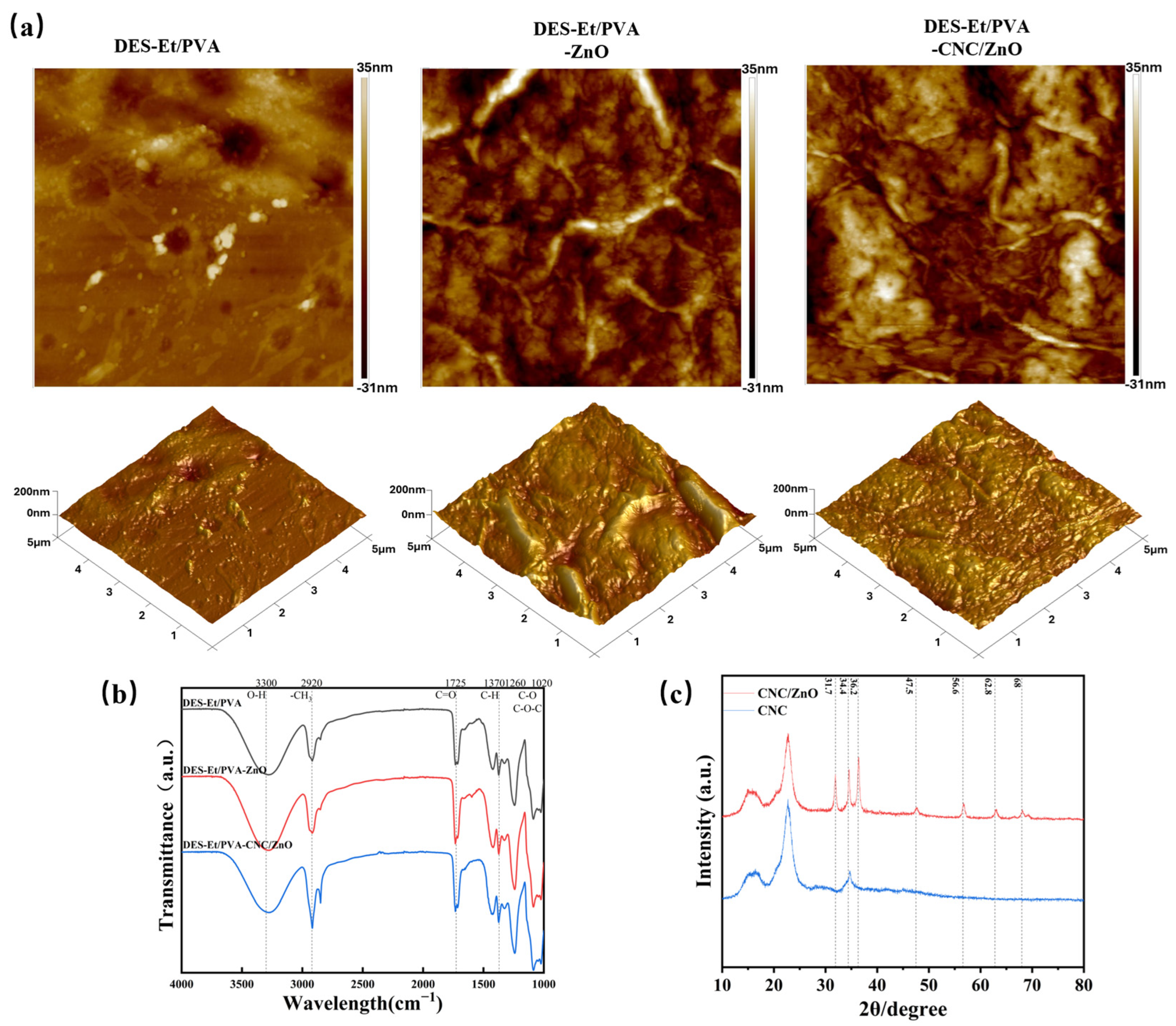
Atomic force microscopy (AFM) was employed to characterize the surface topography of the films. Height and phase images are shown in Figure 3a. The Rq and Ra of DES-Et/PVA were 7.68 nm and 5.11 nm, respectively, indicating a relatively smooth surface. The Rq and Ra of DES-Et/PVA-ZnO increased to 11.7 nm and 9.07 nm, evidenced by a marked rise in surface roughness and a certain degree of nanoparticle aggregation. By contrast, the Rq and Ra of DES-Et/PVA-CNC/ZnO were 9.3 nm and 7.14 nm, respectively, which were significantly lower than those of DES-Et/PVA-ZnO. The above results indicate that the introduction of CNC effectively inhibits the agglomeration of ZnO and promotes its more uniform distribution in the matrix. The X-ray diffraction results of CNC/ZNO (Figure 3b) show the characteristic diffraction peaks of ZnO at 31.7°, 34.4°, 36.2°, 47.5°, 56.6°, 62.8° and 68.0°, confirming the presence of ZnO crystal phase in the system.
The typical absorption features of the films in the 4000–1000 cm−1 region are shown in Figure 3c. A wide and strong O–H stretching band at 3300–3500 cm−1 arises from hydroxyl groups in PVA, lignin, and CNC and their hydrogen bond networks. The absorption peaks at 2940–2900 cm−1 are attributed to the -CH2/-CH3 stretching vibration; the absorption peaks at 1600 and 1510 cm−1 are the aromatic ring skeleton vibration of lignin phenylpropane unit [20,21,22]. The absorption peaks at 1260–1020 cm−1 mainly correspond to the C-O and C-O-C related vibrations of lignin aromatic ether bonds and PVA/CNC. The O-H stretching band intensity of DES-Et/PVA-ZnO slightly decreased and the band shape widened, suggesting that coordination/hydrogen bonding may be formed between the surface sites of ZnO and hydroxyl groups. Simultaneously, the C-O/C-O-C absorption peaks in the 1260–1020 cm−1 region slightly shifted and were accompanied by intensity changes, indicating that CNC and ZnO participate in the interface interaction and improve the coupling between the inorganic phase and the matrix.

3.2. Optical and Mechanical Properties of the Composite Films

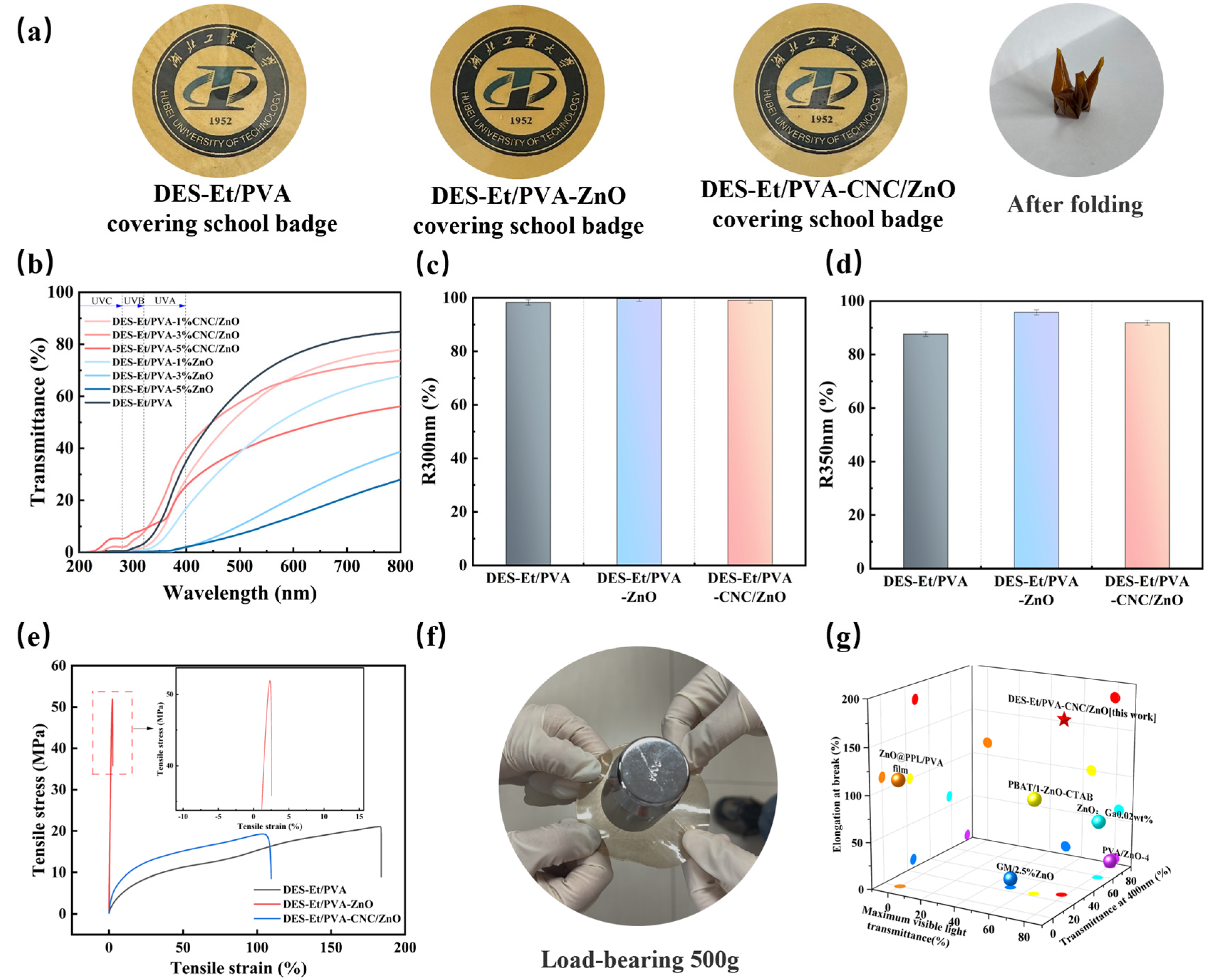
The appearance photos of DES-Et/PVA, DES-Et/PVA-ZnO, and DES-Et/PVA-CNC/ZnO show that it has good transmittance and flexibility (Figure 4a). To evaluate the UV shielding performance, the transmittance of the films was measured over 200–800 nm using a UV-Vis spectrophotometer (Figure 4b). As shown in Figure 4c,d, the UV blocking rate of DES-Et/PVA can reach 88%, while maintaining a high visible light transmittance. After the introduction of ZnO nanoparticles, the ultraviolet shielding performance of DES-Et/PVA-ZnO was enhanced to 99%, but the local visible light transmittance reduced to 30% due to the increase in light scattering. CNC/ZnO can improve the dispersion and interfacial compatibility of nanoparticles and achieve a high level of UV shielding performance (up to 94.2%). Meanwhile, the transmittance of DES-Et/PVA-CNC/ZnO remained at 78% at 800 nm, which was significantly better than the reported level of similar materials, generally <50% at 800 nm [23].
The mechanical properties of the films are one of the important indexes for practical application. As shown in Figure 4e, the introduction of ZnO can significantly increase the tensile strength (TS), but elongation at break (EB) drops sharply to <5%. However, DES-Et/PVA-CNC/ZnO, with the introduction of CNC/ZNO, maintains good TS, and EB was not lower than that of DES-Et/PVA. The simulated load-bearing experiment also found that DES-Et/PVA-CNC/ZnO had good mechanical properties (Figure 4f). The dramatic decrease in elongation at break observed in DES-Et/PVA-ZnO can be attributed to the aggregation of ZnO nanoparticles, which introduces local stress concentration sites within the polymer matrix and disrupts the continuity of the hydrogen bond network. In contrast, when CNC/ZnO hybrids were incorporated, CNC serves as a nanoscale scaffold that improves the dispersion of ZnO and promotes stronger interfacial interactions with the PVA and lignin matrix. The abundant hydroxyl groups on CNC surfaces facilitate the reconstruction of hydrogen bond networks, enabling more efficient stress transfer and restoring the flexibility of the composite film. Compared with the ZNO-containing films reported in previous studies (Figure 4g), DES-Et/PVA-CNC/ZnO achieves concurrently excellent UV shielding, visible transmittance, and mechanical toughness, delivering a well-balanced optical–mechanical profile and demonstrating strong potential for green, high-performance packaging applications.
This anchoring effect directly contributes to the multifunctional properties of the composite film. The uniform dispersion of ZnO reduces light scattering caused by nanoparticle agglomeration, thereby preserving the high visible light transmittance of the film while maintaining UV shielding capability. Well-dispersed CNC/ZnO hybrids generate a more difficult diffusion pathway for gas and water molecules, effectively enhancing the barrier properties of the film. CNC acts as a nano-reinforcing framework that bridges ZnO with the PVA/lignin matrix through hydrogen bond interactions, improving interfacial adhesion and stress transfer. Therefore, compared with films containing aggregated ZnO nanoparticles, the composite film simultaneously achieves enhanced mechanical strength and maintained flexibility.

3.3. Application-Related Performance of the Films in Packaging

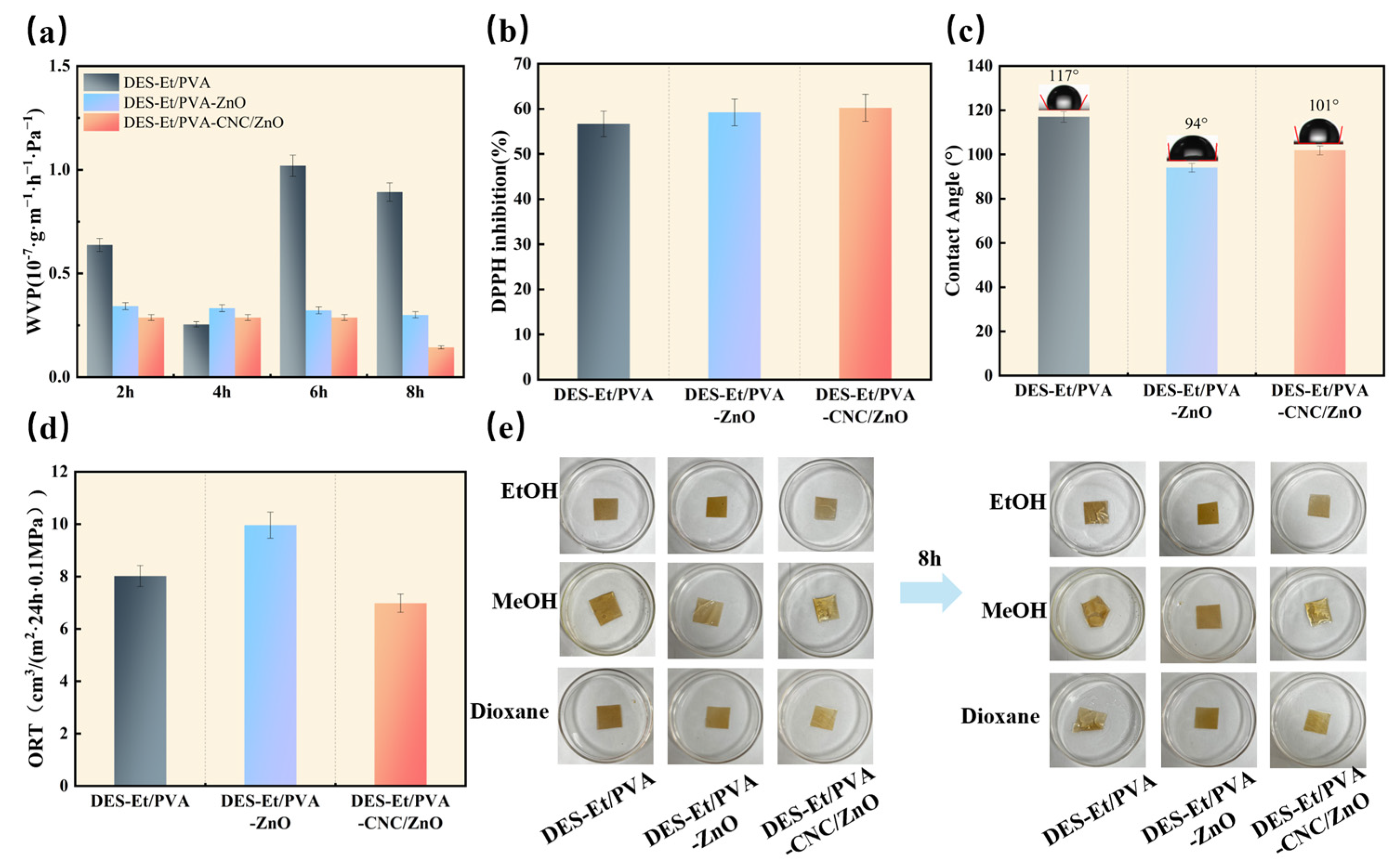
In order to reveal the application potential of DES-Et/PV-based composite film in food packaging and its structure-performance relationship, the key indicators such as water vapor permeability (WVP), oxygen permeability (OTR), antioxidant properties, water contact angle and solvent resistance were explored. As shown in Figure 5a, DES-Et/PVA shows the highest WVP (0.42 × 10⁻⁷ g·m−1·h−1·Pa−1) within the 2–8 h monitoring window, indicating limited water-vapor barrier performance under high humidity. After introducing ZnO, the WVP decreased to 0.34 × 10⁻⁷ g·m−1·h−1·Pa−1, primarily due to the physical filling effect of inorganic particles, which lengthens the diffusion path of water molecules. However, this barrier effect is partially compromised by local agglomeration in the matrix. By contrast, DES-Et/PVA-CNC/ZnO exhibited the lowest WVP (0.24 × 10⁻⁷ g·m−1·h−1·Pa−1), markedly outperforming chitosan/gelatin/ZnO, as reported in the literature (5.31–4.98 × 10⁻⁷ g·m−1·h−1·Pa−1) [29]. This pronounced improvement is attributed to CNC anchoring and dispersion effects that promote a more uniform distribution of ZnO in the polymer matrix. Additionally, CNC further extends the effective diffusion route of water molecules [30].
Antioxidant performance was assessed by DPPH radical scavenging (Figure 5b). The scavenging rate of the DES-Et/PVA membrane was about 55%, indicating that DES-modified lignin could neutralize free radicals through the hydrogen/electron donor pathway. After the introduction of ZnO, the clearance rate increased slightly to about 58%, which may be related to the regulation of reactive oxygen species (ROS) generation-consumption balance by ZnO. Further, DES-Et/PVA-CNC/ZnO had the highest scavenging rate of about 60%. This shows that the introduction of CNC not only improves the dispersion and stability of ZnO, but also promotes the construction of dense hydrogen bond networks, resulting in a synergistic free radical scavenging effect. In general, although the absolute scavenging rate of the composite film is still lower than that of typical polyphenol antioxidants, the observed robust improvement trend highlights the synergistic effect between lignin, CNC and ZnO, which allows the composite film to have a more stable and lasting antioxidant performance.
The static water contact angle of DES-Et/PVA is 117.02° (Figure 5c). After the introduction of ZnO, due to the rich OH groups on the surface and the increase in roughness (Wenzel effect), the contact angle was reduced to 94.06°, and the appearance of local ‘hydrophilic spots’ further reduced the overall apparent contact angle. In contrast, with CNC/ZnO, the filler is more uniformly dispersed in the matrix, avoiding over-hydrophilization, and the contact angle rebounds to 101.92°, indicating a more stable surface state with moderate hydrophobicity. Notably, the contact angle of the reported ZnO-modified films mostly falls in the range of 58.73–75.23° [31], whereas the DES-Et/PVA-CNC/ZnO film here displays substantially higher hydrophobicity.
As shown in Figure 5d, the OTR of DES-Et/PVA was 8.02 cm3·m−2·24 h−1·0.1 MPa−1, indicating limited oxygen-barrier performance. After the introduction of ZnO, the OTR increased to 9.96 cm3·m−2·24 h−1·0.1 MPa−1, because ZnO agglomerated in the matrix and formed local defect channels, thus weakening the overall barrier effect. In contrast, the OTR of DES-Et/PVA-CNC/ZnO achieved 6.98 cm3·m−2·24 h−1·0.1 MPa−1, demonstrating that CNC anchoring/dispersion effectively suppresses agglomeration and enhances gas-barrier properties. It is significantly better than the composite film reported in the previous literature (sodium alginate/TiO2 NPs 14.7–20.9 cm3·m−2·24 h−1·0.1 MPa−1) [32]. The anti-solvent experiment (Figure 5e) showed that the film remained intact after soaking in methanol, absolute ethanol and dioxane for 8 h, and only slight deformation occurred, indicating that it had good anti-solvent properties. The different degrees of swelling can be attributed to the difference in the disturbance of the lignin structure and hydrogen bond network by each solvent.
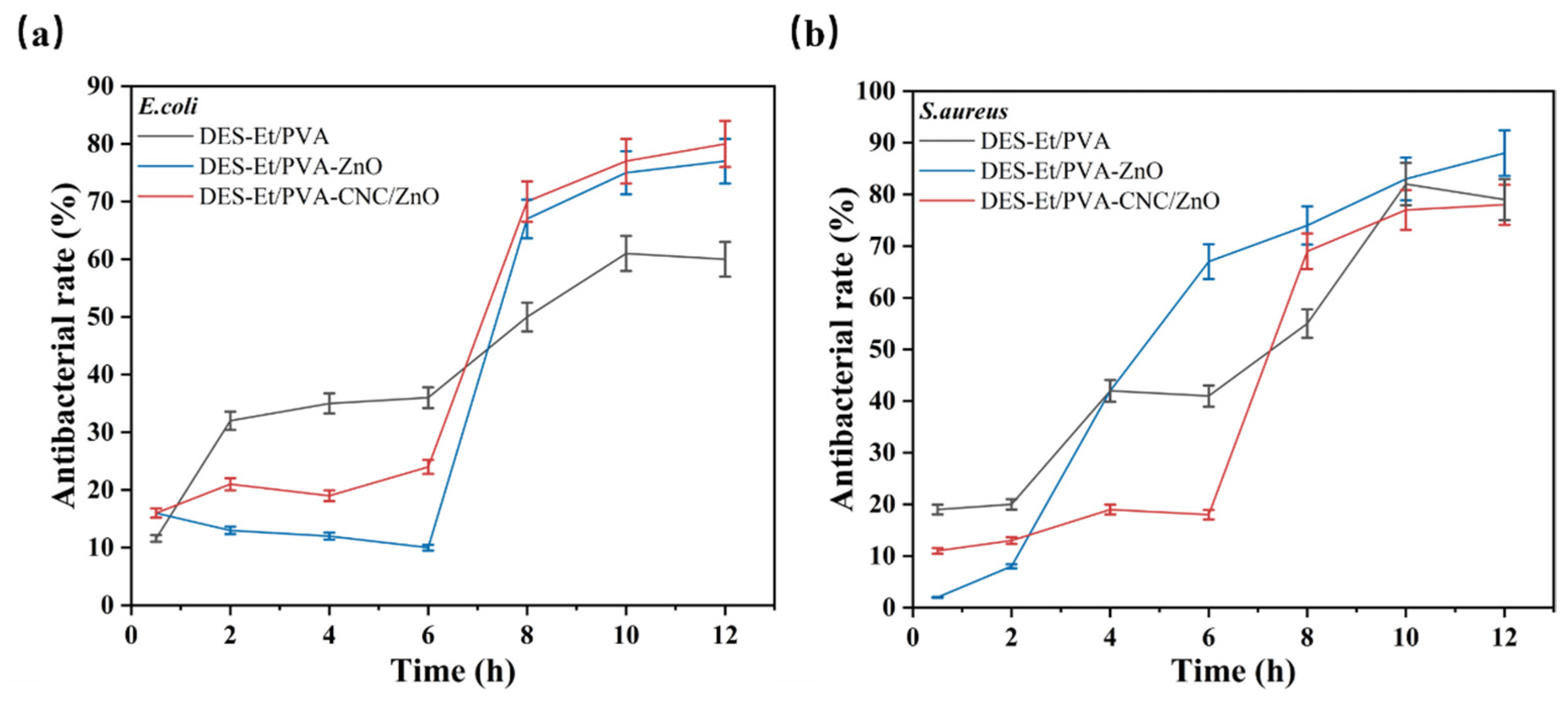
Antimicrobial activity is one of the key properties for food-packaging applications. Here, E. coli (Gram-negative) and S. aureus (Gram-positive) were used as model strains (Figure 6). The inhibition effect of the composite film on Staphylococcus aureus was better than that on Escherichia coli. This difference is related to the cell wall structure of the two types of strains. Gram-positive bacteria lack the outer membrane, and the molecules are easier to pass through [33]. DES-Et/PVA-CNC/ZnO had the best inhibitory effect on Escherichia coli, and DES-Et/PVA-ZnO had the best inhibitory effect on Staphylococcus aureus, followed by DES-Et/PVA-CNC/ZnO. DES-Et/PVA-ZnO showed faster initial inhibition in S.aureus, while DES-Et/PVA-CNC/ZnO may rely on the sustained release of CNC to show more lasting antibacterial activity and maintain a higher inhibition rate in the later stage. The antibacterial activity of the composite films primarily arises from the combined effects of Zn2+ ion release and reactive oxygen species (ROS) generation from ZnO nanoparticles. The released Zn2+ ions can interact with bacterial membranes and intracellular proteins, while ROS such as superoxide and hydroxyl radicals induce oxidative stress that disrupts membrane integrity and cellular metabolism. The CNC-anchored ZnO structure improves nanoparticle dispersion within the matrix, preventing aggregation and exposing more active antibacterial sites, which facilitates a more stable release of Zn2+ and ROS. Moreover, the stronger inhibition toward S. aureus than E. coli can be attributed to their different cell wall structures, as Gram-positive bacteria lack the protective outer membrane present in Gram-negative bacteria, making them more susceptible to antimicrobial species. Overall, the synergistic effect of CNC/ZnO improved the dispersion of ZnO in the matrix and delayed the release of Zn2+ and ROS, thereby enhancing the antibacterial efficiency and stability, providing potential advantages for its application in food preservation packaging.

3.4. Application of the Composite Films in Food Preservation

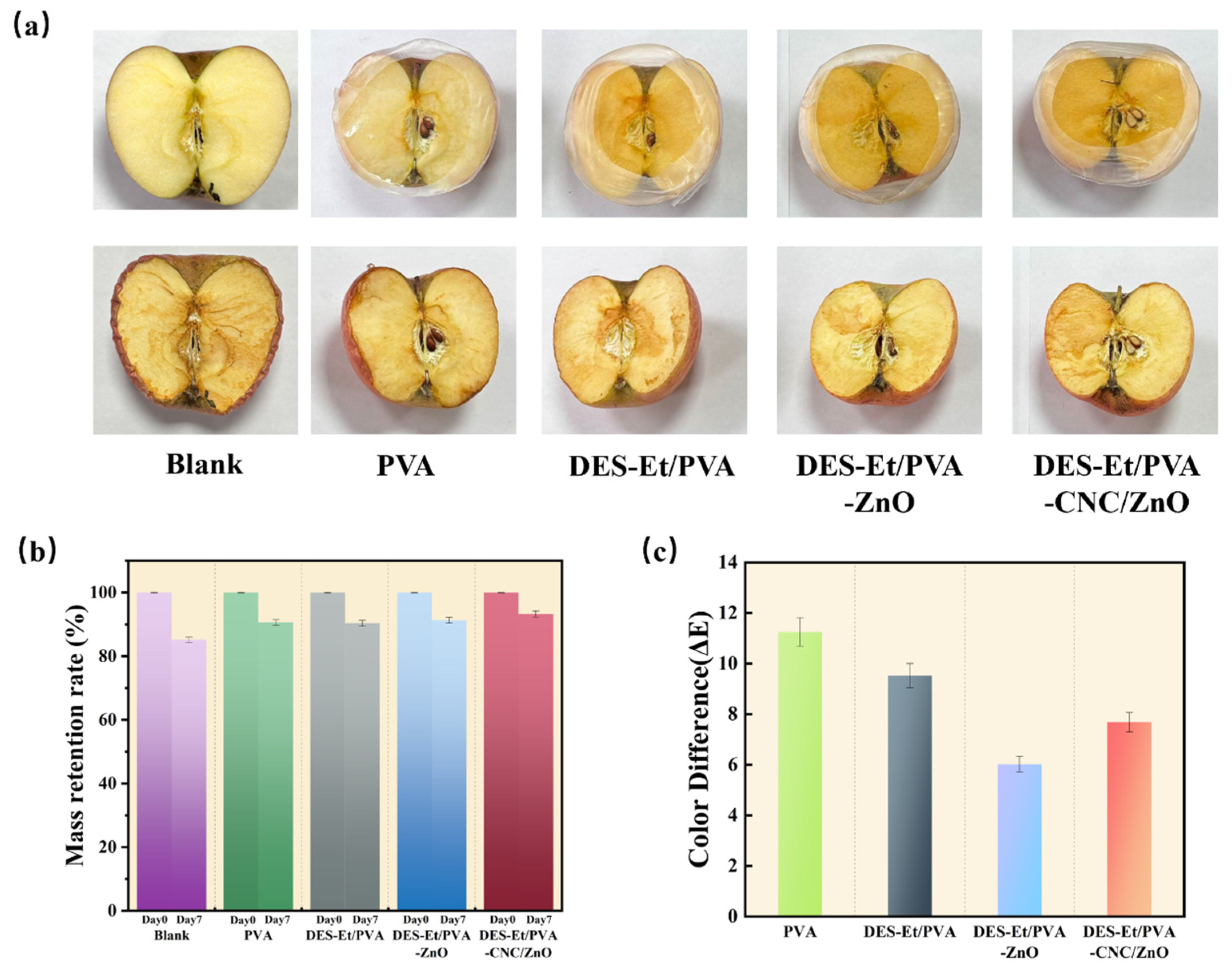
The simulated food preservation experiment (Figure 7a) showed that the uncovered samples (Blank) showed obvious browning and water loss after 7 days: the weight loss was about 25% and the color difference ΔE > 20, indicating that apples were prone to enzymatic browning and water loss deterioration at room temperature. The PVA film only provides a limited physical barrier. After the introduction of DESL, the composite film obtains additional antioxidant capacity, and the browning improves to a certain degree of inhibition (ΔE = 14.25). The addition of ZnO significantly improved the antibacterial and anti-browning effects—ΔE decreased to 6.02, and the weight loss decreased to 8.71%. The mass loss of DES-Et/PVA-CNC/ZnO-coated samples was the lowest. In summary, DES-Et/PVA-CNC/ZnO has moisture-proof, antioxidant, and antibacterial properties, which can effectively prolong the shelf life of fruits and has good potential for food preservation packaging applications.

3.5. Recycling Performance

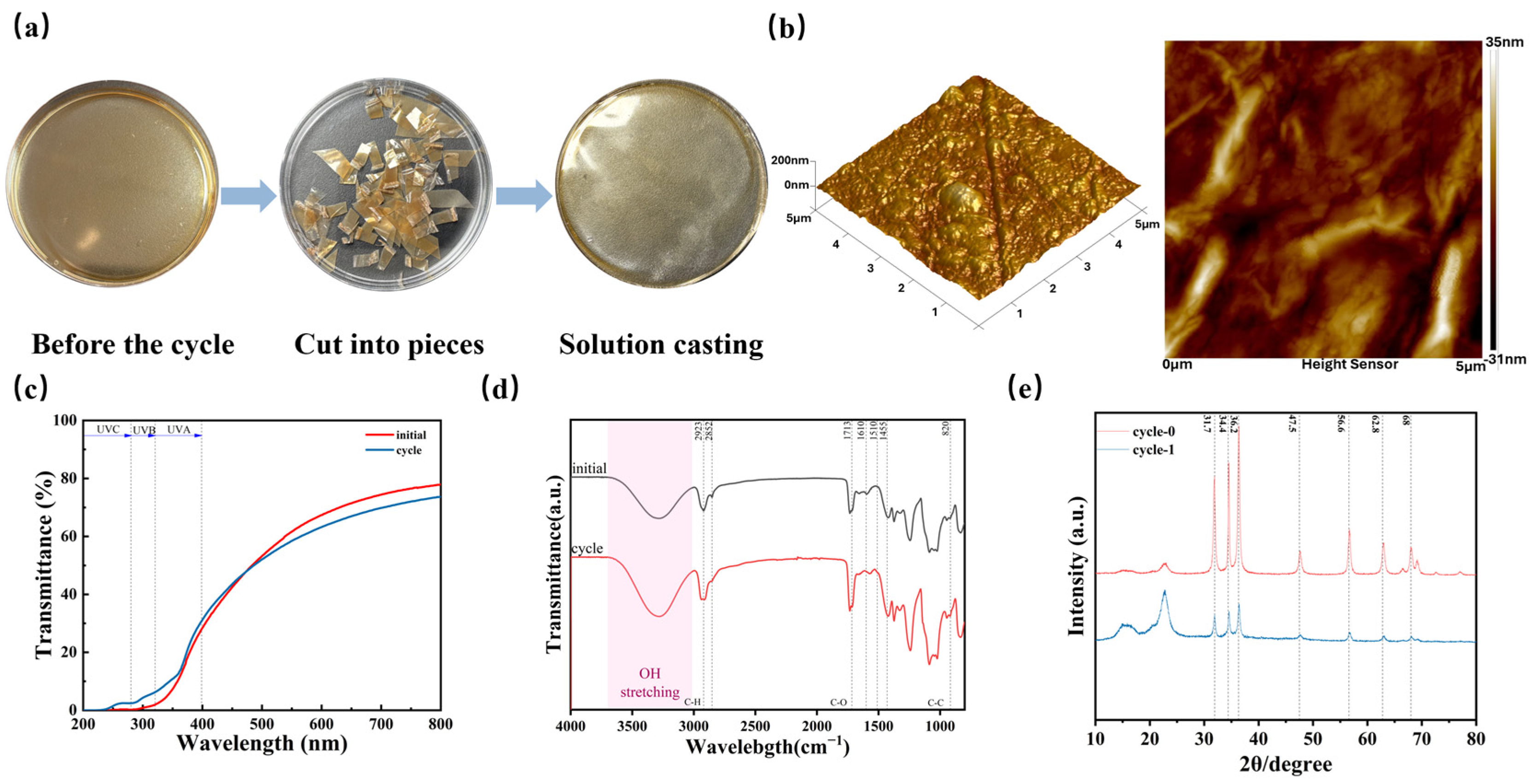
The recyclability of composite film was evaluated through a complete dissolution–recasting process. Despite full disassembly in water, the regenerated film largely preserved the structural integrity and functional performance of the pristine material. As shown in Figure 8c, the recycled film maintained comparable UV shielding efficiency, with a deviation of less than 5%, while exhibiting a high visible light transmittance of ~78% at 800 nm. This indicates that the lignin-based UV-absorbing domains and the CNC-anchored ZnO framework remain intact during recycling. AFM images (Figure 8b) reveal that the regenerated film reproduced the original fibrous morphology and nanoscale continuity, with only a slight increase in surface roughness, which can be attributed to hydrogen bond reorganization rather than nanoparticle aggregation. The chemical structure stability is further confirmed by FTIR analysis (Figure 8d), where no noticeable changes were observed in the characteristic O–H, C–O/C–O–C, aromatic, and C=O vibration bands after recycling, suggesting the preservation of the DES-modified lignin structure and the PVA-based hydrogen-bonding network. Consistently, XRD patterns (Figure 8e) of the recycled film show identical diffraction peak positions to those of the pristine sample, corresponding to PVA semicrystalline domains, cellulose I crystallites, and ZnO phases, with only a slight reduction in peak intensity, indicative of crystallite rearrangement rather than phase transformation or crystallinity loss. Overall, the DES-Et/PVA–CNC/ZnO hybrid film exhibits excellent structural resilience and reconstruction capability, enabling recovery of its hierarchical architecture and multifunctional properties after recycling. This robust recyclability highlights its potential for sustainable, water-processable, and bio-derived film applications.

4. Conclusions

In this study, a PVA-based composite film with DES-Et-modified lignin and CNC/ZnO was constructed to effectively shield UVA/UVB/UVC and maintain a transmittance of about 78% at 800 nm. The composite film had lower water vapor permeability (0.24 × 10⁻⁷ g·m−1·h−1·Pa−1), oxygen permeability (6.98 cm3·m−2·24 h−1·0.1 MPa−1), and higher DPPH free radical scavenging capacity (60%). It also had a more significant inhibitory effect on Gram-positive bacteria, with a broad application prospect in the field of food packaging. In addition, the composite film exhibits improved mechanical flexibility, with the tensile strain reaching 109%, indicating a balanced optimization of transparency, barrier properties, and toughness. The dynamic hydrogen bond network induced by DES significantly improved the polarity matching and interfacial adhesion between lignin and PVA. The anchoring of CNC to ZnO inhibits agglomeration and achieves mild regulation of ROS/ion release, thereby achieving a synergistic balance between transparency, barrier and biological activity. Importantly, the composite film can be completely dissolved in water and reprocessed while retaining most of its structural and functional properties, highlighting its recyclability and sustainability for future packaging applications.

Supplementary Materials

The following supporting information can be downloaded at: https://www.mdpi.com/article/10.3390/pr14101528/s1.

Author Contributions

Formal analysis, Y.J.; Investigation, S.S.; Writing—original draft, Y.L.; Writing—review & editing, C.P. and H.Y. All authors have read and agreed to the published version of the manuscript.

Funding

This research was funded by the the Key Project of Hubei Provincial Department of Education Scientific Research Plan (D20241706), and the Research Funding of Wuhan Polytechnic University (2024RZ044).

Data Availability Statement

The original contributions presented in this study are included in the article/Supplementary Materials. Further inquiries can be directed to the corresponding authors.

Conflicts of Interest

The authors declare no conflict of interest.

References

  1. Castro-Amoedo, R.; Granacher, J.; Kantor, I.; Dahmen, A.; Barbosa-Povoa, A.; Maréchal, F. On the role of system integration in plastic waste management. Resour. Conserv. Recycl. 2024, 201, 107295. [Google Scholar] [CrossRef]
  2. Duncan, T.V. Applications of nanotechnology in food packaging and food safety: Barrier materials, antimicrobials and sensors. J. Colloid Interface Sci. 2011, 363, 1–24. [Google Scholar] [CrossRef]
  3. Constant, S.; Wienk, H.L.J.; Frissen, A.E.; de Peinder, P.; Boelens, R.; van Es, D.S.; Grisel, R.J.H.; Weckhuysen, B.M.; Huijgen, W.J.J.; Gosselink, R.J.A.; et al. New insights into the structure and composition of technical lignins: A comparative characterisation study. Green Chem. 2016, 18, 2651–2665. [Google Scholar] [CrossRef]
  4. Yan, Y.; Li, X.; Zhang, C.; Lv, L.; Gao, B.; Li, M. Research Progress on Antibacterial Activities and Mechanisms of Natural Alkaloids: A Review. Antibiotics 2021, 10, 318. [Google Scholar] [CrossRef]
  5. Bajwa, D.S.; Pourhashem, G.; Ullah, A.H.; Bajwa, S.G. A concise review of current lignin production, applications, products and their environmental impact. Ind. Crops Prod. 2019, 139, 111526. [Google Scholar] [CrossRef]
  6. Boarino, A.; Klok, H.-A. Opportunities and challenges for lignin valorization in food packaging, antimicrobial, and agricultural applications. Biomacromolecules 2023, 24, 1065–1077. [Google Scholar] [CrossRef] [PubMed]
  7. Lu, X.; Gu, X.; Shi, Y. A review on lignin antioxidants: Their sources, isolations, antioxidant activities and various applications. Int. J. Biol. Macromol. 2022, 210, 716–741. [Google Scholar] [CrossRef]
  8. Zou, D.; Nunes, S.P.; Vankelecom, I.F.J.; Figoli, A.; Lee, Y.M. Recent advances in polymer membranes employing non-toxic solvents and materials. Green Chem. 2021, 23, 9815–9843. [Google Scholar] [CrossRef]
  9. Chen, Y.-T.; Sun, Y.-M.; Hu, C.-C.; Lai, J.-Y.; Liu, Y.-L. Employing lignin in the formation of the selective layer of thin-film composite membranes for pervaporation desalination. Mater. Adv. 2021, 2, 3099–3106. [Google Scholar] [CrossRef]
  10. Zhang, Q.; De Oliveira Vigier, K.; Royer, S.; Jérôme, F. Deep eutectic solvents: Syntheses, properties and applications. Chem. Soc. Rev. 2012, 41, 7108–7146. [Google Scholar] [CrossRef]
  11. Zou, S.-L.; Xiao, L.-P.; Yin, W.-Z.; Gui, T.; Sun, R.-C. Fabrication of biodegradable polyvinyl alcohol-based plastics toward technical lignin valorization. Int. J. Biol. Macromol. 2024, 284, 138123. [Google Scholar] [CrossRef]
  12. Gebreyohannes, A.Y.; Aristizábal, S.L.; Silva, L.; Qasem, E.A.; Chisca, S.; Upadhyaya, L.; Althobaiti, D.; Coutinho, J.A.P.; Nunes, S.P. A lignin-based membrane fabricated with a deep eutectic solvent. Green Chem. 2023, 25, 4769–4780. [Google Scholar] [CrossRef]
  13. Morozova, O.; Vasil’eva, I.; Shumakovich, G.; Khlupova, M.; Chertkov, V.; Shestakova, A.; Yaropolov, A. Green Extraction of Reed Lignin: The Effect of the Deep Eutectic Solvent Composition on the UV-Shielding and Antioxidant Properties of Lignin. Int. J. Mol. Sci. 2024, 25, 8277. [Google Scholar] [CrossRef] [PubMed]
  14. Kareem, M.A.; Mjalli, F.S.; Hashim, M.A.; AlNashef, I.M. Phosphonium-Based Ionic Liquids Analogues and Their Physical Properties. J. Chem. Eng. Data 2010, 55, 4632–4637. [Google Scholar] [CrossRef]
  15. Wasim, M.; Shi, F.; Liu, J.; Farooq, A.; Khan, S.U.; Salam, A.; Hassan, T.; Zhao, X. An overview of Zn/ZnO modified cellulosic nanocomposites and their potential applications. J. Polym. Res. 2021, 28, 338. [Google Scholar] [CrossRef]
  16. Wu, J.; Xue, D. Progress of Science and Technology of ZnO as Advanced Material. Sci. Adv. Mater. 2011, 3, 127–149. [Google Scholar] [CrossRef]
  17. Li, H.; Zhang, L.; Lu, H.; Ma, J.; Zhou, X.; Wang, Z.; Yi, C. Macro-/nanoporous Al-doped ZnO/cellulose composites based on tunable cellulose fiber sizes for enhancing photocatalytic properties. Carbohydr. Polym. 2020, 250, 116873. [Google Scholar] [CrossRef]
  18. Shi, C.; Zhang, L.; Bian, H.; Shi, Z.; Ma, J.; Wang, Z. Construction of Ag-ZnO/cellulose nanocomposites via tunable cellulose size for improving photocatalytic performance. J. Clean. Prod. 2021, 288, 125089. [Google Scholar] [CrossRef]
  19. Kang, J.; Hu, C.; Dichiara, A.; Guan, L.; Yun, H.; Gu, J. Facile preparation of cellulose nanocrystals/ZnO hybrids using acidified ZnCl2 as cellulose hydrolytic media and ZnO precursor. Int. J. Biol. Macromol. 2022, 227, 863–871. [Google Scholar] [CrossRef] [PubMed]
  20. Zhu, Y.; Yang, T.-X.; Qi, B.-K.; Li, H.; Zhao, Q.-S.; Zhao, B. Acidic and alkaline deep eutectic solvents (DESs) pretreatment of grapevine: Component analysis, characterization, lignin structural analysis, and antioxidant properties. Int. J. Biol. Macromol. 2023, 236, 123977. [Google Scholar] [CrossRef] [PubMed]
  21. Li, T.; Lyu, G.; Liu, Y.; Lou, R.; Lucia, L.A.; Yang, G.; Chen, J.; Saeed, H.A.M. Deep eutectic solvents (DESs) for the isolation of willow lignin (Salix matsudana cv. Zhuliu). Int. J. Mol. Sci. 2017, 18, 2266. [Google Scholar] [CrossRef]
  22. El Hage, R.; Brosse, N.; Chrusciel, L.; Sanchez, C.; Sannigrahi, P.; Ragauskas, A. Characterization of milled wood lignin and ethanol organosolv lignin from miscanthus. Polym. Degrad. Stab. 2009, 94, 1632–1638. [Google Scholar] [CrossRef]
  23. Wang, Y.-L.; Li, R.; Yang, X.; Li, L. Multifunctional film of soy protein nanofiber/chitosan/zinc oxide for tomato postharvest freshness preservation. Food Hydrocoll. 2025, 168, 111504. [Google Scholar] [CrossRef]
  24. Pruthviraj, I.; Krushna, B.R.; Sharma, S.; Shanmuganathan, S.; Ray, S.; Krithika, C.; Vijayanand, S.; Ponnazhagan, K.; Manjunatha, K.; Wu, S.Y.; et al. Sustainable synthesis of PVA@ZnO:Ga3+ nanocomposite films for UV shielding, food preservation, shape memory and anti-counterfeiting applications. Inorg. Chem. Commun. 2025, 171, 113533. [Google Scholar] [CrossRef]
  25. Han, M.; Qin, Z.; Wang, J.; Ding, Y.; Zhou, D.; Wang, Y.; Liu, N.; Yang, W. Preparation of polybutylene adipate terephthalate/tannic acid-ZnO nanocomposite films with excellent UV shielding, antioxidant and antibacterial activities. LWT 2025, 215, 117239. [Google Scholar] [CrossRef]
  26. Zhao, Z.; Mao, A.; Gao, W.; Bai, H. A facile in situ method to fabricate transparent, flexible polyvinyl alcohol/ZnO film for UV-shielding. Compos. Commun. 2018, 10, 157–162. [Google Scholar] [CrossRef]
  27. Pang, B.; Wu, Z.-Y.; Wang, Z.-B.; You, B.-Q.; Guo, Y.-R.; Li, S.; Pan, Q.-J. Design of a ZnO@plant polyphenol/poly(vinyl alcohol) film via plant polyphenol-induced cross-linking and its enhanced uv shielding and antibacterial performance. ACS Sustain. Chem. Eng. 2022, 10, 9369–9380. [Google Scholar] [CrossRef]
  28. Liu, W.; Wang, T.; Tao, Y.; Ling, Z.; Huang, C.; Lai, C.; Yong, Q. Fabrication of anti-bacterial, hydrophobic and UV resistant galactomannan-zinc oxide nanocomposite films. Polymer 2021, 215, 123412. [Google Scholar] [CrossRef]
  29. Lu, M.; Zhou, Q.; Yu, H.; Chen, X.; Yuan, G. Colorimetric indicator based on chitosan/gelatin with nano-ZnO and black peanut seed coat anthocyanins for application in intelligent packaging. Food Res. Int. 2022, 160, 111664. [Google Scholar] [CrossRef]
  30. Yu, J.; Yang, J.; Liu, B.; Ma, X. Preparation and characterization of glycerol plasticized-pea starch/ZnO–carboxymethylcellulose sodium nanocomposites. Bioresour. Technol. 2009, 100, 2832–2841. [Google Scholar] [CrossRef] [PubMed]
  31. Santhosh, R.; Sarkar, P. Jackfruit seed starch/tamarind kernel xyloglucan/zinc oxide nanoparticles-based composite films: Preparation, characterization, and application on tomato (Solanum lycopersicum) fruits. Food Hydrocoll. 2022, 133, 107917. [Google Scholar] [CrossRef]
  32. Yang, Z.; Li, M.; Zhai, X.; Zhao, L.; Tahir, H.E.; Shi, J.; Zou, X.; Huang, X.; Li, Z.; Xiao, J. Development and characterization of sodium alginate/tea tree essential oil nanoemulsion active film containing TiO2 nanoparticles for banana packaging. Int. J. Biol. Macromol. 2022, 213, 145–154. [Google Scholar] [CrossRef] [PubMed]
  33. Siripatrawan, U.; Kaewklin, P. Fabrication and characterization of chitosan-titanium dioxide nanocomposite film as ethylene scavenging and antimicrobial active food packaging. Food Hydrocoll. 2018, 84, 125–134. [Google Scholar] [CrossRef]
Figure 1. Preparation process of composite film.
Processes 14 01528 g001
Figure 2. (a) Low-magnification SEM images of DES-Et/PVA, (b) DES-Et/PVA-ZnO and (c) DES-Et/PVA-CNC/ZnO films. High-magnification SEM images of CNC/ZnO at different length scales (df); the corresponding EDS element mappings of (g) C, (h) O, and (i) Zn.
Processes 14 01528 g002
Figure 3. (a) Atomic force microscopy images, (b) X-ray diffraction patterns, and (c) FTIR spectra of the composite films.
Processes 14 01528 g003
Figure 4. (a) Photographs of DES-Et/PVA, DES-Et/PVA-ZnO, and DES-Et/PVA-CNC/ZnO, (b) UV-Vis absorption spectra of the films, (c,d) UV shielding ratios of the films at 300 nm and 350 nm, (e) stress–strain curves of the films, (f) photos of the films’ simulated load-bearing, (g) comparison with previously reported studies [24,25,26,27,28].
Processes 14 01528 g004
Figure 5. (a) Water-vapor barrier performance, (b) antioxidant performance, (c) water contact angle, (d) oxygen transmission rate, and (e) solvent resistance of the composite films.
Processes 14 01528 g005
Figure 6. Antibacterial assays of the composite films: (a) inhibition against Escherichia coli and (b) inhibition against Staphylococcus aureus.
Processes 14 01528 g006
Figure 7. Preservation study of the composite films. (a) Photographs of apple wrapped with different films; (b) Mass retention rate of apple; (c) Color difference (ΔE) of apple.
Processes 14 01528 g007
Figure 8. (a) The process of cyclic experimentation, (b) atomic force microscopy images, (c) UV-Vis absorption spectra, (d) FTIR spectra, and (e) X-ray diffraction patterns of the composite films.
Processes 14 01528 g008
Disclaimer/Publisher’s Note: The statements, opinions and data contained in all publications are solely those of the individual author(s) and contributor(s) and not of MDPI and/or the editor(s). MDPI and/or the editor(s) disclaim responsibility for any injury to people or property resulting from any ideas, methods, instructions or products referred to in the content.