


Abstract
The use of Pleurotus ostreatus lyophilizate (POL) and hot water extract (POE) as potential functional ingredients for the development of enriched bread was investigated. The effects of POL and POE were examined based on the results of empirical rheological measurements and physical, textural and sensory analysis of bread. POL was incorporated into dough as a partial substitute for wheat flour (1% and 5%), while POE was added as a replacement for part of the water required to achieve optimal dough consistency (2% and 10%). Inclusion of POL in dough formulation caused dough disintegration: extreme decrease in degree of softening, from 60 FU (control) to 275 FU (POL1) and 290 FU (POL5), and extensographic measurements could not be performed. The specific volume of bread with 10% POL decreased by 46% and the crumb hardness increased approximately four times compared to the control. On the other hand, rheological properties of dough with POE were comparable to control, resulting in minimal impact on physical, textural and sensory characteristics of bread. Both fortifying ingredients positively affected the total phenolic content and antioxidant activity of the bread, with a more pronounced effect observed for POL compared to POE. Additionally, bread enriched with 5% POL had total dietary fiber content of 4.7 g/100 g and could be labeled as a source of fiber. P. ostreatus derivatives show great potential for functional bread development; however, further research is needed to optimize their use and maintain bread quality.
1. Introduction
Bread is one of the most widely consumed staple foods worldwide, providing an ideal vehicle for nutritional and functional enrichment. Mushrooms have attracted attention as a natural fortifying ingredient in bakery products due to their high nutritional and bioactive potential [1,2]. Several studies have shown that their inclusion in bread formulations can enhance nutritional and functional properties. For example, supplementation of wheat flour with 2.5% or 5% lyophilized powder from white and brown button mushrooms (Agaricus bisporus) markedly increased total polyphenol content, vitamin D2 levels and antioxidant activity [3]. Similarly, in a broader comparative study including button, shiitake (Lentinula edodes) and porcini (Boletus edulis) powders at 5–15% substitution levels, bread exhibited increased phenolic content and enhanced antioxidant capacity [4]. The addition of Pleurotus ostreatus powder has been shown to increase protein, mineral and fiber content in wheat and multigrain bread [1,2]. Nevertheless, the literature consistently indicates that while mushroom enrichment enhances nutritional and antioxidant properties, it also compromises bread quality, including reduced loaf volume, denser crumb, darker color, and firmer texture [1,2,3,5]. Therefore, alternative strategies are needed to preserve bread quality while maintaining its functional benefits.
Among edible mushrooms, Pleurotus ostreatus, commonly known as the oyster mushroom, is widely consumed and valued for its nutritional and functional properties [6]. It is a rich source of protein and crude fiber, as well as vitamins E, C, and B2. High levels of minerals such as potassium, iron, and magnesium further enhance its nutritional profile [7]. In addition, P. ostreatus contains diverse bioactive compounds, mainly alkaloids, flavonoids, tannins, and phenols [8], which are associated with antioxidant, antimicrobial, and immunomodulatory activities [9]. Effective preservation of mushroom bioactive compounds is essential for the development of functional bakery products, ensuring that their nutritional and antioxidant benefits are maintained. Lyophilization is considered a superior preservation technique, effectively preserving color, texture, phenolic and ascorbic acid content [10,11]. Alternatively, hot water extraction offers an alternative approach for incorporation of bioactives into foods [12]. These mushroom extracts are obtained in a sustainable, environmentally friendly manner, including the valorization of production residues [13,14].
While numerous studies have investigated the addition of mushrooms to bread, there has been no systematic comparison between whole mushroom biomass and its extractable components. Lyophilized powder, as a source of macronutrients, contains polysaccharides, proteins, fibers, phenolics, and particles that may physically affect the dough, whereas hot water extract, primarily a carrier of soluble bioactive compounds, may influence dough rheology and structure differently. This study addresses this gap by directly comparing the functional effects of these two distinct forms of the same raw material (Pleurotus ostreatus) on bread production. Dough mixing and extensional properties were analyzed, and bread quality was assessed through physical characterization, instrumental measurements of texture and color, and sensory analysis. Additionally, the nutritional and bioactive profile of P. ostreatus-enriched bread, with emphasis on dietary fibers, phenolic compounds, and antioxidant activity was investigated.
2. Materials and Methods
2.1. Materials
Fresh Pleurotus ostreatus mushrooms were obtained from Gobarstvo Jožica Zorko s.p. (Leskovec pri Krškem, Slovenia). Wheat flour for bread production was supplied by a local mill (Danubius d.o.o., Novi Sad, Serbia). Salt, sugar, yeast, and margarine were purchased from a local store.
Ethanol, gallic acid, quercetin, 2,4,6-tripyridil-s-triasine (TPTZ), HCl, NaOH, acetate buffer, NaNO2, AlCl3, FeCl3×6H2O and iron sulphate were purchased from Sigma Aldrich (Darmstadt, Germany). Folin–Ciocalteu reagent was from Merck (Darmstadt, Germany). Na2CO3 was from Kemika (Zagreb, Croatia). Other chemicals were of analytical grade.
2.2. The Preparation of P. ostreatus Lyophilizate and Hot Water Extract
For the preparation of P. ostreatus lyophilizate (POL), fresh mushrooms were frozen at −20 °C (Gorenje d.d., Velenje, Slovenia) and then freeze-dried in a Lio-2000P lyophilizer (Kambič, Semič, Slovenia), yielding 198 g of ground lyophilizate from 3 kg of fresh mushrooms.
The hot water extract (POE) was prepared by boiling mushrooms in distilled water for 5 h at a water-to-mushroom ratio of 1:4. After cooling overnight, the mixture was filtered, and insoluble material was removed by centrifugation (6000× g, 5 min, 4 °C). The supernatant was collected and stored at 4 °C until use.
2.3. Dough and Bread Preparation
The control (wheat) bread formulation consisted of 300 g wheat flour, 3 g salt, 6 g sugar, 9 g yeast, and 15 g margarine. Bread was enriched with POL or POE as follows. For POL1 and POL5 bread, 3.0 g (1% flour basis) and 15.0 g (5% flour basis), respectively, of POL was substituted for an equivalent amount of wheat flour. For POE2 and POE10 bread, 3.2 mL (2% water basis) and 16.0 mL (10% water basis), respectively, of POE replaced part of the water. The effects of POL and POE on dough properties were evaluated (see Section 2.4), and the required water amounts for dough preparation were adjusted accordingly.
The dough was mixed for 5 min in a farinograph mixer (Brabender GmbH & Co. KG, Duisburg, Germany) and then left for bulk fermentation at 30 °C for 45 min. It was then manually kneaded and left to rest for another 15 min under the same conditions. The dough was divided into 150 g portions, rounded by hand, left to rest on the work surface for 10 min, shaped and placed into Teflon molds. Final proofing was performed in a fermentation chamber (BTE-S, Dugo Selo, Zagreb, Croatia) at 80% relative humidity and 30 °C. The samples were then baked in a laboratory oven at 220–250 °C until a 10% weight loss was achieved. The baked bread was cooled for 2 h before further analysis and packaging into polyethylene bags.
2.4. Dough Rheology
The mixing and extensional properties of the control dough and doughs enriched with POL and POE were determined according to the Serbian standard methods, which refer to using a Brabender farinograph (Brabender GmbH & Co. KG, Duisburg, Germany) and Brabender extensograph (Brabender GmbH & Co. KG, Duisburg, Germany) [15,16]. The analyses included the measurement of water absorption, dough development time, stability, degree of softening, and extensographic parameters: energy, resistance, extensibility, and resistance-to-extensibility ratio. The measurements were performed in three replicates.
2.5. Chemical Characterization
The proximate composition of raw materials and bread samples was determined according to the official Association of Official Analytical Chemists methods [17]: moisture (No. 926.5), ash (No. 930.22), protein (No. 950.36), fat (No. 935.38), and total dietary fibers (No. 958.29). Nitrogen to protein conversion factor of 5.7 was used for wheat flour and 6.25 was used for POL and bread. Sugar content was determined using the Luff–Schoorl method [18]. β-Glucan content was quantified using the β-Glucan Assay Kit (yeast and mushroom for fungal samples and mixed-linkage for bread samples, both Megazyme Ltd., Bray, Ireland). Total carbohydrate content was calculated by subtracting the sum of all determined constituents from the total solids.
2.6. Specific Volume and Height of Bread
Bread samples were weighed, and their volume was measured by the standard rapeseed displacement method [19], which allowed for the calculation of specific volume (cm3/g). Additionally, bread height was measured. The bread loaf was sliced in half, and the height was measured at the midpoint of the cross-section.
2.7. Crumb Texture Analysis
To assess the textural properties of bread crumbs, the Texture Profile Analysis (TPA) test was performed using a TA.HDplus Texture Analyzer (Stable Micro Systems, Godalming, UK) 24 h after baking. The samples were sliced into 18 mm thick pieces and subjected to a weight load corresponding to 45% of the sample thickness, according to the official AACC method 74-09.01 [20]. Measurements were performed in five replicates.
2.8. Crumb and Crust Color
Measurements of bread crust and crumb color were conducted using a Minolta Chroma Meter CR-400 colorimeter with a measuring head with an 8 mm aperture and the standard CR-A33b attachment (Konica Minolta Inc., Osaka, Japan). Measurements were taken under D-65 illumination with a 2° standard observer angle. For each sample, color was measured ten times on the crumb and ten times on the crust. The color parameters were expressed in the CIE L*a*b* color space [21], where L* represents lightness, a* redness (+) or greenness (−), b* yellowness (+) or blueness (−).
2.9. Sensory Analysis
Sensory evaluation of the bread samples was conducted 24 h after baking by a panel of 17 semi-trained evaluators who assessed the bread samples for overall acceptability. The panelists were familiarized with basic sensory concepts and attributes according to the ISO 8586 standard [22]. Initially, the panelists were introduced to the descriptors that could be used to evaluate bread and guided to recognize extremely unfavorable sensory attributes [23,24]. The evaluation was performed in the sensory laboratory of the Faculty of Technology, University of Novi Sad, which was designed according to ISO 8589 [25]. Bread samples were cut into 2 × 2 cm cubes, placed on white plastic plates, and presented to the panelists in a randomized order, each coded with a three-digit number to minimize bias. The evaluated attributes included appearance, crust color, crumb color, texture, chewiness, taste, smell, and overall acceptability, using a 9-point hedonic scale, where 1 represents “dislike extremely” and 9 represents “like extremely.”
2.10. Antioxidant Capacity of Bread
Evaluation of antioxidant activity was measured as reported by methodologies described in several studies, with minor adaptations [26,27,28,29]. Bread samples were first air-dried and ground into powder. To 1 g of powdered bread 10 mL of acid ethanol was added. The mixtures were thoroughly mixed and placed in an ultrasonic bath (IskraPio, Šentjernej, Slovenia) at 30 °C for 80 min for extraction. Samples were then filtered (Sartorius, Göttingen, Germany), centrifuged (10,000× g, 15 min; Thermo Fisher Scientific, Waltham, MA, USA) and the supernatants were stored at −20 °C until analysis. All of the following tests were carried out in triplicate.
Total phenolic content (TPC) was determined using the Folin–Ciocalteu method. To 1.5 mL of 10-fold dilution of Folin–Ciocalteu reagent 0.2 mL of sample extract was added, mixed and incubated for 5 min in the dark. Then, 1.5 mL of 2 M sodium carbonate was added and incubated at ambient temperature for 90 min. Absorbance was measured at 725 nm (Perkin Elmer, Shelton, CT, USA), and results were expressed as gallic acid equivalents per 100 g of sample, using a gallic acid calibration curve (0.025–0.375 mg/mL).
Total flavonoid content (TFC) was determined by adding 50 µL of sample extract to 450 µL of aqueous ethanol, to which 150 µL of 0.5 M with NaNO2 was added. After 5 min incubation, 0.3 M AlCl3 solution was added and incubated for another 5 min. Then 1 mL of 1 M NaOH was added and after 15 min incubation, absorbance was measured at 510 nm (Perkin Elmer, Shelton, CT, USA). Results were expressed as quercetin equivalents per 100 g of sample, using quercetin calibration curve (0.002–0.100 mg/L).
For ferric reducing antioxidant power (FRAP), FRAP reagent was prepared by mixing 25 mL of 30 mM acetate buffer, 2.5 mL of 10 mM TPTZ solution and 2.5 mL of 20 mM iron chloride solution. To 1 mL of FRAP reagent, 50 µL of sample extract was added, mixed and incubated for 30 min in the dark; then, absorbance was measured at 593 nm (Perkin Elmer, Shelton, CT, USA), and results were expressed as mM of Fe2+ per 100 g of sample, using an iron sulphate calibration curve (0.0–0.8 mM).
2.11. Statistical Analysis of Results
Statistical analysis of the results was carried out using STATISTICA 14.0.0.15 (TIBCO Statistica™, Palo Alto, CA, USA). One-way ANOVA was applied, Levene’s test was used to check the normal distribution and variance homogeneity of the data, and Tukey’s test was used to determine significant differences between mean values at the p < 0.05 level.
3. Results and Discussion
3.1. Proximate Composition of Raw Materials
The proximate composition of Pleurotus ostreatus derivatives used in this study, along with wheat flour as the primary raw material for bread production, is shown in Table 1. Compared to wheat flour, P. ostreatus lyophilizate (POL) had an ash content 13 times higher, indicating a substantially greater mineral content. POL also contained approximately 18 g/100 g more protein and about 25 g/100 g fewer total carbohydrates than wheat flour. The total sugar content in wheat flour and P. ostreatus extract (POE) was similar, whereas POL exhibited an approximately 50% higher sugar content. Total dietary fiber in POL was about 25 times higher than in wheat flour, with β-glucans constituting 75% of the total dietary fiber. Mushrooms are very rich source of β-glucans and several other studies reported comparable or even higher values of determined β-glucans in P. ostreatus extracts: 13.4–21.6 g/100 g d. w. [30], 12.39 g/100 g d. w. [31] and 6.59–35.97% of dry sample [32], depending on the type of extraction.
Table 1.
Proximate composition of wheat flour and Pleurotus ostreatus derivates used for bread production.
The proximate composition of P. ostreatus in our study is consistent with previous studies on lyophilized oyster mushrooms [33,34]. Fat, ash and protein contents are also comparable to those reported for sun- or oven-dried oyster mushrooms; however, reported fiber levels vary [1,2,35]. These differences in fiber content are most likely influenced by cultivation substrate and environmental conditions [36,37] or strain specificity [38]. Mushroom dietary fiber comprises chitin, β-glucans and hemicellulose, with many health benefits attributed to β-glucans [39]. Consistent with our findings, hot water extraction yields lower β-glucan content compared to whole oyster mushroom powder [40]. Nevertheless, such extraction methods can support the sustainable utilization of cultivation residues to produce valuable products, including β-glucans. Due to the compositional differences between wheat flour and P. ostreatus-based ingredients, the addition of POL and POE may affect dough behavior and bread quality, as discussed in the following sections.
3.2. Impact of P. ostreatus Lyophilizate and Extract on Dough Properties
The effect of POL and POE on dough rheological behavior was thoroughly investigated (Table 2). The addition of POL or POE had no influence on water absorption, with only a slight increase of about 1% observed for POL5. The control dough had the longest development time. In contrast, the development time decreased by about 22% in POL1 and POE10, and by about 11% in POL5 and POE2. Dough stability was similar between the control, POL5, and POE10, while slightly longer stability was observed in POL1 and POE2. The incorporation of POL resulted in more than a 4.5-fold increase in the degree of softening, whereas in POE10 it increased by 1.3-fold compared to the control. No difference was observed for POE2. Moreover, the farinograms of the enriched doughs differed from the typical farinograph curve shape. By the end of farinograph examination, a pronounced narrowing of the curve was observed, indicating matrix degradation and substantial alterations in gluten network structure.
Table 2.
The effects of Pleurotus ostreatus lyophilizate and extract on the rheological properties of dough.
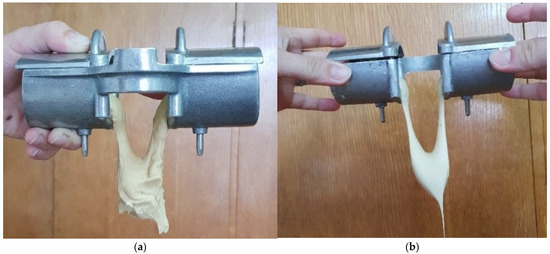
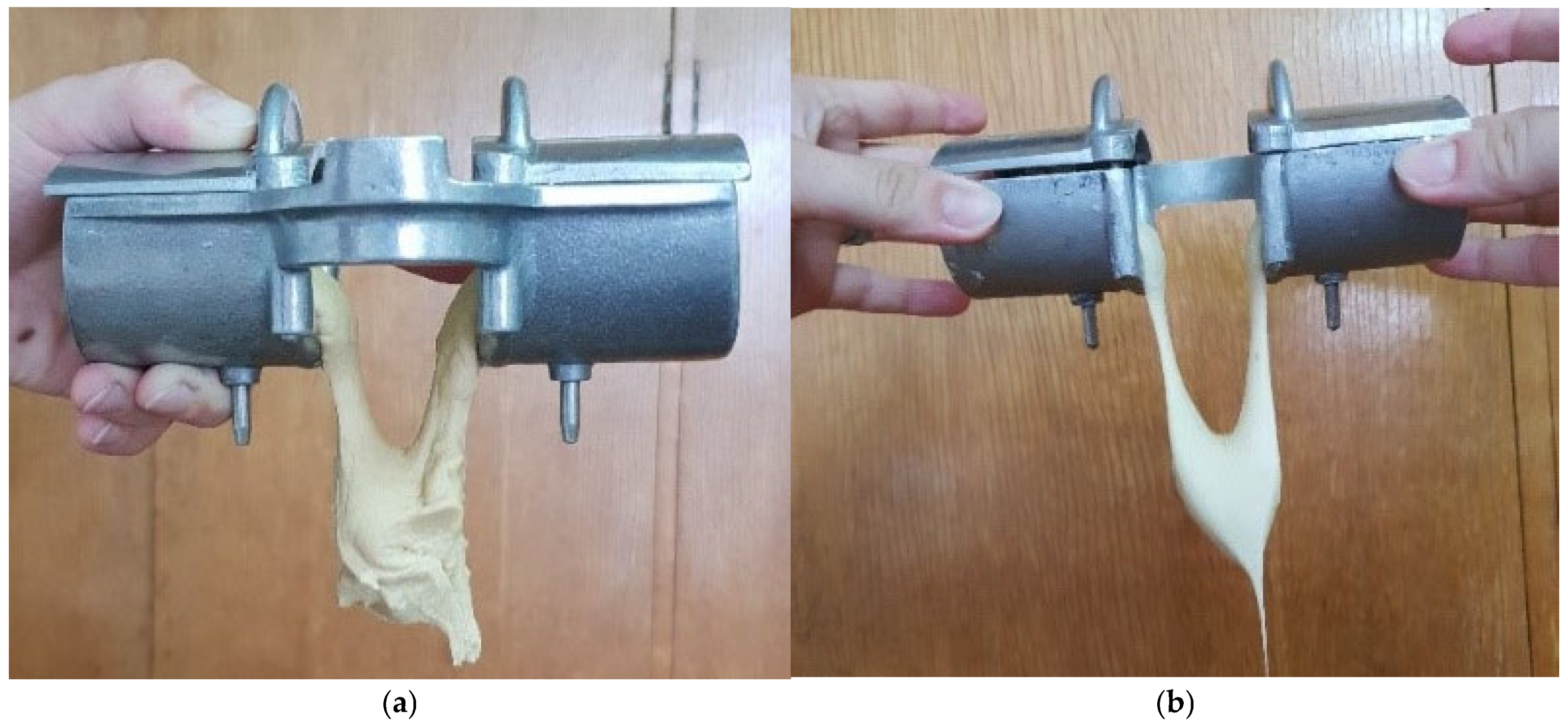
These effects of POL were further supported by the extensographic analysis, as reliable measurements could not be obtained due to the dough’s loss of structural integrity, resulting in excessive softness and cohesiveness (Figure 1). In contrast, POE had no negative effect on dough extensibility regardless of the concentration used (Table 2). All measured parameters for POE-enriched dough were comparable to the control, indicating that its components did not significantly interact with the gluten network, or at least not to an extent detectable by these measurements.
Figure 1.
Dough enriched with Pleurotus ostreatus lyophilizate for extensographic measurements after a 45 min resting period: (a) 1% addition; (b) 5% addition.
Comparable effects have been reported for the incorporation of dried white button [41], shiitake and porcini [5], and oyster mushrooms [35,42] into bread. However, our findings differ regarding water absorption and dough stability, which were not increased or decreased, respectively. Overall, these observations indicate that mushroom powders generally reduce dough strength and modify viscoelastic behavior, primarily by interfering with gluten formation and competing for water. The extent of these effects depends on both the type of mushroom and its concentration. Importantly, our study demonstrates that supplementation with hot water extract of oyster mushroom does not result in these alterations in dough rheology. To our knowledge, no comparable studies have examined the inclusion of hot water fungal extract in bread. Research on other water alternatives has reported similar challenges, including interactions with gluten and other flour ingredients, as well as the effect of fiber on water [43]. These findings highlight the importance of careful selection and optimization of mushroom supplementation to balance nutritional enrichment with desirable dough characteristics for high-quality bread production.
In addition to gluten dilution and water absorption, the observed structural breakdown of the dough may result from proteases present in the mushroom powder, which can partially hydrolyze gluten and impair dough development. P. ostreatus produces various enzymes that are active over a wide pH range [44]. Notably, Palmieri et al. [45] reported an extracellular protease in P. ostreatus capable of degrading different protein substrates, including those resembling the glutenin and gliadin fractions of gluten. Furthermore, fungal cultures, including P. ostreatus, can be used to decrease gluten content in food products [46] by gluten hydrolysis, supporting the hypothesis that enzymes from P. ostreatus may contribute to the degradation of the gluten network in dough.
Proteases are generally heat-labile, with denaturation typically occurring at temperatures above 60–70 °C [47]. Therefore, the 5 h boiling used to prepare POE likely caused thermal inactivation of the proteases present in P. ostreatus. In contrast, the freeze-drying process used to obtain POL can retain enzymatic activity. This difference in processing may explain why POE did not adversely affect dough structure, whereas POL induced noticeable changes in dough quality. Due to these differences, hot water extract may be a more suitable option for preparing bread enriched with mushroom-derived ingredients.
3.3. Bread Quality Alterations Induced by P. ostreatus Lyophilizate and Extract
Based on the dough quality parameters, it was expected that bread with POE would exhibit characteristics comparable to the control, while the inclusion of POL would substantially impair fundamental quality attributes. To verify these assumptions, the quality parameters of the resulting breads were evaluated.
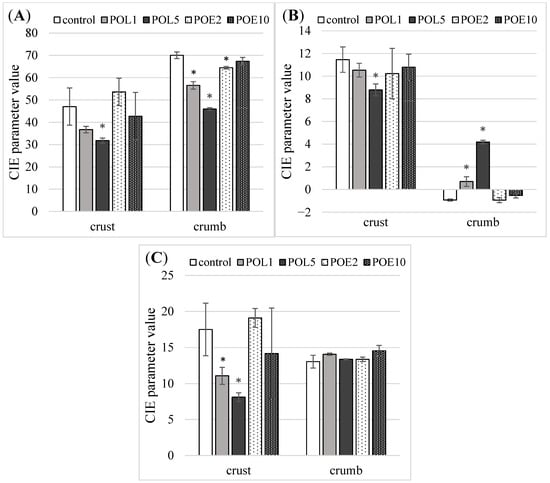
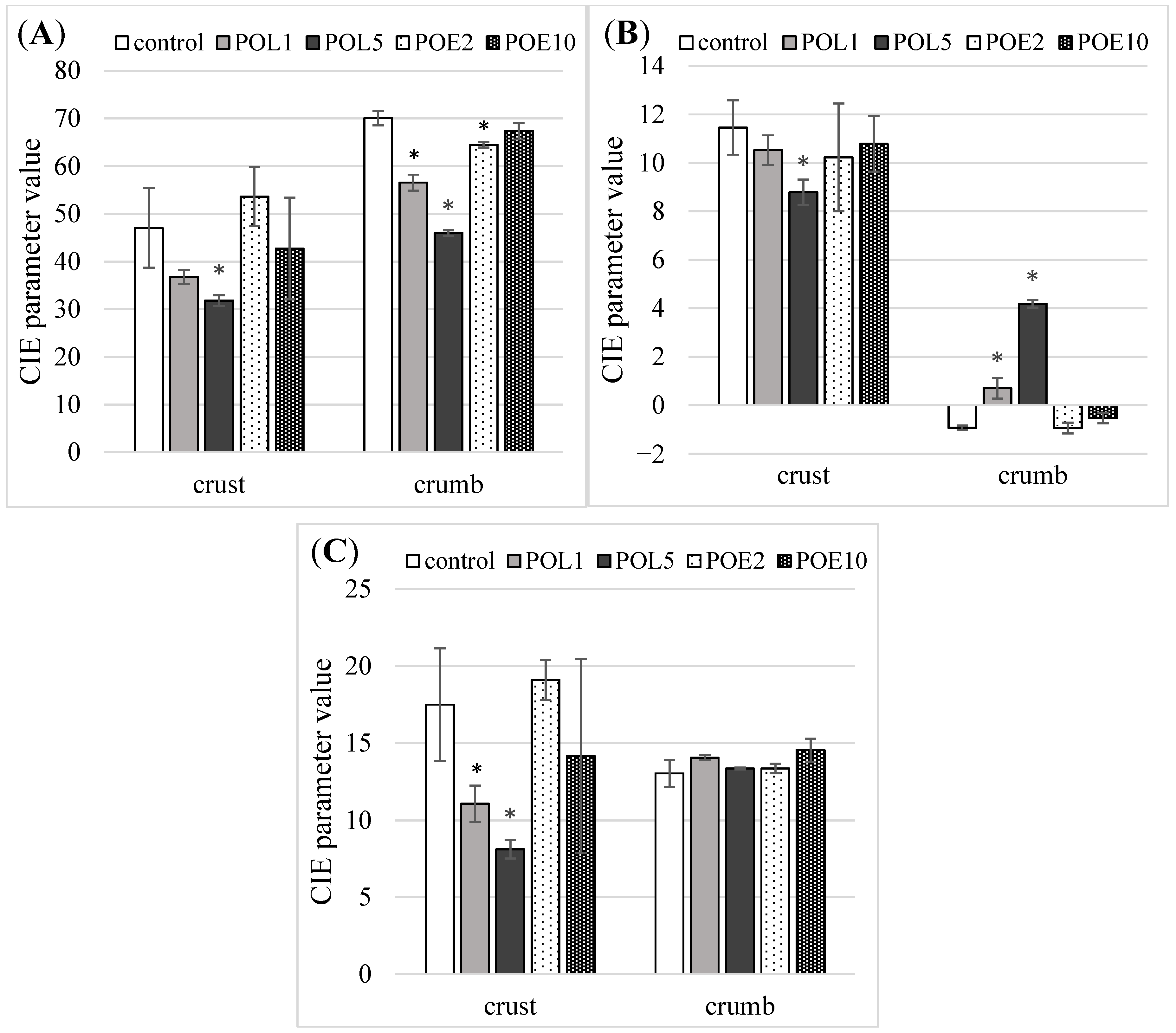
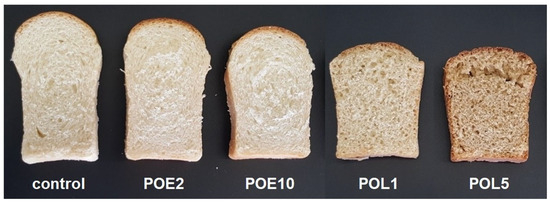
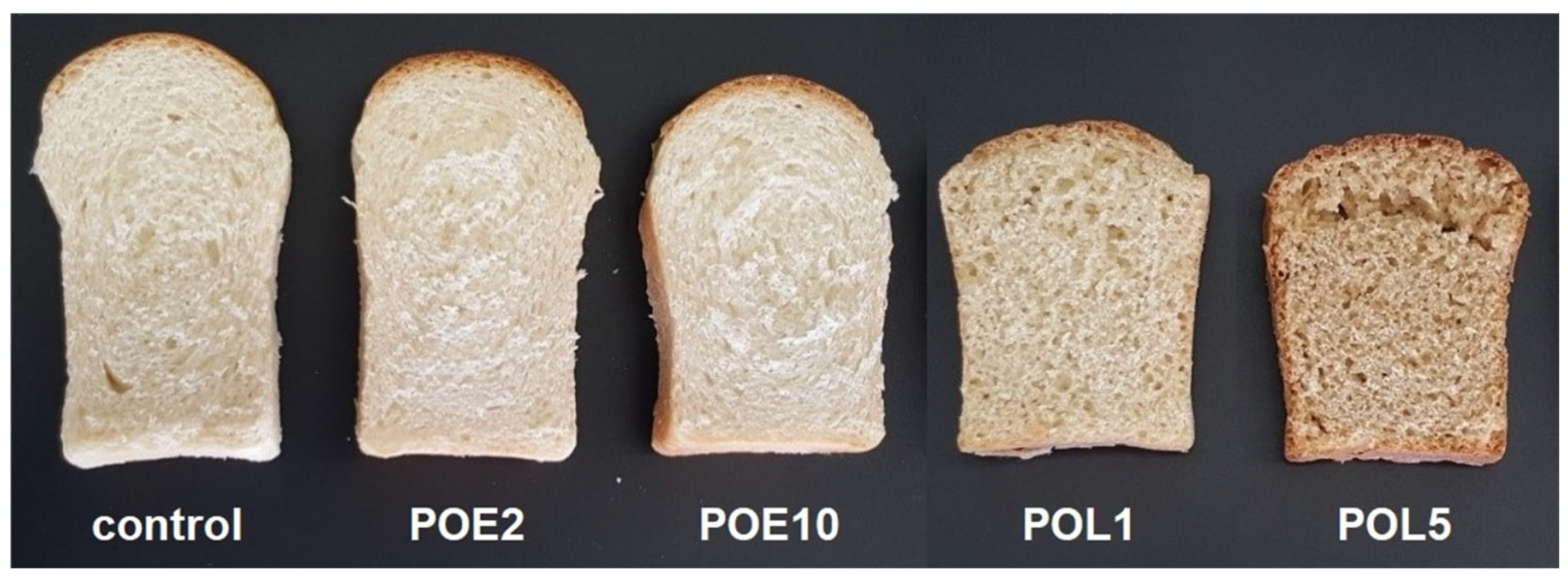
Color analysis of the obtained bread samples revealed that the addition of POL had a more pronounced effect on both crust and crumb color parameters (Figure 2) compared to POE. Specifically, in POL1 and POL5 breads, crust yellowness (b*) decreased, accompanied by a further decrease in lightness (L*) and redness (a*) in POL5. Conversely, POE2 and POE10 showed no significant effect on crust color (p > 0.05). Regarding the crumb, a significant decrease in lightness was observed in POL1, POL5, and POE2, but not in POE10. Furthermore, in POL1 and POL5, significant increases in a* were observed, whereas the control and both POE bread samples gave negative values. This shift led to a visibly browner crumb in breads with POL (Figure 3). No significant differences were observed in the b* parameter of the bread crumb.
Figure 2.
The effects of Pleurotus ostreatus lyophilizate (POL) and extract (POE) on (A) L*, (B) a* and (C) b* color parameters. Asterisk (*) represents statistically significant difference from the control (p < 0.05).
Figure 3.
The effect of Pleurotus ostreatus lyophilizate (POL) and extract (POE) on crumb appearance.
Similar color changes have previously been described in breads enriched with mushroom powders, typically characterized by decreased lightness and redness, although the direction of change in yellowness varies among studies [35,41,48]. The intensified red and brown coloration observed in samples with POL is probably caused by caramelization and Maillard reactions during baking. These reactions are promoted by the elevated high concentrations of reactive precursors, particularly reducing sugars, proteins, and phenolic compounds, which may actively participate in thermal browning processes [1,49].
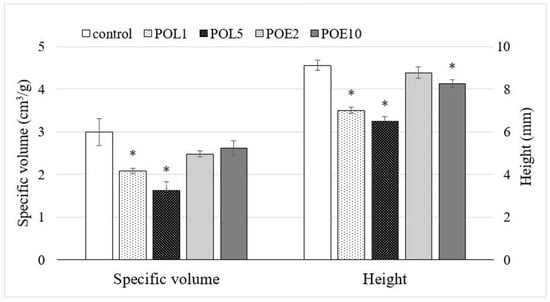
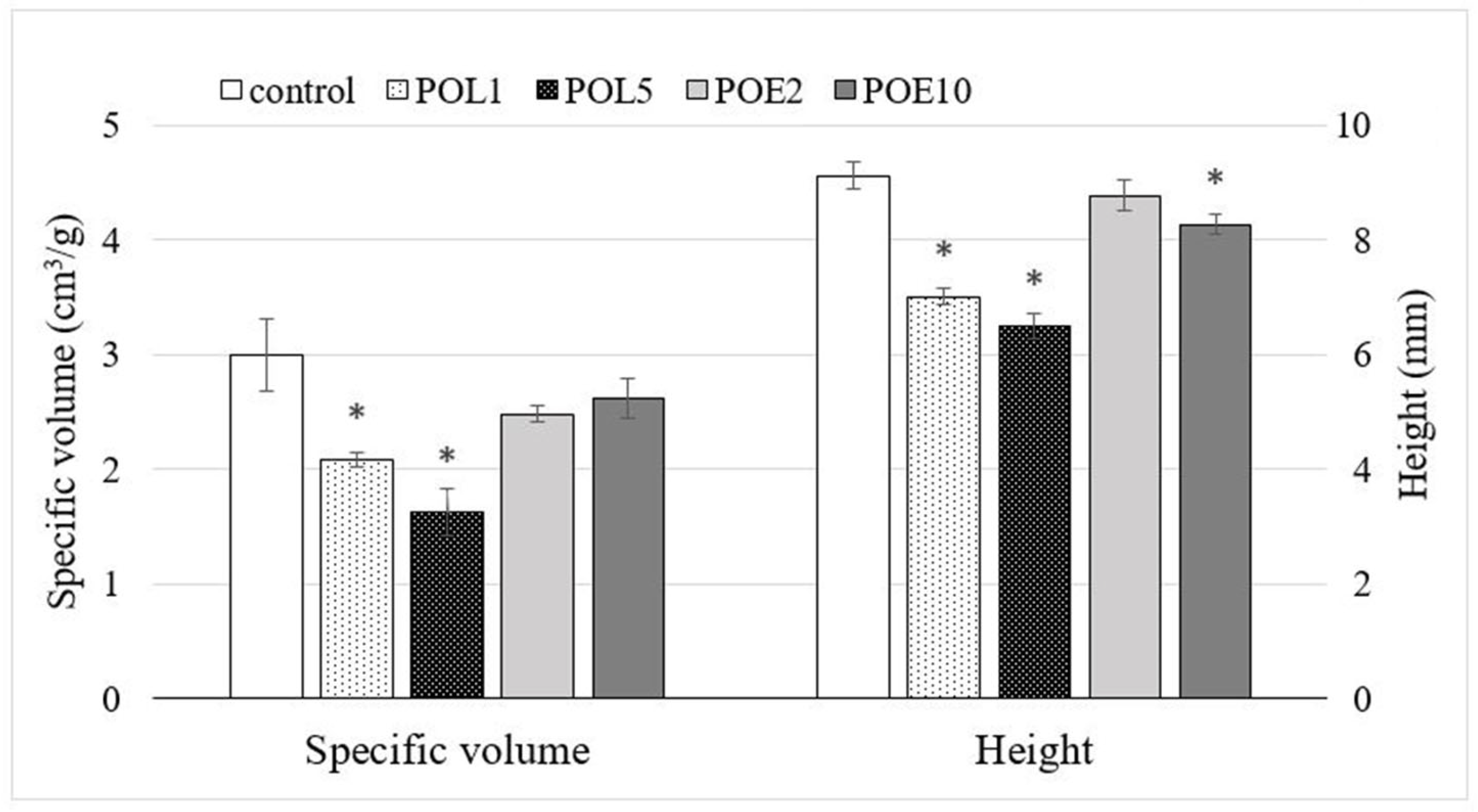
P. ostreatus derivatives had distinct effects on specific volume and height of bread (Figure 4). POL significantly reduced both parameters compared to the control, indicating impaired gas retention due to weakened dough structure. In contrast, the effects of POE were less prominent, although in POE10, a statistically significant decrease in bread height compared to the control was observed. These observations are consistent with the rheological findings and align with previous research showing that mushroom powders significantly reduce specific volume and height of bread [1,35,42].
Figure 4.
The influence of Pleurotus ostreatus lyophilizate (POL) and extract (POE) on specific volume and height of bread. Asterisk (*) represents statistically significant difference from the control (p < 0.05).
The texture profile analysis provided insights into the structural integrity and mechanical resistance of the bread samples (Table 3). Bread hardness varied considerably depending on the type and concentration of P. ostreatus supplement. The control sample exhibited the lowest hardness, whereas POL5 showed the highest value—approximately four times greater than the control. This pronounced effect of the lyophilized powder on crumb hardness is probably associated with its significantly lower crumb moisture and the resulting more compact, less elastic crumb structure. In contrast, POE had a more moderate influence on hardness. Chewiness values followed a similar trend, although the differences between samples were less pronounced. The highest chewiness was recorded in POL5 and the lowest in POE10, suggesting that POL had a greater impact on bread firmness and resistance than POE. Furthermore, POE10 showed lower chewiness than control. This effect can be attributed to the reduction in cohesiveness, which directly contributes to this composite attribute. In addition, POE10 had somewhat lower crumb moisture content than the control (28.64% and 32.40%, respectively). A decrease in moisture typically leads to firmer and more cohesive crumbs; however, in this case, the observed reduction in cohesiveness and moisture in POE10 produced a finer, less interconnected crumb that required less energy to break down during chewing. As a result, chewiness decreased despite its hardness being comparable to the control, which suggests that POE altered the internal crumb structure in a way that limited its ability to withstand deformation.
Table 3.
The effect of Pleurotus ostreatus lyophilizate and extract on the moisture content and texture profile of bread.
The results for springiness, cohesiveness, and resilience showed a consistent pattern, reflecting similar effects on crumb structure. POL significantly reduced all three parameters compared with both the control and POE-enriched breads (p < 0.05), whereas POE had no significant effect on these indicators of crumb elasticity and internal structure. These findings suggest that the crumb of breads with POL had a reduced ability to recover its original shape after compression, indicating a weakened and less elastic structure.
The incorporation of mushroom powders into bread has previously been shown to alter textural properties, with texture parameters shifting either upward or downward depending on the mushroom species used [41]. However, findings related to P. ostreatus powder are largely consistent with our observations [1,48]. The addition of POL led to a decrease in specific volume, indicating a denser and more compact structure, which likely contributed to the observed increase in hardness. These results also align with the previously discussed rheological traits, as partial gluten degradation and impaired network formation can result in a weaker and less resilient crumb matrix.
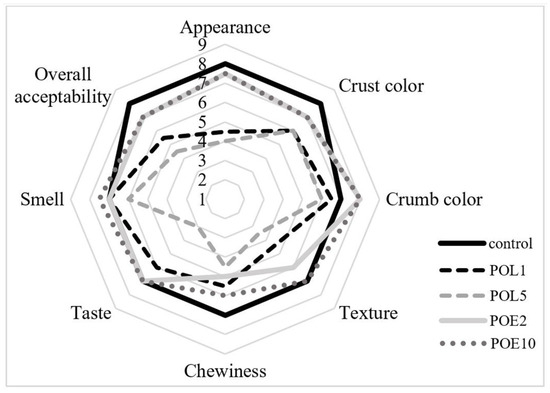
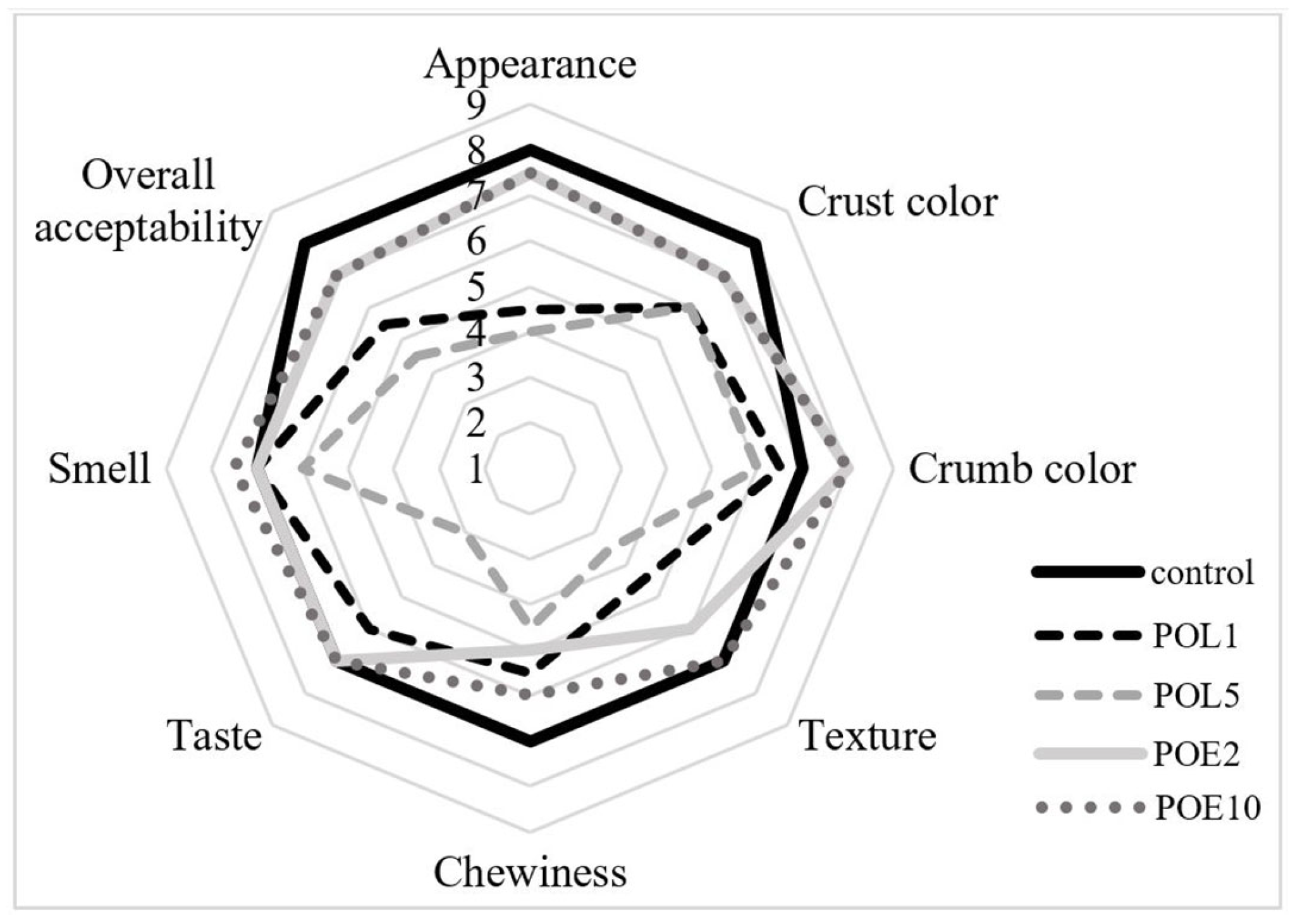
In the sensory analysis, the control bread received the highest overall acceptability score, as well as the highest scores for appearance, crust color, and chewiness (Figure 5). These scores were slightly higher than those of POE2 and POE10. The control and POE10 received similar scores for texture and taste, while POE10 received the highest score for smell and crumb color. Interestingly, POL1 received the same smell score as control and POE breads. However, all other sensory attributes were rated considerably lower, as was also the case for POL5. Notably, smell was the parameter with the least variation among samples, suggesting that P. ostreatus did not produce any unpleasant odor.
Figure 5.
The influence of Pleurotus ostreatus lyophilizate (POL) and extract (POE) on sensory attributes of bread.
Consistent with the results for dough quality and other bread quality parameters, the sensory evaluation showed that bread containing POL, particularly at higher concentrations, had a negative impact on sensory attributes. The sensory findings were in agreement with the rheological and physical quality results. The texture and chewiness scores matched the instrumental texture measurements. The lowest sensory scores for POL can also be attributed to the noticeably reduced loaf volume (Figure 4), which resulted in a denser structure and a less appealing visual appearance compared to the well-risen control bread. Additionally, the altered loaf shape, particularly the flattened top surface due to inadequate oven spring during baking, likely contributed to the less favorable perception of appearance.
Significant sensory changes following the addition of mushroom powders to bread have previously been reported [1,35,42]. These studies consistently reported a decline in sensory scores with increasing levels of mushroom powder, which is consistent with our findings. However, the threshold concentration at which sensory quality was affected varied among studies, ranging from 1% [42] to 5% [1] of dried P. ostreatus powder without significant impact. In contrast, in our study, even 1% of POL resulted in noticeable sensory deterioration. Conversely, POE achieved comparable or slightly improved sensory scores relative to the control, suggesting that the hot water extract may be a promising alternative to mushroom powder for bread enrichment.
3.4. Nutritional and Bioactive Contribution of P. ostreatus Lyophilizate and Extract to Bread Quality
Table 4 presents selected nutritional components of the bread samples. It was determined that the protein content of bread with POL did not increase, contrary to expectations, even though POL contains significantly more protein compared to wheat flour (Table 1). This may be due to the proteolytic activity of proteases present in P. ostreatus fruiting bodies [50]. The protein content was comparable to that of the control bread only in bread with 5% POL whereas it was significantly decreased in the other bread samples. It was also expected that POL and POE would increase the β-glucan content in bread, as they contain 24.63%, and 9.23% β-glucan, respectively. However, no significant difference in the β-glucan content in bread enriched with POL and POE was detected using either mixed-linkage or fungal β-glucan assays. The expected difference in β-glucan content may have been obscured by the small amount added, making it undetectable in the final product, or by the inadequacy of the assays used. It has previously been reported that limitations of the enzymatic methods used in these assays prevent the determination of fungal β-glucan content in bread samples [51]. Conversely, POL did increase the total dietary fiber content (TDF) in bread up to 4.91 g/100 g (POL5). Bread with a total dietary fiber content of ≥3 g/100 g can be labeled as “a source of fiber”, according to Regulation (EC) No 1924/2006 [52] on nutrition and health claims made on food. POE exerted a lower positive effect on the content of total dietary fiber; nevertheless, a significant increase compared to control bread was observed in bread with 2% POE (p < 0.05).
Table 4.
The effects of Pleurotus ostreatus lyophilizate (POL) and extract (POE) on the content of nutritional and bioactive components in bread.
A clear trend was observed for bioactivity. Even POL1 and POE2 showed a significant increase in total phenol content (TPC) compared to the control, with further increases in POL5 and POE10 (Table 4). Total flavonoid content (TFC) was significantly higher only in POE5 (p < 0.05). Both POL and POE enhanced antioxidant properties, as measured by the FRAP assay, with phenolic compounds likely being the main contributors. P. ostreatus is known for its diverse phytochemical composition [8], and previous studies have shown that inclusion of oyster mushroom powder increases bread antioxidant activity [1]. Moreover, POE also achieved this increase in bioactivity while maintaining better sensory performance, suggesting that the hot water extract offers a practical approach to enriching bread with bioactive compounds without compromising consumer acceptability.
4. Conclusions
Pleurotus ostreatus derivatives are a valuable raw material for developing functional bread due to their high content of dietary fibers (particularly β-glucans), proteins and minerals. However, incorporating of lyophilized P. ostreatus into bread dough disrupts structural integrity, resulting in reduced bread quality. Further studies should investigate the potential role of P. ostreatus proteases in these effects, as well as the combined use of lyophilizate with other natural fortifying ingredients that may counteract negative impacts on dough and bread properties. In contrast, hot water P. ostreatus extract maintained technological and sensory properties comparable to the control bread. Future research should explore higher inclusion levels of P. ostreatus extract to further enhance the nutritional and antioxidant properties of bread.
Author Contributions
Conceptualization, J.S., M.S., J.Z. and A.K.; methodology, D.Š.-S. and M.S.; investigation, J.Z., J.P., J.S., M.S. and A.K.; resources, J.S.; data curation, J.Z., M.S. and A.K.; writing—original draft preparation, J.Z.; writing—review and editing, J.S., M.S., A.K. and S.S.M.; visualization, J.P.; supervision, M.S., A.K.; funding acquisition, S.S.M. and D.Š.-S. All authors have read and agreed to the published version of the manuscript.
Funding
This research was funded by the Slovenian Research and Innovation Agency (Grants No. P4-0116, P4-0432), the Ministry of Science, Technological Development and Innovations of the Republic of Serbia, No. 451-03-136/2025-03/200134 and 451-03-137/2025-03/200134 and CEEPUS network CIII-HR-0306-18-2526 For Safe and Healthy Food in Middle Europe.
Data Availability Statement
The original contributions presented in this study are included in the article. Further inquiries can be directed to the corresponding author.
Acknowledgments
We are grateful to Tinka Žugman, Jerneja Burgar and Rebeka Podgrajšek for their technical assistance.
Conflicts of Interest
The authors declare no conflicts of interest.
References
- Losoya-Sifuentes, C.; Simões, L.S.; Cruz, M.; Rodríguez-Jasso, R.M.; Loredo-Treviño, A.; Teixeira, J.A.; Nobre, C.; Belmares, R. Development and characterization of Pleurotus ostreatus mushroom–wheat bread. Starch-Stärke 2021, 74, 2100126. [Google Scholar] [CrossRef] [Scilit]
- Srivastava, A.; Attri, B.L.; Kamal, S.; Pathera, A.K.; Kashyap, R.; Verma, S.; Sharma, V.P. Nutritional enhancement, microstructural modifications, and sensory evaluation of mushroom-enriched multigrain bread. Int. J. Food Sci. Technol. 2024, 59, 9523–9531. [Google Scholar] [CrossRef] [Scilit]
- Sławińska, A.; Sołowiej, B.G.; Radzki, W.; Fornal, E. Wheat Bread Supplemented with Agaricus bisporus Powder: Effect on Bioactive Substances Content and Technological Quality. Foods 2022, 11, 3786. [Google Scholar] [CrossRef] [Scilit]
- Lu, X.; Brennan, M.A.; Guan, W.; Zhang, J.; Yuan, L.; Brennan, C.S. Enhancing the Nutritional Properties of Bread by Incorporating Mushroom Bioactive Compounds: The Manipulation of the Predictive Glycaemic Response and the Phenolic Properties. Foods 2021, 10, 731. [Google Scholar] [CrossRef] [Scilit]
- Lu, X.; Brennan, M.A.; Serventi, L.; Brennan, C.S. Incorporation of Mushroom Powder into Bread Dough—Effects on Dough Rheology and Bread Properties. Cereal Chem. 2018, 95, 418–427. [Google Scholar] [CrossRef] [Scilit]
- Barzee, T.J.; Cao, L.; Pan, Z.; Zhang, R. Fungi for Future Foods. J. Future Foods 2021, 1, 25–37. [Google Scholar] [CrossRef] [Scilit]
- Effiong, M.E.; Umeokwochi, C.P.; Afolabi, I.S.; Chinedu, S.N. Assessing the nutritional quality of Pleurotus ostreatus (oyster mushroom). Front. Nutr. 2024, 10, 1279208. [Google Scholar] [CrossRef] [Scilit]
- Effiong, M.E.; Umeokwochi, C.P.; Afolabi, I.S.; Chinedu, S.N. Comparative antioxidant activity and phytochemical content of five extracts of Pleurotus ostreatus (oyster mushroom). Sci. Rep. 2024, 14, 3794. [Google Scholar] [CrossRef] [Scilit] [PubMed]
- Zhao, Q.; Liu, X.; Cui, L.; Ma, C. Extraction and Bioactivities of the Chemical Composition from Pleurotus ostreatus: A Review. J. Future Foods 2024, 4, 111–118. [Google Scholar] [CrossRef] [Scilit]
- Shams, R.; Singh, J.; Dash, K.K.; Dar, A.H. Comparative Study of Freeze Drying and Cabinet Drying of Button Mushroom. Appl. Food Res. 2022, 2, 100084. [Google Scholar] [CrossRef] [Scilit]
- Wang, D.; Wang, Y.; Pandiselvam, R.; Su, D.; Xu, H. Comparative Analysis of Drying Methods on Pleurotus eryngii: Impact on Drying Efficiency, Nutritional Quality, and Flavor Profile. Food Bioprocess Technol. 2024, 17, 4598–4616. [Google Scholar] [CrossRef] [Scilit]
- Zahorec, J.; Šoronja-Simović, D.; Petrović, J.; Nikolić, I.; Pavlić, B.; Bijelić, K.; Bojanić, N.; Fišteš, A. Fortification of bread with carob extract: A comprehensive study on dough behavior and product quality. Foods 2025, 14, 1821. [Google Scholar] [CrossRef] [Scilit] [PubMed]
- Afonso, T.B.; Marçal, S.; Vale, P.; Sousa, A.S.; Nunes, J.; Pintado, M. Exploring the Bioactive Potential of Mushroom Aqueous Extracts: Antimicrobial, Antioxidant, and Prebiotic Properties. Appl. Sci. 2025, 15, 1551. [Google Scholar] [CrossRef] [Scilit]
- Navarro-Simarro, P.; Gómez-Gómez, L.; Rubio-Moraga, Á.; Moreno-Giménez, E.; López-Jiménez, A.; Prieto, A.; Ahrazem, O. Valorization of Mushroom By-Products for Sustainability: Exploring Antioxidant and Prebiotic Properties. J. Food Biochem. 2025, 2025, 3527311. [Google Scholar] [CrossRef] [Scilit]
- Serbian Official Methods. Određivanje fizičkih osobina pšeničnog brašna Brabenderovim farinografom. In Pravilnik o Metodama Fizičkih i Hemijskih Analiza za Kontrolu Kvaliteta Žita, Mlinskih i Pekarskih Proizvoda, Testenina i Brzo Smrznutih Testa (Regulation of Methods of Physical and Chemical Analysis for Quality Control of Grain, Milling and Bakery Products, Pasta and Quick Frozen Dough); Službeni List SFRJ 74/88; Government of SFRJ: Belgrade, Serbia, 1988. [Google Scholar]
- Dapčević Hadnađev, T.; Pojić, M.; Hadnađev, M.; Torbica, A. The role of empirical rheology on flour quality control. In Wide Spectra of Quality Control; Akyar, I., Ed.; InTech: Rijeka, Croatia, 2011; pp. 335–360. [Google Scholar]
- AOAC (Association of Official Analytical Chemists). Official Methods of Analysis of the Association of Official Analytical Chemists International, 17th ed.; Association of Official Analytical Communities: Gaithersburg, MD, USA, 2000. [Google Scholar]
- Gafta Method 10.1:2018; Sugar—Luff Schoorl Method. GAFTA Analysis Methods. The Grain and Feed Trade Association: London, UK, 2018.
- AACC International. AACCI Method 10-05 Baking Quality Methods: Guidelines for Measurement of Volume by Rapeseed Displacement. In Approved Methods of the American Association of Cereal Chemists, 11th ed.; AACC International: St. Paul, MN, USA, 2008. [Google Scholar]
- AACC Method 74-09; Approved Methods of the AACC. American Association of Cereal Chemists: St. Paul, MN, USA, 2000.
- CIE. International Commission on Illumination, Colorimetry: Official Recommendation of the International Commission on Illumination; Publication CIE No. (E-1.31); Bureau Central de la CIE: Paris, France, 1976. [Google Scholar]
- ISO 8586:2012; Sensory Analysis—General Guidelines for the Selection, Training and Monitoring of Selected Assessors and Expert Sensory Assessors. ISO: Geneva, Switzerland, 2012.
- ISO 5492:2008; Sensory Analysis—Vocabulary. ISO: Geneva, Switzerland, 2008.
- ISO 4121:2003; Sensory Analysis—Methodology—Evaluation of Food Products by Sensory Experts. ISO: Geneva, Switzerland, 2003.
- ISO 8589:2007; Sensory Analysis—General Guidance for the Design of Test Rooms. ISO: Geneva, Switzerland, 2007.
- Yu, L.; Nanguet, A.-L.; Beta, T. Comparison of Antioxidant Properties of Refined and Whole Wheat Flour and Bread. Antioxidants 2013, 2, 370–383. [Google Scholar] [CrossRef] [Scilit]
- Ahmed, D.; Fatima, K.; Saeed, R. Analysis of Phenolic and Flavonoid Contents, and the Anti-Oxidative Potential and Lipid Peroxidation Inhibitory Activity of Methanolic Extract of Carissa opaca Roots and Its Fractions in Different Solvents. Antioxidants 2014, 3, 671–683. [Google Scholar] [CrossRef] [Scilit]
- Li, W.; Pickard, M.D.; Beta, T. Evaluation of Antioxidant Activity and Electronic Taste and Aroma Properties of Antho-Beers from Purple Wheat Grain. J. Agric. Food Chem. 2007, 55, 8958–8966. [Google Scholar] [CrossRef] [Scilit]
- Benzie, I.F.F.; Strain, J.J. Ferric Reducing/Antioxidant Power Assay: Direct Measure of Total Antioxidant Activity of Biological Fluids and Modified Version for Simultaneous Measurement of Total Antioxidant Power and Ascorbic Acid Concentration. Methods Enzymol. 1999, 299, 15–27. [Google Scholar] [CrossRef] [Scilit]
- Gallotti, F.; Turchiuli, C.; Lavelli, V. Production of Stable Emulsions Using β-Glucans Extracted from Pleurotus ostreatus to Encapsulate Oxidizable Compounds. J. Food Process Eng. 2022, 45, e13949. [Google Scholar] [CrossRef] [Scilit]
- Mirończuk-Chodakowska, I.; Witkowska, A.M. Evaluation of Polish Wild Mushrooms as Beta-Glucan Sources. Int. J. Environ. Res. Public Health 2020, 17, 7299. [Google Scholar] [CrossRef] [Scilit] [PubMed]
- Pérez-Bassart, Z.; Fabra, M.J.; Torres, J.A.; Chiralt, A. Compositional Differences of β-Glucan-Rich Extracts from Three Relevant Mushrooms Obtained through a Sequential Extraction Protocol. Food Chem. 2023, 402, 134207. [Google Scholar] [CrossRef] [Scilit]
- Bashir, N.; Sood, M.; Bandral, J.D. Impact of Different Drying Methods on Proximate and Mineral Composition of Oyster Mushroom (Pleurotus florida). Indian J. Tradit. Knowl. 2020, 19, 656–661. [Google Scholar] [CrossRef] [Scilit]
- Sajad, S.; Singh, J.; Gupta, N.; Sharma, S.; Sharma, M.; Sharma, V.; Shankar, U. Physico-Chemical, Color Profile, and Total Phenol Content of Freeze-Dried (Oyster Mushroom) Pleurotus ostreatus. Pharma Innov. 2023, 12, 2076–2078. [Google Scholar]
- Majeed, M.; Khan, M.U.; Owaid, M.N.; Khan, M.R.; Shariati, M.A.; Igor, P.; Ntsefong, G.N. Development of oyster mushroom powder and its effects on physicochemical and rheological properties of bakery products. J. Microbiol. Biotechnol. Food Sci. 2017, 6, 1221–1227. [Google Scholar] [CrossRef] [Scilit]
- Boadu, K.B.; Nsiah-Asante, R.; Antwi, R.T.; Obirikorang, K.A.; Anokye, R.; Ansong, M. Influence of the Chemical Composition of Sawdust on the Levels of Important Macronutrients and Ash Composition in Pearl Oyster Mushroom (Pleurotus ostreatus). PLoS ONE 2023, 18, e0287532. [Google Scholar] [CrossRef] [Scilit]
- Elkanah, F.A.; Oke, M.A.; Adebayo, E.A. Substrate Composition Effect on the Nutritional Quality of Pleurotus ostreatus (MK751847) Fruiting Body. Heliyon 2022, 8, e11841. [Google Scholar] [CrossRef] [Scilit] [PubMed]
- Dutta, A.K.; Pradhan, P.; Chatterjee, S.; Roy, T.; Paul, S.; Saha, R.; Sarkar, J.; Acharya, K. Comparative structural and proximate values of five different cultivated strains of Pleurotus ostreatus. Res. J. Pharm. Technol. 2013, 6, 415–421. [Google Scholar]
- Drężek, J.; Możejko-Ciesielska, J. Production of β-Glucans by Pleurotus ostreatus: Cultivation and Genetic Background. Int. J. Mol. Sci. 2025, 26, 9703. [Google Scholar] [CrossRef] [Scilit]
- Törős, G.; Béni, Á.; Peles, F.; Gulyás, G.; Prokisch, J. Comparative Analysis of Freeze-Dried Pleurotus ostreatus Mushroom Powders on Probiotic and Harmful Bacteria and Its Bioactive Compounds. J. Fungi 2024, 11, 1. [Google Scholar] [CrossRef] [Scilit]
- Zhang, Y.; Ruan, C.; Cheng, Z.; Zhou, Y.; Liang, J. Mixolab behavior, quality attributes and antioxidant capacity of breads incorporated with Agaricus bisporus. J. Food Sci. Technol. 2019, 56, 3921–3929. [Google Scholar] [CrossRef] [Scilit] [PubMed]
- Hong, G.-H.; Song, G.-S.; Kim, Y.-S. Effect of oyster mushroom (Pleurotus ostreatus) powder on bread quality. Prev. Nutr. Food Sci. 2005, 10, 214–218. [Google Scholar] [CrossRef] [Scilit]
- Sadeghi, A.; Kardooni, Z.; Ebrahimi, M.; Assadpour, E.; Jafari, S.M. The Role of Water Alternatives in Bread Formulation and Its Quality: An Emerging Source of Sustainable and Cost-Effective Bakery Improvers. Future Foods 2025, 12, 100733. [Google Scholar] [CrossRef] [Scilit]
- Cruz-Vázquez, A.; Tomasini, A.; Armas-Tizapantzi, A.; Marcial-Quino, J.; Montiel-González, A.M. Extracellular proteases and laccases produced by Pleurotus ostreatus PoB: The effects of proteases on laccase activity. Int. Microbiol. 2022, 25, 495–502. [Google Scholar] [CrossRef] [Scilit] [PubMed]
- Palmieri, G.; Bianco, C.; Cennamo, G.; Giardina, P.; Marino, G.; Monti, M.; Sannia, G. Purification, characterization, and functional role of a novel extracellular protease from Pleurotus ostreatus. App. Environ. Microbiol. 2001, 67, 2754–2759. [Google Scholar] [CrossRef] [Scilit]
- Langan, J.P.; Kelly, B.J.; Davis, H.; Hahn, A.D. Methods for Lowering Gluten Content Using Fungal Cultures. Patent Publication No. 20210274818, 9 September 2021. [Google Scholar]
- Andrejević, N.; Polović, N.; Milošević, J. Kinetics of Protease Thermal Inactivation. In Zymography; Khalil, R.A., Ed.; Methods in Molecular Biology; Humana: New York, NY, USA, 2025; Volume 2917. [Google Scholar] [CrossRef] [Scilit]
- Abdul Wahab, N.B.; Darus, N.A.; Mohd Daud, S.A. Incorporation of mushroom powder in bread. In Proceedings of the National Technology Research in Engineering, Design and Social Science Conference (nTrends’22), Kuala Lumpur, Malaysia, 5–6 October 2022. [Google Scholar]
- Yuan, B.; Zhao, L.; Yang, W.; MClements, D.J.; Hu, Q. Enrichment of bread with nutraceutical-rich mushrooms: Impact of Auricularia auricular (mushroom) flour upon quality attributes of wheat dough and bread. J. Food Sci. 2017, 82, 2041–2050. [Google Scholar] [CrossRef] [Scilit]
- Sabotic, J.; Trcek, T.; Popovic, T.; Brzin, J. Basidiomycetes harbour a hidden treasure of proteolytic diversity. J. Biotechnol. 2007, 128, 297–307. [Google Scholar] [CrossRef] [Scilit]
- Stępniewska, S.; Salamon, A.; Cacak-Pietrzak, G.; Piecyk, M.; Kowalska, H. The Impact of Oyster Mushrooms (Pleurotus ostreatus) on the Baking Quality of Rye Flour and Nutrition Composition and Antioxidant Potential of Rye Bread. Foods 2025, 14, 199. [Google Scholar] [CrossRef] [Scilit]
- European Parliament and Council. Regulation (EC) No 1924/2006 of the European Parliament and of the Council of 20 December 2006 on nutrition and health claims made on foods. Off. J. Eur. Union 2006, L404, 9–25. [Google Scholar]

Disclaimer/Publisher’s Note: The statements, opinions and data contained in all publications are solely those of the individual author(s) and contributor(s) and not of MDPI and/or the editor(s). MDPI and/or the editor(s) disclaim responsibility for any injury to people or property resulting from any ideas, methods, instructions or products referred to in the content. |
© 2025 by the authors. Licensee MDPI, Basel, Switzerland. This article is an open access article distributed under the terms and conditions of the Creative Commons Attribution (CC BY) license.