Article

Raw Material Heating and Optical Glass Synthesis Using Microwaves

by
Takeshi Miyata
1,
Keiichiro Kashimura
1,* and
Kiyoyuki Momono
2
1
Faculty of Engineering, Chubu University, 1200 Matsumoto-cho, Kasugai 487-8501, Aichi, Japan
2
Advanced Materials Development Section, Research and Development Department, Research and Development Center, OHARA INC., 1-15-30, Oyama, Chuo-ku, Sagamihara-shi 252-5286, Kanagawa, Japan
*
Author to whom correspondence should be addressed.
Processes 2026, 14(1), 54; https://doi.org/10.3390/pr14010054
Submission received: 3 November 2025 / Revised: 16 December 2025 / Accepted: 18 December 2025 / Published: 23 December 2025

Abstract

Microwaves have been used as a heat source in various chemical processes, and their application range is expanding to include high-temperature processes. Existing microwave-based methods for glass syntheses predominantly involve coating and drying. Moreover, microwaves have rarely been applied to glass melting, which consumes a large amount of energy. In this study, the raw materials required for preparing optical glass were heated using microwaves to reduce the energy consumption of the glass-melting process. Microwaves were applied to the raw materials of a typical optical glass, i.e., borosilicate crown glass (BK7). The results indicated that the raw materials rapidly reached the target temperature of 1000 °C and were heated particularly well at temperatures above 500 °C. This was reflected in the high microwave absorption of BK7 above 500 °C, as confirmed by dielectric-constant measurements in the high-temperature range using resonance perturbation. Additionally, BK7 was heated on a 100 g scale in a large microwave-concentrated hexagonal furnace. The obtained glass exhibited a refractive index of 1.5155 (d-line of helium: λ = 587.56 nm), which is comparable to that obtained via conventional heating. Our findings are expected to help reduce the time needed for glass melting considerably and conserve energy, thus contributing to a sustainable society.

1. Introduction

The need to replace fossil fuels with low-carbon energy sources is a core issue associated with the decarbonisation of various industries. Madeddu et al. [1] comprehensively analysed the CO2 emissions from the European industrial sector and reported that electrification can reduce emissions by 78%. Lechtenböhmer et al. [2] reported that the decarbonisation of the basic material production process via electrification could substantially reduce CO2 emissions in the European Union. However, the authors warned that this process would increase electricity demands and that the technology required for such electrification was underdeveloped. Therefore, energy-saving technologies must be developed to reduce the electricity demand [3]. Nakano et al. [3] reported that the electrification of the material manufacturing sector could significantly reduce CO2 emissions and conserve energy during electrification.
The glass-melting sector is a major energy-consuming sector that contributes to CO2 emissions. The production of one metric tonne of glass consumes approximately 4–17 GJ of energy [4,5,6,7]. In addition, the glass-melting process uses fossil fuels, which have high electrification potential [2,3], and emits 0.46–0.69 tonnes of CO2 [8,9]. The melting process consumes approximately 50–85% of the total energy required for glass production [10]. This is because the large amounts of raw materials required to produce glass must be maintained at high temperatures for long periods.
In the chemical industry, various methods, such as induction heating, dielectric heating, and plasma heating, are used for electrical heating. Microwaves have been used in a wide range of high-temperature processes, with numerous reports on successful scale-up applications [11,12,13,14]. They can be used to directly heat target materials, enabling rapid heating or cooling via precise output control; therefore, they represent a promising alternative to fossil fuels as a heat source in glass production. For instance, Ioana et al. [15] demonstrated that municipal solid waste mixed with fly ash could be converted to porous glass ceramics via microwave heating. This process enables the use of waste as recycled aggregates and immobilises heavy metals. Wongwan et al. [16] reported that the application of microwaves in the synthesis of Eu3+-doped tellurite glass significantly accelerated the melting process, which could be completed in one-fourth the time required by conventional heating methods. Microwave technology has also attracted considerable attention as a promising method for synthesising various types of glass. However, research on the fabrication of optical glasses using microwave heating has predominantly focused on phosphate-based glasses [17,18,19,20,21]. Considering the production volume and industrial importance of optical glasses, the ability to melt silicate-based glasses is far more critical; however, reports on the microwave melting of such compositions remain limited [22,23,24,25]. This is likely because phosphate-based raw materials can absorb microwave energy relatively easily, whereas the raw materials of silicate glasses exhibit poor microwave absorption and are therefore difficult to efficiently heat.
In this study, we precisely controlled microwaves in a cavity resonator to efficiently heat the raw materials of borosilicate crown glass (BK7), a representative optical glass. The dielectric constants of the raw materials at high temperatures were measured. The proposed method was applied to the rapid heating and melting of 1.5 × 10² g of the raw material, and the refractive index of the resulting glass was determined via the V-block method.

2. Materials and Methods

In the application of microwaves for the heating of glass, which is a difficult material to heat, the heating and melting processes are performed by amplifying the electric fields. This process is governed by the following equation:
d i v E × H   = t 1 2 ε E 2 + 1 2 μ H 2 E · i
where E is the electric-field intensity, H is the magnetic-field intensity, ε is the dielectric constant, μ is the magnetic permeability, and i is the current. Equation (1), which is the most fundamental equation in microwave heating, can be derived from the Faraday–Maxwell and Maxwell–Ampere equations. The first term is the energy imparted to the material by the electric field of the microwaves to heat glass with a low ε. Consequently, E2 increases to efficiently provide energy to the glass. Although not well known, microwaves can be used to heat quartz, which is typically difficult to heat.
The raw materials (3.00 g) were loaded into a quartz holder, which was tapped 100 times to suppress volume changes. Subsequently, the quartz holder was loaded into a cavity resonator. We employed separate microwave fields with a frequency of 2.45 GHz as the heating mode. The system was equipped with six waveguides (109.1 × 56.4 × 149.3 ± 5 mm3) and a magnetron oscillator (MPS-17A, Nissin Co., Ltd., Hyogo, Japan), an E–H tuner (Piat-XX-CE, Nissin Co., Ltd., Hyogo, Japan), a plunger (SP-J, Nissin Co., Ltd., Hyogo, Japan), and a dummy load (NISJ-15A, Nissin Co., Ltd., Hyogo, Japan). Microwaves were focused using a 52 mm slit parallel to the orientation of the electric field to form a TE103 wave within the cavity. Finally, a plunger was placed at the ends of the waveguides. This system spatially separated and strengthened the electric and magnetic fields of the microwaves [26,27]. This device uses a microwave heating method called single mode, which generates a standing wave of the TE103 mode in the waveguide. By adjusting the short plunger, this container responds to changes in microwave wavelength caused by the insertion of a sample. The sample was placed at an electric-field node, denoted by Emax, where the magnetic field was zero, and the reactant temperatures were monitored using a radiation thermometer (FTZ6-R220-5S22, Japan Sensor Corp., Osaka, Japan).
To evaluate the heating behaviour of the materials, the dielectric properties were measured at various temperatures using the cavity perturbation method [27,28]. A TM020-mode cavity was employed, and the dielectric constants were obtained using a vector network analyser (P9371A, Keysight Technologies Co., Ltd., Santa Rosa, CA, USA). To verify the measurement accuracy and calibration status of the analyser, the dielectric properties of quartz and Teflon rods, used as standard reference materials, were measured under the same conditions.
The feedstock presented in Table 1 was employed as a model in this study. Melting these materials yielded a typical glass material, i.e., borosilicate crown glass (SiO2: 69.53 wt%, B2O3: 10.19 wt%, BaO: 2.82 wt%, Na2O: 8.88 wt%, K2O: 8.48 wt%, and Sb2O3: 0.10 wt%). Sb2O3, which has low toxicity, was used as the foaming agent instead of As2O3.
When heating the sample using microwaves, 0.4 L/min of dry air was introduced into the cavity. The temperatures of the reactants were monitored using a radiation thermometer. The cavity resonator concentrated the microwaves on the glass material, rapidly heating the material to high temperatures (800–1000 °C). The heated material was held at high temperatures for 1 min. In addition, the electrical-permittivity values were determined at various temperatures using the cavity perturbation method to examine the heating behaviour of the resulting glass [28,29]. The compositional and structural changes in the heated glass material were investigated via scanning electron microscopy (SEM; JCM-7000, JEOL, Akishima, Japan) and X-ray diffraction (XRD; SmartLab, Rigaku Co., Ltd., Tokyo, Japan).
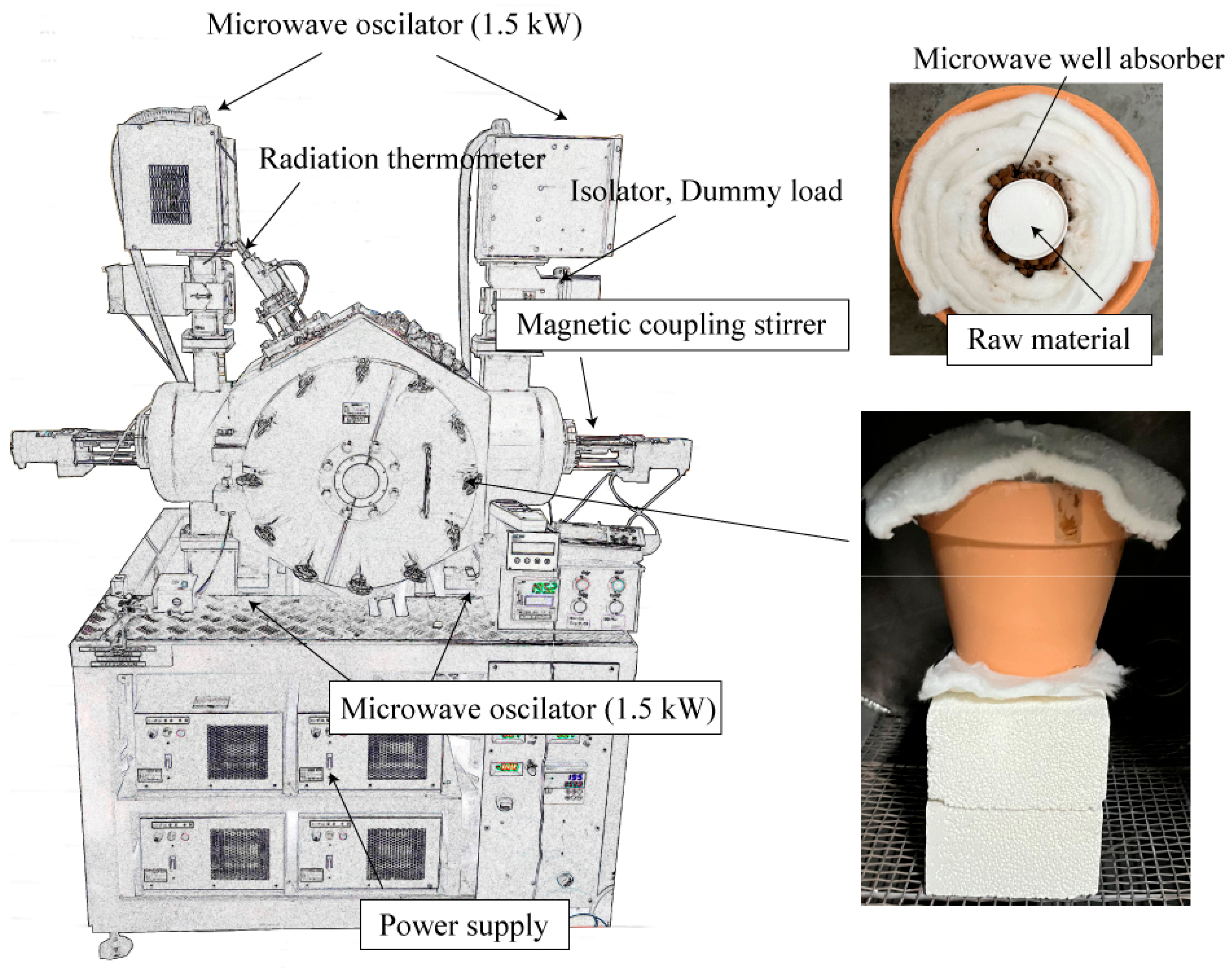
We investigated whether the molten glass material had the necessary refractive index to be categorised as optical glass. First, 146 g of the raw material was melted in a hexagonal microwave furnace, as shown in Figure 1. The distances between the sides of this furnace were an integer multiple of the microwave wavelength. The furnace was equipped with four 1.5 kW microwave oscillators, and the electric fields generated by the oscillators overlapped and were intensified at the centre of the furnace. In addition, a microwave absorber was placed near the sample to facilitate low-temperature heating. The heating atmosphere was dry air (1.0 L/min), the heating temperature was 1000 °C, and the heat holding time was 4 h. The refractive index of the obtained glass was measured using the V-block method in accordance with JIS B 7071-2 [30]. A schematic of the measurement setup is shown in Figure S1. The incident light used for this measurement was the helium d-line (λ = 587.56 nm).
The refractive index of the resulting glass was determined using the V-block method, which measures the declination of a light ray bent through a sample on a V-block prism and calculates the refractive index relative to the V-block.

3. Results and Discussion

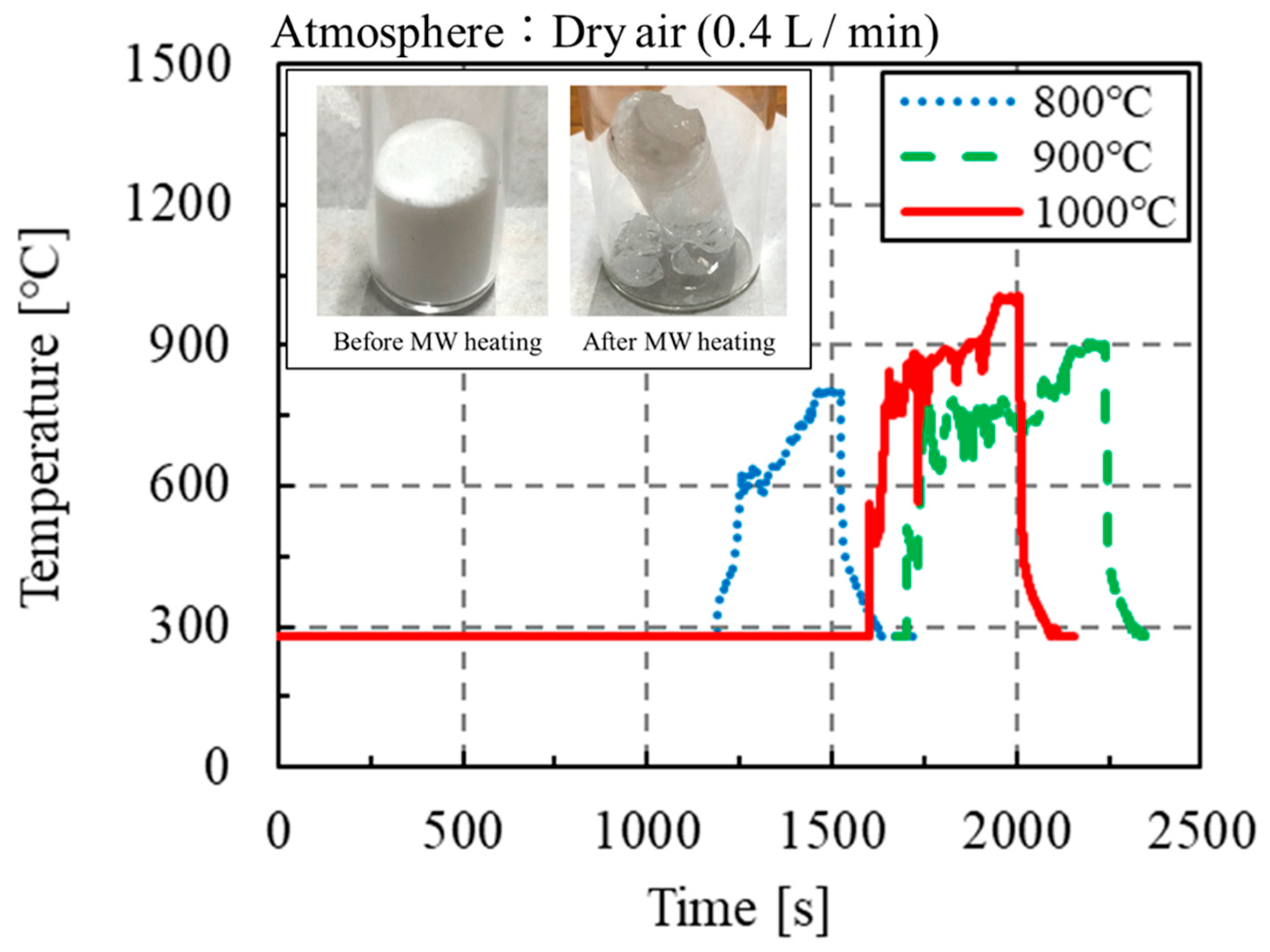
Figure 2 shows the microwave heating behaviour of 3.00 g of the sample at three different temperatures. The experiment employing the cavity resonator revealed that the glass-material temperature increased with the microwave power. The glass material was heated from 300 to 600 °C for 100 s. At 500 °C, microwave reflection increased sharply, and it was subsequently suppressed by changing the impedance of the cavity resonator. The ionised species can be inferred using the ionisation voltage of the atom as an indicator. In this system, the ionisation of alkali metals is suspected to be the cause of the increased microwave reflection. Therefore, the temperature-time curve stabilises over time because the gas species supplied from the raw material were turned into plasma. The microwave absorption of the sample changed abruptly at 500 °C, and there was discharge due to gas release. This rapid temperature increase was confirmed to be reproducible under all heating conditions (Figure S2). At the steady-state temperature, microwaves at powers of 300 and 400 W were needed to heat the glass material to 800 and 1000 °C, respectively. To explain the specificity of the heating behaviour, the microwave absorption capacity of the glass material at high temperatures must be investigated.
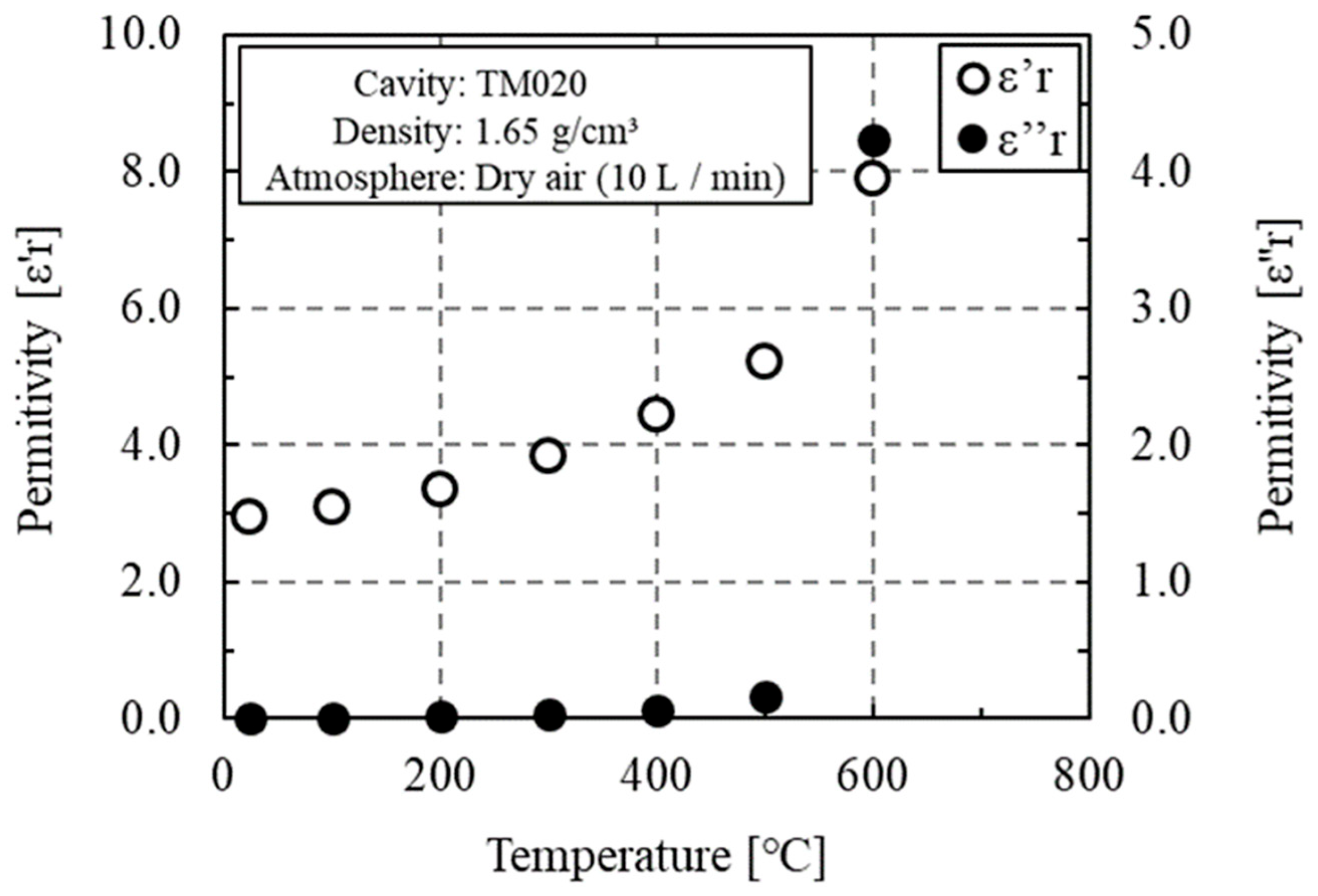
Microwave absorption at high temperatures was investigated using the resonance perturbation method. The cavity used for this measurement was designed to resonate at a microwave frequency of 2.40 GHz. This resonant frequency changed when the cavity was loaded with the glass material. The real and imaginary parts of the dielectric constant were derived by measuring this change. In the experiment, the glass material was heated by blowing hot dry air at 10 L/min. Figure 3 shows the temperature dependence of the real and imaginary parts of the dielectric constant of the glass material. Equation (1) reveals that the imaginary part of the dielectric constant has a linear relationship with the microwave absorption of the glass material. Its rapid increase from 500 °C onwards clarifies the heating behaviour of the glass material. The results obtained in this test showed high reproducibility for both the real and imaginary parts of the electrical permittivity (Figure S3).
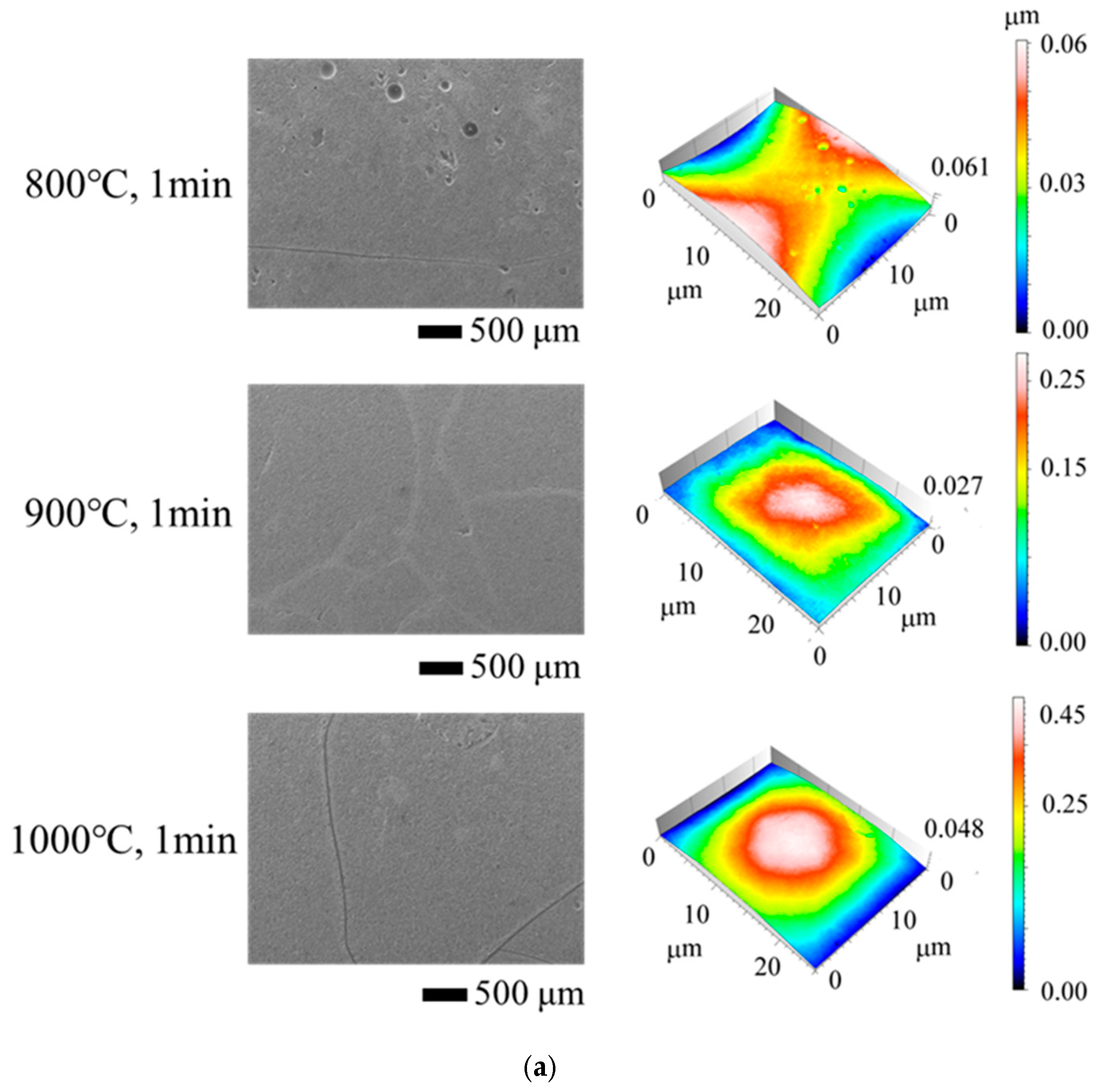
Figure 4a shows an SEM image (33× magnification) of the raw material after heating using microwaves. As the raw material was heated to elevated temperatures, fewer bubbles remained in the resulting glass. The topography also showed that the glass surface became more uniform when the material was processed at elevated temperatures. This improvement occurs because higher thermal conditions promote gas release during melting, as the viscosity of molten glass decreases significantly at such temperatures. Thus, the number of residual bubbles in the resulting glass tended to decrease, along with the number of surface irregularities of the glass.
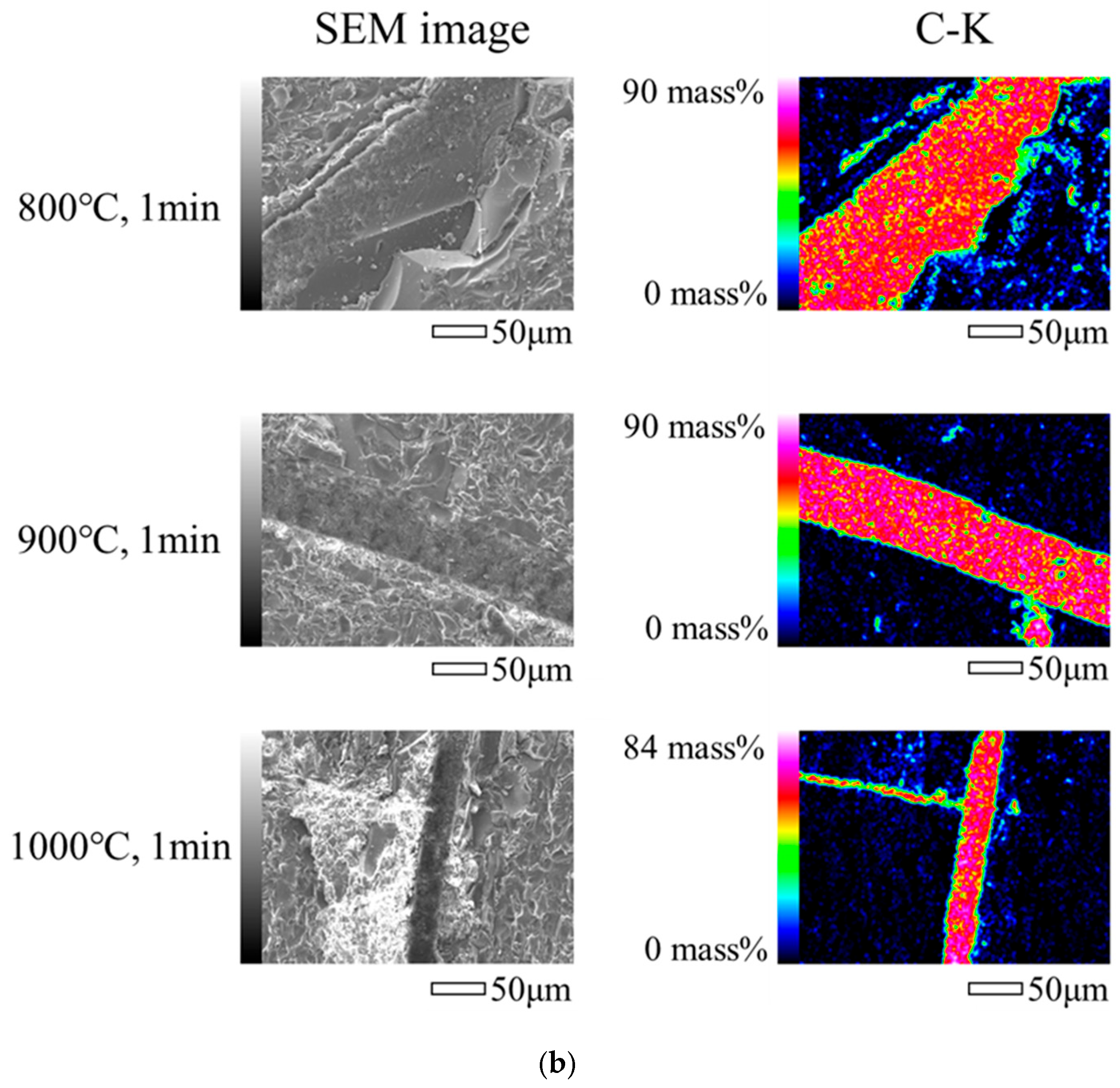
Figure 4b shows an SEM image (500× magnification) of the cracks observed in the obtained glass. The experimental sample was embedded in resin, and carbon was employed as a marker. Several fine cracks were observed in the sample after microwave heating. The observed cracks became smaller as the sample temperature increased. The cracks in the sample were caused by the bubbles generated when the foaming agent in the raw materials decomposed. With increasing sample temperature, the foaming agent decomposes, and cracks form; however, high temperatures promote the melting of the sample. It is presumed that the molten sample fills the cracks, making them smaller. These results indicate that high-temperature processing is important for producing smooth glass. In addition, controlling the cooling process is also important to remove thermal stress from glass [20,21]. Cracks that remained even after sufficient heating are presumed to have occurred during the cooling process. Therefore, such cracks can likely be suppressed by controlling the cooling rate.
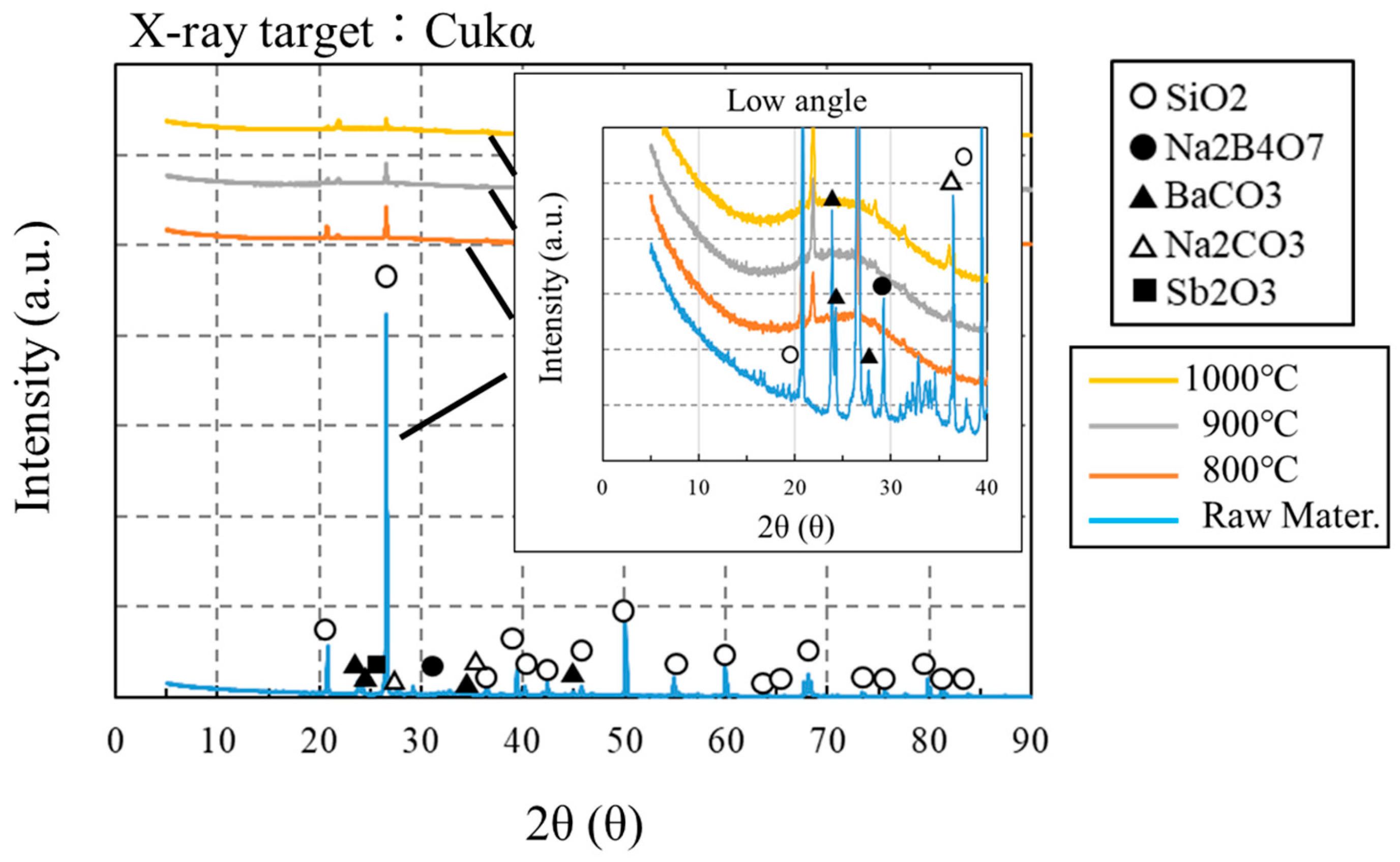
Figure 5 shows the XRD patterns of the glass materials before and after microwave heating. We observed the peaks corresponding to various crystals such as SiO2, Na2B4O7, and BaCO3. The peak intensities corresponding to the raw material were reduced after microwave heating. In Figure 5, the peak intensities decrease with an increase in the microwave heating temperature. With increasing temperature, the intensities of the broad peaks increase at low angles (20–30°), indicating that the raw material was vitrified with increasing microwave heating temperature.
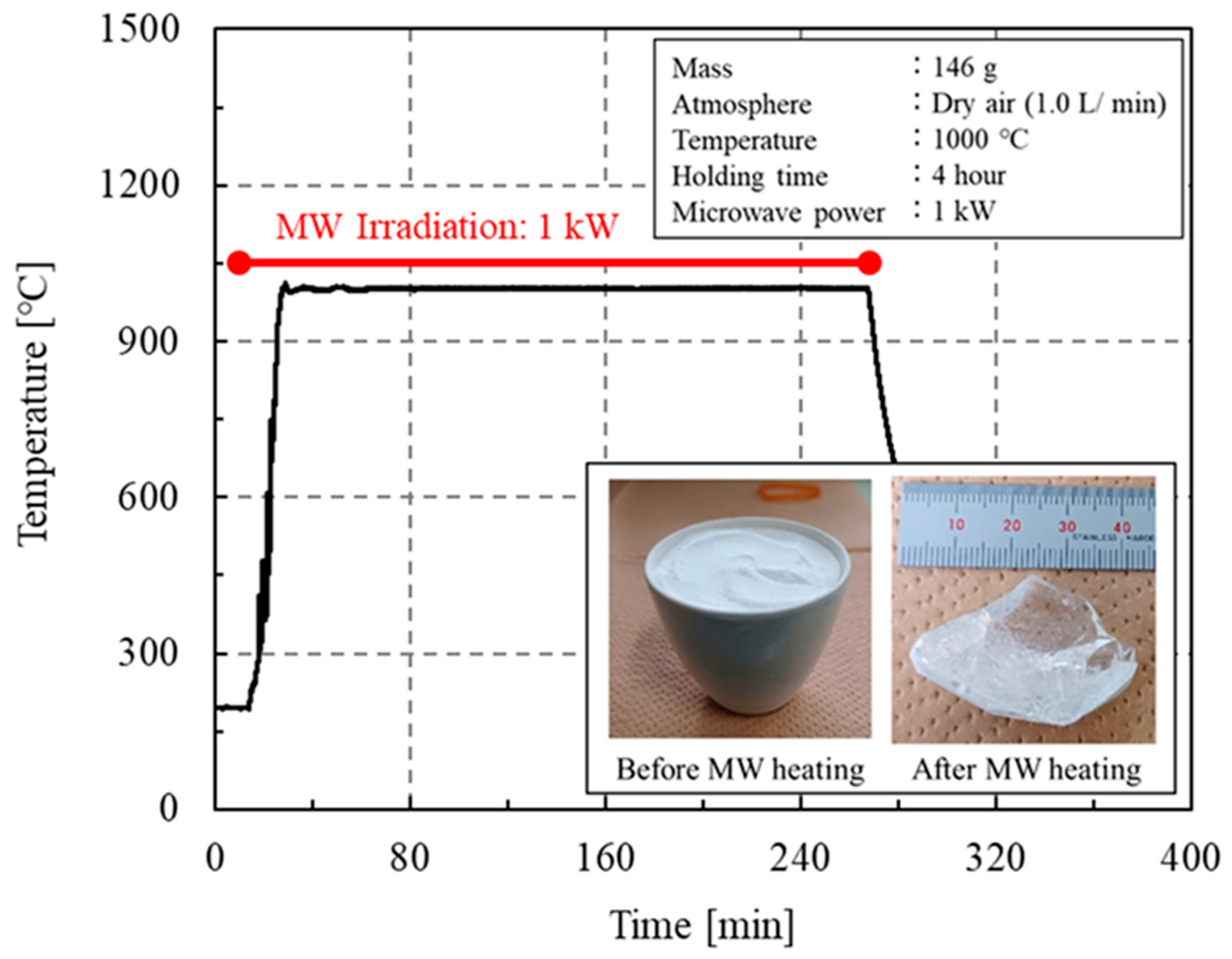
Determining the refractive index of the resulting glass is essential for engineering applications of the microwave glass-melting technology. A large amount of glass (1.5 × 10² g) was heated in a 6 kW-class microwave heating furnace, and the refractive index of the resulting glass was measured. Figure 6 shows the temperature variation in the glass material over time and an image of the glass after heating. In this experiment, the glass material was held at 1000 °C for 4 h to prevent bubbles and cracks. When microwaves were applied, the temperature of the glass material reached 1000 °C in approximately 30 min, after which it stabilised. The refractive index of the obtained glass (n_d) was measured using the V-block method and found to be 1.5155 (d-line, λ = 587.56 nm). This value is in good agreement with those reported in the literature for BK7 glass [31,32]. In particular, the deviation from the literature value measured at the same wavelength (587.56 nm) is only 0.086%, which is sufficiently small to conclude that the optical quality of the sample is equivalent to that of standard BK7 [33,34].
By assuming a plane wave, we can calculate the scale-up limitations of the investigated system. The extinction coefficient (α) can be calculated using the dielectric constant:
α = k 0 A ε r 2
Here, k0 is the wave vector, ε r is the imaginary component of the relative dielectric constant, and A = ε r 2 + ε r 2 , where ε r is the real component of the relative dielectric constant. Taking the reciprocal of the extinction coefficient gives us an estimate of the depth at which the electric field strength becomes 1/E. At room temperature, this is approximately 11 m, while at 600 °C, it is 2.67 cm. Furthering this analysis, we determined that the temperature range at which the heating rate can be improved varies as the sample size increases.

4. Conclusions

A representative optical glass, BK7, was successfully heated and melted by concentrating a high-intensity electric field on its raw materials. Heating tests were conducted using a cavity resonator, in which we achieved the melting of the raw material without using any susceptor to absorb microwaves. Furthermore, a test conducted using a hexagonal furnace demonstrated that the BK7 raw materials can be converted into optical glass using only microwave irradiation. This achievement represents an important engineering advancement in the manufacturing of optical materials. The main findings of this study are as follows:
I. The glass material could be rapidly heated (from 300 to 600 °C in 100 s) and melted using the cavity resonator.
II. At 500 °C, the heating rate of the glass material rapidly increased. At this temperature, the imaginary part of the dielectric constant increased rapidly; therefore, the increase in the heating rate was attributed to the increased microwave absorption of the glass material.
III. The heating and melting times of the raw materials of BK7 could be reduced via microwave heating; however, deaeration and cracking required a certain amount of time.
IV. The glass material (1.5 × 10² g) was melted using a hexagonal microwave furnace. Heating for 4 h resulted in the deaeration of the glass, and the refractive index (nd) of the resulting glass was 1.5155.
These results indicate that microwaves are effective for heating glass materials, particularly at temperatures above 500 °C. The investigated microwave heating technology can substantially reduce the time needed to increase the temperature of glass materials. A shallow furnace structure combined with a higher heating temperature of the raw materials appears to be an effective strategy for resolving the defoaming issue. Producing one metric ton of glass requires 4–17 GJ of energy, 50–80% of which is required for melting. Microwave heating technology shortens the time required for melting, reducing the amount of heat dissipated by furnace walls and the energy wasted as hot gas. By reducing the time needed to melt large amounts of glass material, the microwave heating technology can reduce the amount of heat dissipated from the furnace wall, which is currently a major limitation in glass production.

Supplementary Materials

The following supporting information can be downloaded at: https://www.mdpi.com/article/10.3390/pr14010054/s1, Figure S1: Schematic showing refractive index measurements using the v-block method; Figure S2: Heating behaviour of BK7 raw materials using a cavity resonator (three trials for each condition); Figure S3: Real and imaginary parts of the electric permittivity of BK7 raw materials at each temperature (two trials).

Author Contributions

Data curation, T.M., K.K. and K.M.; formal analysis, T.M. and K.M.; investigation, T.M., K.K. and K.M.; writing—original draft preparation, T.M. and K.K.; funding acquisition, K.K. and T.M.; project administration, K.K. and K.M.; validation, K.K. and K.M. All authors have read and agreed to the published version of the manuscript.

Funding

This research received no external funding.

Data Availability Statement

All the data generated or analysed during this study are included in this published article.

Conflicts of Interest

Author Kiyoyuki Momono was employed by the OHARA INC. The remaining author declares that the research was conducted in the absence of any commercial or financial relationships that could be construed as a potential conflict of interest.

References

  1. Madeddu, S.; Ueckerdt, F.; Pehl, M.; Peterseim, J.; Lord, M.; Kumar, K.A.; Krüger, C.; Luderer, G. The CO2 reduction potential for the European industry via direct electrification of heat supply (power-to-heat). Environ. Res. Lett. 2020, 15, 124004. [Google Scholar] [CrossRef]
  2. Lechtenböhmer, S.; Nilsson, L.J.; Åhman, M.; Schneider, C. Decarbonising the energy intensive basic materials industry through electrification—Implications for future EU electricity demand. Energy 2016, 115, 1623–1631. [Google Scholar] [CrossRef]
  3. Nakano, K.; Hamagata, S.; Nagai, Y.; Nishio, K.; Tagashira, N. A survey on energy usage and electrification potential in industrial sectors toward shaping future socio-economic visions. J. Jpn. Soc. Energy Resour. 2020, 41, 108–114. [Google Scholar]
  4. Leisin, M. Branchensteckbrief der Glasindustrie. Available online: https://www.bmwk.de/Redaktion/DE/Downloads/E/energiewende-in-der-industrie-ap2a-branchensteckbrief-glas.pdf?__blob=publicationFile&v=4 (accessed on 27 August 2019).
  5. Delgado Sancho, L.; Sissa, A.Q.; Scalet, B.M.; Roudier, S.; Garcia Muñoz, M. Best Available Techniques (BAT) Reference Document for the Manufacture of Glass, Industrial Emissions Directive 2010/75/EU (Integrated Pollution Prevention and Control); Publications Office of the European Union: Luxembourg, 2013. [Google Scholar]
  6. Hübner, T.; Guminski, A.; Rouyrre, E.; von Roon, S. Branchensteckbrief der NEMetallindustrie, SISDE17915. Available online: https://www.bmwk.de/Redaktion/DE/Downloads/E/energiewende-in-der-industrie-ap2a-branchensteckbrief-metall.pdf?__blob=publicationFile&v=4 (accessed on 14 June 2019).
  7. Schlemme, J.; Schimmel, M.; Achtelik, C. Branchensteckbrief der Eisen- und Stahlindustrie. Available online: https://www.bmwk.de/Redaktion/DE/Downloads/E/energiewende-in-der-industrie-ap2a-branchensteckbrief-stahl.pdf?__blob=publicationFile&v=4 (accessed on 27 August 2019).
  8. Schmitz, A.; Kamiński, J.; Scalet, B.M.; Soria, A. Energy consumption and CO2 emissions of the European glass industry. Energy Policy 2011, 39, 142–155. [Google Scholar] [CrossRef]
  9. Hu, P.; Li, Y.; Zhang, X.; Guo, Z.; Zhang, P. CO2 emission from container glass in China, and emission reduction strategy analysis. Carbon Manag. 2018, 9, 303–310. [Google Scholar]
  10. Zier, M.; Stenzel, P.; Kotzur, L.; Stolten, D. A review of decarbonization options for the glass industry. Energy Convers. Manag. X 2021, 10, 100083. [Google Scholar] [CrossRef]
  11. Amini, A.; Latifi, M.; Chaouki, J. Electrification of materials processing via microwave irradiation: A review of mechanism and applications. Appl. Therm. Eng. 2021, 193, 117003. [Google Scholar] [CrossRef]
  12. Wada, Y.; Fujii, S.; Suzuki, E.; Maitani, M.M.; Tsubaki, S.; Chonan, S.; Fukui, M.; Inazu, N. Smelting magnesium metal using a microwave Pidgeon method. Sci. Rep. 2017, 7, 46512. [Google Scholar] [CrossRef]
  13. Laubertova, M.; Havlik, T.; Parilak, L.; Derin, B.; Trpcevska, J. The effects of microwave-assisted leaching on the treatment of electric arc furnace dusts (EAFD). Arch. Metall. Mater. 2020, 65, 321–328. [Google Scholar]
  14. Kashimura, K.; Yamaguchi, T.; Sato, M.; Yoneda, S.; Kishima, T.; Horikoshi, S.; Yoshikawa, N.; Mitani, T.; Shinohara, N. Rapid and in-situ transformations of asbestos into harmless waste by microwave rotary furnace: Application of microwave heating to rubble processing of the 2011 Tohoku earthquake. J. Hazard. Toxic Radioact. Waste 2014, 19, 04014041. [Google Scholar]
  15. Ioana, A.; Paunescu, L.; Constantin, N.; Pollifroni, M.; Deonise, D.; Petcu, F.S. Glass foam from flat glass waste produced by the microwave irradiation technique. Micromachines 2022, 13, 550. [Google Scholar] [CrossRef]
  16. Wongwan, W.; Yasaka, P.; Boonin, K.; Khondara, S.; Kim, H.J.; Kothan, S.; Chanlek, N.; Kanjanaboos, P.; Phuphathanaphong, N.; Sareein, T.; et al. A comparative study of microwave assisted and conventional melting techniques to glass properties. Radiat. Phys. Chem. 2024, 224, 112011. [Google Scholar] [CrossRef]
  17. Mandal, A.K.; Mandal, B.; Illath, K.; Ajithkumar, T.G.; Halder, A.; Sinha, P.K.; Sen, R. Preparation of colourless phosphate glass by stabilising higher Fe [II] in microwave heating. Sci. Rep. 2018, 8, 6195. [Google Scholar] [CrossRef]
  18. López, R.E.; Flores Rivera, F.L.; Pérez-Sánchez, G.G.; Figueroa, I.A. Novel energy-efficient microwave-assisted synthesis of Zn3(PO4)2: Er3+ glasses for optical amplification at 1550 nm. Opt. Mater. 2025, 170, 117714. [Google Scholar] [CrossRef]
  19. Halder, A.; Mandal, B.; Mahanty, S.; Sen, R.; Mandal, A.K. A comparative property investigation of lithium phosphate glass melted in microwave and conventional heating. Bull. Mater. Sci. 2017, 40, 999–1006. [Google Scholar] [CrossRef]
  20. Mandal, A.K.; Biswas, K.; Annapurna, K.; Guha, C.; Sen, R. Preparation of alumino-phosphate glass by microwave radiation. J. Mater. Res. 2013, 28, 1955–1961. [Google Scholar] [CrossRef]
  21. Li, B.; Zhou, G. Preparation of Phosphate Glass by the Conventional and Microwave Melt-Quenching Methods and Research on Its Performance. Materials 2025, 18, 1079. [Google Scholar] [CrossRef] [PubMed]
  22. Pathak, N.; Pilania, R.K.; Sooraj, K.P.; Ranjan, M.; Sarker, D.; Dube, C.L. Microwave-assisted rapid synthesis of non-stoichiometric tungsten oxide doped borosilicate glasses for NIR shielding application. Ceram. Int. 2025, 51, 24470–24480. [Google Scholar] [CrossRef]
  23. Westbroek, C.D.; Bitting, J.; Craglia, M.; Azevedo, J.M.; Cullen, J.M. Global material flow analysis of glass. J. Ind. Ecol. 2021, 25, 333–343. [Google Scholar] [CrossRef]
  24. Mandal, A.K.; Sen, R. Microwave absorption of barium borosilicate, zinc borate, Fe-doped alumino-phosphate glasses and its raw materials. Technologies 2015, 3, 111–125. [Google Scholar] [CrossRef]
  25. Mandal, Y.; Sinha, P.K.; Mandal, A.K. Effect of melting time on volatility, OH in glass in microwave processing. Mater. Manuf. Process. 2020, 36, 426–434. [Google Scholar] [CrossRef]
  26. Kashimura, K.; Hasegawa, N.; Suzuki, S.; Hayashi, M.; Mitani, T.; Shinohara, N.; Nagata, K. Effects of relative density on microwave heating of various carbon powder compacts microwave-metallic multi-particle coupling using spatially separated magnetic fields. J. Appl. Phys. 2013, 113, 024902. [Google Scholar] [CrossRef]
  27. Roy, R.; Peelamedu, R.; Hurtt, L.; Cheng, J.; Agrawal, D. Definitive experimental evidence for microwave effects: Radically new effects of separated E and H fields, such as decrystallization of oxides in seconds. Mater. Res. Innov. 2002, 6, 128–140. [Google Scholar] [CrossRef]
  28. Peng, Z.; Hwang, J.-Y.; Mouris, J.; Hutcheon, R.; Huang, X. Microwave penetration depth in materials with non-zero magnetic susceptibility. ISIJ Int. 2010, 50, 1590–1596. [Google Scholar] [CrossRef]
  29. Yoshikawa, N.; Kashimura, K.; Hashiguchi, M.; Sato, M.; Horikoshi, S.; Mitani, T.; Shinohara, N. Detoxification mechanism of asbestos materials by microwave treatment. J. Hazard. Mater. 2015, 284, 201–206. [Google Scholar] [CrossRef]
  30. JIS B 7071-2; Optics and Photonics—Test Method for Refractive Index of Optical Glasses—Part 2: V-Block Refractometer Method. Japanese Industrial Standards Committee (JISC): Tokyo, Japan, 2024. Available online: https://www.jisc.go.jp/ (accessed on 2 February 2025).
  31. Rocha, A.C.P.; Silva, J.R.; Lima, S.M.; Nunes, L.A.O.; Andrade, L.H.C. Measurements of refractive indices and thermo-optical coefficients using a white-light Michelson interferometer. Appl. Opt. 2016, 55, 6639–6644. [Google Scholar] [CrossRef]
  32. Medhat, M.; El-Zaiat, S.Y.; Omar, M.F.; Farag, S.S.; Kamel, S.M. Refraction and dispersion measurement using dispersive Michelson interferometer. Opt. Commun. 2017, 393, 275–283. [Google Scholar] [CrossRef]
  33. SCHOTT Optical Glass Datasheet Collection; SCHOTT AG: Mainz, Germany, 2025. Available online: https://www.schott.com (accessed on 2 December 2025).
  34. Polyanskiy, M.N. Refractive Index Database. Available online: https://refractiveindex.info (accessed on 2 December 2025).
Figure 1. Schematic of a 6 kW-class microwave heating furnace with a hexagonal structure that concentrates microwaves at the centre.
Processes 14 00054 g001
Figure 2. Microwave heating behaviour of the model glass sample at three different temperatures. Here, 0.4 L/min of dry air was used as the heating atmosphere for the glass, which was held at 800, 900, and 1000 °C for 1 min each.
Processes 14 00054 g002
Figure 3. Real and imaginary parts of the electrical permittivity of the raw material at three different temperatures. The cavity perturbation method was employed for electrical-permittivity measurements, and 10 L/min of dry air was used for sample heating.
Processes 14 00054 g003
Figure 4. (a) SEM images and topographies of the glass material after microwave heating (800–1000 °C for 1 min). (b) Energy-dispersive X-ray spectroscopy maps of the cracks in the raw material after microwave heating. A higher temperature corresponds to smaller bubbles.
Processes 14 00054 g004aProcesses 14 00054 g004b
Figure 5. XRD patterns of the glass material before and after microwave heating. The peaks of the raw material disappear with increasing temperature.
Processes 14 00054 g005
Figure 6. Change in the temperature of the glass material over time in a large microwave furnace, along with an image of the resulting glass. Glass with a measurable refractive index (nd = 1.5155) was obtained after 4 h of microwave heating.
Processes 14 00054 g006
Table 1. Raw material composition ratios (wt%) of typical optical glass (BK7).
SiO2Na2B4O7BaCO3Na2CO3K2CO3Sb2O3Total
64.4613.663.376.8911.530.09100.00
Disclaimer/Publisher’s Note: The statements, opinions and data contained in all publications are solely those of the individual author(s) and contributor(s) and not of MDPI and/or the editor(s). MDPI and/or the editor(s) disclaim responsibility for any injury to people or property resulting from any ideas, methods, instructions or products referred to in the content.