
Optimal Scheduling of Wind–Solar Power Generation and Coalbed Methane Well Pumping Systems

 , and
, and
Abstract
1. Introduction
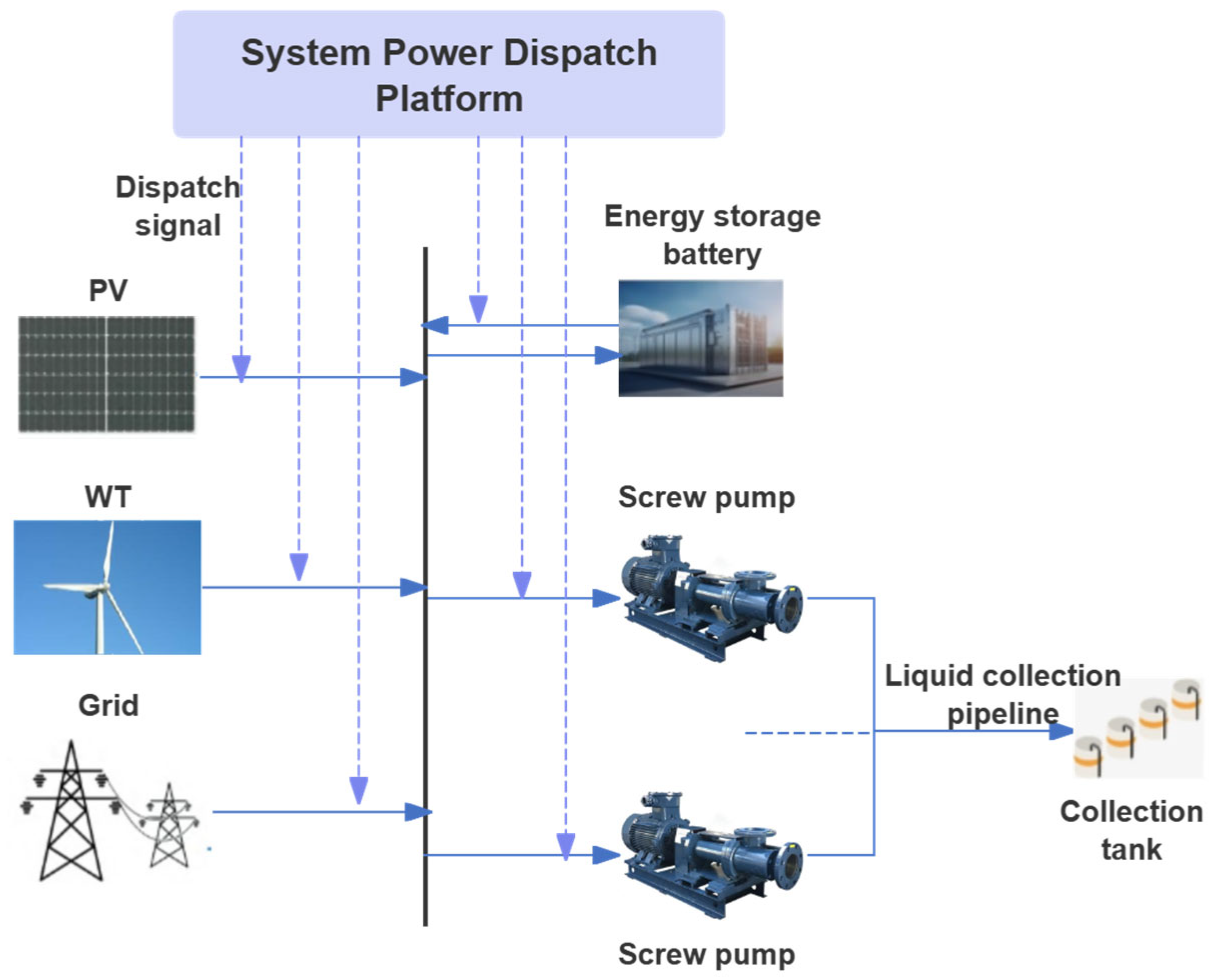
2. Wind/Solar/Storage Microgrid-Based Screw Pump Production System for Coalbed Methane Wells
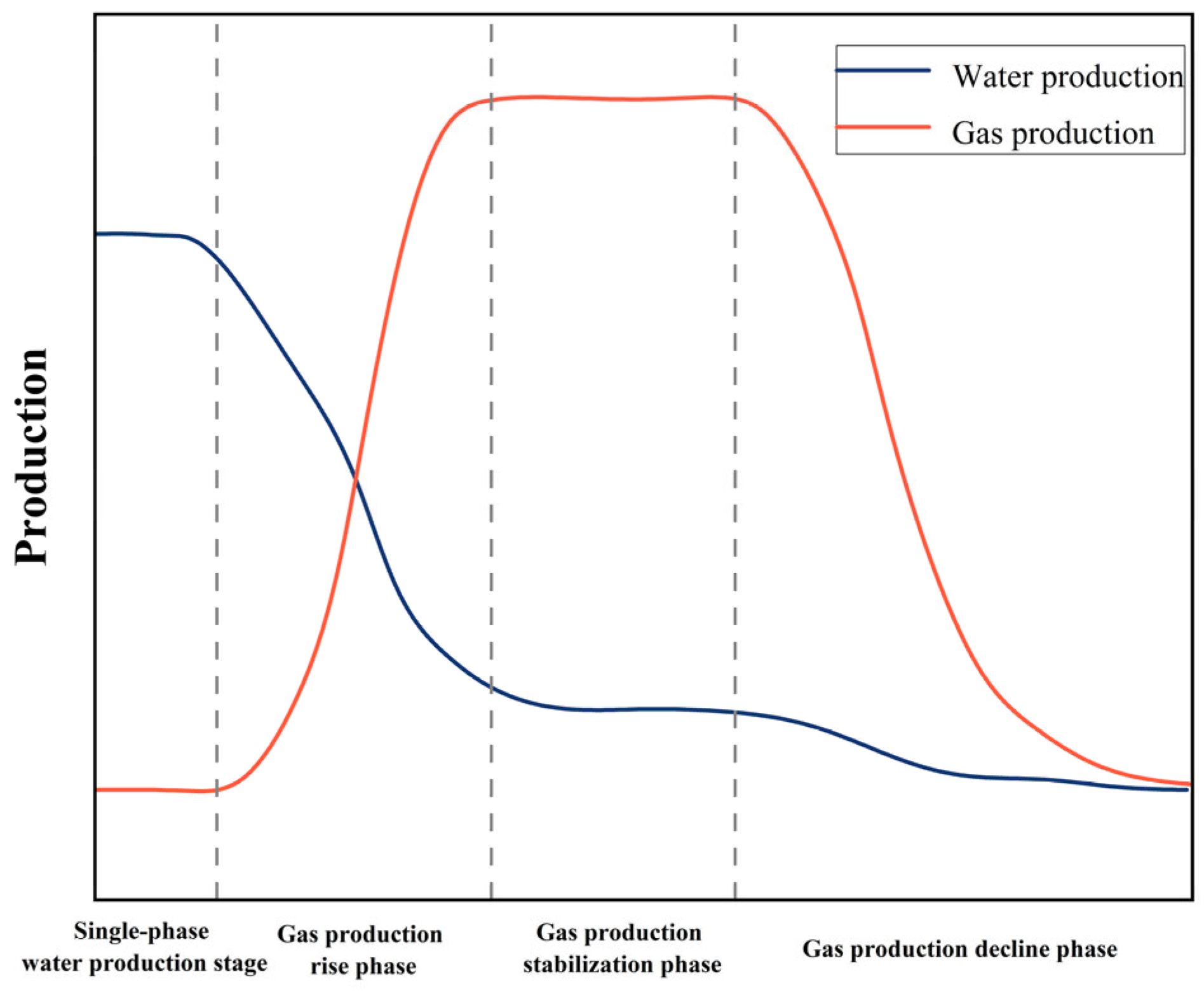
2.1. Stages of Coalbed Methane Production and Depletion
- (1)
- Single-Phase Water Production Stage: In this stage, coalbed methane exists in an adsorbed state within the coal matrix, and the bottom-hole flowing pressure is higher than the critical desorption pressure. During the initial dewatering phase, a large amount of water needs to be removed to reduce reservoir pressure, resulting in very low or zero gas production. When the bottom-hole flowing pressure drops to the critical desorption pressure (usually 70% to 80% of the original reservoir pressure), the gas production begins to increase. In this stage, the optimization objective is to maximize the dewatering rate while ensuring that excessive coal fines are not produced (i.e., controlling the dewatering volume within a reasonable upper limit, such as not exceeding 90% of the reservoir’s fluid supply capacity per day), to shorten the pressure reduction time and reduce dewatering energy consumption.
- (2)
- Gas Production Rise Phase: As the bottom-hole pressure falls below the critical desorption pressure, coalbed methane begins to desorb and diffuse. Daily gas production rapidly increases from zero (e.g., from 0 to 1000 m3/d), while daily water production begins to decrease slowly. A two-phase gas-water flow forms in the wellbore, and the fluid density decreases. When the growth rate of daily gas production levels off (e.g., monthly growth rate < 5%) and the gas production approaches its peak, the stable gas production stage is reached.
- (3)
- Stable Gas Production Phase: When drainage and desorption reach a dynamic equilibrium, the daily gas production remains fluctuating within the peak range (e.g., 1000–3000 m3/d), and the daily water production decreases to a low level and remains stable. This stage lasts the longest and is the core period for generating economic benefits. When the daily gas production begins to show an irreversible and continuous decline (e.g., an annual decline rate > 10%), it marks the end of the stable production period. At this point, the bottom-hole flowing pressure is relatively stable, and the optimization objective is to minimize system operating costs through coordinated scheduling of wind, solar, and energy storage while maintaining a constant dynamic fluid level.
- (4)
- Declining Gas Production Phase: As the coal seam energy is depleted, the amount of desorbed gas gradually decreases. Daily gas production and daily water production show a simultaneous downward trend (gas production may drop to <500 m3/d) until it is no longer economically viable to extract. This stage is considered a low-efficiency production period, and operating energy consumption can be reduced by lowering the screw pump speed.
2.2. System Architecture
- (1)
- Day-ahead predicted data (wind speed, solar irradiance) are treated as deterministic inputs within the scheduling cycle, neglecting the impact of ultra-short-term random fluctuations.
- (2)
- The charging and discharging efficiency of the energy storage battery and the inverter conversion efficiency are considered constant, neglecting the nonlinear effect of temperature on battery capacity.
2.3. Source-End Device Mathematical Model
2.3.1. Photovoltaic Power Model
2.3.2. Wind Power Model
2.3.3. Energy Storage Battery Model
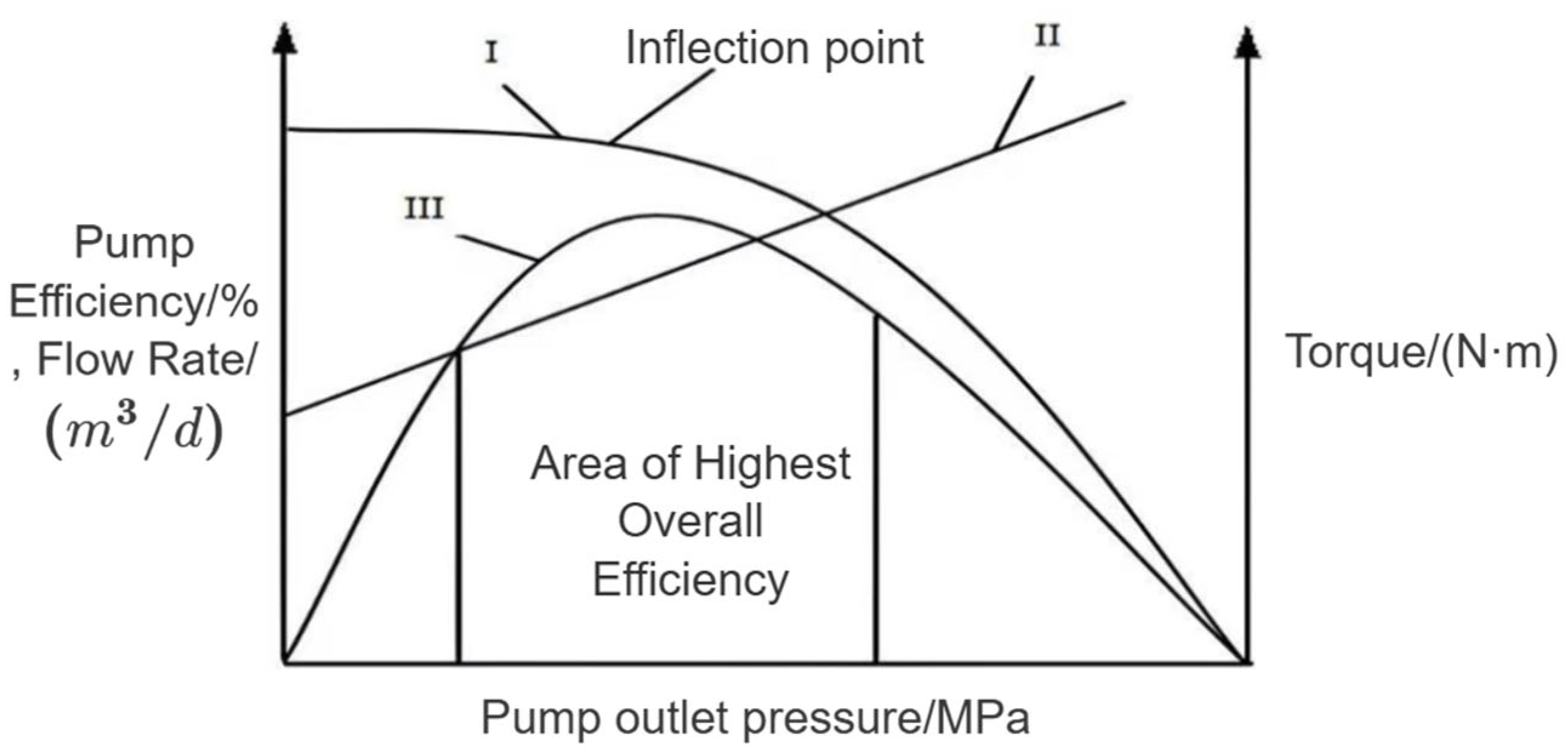
2.4. Mathematical Model of Load-End Screw Pump
3. Daily Dispatch Optimization Model for Screw Pumping Storage Systems in Wind/Solar/Storage Microgrids
3.1. Objective Function
3.2. Constraints
3.2.1. Source-Side Constraints
3.2.2. Load-End Constraints
3.2.3. Source-Load Power Balance Constraint
4. Particle Swarm Optimization Solution
4.1. Algorithm Introduction
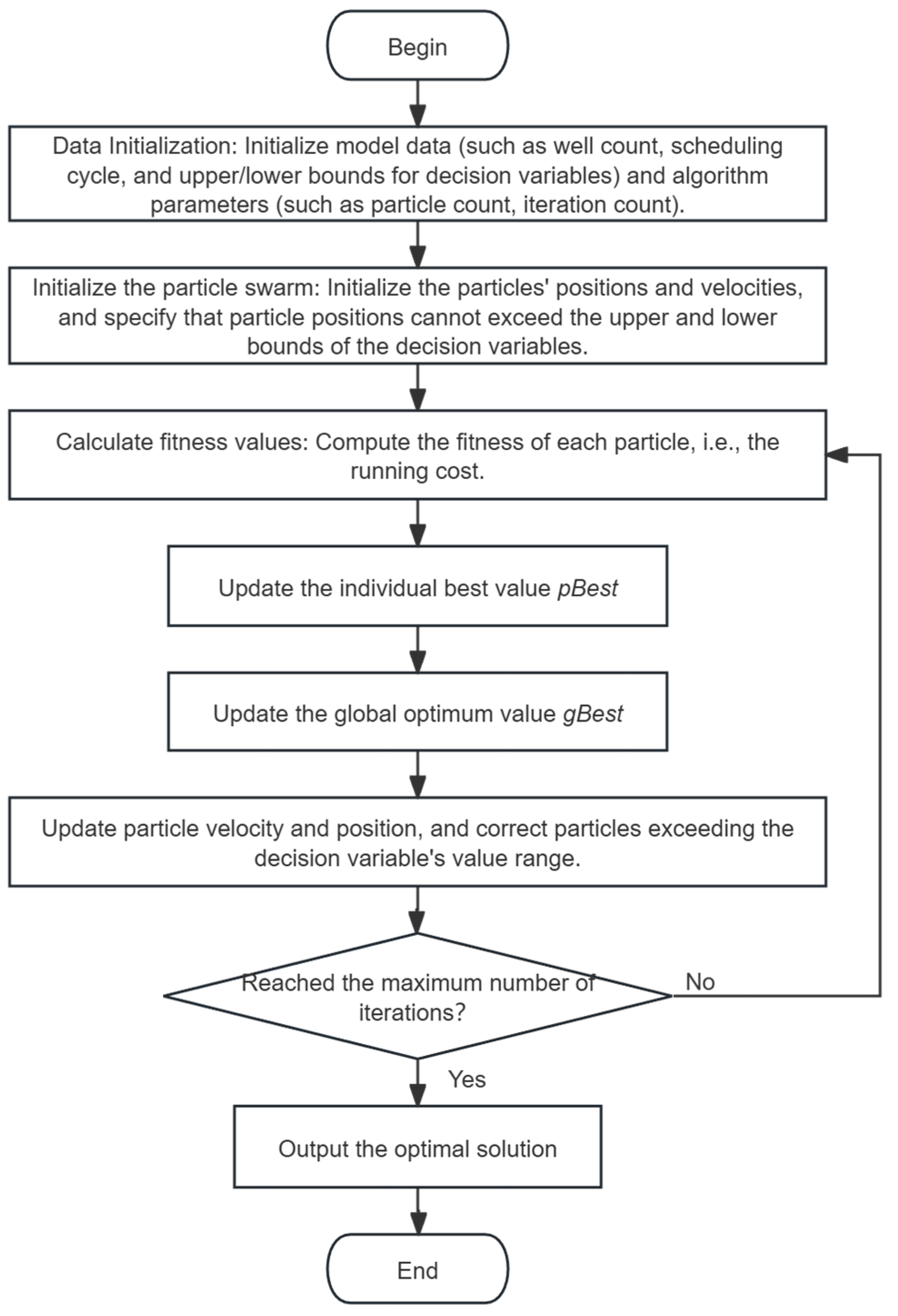
4.2. Algorithm Solution Process
- (1)
- Data initialization. Initialize model parameters, including preset values such as the upper limit of PV output, upper and lower limits of energy storage battery charge/discharge power, daily start/stop times for each well, number of wells, and scheduling cycle. Initialize algorithm parameters, including population size, iteration count, particle dimension, inertia weight, and learning factor. The key parameter settings for PSO are shown in Table 1.
- (2)
- Initialize particle swarm. Randomly generate initial positions and velocities for a set of particles, ensuring each particle’s position remains within the upper and lower bounds of decision variables.
- (3)
- Calculate fitness. Compute the fitness value for each particle using the sum of system operating costs and penalty terms for each constraint as the fitness function output. The fitness function is defined as follows:In the formula, Violation represents the degree of violation of all constraints (the sum of the violation amounts), and is the penalty factor. The penalty function method ensures that solutions violating the constraints are severely penalized, thereby guiding the population towards the feasible region.
- (4)
- Update individual optimal values . For each particle, compare its current position’s fitness value with the individual’s optimal fitness value, and update the individual’s optimal fitness value.
- (5)
- Update global optimal values . Compare each particle’s optimal value with the global optimal value at the current iteration, and update the global optimal value.
- (6)
- Update particle velocity and position. Update particle velocity and position according to the particle swarm algorithm’s velocity and position update formulas. Correct particle positions exceeding the decision variable’s valid range.
- (7)
- Check termination conditions. Determine if the algorithm’s termination conditions are met, such as reaching the maximum iteration count or satisfying accuracy requirements. This paper adopts the maximum iteration count as the termination condition. If termination conditions are not met, return to step (3) to continue the iteration process.
- (8)
- Output results. Output the global optimum solution as the final optimized solution for the research model.
5. Case Study
5.1. Case Parameters
5.2. Case Study Results Analysis
6. Conclusions
- (1)
- When establishing a day-ahead scheduling optimization model for wind and solar power generation, battery energy storage, and screw pump production systems to maximize system green electricity consumption, coordinated scheduling between energy storage batteries and grid power purchase/sale can meet screw pump electricity demands and enhance the system’s green electricity consumption capacity.
- (2)
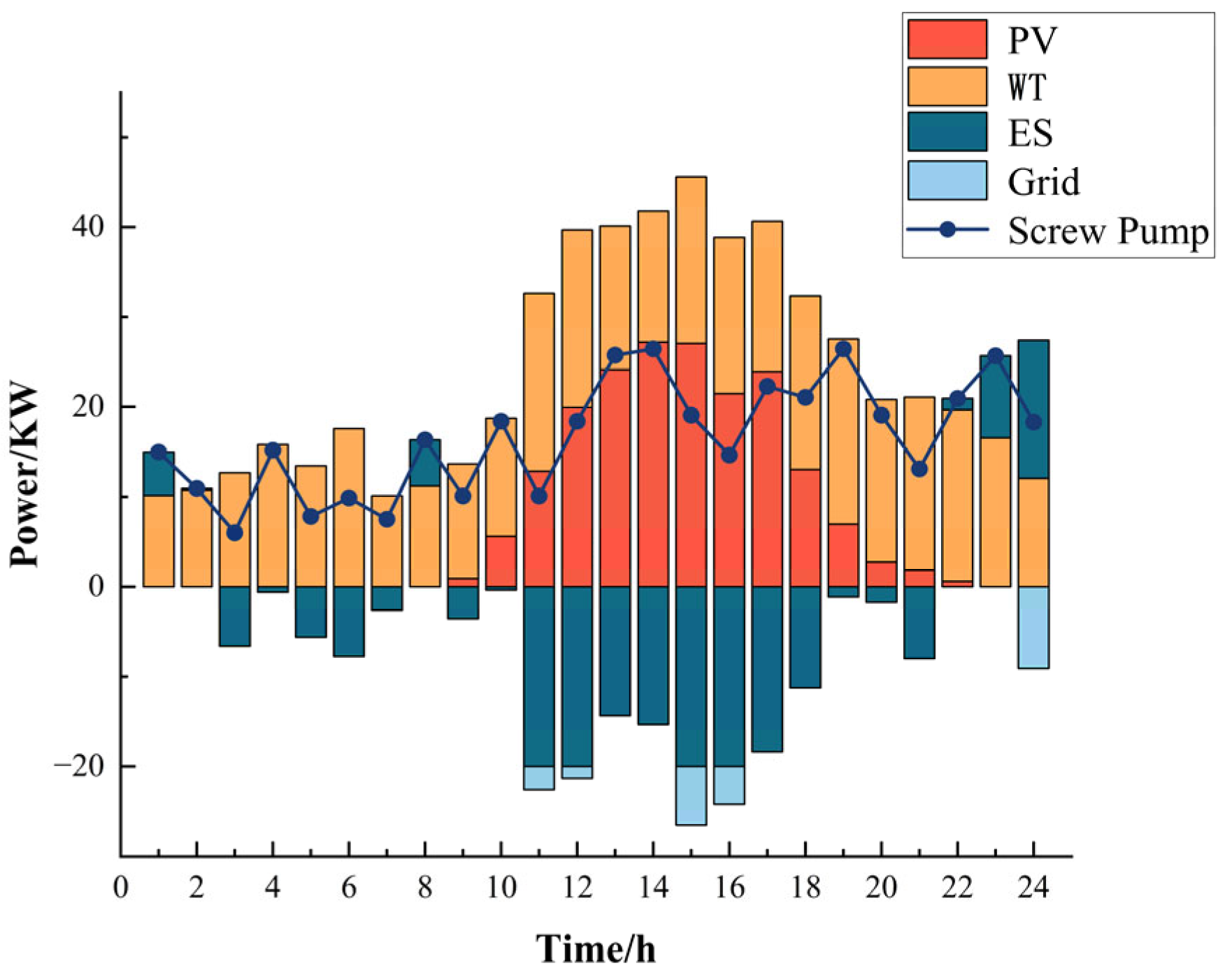
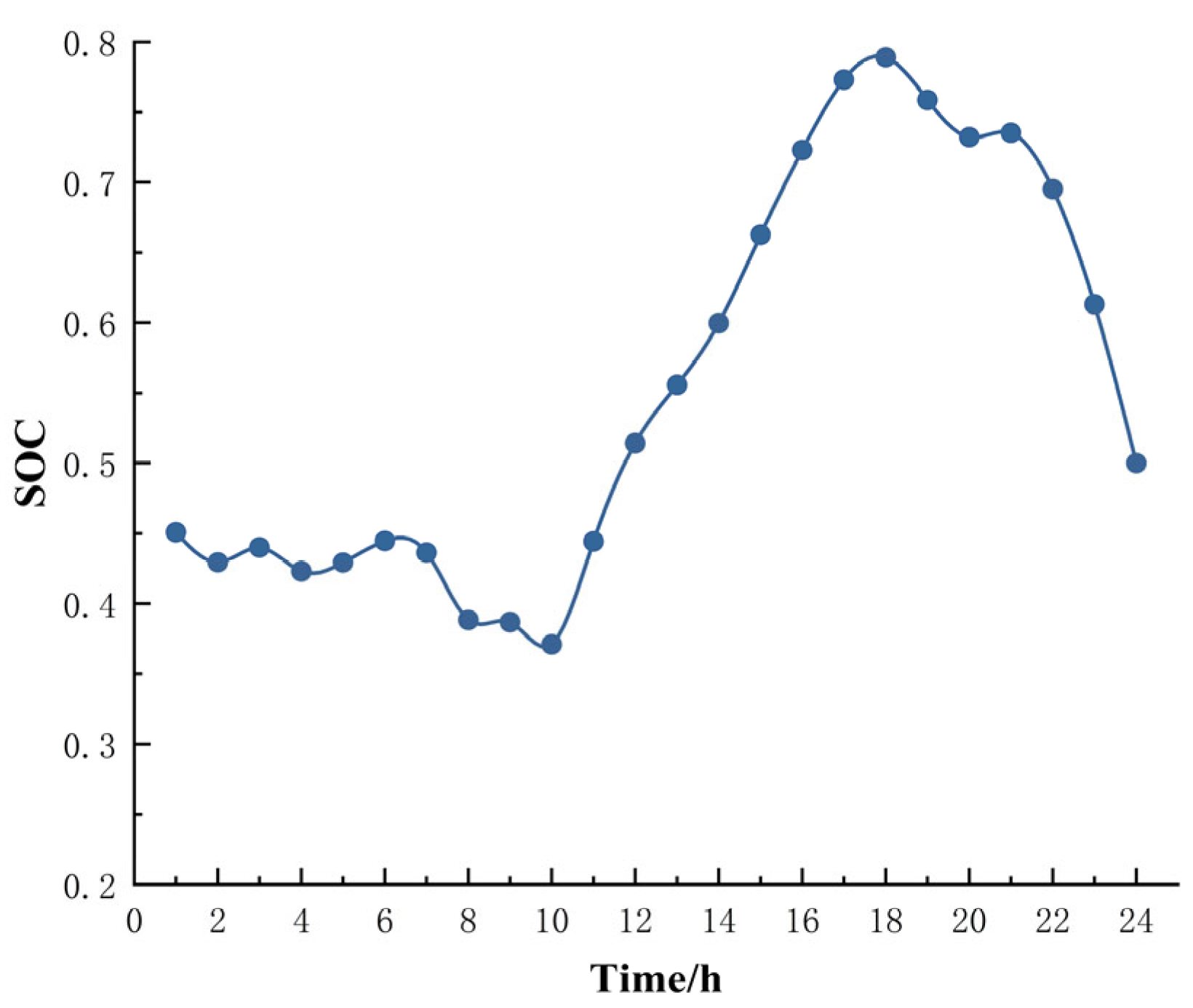
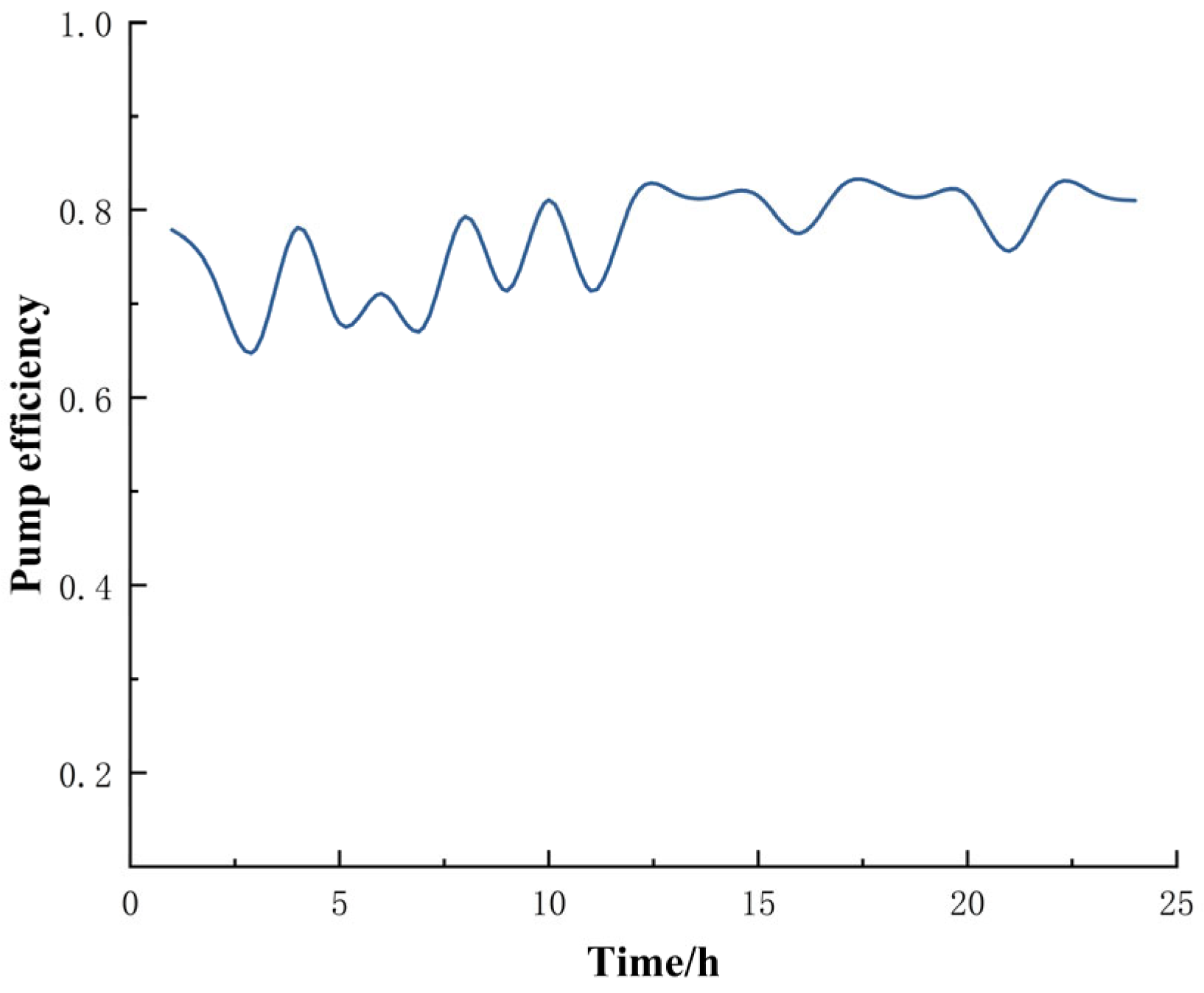
- Analysis of the computational example demonstrates that batteries perform peak shaving and valley filling for wind and solar power generation, smoothing fluctuations in renewable energy output. This ensures system stability and reliability while prioritizing battery supply over grid power. Consequently, it reduces dependence on grid electricity purchases, lowers system operating costs, and enhances green electricity consumption capacity. Across different coalbed methane production phases, screw pump speed can be optimized based on wind and solar generation conditions. This ensures screw pumps operate at high efficiency while meeting daily drainage requirements.
- (3)
- The optimization model and solution results presented in this paper have significant guiding value for practical engineering applications. The current work uses the Particle Swarm Optimization (PSO) algorithm to solve the model, achieving satisfactory results in the case study. In future research, we will, on the one hand, refine the production constraints of coalbed methane extraction (such as bottom-hole pressure control and gas production fluctuations) to adapt to the needs of more complex extraction stages; on the other hand, we will focus on improving the computational efficiency and robustness of the algorithm, for example, by improving the parameter adaptation mechanism of PSO or introducing parallel computing, to address the computational challenges brought about by the increasing scale of future models.
Author Contributions
Funding
Data Availability Statement
Conflicts of Interest
References
- Zhang, Q.; Zhang, H.; Yan, Y.; Yan, J.; He, J.; Li, Z.; Shang, W.; Liang, Y. Sustainable and clean oilfield development: How access to wind power can make offshore platforms more sustainable with production stability. J. Clean. Prod. 2021, 294, 126225. [Google Scholar] [CrossRef]
- Banihabib, R.; Assadi, M. Towards a low-carbon future for offshore oil and gas industry: A smart integrated energy management system with floating wind turbines and gas turbines. J. Clean. Prod. 2023, 423, 138742. [Google Scholar] [CrossRef]
- Wang, Y.; Song, Y.; Ni, C.; Yi, J.; Zou, P. Cooperative peak load regulation ability analysis of thermal power plant and demand response for oil field integrated energy system with photovoltaic. Electr. Power Autom. Equip. 2022, 42, 198–204. [Google Scholar]
- Facci, M.; di Sipio, E.; Gola, G.; Montegrossi, G.; Galgaro, A. Sustainable reuse of oil and gas wells for geothermal energy production: Numerical analysis of deep closed loop solutions in Italy. Energy Convers. Manag. X 2024, 24, 100743. [Google Scholar] [CrossRef]
- Wang, J.; Tan, C.; Diao, L.; Chen, P.; Feng, G.; Jing, L.; Liu, T.; Ai, X. Discussion on New Construction Mode of Low-carbon and Zero-carbon Intelligent Oil and Gas Well Site. Drill. Prod. Technol. 2025, 48, 199–206. [Google Scholar]
- Jing, L.; Tan, C.; Chen, P.; Feng, G.; Wang, J.; Liu, B. Capacity configuration optimization of wind-solar-storage systems for oil well groups at drilling sites. Integr. Intell. Energy 2025, 1–9. Available online: https://link.cnki.net/KCMS/detail/detail.aspx?dbcode=CAPJ&dbname=CAPJLAST&filename=SLDL20250120001&uniplatform=OVERSEA&v=t9-yeOELXRsOMD28g390yTy0eoCZfroJDnlB7y2pVcLS7HASa-cuYjz3cn_3g6tI (accessed on 10 December 2025).
- Gao, X.; Li, C.; Tan, C.; Huang, F.; Mi, S.; Yuan, Y. A mixed integer nonlinear optimization method for inter well pumping between pumping units in a non energy storage opto electric microgrid. Oil Drill. Prod. Technol. 2023, 45, 773–782. [Google Scholar]
- Gao, D. Two-layer Optimization Scheduling of Oilfield Multi-source Microgrid Based on Improved Adaptive Genetic Algorithm. Jilin Electr. Power 2023, 51, 40–45. [Google Scholar]
- Wang, J.; Tan, C.; Chen, P.; Lu, M.; Feng, G.; Gao, X.; Liu, B.; Jing, L. Optimization of staggered peak intermittent pumping operation scheduling of pumping unit well clusters under wind, solar and energy storage microgrid with improved adaptive GAPSO hybrid algorithm. Geoenergy Sci. Eng. 2025, 252, 213897. [Google Scholar] [CrossRef]
- Shen, L.; Wang, S. Research of Rotor Speed Regulating Technology of ESPCP System Based on ANN. Mech. Eng. 2010, 2, 76–78. [Google Scholar]
- Wu, C. Research of Electromechanical Controlling Technology for Rotational Speed of ESPCP System. Master’s Thesis, Shenyang University of Technology, Shenyang, China, 2005. [Google Scholar]
- Shen, L. Research of Control System for Espcp Under the Multifactor Coupling. Master’s Thesis, Shenyang University of Technology, Shenyang, China, 2009. [Google Scholar]
- Luo, X. Research on Optimization Method of Rotor Speed for Progressive Cavity Pump. Ph.D. Thesis, Shenyang University of Technology, Shenyang, China, 2013. [Google Scholar]
- Li, J. Research on optimization method of rotor speed for oil production progressive cavity pump. Chem. Eng. Equip. 2018, 1, 126–127. [Google Scholar] [CrossRef]
- Yang, Q. Analysis and Application of Coalbed Methane Drainage Model. Master’s Thesis, Zhejiang Sci-Tech University, Hangzhou, China, 2018. [Google Scholar]
- Du, Y. Study on Optimization of Coalbed Methane Drainage System Based on Time Series Analysis. Master’s Thesis, China University of Petroleum (Beijing), Beijing, China, 2018. [Google Scholar]
- Zou, Q.; Chen, Z.; Cheng, Z.; Liang, Y.; Xu, W.; Wen, P.; Zhang, B.; Liu, H.; Kong, F. Evaluation and intelligent deployment of coal and coalbed methane coupling coordinated exploitation based on Bayesian network and cuckoo search. Int. J. Min. Sci. Technol. 2022, 32, 1315–1328. [Google Scholar] [CrossRef]
- Kong, L.; Wang, J.; Han, Z.; Yan, H.; Wang, S.; Liu, C.; Cai, G. On-Line Power Regulation of Wind-Photovoltaic-Storage-Hydrogen Coupling System Based on Weight Adjustment Model Predictive Control. Trans. China Electrotech. Soc. 2023, 38, 4192–4207. [Google Scholar]
- Mishra, S.; Shaik, A.G. Solving bi-objective economic-emission load dispatch of diesel-wind-solar microgrid using African vulture optimization algorithm. Heliyon 2024, 10, e24993. [Google Scholar] [CrossRef] [PubMed]
- Leng, C.; Yang, H.; Song, Y.; Yu, Z.; Shen, C. Expected value model of microgrid economic dispatching considering wind power uncertainty. Energy Rep. 2023, 9, 291–298. [Google Scholar] [CrossRef]
- Qu, W.; Ma, J.; Sun, Y.; Zou, W. Production System Parameters Optimization of Direct-drive Electric Submersible Progressing Cavity Pump. Oil Field Equip. 2014, 43, 42–44. [Google Scholar]



| Parameter Name | Parameter Value | Parameter Name | Parameter Value |
|---|---|---|---|
| population size | 200 | 1.8 | |
| 500 | 1 | ||
| 1.8 | 0.4 |
| Parameter Name | Parameter Value | Parameter Name | Parameter Value |
|---|---|---|---|
| /KW | 20 | /% | 90 |
| /KW | 20 | /% | 90 |
| /% | 0.9 | /% | 4.5 |
| /% | 0.1 | /KWh | 200 |
| Parameter Name | Parameter Value |
|---|---|
| /(yuan/KW) | 0.3 |
| /(yuan/KW) | 0.2 |
| /(yuan/KW-h) | 0.35 |
| Time of Use | Appointed Time | Purchased Electricity Tariff/(yuan/KW·h) | Electricity Sales Price/(yuan/KW·h) |
|---|---|---|---|
| trough hours | 0:00–7:00 | 0.311 | 0.12 |
| normal hours | 7:00–9:00, 11:00–19:00 | 0.588 | 0.35 |
| peak hours | 9:00–11:00, 19:00–24:00 | 0.861 | 0.68 |
| Parameter Name | Parameter Value | Parameter Name | Parameter Value |
|---|---|---|---|
| /(r/min) | 80 | /(mL/r) | 500 |
| /(r/min) | 500 | /% | 50 |
| /m3 | 100 | 1.1 |
Disclaimer/Publisher’s Note: The statements, opinions and data contained in all publications are solely those of the individual author(s) and contributor(s) and not of MDPI and/or the editor(s). MDPI and/or the editor(s) disclaim responsibility for any injury to people or property resulting from any ideas, methods, instructions or products referred to in the content. |
© 2026 by the authors. Licensee MDPI, Basel, Switzerland. This article is an open access article distributed under the terms and conditions of the Creative Commons Attribution (CC BY) license.
Share and Cite
Gao, Y.; Wang, J.; Yu, J.; Li, Y.; Zhang, Y.; Liu, B.; Gao, X.; Tan, C. Optimal Scheduling of Wind–Solar Power Generation and Coalbed Methane Well Pumping Systems. Processes 2026, 14, 176. https://doi.org/10.3390/pr14010176
Gao Y, Wang J, Yu J, Li Y, Zhang Y, Liu B, Gao X, Tan C. Optimal Scheduling of Wind–Solar Power Generation and Coalbed Methane Well Pumping Systems. Processes. 2026; 14(1):176. https://doi.org/10.3390/pr14010176
Chicago/Turabian StyleGao, Ying, Jun Wang, Jiaojiao Yu, Youwu Li, Yue Zhang, Bin Liu, Xiaoyong Gao, and Chaodong Tan. 2026. "Optimal Scheduling of Wind–Solar Power Generation and Coalbed Methane Well Pumping Systems" Processes 14, no. 1: 176. https://doi.org/10.3390/pr14010176
APA StyleGao, Y., Wang, J., Yu, J., Li, Y., Zhang, Y., Liu, B., Gao, X., & Tan, C. (2026). Optimal Scheduling of Wind–Solar Power Generation and Coalbed Methane Well Pumping Systems. Processes, 14(1), 176. https://doi.org/10.3390/pr14010176