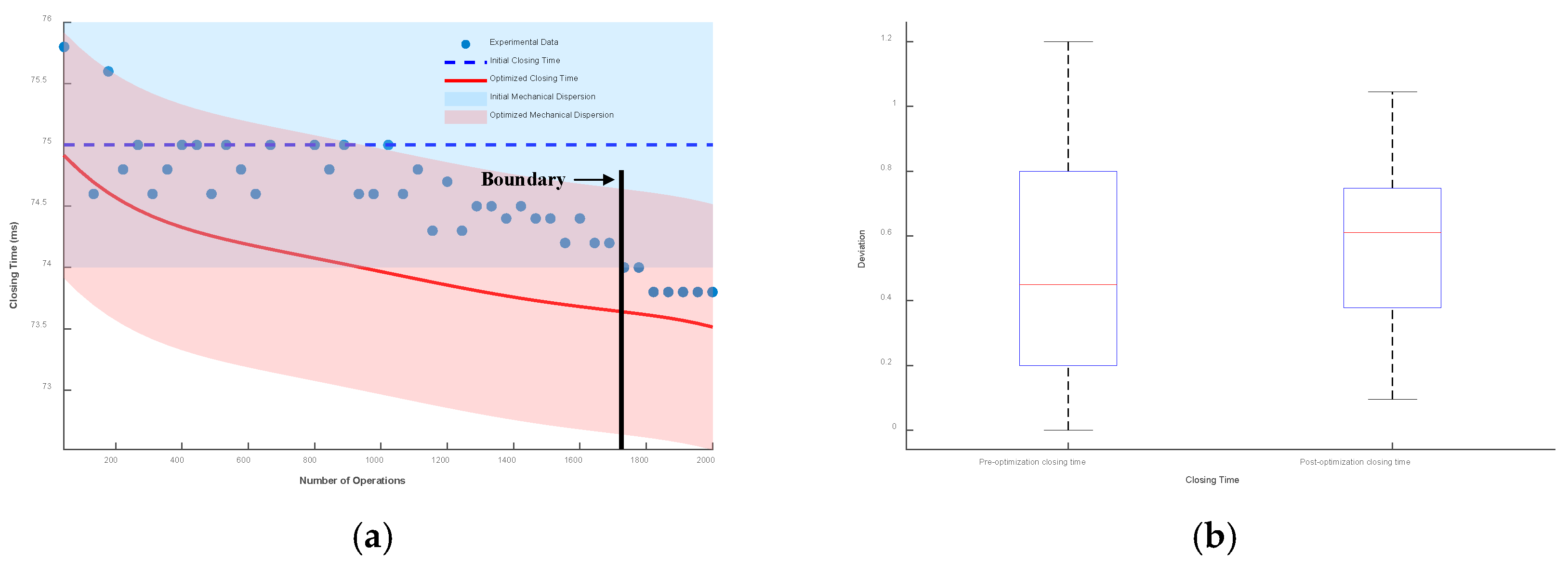
Prediction of the Closing Time of UHV Disc Spring Hydraulic Operating Mechanism Circuit Breakers Considering Low-Cycle Fatigue

 and
and
Abstract
1. Introduction
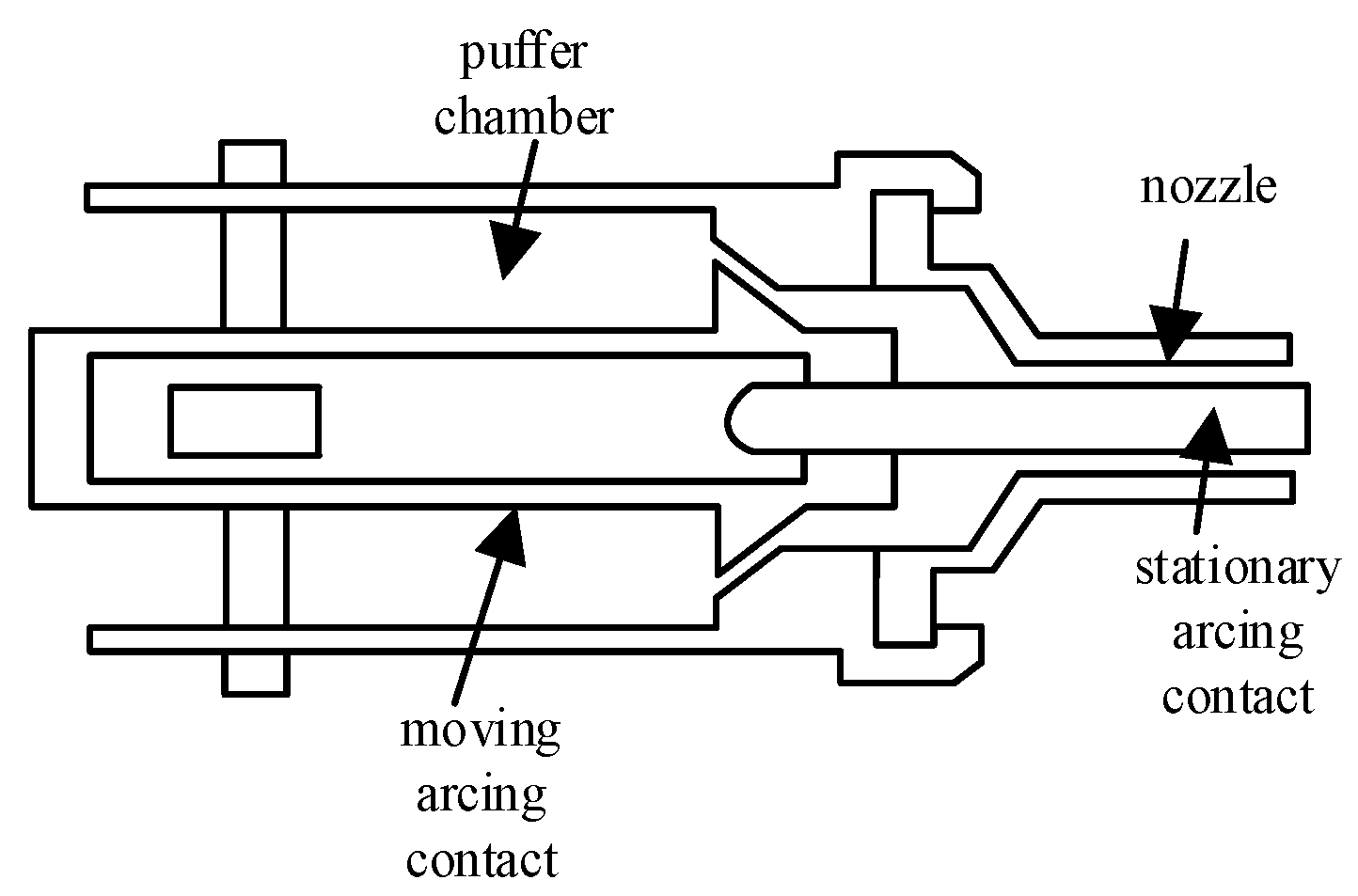
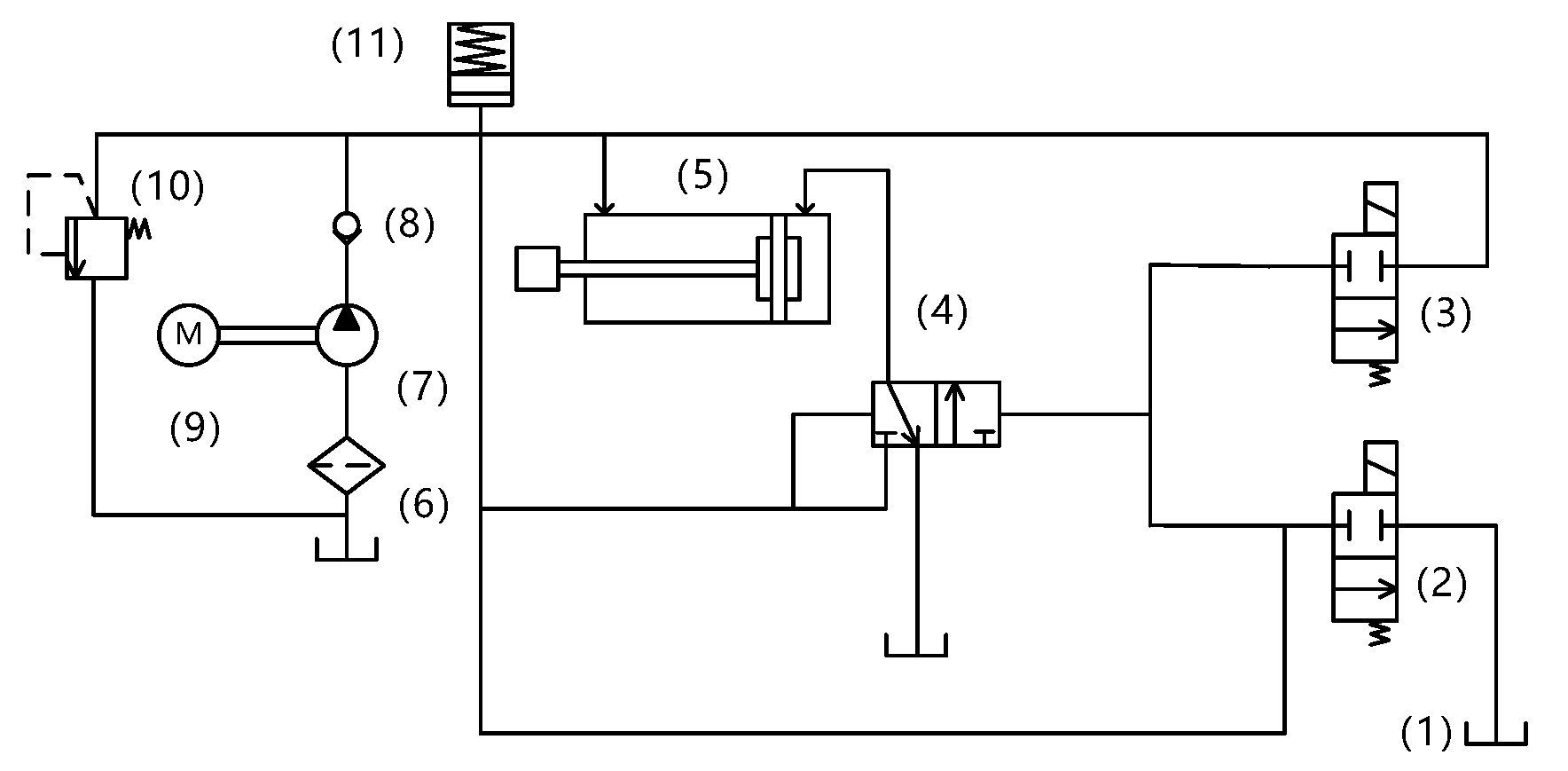
2. Model of Disc Spring Hydraulic Actuator
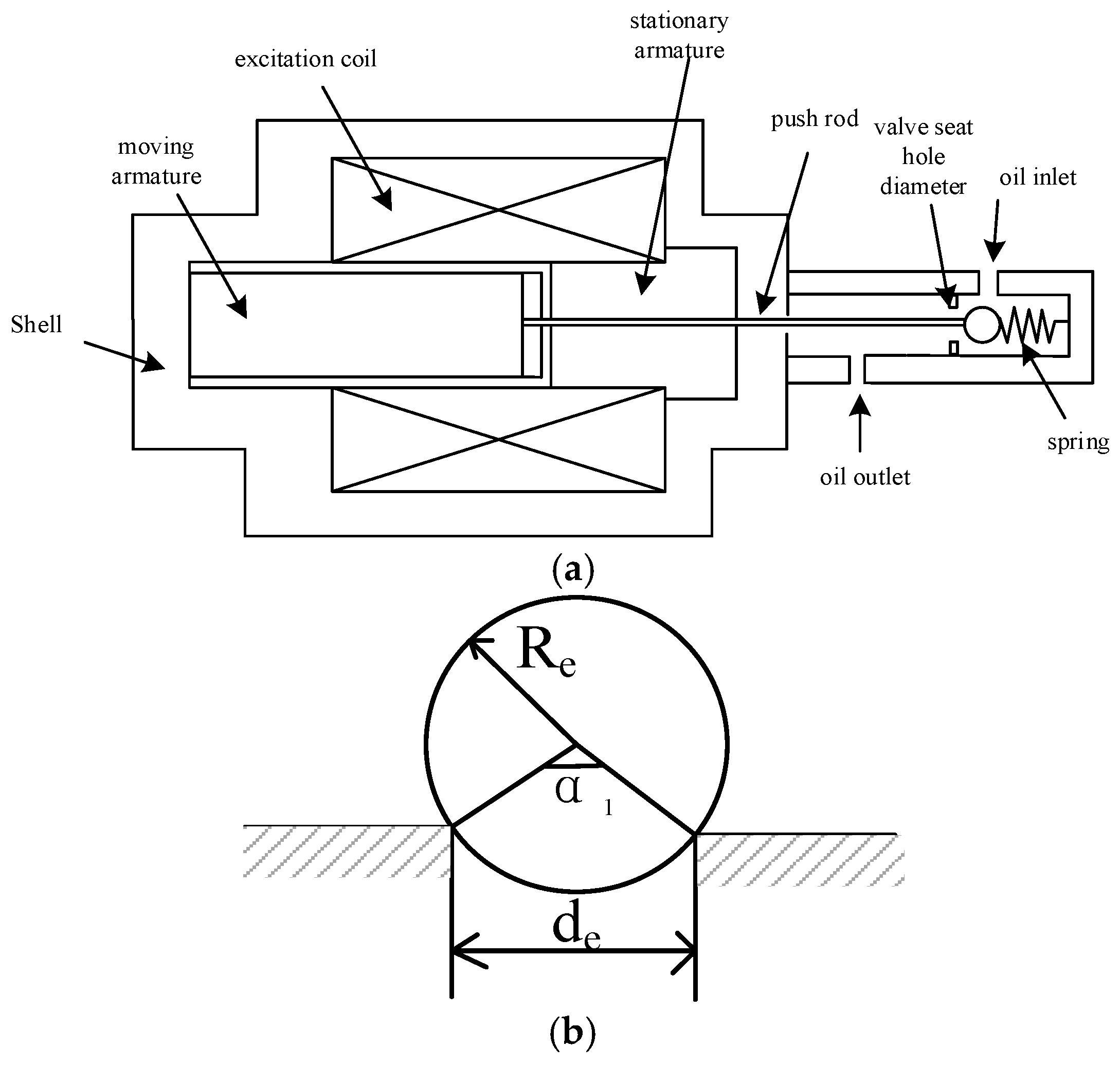
2.1. Solenoid Valve
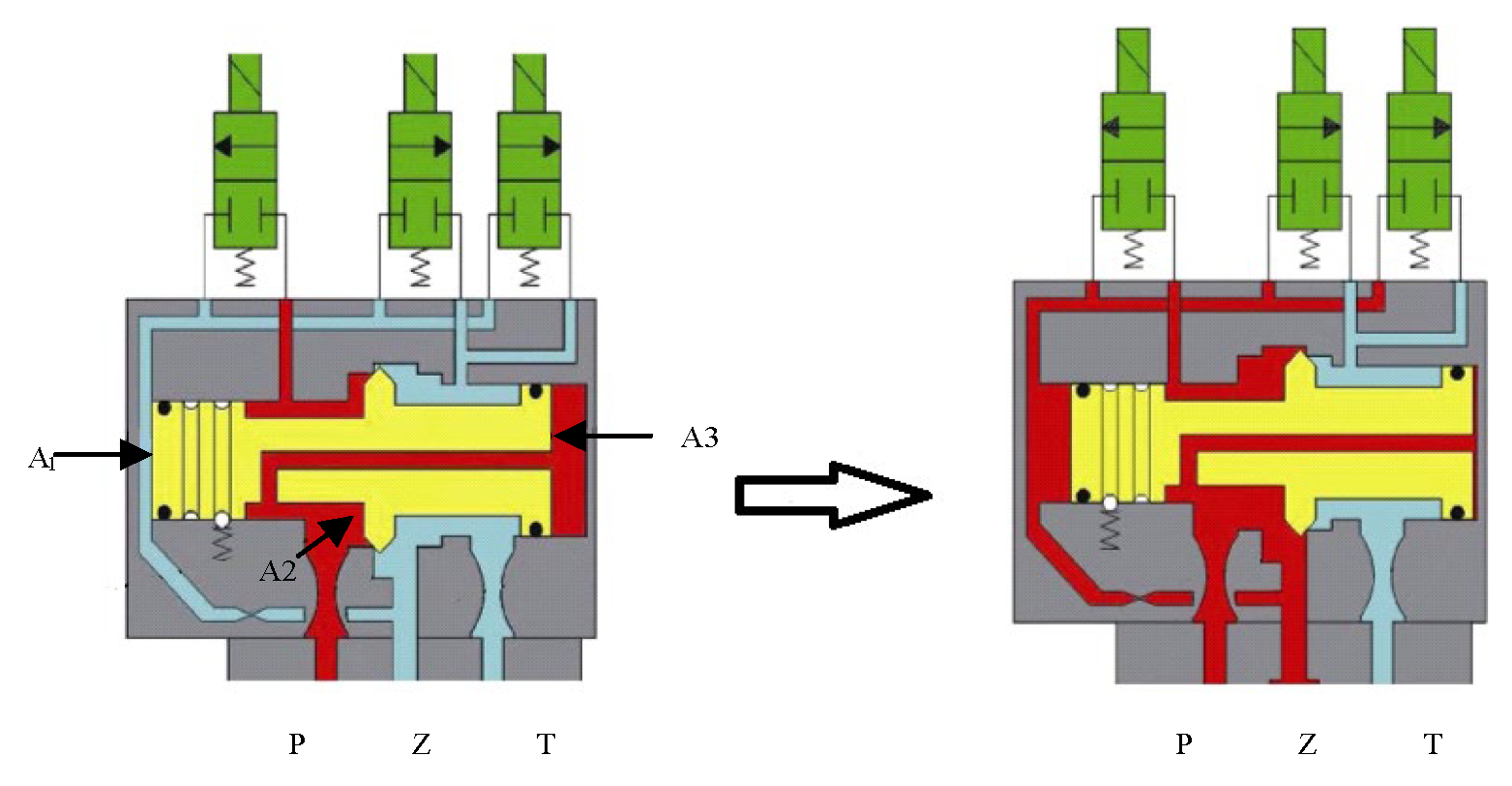
2.2. Main Valve
2.3. Working Cylinder
2.4. Loads
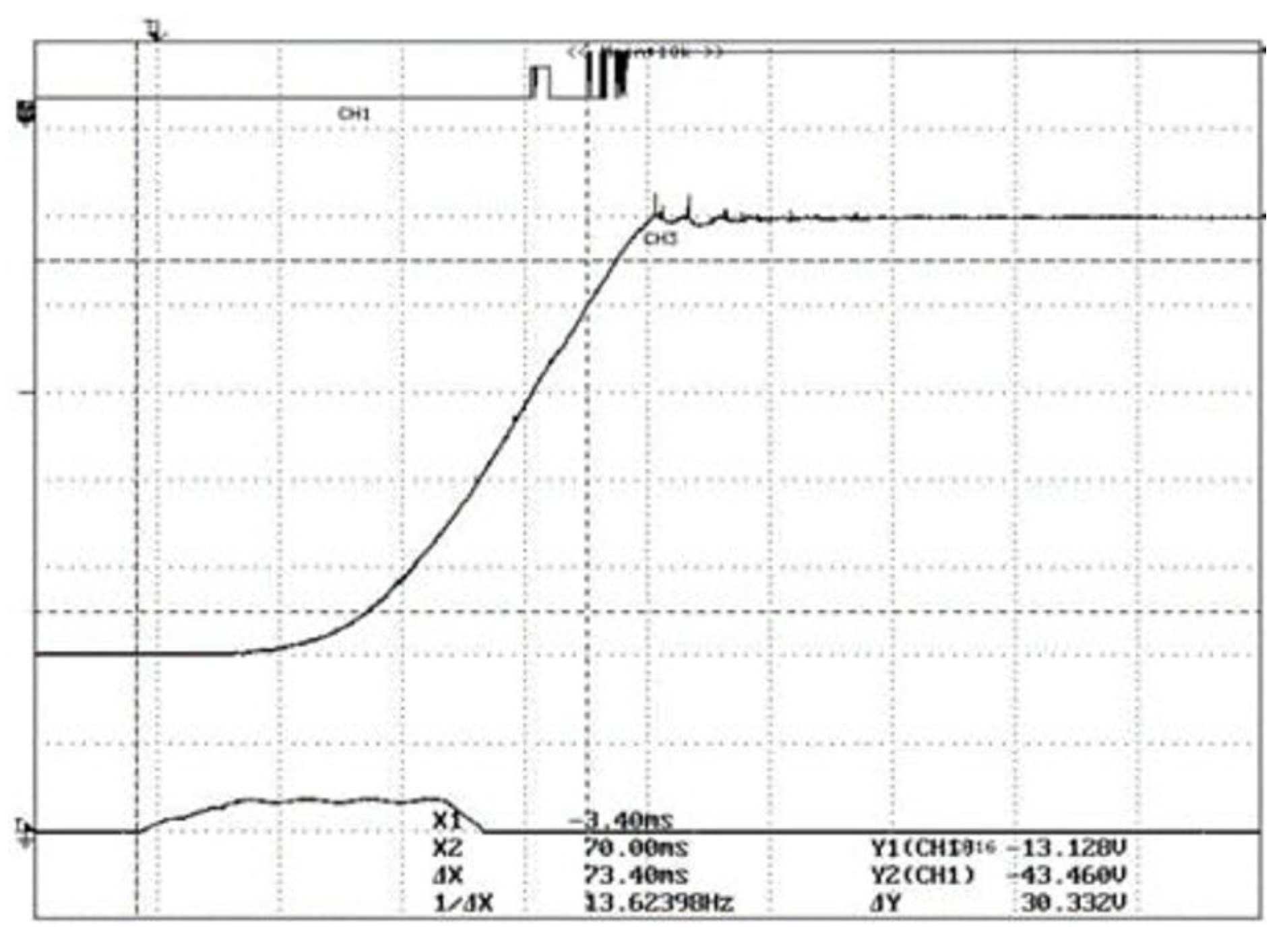
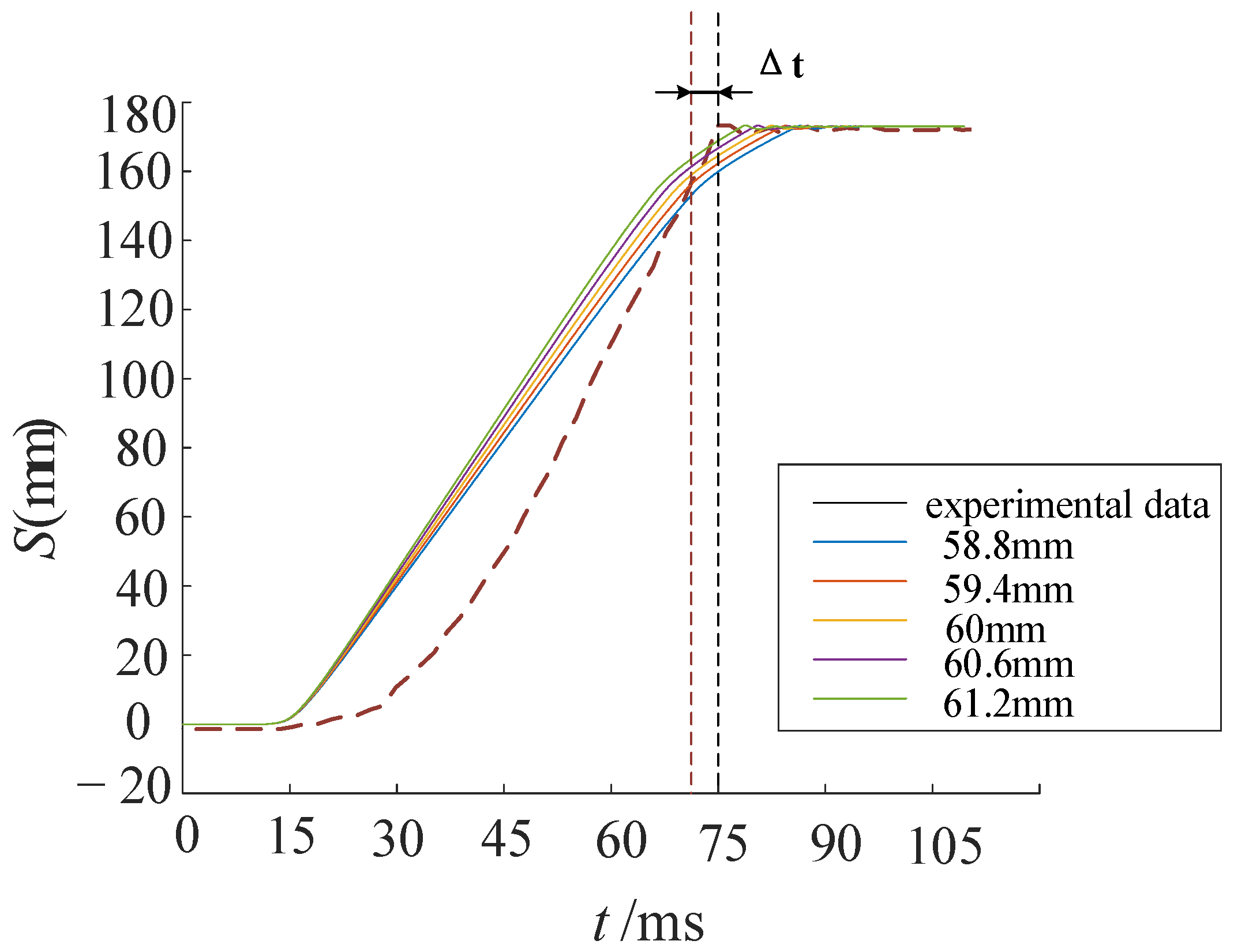
2.5. Simulation Analysis
2.5.1. Typical Working Condition Analysis
2.5.2. Selection of Parameter Range
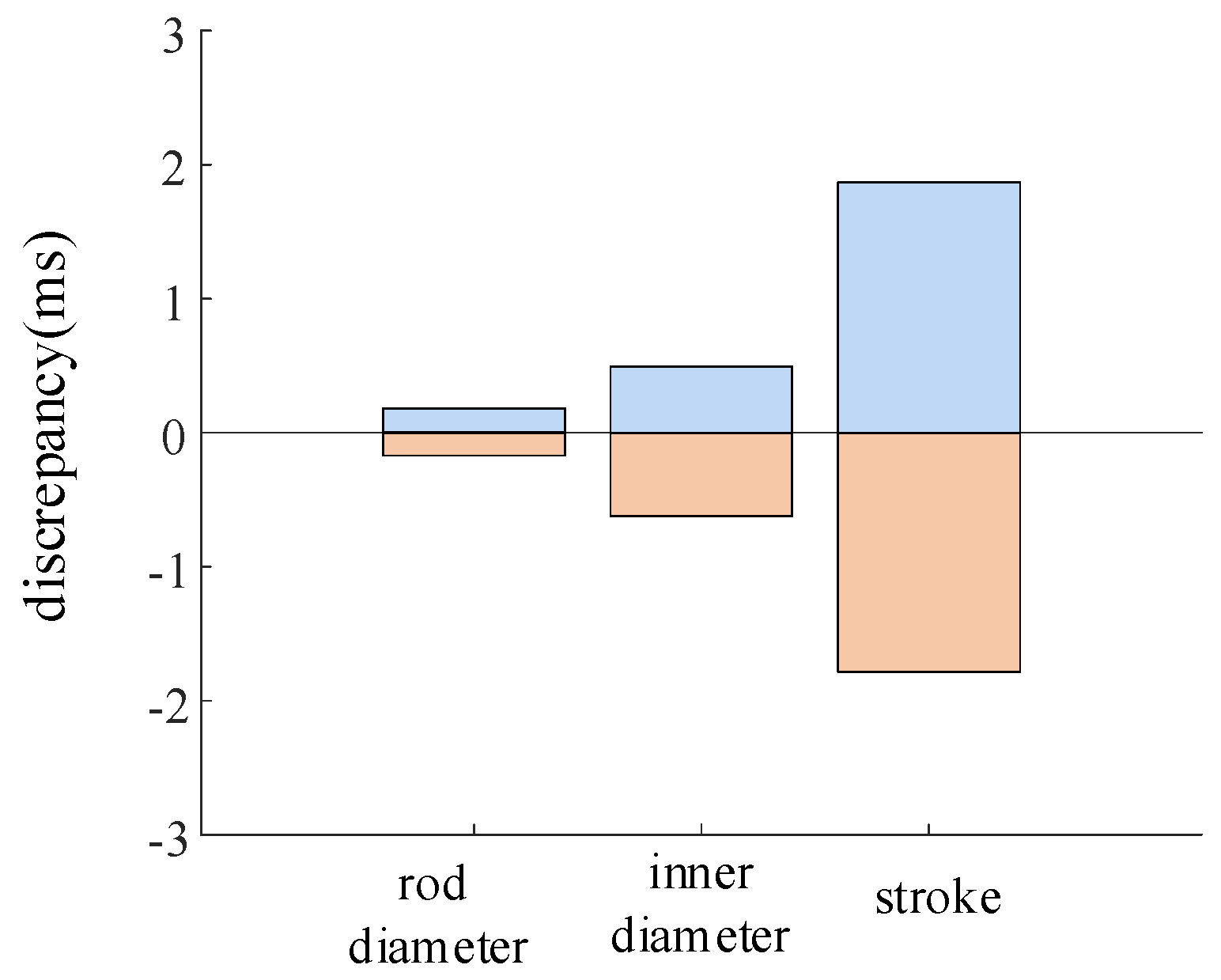
2.5.3. Working Cylinders
2.5.4. Main Valve
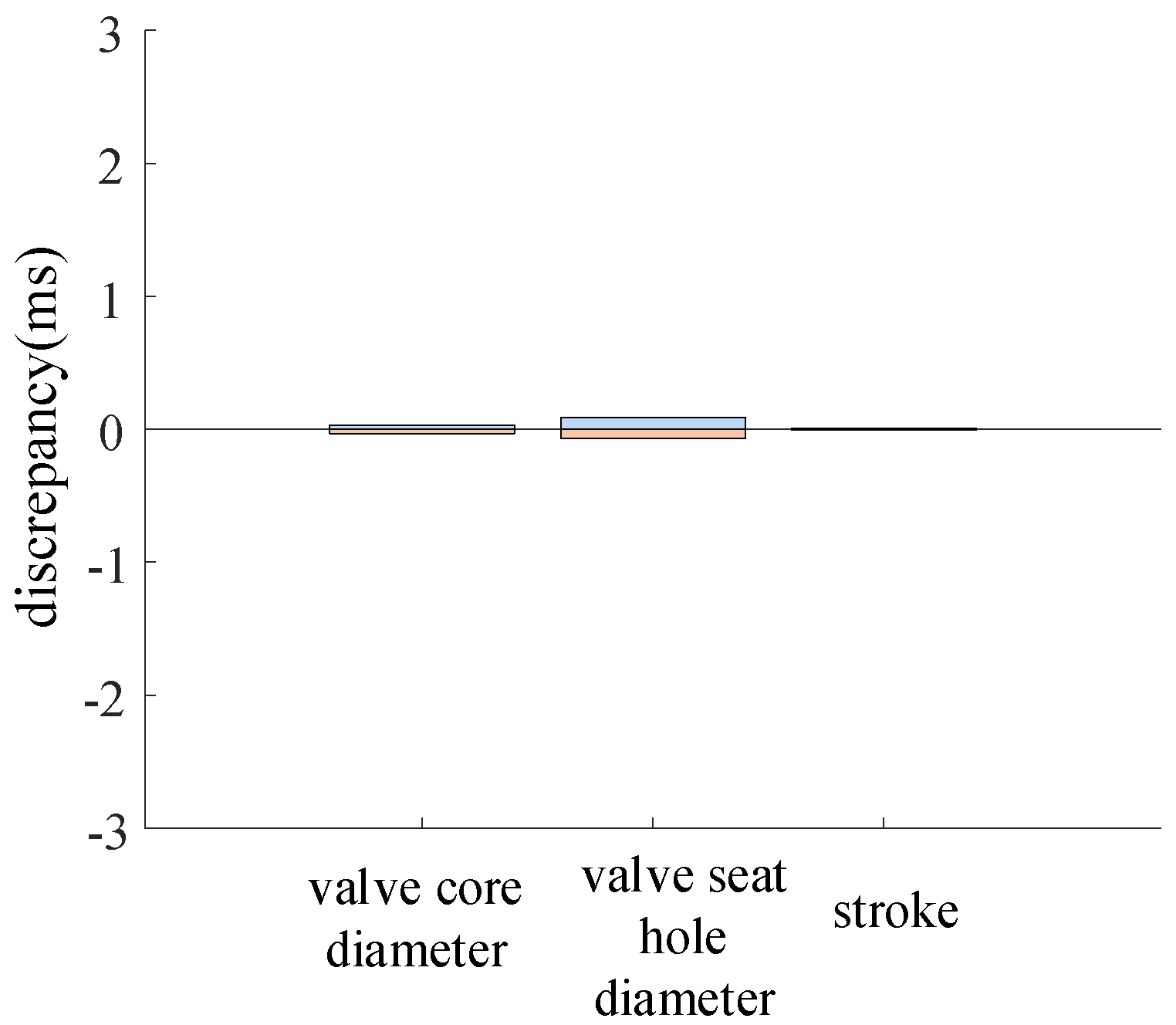
2.5.5. Solenoid Valves
3. Reliability Analysis of Disc Spring Hydraulic Operating Mechanism
3.1. Limit State Functions
3.2. Adaptive Kriging Surrogate Model
3.3. Directionally Important Sampling
3.4. Calculation Process
- (1)
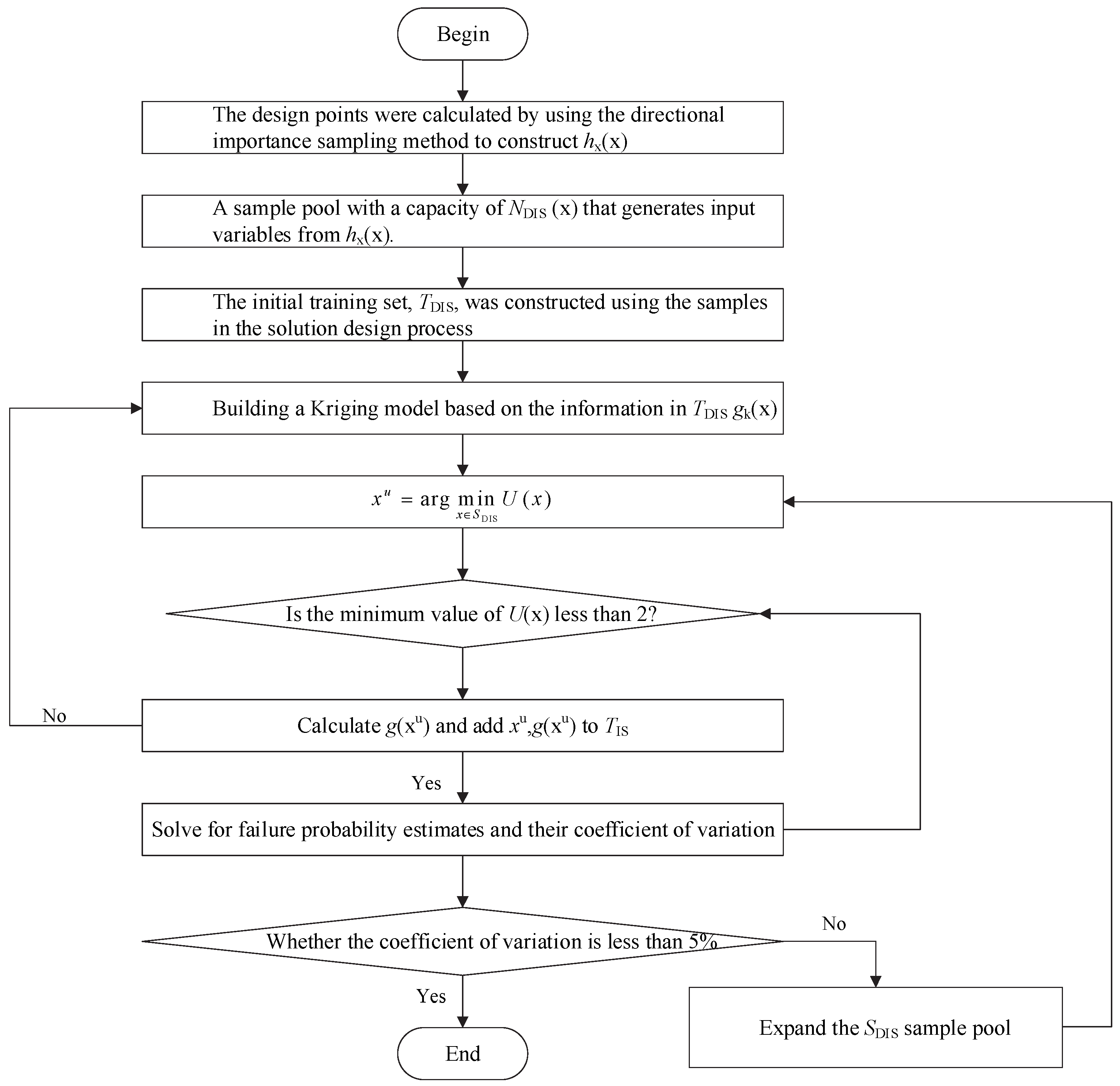
- The unimodal directional sampling density function is constructed by solving the design point P* using the unimodal directional method. The sampling center of the original sampling density function is shifted to P*, and the unimodal directional sampling density function hx(x) is constructed.
- (2)
- Construct a single-mode directional sampling sample pool and initial training set TIS: hx(x) is used to extract the sample pool SDIS with a sample size of NDIS, and the input–output samples in the process of solving the design points are used to form the initial training sample set TDIS.
- (3)
- Construct the Kriging model gk(x) based on the information in TDIS.
- (4)
- Select the update sample point xu in SDIS; then, there is the following:
- (5)
- Determine whether the self-learning process has converged: if the U-learning function is greater than 2, stop the adaptive learning process and proceed to step 6; otherwise, calculate g(xu), and add {xu, g(xu)} to the training samples in TDIS, and then return to step 3 to continue updating the Kriging model gk(x).
- (6)
- Use the current Kriging surrogate model to estimate the failure probability: use the Kriging surrogate model to calculate the failure domain indicator function value corresponding to each sample point in SDIS, and obtain the estimated value of the failure probability.
- (7)
- Calculate the coefficient of variation of the failure probability estimate to determine the convergence of AK-DIS reliability. When the coefficient of variation is less than 5%, the algorithm stops running.
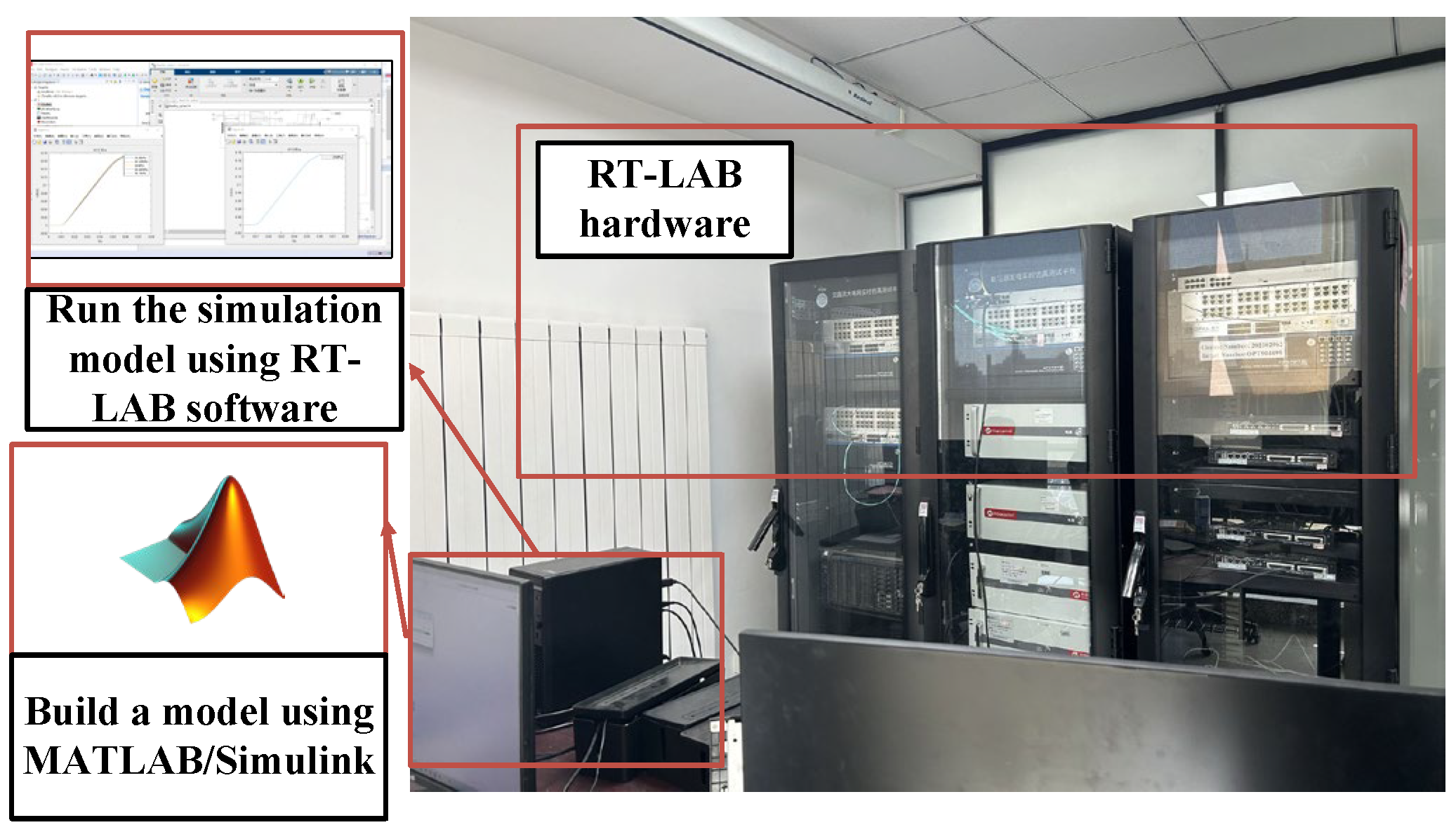
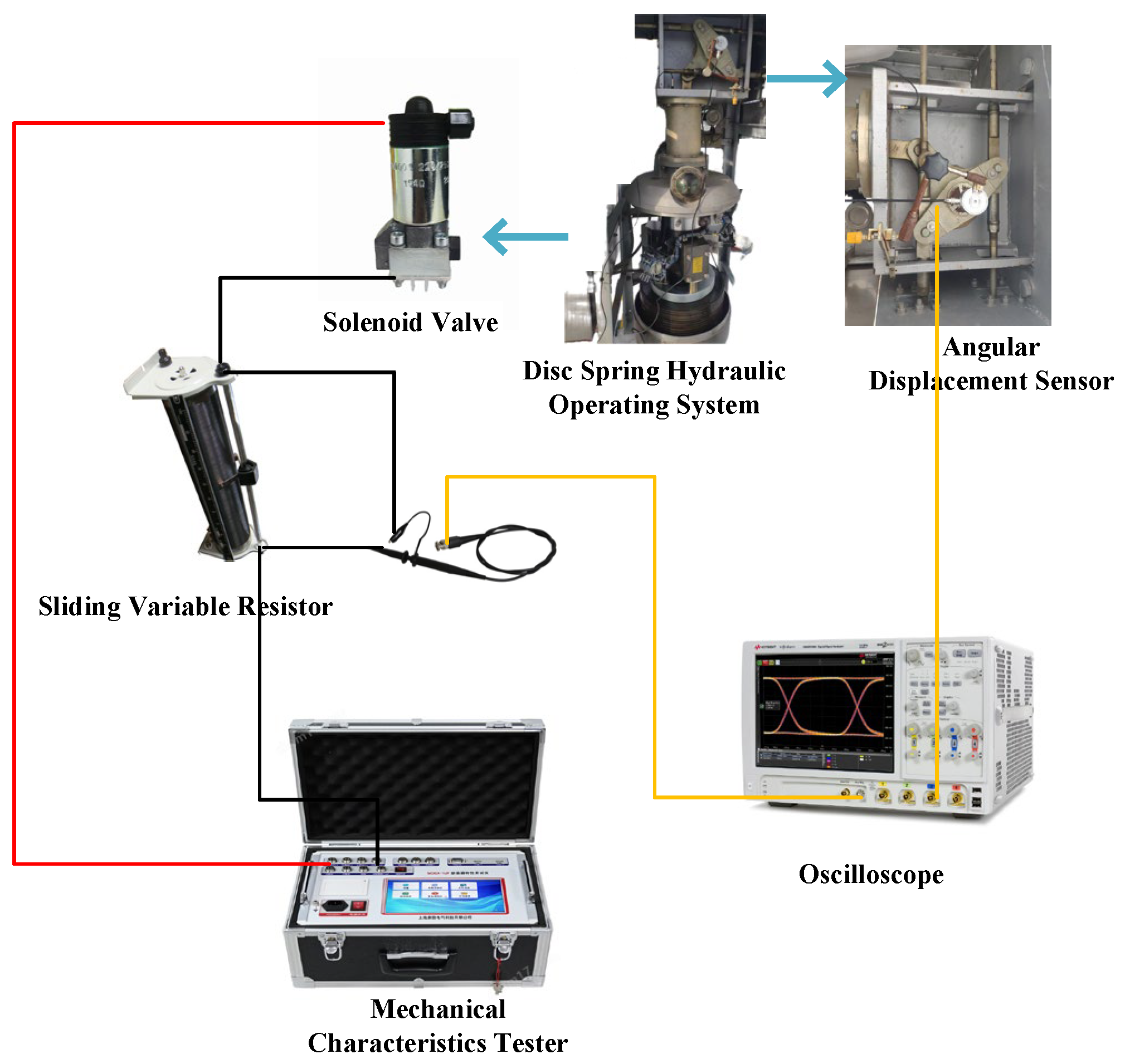
4. Closing Time Prediction Model

5. Conclusions
- (1)
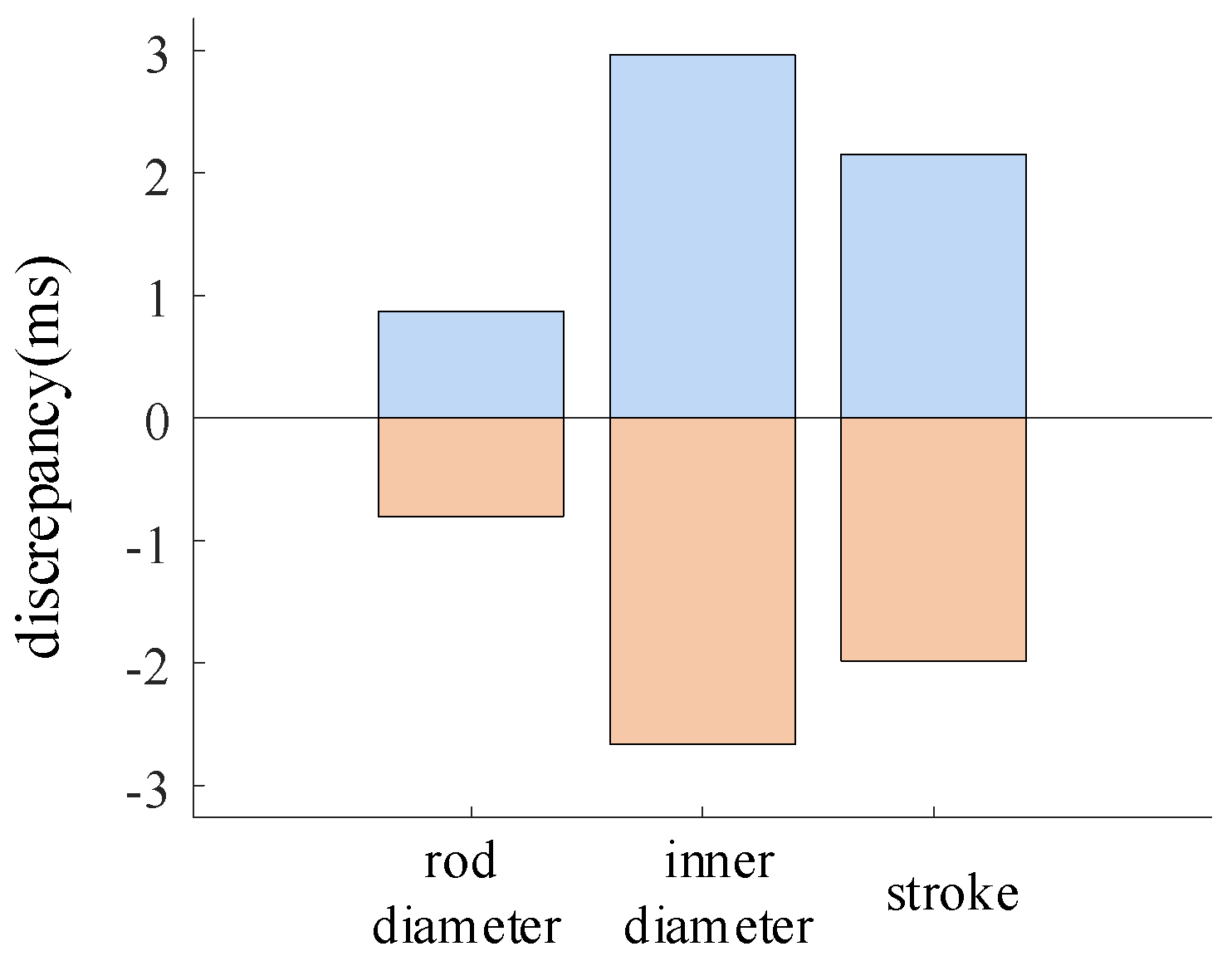
- By analyzing the transmission process of the circuit breaker operating mechanism, the deformation ranges of working components caused by low-cycle fatigue were calculated and substituted into the model simulation. The resulting fluctuation range of the circuit breaker’s operating time was −2.6 ms to 2.9 ms, significantly exceeding the mechanical dispersion requirements.
- (2)
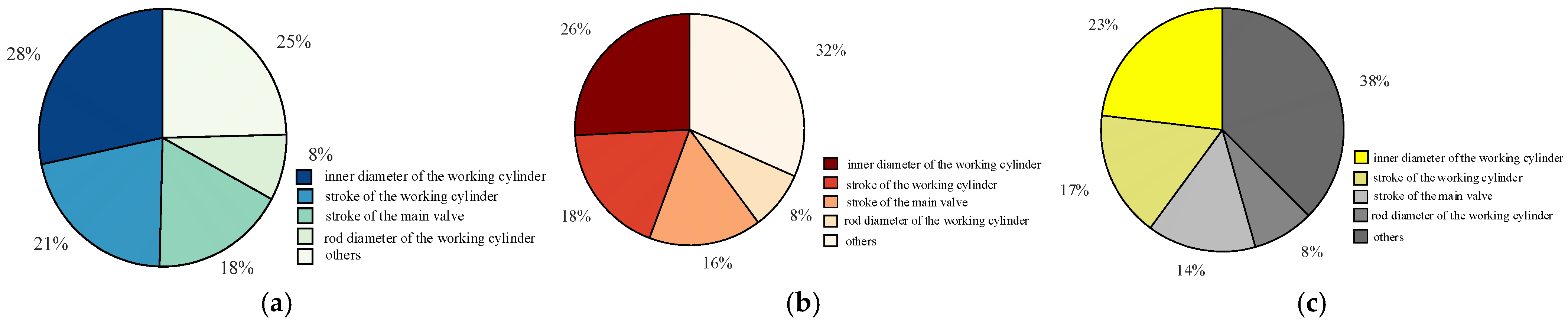
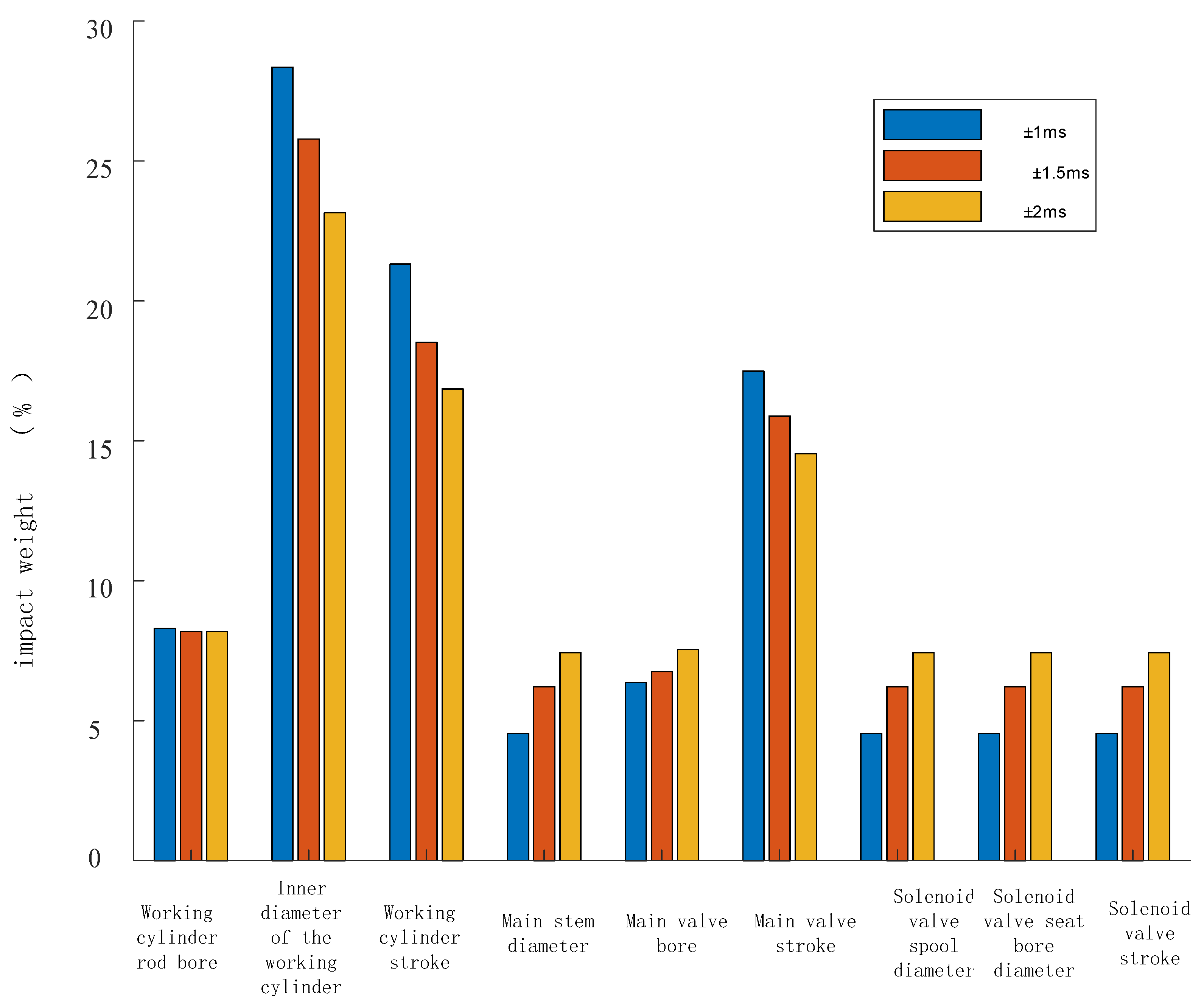
- By processing the stability analysis results, the influence degrees of different parameters on closing time stability under various mechanical dispersions were obtained. Among them, four parameters—working cylinder inner diameter, working cylinder stroke, main valve stroke, and working cylinder rod diameter—each accounted for more than 10% under any mechanical dispersion.
- (3)
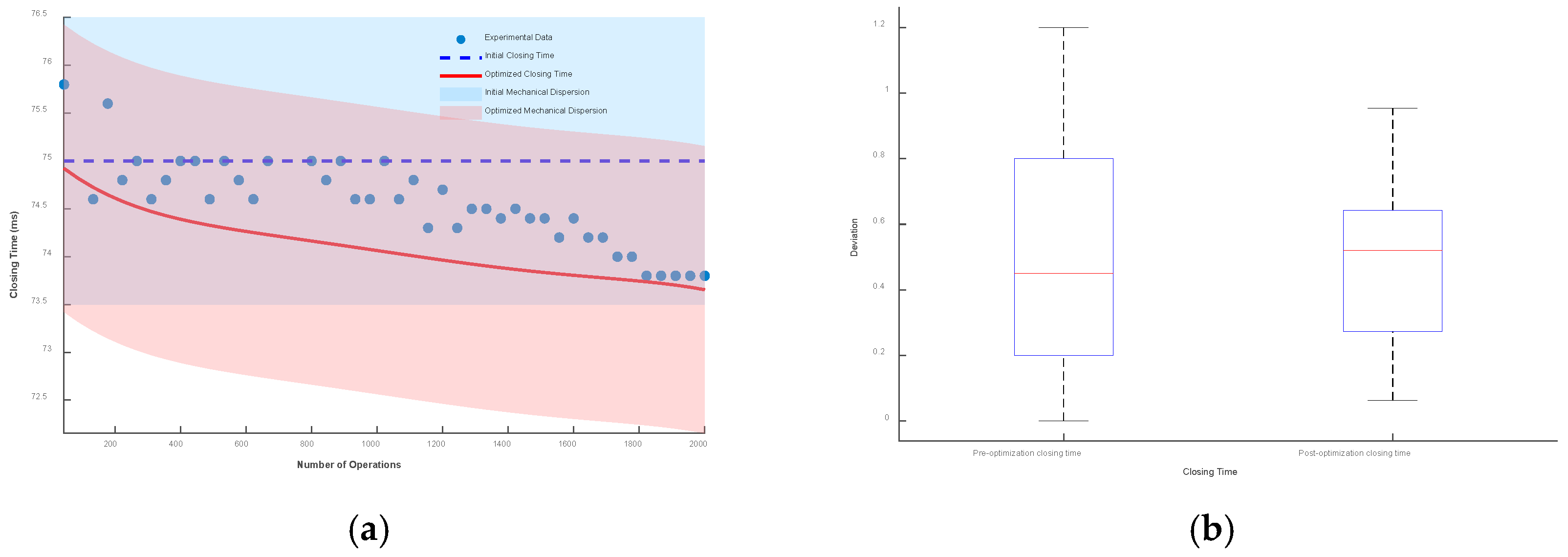
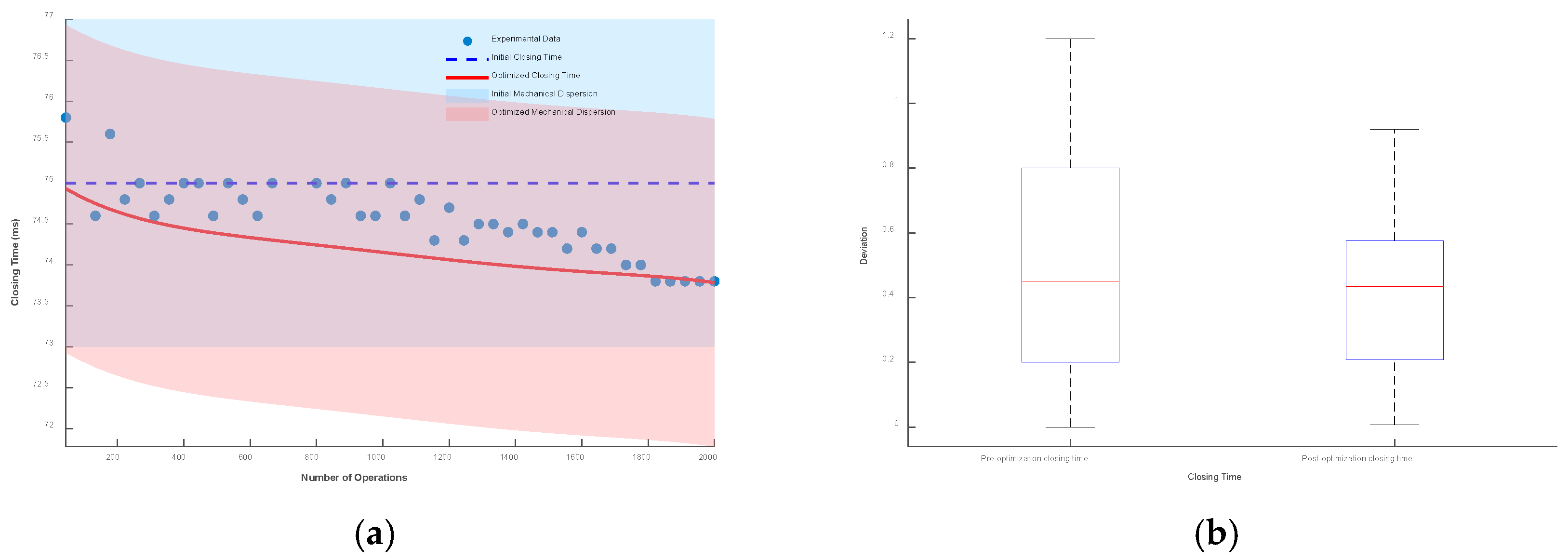
- A closing time prediction model considering the low-cycle fatigue of the operating mechanism was designed. Through comparison with no-load closing tests, under mechanical dispersions of ±1 ms, ±1.5 ms, and ±2 ms, the maximum deviation values of the optimized model were reduced by 12.8%, 20.4%, and 23.3%, respectively, while the fluctuation ranges were reduced by 37%, 38.3%, and 38.6%, respectively.
Author Contributions
Funding
Data Availability Statement
Conflicts of Interest
References
- Maller, V.N.; Naigu, M.S. Advances in High Voltage Insulation and Arc Interruption in SF6 and Vacuum; Pergamon: Oxford, UK, 1981; pp. 100–118. [Google Scholar]
- Nakanishi, K. Switching Phenomena in High-Voltage Circuit Breakers; Marcel Dekker: New York, NY, USA, 1991; pp. 102–104. [Google Scholar]
- Garzon, R.D. High Voltage Circuit Breakers: Design and Applications, 2nd ed.; Marcel Dekker: New York, NY, USA, 2002; pp. 212–216. [Google Scholar]
- Huang, Y.; Wang, J.; Zhang, W.; Al-Dweikat, M.; Li, D.; Yang, T.; Shao, S. A motor-drive-based operating mechanism for high-voltage circuit breaker. IEEE Trans. Power Deliv. 2013, 28, 2602–2609. [Google Scholar] [CrossRef]
- Liu, W.; Xu, B.; Yang, H.; Zhao, H.; Wu, J. Hydraulic operating mechanisms for high voltage circuit breakers: Progress evolution and future trends. Sci. China Technol. Sci. 2011, 54, 116–125. [Google Scholar] [CrossRef] [Scilit]
- Wang, F.; Gu, L.Y.; Chen, Y. A hydraulic pressure-boost system based on high-speed on–off valves. IEEE/ASME Trans. Mechatron. 2012, 18, 733–743. [Google Scholar] [CrossRef] [Scilit]
- Yao, J.; Jiao, Z.; Ma, D.; Yan, L. High-Accuracy tracking control of hydraulic rotary actuators with modeling uncertainties. IEEE/ASME Trans. Mechatron. 2013, 19, 633–641. [Google Scholar] [CrossRef] [Scilit]
- Wang, F.; Chen, Y. Dynamic characteristics of pressure compensator in underwater hydraulic system. IEEE/ASME Trans. Mechatron. 2013, 19, 777–787. [Google Scholar] [CrossRef] [Scilit]
- Cano-González, R.; Bachiller-Soler, A.; Rosendo-Macías, J.A.; Álvarez-Cordero, G. Controlled switching strategies for transformer inrush current reduction: A comparative study. Electr. Power Syst. Res. 2017, 145, 12–18. [Google Scholar] [CrossRef] [Scilit]
- Parikh, U.B.; Bhalja, B.R. Mitigation of magnetic inrush current during controlled energization of coupled un-loaded power transformers in presence of residual flux without load side voltage measurements. Int. J. Electr. Power Energy Syst. 2016, 76, 156–164. [Google Scholar] [CrossRef] [Scilit]
- Chandrasena, W.; Jacobson, D.; Wang, P. Controlled switching of a 1200MVA transformer in Manitoba. IEEE Trans. Power Deliv. 2016, 31, 2390–2400. [Google Scholar] [CrossRef] [Scilit]
- Elvis, B.; Adam, M.; Andruşcă, M.; Micu, M. Aspects regarding the controlled switching of the shunt reactors. In Proceedings of the 2016 International Conference and Exposition on Electrical and Power Engineering (EPE), Iasi, Romania, 20–22 October 2016; pp. 119–122. [Google Scholar]
- Stanek, M. Analysis of circuit breaker controlled switching operations—From manual to automatic. In Proceedings of the 2015 50th International Universities Power Engineering Conference (UPEC), Trent, UK, 1–4 September 2015; pp. 1–6. [Google Scholar]
- Duan, X.Y.; Huang, Z.H.; Liao, M.F.; Ding, F.H. Prediction and compensation of operating time based on multi-element linear regression for controlled switching. Electr. Power Autom. Equip. 2009, 29, 72–75. [Google Scholar]
- Bai, S.Y.; Wei, J.C.; Sun, S.P. Research on the synchronous closing controlof an intelligent breaker. J. Xihua Univ. Nat. Sci. 2009, 28, 17–20. [Google Scholar]
- Fangang, M.; Shijing, W.; Jicai, H.; Yang, X.; Junfeng, J.; Qiaoquan, L.; Cunling, S. Simulation and stability analysis of spring operating mechanism with clearance for high voltage circuit breakers. In Proceedings of the 2016 China International Conference on Electricity Distribution (CICED), Xi’an, China, 10–13 August 2016; pp. 1–5. [Google Scholar]
- Zhao, W.; Dang, D.; Di, Z.; Liu, C. Optimal Design and Fatigue Life Analysis on Buffer in Spring Mechanism. High Volt. Appar. 2017, 53, 6. [Google Scholar]
- Liu, Y.; Zhang, G.; Zhao, C.; Lei, S.; Qin, H.; Yang, J. Mechanical Condition Identification and Prediction of Spring Operating Mechanism of High Voltage Circuit Breaker. IEEE Access 2020, 8, 210328–210338. [Google Scholar] [CrossRef] [Scilit]
- Xu, B.; Ding, R.; Zhang, J.; Sha, L.; Cheng, M. Multiphysics-Coupled Modeling: Simulation of the Hydraulic-Operating Mechanism for a SF6 High-Voltage Circuit Breaker. IEEE/ASME Trans. Mechatron. 2016, 21, 379–393. [Google Scholar] [CrossRef] [Scilit]
- Gonzalez, J.J.; Freton, P. Flow behavior in high-voltage circuit breaker. IEEE Trans. Plasma Sci. 2011, 39, 2856–2857. [Google Scholar] [CrossRef] [Scilit]
- Pinto, L.C.; Zanetta, L.C. Medium voltage SF6 circuit-breaker arc model application. Electr. Power Syst. Res. 2000, 53, 67–71. [Google Scholar] [CrossRef] [Scilit]
- Looe, H.M.; Brazier, K.J.; Huang, Y.; Coventry, P.F.; Jones, G.R. High frequency effects in SF6 circuit breakers. IEEE Trans. Power Deliv. 2004, 19, 1095–1104. [Google Scholar] [CrossRef]
- Mori, T.; Kawano, H.; Iwamoto, K.; Tanaka, Y.; Kaneko, E. Gas-flow simulation with contact moving in GCB considering high-pressure and high-temperature transport properties of SF6 gas. IEEE Trans. Power Deliv. 2005, 20, 2466–2472. [Google Scholar] [CrossRef]
- Ding, F. Research on High Voltage Circuit Breaker with Hydraulic Operating Mechanism; Zhejiang University Hangzhou: Zhejiang, China, 1994; pp. 4–30. (In Chinese) [Google Scholar]
- Bošnjak, S.; Petković, Z.; Zrnić, N.; Pantelić, M.; Obradović, A. Failure analysis and redesign of the bucket wheel excavator two-wheel bogie. Eng. Fail. Anal. 2010, 17, 473–485. [Google Scholar] [CrossRef] [Scilit]
- Arsić, M.; Bošnjak, S.; Gnjatović, N.; Sedmak, S.A.; Arsić, D.; Savić, Z. Determination of residual fatigue life of welded structures at bucket-wheel excavators through the use of fracture mechanics. Procedia Struct. Integr. 2018, 13, 79–84. [Google Scholar] [CrossRef] [Scilit]
- Liu, W.; Zeng, Q.; Qin, W.; Wan, L.; Liu, J. Lifetime reliability of hydraulic excavators’ actuator. IEEE Access 2023, 11, 117670–117684. [Google Scholar] [CrossRef] [Scilit]
- Mohammad, J.; Odinokova, I.; Gaevskiy, V.; Nosko, E. Optimization design of the stick of an excavator under uncertain loading (in the conditions of the Syrian Arab Republic). MATEC Web Conf. 2021, 341, 00014. [Google Scholar] [CrossRef] [Scilit]
- Ma, T.; Gu, J.; Duan, M. Dynamic response of pipes conveying two-phase flow based on Timoshenko beam model. Mar. Syst. Ocean Technol. 2017, 12, 196–209. [Google Scholar] [CrossRef] [Scilit]
- Wei, Y.; Deng, G.; Yang, Z. Experimental study and numerical analysis of fluid-structure coupling vibration characteristics for the reciprocating compressor pipeline. IOP Conf. Ser. Earth Environ. Sci. 2020, 558, 022007. [Google Scholar]
- Fan, S.; Xu, R.; Ji, H.; Yang, S.; Yuan, Q. Experimental Investigation on Contaminated Friction of Hydraulic Spool Valve. Appl. Sci. 2019, 9, 5230. [Google Scholar] [CrossRef] [Scilit]
- Huang, J.; Shi, D.; Yang, X.; Yu, H.; Dong, C. Unified modeling of high temperature deformations of a Ni-based polycrystalline wrought superalloy under tension-compression, cyclic, creep and creep-fatigue loadings. Sci. China Technol. Sci. 2015, 58, 248–257. [Google Scholar] [CrossRef] [Scilit]
- Ambroziak, A. Application of elasto-viscoplastic Bodner-Partom constitutive equations in finite element analysis. Comput. Assist. Methods Eng. Sci. 2022, 14, 405–429. [Google Scholar]
- GB/T 30846-2014; High-Voltage Alternating Current Circuit-Breakers with Intentionally Non-Simultaneous Pole Operation. General Administration of Quality Supervision, Inspection and Quarantine of the People’s Republic of China, Standardization Administration of the People’s Republic of China: Beijing, China, 2014.
- Echard, B.; Gayton, N.; Lemaire, M.; Relun, N. A combined im-portance sampling and Kriging reliability method for small fail-ure probabilities with time demanding numerical model. Reliab. Eng. Syst. Saf. 2013, 111, 232–240. [Google Scholar] [CrossRef] [Scilit]
- Rausand, M.; Hoyland, A. System Reliability Theory: Models, Statistical Methods, and Applications; John Wiley & Sons Inc.: Hoboken, NJ, USA, 2020. [Google Scholar]
- Echard, B.; Gayton, N.; Lemaire, M. AK—MCS: An active learning reliability method combining Kriging and Monte Carlo Simulation. Struct. Saf. 2011, 33, 145–154. [Google Scholar] [CrossRef] [Scilit]








| Serial Number | The Name of the Parameter | Symbol | Unit | Numeric Value |
|---|---|---|---|---|
| 1 | Trigger Signal | Ut | V | 220 |
| 2 | Solenoid Valve Spool Mass | mc | kg | 0.2 |
| 3 | Main Valve Spool Mass | mx | Kg | 0.25 |
| 4 | Working Cylinder Spool Mass | my | Kg | 50 |
| 5 | Main Valve A1 Surface Diameter | A1 | mm | 8 |
| 6 | Main Valve A2 Surface Diameter | A2 | mm | 9 |
| 7 | Main Valve A3 Are Surface Diameter | A3 | mm | 10 |
| 8 | Pressure Chamber Initial Pressure | P0 | Mpa | 0.6 |
| 9 | Hydraulic Oil Viscosity | μ | mm2/s | 20 |
| 10 | Temperature | T | °C | 20 |
| Serial Number | The Name of the Parameter | Symbol | Unit | Numeric Value |
|---|---|---|---|---|
| 1 | Working cylinder rod bore | d1 | mm | 30 |
| 2 | Inner diameter of the working cylinder | D1 | mm | 60 |
| 3 | Working cylinder piston stroke | L1 | mm | 180 |
| 4 | Main stem diameter | d2 | mm | 8 |
| 5 | Main valve bore | D2 | mm | 10 |
| 6 | Main valve piston stroke | L2 | mm | 7.2 |
| 7 | Solenoid valve spool diameter | de | mm | 4 |
| 8 | Solenoid valve seat bore diameter | Re | mm | 3 |
| 9 | Solenoid valve piston stroke | le | mm | 4 |
| Serial Number | Parts | Material | Density (kg/m3) | Elastic Modulus (Gpa) | Poisson’s Ratio | Allowable Stress (Mpa) |
|---|---|---|---|---|---|---|
| 1 | Working cylinder rod bore | TC4 | 4440 | 97 | 0.34 | 559 |
| 2 | Inner diameter of the working cylinder | TC4 | 4440 | 97 | 0.34 | 559 |
| 3 | Working cylinder piston stroke | 7075 | 2800 | 71.7 | 0.33 | 328 |
| 4 | Main stem diameter | 7075 | 2800 | 71.7 | 0.33 | 328 |
| 5 | Main valve bore | 7075 | 2800 | 71.7 | 0.33 | 328 |
| 6 | Main valve piston stroke | 7075 | 2800 | 71.7 | 0.33 | 328 |
| 7 | Solenoid valve spool diameter | 304 | 7900 | 193 | 0.28 | 230 |
| 8 | Solenoid valve seat bore diameter | 304 | 7900 | 193 | 0.28 | 230 |
| 9 | Solenoid valve piston stroke | 304 | 7900 | 193 | 0.28 | 230 |
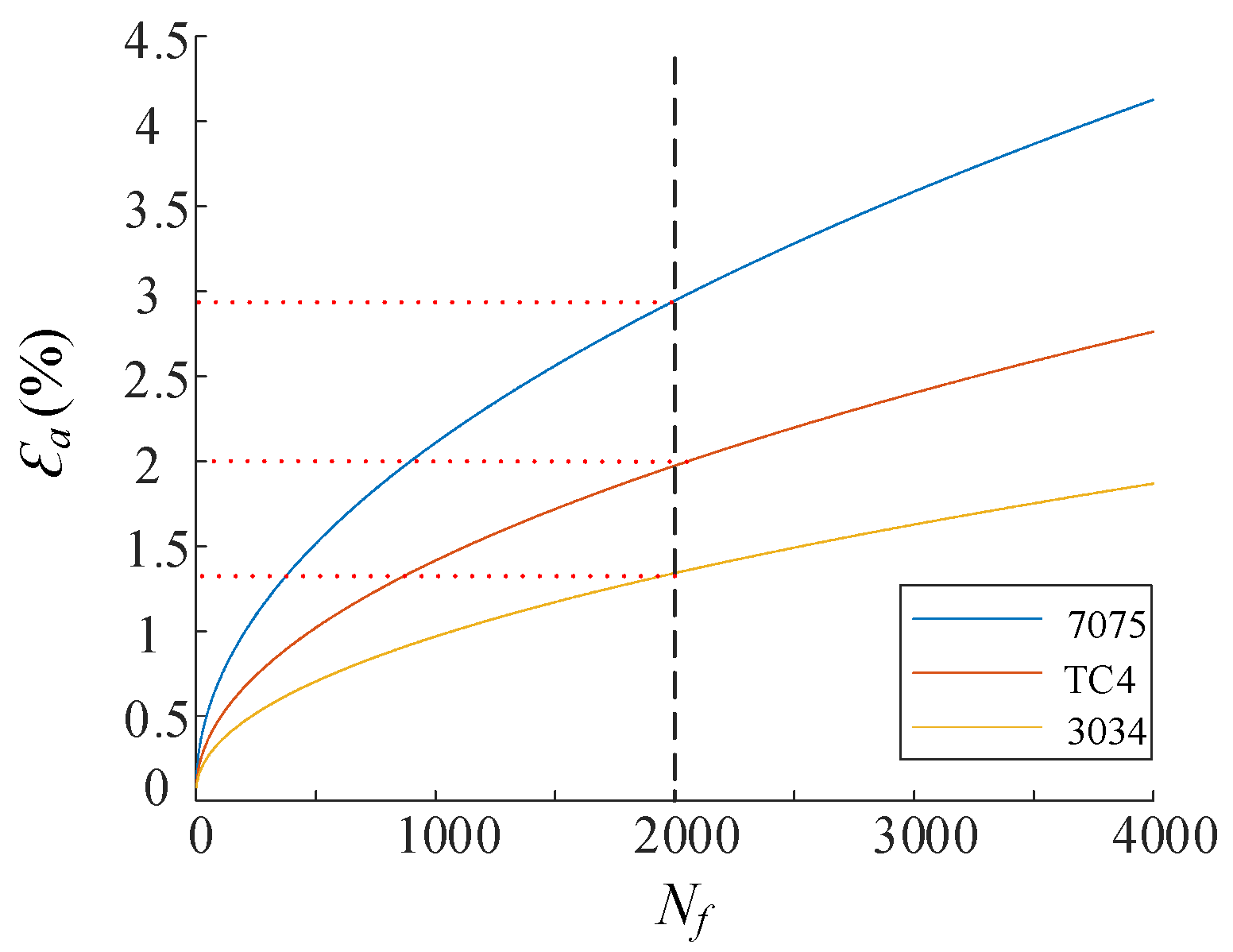
| Serial Number | Material | ɛ′f | b | ɛf | c |
|---|---|---|---|---|---|
| 1 | 7075 | 0.65% | −0.05 | 0.45% | −0.5 |
| 2 | TC4 | 0.5% | −0.05 | 0.3% | −0.5 |
| 3 | 3034 | 0.5% | −0.05 | 0.2% | −0.5 |
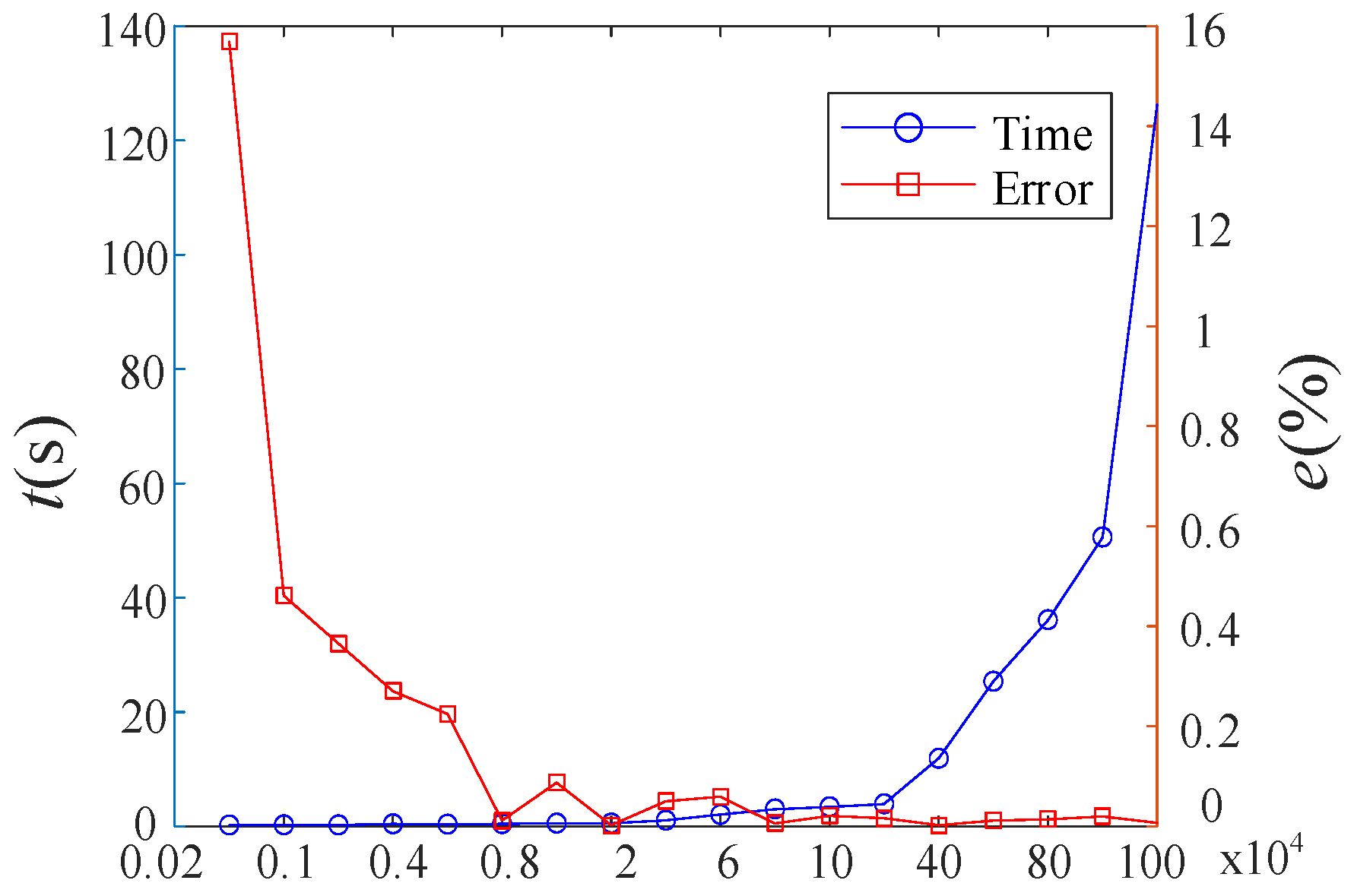
| Method | Nd | n | Pf | Cov |
|---|---|---|---|---|
| MCS | 107 | 0.976 | 2.78 × 10⁻⁴ | |
| IS | 3000 | 0.926 | 9.23 × 10⁻⁴ | |
| AK-MCS | 216 | 2.9 × 10⁶ | 0.981 | 0.34 × 10⁻⁴ |
| AK-DIS | 84 | 2.1 × 10⁴ | 0.955 | 7.57 × 10⁻⁴ |
Disclaimer/Publisher’s Note: The statements, opinions and data contained in all publications are solely those of the individual author(s) and contributor(s) and not of MDPI and/or the editor(s). MDPI and/or the editor(s) disclaim responsibility for any injury to people or property resulting from any ideas, methods, instructions or products referred to in the content. |
© 2025 by the authors. Licensee MDPI, Basel, Switzerland. This article is an open access article distributed under the terms and conditions of the Creative Commons Attribution (CC BY) license (https://creativecommons.org/licenses/by/4.0/).
Share and Cite
Long, Q.; Yang, X.; Jiang, K.; Li, W.; Li, M.; Hou, M.; Peng, X.; Huang, D.; Xiong, D.; Duan, X. Prediction of the Closing Time of UHV Disc Spring Hydraulic Operating Mechanism Circuit Breakers Considering Low-Cycle Fatigue. Processes 2025, 13, 1196. https://doi.org/10.3390/pr13041196
Long Q, Yang X, Jiang K, Li W, Li M, Hou M, Peng X, Huang D, Xiong D, Duan X. Prediction of the Closing Time of UHV Disc Spring Hydraulic Operating Mechanism Circuit Breakers Considering Low-Cycle Fatigue. Processes. 2025; 13(4):1196. https://doi.org/10.3390/pr13041196
Chicago/Turabian StyleLong, Qi, Xu Yang, Keru Jiang, Weiguo Li, Mingyang Li, Mingchun Hou, Xiang Peng, Dachao Huang, Dehua Xiong, and Xiongying Duan. 2025. "Prediction of the Closing Time of UHV Disc Spring Hydraulic Operating Mechanism Circuit Breakers Considering Low-Cycle Fatigue" Processes 13, no. 4: 1196. https://doi.org/10.3390/pr13041196
APA StyleLong, Q., Yang, X., Jiang, K., Li, W., Li, M., Hou, M., Peng, X., Huang, D., Xiong, D., & Duan, X. (2025). Prediction of the Closing Time of UHV Disc Spring Hydraulic Operating Mechanism Circuit Breakers Considering Low-Cycle Fatigue. Processes, 13(4), 1196. https://doi.org/10.3390/pr13041196