Article

Minimizing Carbon Dioxide (CO2) Emissions of POME Treatment System Using MILP Model
by
Sivakumar Pallikodathan
1,2,*,
Hasfalina Che Man
1,3,
Tinia Idaty Mohd Ghazi
4,
Alawi Sulaiman
5,
Gunasilan Nagarajoo
2 and
Mohamad Firdza Shukery
1
1
Department of Biological and Agricultural Engineering, Faculty of Engineering, Universiti Putra Malaysia, Serdang 43300, Selangor, Malaysia
2
Engineering Department Hargy Oil Palms Ltd., Bialla P.O. Box 21, Papua New Guinea
3
Smart Farming Technology Research Center, Faculty of Engineering, Universiti Putra Malaysia, Serdang 43300, Selangor, Malaysia
4
Department of Chemical and Environmental Engineering, Faculty of Engineering, Universiti Putra Malaysia, Serdang 43300, Selangor, Malaysia
5
Faculty of Plantation and Agrotechnology, Universiti Teknologi MARA, Melaka 77300, Melaka, Malaysia
*
Author to whom correspondence should be addressed.
Processes 2025, 13(2), 583; https://doi.org/10.3390/pr13020583
Submission received: 11 October 2024 / Revised: 1 February 2025 / Accepted: 17 February 2025 / Published: 19 February 2025
(This article belongs to the Special Issue Waste Management and Biogas Production Process and Application)

Abstract

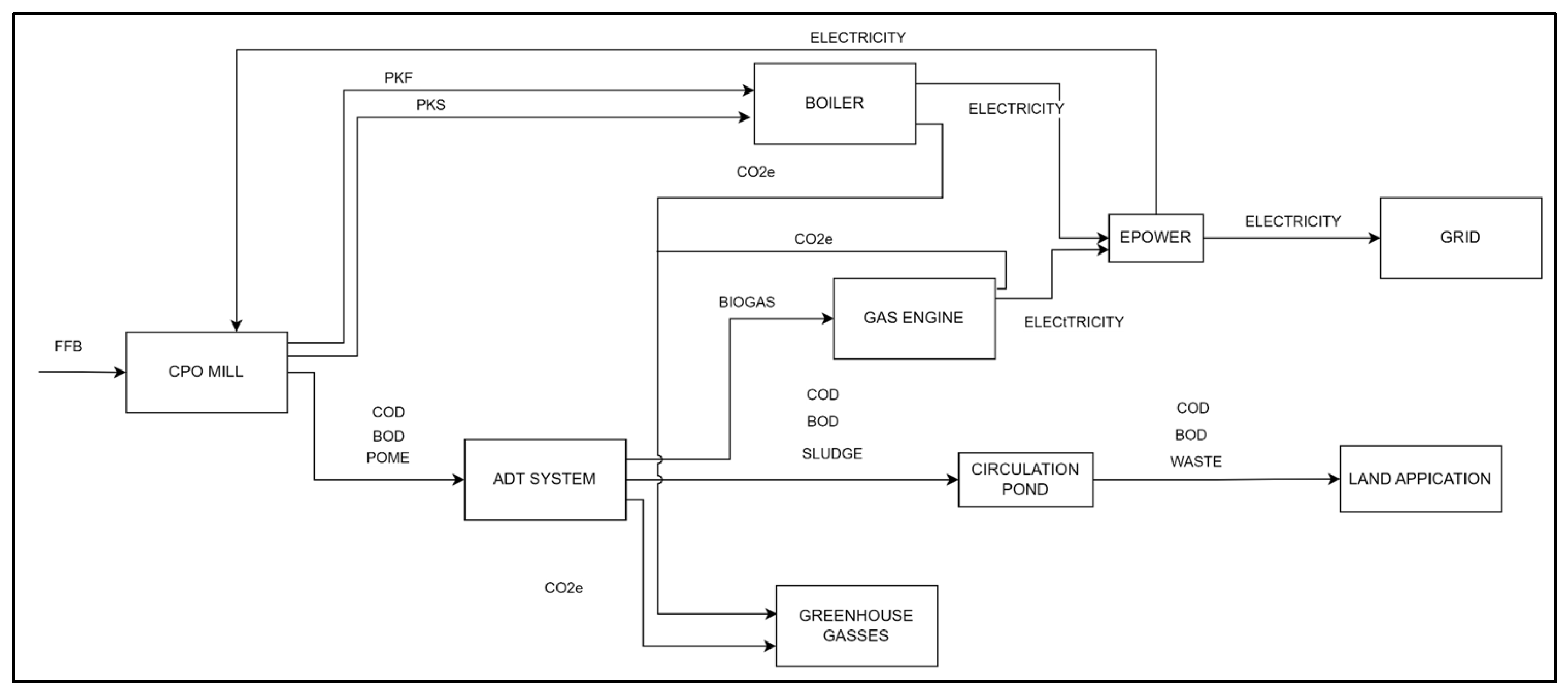
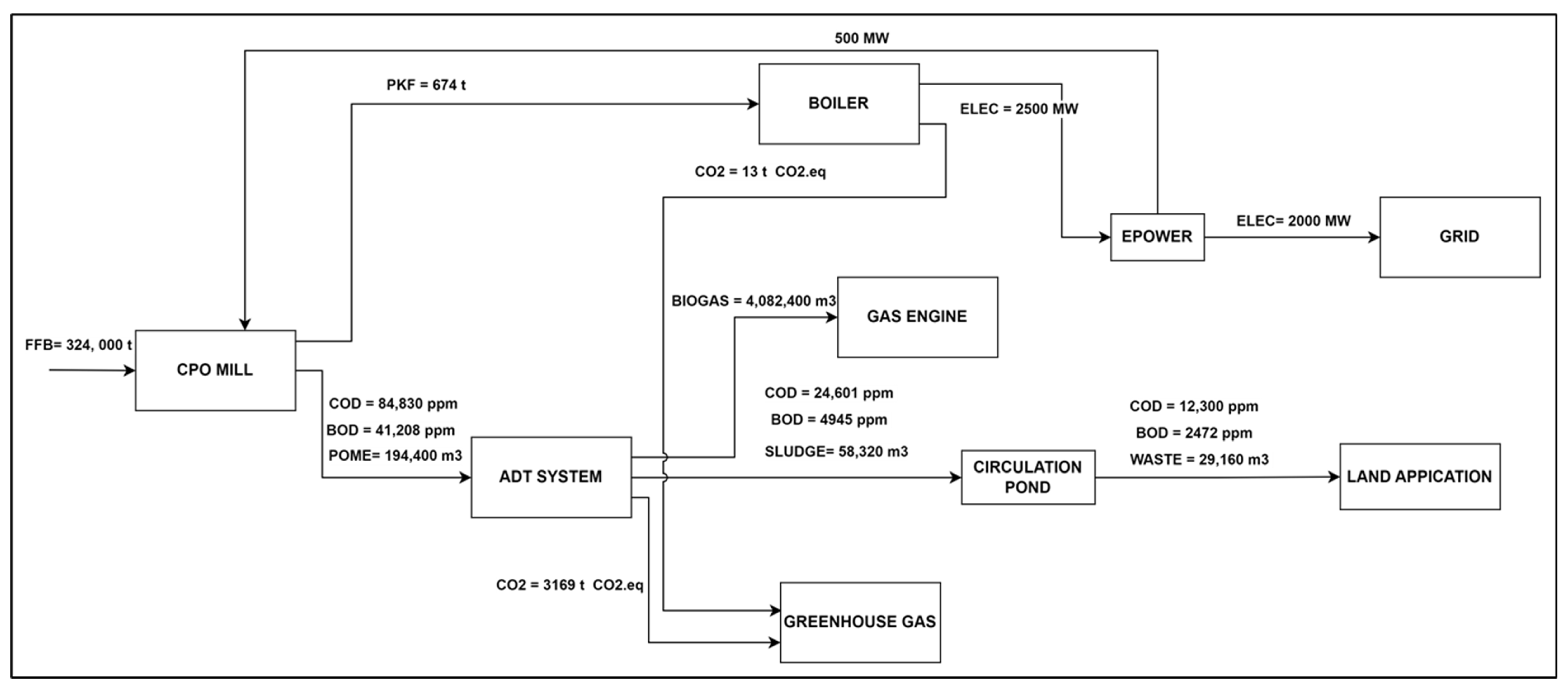
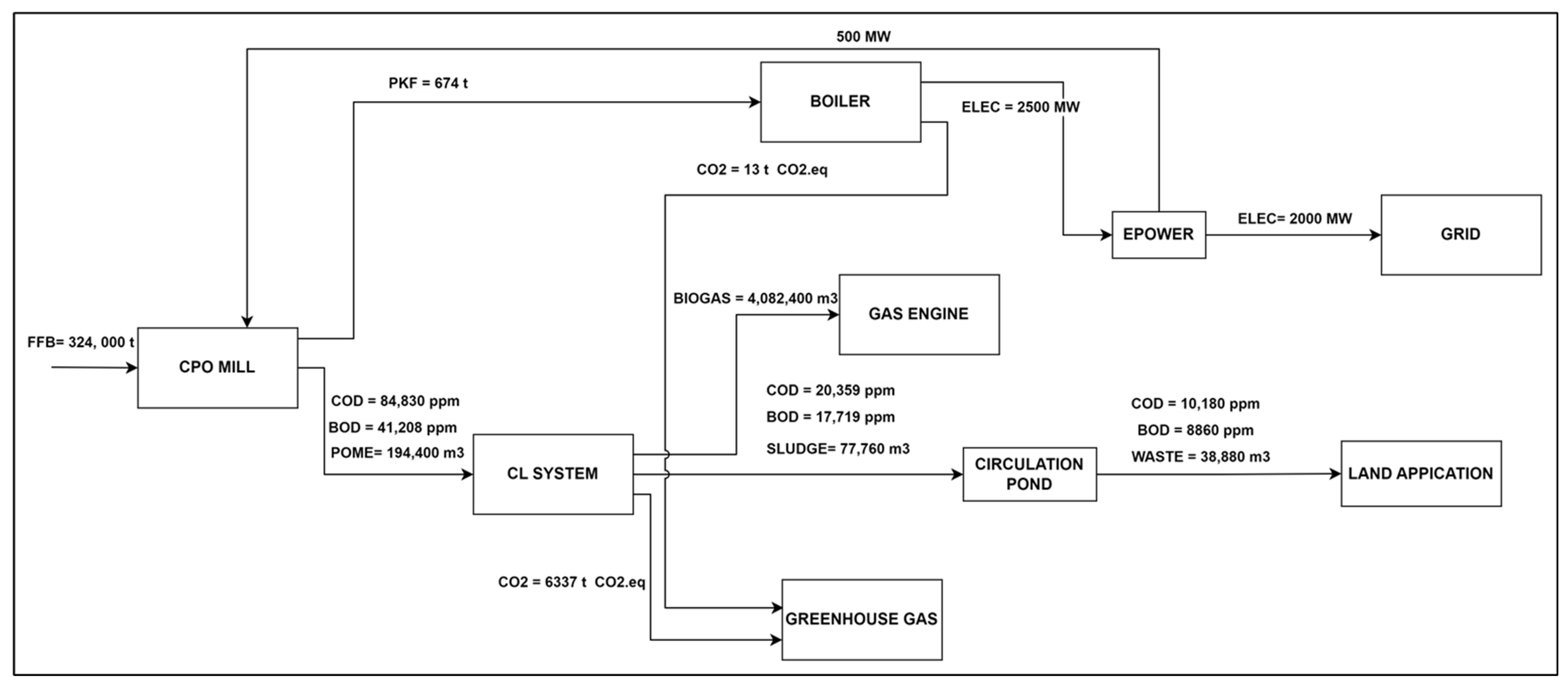
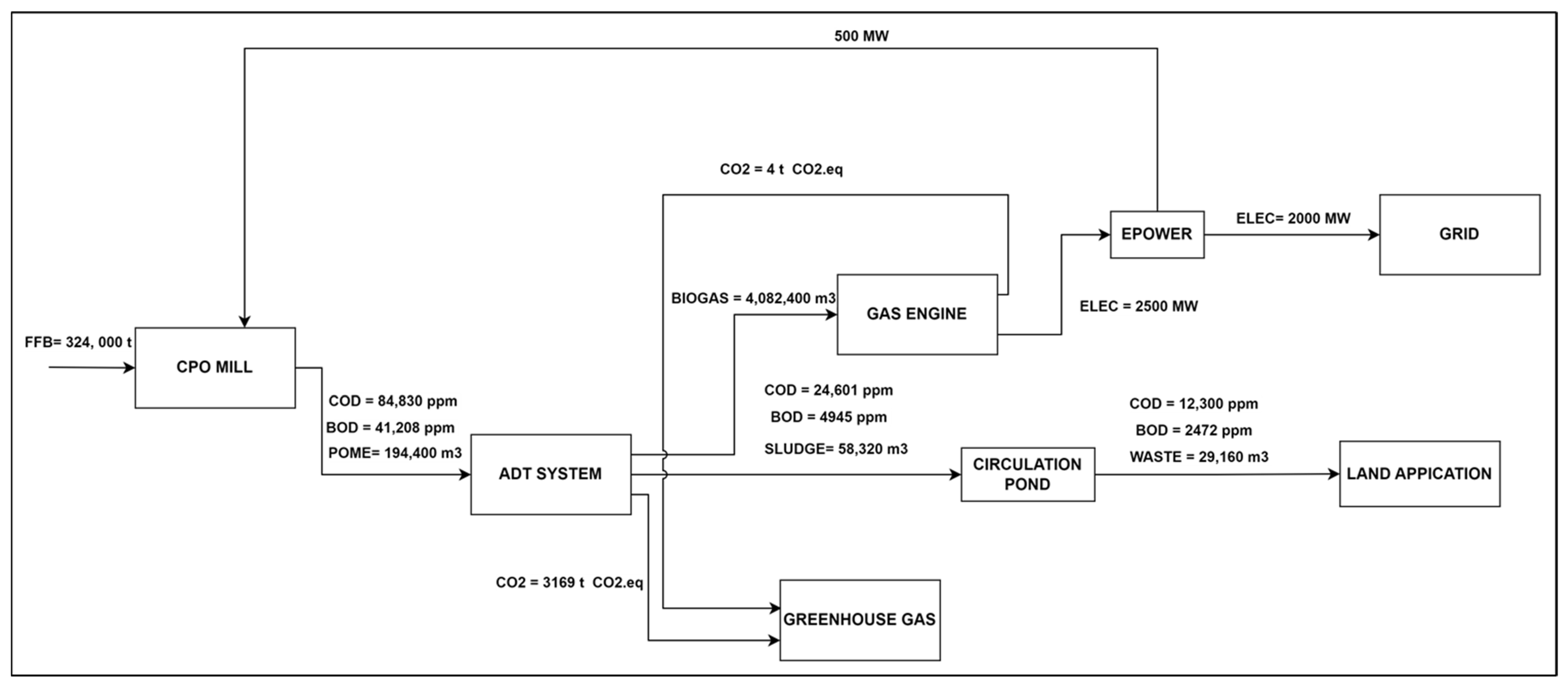
This paper presents a strategic planning model aimed at optimizing the economic and environmental impacts of palm oil mill effluent (POME) treatment systems. The model determines the optimal selection of POME treatment systems to minimize the environmental impact, specifically focusing on three systems: an anaerobic digester tank system (ADT), a covered lagoon system (CL) with biogas capture, and an open pond system (OP). The model incorporates constraints related to fresh fruit bunch (FFB) production, POME generation, the biological oxygen demand (BOD), the chemical oxygen demand (COD), and carbon dioxide (CO2) emissions. The optimization framework, formulated as a mixed-integer linear programming (MILP) model, is solved using the GAMS 40.1.0 software. Integer decision variables are used to represent the choice of POME treatment system that minimizes the environmental impact. The study specifically considers the ADT, CL, and OP systems, with the results indicating that the ADT system is the most effective in reducing the BOD, COD, and CO2-equivalent emissions, thereby highlighting its environmental benefits. The model selects the ADT treatment system, which exhibits the lowest COD, BOD, and CO2e emissions. Specifically, the COD registered an 85% reduction, from 84,830 mg/L to 12,725 mg/L. The BOD level was reduced by 88%, resulting in a BOD level of 41,208 mg/L to 4945 mg/L. The minimum CO2e emissions that could be achieved was about 3173 t CO2e per annum. This model provides a valuable tool for governmental agencies and policymakers to guide the private sector in developing environmentally sustainable POME treatment strategies.
Keywords: palm oil mill effluent; optimization modeling; mixed-integer linear programming; carbon dioxide emission palm oil mill effluent; optimization modeling; mixed-integer linear programming; carbon dioxide emission