Article

From Viability to Resilience: Technical–Economic Insights into Palm Oil Production Using a FP2O Approach


by
Sofía García-Maza
1,
Segundo Rojas-Flores
2 and
Ángel Darío González-Delgado
1,*
1
Nanomaterials and Computer-Aided Process Engineering Research Group (NIPAC), Chemical Engineering Department, Universidad de Cartagena, Cartagena 130014, Colombia
2
Institutos y Centros de Investigación, Universidad Cesar Vallejo, Trujillo 13001, Peru
*
Author to whom correspondence should be addressed.
Processes 2025, 13(12), 4056; https://doi.org/10.3390/pr13124056
Submission received: 2 October 2025 / Revised: 12 November 2025 / Accepted: 20 November 2025 / Published: 15 December 2025

Abstract

This work presents an assessment focused on technical, economic, and resilience-related aspects applied to a crude palm oil production process using the FP2O methodology, considering a capacity of 30 tons of fresh fruit bunches (FFB) per hour and an annual production of 54,056 tons of oil per year. Operating parameters, capital and input costs, as well as the total investment, which amounts to approximately US$43 million, distributed between fixed capital, working capital, and start-up costs, were established. The analysis identified annual operating costs of US$24.7 million, with a majority share of raw materials. Economic and financial indicators showed positive values, higher than previous studies, highlighting a gross profit of over US$23 million, an after-tax profitability of US$13.7 MM, and an internal rate of return of 25.29%, which demonstrates the economic viability of the process. A simple payback period of 1.62 years and a discounted payback period of 4.88 years were determined, in addition to a positive net present value of $58.74 million, confirming the project’s profitability over a 15-year horizon. Using the FP2O methodology, the technical and economic resilience of the process to variations in product price, raw material costs, processing capacity, and normalized operating costs was evaluated. The results showed sensitivity to reductions in the oil sales price, while also demonstrating high resilience to increases in palm bunch costs and decreases in processing capacity. Furthermore, the break-even analysis revealed that the plant can operate 36.59% below its maximum capacity and maintain positive margins, requiring a minimum of 87,825 tons of raw material per year and a sales price of $482.35 per ton to avoid losses. This research highlights the applicability of the FP2O methodology as a strategic tool for scaling up crude palm oil production processes, guiding investment decisions, and supporting policies that promote more resilient and sustainable agro-industrial systems.

1. Introduction

Crude palm oil (CPO) is obtained by processing the fleshy mesocarp of oil palm fruits—primarily from Elaeis guineensis—and has become one of the most extensively manufactured and commercially exchanged plant-based oils worldwide [1]. Its extraction process involves harvesting the fresh fruit bunch (FFB), followed by maceration, pressing, and phase separation, and then refining it for food or industrial uses [2]. Originally native to tropical Africa, the oil palm has been successfully imported to regions of Southeast Asia, Latin America, and some tropical areas of Africa, where it currently accounts for the majority of global production [3]. Palm oil has multiple applications: in the food sector, it is used as a fat for frying, as an ingredient in margarines, baked goods, cookies, and confectionery [4]. Additionally, it has gained increasing relevance in the energy sector, as a raw material in the production of biodiesel or biofuels [5]. This portfolio of uses has driven sustained global demand over the past few decades, positioning palm oil as a strategic component in the global vegetable oil matrix [3].
In terms of volume, palm oil leads the market: for the 2022–2023 season, global production was estimated at approximately 78.2 million tons of CPO, with Indonesia and Malaysia being the main producing countries, accounting for approximately 82% of the total volume [6]. Other countries such as Colombia, Nigeria, Ecuador, and Thailand also contribute to global supply, albeit with smaller shares [7]. The trend has been an accelerated expansion of cultivated areas and an intensification of yields, although there are still production gaps that limit the full utilization of the potential in many regions [8].
From an economic perspective, the cultivation and processing of oil palms constitute a significant source of income, rural employment, and local development in producing areas. It is estimated that a large portion of the farms are in the hands of small producers, who assume climatic, logistical, and market risks [9]. The palm oil industry has proven to be a driver of growth [10]. In fact, in countries like Indonesia, it represents a considerable percentage of the agro-industrial Gross Domestic Product (GDP) and has contributed to the reduction of rural poverty [11].
In parallel, the industrial process of transforming fresh fruit bunches into crude oil requires significant investments in infrastructure, processing plants, equipment, waste management (petiole biomass, fiber, peel), and energy services [12]. The profitability of the complex depends heavily on operational efficiency, raw material costs (bunches), oil prices on the international market, and energy policies that promote or discourage the use of oil as fuel [13].
In this context, the economic component becomes a determining factor when designing a new process or modernizing an existing one, given that technical, environmental, energy, and safety decisions are intrinsically linked to economic aspects. The ability to predict and quantify financial performance not only influences process configuration and the choice of technology but also determines long-term sustainability, operational flexibility, and competitiveness in an increasingly demanding industrial environment. Therefore, it is essential to evaluate processes through methodologies that explicitly and structurally integrate technical and economic perspectives, allowing for an accurate assessment of performance and sound strategic planning.
In this regard, this paper develops a technical–economic evaluation and a technical–economic resilience analysis using the FP2O (Raw Material–Product–Process–Operation) methodology, originally proposed by Herrera-Rodríguez et al. (2024) for the analysis of suspended PVC production [14]. This tool, whose applicability has been demonstrated in crude palm oil production [15], offers a comprehensive framework for examining the interaction between process variables and economic outcomes, promoting the design of more resilient and competitive processes.
The study addresses both the technical and economic evaluation and the resilience of the crude palm oil extraction process. To this end, 18 technical–economic indicators and three financial indicators were analyzed to diagnose the current commercial situation of the process and identify areas for potential improvement. A technical and economic resilience analysis was also conducted using FP2O, which includes the development of comparative graphs of technical and financial indicators against key variables such as processing capacity, selling prices of the final products, feedstock expenses, normalized variable operating costs, and the determination of the break-even point.
The FP2O method applied in this work was designed as a fast, transparent, and low-data-requirement techno-economic diagnostic tool aimed at evaluating the operational, economic, and financial resilience of industrial processes in their early stages. These properties allow for screening and prioritization of alternatives with a significantly lower computational and data collection cost than probabilistic or machine learning methods. However, probabilistic approaches (e.g., Monte Carlo simulation) and agent-based/AI techniques offer added value in different contexts: Monte Carlo explicitly quantifies output uncertainty (confidence bands for NPV, IRR, PBP) [16], while AI agents or data-driven models can capture complex nonlinear relationships when sufficient historical information is available [17]. Despite this, the selected deterministic methodology maintains clear advantages over these alternative probabilistic approaches, such as speed of diagnosis, requiring a limited set of variables and simulations; analytical transparency, since the interactions between technical and economic factors are explicit and traceable; low computational requirements, suitable for exploratory or pre-feasibility studies; and ease of integration with established process simulation tools.
This approach clearly represents the process’s sensitivity to economic and operational changes. By combining technical and economic assessment with resilience analysis, the FP2O methodology makes it possible to identify and quantify in detail the interactions between operational, productive, and financial dimensions, facilitating the early detection of vulnerabilities and optimization opportunities in complex industrial systems. The uniqueness of this work lies in the application, for the first time, of this robust methodology to a crude palm oil production plant. The main benefit of using this innovative methodology is that it is a robust approach that allows for the simultaneous study of the sensitivity and resilience of the CPO production process to changes in various parameters (product price, raw material costs, processing capacity, and operating costs), identifying their influence on diverse technical, economic, and financial indicators. In this way, rapid preliminary assumptions can be established regarding the profitability of the process in the face of sudden changes in operations or the market. This contributes to expanding and updating the existing literature, filling a gap in the technical–economic and resilience studies of this type of production process.

2. Materials and Methods

A technical–economic evaluation and resilience analysis was conducted using the FP2O approach, with a processing capacity of 30 tons of fresh fruit bunches (FFB) per hour (240,000 tons/year with 8000 h per year) [18]. The cost of fresh fruit bunches (FFB) is US$50 per ton [19], while the price of crude oil is US$900 per ton [20], for a production of 54,056 tons of crude palm oil per year. The estimated useful life of the plant is 15 years from start-up, with a two-year construction period, and a salvage value equivalent to 10% of the depreciable fixed capital investment (DPFCI) at the end of the period. During the first year, the plant operates at half of its maximum capacity; in the second year, at 70%; and at full capacity from the third year onwards. The process is digitally controlled and uses a straight-line depreciation method for 15 years after implementation.

2.1. Process Description

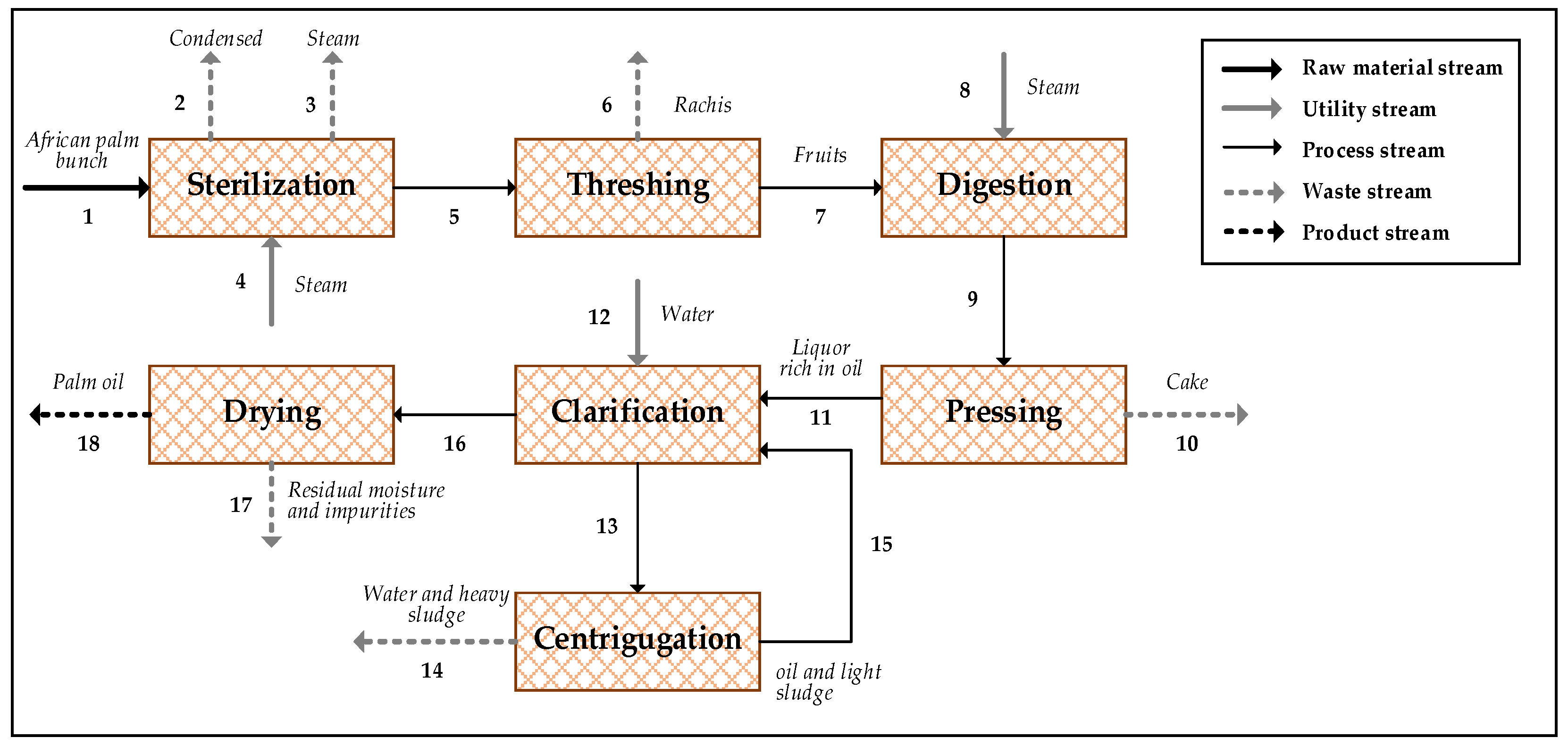
Figure 1 shows a block diagram of the main stages of the crude palm oil extraction process. The process begins with the transportation of African palm (Elaeis guineensis) bunches (stream 1) from a hopper to autoclaves, which are closed horizontal cylinders. This transfer is carried out by wagons. In these units, the bunches undergo a sterilization treatment using saturated steam (stream 4), generated from a gas-fired boiler. This step aims to halt the activity of the lipase enzyme on free fatty acids while promoting stalk hydrolysis to soften the fruit tissues. The outcome is a sterilized bunch (stream 5), together with the associated steam and condensate flows (streams 2 and 3) [21].
Using natural gas as fuel in the boiler is a conventional option that simplifies operation, but it has less favorable environmental and economic implications compared to biomass (biofuels like biodiesel [22]) or biogas-based alternatives. Replacing the gas with process byproducts—such as fiber, husks, or biogas obtained from the effluent (POME, Palm Oil Mill Effluent)—would significantly reduce greenhouse gas emissions, especially fossil CO2 and methane [23], by valorizing byproducts that would otherwise be discarded. From an economic standpoint, the internal energy utilization of these byproducts could significantly decrease fuel operating costs and, in some cases, generate additional income from the sale of surplus energy or carbon credits. However, implementing cogeneration or anaerobic digestion systems requires high initial investments and more complex technical management, which can affect cash flow in the project’s early years.
Subsequently, the fruits (stream 7) are separated from the stem (stream 6) by a rotating drum. The nuts are then transported via a conveyor belt to the digestion stage. During this phase, heat is applied to facilitate the release of oil during pressing, and the separation of the pulp from the nuts is promoted through steam-assisted maceration (stream 8). The digested nuts (stream 9) are sent to a horizontal, cylindrical, perforated press, where an oil-rich liquor is extracted (stream 11). This extraction is achieved through the mechanical action of two reverse-moving augers, rotating in opposite directions. The press cake (stream 10) is evacuated through the tops of the augers [18].
Water is subsequently introduced into the liquor (stream 12) to help dilute it, optimizing the oil separation and purification process. In the static clarification phase (decantation), which recovers up to 90% of the oil, it is extracted by overflow and pumped (stream 16) to the drying stage. The remaining 10% of the oil is recovered in the dynamic clarification stage, which uses centrifugation. In this operation, the heavy fraction from decantation (stream 13) enters the system, where the water and heavy sludge are expelled through nozzles (stream 14). In contrast, the oil, along with the lighter sludge, is concentrated in the central shaft and extracted through a collection tube. This mixture is recirculated to the static clarification stage along with the original liquor (stream 15). Finally, the extracted oil undergoes a vacuum drying process (stream 17) to remove moisture and impurities. Given the high temperature of the oil, the vacuum reduces the pressure and promotes evaporation of the remaining water. The final product, already dry, is pumped to its corresponding storage system (stream 18) [24].
The main equipment in a crude palm oil (CPO) extraction process for a recommended capacity of 30 t of fresh fruit bunches (FFB) per hour includes sterilizers with a batch sterilization cycle of 60–90 min and a continuous configuration or 6–10 cages of 3–5 t each. A thresher with a capacity exceeding 30 t/h (33–36 t/h) and designed for continuous handling and feeding from the sterilizer. A digester with a volume of 15–20 t in a simultaneous process to process destemmed fruit with a residence time of 15–30 min. A screw press/oil press with a combined capacity exceeding 30 t/h and 2–4 presses in parallel (8–16 t/h each) for ease of maintenance. A decanter centrifuge to handle the press flow with an approximate capacity of 30–40 m3/h. Typically, one to two decanters are installed in parallel. A continuous clarification tank is required to treat approximately 6.6 t/h of CPO and recycled streams, and decanter tanks and centrifuges are sized for oil flow rates greater than 8 m3/h. A dryer or conditioning chamber with a capacity greater than 1.5–2 t/h of wet product is also needed. A steam boiler with an approximate steam capacity of 7.5 t/h is required for the sterilizer. Finally, a solids handling system is included, comprising conveyors, screws, hoppers, and crushers [24].

2.2. Considerations of Technical–Economic Evaluation for Crude Palm Oil Production Process

Any technical–economic evaluation is influenced by various internal and external technical and economic factors. Among these, the location of the plant plays an important role, as it affects aspects such as wages, raw material and industrial services costs, tax burdens, interest rates, and the fluctuation in the time value of money. Also relevant is the size of the plant, which impacts the selling price, production capacity, and the flow of raw materials and products. The type of process is another key factor; new or unproven processes often have different economies of scale and risks compared to established processes or modernizations and expansions of existing plants. In addition, factors such as the type of fluids handled, salvage value, and the time required to construct the plant, among others, play a role [25]. Table 1 provides a detailed summary of the techno-economic considerations evaluated in this study.
In this particular study, the African oil palm fruit bunch is considered the main raw material, with the press cake, seeds, and husks considered as waste. This waste can be used in other processes such as the production of bioethanol, palm kernel oil, or biochar, respectively. However, this is not the purpose of the present research, which focuses solely on the production of crude palm oil as a single-product physical process. Therefore, the economic modeling only incorporates sales and costs directly attributable to the crude oil. Including these side streams would have required broadening the scope, adding process units, additional investment and operating costs, markets and prices for co-products, and their seasonality. For illustrative purposes, if the valued streams contributed an additional net flow equivalent to 5–20% of current oil revenues, the NPV and ROI could increase by a similar amount. However, these values are merely numerical examples to illustrate sensitivity; the actual effect depends heavily on recoverable yields, market prices, conditioning costs, logistics, and other factors.

2.3. Technical–Economic Evaluation for Crude Palm Oil Production Process

A techno-economic analysis was carried out to determine the main variables affecting the crude palm oil extraction process, highlighting that it is a single-product process. The analysis identified the key operating parameters—such as temperature, pressure, and the mass composition of the streams—and used them to choose the equipment required for building the process model in Aspen Plus® V14.0 simulator. In developing the design for a crude palm oil extraction facility, it was essential to compile data on equipment pricing, expected income, workforce requirements, taxation, and land purchase, along with using the appropriate calculations to underpin the economic assessment. The total capital investment (TCI) was calculated using Equation (1), where the Fixed Capital Investment (FCI) covers expenses related to equipment, construction, site preparation, control systems, and infrastructure. Working Capital Investment (WCI) and Start-Up Costs (SUC)—which account for services such as legal support, marketing, and staff training and are generally estimated as 10% of FCI—were also considered [25].
Costs directly associated with processing capacity—such as buildings, piping, and purchased equipment (FOB)—are estimated through Equation (2). In some cases, equipment prices are obtained from earlier studies; when this occurs, the values must be updated to reflect inflation and other economic variations using cost indexes. The Marshall and Swift (M&S) Equipment Cost Index is typically used for this purpose, with adjustments carried out through Equation (3) [26]. The annualized operating costs (AOC) of an industrial process, calculated with Equation (4), consist of a variable component (VAOC)—which covers raw materials and inputs (RM) as well as utilities (U), determined by Equation (5)—and a fixed component (FAOC), which includes Direct Production Costs (DPC), Overhead (POH), Fixed Charges (FCH), and General Expenses (GE), obtained through Equation (6). Annualized fixed costs (AFC) are derived from Equation (7). Once the AOC and AFC have been calculated, the Total Fixed Costs (TFC) can be calculated using Equation (8). Finally, total annual costs (TAC) are calculated using Equation (9), combining both AFC and AOC [27].
T C I = F C I + W C I + S U C
F O B B = F O B A C a p a c i t y B C a p a c i t y A 0.6
F O B t 2 = F O B t 1 E C I t 2 E C I t 1
A O C = V A O C + F A O C
V A O C = R M + U
F A O C = D P C + F C H + P O H + G E
A F C = F C I 0 F C I s N
T F C = A F C + F A O C
T A C = A F C + A O C
where F O B B and F O B A are the FOB price for B capacity and the FOB price for A capacity, respectively. F O B t 2 and F O B t 1 are the FOB price at time 2 and the FOB price at time 1, respectively. E C I t 2 and E C I t 1 are the Equipment Cost Index at time 2 and the Equipment Cost Index at time 1, respectively. F C I 0 , F C I s , and N are the initial value of the FCI, the salvage value of the FCI, and the recovery period (years), respectively [25].
On the other hand, if the variable component of operating costs is expressed per unit of raw material, they are known as Normalized Variable Operating Costs (NVAOC), and are determined using Equation (10), which consists of dividing the Annualized Variable Operating Costs (VAOC) by the annual flow of raw material ( m R M ) [27].
N V A O C = V A O C m R M
There are various indicators for evaluating the profitability of an industrial process, which can be classified into two categories: technical–economic indicators and financial indicators. Technical–economic indicators are designed to measure the overall performance and profitability of the process, considering both internal aspects of the operation and external factors, such as efficiency in value generation, resource utilization, and return on investment. These indicators seek to show the final value generated from available resources.
Among the economic indicators, some consider the change in the value of money over time, while others do not. A key indicator is gross profit (GP), which reflects the process’s earnings ( m p C p v ) before taxes and depreciation, calculated using Equation (11). This indicator can also be calculated by including asset depreciation (DGP) using Equation (12). From an economic perspective, a higher value for this indicator indicates a more profitable process. The net profitability after tax (PAT) can also be determined, offering a clearer indication of the process’s real earnings. This is determined using Equation (13), where i t r represents the tax rate established by the tax authorities for the location of the plant. Like GP, a higher PAT value indicates a more economically attractive process [27].
G P = m p C p v A O C
D G P = m p C p v T A C
P A T = D G P 1 i t r
where C p v and m p are the selling price of the product (USD/year) and the mass flow of the product (t/year), respectively.
It is also possible to obtain indicators called Economic Potentials (EP), which represent the ideal capacity of an industrial process to generate revenue. The analysis of these potentials focuses primarily on the gross potential of the process. The value of EP depends on the calculation method used (Equations (14)–(16)). Being an ideal potential, they may or may not consider capital investments or operating expenses [25].
E P 1 = m p C p v j m j C j R M
E P 2 = m p C p v j m j C j R M U
E P 3 = m p C p v A O C
where C j R M and m j are the cost of the raw material (USD/year) and the mass flow of the raw material (t/year), respectively.
The cumulative cash flow (CCF) represents the relationship between the process’s generated earnings and the capital invested. It can be determined using Equation (17). A process is considered economically viable when the CCF is less than one year. On the other hand, the payback period (PBP) indicates the time it takes to recover the investment in depreciable fixed assets: the shorter this period, the more attractive the project. The PBP is determined using Equation (18), although it should be noted that this indicator does not take into account the variation in the value of money over time. To include this factor, the discounted payback period (DPBP) is used, which is calculated using a cumulative function between two periods, according to Equations (19) and (20) [27].
C C F = m p C p v A O C T C I
P B P = F C I P A T
D P B P = y e a r b e f o r e d i s c o u n t e d n o n F C I e x p e n s e s   + d i s c o u n t e d n o n F C I e x p e n s e s C u m m u l a t i v e N P V b e f o r e d i s c o u n t e d n o n F C I e x p e n s e s C u m m u l a t i v e N P V a f t e r d i s c o u n t e d n o n F C I e x p e n s e s C u m m u l a t i v e N P V b e f o r e d i s c o u n t e d n o n F C I e x p e n s e s
D i s c o u n t e d n o n F C I e x p e n s e s = L a n d c o s t W C I ( 1 + i ) n f o r W C I
Finally, the Return on Investment (% ROI) measures the profitability of an investment with respect to the capital invested and is used to compare the profitability of different projects or technologies, decide whether a process justifies the capital investment, and evaluate the attractiveness of a project compared to other financial alternatives. It is calculated using Equation (21), which relates profit after tax (PAT) to total capital investment (TCI). As with the PBP, it should be noted that the % ROI does not consider the change in the value of money over time [25].
% R O I = P A T T C I × 100 %
In addition to the Discounted Payback Period (DPBP), other technical and economic indicators consider the variation in the value of money over time. One commonly used metric is the Net Present Value (NPV), which reflects the total earnings generated throughout the plant’s operating life, converted into their equivalent value at the present time. This is calculated using Equation (22), where i is the inflation or interest rate that reflects the variation in the value of money over time, and A C F n corresponds to the net profit for year n. Another important indicator is the Internal Rate of Return (IRR or DCF-ROI), which corresponds to the interest rate that makes the NPV zero. This value represents the investment’s yield after accounting for the time value of money, and its determination is shown in Equation (23). A higher IRR value indicates a more profitable project. Finally, the Annual Cost/Return Ratio (ACR) distributes the Net Present Value evenly over a given period; if the ACR is negative, it is interpreted as an annual cost, and if it is positive, it is interpreted as an annual return. The ACR is determined using Equation (24).
N P V = n A C F n 1 + i n
I R R = T = 0 n A C F n 1 + i n = 0
A C R = N P V i 1 + i n 1 + i n 1
Financial indicators, on the other hand, focus on evaluating the operating performance of a process, especially in terms of interest, profitability before taxes, or amortization. These indicators facilitate understanding of the financial efficiency of the process and allow for comparison with similar processes, without including factors external to the core business. For example, they are useful for comparing the operation of a CPO production plant in Colombia with one in Indonesia [28] or Malaysia [29], as they eliminate differences in tax burdens between countries.
Operating profit, known as earnings before interest and taxes (EBIT), reflects the profitability generated by the industrial process. It is obtained by subtracting all operating expenses, which include cost of goods sold, overhead, and depreciation, from total revenue. EBIT excludes financial costs and taxes, and a higher value indicates better performance. It is calculated according to Equation (25). Earnings before taxes (EBT) represents the profit earned by a process before applying the tax rate applicable to the region where it operates. It is determined by subtracting all operating expenses—including cost of goods sold, overhead, and depreciation—as well as interest expenses from total revenue. EBT excludes all taxes, and a higher value indicates a more profitable process. If EBIT has been previously calculated, its value is obtained using Equation (26). EBITDA (earnings before interest, taxes, depreciation, and amortization) serves as an indicator of the cash generated through a firm’s core operations. It is obtained by subtracting all operating expenses, including cost of goods sold, overhead, and depreciation and amortization, from total revenue. Because it excludes interest expenses and taxes, EBITDA is especially useful for comparing profitability between companies with different levels of debt or tax burdens. It is calculated using Equation (27) [30].
E B I T = m p C p v A O C
E B T = E B I T i n t e r e s t / r e n t
E B I T D A = E B I T + D
where D is the depreciation.
The break-even point (BEP) is a fundamental parameter in the technical and economic evaluation of an industrial process. It is defined as the conditions under which annual production costs equal the annual revenue from product sales. This point is key for establishing the minimum price at which the product must be sold or for identifying the minimum production capacity required. The BEP is calculated using Equation (28) [27].
B E P = m p C p v T A C = 0
To obtain certain indicators, it is preferable to base calculations on the raw material processing capacity rather than the quantity of final product obtained. To do this, it is useful to establish a relationship between the product flow generated and the raw material flow used. Thus, the term θ is introduced. With this term, it is possible to obtain the processing capacity at the break-even point, which determines the minimum raw material mass flow that the plant must process to avoid economic losses and is determined using Equation (29). Additionally, the break-even selling price is the minimum monetary value at which the obtained product must be sold to avoid incurring economic losses by operating at maximum processing capacity. This parameter is calculated using Equation (30) [27].
m R M B E P = A F C + F A O C C p v θ N V A O C ; θ = m R M m p
C p v = A F C + F A O C m m a x + N V A O C × θ
where m R M B E P and m m a x represent the raw material mass flow at the BEP and the maximum allowable raw material mass flow, respectively [25].
Another key parameter in the technical and economic evaluation of a single-product physical process is the on-stream efficiency at the break-even point, which serves as the basis for technical and economic resilience analyses related to raw material costs, finished goods costs, and production capacity (FP2O). This on-stream efficiency can be defined in terms of both time and production capacity, either at the break-even point or at production levels below the maximum. The break-even efficiency, expressed as a function of processing capacity, shows how close the break-even processing capacity is to the plant’s maximum processing capacity. The closer these values are, the closer to maximum capacity the plant must operate to avoid incurring losses. This parameter is calculated using Equation (31) [27].
η O n s t r e a m B E P = m R M B E P m m a x
where η O n s t r e a m B E P is the on-stream efficiency at the break-even point (BEP).
From the previously calculated on-stream efficiency in equilibrium, the equilibrium operating time can be calculated, which determines the minimum time that the plant must operate to avoid economic losses and is determined using Equation (32) [27].
t i m e B E P = η O n s t r e a m B E P × t i m e m a x
where t i m e B E P is the operating time at the break-even point (BEP), and t i m e m a x is the maximum operating time.

2.4. Technical–Economic Resilience via FP2O Methodology for Crude Palm Oil Production Process

Herrera-Rodríguez et al. (2024) proposed a technical–economic resilience approach for chemical processes using the FP2O (Feedstock–Product–Process–Operation) methodology to analyze the impact of variations in specific factors on the behavior of a process. These factors relate to raw materials, products, processes, and operations, considering parameters including selling prices of the products, throughput, feedstock expenses, and operational expenditures. Following this methodology, twelve (12) graphs are created to determine how resilient a facility’s technical–economic indicators to FP2O variations, using the Break-Even Point (BEP) as the reference state [14].
In the case of a single-product process without a chemical reaction, such as the crude palm oil production process, we begin by analyzing its technical–economic resilience with respect to the product’s selling price. To do this, three (3) graphs are constructed comparing this parameter with the on-stream efficiency at the break-even point, calculated using Equation (31), and other indicators, both economic, such as Profitability After Taxes (PAT), calculated using Equation (13), and Gross Depreciable Profit (DGP), calculated using Equation (12), and financial, like Earnings Before Interest, Taxes, Depreciation and Amortization (EBITDA), calculated using Equation (27) [14].
Subsequently, to analyze the technical and economic resilience of the process with respect to raw material costs, four (4) graphs are drawn comparing this parameter with the on-stream efficiency in BEP and different technical and economic indicators such as PAT, DGP, the Internal Rate of Return (IRR), calculated with Equation (23), and the Normalized Variable Operating Costs (NVAOC), calculated with Equation (10), and financial indicators such as EBITDA. Next, to evaluate how the process responds technically and economically to changes in processing capacity, two (2) plots are generated. These figures relate the capacity to annual revenues, the Annualized Operating Costs (AOC), and the Normalized Fixed Capital Investment (NFCI), the latter obtained using Equation (33) [14].
N F C I = F C I m R M
Additionally, to analyze the technical–economic resilience of the process with respect to the NVAOC, two (2) graphs are constructed comparing this parameter with the Return on Investment (ROI), calculated with Equation (21), and the Payback Period (PBP), calculated with Equation (18). Lastly, a plot is generated to illustrate where the BEP lies, based on the formulation given in Equation (28) [14].

3. Results and Discussion

The metrics used in the techno-economic assessment made it possible to obtain outcomes related to the resilience of the crude palm oil production process. These results were compared with those of other crude palm oil extraction facilities.

3.1. Analysis of the Technical–Economic Evaluation of Crude Palm Oil Production Process

Table 2 presents how each parameter contributes to the overall capital investment in the crude palm oil production process. This table presents the results of the technical and economic evaluation, including the required initial investment, costs related to the installation of equipment, instrumentation, piping, electrical grid and services, costs related to land development and required civil works, and contractor fees, legal expenses, and contingencies. Moreover, Table 2 presents the FCI, WCI, SUC, total capital investment (TCI), the salvage value, and the annualized fixed expenses (AFC).
Regional factors can significantly influence technical–economic and financial indicators, as well as the overall resilience of the process. These factors include costs associated with land, site improvements, engineering and supervision, R&D equipment, construction, legal expenses, contractor fees, and contingencies, as shown in Table 2. These localized assumptions provide a more realistic basis for studying this particular case, considering that the generalizability of the results to other regions may vary depending on local market conditions, infrastructure costs, and regulatory frameworks.
From the findings discussed, it becomes clear that, although the investment in equipment (FOB price) is approximately US$3,743,000, direct investment costs reach approximately US$12,600,000, being a little more than triple these, this is due to the high cost of facilities for industrial services that include water, steam, natural gas and electricity, indirect fixed capital investment reaches an approximate value of US$10,000,000, obtaining a fixed capital investment of US$22.6 million, adding the direct fixed investment and indirect fixed investment, adding the start-up costs and working capital, a total capital investment (TCI) of approximately US$43 million is obtained. In order to obtain the requested economic indicators, these costs must be annualized. This is done by subtracting the salvage value from the non-depreciable fixed costs, yielding the corresponding AFC of $1,359,369.40 per year.
Once the operating labor, industrial services, and raw material costs have been calculated, the annualized operating costs (AOC) are calculated. These costs are both variable (VAOC), which depend on the plant’s processing capacity, and fixed (FAOC), which are a function of the costs mentioned above. Table 3 shows the results obtained for the annualized operating cost (AOC) items. At the end of this table, it can be seen that the AOC for this plant amounts to approximately $25 million.
When comparing the results presented in Table 2 and Table 3 with other plants worldwide, it is evident that the CPO production process in the present study requires a higher TCI (USD 42,989,795.22) than a production plant in Malaysia (MYR 150,841,633 or USD 35,803,853.12) with a processing capacity of 60 MT of FFB/h, i.e., 60 million tons of fresh fruit bunches per hour; which may be due to the number of stages and/or equipment implemented in each topology. However, the same plant in Malaysia requires a higher AOC (MYR 325,065,517/year or USD 77,157,730.23/year) than the process studied (USD 24,714,765.91/year); this is due to the large difference in raw material mass flows (FFB), generating additional variable operating costs in the Malaysian plant due to its higher mass flow, compared to the plant in this study, which has a processing capacity of only 30 T of FFB/h [31].
Finally, Table 4 and Table 5 present the results of the technical, economic, and financial indicators calculated for the crude palm oil production process. In this analysis, the project recovered its initial investment in about 1.62 years, and when depreciation was included, the payback time extended to approximately 4.88 years. However, in the study developed by Romero Pérez et al. (2017) for a base case of crude palm oil production and a case of a palm-based biorefinery at a plant in Colombia, a payback period of 1.98 and 1.43, respectively, was obtained. In other words, the present study takes less time to recover the investment than the base case of the 2017 research, but the biorefinery case is more profitable in terms of this indicator. Additionally, given the cash flow (CCF) of 0.56 years−1, i.e., less than 1 year−1, the crude palm oil production process investigated can be considered an economically attractive project; it is even more profitable than the base case (0.57 years−1) and the biorefinery (0.71 years−1) of the 2017 study [15].
With respect to the technical and economic metrics, the GP, DGP, and PAT figures exceeded those of USD 23 million, USD 22 million and USD 13 million, respectively, which is positive given that their values are considerably high compared to the values obtained for the base case of crude palm oil production from a plant in Colombia for the year 2017 (USD 12,276,932.98, USD 11,506,524.13 and USD 6,328,588.27, respectively) and the case of the palm-based biorefinery for this same year and sector (USD 19,571,201.88, USD 18,584,271.25 and USD 11,336,405.46, respectively). On the other hand, the economic potentials 1 (EP1), 2 (EP2), and 3 (EP3) are also significantly higher compared to the 2017 study, both for the base case (USD 21,284,800.00, USD 20,713,600.00, and USD 12,211,924.40, respectively) and the biorefinery (USD 29,877,198.40, USD 29,006,780.92, and USD 19,498,198.76, respectively), exceeding USD 36 million, USD 35 million, and USD 23 million, respectively, in the present study [15].
Regarding the annual cost ratio (ACR), the value is 7.16, and the return on investment (ROI) is 32.03%. The latter result is higher than the return on investment (ROI) of the base case of the 2017 study (29.74%), but lower than the biorefinery case (41.16%) of the same study, indicating that, in proportion to the invested capital, the CPO production process in this study generates higher profits than the base case, but lower than the biorefinery in the comparative study. Furthermore, in this study, an NVAOC value of USD 54.35/t of feedstock was obtained, being higher than the base case of the 2017 study ($25/t), but lower than the biorefinery ($200/t) in this same study; this may be due to the considerations made in the studies, the number of stages, and the industrial services, given that the processing capacity is the same (240,000 t/year) in both the 2017 study and the present study [15].
In addition, the crude palm oil production plant generates a revenue (NPV) of US$58.74 million, a figure lower than the 2017 base case study (US$161.39 million) and the biorefinery case (US$342.00 million). This indicates that, after the 15-year lifespan for all three studies, the process in this research will generate lower profits in comparison [15]. On the other hand, a satisfactory internal rate of return (IRR) of 25.29% is observed, indicating the minimum interest rate for obtaining neither profit nor loss in the crude palm oil production process. Finally, regarding financial indicators, EBT, EBIT, and EBITDA exceeded US$23 million, which is positive, as these are relatively high values.
For the break-even processing capacity (BEP), a value of 87,825.26 t of raw material/year was obtained, representing the raw material mass flow at which total annualized costs equal the annual revenue from product sales. This represents the minimum palm bunch capacity that the plant must process to avoid economic losses. Additionally, a minimum sales price of USD 482.35/t of product was obtained, at which neither profit nor loss is incurred; that is, it is the lowest price for which crude palm oil could be sold in this topology. Furthermore, for on-stream efficiency in the BEP, a value of 36.59% was achieved, indicating that this plant is operating at levels well above its break-even point, and the risk of operating at a loss is low. It is possible to process a smaller amount of raw material than stipulated in its design without incurring economic losses.
The above is beneficial for mitigating decreases in the amount of raw material processed due to unforeseen events in the acquisition of palm bunches. Examining this indicator, it can be observed that the plant can process one-fifth of the required raw material and still generate a profit. Finally, a break-even operating time of 2927.51 h per year was obtained, with respect to the 8000 h/year actually worked, representing the operating time in which the annual production costs are equal to the annual income from the sale of the product, which is why this is the minimum operating time at which the plant must operate in order not to incur economic losses.
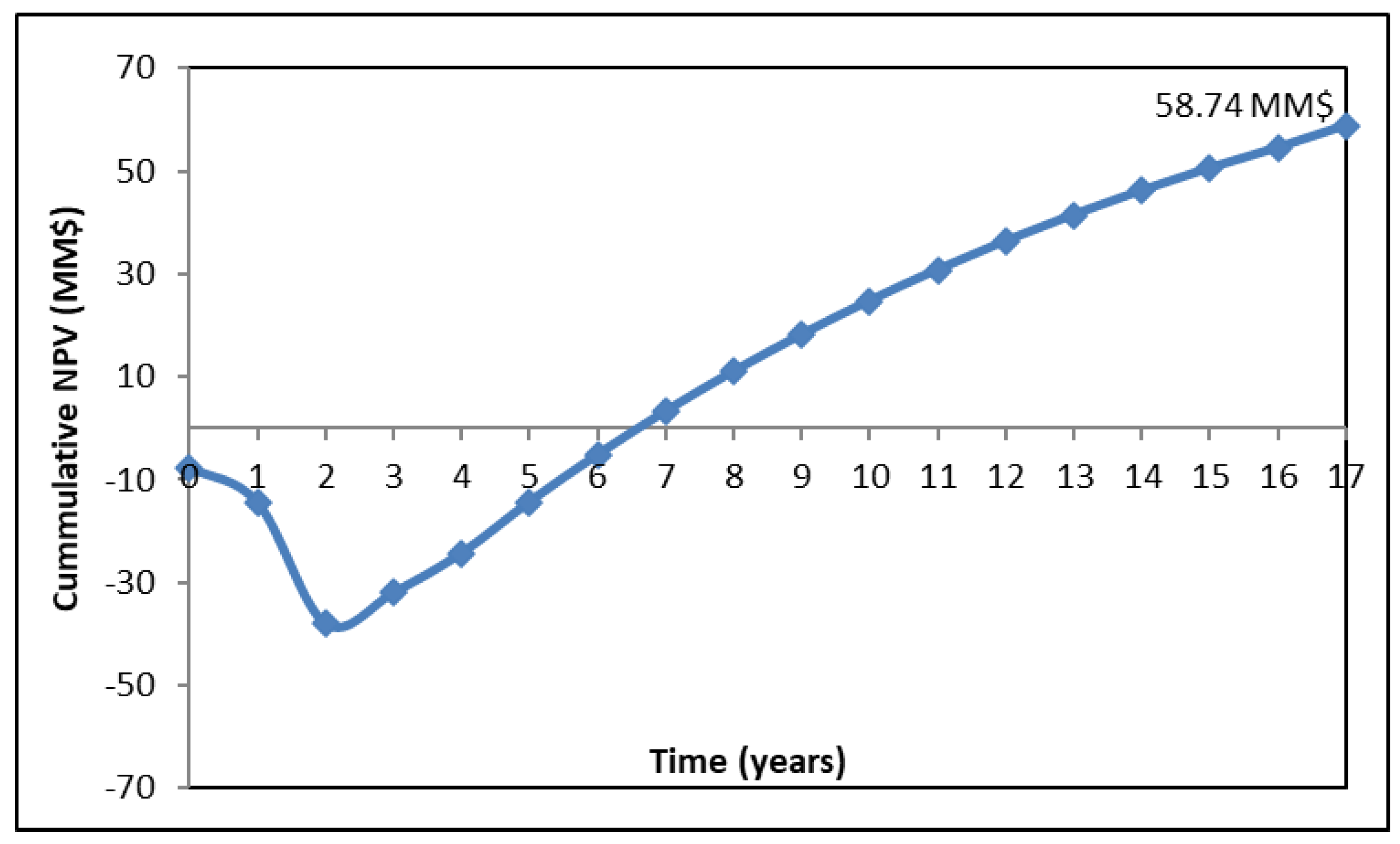
Figure 2 represents the net present value (NPV) of the CPO production process. In this figure, it can be noted that the net present value at the end of 15 years is positive, and that it coincides with the value obtained in the economic evaluation ($58.74 MM); however, the NPV begins to be positive after year 7, that is, almost two thirds of the total operating time of the plant, which can be risky due to operational unforeseen events of different kinds that may arise during those first years, or due to external factors such as natural disasters or pandemics, which could affect the recovery of the investment made.

3.2. Analysis of Technical–Economic Resilience Through the FP2O Methodology of the Crude Palm Oil Production Process

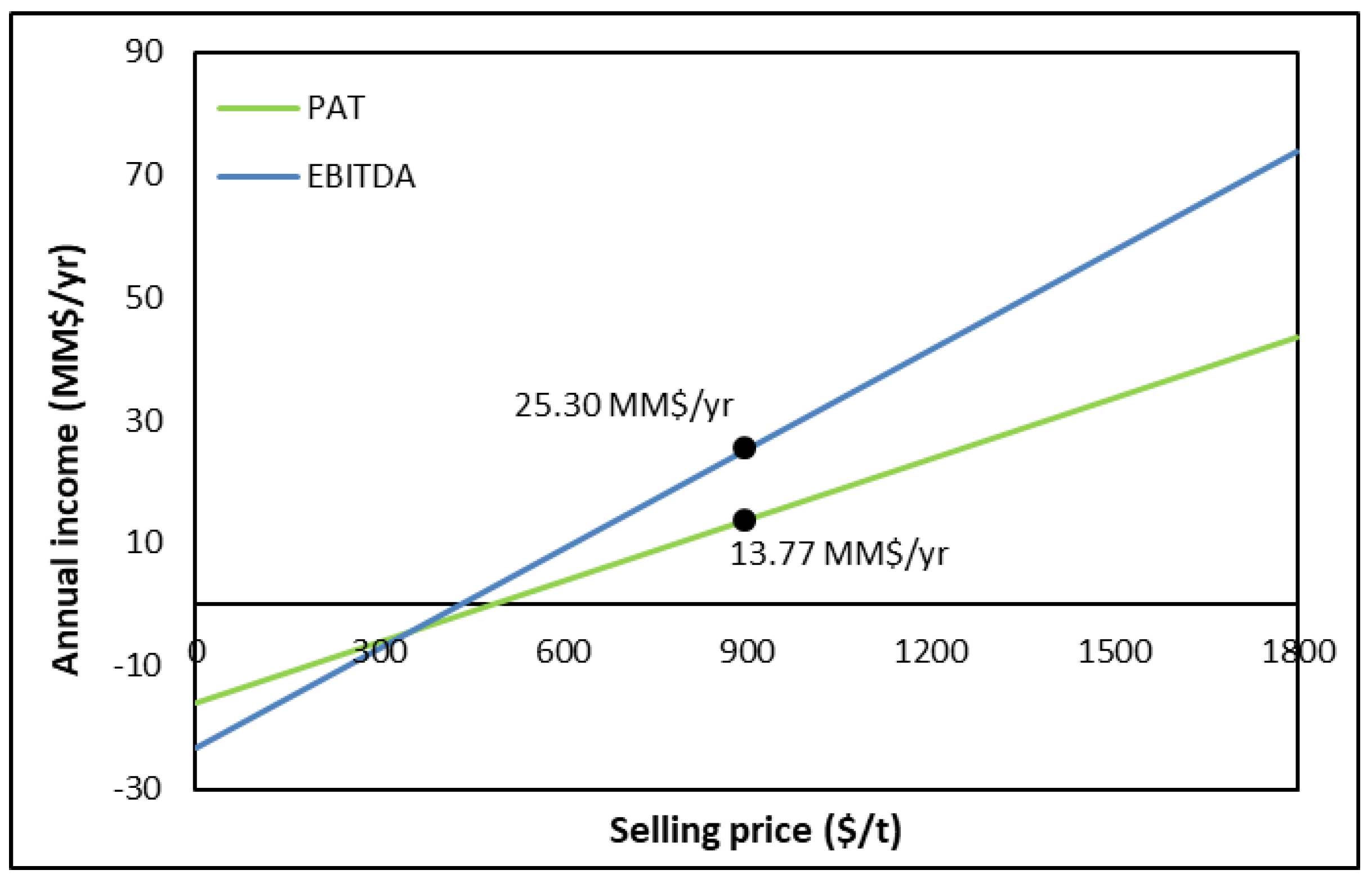
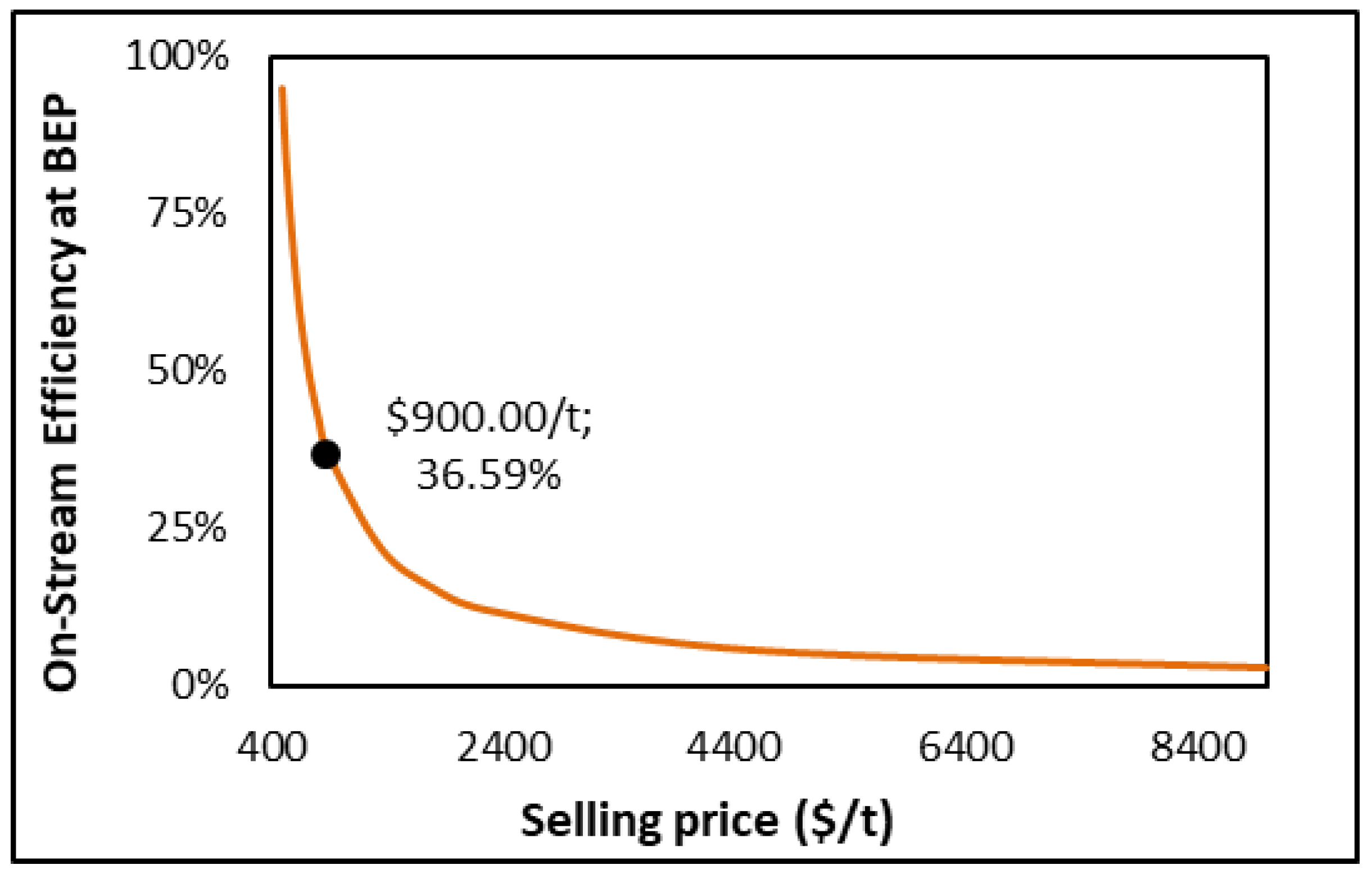
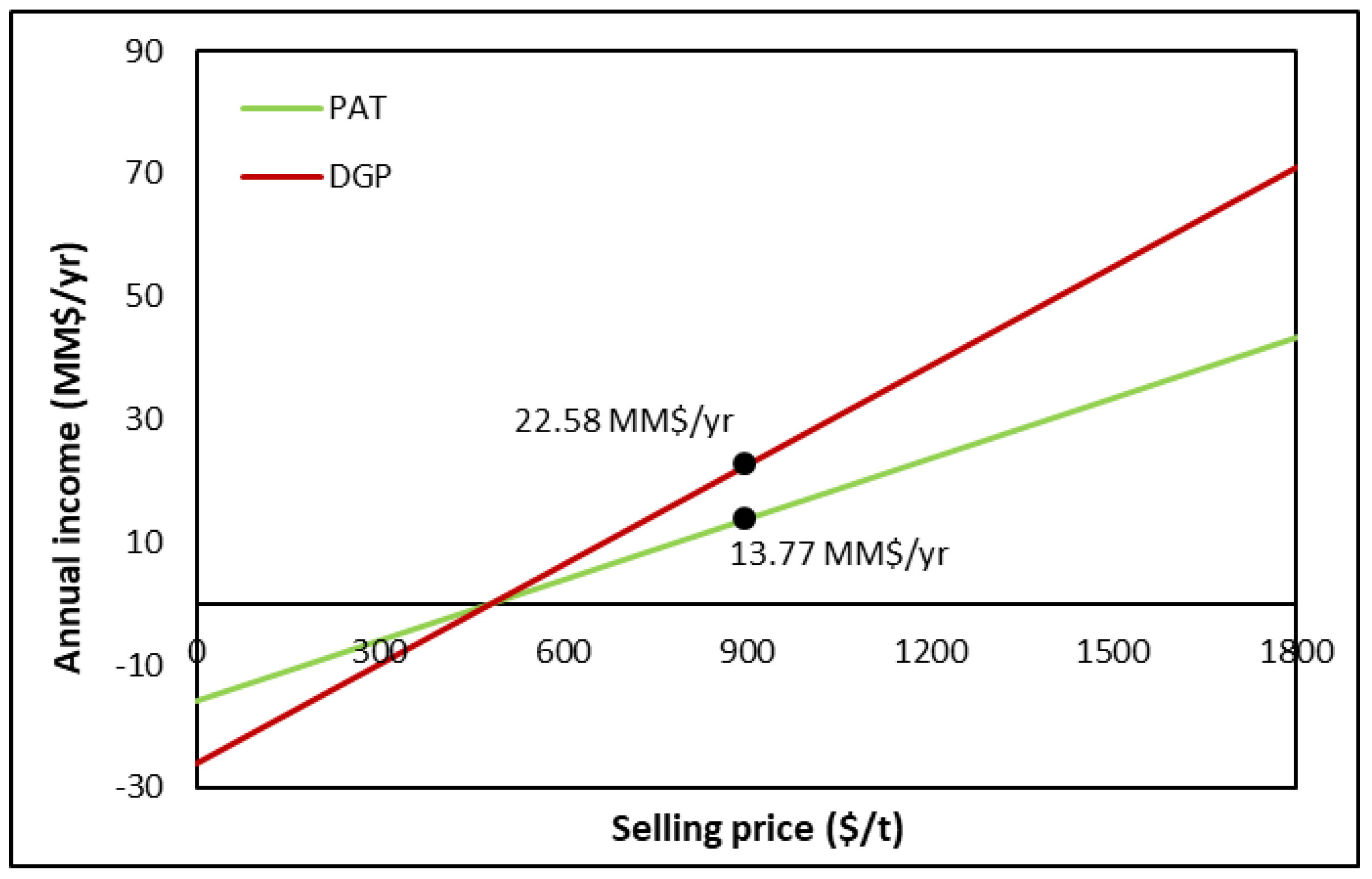
Figure 3, Figure 4 and Figure 5 illustrate how the crude palm oil production process responds, both technically and economically, to variations in the product’s selling price. Figure 3 shows the connection between the selling price, EBITDA, and PAT. Figure 4 presents a comparison between the selling price, DGP, and PAT. Lastly, Figure 5 links the product’s selling price with the on-stream BEP efficiency.
Figure 3 illustrates that EBITDA reacts more strongly to variations in product price than PAT, which is reflected in the steeper trend of the EBITDA line. The point where both curves meet marks a threshold for the selling price and the resulting annual profit, indicating that values below roughly $450/t lead to negative returns. This suggests that the process currently operates in a favorable region: at a selling price of $900/t, both EBITDA ($25.30 million per year) and PAT ($13.77 million per year) remain positive. Additionally, comparing the critical selling price with the actual selling price highlights how vulnerable the process is to price reductions. The greater the distance between the current price and the intersection point, the higher the resilience of the process. In this scenario, the two prices are relatively close, showing that the process is quite sensitive to declines in product value.
Figure 4 illustrates that the DGP of the crude palm oil production process reacts more strongly to variations in product price than the PAT, which is evidenced by its sharper slope. The point where the two curves meet marks a threshold for both selling price and annual profitability, below which losses occur—around $450/t of product. This suggests that the system currently operates within a favorable region, since at a selling price of $900/t the DGP reaches $22.58 MM/yr and the PAT $13.77 MM/yr.
Additionally, contrasting the price at this threshold with the actual market price highlights how vulnerable the process is to reductions in product value. The greater the distance between the operating point and the intersection of the lines, the higher the process resilience. In this situation, the proximity of both values indicates that the process remains quite sensitive to a drop in product prices.
The behavior in Figure 5 can be divided into three zones. In the first one, corresponding to product prices between $400/t and $600/t, the on-stream BEP efficiency responds strongly to even slight variations in the selling price. This means the process lacks resilience in this interval, since a minor drop in product price leads to a marked rise in the on-stream BEP efficiency. In the plot, this is reflected by the curve approaching the y-axis in an asymptotic manner.
The second zone, spanning from about $600/t to $4000/t of product, represents a transitional interval and corresponds to the current operating range of the crude palm oil production process. In this region, an on-stream BEP efficiency of 36.59% is obtained at a market price of $900/t, and a reasonable profit margin can be maintained. Since this zone is not as highly sensitive as the first one, the process can operate with more flexibility under fluctuations in selling price. In contrast, the third zone—associated with combined selling prices exceeding $4000/t—shows that substantial increases in product price produce little to no change in BEP on-stream efficiency, which no longer behaves as a dependent variable. Consequently, within this high-price range, even considerable upward or downward shifts in the selling price do not meaningfully affect the BEP on-stream efficiency.
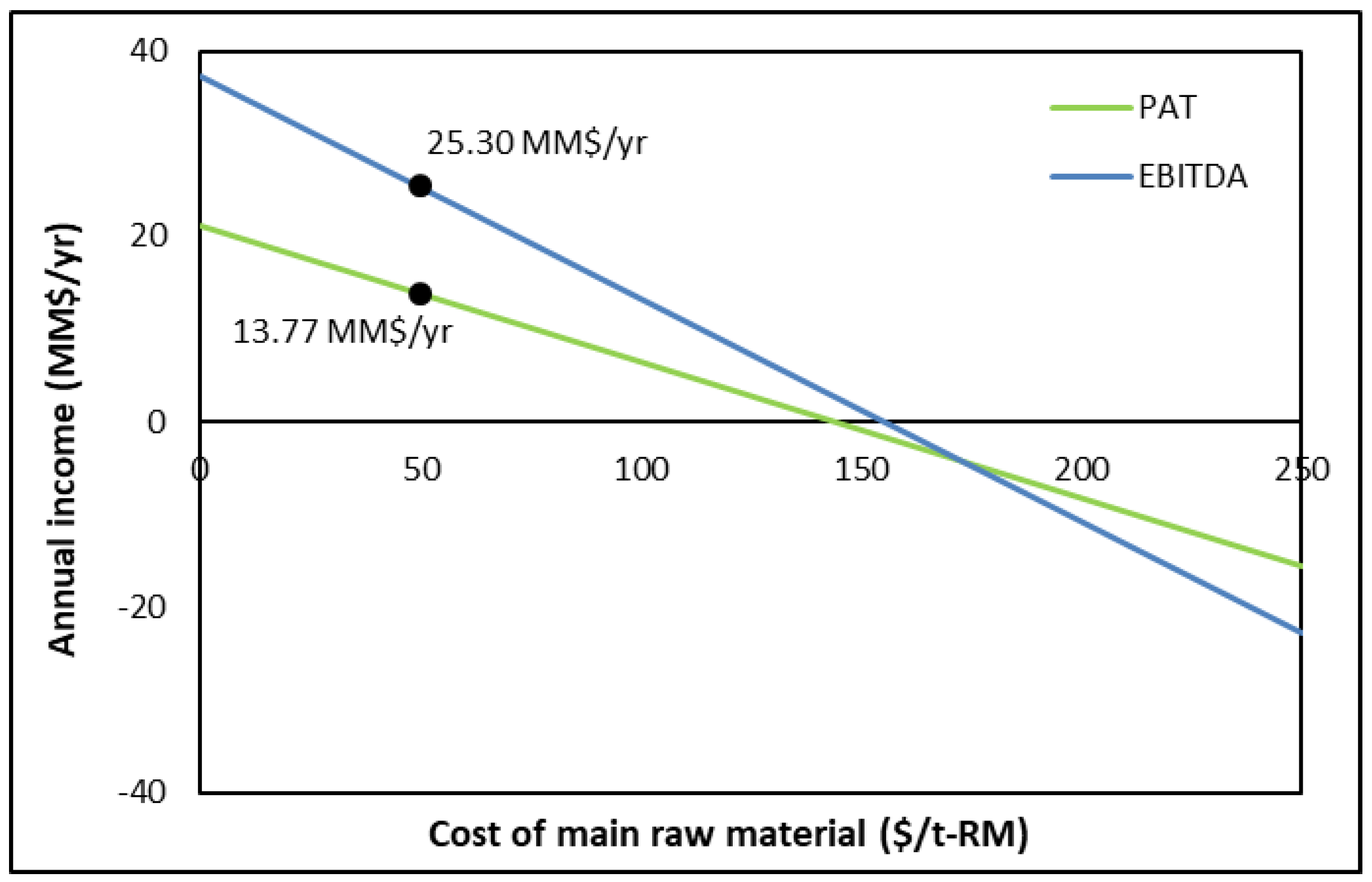
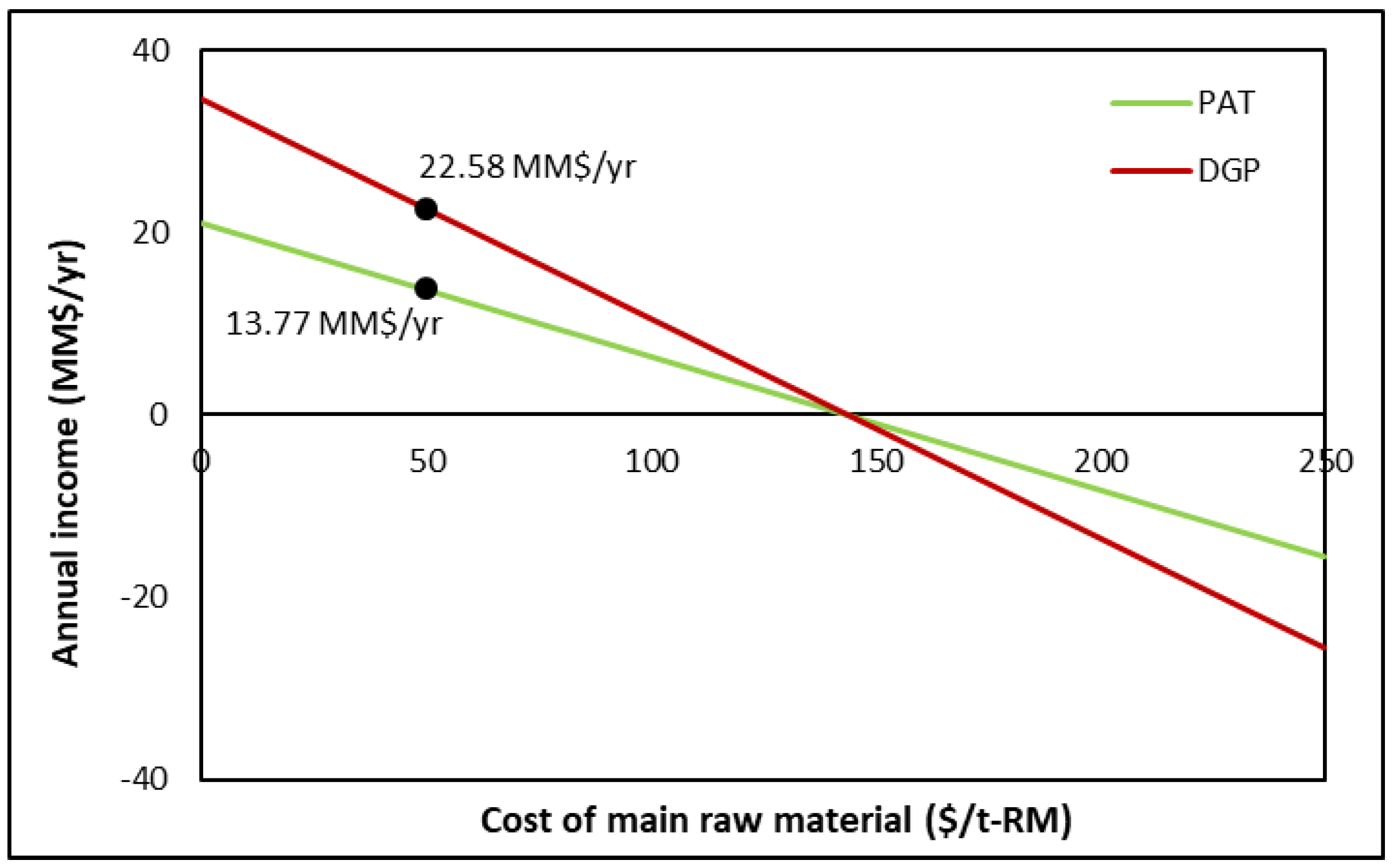
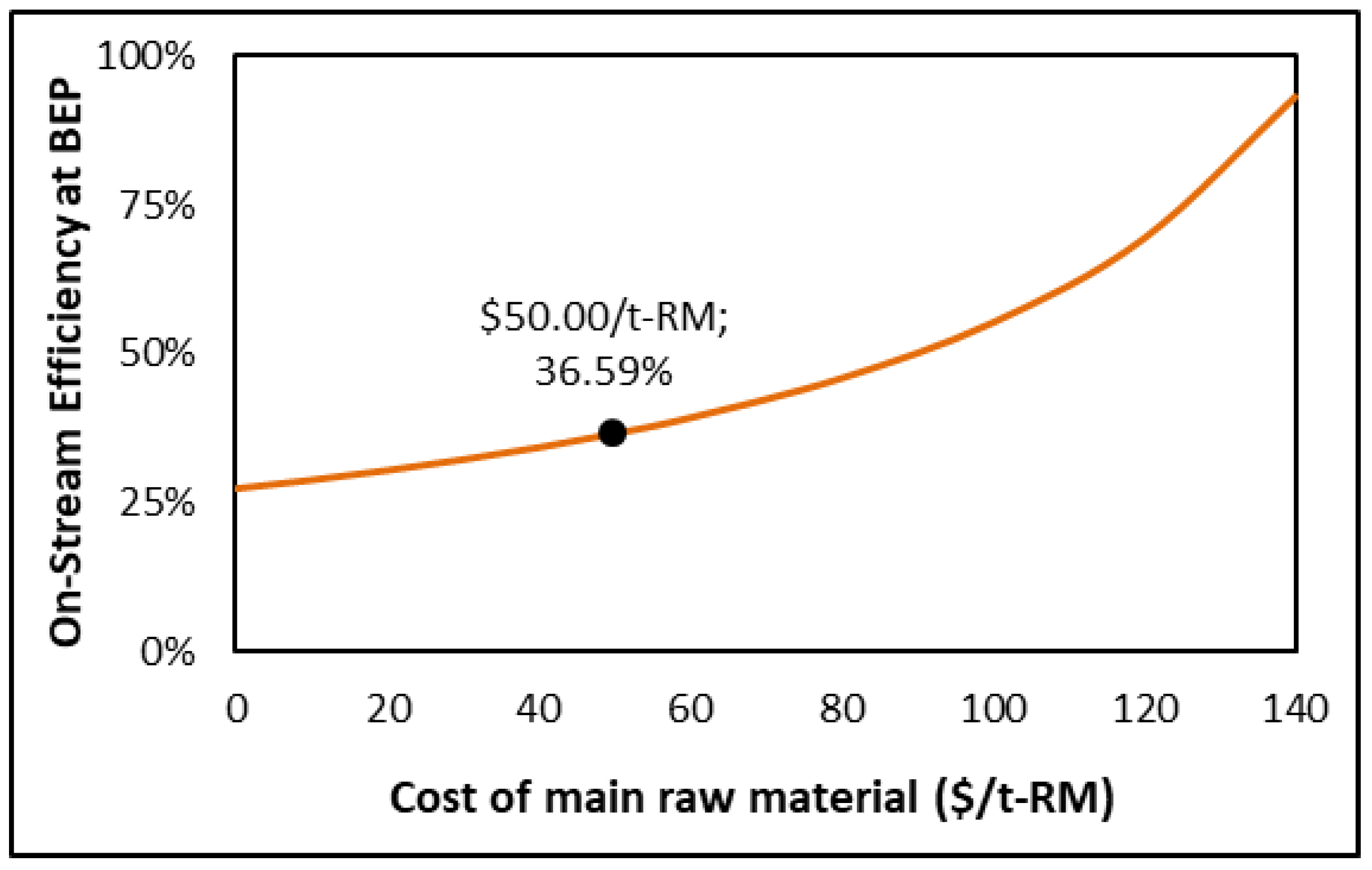
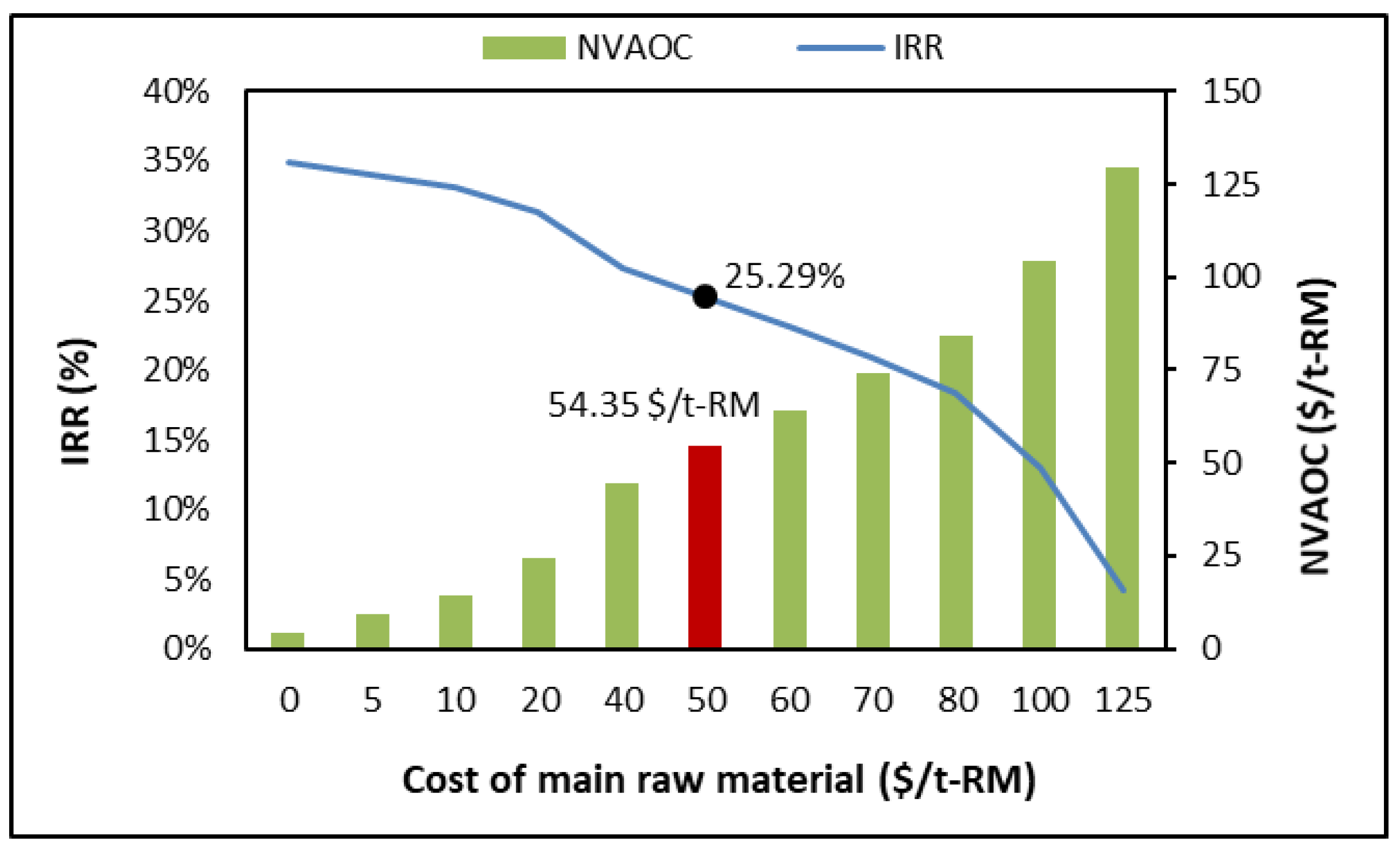
Figure 6, Figure 7, Figure 8 and Figure 9 illustrate how variations in the cost of the primary feedstock (FFB) influence the techno-economic resilience of the crude palm oil production process. Figure 6 shows the connection between feedstock price, EBITDA, and PAT, while Figure 7 contrasts feedstock cost with DGP and PAT. Figure 8 links the feedstock price to the on-stream BEP efficiency. Finally, Figure 9 presents the relationship between the main feedstock cost, the IRR, and the NVOC.
Figure 6 indicates that the EBITDA of the crude palm oil production process reacts more strongly to variations in feedstock prices than the PAT does, as reflected by its steeper trend. The point where both curves cross marks a threshold for feedstock cost and annual income, below which (around $150/t) the process begins to incur losses. This suggests that the system currently operates in a favorable region, since a feedstock cost of $50/t still results in positive EBITDA ($25.30 MM/yr) and PAT ($13.77 MM/yr). Additionally, comparing the feedstock cost at this threshold with the actual feedstock cost highlights how sensitive the process is to price increases. The greater the distance between current operating conditions and the intersection point, the higher the resilience of the process. In this case, that separation is considerable, indicating that the process can withstand increases in raw material costs.
Figure 7 illustrates that the DGP responds more strongly to variations in feedstock price than the PAT, as reflected by its sharper slope. The point where the two curves meet marks a threshold for both feedstock cost and yearly income, below which (around $150/t) the process begins to incur losses. This suggests that the system currently operates under favorable conditions, since at a feedstock cost of $50/t the DGP and PAT remain positive ($22.58 MM/yr and $13.77 MM/yr, respectively). In addition, contrasting the feedstock cost at the threshold with the actual value used in the process highlights how susceptible the process is to increases in raw material prices. The greater the distance between the current operating point and this intersection, the greater the resilience. In this scenario, that gap is considerable, indicating that the process can withstand rises in feedstock costs.
Figure 8 presents three distinct zones. In the first zone, from $0/t to $20/t of feedstock, substantial reductions in feedstock price do not meaningfully influence the on-stream BEP efficiency; within this interval, feedstock cost ceases to act as a determining variable for this indicator. Consequently, even notable fluctuations in this cost range will not produce observable changes in on-stream BEP efficiency, which reaches its minimum value of 27.37% in this segment. The second zone, spanning from $20/t to $80/t, represents a transitional interval and corresponds to the current operating conditions of the crude palm oil production system, where an on-stream BEP efficiency of 36.59% is obtained at a feedstock cost of $50/t. In this range, the process maintains acceptable profitability because it can tolerate moderate variations in raw material prices. Lastly, the third zone—associated with feedstock costs above $80/t—shows that the on-stream BEP efficiency becomes highly responsive to even slight changes in raw material cost. As a result, the process exhibits low resilience in this region since minor increases in feedstock prices lead to pronounced increases in on-stream BEP efficiency.
Figure 9 depicts how the IRR and NVAOC vary as a function of feedstock price. For the crude palm oil production scenario, the process achieves an IRR of 25.29%, an NVAOC of $54.35 per tonne of feedstock (see the red bar), and a feedstock price of $50 per tonne. The techno-economic resilience assessment indicates that the IRR decreases as feedstock costs rise, whereas NVAOC increases with higher feedstock expenses; consequently, NVAOC and IRR exhibit an inverse correlation.
In practical terms, when NVAOC represent a large share of the generated cash flows, the IRR may decline because elevated operating costs diminish net revenue and thus overall profitability. Conversely, when NVAOC remain low relative to cash flows, the IRR tends to improve as net revenue increases.
Figure 10 and Figure 11 illustrate how the crude palm oil production process responds technically and economically to variations in the plant’s processing capacity. Figure 10 shows how capacity changes relate to annual revenues and operating costs, while Figure 11 presents how these capacity adjustments compare with the NFCI values.
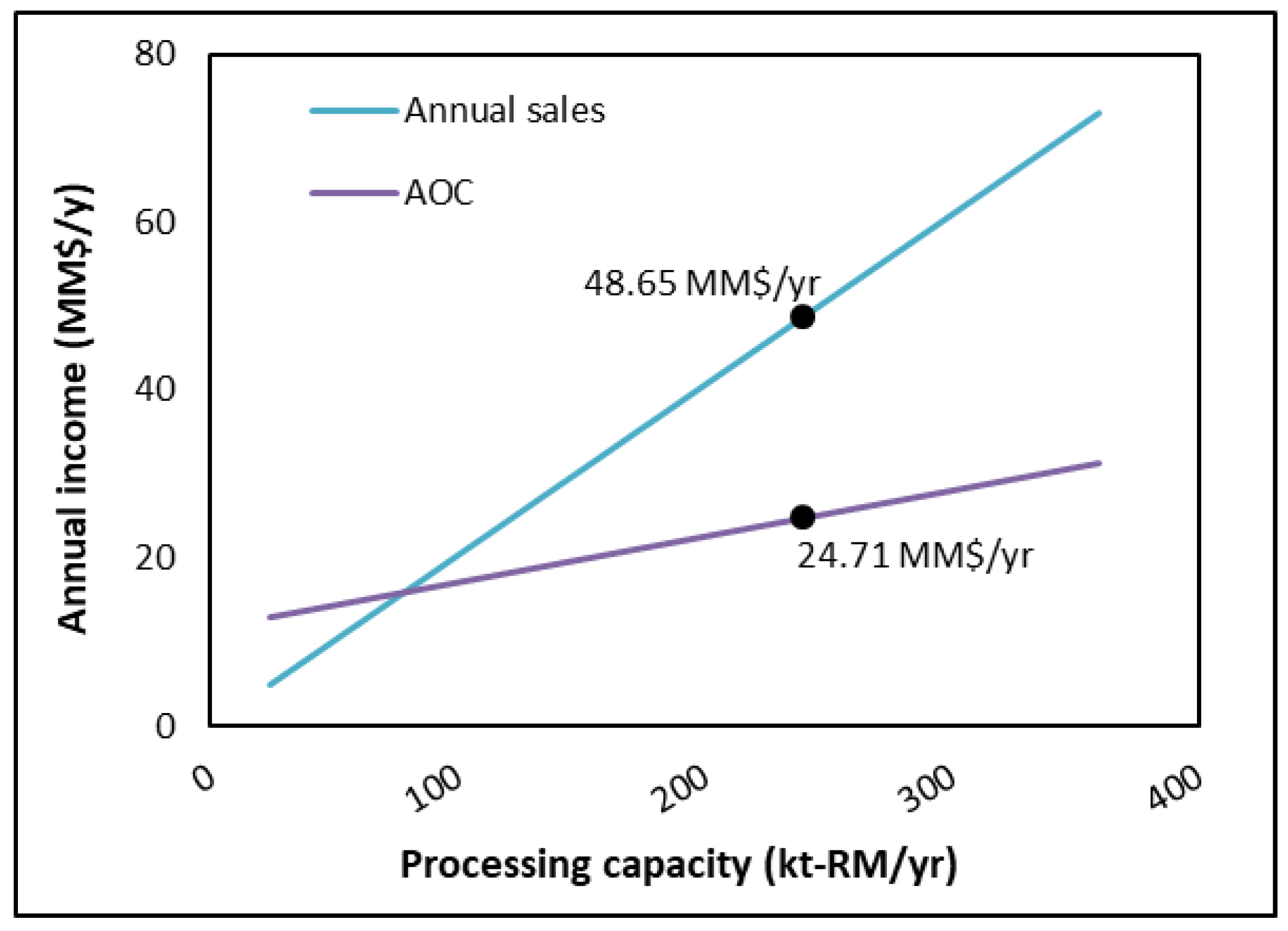
Figure 10 illustrates that revenues from crude palm oil production are less affected by fluctuations in plant throughput than the AOCs, as evidenced by the steeper slope of the sales curve. The point where the two lines intersect represents the break-even throughput with respect to AOCs and annual revenue, which in this case is around 70 kt-RM/yr. Below this value, AOCs surpass annual sales—an unfavorable condition—whereas above it, sales exceed AOCs. This confirms that under the current operating capacity of 240 kt-RM/yr, the process remains in a favorable region, generating annual sales of $48.65 MM against AOCs of $24.71 MM. Moreover, comparing the break-even capacity with the actual plant capacity reveals how sensitive the system is to changes in throughput: the greater the distance between these two points, the stronger the resilience of the process. Here, that separation is substantial, indicating that the process can withstand significant reductions in processing capacity.
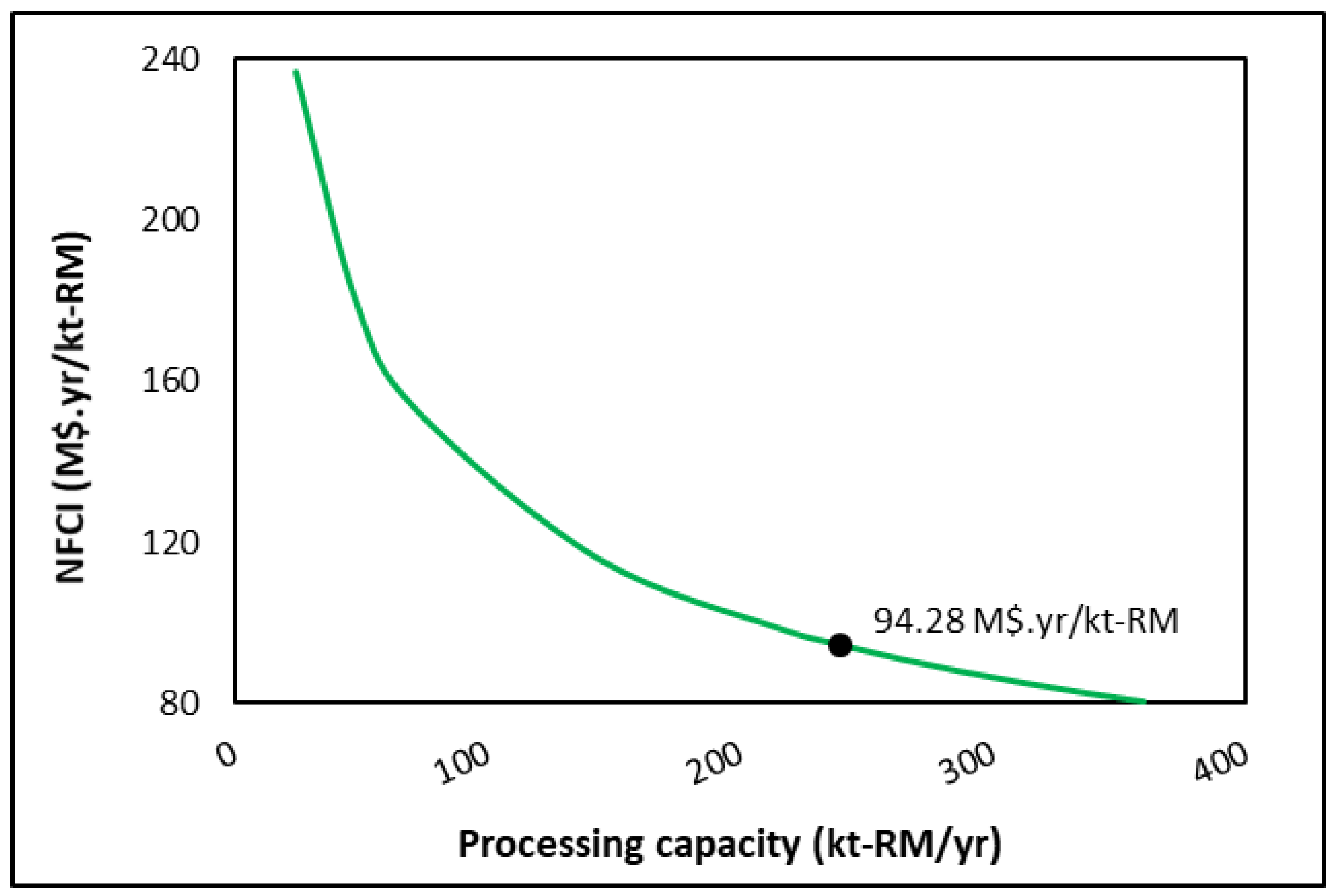
Figure 11 illustrates that normalized fixed costs decline as the processing capacity of a crude palm oil facility increases. For this analysis, the plant was considered to operate at an installed capacity of 240,000 tons per year, yielding an NFCI of 94.28 M·yr/kt-RM—equivalent to 94.28 thousand annually for each kiloton of raw material. Because fixed costs do not vary with the amount of products generated, expanding the production rate distributes these costs over a larger output. Consequently, the fixed cost attributed to each unit becomes smaller as throughput grows, ultimately lowering unit production costs.
Figure 12 and Figure 13 illustrate the technical and economic robustness of the crude palm oil production process in relation to NVOCs. Figure 12 shows how NVOCs impact ROI, while Figure 13 presents a comparison between NVOCs and payback periods.
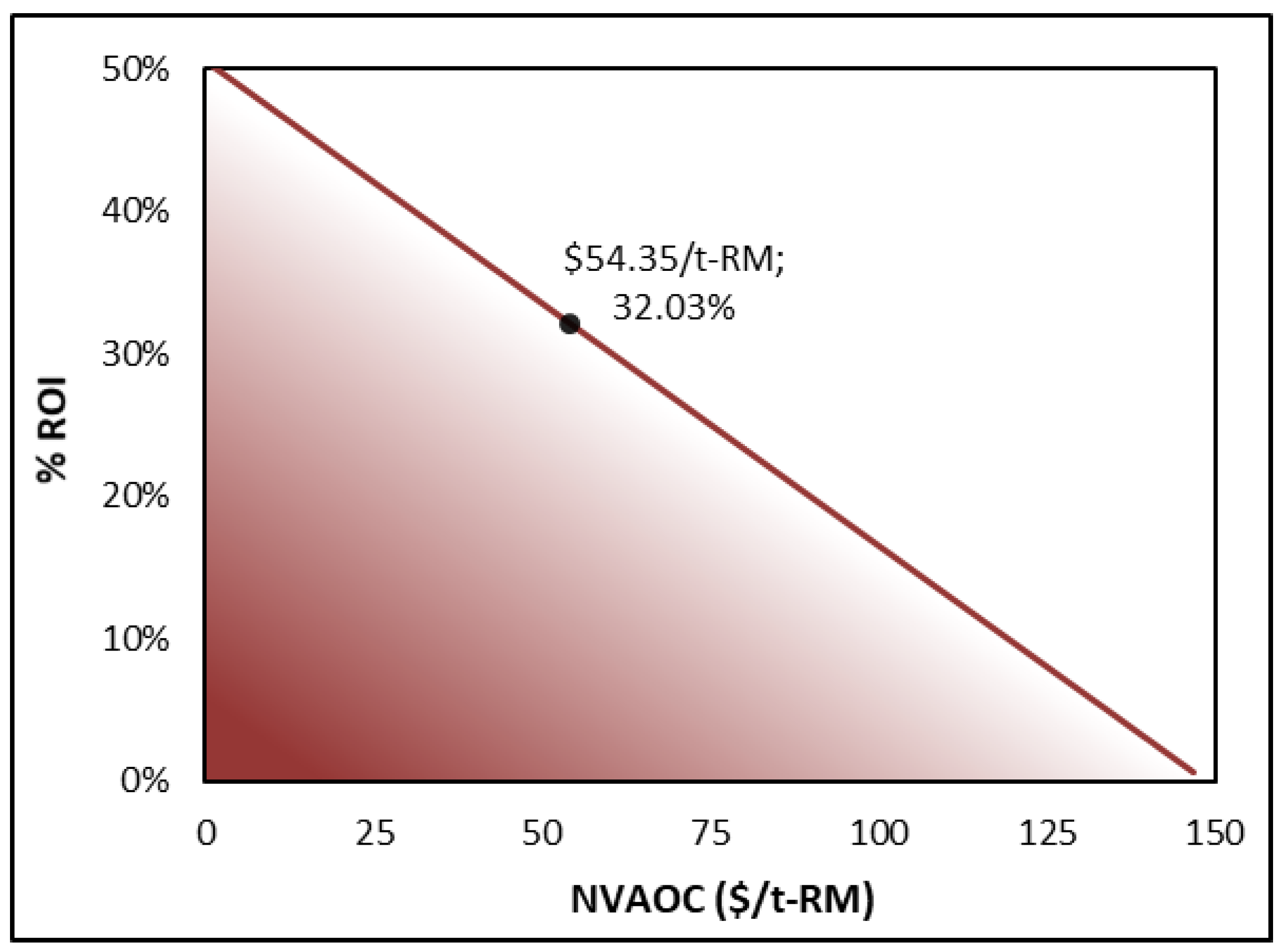
Figure 12 illustrates how NVAOCs affect the process ROI. The plot indicates a strong linear relationship between ROI and variable costs, with a critical threshold near $150 per ton, above which the ROI drops to zero. For the crude palm oil production process, this threshold is significantly higher than the current NVAOC ($54.35 per ton), slightly extending the ROI and enhancing the process’s resilience to fluctuations in variable costs. Additionally, considering the other corner of the triangular analysis, the maximum achievable ROI in an ideal scenario with near-zero variable costs is around 50%, whereas the process currently yields an ROI of 32.03%.
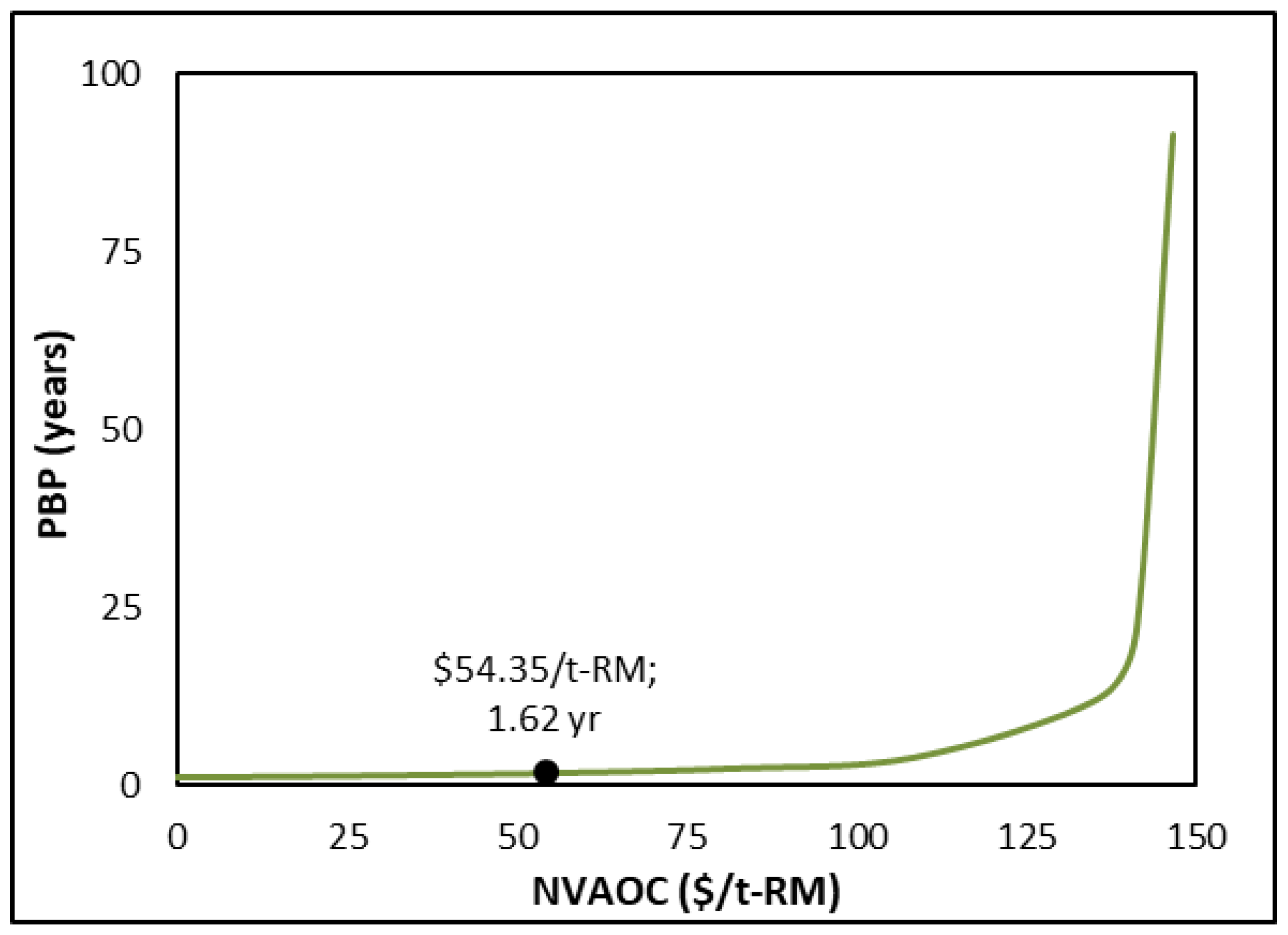
Figure 13 presents the assessment of the PBP’s technical and economic resilience in relation to the NVAOC. When the operating expenses match the product’s selling price, the pre-tax gross profit becomes zero, preventing recovery of the fixed capital investment (FCI) and causing the payback period (PBP) to approach infinity. In the crude palm oil production process, this situation arises when operating costs reach around US$150 per ton. This range, known as the out-of-control region, exhibits differences measured in decades rather than years for small variations in costs.
A stability zone can be observed for NVAOC values up to roughly US$50 per ton of raw material, beyond which a transition zone exists until changes in NVAOC no longer significantly affect the PBP. The process analyzed falls within the stable region, achieving a PBP of 1.62 years with an NVAOC of $54.35 per ton of feedstock, indicating a relatively quick investment recovery. It is notable that the plant is highly sensitive to fluctuations in Normalized Variable Operating Costs (NVAOC); even minor cost changes can determine whether the project remains profitable or faces financial failure, highlighting a critical vulnerability in the process.
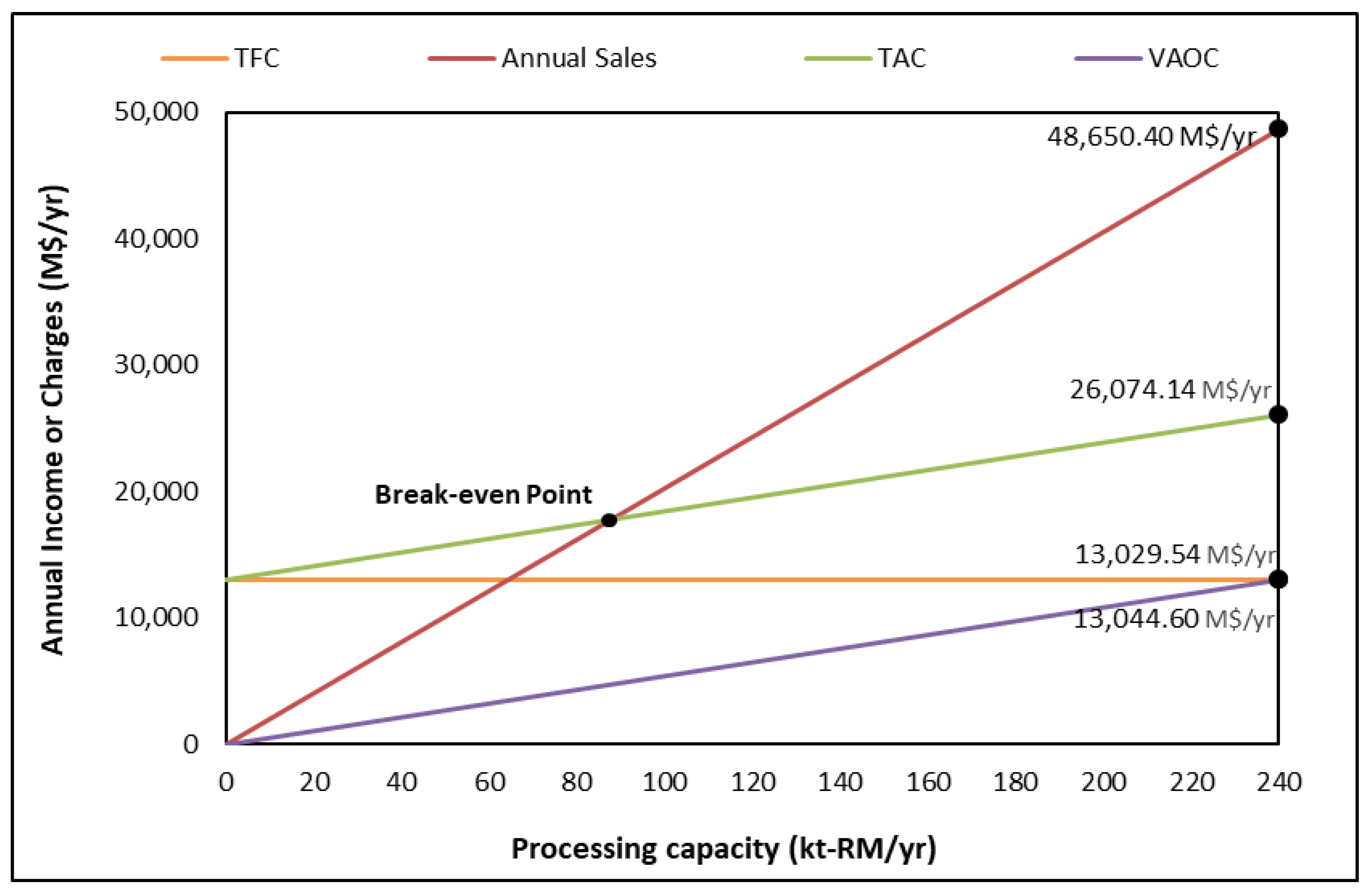
Figure 14 illustrates the break-even point (BEP) for the crude palm oil production process, showing plant capacity, total fixed costs (TFC), yearly sales, annual variable operating costs (VAOC), and total annualized costs (TAC).
The BEP analysis is used to determine the conditions under which the process’s total costs are equal to its generated revenue. In Figure 14, total fixed costs (TFC) are depicted as a horizontal line because they remain essentially constant regardless of processing capacity. For the crude palm oil production process, these costs amount to $13,029.54 M/yr, or $13,029.54 thousand annually. In comparison, the annualized variable operating costs (VAOC) of $13,044.60 M/yr are plotted across the processing range. VAOCs typically increase proportionally with processing capacity, starting from zero when no production occurs and rising to their maximum at full capacity (240 kt-RM/yr). The total annualized costs (TAC) are obtained by combining TFCs and VAOCs, layering the VAOCs on top of the fixed costs, resulting in a total of $26,074.14 M/yr in this case. Annual sales, totaling $48,650.40 M/yr for this process, are shown as a line beginning at the origin and increasing with capacity until reaching maximum revenue. The intersection between the TAC curve and the annual sales line marks the break-even point (BEP). When operating below the BEP, costs exceed revenue, resulting in a loss, whereas operation above the BEP generates profit. Currently, the crude palm oil plant functions well above the BEP, demonstrating financial resilience.

4. Conclusions

The results obtained from the technical and economic analysis of the crude palm oil production process allow us to conclude that this industrial alternative is viable and competitive under the established conditions. The total capital investment, close to US$43 million, is justified by positive financial and economic indicators, including a payback period of 1.62 years, an internal rate of return of 25.29%, and a net present value of over US$58 million after fifteen years of operation. These values reflect the process’s ability to generate sustainable profits, even in a scenario of variable prices and costs, demonstrating that the plant not only manages to cover its investment and operating costs but is also projected to be a profitable option in the long term. The break-even point, defined at 87,825 tons of bunches processed per year, demonstrates that the plant can maintain profit margins even when operating below maximum capacity, which reduces the risk of losses in situations of declining raw material supply. Likewise, the on-stream efficiency at BEP of over 36% under break-even conditions, along with a minimum sales price of $482 per ton and a minimum time of 2927.51 h/yr to avoid losses, provide evidence of the economic soundness of the evaluated production scheme.
From a techno-economic resilience standpoint, the process showed strong performance under fluctuations in processing capacity and raw material costs, although a marked sensitivity to increases in normalized operating costs was observed. This behavior indicates that while the project remains stable under typical operating conditions, substantial rises in variable expenses could reduce profitability and lengthen the payback period. Nevertheless, the implementation of the FP2O methodology enabled a thorough assessment of the interconnections among technical, economic, and financial factors, offering a detailed understanding of operational stability ranges and safe performance margins. Therefore, this study not only validates the process as a financially sound and competitive alternative but also introduces a practical methodological approach for anticipating risks and developing strategies to enhance resilience against shifts in market prices, feedstock supply, or plant efficiency. In doing so, it adds to the body of knowledge on crude palm oil processing by demonstrating, for the first time, the applicability of the FP2O framework to this type of system, providing the industry with a strategic decision-support tool for improving sustainability and competitiveness.
Finally, this research adopted the assumption of 8000 h of operation per year. To assess the model’s sensitivity in future studies, a conservative variation of ±10% in annual operating hours is proposed. With a typical cost allocation, a 10% reduction in operating hours results in a decrease in total annual operating cost (AOC) due to lower total variable costs; however, the operating cost per ton increases because fixed costs are spread over less production. On the other hand, the best-in-class profit (BEP), measured as a fraction of operating time, worsens, reflecting a greater commercial risk with fewer hours worked. These relationships are illustrative; the exact effect depends heavily on the plant’s fixed/variable cost composition, the hourly production rate, and the selling price. Therefore, in future studies it is recommended to explicitly report planned/unplanned downtime assumptions, incorporate sensitivity scenarios of ±5–15% on operating hours, and present AOC in both absolute values and per unit produced, so that the reader can clearly appreciate the vulnerability of the project to variations in operational availability.

Author Contributions

Conceptualization, Á.D.G.-D. and S.R.-F.; methodology, S.G.-M.; software, S.G.-M.; validation, Á.D.G.-D.; formal analysis, S.G.-M. and S.R.-F.; investigation, S.G.-M.; resources, Á.D.G.-D.; data curation, S.G.-M.; writing—original draft preparation, S.G.-M.; writing—review and editing, Á.D.G.-D. and S.R.-F.; visualization, Á.D.G.-D.; supervision, Á.D.G.-D.; project administration, Á.D.G.-D.; funding acquisition, S.R.-F. All authors have read and agreed to the published version of the manuscript.

Funding

This research was funded by the project approved by Resolution 01880 of 2022 and commitment act No. 027 of 2022.

Institutional Review Board Statement

Not applicable.

Informed Consent Statement

Not applicable.

Data Availability Statement

The data that support the findings of this study are available from the corresponding author, Á.D.G.-D., upon reasonable request.

Acknowledgments

The authors thank the Universidad de Cartagena for technical support.

Conflicts of Interest

The authors declare no conflicts of interest.

References

  1. Alhaji, A.M.; Almeida, E.S.; Carneiro, C.R.; da Silva, C.A.S.; Monteiro, S.; Coimbra, J.S.d.R. Palm Oil (Elaeis Guineensis): A Journey through Sustainability, Processing, and Utilization. Foods 2024, 13, 2814. [Google Scholar] [CrossRef]
  2. Urugo, M.M.; Teka, T.A.; Teshome, P.G.; Tringo, T.T. Palm Oil Processing and Controversies over Its Health Effect: Overview of Positive and Negative Consequences. J. Oleo Sci. 2021, 70, 1693–1706. [Google Scholar] [CrossRef]
  3. Shigetomi, Y.; Ishimura, Y.; Yamamoto, Y. Trends in Global Dependency on the Indonesian Palm Oil and Resultant Environmental Impacts. Sci. Rep. 2020, 10, 20624. [Google Scholar] [CrossRef]
  4. Mba, O.I.; Dumont, M.J.; Ngadi, M. Palm Oil: Processing, Characterization and Utilization in the Food Industry—A Review. Food Biosci. 2015, 10, 26–41. [Google Scholar] [CrossRef]
  5. Kurnia, J.C.; Jangam, S.V.; Akhtar, S.; Sasmito, A.P.; Mujumdar, A.S. Advances in Biofuel Production from Oil Palm and Palm Oil Processing Wastes: A Review. Biofuel Res. J. 2016, 3, 332–346. [Google Scholar] [CrossRef]
  6. Purnomo, H.; Okarda, B.; Dermawan, A.; Ilham, Q.P.; Pacheco, P.; Nurfatriani, F.; Suhendang, E. Reconciling Oil Palm Economic Development and Environmental Conservation in Indonesia: A Value Chain Dynamic Approach. For. Policy Econ. 2020, 111, 102089. [Google Scholar] [CrossRef]
  7. Bispo, A.M.; Alves, A.S.B.; da Silva, E.F.; Krumreich, F.D.; Nunes, I.L.; Ribeiro, C.D.F. Perception, Knowledge, and Consumption Potential of Crude and Refined Palm Oil in Brazilian Regions. Foods 2024, 13, 2923. [Google Scholar] [CrossRef]
  8. Murphy, D.J.; Goggin, K.; Paterson, R.R.M. Oil Palm in the 2020s and beyond: Challenges and Solutions. CABI Agric. Biosci. 2021, 2, 39. [Google Scholar] [CrossRef]
  9. Syahza, A.; Tampubolon, D.; Irianti, M.; Meiwanda, G.; Asmit, B. The Impact of Small-Scale Oil Palm Plantation Development on the Economy Multiplier Effect and Rural Communities Welfare. Int. J. Sustain. Dev. Plan. 2023, 18, 1407–1415. [Google Scholar] [CrossRef]
  10. Awoh, E.T.; Kiplagat, J.; Kimutai, S.K.; Mecha, A.C. Current Trends in Palm Oil Waste Management: A Comparative Review of Cameroon and Malaysia. Heliyon 2023, 9, e21410. [Google Scholar] [CrossRef]
  11. Rifin, A.; Feryanto; Herawati; Harianto. Assessing the Impact of Limiting Indonesian Palm Oil Exports to the European Union. J. Econ. Struct. 2020, 9, 26. [Google Scholar] [CrossRef]
  12. TO, O.; O, A.; PO, O.; Olatubi, I.V.; VA, A.; EA, A. Environmental Impact of Oil Palm Processing on Some Properties of the On-Site Soil in a Growing City in Nigeria. Front. Environ. Sci. 2022, 10, 918478. [Google Scholar] [CrossRef]
  13. Wondi, M.H.; Haris, N.I.N.; Shamsudin, R.; Yunus, R.; Mohd Ali, M.; Iswardi, A.H. Development and Testing of an Oil Palm (Elaeis Guineensis Jacq.) Fruit Digester Process for Kernel Free in Crude Palm Oil Production. Ind. Crops Prod. 2024, 208, 117755. [Google Scholar] [CrossRef]
  14. Herrera-Rodríguez, T.C.; Ramos-Olmos, M.; González-Delgado, Á.D. A Joint Economic Evaluation and FP2O Techno-Economic Resilience Approach for Evaluation of Suspension PVC Production. Results Eng. 2024, 24, 103069. [Google Scholar] [CrossRef]
  15. Perez, J.C.R.; Echeverry, L.A.V.; Peralta-Ruiz, Y.Y.; González-Delgado, A.D. A Techno-Economic Sensitivity Approach for Development of a Palm-Based Biorefineries in Colombia. Chem. Eng. Trans. 2017, 57, 13–18. [Google Scholar] [CrossRef]
  16. Jang, D.; Kim, K.; Kim, K.H.; Kang, S. Techno-Economic Analysis and Monte Carlo Simulation for Green Hydrogen Production Using Offshore Wind Power Plant. Energy Convers. Manag. 2022, 263, 115695. [Google Scholar] [CrossRef]
  17. Gao, R.; Li, D.; Zhang, D. An AI Agent for Techno-Economic Analysis of Anaerobic Co-Digestion in Renewable Energy Applications. Energies 2025, 18, 5632. [Google Scholar] [CrossRef]
  18. García-Maza, S.; Rojas-Flores, S.; González-Delgado, Á.D. Technical Insights into Crude Palm Oil (CPO) Production Through Water–Energy–Product (WEP) Analysis. Sustainability 2025, 17, 4485. [Google Scholar] [CrossRef]
  19. Fedepalma. Federación Nacional de Cultivadores de Palma de Aceite. 2022. Available online: https://fedepalma.org/ (accessed on 9 November 2025).
  20. Wibowo, L.S. Factor Influencing Crude Palm Oil (CPO) Biodiesel Supply in Indonesia Using Error Correction Model (ECM). Bus. Econ. Res. 2015, 5, 133. [Google Scholar] [CrossRef]
  21. Martínez, D.; Puerta, A.; Mestre, R.; Peralta-Ruiz, Y.; Gonzalez-Delgado, A.D. Exergy-Based Evaluation of Crude Palm Oil Production in North-Colombia. Aust. J. Basic Appl. Sci. 2016, 10, 82–88. [Google Scholar]
  22. Ajith, B.S.; Manjunath Patel, G.C.; Der, O.; Selvan, C.P.; Samuel, O.D.; Annadurai, S.; Thajudeen, K.Y.; Yadav, K.K. Microwave-Assisted Transesterification of Hybrid Garcinia Gummi-Gutta and Garcinia Indica Oils: Optimization Using RSM and Meta-Heuristic Algorithms for High-Yield Biodiesel Production. Biomass Bioenergy 2025, 202, 108223. [Google Scholar] [CrossRef]
  23. Zhu, C.; Samuel, O.D.; Patel G C, M.; Der, O.; Abbas, M.; Hussain, F.; Ting, T.T. Enhancing CI Engine Performance and Emission Control Using a Hybrid RSM–Rao Algorithm for ZnO-Doped Castor–Neem Biodiesel Blends. Case Stud. Therm. Eng. 2025, 74, 106841. [Google Scholar] [CrossRef]
  24. González-Delgado, Á.D. Computer-Assisted Hira Assessment of Hazardous in the Production of Crude Palm Oil. 2019. Available online: https://agris.fao.org/search/en/providers/122609/records/68877c277fd4d06c32a8c993 (accessed on 2 October 2025).
  25. Peters, M.S.; Timmerhaus, K.D.; West, R.E. Plant Design and Economics for Chemical Engineers; McGraw-Hill Education: New York, NY, USA, 1991. [Google Scholar]
  26. Marshall Swift Valuation Services. Inventory Index Factors; Freestone Central Appraisal District: Fairfield, TX, USA, 2025.
  27. El-Halwagi, M.M. Sustainable Design Through Process Integration: Fundamentals and Applications to Industrial Pollution Prevention, Resource Conservation, and Profitability Enhancement; Elsevier: Amsterdam, The Netherlands, 2025. [Google Scholar]
  28. Dermoredjo, S.K.; Darmawan, D.H.A.; Sumedi; Mutaqin; Dani, F.Z.D.P.; Yusuf, E.S.; Pasaribu, S.M.; Sayaka, B.; Wardana, I.P.; Adnyana, I.M.O.; et al. The Global Sway of Indonesian Palm Oil: An Export Analysis. J. Agric. Food Res. 2025, 22, 102064. [Google Scholar] [CrossRef]
  29. Haryati, Z.; Subramaniam, V.; Noor, Z.Z.; Hashim, Z.; Loh, S.K.; Aziz, A.A. Social Life Cycle Assessment of Crude Palm Oil Production in Malaysia. Sustain. Prod. Consum. 2022, 29, 90–99. [Google Scholar] [CrossRef]
  30. Koliesnichenko, A.S. EBIT and EBITDA Measures in Company Accounting and Reporting. 2018. Available online: https://nubip.edu.ua/sites/default/files/zbirnik_0.pdf#page=26 (accessed on 2 October 2025).
  31. Sulin, S.N.; Mokhtar, M.N.; Baharuddin, A.S.; Mohammed, M.A.P. Simulation and Techno-Economic Evaluation of Integrated Palm Oil Mill Processes for Advancing a Circular Economy. Clean. Environ. Syst. 2025, 19, 100323. [Google Scholar] [CrossRef]
Figure 1. Block diagram of the crude palm oil extraction process.
Processes 13 04056 g001
Figure 2. Net present value (NPV) of the crude palm oil production process.
Processes 13 04056 g002
Figure 3. Effect of the product sales price on EBITDA and PAT of the crude palm oil production process.
Processes 13 04056 g003
Figure 4. Effect of the product sales price on DGP and PAT of the crude palm oil production process.
Processes 13 04056 g004
Figure 5. Effect of the product sales price on on-stream efficiency at the BEP of the crude palm oil production process.
Processes 13 04056 g005
Figure 6. Effect of the cost of the main raw material on EBITDA and PAT of the crude palm oil production process.
Processes 13 04056 g006
Figure 7. Effect of the cost of the main raw material on DGP and PAT of the crude palm oil production process.
Processes 13 04056 g007
Figure 8. Effect of the cost of the main raw material on on-stream efficiency at the BEP of the crude palm oil production process.
Processes 13 04056 g008
Figure 9. Effect of the cost of the main raw material on IRR and NVAOC of the crude palm oil production process.
Processes 13 04056 g009
Figure 10. Effect of the processing capacity on annual sales and AOC of the crude palm oil production process.
Processes 13 04056 g010
Figure 11. Effect of the processing capacity on NFCI of the crude palm oil production process.
Processes 13 04056 g011
Figure 12. Effect of the NVAOC on the ROI of the crude palm oil production process.
Processes 13 04056 g012
Figure 13. Effect of the NVAOC on the PBP of the crude palm oil production process.
Processes 13 04056 g013
Figure 14. Location of the break-even point (BEP) of the crude palm oil production process.
Processes 13 04056 g014
Table 1. Technical–economic considerations for the crude palm oil extraction process.
ItemValue
Fresh fruit bunches flow (t/year)240,000
Crude palm oil flow (t/year)54,056
Fresh fruit bunches cost (USD/t)50
Crude palm oil cost (USD/t)900
Plant life (years)15
Salvage value10% of the Fixed Capital Investment (FCI) subject to depreciation
Construction time2 years
LocationColombia
Tax rate39%
Discount rate8.7%
Capacity operatedHalf of the total in the first year, rising to seventy percent in the second, and reaching full implementation from the third year forward
Process typeProven process
Process controlDigital
Type of projectFacility built on undeveloped land
Type of soilSoft clay
Contingency percentage (%)60
Tank design codeASME
Vessel diameter specificationInternal diameter
Operator hour cost (USD/h)30
Supervisor hourly cost (USD/h)35
Salaries per year13
UtilitiesNatural gas, steam, water and electricity
Process fluidsSolid, gas and liquid
Depreciation methodLinear
Table 2. Detailed report of total capital investment items for the crude palm oil production process.
ItemTotal
Cost of equipment (USD)3,743,556.96
Delivered purchased equipment cost (USD) 4,492,268.35
Purchased equipment (installed; USD)1,347,680.51
Instrumentation (installed; USD)539,072.20
Piping (installed; USD)1,347,680.51
Electrical network (installed; USD)853,530.99
Buildings (including services; USD)2,246,134.18
Services facilities (installed; USD)1,796,907.34
Total DFCI (USD)12,623,274.07
Land (USD)269,536.10
Land improvements (USD)1,796,907.34
Engineering and supervision (USD)2,335,979.54
Equipment (R+D; USD)449,226.84
Construction costs (USD)1,527,371.24
Legal expenses (USD)44,922.68
Contractors’ fees (USD)883,629.18
Contingency (USD)2,695,361.01
Total IFCI (USD)10,002,933.94
Fixed capital investment (FCI; USD)22,626,208.01
Working capital (WCI; USD)18,100,966.41
Start-up (SUC; USD)2,262,620.80
Total capital investment (TCI; USD)42,989,795.22
Salvage value FCI (USD)2,235,667.19
Annualized fixed costs (AFC; USD/year)1,359,369.39
Table 3. Detailed report of the annualized operating costs of the crude palm oil production process.
ItemTotal $/year
Raw materials12,000,000.00
Industrial services1,044,600.00
Total VAOC13,044,600.00
Local taxes678,786.24
Insurance226,262.08
Interest/rent429,897.95
Total FCH1,334,946.27
Maintenance and repairs1,131,310.40
Operating supplies169,696.56
Operating labor3,643,733.33
Direct supervision and office work546,560.00
Laboratory charges364,373.33
Patents and royalties226,262.08
Total DPC6,081,935.71
Overhead (POH)2,186,240.00
General expenses (GE)2,067,043.93
Total FAOC11,670,165.91
Annualized operating costs (AOC)24,714,765.91
Table 4. Technical–economic indicators for the crude palm oil production process.
IndicatorTotal
Gross profit (depreciation not included) (GP; USD)23,935,634.09
Gross profit (depreciation included) (DGP; USD)22,576,264.71
Profitability after tax (PAT; USD)13,771,521.47
Economic potential 1 (EP1; USD/year)36,650,400.00
Economic potential 2 (EP2; USD/year)35,605,800.00
Economic potential 3 (EP3; USD/year)23,935,634.09
Cumulative cash flow (CCF; 1/year)0.56
Payback period (PBP; years)1.62
Depreciable payback period (DPBP; years)4.88
Return on investment (% ROI)32.03
Net present value (NPV; MMUSD)58.74
Annual cost/benefit (ACR)7.16
Internal rate of return (% IRR)25.29
Normalized variable operating costs (NVAOC; USD/t-RM)54.35
Capacity at BEP (t-RM/yr)87,825.26
Selling price at BEP ($/t)482.35
On-stream at BEP (%)36.59
Time at BEP (h/yr)2927.51
Table 5. Financial indicators for the crude palm oil production process.
IndicatorTotal
Earnings before taxes (EBT; USD)23,935,634.09
Earnings before interest and taxes (EBIT; USD)23,505,736.14
Earnings before interest, taxes, depreciation, and amortization (EBITDA; USD)25,295,003.48
Disclaimer/Publisher’s Note: The statements, opinions and data contained in all publications are solely those of the individual author(s) and contributor(s) and not of MDPI and/or the editor(s). MDPI and/or the editor(s) disclaim responsibility for any injury to people or property resulting from any ideas, methods, instructions or products referred to in the content.