
Research on Bo-BiLSTM-Based Synchronous Load Transfer Control Technology for Distribution Networks


Abstract
1. Introduction
- A Bo-BiLSTM-based prediction model for switching operation timing in distribution networks is proposed. By adaptively obtaining optimal hyperparameters for the BiLSTM network through Bayesian optimization algorithms, the model’s predictive accuracy and generalization capability are effectively enhanced under conditions of small sample sizes and high data dispersion, laying the foundation for subsequent implementation of control strategies.
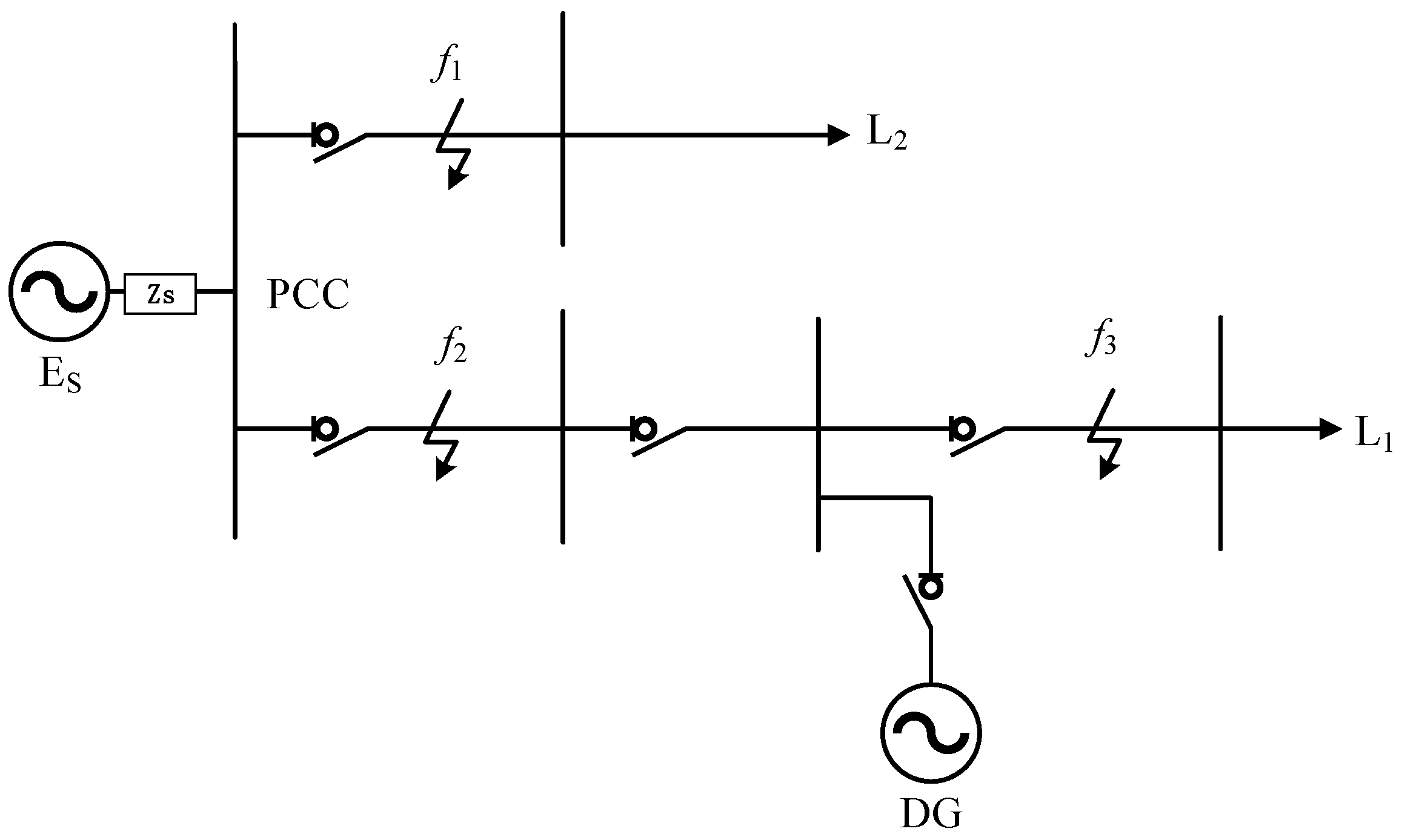
- A comprehensive database of switch operation time characteristics was established. A detailed simulation model of the distribution network incorporating DG was constructed using MATLAB/Simulink. This model simulated 620 operational scenarios encompassing various short-circuit fault types, different fault locations, and transition resistances, providing a robust data foundation for model training and control logic validation.
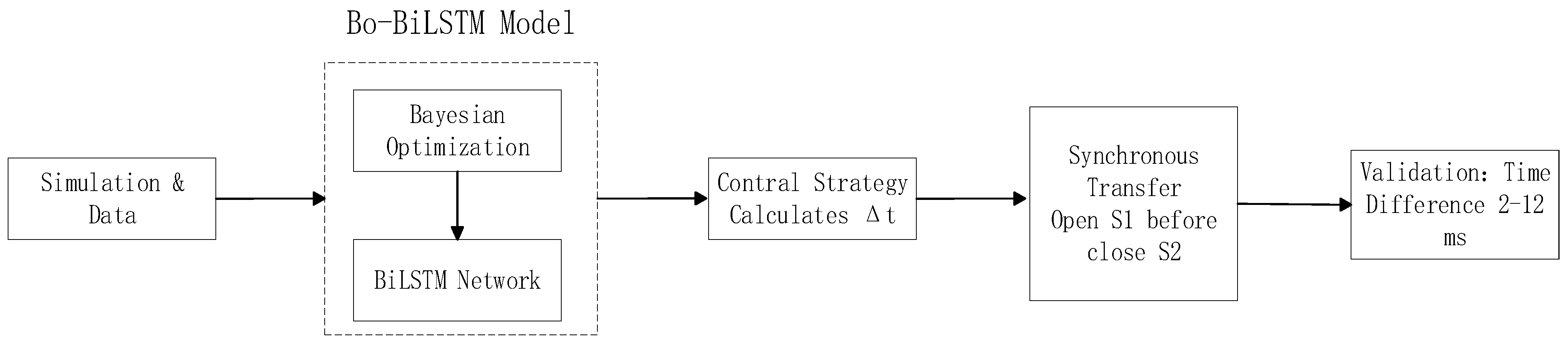
- We innovatively integrate switch timing prediction results with load transfer control strategies. Based on the predicted time parameters, a synchronous transfer control strategy was designed following the principle of “open first and then close” with dynamic delay, Δt, as its core. Physical experiments validated that this strategy can strictly control the opening and closing time difference within a 20 ms safety margin, with experimental results ranging from 2 to 12 ms. This fundamentally eliminates the risk of circulating currents caused by asynchronous closing, achieving seamless load transfer control after a fault.
2. System Modeling and Feature Database Construction
2.1. System Modeling
2.2. Construction of a Database for Time Characteristics of Distribution Network Switch Operations
3. Bayesian Optimization-Based BiLSTM Forecasting Model
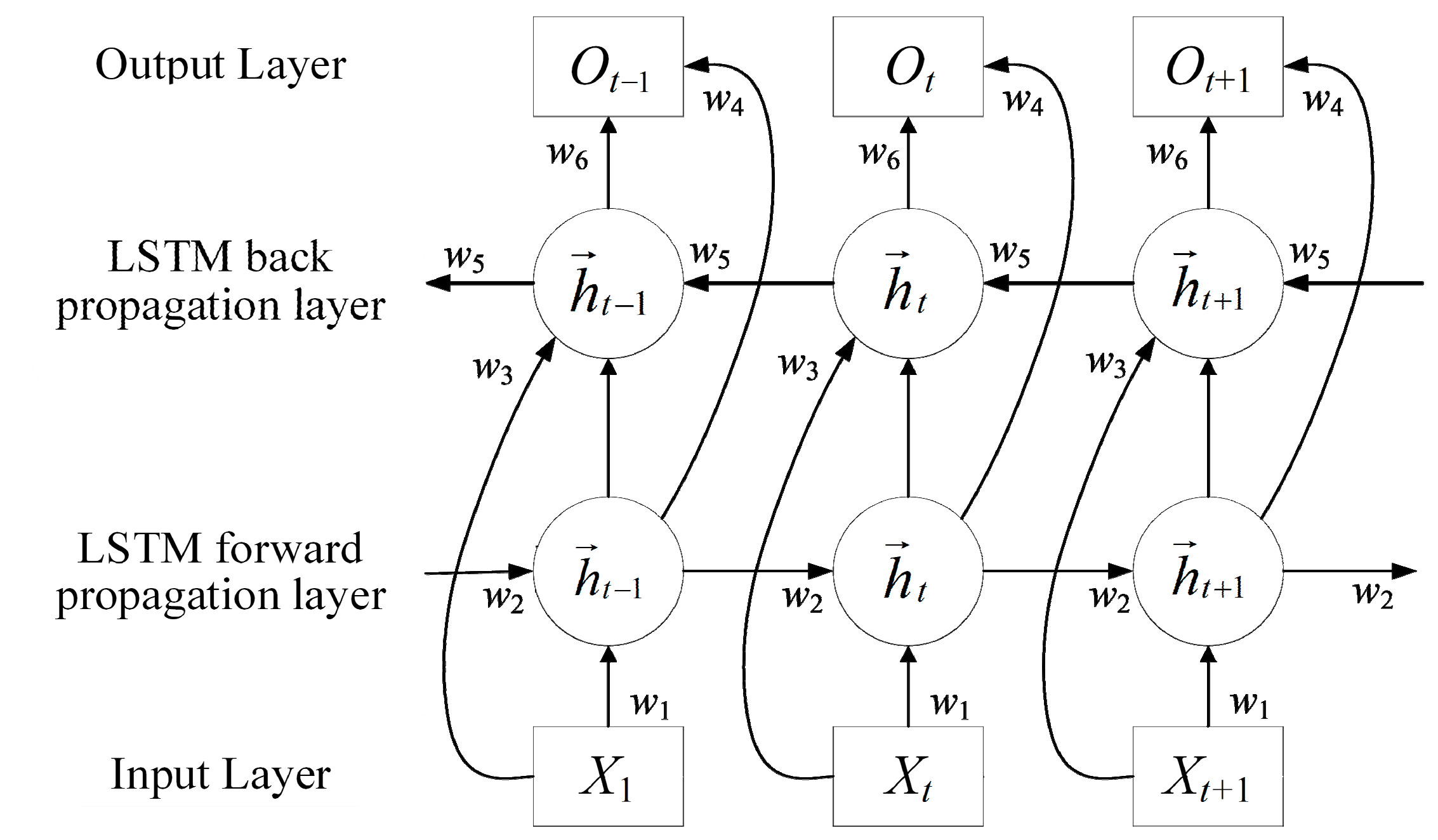
3.1. BiLSTM Principles and Applicability
3.2. Bayesian Optimization Principle
- (1)
- Gaussian Process Regression
- (2)
- Collection Function
3.3. Bo-BiLSTM Network Parameter Optimization
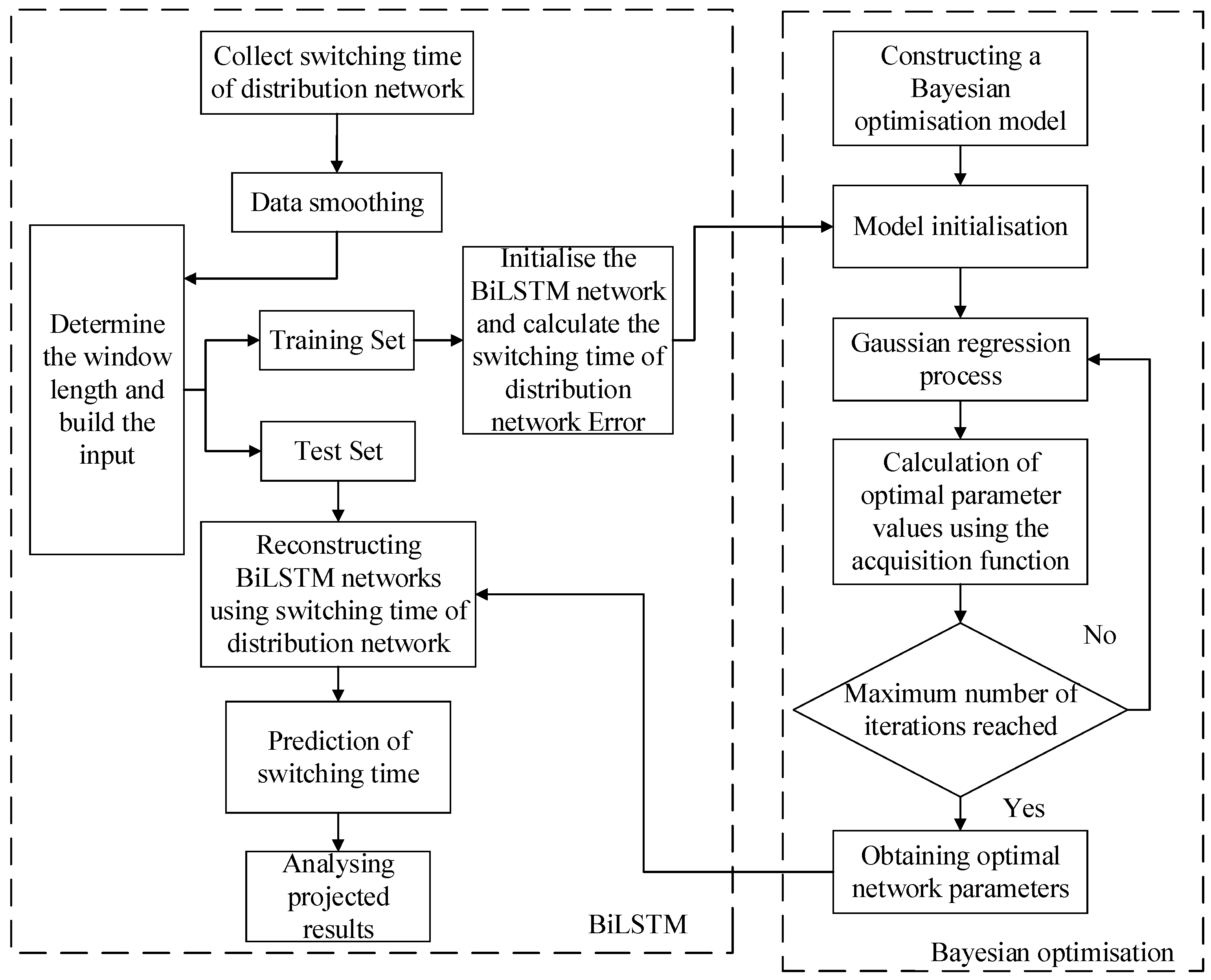
3.4. Switch Operation Time Prediction Method for Distribution Networks Based on Bo-BiLSTM Network
- (1)
- Model initialization: Define the function f(x) and the definition domain of x to be optimized in the Bayesian optimization algorithm, set the objective function and the maximum number of iterations, etc.; divide the processed failure characteristics dataset into test set kernel and training set; and train the BiLSTM model.
- (2)
- Select the BiLSTM model failure prediction error rate to obtain the initial observation of the Bayesian algorithm.
- (3)
- The Gaussian process is applied to estimate the initial observation value to determine the next observation point.
- (4)
- Select the optimal parameters according to the acquisition function until the end of the iteration.
- (5)
- The optimal parameters obtained by the Bayesian algorithm are brought into the BiLSTM network for parameter reconstruction.
- (6)
- The optimal parameters are brought into the BiLSTM model to predict the test set data, and the predicted results are obtained and analyzed.
4. Analysis of BiLSTM Prediction Model Results
4.1. Model Prediction Standard
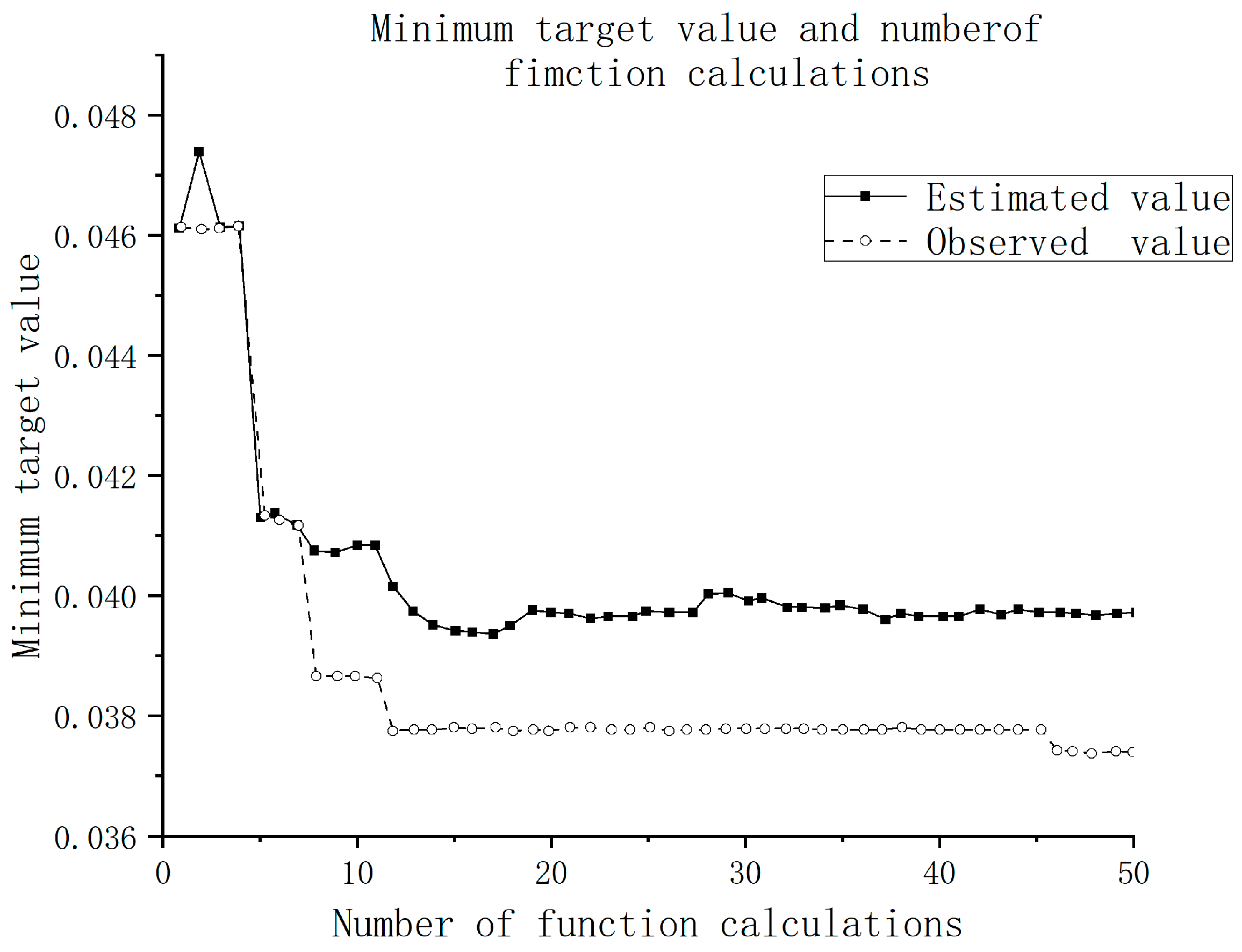
4.2. Bayesian Optimization Search Results
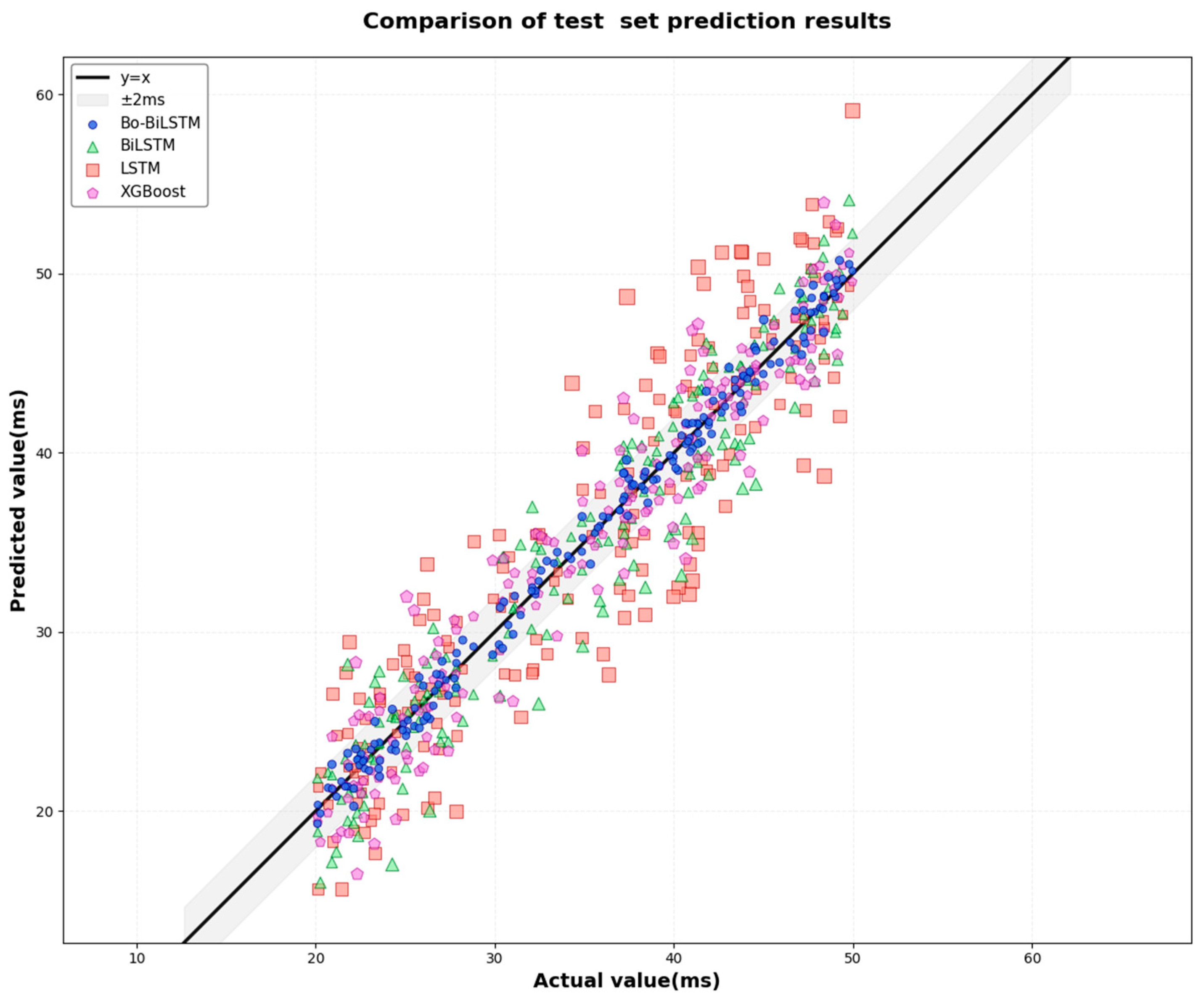
4.3. Distribution Network Switching Time Prediction Results
4.4. Discussion on Prediction Error Accumulation
- Temporal Dependency and Autoregressive Nature: The BiLSTM model makes predictions based on a sequence of previous time steps. In an autoregressive setting, the current prediction relies on past observed or predicted values. As the prediction horizon extends into the future, the model increasingly depends on its own previous predictions rather than ground-truth data. Any small error made at an early step can therefore be propagated and amplified in subsequent predictions, leading to a gradual divergence from the actual series.
- Attenuation of Long-range Contextual Information: Although BiLSTM is designed to capture long-term dependencies, its ability to retain and utilize information from the distant past is still finite. For very long sequences or sequences with complex, non-stationary patterns, the influence of the initial, most informative states of the network may diminish over time. This makes it increasingly difficult for the model to correct its course based on the foundational context.
- Limitations of the Training Dataset: Our model was trained on a finite set of 620 operational scenarios. While this provides a solid foundation, the testing sequence might encounter a subtle, cumulative combination of features that represents an edge case or a gradual shift in system dynamics not fully captured in the training distribution. The model, having not been explicitly trained on such a prolonged, specific trajectory, struggles to maintain perfect accuracy.
5. Time-Based Model and Experimental Validation for Full-Process Control of Load Transfer Using Bo-BiLSTM
5.1. Time Constraints and Problem Modeling
- Known Conditions:
- Master Station Command Sequence:
- Mathematical Model:
5.2. Control Strategy Design: Determination of Dynamic Delay Time Δt
- For Ttotal > 0: T_close − T_open − Δt > 0 => Δt < T_close − T_open
- 2.
- For Ttotal < 20 ms: T_close − T_open − Δt < 20 => Δt > T_close − T_open − 20
5.3. Physical Experiment Verification and Result Analysis
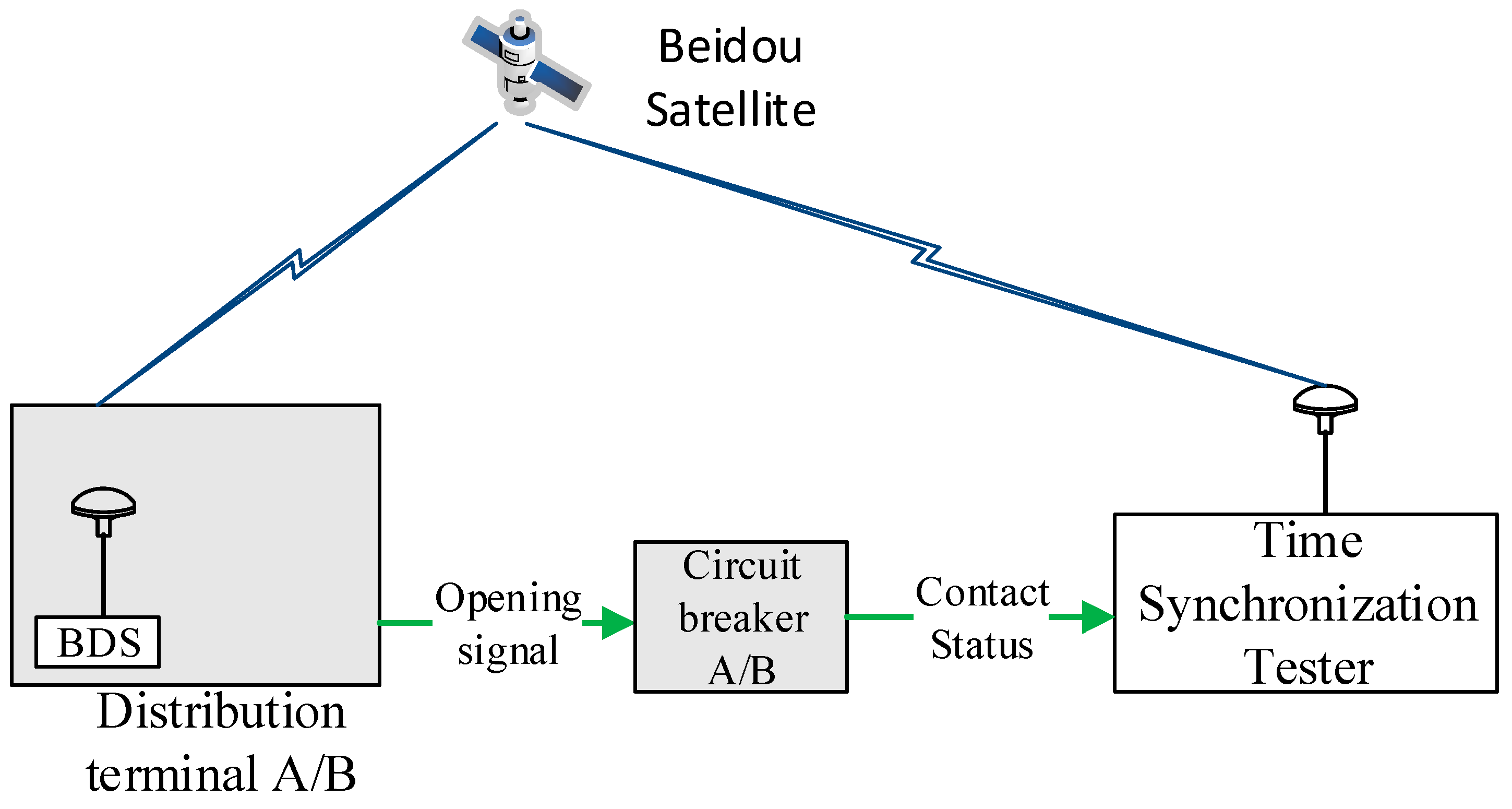
5.3.1. Experimental Platform Setup
5.3.2. Experimental Protocol Design
- (1)
- Before starting the test, first ensure that both power distribution terminals are synchronized and operating stably for over 10 min under the synchronized time reference output by the satellite signal simulator to establish a reliable synchronized state.
- (2)
- During testing, the master station system issues control commands with absolute timestamps to distribution terminal A (to open the original power source switch S1) and distribution terminal B (to close the target power source switch S2) based on the switching times predicted by the Bo-BiLSTM model and the calculated dynamic delay, following the “open first and then close” timing logic.
- (3)
- Critical timing points during the switching operation—specifically, the precise moment when breaker A’s contacts open and the precise moment when breaker B’s contacts close—are captured and recorded in parallel by a high-precision time synchronization tester. This tester also receives the time reference from the satellite signal simulator, ensuring that its recorded data aligns perfectly with the distribution terminal’s timeline to eliminate system timing errors. To quantitatively assess control precision, the time difference between Circuit Breaker A’s opening moment and Circuit Breaker B’s closing moment is calculated. This value represents the actual opening-closing time interval.
- (4)
- The aforementioned test procedure is repeated 100 times to obtain statistically significant results and verify the consistency and reliability of the control strategy across different operations.
5.3.3. Experimental Data Analysis
5.3.4. Experimental Conclusions
- High Precision and Safety: In all experimental rounds, the time difference between opening and closing operations was strictly controlled within 2–12 ms. This result not only fully meets the engineering safety requirement of less than 20 ms but also demonstrates that the system possesses sufficient performance margin, fundamentally avoiding the risk of circulating currents caused by asynchronous closing.
- Exceptional Reliability: No noticeable contact bounce was observed in all 100 repeated operations. All 100 experiments successfully achieved safe transfer, demonstrating that this control strategy exhibited high reliability and consistency rather than merely coincidental effectiveness.
- Effectiveness of the Predictive-Control Closed Loop: The experiment successfully validated the effectiveness of the dynamic delay control strategy designed based on Bo-BiLSTM high-precision time prediction, achieving a closed loop from “precise sensing” to “precise control.” This provides a reliable technical solution for seamless and rapid load transfer in distribution networks following faults.
6. Conclusions
- A Novel Prediction Model for Switching Times
- 2.
- A Comprehensive and Publicly Accessible Feature Database
- 3.
- An Innovative Integrated Framework from Prediction to Control
- 4.
- Experimental Validation with High Practicality
Author Contributions
Funding
Data Availability Statement
Acknowledgments
Conflicts of Interest
Appendix A

| Operating Order Number | VA/(V) | VB/(V) | VC/(V) | IA/(A) | IB/(A) | IC/(A) | T/(ms) |
|---|---|---|---|---|---|---|---|
| O1 | 28,140 | 28,760 | 28,780 | 106.4 | 40.78 | 35.07 | 26.04 |
| O2 | 28,750 | 27,500 | 28,790 | 33.38 | 276.7 | 42.67 | 37.60 |
| O3 | 28,730 | 28,740 | 28,730 | 35.99 | 36.01 | 35.99 | 31.70 |
| O4 | 28,730 | 28,750 | 26,540 | 36.92 | 36.35 | 388.9 | 16.85 |
| O5 | 28,740 | 28,790 | 27,970 | 40.8 | 37.22 | 119.2 | 27.73 |
| ⁝ | ⁝ | ⁝ | ⁝ | ⁝ | ⁝ | ⁝ | ⁝ |
| O620 | 28,730 | 27,250 | 25,710 | 35.96 | 574.3 | 542.7 | 36.889 |
| VA | VB | VC | IA | IB | IC | |
|---|---|---|---|---|---|---|
| O1 | 0.4144 | 0.9822 | 0.9911 | −0.8120 | −0.9799 | −0.9945 |
| O2 | 0.6390 | 0.4209 | 0.9956 | −0.9988 | −0.3763 | −0.9751 |
| O3 | 0.6317 | 0.9733 | 0.9689 | −0.9921 | −0.9921 | −0.9921 |
| O4 | 0.6317 | 0.9777 | −0.0044 | −0.9898 | −0.9912 | −0.0893 |
| O5 | 0.6354 | 0.9955 | 0.6311 | −0.9798 | −0.9890 | −0.7793 |
| ⁝ | ⁝ | ⁝ | ⁝ | ⁝ | ⁝ | ⁝ |
| O620 | 0.6317 | 0.3096 | −0.3733 | −0.9922 | 0.3850 | 0.3042 |
| No. | The Moment When Circuit Breaker A Opens | The Closing Time of Circuit Breaker B | Time Difference (ms) | Is the Difference Between the Switch Operation Time and the Model Prediction Time Less than 0.1 ms? |
|---|---|---|---|---|
| 1 | 8:50:27.244 | 8:50:27.251 | 7 | Yes |
| 2 | 8:52:51.831 | 8:52:51.841 | 10 | Yes |
| 3 | 9:04:10.433 | 9:04:10.443 | 10 | Yes |
| 4 | 9:09:11.311 | 9:09:11.316 | 5 | Yes |
| 5 | 9:15:10.211 | 9:15:10.223 | 12 | Yes |
| 6 | 9:20:20.430 | 9:20:20.433 | 3 | Yes |
| 7 | 9:25:40.556 | 9:25:40.559 | 3 | Yes |
| 8 | 9:29:30.466 | 9:29:30.477 | 11 | Yes |
| 9 | 9:35:10.876 | 9:35:10.879 | 3 | Yes |
| 10 | 9:40:20.431 | 9:40:20.438 | 7 | Yes |
| 11 | 10:50:27.244 | 10:50:27.251 | 7 | Yes |
| 12 | 10:20:20.430 | 10:20:20.438 | 8 | Yes |
| 13 | 10:25:47.556 | 10:25:47.559 | 3 | Yes |
| 14 | 10:29:30.466 | 10:29:30.477 | 11 | Yes |
| 15 | 10:15:10.211 | 10:15:10.223 | 12 | Yes |
| 16 | 10:20:20.430 | 10:20:20.439 | 9 | Yes |
| 17 | 10:25:40.556 | 10:25:40.558 | 2 | Yes |
| 18 | 10:29:30.466 | 10:29:30.477 | 11 | Yes |
| 19 | 10:35:10.876 | 10:35:10.879 | 3 | Yes |
| 20 | 10:40:20.431 | 10:40:20.438 | 7 | Yes |
| ⁝ | ⁝ | ⁝ | ⁝ | ⁝ |
| 100 | 21:24:40.556 | 21:24:40.558 | 2 | Yes |
References
- Jiang, J.; Xin, P.; Xiao, N.; Li, Q. A Multi-Domain Protection for Reliable Slicing in Network Coding Based 5G/B5G RAN Enabled Power Distribution Network. In Proceedings of the 2024 22nd International Conference on Optical Communications and Networks (ICOCN), Harbin, China, 26–29 July 2024; pp. 1–3. [Google Scholar] [CrossRef]
- Li, X.; Yao, Z.; Zhou, L.; Zhou, S. Dispersed operating time control of a mechanical switch actuated by an ultrasonic motor. J. Vibroeng 2018, 20, 321–331. [Google Scholar] [CrossRef]
- Zhang, J.; Wang, P.; Yan, R.; Gao, R.X. Long short-term memory for machine remaining life prediction. J. Manuf. Syst. 2018, 48, 78–86. [Google Scholar] [CrossRef]
- Gugulothu, N.; Tv, V.; Malhotra, P.; Vig, L.; Agarwal, P.; Shroff, G. Predicting remaining useful life using time series embed-dings based on recurrent neural networks. Int. J. Progn. Health Manag. 2018, 9. [Google Scholar] [CrossRef]
- Lu, Q.; Polyzos, K.D.; Li, B.; Giannakis, G.B. Surrogate modeling for Bayesian optimization beyond a single Gaussian process. IEEE Trans. Pattern Anal. Mach. Intell. 2023, 45, 2891–2904. [Google Scholar] [CrossRef] [PubMed]
- Burke, J.; King, S. Edge tracing using Gaussian process regression. IEEE Trans. Image Process. 2021, 31, 138–148. [Google Scholar] [CrossRef] [PubMed]
- Hochreiter, S.; Schmidhuber, J. Long short-term memory. Neural Comput. 1997, 9, 1735–1780. [Google Scholar] [CrossRef] [PubMed]
- Babu, G.S.; Zhao, P.; Li, X.-L. Deep Convolutional Neural Network Based Regression Approach for Estimation of Remaining Useful Life. In Database Systems for Advanced Applications, Proceedings of the 21st International Conference, DASFAA 2016, Dallas, TX, USA, 16–19 April 2016; Navathe, S., Wu, W., Shekhar, S., Du, X., Wang, X., Xiong, H., Eds.; Lecture Notes in Computer Science; Springer: Cham, Switzerland, 2016; Volume 9642. [Google Scholar] [CrossRef]
- Guo, L.; Lei, Y.; Li, N.; Xing, S. Deep convolution feature learning for health indicator construction of bearings. In Proceedings of the 2017 Prognostics and System Health Management Conference (PHM-Harbin), Harbin, China, 9–12 July 2017; pp. 318–323. [Google Scholar] [CrossRef]
- Zhang, S.; Wang, L.; Zhu, M.; Chen, S.; Zhang, H.; Zeng, Z. A Bi-directional LSTM Ship Trajectory Prediction Method based on Attention Mechanism. In Proceedings of the 2021 IEEE 5th Advanced Information Technology, Electronic and Automation Control Conference (IAEAC), Chongqing, China, 12–14 March 2021; pp. 1987–1993. [Google Scholar] [CrossRef]
- Guan, L.; Qiao, F.; Zhai, X.; Wang, D. Model Evolution Mechanism for Incremental Fault Diagnosis. IEEE Trans. Instrum. Meas. 2022, 71, 3522111. [Google Scholar] [CrossRef]
- Liu, X.; Yan, F.; Song, C.; Yin, X.; Wang, Y. A research on Bayesian optimisation of bilstm neural network algorithms-application to photovoltaic power prediction. In Proceedings of the 2024 4th International Conference on Neural Networks, Information and Communication Engineering (NNICE), Guangzhou, China, 19–21 January 2024; pp. 1544–1547. [Google Scholar] [CrossRef]
- Dong, E.; Guo, Y. The Bayesian CNN-LSTM Mixed Hybrid Algorithm Model of the Photovoltaic Short-term Output Forecasting. In Proceedings of the 2023 3rd International Conference on New Energy and Power Engineering (ICNEPE), Huzhou, China, 24–26 November 2023; pp. 242–246. [Google Scholar] [CrossRef]
- Ma, Y.; He, Y.; Wang, L.; Zhang, J. Probabilistic reconstruction for spatiotemporal sensor data integrated with Gaussian process regression. Probabilistic Eng. Mech. 2022, 69, 103264. [Google Scholar] [CrossRef]
- Hodson, T.O. Root mean square error (RMSE) or mean absolute error (MAE): When to use them or not. Geosci. Model Dev. Discuss. 2022, 15, 5481–5487. [Google Scholar] [CrossRef]
- Alturki, Y.A.; Alhussainy, A.A.; Alghamdi, S.M.; Rawa, M. A novel point of common coupling direct power control method for grid integration of renewable energy sources. Energies 2024, 17, 5111. [Google Scholar] [CrossRef]
- Raj, R.D.A.; Bhattacharjee, S. Short-circuit fault analysis of three-phase grid integrated photovoltaic power system. In Proceedings of the 2020 International Conference on Power Electronics & IoT Applications in Renewable Energy and its Control (PARC), Mathura, India, 28–29 February 2020; pp. 231–236. [Google Scholar] [CrossRef]
- Jiang, W.-J.; Kim, C.-W.; Goi, Y.; Zhang, F.-L. Data normalization and anomaly detection in a steel plate-girder bridge using LSTM. ASCE-ASME J. Risk Uncertain. Eng. Syst. Part A Civ. Eng. 2022, 8, 2022. [Google Scholar] [CrossRef]
- Ran, J.; Cui, Y.; Xiang, K.; Song, Y. Improved runoff forecasting based on time-varying model averaging method and deep learning. PLoS ONE 2022, 17, e0274004. [Google Scholar] [CrossRef]


| Parameter | Value |
|---|---|
| Distributed power supply access location | Distribution network feeder non-terminal bus |
| Line positive sequence impedance/(Ω·km−1) | 0.27 + j0.335 |
| Active power/kW | PL1 = PL2 = 300 |
| Reactive power/kvar | QL1 = QL2 = 130 |
| Fault type | Single-phase short circuit, two-phase short circuit, two-phase ground short circuit, three-phase short circuit, three-phase short circuit grounding |
| Fault location | f1, f2, f3 |
| Grounding transition resistance/Ω | 0.001~130 |
| Duration of the fault/s | 0.5 |
| Photovoltaic capacity/kW | 213.15 |
| L1, L2, length/km | 300, 100 |
| Power supply rated voltage/kV | 35 |
| Power supply rated capacity/kVA | 630 |
| Zs/Ω | 0.8929 + j5.209 |
| Variables | Parameter |
| VA | Phase A voltage peak |
| VB | Phase B voltage peak |
| VC | Phase C voltage peak |
| IA | Phase A current peak |
| IB | Phase B current peak |
| IC | Phase C current peak |
| T | Switching time |
| Hyperparameters | Search Scope | Optimum Value | Note |
|---|---|---|---|
| Number of hidden cells | [32, 128] | 96 | Control network capacity and expressiveness |
| Initial learning rate | [1 × 10⁻⁴, 1 × 10⁻²] | 3.16 × 10⁻³ | Initial step size of the “adam” optimizer |
| L2 regularization coefficient | [1 × 10⁻⁵, 1 × 10⁻²] | 2.45 × 10⁻⁴ | Prevent overfitting and enhance generalization capabilities |
| Gradient threshold | [0.5, 2] | 1.2 | Trim gradients to prevent training instability |
| Maximum number of iterations | - | 50 | Bayesian optimization iteration upper bound |
| Convergence tolerance | - | 0.2% | Stop when the relative improvement of the target value falls below this threshold for 10 consecutive iterations. |
| Model | R2 | RMSE | MAE |
|---|---|---|---|
| Bo-BiLSTM | 0.91464 | 0.59996 | 0.49855 |
| BiLSTM | 0.61988 | 1.1900 | 1.0219 |
| LSTM | 0.54715 | 1.3022 | 1.1131 |
| XGBoost | 0.80122 | 0.85011 | 0.70144 |
| Model | True Value (ms) | Predicted Value (ms) | Absolute Value Error (ms) |
|---|---|---|---|
| Bo-BiLSTM | 36.88883 | 36.12697 | 0.76186 |
| BiLSTM | 36.88883 | 35.54005 | 1.34878 |
| LSTM | 36.88883 | 34.72493 | 2.1639 |
| XGBoost | 36.88883 | 35.21045 | 1.67838 |
| Equipment Name | Model | Core Parameters | Effect |
|---|---|---|---|
| Satellite Signal Simulator | GSS7000 | Time synchronization accuracy ≤ 10 ns, supporting BeiDou/GPS dual-mode | Provides a high-precision, coherent clock reference |
| Time Synchronization Tester | YZ-9910 | Time resolution: 1 ns; supports contact action moment capture | Records the precise moment of switch closure and opening |
| Oscilloscope | Fluke-190 | Sampling rate ≥ 100 MS/s; bandwidth ≥ 200 MHz | Auxiliary verification switch contact action waveform |
| Distribution Terminal Unit | Custom Edition | Timing accuracy ≤ 50 ns; supports absolute timestamp instruction execution | Receives commands from the master station and control switch operation |
| Vacuum Circuit Breaker | VS1-12, Shanghai Jikai Electric Power Technology Co., Ltd., Shanghai, China | Opening time ≤ 50 ms; closing time ≤ 60 ms (nominal value) | Simulated switch gear for actual distribution networks |
Disclaimer/Publisher’s Note: The statements, opinions and data contained in all publications are solely those of the individual author(s) and contributor(s) and not of MDPI and/or the editor(s). MDPI and/or the editor(s) disclaim responsibility for any injury to people or property resulting from any ideas, methods, instructions or products referred to in the content. |
© 2025 by the authors. Licensee MDPI, Basel, Switzerland. This article is an open access article distributed under the terms and conditions of the Creative Commons Attribution (CC BY) license (https://creativecommons.org/licenses/by/4.0/).
Share and Cite
Long, C.; Zhang, H.; Su, X.; Gao, Y.; Luo, W. Research on Bo-BiLSTM-Based Synchronous Load Transfer Control Technology for Distribution Networks. Processes 2025, 13, 3999. https://doi.org/10.3390/pr13123999
Long C, Zhang H, Su X, Gao Y, Luo W. Research on Bo-BiLSTM-Based Synchronous Load Transfer Control Technology for Distribution Networks. Processes. 2025; 13(12):3999. https://doi.org/10.3390/pr13123999
Chicago/Turabian StyleLong, Cheng, Hua Zhang, Xueneng Su, Yiwen Gao, and Wei Luo. 2025. "Research on Bo-BiLSTM-Based Synchronous Load Transfer Control Technology for Distribution Networks" Processes 13, no. 12: 3999. https://doi.org/10.3390/pr13123999
APA StyleLong, C., Zhang, H., Su, X., Gao, Y., & Luo, W. (2025). Research on Bo-BiLSTM-Based Synchronous Load Transfer Control Technology for Distribution Networks. Processes, 13(12), 3999. https://doi.org/10.3390/pr13123999