Synergistic Optimization Strategy for Agricultural Zone Microgrids Based on Multi-Energy Complementarity and Carbon Trading Mechanisms

Abstract
1. Introduction
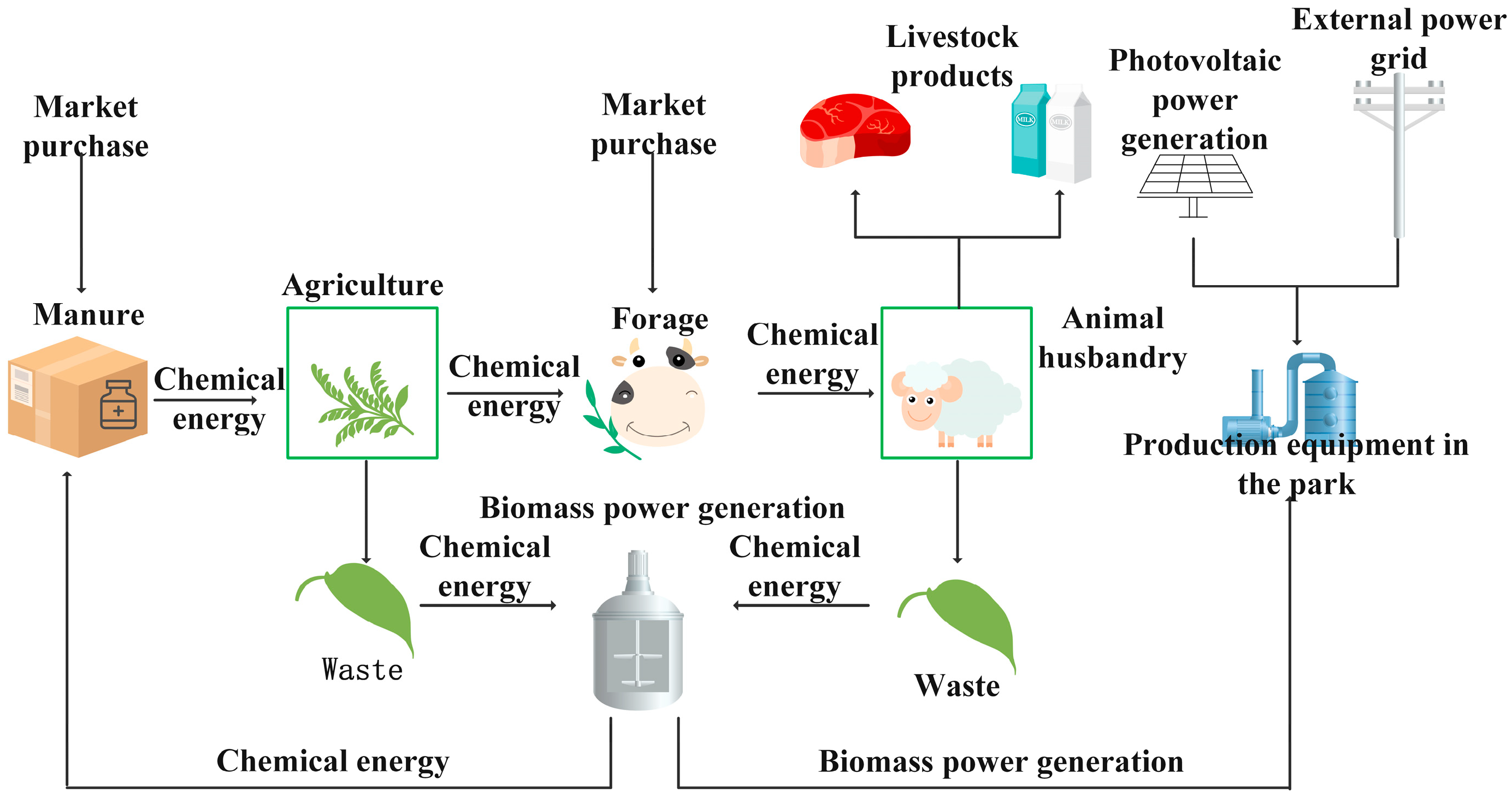
2. Problem Description
3. Load Demand Response Model Based on Carbon Trading
3.1. Demand Response Model
3.1.1. Alternative Demand Response
3.1.2. Price-Based Demand Response
3.2. Carbon Trading Model
3.2.1. Free Carbon Emission Quota Model
3.2.2. Carbon Emission Cost Model
4. Multi-Energy Collaborative Optimization Strategies for Agricultural and Pastoral Parks
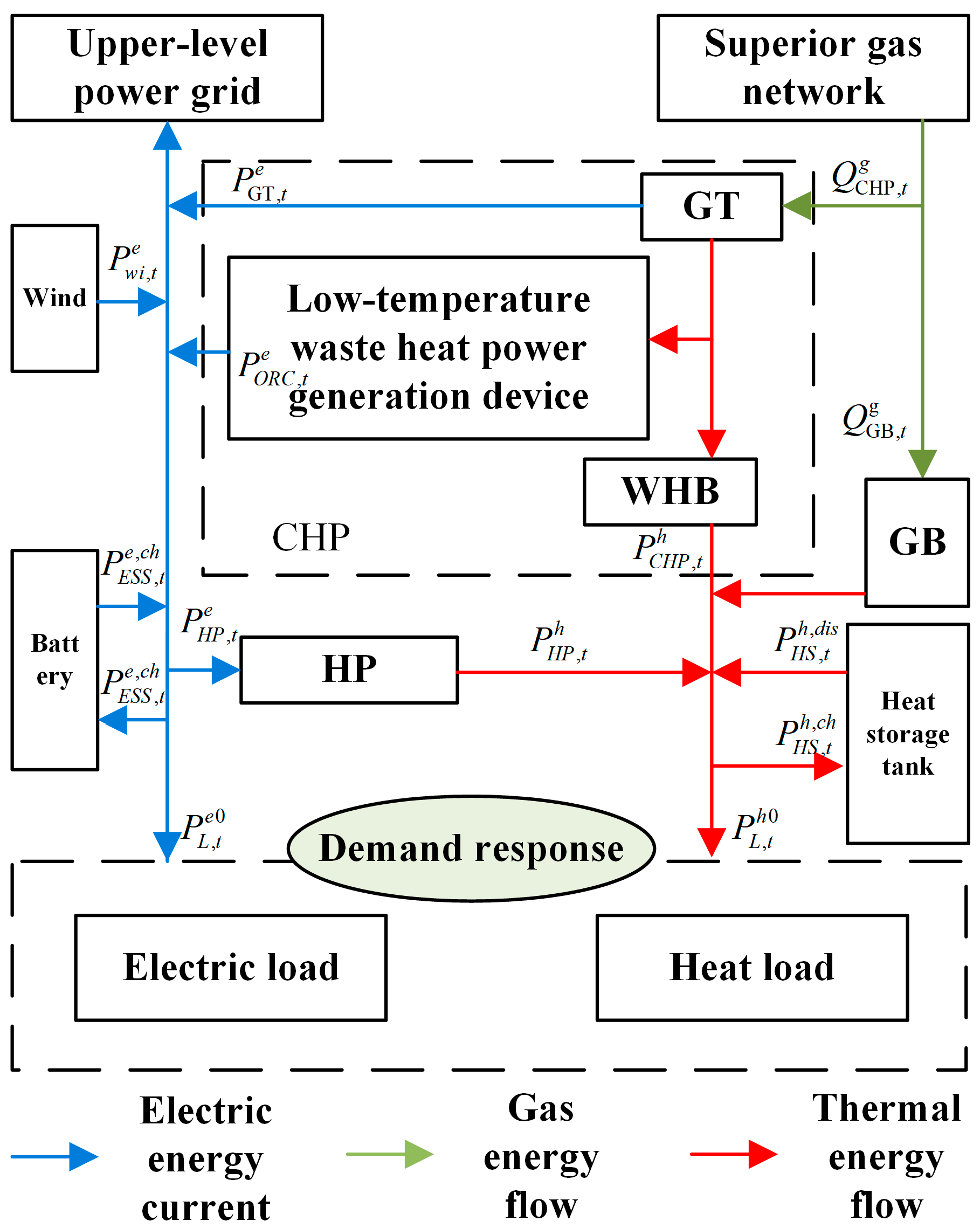
4.1. Multi-Energy Collaborative Operation Optimization Model for Parks
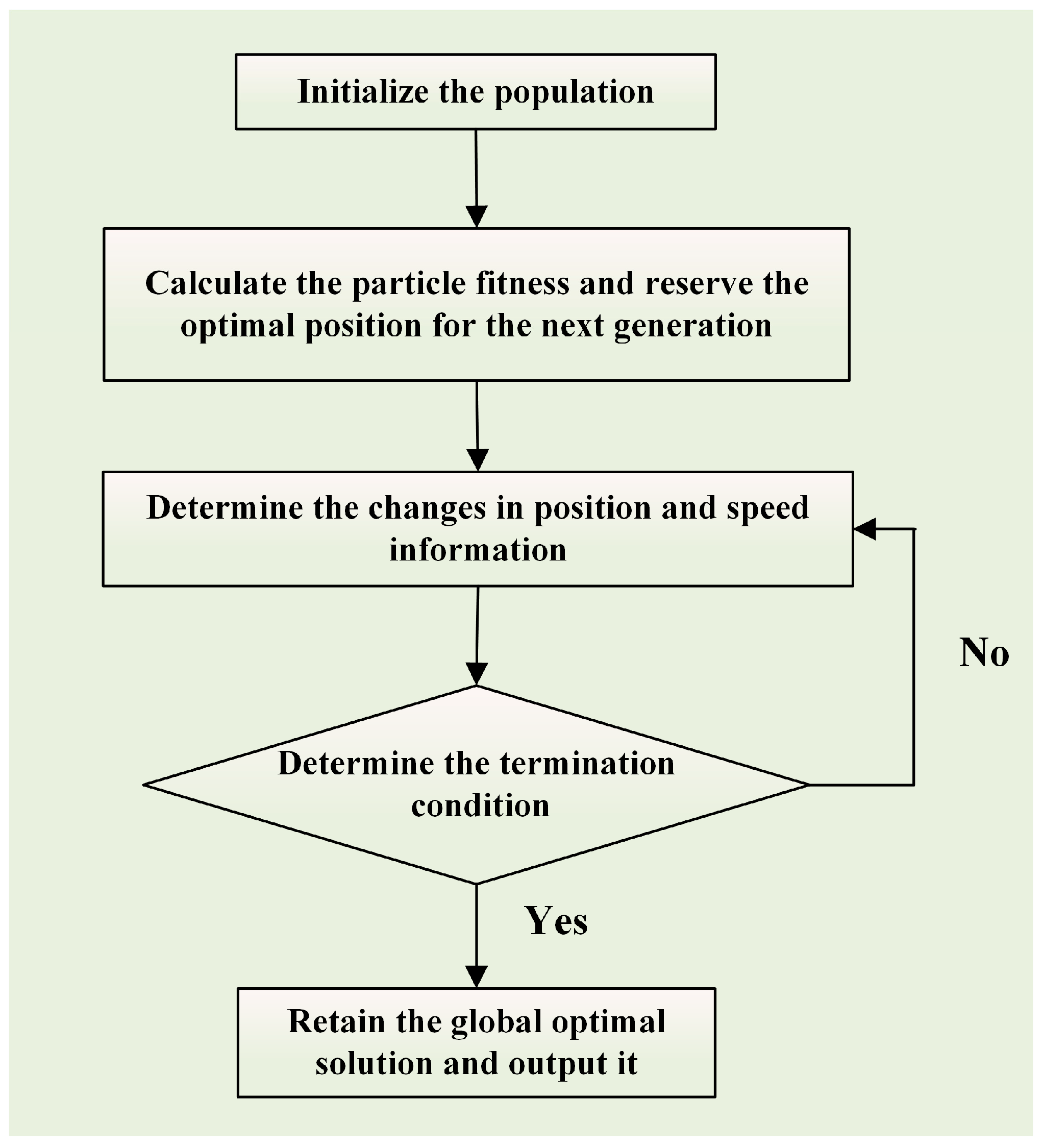
4.2. Optimization Model Solution Methods for Agricultural and Pastoral Parks
- The hourly electrical and thermal outputs of controllable units (gas boiler, biomass generator, combined heat and power unit, heat pump, etc.);
- The charging and discharging power of electrical and thermal energy storage systems;
- The demand–response adjustment of electrical and thermal loads.
- The number of iterations reaches the preset upper limit,
- Within consecutive generations, the relative change in the global best fitness is smaller than a threshold ().
5. Analysis of Calculation Examples
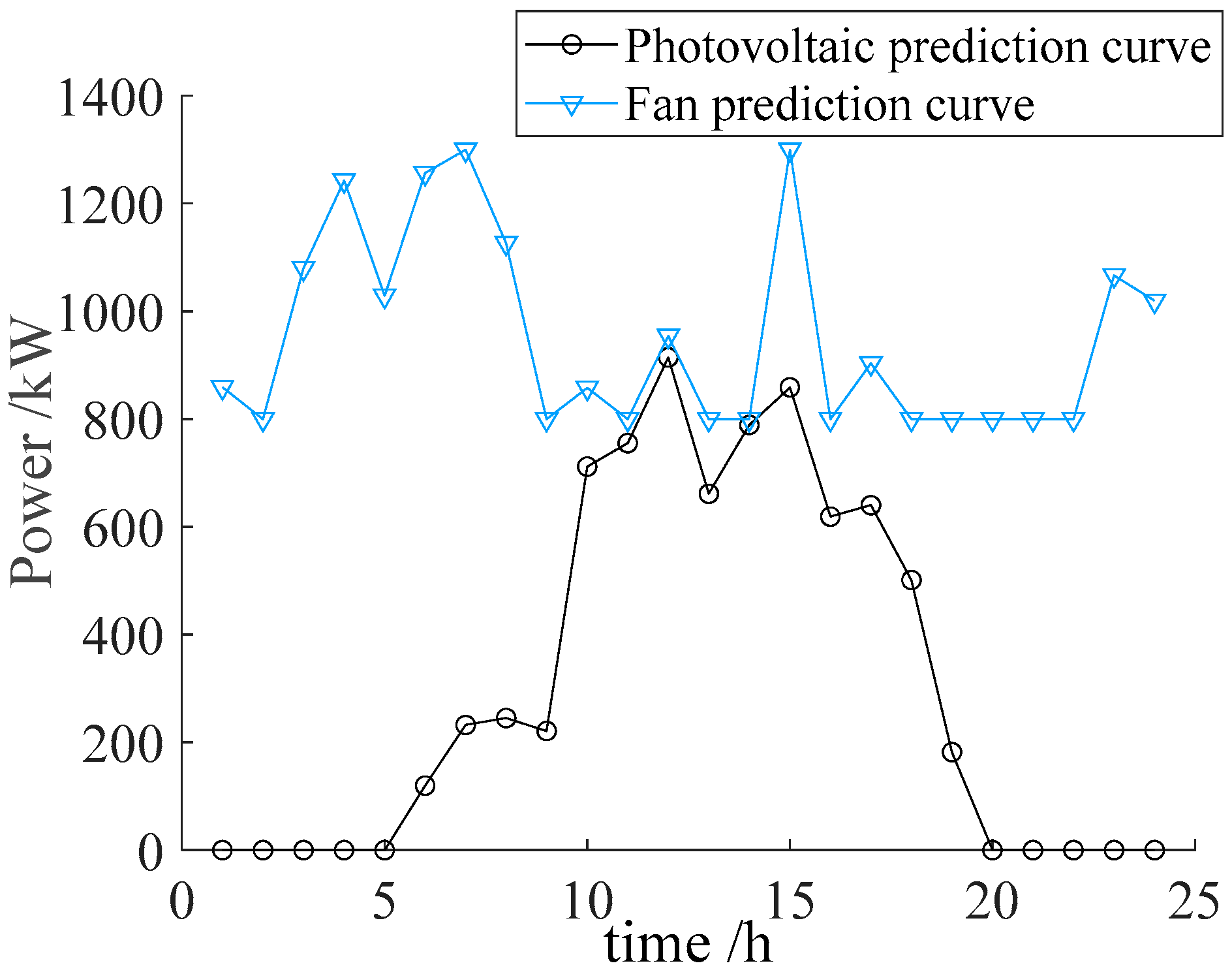
5.1. Description of the Calculation Example System
- Scenario 1: only considering the CTM;
- Scenario 2: only considering DR;
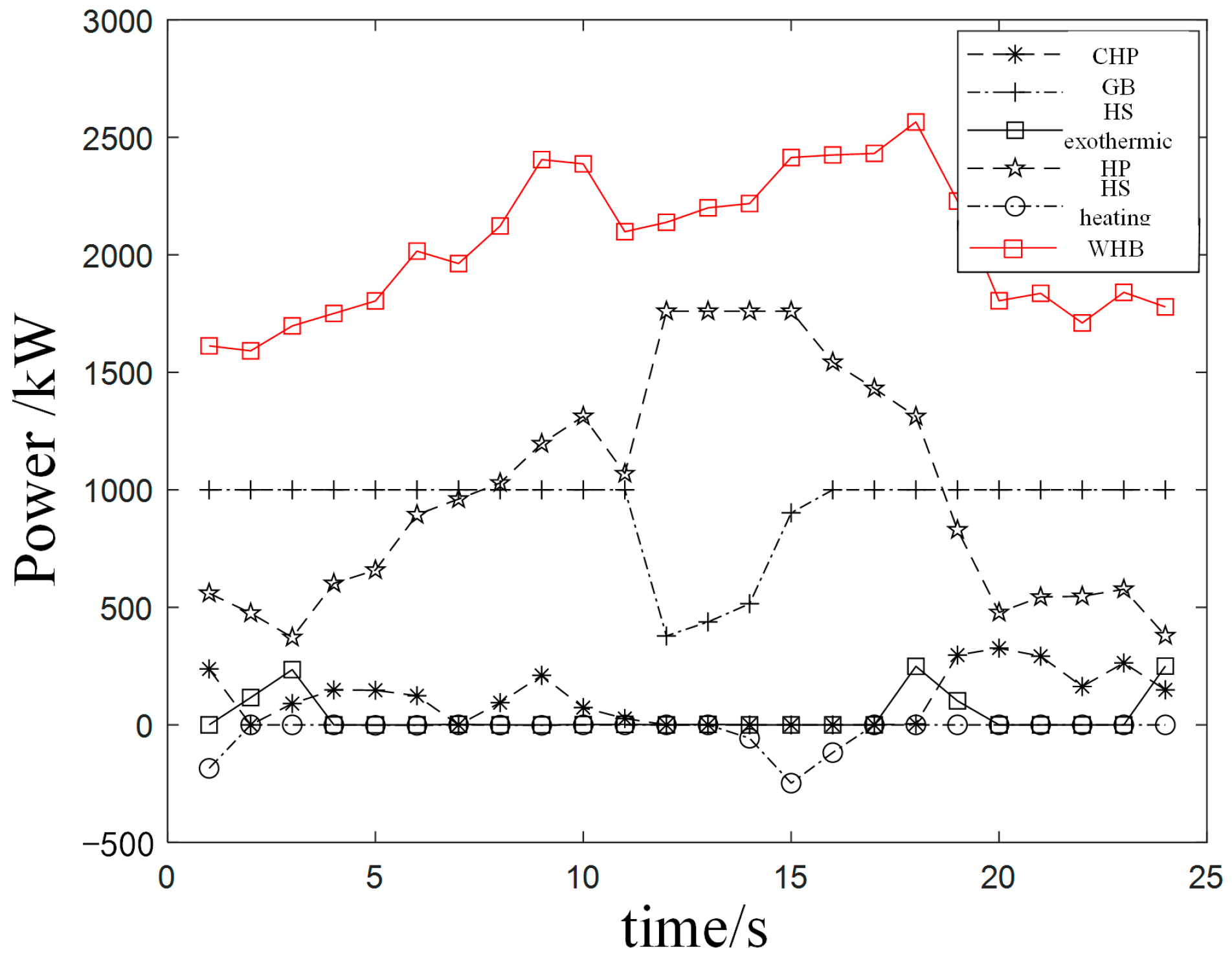
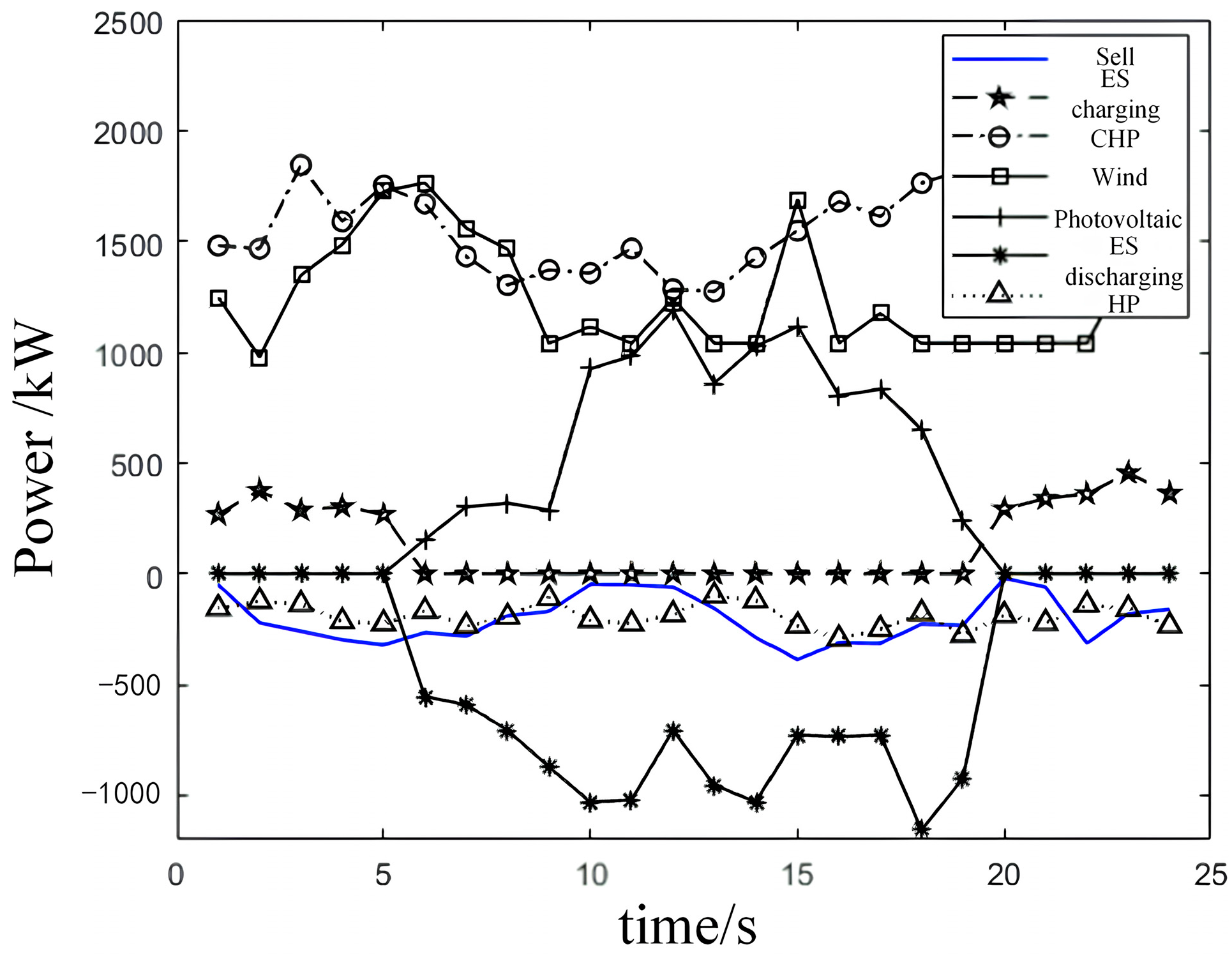
- Scenario 3: considering coordinated multi-energy optimization for both aforementioned scenarios.
- Scenario 4: high renewable energy output scenario;
- Scenario 5: low renewable energy output scenario.
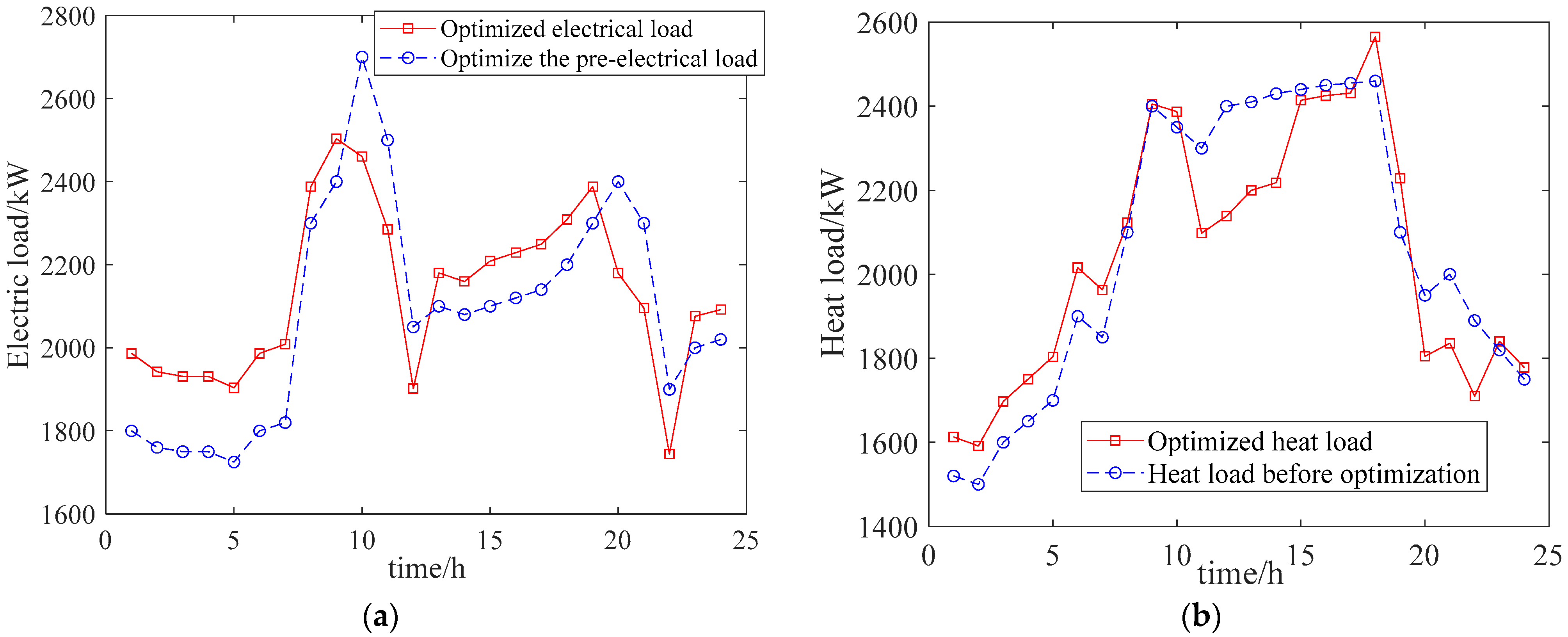
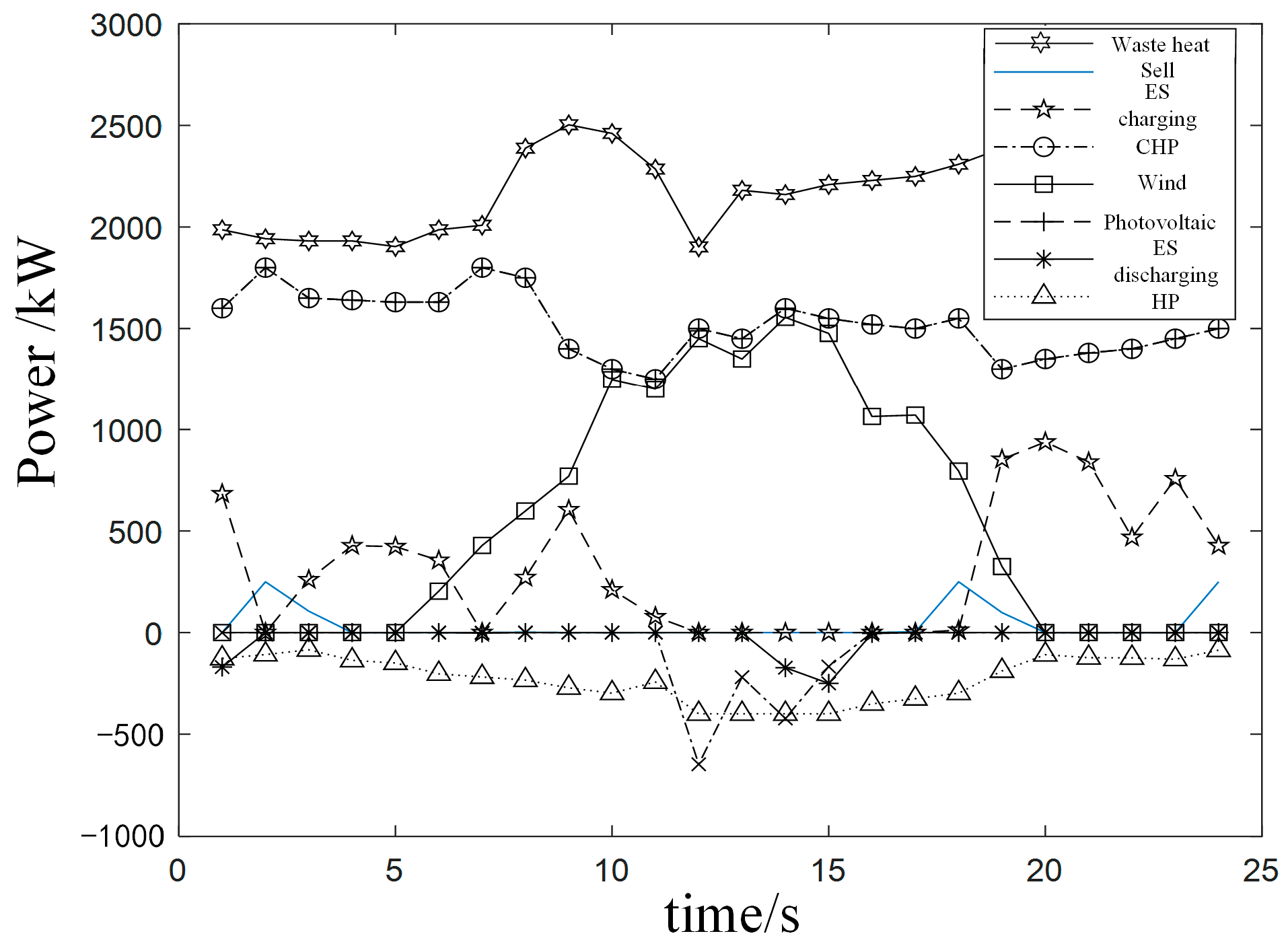
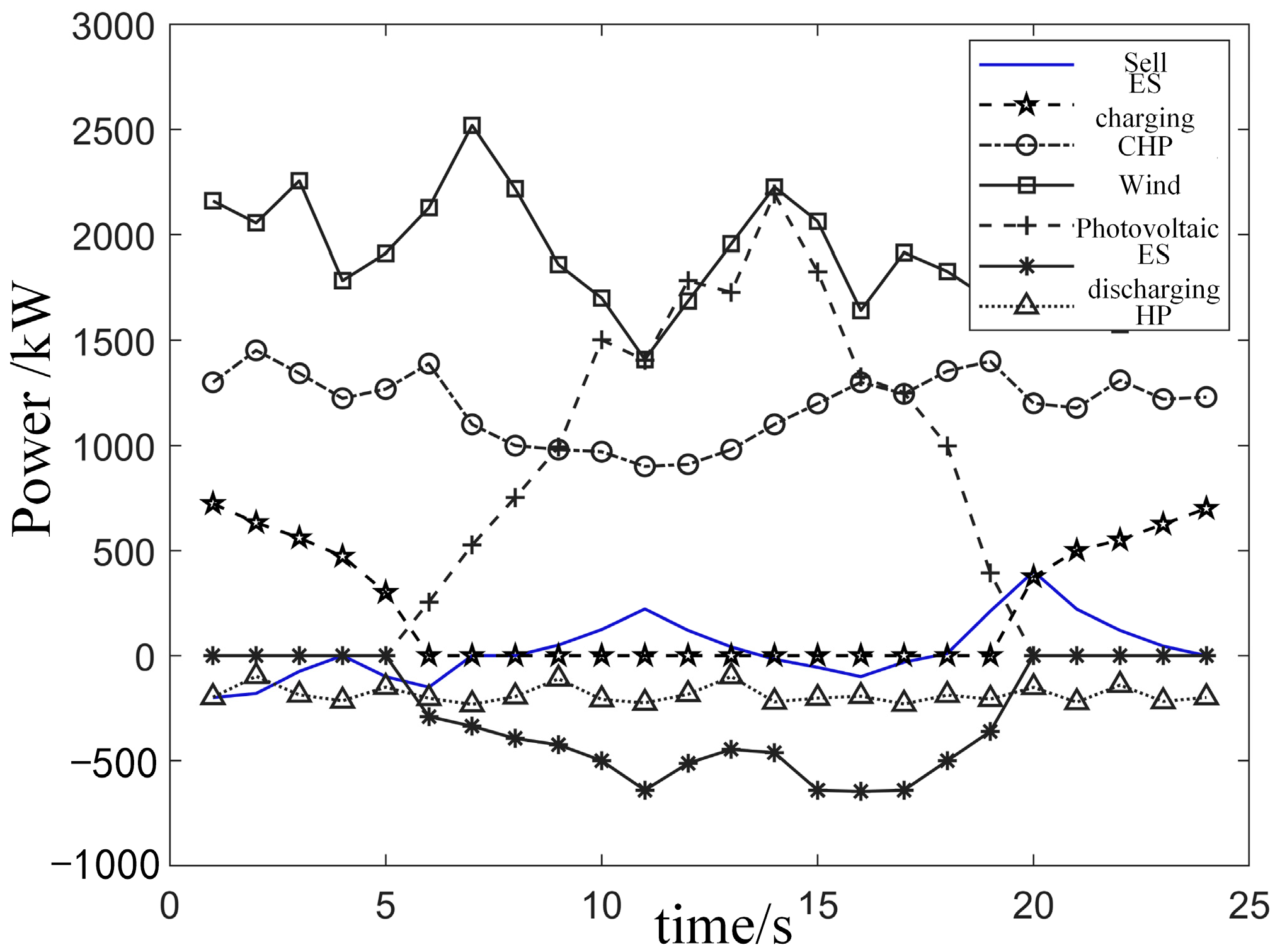
5.2. Collaborative Optimization Results
6. Conclusions
- In comparison to the pre-optimization system’s electricity and heat loads, the collaborative optimization technology facilitates the shifting of loads between different pricing periods, resulting in a smoother load curve and achieving peak shaving and valley filling effects.
- In comparison to traditional operating modes, the proposed strategy reduces operational costs by 12.6% and decreases carbon emissions by 23.3% through optimized DR allocation, validating the comprehensive benefits of multi-energy collaboration and CTMs.
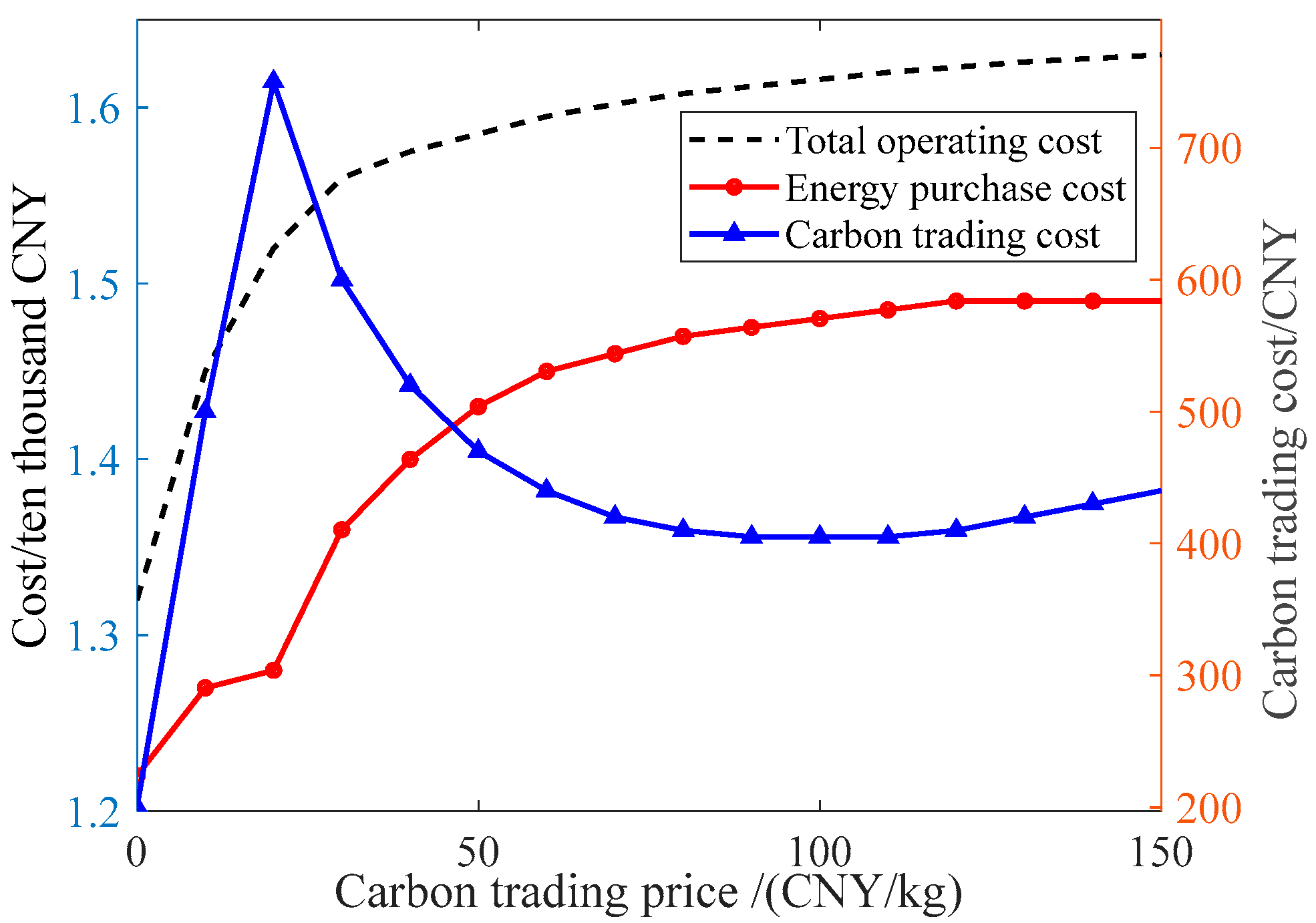
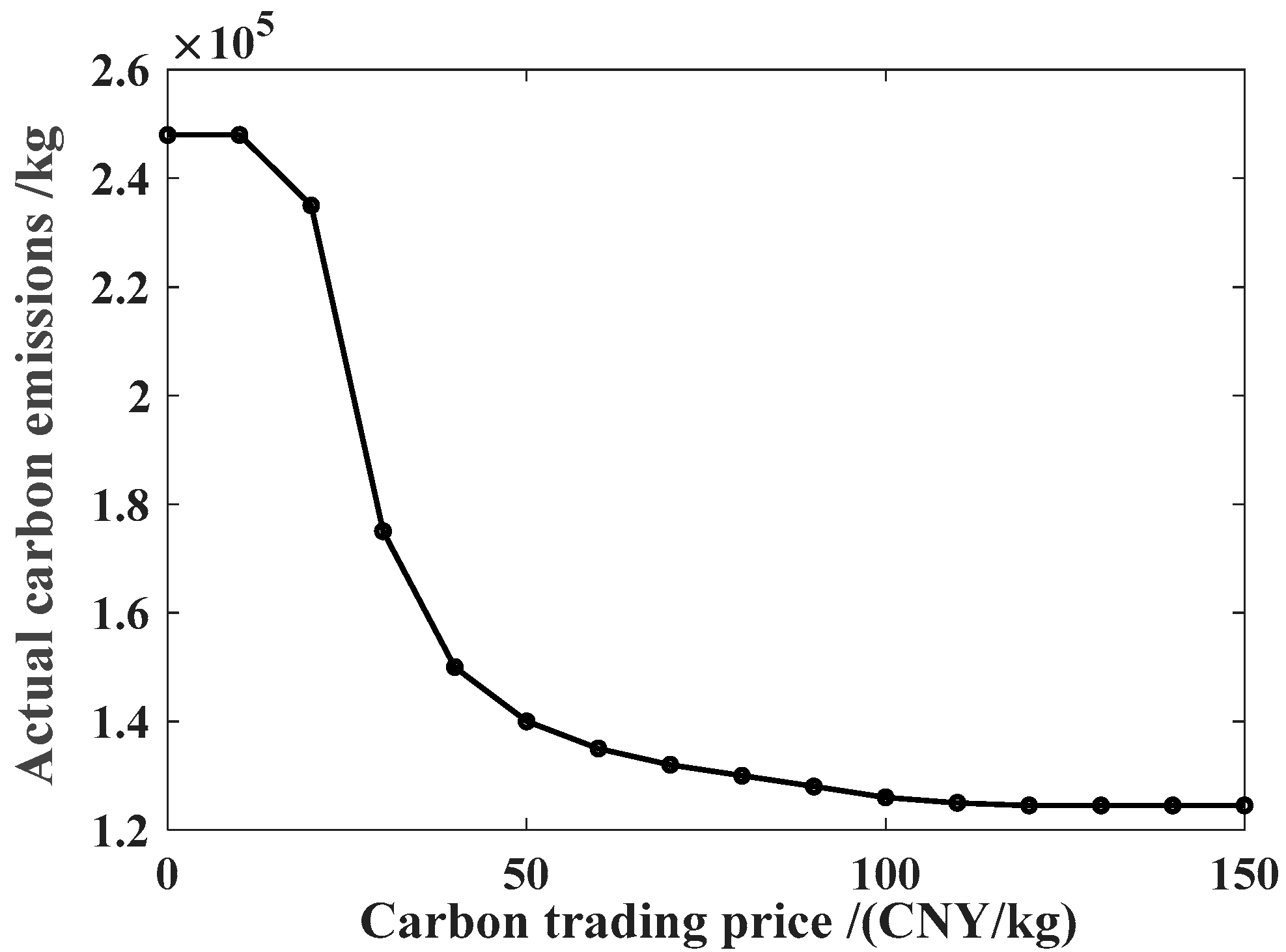
- As carbon trading prices rise and effectively reduce carbon emissions, they also lead to an increase in carbon trading costs. Different levels of carbon trading prices have varying impacts on the system’s operation costs and carbon emissions. Therefore, scientifically and reasonably setting the carbon trading price can achieve low-carbon development while considering economic benefits.
7. Discussion
- For integrated energy systems with electricity, heat, and gas demands, we will introduce gas–load demand response and a tiered carbon trading mechanism and systematically evaluate how different response structures affect operating cost and carbon emissions.
- Considering uncertainties in wind and photovoltaic outputs, biomass supply, and user responses, we will develop stochastic or robust optimization models to enhance reliability and disturbance-resilience under real operating fluctuations.
- For larger agro-industrial zones or multi-park clusters, we will explore hierarchical/zonal coordination and decomposition-based solution schemes to improve scalability and computational efficiency.
- Toward real-world deployment, we will use demonstration park data to model online elasticity identification, data acquisition limitations, and communication-infrastructure constraints, and validate online executability and control feasibility through rolling optimization or model predictive control.
Author Contributions
Funding
Data Availability Statement
Conflicts of Interest
Abbreviations
| Symbol | Definition | Unit |
| Substitutable electrical load quantity | kW | |
| Substitutable heating load quantity | kW | |
| Electrical-to-thermal conversion efficiency | \ | |
| Thermal-to-electrical conversion efficiency | \ | |
| Conversion coefficients for electrical and thermal energy forms | \ | |
| Changes in load | kW | |
| Changes in electricity price | CNY | |
| Initial values of load | kW | |
| Initial values of electricity price | CNY | |
| Elasticity coefficient of CL demand at time t in response to electricity prices at time k | \ | |
| Change in CL after optimization | kW | |
| Initial value of CL | kW | |
| Electricity price | CNY | |
| Change in SL after optimization | kW | |
| Initial value of SL | kW | |
| Elasticity coefficient of SL demand at time t in response to electricity prices at time k | \ | |
| Carbon emission quota of the system at time t | Mg/h | |
| Carbon emission quota corresponding to the regional unit’s electricity generation | Mg/(MW·h) | |
| Electrical output power of the GT at the interval | MW | |
| Thermal output power of the GT at the interval | MW | |
| Thermal output power of the GB at the interval | MW | |
| Actual carbon emissions of the system at time t | t/h | |
| Coefficients of carbon emission for the GT | Mg/(MW·h) | |
| Coefficients of carbon emission for the GB | Mg/(MW·h) | |
| Market price of carbon trading | CNY/t | |
| Bought electric power from the main grid at intervals | kW | |
| Sold electric power from the main grid at intervals | kW | |
| Amount of natural gas purchased | ||
| Buying electricity prices from the main grid at intervals | CNY/kW | |
| Selling electricity prices from the main grid at intervals | CNY/kW | |
| Natural gas unit price purchased | CNY/ | |
| Carbon trading cost | CNY | |
| Operational and maintenance costs | CNY | |
| Output power | kW | |
| Electricity consumption power of the HP | kW | |
| Thermal output power of the HP | kW | |
| Electric output power | kW | |
| Thermal output power | kW | |
| Natural gas consumption of the combined heat and power system at interval | ||
| , | Power exchange in the energy storage system | kW |
| Electricity loads before the collaborative optimization | kW | |
| Thermal loads before the collaborative optimization | kW | |
| Natural gas consumption of the GB | ||
| Thermal output power of the GB | kW | |
| , | Thermal power exchange in the thermal storage tank at interval | kW |
| Actual wind power generation at time | kW | |
| Predicted wind power generation at time | kW | |
| Electric outputs of the gas turbine | kW | |
| Thermal outputs of the gas turbine | kW | |
| Biomass waste heat utilization for power generation | kW | |
| Satisfaction levels of users regarding energy consumption patterns | \ | |
| Minimum acceptable level of energy supply service satisfaction | \ |
References
- Slameršak, A.; Kallis, G.; O’Neill, D.W. Energy requirements and carbon emissions for a low-carbon energy transition. Nat. Commun. 2022, 13, 6932. [Google Scholar] [CrossRef]
- Cui, Y.; Sun, X.B.; Fu, X.B.; Tang, Y.H.; Li, C.G. Low-carbon dispatch method of rural chemical industry integrated energy system considering power to ammonia and biomass waste energy conversion. Power Syst. Technol. 2024, 48, 3350–3360. [Google Scholar] [CrossRef]
- Zhang, X.Q.; Wang, Z.F.; Can, M.Y.; Bai, H.H.; Ta, N. Analysis of the Yield and Comprehensive Utilization Status of Crop Straw in China. J. China Agric. Univ. 2021, 26, 30–41. [Google Scholar]
- Yang, M.; Jiang, X.D.; Xu, G.W. Fully Exploiting the Comprehensive Utilization Efficiency of Biomass for Energy and Materials. China Dev. 2024, 24, 23–31. [Google Scholar] [CrossRef]
- Wu, N.; Zhan, X.; Zhu, X.; Zhang, Z.; Lin, J.; Xie, S.; Meng, C.; Cao, L.; Wang, X.; Shah, N.; et al. Analysis of biomass polygeneration integrated energy system based on a mixed-integer nonlinear programming optimization method. J. Clean Prod. 2020, 271, 122761. [Google Scholar] [CrossRef]
- Kiselev, A.; Magaril, E.; Karaeva, A. Environmental and economic efficiency assessment of biogas energy projects in terms of greenhouse gas emissions. Energ. Ecol. Environ. 2024, 9, 68–83. [Google Scholar] [CrossRef]
- Zhou, X.W.; Strunz, K.; Brown, T.; Sun, H.B.; Neumann, F. Multi-energy system horizon planning: Early decarbonisation in China avoids stranded assets. Energy Internet 2024, 1, 81–98. [Google Scholar] [CrossRef]
- Zhang, D.; Jiang, Y.Z.; Li, H.R.; Bai, J.H.; Zhang, R. Research progress in biomass coupling cogeneration systems for cooling, heating, and electricity. Trans. Chin. Soc. Agric. Eng. 2024, 40, 14–28. [Google Scholar] [CrossRef]
- Pisacane, O.; Severini, M.; Fagiani, M.; Squartini, S. Collaborative energy management in a micro-grid by multi-objective mathematical programming. Energy Build. 2019, 203, 109432. [Google Scholar] [CrossRef]
- Falope, T.; Lao, L.; Hanak, D.; Huo, D. Hybrid energy system integration and management for solar energy: A review. Energy Convers. Manag. X 2024, 21, 100527. [Google Scholar] [CrossRef]
- Lu, Y.; Lu, C.P.; Xu, W.; Yang, F. Design and Research of Multi energy Complementary Microgrid System with Pumped Storage Power Station. Shandong Electr. Power 2023, 50, 34–40. [Google Scholar] [CrossRef]
- Geng, J.; Jin, Y.L.; Yang, Y.F.; Cao, J.; Wu, X.J. Research on the optimization of daily operation of virtual power plants considering peak shaving auxiliary services. Shandong Electr. Power 2024, 51, 44–52. [Google Scholar] [CrossRef]
- Tang, X.; Yuan, F.; Dai, Y.; Liu, W.M.; Zhang, H. A comprehensive energy system optimization scheduling model that takes into account the tiered carbon trading mechanism and load response. Shandong Electr. Power 2024, 51, 74–84. [Google Scholar] [CrossRef]
- Gao, J.W.; Luo, Y.B.; Kong, L.Q.; Fang, S.D.; Niu, T.; Chen, G.H.; Liao, R.J. A two layer energy management method for distributed ship energy storage system with state coupling constraints. Proc. CSEE 2025, 45, 2500–2514. [Google Scholar] [CrossRef]
- Wang, X.Y.; Zhang, W.Y. Exergoeconomic analysis of integrated energy systems of power to gas-carbon capture power plant. Power Gener. Technol. 2024, 1, 1–11. [Google Scholar]
- Chen, F.X.; Yan, X.Y.; Shao, Z.G.; Li, Y.M.; Zheng, X.H.; Zhang, H. Review on modeling and energy flow calculation methods for integrated energy systems. High Volt. Eng. 2024, 50, 1376–1391. [Google Scholar] [CrossRef]
- Li, Y.Z.L.; Han, X.Q.; Li, T.J.; Zhou, X.; Xiao, C. A multifaceted low-carbon trading approach for integrated energy systems accounting for dynamic electricity-carbon demand response. Autom. Electr. Power Syst. 2024, 48, 24–35. [Google Scholar] [CrossRef]
- Wang, S.X.; Zheng, W.T.; Zhao, Q.Y.; Wang, X. Source-load low-carbon economic dispatch method for hydrogen multi-energy system based on mutual recognition of carbon-green certificates and electric and thermal flexible loads. High Volt. Eng. 2024, 51, 1–12. [Google Scholar] [CrossRef]
- Zhu, J.Z.; Dong, H.J.; Li, S.L.; Zhong, Z.Y.; Chen, Z.Y.; Wu, W.L. Review of optimal dispatching for the aggregation of micro-energy grids based on distributed new energy. Proc. CSEE 2024, 44, 7952–7970. [Google Scholar] [CrossRef]
- Hu, Y.M.; Chen, B.; Li, M.; Zhong, J.; Li, W.; Xiao, Y. Research on Multi Objective Load Optimization of Mother Control Cogeneration System Based on EBSILON. Shandong Electr. Power 2024, 51, 61–67. [Google Scholar] [CrossRef]
- Li, Z.; Min, S.S.; Hu, M. Overview of the current situation of biomass gasification power generation in China. Power Syst. Eng. 2020, 36, 11–13. [Google Scholar]
- Wang, Y.K.; Zhang, G.C.; Wang, X.X.; Deng, L.; Zhou, L.Y. Analysis of biomass gasification coupled power generation to enhance the flexibility of coal-fired units. Therm. Power Gener. 2018, 47, 77–82. [Google Scholar] [CrossRef]
- Li, Z.M.; Xu, Y. Temporally-coordinated optimal operation of a multi-energy microgrid under diverse uncertainties. Appl. Energy 2019, 240, 719–729. [Google Scholar] [CrossRef]
- Sari, K.; Balamane, W. Reducing intermittency using distributed wind energy: Are wind patterns sufficiently diversified within France? Energy 2024, 313, 133516. [Google Scholar] [CrossRef]
- Zholbaryssov, M.; Hadjicostis, C.N.; Dominguez-Garcia, A.D. Fast coordination of distributed energy resources over time-varying communication networks. IEEE Trans. Autom. Control 2022, 68, 1023–1038. [Google Scholar] [CrossRef]
- Zhao, J.; Huang, K.R.; Gao, Y.; Bian, X.Y.; Zhang, K.; Li, D.D. Coordinated scheduling optimization for Computility center microgrid considering computing resources dynamic pooling. Appl. Energy 2025, 393, 719–729. [Google Scholar] [CrossRef]
- Darwin, A.Q.; Morteza, V.; Mohammad, S.J.; Antonio, P.F.; João, P.S.C. A Price-Based Strategy to Coordinate Electric Springs for Demand Side Management in Microgrids. IEEE Trans. Smart Grid 2023, 14, 400–412. [Google Scholar] [CrossRef]
- Kumar, A.; Singh, A.R.; Deng, Y.; He, X.N.; Kumar, P.; Bansal, R.C. A novel methodological framework for the design of sustainable rural microgrid for developing nations. IEEE Access 2018, 6, 24925–24951. [Google Scholar] [CrossRef]
- Zhao, C.Q.; Zhang, G.J.; Lv, J. Application of energy-carbon flow charts in high-tech industrial park. Procedia Eng. 2017, 24, 231–252. [Google Scholar] [CrossRef]
- Cai, Q.Q.; Yi, Z.K.; Xu, Y.; Zhu, Y.Q.; Ding, Z.H.; Xi, M.F.; Zhu, X.C.; Rong, S.; Sun, Y.; Kuang, H.H. A generalised dynamic energy flow model in multi-energy network. Energy Internet 2024, 1, 176–187. [Google Scholar] [CrossRef]
- Xie, S.C.; Chen, C.H.; Li, L.; Huang, C.; Cheng, Z.; Lu, J. 2006 China energy flow chart. Energy China 2009, 31, 21–23. [Google Scholar] [CrossRef]







| Parameter | Symbol | Value |
|---|---|---|
| Swarm size | 100 | |
| Max. iterations | 150 | |
| Max./Min. inertia weight | 0.9/0.4 | |
| Cognitive learning factor | 1.5 | |
| Social learning factor | 2 | |
| Stall generations for convergence | 20 |
| Equipment Name | Parameter Name | Value |
|---|---|---|
| Gas Turbine (GT) | Installed Capacity/kW | 4000 |
| Electrical Efficiency | 0.3 | |
| Thermal Efficiency | 0.4 | |
| Gas-Fired Boiler (GB) | Installed Capacity/kW | 1000 |
| Efficiency | 0.9 | |
| Waste Heat Boiler (WHB) | Efficiency | 0.8 |
| Heat Pump (HP) | Installed Capacity/kW | 400 |
| Efficiency | 4.4 | |
| Biomass Waste Heat Utilization Power Generation | Installed Capacity/kW | 400 |
| Efficiency | 0.8 | |
| Curtailment Coefficient | 0.15 | |
| Heat Storage Tank (HS) | Maximum Capacity/(kW·h) | 400 |
| Initial Heat Storage/(kW·h) | 50 | |
| Charging/Discharging Efficiency | 0.95/0.9 | |
| Maximum Charging/Discharging Power/kW | 250 | |
| Energy Storage System (ES) | Maximum Capacity/(kW·h) | 400 |
| Initial Electricity Storage/(kW·h) | 80 | |
| Charging/Discharging Efficiency | 0.95/0.9 | |
| Maximum Charging/Discharging Power/kW | 250 |
| Time Period Category | Time Period Division | Electricity Price (CNY/kW·h) |
|---|---|---|
| Valley | 00:00–08:00 | 0.35 |
| Flat | 08:00–09:00 | 0.68 |
| 12:00–19:00 | ||
| 22:00–24:00 | ||
| Peak | 09:00–12:00 | 1.09 |
| 19:00–22:00 |
| Scenario Category | Total Cost/CNY | Total Profit/CNY | Total Carbon Emissions/kg |
|---|---|---|---|
| 1 | 19,314 | 37,985 | 39,664 |
| 2 | 21,034 | 35,021 | 40,972 |
| 3 | 17,846 | 39,446 | 31,418 |
Disclaimer/Publisher’s Note: The statements, opinions and data contained in all publications are solely those of the individual author(s) and contributor(s) and not of MDPI and/or the editor(s). MDPI and/or the editor(s) disclaim responsibility for any injury to people or property resulting from any ideas, methods, instructions or products referred to in the content. |
© 2025 by the authors. Licensee MDPI, Basel, Switzerland. This article is an open access article distributed under the terms and conditions of the Creative Commons Attribution (CC BY) license (https://creativecommons.org/licenses/by/4.0/).
Share and Cite
Zhang, H.; Niu, Z.; Zhao, L.; Wang, S.; He, X.; Fang, S. Synergistic Optimization Strategy for Agricultural Zone Microgrids Based on Multi-Energy Complementarity and Carbon Trading Mechanisms. Processes 2025, 13, 3998. https://doi.org/10.3390/pr13123998
Zhang H, Niu Z, Zhao L, Wang S, He X, Fang S. Synergistic Optimization Strategy for Agricultural Zone Microgrids Based on Multi-Energy Complementarity and Carbon Trading Mechanisms. Processes. 2025; 13(12):3998. https://doi.org/10.3390/pr13123998
Chicago/Turabian StyleZhang, Hailong, Zhen Niu, Linxiang Zhao, Shijun Wang, Xin He, and Sidun Fang. 2025. "Synergistic Optimization Strategy for Agricultural Zone Microgrids Based on Multi-Energy Complementarity and Carbon Trading Mechanisms" Processes 13, no. 12: 3998. https://doi.org/10.3390/pr13123998
APA StyleZhang, H., Niu, Z., Zhao, L., Wang, S., He, X., & Fang, S. (2025). Synergistic Optimization Strategy for Agricultural Zone Microgrids Based on Multi-Energy Complementarity and Carbon Trading Mechanisms. Processes, 13(12), 3998. https://doi.org/10.3390/pr13123998