You are currently viewing a new version of our website. To view the old version click .
Processes
  • Article
  • Open Access

8 December 2025

Day-Ahead Economic Dispatch Optimization for Industrial Consumers Utilizing Shared Energy Storage Stations

,
,
,
,
and
1
Hubei East Lake Laboratory, Wuhan 430202, China
2
National Key Laboratory of Electromagnetic Energy, Naval University of Engineering, Wuhan 430030, China
3
State Grid Henan Electric Power Research Institute Co., Ltd., Zhengzhou 450052, China
4
School of Electrical and Electronic Engineering, Huazhong University of Science and Technology, Wuhan 430074, China
This article belongs to the Special Issue Modeling, Simulation and Control in Energy Systems—2nd Edition

Abstract

With the transition of power systems toward a high penetration of renewable energy and multi-user collaborative operation, issues related to load fluctuations and grid stability have become increasingly prominent. As a centralized energy infrastructure, a shared energy storage system (SESS) can enhance the utilization efficiency of storage resources through centralized configuration and coordinated scheduling among multiple users. This study focuses on four typical industrial user load profiles and four representative renewable power stations within an industrial park in Jiangsu Province, China. A day-ahead economic dispatch method based on a shared battery energy storage station is proposed for industrial users, integrating actual operational data from 2024 with a tiered electricity tariff scheme to minimize the total daily operating cost of the user group. Four operational scenarios are constructed: (1) no energy storage, (2) independent battery energy storage for each user, (3) shared battery energy storage, and (4) shared battery–flywheel hybrid energy storage. Typical-day load curve simulations are performed for each case. The results indicate that shared battery energy storage can significantly reduce daily operating costs and improve resource utilization, achieving a 4.1% reduction in total cost compared with an independent storage configuration for each user. The shared battery–flywheel hybrid storage demonstrates millisecond-level responses to second-level high-frequency power fluctuations, effectively lowering peak demand and smoothing the power curve for high-fluctuation users. Compared with shared battery-only storage, the hybrid scheme achieves a 4.6% reduction in peak-period electricity purchase costs, a 0.6% reduction in total electricity consumption, and a 0.39% decrease in overall system operating costs. The proposed method and hybrid storage topology outperform conventional configurations in both technical performance and economic benefits, providing theoretical and empirical support for engineering applications of shared energy storage under high-frequency fluctuation load scenarios.

1. Introduction

In response to climate change, the global energy transition is advancing at an unprecedented pace. Renewable energy sources, particularly wind power and photovoltaics, are assuming an increasingly dominant role in next-generation power systems [1,2]. However, the large-scale integration of renewables—given their inherent intermittency and variability—reduces controllability on the generation side [3]. Meanwhile, the demand side exhibits heightened uncertainty and stochasticity due to growing electricity consumption and the widespread deployment of distributed energy resources. The superposition of these two-sided uncertainties substantially increases the complexity of secure and stable power system operation, thereby creating an urgent need for flexible regulation resources [4].
Against this backdrop, energy storage technology has emerged as a pivotal flexibility resource due to its configurable nature and diverse application scenarios across the generation, transmission, and consumption domains. Energy storage can be extensively applied to frequency regulation, peak shaving, renewable energy fluctuation mitigation, demand-side response, and reliability enhancement, playing a critical role in advancing renewable energy consumption and facilitating the construction of the energy internet [5,6].
For industrial consumers, electricity expenditure constitutes a major share of operating costs [7]. Deploying behind-the-meter energy storage systems (BESSs) to conduct time-of-use (peak–valley) price arbitrage can not only reduce electricity expenses but also alleviate system peaking requirements, thereby lowering carbon emissions from fossil-fuel units and increasing the penetration of renewable energy resources [8,9].
However, the widespread adoption of behind-the-meter energy storage systems (ESSs) is hindered by high upfront capital costs, long payback periods, and low utilization in single-user deployments [10,11]. These factors dampen individual investment incentives and impede the full realization of storage value.
To overcome these limitations, the sharing-economy concept has been introduced into the energy storage domain, giving rise to the shared energy storage station (SESS) model [12,13]. Under this model, specialized operators invest in, own, and operate centralized storage facilities or aggregate distributed storage resources to provide capacity and services to multiple independent users. By exploiting temporal complementarity among user load profiles and accommodating the variability in renewable generation, SESSs can significantly improve asset utilization, reduce individual user costs, and yield synergistic benefits that exceed simple aggregation. Nevertheless, the economic viability and large-scale deployment of SESSs hinge on sound capacity sizing, optimal dispatch strategies, and equitable revenue allocation mechanisms—issues that warrant systematic investigation.
This study focuses on an industrial park in Jiangsu Province, China, and considers four representative industrial user load profiles—bimodal (food processing), evening-peak (iron and steel smelting), steady (chemical industry), and highly volatile (railway traction)—together with four typical renewable resources (photovoltaic, wind, biomass, and hydropower). Using actual operating data from 2024, we derive representative daily power profiles. Based on the peak–flat–valley time-of-use tariffs for industrial users issued by the Jiangsu Provincial Development and Reform Commission, we introduce a shared energy storage station (SESS) for this user group and formulate a day-ahead economic dispatch model for optimal capacity sizing, aiming to minimize the aggregate daily operating cost. The results show that, with SESS integration, industrial users reduce the share of direct purchases during peak-price periods and increase purchases or charging during valley-price periods, thereby reducing the peak–valley gap; high-price purchases induced by power fluctuations are markedly curtailed. Under different renewable generation mixes, the SESS significantly improves the economic efficiency of user-side scheduling and enhances the overall flexibility and adaptability of the system.
By comparing four operating scenarios (no storage, standalone battery storage, shared battery storage, and shared battery–flywheel hybrid storage), we validate the significant advantages of shared storage in reducing daily operating costs and improving asset utilization. With shared storage integration, the total operating cost decreases by 14.0% relative to the no-storage baseline, and grid electricity purchases decline by 41.4%, thereby alleviating peak-load stress on the bulk power system. For highly volatile loads (e.g., railway traction), a battery–flywheel hybrid storage system, benefiting from a millisecond-level response, effectively trims peak demand and suppresses transient grid disturbances; compared with shared battery storage alone, the peak-period purchase cost decreases by 4.6%, total electricity procurement falls by 0.6%, and the system-wide operating cost drops by 0.39%. The hybrid configuration also mitigates high-frequency cycling stress on the battery subsystem and delivers notable life-cycle economic benefits.
Although this case study draws on industrial load profiles, renewable resources, and a peak–flat–valley time-of-use tariff specific to an industrial park in Jiangsu Province, China, the proposed economic dispatch model is broadly applicable. By substituting power profiles, adjusting the TOU tariff structure, and updating energy storage cost parameters, the model can be readily adapted to other countries and regions. It can thus provide grid planning authorities and generation companies with a scientific, quantitative basis for capacity sizing and investment decisions in grid and energy storage projects.
The remainder of this study is organized as follows. Section 2 provides a literature review, summarizing relevant studies. Section 3 formulates a day-ahead economic dispatch model for optimal capacity sizing of shared energy storage, accounting for the power characteristics of industrial loads and renewable generation. Section 4 compares daily operating costs across four operating scenarios and evaluates life-cycle economic benefits. Section 5 presents the conclusions of this study.

2. Literature Review

Research on economic dispatch and shared storage for industrial users has evolved along two major directions:
(1) Industrial users, renewable energy modeling, and energy storage demand response: In specific industrial applications, Golmohamadi Hessam et al. [14] targeted cement plants, and Zhang Xiao et al. [15] focused on electric arc furnace loads in steel plants, each proposing novel industrial optimization dispatch models to enhance power system flexibility and reduce energy consumption. Collaborative operation of multi-energy systems and storage: Wang T et al. [16] modeled an integrated wind–solar–biogas–energy storage system and aimed to maximize the daily operational economic benefit. They employed a multi-population genetic algorithm to simulate the performance of a novel wind–solar–storage system under four typical weather scenarios, thereby validating the feasibility of the proposed model. Ahmed F et al. [17] addressed the dynamic load characteristics of base stations powered by photovoltaic and wind energy and proposed an inter-base-station energy cooperation scheme. Yan D X et al. [18] introduced a distributed online optimization model adaptable to multiple scenarios, aiming to cope with the fluctuations in renewable generation and charging loads.
(2) Planning, operation, and benefit allocation in shared storage: Awnalisa Walker et al. [19] compared the operational performance of a decentralized energy storage scenario with that of a shared energy storage scenario having the same total storage capacity. Their results showed that shared energy storage can reduce electricity costs by approximately 14% and increase utilization rates by about 40%. Pratyush Chakraborty et al. [20] investigated the energy allocation problem for users jointly investing in shared energy storage stations (SESSs), applying cooperative game theory in their modeling approach. They demonstrated that cooperative shared energy storage is highly beneficial for both all participating users and society as a whole. Giordano et al. [21] proposed an IoT-enabled community energy sharing model, emphasizing that reasonable energy storage sizing is crucial for enhancing self-consumption rates and reducing costs. Wang H L et al. [22] introduced a hierarchical optimization control strategy for regulating HVAC systems in buildings, providing frequency regulation services while simultaneously considering operational costs and occupant comfort. Wei Congying et al. [23] proposed a bi-level scheduling model designed to aggregate large numbers of distributed temperature-controlled loads and renewable energy sources. In this framework, the upper level optimizes the energy exchange curve of the power grid to reduce imbalance costs in the intraday market, while the lower level performs real-time tracking of the optimized power curve to meet scheduling objectives. J. J. Li et al. [24] designed an optimized operational framework and dynamic hierarchical strategy for centralized shared energy storage stations. They applied a cooperative model based on Nash bargaining in conjunction with the Alternating Direction Method of Multipliers (ADMM) algorithm to enhance storage utilization and the renewable energy absorption rate. A. Miao et al. [25] incorporated shared energy storage into a campus integrated energy system to achieve low-carbon economic dispatch, comparing four typical application scenarios and demonstrating notable carbon reduction and economic benefits. L. Li et al. [26] proposed a two-stage stochastic dispatch model for power systems considering both shared energy storage and renewable energy, addressing the uncertainty issues associated with their integration. Yu Yang et al. [27] investigated the planning, operation, and cost allocation of shared energy storage under non-cooperative pricing mechanisms, encompassing auction theory and Stackelberg game frameworks. Bizzat Hussain Zaidi et al. [28] constructed a scenario in which households bid for shared storage capacity through an auctioneer and proposed a combinatorial auction mechanism. They compared the battery capacity allocated under combinatorial auctions with Vickrey auctions and sequential auctions, demonstrating that the combinatorial auction enables households to acquire greater storage capacity. Mingtao Ma et al. [29] employed a bi-level nested genetic algorithm, where the upper-level model maximizes the benefits of all participating entities and the lower-level model minimizes the total system operational cost, thereby achieving coordinated optimization of capacity planning and operational strategies. Pei Huang A et al. [30] introduced a hierarchical design methodology for storage capacity in shared energy communities, treating all distributed batteries as a single virtual “shared” battery. They utilized a genetic algorithm to search for the optimal capacity, aiming to reduce installed capacity and minimize energy losses during the sharing process. MA L et al. [31] developed a bi-level optimization model aiming to minimize the total investment cost of industrial users, incorporating electricity bill reduction and demand response to improve scheduling economics. Yu Mengmeng et al. [32] developed a transaction framework for demand response resources between multiple service providers and multiple end customers based on a multi-leader multi-follower Stackelberg game. Through the Stackelberg game mechanism, service providers and customers are guided to strike an optimal balance between incentives and load reduction, thereby achieving efficient allocation of demand response resources. Nagpal H et al. [33] introduced a quantification model for local flexible loads to participate in grid ancillary services, achieving the dual objectives of local energy optimization and system support.
Although prior studies have yielded valuable insights into ESS deployment and the operation of shared storage, notable gaps remain for industrial-park settings with diverse user profiles:
(1) Insufficient modeling of industrial-load heterogeneity, hampering accurate matching between storage needs and production modes. Many studies homogenize industrial users or examine a single user type, lacking a systematic characterization of continuous-, intermittent-, and high-power-fluctuation users in terms of load shapes, demand elasticity, and storage requirements. This limits the generalizability and external validity of the resulting models in practice.
(2) Underexplored flexibility value of shared storage and a lack of joint optimization that balances fairness and economic efficiency in capacity sizing and revenue allocation. Much of the literature centers on single-value streams (e.g., peak–valley arbitrage) without fully capturing the integrated flexibility of shared storage for smoothing user-side fluctuations, providing shared reserves, and optimizing cluster energy management. As a result, overall benefits are underestimated, and integrated frameworks tailored to industrial-park user groups that couple day-ahead scheduling with economic analysis remain scarce.
To address these two gaps, this study selects four representative industrial user types in an industrial park in Jiangsu Province, China—bimodal load (food processing), evening-peak load (iron and steel smelting), steady load (chemical industry), and highly volatile load (railway traction)—together with four renewable resources (photovoltaic, wind, biomass, and hydropower). By comparing four operating scenarios (no storage, standalone battery storage, shared battery storage, and shared battery–flywheel hybrid storage), we validate the significant advantages of shared storage in reducing daily operating costs and improving asset utilization.

3. Methodology and Analysis

This chapter first introduces the concept and operating modes of a shared energy storage station (SESS) and the peak–flat–valley time-of-use (TOU) tariff scheme for industrial users issued by the Jiangsu Provincial Development and Reform Commission. We then focus on a local industrial park and select four representative industrial load profiles—bimodal (food processing), evening-peak (steel smelting), steady (chemical), and highly volatile (railway traction)—together with four typical renewable resources (PV, wind, biomass, and hydropower).
Using actual operating data from 2024, we construct representative power profiles. Based on this user group, we integrate an SESS (see Figure 1) and formulate a day-ahead economic dispatch model for optimal capacity sizing of the shared storage system, aiming to minimize the user group’s total daily operating cost.
Figure 1. Schematic diagram of industrial users, renewable power plants, and the shared energy storage station within the industrial park.

3.1. Shared Energy Storage Station Concept and Operation Mode

A shared energy storage station (SESS) is a centrally deployed storage facility that a professional operator finances, builds, operates, and dispatches to serve multiple users within the same distribution network area. Leveraging capital strength and economies of scale, the operator deploys large-capacity storage under unified O&M, enabling users to access storage capacity on demand for charging and discharging without investing in dedicated systems.
In this model, users obtain access to storage capacity by paying a service fee to the SESS, billed on energy throughput (the sum of charged and discharged energy, kWh). Compared with stand-alone self-owned storage, the shared model relaxes both capacity and temporal constraints, markedly increasing utilization and improving overall cost-effectiveness.
In an industrial-park SESS, users first submit load forecasts, and the operator allocates charge–discharge services to achieve peak shaving and demand limiting. Within each settlement cycle, users may simultaneously procure power from the grid and transact storage services via the SESS. When some users request charging while others request discharging in the same interval, the system prioritizes a virtual matching platform to net exchanges directly among participants, bypassing physical storage. This platform functions as loss-free “virtual storage” (efficiency = 1), avoiding round-trip losses. Physical storage then serves only the residual net demand after offsetting, thereby improving overall operating efficiency.
Fees are settled daily. Meters at each user–SESS point of interconnection continuously record energy injected (Q1) and withdrawn (Q2); charges are based on energy throughput Q1 + Q2 over the settlement cycle, in accordance with the agreed tariff. Using historical data, users can forecast loads and devise charge–discharge plans to minimize operating costs. Under the shared model, end users avoid the CAPEX and O&M obligations of owning storage assets, thereby reducing financial burdens.
The operator maintains a central control center at the SESS and dynamically schedules against the real-time aggregated net demand; when the net demand is positive (charging), energy is stored, and when negative (discharging), energy is released to supply the loads. For capacity sizing, aggregated planned charge–discharge power profiles over the settlement cycle are used to determine the required energy capacity and maximum charge/discharge power ratings while enforcing an end-of-cycle state of charge (SOC) equal to the initial level to ensure seamless rollover into the next cycle.
By leveraging load complementarities across time (intra-user diversity) and across users at the same time (inter-user diversity), the operator can optimally size storage and mitigate idle capacity and underutilization. Centralized deployment delivers strong economies of scale: the unit cost per kWh of capacity for large SESS installations is significantly lower than for distributed systems, thereby reducing total investment, shortening payback periods, and improving equipment/asset utilization [34].

3.2. Classification of Industrial User Loads and Energy Storage Configuration Requirements

In industrial parks in Jiangsu Province, China, users exhibit pronounced heterogeneity in electricity consumption, manifested not only in peak–valley patterns and fluctuation frequency but also in underlying differences in production processes, shift schedules, and business attributes [35]. Consequently, optimal SESS configuration must explicitly account for and leverage this heterogeneity to maximize capacity utilization and shorten the investment payback period [36]. Based on daily load-curve patterns, typical industrial scenarios can be grouped into four types: bimodal (dual-peak), night-peak, flat, and highly fluctuating. This taxonomy spans a spectrum from regular diurnal peaks and troughs to high-frequency, short-duration volatility [37].
A joint analysis of industrial load characteristics and renewable output profiles yields the storage utilization requirements, providing the basis for differentiated capacity sizing (energy and power) and operational strategies for the SESS. Leveraging inter-user load complementarity and the storage system’s flexibility, operators can achieve system-wide economic optimization across multiple users and diverse scenarios [38].
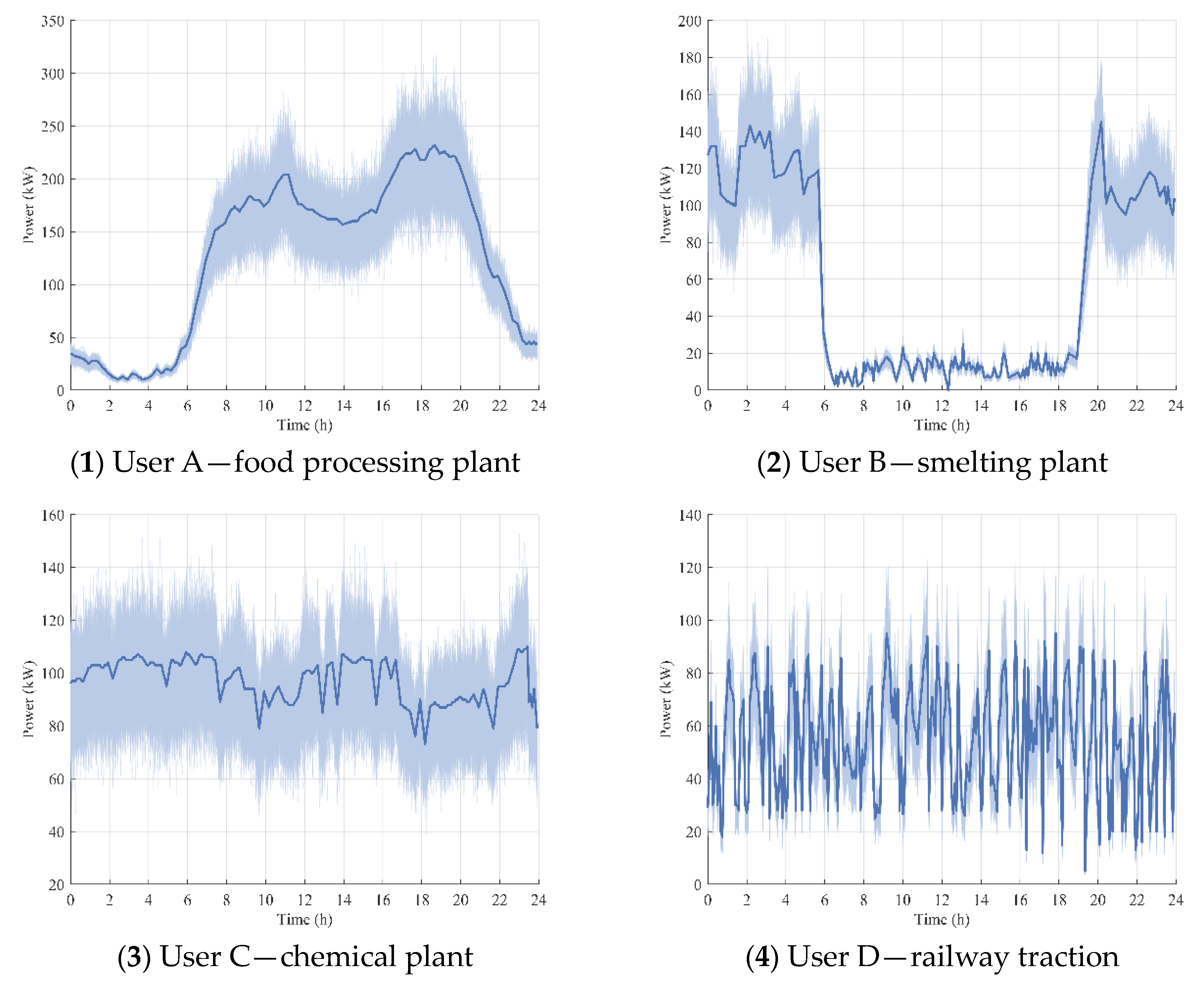
Based on industrial load characteristics, this study selects four industrial users in Jiangsu Province, China, together with their associated renewable power plants. Figure 2 shows the daily load curves for users A, B, C, and D across the full year of 2024, sampled every five minutes (288 points per day, light blue), with specific features described below. To facilitate feature analysis and storage sizing, a load-curve clustering approach is used to extract each user’s annual median load profile as the representative typical daily curve (dark blue).
Figure 2. Annual and typical daily load profiles—users A, B, C, and D.

3.2.1. Load Type A: Dual-Peak Load Curve (Food Processing Plant)

Polished English load characteristics: Two pronounced daily peaks typically occur around midday (11:00–13:00) and early evening (17:00–20:00). Nighttime demand drops substantially, yielding a marked peak–valley spread. The profile is highly temperature-sensitive—especially in summer—and broadly tracks human activity patterns with notable intraday volatility.
Typical industrial users: Food processing, pharmaceuticals, electronics manufacturing, and large shopping malls. These facilities are sensitive to temperature and shift schedules, often requiring strict environmental control (e.g., cold storage, clean rooms). HVAC loads surge during hot midday periods, with a secondary peak in the evening due to overtime production or maintenance.
Typical user A (food processing plant, Jiangsu industrial park): A clear dual-peak profile with morning (08:00–12:00) and early-evening (17:00–20:00) peaks. Peak loads range from 250–340 kW in summer/winter, while spring/autumn peaks are gentler at ~150 kW. Nighttime demand drops to ~20 kW, indicating a pronounced peak–valley differential.
Storage configuration implications: Charge during off-peak periods (night/early morning) and discharge at midday and evening peaks to achieve effective peak shaving and valley filling. A medium energy capacity with two intraday dispatch windows (≈2 equivalent cycles) is generally appropriate for cost-effectiveness and high utilization.

3.2.2. Load Type B: Night-Peak Load Curve (Smelting Plant)

Load characteristics: Higher demand at night (approximately 22:00–06:00) and lower during the day, forming an “inverse” peak–valley pattern. The profile is sensitive to tariffs and shift schedules, with sustained nighttime output driven by off-peak prices and continuous process requirements.
Typical industrial users: Smelters (e.g., electric arc furnaces, aluminum electrolysis), pumping stations, water treatment plants, and port cargo handling. These are energy-intensive, continuous processes that are highly price-sensitive; operating at night leverages lower tariffs and eases daytime grid loading.
Typical user B (smelting plant, Jiangsu industrial park): A night-peak profile with elevated demand from 19:00 to 06:00, ranging from 60–180 kW and fluctuating with the number of active production lines; daytime (06:00–17:00) demand drops below 20 kW due to reduced operations or shutdowns.
Storage configuration implications: Charge during low-load/low-price daytime hours and discharge during the high-load nighttime period to relieve night-peak stress. Favor larger energy capacity with a lower C-rate, following a “once-per-day charge, once-per-night discharge” strategy with a reserve margin to handle nighttime variability.

3.2.3. Load Type C: Stable Load Curve (Chemical Plant)

Load characteristics: Smooth, steady demand throughout the day with minimal variability and no pronounced peaks or troughs; weak short-term sensitivity to external factors (e.g., temperature, tariffs), with only minor deviations during maintenance or process transitions.
Typical industrial users: Continuous-process chemical plants (fertilizers, plastics, refineries) operating 24/7. Equipment such as reactors, distillation columns, compressors, and circulation pumps draw relatively uniform power.
Typical user C (chemical plant, Jiangsu industrial park): A stable profile with demand fluctuating modestly between ~60–150 kW; limited dependence on ambient temperature and tariff signals.
Storage configuration implications: Primarily suited for time-of-use arbitrage—charge in low-tariff periods and discharge in high-tariff periods. Required energy capacity is relatively small; small energy capacity with a moderate C-rate and a shallow daily cycle (~1 cycle/day) are recommended. High round-trip efficiency and low degradation should be prioritized; if participating in ancillary services or renewable integration, intraday dispatch frequency should be modestly increased to enhance returns.

3.2.4. Load Type D: Highly Fluctuating Load Curve (Railway/Transit)

Load characteristics: Frequent, large-amplitude swings throughout the day; demand ramps up or down within seconds to minutes, creating multiple sharp peaks and deep troughs. Strongly driven by train dispatch/acceleration/regenerative braking cycles; shore power at ports shows similar step changes during docking/undocking.
Typical industrial users: Rail traction power for metro/light rail/railway and large shore-to-ship power systems at ports.
Typical user D (railway, Jiangsu industrial park): A highly volatile profile fluctuating roughly between 20–120 kW, with rapid surges and drops that produce dense peaks and valleys.
Storage configuration implications: Power-dominant, short-duration, fast-response storage for smoothing. Configured as high power (high C-rate) with short energy duration; operates SoC in a mid-band (e.g., 40–60%) to maintain up/down headroom. EMS should enforce ramp-rate limits and smoothing (e.g., moving-average/lag filters) and reserve capacity to capture regenerative braking energy. Hybrid storage (battery + supercapacitor) or high-rate lithium solutions should be considered, with careful thermal management and degradation control under high-frequency shallow cycling. Economics are driven by peak shaving and power smoothing; tariff arbitrage is secondary.
Table 1 cross-references the four representative industrial load profiles with their sector-specific requirements and corresponding energy storage configuration strategies. This taxonomy supplies baseline data and typical scenarios that underpin subsequent SESS capacity optimization and dispatch simulations.
Table 1. Typical industrial user load profiles and corresponding SESS strategies.

3.3. Renewable Energy Power

In the industrial park of Jiangsu Province, China, users A–D are each paired with a distinct renewable technology: A with PV, B with wind, C with biomass, and D with hydropower. Because the power output characteristics of these technologies are strongly shaped by meteorology, site conditions, and operational dispatch strategies, typical daily power curves should be derived using differentiated methodological treatments [39].
PV output is governed primarily by solar irradiance, sunshine duration, ambient temperature, and weather conditions. Under the same site and seasonal irradiance regime, PV daily profiles exhibit high shape consistency, typically forming a single-peak pattern: a gradual ramp-up in the morning, a midday maximum, and a rapid evening decline. Inter-day shape variations are limited, while peak magnitudes vary with irradiance intensity and cloud shading; representative typical days can be selected via clear/partly cloudy/overcast classification or irradiance binning [40].
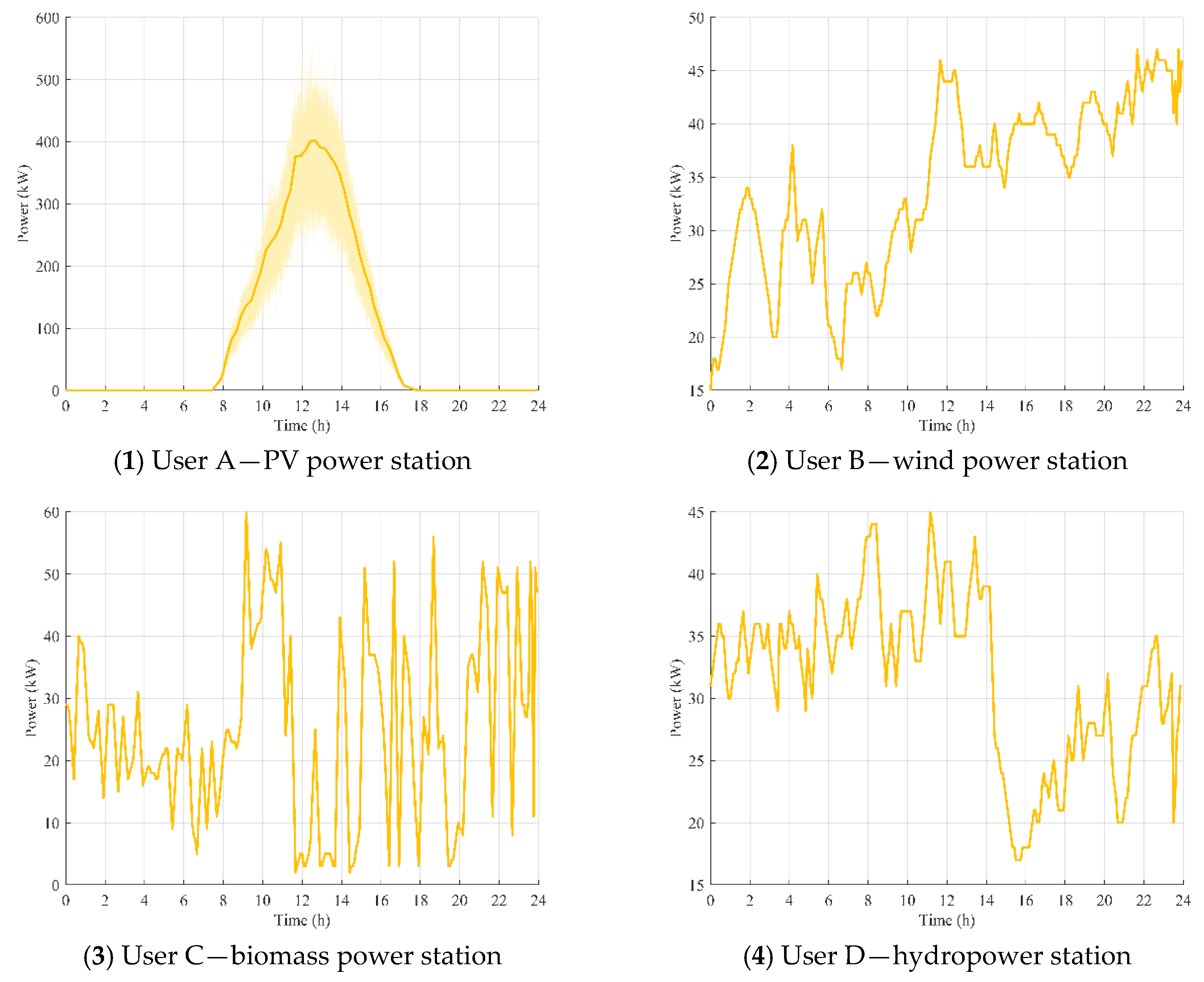
For user A’s PV plant in the Jiangsu industrial park, we derive the typical daily profile by clustering all 24 h measured PV output for 2024 at 5 min resolution (288 points per day; light yellow in the figure) and selecting the cluster-median curve as the representative (dark yellow). This approach captures the central tendency while remaining robust to outliers, balancing average trend and typicality, thereby improving the representativeness and robustness of PV output in subsequent models.
By contrast, the daily power profiles of wind, biomass, and hydropower exhibit greater uncertainty and heterogeneity [41,42]. Specifically, wind power is driven by stochastic meteorology (wind speed/direction and turbulence), often yielding multi-peak or irregular oscillatory patterns; biomass output depends on fuel supply continuity, boiler loading, and unit startup/shutdown schedules; and hydropower is constrained by reservoir level, inflow, operational dispatch, and seasonal hydrology, leading to discontinuities characterized by abrupt ramps up or down.
Owing to the combined effects of the aforementioned uncertainties, the daily power profiles of wind, biomass, and hydropower vary markedly throughout the year and lack the stable temporal structure characteristic of PV. Consequently, clustering over annual datasets cannot yield smooth median curves with broad representativeness for these technologies.
In this study, for the wind (user B), biomass (user C), and hydropower (user D) plants in the Jiangsu industrial park, we adopt the measured 24 h output from a single working day as the typical daily profile (see Figure 3). Data are sampled at 5 min resolution (288 points per day), with the yellow traces denoting the measured series. This approach enables the subsequent shared energy storage dispatch optimization to faithfully capture the intrinsic variability in and stochasticity of each resource type.
Figure 3. Typical daily renewable generation profiles—users A, B, C, and D.

3.4. Time-of-Use Electricity Prices and Shared Energy Storage Parameters

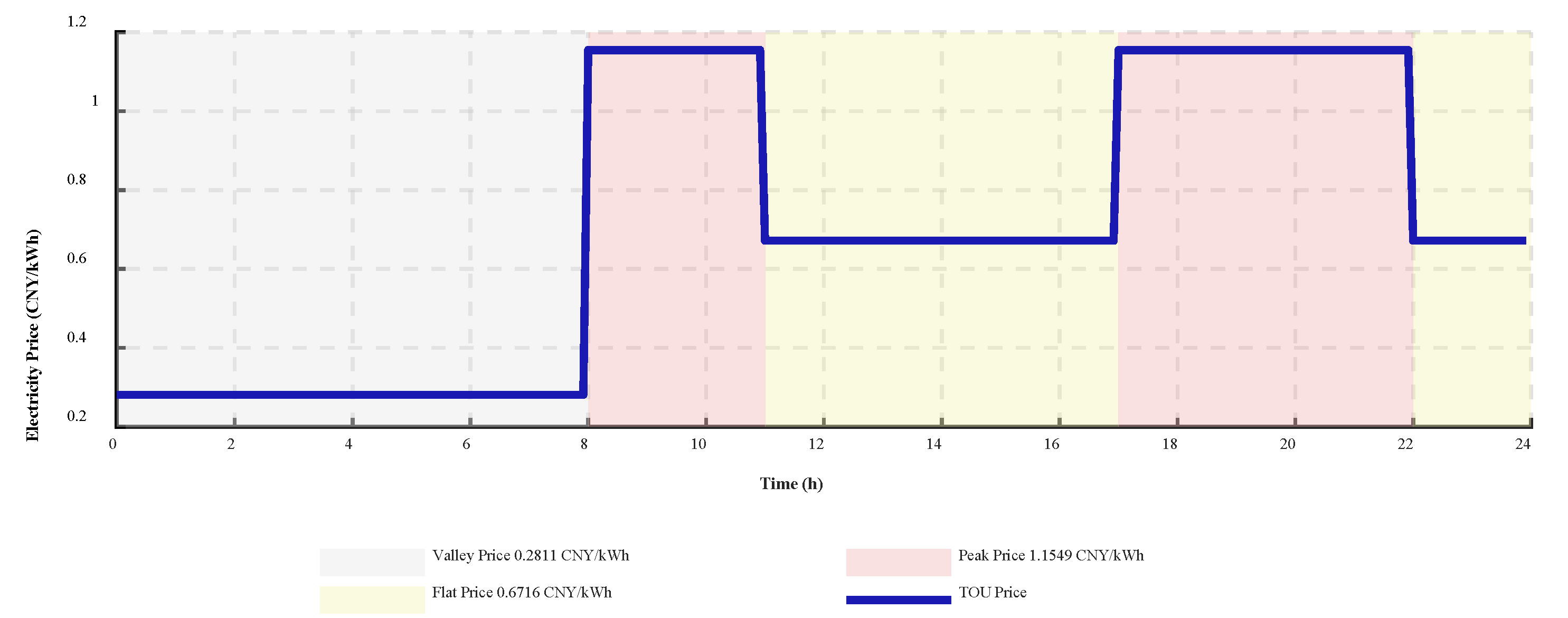
The Jiangsu Provincial Development and Reform Commission has formulated a typical time-of-use (TOU) pricing policy for industrial electricity users. Its purpose is to use price signals to encourage users to optimize their electricity consumption in the time dimension, achieving peak shaving, valley filling, and balanced system load. The electricity price is expressed in CNY/kWh, and the time periods use the 24 h format. Specific time divisions and corresponding grid purchase prices are shown in Table 2 and Figure 4.
Table 2. Time-of-use electricity tariffs for industrial consumers.
Figure 4. Time-of-use electricity tariffs for large industrial consumers.
This TOU structure has the following notable characteristics:
The entire day is divided into three distinct periods. The peak period covers the morning peak (08:00–11:00) and evening peak (17:00–22:00), which closely coincide with concentrated commercial and industrial activities as well as the escalation of residential demand. The flat period corresponds to the midday stable operation phase (11:00–17:00) and the initial nighttime rest period (22:00–24:00). The valley period spans midnight to early morning (00:00–08:00), during which the total societal electricity demand reaches the lowest level.
There is a pronounced differential between the peak, flat, and valley prices. The peak-period electricity price is 1.1549 CNY/kWh, approximately 4.1 times higher than the valley-period price of 0.2811 CNY/kWh, with the flat-period price positioned between these extremes. This significant price gradient serves as a strong economic incentive for industrial users with load-shifting capability—such as user B—to adjust production schedules, transferring shiftable loads from high-price peak hours to low-price valley hours, thereby substantially reducing electricity expenditure.
This tariff structure creates notable economic feasibility for deploying shared energy storage systems in users A, C, and D. By charging at a low cost during the valley period and discharging during the peak period, these users can effectively reduce grid purchases or capitalize on price arbitrage opportunities, thereby enhancing storage system utilization and return on investment. Moreover, this pricing framework provides critical boundary conditions for the subsequent optimization scheduling of shared energy storage.
In this study, the initial state of charge (SOC) of the shared energy storage station (SESS) is set at 0.20, with a maximum SOC of 0.90 and a minimum SOC of 0.10. The charging and discharging service fee of the SESS is 0.9 CNY/kWh, and the maximum charging and discharging power available to each user is 1000 kW.
The capacity cost is based on the tendered unit price of battery modules from a representative domestic energy storage project in 2024, amounting to 1800 CNY/kWh. The power system cost is derived from the tendered unit price for power conversion equipment in the same project, set at 1500 CNY/kW. The operation and maintenance (O&M) cost is 200 CNY/(kW·year). The theoretical service life of the storage system is 8 years, and the annual discount rate is 0.08. The charging and discharging efficiencies are both set at 0.95, the self-discharge rate is 0.001 per hour, and the ramp rate limit is 0.20 (relative to the rated power).

3.5. Optimization Scheduling Model Based on Shared Energy Storage

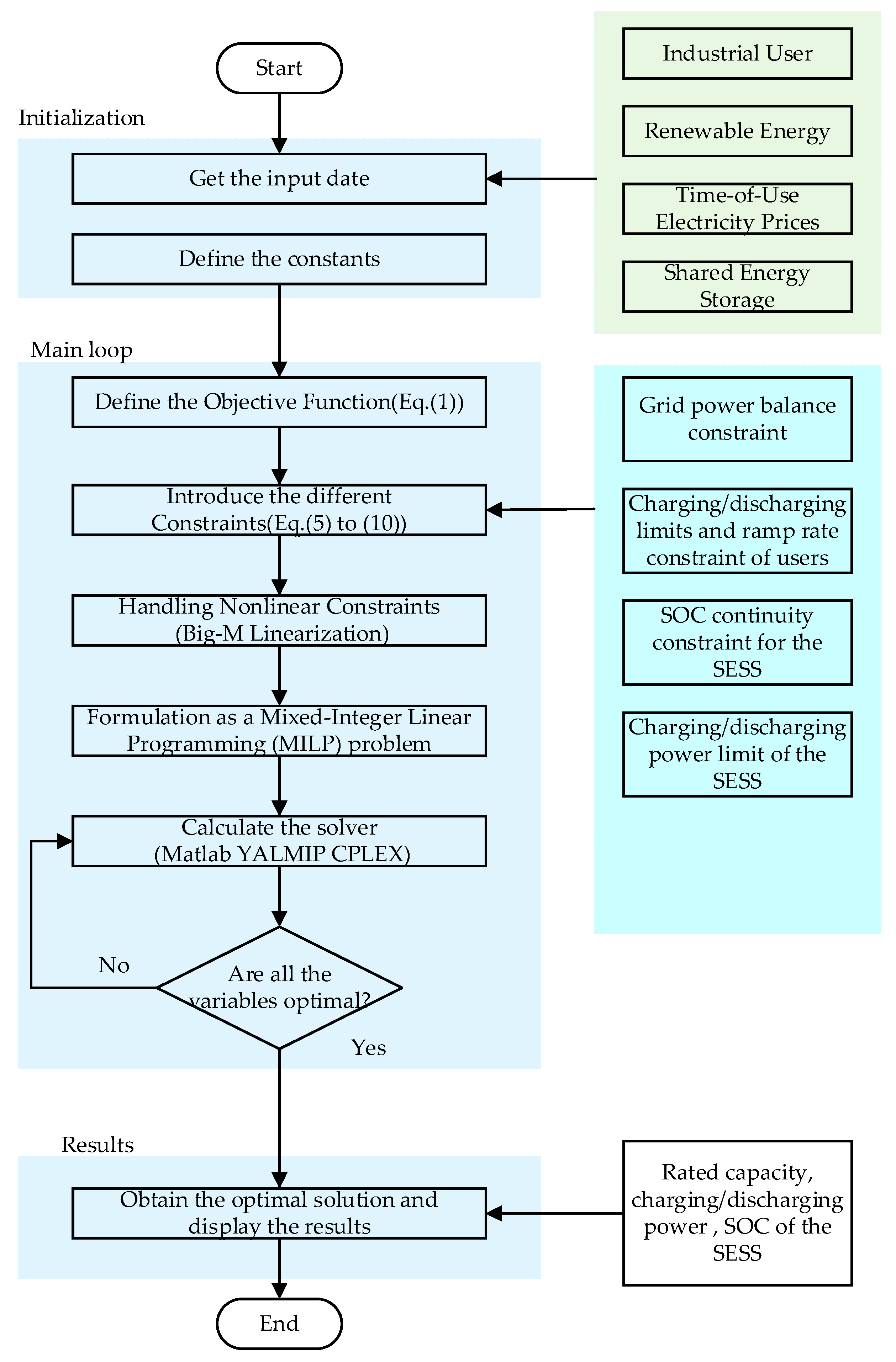
In this subsection, the calculation flowchart of the day-ahead economic dispatch model is shown in Figure 5. By adjusting the parameters and cost models of industrial users, renewable power plants, electricity prices, and shared energy storage, this method can be adapted to different system scales and application scenarios.
Figure 5. Day-ahead economic dispatch model calculation flowchart.

3.5.1. Objective Function

The objective of the model is to minimize the sum of the electricity purchase cost and the energy storage service cost for the user group. The objective function is formulated as follows [43]:
min F = C grid + C service + C degrade
where: F is the total daily operating economic cost of all users connected to the SESS. Cgrid is the cost of purchasing electricity from the distribution grid. Cservice is the service fee paid to the SESS operator for using storage capacity, which is typically calculated based on the total charging and discharging throughput. Cdegrade is the depreciation cost resulting from battery lifetime degradation.
Cservice represents the user-side service fee, and Cdegrade represents the physical degradation cost of the device. They originate from different sources and serve different purposes, and thus, no double counting occurs.
C grid = i = 1 N t = 1 T γ ( t ) P grid , i ( t ) Δ t  
C service = i = 1 N t = 1 T δ ( t ) P ess , b , i ( t ) + P ess , s , i ( t ) Δ t
C degrade = c cycle t = 1 T P abs ( t ) + P relea ( t ) Δ t
In Equations (2)–(4), N is the number of users. T is the total number of time intervals in the scheduling horizon. γ(t) is the electricity price for purchasing power from the main grid at time interval t. δ(t) is the service fee rate charged to the user for using the SESS at time interval t. Δt is the duration of a single scheduling interval.
Pgrid,i(t) denotes the electricity purchasing power from the grid by user i at time interval t.
Pess,b,i(t) is the discharge power supplied by the shared energy storage station by user i at time interval t.
Pess,s,i(t) denotes the charging/discharging power from the shared energy storage station (SESS) by user i at time interval t.
ccycle is the unit depreciation cost per charging–discharging cycle.
Pabs(t) and Prelea(t) are the charging power and discharging power of the SESS at time interval t.

3.5.2. Constraints

By neglecting transmission losses and equipment losses, the optimization scheduling model for the user group connected to the shared energy storage station (SESS) must satisfy the following constraints [44]:
(1) Grid power balance constraint:
P res , i ( t ) + P grid , i ( t ) + P ess , b , i ( t ) P ess , s , i ( t ) P load , i ( t ) = 0
In Equation (5), Pres,i(t) is the renewable energy generation power of user i at time interval t. Pload,i(t) is the electrical load demand power of user i at time interval t.
(2) Charging/discharging power limits and ramp rate constraint of users:
0 P ess , b , i P ess max U ess , b , i 0 P ess , s , i P ess max U ess , s , i U ess , b , i + U ess , s , i 1 U ess , b , i { 0 , 1 } , U ess , s , i { 0 , 1 }
In Equation (6), P e s s m a x is the maximum allowable charging and discharging power for a user when utilizing the shared energy storage station (SESS). Uess,b,i and Uess,s,i represent the discharging state indicator and the charging state indicator, respectively, for user i at time interval t. The values are typically binary, i.e., 0 or 1.
To reduce frequent adjustments to the energy storage system, the change in charging or discharging power between consecutive time intervals must be limited. This restriction is referred to as the ramp rate constraint.
P ess , b , i ( t ) P ess , b , i ( t 1 ) R max , i , t 2 P ess , s , i ( t ) P ess , s , i ( t 1 ) R max , i , t 2
(3) SOC continuity constraint of the SESS:
E ( t ) = ( 1 u ) E ( t 1 ) + η abs P abs ( t ) P relea ( t ) η relea Δ t E min + Δ safe E ( t ) E max Δ safe , t S O C min + Δ safe S O C ( t ) S O C max Δ safe , t
In the above equations, Emax and Emin are the maximum and minimum state of charge (SOC) of the shared energy storage station (SESS). E(t) is the SOC of the SESS at time interval t. u is the self-discharge rate of the SESS, which is generally negligible. ηabs and ηrelea are the charging efficiency and discharging efficiency of the SESS, respectively. Pabs(t) and Prelea(t) are the charging power and discharging power of the SESS at time interval t, respectively.
(4) Charging/discharging power limit of the SESS:
0 P abs P max U abs 0 P relea P max U relea U abs + U relea 1 U abs { 0 , 1 } , U relea { 0 , 1 }  
In Equation (9), Uabs and Urelea are the charging state indicator and discharging state indicator of the shared energy storage station (SESS), with values typically set to 0 or 1. Pmax is the maximum charging and discharging power of the SESS.
(5) Charging/discharging power balance constraint of the SESS: The sum of the charging/discharging power utilized by all users via the shared energy storage station equals the station’s total.
i = 1 N P ess , b , i ( t ) P ess , s , i ( t ) = P relea ( t ) P abs ( t )

3.5.3. Solution Methodology

The decision variables in the above model include the charging and discharging power and the corresponding charging and discharging state indicators for each user utilizing the shared energy storage station (SESS); the electricity purchasing power of each user from the main grid; the state of capacity, the maximum charging and discharging power, and the maximum energy capacity of the SESS; and the charging and discharging power and the corresponding charging and discharging state indicators of the SESS itself.
It can be observed that constraint (9) is a nonlinear constraint. To facilitate solving the model, the Big-M method is employed to linearize this nonlinear constraint, thereby transforming it into constraint (11), where M denotes a sufficiently large constant.
0 P abs P max   0 P abs U abs M 0 P relea P max 0 P relea U relea M U abs + U relea 1 U abs { 0 , 1 } , U relea { 0 , 1 }
After the nonlinear constraints are linearized, the user scheduling model based on the shared energy storage station (SESS) is transformed into a mixed-integer linear programming (MILP) problem. The model is solved in the MATLAB environment by employing the commercial solver CPLEX in conjunction with the YALMIP toolbox.

4. Results and Discussion

4.1. Analysis of Optimization Results for System Integration with a Shared Energy Storage Station

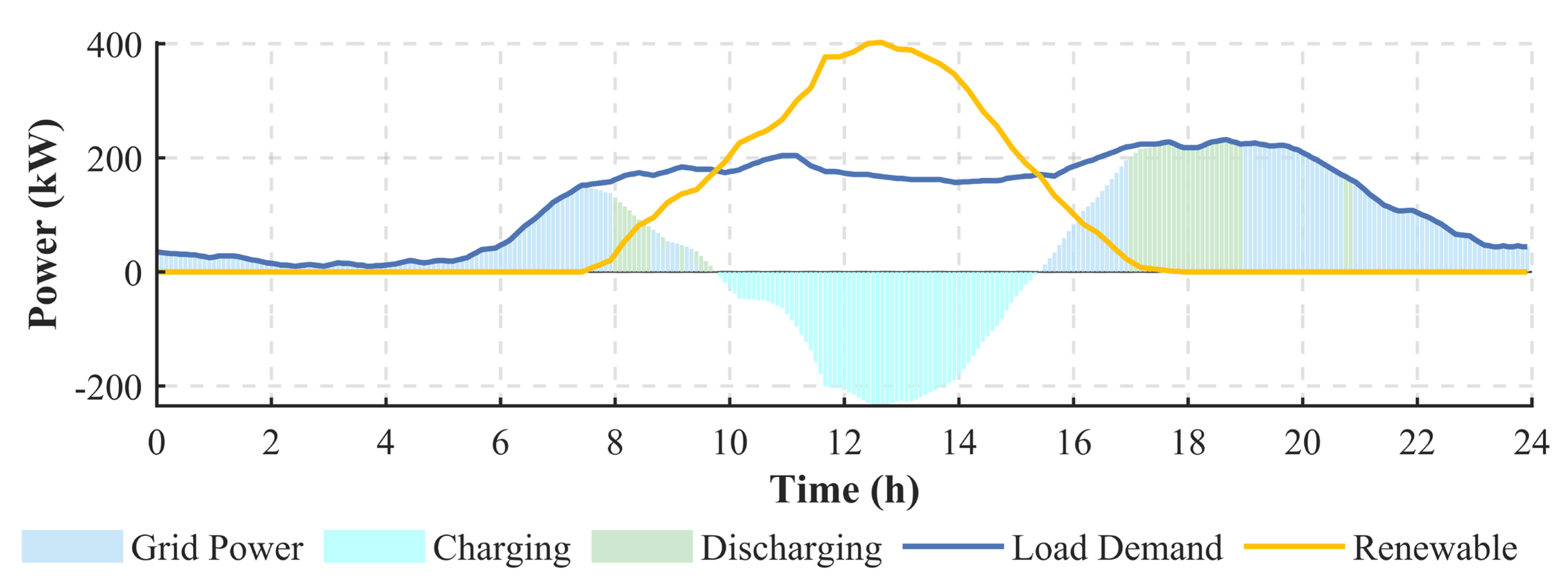
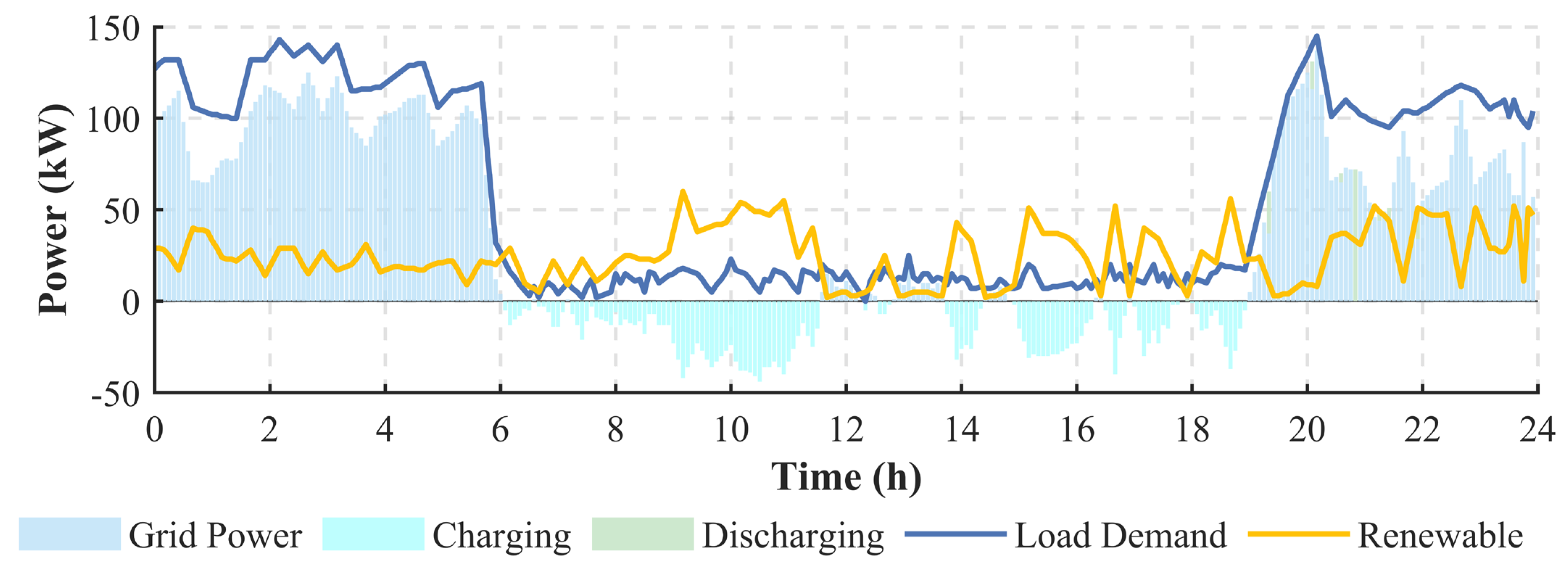
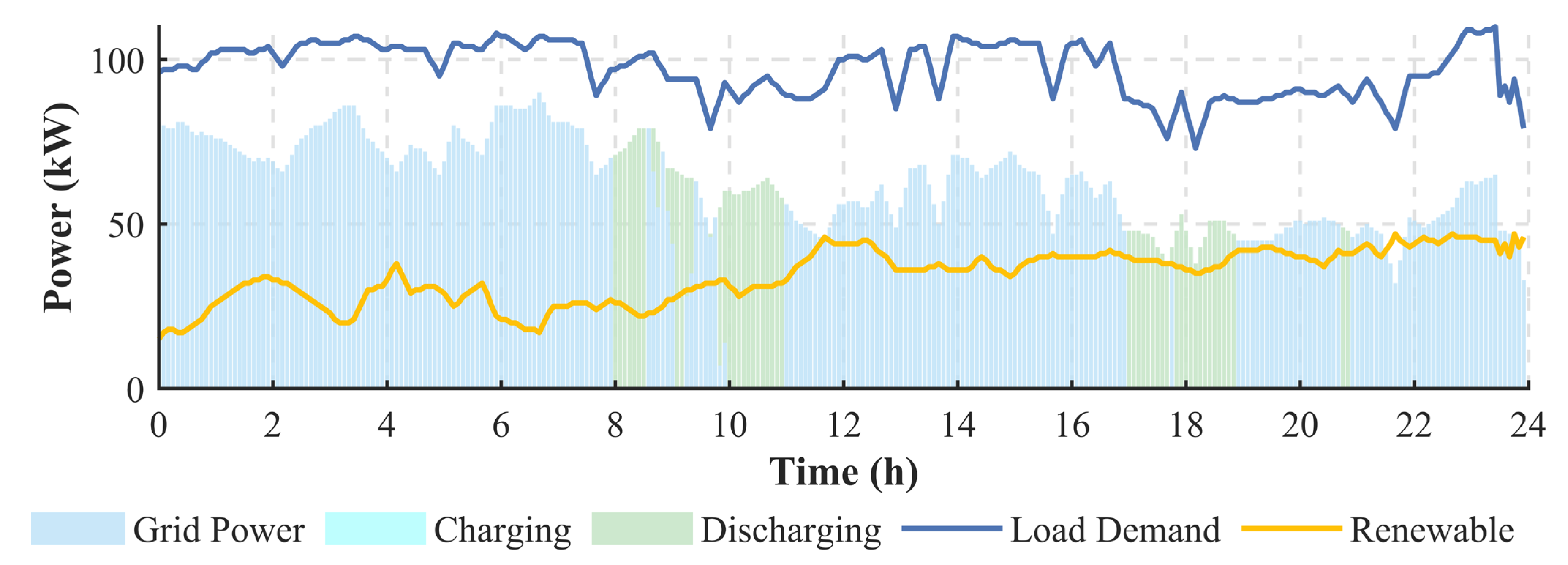
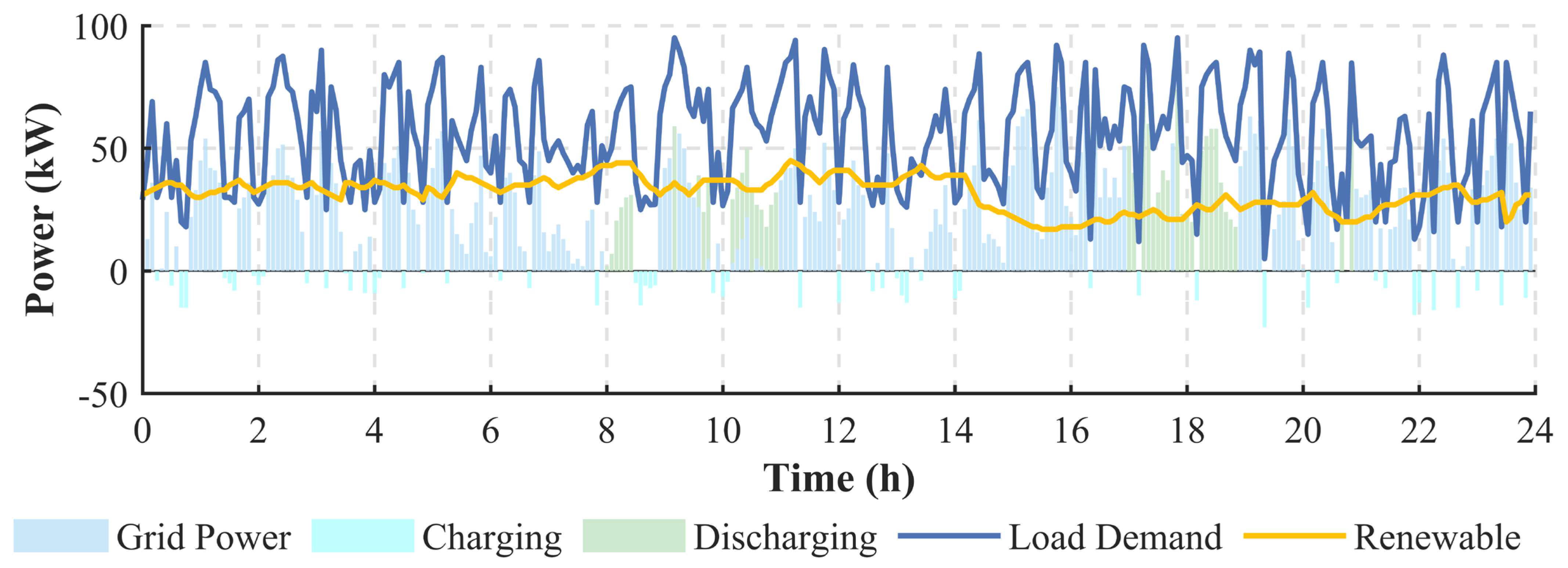
The optimization scheduling results for the four representative users integrated with the shared energy storage station (SESS) are illustrated in Figure 6, Figure 7, Figure 8 and Figure 9. Each scheduling interval has a duration of 5 min. The optimized configuration of the SESS yields an energy capacity of 1075 kWh and a maximum charging/discharging power of 347 kW.
Figure 6. Power load balance curves of user A.
Figure 7. Power load balance curves of user B.
Figure 8. Power load balance curves of user C.
Figure 9. Power load balance curves of user D.
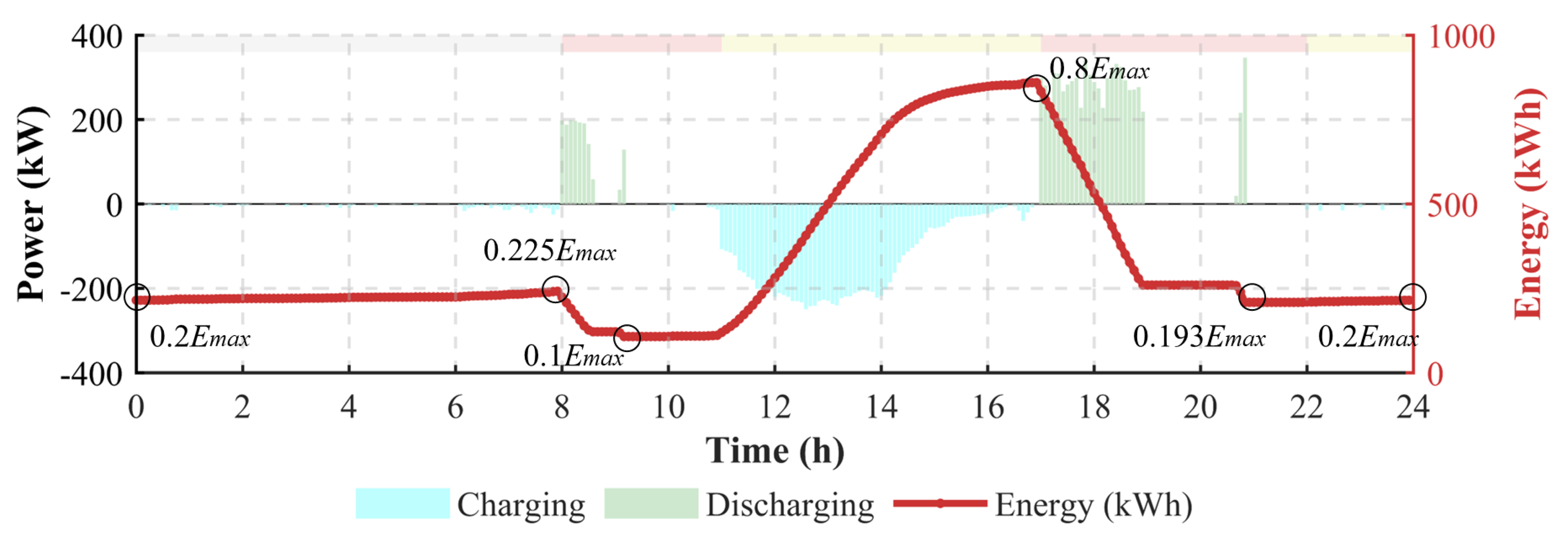
The charging/discharging power profile and the state of charge (SOC) trajectory of the SESS are depicted in Figure 10. A negative charging/discharging power value indicates that the SESS is in the charging mode, whereas a positive value signifies that the SESS is in the discharging mode.
Figure 10. Power and SOC curves of the sharing energy storage station.
In Figure 6, during the period 00:00–09:50, the renewable energy (photovoltaic) power of user A is lower than the electrical load demand. The deficit is compensated by discharging from the shared energy storage station (SESS) and purchasing electricity from the grid. Notably, since 00:00–08:00 falls within the valley-price period, user A opts not to draw energy from the SESS in order to minimize operational costs, relying entirely on grid purchases to meet load requirements. In the period 09:50–15:30, photovoltaic power exceeds the load demand. User A stores the surplus energy in the SESS, effectively preventing curtailment of renewable generation. It is observed that between 12:30–13:00, the maximum photovoltaic power reaches 402 kW, while the highest charging power to the SESS attains 235 kW. During 15:30–24:00, the photovoltaic power once again falls below the load demand, with the shortfall covered by SESS discharging and supplementary grid purchases. In particular, between 17:30–18:45, the maximum discharging power from the SESS reaches 231 kW.
In Figure 7, the electrical load of user B and the renewable energy (wind power) exhibit certain fluctuations over the operating cycle. During 00:00–06:00, which corresponds to the valley-price period in the TOU tariff, user B purchases all required electricity from the grid and does not draw power from the shared energy storage station (SESS) in order to minimize operating costs. The maximum grid purchase power in this interval is 125 kW. From 06:00–19:00, the wind power is generally higher than the load demand. Since this interval spans both peak and flat price periods, user B alternates between grid purchases and SESS discharging to minimize cost. Between 07:00–11:30, the wind power exceeds the load demand, and surplus energy is stored in the SESS, with the maximum charging power reaching 44 kW. In the period 11:30–13:45, wind power falls below the load demand, and electricity prices remain in the flat period. User B primarily relies on grid power, with a maximum purchase power of 13 kW. From 13:45–19:00, wind power once again exceeds the load demand, prompting further charging of the SESS, with a maximum charging power of 40 kW. During 19:00–24:00, wind power is lower than the load demand. As this period covers both peak and flat price intervals, user B alternates between grid power purchases and SESS discharging, with the maximum discharging power reaching 131 kW.
In Figure 8, both the electrical load of user C and the renewable energy power from biomass generation remain relatively stable throughout the day. The load consistently exceeds the biomass generation power by approximately 40–80 kW, with the deficit covered through a combination of grid electricity purchases and discharging from the shared energy storage station (SESS). The maximum discharging power from the SESS reaches 90 kW.
In Figure 9, the electrical load of user D and the renewable energy (hydropower) power exhibit alternating patterns throughout the day. In response to the peak–valley–flat time-of-use (TOU) pricing of the grid, user D alternates between grid electricity purchases, charging the shared energy storage station (SESS), and discharging from the SESS. During operation, the maximum grid purchase power reaches 75 kW, the maximum discharging power from the SESS reaches 74 kW, and the maximum charging power reaches 23 kW.
A synthesis of the optimization scheduling results presented in Figure 6, Figure 7, Figure 8 and Figure 9 reveals that all four representative users achieved improved operational strategies and enhanced peak–valley load balancing after integrating with the shared energy storage station (SESS). The observed differences are primarily attributable to variations in renewable energy power characteristics, responsiveness to the time-of-use (TOU) tariff, and patterns of energy storage utilization.
User A (photovoltaic type) and user B (wind power type) rely heavily on SESS discharging during peak-price periods. In high-tariff intervals where PV or wind power is insufficient, energy storage discharging substantially reduces the amount of high-cost electricity purchased from the grid. User C (biomass type), due to stable generation, uses energy storage mainly to consistently cover the load deficit, resulting in relatively smaller cost reductions. User D (hydropower type) achieves balanced cost response throughout the day by alternating between storage and grid purchases during peak tariff periods.
User A concentrates energy storage usage in afternoon–evening discharging, with a maximum charging power of 235 kW and maximum discharging power of 231 kW. User B exhibits dispersed charging/discharging behaviors, with a charging peak of 44 kW and a maximum discharging power of 131 kW. User C maintains a stable discharging power of around 90 kW, primarily for constant load supplementation, with infrequent charging events. User D alternates charging and discharging in a balanced manner, with a maximum charging power of 23 kW and maximum discharging power of 74 kW.
With SESS integration, all users reduce direct grid purchases during peak-price periods and increase grid charging or electricity consumption during valley-price periods, thereby mitigating peak–valley load differences. The highest economic benefits of the SESS are observed for variable renewable energy users (PV and wind), as energy storage mitigates the impact of fluctuating generation on high-tariff power purchases. For stable power users (biomass and hydropower), the SESS serves more as a price-response tool than as an essential peak-shaving resource.
In conclusion, integrating a shared energy storage station significantly enhances the economic efficiency of electricity dispatch for diverse renewable energy configurations while improving overall system flexibility and adaptability.
In Figure 10, the charging/discharging status and energy level of the shared energy storage station (SESS) follow a distinct time-of-day pattern: 00:00–08:00: the SESS remains in charging mode, with its energy increasing from 0.200 Emax to 0.225 Emax. 08:00–09:00: the SESS switches to discharging mode, with its energy decreasing from 0.225 Emax to 0.1 Emax. 09:00–17:00: the SESS charges again, raising its energy level from 0.1 Emax to the maximum value of 0.800 Emax. 17:00–20:00: the SESS discharges, with energy reduced from 0.800 Emax to 0.193 Emax. 20:00–24:00: the SESS returns to charging mode, increasing its energy from 0.193 Emax to 0.200 Emax. In terms of power, the maximum charging power of 250 kW occurs at approximately 13:00, whereas the maximum discharging power of 347 kW occurs at approximately 20:00. A synthesis of Figure 3, Figure 4, Figure 5, Figure 6, Figure 7 and Figure 8 indicates that the electrical loads of users A, B, C, and D remain balanced throughout the scheduling cycle, with no renewable energy curtailment observed. Furthermore, the SESS completes a full operational cycle and returns to its initial energy state, ensuring that the subsequent cycle begins under stable initial conditions.

4.2. Economic Analysis of User Groups Integrated with a Shared Energy Storage Station

To comprehensively assess the economic impact of deploying a shared energy storage station (SESS) for a group of users, four representative operational scenarios are established for comparative analysis:
Scenario 1 (S1): All users operate without any energy storage system, and their electricity demand is met solely through renewable generation and grid purchases.
Scenario 2 (S2): Each user independently deploys its own energy storage system, with capacity and power ratings optimally determined according to their respective load characteristics and renewable generation profiles, without sharing resources with other users.
Scenario 3 (S3): All users connect to a common shared energy storage station (SESS), managed under a unified scheduling strategy to enable shared capacity, charging/discharging power, and operational resources.
Scenario 4 (S4): All users are jointly connected to a unified shared energy storage station (SESS), which is equipped with a hybrid energy storage configuration consisting of a battery energy storage system (BESS) and short-duration, fast-response flywheel energy storage (FES) units. Under a coordinated dispatch strategy, the BESS is primarily responsible for inter-period energy transfer and the mitigation of medium- and low-frequency power fluctuations, while the FES, benefiting from its millisecond-level dynamic response capability, is dedicated to regulating second-scale high-frequency power variations. This hybrid configuration effectively reduces instantaneous peak loads, suppresses grid disturbances, and alleviates high-frequency deep cycling stress on the BESS, thereby achieving a synergistic optimization of technical performance and economic benefits.
A quantitative comparison is then conducted in terms of curtailed energy, electricity purchased from the grid, grid purchase cost, and total operational cost, in order to reveal the role and advantages of the SESS in enhancing overall economic benefits, reducing operating expenses, and improving system-wide operational efficiency for the user group.

4.2.1. Scenario 1: Users Without Energy Storage

As the baseline, S1 quantifies operating cost, grid purchase structure, and curtailment in the absence of storage.
In scenario 1 (S1), the operational scheduling of the user group is optimized with the objective of minimizing the total operating cost (i.e., the cost of electricity purchased from the grid). The results are shown in Table 3.
Table 3. Optimization scheduling results of scenario 1.
When renewable generation is lower than the load demand, the entire deficit is supplied by grid electricity purchases. Conversely, when generation exceeds demand, the absence of energy storage leads to renewable energy curtailment and waste. According to Figure 2 and Figure 3, user A’s midday peak load is 150–250 kW, user B’s is below 20 kW, user C’s is 90–110 kW, and user D’s fluctuates sharply between 20 and 100 kW. The PV plant paired with user A reaches a midday peak of about 400 kW, whereas the wind, biomass, and hydropower plants paired with users B, C, and D generally produce below 60 kW. The load–generation difference is roughly 200 kW for user A and about 50 kW for users B, C, and D. Hence, user A has substantially higher industrial load and renewable output than users B–D and a larger load–generation mismatch, which manifests as higher curtailment or higher grid purchases.
In Table 3, curtailment is substantial, with a total curtailed energy of 1090 kWh. User A has the highest curtailed energy (840 kWh), while user C has none. Total electricity purchased from the grid is 5300 kWh, with user A purchasing the most (1896 kWh) and user D the least (675.4 kWh). The aggregate grid purchase cost for the four users is CNY 3874, with user A incurring the highest cost (CNY 1702) and user B the lowest (CNY 587). These results indicate that, without energy storage, renewable energy utilization is significantly constrained, and substantial curtailment diminishes economic performance and energy efficiency, particularly for users with highly variable renewable profiles, such as the PV-based user A.
The S1 results show that without storage, renewable utilization is constrained and curtailment is evident. To alleviate this and enhance local absorption, S2 introduces user-side standalone storage to enable intra-user energy shifting and power smoothing.

4.2.2. Scenario 2: Independent Energy Storage Configuration Within Each User

Building on S1, S2 equips each user with independent storage to increase local renewable absorption and reduce grid costs.
In scenario 2 (S2), each user configures an independent energy storage system based on its renewable energy generation power and load fluctuation characteristics. The optimization objective is given in Equation (12) and the economic calculation method in Equation (13):
min F = C 1 + C inv
C inv = i = 1 N η P P max , i + η S E max , i / T s + M i
where Cinv is the daily average investment and O&M cost of the storage system (CNY/day); ηP and ηS are the unit power cost and unit capacity cost of storage; Pmax,i and Emax,i are the maximum charging/discharging power and maximum capacity configured for user i; Ts is the expected service life (days) of the storage system; and Mi is the daily O&M cost for storage for user i.
Compared with Table 4 (scenario 1), user A reduced its daily operating cost by 1.9%, user B achieved a reduction of 1.6%, user C’s cost remained unchanged due to full reliance on grid electricity, and user D achieved the largest reduction, at 9.9%.
Table 4. Optimization scheduling results of scenario 2.
The total operating cost for the four users is CNY 3714, which is approximately 4.1% lower than in scenario 1 (CNY 3874). No renewable energy curtailment is observed, and all renewable generation is utilized. These results indicate that independently deployed storage systems improve renewable utilization and reduce operating costs. Furthermore, higher renewable generation levels would amplify the observed cost reduction effects.
Although standalone storage reduces grid purchases and curtailment, duplicated assets and fragmented dispatch lead to a larger overall scale and higher investment with limited flexibility. To improve asset utilization and reduce total investment, S3 introduces a shared energy storage station (SESS) that enables coordinated optimization and resource sharing.

4.2.3. Scenario 3: Users Integrated with a Shared Energy Storage Station

S3 leverages shared storage and unified dispatch to pursue better economic and operational outcomes with a smaller installed scale.
In scenario 3 (S3), all users are connected to a common shared energy storage station (SESS), operated under a unified scheduling strategy to enable shared capacity, charging/discharging power, and operational resources. The optimization scheduling results are shown in Table 5.
Table 5. Optimization scheduling results of scenario 3.
Compared with scenario 1 (Table 3), integration with the SESS reduces the daily grid purchase volume by 39%, effectively alleviating peak load stress for the main grid, saving electricity and reducing purchase costs. The total operating cost decreases from CNY 3874 to CNY 3345, a 34% reduction.
Compared with scenario 2 (Table 4), the shared energy storage requires 7.4% less total installed capacity, delivers a 23.5% higher total power rating, and reduces total operating cost by 4.1%, significantly cutting storage scale and investment. In summary, integrating a shared energy storage station not only outperforms both no-storage and standalone-storage schemes economically but also achieves better operating cost control and higher renewable utilization with a smaller storage footprint, highlighting the economic advantages of scale sharing and greater dispatch flexibility.
In summary, integrating users into a shared energy storage station not only surpasses both the non-storage and independent-storage configurations in terms of economic performance but also achieves superior operating cost control and renewable energy utilization with a smaller storage scale, demonstrating the economic advantage and operational flexibility of capacity sharing.
Shared storage already outperforms the previous schemes in economics and renewable utilization. However, for user D (railway) with pulsed loads, a battery-only solution remains constrained in second-level high-frequency regulation and cycle life. Therefore, S4 overlays a flywheel energy storage (FES) unit on the shared battery to form a hybrid system, enhancing transient regulation and alleviating the BESS’s high-frequency deep-cycling stress.

4.2.4. Scenario 4: Shared Energy Storage Station Incorporating a Short-Duration High-Power Flywheel Energy Storage Unit

Considering user D’s second-level pulsed loads, S4 adds a flywheel to the shared battery, forming a hybrid system to enhance high-frequency dynamic regulation.
Flywheel energy storage (FES) is an advanced storage technology that stores and releases electrical energy in the form of high-speed mechanical kinetic energy. It exhibits an extremely high power density, millisecond-level charge/discharge response speed, and ultra-long cycle life. When addressing second-to-minute-scale power fluctuations, FES can smooth the power curve precisely without the degradation associated with frequent cycling of electrochemical batteries. Furthermore, it can rapidly mitigate instantaneous peaks and valleys while reducing the lifetime degradation and efficiency losses of a battery energy storage system (BESS) under high-frequency deep cycling. The advanced composite flywheel using magnetic suspension bearings and vacuum chamber technology differs from bearings that rely on mechanical wear. Magnetic suspension bearings enable contact-free rotation, while the vacuum environment eliminates wind resistance losses. It can achieve up to one million charge–discharge cycles and requires no replacement throughout its entire service life. Therefore, FES offers superior dynamic performance in scenarios with rapid load variation, such as rail transit, ports, and industrial environments, combined with low maintenance cost and advantageous life-cycle economics [45,46].
User D represents a railway traction power supply system with highly pulsed load characteristics. Short-term, high-power demands occur during train start-up and acceleration, while regenerative braking during deceleration feeds significant energy back to the traction network. These peak–valley changes are short in duration but large in magnitude, often leading to instantaneous voltage fluctuations and frequency disturbances in the traction power supply system and upstream grid, thereby increasing grid dispatch pressure. Under such high-frequency, transient power shocks, a BESS is prone to accelerated degradation and response delays, making it challenging to fulfill both dynamic stability and economic life-cycle requirements [47].
For User D’s aforementioned characteristics and issues, in order to enhance the shared energy storage system’s second-level power regulation capability, this scenario adds a short-duration, fast-response flywheel energy storage unit (FES) to the original battery energy storage system (BESS), forming a hybrid energy storage system. The parameters are shown in Table 6.
Table 6. Economical parameters of electrochemical and flywheel energy storage systems.
The economic parameter settings in this study are based on research into China’s energy storage market. Battery energy storage costs are drawn from large-scale project tender prices and reference data provided by design institutes, while flywheel energy storage costs are based on quotations from domestic suppliers for megawatt-level solutions. All parameters have been cross-verified from multiple sources to represent typical market levels during the study period. All economic parameters can be replaced with actual project data as needed.
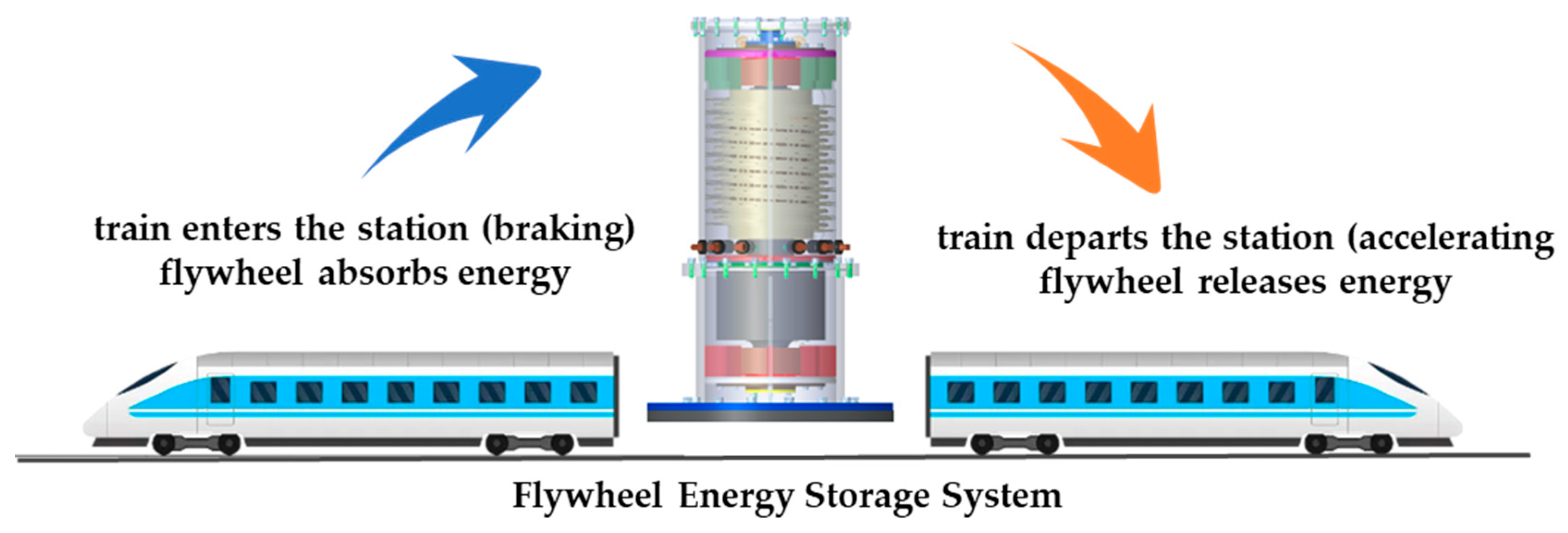
In the hybrid energy storage system(Figure 11), the flywheel is deployed to rapidly absorb or release the instantaneous energy associated with railway traction during regenerative braking and abrupt load increases, thereby smoothing the power profile, attenuating peak demand, and mitigating impacts on the grid. The battery energy storage system (BESS) provides approximately 1073.33 kWh of capacity with a rated power of 327 kW and is tasked with energy shifting and the suppression of medium- to low-frequency power fluctuations over minutes-to-hours timescales. The flywheel energy storage system (FESS) provides approximately 1.67 kWh of capacity and 20 kW of rated power, with a rated continuous discharge duration of 5 min. It represents roughly 0.15% of the total system capacity and about 6% of the total system power. Its power-to-capacity ratio is around 12, which far exceeds the typical range of 0.2 to 0.5 of battery systems and makes it particularly suitable for high-frequency and transient power regulation.
Figure 11. Schematic of the flywheel energy storage system and railway traction power supply system.
The unit cost of power for the flywheel energy storage system is approximately CNY 1000 per kilowatt, and the unit cost of energy capacity is approximately CNY 5000 per kilowatt-hour. Based on the configuration applied in this scenario (20 kW and 1.67 kWh), the one-time investment cost is estimated to be around CNY 28,350. This cost accounts for roughly 0.5% of the total one-time investment in the hybrid energy storage system. Despite its small proportion, the flywheel can markedly enhance the system’s second-level power regulation capability and effectively reduce the high-frequency cycling stress on the battery energy storage system. This effect contributes to extending the overall service life of the system. Therefore, from a full life-cycle perspective, the incorporation of flywheel storage demonstrates clear technical necessity and economic rationality.
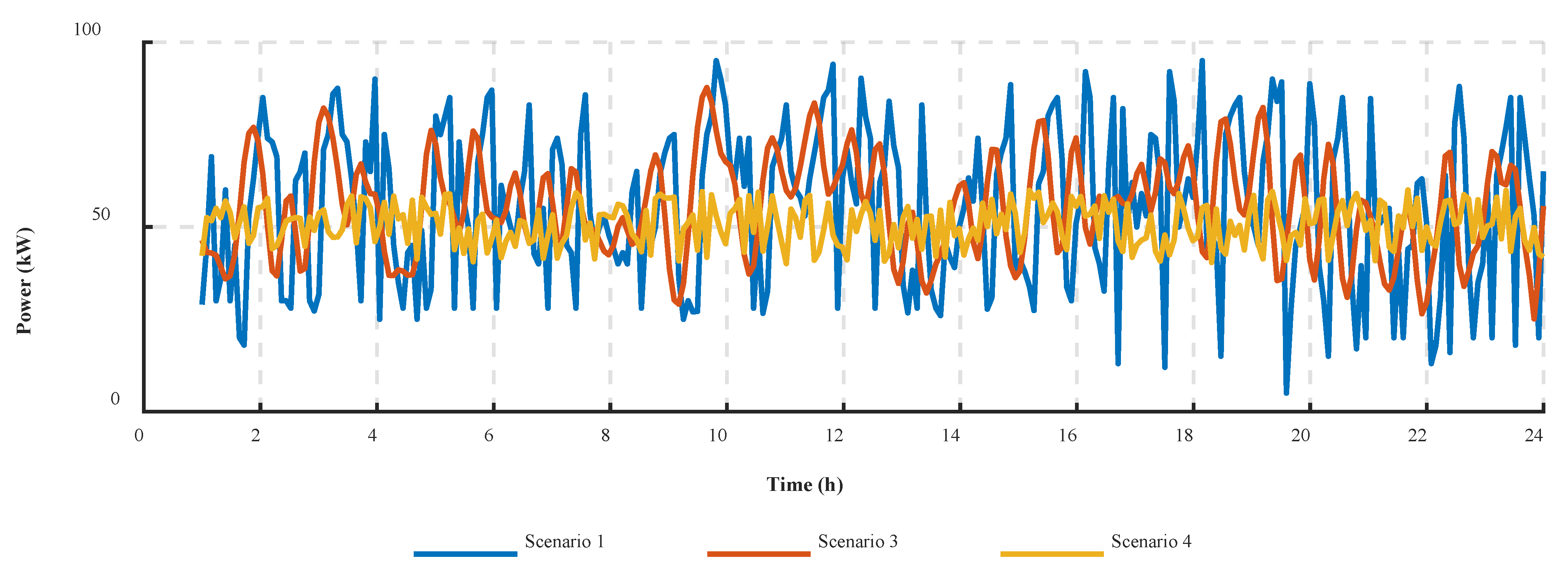
Table 7 and Figure 12 present the optimized dispatch results for scenario 4 and compare them with scenario 3, which utilizes a shared energy storage system composed solely of BESS. In scenario 4, user D’s electricity purchase volume decreases by approximately 1.2%. The cost of electricity purchased during peak periods decreases by roughly 4.6%. The total operating cost decreases by around 0.39%. Meanwhile, the high-frequency cycling count of the BESS is reduced by approximately 15 to 20%. The peak-load reduction rate reaches 20%.
Table 7. Optimization scheduling results of scenario 4.
Figure 12. Power curves of user 4 (railway) under three scenarios.
Together, S1–S4 form a complete pathway from baseline to shared and, further, to hybrid configurations. To present the overall trends clearly, Section 4.2.5 provides a side-by-side comparison and synthesis across curtailed energy, grid purchases, purchase cost, and total operating cost.

4.2.5. Comparative Analysis from Scenario 1 to Scenario 4

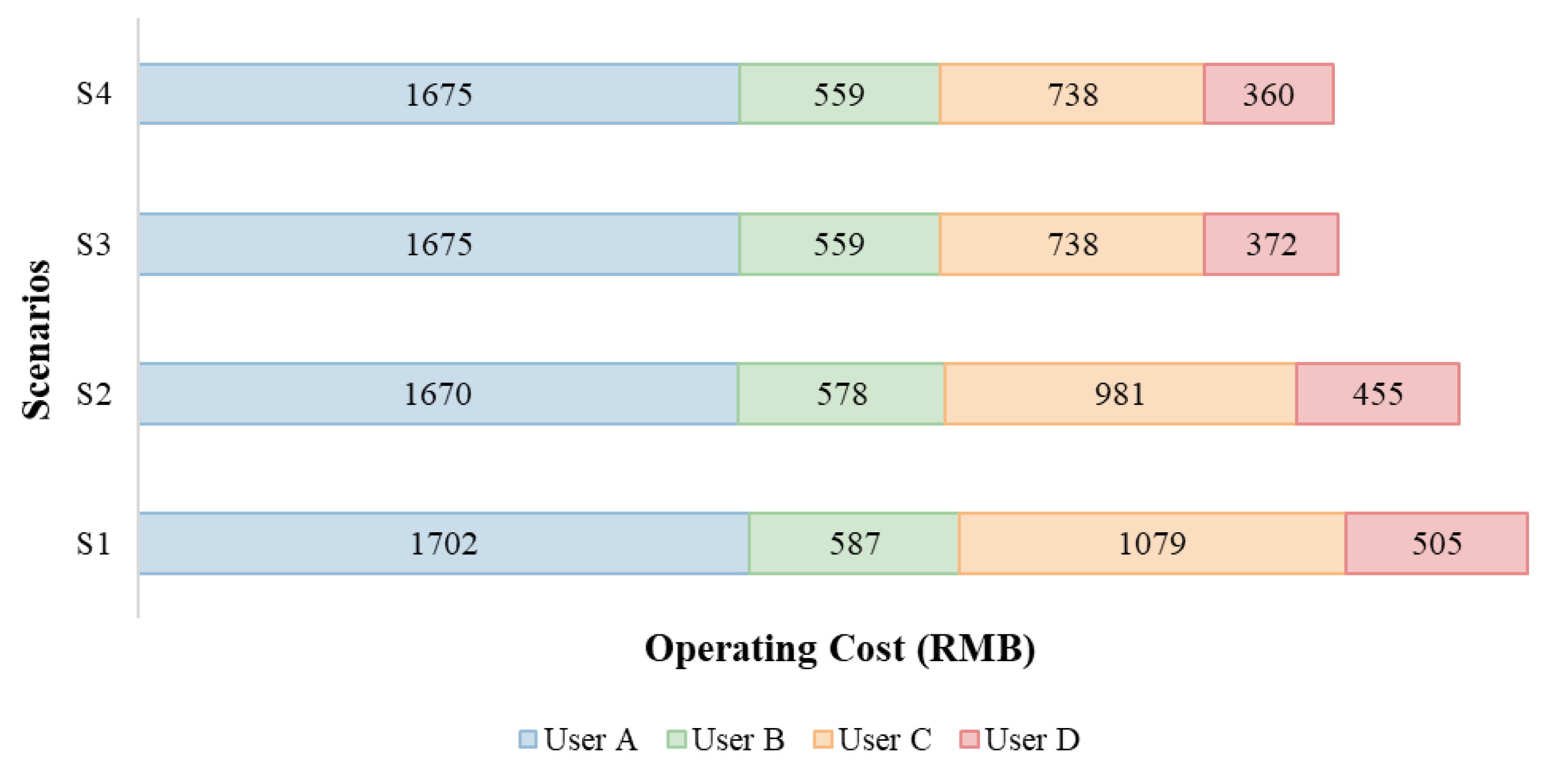
To comprehensively evaluate the performance of different energy storage configurations in the operation of renewable energy user groups, the key performance indicators for scenario 1 (S1) through scenario 4 (S4) are aggregated and compared in Table 8 and Table 9 and Figure 13.
Table 8. Summary of economic performance from scenario 1 to scenario 4.
Table 9. Comparative economic performance across scenarios 1–4.
Figure 13. Summary of economic performance from scenario 1 to scenario 4.
(1) Performance and Efficiency Comparison:
Renewable energy utilization: In scenario 1 (S1) without energy storage, the annual curtailed energy is 1090 kWh, with the PV-type user A accounting for 840 kWh. With the integration of energy storage (S2–S4), curtailment is eliminated (0 kWh), achieving full utilization of renewable energy.
Reduction in electricity purchases: Compared with S1, the independent storage configuration (S2) reduces grid purchases by about 21%, the shared storage configuration (S3) by approximately 41.0%, and the hybrid storage configuration (S4) further to about 41.4%, thereby alleviating peak-load stress on the main grid.
Peak–valley spread reduction: For PV-type (A) and wind-type (B) users, integrating shared storage (S3 and S4) significantly decreases the share of grid purchases during peak periods while increasing purchases or charging during valley periods, resulting in smoother load profiles.
(2) Economic Analysis
In scenario S2 (independent storage), the total operating cost is reduced by approximately 4.1% compared to scenario S1 (no storage). In scenario S3 (shared storage), the reduction reaches about 13.6%, while in scenario S4 (hybrid storage), it reaches approximately 14.0%.
Compared with independent storage (S2), shared storage (S3) achieves a 7.4% reduction in total storage capacity and a 23.5% increase in total power capability, alongside a further 4.1% drop in operating cost. This demonstrates the investment-saving effect and improved power dispatch flexibility enabled by capacity sharing.
In the hybrid storage configuration (S4), the flywheel energy storage unit accounts for only 0.15% of total capacity and 5.8% of total power, with a one-time investment cost of approximately CNY 28,350—representing a negligible share of total storage investment. Nevertheless, for the railway traction user D, it results in a 4.6% reduction in peak-period electricity purchase cost, a 0.6% decrease in total electricity purchases, a 0.39% reduction in total system operating cost, and a 20% decrease in peak load, yielding a highly favorable ratio of economic benefit to investment cost.
(3) Capacity Configuration
For variable renewable users—PV-type (A) and wind-type (B)—the storage strategy prioritizes charging during low-price valley periods and discharging during high-price peak periods to achieve peak shaving and cost reduction, thereby jointly improving economic efficiency and load balancing.
For power-stable users—biomass-type (C) and hydropower-type (D)—storage is primarily used for time-of-use (TOU) price response; although the peak-reduction effect is modest, operating costs are still reduced.
In the hybrid storage scheme (S4), minutes-to-hours energy shifting and medium-to-low-frequency power smoothing are handled by the battery energy storage system (BESS), whereas second-scale high-frequency power regulation is handled by the flywheel energy storage system (FESS). This coordination significantly reduces high-frequency cycling of the BESS (by approximately 15–20%), thereby extending service life and enhancing dynamic response under high-variability conditions.
(4) Overall Advantages and Concluding Analysis
Shared storage systems, even with smaller total capacity configurations, achieve greater reductions in electricity purchases and operating costs while fully eliminating renewable energy curtailment. In high-frequency fluctuation scenarios, hybrid storage systems provide millisecond-level response capability, effectively suppressing instantaneous grid disturbances and enhancing operational stability. Compared with independent storage schemes, shared storage reduces capacity requirements and investment costs. In highly variable load scenarios, hybrid storage delivers additional energy savings and cost reductions at a very low investment share, resulting in notable cost-effectiveness along with operational benefits.
The multi-scenario optimization results indicate that shared storage systems consistently improve operational economics and dispatch flexibility across diverse portfolios of renewable energy users. Under high-frequency transient load conditions, hybrid storage schemes offer pronounced advantages in both performance and life-cycle economics, demonstrating clear engineering feasibility and strong deployment potential.

5. Conclusions

This study addresses the challenges of load volatility and grid stability arising from multi-user coordinated energy utilization with high renewable penetration in industrial parks. We propose a day-ahead optimal economic dispatch method based on a shared battery energy storage station (BESS) and incorporate a short-duration, fast-response flywheel energy storage system (FES) to construct a hybrid “battery–flywheel” architecture that synergistically separates energy shifting from power smoothing. The case study focuses on four representative industrial users in an industrial park in Jiangsu Province, China: a bimodal-load food processing plant, a night-peak steel smelting plant, a steady-load chemical plant, and a highly volatile railway traction system, each paired, respectively, with photovoltaic (PV), wind, biomass, and hydropower generation. Using measured operational data from 2024, typical power profiles are constructed, and optimization is carried out under Jiangsu’s peak–flat–valley time-of-use tariff framework. The model aims to minimize the day-ahead operating cost of the user group and produces reproducible capacity sizing and coordinated dispatch strategies.
The main conclusions are as follows. Shared storage significantly enhances economic dispatch performance and system flexibility. Compared with the no-storage scenario (S1), integrating shared BESS (S3) reduces the user-group average daily total operating cost by 14.0% and cuts grid electricity purchases by 41.4%. It also decreases the proportion of purchases during peak-price periods and increases charging during valley-price periods, thereby effectively narrowing the peak-to-valley gap and reducing high-price purchases driven by power fluctuations. Hybrid storage shows pronounced advantages under highly fluctuating pulse-load conditions. For railway-type high-frequency pulse loads, introducing a flywheel to form a hybrid scheme (S4) enables millisecond-level fast response while accounting for only about 0.5% of the hybrid storage system’s total investment, suppresses instantaneous disturbances in the traction system, and reduces peak load by 20%. Relative to a shared BESS (S3), S4 lowers the peak-period electricity purchase cost by 4.6%, total electricity purchases by 0.6%, and the overall system’s daily operating cost by 0.39%.
In summary, the proposed capacity sizing and day-ahead dispatch method for multi-user shared storage delivers notable technical improvements and quantifiable economic benefits across diverse renewable portfolios and load profiles. It is particularly suitable for engineering deployment under high-frequency fluctuating loads and can inform the planning and operation of similar industrial parks and rail transit power systems. The main limitation is that the current modeling does not incorporate electricity market mechanisms, industrial load forecasting, or renewable generation forecasting. Future work will validate the hybrid storage scheme in larger-scale industrial parks and railway traction networks and will explore dispatch strategies coupled with renewable generation, real-time pricing, and demand response to further enhance system flexibility, stability, and overall effectiveness.

Author Contributions

Conceptualization—C.T. and Q.Z.; methodology—C.T. and Q.Z.; validation—C.T. and Z.L.; investigation—C.T., D.M. and X.Z.; data curation—C.T. and D.M.; writing—C.T. and E.C.; writing—review and editing—Q.Z. and E.C.; supervision—C.T. and Q.Z.; project administration—Q.Z. and D.M. All authors have read and agreed to the published version of the manuscript.

Funding

This research was funded by the following grant: State Grid Corporation of China project, “Research on Application and Design of Flywheel-Based Synchronous Condensers for Transient Control in Modern Power Systems” (project no. 5500-202399516A-3-2-ZN).

Data Availability Statement

The original contributions presented in this study are included in the article. Further inquiries can be directed to the corresponding author.

Conflicts of Interest

Authors Zhengping Li and Erqiang Chen were employed by the company State Grid Henan Electric Power Research Institute Co., Ltd. The remaining authors declare that the research was conducted in the absence of any commercial or financial relationships that could be construed as a potential conflict of interest.

Nomenclature

SymbolMeaningUnit
F Total daily operating economic cost of all users connected to the SESSCNY/day
C grid Cost of purchasing electricity from the distribution gridCNY
C service Service fee paid to the SESS operator for using storage capacityCNY
C degrade Depreciation cost resulting from battery lifetime degradationCNY
N Number of users
T Total number of time intervals in the scheduling horizon
γ ( t ) Electricity price for purchasing power from the main grid at time interval t CNY/kWh
δ ( t ) Service fee rate charged to the user for using the SESS at time interval t CNY/kWh
Δ t Duration of a single scheduling intervalmin
P grid , i ( t ) Electricity purchasing power from the grid by user i at time interval t kW
P ess , b , i ( t ) Discharge power supplied by the SESS to user i at time interval t kW
P ess , s , i ( t ) Charging/discharging power from the SESS by user i at time interval t kW
c cycle Unit depreciation cost per charging–discharging cycleCNY/kWh
P abs ( t ) Charging power of the SESS at time interval t kW
P relea ( t ) Discharging power of the SESS at time interval t kW
P res , i ( t ) Renewable energy generation power of user i at time interval t kW
P load , i ( t ) Electrical load demand power of user i at time interval t kW
P ess max Maximum allowable charging and discharging power for a user utilizing the SESSkW
U ess , b , i ( t ) Discharging state indicator for user i at time interval t (binary)
U ess , s , i ( t ) Charging state indicator for user i at time interval t (binary)
E max Maximum state of charge (SOC) of the SESSkWh
E min Minimum state of charge (SOC) of the SESSkWh
E ( t ) State of charge (SOC) of the SESS at time interval t kWh
u Self-discharge rate of the SESS (generally negligible)
η abs Charging efficiency of the SESS
η relea Discharging efficiency of the SESS
U abs ( t ) Charging state indicator of the SESS
U relea ( t ) Discharging state indicator of the SESS
P max Maximum charging and discharging power of the SESSkW
M Sufficiently large constant in the Big-M method

References

  1. Sinsel, S.R.; Riemke, R.L.; Hoffmann, V.H. Challenges and solution technologies for the integration of variable renewable energy sources: A review. Renew. Energy 2020, 145, 2271–2285. [Google Scholar] [CrossRef]
  2. Hou, Q.; Du, E.; Zhang, N.; Kang, C. Impact of high renewable penetration on the power system operation mode: A data-driven approach. IEEE Trans. Power Syst. 2020, 35, 731–741. [Google Scholar] [CrossRef]
  3. Song, M.; Nejad, R.R.; Sun, W. Robust distribution system load restoration with time-dependent cold load pickup. IEEE Trans. Power Syst. 2021, 36, 3204–3215. [Google Scholar] [CrossRef]
  4. Yang, G.; Tian, J.; Chen, L. Managing energy infrastructure to decarbonize industrial parks in China. Nat. Commun. 2020, 11, 981. [Google Scholar] [CrossRef]
  5. Hayes, B.; Melatti, I.; Mancini, T.; Prodanovic, M.; Tronci, E. Residential demand management using individualized demand aware price policies. IEEE Trans. Smart Grid 2017, 8, 1284–1294. [Google Scholar] [CrossRef]
  6. Chen, X.; Lin, B. Towards carbon neutrality by implementing carbon emissions trading scheme: Policy evaluation in China. Energy Policy 2021, 157, 112510. [Google Scholar] [CrossRef]
  7. Zhao, Y.X.; Lin, J.; Song, Y.H.; Liu, Y.; Li, J.H. A hierarchical strategy for restorative self-healing of hydrogen-penetrated distribution systems considering energy sharing via mobile resources. IEEE Trans. Power Syst. 2022, 99, 1388–1404. [Google Scholar] [CrossRef]
  8. Chen, W.; Qiu, J.; Zhao, J.; Chai, Q.; Dong, Z.Y. Bargaining game-based profit allocation of virtual power plant in frequency regulation market considering battery cycle life. IEEE Trans. Smart Grid 2021, 12, 2913–2928. [Google Scholar] [CrossRef]
  9. Jing, Y.; Zhu, L.; Yin, B.; Sun, Y.; Zhao, Y.; Wang, S. Evaluating the PV system expansion potential of existing integrated energy parks: A case study in North China. Appl. Energy 2023, 330, 120310. [Google Scholar] [CrossRef]
  10. Zhao, D.; Wang, H.; Huang, J.; Lin, X. Virtual energy storage sharing and capacity allocation. IEEE Trans. Smart Grid 2020, 11, 1112–1123. [Google Scholar] [CrossRef]
  11. Lai, S.; Qiu, J.; Tao, Y. Individualized pricing of energy storage sharing based on discount sensitivity. IEEE Trans. Ind. Inform. 2022, 18, 4642–4653. [Google Scholar] [CrossRef]
  12. Jo, J.; Park, J. Demand-side management with shared energy storage system in smart grid. IEEE Trans. Smart Grid 2020, 11, 4466–4476. [Google Scholar] [CrossRef]
  13. Dai, R.; Esmaeilbeigi, R.; Charkhgard, H. The utilization of shared energy storage in energy systems: A comprehensive review. IEEE Trans. Smart Grid 2021, 12, 3163–3174. [Google Scholar] [CrossRef]
  14. Golmohamadi, H.; Keypour, R.; Bak-Jensen, B.; Pillai, J.R.; Khooban, M.H. Robust self-scheduling of operational processes for industrial demand response aggregators. IEEE Trans. Ind. Electron. 2020, 67, 1387–1395. [Google Scholar] [CrossRef]
  15. Zhang, X.; Hug, G.; Harjunkoski, I. Cost-effective scheduling of steel plants with flexible EAFs. IEEE Trans. Smart Grid 2017, 8, 239–249. [Google Scholar] [CrossRef]
  16. Wang, T.; Wang, Q.Y.; Zhang, C.Q. Research on the optimal operation of a novel renewable multi-energy complementary system in rural areas. Sustainability 2021, 13, 2196. [Google Scholar] [CrossRef]
  17. Ahmed, F.; Naeem, M.; Ejaz, W.; Iqbal, M.; Anpalagan, A. Renewable energy assisted traffic aware cellular base station energy cooperation. Energies 2018, 11, 99. [Google Scholar] [CrossRef]
  18. Yan, D.X.; Chen, Y. A distributed online algorithm for promoting energy sharing between EV charging stations. IEEE Trans. Smart Grid 2023, 14, 1158–1172. [Google Scholar] [CrossRef]
  19. Walker, A.; Kwon, S. Analysis on impact of shared energy storage in residential community: Individual versus shared energy storage. Appl. Energy 2021, 282, 116172. [Google Scholar] [CrossRef]
  20. Chakraborty, P.; Baeyens, E.; Poolla, K.; Khargonekar, P.P.; Varaiya, P. Sharing storage in a smart grid: A coalitional game approach. IEEE Trans. Smart Grid 2019, 10, 4379–4390. [Google Scholar] [CrossRef]
  21. Giordano, A.; Mastroianni, C.; Scarcello, L.; Spezzano, G. IoT-based energy sharing model for sizing storage systems in energy communities. In Proceedings of the 2020 6th IEEE International Energy Conference (ENERGYCon), Gammarth, Tunisia, 28 September–1 October 2020; pp. 503–508. [Google Scholar] [CrossRef]
  22. Wang, H.L.; Wang, S.W. A hierarchical optimal control strategy for continuous demand response of building HVAC systems to provide frequency regulation service to smart power grids. Energy 2021, 230, 120741. [Google Scholar] [CrossRef]
  23. Wei, C.; Xu, J.; Liao, S.; Sun, Y.; Jiang, Y.; Ke, D.; Wang, J. A bi-level scheduling model for virtual power plants with aggregated thermostatically controlled loads and renewable energy. Appl. Energy 2018, 224, 659–670. [Google Scholar] [CrossRef]
  24. Li, J.; Fang, Z.; Wang, Q.; Zhang, M.; Li, Y.; Zhang, W. Optimal operation with dynamic partitioning strategy for centralized shared energy storage station with integration of large-scale renewable energy. J. Mod. Power Syst. Clean Energy 2024, 12, 359–370. [Google Scholar] [CrossRef]
  25. Miao, A.; Yuan, Y.; Feng, C.; Hou, Y.; Wang, A.; Huang, Y. Low-carbon economic scheduling of park integrated energy system considering user-side shared energy storage. In Proceedings of the 2023 7th International Conference on Smart Grid and Smart Cities (ICSGSC), Lanzhou, China, 22–24 September 2023; pp. 567–572. [Google Scholar] [CrossRef]
  26. Li, L.; Zhang, Q.; Zhang, X.; Zhang, Z.; Yang, M.; Gao, B. A two-stage stochastic unit commitment considering shared energy storage and renewable energy sources. In Proceedings of the 2023 International Conference on Power Energy Systems and Applications (ICoPESA), Nanjing, China, 24–26 February 2023; pp. 473–477. [Google Scholar] [CrossRef]
  27. Yang, Y.; Hu, G.; Spanos, C.J. Optimal sharing and fair cost allocation of community energy storage. IEEE Trans. Smart Grid 2021, 12, 5052–5063. [Google Scholar] [CrossRef]
  28. Zaidi, B.H.; Bhatti, D.M.S.; Ullah, I. Combinatorial auctions for energy storage sharing amongst the households. J. Energy Storage 2018, 19, 291–301. [Google Scholar] [CrossRef]
  29. Ma, M.; Huang, H.; Song, X.; Pimm, A.J.; Wu, X.; Liao, S. Optimal sizing and operations of shared energy storage systems in distribution networks: A bi-level programming approach. Appl. Energy 2022, 307, 118170. [Google Scholar] [CrossRef]
  30. Huang, P.; Sun, Y.; Lovati, M.; Zhang, X. Solar-photovoltaic-power-sharing based design optimization of distributed energy storage systems for performance improvements. Energy 2021, 222, 119931. [Google Scholar] [CrossRef]
  31. Ma, L.; Li, X.Z.; Kong, X.; Zhang, L.; Liu, Z.W. Optimal participation and cost allocation of shared energy storage considering customer directrix load demand response. J. Energy Storage 2024, 81, 110404. [Google Scholar] [CrossRef]
  32. Yu, M.; Jiang, J.; Ye, X.; Gao, D.W.; Ai, X. Demand response flexibility potential trading in smart grids: A multileader multifollower Stackelberg game approach. IEEE Trans. Syst. Man Cybern. 2023, 53, 2664–2675. [Google Scholar] [CrossRef]
  33. Nagpal, H.; Avramidis, I.I.; Capitanescu, F.; Heiselberg, P.K. Local energy communities in service of sustainability and grid flexibility provision: Hierarchical management of shared energy storage. IEEE Trans. Sustain. Energy 2022, 13, 1523–1535. [Google Scholar] [CrossRef]
  34. Zhong, L.; Ye, T.; Yang, Y.; Pan, F.; Feng, L.; Qi, S.; Huang, Y. Deep Reinforcement Learning-Based Joint Low-Carbon Optimization for User-Side Shared Energy Storage–Distribution Networks. Processes 2024, 12, 1791. [Google Scholar] [CrossRef]
  35. Zhou, X.; Qi, L.; Pan, N.; Hou, M.; Yang, J. Optimization method for load aggregation scheduling in industrial parks considering multiple interests and adjustable load classification. Energy 2025, 326, 135887. [Google Scholar] [CrossRef]
  36. Turdybek, B.; Tostado-Véliz, M.; Mansouri, S.A.; Jordehi, A.R.; Jurado, F. A local electricity market mechanism for flexibility provision in industrial parks involving Heterogenous flexible loads. Appl. Energy 2024, 359, 122748. [Google Scholar] [CrossRef]
  37. Hasan, M.; Mifta, Z.; Papiya, S.J.; Roy, P.; Dey, P.; Salsabil, N.A.; Chowdhury, N.-U.-R.; Farrok, O. A state-of-the-art comparative review of load forecasting methods: Characteristics, perspectives, and pplications. Energy Convers. Manag. X 2025, 26, 100922. [Google Scholar] [CrossRef]
  38. Xu, W.; Zhou, D.; Huang, X.; Lou, B.; Liu, D. Optimal allocation of power supply systems in industrial parks considering multi-energy complementarity and demand response. Appl. Energy 2020, 275, 115407. [Google Scholar] [CrossRef]
  39. Emrani, A.; Berrada, A. A Comprehensive Review on Techno-economic Assessment of Hybrid Energy Storage Systems Integrated with Renewable Energy. Energy Storage 2024, 84, 111010. [Google Scholar] [CrossRef]
  40. Sutikno, T.; Arsadiando, W.; Wangsupphaphol, A.; Yudhana, A.; Facta, M. A Review of Recent Advances on Hybrid Energy Storage System for Solar Photovoltaics Power Generation. IEEE Access 2022, 10, 42346–42364. [Google Scholar] [CrossRef]
  41. Ehsan, A.; Yang, Q. Scenario-based investment planning of isolated multi-energy microgrids considering electricity, heating and cooling demand. Appl. Energy 2019, 235, 1277–1288. [Google Scholar] [CrossRef]
  42. Varasteh, F.; Nazar, M.S.; Heidari, A.; Shafie-khah, M.; Catalão, J.P.S. Distributed energy resource and network expansion planning of a CCHP based ctive microgrid considering demand response programs. Energy 2019, 172, 79–105. [Google Scholar] [CrossRef]
  43. Yang, M.; Zhang, Y.; Liu, J.; Yin, S.; Chen, X.; She, L.; Fu, Z.; Liu, H. Distributed Shared Energy Storage Double-Layer Optimal Configuration for Source-Grid Co-Optimization. Processes 2023, 11, 2194. [Google Scholar] [CrossRef]
  44. El Barkouki, B.; Laamim, M.; Rochd, A.; Chang, J.-W.; Benazzouz, A.; Ouassaid, M.; Kang, M.; Jeong, H. An Economic Dispatch for a Shared Energy Storage System Using MILP Optimization: A Case Study of a Moroccan Microgrid. Energies 2023, 16, 4601. [Google Scholar] [CrossRef]
  45. Malik, F.H.; Hussain, G.A.; Alsmadi, Y.M.S.; Haider, Z.M.; Mansoor, W.; Lehtonen, M. Integrating Energy Storage Technologies with Renewable Energy Sources: A Pathway Toward Sustainable Power Grids. Sustainability 2025, 17, 4097. [Google Scholar] [CrossRef]
  46. Ochoa-Correa, D.; Arévalo, P.; Martinez, S. Pathways to 100% Renewable Energy in Island Systems: A Systematic Review of Challenges, Solutions Strategies, and Success Cases. Technologies 2025, 13, 180. [Google Scholar] [CrossRef]
  47. Raza, M.S.; Abid, M.I.; Akmal, M.; Munir, H.M.; Haider, Z.M.; Khan, M.O.; Alamri, B.; Alqarni, M. A Comprehensive Assessment of Storage Elements in Hybrid Energy Systems to Optimize Energy Reserves. Sustainability 2024, 16, 8730. [Google Scholar] [CrossRef]
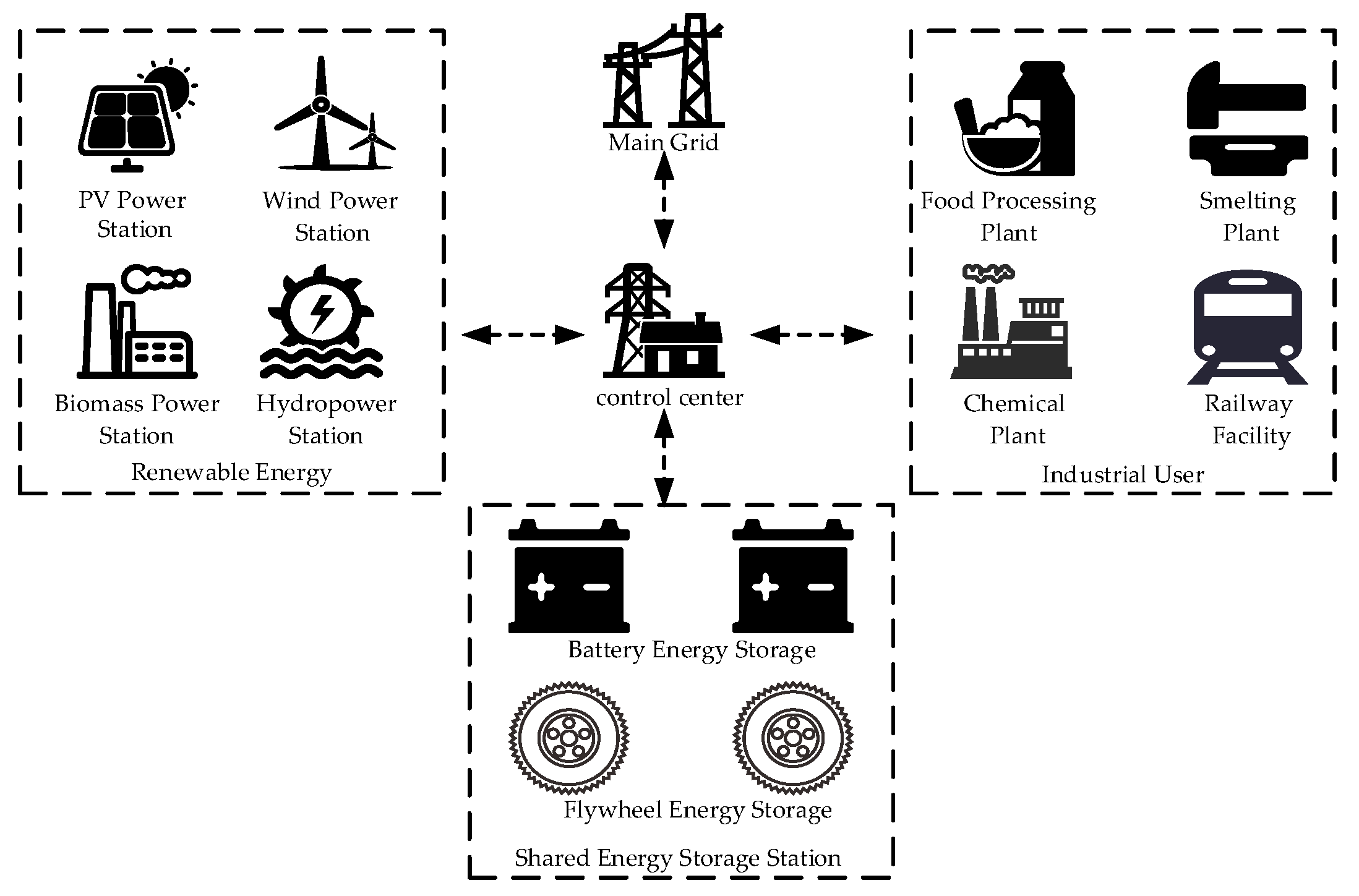
Disclaimer/Publisher’s Note: The statements, opinions and data contained in all publications are solely those of the individual author(s) and contributor(s) and not of MDPI and/or the editor(s). MDPI and/or the editor(s) disclaim responsibility for any injury to people or property resulting from any ideas, methods, instructions or products referred to in the content.

Article Metrics

Citations

Article Access Statistics

Multiple requests from the same IP address are counted as one view.