



Planning for the Reuse of Abandoned Mines—From the Perspective of Value Evaluation and Sustainable Development

Abstract
1. Introduction
2. Materials and Methods
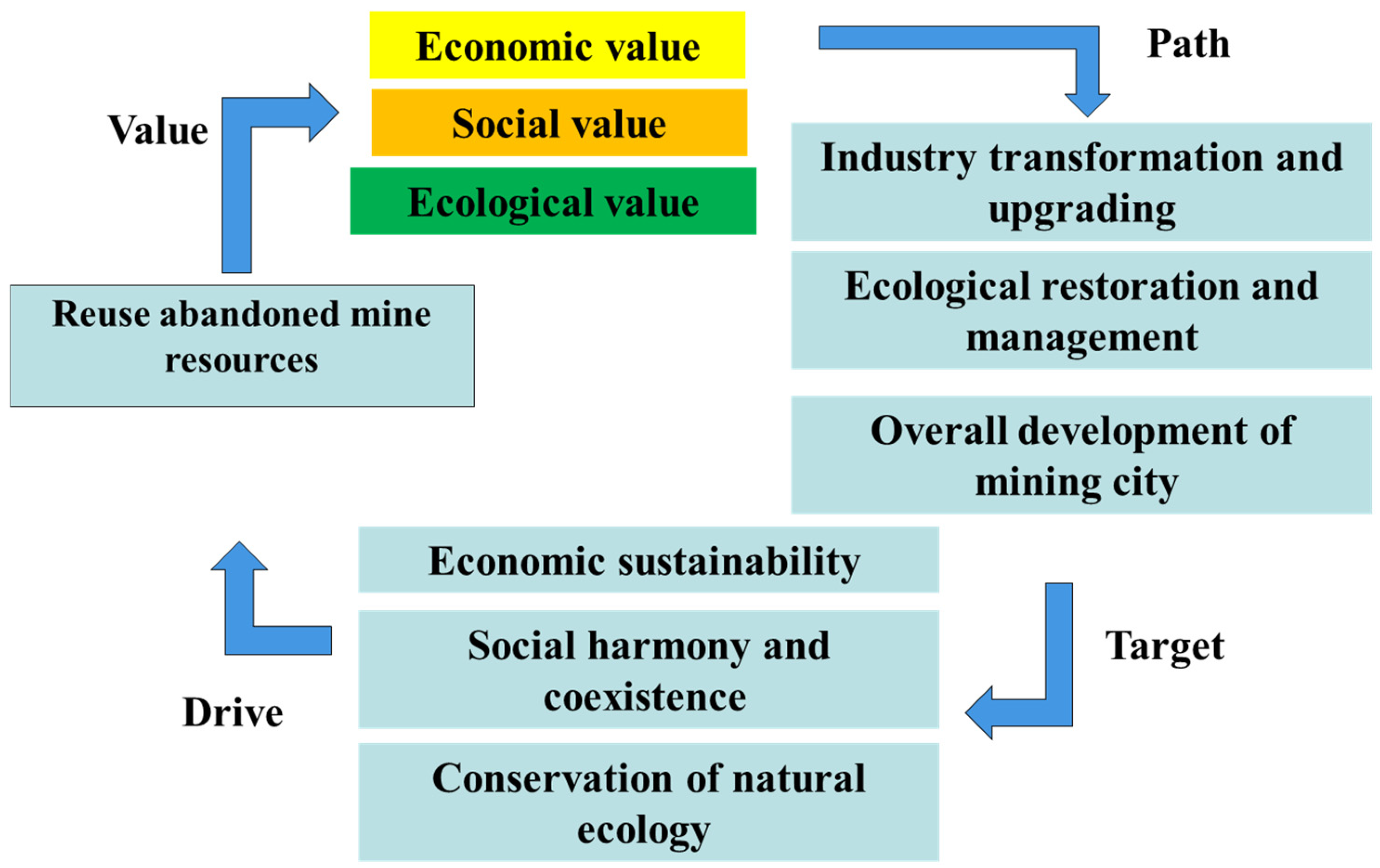
2.1. Reuse Value of Abandoned Mines
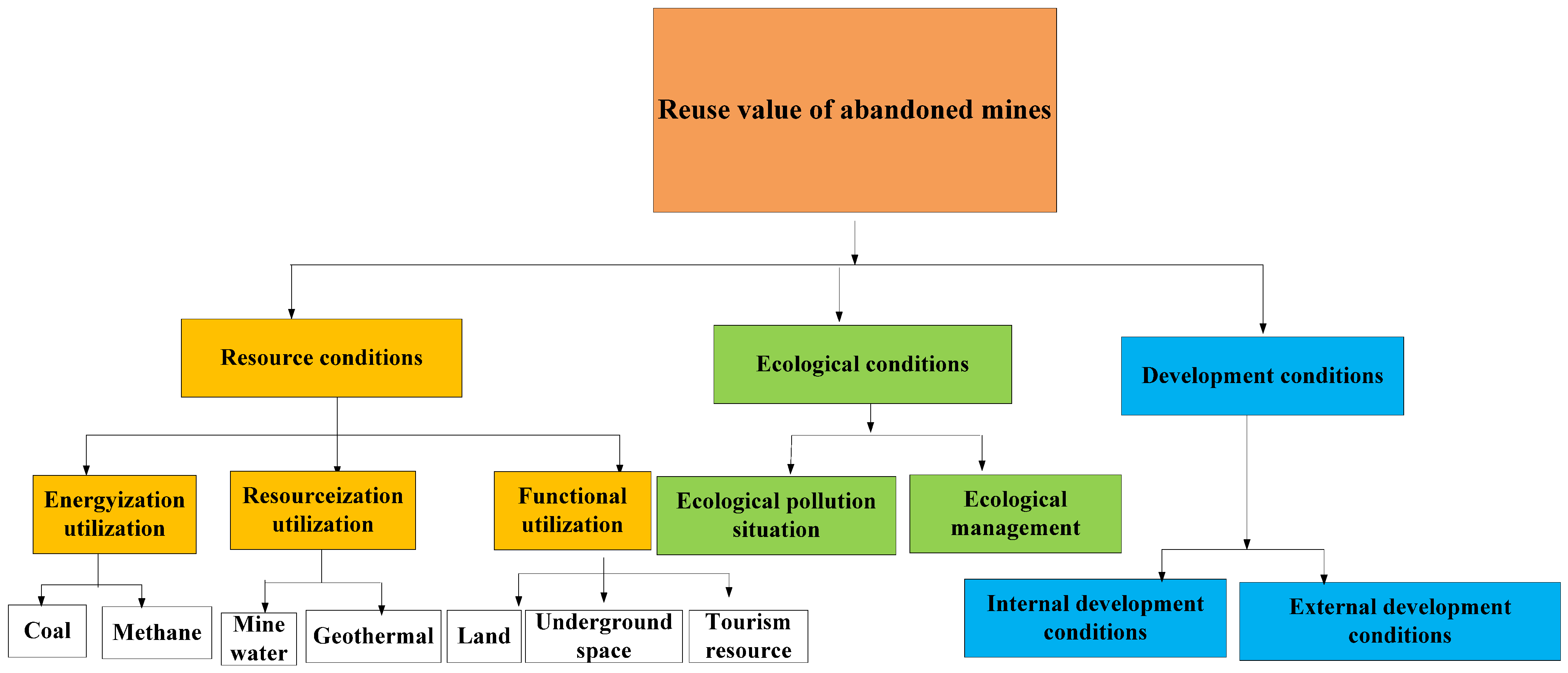
2.2. Construction of an Evaluation System for Abandoned Mine Reuse Value
2.2.1. Abandoned Mine Resource Conditions
2.2.2. Ecological Conditions
2.2.3. Development Conditions
2.3. Index Integration Method
2.4. Integrated Evaluation of Abandoned Mine Reuse Value
3. Results and Discussion
3.1. Division of Abandoned Mine Reuse Value
3.2. Division of Abandoned Mine Reuse Stages
4. Main Conclusions
Funding
Data Availability Statement
Acknowledgments
Conflicts of Interest
References
- Lin, B.; Lan, T. The influence of coal price uncertainty on investment and consumption dynamics: Evidence from China. Energy Policy 2025, 198, 114517. [Google Scholar] [CrossRef]
- Li, G.; Xiu, Y.; Liu, Q.; Zhang, B.; Duan, M.; Yang, Y.; Guo, C. Target Area Selection for Residual Coalbed Methane Drainage in Abandoned Multi-Seam Mines. Appl. Sci. 2025, 15, 10619. [Google Scholar] [CrossRef]
- Yuan, L.; Yang, K. Further discussion on the scientific problems and countermeasures in the utilization of abandoned mines. J. China Coal Soc. 2021, 46, 16–24. [Google Scholar]
- Schneider, D.; Greenberg, M.R. Remediating and Reusing Abandoned Mining Sites in U.S. Metropolitan Areas: Raising Visibility and Value. Sustainability 2023, 15, 7080. [Google Scholar] [CrossRef]
- Shi, Y.; Fan, X.; Ding, X.; Sun, M. An Assessment of Ecological Sensitivity and Landscape Pattern in Abandoned Mining Land. Sustainability 2024, 16, 1105. [Google Scholar] [CrossRef]
- Ji, L.; Dong, J.; Kienberger, T.; Huang, J.; Liu, F.; Wang, L.; Huang, Y.; Gao, H. Quantitative assessment and development utilization modes of space resources in closed and abandoned mines. Energy Sources Part A Recovery Util. Environ. Eff. 2023, 45, 10366–10380. [Google Scholar] [CrossRef]
- Kuerban, A.; Gao, G.; Waheed, A.; Xu, H.; Wang, S.; Tong, Z. Assessing the Effectiveness of Turf Transplantation and Artificial Replanting in Restoring Abandoned Mining Areas. Sustainability 2024, 16, 8977. [Google Scholar] [CrossRef]
- Rodríguez-Espinosa, T.; Pérez-Gimeno, A.; Almendro-Candel, M.B.; Navarro-Pedreño, J.; García-Fernández, G. Technosols for Mine Restoration: Overcoming Challenges and Maximising Benefit. Appl. Sci. 2025, 15, 11664. [Google Scholar] [CrossRef]
- Mlalazi, N.; Mbohwa, C.; Ramuhaheli, S.; Chimwani, N. Assessing Soil and Water Pollution: A Case Study of an Abandoned Coal Mine for Remediation and Repurposing in Mpumalanga Province, South Africa. Processes 2025, 13, 3307. [Google Scholar] [CrossRef]
- Liu, Q.J.; Yang, Q.G.; Yang, K.; Fu, Q.; Xie, Q.; Han, Y. Case study of pumped storage hydropower based on multi-energy complementary utilization mode in abandoned coal mines. J. Min. Saf. Eng. 2023, 40, 578–586. [Google Scholar]
- Cheng, L.; Zhang, N.; Cui, H.; Yin, Y.; Sun, H. Optimization and regulation of the abandoned mining land reuse for industrial transformation. Trans. Chin. Soc. Agric. Eng. 2022, 38, 203–212. [Google Scholar]
- Xiu, Y.; Liu, Q.; Fu, Q.; Yang, K.; Zhang, M.; Wu, B.N. Optimization of residual coalbed methane extraction wells and analysis of development and emission reduction benefits in the Songzao mining area. Sci. Rep. 2025, 15, 13731. [Google Scholar] [CrossRef] [PubMed]
- GB15618-2008; Environmental Quality Standard for Soils. Ministry of Environmental Protection of the People’s Republic of China: Beijing, China, 2008.
- Qin, Y.; Wang, Z.; Han, L. Geological problems in underground coal gasification. J. China Coal Soc. 2019, 44, 2516–2530. [Google Scholar]
- Feng, G.; Zhang, A.; Hu, S.; Cheng, J.; Miu, X.; Hao, G.; Han, D.; Guan, S.; Zhao, G. A methodology for determining the methane flow space in abandoned mine gobs and its application in methane drainage. Fuel 2018, 227, 208–217. [Google Scholar] [CrossRef]
- DZ/T 0216-2002; Specification of Geological Exploration for Mineral Resources of Solid Fuels. Ministry of Land and Resources of the People’s Republic of China: Beijing, China, 2002.
- AQ20612018; Criterion for Identifying Major Potential Accidents of Metal and Nonmetal Mine. State Administration of Work Safety: Washington, DC, USA, 2018.
- GB/T 19223-2015; Classification of Coal Mine Water. General Administration of Quality Supervision, Inspection and Quarantine of the People’s Republic of China: Beijing, China, 2015.
- GB11615-89; Specification for Geological Exploration of Geothermal Resources. Inspection and Quarantine of the People’s Republic of China: Beijing, China, 1989.
- GB50215-2015; Code for Mine Design of Coal Industry. Ministry of Housing and Urban-Rural Development of the People’s Republic of China: Beijing, China, 2015.
- HJ/T192-2015; Technical Specifications for Assessment of Ecological Environment. Ministry of Environmental Protection of the People’s Republic of China: Beijing, China, 2015.
- GB/T18972-2003; Classification, Investigation and Evaluation of Tourism Resources. General Administration of Quality Supervision, Inspection and Quarantine of the People’s Republic of China: Beijing, China, 2003.
- GB/T 33469-2016; Land Quality Classification for Cultivated Land. The Standardization Administration of the People’s Republic of China (SAC): Beijing, China, 2016. Available online: https://openstd.samr.gov.cn/ (accessed on 20 March 2023).
- DZT0290-2015; Specification for Survey of Geological Heritage. Ministry of Land and Resources of the People’s Republic of China: Beijing, China, 2015.
- HJ 652-2013; Code for Compilation of Mine Ecological Environment Protection and Restoration Scheme (Planning) (Trial). Ministry of Environmental Protection of the People’s Republic of China: Beijing, China, 2013.
- Cui, C.; Wang, B.; Zhao, Y.; Wang, Q.; Sun, Z. China’s regional sustainability assessment on mineral resources: Results from an improved analytic hierarchy process-based normal cloud model. J. Clean. Prod. 2019, 210, 105–120. [Google Scholar] [CrossRef]
- Cui, C.; Wang, B.; Zhao, Y.; Zhang, Y.; Xue, L. Risk management for mine closure: A cloud model and hybrid semi-quantitative decision method. Int. J. Miner. Metall. Mater. 2020, 27, 1021–1035. [Google Scholar] [CrossRef]
- Zhang, B.; Cao, Z.G.; Zhang, Y. Adaptive condition of construction and design system of coal mine underground reservoir. Saf. Coal Mines 2022, 53, 93–98. [Google Scholar]
- Li, X.; Chen, Z.; Liu, Z.; Yang, H. Decision-making on reuse modes of abandoned coal mine industrial sites in Beijing based on environment-economy-society matter-element models. Math. Probl. Eng. 2021, 2021, 9941182. [Google Scholar] [CrossRef]

| Factor Layer | Indicator Layer | Classification Standard | Reference | |||
|---|---|---|---|---|---|---|
| Excellent | Medium | Poor | ||||
| Energization utilization | Coal | Remaining reserves | >3.5 million tons | Minimum economic resources | <Minimum economic resources | [14] |
| Buried depth | 300–2000 m | 100–300 m | <100 m/>2000 m | |||
| Coal quality characteristics | Lignite | Sub-bituminous coal | High-rank coal | |||
| Thickness | >1.5 m | 0.5–1.5 m | <0.5 m | |||
| Coalbed methane | Coalbed methane abundance | Gas content > 20 m3/t, resource abundance > 3 × 10⁸ m3/km2 | The gas content is 8~20 m3/t, and the resource abundance is 1 × 10⁸–3 × 10⁸ m3/km2 | Gas content < 8 m3/t; resource abundance < 1 × 10⁸/km2 | Ref. [15], Coalbed Methane Resources/Reserves Specification (DZ/T 0216-2002) [16] | |
| Storage condition | The coal body structure is complete and simple, the pressure coefficient of coal reservoir is ≥1, the ratio of temporary reservoir is ≥0.8, the permeability of coal seam is ≥5 × 10⁻³ μm2, and the adsorption time is ≤1 day | The coal reservoir pressure coefficient is 0.4–1, the temporary reservoir ratio is 0.2–0.8, the permeability of the coal seam is 0.1–5 × 10⁻³ μm2, and the adsorption time is 1–10 days | The coal reservoir pressure coefficient is less than 0.4, the temporary reservoir ratio is less than 0.2, the permeability of the coal seam is less than 0.1 × 10⁻³ μm2, and the adsorption time is more than 10 days | |||
| Resource utilization | Mine water | Mine water inflow | >2100 m3/h (>1200 in Northwest China) | 180–2100 (NW 90–1200) | ≤180 (≤90 in Northwest China) | (AQ20612018) [17] |
| Mine water quality | Clean mine water | Mine water containing suspended solids | Mine water with high salinity, acidity, or special pollution | Classification of Coal Mine Water (GB/T 19223-2015) [18] | ||
| Geothermal | Geothermal scale | Ensure that the electric energy of high-temperature geothermal fields with a mining life of 30 years is more than 50 MWe, and that of medium- and low-temperature geothermal fields with a mining life of 100 years is more than 50 MWe | 10~50 MWe for high-temperature geothermal fields and 10~50 MWe for medium- and low-temperature geothermal fields with a mining life of 30 years and 100 years, respectively | Ensure that the electric energy of high-temperature geothermal field with 30 years of mining life is less than 10 MWe, and that the electric energy of medium- and low-temperature geothermal field with 100 years of mining life is less than 10 MWe | Code for Geological Exploration of Geothermal Resources (GB11615-89) [19] | |
| Well completion depth | <1000 m | 1000~3000 m | >3000 m, | Evaluation standard of geothermal resources development | ||
| Functional utilization | Land | Occupied land area | Occupied area of a large mine | Occupied area of a medium-sized mine | Occupied area of a small mine | Coal Mine Design Specifications (GB50215-2015) [20] |
| Degree of land destruction | Mild damage | Moderate damage | Severe damage | Technical Specifica-tions for Assessment of Ecological Environment (HJ/T192-2015) [21] | ||
| Underground space | Underground space capacity | >600,000 m3 | 300,000–600,000 m3 | <300,000 m3 | [6] | |
| Stability of surrounding rock | The rock is hard, the structure is complete, and the geological structure is simple | The rock is relatively hard, the structure is relatively complete, and the geological structure is moderately complex | The rock is broken, the structure is incomplete, or the rock and soil mass is incomplete, and the geological structure is complex | [6] | ||
| Tourism resources | Resource influence | Suitable for visiting more than 300 days per year, or suitable for all tourists to use and participate in | Suitable for visiting more than 150 days per year, or suitable for 60% of tourists to use and participate | Suitable for visiting more than 100 days per year, or suitable for 40% of tourists to use and participate | (GB/T18972-2003) [22] | |
| Value of resource elements | Ornamental recreation value, cultural value, and peculiarity are high | The ornamental recreation value, cultural value, and peculiarity are high | Ornamental recreation value, cultural value, and peculiarity are average | |||
| Factor Layer | Indicator Layer | Classification Standard | Reference | ||
|---|---|---|---|---|---|
| Excellent | Medium | Poor | |||
| Ecological pollution situation | Degree of land destruction | Mild damage | Moderate damage | Severe damage | Technical Specifications for Assessment of Ecological Environment (HJ/T192-2015) |
| Soil pollution degree | I | II | III | Soil Environmental Quality Standard (GB15618-2008) | |
| Aquifer destruction | <50 m | 50–200 m | >200 m | [23] | |
| Water-quality grade | I, II | III | IV, V | (DZT0290-2015) Groundwater Quality Standard [24] | |
| Vegetation coverage | >6% | 3–6% | <3% | Code for Compilation of Mine Ecological Environment Protection and Restoration Scheme (Planning) (Trial) (HJ 652-2013) [25] | |
| Ecological management | Governance investment ratio | >0.6% | 0.4–0.6% | <0.4% | [26] |
| Treatment area ratio | >6% | 4–6% | <4% | [3] | |
| Utilization rate of three wastes | >60% | 20–60% | <20% | [26] | |
| Factor Layer | Indicator Layer | Classification Standard | Reference | ||
|---|---|---|---|---|---|
| Excellent | Medium | Poor | |||
| Internal development conditions | Distance from residential area | <2000 m | 2000–2500 m | >2500 m | [27] |
| Well size | ≥900,000 t/a | 600,000–900,000 t/a | ≤600,000 t/a | [6] | |
| Security risk level | Low | Medium | High | [6] | |
| Mine location | Urban or suburban type | Outer suburb type | Remote type | [12] | |
| Accessibility of mining area | The transportation convenience inside and outside the region is high | High accessibility within the region | Low accessibility within the region | [6,23] | |
| Employed population | ≥2000 | 1000–2000 | ≤1000 | [12,23] | |
| External development conditions | Location condition | East | Middle | West and Northeast | [6] |
| City hierarchy | One, two, three lines | Four lines | Four lines | [26] | |
| Urban population size | ≥3 million | 100–300 million | <1 million | Notice on Adjusting the Standard of City Scale Division | |
| Planning and policy | National priority planning has been supported by relevant policies | City (district)-level development planning is planning the utilization policy of abandoned mines | Other district- and town-level development plans are seriously lacking in development policies | [15] | |
| Category | |||
|---|---|---|---|
| Quality resources | and are both excellent | and are both excellent | , , and are excellent |
| Individual quality resources | or is excellent | Or is excellent | , , or is excellent |
| General resources | and are not excellent | and are not excellent | Neither , , or is excellent |
| No. | Value Sequence | Value Embodiment | Resource Conditions | Ecological Conditions | Development Conditions | Development Phase | Suitability | Region | ||||
|---|---|---|---|---|---|---|---|---|---|---|---|---|
| Quality | Individual Quality | General | ||||||||||
| 1 | Highest | Comprehensive value | ✔ | ● | ● | ● | ● | Primary | Inappropriate | Large mines in western and northern China | ||
| 2 | Higher | Ecological value + economic value | ✔ | ● | ● | ● | ● | Primary | Inappropriate | Large mines in central and eastern China | ||
| 3 | Higher | Economic value + social value | ✔ | ● | ● | ● | ● | Intermediate | General suitability | Large mine in central China | ||
| 4 | Higher | Economic value | ✔ | ● | ● | ● | ● | Advanced | Optimal | Large mines in eastern China | ||
| 5 | High | Comprehensive value | ✔ | ● | ● | ● | ● | Primary | Inappropriate | Large and medium-sized mines in western and northern China | ||
| 6 | High | Ecological value + economic value | ✔ | ● | ● | ● | ● | Primary | Inappropriate | Large and medium-sized mines in central and eastern China | ||
| 7 | High | Economic value + social value | ✔ | ● | ● | ● | ● | Intermediate | General suitability | Large and medium-sized mines in central China | ||
| 8 | High | Economic value | ✔ | ● | ● | ● | ● | Advanced | More suitable | Large and medium-sized mines in eastern China | ||
| 9 | General | Average value | ✔ | ●/● | ●/● | ●/● | ●/● | Primary | Inappropriate | Part of the southern mine | ||
| Factor Layer | Indicator Layer | Basic Data | Quality | Quantity | Results | Category |
|---|---|---|---|---|---|---|
| Energy conversion | Coal | About 238 million tons/anthracite | poor | excellent | poor | General resources |
| Coalbed methane | Low gas mine | poor | poor | poor | ||
| Resource utilization | Mine water | 3 m3/min, mine water containing suspended solids | poor | poor | poor | Individual quality resources |
| Geothermal | More than 160 wells have been completed | excellent | excellent | excellent | ||
| Functionalization | Land | Large mine, the degree of land damage is light | excellent | excellent | excellent | Quality resources |
| Underground space | The roof and floor are hard rock, and the underground space is stable/71,000 m3 | excellent | excellent | excellent | ||
| Tourism | It is suitable for all tourists to use and participate and has high value | excellent | excellent | excellent |
| Factor Layer | Indicator Layer | Basic Data | Rank | Results |
|---|---|---|---|---|
| Ecological pollution situation | Degree of land destruction | mild | excellent | excellent |
| Soil pollution degree | I | excellent | ||
| Aquifer destruction | <50 m (obtained by the literature investigation) | excellent | ||
| Water-quality grade | II | excellent | ||
| Vegetation coverage | 60% | excellent | ||
| Ecological management | Governance investment ratio | 0.79% | excellent | excellent |
| Treatment area ratio | 14% | excellent | ||
| Utilization rate of three wastes | 75% | excellent |
| Factor Layer | Indicator Layer | Basic Data | Rank | Results |
|---|---|---|---|---|
| Internal conditions | Distance from residential area | 1500 m | excellent | excellent |
| Well type | All of them are large mines (≥1 million t/a) | excellent | ||
| Security risk level | low | excellent | ||
| Mine location | 46 Km from the city center | excellent | ||
| Accessibility of mining area | The roads are connected and the transportation is convenient | excellent | ||
| Employed population | 10,385 people | excellent | ||
| External conditions | Location | East | excellent | excellent |
| City hierarchy | First-tier cities | excellent | ||
| Urban population size | 21.54 million people | excellent | ||
| Planning and policy | National priority development | excellent | ||
| Resources | Reuse Patterns | Project Progress | Development Body |
|---|---|---|---|
| Land | Ecological restoration | Under planning | Government |
| Land | Real estate | Under planning | Jingmei GROUP |
| Land and roadway | Big data storage base | Under planning | ingmei |
| Land | National mountain park | Under planning | Government |
| Land | Nursing home | Completed the plans | Jingmei GROUP and Longfor GROUP |
| Anthropogenic wastes | Industrial tourism | Under planning | Jingmei GROUP |
| Roadways and land | Skiing industrial park | Under planning | Jingmei GROUP |
| Utilization Stage | Principle | Main Value | Key Points of Reuse |
|---|---|---|---|
| Primary stage | Recovery | Ecological value | Ecological restoration and management |
| Safety value | Engineering safety treatment | ||
| Intermediate stage | Re-mining | Economic value | Underground coal gasification Coalbed methane extraction |
| Redevelopment | Economic value and ecological value Economic value | Mine water utilization Geothermal energy development | |
| Ecological value and economic value | Ecological agriculture and tourism | ||
| Reuse | Economic value | Ground land use Underground space utilization | |
| Advanced stage | Recycle | Comprehensive value | Cultivation of new industries |
Disclaimer/Publisher’s Note: The statements, opinions and data contained in all publications are solely those of the individual author(s) and contributor(s) and not of MDPI and/or the editor(s). MDPI and/or the editor(s) disclaim responsibility for any injury to people or property resulting from any ideas, methods, instructions or products referred to in the content. |
© 2025 by the author. Licensee MDPI, Basel, Switzerland. This article is an open access article distributed under the terms and conditions of the Creative Commons Attribution (CC BY) license (https://creativecommons.org/licenses/by/4.0/).
Share and Cite
Cui, C. Planning for the Reuse of Abandoned Mines—From the Perspective of Value Evaluation and Sustainable Development. Processes 2025, 13, 3894. https://doi.org/10.3390/pr13123894
Cui C. Planning for the Reuse of Abandoned Mines—From the Perspective of Value Evaluation and Sustainable Development. Processes. 2025; 13(12):3894. https://doi.org/10.3390/pr13123894
Chicago/Turabian StyleCui, Chaoqun. 2025. "Planning for the Reuse of Abandoned Mines—From the Perspective of Value Evaluation and Sustainable Development" Processes 13, no. 12: 3894. https://doi.org/10.3390/pr13123894
APA StyleCui, C. (2025). Planning for the Reuse of Abandoned Mines—From the Perspective of Value Evaluation and Sustainable Development. Processes, 13(12), 3894. https://doi.org/10.3390/pr13123894

