Article

Quantifying Radical Pathways in a 425 kHz Sonoreactor: Coupled Calorimetric–Multidosimetric Assessment and Process Variable Impacts in Sunset Yellow FCF Degradation

by
Abdulmajeed Baker
,
Oualid Hamdaoui
*,
Lahssen El Blidi
,
Mohamed K. Hadj-Kali
and
Abdulaziz Alghyamah
Chemical Engineering Department, College of Engineering, King Saud University, Riyadh 12372, Saudi Arabia
*
Author to whom correspondence should be addressed.
Processes 2025, 13(12), 3827; https://doi.org/10.3390/pr13123827
Submission received: 17 October 2025 / Revised: 24 November 2025 / Accepted: 25 November 2025 / Published: 26 November 2025
(This article belongs to the Special Issue Advances in Solid Waste Treatment and Design (2nd Edition))

Abstract

This study quantifies radical pathways and the influence of process variables in a 425 kHz sonoreactor through a coupled calorimetric and multidosimetric approach during Sunset Yellow FCF degradation. Reactive oxygen species were mapped with four complementary dosimeters. Potassium iodide (KI) tracked interfacial hydroxyl radicals (OH). KI with ammonium heptamolybdate (AHM) captured OH radicals together with hydrogen peroxide (H2O2). Bulk H2O2 accumulation integrated the recombination branch. Hydroxylation of 4-nitrophenol to 4-nitrocatechol acted as a selective near-interface OH probe. Calorimetry showed that acoustic power density increased with set power and decreased with liquid height. All four dosimeters rose coherently with this variable, indicating that stronger driving elevated OH generation while channeling a larger fraction into H2O2 through recombination. Process studies linked energy delivery to performance across operating conditions. Higher power accelerated pseudo-first order dye decay. Increasing initial dye concentration reduced fractional removal at fixed power, consistent with a radical-limited regime. Acidic media enhanced degradation by maintaining a stronger hydroxyl radical to water redox couple and by improving H2O2 persistence. Near neutral and alkaline media exhibited carbonate and bicarbonate scavenging of hydroxyl radicals and faster peroxide loss. Dissolved gas identity strongly modulated activity. Oxygen and argon outperformed air and carbon dioxide due to the combined thermophysical and chemical roles of the bubble gas. The calorimetry anchored and multidosimetric protocol provides a general route to compare reactors, optimize conditions, and support scale-up based on delivered energy density. Ultrasonication-driven degradation is a robust, practical technology for advanced treatment of dye-laden waters.

1. Introduction

Ultrasonic advanced oxidation is governed not by nominal electrical settings but by the energy that couples into the liquid and by how that energy partitions into reactive oxygen species near cavitating bubbles [1]. Much of the sonochemistry literature still reports input power and reactor make or model without establishing a quantitative bridge from energy delivery to radical pathways, which limits reproducibility and scale-up across geometries and fills. Temperature-rise calorimetry provides that bridge by measuring delivered acoustic power and, when normalized by volume, an energy density variable that is portable across reactors and operating points. Although community guidance recommends this practice, it is rarely integrated with a mechanistic readout of radical speciation in the same system.
Ultrasonic advanced oxidation is regulated by acoustic cavitation dynamics and by mass transport at the bubble–liquid interface. Transient bubble collapse generates primary radicals through water ultrasonication and produces pyrolytic fragments when reactive gases are present. The interfacial region sustains rapid reactions and transfers hydrogen peroxide into the bulk solution, so the accessible oxidant pool depends on both in-bubble chemistry and near-interface scavenging processes [2]. The principal regulatory levers are as follows. First, acoustic parameters govern radical formation. Frequency determines bubble size and lifetime and thereby the balance between radical pathways and pyrolysis, while delivered power density controls bubble number density and collapse intensity. Reported trends across tens to thousands of kilohertz and across reactor volumes demonstrate strong sensitivity to both variables [3]. Second, reactor geometry, standing wave structure, and liquid path length determine the fraction of the volume that resides in active zones. Third, temperature modifies vapor pressure and the cavitation threshold, so moderate liquid temperatures favor violent collapse and higher radical yields [2]. Fourth, gas composition and saturation regulate both thermophysical and chemical effects. Argon and oxygen commonly enhance activity through hotter collapse or direct oxidative participation, whereas carbon dioxide tends to suppress activity through carbonate radical formation and collapse cushioning [4]. Fifth, solution chemistry sets radical fate and persistence. Acidic media strengthen the hydroxyl radical to water redox couple and reduce scavenging, while bicarbonate and chloride can divert hydroxyl radicals or shorten oxidant lifetime. Finally, hybrid routes intensify oxidation by converting cavitation energy into additional oxidants. Ultrasonication activates persulfate or peroxymonosulfate to generate sulfate radicals and also enhances ozonation and Fenton-based schemes, thereby extending the effective pH window and increasing oxidant flux [4]. Recent works clarified how delivered acoustic power, reactor mapping, and complementary dosimetry enabled reproducible sonochemistry and demonstrated the growing use of ultrasound in hybrid oxidation routes [5,6,7,8].
This study introduces a calorimetry-anchored multidosimetric strategy that quantifies both energy delivery and the distribution of oxidizing equivalents under high-frequency irradiation at 425 kHz. Calorimetric maps establish the volumetric acoustic power density, while a four-probe panel consisting of potassium iodide, potassium iodide with ammonium heptamolybdate, bulk hydrogen peroxide accumulation, and hydroxylation of 4 nitrophenol to 4 nitrocatechol triangulates where the delivered energy is directed. The probes capture interfacial hydroxyl radicals, hydroxyl radicals combined with hydrogen peroxide, the recombination branch that forms hydrogen peroxide, and pollutants like aromatic oxidation at the bubble–liquid boundary. The design leverages standard iodide dosimetry and established mechanistic frameworks for cavitation chemistry, but advances them by co-registering energy density and reactive oxygen species inventories under identical conditions, thereby converting qualitative trends into quantitative budgets that are actionable for process engineering.
The choice of 425 kHz is deliberate. At these frequencies, cavitation clouds and path length effects make sonochemical efficiency highly sensitive to fill height and standing wave structure, so comparisons that rely on nameplate power are especially misleading [2]. By coupling calorimetry to iodide-based probes and to organic and Fricke-type readouts, the study resolves the long-standing ambiguity of whether performance gains arise from stronger collapses, greater bubble number density, or a shift from radical to molecular oxidants with increasing drive. The approach also reveals how classical process variables, including power, volume, dissolved gas, pH, and substrate loading, modulate the energy to chemistry link. In particular, the method shows why oxygen or argon feeds outperform air by combining favorable collapse thermodynamics with oxidative participation of the bubble gas, and why carbonate buffering and base-catalyzed hydrogen peroxide loss depress activity at neutral and alkaline pH.
Sunset Yellow FCF is used as a representative azo dye to demonstrate how a single unified metric, delivered energy density, organizes multiscale observations from calorimetry, dosimetry, and kinetics into predictive operating maps. The result is a practical recipe for selection of working volume, gas feed, and pH at fixed hardware, together with a transferable basis for scale-up that aligns with reactor design guidance on reporting delivered energy rather than nominal settings. The framework is compatible with diverse sonochemical platforms and complements recent efforts to model and optimize ultrasonication energy with calorimetric calibration, extending those ideas from probes to reactors and from energy accounting to radical pathway quantification.
By merging standardized calorimetry with orthogonal and concurrently applied dosimeters, the study delivers a quantitative map from acoustic power density to oxidant speciation and pollutant loss, enabling rigorous comparison across fills and geometries and offering a reproducible template for sonochemical water treatment.
Reporting of nominal electrical settings without quantifying the acoustic energy delivered to the liquid has hindered comparison across reactor geometries and fill volumes. Single-probe dosimetry remains common and often yields divergent estimates of hydroxyl radical production and peroxide formation. The balance between peroxide generation and peroxide decomposition under strong drive at high frequency has rarely been quantified directly in the same reactor. Operating windows for gas feed, pH, and substrate loading have frequently been presented qualitatively and without normalization to energy delivered per volume.
This study addressed these gaps by introducing a calorimetry-anchored framework in which volumetric acoustic power density was mapped, and four complementary dosimeters were applied concurrently in the same 425 kHz reactor. The iodide test with and without ammonium heptamolybdate resolved the respective contributions of hydroxyl radicals and hydrogen peroxide at the bubble–liquid interface. Independent bulk peroxide accumulation, Fricke chemistry in acidic medium, and selective 4-nitrophenol hydroxylation triangulated short-lived interfacial radicals and longer-lived molecular oxidants. This combined design converted qualitative trends into quantitative oxidant budgets linked to delivered energy. The approach identified process windows in volume, gas identity, and pH that maximized radical availability and explained performance changes at higher substrate loading. The framework provides a transferable basis for reactor comparison and scale-up using delivered energy density rather than nominal electrical settings.

2. Materials and Methods

Sunset Yellow FCF (SSY; disodium 6-hydroxy-5-[(4-sulfophenyl)azo]-2-naphthalenesulfonate; 90% purity) was obtained from Sigma-Aldrich. All other reagents were analytical grade and used as received. Solutions were prepared with Milli-Q water (18.2 MΩ·cm resistivity).
Experiments were carried out in a double-jacketed cylindrical glass vessel (internal Ø 6 cm). A 4 cm piezoelectric ceramic transducer, bonded to the vessel base and operated at 425 kHz, provided ultrasonication; the electrical input was adjusted to the desired setpoints. Liquid temperature was regulated by recirculating water through the external jacket and continuously logged with an immersed thermocouple.
The acoustic power delivered to the liquid was quantified calorimetrically from the temperature rise during 5 min of ultrasonication [9,10,11]. For this power calibration, Milli-Q water served as the working fluid, and the jacket was drained to minimize heat loss to the thermostat, improving the accuracy of the energy balance.
The formation of reactive oxygen species (ROS) during ultrasonication was quantified using potassium iodide (KI) dosimetry, both in the absence and presence of ammonium heptamolybdate (AHM) as a catalyst. In the classical Weissler test, hydroxyl radicals (OH) generated by acoustic cavitation oxidized iodide ions to iodine, which was rapidly converted to triiodide (I3). The accumulation of I3 was monitored spectrophotometrically at 351 nm using a 1 cm path length cuvette and an extinction coefficient of 2.63 × 10⁴ L/mol·cm [12]. The slope of I3 concentration versus time was taken as the OH radical production rate. To account for oxidants formed by OH recombination, namely H2O2, the KI test was repeated in the presence of ammonium heptamolybdate. The molybdate catalyst promoted the reaction between H2O2 and iodide, producing iodine that was subsequently converted to I3. Thus, the KI–molybdate system provided a combined measure of OH and H2O2 yields, with the specific H2O2 contribution estimated by subtracting the uncatalyzed rate from the catalyzed rate [13].
Hydrogen peroxide was quantified iodometrically [14]. During ultrasonication, 200 µL of the reaction solution was withdrawn and transferred into a quartz cuvette with a 1.0 cm path length. Subsequently, 20 µL of 0.01 M ammonium heptamolybdate and 1.00 mL of 0.10 M KI were added [12]. In the molybdate-catalyzed medium, H2O2 oxidized iodide (I) to iodine, which is rapidly converted to triiodide (I3), forming a stable complex. The mixture was allowed to stand for 5 min at room temperature before analysis. The absorbance of I3 was then recorded at 351 nm using a UV7 Mettler Toledo UV–Vis spectrophotometer. The H2O2 concentration was calculated via the Beer–Lambert law. Reagent blanks and replicate measurements were routinely performed to ensure baseline stability and analytical precision. The accumulation of H2O2 was found to be linear with time, consistent with zero-order kinetics, and the formation rate was determined from the slopes of the concentration–time plots [13,15].
A classical Fricke dosimeter containing acidic ferrous sulfate was employed to quantify the total oxidizing capacity generated during ultrasonication. In this system, OH and hydrogen peroxide were produced in situ and contributed to the oxidation of ferrous ions. Specifically, in a solution composed of 0.4 M H2SO4, 1.0 mM ferrous ammonium sulfate (Mohr’s salt), and 1.0 mM air-saturated NaCl, OH directly oxidized Fe2+ to Fe3+. In parallel, hydrogen peroxide participated in the Fenton reaction (Fe2+ + H2O2 → Fe3+ + OH + OH), generating additional hydroxyl radicals that further oxidized Fe2+. As a result, the ferric ion yield reflected the aggregate oxidant production, which under ideal conditions corresponded to the rate of [Fe3+] formation. The concentration of Fe3+ was monitored spectrophotometrically at 303 nm using a 1-cm path-length quartz cuvette and an extinction coefficient of ε = 2197 L/mol·cm. The oxidant formation rate was then calculated via the Beer–Lambert law.
Hydroxyl radicals generated during ultrasonication were quantified via their aromatic substitution on 4-nitrophenol (4-NP), yielding 4-nitrocatechol (4-NC). A 200 mL solution of 4-NP (1.0 mM, pH adjusted to 5.0 to suppress base-catalyzed side reactions) was irradiated in the ultrasonic reactor. At defined intervals, 0.5 mL aliquots were withdrawn and immediately mixed with 0.5 mL of 0.20 M NaOH in a quartz cuvette. The alkaline medium converted the product into its strongly absorbing phenolate, enabling photometric detection. The concentration of 4-NC was determined spectrophotometrically at 510 nm (ε = 12,500 L/mol·cm). The accumulation of 4-NC was linear with irradiation time within the sampling window, consistent with zero-order kinetics, and the slope of [4-NC] versus time provided the OH production rate.
For SSY degradation experiments under various process conditions, 200 mL of freshly prepared dye solution at a fixed concentration was subjected to ultrasonication. The progress of SSY degradation was monitored using a UV–visible spectrophotometer at 482 nm by analyzing 1.2 mL aliquots. After measurement, each aliquot was promptly returned to the bulk solution in order to maintain the acoustic power density applied to the system.
Each experiment was carried out in three independent replicates. Unless noted otherwise, values were reported as the mean of three runs. Differences between conditions were evaluated with two-tailed Student’s t-tests, with statistical significance defined as p < 0.03.

3. Results and Discussion

The performance of the 425 kHz sonoreactor was first evaluated through calorimetric studies to establish the actual acoustic power delivered to the liquid phase and to provide a reliable basis for comparing experimental conditions. To complement this energy-based characterization, a suite of chemical dosimeters, including potassium iodide (with and without catalyst), hydrogen peroxide, Fricke, and 4-NP probes, was employed to quantify radical generation and to map the oxidative environment within the sonoreactor. These combined approaches enabled a mechanistic understanding of cavitation activity and radical pathways under varying process variables. Building on this reactor characterization, the ultrasonic degradation of SSY was systematically investigated, allowing the correlation of sonochemical reactivity with operational parameters and providing insights into the efficiency and pathways of SSY sono-oxidation.

3.1. Calorimetric Studies

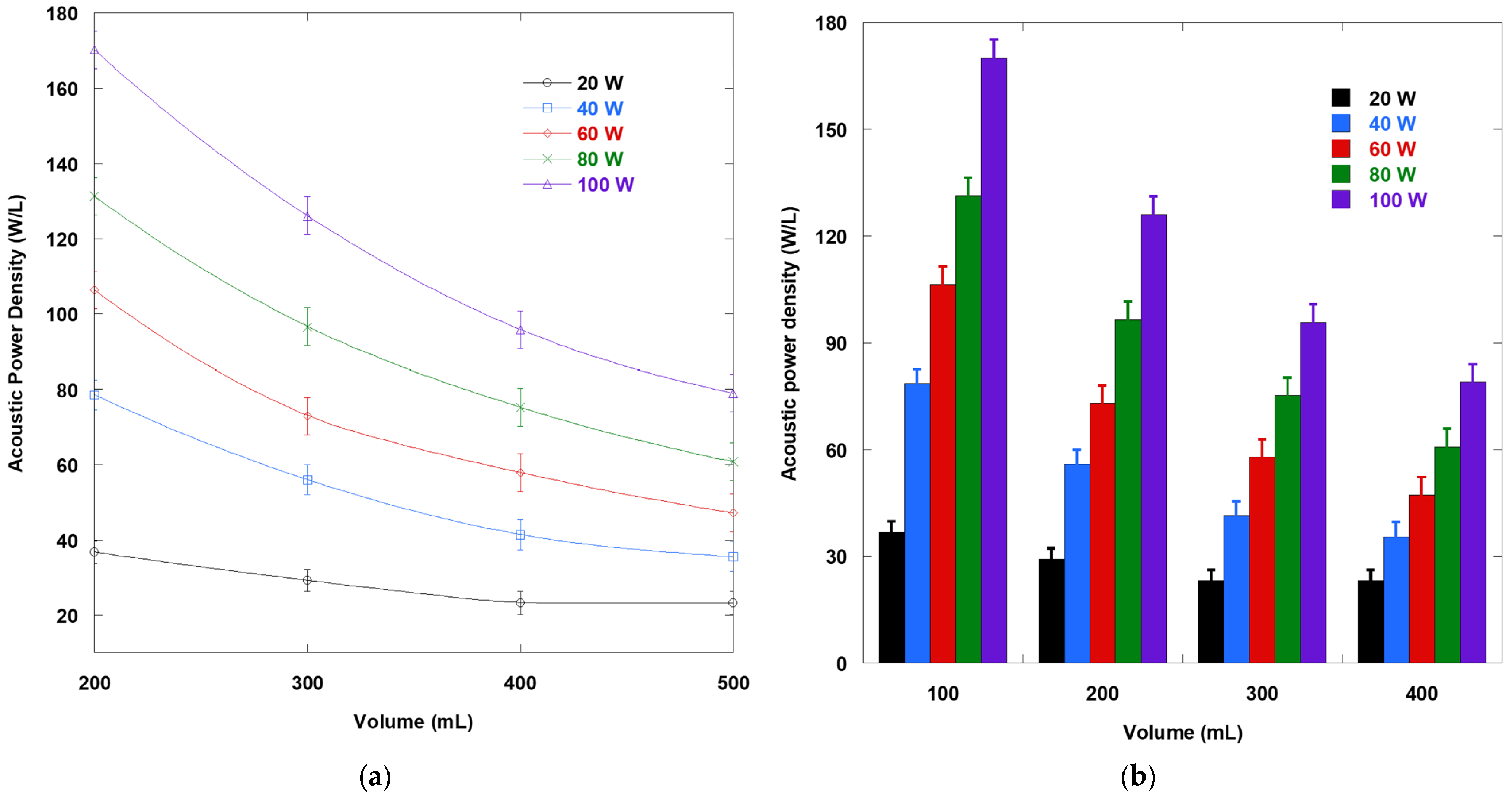
Figure 1a illustrates the correlation between calorimetric acoustic power density (i.e., calorimetric acoustic power divided by liquid volume) and working volume across input powers ranging from 20 to 100 W. As the working volume increased from 200 to 500 mL, the calorimetric acoustic power density systematically decreased at each power setting: by approximately 2.2, 2.2, 2.3, 2.2, and 1.6-fold for input powers of 100, 80, 60, 40, and 20 W, respectively. This inverse trend was expected because distributing energy into a larger liquid volume decreased the energy density available to nucleate and drive transient cavitation events for a given transducer output. This diminishes hot-spot formation and sonochemical potency. The small confidence intervals highlighted good reproducibility of the calorimetric readout from run to run. These results aligned with cavitation theory, which stated that chemical effects scale with the local acoustic energy available per unit volume. The results also support the long-standing recommendation to treat calorimetric acoustic power density as a primary scale variable in sonoreactor design.
Figure 1b showed how calorimetric acoustic power density changed across different volumes (200–500 mL) as set power increased from 20 to 100 W. As the set power increased, the calorimetric acoustic power density rose nearly monotonically with each volume increase. For example, at 300 mL, the values were 29.26, 56.01, 72.94, 96.56, and 126.03 W/L for set powers ranging from 20 to 100 W. However, the increase became sublinear at larger volumes because attenuation and dispersion of the ultrasound field increased as the liquid path lengthened.
Figure 1a,b together emphasize two ways to intensify sonochemistry: decreasing the volume (or, equivalently, the liquid height/path) and increasing the delivered power. Both methods are expressed compactly through calorimetric acoustic power density. Therefore, maintaining a comparable calorimetric acoustic power density when changing scales should preserve the cavitation activity map and radical production to a first approximation.
Delivered acoustic power was quantified by calorimetry (temperature-rise method), an accepted approach for power calibration in sonochemistry and sonoprocessing [9,10,11]. Reporting calorimetric acoustic power density provided a normalized metric that could be compared directly across reactor fills and geometries. Since radical generation rates and pollutant degradation kinetics typically increased with acoustic power density, these calorimetric maps can be used to interpret trends in dosimetry (e.g., with potassium iodide, hydrogen peroxide, Fricke reagent, and 4-NP) and SSY oxidation. In short, volumes and powers that maximized calorimetric acoustic power density were expected to maximize measurable dosimeter yields and SSY removal.

3.2. ROS Dosimeters

To complement calorimetry and determine the formation of ROS at 425 kHz, the sonoreactor using a set of well-established dosimeters that detect various aspects of cavitation chemistry was profiled. Potassium iodide measured the local oxidizing environment by forming I3 from I. This process is initiated by OH/HO2 and promoted by in situ H2O2. The strong absorbance of KI at 351 nm enables high sensitivity to interfacial radical fluxes. Bulk H2O2 accumulation integrated ROS production in the liquid phase, primarily the recombination of OH. This provides a volumetric marker that scales with acoustic energy input. The Fricke system provided a quantitative standardized measure of hydroxyl radical yield under acidic conditions via Fe2+ conversion to Fe3+ with a defined response factor. Finally, 4-NP acted as an organic probe that was rapidly consumed by electrophilic OH attack. This links dosimetric signals to pollutant-like reactivity. Together, KI, H2O2, the Fricke system, and 4-NP triangulated ROS generation across bubble–liquid regions and chemistries. This approach showed a relation between volumetric acoustic power density and specific oxidative pathways and enabled systematic evaluation of process variables.
A working volume of 200 mL was selected because calorimetry demonstrated that, at a fixed electrical set power, the delivered acoustic power was essentially volume independent, so the volumetric acoustic power density decreased as the fill increased. Under typical conditions, this corresponded to nearly twice the power density at 200 mL compared with 500 mL, representing the strongest energy density achievable without hardware modification. From a reactor physics standpoint, at 425 kHz, a smaller working volume shortened the liquid height, reduced attenuation, and better aligned the bulk with antinode regions. At the same time, 200 mL avoided the drawbacks of very small fills, such as rapid heating, evaporation, and field distortion, while still delivering the high power density required to resolve kinetics over extended runs.

3.2.1. KI Dosimeter

To identify the primary ROS at 425 kHz ultrasonication, the formation of triiodide in 0.1 M KI in the absence and presence of AHM was examined. In KI solution, the OH radical oxidized iodide through a short chain (I/I2•−) to form I2, which rapidly converted to I3. The I3 concentration was measured and found that its linear increase over time corresponded to the zero-order OH production rate during steady ultrasonication. In the presence of AHM, H2O2 formed from OH recombination was catalytically converted with I to I2 (H2O2 + 2I → I2 + 2OH). Thus, the measured I3 slope reflects the total oxidant flux (OH + H2O2). Subtracting the KI-only slope yields the H2O2 formation rate. These procedures are commonly used to distinguish between radical and molecular oxidants produced by cavitation [13].
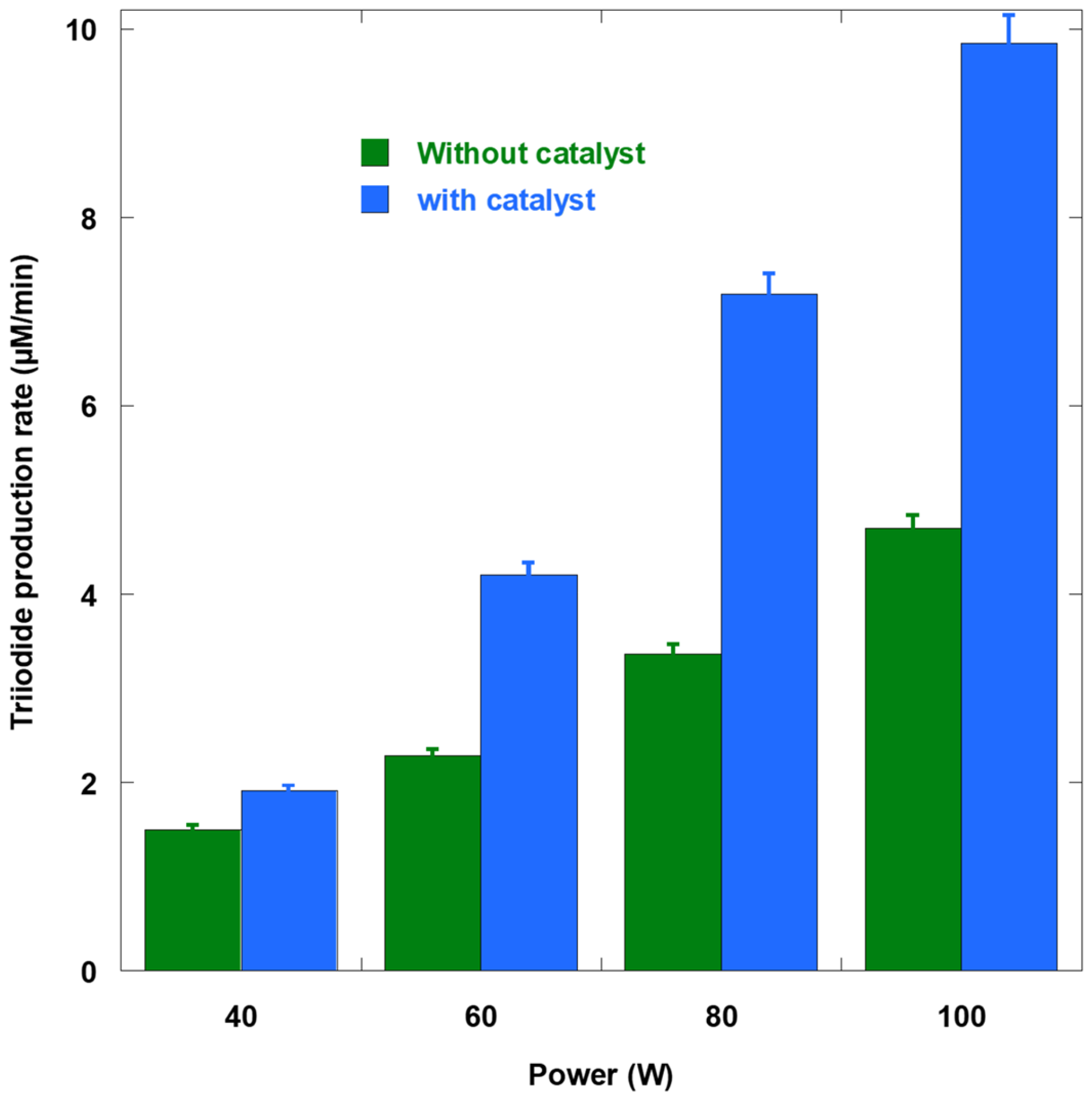
Figure 2 showed that the formation rate of I3 from KI dosimetry increased monotonically with input power, regardless of the presence of AHM. When the KI-only slopes were interpreted as OH-equivalent production rates, the OH flux increased nearly linearly with input power. Specifically, it increases by a factor of 3.13 from 40 to 100 W (from 1.50 to 4.70 µM/min). This trend aligns with calorimetric power density scaling, wherein greater acoustic energy delivered per unit volume results in more violent collapses and higher OH production rates. As power increased, so did the fraction of the oxidant captured as H2O2 (21%, 46%, 53%, and 52% at 40, 60, 80, and 100 W, respectively). This suggested that, at higher acoustic intensities, a greater percentage of nascent OH species combined before reacting with solutes. This outcome is expected because the bubble number density and coalescence increase, thereby enhancing recombination pathways (OH + OH → H2O2). H2O2 is a stable molecular product that primarily forms through radical recombination in and around collapsing bubbles. The yield of H2O2 increases with ultrasonication power and acoustic path length.
In the presence of AHM, the enhancement increased from 1.3-fold at 40 W to 1.8-fold at 60 W to 2.1-fold at 80–100 W. This showed that H2O2 became a more significant sink for OH at higher power settings. AHM mechanistically accelerates iodometric capture of H2O2 (H2O2 + 2I → I2 + 2OH), enabling real-time observation of the growing H2O2 pool. Without AHM, KI cannot practically detect H2O2 within the measurement timescale.
The production rate of OH established the upper limit of pollutant transformation via direct radical attack, scaling with calorimetric acoustic power density. The H2O2 share indicates the proportion of the radical inventory diverted to non-radical oxidant pools. This information is crucial when coupling ultrasound with a process for which H2O2 is a useful co-reagent rather than a radical sink. Along with calorimetric maps, the results of the KI dosimeters (with and without AHM) provide a quantitative link between energy input, ROS speciation, and expected reactivity. These results will be used to interpret the behavior of the other dosimeters and the kinetics of SSY oxidation. KI (with and without AHM) remains a reliable method for determining the contributions of OH and H2O2 in high-frequency reactors.

3.2.2. H2O2 Formation

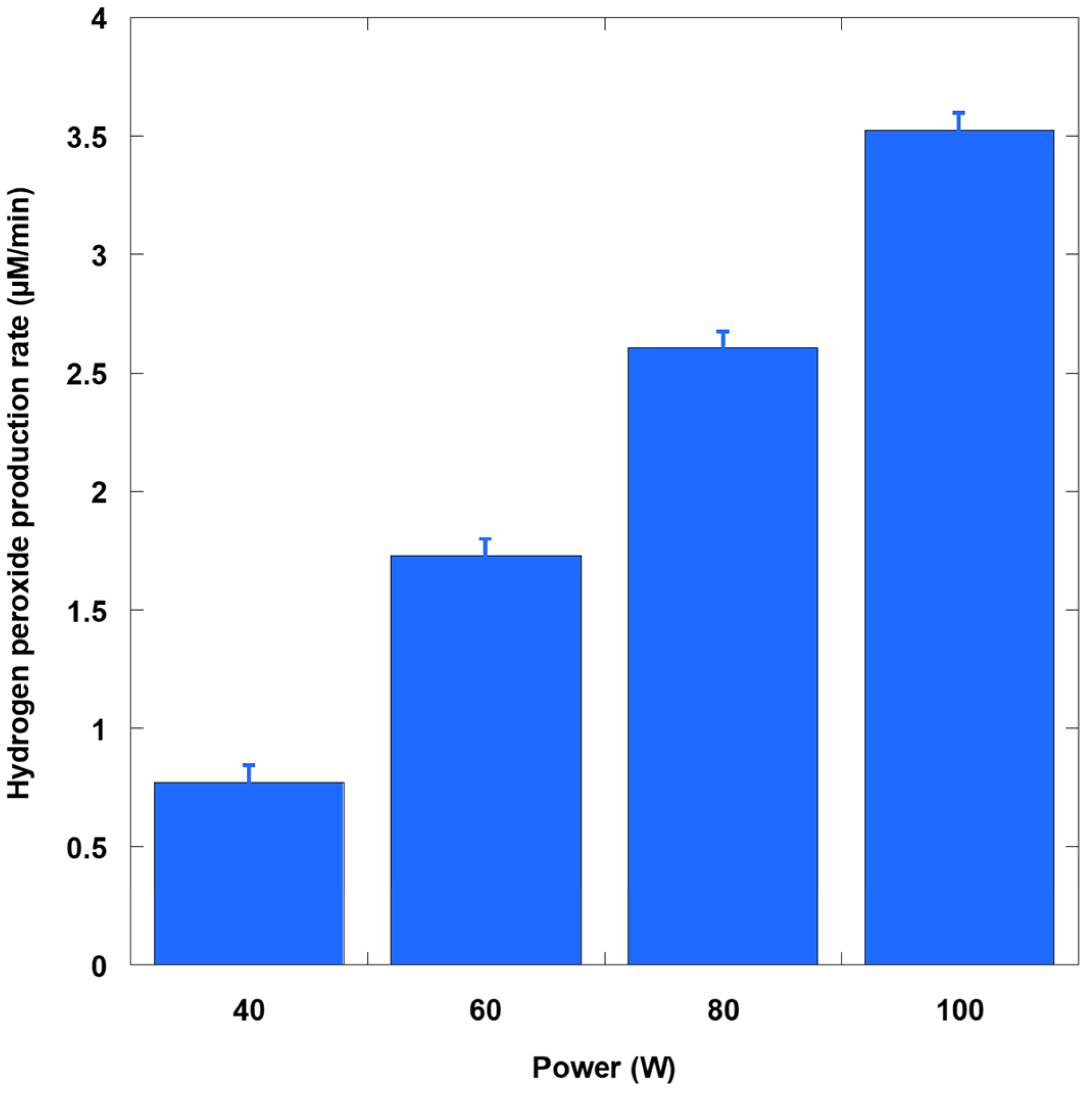
The production rate of H2O2 increased monotonically with input power (40 to 100 W), ranging from approximately 0.75 to 3.5 µM/min (Figure 3). Since hydrogen peroxide in pure water primarily arose from hydroxyl radical self-recombination and, to a lesser extent, from hydroxyl radical pathways formed from hydrogen/oxygen reactions, its accumulation indicated net ROS generation under acoustic cavitation. Thus, increasing the delivered acoustic energy raises the number of active bubbles and their collapse intensity, thereby boosting primary water sonolysis (H2O → OH + H) and subsequent ROS coupling to H2O2.
As expected, the scaling is not perfectly linear because the measured H2O2 rate reflected the balance between production and concurrent losses. At higher powers, ultrasound attenuation, bubble–bubble interactions, and local heating can reduce collapse severity (shielding), while H2O2 itself can be consumed by further sonolysis and radical reactions (e.g., H2O2 + OH → HO2 + H2O), moderating net accumulation. Thus, the sublinear gain at the highest settings likely reflects physical (acoustic) and chemical (secondary ROS) limitations superimposed on the primary power effect.
Notably, the power-response profile aligned with earlier calorimetric mapping results. Increasing acoustic power density increases H2O2 productivity. This finding further establishes calorimetry as a meaningful normalization method for comparing reactor fills and geometries. Since H2O2 integrates ROS generated across hot spots and interfacial regions, these maps provide a useful baseline for interpreting the behavior of more selective dosimeters, such as KI, Fricke, and 4-NP. Ultimately, these maps clarify the trends in SSY abatement reported below.
To reconcile iodometric and hydrogen peroxide dosimeters, KI assays performed with and without AHM were compared to independent bulk H2O2 measurements, thereby quantifying how ROS are formed and evolve in the 425 kHz sonoreactor. In neat KI, I3 originates primarily from the Weissler reaction, in which interfacial OH oxidizes I. AHM addition generates catalytic species that rapidly oxidize I using freshly formed H2O2 (H2O2 + 2 I + 2 H+ → I2 + 2 H2O; I2 + I → I3). Because this catalytic pathway is both fast and selective, the increment in I3 production (ΔKI = with − without AHM) serves as a proxy for the instantaneous H2O2 formation rate near the bubble–liquid interface, before peroxide undergoes back-decomposition or diffusion losses.
A minimal kinetic framework rationalizes the divergence between KI without AHM, KI with AHM, and bulk H2O2 at high power. Let r•OH denote the volumetric formation rate of OH radicals near the interface. Loss of OH radicals occurs by recombination, with second-order rate constant k2, and by first-order scavenging, with effective rate constant kS, which represents reactions with solutes and the liquid matrix. Under quasi-steady-state conditions:
r•OH = k2 [OH]2 + kS [OH]
Solving gives:
H O = k S + k S 2 + 4 k 2 r O H 2 k 2
The instantaneous interfacial H2O2 formation rate is then
rH2O2 = k2 [OH]2
Two limiting regimes follow:
  • When the OH radical concentration scales linearly with r•OH, and the H2O2 formation rate scales with r O H 2 . In this regime, most oxidative capacity remains with short-lived radicals.
  • When the OH radical concentration scales as r O H / k 2 , and the H2O2 formation rate approaches r•OH, oxidative capacity is transferred largely through molecular oxidants.
Representative aqueous constants support this shift. The reaction OH + OH → H2O2 has k2 = 5.5 × 10⁹ M−1·s−1 at 25 °C. The reaction H2O2 + OH → HO2 + H2O has k = 2.7 × 10⁷ M−1·s−1, providing a significant back reaction at elevated radical levels. Hydroperoxyl self-reaction, HO2 + HO2 → H2O2 + O2, proceeds with k = 8 × 10⁵ M−1·s−1. The acid–base pair HO2/O2•− has pKa = 4.8, so conversion to superoxide increases with pH and alters secondary sinks.
These values explain the growing KI + AHM increments and the sublinear bulk H2O2 gains at the highest powers by showing that bimolecular termination accelerates strongly as r•OH increases and that secondary loss of H2O2 becomes non-negligible at elevated radical concentrations.
KI dosimetry without AHM gave triiodide formation rates of approximately 1.50, 2.28, 3.36, and 4.70 µM/min at 40, 60, 80, and 100 W, respectively. With AHM, the rates increased to about 1.91, 4.20, 7.18, and 9.85 µM/min, corresponding to boosts of nearly 27–110% as power increased. The AHM-induced increments (ΔKI) of nearly 0.41, 1.92, 3.82, and 5.15 µM/min thus reflect a growing peroxide contribution at higher acoustic powers. Independent bulk H2O2 accumulation assays yielded approximately 0.77, 1.73, 2.61, and 3.53 µM/min over the same power range. At powers of 80−100 W, these bulk rates fell below the corresponding ΔKI values, indicating that net peroxide destruction (via sonolysis inside/near bubbles and secondary radical reactions) increasingly offsets formation as the ultrasound field intensifies. This divergence is consistent with the dual role of H2O2 as both a product of OH recombination and a substrate for further sonochemical degradation.
Because two hydroxyl radicals recombine to form one H2O2, the observed bulk accumulation provides a lower-bound recombination sink of 1.54, 3.46, 5.21, and 7.05 µM/min at 40–100 W. Adding these values to the KI without AHM rates (OH captured by I) yields minimum total OH generation estimates of approximately 3.04, 5.74, 8.57, and 11.75 µM/min, respectively. Expressed as fractions, the share of OH lost to recombination rises from about 51% at 40 W to 60% at 60−100 W, showing that stronger fields not only increase absolute radical production but also favor radical–radical coupling. This trend aligns with the expected behavior of high-frequency cavitation clouds, where higher power expands the active bubble population and shortens radical diffusion paths, thereby promoting bimolecular OH loss to H2O2.
As an ensemble, the observations reveal that the two dosimetric approaches bracket the actual ROS dynamics. KI without AHM emphasizes interfacial OH capture, KI with AHM approximates the combined flux of OH and freshly formed H2O2 near bubbles, and bulk H2O2 accumulation reports the net peroxide that survives mixing and secondary chemistry in the sonoreactor volume. The internal consistency of these trends, and their systematic dependence on acoustic power, confirmed that power primarily scaled OH generation while shifting a larger fraction toward H2O2 via recombination. The KI/AHM trap is thus valuable for capturing all oxidizing equivalents produced at the cavity interface, and using both KI and H2O2 readouts provides complementary bounds on ROS budgets that can be directly related to calorimetric acoustic power density for sonoreactor optimization and scale-up.

3.2.3. Fricke Dosimeter

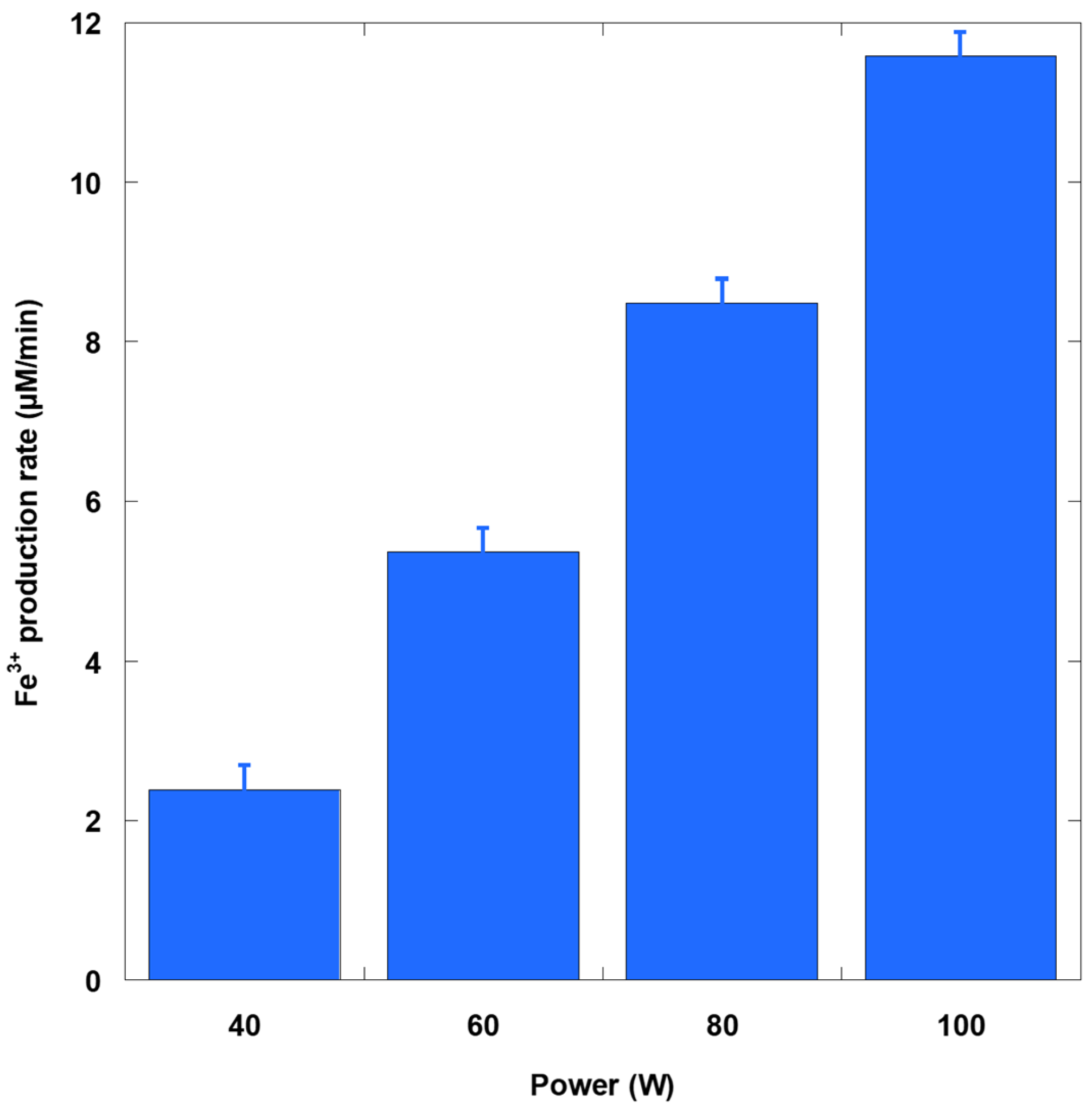
Figure 4 showed a monotonic increase in oxidizing capacity with acoustic power, as quantified by the Fricke dosimeter. As the input power rose from 40 to 100 W, the Fe3+ formation rate increased from 2.39 to 11.58 μM/min. This scaling is expected, since stronger driving enhances both cavitation number density and collapse intensity, thereby increasing radical generation in the bubble–liquid interfacial zone and the surrounding liquid. In acidic Fricke solution, the primary oxidant is OH, with a smaller contribution from HO2/H2O2 via Fenton-type secondary chemistry. Each OH (and HO2 under these conditions) oxidizes one Fe2+ to Fe3+, making the Fe3+ formation rate a reliable indicator of the total oxidizing radical flux in the bulk liquid. Two features of the response are noteworthy. First, the rate–power curve becomes slightly superlinear at higher powers, consistent with the growth of nonlinear cavitation activity at elevated acoustic power densities. Second, absolute Fe3+ formation rates are substantially higher than measured H2O2 production rates (Figure 3), consistent with the Fricke system integrating contributions from both primary OH and secondary oxidants such as HO2/H2O2 in strongly acidic media.
The KI (Weissler) dosimeter corroborates the power dependence but also reveals chemistry-specific differences. The triiodide formation rate rises from 1.50 to 4.70 µM/min without AHM and from 1.91 to 9.85 with AHM as the power increases from 40 to 100 W. This enhancement stems from the well-established Mo(VI)-catalyzed oxidation of I by H2O2 in the Weissler reaction. H2O2, formed by the recombination of OH, enters a catalytic cycle that swiftly converts I to I3. This enables the KI assay to detect direct OH attacks on I and the H2O2 pathway. Consequently, the KI+AHM system reports a larger fraction of the overall ROS budget than the uncatalyzed KI system, and its rates approach those of the Fricke system.
Bulk H2O2 accumulation increased with power, rising from 0.77 to 3.52 µM/min over a range of 40 to 100 W. Because H2O2 is predominantly formed by radical recombination (2OH → H2O2), the lower-bound OH production rates are approximately twice the H2O2 rates (1.54, 3.46, 5.21, and 7.05 µM/min). These values remain lower than the Fricke Fe3+ and KI+AHM rates at the same powers. This outcome is consistent with the fact that H2O2 reflects only the recombination branch of OH chemistry, is subject to back reactions and loss processes, and undergoes additional Fe2+ oxidation pathways in the Fricke solution. The qualitative ordering observed across all powers (Fricke ≥ KI+AHM > KI without AHM > H2O2) is therefore mechanistically coherent. Fricke dosimeter integrates OH and secondary oxidants in an acidic environment, KI with AHM directly senses OH and the H2O2 formed from OH. Uncatalyzed KI primarily detects interfacial OH, and H2O2 alone reflects only the recombination sink of OH.
Synthesizing these findings, the three dosimeters provide a consistent picture of ROS generation at 425 kHz. Increasing power elevates acoustic power density, amplifying OH formation and H2O2 yields downstream. The AHM-promoted KI response confirms that a significant portion of the oxidative capacity originates from the H2O2 produced by OH recombination. Meanwhile, Fricke rates demonstrate that the total oxidizing equivalents accessible to the bulk liquid increase due to the efficient conversion of OH and peroxy species into Fe3+ under acidic conditions.

3.2.4. 4-Nitrophenol Dosimeter

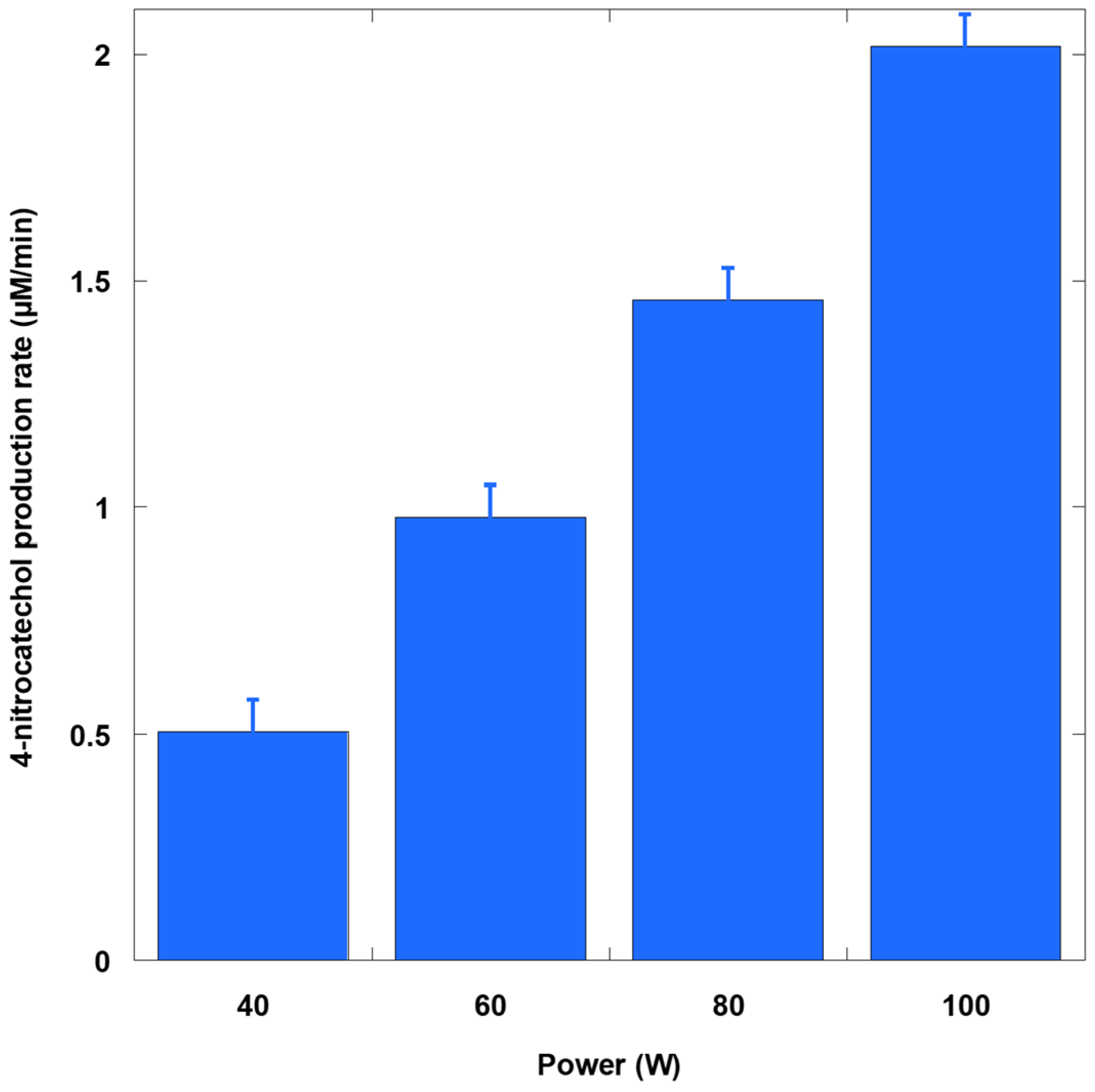
Figure 5 showed that the formation rate of 4-NC increased monotonically with input power. The formation rate ranged from approximately 0.51 µM/min at 40 W to 2.02 µM/min at 100 W. This behavior is consistent with cavitation theory, which states that greater acoustic driving increases the frequency and intensity of transient collapses. These collapses increase the flux of OH at the interface and the likelihood of electrophilic aromatic substitution on 4-NP, yielding 4-NC, the canonical hydroxylation product. Since 4-NP reacts with OH via a high second-order rate constant (k = 3.8 × 10⁹ M−1·s−1 [16]) and a selective ring-substitution pathway, its response depends more on the presence of short-lived radicals at the bubble–liquid interface than on bulk oxidants. Consequently, 4-NP acts as a stringent process probe for ROS generated directly by cavitation. The nearly linear increase in product formation with power indicates that interfacial OH production scales with acoustic power density in this sonoreactor.
Collectively, the observations demonstrate that the four dosimeters provide complementary yet internally consistent information. 4-NP (or 4-NC) primarily responds to interfacial, extremely short-lived OH radicals. KI without AHM captures rapid radical oxidation but is less sensitive to H2O2 accumulation. KI with AHM converts stored H2O2 into I3, thereby reflecting the combined contributions of immediate OH radicals and accumulated peroxides. The Fricke dosimeter, in contrast, quantifies the total pool of oxidizing equivalents under acidic conditions.

3.3. SSY Sono-Oxidation

This section examines how operating conditions affect cavitation chemistry and, consequently, the sonochemical oxidation of SSY at 425 kHz. Acoustic power governs bubble population and collapse intensity. Although increases in acoustic power typically increase OH/H2O2 production, attenuation and decoupling effects prevent additional increases. SSY loading influences radical demand and interfacial availability, often altering the apparent reaction order as the substrate competes for OH in the boundary layers. pH alters the speciation of the dye, the lifetimes of ROS, and the balance between bulk and interfacial reactions. These changes lead to systematic alterations in degradation kinetics. Dissolved gas composition and sparging determine bubble thermodynamics and hot-spot temperatures. In aggregate, power, dye loading, pH, and the gas environment provide the mechanistic framework through which SSY decay behavior is understood.

3.3.1. Power Impact

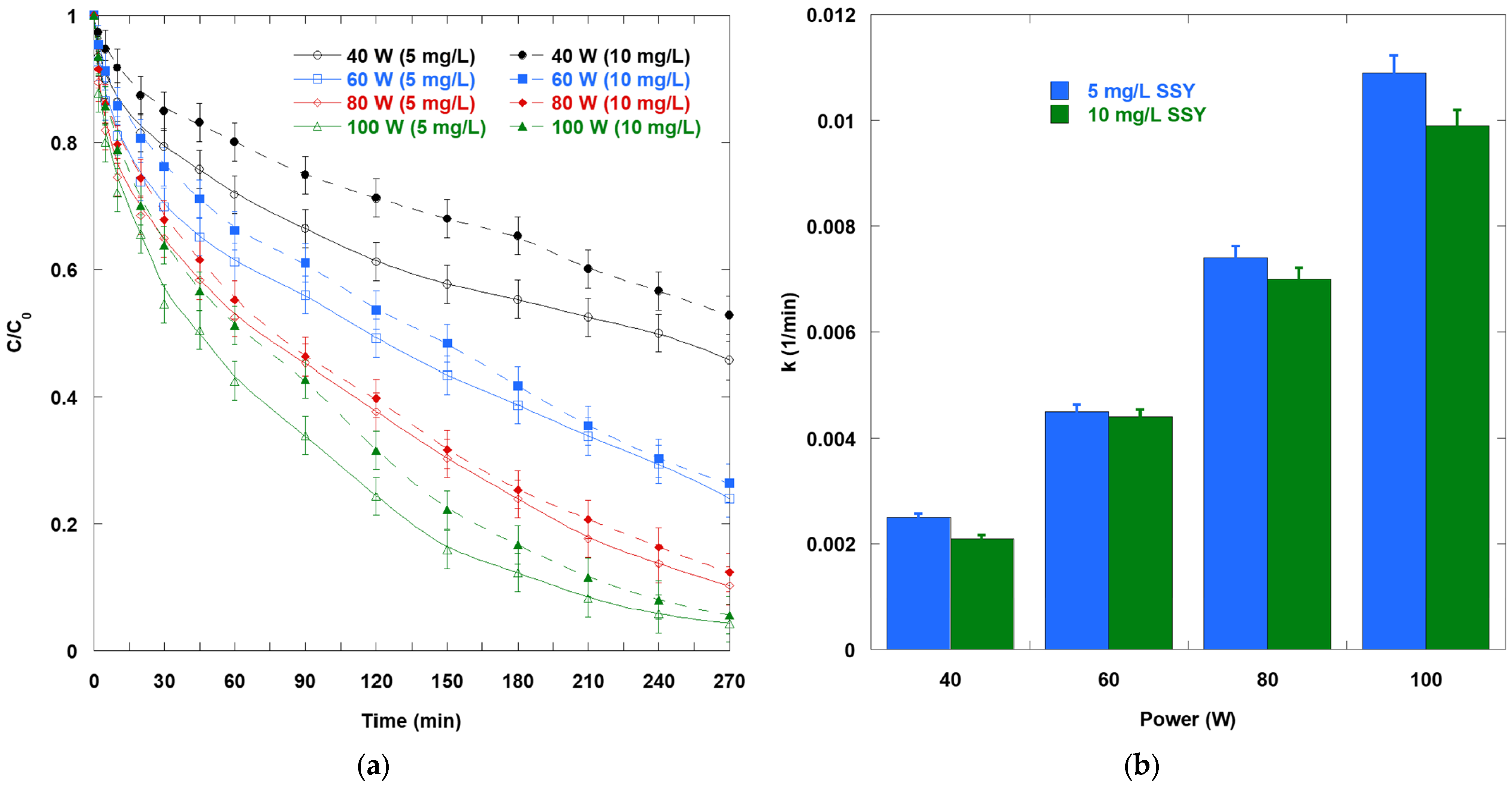
Figure 6a showed how ultrasonication power affected SSY degradation at initial dye concentrations of 5 and 10 mg/L. Increasing the electrical input power from 40 to 100 W accelerated SSY decay at both concentrations. The normalized concentration profiles (C/C0 vs. time) consistently rank the power levels as follows: 100 W > 80 W > 60 W > 40 W. The largest differences emerge beyond the 60–90 min mark. At a fixed power level, the 10 mg/L solutions decay more slowly than the 5 mg/L solutions, reflecting stronger competition for ROS and higher radical demand per unit volume. Steeper apparent slopes emerge as power increases, and modest but systematic rate suppression occurs when the initial dye concentration doubles. Fitting over the main ultrasonication window gives apparent pseudo-first-order rate constants that grow with power (Figure 6b). For 5 mg/L SSY, k increases from 2.5 × 10⁻³ to 1.09 × 10⁻² min−1 as the power rises from 40 to 100 W, and for 10 mg/L, k increases from 2.1 × 10⁻³ to 0.99 × 10⁻² min−1. The slight suppression of k at 10 mg/L relative to 5 mg/L reflects stronger competition for short-lived oxidants (primarily OH) at higher solute loading, a common feature of sonolytic dye abatement where steady-state radical assumptions lead to apparent first-order kinetics with respect to the dye. At a given ROS flux, a higher bulk SSY level increases competition for OH in the interfacial reaction zone and consumes a larger share of the H2O2 pool. This results in lower fractional conversion at equal irradiation times. Since solute levels are low (in the mg/L range), acoustic attenuation by the dye is minimal. Thus, radical demand is the dominant factor rather than changes in cavitation hydrodynamics. Overall, power is the primary factor governing SSY sono-oxidation. Higher acoustic power densities result in higher radical and peroxide yields and faster dye decay. Increasing the initial SSY concentration uniformly shifts the curves toward slower kinetics by increasing ROS consumption.
Calorimetric mapping in this sonoreactor showed that delivered acoustic power and, by normalization, the volumetric acoustic power density increased systematically with the set power, providing a device-independent scale variable for comparing fills and operating points. In parallel, all four dosimeters confirmed that higher power drove larger oxidant fluxes. KI (Weissler) without AHM tracks interfacial OH production and rises nearly linearly with power, while the KI with AHM variant captures both OH and H2O2, rising more steeply and indicating that the peroxide fraction of the oxidant budget grows with power. Bulk H2O2 accumulation also increases but remains below KI with AHM at the highest powers, consistent with in situ H2O2 losses through back decomposition and radical reactions in dense cavitation fields. Complementary Fricke measurements, which integrate OH and peroxy species in acidic media via Fe2+ to Fe3+ oxidation, likewise increase with power and provide an upper bound on accessible oxidizing equivalents. The 4-NP to 4-NC hydroxylation, a selective probe for near-interface OH, shows the same trend. The consistent ranking with power aligns with calorimetric delivered-power mapping and with established sonochemistry: stronger acoustic driving increases active bubble density and collapse severity, raising both OH flux and the fraction diverted to H2O2 via recombination.
The coherent power response across SSY, KI with and without AHM, H2O2, Fricke, and 4-NP was consistent with cavitation theory [1]. Stronger acoustic driving increases both the number density of active bubbles and the intensity of their collapse, thereby enhancing primary water sonolysis and, in turn, promoting both direct radical attack and radical recombination to H2O2.
Figure 6a,b, together with calorimetric and dosimetric data, established a clear linkage between energy input and chemical output. Increasing the calorimetric acoustic power density enhances both OH and H2O2 generation, which in turn monotonically accelerates SSY removal.

3.3.2. SSY Loading Impact

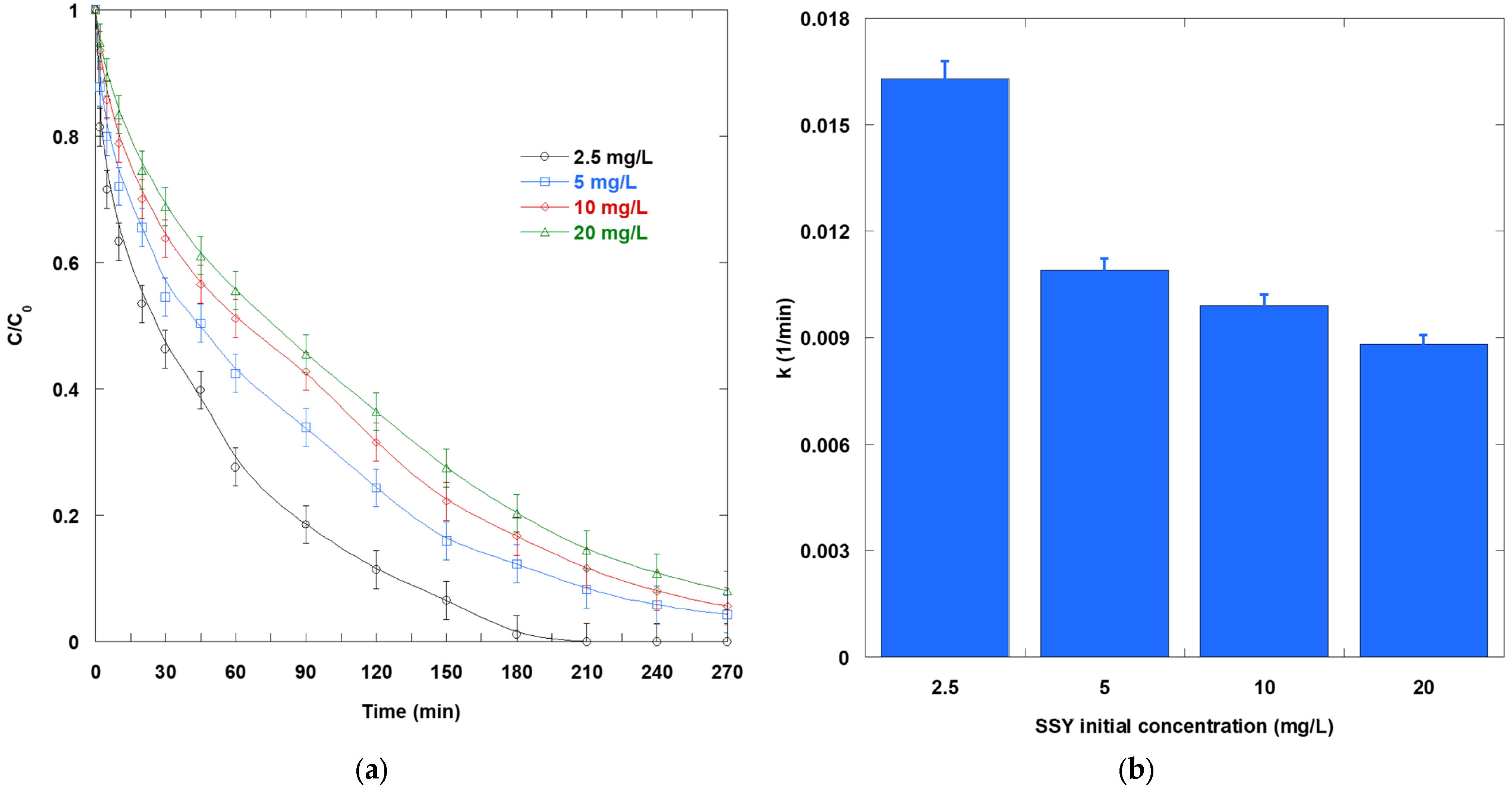
Figure 7a illustrates the influence of initial SSY loading on its degradation, with dye concentrations varied between 2.5 and 20 mg/L. When the acoustic input remains constant (100 W), SSY degradation exhibits an inverse relationship with the initial concentration. A concentration of 2.5 mg/L decays the fastest, reaching complete removal within 210 min. Concentrations of 5, 10, and 20 mg/L, on the other hand, exhibit progressively slower fractional losses within the same irradiation period. The accompanying pseudo-first-order fits quantify this trend (Figure 7b): the apparent rate constant (k) decreases from 1.63 × 10⁻² to 1.09 × 10⁻², 0.99 × 10⁻², and 0.88 × 10⁻² min−1 as the initial SSY concentration increases from 2.5 to 5, 10, and 20 mg/L, respectively. In normalized coordinates (C/C0), the initial degradation slopes systematically decrease with increasing dye concentration, indicating that the system operates in a radical-limited regime. In this regime, the flux of ROS is essentially fixed by the acoustic field and must be distributed over a larger number of dye molecules as the initial SSY concentration rises. At higher loadings, two additional effects reinforce this behavior. First, saturation of the bubble–liquid interfacial layer, where most OH is generated, limits the frequency of encounters between radicals and individual dye molecules. Second, aromatic transformation products accumulate over time and compete for ROS, progressively scavenging oxidants. Together, these effects account for the observed curvature in the degradation profiles and the pronounced slowdown at later stages of reaction.
These concentration trends are consistent with the established power dependence observed at 5 and 10 mg/L (Figure 7a,b). Increasing the input power from 40 to 100 W markedly steepened the C/C0 decay curves at both concentrations, demonstrating that higher acoustic input accelerates ROS formation. Calorimetry confirmed this energy delivery: the acoustic power density rose significantly with input power, reflecting a larger population of active bubbles and more violent collapses. Dosimetry provided the chemical correlate. The KI assay showed a linear increase in OH production with power, while the KI/AHM assay, which also detects H2O2, exhibited an even steeper rise. Together, these results indicate that both primary OH and secondary H2O2 increase with acoustic intensity. Accordingly, the degradation curves at 100 W represent the outcome of the highest available ROS flux, while increasing initial SSY concentration simply imposes a larger stoichiometric demand and intensifies radical competition against this fixed flux.
Overall, the data set reveals a coherent link between energy, chemistry, and performance. Calorimetry demonstrates that higher input power delivers greater acoustic power density, dosimeters show that this translates into higher OH and total oxidant generation, and kinetics confirm faster SSY loss at a fixed initial dye concentration. At constant power, fractional conversion slows as the initial SSY concentration increases. In practical terms, lower influent dye concentrations are removed more efficiently on a fractional basis when treatment volume and power are fixed, whereas higher loadings require extended residence times or increased acoustic power density to achieve comparable conversion.

3.3.3. pH Impact

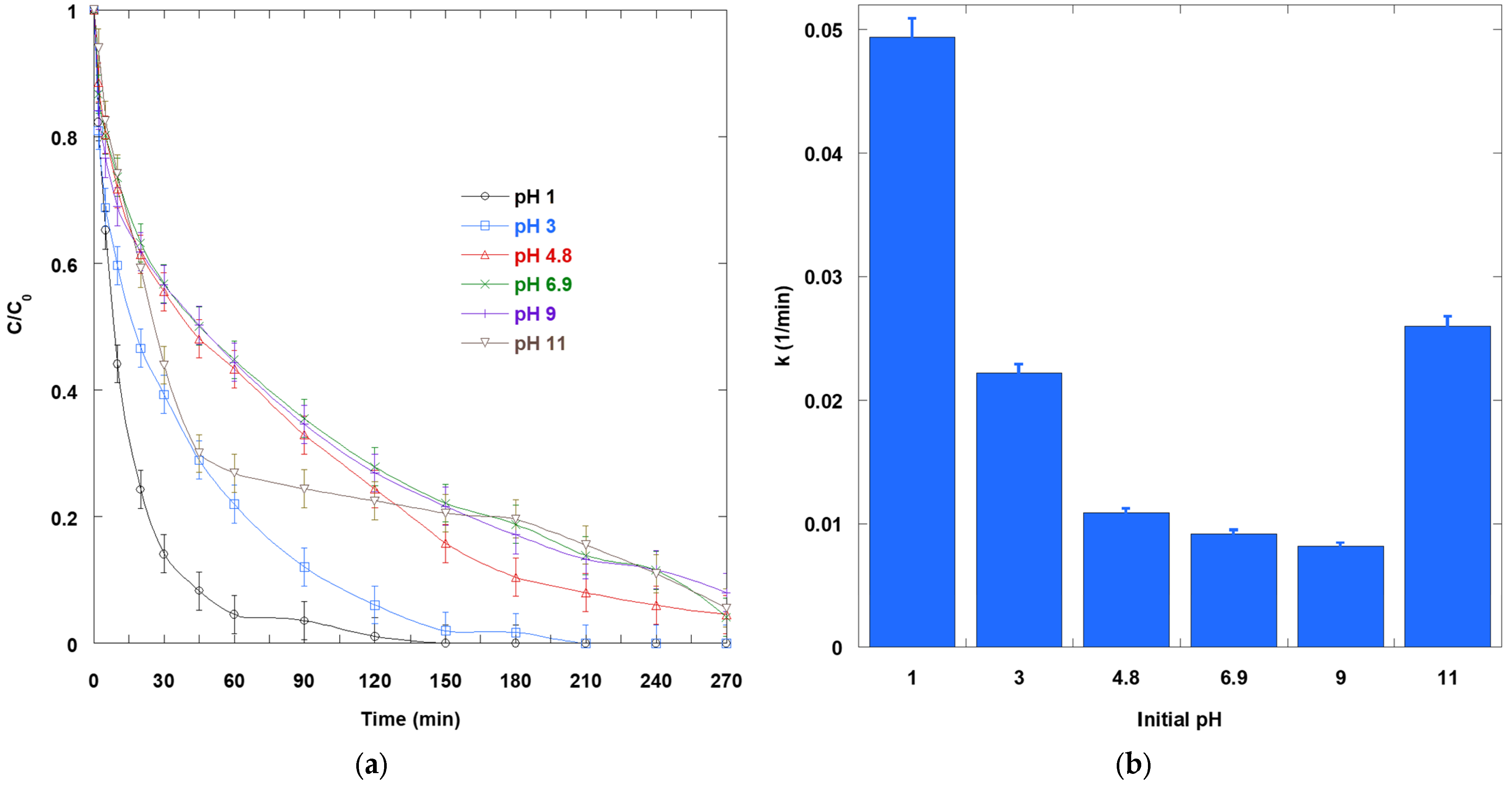
SSY removal was strongly pH-dependent (Figure 8a,b). The fastest decay occurred under strongly acidic conditions. At pH 1, the normalized concentration drops to zero within 150 min, and the apparent pseudo-first-order constant is the largest in the series. The next most effective condition is pH 3. As the medium shifts to mildly acidic/near-neutral (pH 4.8–6.9) and moderately alkaline (pH 9), the curves flatten and the fitted rate constants decrease, indicating slower fractional conversion. At pH 11, the early-time loss is the slowest, yet the time-averaged rate constant is higher than at pH 4.8–9 due to a late-stage acceleration. This explains why its bar is elevated in Figure 8b, even though Figure 8a shows an initially sluggish trajectory.
Under acidic conditions, the oxidizing strength of the OH radical was higher, and the potential shifted negatively with increasing pH according to Nernstian dependence. This favored aromatic hydroxylation and cleavage of the azo bond in SSY. In addition, OH remains in its protonated form at low pH; only at very high pH does partial deprotonation occur (pKa 11.9), producing the oxyl radical anion O•−. This species is more nucleophilic and far less prone to aromatic addition, thereby suppressing dye-bleaching pathways. Acidic media also stabilize H2O2 against base-catalyzed decomposition (maximal stability at pH < 4), allowing it to persist as both a secondary oxidant and a precursor of OH.
In neutral to alkaline water, background anions such as bicarbonate and carbonate efficiently scavenge OH (e.g., k•OH+HCO3− = 8.5 × 10⁶ M−1·s−1 [16]), diverting the radical flux toward less reactive species such as CO3•− and reducing the oxidant budget available for SSY degradation. Base also accelerates H2O2 disproportionation, further diminishing oxidant persistence. These effects explain the slower kinetics observed at pH 4.8–9. The elevated average rate constant at pH 11 reflects a different balance: although early-time scavenging and OH to O•− deprotonation suppress aromatic addition initially, prolonged sonolysis at high pH accumulates substantial oxidant pools and can alter SSY speciation or aggregation. This leads to a late-stage acceleration, producing a low early-loss curve but a higher global fit.
Quantitative stability context supports the observed pH trend. H2O2 has a pKa of 11.62 at 25 °C, so alkaline conditions shift speciation toward the conjugate base HO2. At pH 10, 11, 11.62, and 12, the calculated HO2 fractions are approximately 0.02, 0.19, 0.50, and 0.71, respectively, consistent with faster base-promoted decomposition relative to the neutral species. In alkaline solution, HO2 reacts with neutral H2O2 to yield oxygen, water, and hydroxide, and the reaction of OH radicals with HO2 proceeds about two orders of magnitude faster than with neutral H2O2. In addition, OH radicals react with H2O2 with a second-order rate constant of 2.7 × 10⁷ M−1·s−1 at 25 °C [16], so elevated radical levels also limit net accumulation. Field and laboratory measurements indicate representative half-lives of 8–31 h in fresh water and 50–70 h in filtered seawater, whereas wastewater exhibits decay on the order of minutes to hours due to catalytic metals and enzymes [17]. These quantitative points explain the reduced peroxide persistence as pH increases and under strong acoustic drive.
The pH trends aligned with ROS measurements. KI (Weissler) tracks interfacial OH and increases with driving power. KI/AHM captures both OH and H2O2, rising even more steeply and reflecting enhanced peroxide formation and persistence at low pH. The Fricke assay integrates oxidizing equivalents in acidic media and likewise increases with power. Together, these protocols support the conclusion that acidic operation provides a larger effective oxidant budget at the same delivered acoustic power density, directly accounting for the steeper C/C0 decays at pH 1–3.
When power and volume were fixed, operation under acidic conditions (pH 1–3) minimized the residence time or delivered energy required for a given SSY conversion. Near-neutral and weakly basic conditions are hindered by radical scavenging and faster H2O2 loss, while strongly basic conditions (pH 11) exhibit slow initial kinetics but composition-dependent late gains.

3.3.4. Gases Impact

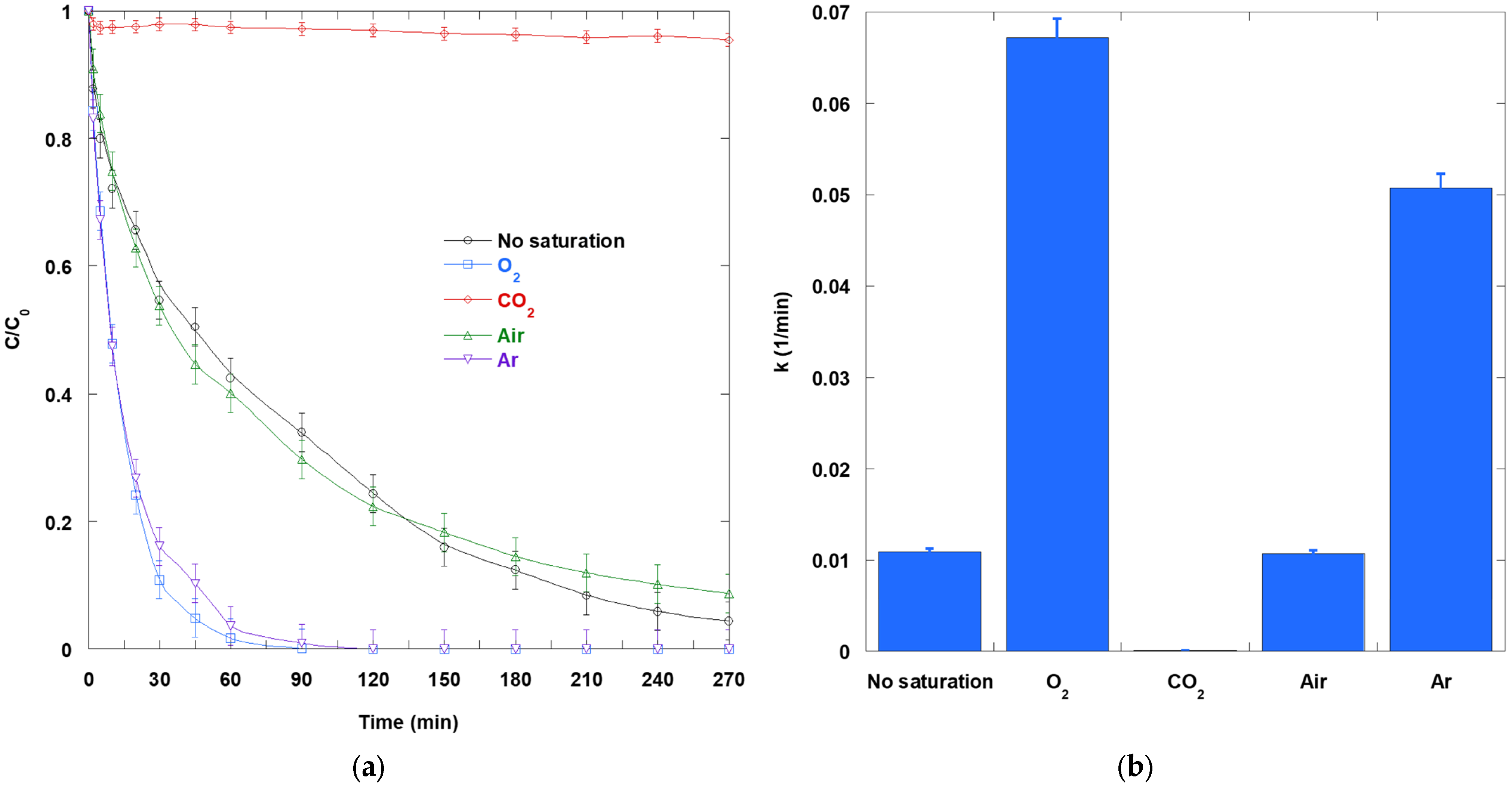
Figure 9a,b illustrates the effect of saturated gases on SSY degradation. The kinetic curves and fitted rate constants followed the order O2 > Ar >> Air ≈ No saturation >> CO2. Oxygen produces the steepest decay (k = 6.72 × 10⁻² min−1), followed by argon (5.07 × 10⁻² min−1). Air and the unsparged condition cluster near ≈ 0.011 min−1, whereas CO2 essentially suppresses removal over the same ultrasonication window. This hierarchy reflects the combined influence of thermophysical control of collapse intensity and chemical participation of the bubble gas.
The observed order (O2 > Ar >> Air ≈ No saturation >> CO2) provides direct guidance for treatment design. Oxygen represents a practical default for dye removal because it combines vigorous collapse conditions with in-bubble participation that enhances oxidant formation and accelerates decay. Argon can generate very strong activity through hotter collapses, but its use is generally suited to small-volume studies or polishing steps rather than large-scale continuous operation. Air or no sparging results in lower activity, and the sonicated liquid progressively loses dissolved gas during operation; therefore, continuous sparging is advisable to maintain steady performance. Carbon dioxide should be avoided for oxidation of aromatics because collapse cushioning and diversion of hydroxyl radicals into carbonate chemistry reduce effective oxidant availability. For all gases, placement of the sparger close to the active acoustic zone and adjustment of flow rate to refresh dissolved gas without excessive stripping of cavitation nuclei are practical operational levers.
Ar is monatomic with a high heat capacity ratio (γ = 1.67) and low heat capacity, so adiabatic compression produces very high hot-spot temperatures. Replacing a fraction of Ar with a polyatomic gas sharply lowers the estimated collapse temperature. Stronger collapses enhance primary water sonolysis (OH, H) and thereby increase oxidative capacity. Oxygen, with a lower γ of about 1.4, slightly cushions the collapse relative to Ar, but it also participates chemically inside the bubble or plume. Pathways such as O2 → O and HO2, H + O2 → HO2, and HO2 → H2O2 contribute to oxidant yields, generating HO2, H2O2, and additional OH through secondary reactions.
Air contains O2 and N2, the latter being chemically less reactive and lowering the heat-capacity ratio (γ). As a result, both collapse intensity and in-bubble chemistry are diluted compared with pure O2 or Ar. In addition, ultrasound progressively degasses solutions, so without continuous sparging, the dissolved gas content decreases during operation, reducing cavitation activity toward the unsparged condition. This explained why the air and no-saturation traces converged.
In the presence of CO2, two effects act in the same unfavorable direction. First, collapses are weaker because CO2 is polyatomic with a lower heat-capacity ratio and a higher effective heat capacity, which reduces peak collapse temperatures compared with Ar or O2 and depresses primary radical formation. Second, dissolved CO2 establishes H2CO3/HCO3/CO32− buffers that divert radicals into carbonate chemistry. Hydroxyl radicals react rapidly with HCO3 and CO32− to form CO3•−, a much less reactive oxidant toward many aromatics, with reported rate constants on the order of 106–107 M−1·s−1 [16]. The CO3•− radical is a more selective and generally less reactive oxidant toward many aromatics. The suppression observed under CO2 saturation is consistent with this kinetic framework, although CO3•− radical formation was not directly confirmed in this study.

4. Conclusions

A coupled calorimetric and multidosimetric framework was established to quantify radical pathways in a 425 kHz sonoreactor and to link energy delivery with chemistry and performance in SSY degradation. Temperature-rise calorimetry provided the delivered acoustic power, which, when normalized by working volume, yielded the acoustic power density as a device-independent scale variable. Across fills and set powers, higher acoustic power density reproducibly translated into stronger cavitation activity and faster pollutant removal, confirming calorimetry as the anchor for reactor comparison and scale-up. Four complementary dosimeters, KI, KI/AHM, bulk H2O2 accumulation, and 4-NP to 4-NC hydroxylation, enabled triangulation of oxidant formation across bubble–liquid regions and mapping of ROS. KI isolated interfacial OH attack. KI/AHM captured OH combined with H2O2. Bulk H2O2 integrated the recombination branch. 4-NP to 4-NC selectively reported near-interface OH. The four readouts rose coherently with acoustic power density, demonstrating that stronger driving both increased OH generation and shifted a larger fraction into H2O2 through recombination.
Process variable studies rationalized SSY kinetics through this energy-to-chemistry linkage. Power was the primary lever. Increasing set power increased apparent pseudo-first-order rate constants and steepened C/C0 trajectories in step with higher dosimeter signals. Substrate loading modulated fractional removal at fixed power, with higher pollutant concentration imposing greater radical demand and competition in the interfacial zone. pH tuned oxidant strength and persistence. Acidic media maximized bleaching by maintaining a stronger OH/H2O redox couple and stabilizing H2O2. Near-neutral and alkaline media suffered from carbonate and bicarbonate scavenging of OH and base-catalyzed H2O2 loss. Dissolved gas identity controlled both collapse thermodynamics and in-bubble chemistry. Oxygen and argon gave the fastest removal by combining violent collapses with oxidative participation, while carbon dioxide suppressed activity through collapse cushioning and diversion of OH to carbonate radicals.
The calorimetry-anchored multidosimetric strategy provides a generalizable protocol for quantifying cavitation-driven radical pathways and diagnosing process variables in other aqueous systems. Reporting delivered power and standardized dosimetry enables future studies to construct comparable datasets across reactor geometries and operating frequencies, accelerate process optimization, and support the advanced treatment of dye-contaminated water.
Lower frequencies generate larger cavitation bubbles with more violent collapses, producing stronger mechanical effects but lower radical yields per unit volume. Our dosimetric framework enables quantification of these differences and can guide reactor design when mechanical disruption is prioritized. At higher frequencies, cavitation produces smaller bubbles with gentler collapses, favoring chemical effects and more uniform radical generation, and the methodology presented in this study provides a basis for evaluating efficiency and reproducibility under such conditions. More broadly, normalizing results by delivered energy density and dosimetric parameters establishes a transferable framework for comparing sonoreactors across frequency ranges despite inherent differences in cavitation dynamics.
The proposed framework has direct implications for real-world water treatment practice. By linking delivered acoustic power density with radical speciation, the method provides a transferable basis for scaling laboratory reactors to pilot and industrial units. The approach enables rational selection of operating parameters such as working volume, gas feed, and pH to maximize oxidant yield under given hardware constraints. In practical scenarios, this allows treatment plants to predict performance across variable influent loads, to minimize energy consumption per unit pollutant removed, and to integrate ultrasound with complementary advanced oxidation processes. The strategy also supports regulatory compliance by providing a standardized and reproducible metric for reporting energy delivery and oxidative capacity, thereby facilitating comparison across technologies and installations. These features make the method suitable for deployment in textile effluent treatment, pharmaceutical wastewater abatement, and other industrial sectors where dye and aromatic contaminants are prevalent.

Author Contributions

Investigation, validation, data curation, visualization, A.B.; Conceptualization, methodology, software, validation, formal analysis, investigation, resources, data curation, writing—original draft preparation, writing—review and editing, visualization, supervision, project administration, funding acquisition, O.H.; Conceptualization, methodology, validation, investigation, resources, visualization, supervision, L.E.B.; Resources, validation, visualization, funding acquisition, M.K.H.-K.; Validation, visualization, supervision, A.A. All authors have read and agreed to the published version of the manuscript.

Funding

This research received no external funding.

Data Availability Statement

Data is contained within the article.

Acknowledgments

This research was funded by the National Plan for Science, Technology and Innovation (MAARIFAH), King Abdulaziz City for Science and Technology, Kingdom of Saudi Arabia, award no. 13-MED1022-02.

Conflicts of Interest

The authors declare no conflicts of interest.

References

  1. Merouani, S.; Hamdaoui, O.; Dehane, A. Sono-Hybrid Advanced Oxidation Processes for Water and Wastewater Treatment; Elsevier: Amsterdam, The Netherlands, 2025; ISBN 9780443220876. [Google Scholar]
  2. Manickam, S.; Camilla Boffito, D.; Flores, E.M.M.; Leveque, J.M.; Pflieger, R.; Pollet, B.G.; Ashokkumar, M. Ultrasonics and Sonochemistry: Editors’ Perspective. Ultrason. Sonochem. 2023, 99, 106540. [Google Scholar] [CrossRef] [PubMed]
  3. Asakura, Y.; Yasuda, K. Frequency and Power Dependence of the Sonochemical Reaction. Ultrason. Sonochem. 2021, 81, 105858. [Google Scholar] [CrossRef] [PubMed]
  4. Choi, J.; Son, Y. Effect of Dissolved Gases on Sonochemical Oxidation in a 20 KHz Probe System: Continuous Monitoring of Dissolved Oxygen Concentration and Sonochemical Oxidation Activity. Ultrason. Sonochem. 2023, 97, 106452. [Google Scholar] [CrossRef] [PubMed]
  5. Son, Y.; Seo, J. Effects of Gas Saturation and Sparging on Sonochemical Oxidation Activity in Open and Closed Systems, Part I: H2O2 Generation. Ultrason. Sonochem. 2022, 90, 106214. [Google Scholar] [CrossRef] [PubMed]
  6. Adamou, P.; Harkou, E.; Villa, A.; Constantinou, A.; Dimitratos, N. Ultrasonic Reactor Set-Ups and Applications: A Review. Ultrason. Sonochem. 2024, 107, 106925. [Google Scholar] [CrossRef] [PubMed]
  7. Zhu, Y.; Zhu, X.; Pan, X.; Liu, X.L.; Bussemaker, M.J. Correlation of Sonochemical Activities Measured via Dosimetry and an Area-Selective Analysis of Sono(Chemi)Luminescence—RSC Mechanochemistry (RSC Publishing). RSC Mechanochem. 2025, 2, 399–418. [Google Scholar] [CrossRef]
  8. Mason, T.J.; Ghimpeteanu, D.; Călinescu, I.; Vinatoru, M.; Trifan, A. A Simple New Approach for Mapping an Ultrasonic Tank for Sonochemistry. Ultrason. Sonochem. 2024, 107, 106940. [Google Scholar] [CrossRef] [PubMed]
  9. Koda, S.; Kimura, T.; Kondo, T.; Mitome, H. A Standard Method to Calibrate Sonochemical Efficiency of an Individual Reaction System. Ultrason. Sonochem. 2003, 10, 149–156. [Google Scholar] [CrossRef] [PubMed]
  10. Al-Juboori, R.A.; Yusaf, T.; Bowtell, L.; Aravinthan, V. Energy Characterisation of Ultrasonic Systems for Industrial Processes. Ultrasonics 2015, 57, 18–30. [Google Scholar] [CrossRef] [PubMed]
  11. Mason, T.J.; Lorimer, J.P.; Bates, D.M. Quantifying Sonochemistry: Casting Some Light on a ‘Black Art’. Ultrasonics 1992, 30, 40–42. [Google Scholar] [CrossRef]
  12. Ferkous, H.; Hamdaoui, O.; Pétrier, C. Sonochemical Formation of Peroxynitrite in Water: Impact of Ultrasonic Frequency and Power. Ultrason. Sonochem. 2023, 98, 106488. [Google Scholar] [CrossRef] [PubMed]
  13. Zare, M.; Bussemaker, M.J.; Serna-Galvis, E.A.; Torres-Palma, R.A.; Lee, J. Impact of Sonication Power on the Degradation of Paracetamol under Single- and Dual-Frequency Ultrasound. Ultrason. Sonochem. 2023, 99, 106564. [Google Scholar] [CrossRef] [PubMed]
  14. Kormann, C.; Bahnemann, D.W.; Hoffmann, M.R. Photocatalytic Production of H2O2 and Organic Peroxides in Aqueous Suspensions of TiO2, ZnO, and Desert Sand. Environ. Sci. Technol. 1988, 22, 798–806. [Google Scholar] [CrossRef] [PubMed]
  15. Hart, E.J.; Henglein, A. Free Radical and Free Atom Reactions in the Sonolysis of Aqueous Iodide and Formate Solutions. J. Phys. Chem. 1985, 89, 4342–4347. [Google Scholar] [CrossRef]
  16. Buxton, G.V.; Greenstock, C.L.; Helman, W.P.; Ross, A.B.; Buxton, G.V.; Greenstock, C.L.; Helman, P.; Ross, A.B. Critical Review of Rate Constants for Reactions of Hydrated Electrons, Hydrogen Atoms and Hydroxyl Radicals (OH/O•−) in Aqueous Solution. Phys. Chem. Ref. Data 1988, 17, 375. [Google Scholar] [CrossRef]
  17. Solvay Chemicals, Inc. HYDROGEN PEROXIDE: Safety & Handling Technical Data Sheet; Technical Data Sheet HH-2323; Solvay Chemicals, Inc.: Houston, TX, USA, 2006. [Google Scholar]
Figure 1. Volumetric acoustic power density in the 425 kHz sonoreactor: (a) dependence on liquid volume for set powers 20–100 W; (b) comparison at discrete volumes (100–400 mL) across power levels.
Processes 13 03827 g001
Figure 2. Triiodide production rate via ultrasonication at various electrical powers in the absence and presence of ammonium heptamolybdate as catalyst (425 kHz, 20 °C, 200 mL).
Processes 13 03827 g002
Figure 3. Hydrogen peroxide production rate via ultrasonication at various electrical powers (425 kHz, 20 °C, 200 mL).
Processes 13 03827 g003
Figure 4. Fe3+ production rate via ultrasonication at various electrical powers (425 kHz, 20 °C, 200 mL).
Processes 13 03827 g004
Figure 5. 4-nitrocatechol production rate via ultrasonication at various electrical powers (425 kHz, 20 °C, 200 mL).
Processes 13 03827 g005
Figure 6. SSY degradation kinetics (a) and corresponding pseudo-first order rate constants (b) at various powers (425 kHz, 5 mg/L SSY, 20 °C, pH 6.9).
Processes 13 03827 g006
Figure 7. SSY degradation kinetics (a) and corresponding pseudo-first order rate constants (b) at various dye loadings (425 kHz, 20 °C, 100 W, pH 6.9).
Processes 13 03827 g007
Figure 8. SSY degradation kinetics (a) and corresponding pseudo-first order rate constants (b) at various solution pH values (425 kHz, 5 mg/L SSY, 100 W, 20 °C).
Processes 13 03827 g008
Figure 9. SSY degradation kinetics (a) and corresponding pseudo-first order rate constants (b) under various gases (425 kHz, 5 mg/L SSY, 100 W, 20 °C, pH 6.9).
Processes 13 03827 g009
Disclaimer/Publisher’s Note: The statements, opinions and data contained in all publications are solely those of the individual author(s) and contributor(s) and not of MDPI and/or the editor(s). MDPI and/or the editor(s) disclaim responsibility for any injury to people or property resulting from any ideas, methods, instructions or products referred to in the content.