


A Ghost Wave Suppression Method for Towed Cable Data Based on the Hybrid LSMR


Abstract
1. Introduction
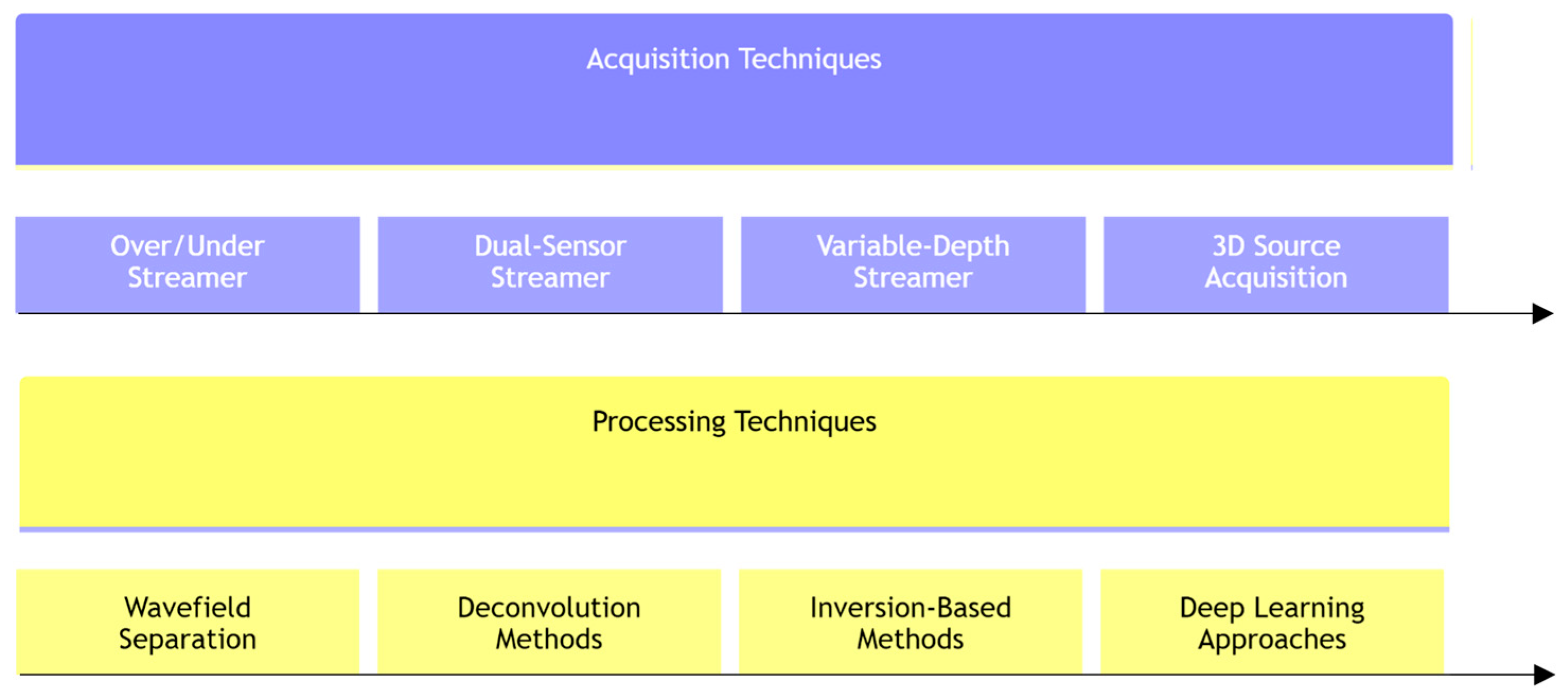
2. Related Work
3. Method
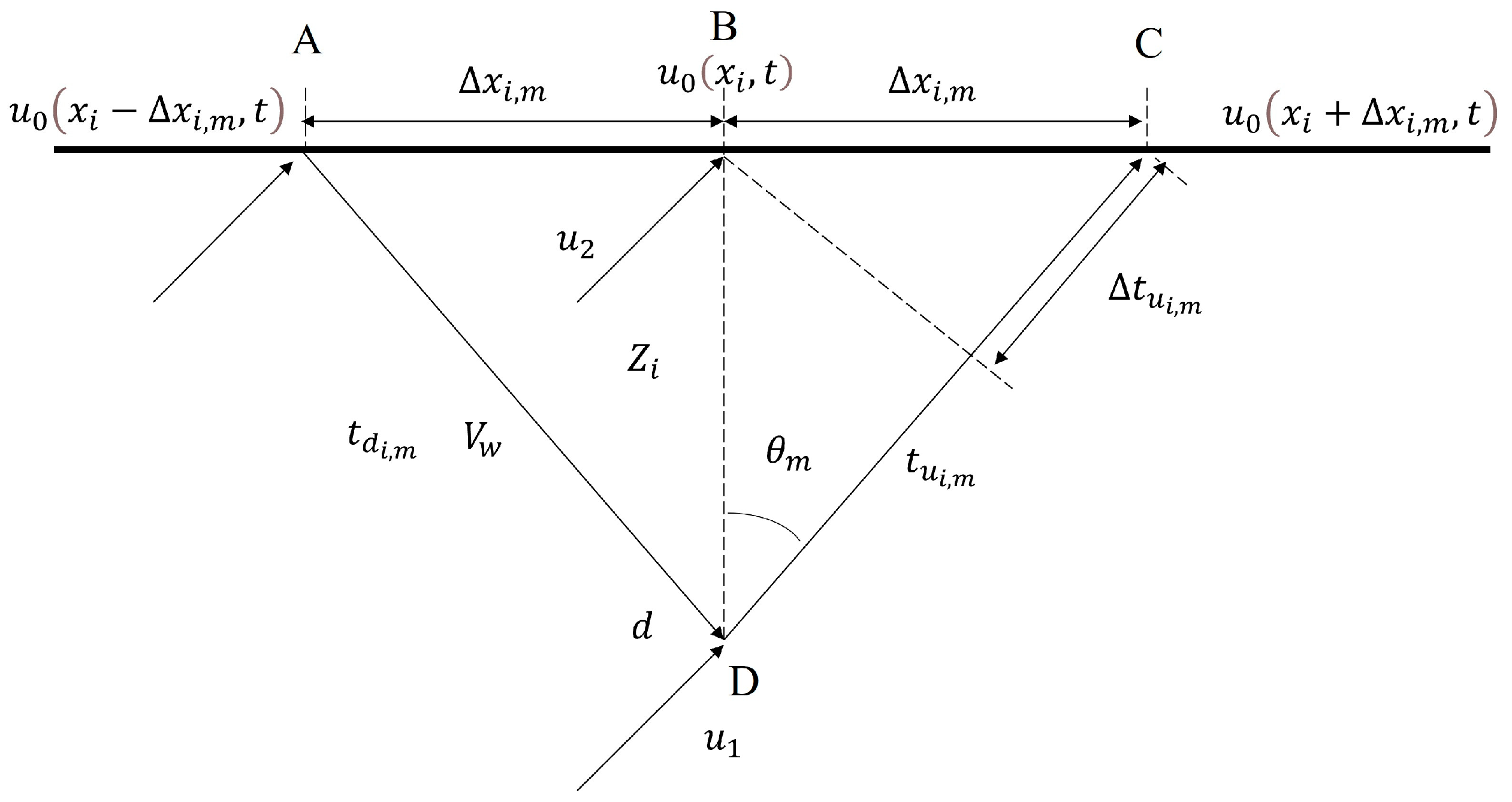
3.1. τ-p Domain Inversion Method
3.2. LSMR Algorithm
3.3. Improved Hybrid LSMR Algorithm
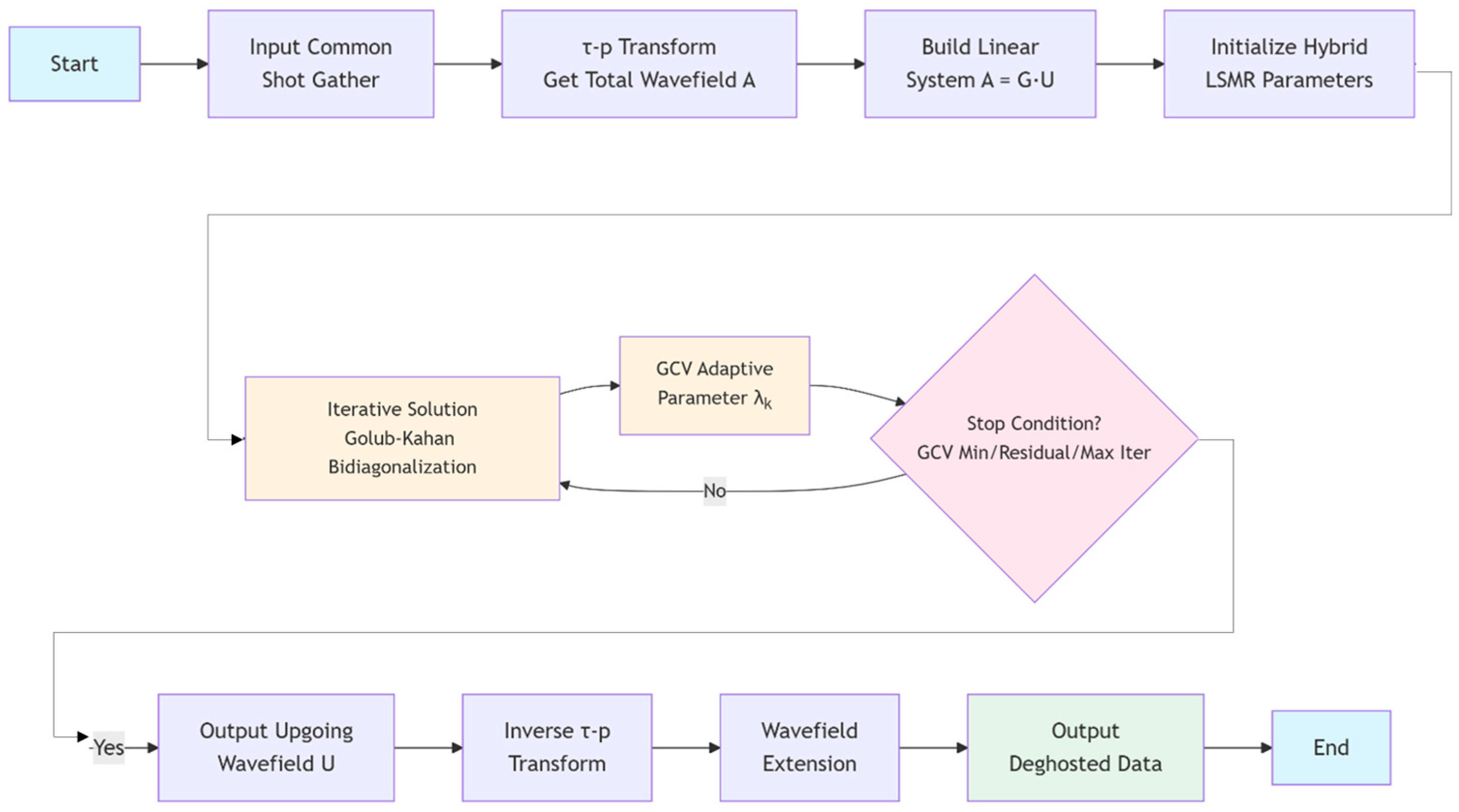
3.4. Algorithm Workflow
- (1)
- Input Common Shot Gather: Input the original seismic data in the common shot gather domain.
- (2)
- τ-p Transform: Transform the seismic data from the time–space (t-x) domain to the τ-p domain to obtain the total wavefield A.
- (3)
- Construct Linear System: Build the linear system A = GU, where G is the linear Radon operator constructed based on ghost wave delay time and ray parameters, and U is the upgoing wavefield at the sea surface.
- (4)
- Initialize Hybrid LSMR: Set the initial parameters, including the maximum iteration number, residual tolerance, and initial regularization parameter λ.
- (5)
- Iterative Solution with GCV: Perform Golub–Kahan bidiagonalization to update the solution subspace. In each iteration, compute the Tikhonov-regularized solution for the subproblem. Use the generalized cross-validation (GCV) function to adaptively determine the optimal regularization parameter λk and evaluate the stopping criterion.
- (6)
- Check Stopping Criteria: Terminate the iteration if one of the following conditions is met: The GCV function reaches its minimum. The residual norm falls below the preset tolerance. The maximum number of iterations is reached.
- (7)
- Output Upgoing Wavefield in τ-p Domain: Obtain the estimated upgoing wavefield U in the τ-p domain.
- (8)
- Inverse τ-p Transform: Transform U back to the time–space domain to recover the deghosted seismic wavefield.
- (9)
- Wavefield Extension (Optional): If needed, extend the wavefield from the sea surface to the actual receiver depth using wavefield continuation techniques.
- (10)
- Output Deghosted Seismic Record: Output the final ghost-suppressed seismic data.
4. Data Testing
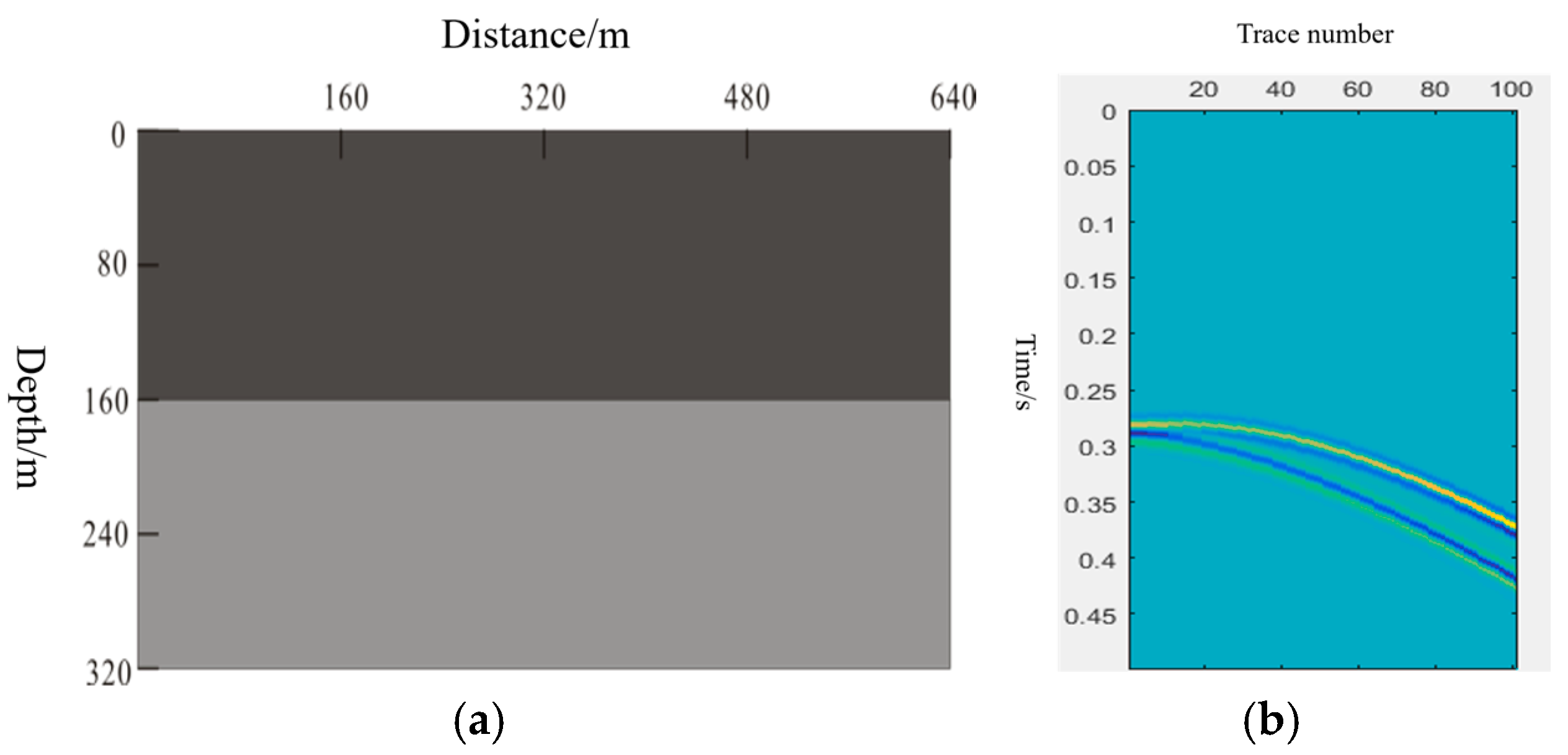
4.1. Numerical Examples
4.1.1. Deviation Principle (DP)
4.1.2. Unbiased Prediction Risk Estimation (UPRE)
4.1.3. Sensitivity Analysis of Cable Depth and Seawater Velocity
4.2. Application of Actual Data
5. Conclusions
- (1)
- The τ-p domain linear inversion framework constructed in this paper can effectively describe the wave–field relationship between ghost waves and primary reflection waves, converting the ghost wave suppression problem into a linear equation solving problem. The solver based on the hybrid LSMR algorithm combines the stability of Tikhonov regularization and the efficiency of the LSMR algorithm. The GCV function is used to achieve adaptive selection of regularization parameters and iterative termination, significantly improving the numerical stability and computational efficiency of the inversion process.
- (2)
- Numerical examples show that compared with traditional LSQR and LSMR algorithms, the HyBR LSMR algorithm performs best in terms of signal-to-noise ratio improvement and ghost wave suppression effects. It can more thoroughly eliminate ghost wave interference and restore the effective reflection wave field. The comparison of different regularization parameter selection methods further verifies the superiority of the GCV function, which can still achieve the best processing effect without relying on prior noise information.
- (3)
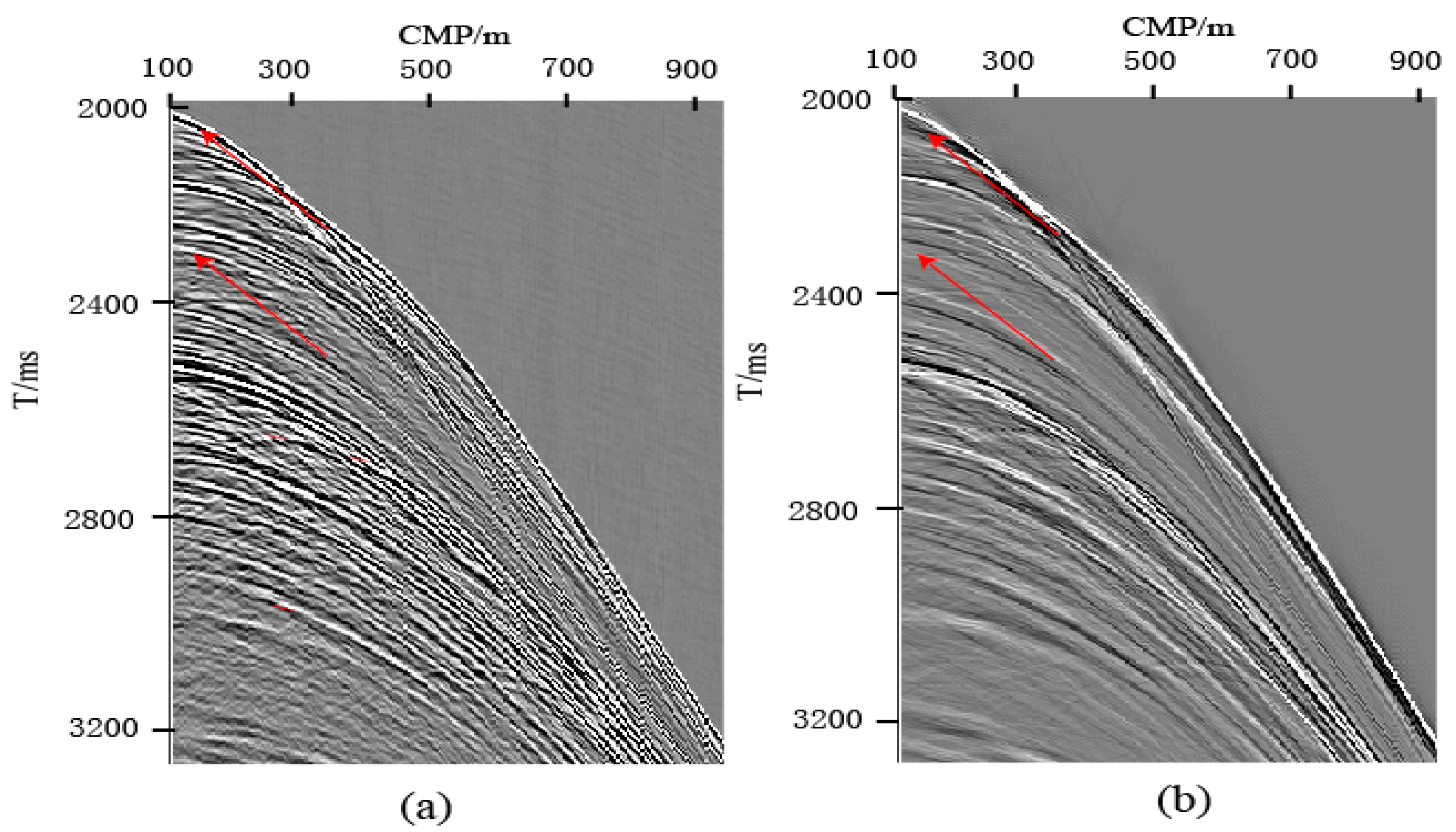
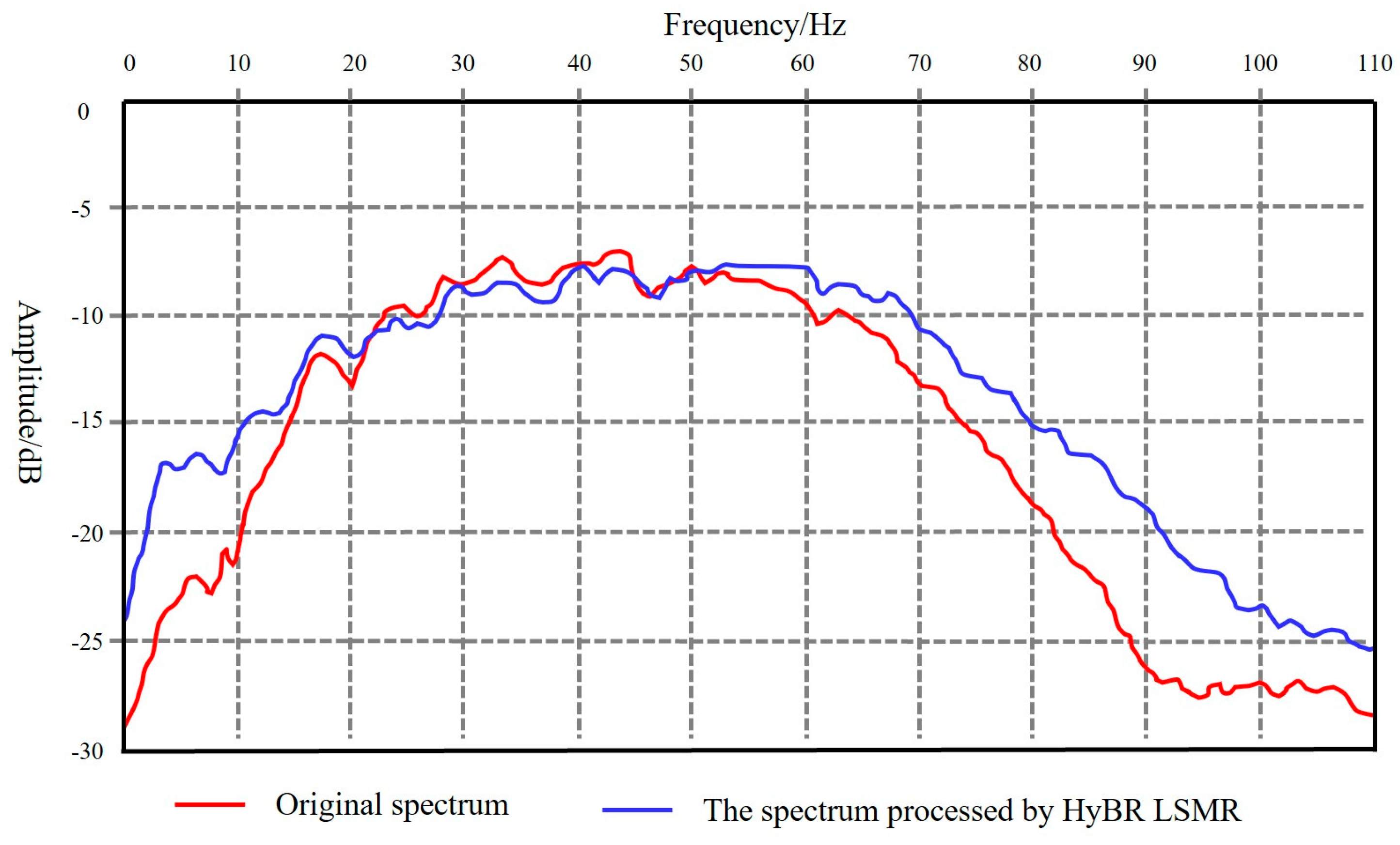
- The processing results of actual data verify the applicability and robustness of this method in complex geological conditions. The ghost wave interference in the processed seismic records is effectively suppressed, the continuity of the same-phase axis, signal-to-noise ratio, and resolution are significantly improved, the spectrum is effectively broadened, and low-frequency and high-frequency information are enhanced.
- (4)
- The proposed deghosting method holds significant promise for industrial applications, particularly in the context of high-cost and high-risk offshore oil and gas exploration. The ability to obtain high-resolution, broadband seismic data is crucial for accurate reservoir characterization in deepwater and complex geological settings. This method provides a reliable and efficient processing solution that can be directly integrated into conventional marine seismic processing workflows by effectively suppressing ghost waves and broadening the seismic bandwidth without stringent requirements on acquisition parameters.
Author Contributions
Funding
Data Availability Statement
Acknowledgments
Conflicts of Interest
References
- Kragh, E.; Muyzert, E.; Curtis, T.; Svendsen, M.; Kapadia, D. Efficient broadband marine acquisition and processing for improved resolution and deep imaging. Lead. Edge 2010, 29, 464–469. [Google Scholar] [CrossRef] [Scilit]
- Han, B.; Jing, J.; Yan, Z.; Mao, W.; Gu, H. Deghosting in depth image domain using a PSF-trained U-Net. IEEE Trans. Geosci. Remote. Sens. 2024, 62, 3438754. [Google Scholar] [CrossRef] [Scilit]
- Moldoveanu, N.; Seymour, N.; Manen, D.; Caprioli, P. Broadband seismic methods for towed-streamer acquisition. In Proceedings of the 74th EAGE Conference and Exhibition incorporating EUROPEC, Copenhagen, Denmark, 4–7 June 2012; pp. 1169–1174. [Google Scholar]
- Zhao, M.; Huang, J.; Li, C.; Li, J.; Zheng, J.; Han, R.; Liu, H. Analysis of factors affecting the performance of air gun source under shallow water conditions: Insights from the non-ideal gas air gun wavelet model. Ocean Eng. 2024, 296, 117001. [Google Scholar] [CrossRef] [Scilit]
- Liu, P. Seismic exploration device based on time-frequency space algorithm. J. Phys. Conf. Ser. 2020, 1544, 012004. [Google Scholar] [CrossRef] [Scilit]
- Carlson, D.H.; Long, A.; Sollner, W.; Tabti, H.; Tenghamn, R.; Lunde, N. Increased resolution and penetration from a towed dual-sensor streamer. First Break 2007, 25, 71–77. [Google Scholar] [CrossRef] [Scilit]
- Moldoveanu, N.; Combee, L.; Egan, M.; Hampson, G.; Sydora, L.; Abriel, W. Over/under towed-streamer acquisition: A method to extend seismic bandwidth to both higher and lower frequencies. Lead. Edge 2007, 26, 41–58. [Google Scholar] [CrossRef] [Scilit]
- Soubaras, R.; Whiting, P. Variable depth streamer—The new broadband acquisition system. In Proceedings of the SEG Technical Program Expanded Abstracts, San Antonio, TX, USA, 8 January 2011; pp. 4349–4353. [Google Scholar]
- Ozdemir, A.K.; Caprioli, P.; Ozbek, A.; Kragh, E.; Robertsson, J.O.A. Optimized deghosting of over/under towed-streamer data in the presence of noise. Lead. Edge 2008, 27, 190–199. [Google Scholar] [CrossRef] [Scilit]
- Zhou, X.; Guo, P.; Song, S.; Li, Q. Applying wavelet transform to suppress ghost in ocean-bottom node dual-sensor technology. Mar. Geophys. Res. 2022, 43, 5. [Google Scholar] [CrossRef] [Scilit]
- Hicks, E.; Hoeber, H.; Poole, G.; King, B. An efficient 4D processing flow for variable-depth streamer data. Lead. Edge 2014, 33, 172–174, 176–178, 180. [Google Scholar] [CrossRef] [Scilit]
- Soubaras, R. Deghosting by joint deconvolution of a migration and a mirror migration. In Proceedings of the SEG International Exposition and Annual Meeting, Denver, CO, USA, 17–22 October 2010; pp. 3406–3410. [Google Scholar]
- Reshef, M. Depth migration from irregular surfaces with depth extrapolation methods. Geophysics 1991, 56, 119–122. [Google Scholar] [CrossRef] [Scilit]
- Zhang, J. Wave Theory Based Data Preparation for Inverse Scattering Multiple Removal, Depth Imaging and Parameter Estimation: Analysis and Numerical Tests of Green’s Theorem Deghosting Theory. Ph.D. Thesis, University of Houston, Houston, TX, USA, 2007. [Google Scholar]
- Weglein, A.B.; Gasparotto, F.A.; Carvalho, P.M.; Stolt, R.H.; Matson, K.H.; Coates, R.T.; Corrigan, D.; Foster, D.J.; A Shaw, S.; Zhang, H. Inverse-scattering series and seismic exploration. Inverse Probl. 2003, 19, R27–R83. [Google Scholar] [CrossRef] [Scilit]
- Denisov, M.; Egorov, A.; Burtsev, A. A method for deghosting of data recorded with a streamer of arbitrary shape in rough sea conditions. Geophys. Prospect. 2018, 66, 1702–1713. [Google Scholar] [CrossRef] [Scilit]
- Poole, G. Pre-migration receiver de-ghosting and redatuming for variable depth streamer data. In Proceedings of the SEG International Exposition and Annual Meeting, Houston, TX, USA, 22–27 September 2013; pp. 4216–4220. [Google Scholar]
- Kiraz, M.S.R.; Snieder, R.; Sheiman, J. Attenuating free-surface multiples and ghost reflection from seismic data using a trace-by-trace convolutional neural network approach. Geophys. Prospect. 2024, 72, 908–937. [Google Scholar] [CrossRef] [Scilit]
- Haggerty, P.E. Method and Apparatus for Canceling Reverberations in Water Layers. U.S. patent 2757356, 31 July 1956. [Google Scholar]
- Barr, F.J. System for Attenuation of Water-Column Reverberations. U.S. Patent 4979150, 18 December 1990. [Google Scholar]
- Bearnth, R.E.; Moore, N.A. Broad-band recording through ghost elimination. In Proceedings of the Offshore Technology Conference, Houston, TX, USA, 7–10 May 1990. OnePetro. [Google Scholar]
- Ferber, R. Adding streamers to an over/under configuration can improve imaging: Exploration. World Oil 2008, 229, 37–42. [Google Scholar]
- Wang, Y.; Wang, J.; Wang, X.; Sun, W.; Zhang, J. Deghosting method of variable-depth streamer seismic data based on the iterative inversion of wave equation. In Proceedings of the 81st EAGE Conference and Exhibition 2019, London, UK, 3–6 June 2019; European Association of Geoscientists & Engineers: Utrecht, The Netherlands, 2019; Volume 1, pp. 1–5. [Google Scholar]
- Weglein, A.B.; Gasparotto, F.A.; Carvalho, P.M.; Stolt, R.H. An inverse-scattering series method for attenuating multiples in seismic reflection data. Geophysics 1997, 62, 1975–1989. [Google Scholar] [CrossRef] [Scilit]
- Cecconello, E.; Asgedom, E.G.; Orji, O.C.; Söllner, W. Modelling of time-varying rough sea surface ghosts and source deghosting by integral inversion. In Proceedings of the 79th EAGE Conference and Exhibition 2017, Paris, France, 12–15 June 2017; European Association of Geoscientists & Engineers: Utrecht, The Netherlands, 2017; Volume 1, pp. 1–5. [Google Scholar]
- Klüver, T. Wavefield separation for dual-sensor data with local handling of aliased energy. In Proceedings of the 2008 SEG Annual Meeting, Las Vegas, NV, USA, 9–14 November 2008. OnePetro. [Google Scholar]
- Aytun, K. The footsteps of the receiver ghost in the fk domain. Geophysics 1999, 64, 1618–1626. [Google Scholar] [CrossRef] [Scilit]
- Wang, P.; Peng, C. Premigration deghosting for marine towed streamer data using a bootstrap approach. In Proceedings of the SEG Technical Program Expanded Abstracts, Istanbul, Turkey, 17–19 September 2012; pp. 1–5. [Google Scholar]
- Telling, R.; Grion, S. A perturbed ghost model for estimating air-gun array signatures. Lead. Edge 2019, 38, 692–696. [Google Scholar] [CrossRef] [Scilit]
- Coates, R.; Beasley, C.J.; Flath, P. Wave-equation receiver deghosting: Real data and receiver depth estimation. In Proceedings of the 77th Annual International Conference and Exhibition, EAGE, Extended Abstracts, Madrid, Spain, 1–4 June 2015. [Google Scholar]
- Grion, S.; Telling, R.; Holland, S. Rough sea estimation for phase-shift deghosting. In Proceedings of the 86th Annual International Meeting, SEG, Expanded Abstracts, Dallas, TX, USA, 19–21 October 2016; pp. 5129–5133. [Google Scholar]
- Vrolijk, J.W.; Blacquière, G. Adaptive deghosting for a rough and dynamic sea surface. In Proceedings of the 88th Annual International Meeting, SEG, Expanded Abstracts, Anaheim, CA, USA, 14–19 October 2018; pp. 4583–4587. [Google Scholar]
- Vrolijk, J.W.; Blacquière, G. Adaptive estimation of the upgoing wavefield from a variable-depth recording in the case of a dynamic sea surface. Geophysics 2020, 85, V45–V56. [Google Scholar] [CrossRef] [Scilit]
- Zhong, T.; Cong, Z.; Tong, X.; Dong, S.; Lu, S.; Dong, X. Mutual-guided scale-aggregation denoising network for seismic noise attenuation. Comput. Geosci. 2024, 191, 105682. [Google Scholar] [CrossRef] [Scilit]
- Bao, D.; Chen, S.; Wang, G.; Chen, Z.; Liu, L. Intelligent Ghost Wave Suppression Based on Quadratic Convolution Kernel and Attention Mechanism. IEEE Trans. Geosci. Remote Sens. 2025, 63, 1–14. [Google Scholar] [CrossRef] [Scilit]
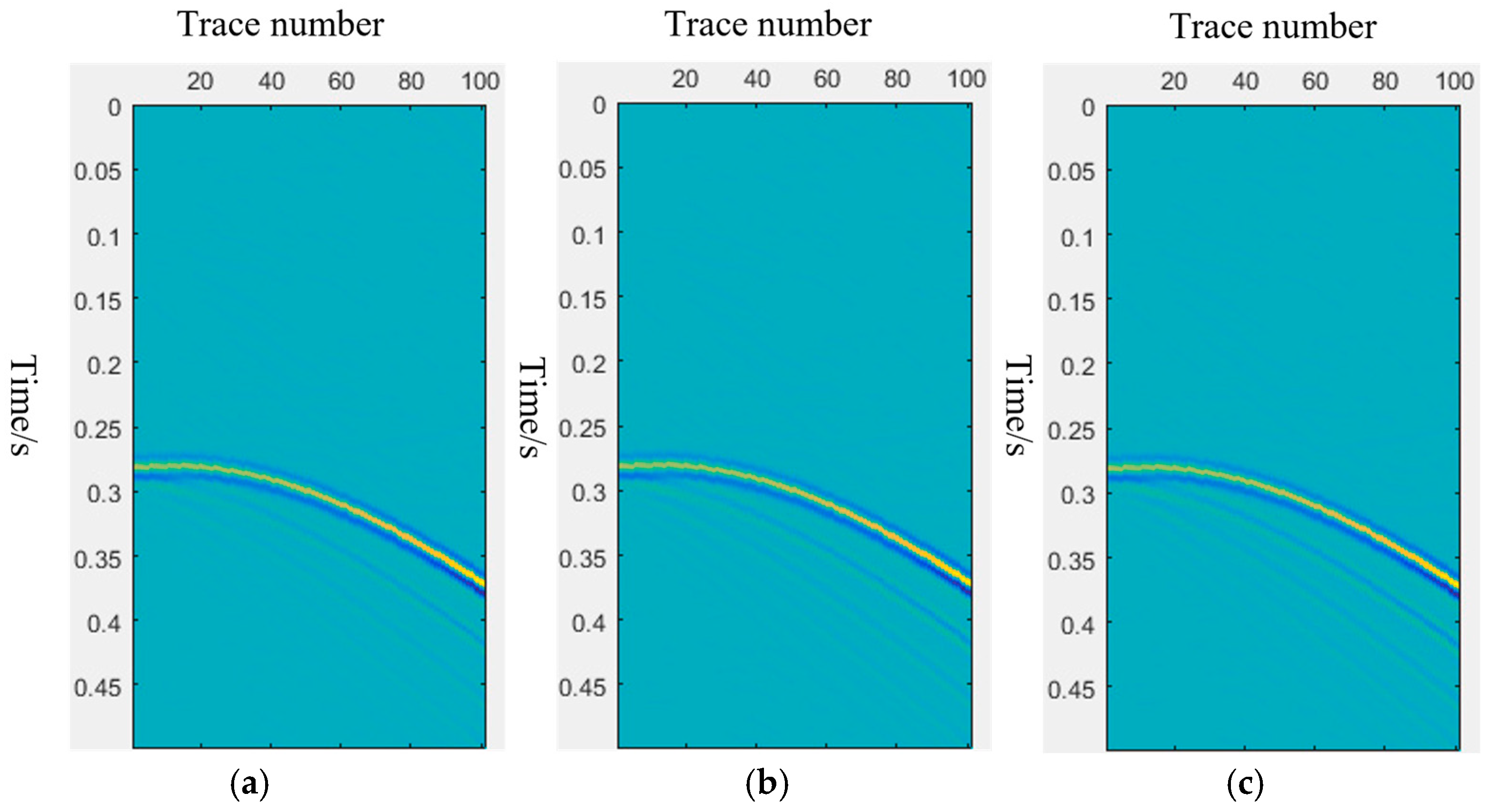
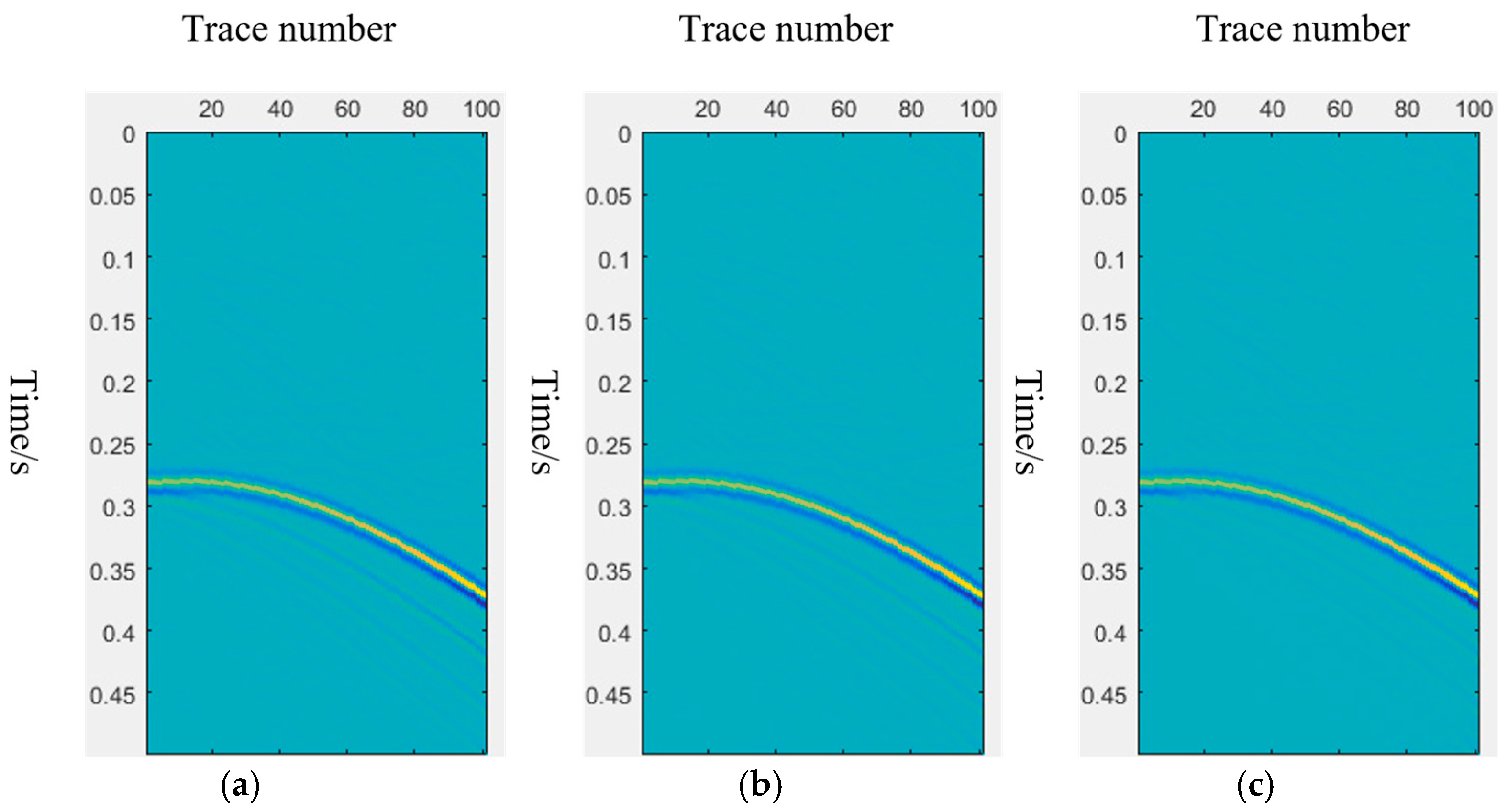
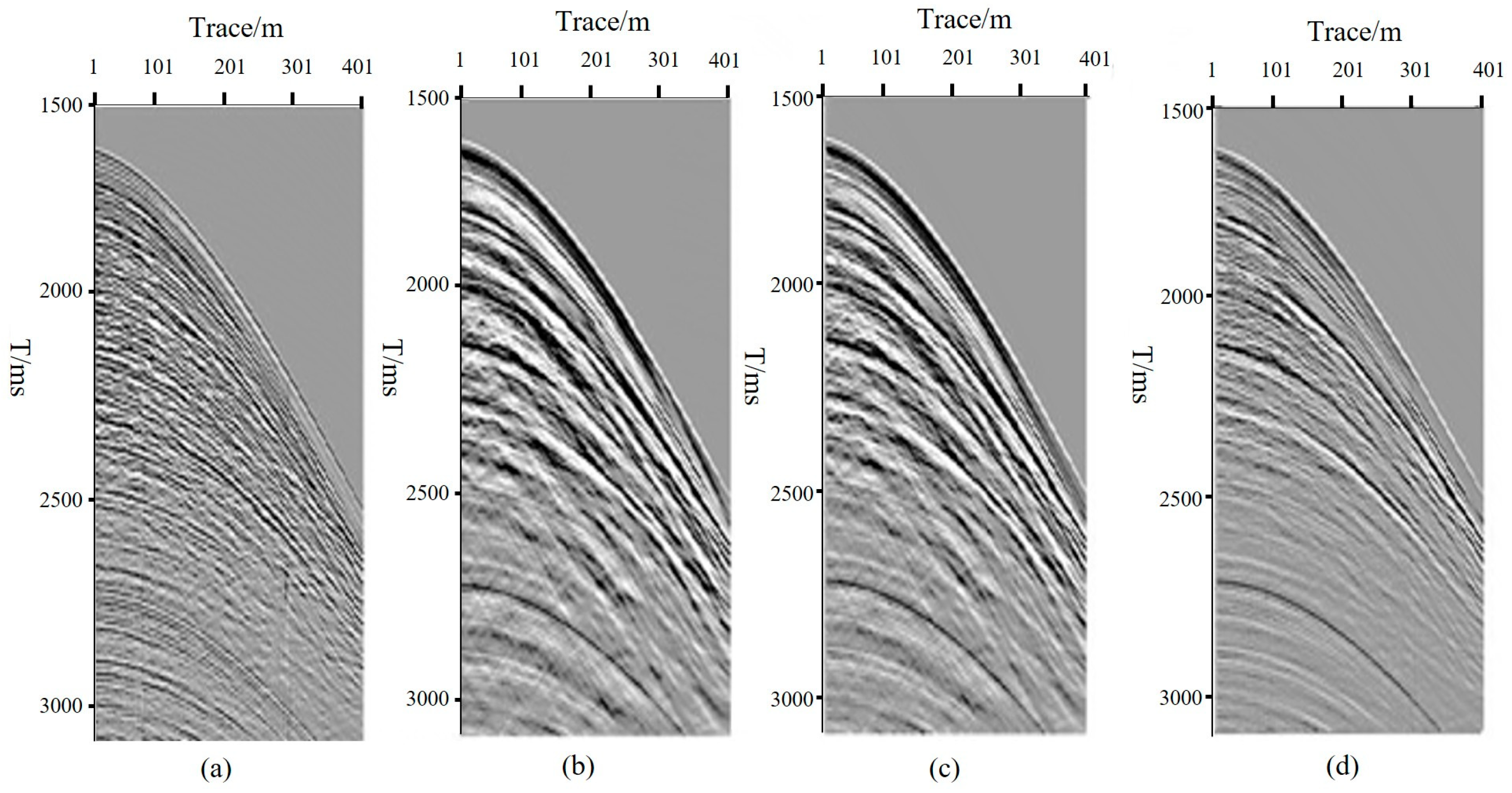

| Network | SNR | Recovery Rate (%) |
|---|---|---|
| LSQR | 2.43 | 59.4% |
| LSMR | 3.11 | 65.7% |
| HyBR LSMR | 4.08 | 73.3% |
| Network | SNR | Recovery Rate (%) |
|---|---|---|
| DP | 4.08 | 73.4% |
| UPRE | 4.36 | 76.5% |
| GCV | 4.89 | 82.3% |
| Perturbation Type. | Error Magnitude | SNR (dB) | SNR Change (dB) |
|---|---|---|---|
| Cable Depth | 5% | 4.75 | −0.14 |
| 10% | 4.52 | −0.37 | |
| −5% | 4.71 | −0.18 | |
| −10% | 4.48 | −0.41 | |
| Water Velocity | +5% (1575 m/s) | 4.81 | −0.08 |
| +10% (1650 m/s) | 4.66 | −0.23 | |
| −5% (1425 m/s) | 4.78 | −0.11 | |
| −10% (1350 m/s) | 4.62 | −0.27 |
Disclaimer/Publisher’s Note: The statements, opinions and data contained in all publications are solely those of the individual author(s) and contributor(s) and not of MDPI and/or the editor(s). MDPI and/or the editor(s) disclaim responsibility for any injury to people or property resulting from any ideas, methods, instructions or products referred to in the content. |
© 2025 by the authors. Licensee MDPI, Basel, Switzerland. This article is an open access article distributed under the terms and conditions of the Creative Commons Attribution (CC BY) license (https://creativecommons.org/licenses/by/4.0/).
Share and Cite
Wang, Z.; Li, Y.; Sun, Z.; Li, Z.; Ge, D. A Ghost Wave Suppression Method for Towed Cable Data Based on the Hybrid LSMR. Processes 2025, 13, 3689. https://doi.org/10.3390/pr13113689
Wang Z, Li Y, Sun Z, Li Z, Ge D. A Ghost Wave Suppression Method for Towed Cable Data Based on the Hybrid LSMR. Processes. 2025; 13(11):3689. https://doi.org/10.3390/pr13113689
Chicago/Turabian StyleWang, Zhaoqi, Ya Li, Zhixue Sun, Zhonghua Li, and Dongsheng Ge. 2025. "A Ghost Wave Suppression Method for Towed Cable Data Based on the Hybrid LSMR" Processes 13, no. 11: 3689. https://doi.org/10.3390/pr13113689
APA StyleWang, Z., Li, Y., Sun, Z., Li, Z., & Ge, D. (2025). A Ghost Wave Suppression Method for Towed Cable Data Based on the Hybrid LSMR. Processes, 13(11), 3689. https://doi.org/10.3390/pr13113689

