


A Collaborative Planning Method for Distributed Energy Storage Based on Differentiated Demands

Abstract
1. Introduction
- A distributed energy storage planning framework based on differentiated thinking has been established. Cluster division is carried out based on the differentiated source–load characteristics, and the source–load feature matching degree index is proposed to meet the functional principle as the division index. Different configuration methods are selected for energy storage based on the current problem situation in different regions. A major strength of the work is that it does not treat energy storage as a single, uniform asset. Instead, it considers that generation-side storage, grid-side storage, and user-side storage each operate under different physical and economic conditions. This perspective addresses a real gap in the existing literature, where many studies evaluate storage under only one scenario or one revenue model.
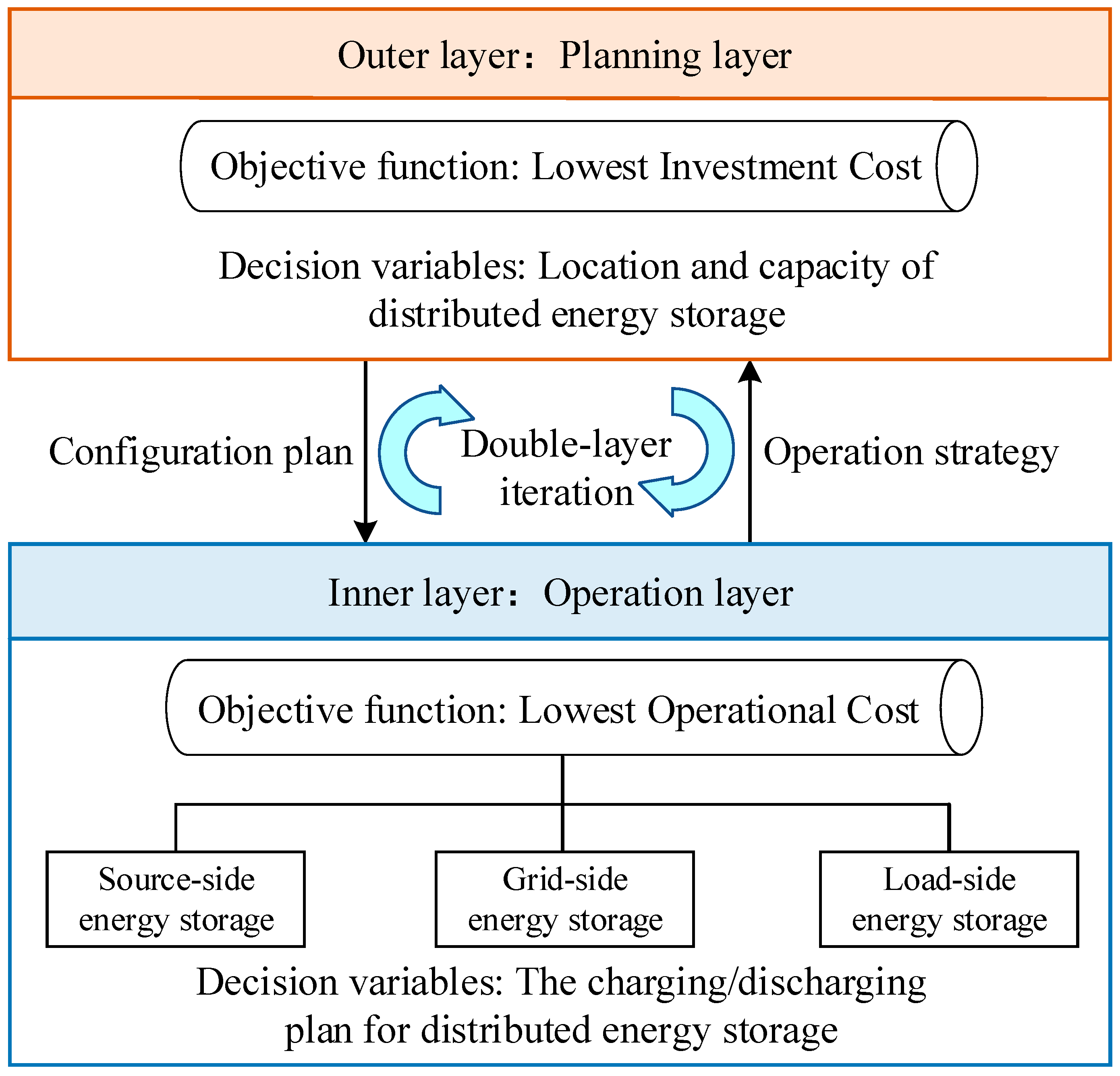
- A two-tier planning model for distributed energy storage that coordinates the planning and operation phases was proposed. The outer optimization model takes investment cost, construction cost, and retirement recovery value into account in the energy storage planning. The inner optimization model further introduces differentiated operation cost and revenue models for energy storage, achieving scientific, reasonable, and differentiated planning for large-scale distributed energy storage.
- The improved particle swarm optimization algorithm was adopted to solve the model. Based on the IEEE33 node system, the feasibility and effectiveness of the strategy proposed in this paper were verified by comparing the voltage fluctuation, load fluctuation, and net benefit of three different examples.
2. Typical Application Scenarios of Distributed Energy Storage
- (1)
- Consumption of new energy power generation (photovoltaic/wind power matching)
- (2)
- Grid peak shaving/frequency regulation/inertia support
- (3)
- User-side peak–valley arbitrage/enhancing power supply reliability
3. Cluster Division
- (1)
- Initialize the particle swarm size, dimensions, and number of iterations.
- (2)
- Initialize the position and velocity of each particle.
- (3)
- Calculate the fitness value of each particle based on the comprehensive performance indicator calculation formula proposed in this paper.
- (4)
- Determine whether there are isolated points within the swarm; if there are, update the fitness value through penalty items, but if not, proceed to the next step.
- (5)
- Update the individual and global optimal swarm position of the particles based on the fitness value, and if the termination condition is met, end the operation; if not, return to step 3.
4. Distributed Energy Storage Planning Model
4.1. Multi-Objective Optimization
- (1)
- Voltage fluctuation at nodes. With access to distributed power sources, although the node voltage in the system has increased to a certain extent, the fluctuation has intensified. The objective function of voltage fluctuation is
- (2)
- Load fluctuation. The randomness and uncertainty of distributed power sources can also intensify the load fluctuations in the system. The calculation formula is
- (3)
- Net income from distributed energy storage. The difference between the total cost and total revenue of distributed energy storage is taken as the objective function, and its calculation formula is
4.2. Outer-Layer Optimization Model
4.3. Inner-Layer Optimization Model
- (1)
- Scenarios for energy storage in conjunction with new energy
- (2)
- Independent energy storage scenarios on the grid side
- (3)
- User-side energy storage
5. Simulation Verification
5.1. Comparison of Optimization Results Based on Cluster Division
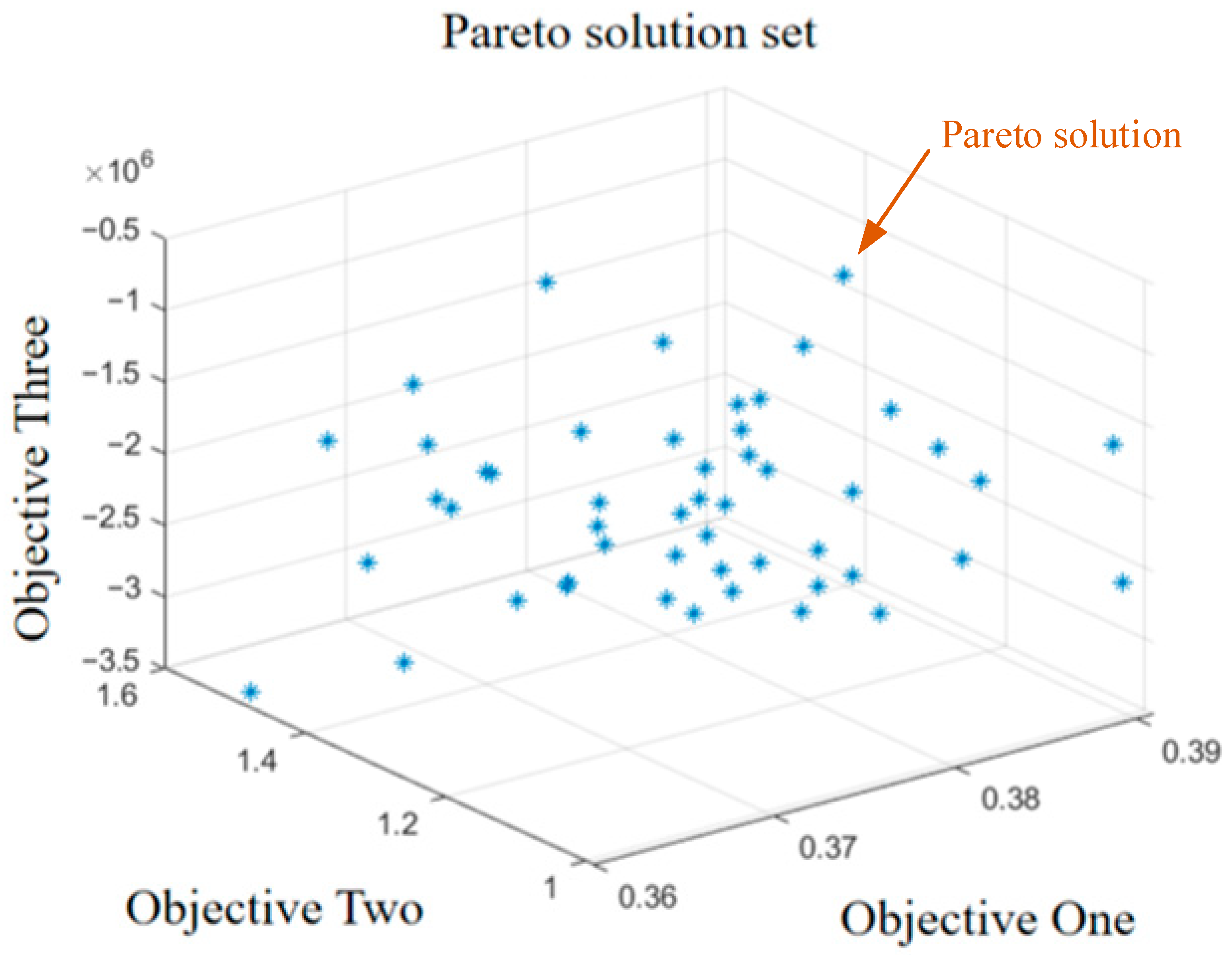
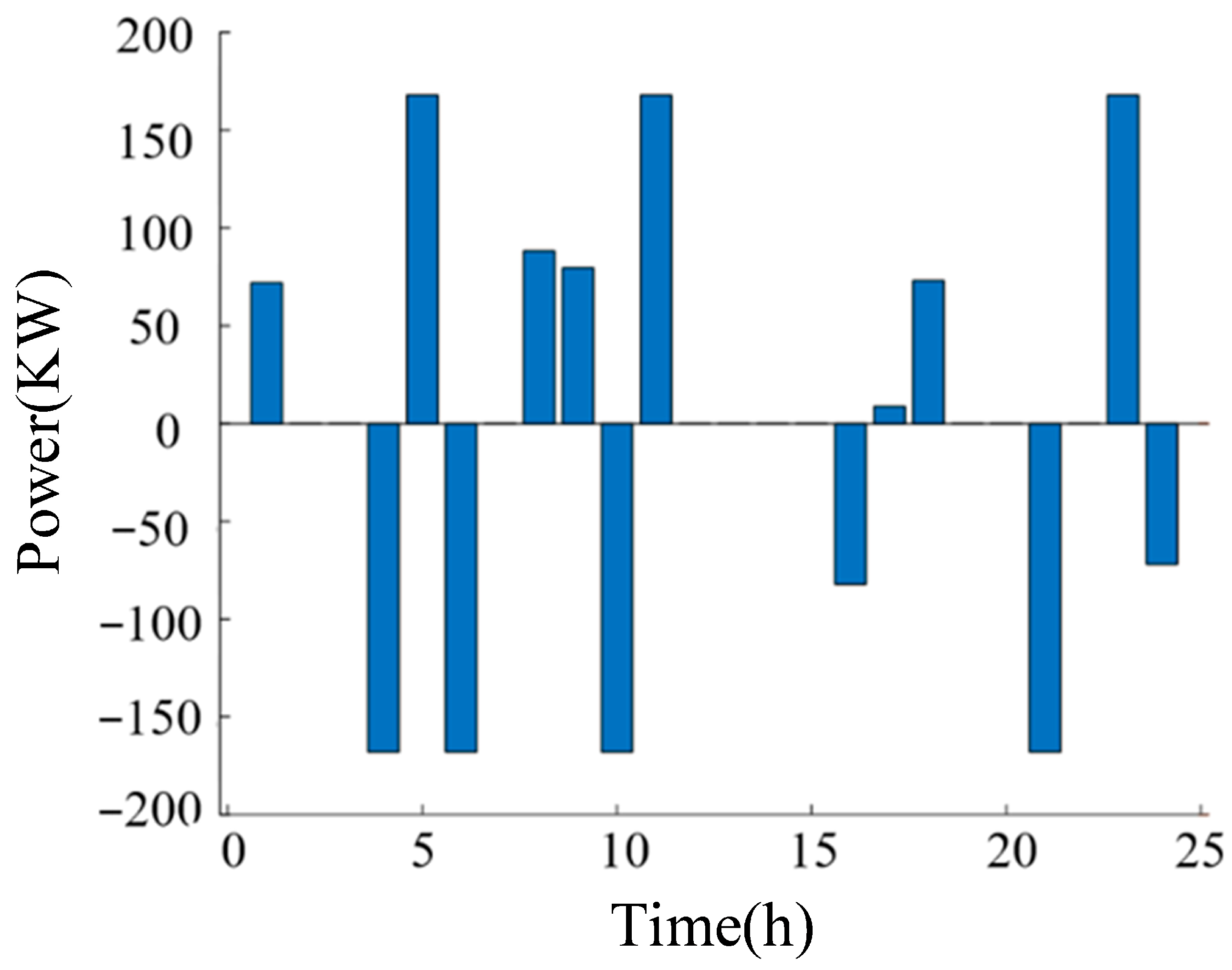
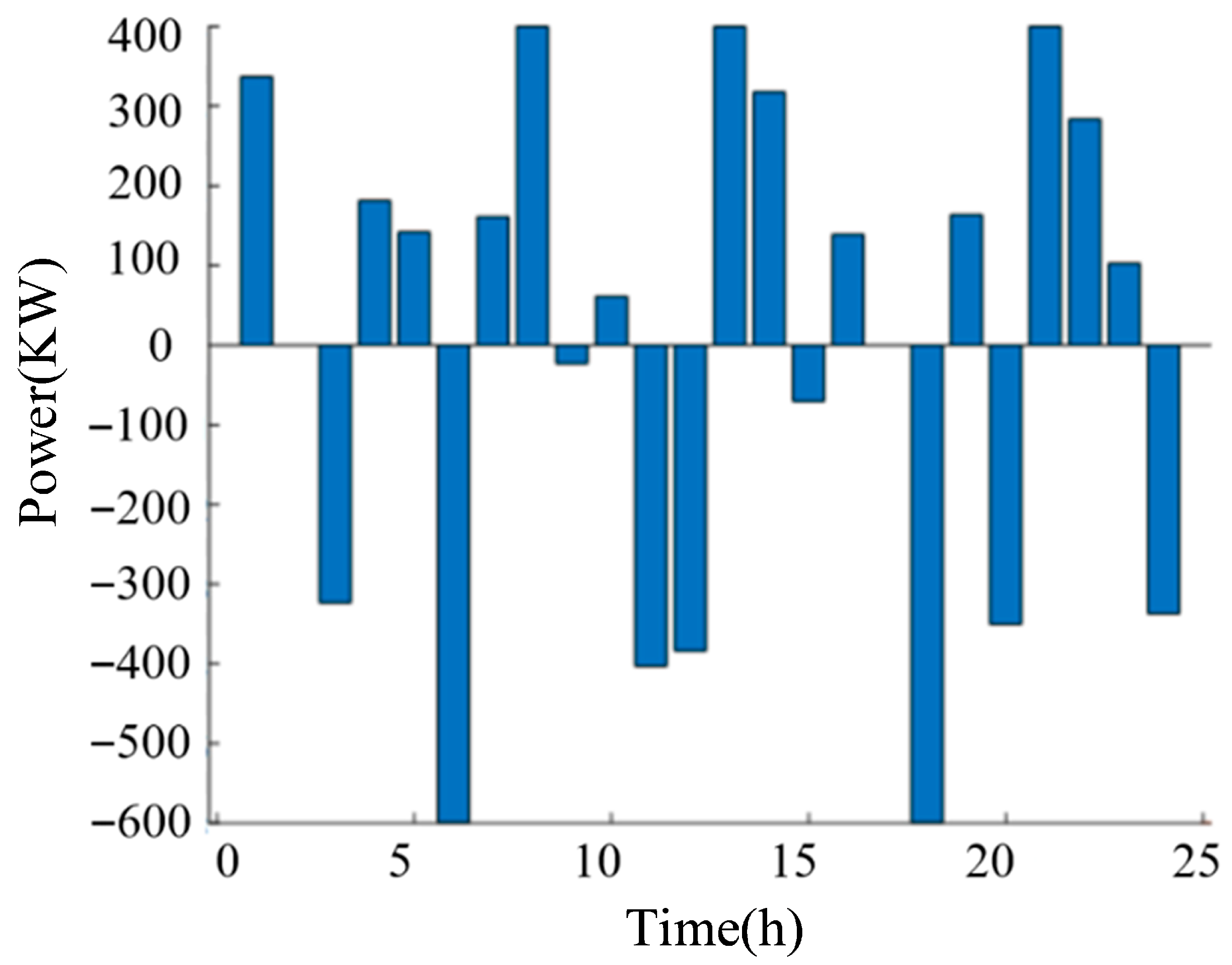
5.2. Analysis of Distributed Energy Storage Planning Results Under Cluster Division
6. Conclusions
Author Contributions
Funding
Data Availability Statement
Conflicts of Interest
References
- Shair, L.J.; Xie, X.; Li, H.; Terzija, V. New-Type Power System Stabilizers (NPSS) for Damping Wideband Oscillations in Converter-Dominated Power Systems. CSEE J. Power Energy Syst. 2025, 11, 1186–1198. [Google Scholar] [CrossRef]
- Liu, Y.; Du, W.; Xiao, L.; Wang, H.; Bu, S.; Cao, J. Sizing a Hybrid Energy Storage System for Maintaining Power Balance of an Isolated System with High Penetration of Wind Generation. IEEE Trans. Power Syst. 2016, 31, 3267–3275. [Google Scholar] [CrossRef]
- Egido, I.; Fernandez-Bernal, F.; Centeno, P.; Rouco, L. Maximum Frequency Deviation Calculation in Small Isolated Power Systems. IEEE Trans. Power Syst. 2009, 24, 1731–1738. [Google Scholar] [CrossRef]
- Fang, J.; Pei, Z.; Chen, T.; Peng, Z.; Kong, S.; Chen, J.; Huang, S. Economic benefit evaluation model of distributed energy storage system considering custom power services. Front. Energy Res. 2023, 10, 1029479. [Google Scholar] [CrossRef]
- Koca, Y.B. Adaptive energy management with machine learning in hybrid PV-wind systems for electric vehicle charging stations. Electr. Eng. 2025, 107, 4771–4782. [Google Scholar] [CrossRef]
- Cleary, B.; Duffy, A.; OConnor, A.; Conlon, M.; Fthenakis, V. Assessing the Economic Benefits of Compressed Air Energy Storage for Mitigating Wind Curtailment. IEEE Trans. Sustain. Energy 2015, 6, 1021–1028. [Google Scholar] [CrossRef]
- Schroeder, A. Modeling storage and demand management in power distribution grids. Appl. Energy 2011, 88, 4700–4712. [Google Scholar] [CrossRef]
- Li, J.; Fang, Z.; Wang, Q.; Zhang, M.; Li, Y.; Zhang, W. Optimal Operation with Dynamic Partitioning Strategy for Centralized Shared Energy Storage Station with Integration of Large-scale Renewable Energy. J. Mod. Power Syst. Clean Energy 2024, 12, 359–370. [Google Scholar] [CrossRef]
- Pulazza, G.; Zhang, N.; Kang, C.; Nucci, C.A. Transmission Planning with Battery-Based Energy Storage Transportation For Power Systems With High Penetration of Renewable Energy. IEEE Trans. Power Syst. 2021, 36, 4928–4940. [Google Scholar] [CrossRef]
- Giannitrapani, A.; Paoletti, S.; Vicino, A.; Zarrilli, D. Optimal allocation of energy storage systems for voltage control in LV distribution networks. IEEE Trans. Smart Grid 2017, 8, 2859–2870. [Google Scholar] [CrossRef]
- An, D.; Yang, D.Y.; Wu, W.L.; Cai, W.C.; Li, H.; Yang, B.; Han, Y.L. Optimal location and sizing of battery energy storage systems in a distribution network based on a modified multi-objective mayfly algorithm. Power Syst. Prot. Control 2022, 50, 31–39. [Google Scholar] [CrossRef]
- Li, J.Y.; Song, F.L.; Ma, J.J.; Ding, Y.X.; Yu, X.X. Siting and sizing method for energy storage based on dispatchable potential of 5G base station and cluster partition of distribution network. Autom. Electr. Power Syst. 2023, 47, 151–160. [Google Scholar]
- Zhao, C.; Duan, Q.; Lu, J.; Wang, H.; Sha, G.; Jia, J.; Zhou, Q. Coordinated Optimization Method for Distributed Energy Storage and Dynamic Reconfiguration to Enhance the Economy and Reliability of Distribution Network. Energies 2024, 17, 6040. [Google Scholar] [CrossRef]
- Zhong, Z.; Liu, Y.; Zhu, Y.; Jin, Y.; Yang, Z.; Lin, F. Dual layer capacity optimization configuration of rail transit multi hybrid energy storage system based on equivalent energy storage. CSEE J. Power Energy Syst. 2025, 1–13. [Google Scholar] [CrossRef]
- Li, X.; Wang, L.; Yan, N.; Ma, R. Cooperative Dispatch of Distributed Energy Storage in Distribution Network with PV Generation Systems. IEEE Trans. Appl. Supercond. 2021, 31, 0604304. [Google Scholar] [CrossRef]
- Ren, R.H. Optimal configuration of distributed energy storage layout in smart distribution network. Electrotech. Appl. 2021, 40, 31–35. [Google Scholar]
- Geng, G.F.; Sun, Y.Z.; Niu, X.K. Optimal allocation of shared energy storage on the user side and its impact on carbon emissions. Distrib. Util. 2023, 40, 32–39. [Google Scholar] [CrossRef]
- Yan, N.; Zhang, B.; Li, W.; Ma, S. Hybrid Energy Storage Capacity Allocation Method for Active Distribution Network Considering Demand Side Response. IEEE Trans. Appl. Supercond. 2019, 29, 5700204. [Google Scholar] [CrossRef]
- Peng, Q.; Ouyang, S.; Zhang, J.M.; Xie, Y.X. Cluster division method for high-proportion distributed photovoltaic access to distribution networks considering multi-section source-load characteristic matching. China South. Power Grid Technol. 2020, 19, 161–172+184. [Google Scholar] [CrossRef]
- Feng, P.; Zeng, P.; Tang, Z.; Zhou, X.; Zhu, Y. A distributionally collaborated planning of energy storage, transmission and distribution systems considering long- and short-term energy storage characteristics. J. Energy Storage 2025, 120, 116396. [Google Scholar] [CrossRef]
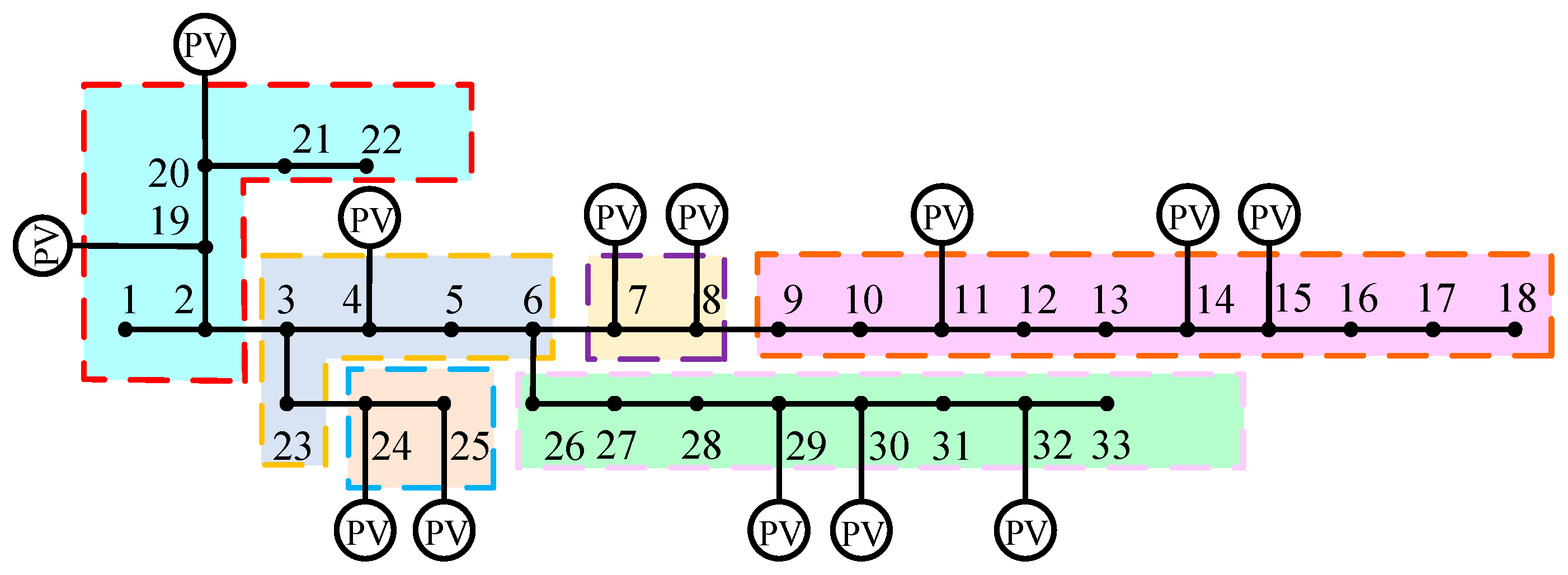
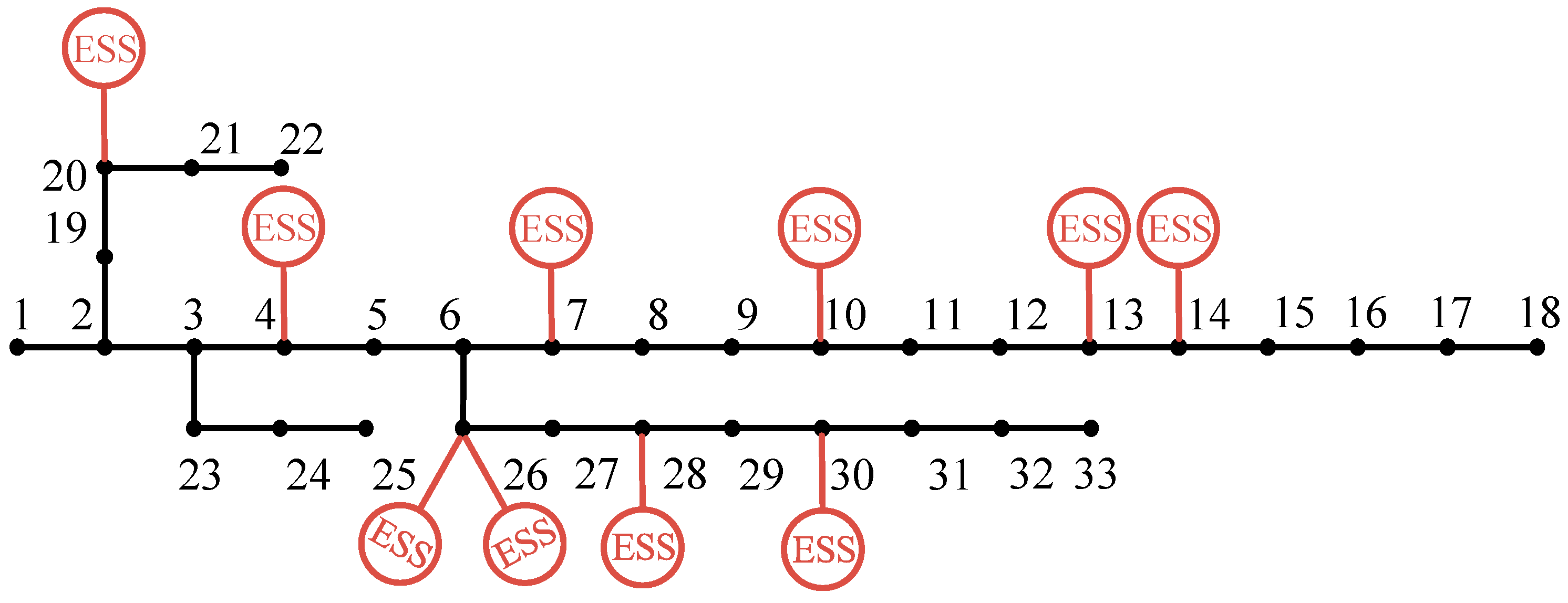

| Node Location | Installation Capacity/kw |
|---|---|
| 4 | 250 |
| 7 | 350 |
| 8 | 350 |
| 11 | 350 |
| 14 | 350 |
| 15 | 450 |
| 19 | 350 |
| 20 | 450 |
| 24 | 350 |
| 25 | 350 |
| 29 | 550 |
| 30 | 350 |
| 32 | 450 |
| Plan | Install the Node | Installation Capacity (MWh) | ||
|---|---|---|---|---|
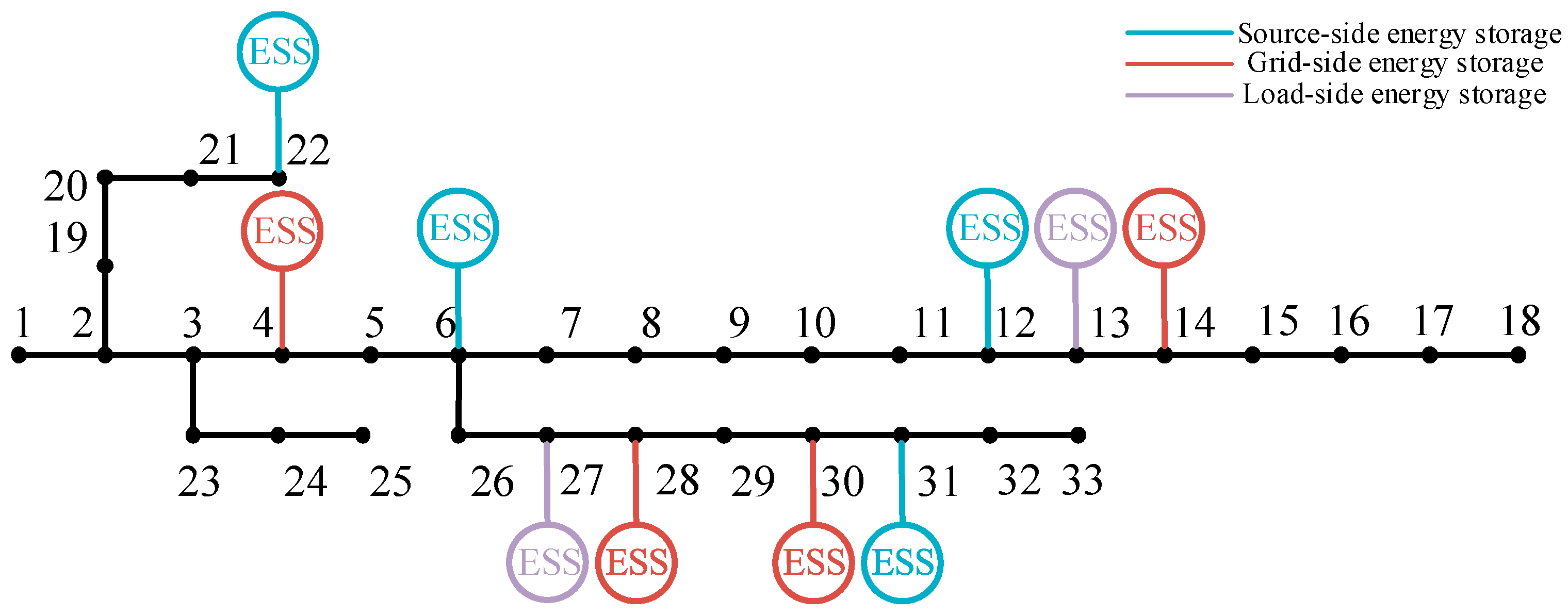
| 1 | 4, 6, 12, 13, 14, 22, 27, 28, 30, 31 | 1.069/0.24/1.235/1.103/1.124/1.085/0.819/1.103/1.103/1.124 | ||
| 2 | 4, 7, 13, 14, 10, 26, 30, 26, 20, 28 | 1.318/0.504/0.257/1.235/0.257/1.390/1.282/1.282/1.282/1.201 | ||
| Plan | Net income (CNY) | Voltage fluctuation/pu | Load fluctuation/pu | Total capacity (MWh) |
| 1 | 4,130,022.4108 | 0.3834 | 1.0478 | 10 |
| 2 | 1,713,622.8747 | 0.3956 | 0.9142 | 10 |
| 3 | 0 | 0.3846 | 0.9273 | 0 |
| Peak–Valley Price Difference Gain (CNY) | Lease Income (CNY) | Peak Shaving Compensation Income (CNY) | Revenue From the Consumption of New Energy (CNY) | Demand Reduction Revenue (CNY) | Government Subsidy Income (CNY) |
|---|---|---|---|---|---|
| 181,537.1265 | 2,001,000 | 832,679.6034 | 47,982.024 | 3,836,817.9389 | 462,627.372 |
Disclaimer/Publisher’s Note: The statements, opinions and data contained in all publications are solely those of the individual author(s) and contributor(s) and not of MDPI and/or the editor(s). MDPI and/or the editor(s) disclaim responsibility for any injury to people or property resulting from any ideas, methods, instructions or products referred to in the content. |
© 2025 by the authors. Licensee MDPI, Basel, Switzerland. This article is an open access article distributed under the terms and conditions of the Creative Commons Attribution (CC BY) license (https://creativecommons.org/licenses/by/4.0/).
Share and Cite
Li, Z.; Ren, X.; Zhang, L.; Shi, T.; Liu, Y.; Wang, J.; Liu, H.; Qiu, X.; Wang, Z. A Collaborative Planning Method for Distributed Energy Storage Based on Differentiated Demands. Processes 2025, 13, 3680. https://doi.org/10.3390/pr13113680
Li Z, Ren X, Zhang L, Shi T, Liu Y, Wang J, Liu H, Qiu X, Wang Z. A Collaborative Planning Method for Distributed Energy Storage Based on Differentiated Demands. Processes. 2025; 13(11):3680. https://doi.org/10.3390/pr13113680
Chicago/Turabian StyleLi, Zhiwei, Xijun Ren, Li Zhang, Tiancheng Shi, Yufeng Liu, Jiayao Wang, Huizhou Liu, Xueao Qiu, and Zixuan Wang. 2025. "A Collaborative Planning Method for Distributed Energy Storage Based on Differentiated Demands" Processes 13, no. 11: 3680. https://doi.org/10.3390/pr13113680
APA StyleLi, Z., Ren, X., Zhang, L., Shi, T., Liu, Y., Wang, J., Liu, H., Qiu, X., & Wang, Z. (2025). A Collaborative Planning Method for Distributed Energy Storage Based on Differentiated Demands. Processes, 13(11), 3680. https://doi.org/10.3390/pr13113680

