Article

Bimetallic Fe, Co-Modified TiO2 Derived from NH2-MIL-125(Ti) as an Efficient Photocatalyst for N2 Fixation

Key Laboratory of Marine Chemistry Theory and Technology, Ministry of Education, College of Chemistry and Chemical Engineering, Ocean University of China, Qingdao 266100, China
*
Author to whom correspondence should be addressed.
Processes 2024, 12(9), 1879; https://doi.org/10.3390/pr12091879
Submission received: 20 July 2024 / Revised: 10 August 2024 / Accepted: 29 August 2024 / Published: 2 September 2024
(This article belongs to the Special Issue Photocatalysts: Synthesis, Mechanisms and Applications)

Abstract

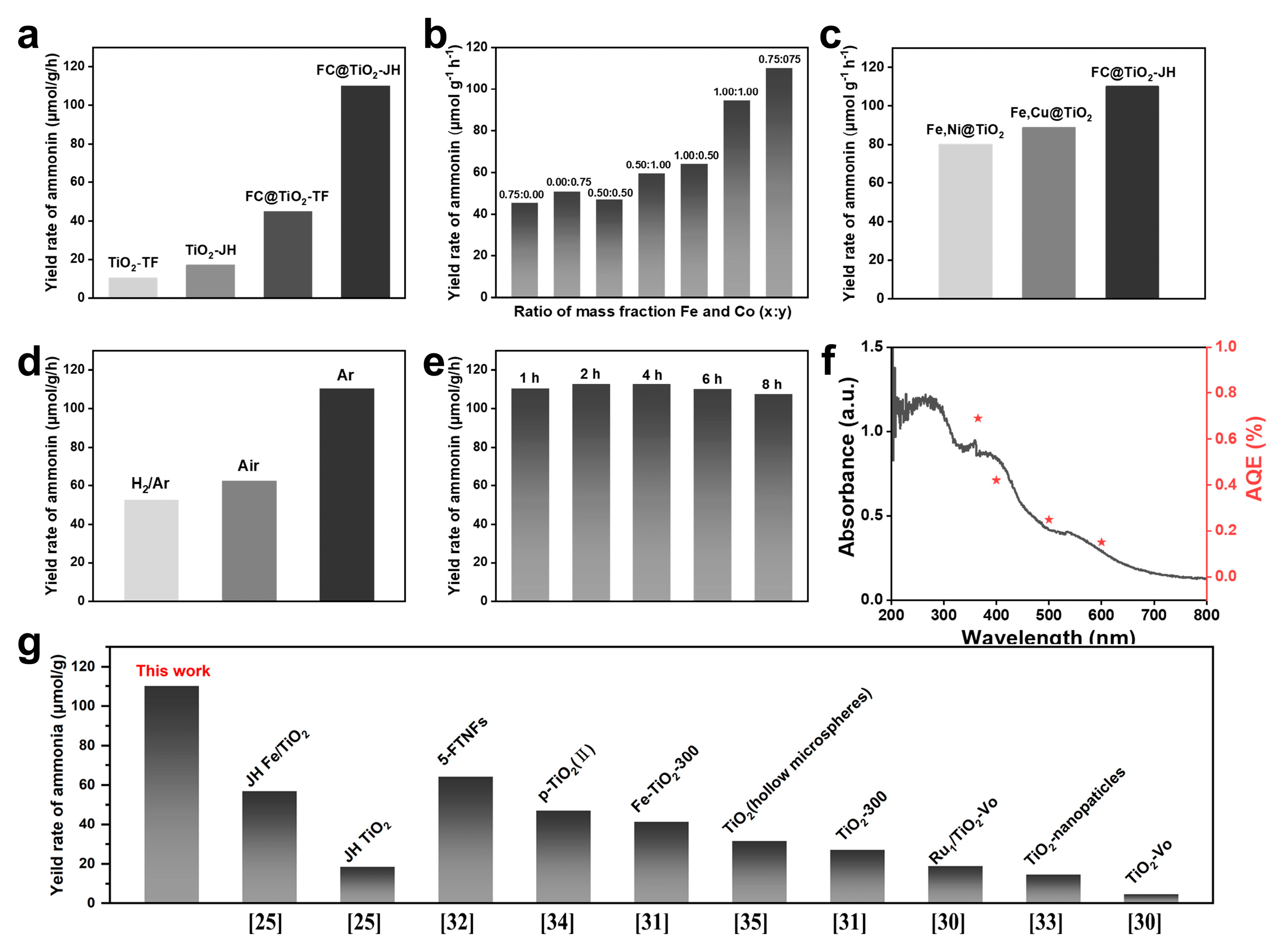
The conversion of nitrogen (N2) and water (H2O) into NH3 by photocatalysis under ambient conditions has been considered an environmentally friendly strategy. However, developing effective catalysts for N2 fixation is still challenging. Herein, we report a bimetallic JH Fe, Co/TiO2 derived from NH2-MIL-125(Ti) by the fast Joule heating (FJH) method for visible–light–driven catalytic N2 fixation. It was found that the photocatalytic N2 reduction efficiency of bimetallic FC@TiO2-JH was improved, enabling an NH3 yield rate of 110.14 µmol g−1 h−1 without any sacrificial agents. Furthermore, the rate was higher than those of Fe@TiO2-JH and Co@TiO2-JH, suggesting that the synergistic effect between Fe and Co broke the electronic equilibrium and increased the center of its d-band, enhancing electronic feedback to the antibonding π* orbitals of N2 while weakening the bonding energy of N≡N. Meanwhile, the rate was about 2.75 times higher than that of FC@TiO2-TF, which was calcined in a tube furnace. It is assumed that FJH might lead to the formation of lattice defects, leading to localized charge deficiency, enhanced carrier separation, and transport. Thus, doping of Fe and Co synergistically interacted with the defects produced from FJH, facilitating the photocatalytic reduction process. As detected, it had a greater ability to separate hole–electron pairs and transferred electrons to adsorbed N2 at faster rates. Our work demonstrates a prospective strategy for designing bimetallic catalysts derived from NH2-MIL-125(Ti) for N2 fixation.
Keywords: NH2-MIL-125(Ti); bimetallic synergistic effect; nitrogen fixation; active sites; FJH method NH2-MIL-125(Ti); bimetallic synergistic effect; nitrogen fixation; active sites; FJH method