Article

Numerical and Experimental Study on Preheating Burner Characteristics for Peak Shaving

1
School of Automation Engineering, Northeast Electric Power University, Jilin 132012, China
2
State Grid Harbin Power Supply Company, Harbin 150000, China
*
Author to whom correspondence should be addressed.
Processes 2024, 12(2), 346; https://doi.org/10.3390/pr12020346
Submission received: 19 January 2024 / Revised: 1 February 2024 / Accepted: 5 February 2024 / Published: 6 February 2024
(This article belongs to the Special Issue Advanced Low-Emission Combustion Technologies)

Abstract

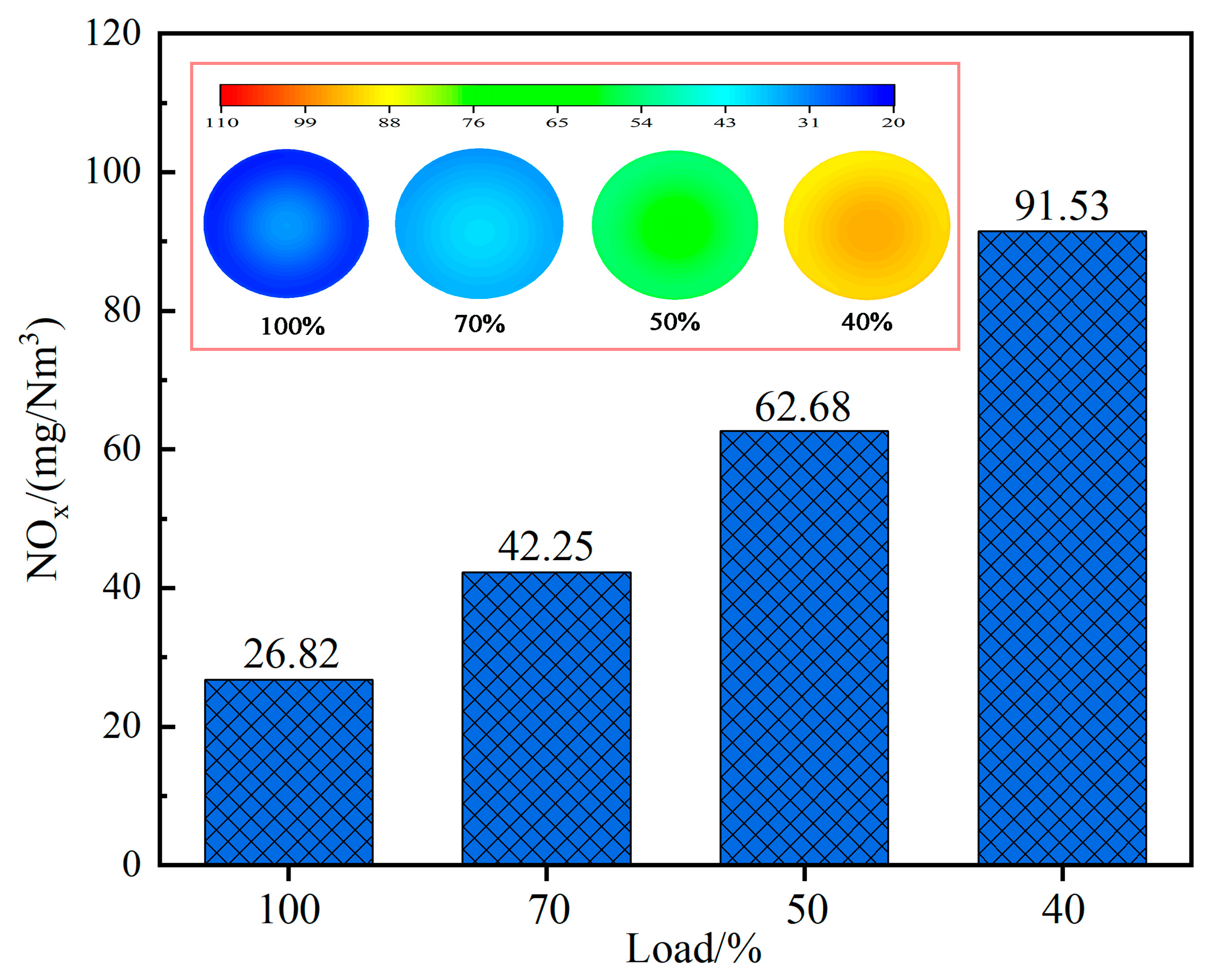
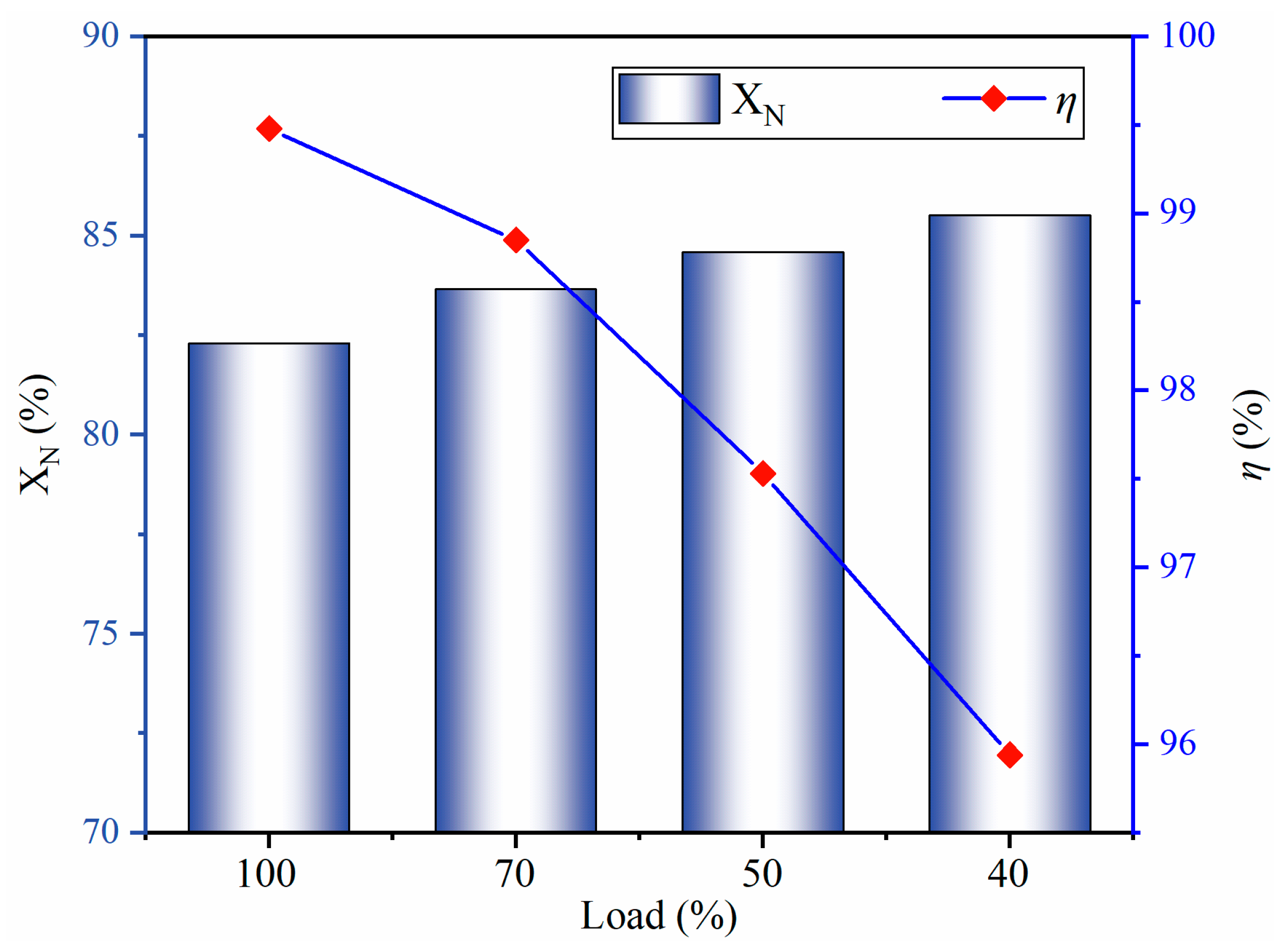
With the proportion of renewable energy power in the electricity market gradually increasing, coal-fired power is transforming from primary to basic power, with it providing peak and frequency shaving. However, most current methods for peaking below 50% load have been applied industrially, sacrificing the efficiency of the unit. This is not in line with the goals of energy conservation and emission reduction. Therefore, this study proposes a new preheating-based peaking method. This study experimentally and simulatively explores the flow characteristics, pyrolysis gas law, and NOx emission characteristics of a preheating burner at 40–100% load. The results show that the burner has a significant preheating effect, producing high-temperature char and large amounts of pyrolysis gas. As the load decreases, the burner exit temperature increases, whereas the airflow stiffness decreases. There is little variation in the pyrolysis gas concentration between 40% and 100% loads. The NOx concentration at the burner outlet increases and the reduction efficiency decreases with decreasing load. At 40% load, NOx emissions are 91.53 mg/Nm3 and the reduction efficiency reaches 95.9%. Therefore, preheating is an economical, stable, and low-NOx-emission-peaking method. This study provides theoretical guidance for the application of preheating burners for the 40–100% load peaking of coal-fired units.
Keywords: coal-fired power; peaking; preheating; NOx; simulation coal-fired power; peaking; preheating; NOx; simulation