Article

B-LIME: An Improvement of LIME for Interpretable Deep Learning Classification of Cardiac Arrhythmia from ECG Signals


by
Talal A. A. Abdullah
1,*,
Mohd Soperi Mohd Zahid
1,*,
Waleed Ali
2 and
Shahab Ul Hassan
1
1
Computer & Information Sciences Department, Universiti Teknologi PETRONAS, Seri Iskandar 32610, Malaysia
2
Information Technology Department, Faculty of Computing and Information Technology, King Abdulaziz University, Rabigh, Jeddah 25729, Saudi Arabia
*
Authors to whom correspondence should be addressed.
Processes 2023, 11(2), 595; https://doi.org/10.3390/pr11020595
Submission received: 12 January 2023 / Revised: 5 February 2023 / Accepted: 10 February 2023 / Published: 16 February 2023
(This article belongs to the Special Issue Trends of Machine Learning in Multidisciplinary Engineering Processes)

Abstract

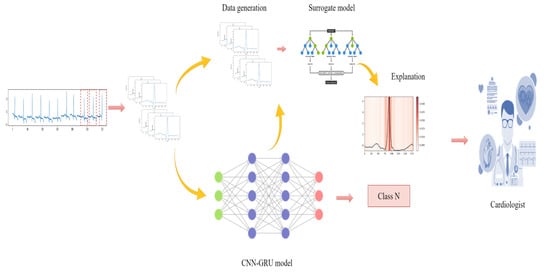
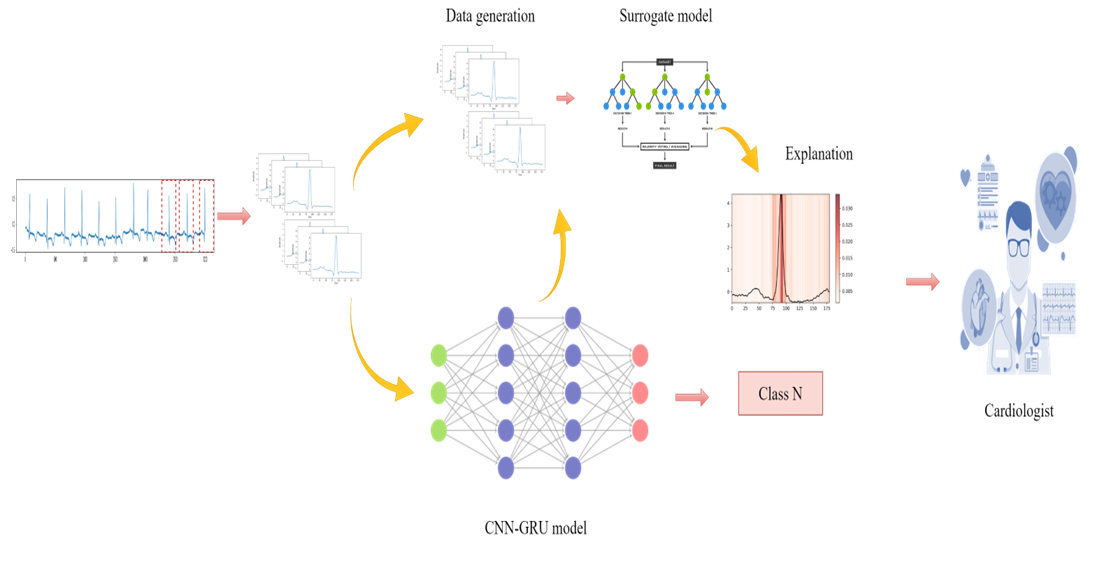
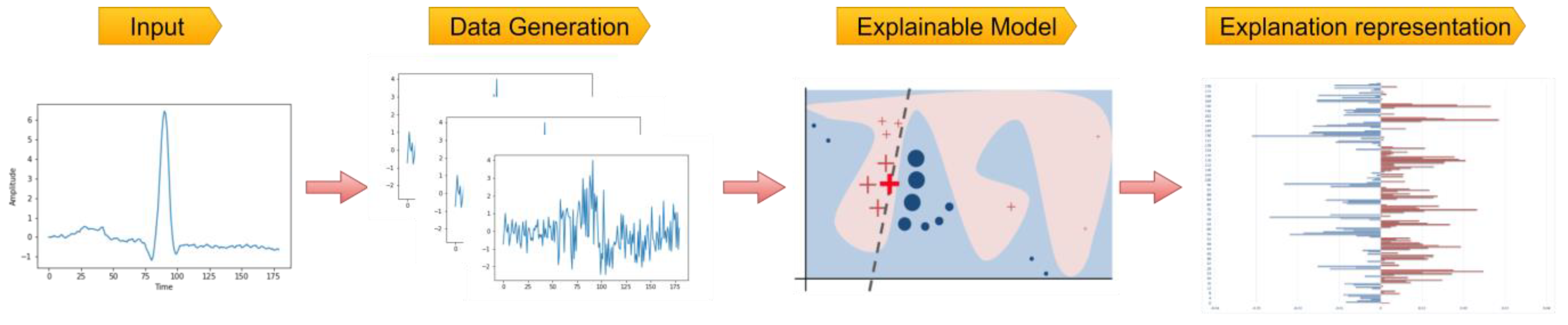
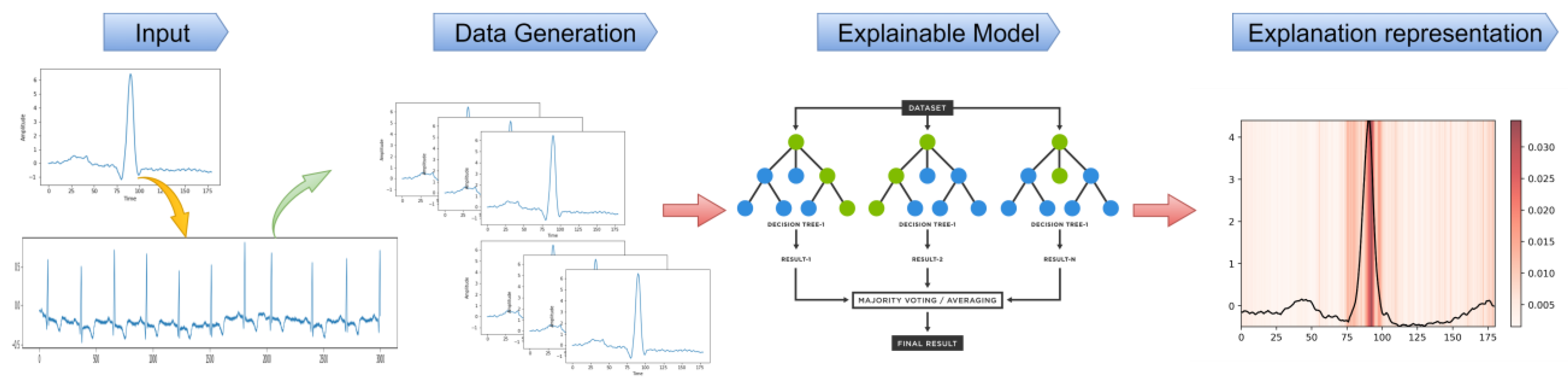
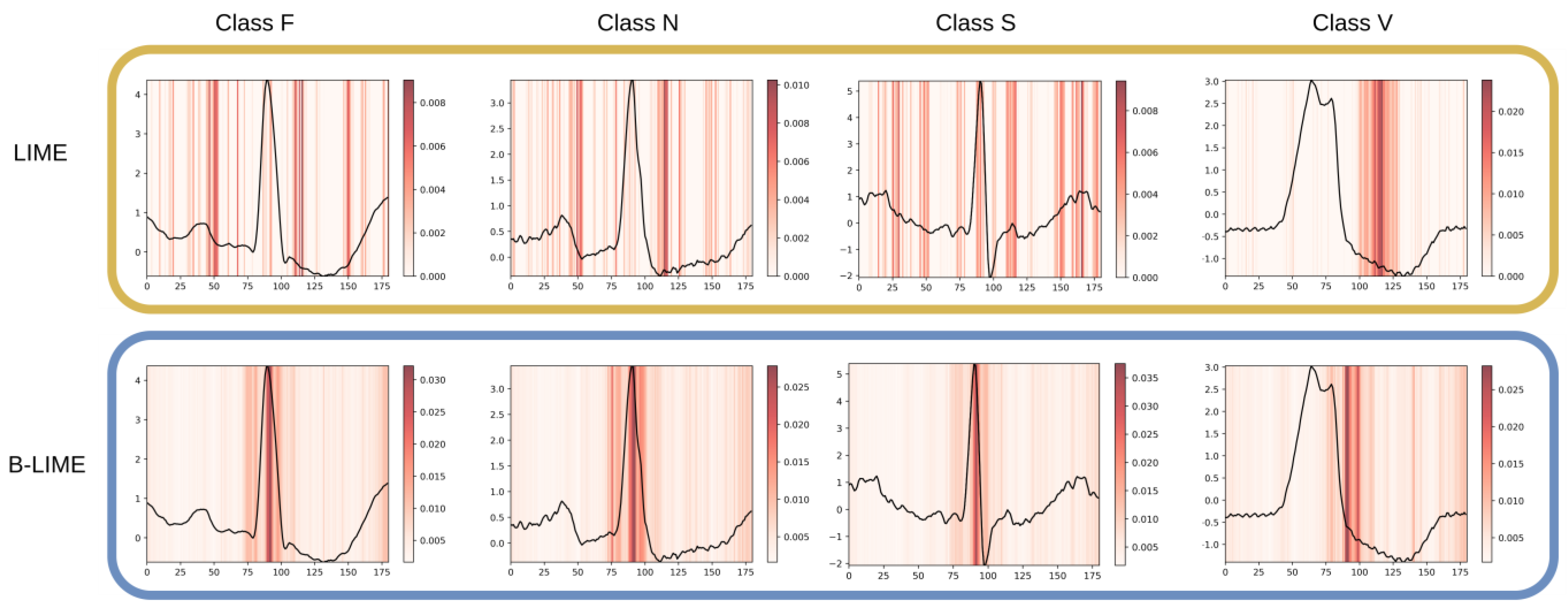
Deep Learning (DL) has gained enormous popularity recently; however, it is an opaque technique that is regarded as a black box. To ensure the validity of the model’s prediction, it is necessary to explain its authenticity. A well-known locally interpretable model-agnostic explanation method (LIME) uses surrogate techniques to simulate reasonable precision and provide explanations for a given ML model. However, LIME explanations are limited to tabular, textual, and image data. They cannot be provided for signal data features that are temporally interdependent. Moreover, LIME suffers from critical problems such as instability and local fidelity that prevent its implementation in real-world environments. In this work, we propose Bootstrap-LIME (B-LIME), an improvement of LIME, to generate meaningful explanations for ECG signal data. B-LIME implies a combination of heartbeat segmentation and bootstrapping techniques to improve the model’s explainability considering the temporal dependencies between features. Furthermore, we investigate the main cause of instability and lack of local fidelity in LIME. We then propose modifications to the functionality of LIME, including the data generation technique, the explanation method, and the representation technique, to generate stable and locally faithful explanations. Finally, the performance of B-LIME in a hybrid deep-learning model for arrhythmia classification was investigated and validated in comparison with LIME. The results show that the proposed B-LIME provides more meaningful and credible explanations than LIME for cardiac arrhythmia signal data, considering the temporal dependencies between features.
Keywords: B-LIME; cardiac arrhythmia; deep learning; electrocardiogram; explanation; interpretation; LIME B-LIME; cardiac arrhythmia; deep learning; electrocardiogram; explanation; interpretation; LIME
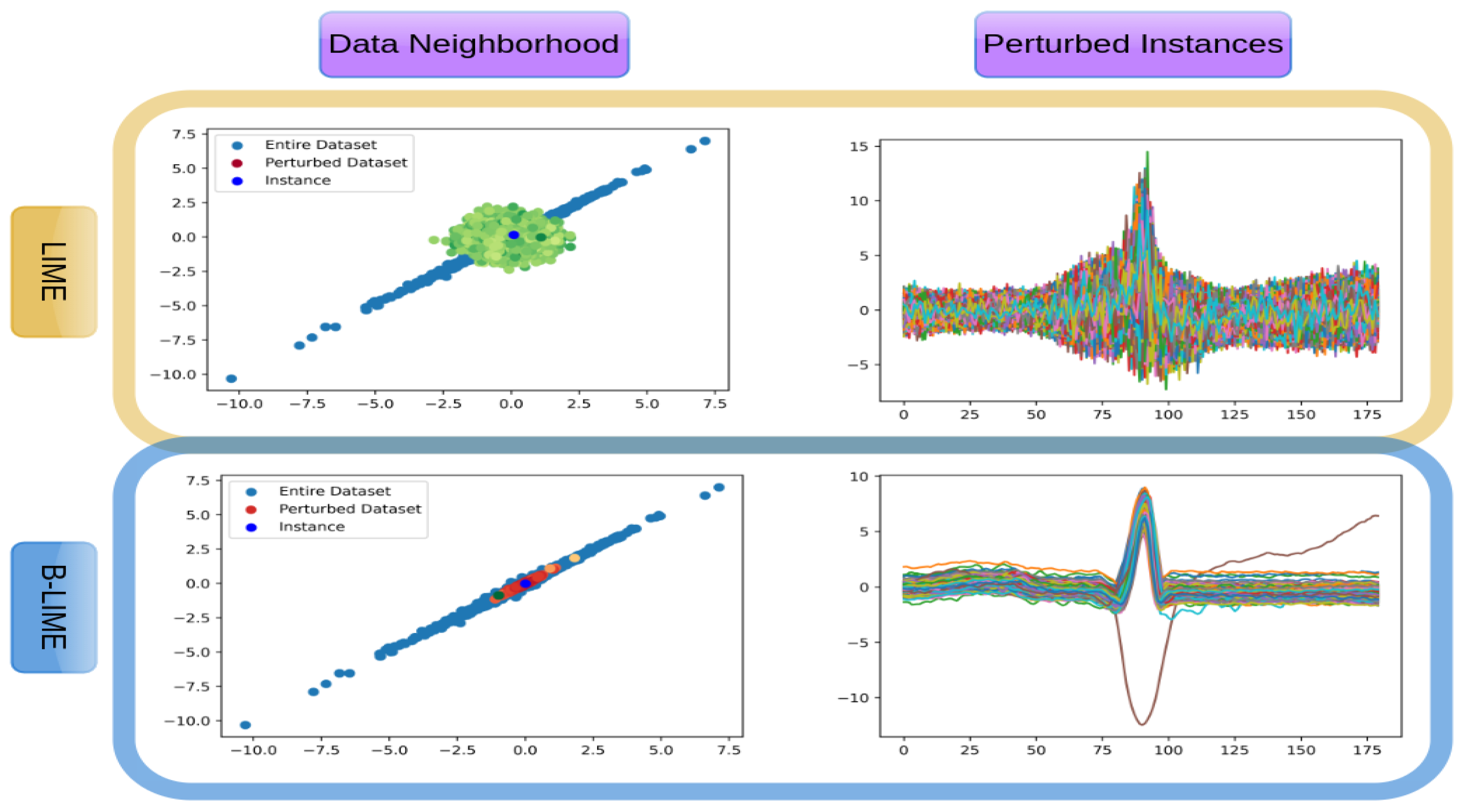
Graphical Abstract