Review

Cellulose Acetate Membranes: Fouling Types and Antifouling Strategies—A Brief Review


1
The Nanotechnology Center, The University of Jordan, Amman 11942, Jordan
2
Hamdi Mango Center for Scientific Research, The University of Jordan, Amman 11942, Jordan
3
Chemistry Department, The University of Jordan, Amman 11942, Jordan
4
Department of Basic Sciences, Faculty of Arts and Sciences, Al-Ahliyya Amman University, Amman 19328, Jordan
5
Department of Nanoscience, Joint School of Nanoscience and Nanoengineering, University of North Carolina at Greensboro, 2907 E. Gate City Blvd., Greensboro, NC 27401, USA
6
Civil and environmental Engineering Department, German Jordanian University, Amman 11180, Jordan
7
Consolidated Consultant Group (CCG), Amman 11183, Jordan
*
Author to whom correspondence should be addressed.
Processes 2023, 11(2), 489; https://doi.org/10.3390/pr11020489
Submission received: 20 December 2022 / Revised: 31 January 2023 / Accepted: 1 February 2023 / Published: 6 February 2023

Abstract

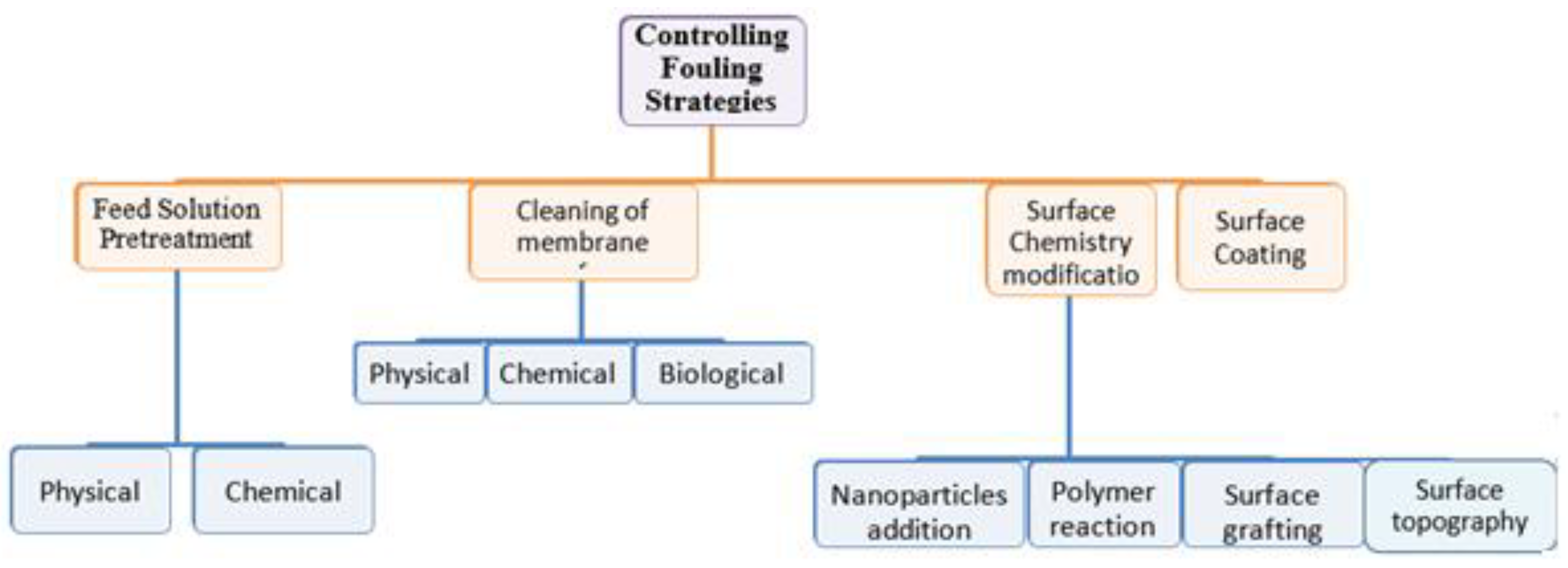
Cellulose acetate (CA) is a semisynthetic, biodegradable polymer. Due to its characteristics, CA has several applications, including water membranes, filament-forming matrices, biomedical nanocomposites, household tools, and photographic films. This review deals with topics related to the CA membranes, which are prepared using different techniques, such as the phase inversion technique. CA membranes are considered very important since they can be used as microfiltration membranes (MF), ultrafiltration membranes (UF), nanofiltration membranes (NF), reverse osmosis (RO) membranes, and forward osmosis (FO) membranes. Membrane fouling results from the accumulation of materials that the membrane rejects on the surface or in the membrane’s pores, lowering the membrane’s flux and rejection rates. There are various forms of CA membrane fouling, for instance, organic, inorganic, particulate fouling, and biofouling. In this review, strategies used for CA membrane antifouling are discussed and summarized into four main techniques: feed solution pretreatment, cleaning of the membrane surface, membrane surface modification, which can be applied using either nanoparticles, polymer reactions, surface grafting, or surface topography, and surface coating.
Keywords: biodegradable; phase inversion porosity; hydrophilicity; acetylation; grafting biodegradable; phase inversion porosity; hydrophilicity; acetylation; grafting