Article

Optimal Dispatch of the Source-Grid-Load-Storage under a High Penetration of Photovoltaic Access to the Distribution Network

1
School of Electrical Engineering, Tibet Agriculture and Animal Husbandry University, Linzhi 860000, China
2
Research Center of Civil, Hydraulic and Power Engineering of Tibet, Linzhi 860000, China
3
Linzhi Power Supply Company, State Grid, Linzhi 860000, China
4
College of Water Conservancy and Civil Engineering, Tibet Agriculture and Animal Husbandry University, Linzhi 860000, China
*
Author to whom correspondence should be addressed.
Processes 2023, 11(10), 2824; https://doi.org/10.3390/pr11102824
Submission received: 26 August 2023 / Revised: 23 September 2023 / Accepted: 23 September 2023 / Published: 25 September 2023
(This article belongs to the Special Issue Advances in Electrical Systems and Power Networks)

Abstract

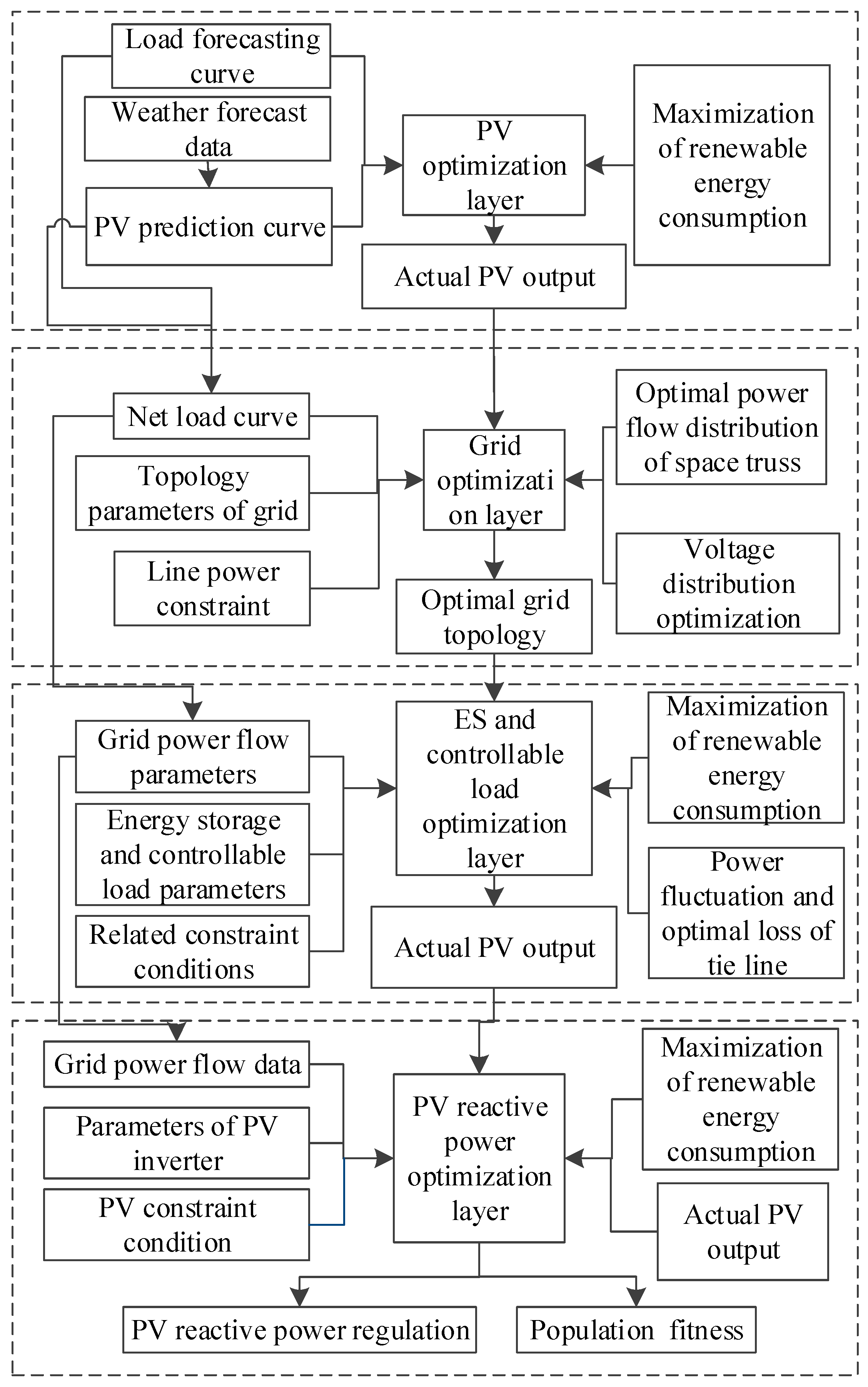
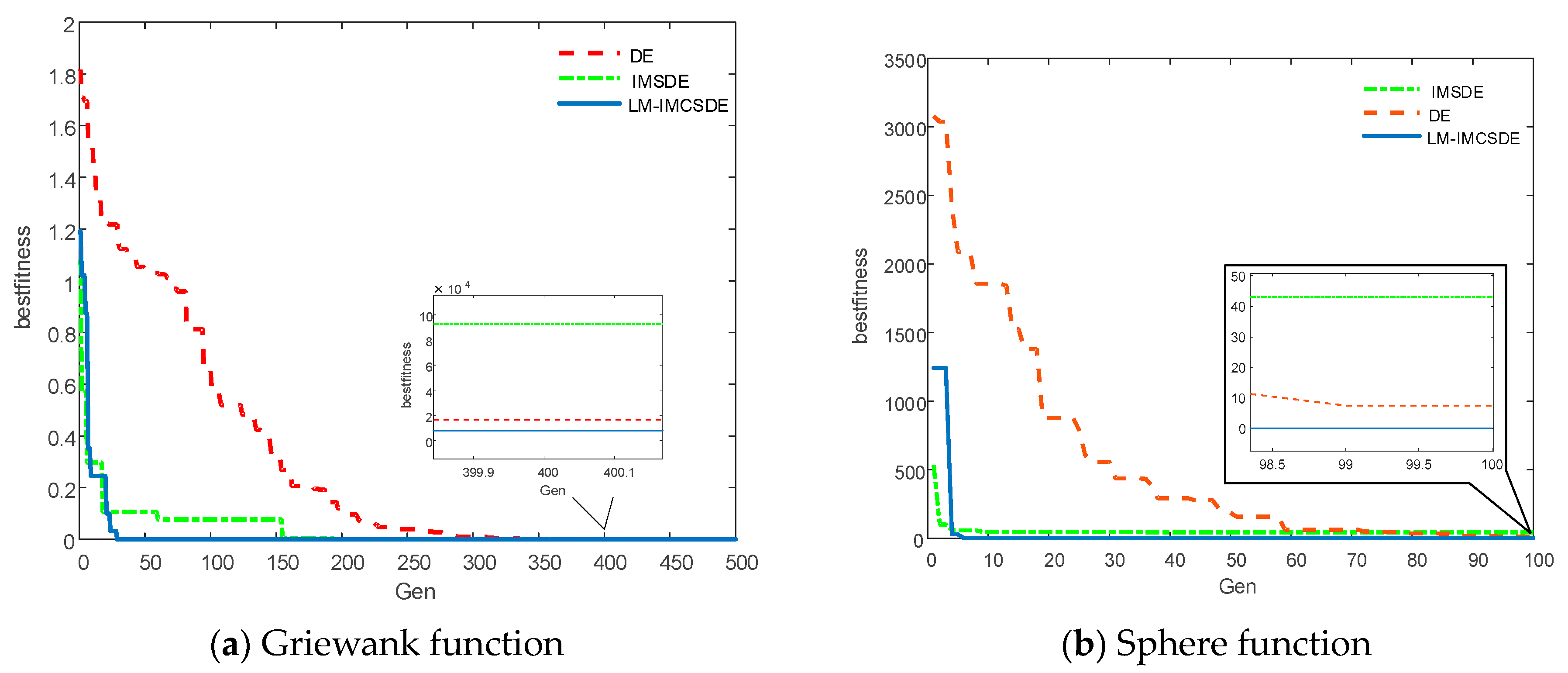
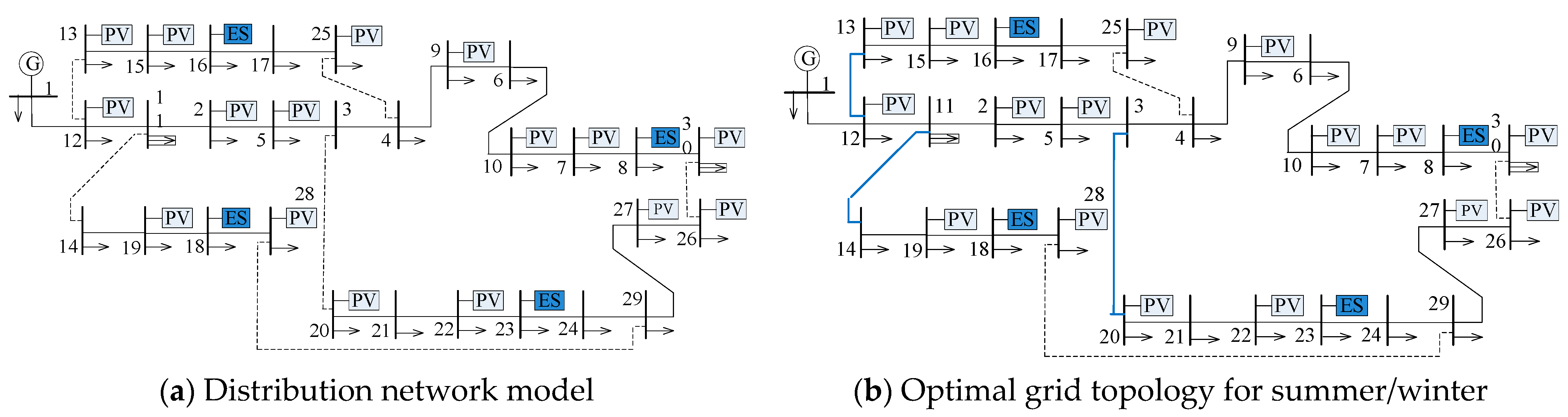
In the context of carbon peaking and carbon neutralization, distributed photovoltaics is a relatively mature new energy power generation technology that is being widely promoted. However, the randomness and volatility of distributed generation bring severe challenges to the distribution network’s operation. Based on this, taking the typical scenario of a high proportion of distributed photovoltaic grid connections against the background of a whole-county photovoltaic system as the research object, this paper constructs a source-grid-load-storage coordination optimal scheduling model in distribution networks, considering the spatial distribution of power flow, tie-line power fluctuation, grid loss, and voltage amplitude from the perspective of optimal day-to-day scheduling. Next, the Lehmer weighted and improved multi-mutation cooperation strategy differential evolution (LW-IMCSDE) algorithm is introduced to enhance the differential evolution algorithm based on the weighted Lehmer average, improved multi-mutation cooperation, and population update strategies. The feasibility and effectiveness of the algorithm are investigated by using a test function to verify its effectiveness. Finally, the feasibility and effectiveness of the proposed strategy are verified in two typical power scenarios: summer and winter.
Keywords: distributed photovoltaic; source-grid-load-storage; LW-IMCSDE algorithm; hierarchical optimization; multi-scene; distribution network distributed photovoltaic; source-grid-load-storage; LW-IMCSDE algorithm; hierarchical optimization; multi-scene; distribution network