

Investigation of Women’s Health on Wikipedia—A Temporal Analysis of Women’s Health Topic


Abstract
1. Introduction
2. Research Problem and Questions
- RQ1: What are the emergent themes and subjects of the women’s health topic on Wikipedia and the relations among them?
- RQ2: How does the women’s health topic evolve on Wikipedia in terms of its internal characteristics and external popularity during the investigated time periods?
3. Materials and Methods
3.1. Data Collection
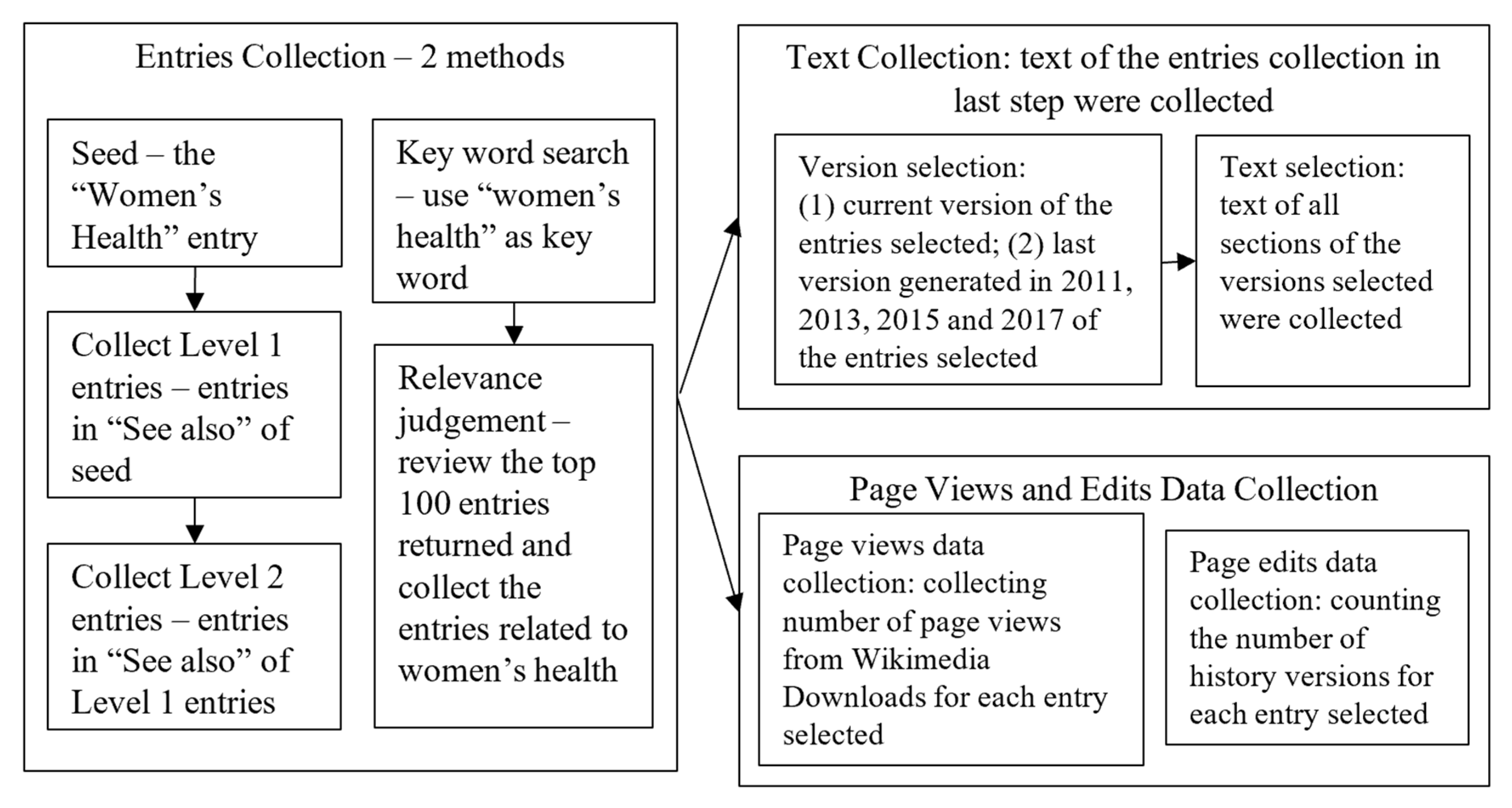
3.1.1. Entries Collection
3.1.2. Text Collection
3.1.3. Page Views and Edits Data Collection
3.2. Data Analysis
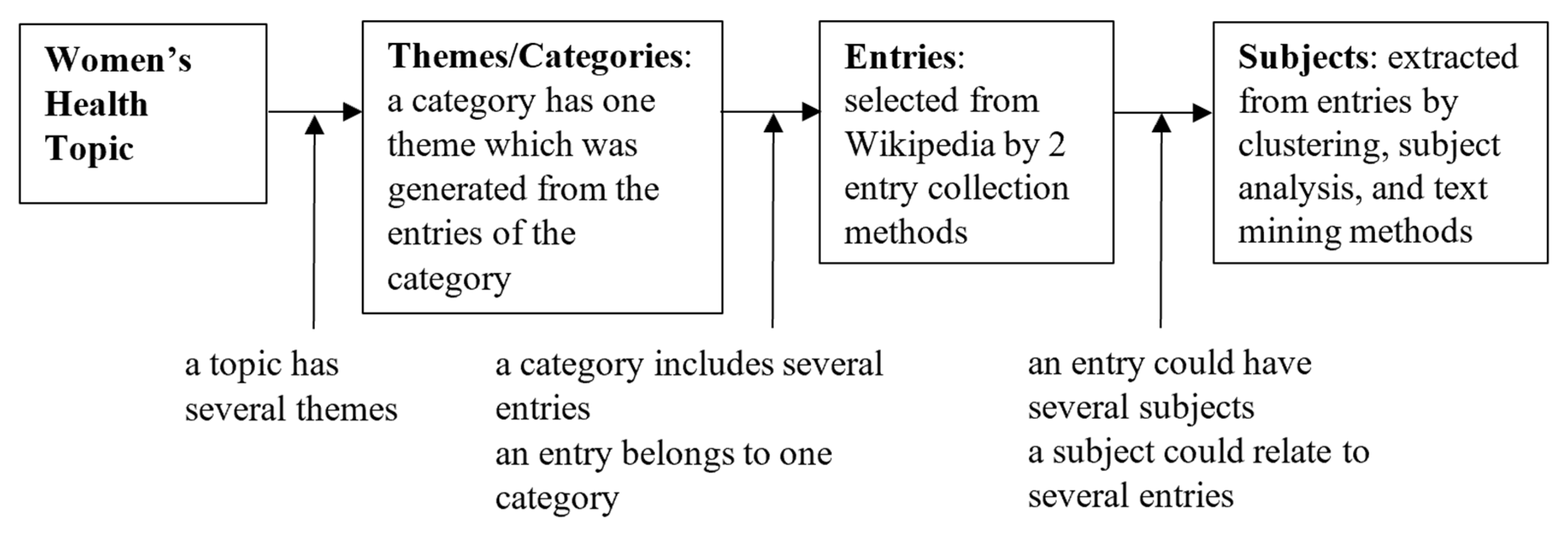
3.2.1. Categories and Themes
3.2.2. Text Data Processing
3.2.3. SOM Approach
3.2.4. Subject Analysis
3.2.5. Inferential Analysis
- H01: There were no significant differences among the investigated time periods in terms of the number of views of the entries relevant to women’s health.
- H02: There were no significant differences among the investigated time periods in terms of the number of edits of the entries relevant to women’s health.
4. Results and Discussion
4.1. Descriptive Results
4.1.1. Entries and Themes
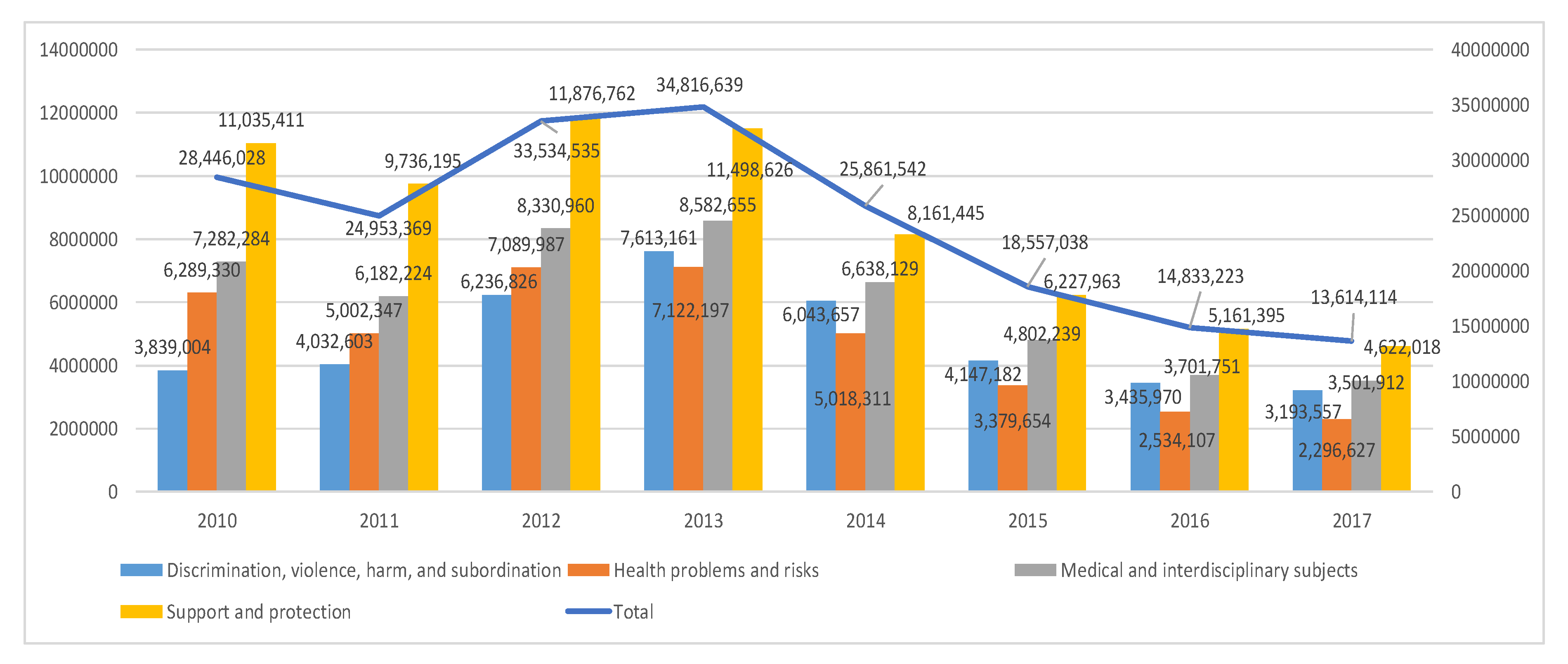
4.1.2. Page Views and Edits
4.2. Subject Analysis Results and Discussion
4.2.1. The Discrimination, Violence, Harm, and Subordination (DVHS) Theme
4.2.2. The Health Problems and Risks (WH-HPR) Theme
4.2.3. The Medical and Interdisciplinary Subjects (MIS) Theme
4.2.4. The Support and Protection (WH-SP) Theme
4.3. Evolution of the Women’s Health Topic
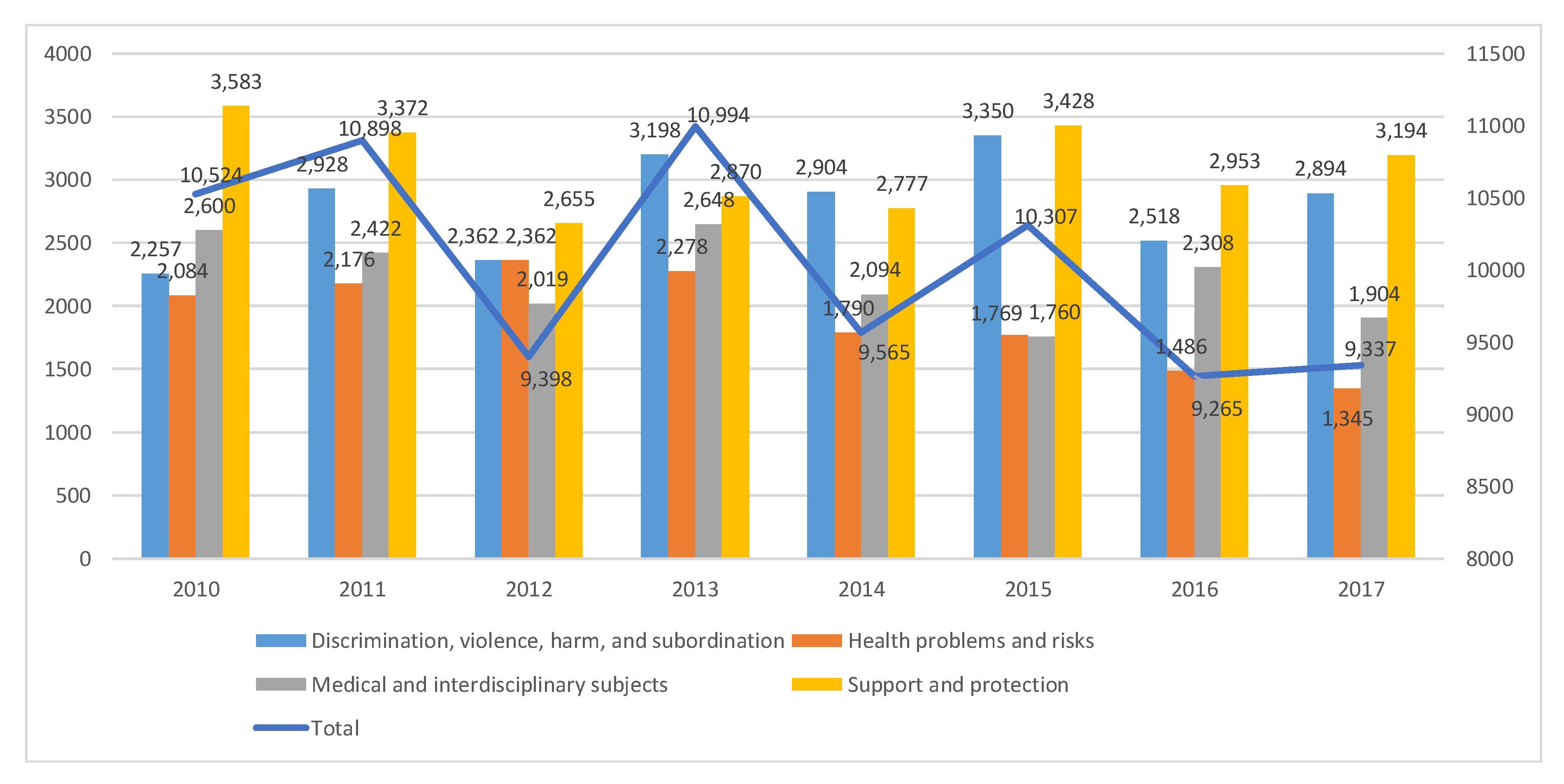
4.3.1. Entry Growth
4.3.2. Changes of Subjects
4.3.3. Changes of External Popularities
5. Conclusions
Author Contributions
Funding
Conflicts of Interest
Appendix A

| Themes | Entries |
|---|---|
| Discrimination, violence, harm, and subordination (DVHS): 37 entries | (1) Ageism, (2) Airline seating sex discrimination controversy, (3) Ambivalent sexism, (4) Discrimination against girls in India, (5) Female genital mutilation, (6) Femicide, (7) Gender apartheid, (8) Gender bias on Wikipedia, (9) Gender inequality in India, (10) Gender inequality, (11) Glass cliff, (12) Hegemonic masculinity, (13) Heterosexism, (14) Husband stitch, (15) Hypermasculinity, (16) LGBT stereotypes, (17) Male privilege, (18) Misogyny in horror films, (19) Misogyny, (20) Missing women, (21) Occupational segregation, (22) Occupational sexism, (23) Patriarchy, (24) Pink-collar worker, (25) Rape culture, (26) Reverse sexism, (27) Sexism in the technology industry, (28) Sexism, (29) Transphobia, (30) Triple oppression, (31) Victim blaming, (32) Wife selling, (33) Women in firefighting, (34) Women in law enforcement, (35) Women in medicine, (36) Women in Pakistan, (37) Women in the workforce |
| Health problems and risks (WH-HPR): 25 entries | (1) Abortion, (2) Anilingus, (3) Birth control, (4) Complications of pregnancy, (5) Disease, (6) Diseases of affluence, (7) Diseases of poverty, (8) Drift hypothesis, (9) Gender disparities in health, (10) Gender polarization, (11) Hypertensive disease of pregnancy, (12) Incarceration of women in the United States, (13) Inequality in disease, (14) Infant mortality, (15) List of bacterial vaginosis microbiota, (16) Medical anthropology, (17) Mental health inequality, (18) Misandry, (19) Molar pregnancy, (20) Ovarian cancer, (21) Schistosomiasis, (22) Unnatural Causes: Is Inequality Making Us Sick?, (23) Water supply and sanitation in India, (24) Women’s Health Issues (journal), (25) Women and smoking |
| Medical and interdisciplinary subjects (MIS): 46 entries | (1) Epidemiology, (2) Etiology, (3) Face-ism, (4) Family planning, (5) Gender-blind, (6) Global health, (7) Health equity, (8) Health in China, (9) Health in India, (10) Health, (11) History of medicine, (12) History of nursing, (13) Immigrant paradox, (14) International Conference on Population and Development, (15) Intersectionality, (16) Maternal health, (17) Matriarchy, (18) Medical sociology, (19) Menstruation, (20) Mental health, (21) Molecular pathological epidemiology, (22) Pathogenesis, (23) Pathology, (24) Population Health Forum, (25) Population health, (26) Public health, (27) Race and health, (28) Reproductive health, (29) Richard G. Wilkinson, (30) Sex differences in humans, (31) Sex segregation, (32) Sexual division of labour, (33) Social determinants of health in Mexico, (34) Social determinants of health in poverty, (35) Social determinants of health, (36) Social determinants of obesity, (37) Social epidemiology, (38) Vaginal tightening, (39) Whitehall Study, (40) Women’s health in China, (41) Women’s health in Ethiopia, (42) Women’s health in India, (43) Women’s health, (44) Women’s reproductive health in Russia, (45) Women’s reproductive health in the United States, (46) Women who have sex with women |
| Support and protection (WH-SP): 99 entries | (1) Alexandria Regional Center for Women’s Health and Development, (2) American Medical Women’s Association, (3) AnMed Health Women’s & Children’s Hospital, (4) Antifeminism, (5) Association of Women’s Health, Obstetric and Neonatal Nurses, (6) Australian Longitudinal Study on Women’s Health, (7) Australian Women’s Health Network, (8) B.C. Women’s Hospital & Health Centre, (9) Black Women’s Health Study, (10) Condom, (11) Dennis Raphael, (12) Equity feminism, (13) EuroHealthNet, (14) European Institute of Women’s Health, (15) Female condom, (16) Female education, (17) Feminism, (18) Feminist health centers, (19) Feminist movement, (20) Feminist Women’s Health Center (Atlanta, Georgia), (21) Florence Hartley, (22) Gender equality, (23) Gender feminism, (24) Gender neutrality, (25) Global Library of Women’s Medicine, (26) Global Task Force on Expanded Access to Cancer Care and Control in Developing Countries, (27) Gynaecology, (28) Gynography, (29) Health (magazine), (30) Health Care for Women International, (31) Health care in the United States, (32) Health Disparities Center, (33) Health education, (34) Health literacy, (35) Health professional, (36) Healthcare and the LGBT community, (37) Healthcare in Canada, (38) Healthy People program, (39) HealthyWomen, (40) Hopkins Center for Health Disparities Solutions, (41) Hormone replacement therapy (menopause), (42) Howard Atwood Kelly, (43) International Journal of Women’s Health, (44) International Planned Parenthood Federation, (45) International Women’s Health Coalition, (46) Ipas (organization), (47) Journal of Midwifery & Women’s Health, (48) Journal of Women’s Health, (49) Kegel exercise, (50) Laura W. Bush Institute for Women’s Health, (51) List of first female physicians by country, (52) List of health and fitness magazines, (53) List of medical journals, (54) List of women’s studies journals, (55) Madsen v. Women’s Health Center, Inc., (56) Martha Ballard, (57) Men and feminism, (58) Michael Marmot, (59) Michigan Medicine, (60) Midwife, (61) Midwifery, (62) National Organization for Men Against Sexism, (63) National Organization for Women, (64) National Women’s Health Network, (65) New Space for Women’s Health, (66) Office on Women’s Health, (67) Oregon Health and Science University Center for Women’s Health, (68) Our Bodies, Ourselves, (69) Psychology of Women Quarterly, (70) Reproductive Health Supplies Coalition, (71) Reproductive rights, (72) Separatist feminism, (73) Sex Roles (journal), (74) Society for Women’s Health Research, (75) Sunnybrook Health Sciences Centre, (76) Sutter Health, (77) Sybil Shainwald, (78) Tamika D. Mallory, (79) The Heart Truth, (80) The Honest Body Project, (81) The NeuroGenderings Network, (82) Torches of Freedom, (83) United Nations Foundation, (84) United Nations Population Fund, (85) United States Department of Health and Human Services, (86) University of Pittsburgh Graduate School of Public Health, (87) Women’s College Hospital, (88) Women’s empowerment, (89) Women’s Health (magazine), (90) Women’s Health Action and Mobilization, (91) Women’s Health Care Nurse Practitioner-Board Certified, (92) Women’s Health Initiative, (93) Women’s health nurse practitioner, (94) Women’s medicine in antiquity, (95) Women’s rights in Iran, (96) Women’s rights, (97) Women’s suffrage, (98) Women & Health, (99) Women in India |
References
- Tu, H.T. Surprising decline in consumers seeking health information. Track. Rep. 2011, 26, 1–6. [Google Scholar]
- Fox, S.; Duggan, M. Health Online. 2013. Available online: http://www.pewinternet.org/2013/01/15/health-online-2013/ (accessed on 20 June 2020).
- Moorhead, S.A.; Hazlett, D.E.; Harrison, L.; Carroll, J.K.; Irwin, A.; Hoving, C. A new dimension of health care: Systematic review of the uses, benefits, and limitations of social media for health communication. J. Med. Internet Res. 2013, 15, e85. [Google Scholar] [CrossRef] [PubMed]
- Dawson, J. Doctors Join Patients in Going Online for Health Information. Available online: http://connection.ebscohost.com/c/opinions/49259197/doctors-join-patients-going-online-health-information (accessed on 25 March 2010).
- Marar, S.D.; Al-Madaney, M.M.; Almousawi, F.H. Health information on social media. perceptions, attitudes, and practices of patients and their companions. Saudi Med. J. 2019, 40, 1294–1299. [Google Scholar] [CrossRef] [PubMed]
- Zhang, J.; Zhao, Y. A user term visualization analysis based on a social question and answer log. Inf. Process. Manag. 2013, 49, 1019–1048. [Google Scholar] [CrossRef]
- Brasil, P.; Pereira, J.P.J.; Moreira, M.E.; Ribeiro Nogueira, R.M.; Damasceno, L.; Wakimoto, M.; Nielsen-Saines, K. Zika Virus Infection in Pregnant Women in Rio de Janeiro. N. Engl. J. Med. 2016, 375, 2321–2334. [Google Scholar] [CrossRef] [PubMed]
- Oteng-Ntim, E.; Tezcan, B.; Seed, P.; Poston, L.; Doyle, P. Lifestyle interventions for obese and overweight pregnant women to improve pregnancy outcome: A systematic review and meta-analysis. Lancet 2015, 386, S61. [Google Scholar] [CrossRef]
- Subramaniam, M.; Prasad, R.O.; Abdin, E.; Vaingankar, J.A.; Chong, S.A. Single mothers have a higher risk of mood disorders. Ann. Acad. Med. Singap. 2014, 43, 145–151. [Google Scholar] [PubMed]
- Asiodu, I.V.; Waters, C.M.; Dailey, D.E.; Lee, K.A.; Lyndon, A. Breastfeeding and use of social media among first-time African American mothers. J. Obstet. Gynecol. Neonatal Nurs. 2015, 44, 268–278. [Google Scholar] [CrossRef] [PubMed]
- Gleeson, D.M.; Craswell, A.; Jones, C.M. Women’s use of social networking sites related to childbearing: An integrative review. Women Birth 2019, 32, 294–302. [Google Scholar] [CrossRef] [PubMed]
- Holtz, B.; Smock, A.; Reyes-Gastelum, D. Connected motherhood: Social support for moms and moms-to-be on Facebook. Telemed. J. E-Health 2015, 21, 415–421. [Google Scholar] [CrossRef] [PubMed]
- Ure, C.; Cooper-Ryan, A.M.; Condie, J.; Galpin, A. Exploring Strategies for Using Social Media to Self-Manage Health Care When Living with and Beyond Breast Cancer: In-Depth Qualitative Study. J. Med. Internet Res. 2020, 22, e16902. [Google Scholar] [CrossRef] [PubMed]
- Milne, D.; Witten, I.H. Learning to Link with Wikipedia. In Proceedings of the 17th ACM Conference on Information and Knowledge Management, Napa Valley, CA, USA, 26–30 October 2008; Association for Computing Machinery: New York, NY, USA, 2008; pp. 509–518. [Google Scholar]
- Milne, D.; Witten, I.H. An open-source toolkit for mining Wikipedia. Artif. Intell. 2013, 194, 222–239. [Google Scholar] [CrossRef]
- Wikimedia Downloads. Available online: https://dumps.wikimedia.org/ (accessed on 9 July 2020).
- Keyes, O. Package ‘WikipediR’. Available online: http://www.stats.bris.ac.uk/R/web/packages/WikipediR/WikipediR.pdf (accessed on 20 June 2020).
- Kohonen, T.; Kaski, S.; Lagus, K.; Salojarvi, J.; Honkela, J.; Paatero, V.; Saarela, A. Self organization of a massive document collection. IEEE Trans. Neural Netw. 2000, 11, 574–585. [Google Scholar] [CrossRef] [PubMed]
- The R Foundation for Statistical Computing. The R Project for Statistical Computing. Available online: https://www.r-project.org/ (accessed on 17 July 2020).
- RStudio Team. RStudio. Available online: https://rstudio.com/ (accessed on 17 July 2020).
- Ultsch, A.; Siemon, H. Kohonen’s Self Organizing Feature Maps for Exploratory Data Analysis. In Proceedings of the INNC’90, International Neural Networks Conference, Palais des Congres, Paris, France, 9–13 July 1990; Kluwer Academic: Dordrecht, The Netherlands; Boston, MA, USA, 1990; pp. 305–308. [Google Scholar]
- Bem, S.L. Dismantling gender polarization and compulsory heterosexuality: Should we turn the volume down or up? J. Sex Res. 1995, 32, 329–334. [Google Scholar] [CrossRef]
| Themes | No. of Entries | Descriptions |
|---|---|---|
| Discrimination, violence, harm, and subordination (DVHS) | 37 | Entries related to mental and physical violence and harm, discrimination, and subordination to women |
| Health problems and risks (WH-HPR) | 25 | Entries related to health problems and risks |
| Medical and interdisciplinary subjects (MIS) | 46 | Entries related to medical subjects and health-related interdisciplinary subjects |
| Support and protection (WH-SP) | 99 | Entries related to policies, laws, research studies, literary and artistic work, treatments, people, and organizations that support and protect women, and improve women’s health |
| Themes | 2010 | 2011 | 2012 | 2013 | 2014 | 2015 | 2016 | 2017 |
|---|---|---|---|---|---|---|---|---|
| Discrimination, violence, harm, and subordination | 1 | 1 | 1 | 1 | 2 | 1 | 0 | 1 |
| Health problems and risks | 0 | 1 | 0 | 2 | 0 | 3 | 0 | 1 |
| Medical and interdisciplinary subjects | 1 | 0 | 1 | 4 | 2 | 1 | 0 | 1 |
| Support and protection | 7 | 4 | 5 | 4 | 3 | 8 | 3 | 3 |
| Total | 9 | 6 | 7 | 11 | 7 | 13 | 3 | 6 |
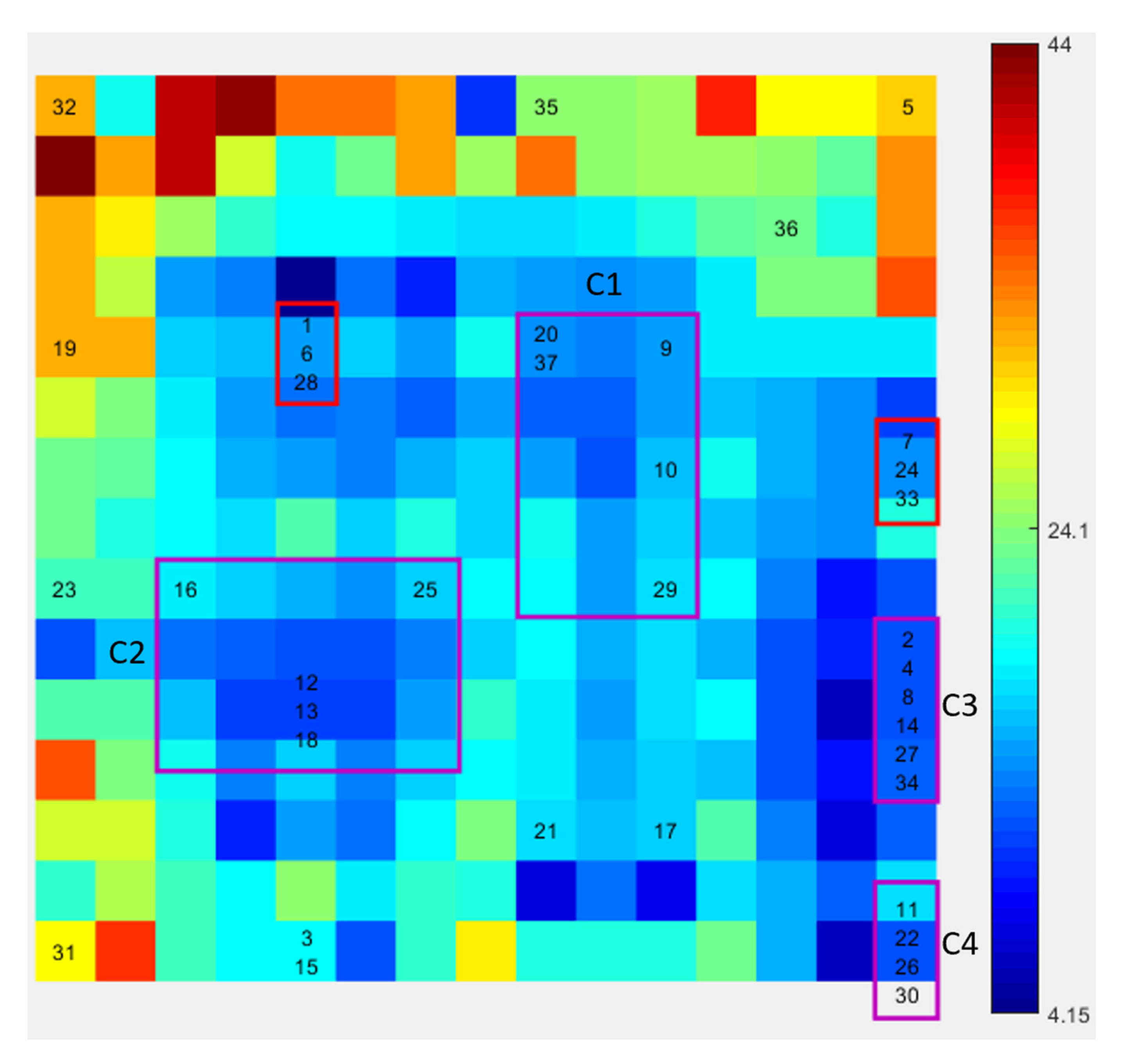
| Clusters | High-Frequency Terms and Phrases | Subjects |
|---|---|---|
| C1 | sex ratio (81), missing women (65), gender inequality (47), gender gap (45), transgender people (43), men and women (40), United States (39), Gender Gap Report (25), sexual harassment (21), labor force (16), gender identity (16), female children (15), wage gap (15), World Economic Forum (15), birth sex (14) | Inequality and discrimination (health care, work), minority group (LGBT, woman), abuse and violence (sexual violence) |
| C2 | rape culture (73), hegemonic masculinity (65), gay men (34), horror films (23), sexual violence (22), sexual assault (20), rape victims (17), sexual orientation (15), rape myths (15), South Africa (15), violence against women (11), slasher films (10), United States (9), victim blaming (9), mass media (9), LGBT people (9) | Minority group (LGBT, woman), abuse and violence (sexual violence, heterosexist violence) |
| C3 | gender gap (22), law enforcement (20), female child (20), police officers (14), Wikimedia foundation (13), New York Times (13), Wikipedia editors (12), Silicon Valley (11), gender bias (9), British Airways (8), New Zealand (8), black women (8), technology industry (7), female officers (6), sexual harassment (6) | Inequality and discrimination (work, research), minority group (woman), abuse and violence (sexual violence) |
| C4 | glass cliff (28), triple oppression (20), black women (15), Communist Party (9), leadership positions (7), women executives (6), Michelle K (5), United States (5), black feminist (5), gender roles (4), occupational sexism (4), Claudia Jones (4), Socialist Party (4), reverse sexism (4), glass ceiling (4), Supreme Court (4), men and women (4) | Inequality and discrimination (work), minority group (black, woman), woman protection (organization, research) |
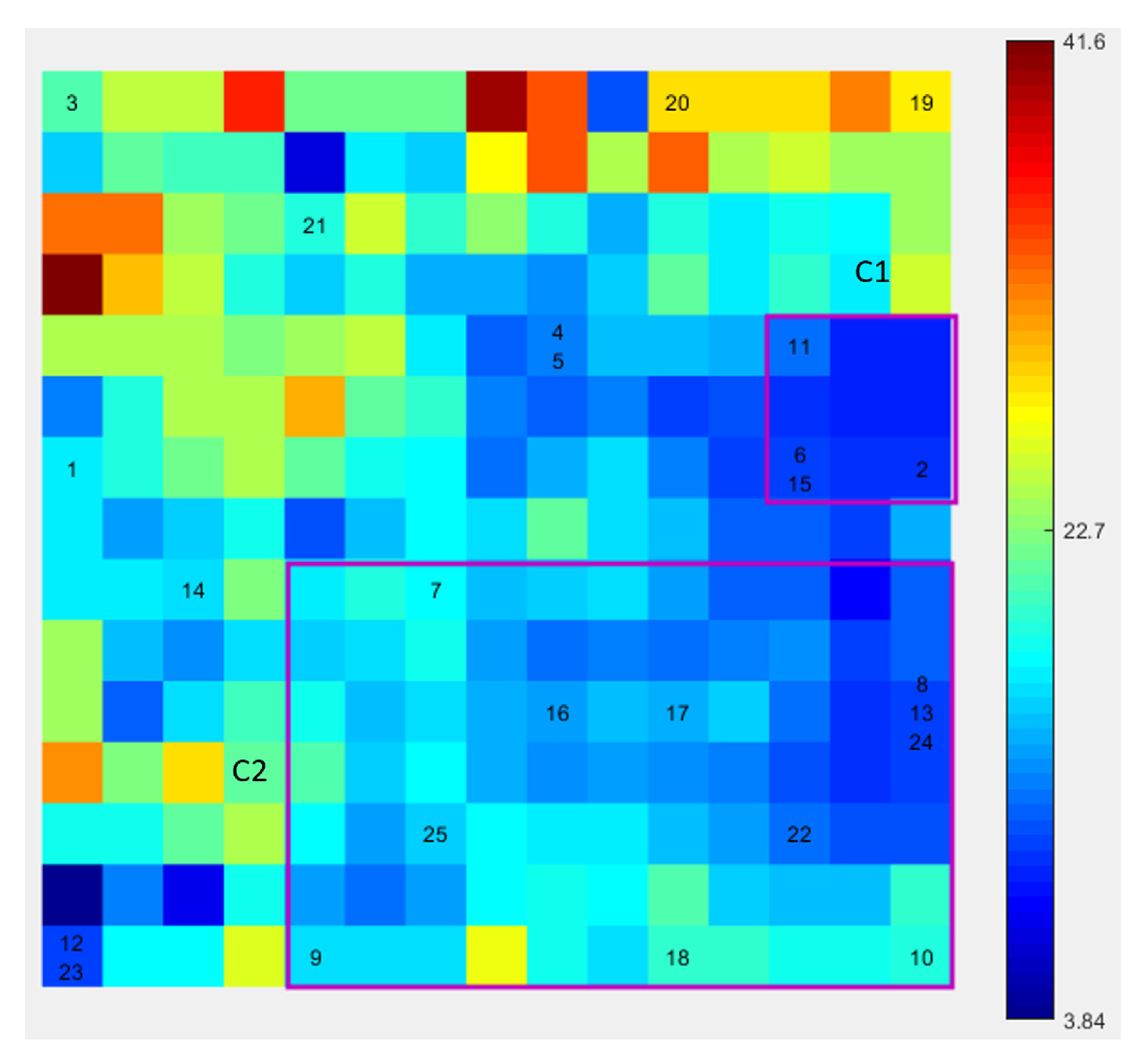
| Clusters | High-Frequency Terms and Phrases | Subjects |
|---|---|---|
| C1 | blood pressure (20), high blood pressure (11), bacterial vaginosis (7), passive partner (7), active partner (6), chronic hypertension (5), diseases of affluence (5), sexually transmitted infections (4) | Health issue (problem) |
| C2 | mental health (70), health care (53), United States (42), medical anthropology (39), public health (30), African Americans (23), heart disease (22), World Health Organization (19), gender equality (17), gender polarization (17), mental illness (16), sub-Saharan Africa (16), social class (15), men and women (15), women’s health (14) | Health issue (service, research, organization, problem), inequality and discrimination (research) |
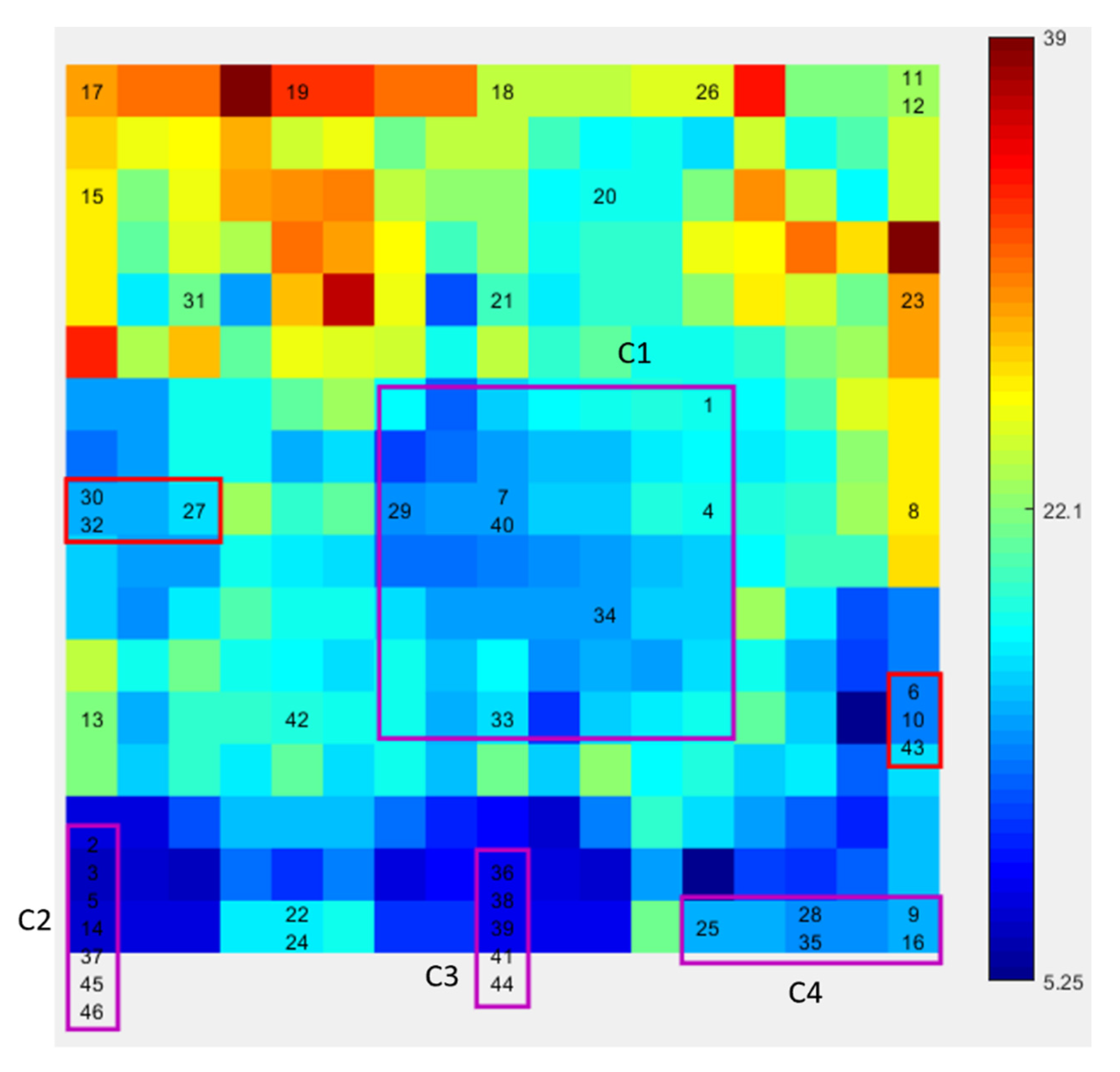
| Clusters | High-Frequency Terms and Phrases | Subjects |
|---|---|---|
| C1 | health care (68), family planning (68), United States (37), public health (32), health disparities (28), rural areas (24), health outcomes (24), structural violence (22), social determinants of health (21), World Health Organization (19), health equity (18), living conditions (16), spirit level (15), life expectancy (15), socioeconomic status (14), medical care (14), birth control (14) | Health issue (service, problem, research, organization), family planning and reproduction, abuse and violence (structural violence) |
| C2 | United States (22), sexually transmitted disease (14), reproductive health (13), facial prominence (9), social epidemiology (8), intrauterine contraception (8), birth control (8), women’s health (13), health and human (8), family medicine patients (8), hormonal contraceptives (7), CDC exploratory research (7), family planning (6), human services (5), reproductive age (5), bisexual women (5), sexual health (5), health and human services (5) | Health issue (problem, research, service), family planning and reproduction (method), minority group (LGBT) |
| C3 | Whitehall Study (25), pelvic floor (23), reproductive health (21), Whitehall II (16), health care (16), reproductive rights (13), heart disease (13), Russian women (13), coronary heart disease (10), reproductive law and policy (8), Center for Reproductive Law (8), women’s health (7), civil servants (6), social class (6), mortality rate (6), live births (6), risk factors (6), social determinants (6), blood pressure (6), pelvic floor muscles (6) | Health issue (research, problem, service), family planning and reproduction (law, organization), social factor |
| C4 | social determinants of health (44), health care (43), population health (35), reproductive health (33), maternal mortality (30), oral health (29), World Health Organization (23), family planning (23), maternal health (20), public health (16), maternal deaths (14), health services (14), prenatal care (13), developing countries (12), United Nations (12), United States (12) | Health issue (problem, service, organization), population issue (problem), family planning and reproduction |
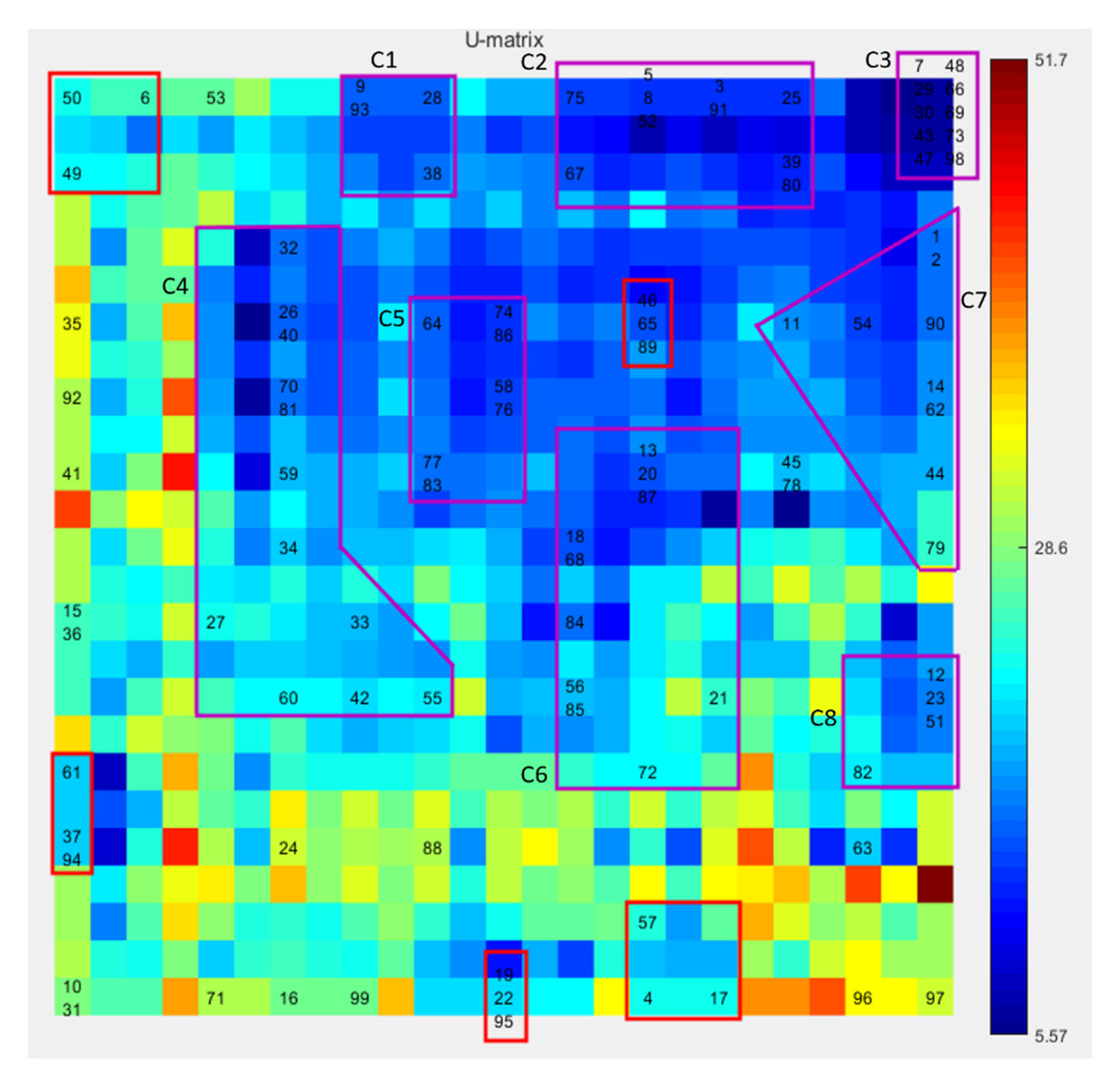
| Clusters | High-Frequency Terms and Phrases | Subjects |
|---|---|---|
| C1 | healthy people (17), Department of Health (12), black women (9), health and human services (9), women’s health (8), disease prevention (6), health promotion (5), Human Services Office (5), Office of Disease Prevention (5) | Health issue (organization, problem, service), minority group (black) |
| C2 | women’s health (42), Center for Women’s Health (14), health sciences (13), Health Centre (10), women’s hospital (10), AnMed Health (7), health services (7), OHSU Center (6), women and newborns (6), Christie Street (5), Cancer Centre (4), World War (4), health care (4), St. Michael’s Hospital (4), Honest Body (4), maternity hospital (4), The Huffington Post (4), Sunnybrook Health Sciences Centre (4), obstetric and neonatal nurses (4) | Health issue (organization, service) |
| C3 | women’s health (38), health care (11), women’s studies (10), Journal Citation Reports (8), Care for Women (6), health care journal (5), impact factor (5), women’s studies journals (4) | Health issue (service, research) |
| C4 | health education (138), health literacy (105), health disparities (83), public health (69), health system (44), reproductive health (43), University of Michigan (33), health care (32), Medical School (31), health promotion (28), United States (25), New York (24), Performance Indicators for Grades (24), school health (23), health supplies (23) | Health issue (education, problem, organization, service) |
| C5 | United Nations (60), women’s health (59), public health (41), health care (29), Sutter Health (22), UN Foundation (18), New York (15), health research (14), health network (12), University of Pittsburgh (11), San Francisco (10), Women’s Health Research (10), Society for Women’s Health (10), Medical Center (9), United States (9), Pittsburgh Graduate School (9), School of Public Health (9) | Health issue (service, organization, research, education), population issue (organization) |
| C6 | women’s health (98), United States (57), public health (40), health care (39), health education (35), Women’s Health Center (34), Health and Human Services (26), social security (22), College Hospital (20), feminist health centers (20), United Nations (17), Department of Health Education (16), Federal Security (13), Our Bodies Ourselves (13), Health Education and Welfare (11), Boston Women’s Health Book (11) | Health issue (service, education, organization, law) |
| C7 | women’s health (24), Planned Parenthood (21), Heart Truth (20), Red Dress Collection (17), Conference on Planned Parenthood (10), American Medical Women’s Association (10), United Nations (7), United States (7), New York (5), National Organization (5), First Ladies (5), sexual health (5), health policy (5), heart disease (5), National Organization for Men (5), Institute of Women’s Health (5), Women’s Health and Development (5) | Health issue (organization, law, problem, research), family planning and reproduction (organization) |
| C8 | equity feminism (9), gender feminism (7), tobacco companies (5), United States (4), female physicians (4), Hoff Sommers (4), medical school (4) | Woman protection (activity, research) |
| Themes | Subjects | |||||||
|---|---|---|---|---|---|---|---|---|
| Inequality and discrimination | Minority Group | Abuse and Violence | Woman Protection | Health Issue | Family Planning and Reproduction | Social Factor | Population Issue | |
| Discrimination, violence, harm, and subordination | √ | √ | √ | √ | ||||
| Health problems and risks | √ | √ | ||||||
| Medical and interdisciplinary subjects | √ | √ | √ | √ | √ | √ | ||
| Support and protection | √ | √ | √ | √ | √ | |||
| Time Period | High-Frequency Terms and Phrases | Subjects | |
|---|---|---|---|
| Period 1–Period 2 | Frequency Decreasing Terms | a history of women (−9), US Department (−5) | Inequality and discrimination (work), minority group (woman) |
| Frequency Increasing Terms | female genital (92), female genital mutilation (73), female circumcision (40), hegemonic masculinity (39), human rights (38), New York (34), United States (29), gender apartheid (29), United Nations (27), gender identity (23), men and women (21), transgender people (20), age discrimination (18), rape culture (18), Glick P (16), World Health Organization (16), genital cutting (14), Oxford University (14), South Africa (14), gender roles (13), sexual assault (13), Islamic law (13) | Abuse and violence (domestic violence, sexual violence), inequality and discrimination (society, economy, work), minority group (LGBT), woman protection (organization), health issue (organization) | |
| Period 2–Period 3 | Frequency Decreasing Terms | genital mutilation (−32), female circumcision (−30), female genital (−29), Islamic law (−13), South Carolina (−9), gender identity (−8), Type III (−7), Hosken Report (−6), Glick P (−5), Oxford University (−5), World Health Organization (−5), medical journal (−5), Agrarian System (−5) | Abuse and violence (domestic violence), inequality and discrimination (research), health issue (organization, research) |
| Frequency Increasing Terms | New York (50), gender gap (39), sex ratio (31), first female (25), rape culture (23), gender inequality (22), age discrimination (19), missing women (19), New York Times (18), women and girls (18), United States (16), men and women (16), hegemonic masculinity (15), glass cliff (15), victim blaming (11), male privilege (11), sexual violence (10), gender equality (10), gender bias (10), transgender people (9), women and children (8) | Inequality and discrimination (health care, work), abuse and violence (sexual violence), minority group (LGBT, woman) | |
| Period 3–Period 4 | Frequency Decreasing Terms | New Zealand (−5) | Inequality and discrimination (work) |
| Frequency Increasing Terms | men and women (42), missing women (37), United States (30), gender gap (23), sexual assault (20), genital mutilation (20), transgender people (17), triple oppression (16), sexual violence (15), South Africa (13), women’s rights (11), New York (9), gender bias (9), rape victims (9), global gender gap (9), gender roles (9), violence against women (9), labor force (9), sex differences (9), pay gap (9), gender gap report (9) | Inequality and discrimination (health care, work), abuse and violence (sexual violence, domestic violence), minority group (LGBT, woman), woman protection | |
| Time Period | High-Frequency Terms and Phrases | Subjects | |
|---|---|---|---|
| Period 1–Period 2 | Frequency Decreasing Terms | Disease Control and Prevention (−43), medical dictionary (−5) | Health issue (organization) |
| Frequency Increasing Terms | infant mortality (62), United States (40), mortality rate (38), health organization (36), health care (34), World Health Organization (29), public health (25), reproductive health (23), developing countries (18), infant mortality rate (17), Sub-Saharan Africa (14), family planning (12), urban development (10), men and women (10), ovarian cancer (9), New York (9), drinking water (9), determinants of health (9), heart disease (8), infant death (8), United Nations (8) | Health issue (problem, organization, service, cause), family planning and reproduction (organization) | |
| Period 2–Period 3 | Frequency Decreasing Terms | Today’s Evidence (−15), Tomorrow’s Agenda (−15) | Health issue (organization), woman protection (organization) |
| Frequency Increasing Terms | ovarian cancer (102), epithelial ovarian cancer (18), infant mortality (16), United States (13), gender polarization (12), risk of ovarian cancer (12), birth control (10), women’s health (10), mental health (7), public health (6), live birth (6), health issues (6), side effects (6), health care (5), mortality rate (5), New York (5), infant mortality rate (5), infant death (5), induced abortion (5), million people (5), substance abuse (5), preterm birth (5), lymph node (5) | Health issue (problem, service), family planning and reproduction (method), inequality and discrimination (society) | |
| Period 3–Period 4 | Frequency Decreasing Terms | embryo or fetus (−11), gynecologic oncology (−7), poor health (−6) | Health issue (research, problem), family planning and reproduction (method) |
| Frequency Increasing Terms | mental health (67), health care (29), germ cell (26), blood pressure (21), United States (20), cell tumor (25), birth control (14), African Americans (12), socioeconomic status (12), infant mortality (11), mortality rate (8), health and human (8), health organization (7), burden of disease study (7), causes of death (7), ovarian cancer (11), infant mortality rate (6), systematic analysis (6), Stage I (6), health problems (5), health services (5), developed countries (5), medical abortion (5), systematic review (5), Cochrane Database (5) | Health issue (service, problem, organization, research, cause), family planning and reproduction (method) | |
| Time Period | High-Frequency Terms and Phrases | Subjects | |
|---|---|---|---|
| Period 1–Period 2 | Frequency Decreasing Terms | population health (−12), Oxford University (−5), health status (−5), maternal deaths (−5), political economy (−5) | Population issue, health issue (problem), economy, politics |
| Frequency Increasing Terms | public health (83), health care (72), sex segregation (70), world health (40), mental health (39), health organization (39), United States (37), men and women (28), social determinants (27), health outcomes (26), World Health Organization (26), history of medicine (25), rural areas (24), health services (22), determinants of health (21), global health (19), 19th century (19), family planning (18), maternal mortality (17), living conditions (17), sex differences (16) | Health issue (service, organization, cause, research, problem), family planning and reproduction | |
| Period 2–Period 3 | Frequency Decreasing Terms | African American (−40), health disparities (−17), global health (−13), heart disease (−11), risk factors (−8), coronary heart disease (−8), Health care Research and Quality (−7), ethnic disparities (−6), Community Health (−5), physical activity (−5), racial and ethnic disparities (−5), racial differences (−5), universal health (−5) | Health issue (service, problem, organization, research), inequality and discrimination (health care) |
| Frequency Increasing Terms | reproductive health (35), mental health (33), family planning (21), medical sociology (20), New York (19), health care (18), women’s health (14), public health (13), sexually transmitted diseases (13), women’s health (13), molecular pathology (13), United Nations (12), social science (12), reproductive age (12), health issues (11), live births (10), rural areas (9), determinants of health (9), mental illness (9), Social Science & Medicine (9), women of reproductive age (9) | Health issue (research, service, problem, cause), family planning and reproduction (organization), population issue (organization) | |
| Period 3–Period 4 | Frequency Decreasing Terms | feminist theory (−10), women’s studies (−8), Western medicine (−8), sexually transmitted diseases (−6), Chinese medicine (−6), Law Review (−5), myth of matriarchal prehistory (−5), Charlotte Perkins (−5), John Knox (−5), medical care (−5) | Woman protection (research, law), health issue (research, treatment, problem) |
| Frequency Increasing Terms | mental health (72), women’s health (54), United States (38), public health (34), mental illness (26), health care (25), social work (24), world health (24), female genital (24), family planning (23), United Nations (22), developing countries (22), reproductive health (20), sustainable development (20), violence against women (20), maternal mortality (16), developed countries (16), Millennium Development (16), health issues (15), social determinants (13), World Health Organization (13), health research (13), health disparities (13), intimate partner (13), cervical cancer (13) | Health issue (problem, organization, cause, research), abuse and violence (domestic violence), family planning and reproduction (organization), population issue (organization), inequality and discrimination (health care) | |
| Time Period | High-Frequency Terms and Phrases | Subjects | |
|---|---|---|---|
| Period 1–Period 2 | Frequency Decreasing Terms | health insurance (−42), Health Affairs (−13), care services (−12), women’s college (−12), medical care (−10), health care services (−10), health care costs (−10), insurance coverage (−8), sex discrimination (−8), Medicaid Services (−8), Women’s College Hospital (−8), Centers for Medicare (−7), Washington DC (−6), medical treatment (−6), National Organization for Women (−6), civil rights (−5), universal health (−5) | Health issue (insurance, research, service, organization, treatment), inequality and discrimination, woman protection (organization) |
| Frequency Increasing Terms | women’s health (163), health center (59), United States (50), reproductive health (50), women’s suffrage (37), health initiative (28), public health (27), health centers (27), breast cancer (26), women’s rights (25), men and women (22), Michigan Health System (22), Women’s Health Initiative (20), hormone therapy (19), planned parenthood (18), health education (16), female condom (16), red dress (16), postmenopausal women (15), colorectal cancer (14), University of Michigan (14), red dress collection (14) | Health issue (organization, problem, treatment, education), inequality and discrimination (politics), woman protection, family planning and reproduction (method) | |
| Period 2–Period 3 | Frequency Decreasing Terms | reproductive health (−8), ancient Rome (−5), University of Pittsburgh (−5), Journal of Obstetrics (−5), Stefanick ML (−5) | Family planning and reproduction (organization, research, treatment), health issue (organization, education) |
| Frequency Increasing Terms | women’s health (82), public health (40), health literacy (35), health education (33), human rights (33), New York (30), violence against women (30), gender equality (29), domestic violence (28), United Nations (27), health care (25), Department of Health (23), Oxford University (21), women’s suffrage (20), breast cancer (20), right to vote (20), reproductive rights (20), social security (18), men and women (17), United States (15), health system (15), National Institute (15) | Health issue (education, service, organization), abuse and violence (domestic violence), inequality and discrimination, woman protection (politics, health) | |
| Period 3–Period 4 | Frequency Decreasing Terms | hormone replacement (−20), health system (−16), hormone replacement therapy (−11), Michigan Health System (−10), red dress collection (−9), suffrage referendum (−5), equine estrogen (−5) | Health issue (treatment, organization), inequality and discrimination (politics) |
| Frequency Increasing Terms | New York (84), United States (55), women’s health (36), violence against women (35), United Nations (26), health care (25), reproductive health (25), gender equality (24), health organization (21), Medical Association (21), women’s rights (20), women’s suffrage (16), birth control (16), World Health Organization (16), sexual and reproductive health (15), Department of Health (14), health and human (14), United States Department (14), human rights (13), reproductive rights (13), family planning (13), women’s education (13) | Health issue (service, organization), abuse and violence, women protection (politics, education), family planning and reproduction | |
| Types | Subjects |
|---|---|
| Growing subjects | Abuse and violence, family planning and reproduction, health issue, inequality and discrimination, minority group, woman protection |
| Diminishing subjects | Economy, politics |
| Fluctuating subjects | Population issue |
| Hypotheses | Chi-Square Value | p-Value |
|---|---|---|
| H01 | χ2(3) = 73.384 | 0.000 |
| H02 | χ2(3) = 0.383 | 0.944 |
| Values | Period 1 vs. Period 2 | Period 2 vs. Period 3 | Period 3 vs. Period 4 |
|---|---|---|---|
| Z-value | −7.363 | −1.331 | −6.134 |
| p-value | 0.000 | 0.183 | 0.000 |
© 2020 by the authors. Licensee MDPI, Basel, Switzerland. This article is an open access article distributed under the terms and conditions of the Creative Commons Attribution (CC BY) license (http://creativecommons.org/licenses/by/4.0/).
Share and Cite
Wang, Y.; Zhang, J. Investigation of Women’s Health on Wikipedia—A Temporal Analysis of Women’s Health Topic. Informatics 2020, 7, 22. https://doi.org/10.3390/informatics7030022
Wang Y, Zhang J. Investigation of Women’s Health on Wikipedia—A Temporal Analysis of Women’s Health Topic. Informatics. 2020; 7(3):22. https://doi.org/10.3390/informatics7030022
Chicago/Turabian StyleWang, Yanyan, and Jin Zhang. 2020. "Investigation of Women’s Health on Wikipedia—A Temporal Analysis of Women’s Health Topic" Informatics 7, no. 3: 22. https://doi.org/10.3390/informatics7030022
APA StyleWang, Y., & Zhang, J. (2020). Investigation of Women’s Health on Wikipedia—A Temporal Analysis of Women’s Health Topic. Informatics, 7(3), 22. https://doi.org/10.3390/informatics7030022

