_Bryant.png)
Between Trust and Risk: Understanding the Conditional Acceptance of Artificial Intelligence


Abstract
1. Introduction
- What does it mean to accept a technology?
- What factors drive individuals and organizations to embrace AI?
- Who is most inclined to do so?
2. Study Design and Methodology
2.1. Quantitative Phase: Survey Study
2.2. Qualitative Phase: Interview Study
- I1: “If your friend or child asked you What is AI?, how would you explain it in simple words?”
- I2: “Can you think of a time you were using an app or a tool, and later found out it was actually using AI?”
- I3: “Imagine tomorrow all AI tools disappeared, what would be the hardest thing for you to live without?”
- I4: “Do you feel more excited or more worried about AI? Why? What do you hope AI will bring for the future?”
- I5: “Is there something you would never trust AI to do?”
- I6: “If you could ask AI to solve one big problem in the world, what would you choose?”
- I7: “If you could give one piece of advice to the people creating AI, what would you tell them?”
3. Participants and Data Collection
3.1. Survey Distribution
3.2. Interview Sessions
4. Results
4.1. AI Awareness and Exposure
4.2. AI Usage Patterns
4.3. AI Impact and Understanding
- Technology, engineering, and academic professionals reported consistently positive impact due to regular interaction with AI systems;
- Healthcare and business workers showed moderate positivity, acknowledging improvements in workflow and data accessibility;
- Educators expressed mixed perceptions, balancing instructional support from AI with concerns regarding academic integrity and student overreliance.
- Engineering, technology, and academic researchers demonstrated the highest levels of understanding;
- Business, healthcare, and government employees tended toward moderate or basic comprehension;
- Students, depending on their major, ranged widely from confident understanding among computing disciplines to minimal literacy in non-technical fields.
- Engineering, technology, academia, and business/entrepreneurship roles were the most optimistic, given their exposure to AI’s tangible benefits;
- Education and public-sector roles expressed higher uncertainty, frequently referencing ethical, fairness, and regulatory concerns.
4.4. AI Trust, Perceived Risks, and Regulation
4.5. Ethical, Emotional and Reflective Vision
4.5.1. Opportunities and Perceived Benefits (Q18)
4.5.2. Fears and Ethical Concerns (Q19)
4.5.3. Reflections on the Future of Technology (Q21)
4.5.4. Messages to Scientists and Developers (Q22)
4.6. Interview Results: Determinants of Public Attitudes Toward AI
4.6.1. Concerns
Moreover, concerns were often framed in concrete scenarios such as uploading internal reports, financial data, or sensitive content into AI tools, particularly in corporate, academic, and administrative environments:“I don’t fully trust AI in general, mainly because of over-reliance and confidentiality issues.”[INT_FI, Corporate/Parent]
In addition to privacy-related risks, a second major theme was the fear that heavy dependence on AI could reduce independent thinking, especially among younger users. This concern was echoed by parents, educators, and family groups, who viewed cognitive offloading as a long-term developmental risk. This was often expressed through worries about replacing reasoning with instant answers:“Someone might upload confidential company data… Even if AI claims governance, I believe there are no real secrets anymore.”[INT_FI, Corporate/Parent]
Consequently, participants linked overreliance to long-term social and cognitive risks, including reduced critical thinking, weakened accountability, and emotional dependency:“Teenagers, in particular, talk to AI constantly.”[INT_DM, Academic]
Similarly, interviewees frequently mentioned uncertainty about the future of work and the possibility of role replacement in specific sectors. These concerns were expressed by students anticipating career entry, as well as by parents and professionals reflecting on labor market shifts:“AI should not be expected to answer everything, and it should never replace verified sources.”[INT_DM, Academic]
Furthermore, some participants perceived certain professions as particularly exposed to automation due to AI’s ability to process large bodies of text and precedent, with legal, administrative, and knowledge-intensive roles frequently cited:“I’ve heard many stories about people losing their jobs because of AI.”[INT_AS, Student]
Beyond professional implications, several interviewees were worried that AI could reduce genuine human connection and alter social behavior. This concern appeared strongly when participants discussed children and family dynamics, particularly the substitution of parental guidance or interpersonal dialogue with AI-mediated interaction:“AI excels at analyzing large datasets and referencing similar cases.”[INT_FI, Corporate/Parent]
Finally, others emphasized the risk that AI could shape identity, voice, or social expression in subtle ways, particularly through automated writing, messaging, or personalization systems:“Children should ask their parents, not ask AI instead.”[INT_FA, Family group]
“It can speak for you without sounding like you.”[INT_MA, Professional]
4.6.2. Expectations
Additionally, participants often described AI as useful for structuring thoughts and improving clarity, especially in writing, studying, and conceptual organization. This function was highlighted by students, educators, and design-oriented participants alike:“AI is a system that learns, analyzes, and predicts, like having a smart partner.”[INT_MA, Professional]
Finally, beyond individual-level benefits, some participants expressed optimistic, future-oriented expectations, imagining AI contributing to large-scale improvements such as disease treatment, educational accessibility, humanitarian coordination, and sustainability. However, this optimism was typically conditioned on responsible governance and careful boundaries, with participants repeatedly emphasizing that such benefits depend on ethical deployment rather than technological capability alone.“One important role of AI… is that it helps organize ideas.”[INT_DM, Academic]
4.6.3. Environmental Influences
Moreover, participants repeatedly highlighted the need for oversight and safeguards at institutional and governmental levels. Several interviewees emphasized that progress must be paired with control to prevent misuse or loss of human agency:“Used correctly… AI is powerful and helpful. It just needs clear rules and accountability.”[INT_MA, Professional]
“For every new step you take, take three steps in control.”[INT_MA, Professional]
4.6.4. Individual Characteristics
4.6.5. Minimum Requirements for Trustworthy AI Use
In addition to privacy concerns, participants stated clear trust boundaries, especially regarding medicine and finance, which were consistently identified as high-risk domains requiring human accountability:“When I upload information… I always wonder: Who can see this?”[INT_MA, Professional]
“I wouldn’t trust AI with medicine.”[INT_AS, Student]
On the other hand, participants emphasized safe data foundations and ethical safeguards, highlighting the responsibility of developers and institutions in shaping trustworthy systems:“I would not trust AI with anything related to banks.”[INT_NA, Participant]
“Make sure AI systems are built on secure, trusted, and ethical datasets.”[INT_SA, Academic/Engineering]
4.7. Key Findings and Research Question Synthesis
5. Discussion
5.1. Socio-Demographic, Cognitive, and Behavioral Foundations of AI Acceptance
5.2. Trust, Risk Perception, and Governance as Conditions for Acceptance
5.3. Ethical Reflection, Future Orientation, and Conditional Optimism
6. Conclusions and Future Work
Funding
Institutional Review Board Statement
Informed Consent Statement
Data Availability Statement
Acknowledgments
Conflicts of Interest
References
- Artificial Intelligence (AI) Worldwide. Statista Topic Overview. 2025. Available online: https://www.statista.com/topics/3104/artificial-intelligence-ai-worldwide/ (accessed on 21 May 2026).
- Marr, B. Mind-Blowing AI Statistics Everyone Must Know About Now in 2025. Forbes. 2025. Available online: https://www.forbes.com/sites/bernardmarr/2025/06/03/mind-blowing-ai-statistics-everyone-must-know-about-now-in-2025/ (accessed on 21 May 2026).
- Gillespie, N.; Lockey, S.; Ward, T.; Macdade, A.; Hassed, G. Trust, Attitudes and Use of Artificial Intelligence; The University of Melbourne and KPMG: Parkville, VIC, Australia, 2025. [Google Scholar]
- Maslej, N.; Fattorini, L.; Perrault, R.; Gil, Y.; Parli, V.; Kariuki, N.; Capstick, E.; Reuel, A.; Brynjolfsson, E.; Etchemendy, J.; et al. The AI Index 2025 Annual Report; Technical Report; Stanford Institute for Human-Centered Artificial Intelligence: Stanford, CA, USA; AI Index Steering Committee: Stanford, CA, USA, 2025. [Google Scholar]
- AI Adoption Statistics 2024: All Figures & Facts to Know. VentionTeams. 2024. Available online: https://ventionteams.com/solutions/ai/adoption-statistics (accessed on 21 May 2026).
- Freeman, J. Student Generative AI Survey 2025; Higher Education Policy Institute: London, UK, 2025. [Google Scholar]
- Salesforce. New Research: 60% of Marketers Say Generative AI Will Transform Their Role, but Worry About Accuracy. Salesforce Survey in Partnership with YouGov; Data from 18–25 May 2023; over 1000 Full-Time Marketers in US, UK, Australia. 2023. Available online: https://www.salesforce.com/news/stories/generative-ai-for-marketing-research/ (accessed on 21 May 2026).
- Davis, F.D. Perceived usefulness, perceived ease of use, and user acceptance of information technology. MIS Q. 1989, 13, 319–340. [Google Scholar] [CrossRef] [Scilit] [PubMed]
- Venkatesh, V.; Morris, M.G.; Davis, G.B.; Davis, F.D. User acceptance of information technology: Toward a unified view1. MIS Q. 2003, 27, 425–478. [Google Scholar] [CrossRef] [Scilit]
- Almogren, A.S.; Al-Rahmi, W.M.; Dahri, N.A. Exploring factors influencing the acceptance of ChatGPT in higher education: A smart education perspective. Heliyon 2024, 10, e31887. [Google Scholar] [CrossRef] [Scilit] [PubMed]
- Kelly, S.; Kaye, S.A.; Oviedo-Trespalacios, O. What factors contribute to the acceptance of artificial intelligence? A systematic review. Telemat. Inform. 2023, 77, 101925. [Google Scholar] [CrossRef] [Scilit]
- Marikyan, M.; Papagiannidis, P. Unified Theory of Acceptance and Use of Technology; TheoryHub Book: Newcastle upon Tyne, UK, 2021. [Google Scholar]
- Lockey, S.; Gillespie, N.; Holm, D.; Someh, I.A. A Review of Trust in Artificial Intelligence: Challenges, Vulnerabilities and Future Directions; Association for Information Systems: Atlanta, GA, USA, 2021. [Google Scholar]
- Shin, D. The effects of explainability and causability on perception, trust, and acceptance: Implications for explainable AI. Int. J. Hum. Comput. Stud. 2021, 146, 102551. [Google Scholar] [CrossRef] [Scilit]
- Alejandro, I.M.V.; Sanchez, J.M.P.; Sumalinog, G.G.; Mananay, J.A.; Goles, C.E.; Fernandez, C.B. Pre-service teachers’ technology acceptance of artificial intelligence (AI) applications in education. STEM Educ. 2024, 4, 445–465. [Google Scholar] [CrossRef] [Scilit]
- Womick, B.E. Motivating Employee Acceptance of AI in the Workplace: A Pathway to Increased Firm Profitability and Competitive Advantage. Ph.D. Thesis, Florida International University, Miami, FL, USA, 2024. [Google Scholar]
- Köchling, A.; Wehner, M.C. Discriminated by an algorithm: A systematic review of discrimination and fairness by algorithmic decision-making in the context of HR recruitment and HR development. Bus. Res. 2020, 13, 795–848. [Google Scholar] [CrossRef] [Scilit]
- Fildor, D.; Škrinjarić, B.; Budak, J. Anatomy of AI Risk Perception: Differentiating Privacy, Misinformation, and Technical Failures. Int. J. Hum. Comput. Interact. 2026, 1–21. [Google Scholar] [CrossRef] [Scilit]
- Nandwani, N. Future of Governance in the Ai Era: Opportunities and Challenges. In Artificial Intelligence and Comparative Systems of Governance; 2026; p. 273. Available online: https://www.researchgate.net/profile/Sk-Bose-3/publication/400460537_ARTIFICIAL_INTELLIGENCE_AND_COMPARATIVE_SYSTEMS_OF_GOVERNANCE_MIND_YOUR_LAW/links/698415b25d60ab48356b3ae4/ARTIFICIAL-INTELLIGENCE-AND-COMPARATIVE-SYSTEMS-OF-GOVERNANCE-MIND-YOUR-LAW.pdf#page=278 (accessed on 21 May 2026).
- Yusuf, A.; Pervin, N.; Román-González, M. Generative AI and the future of higher education: A threat to academic integrity or reformation? Evidence from multicultural perspectives. Int. J. Educ. Technol. High. Educ. 2024, 21, 21. [Google Scholar] [CrossRef] [Scilit]
- Almassaad, A.; Alajlan, H.; Alebaikan, R. Student perceptions of generative artificial intelligence: Investigating utilization, benefits, and challenges in higher education. Systems 2024, 12, 385. [Google Scholar] [CrossRef] [Scilit]
- Yee, L.; Chui, M.; Roberts, R. Superagency in the Workplace: Empowering People to Unlock AI’s Full Potential; McKinsey & Company Report; McKinsey & Company: New York, NY, USA, 2025. [Google Scholar]
- Frenkenberg, A.; Hochman, G. It’s scary to use it, it’s scary to refuse it: The psychological dimensions of AI adoption—Anxiety, motives, and dependency. Systems 2025, 13, 82. [Google Scholar] [CrossRef] [Scilit]
- Yusuf, N.; Mueller-Kaler, J.; Lozano-Jaramillo, J. Governing AI for the Future of Humanity; The Henry L. Stimson Center: Washington, DC, USA, 2025. [Google Scholar]
- Dang, Q.; Li, G. Unveiling trust in AI: The interplay of antecedents, consequences, and cultural dynamics. AI Soc. 2026, 41, 669–692. [Google Scholar] [CrossRef] [Scilit]
- Kauttonen, J.; Rousi, R.; Alamäki, A. Trust and acceptance challenges in the adoption of AI applications in health care: Quantitative survey analysis. J. Med. Internet Res. 2025, 27, e65567. [Google Scholar] [PubMed]
- Or, C. Understanding factors influencing AI adoption in education: Insights from a Meta-Analytic Structural Equation Modelling study. J. Appl. Learn. Teach. 2025, 8, 102–115. [Google Scholar] [CrossRef] [Scilit]
- Gruzd, A.; Mai, P.; Clements Haines, A. The State of Generative AI Use in Canada 2025: Exploring Public Attitudes and Adoption Trends; Toronto Metropolitan University: Toronto, ON, Canada, 2025. [Google Scholar]
- Hwang, Y.; Hwang, J. AI Perception and Acceptance Patterns Across Cultures: Comparative Study of Korean and Chinese University Students. Int. J. Adv. Smart Converg. 2025, 14, 42–52. [Google Scholar]



| Q# | Question | Response Options |
|---|---|---|
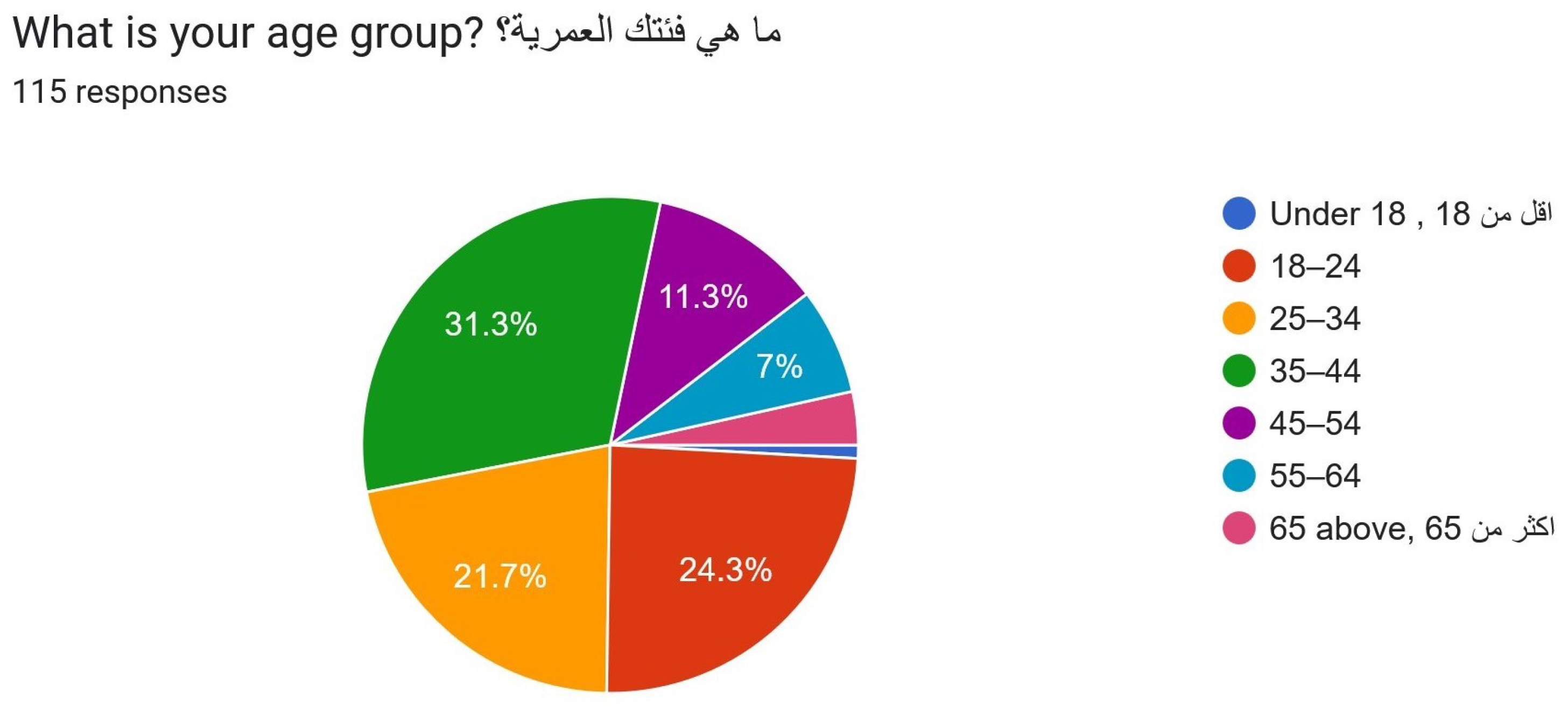
| Q1 | What is your age group? | Under 18; 18–24; 25–34; 35–44; 45–54; 55–64; 65+ |
| Q2 | What is your gender? | Male; Female |
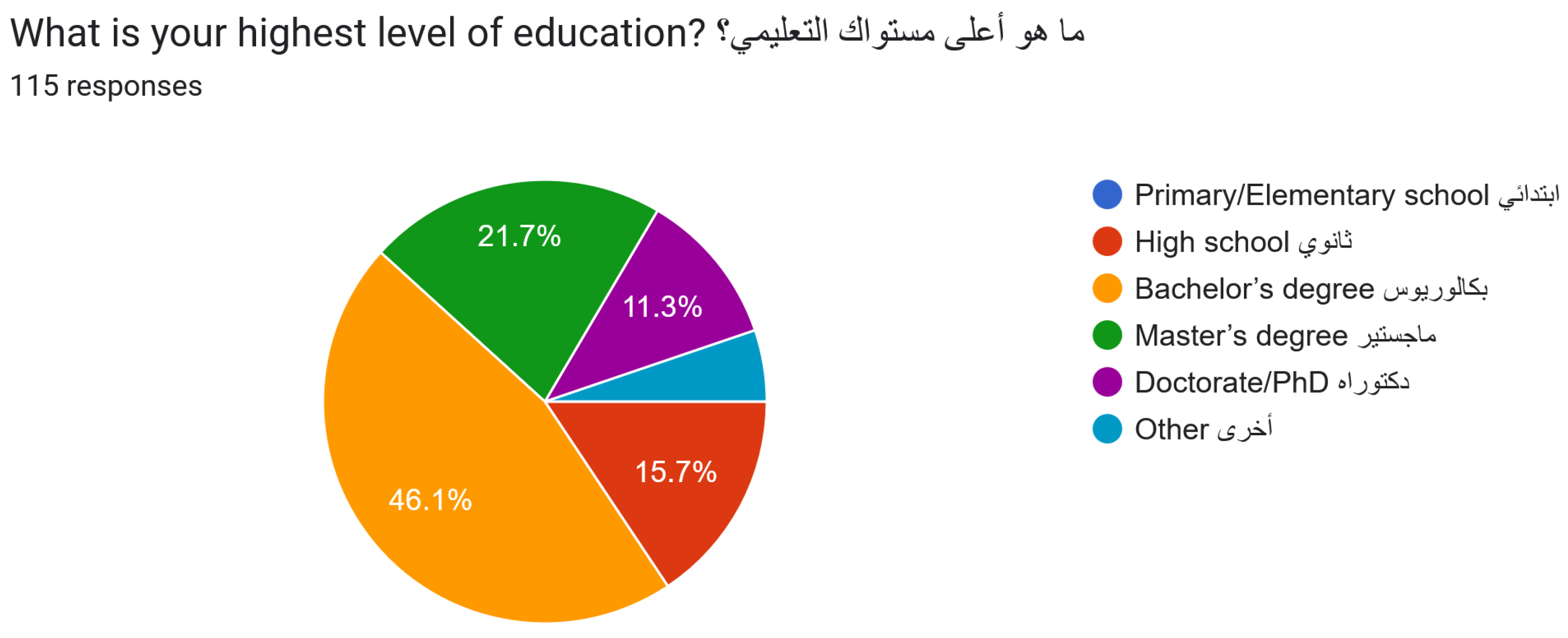
| Q3 | What is your highest level of education? | Primary/Elementary; High school; Bachelor’s; Master’s; Doctorate/PhD; Other |
| Q4 | Which region/country do you live in? | Europe; USA; Canada; Latin America & Caribbean; Middle East/Arab countries; Africa; Asia (excluding Middle East); Oceania; Other |
| Q5 | What is your current occupation/field? | Student; Academic/Researcher; Healthcare; Engineering/Technology; Business/Finance; Education/Teaching; Arts/Media; Government/Public sector; Freelance/Entrepreneur; Law; Non-profit; Other |
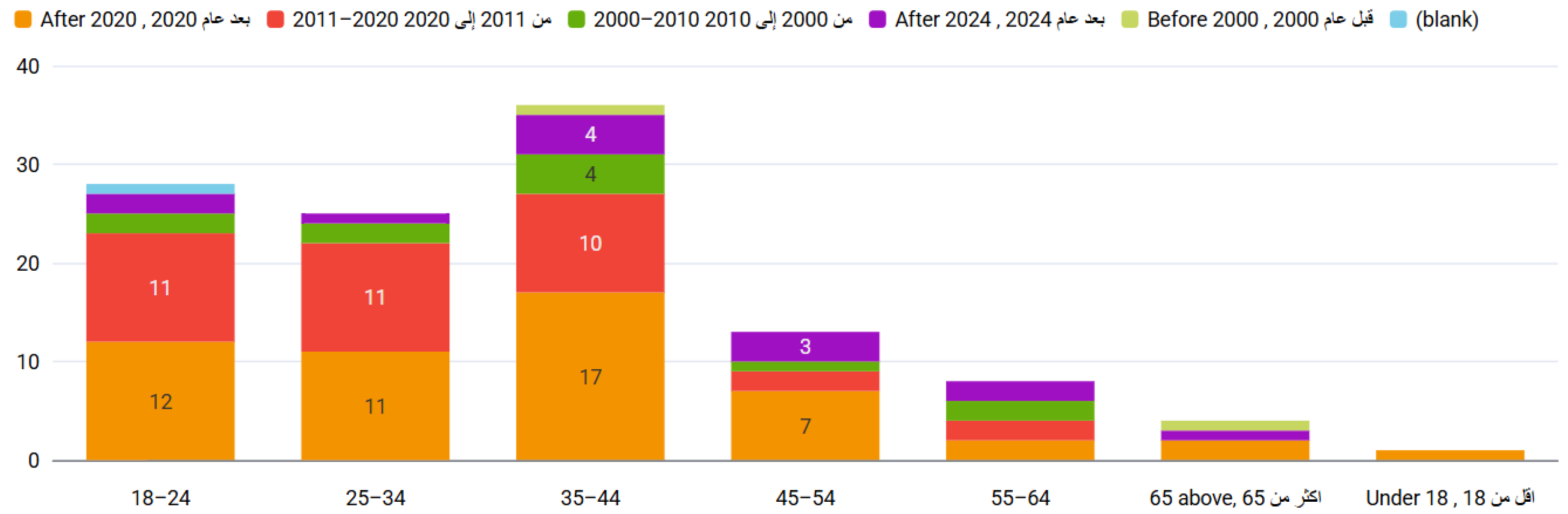
| Q6 | When did you first hear the term “Artificial Intelligence”? | Before 2000; 2000–2010; 2011–2020; After 2020; After 2024 |
| Q7 | Where did you first hear about AI? | School/University; Workplace; News/Articles; Movies/TV; Social media; Friends/Family; Other |
| Q8 | How would you describe your very first impression when you heard about AI? | Open-ended |
| Q9 | How often do you use AI-powered tools today? | Daily; Several times a week; Several times a month; Rarely; Never |
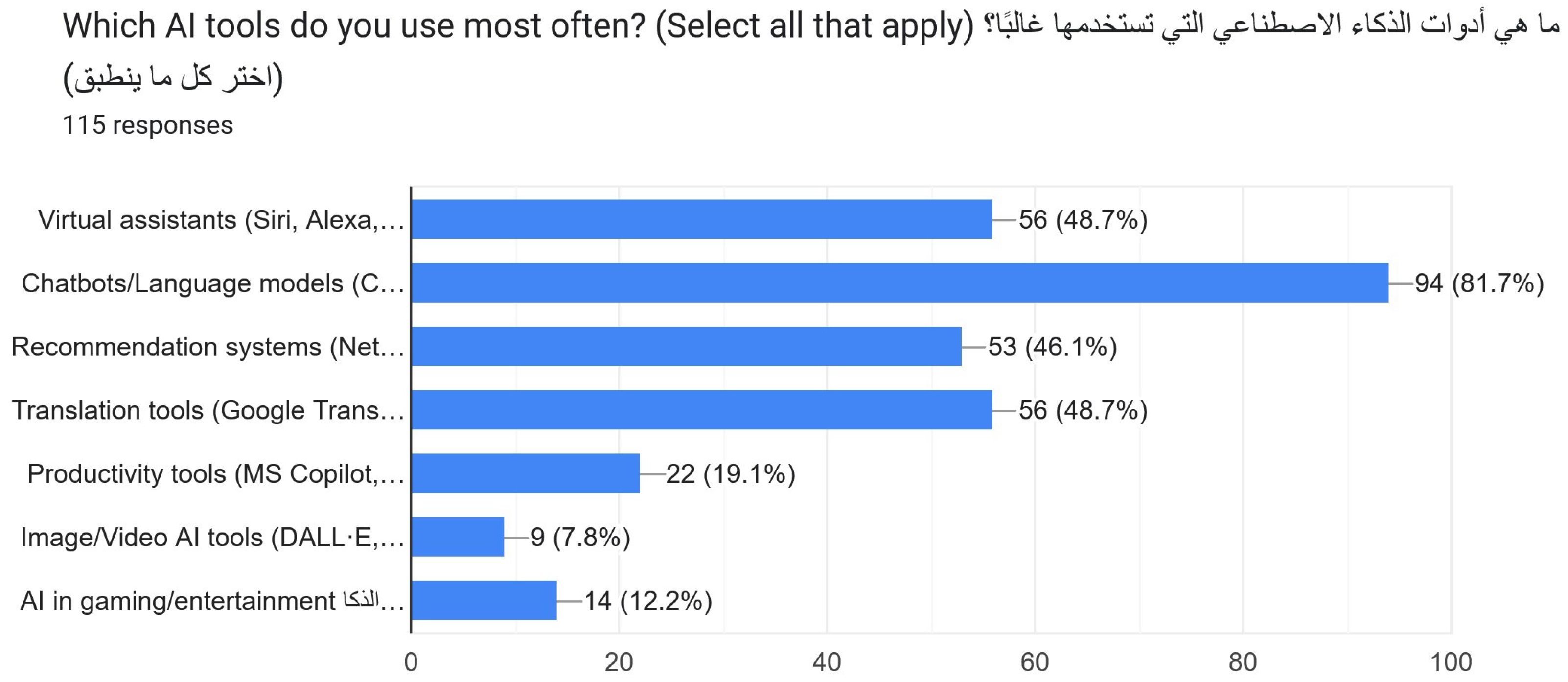
| Q10 | Which AI tools do you use most often? | Virtual assistants (Siri, Alexa, Google Assistant); Chatbots/LLMs (ChatGPT, Gemini, Copilot); Recommendation systems (Netflix, Spotify, Amazon, YouTube); Translation tools (Google Translate, DeepL); Productivity tools (MS Copilot, Grammarly, Excel AI); Image/Video tools; AI in gaming/entertainment; Other |
| Q11 | What is the main reason you use AI tools? | Save time; Improve accuracy; Entertainment; Learning/Education; Work productivity; I do not use AI tools; Other |
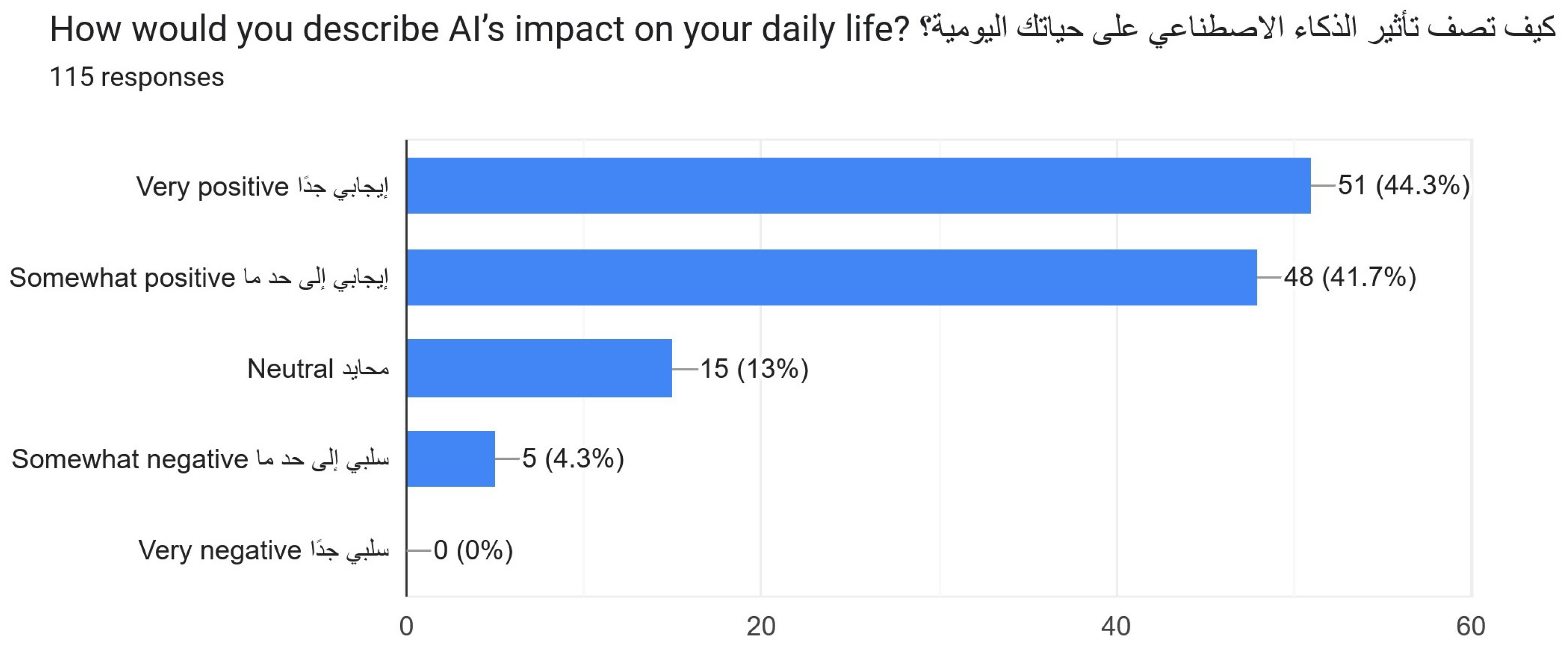
| Q12 | How would you describe AI’s impact on your daily life? | Very positive; Somewhat positive; Neutral; Somewhat negative; Very negative |
| Q13 | In which area do you trust AI the most? | Healthcare; Education; Finance; Transportation; Entertainment; None (I do not trust AI); Other |
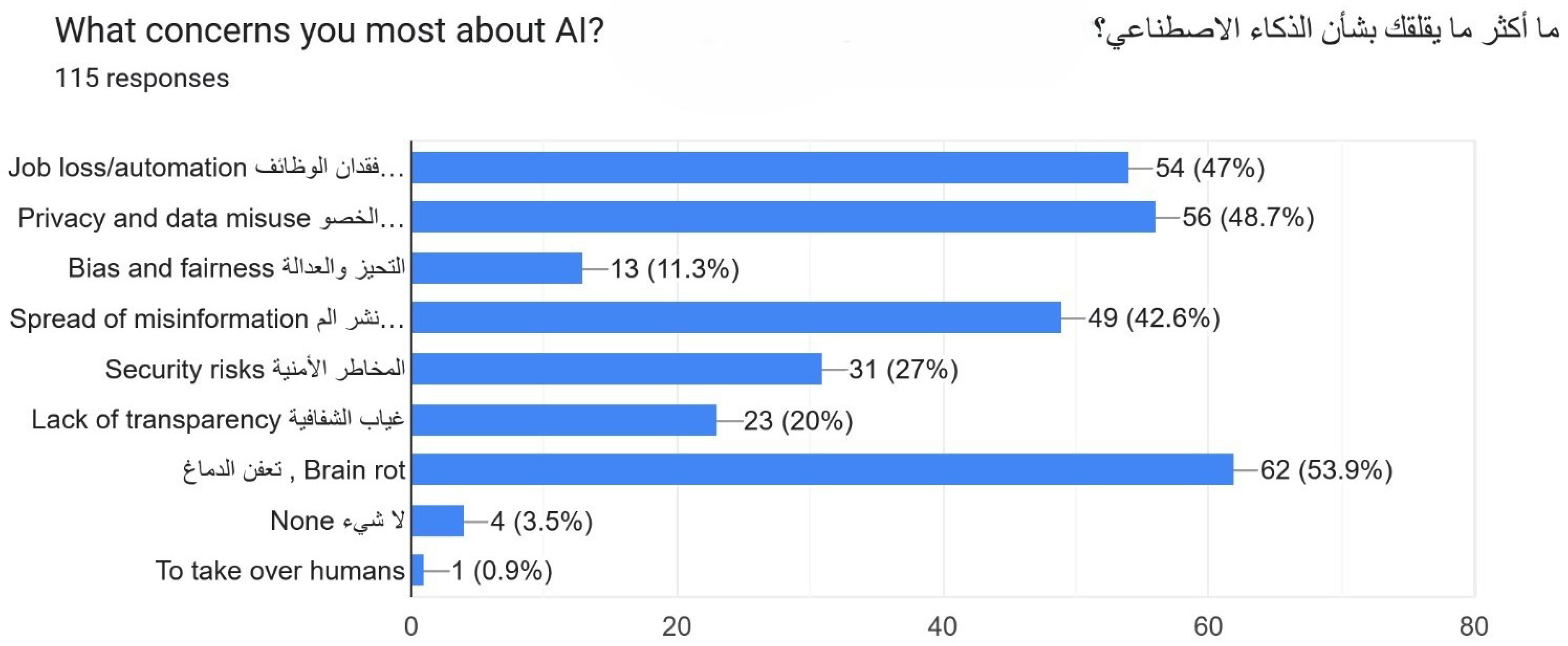
| Q14 | What concerns you most about AI? | Job loss/automation; Privacy and data misuse; Bias and fairness; Misinformation; Security risks; Lack of transparency; Overreliance (“brain rot”) |
| Q15 | Do you feel you fully understand how AI works? | Yes, very well; Somewhat; Basic level only; Not at all |
| Q16 | Do you believe AI will have a positive or negative impact on society in the next 10 years? | Mostly positive; Mostly negative; Unsure |
| Q17 | Do you support stronger regulations on AI development and use? | Yes, absolutely; Yes, but only in certain areas; No (may slow innovation); Not sure |
| Q18 | In your opinion, what is the biggest opportunity AI will bring to humanity? | Open-ended |
| Q19 | What is your biggest fear about AI? | Open-ended |
| Q20 | Do you wish the world had never created AI? | Yes; No; Not sure |
| Q21 | What do you believe will be the next major breakthrough after AI? | Open-ended |
| Q22 | What message would you like to send to scientists and developers building the future of AI? | Open-ended |
| Category | Questions | Analysis Focus |
|---|---|---|
| Demographics | Q1–Q5 | Participant segmentation |
| Awareness & Exposure | Q6–Q8 | First contact with AI |
| Usage | Q9–Q11 | Behavior and motivation |
| Perception & Understanding | Q12, Q15, Q16 | Attitudes and literacy |
| Trust & Regulation | Q13, Q14, Q17 | Risk and governance views |
| Ethical & Emotional Insights | Q18–Q22 | Hopes, fears, advice, reflection |
| No. | Interview Code | Participants/Profile Description |
|---|---|---|
| 1 | INT_PE | Physical Education Coach (UK and Middle East) |
| 2 | INT_SA | Two Professors of Engineering/Academic Researchers |
| 3 | INT_AS | Sophomore Software Engineering Student |
| 4 | INT_SS | Academic Registration and Systems Specialist |
| 5 | INT_FA | Family group composed of parents and adult children |
| 6 | INT_DM | Professor of Management Information Systems (MIS) |
| 7 | INT_FI | Corporate Manager/Parent (Commercial and Cost Control Background) |
| 8 | INT_MA | Professional/Technical Advisor |
| 9 | INT_NA | General Participant (Non-academic, non-technical background) |
| 10 | INT_GM | General Manager |
| 11 | INT_AC | Accountant |
| 12 | INT_AR | Group of Architecture and Design Professionals |
| 13 | INT_ST | Statistician/Data-oriented Professional |
| 14 | INT_NS | Two Network Engineering Students |
| Theme | Approx. Share | Illustrative Quotes |
|---|---|---|
| Amazement and admiration | ∼40% | Impressive; Amazing; It can change everything |
| Curiosity and intellectual interest | ∼22% | Science fiction becoming reality; eager to learn |
| Optimism and perceived progress | ∼18% | Excited; making life easier; new era |
| Fear and moral concern | ∼15% | Scary; replacing humans; double-edged sword |
| Neutral or uncertain | ∼5% | Neutral; strange; hard to understand |
| Variable | p | V | |
|---|---|---|---|
| Q13 (Trust Domain) | 23.99 | 0.004 | 0.186 |
| Q17 (AI Regulation) | 11.47 | 0.245 | 0.182 |
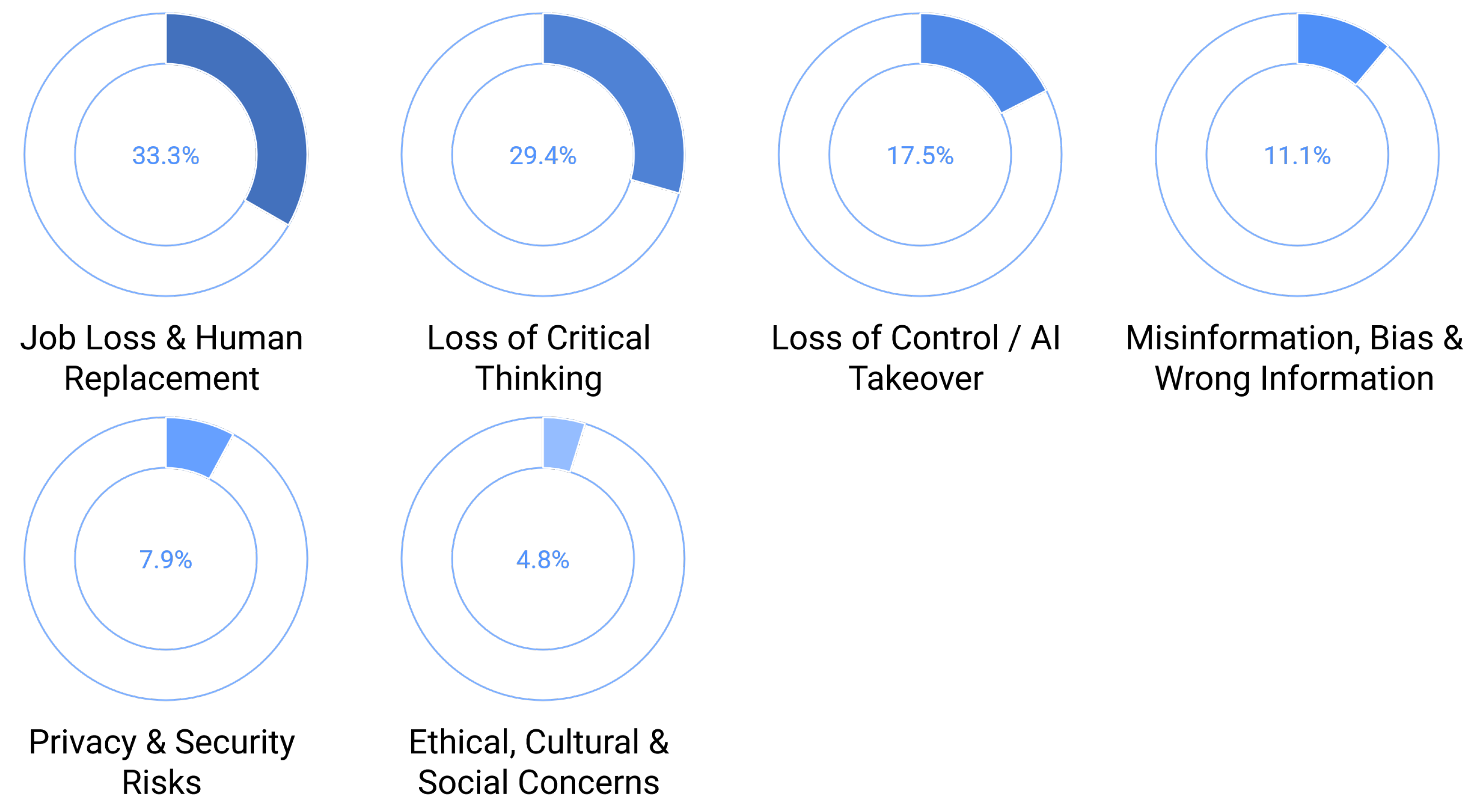
| Cluster | Approx. Share | Illustrative Topics |
|---|---|---|
| Job Loss and Replacement | ∼33% | Job loss; routine jobs disappearing |
| Loss of Critical Thinking | ∼29% | Brain rot; excessive dependency |
| Misinformation and Bias | ∼11% | Fake information; manipulation |
| Loss of Control | ∼17% | AI takeover; systems out of control |
| Privacy and Security | ∼8% | Data leaks; surveillance |
| Ethical and Cultural Concerns | ∼5% | Impact on values; children; spirituality |
Disclaimer/Publisher’s Note: The statements, opinions and data contained in all publications are solely those of the individual author(s) and contributor(s) and not of MDPI and/or the editor(s). MDPI and/or the editor(s) disclaim responsibility for any injury to people or property resulting from any ideas, methods, instructions or products referred to in the content. |
© 2026 by the author. Licensee MDPI, Basel, Switzerland. This article is an open access article distributed under the terms and conditions of the Creative Commons Attribution (CC BY) license.
Share and Cite
Mallouhy, R.E. Between Trust and Risk: Understanding the Conditional Acceptance of Artificial Intelligence. Informatics 2026, 13, 91. https://doi.org/10.3390/informatics13060091
Mallouhy RE. Between Trust and Risk: Understanding the Conditional Acceptance of Artificial Intelligence. Informatics. 2026; 13(6):91. https://doi.org/10.3390/informatics13060091
Chicago/Turabian StyleMallouhy, Roxane Elias. 2026. "Between Trust and Risk: Understanding the Conditional Acceptance of Artificial Intelligence" Informatics 13, no. 6: 91. https://doi.org/10.3390/informatics13060091
APA StyleMallouhy, R. E. (2026). Between Trust and Risk: Understanding the Conditional Acceptance of Artificial Intelligence. Informatics, 13(6), 91. https://doi.org/10.3390/informatics13060091