Article

A Discrete-Form Double-Integration-Enhanced Recurrent Neural Network for Stewart Platform Control with Time-Varying Disturbance Suppression


1
College of Information and Artificial Intelligence, Yangzhou University, Yangzhou 225127, China
2
Jiangsu Province Engineering Research Center of Knowledge Management and Intelligent Service, Yangzhou University, Yangzhou 225127, China
3
School of Physics and Information Engineering, Guangxi Science & Technology Normal University, Laibin 546199, China
*
Author to whom correspondence should be addressed.
Informatics 2026, 13(4), 49; https://doi.org/10.3390/informatics13040049
Submission received: 22 January 2026 / Revised: 17 March 2026 / Accepted: 23 March 2026 / Published: 25 March 2026
(This article belongs to the Section Industry 4.0)

Abstract

The discrete-form control of the Stewart platform is essential for digital implementation in intelligent manufacturing and robotic systems under the context of Industry 4.0, yet its performance is often degraded by unavoidable discrete disturbances. This challenge motivates the development of algorithms with strong disturbance suppression capability. To address this issue, a continuous-form double-integration-enhanced recurrent neural network (CF-DIE-RNN) algorithm incorporating a novel double-integration-enhanced design concept is first developed to improve robustness against time-varying disturbances. For digital hardware applications, a discrete-form double-integration-enhanced RNN (DF-DIE-RNN) algorithm is then constructed by discretizing the CF-DIE-RNN algorithm using a general four-step discretization formula and a one-step forward difference formula based on Taylor expansion. Rigorous theoretical analysis establishes the convergence properties of the proposed algorithm and characterizes its steady-state residual bounds under different disturbance types, revealing its capability to suppress discrete quadratic time-varying disturbances. Numerical and simulation experiments demonstrate that the DF-DIE-RNN algorithm achieves superior disturbance suppression and more accurate trajectory tracking than existing discrete-form RNN algorithms, confirming its effectiveness for discrete-form Stewart platform control.

1. Introduction

The Stewart platform, as a representative parallel robotic mechanism, is characterized by high structural stiffness, strong load-carrying capability, and excellent dynamic responsiveness. Owing to these advantages, it has been widely deployed in applications such as minimally invasive surgery [1], aerospace line-of-sight stabilization [2], and marine exploration process simulation [3]. With the rapid development of Industry 4.0, high-precision parallel platforms such as the Stewart platform play an increasingly important role in intelligent manufacturing and robotic systems operating under complex and uncertain environments. Motivated by these practical demands, extensive research efforts have been devoted to the control of Stewart platforms, covering topics ranging from motion control strategies to high-accuracy trajectory tracking [4,5,6,7]. For example, an observer-based forward kinematic algorithm was proposed for a 6-6 Stewart platform, enabling real-time output feedback control of the platform’s posture without external sensors [5]. A novel adaptive sliding mode fault-tolerant control was proposed for a Stewart platform, achieving robust 6-DOF tracking under actuator faults and uncertainties in [6]. A fault-tolerant control based on nonsingular fast terminal sliding mode and an extended state observer was proposed for a Stewart platform, achieving fast finite-time convergence and robust tracking under disturbances and faults in [7].
Neural networks, owing to their strong nonlinear mapping capability, adaptability, and learning ability, have been widely applied across a variety of domains, including data modeling, pattern recognition, and prediction tasks [8,9,10,11,12,13,14]. Among them, recurrent neural networks (RNNs), which incorporate feedback connections and internal memory, have been extensively employed in dynamic systems, robot control, time-series prediction, and other applications requiring temporal dependency modeling [15,16,17,18,19,20,21]. A complex zeroing neural dynamic (CZND) model has been proposed to optimize inter-robot distances in real time, ensuring follower robots track ideal trajectories, with demonstrated advantages over conventional gradient-based neural networks in handling dynamic behaviors and reducing steady-state errors [18]. Zhang et al. proposed a data-driven distributed recurrent neural network (DDD-RNN) for multimanipulator systems, which enables online estimation of both first- and second-order Jacobian matrices and facilitates accurate collaborative motion generation even when the robot models are unknown [19]. Dai et al. proposed a norm-based zeroing neural dynamic (NBZND) model for time-varying nonlinear equations, which replaces element-wise nonlinear activations with a two-norm operation to achieve finite-time convergence and strong robustness, and further developed a discrete-time version suitable for digital implementation [20]. Despite the demonstrated success of recurrent neural networks in various dynamic and time-dependent applications, they face significant challenges in real-world implementations due to unavoidable disturbances and uncertainties. These disturbances may arise from sensor noise, modeling errors, environmental fluctuations, or discretization effects in digital hardware, all of which can degrade network performance.
To address these challenges, researchers have increasingly focused on developing methods that exhibit strong noise suppression and robust performance in real-world dynamic systems [22,23,24,25,26,27,28,29]. Xiao et al. proposed a noise-resistant zeroing neural network (NNR-ZNN) with a novel power activation function to solve time-varying quaternion generalized Lyapunov equations, achieving fixed-time convergence and strong robustness under various noises, with applications demonstrated in color image fusion and denoising [22]. Kong et al. proposed robust terminal recurrent neural network (RTRNN) models for solving time-varying quadratic programming problems, achieving prespecified-time convergence independent of initial conditions and exhibiting strong robustness against various external noises [26]. Zhang et al. proposed a jump-gain integral recurrent (JGIR) neural network for solving noise-disturbed time-varying nonlinear inequality problems, achieving global convergence, strong robustness, and faster convergence with smaller errors than existing ZNN-based methods, as validated by simulations and manipulator experiments [27].
In addition to neural-network-based approaches, various disturbance suppression strategies have been developed in control systems. For example, an improved equivalent-input-disturbance method integrated with high-order sliding-mode control was proposed to enhance disturbance estimation and compensation in nonlinear repetitive-control systems [30]. Moreover, a robust iterative learning predictive asynchronous switching control strategy was developed to handle disturbances in multi-phase batch processes [31]. Compared with these methods, the present work focuses on disturbance suppression in a discrete neural-dynamics-based framework. Therefore, the main distinction of this study lies not in replacing observer-based, sliding-mode, or iterative-learning strategies but in developing and analyzing an RNN-based discrete-time scheme with enhanced disturbance rejection capability. Nevertheless, from the perspective of RNN-based disturbance suppression, existing algorithms still exhibit limited capability when dealing with more complex disturbance scenarios. On the one hand, some algorithms are capable of handling continuous time-invariant disturbances and linear time-varying disturbances, yet their performance degrades significantly when confronted with more complex continuous nonlinear time-varying disturbances, such as quadratic time-varying disturbances. On the other hand, most existing studies focus primarily on algorithm design and analysis in continuous-time environments, while systematic investigations under discrete-time settings remain relatively limited. As a result, systematic RNN-based discrete-time frameworks that can simultaneously ensure convergence and effectively suppress quadratic time-varying disturbances remain limited. In order to highlight the differences among recently developed RNN algorithms in disturbance suppression capability and implementation frameworks, a systematic comparison is provided in Table 1.
It is worth noting that in practical digital controllers and hardware implementations, systems inherently operate in discrete time, where the effects of discrete time-varying disturbances are more direct and cannot be neglected. Consequently, developing discrete-form RNN algorithms with strong disturbance suppression capability is of both theoretical significance and practical importance. Motivated by these considerations, this paper aims to develop a discrete-form RNN algorithm capable of effectively suppressing discrete time-varying disturbances. In this paper, Section 2 introduces the Stewart platform and formulates its trajectory-tracking control problem, alongside the development of a continuous-form double-integration-enhanced RNN (CF-DIE-RNN) algorithm capable of suppressing quadratic time-varying disturbances. Building upon this, Section 3 presents the discrete-form double-integration-enhanced RNN (DF-DIE-RNN) algorithm and theoretically establishes its performance under discrete quadratic time-varying disturbances. Section 4 validates the theoretical analysis through numerical and simulation experiments, demonstrating the effectiveness and superior disturbance suppression capability of the proposed algorithm. Finally, Section 5 concludes the paper and discusses potential applications and extensions of the method. The main contributions of this paper are presented as follows.
1.
A CF-DIE-RNN algorithm is developed by incorporating a double-integration-enhanced design concept, which enables effective suppression of quadratic time-varying disturbances in Stewart platform trajectory tracking.
2.
Based on the continuous formulation, a DF-DIE-RNN algorithm is constructed for digital implementation using the general four-step ZeaD discretization formula and the one-step difference formula, and rigorous theoretical analysis establishes its convergence and steady-state residual bounds under discrete quadratic time-varying disturbances.

2. Problem Formulation and Continuous-Form RNN Algorithm

This section begins with an introduction to the Stewart platform, followed by the problem formulation of the corresponding control problem. To enhance its disturbance suppression capability, the double-integration-enhanced RNN (DIE-RNN) design concept is then introduced. Then a continuous-form DIE-RNN algorithm is subsequently developed.

2.1. Problem Formulation

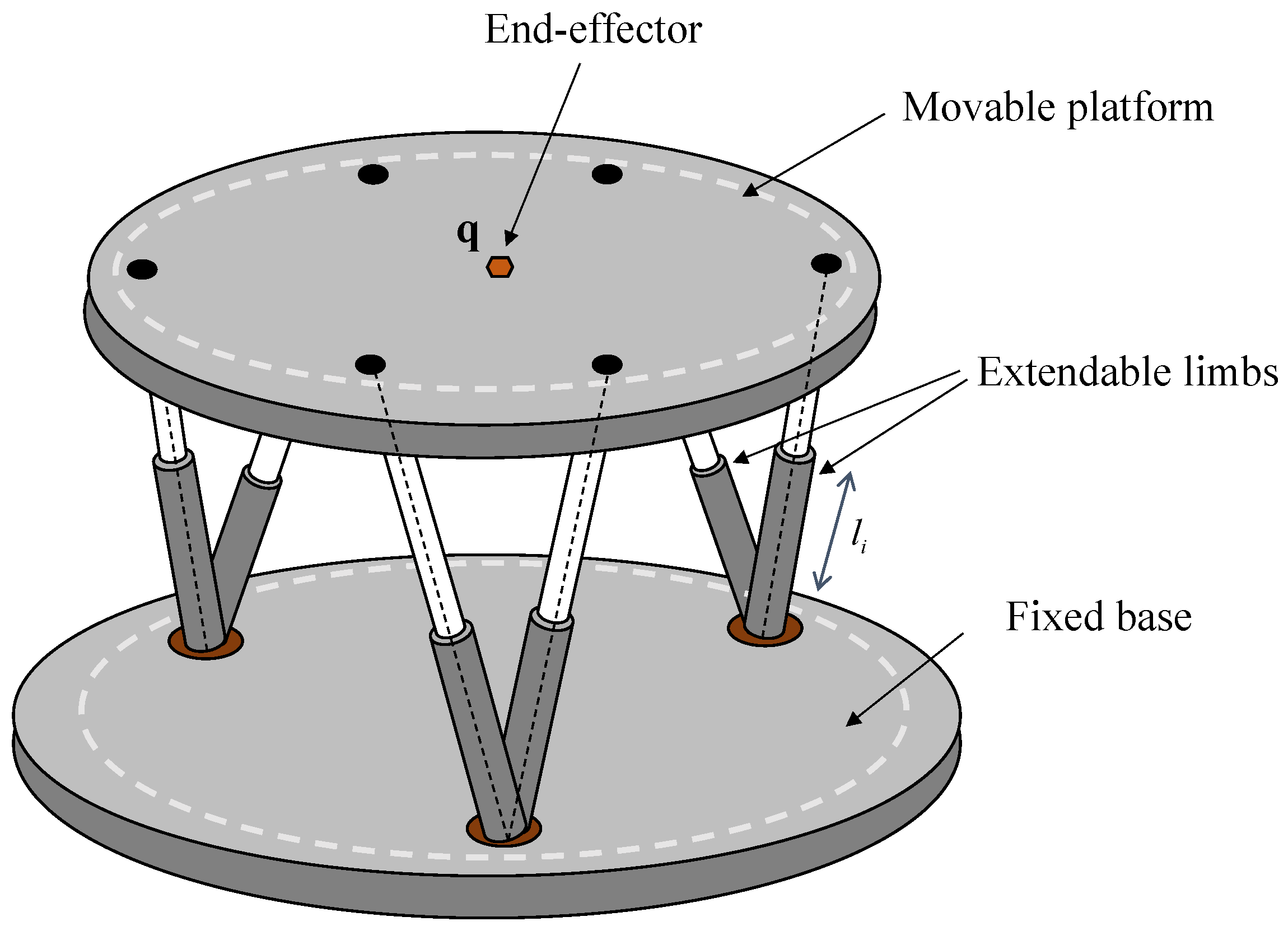
The Stewart platform is a typical parallel mechanical structure consisting of a fixed base and a movable platform, which are connected by six independently extendable limbs. For clarity of subsequent analysis, a control-oriented schematic of the Stewart platform is illustrated in Figure 1, following the standard structural configuration reported in the literature [32]. The center of the movable platform is defined as the end-effector, whose actual position and desired position are denoted by q a and q d , respectively. Let l = l 1 , l 2 , l 3 , l 4 , l 5 , l 6 T represent the lengths of the six limbs. The objective of the Stewart platform tracking control is to compute l ( t k + 1 ) in real time at each discrete sampling interval [ t k , t k + 1 ) [ t 0 , t f ] [ 0 , + ) so that the actual position of the end-effector q a ( t k + 1 ) closely approximates the desired position q d ( t k + 1 ) . Accordingly, the trajectory tracking task can be formulated as solving the following discrete-form time-varying equation:
s ( r k + 1 , t k + 1 ) = q k + 1 a q k + 1 d ,
where s ( r k + 1 , t k + 1 ) denotes the next-step tracking error, and the control objective is to drive
s ( r k + 1 , t k + 1 ) = 0 .
To further analyze the system dynamics and facilitate controller design, the discrete-form time-varying problem can be reformulated in continuous-form as
s ( r ( t ) , t ) = q a ( t ) q d ( t ) .

2.2. CF-DIE-RNN Algorithm

To achieve disturbance suppression, based on previous research [33], the DIE-RNN design concept is introduced and formulated as follows:
d s ( r ( t ) , t ) d t = ξ 1 s ( r ( t ) , t ) ξ 2 0 t s ( r ( σ ) , σ ) d σ ξ 3 0 t d u 0 u s ( r ( σ ) , σ ) d σ ,
where ξ 1 > 0 , ξ 2 > 0 , and ξ 3 > 0 are three design parameters that can affect the convergence of the CF-DIE-RNN algorithm, and σ and u are dummy variables of integration.
Remark 1.
It should be noted that the DIE-RNN design concept is inspired by the work reported in [33]. However, the focus of [33] is mainly on developing RNN algorithms for solving general discrete time-varying equation systems under quadratic time-varying disturbances. In contrast, the present work investigates the trajectory tracking control problem of the Stewart platform, where the discrete time-varying equation arises from the kinematic model of the platform. Furthermore, the proposed algorithm integrates the DIE-RNN design with a general four-step Zhang et al. discretization (ZeaD) formula to construct a discrete-form control algorithm suitable for digital implementation. These aspects distinguish the present study from the existing work in [33].
In addition, when disturbance effects are incorporated, the disturbance-affected DIE-RNN design concept can be reformulated as follows:
d s ( r ( t ) , t ) d t = ξ 1 s ( r ( t ) , t ) ξ 2 0 t s ( r ( σ ) , σ ) d σ ξ 3 0 t d u 0 u s ( r ( σ ) , σ ) d σ + d ( t ) ,
where d ( t ) represents the continuous time-varying disturbance vector.
Based on Equations (3) and (4), the following can be obtained:
q ˙ a ( t ) q ˙ d ( t ) = ξ 1 s ( r ( t ) , t ) ξ 2 0 t s ( r ( σ ) , σ ) d σ ξ 3 0 t d u 0 u s ( r ( σ ) , σ ) d σ ,
which can be expressed as
q ˙ a ( t ) = q ˙ d ( t ) ξ 1 s ( r ( t ) , t ) ξ 2 0 t s ( r ( σ ) , σ ) d σ ξ 3 0 t d u 0 u s ( r ( σ ) , σ ) d σ .
Considering the Stewart platform at the velocity level [32], the kinematic relationship can be expressed as:
l ˙ ( t ) = G ( l ( t ) , H ( t ) ) q ˙ a ( t ) ,
where G ( l ( t ) , H ( t ) ) represents the inverse kinematic coefficient matrix of the Stewart platform, which describes the relationship between the lengths of the six limbs l ( t ) and the coordinate matrix H ( t ) in the global coordinate system.
By combining Equation (7) and kinematic relationship (8), the CF-DIE-RNN algorithm can be obtained as follows:
l ˙ ( t ) = G ( l ( t ) , H ( t ) ) ( q ˙ d ( t ) ξ 1 s ( r ( t ) , t ) ξ 2 0 t s ( r ( σ ) , σ ) d σ ) + G ( l ( t ) , H ( t ) ) ( ξ 3 0 t d u 0 u s ( r ( σ ) , σ ) d σ ) .

3. DF-DIE-RNN Algorithm and Theoretical Analyses

In this section, the general four-step ZeaD formula and a one-step forward difference formula based on Taylor expansion are first introduced. Building upon these formulations, the DF-DIE-RNN algorithm is then developed. A series of theoretical analyses are subsequently conducted to demonstrate the convergence and disturbance suppression capabilities of the DF-DIE-RNN algorithm. Finally, the discrete-form singular-integration-enhanced RNN (DF-SIE-RNN) and discrete-form classical RNN (DF-C-RNN) algorithms are presented for comparative evaluation.

3.1. Discretization Formulas

Based on the previous study [34], the general four-step ZeaD formula is presented as follows:
x ˙ k = 1 g ( γ + 1 3 ) x k + 1 + 1 g ( 4 γ + 1 2 ) x k + 1 g ( 6 γ 1 ) x k 1 + 1 g ( 4 γ + 1 6 ) x k 2 + γ g x k 3 + O ( g 3 ) .
Here, g represents the sampling interval, while γ is a selection parameter. It is known that the truncation error of the general four-step ZeaD formula is O ( g 3 ) for γ ( 1 / 12 , 1 / 6 ) . Rearranging Equation (10) yields the following explicit update form for the next-step state:
x k + 1 = 3 3 γ + 1 x ˙ k + 24 γ 3 6 γ + 2 x k + ( 18 γ 3 ) 3 γ + 1 x k 1 + 24 γ 1 6 γ + 2 x k 2 + 3 γ 3 γ + 1 x k 3 + O ( g 4 ) .
As shown in (11), x k + 1 is not directly used as known future information. Instead, it is recursively computed from the currently available quantities x ˙ k , x k , x k 1 , x k 2 , and x k 3 .
Based on a previous study [33], a novel one-step forward difference formula is presented as follows:
x ¨ k = 11 12 g 2 x k + 1 5 3 g 2 x k + 1 2 g 2 x k 1 + 1 3 g 2 x k 2 1 12 g 2 x k 3 + O ( g 3 ) ,
where x ¨ k represents the second derivative of x k . It is worth noting that this discretization formula is derived based on Taylor expansion, and its truncation error is of order O ( g 3 ) .

3.2. DF-DIE-RNN Algorithm

By applying the general four-step ZeaD formula (10) to discretize the CF-DIE-RNN algorithm (9), the following DF-DIE-RNN algorithm is obtained:
l k + 1 = 3 3 γ + 1 G ( l k , H k ) g ( q ˙ k d ξ 1 ( s ( r k , t k ) ) ) + 3 3 γ + 1 G ( l k , H k ) g ( ξ 2 m k ξ 3 n k ) + 24 γ 3 6 γ + 2 l k + ( 18 γ 3 ) 3 γ + 1 l k 1 + 24 γ 1 6 γ + 2 l k 2 + 3 γ 3 γ + 1 l k 3 .
The above equation neglects the O ( g 4 ) term. Here, m k and n k denote the discrete counterparts of the single integral term and the double integral term in Equation (9), respectively. It should be noted that the proposed algorithm does not require the exact disturbance information to be known in advance. Instead, disturbance suppression is achieved through the designed double-integration-enhanced error dynamics. Specifically, the single-integral term accumulates past errors to reduce steady-state error and improve robustness against persistent disturbances, while the introduced double-integral term provides an additional level of error accumulation to further enhance the suppression of more complex time-varying disturbances, especially quadratic time-varying disturbances. This additional double-integral term constitutes the key structural innovation of the proposed algorithm. They can be approximately computed as shown below.
By using discretization formula (10) to compute the single integral term m k , the result can be approximately obtained as follows:
m ( r k + 1 , t k + 1 ) = 3 3 γ + 1 g s ( r k , t k ) + 24 γ 3 6 γ + 2 m ( r k , t k ) + ( 18 γ 3 ) 3 γ + 1 m ( r k 1 , t k 1 ) + 24 γ 1 6 γ + 2 m ( r k 2 , t k 2 ) + 3 γ 3 γ + 1 m ( r k 3 , t k 3 ) + O ( g 4 ) .
By using discretization formula (12) to compute the double integral term n k , the result can be approximately obtained as follows:
n ( r k + 1 , t k + 1 ) = 12 g 2 11 s ( r k , t k ) + 20 11 n ( r k , t k ) 6 11 n ( r k 1 , t k 1 ) 4 11 n ( r k 2 , t k 2 ) + 1 11 n ( r k 3 , t k 3 ) + O ( g 5 ) .
Based on the kinematic Equation (8), it is assumed that the pseudo-inverse of G ( l k , H k ) exists and can be computed throughout the task execution. Consequently, the following expression is derived:
q ˙ k a = G + ( l k , H k ) l ˙ k .
Using the general four-step ZeaD formula (10), the discrete update of (16) is given by:
q k + 1 a = 3 3 γ + 1 g G + ( l k , H k ) l ˙ k + 24 γ 3 6 γ + 2 q k a + ( 18 γ 3 ) 3 γ + 1 q k 1 a + 24 γ 1 6 γ + 2 q k 2 a + 3 γ 3 γ + 1 q k 3 a + O ( g 4 ) .

3.3. Theoretical Analyses

Theorem 1.
If γ ( 1 / 12 , 1 / 6 ) , then the proposed DF-DIE-RNN algorithm (13) is zero-stable.
Proof. 
The characteristic polynomial of Equation (13) is
ϕ ( θ ) = ( γ + 1 3 ) θ 4 + ( 4 γ + 1 2 ) θ 3 + ( 6 γ 1 ) θ 2 + ( 4 γ + 1 6 ) θ + γ .
According to previous studies [29,34], when γ > 1 / 12 and γ < 1 / 6 , all roots of ϕ ( θ ) = 0 satisfy | θ | 1 , and | θ | = 1 is a simple root. Therefore, the proposed DF-DIE-RNN algorithm (13) is zero-stable. □
Theorem 2.
If γ ( 1 / 12 , 1 / 6 ) , then the proposed DF-DIE-RNN algorithm (13) is consistent and convergent with a truncation error of order O ( g 4 ) .
Proof. 
Equation (13) can be rewritten as follows:
l k + 1 = 3 3 γ + 1 G ( l k , H k ) g ( q ˙ k d ξ 1 ( s ( r k , t k ) ) ) + 3 3 γ + 1 g G ( l k , H k ) ( ξ 2 m k ξ 3 n k ) + 24 γ 3 6 γ + 2 l k + ( 18 γ 3 ) 3 γ + 1 l k 1 + 24 γ 1 6 γ + 2 l k 2 + 3 γ 3 γ + 1 l k 3 + O ( g 4 ) .
It is evident that the truncation error of the DF-DIE-RNN algorithm is O ( g 4 ) . In addition, the truncation error of the single-integral approximation (14) is of order
m ( r k + 1 , t k + 1 ) = 3 3 γ + 1 g s ( r k , t k ) + 24 γ 3 6 γ + 2 m ( r k , t k ) + ( 18 γ 3 ) 3 γ + 1 m ( r k 1 , t k 1 ) + 24 γ 1 6 γ + 2 m ( r k 2 , t k 2 ) + 3 γ 3 γ + 1 m ( r k 3 , t k 3 ) + O ( g 4 ) .
The truncation error of the double-integral approximation is of order (15) O ( g 5 ) , as shown below:
n ( r k + 1 , t k + 1 ) = 12 g 2 11 s ( r k , t k ) + 20 11 n ( r k , t k ) 6 11 n ( r k 1 , t k 1 ) 4 11 n ( r k 2 , t k 2 ) + 1 11 n ( r k 3 , t k 3 ) + O ( g 5 ) .
Since O ( g 5 ) is of higher order and can be subsumed into O ( g 4 ) in the overall truncation error analysis, it follows that the truncation error of the DF-DIE-RNN algorithm (13) is of order O ( g 4 ) . The proof is thus completed. □
In addition, when disturbance effects are incorporated, the disturbance-affected DF-DIE-RNN algorithm (13) can be reformulated as follows:
l k + 1 = 3 3 γ + 1 G ( l k , H k ) g ( q ˙ k d ξ 1 ( s ( r k , t k ) ) ) + 3 3 γ + 1 G ( l k , H k ) g ( ξ 2 m k ξ 3 n k ) + 24 γ 3 6 γ + 2 l k + ( 18 γ 3 ) 3 γ + 1 l k 1 + 24 γ 1 6 γ + 2 l k 2 + 3 γ 3 γ + 1 l k 3 + d k ,
where d k represents the discrete time-varying disturbance vector. The following theoretical analysis demonstrates the noise suppression capability of the DF-DIE-RNN algorithm (13) under different discrete time-varying disturbances.
Theorem 3.
If the disturbance d k is a discrete linear time-varying disturbance of the form d k = α t k + β R 3 , or a discrete constant time-invariant disturbance of the form d k = β R 3 , then the DF-DIE-RNN algorithm (13) converges to the theoretical solution with a residual error on the order of O ( g 4 ) .
Proof. 
The DF-DIE-RNN algorithm (13) is obtained by applying discretization formulas (10) and (12) to discretize the CF-DIE-RNN algorithm (9), it can be obtained that lim k sup E ( t k + 1 ) F = 0 + O ( g 4 ) = O ( g 4 ) . Thus, under discrete linear time-varying disturbance and discrete constant disturbance, the DF-DIE-RNN algorithm (13) converges with a residual error on the order of O ( g 4 ) . □
Theorem 4.
If the disturbance d k is a discrete quadratic time-varying disturbance of the form d k = α t k 2 + β R 3 , then the DF-DIE-RNN algorithm (13) converges to the theoretical solution with a residual error E ( t k + 1 ) . Moreover, E ( t k + 1 ) is positively correlated with the disturbance parameter α and negatively correlated with the design parameter ξ 3 .
Proof. 
Under discrete quadratic time-varying disturbance described by d k = α t k 2 + β R 3 , existing results in [33] show that the CF-DIE-RNN algorithm (9) admits a bounded steady-state error satisfying lim k sup E ( t k + 1 ) F = 2 α 2 ξ 3 . When implemented in a discrete-time framework, the DF-DIE-RNN algorithm (13) preserves the above convergence property, while an additional discretization-induced term arises due to numerical approximation. Consequently, the residual error obeys lim k sup E ( t k + 1 ) F = 2 α 2 ξ 3 + O ( g 4 ) . This bound indicates that the steady-state performance of the DF-DIE-RNN algorithm (13) is jointly determined by the disturbance parameter α and the design parameter ξ 3 , whereas the high-order term O ( g 4 ) reflects the influence of discretization. In practical scenarios where the disturbance-induced component 2 α 2 ξ 3 dominates the discretization effect, the contribution of O ( g 4 ) becomes negligible and may not be explicitly observable in numerical results. The proof is thus completed. □

3.4. Other Algorithms

In this subsection, two conventional DF-RNN algorithms are presented for comparison. First, the DF-SIE-RNN algorithm is presented as follows:
l k + 1 = 3 3 γ + 1 G ( l k , H k ) g ( q ˙ k d ξ 1 ( s ( r k , t k ) ) ) + 3 3 γ + 1 g G ( l k , H k ) ( ξ 2 m k ) + 24 γ 3 6 γ + 2 l k + ( 18 γ 3 ) 3 γ + 1 l k 1 + 24 γ 1 6 γ + 2 l k 2 + 3 γ 3 γ + 1 l k 3 + O ( g 4 ) ,
where
m ( r k + 1 , t k + 1 ) = 3 3 γ + 1 g s ( r k , t k ) + 24 γ 3 6 γ + 2 m ( r k , t k ) + ( 18 γ 3 ) 3 γ + 1 m ( r k 1 , t k 1 ) + 24 γ 1 6 γ + 2 m ( r k 2 , t k 2 ) + 3 γ 3 γ + 1 m ( r k 3 , t k 3 ) + O ( g 4 ) .
In addition, the DF-C-RNN algorithm is presented as follows:
l k + 1 = 3 3 γ + 1 G ( l k , H k ) g ( q ˙ k d ξ 1 ( s ( r k , t k ) ) ) + 24 γ 3 6 γ + 2 l k + ( 18 γ 3 ) 3 γ + 1 l k 1 + 24 γ 1 6 γ + 2 l k 2 + 3 γ 3 γ + 1 l k 3 + O ( g 4 ) .
Remark 2.
In summary, the two conventional discrete-form RNN algorithms, i.e., the DF-SIE-RNN algorithm (23) and DF-C-RNN algorithm (25), are presented here for tracking control of the Stewart platform. Among them, the DF-C-RNN algorithm (25) has been widely used, whereas the DF-SIE-RNN algorithm (23) is a recently proposed novel approach. Both algorithms can converge to the theoretical solution with corresponding residual error when applied to discrete-form control of the Stewart platform. It should be noted that the DF-SIE-RNN algorithm (23) also possesses certain discrete time-varying disturbance suppression capability.

4. Real-Time Tracking Experiments and Performance Evaluation

In the preceding sections, the proposed DF-DIE-RNN algorithm (13) with enhanced disturbance suppression capability was proposed, and its effectiveness was theoretically analyzed and validated. In addition, two conventional discrete-form RNN algorithms were presented for comparison purposes. To further verify the theoretical findings, a series of numerical simulations and real-time tracking experiments are conducted in this section.

4.1. Example 1

The three-dimensional coordinate expression of the desired path is as follows:
x = 1 / 3 sin ( 1 / 15 ) π t k cos ( 1 / 5 ) π t k y = 1 / 5 cos ( 1 / 15 ) π t k sin ( 1 / 5 ) π t k z = 2 + sin ( 1 / 9 ) π t k .
To evaluate the effectiveness and disturbance suppression capability of the proposed DF-DIE-RNN algorithm (13), a series of numerical experiments were conducted under different conditions. The selection parameter γ was set to 1 / 11 , and the results were compared with those obtained using the DF-SIE-RNN (23) and DF-C-RNN (25) algorithms. In the experimental figures, the residual error is defined as the Euclidean norm of the three-dimensional tracking error vector, i.e., s ( r k + 1 , t k + 1 ) 2 , rather than the componentwise errors along the three coordinate directions.
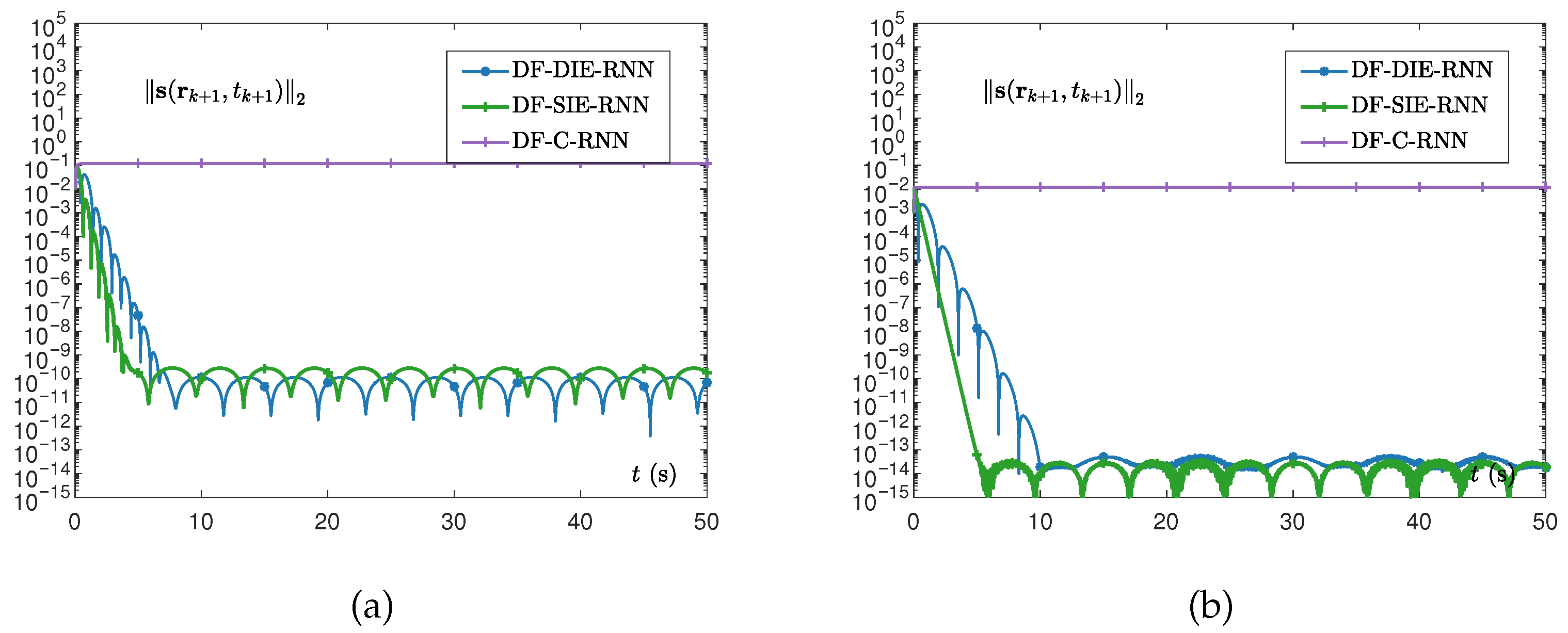
First, the performance of the three RNN algorithms was examined under discrete constant time-invariant disturbance d k = c R 3 , as depicted in Figure 2. As shown in Figure 2, all three algorithms achieved convergence under different sampling intervals. However, the residual errors produced by the DF-DIE-RNN algorithm (13) were nearly comparable to those of the DF-SIE-RNN algorithm (23) and consistently smaller than those of the DF-C-RNN algorithm (25). Specifically, when g = 0.01 , the residual error of the DF-DIE-RNN algorithm (13) is on the order of O ( g 10 ) , and when g = 0.001 , it decreases to O ( g 14 ) . Furthermore, the maximum steady-state residual error of the DF-DIE-RNN algorithm (13) varies on the order of O ( g 4 ) , which is consistent with the theoretical analysis.
Next, the experimental results of the three RNN algorithms under discrete linear time-varying disturbance d k = α t k + β R 3 were illustrated in Figure 3. As observed from Figure 3, the residual error of the DF-DIE-RNN algorithm (13) rapidly converged to zero under different sampling intervals. Under the same sampling interval, the residual error generated by the DF-DIE-RNN algorithm (13) was significantly smaller than those of the DF-SIE-RNN (23) and DF-C-RNN (25) algorithms. These results clearly demonstrate the effectiveness and robustness of the DF-DIE-RNN algorithm (13) when dealing with discrete linear time-varying disturbances.
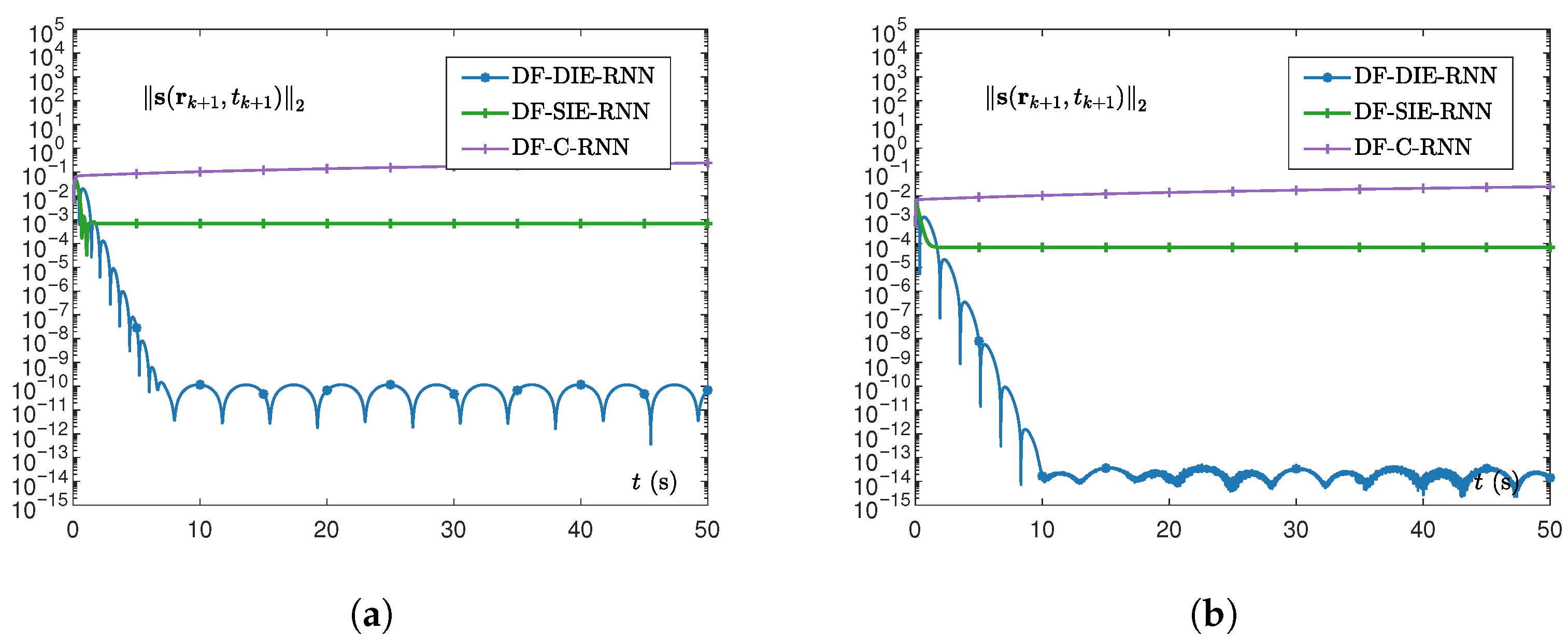
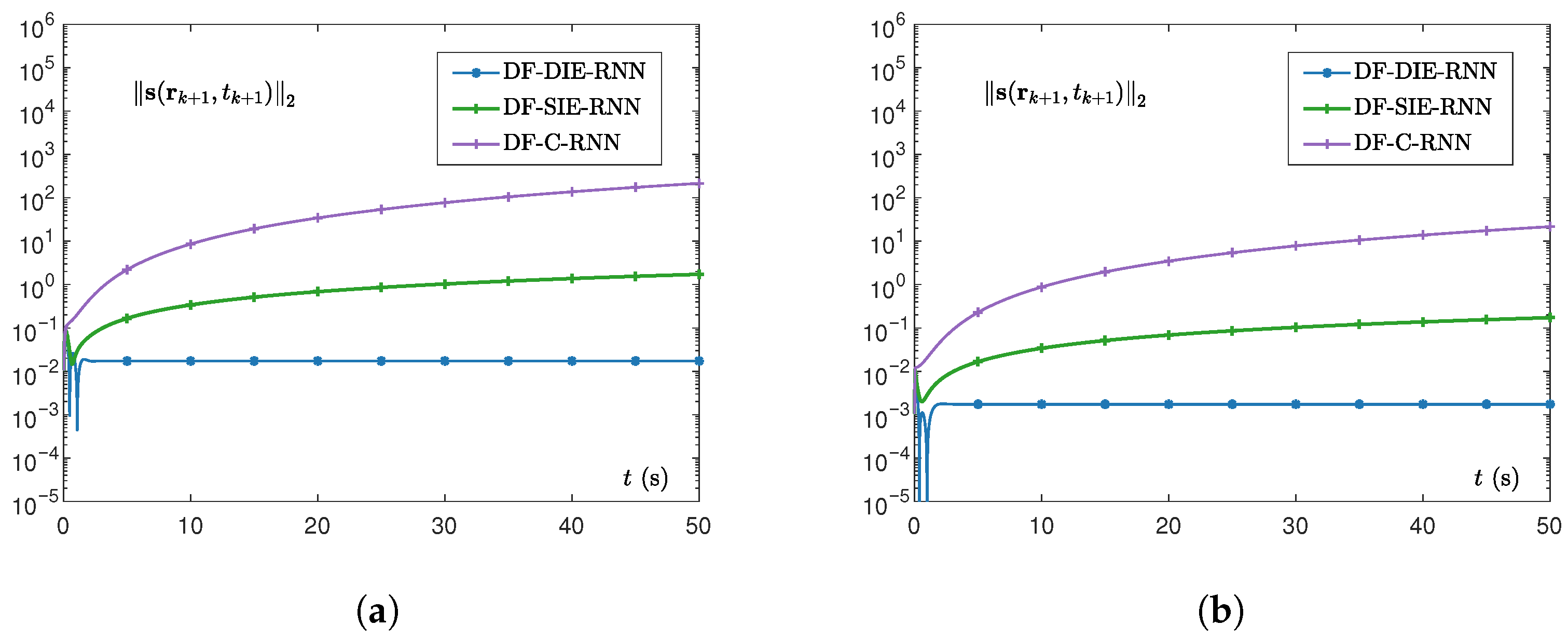
Finally, the residual errors of the three algorithms under discrete quadratic time-varying disturbance d k = α t k 2 + β R 3 were illustrated in Figure 4. As shown in Figure 4, only the residual error of the DF-DIE-RNN algorithm (13) exhibited a clear tendency toward stability as time increases, indicating its superior capability in suppressing discrete quadratic time-varying disturbance. In contrast, the residual errors of the other two algorithms increased over time, suggesting that they are less effective in suppressing such disturbance. These observations clearly verify the superior disturbance suppression capability of the proposed DF-DIE-RNN algorithm (13) under highly time-varying disturbances.

4.2. Example 2

The three-dimensional coordinate expression of the desired path is as follows:
x = sin ( ( 1 / 5 ) π t k ) + 9 / 10 cos ( ( 2 / 5 ) π t k ) y = cos ( ( 1 / 5 ) π t k ) + 9 / 10 sin ( ( 2 / 5 ) π t k ) z = 2 + 1 / 2 cos ( ( 3 / 5 ) π t k ) .
To further investigate the effectiveness and robustness of the DF-DIE-RNN algorithm (13), DF-SIE-RNN algorithm (23), and DF-C-RNN algorithm (25) under different disturbance conditions, a series of simulation experiments were conducted. The selection parameter γ was set to 1 / 11 .
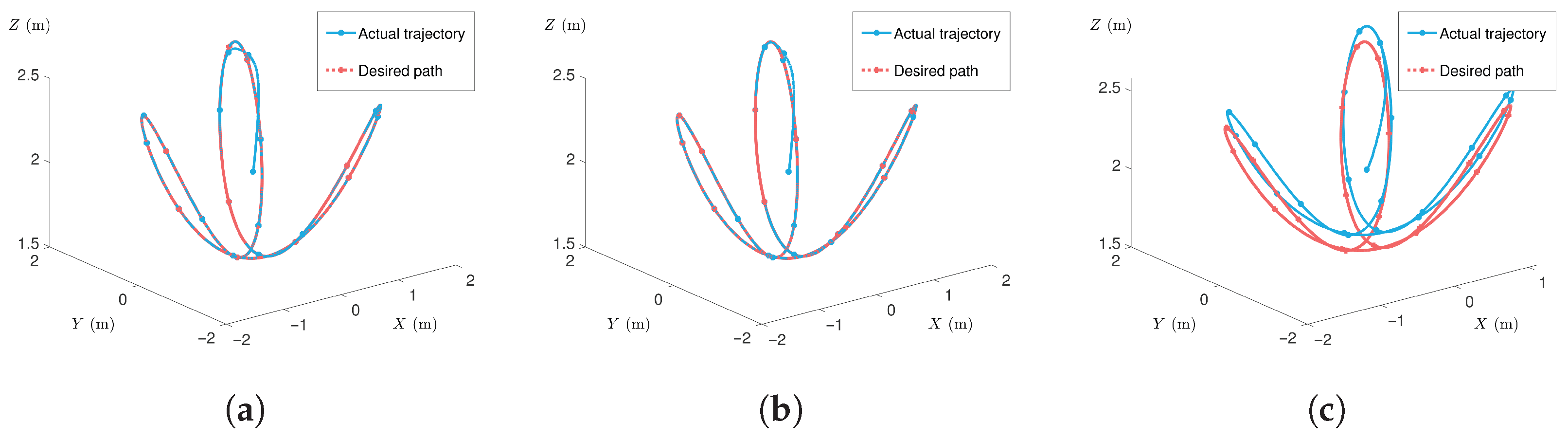
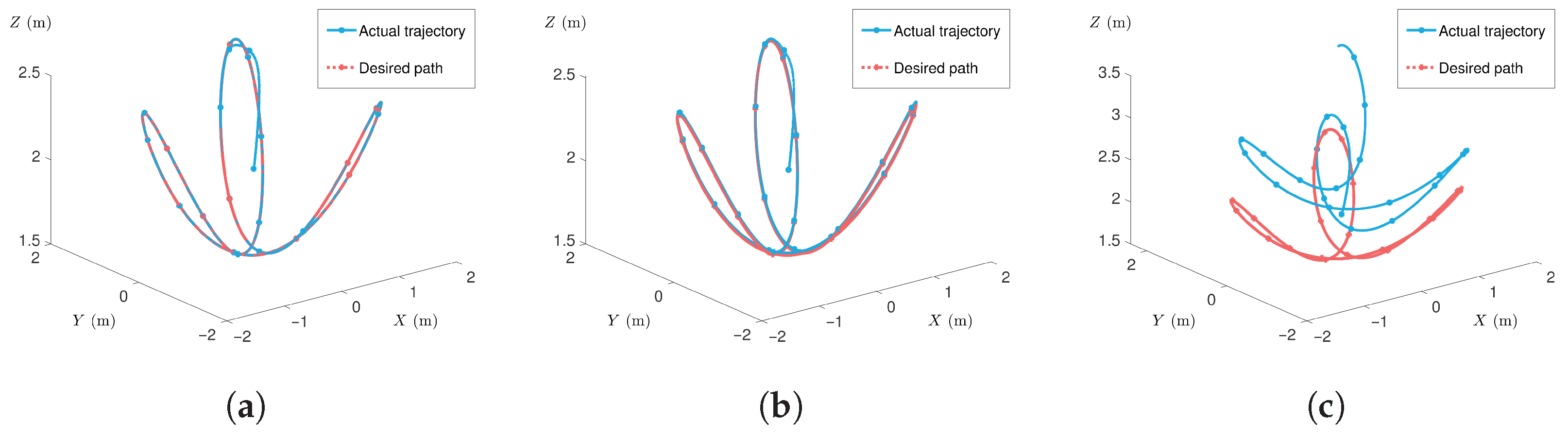
First, a discrete constant time-invariant disturbance d k = c R 3 was considered, and the corresponding trajectory tracking results are shown in Figure 5, where the blue curves represent the actual trajectories and the red curves denote the desired paths. As illustrated in Figure 5a, the DF-DIE-RNN algorithm (13) maintains accurate trajectory tracking, with the actual trajectory closely matching the desired path. Similarly, as shown in Figure 5b, the DF-SIE-RNN algorithm (23) also achieves satisfactory tracking performance under constant disturbance. In contrast, the DF-C-RNN algorithm (25) exhibits noticeable tracking deviations in Figure 5c, indicating its limited disturbance suppression capability even in the presence of discrete constant time-invariant disturbance.
Next, a discrete linear time-varying disturbance d k = α t k + β R 3 was introduced, and the results are presented in Figure 6. In Figure 6a, the DF-DIE-RNN algorithm (13) again achieves high tracking accuracy, with the actual trajectory tightly matching the desired path. In Figure 6b, the DF-SIE-RNN algorithm (23) was also able to follow the desired path under this disturbance. However, the DF-C-RNN algorithm (25) shows visible deviations in Figure 6c, demonstrating its limited capability in suppressing discrete linear time-varying disturbances.
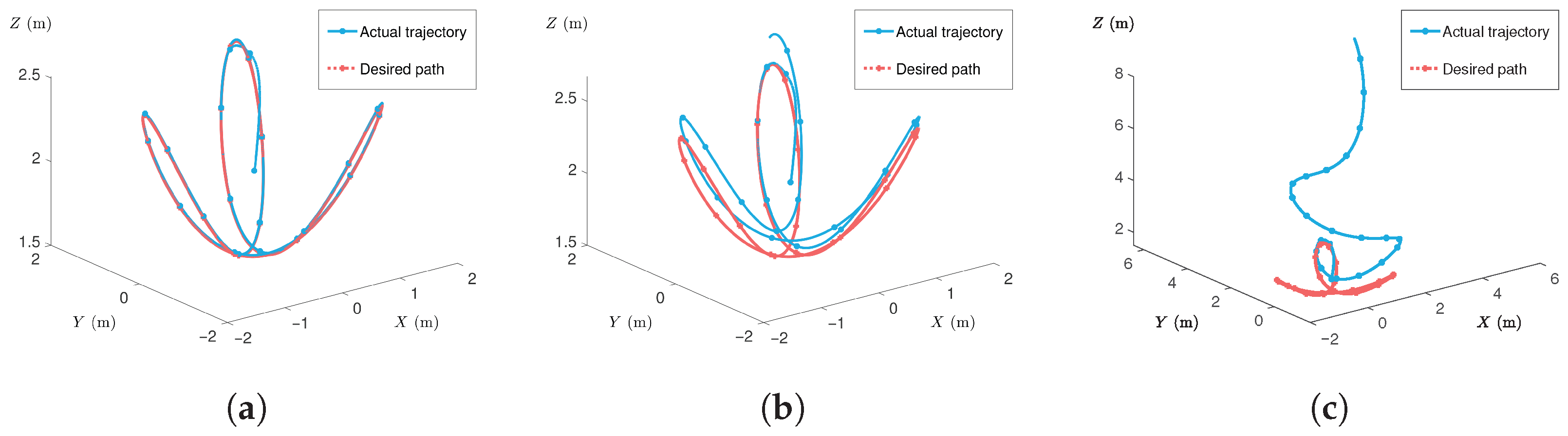
Finally, a discrete quadratic time-varying disturbance was applied, and the actual trajectories and desired paths obtained by the three algorithms are illustrated in Figure 7. As shown in Figure 7a, the trajectory generated by the DF-DIE-RNN algorithm (13) closely follows the desired path, indicating effective suppression of discrete quadratic time-varying disturbances. In contrast, the DF-SIE-RNN algorithm (23) exhibits noticeable deviations, as illustrated in Figure 7b, while the DF-C-RNN algorithm failed to maintain accurate tracking and produced severe deviations in Figure 7c. These observations indicate that only the DF-DIE-RNN algorithm can effectively suppress discrete quadratic time-varying disturbances.
Overall, the simulation results under different disturbance conditions clearly demonstrate the distinct disturbance suppression capabilities of the three algorithms. Under discrete constant time-invariant disturbances, both DF-DIE-RNN algorithm (13) and DF-SIE-RNN algorithm (23) were able to maintain satisfactory trajectory tracking performance, whereas the DF-C-RNN algorithm (25) exhibits noticeable tracking deviations, indicating limited robustness. When discrete linear time-varying disturbances are introduced, the DF-DIE-RNN algorithm (13) continues to achieve high tracking accuracy, and the DF-SIE-RNN algorithm (23) remains effective, while the DF-C-RNN algorithm (25) showed degraded performance. In the presence of discrete quadratic time-varying disturbances, only the DF-DIE-RNN algorithm (13) was capable of accurately following the desired trajectory, whereas the DF-SIE-RNN algorithm (23) suffered from significant deviations and the DF-C-RNN algorithm (25) failed to maintain stable tracking.
These results indicate that the DF-DIE-RNN algorithm (13) exhibits the strongest disturbance suppression capability among the three algorithms, particularly for discrete quadratic time-varying disturbances, which is consistent with the theoretical analysis presented earlier.

5. Conclusions

This paper proposes a DF-DIE-RNN algorithm (13) with strong disturbance suppression capability for discrete-form Stewart platform control. By incorporating the double-integration-enhanced design concept, a CF-DIE-RNN algorithm (9) is constructed, which also facilitates theoretical analysis. Subsequently, the continuous-form algorithm is discretized using a general four-step ZeaD discretization formula together with a one-step forward difference formula based on Taylor expansion, leading to the DF-DIE-RNN algorithm (13) suitable for digital implementation. Rigorous theoretical analysis is conducted to establish the convergence properties of the proposed DF-DIE-RNN algorithm (13) and to characterize its disturbance suppression performance under various discrete time-varying disturbance conditions. Finally, numerical and simulation experiments are performed to validate the theoretical results and to demonstrate the superiority of the proposed algorithm in terms of disturbance suppression and trajectory tracking accuracy, highlighting its potential for high-precision motion control tasks in intelligent manufacturing and robotic systems aligned with the requirements of Industry 4.0. Although the proposed algorithm demonstrates promising performance in disturbance suppression and trajectory tracking, several challenges still remain. For instance, extending the proposed algorithm to more complex disturbance environments and large-scale parallel robotic systems deserves further investigation. In addition, integrating the proposed algorithm with real-time hardware platforms and conducting experimental validation on physical Stewart platforms will constitute important directions for future research.

Author Contributions

Conceptualization, Y.M. and Y.S.; methodology, Y.M., Y.S. and C.J.; validation, Y.M., Y.S. and C.J.; formal analysis, Y.M.; investigation, Y.M.; resources, Y.S. and C.J.; data curation, Y.M.; writing—original draft preparation, Y.M.; writing—review and editing, Y.S. and C.J.; visualization, Y.M.; supervision, Y.S. and C.J.; project administration, Y.S.; funding acquisition, Y.S. and C.J. All authors have read and agreed to the published version of the manuscript.

Funding

This work was supported by the National Natural Science Foundation of China under Grant No. 61906164 and the Universities Natural Science Research Project of Jiangsu Province, China under Grant No. 19KJB120015.

Data Availability Statement

The data presented in this study are available from the corresponding author upon reasonable request.

Conflicts of Interest

The authors declare no conflicts of interest.

References

  1. Li, K.; Zhuo, Y.; Li, D.; Chen, C.; Wei, G.; Liu, H. Miniature six-axis force/torque sensor based on a Stewart platform and FBG sensing for endoscopic surgery. IEEE Sens. J. 2024, 24, 13968–13979. [Google Scholar] [CrossRef]
  2. Wu, Y.; Wen, L.; Tang, T. Line-of-sight stabilization enhancement with hybrid sensing in a piezoelectric mirror-based cubic Stewart platform. IEEE Trans. Aerosp. Electron. Syst. 2024, 60, 2843–2853. [Google Scholar] [CrossRef]
  3. Wang, C.; Wu, M.; Wang, Y.; Lu, C.; Du, S.; Ma, Z.; Wang, Z. Dynamics modeling and parameter identification of a double-layer 6-DOF Stewart platform for simulating marine exploration processes. IEEE Sens. J. 2025, 25, 35289–35302. [Google Scholar] [CrossRef]
  4. Li, W.; Zou, Y.; Ma, X.; Qiu, B.; Guo, D. Novel neural controllers for kinematic redundancy resolution of joint-constrained Gough–Stewart robot. IEEE Trans. Ind. Inform. 2024, 20, 4559–4570. [Google Scholar] [CrossRef]
  5. Chen, S.-H.; Fu, L.-C. Output feedback sliding mode control for a Stewart platform with a nonlinear observer-based forward kinematics solution. IEEE Trans. Control Syst. Technol. 2013, 21, 176–185. [Google Scholar] [CrossRef]
  6. Meng, Q.; Zhang, T.; Gao, X.; Song, J.-Y. Adaptive sliding mode fault-tolerant control of the uncertain Stewart platform based on offline multibody dynamics. IEEE/ASME Trans. Mechatron. 2014, 19, 882–894. [Google Scholar] [CrossRef]
  7. Le, D.-V.; Ha, C. Finite-time fault-tolerant control for a Stewart platform using sliding mode control with improved reaching law. IEEE Access 2022, 10, 43284–43302. [Google Scholar] [CrossRef]
  8. Li, Z.; Li, S. Neural network model-based control for manipulator: An autoencoder perspective. IEEE Trans. Neural Netw. Learn. Syst. 2023, 34, 2854–2868. [Google Scholar] [CrossRef]
  9. Jiao, X.; Li, X.; Lin, D.; Xiao, W. A graph neural network based deep learning predictor for spatio-temporal group solar irradiance forecasting. IEEE Trans. Ind. Inform. 2022, 18, 6142–6149. [Google Scholar] [CrossRef]
  10. Yang, X.; Cheng, Y.; Dong, M.; Xie, X. Tourist flow prediction based on GA-ACO-BP neural network model. Informatics 2025, 12, 89. [Google Scholar] [CrossRef]
  11. Guo, Z.; Yu, K.; Jolfaei, A.; Li, G.; Ding, F.; Beheshti, A. Mixed graph neural network-based fake news detection for sustainable vehicular social networks. IEEE Trans. Intell. Transp. Syst. 2023, 24, 15486–15498. [Google Scholar] [CrossRef]
  12. Krishna, G.S.; Gulzar, Z.; Baronia, A.; Srinivas, J.; Paramanandam, P.; Balakrishna, K. AI-enabled intelligent system for automatic detection and classification of plant diseases towards precision agriculture. Informatics 2025, 12, 138. [Google Scholar] [CrossRef]
  13. Kang, T.; Shin, C.; Lee, J.; Lee, J.-J.; Sim, D.; Kim, S.-E. BCRNet-SNN: Body channel response-aware spiking neural network for user recognition. IEEE Trans. Ind. Inform. 2025, 21, 6017–6027. [Google Scholar] [CrossRef]
  14. Elmezain, M.; Alwateer, M.M.; El-Agamy, R.; Atlam, E.; Ibrahim, H.M. Forward hand gesture spotting and prediction using HMM-DNN model. Informatics 2023, 10, 1. [Google Scholar] [CrossRef]
  15. Ghazi, M.M.; Sørensen, L.; Ourselin, S.; Nielsen, M. CARRNN: A continuous autoregressive recurrent neural network for deep representation learning from sporadic temporal data. IEEE Trans. Neural Netw. Learn. Syst. 2024, 35, 792–802. [Google Scholar] [CrossRef]
  16. Adeoye, A.D.; Bemporad, A. An inexact sequential quadratic programming method for learning and control of recurrent neural networks. IEEE Trans. Neural Netw. Learn. Syst. 2025, 36, 2762–2776. [Google Scholar] [CrossRef]
  17. Guo, D.; Yu, Y.; Cang, N.; Jia, Z.; Zhang, W.; Ma, Z. Discrete-time zeroing neural network for time-dependent constrained nonlinear equation with application to dual-arm robot system. IEEE Trans. Syst. Man Cybern. Syst. 2025, 55, 1735–1745. [Google Scholar] [CrossRef]
  18. Liao, B.; Hua, C.; Xu, Q.; Cao, X.; Li, S. Inter-robot management via neighboring robot sensing and measurement using a zeroing neural dynamics approach. Expert Syst. Appl. 2024, 244, 122938. [Google Scholar] [CrossRef]
  19. Zhang, M.; Zhang, Z. A data-driven distributed recurrent neural network for a collaborative system of multiple redundant manipulators with unknown structure. IEEE Trans. Cybern. 2025, 55, 1–12. [Google Scholar] [CrossRef] [PubMed]
  20. Dai, L.; Xu, H.; Zhang, Y.; Liao, B. Norm-based zeroing neural dynamics for time-variant non-linear equations. CAAI Trans. Intell. Technol. 2024, 9, 1561–1571. [Google Scholar] [CrossRef]
  21. Dong, Y.; Wang, L.; Zhou, S.; Tang, W.; Hua, G.; Sun, C. AFC-RNN: Adaptive forgetting-controlled recurrent neural network for pedestrian trajectory prediction. IEEE Trans. Pattern Anal. Mach. Intell. 2025, 47, 10177–10191. [Google Scholar] [CrossRef]
  22. Xiao, L.; Yan, X.; He, Y.; Luo, B.; Song, Q. A nonlinear noise-resistant zeroing neural network model for solving time-varying quaternion generalized Lyapunov equation and applications to color image processing. IEEE Trans. Neural Netw. Learn. Syst. 2025, 36, 14371–14383. [Google Scholar] [CrossRef]
  23. Zhou, Y.; She, J.; Wang, F.; Iwasaki, M. Disturbance rejection for Stewart platform based on integration of equivalent-input-disturbance and sliding-mode control methods. IEEE/ASME Trans. Mechatron. 2023, 28, 2364–2374. [Google Scholar] [CrossRef]
  24. Cui, Z.; Li, Z.; Chen, M.; Zhang, Z.; Liu, H. Novel noise-tolerant recurrent neural network adaptive control of preoperative pose for cranial neurosurgery robot with physical constraints. IEEE Trans. Ind. Electron. 2025, 72, 1673–1683. [Google Scholar] [CrossRef]
  25. Qi, Y.; Jin, L.; Luo, X.; Zhou, M. Recurrent neural dynamics models for perturbed nonstationary quadratic programs: A control-theoretical perspective. IEEE Trans. Neural Netw. Learn. Syst. 2022, 33, 1216–1227. [Google Scholar] [CrossRef] [PubMed]
  26. Kong, Y.; Wu, J.; Jiang, Y.; Wu, H. Robust terminal recurrent neural network for finding exact solution of the TVQP problem with various noises. IEEE Trans. Ind. Inform. 2023, 19, 6907–6916. [Google Scholar] [CrossRef]
  27. Zhang, Z.; Song, Y.; Zheng, L.; Luo, Y. A jump-gain integral recurrent neural network for solving noise-disturbed time-variant nonlinear inequality problems. IEEE Trans. Neural Netw. Learn. Syst. 2024, 35, 5793–5806. [Google Scholar] [CrossRef]
  28. Dai, L.; Zhang, Y.; Geng, G. Norm-based finite-time convergent recurrent neural network for dynamic linear inequality. IEEE Trans. Ind. Inform. 2024, 20, 4874–4883. [Google Scholar] [CrossRef]
  29. Shi, Y.; Ma, Y.; Chen, L.; Gerontitis, D.K.; Jin, L. A recurrent neural network approach for discrete-form Stewart platform control with disturbance rejection. CAAI Artif. Intell. Res. 2025, 4, 9150047. [Google Scholar] [CrossRef]
  30. Tian, S.; Liu, K.-Z.; Zhang, M.; Lu, C.; Wu, M.; She, J. Improved equivalent-input-disturbance method for nonlinear repetitive-control systems: Integration with high-order sliding-mode control. IEEE/ASME Trans. Mechatron. 2025, 30, 692–702. [Google Scholar] [CrossRef]
  31. Xiang, W.; Shi, H.; Li, H.; Mu, Y.; Su, C.; Li, P. Robust iterative learning predictive asynchronous switching control with disturbance input for multi-phase batch processes. Commun. Nonlinear Sci. Numer. Simul. 2026, 157, 109719. [Google Scholar] [CrossRef]
  32. Shi, Y.; Sheng, W.; Wang, J.; Jin, L.; Li, B.; Sun, X. Real-time tracking control and efficiency analyses for Stewart platform based on discrete-time recurrent neural network. IEEE Trans. Syst. Man Cybern. Syst. 2024, 54, 5099–5111. [Google Scholar] [CrossRef]
  33. Shi, Y.; Chong, W.; Cao, X.; Jiang, C.; Zhao, R.; Gerontitis, D.K. A new double-integration-enhanced RNN algorithm for discrete time-variant equation systems with robot manipulator applications. IEEE Trans. Autom. Sci. Eng. 2025, 22, 8856–8869. [Google Scholar] [CrossRef]
  34. Zhang, Y.; He, L.; Hu, C.; Guo, J.; Li, J.; Shi, Y. General four-step discrete-time zeroing and derivative dynamics applied to time-varying nonlinear optimization. J. Comput. Appl. Math. 2019, 347, 314–329. [Google Scholar] [CrossRef]
Figure 1. Control-oriented schematic of the Stewart platform, consisting of a fixed base and a movable platform connected by six independently extendable limbs. The center of the movable platform is defined as the end-effector.
Informatics 13 00049 g001
Figure 2. Residual errors of DF-DIE-RNN algorithm (13), DF-SIE-RNN algorithm (23), and DF-C-RNN algorithm (25) under discrete constant time-invariant disturbance d k = c R 3 . (a) With ξ 1 = 10 , ξ 2 = 50 , ξ 3 = 100 , g = 0.01 , and c i = 0.7 . (b) With ξ 1 = 100 , ξ 2 = 500 , ξ 3 = 1000 , g = 0.001 , and c i = 0.7 .
Informatics 13 00049 g002
Figure 3. Residual errors of DF-DIE-RNN algorithm (13), DF-SIE-RNN algorithm (23), and DF-C-RNN algorithm (25) under discrete linear time-varying disturbance d k = α t k + β R 3 . (a) With ξ 1 = 10 , ξ 2 = 50 , ξ 3 = 100 , g = 0.01 , α i = 0.02 , and β i = 0.4 . (b) With ξ 1 = 100 , ξ 2 = 500 , ξ 3 = 1000 , g = 0.001 , α i = 0.02 , and β i = 0.4 .
Informatics 13 00049 g003
Figure 4. Residual errors of DF-DIE-RNN algorithm (13), DF-SIE-RNN algorithm (23), and DF-C-RNN algorithm (25) under discrete quadratic time-varying disturbance d k = α t k 2 + β R 3 . (a) With ξ 1 = 10 , ξ 2 = 50 , ξ 3 = 100 , g = 0.01 , α i = 0.5 , and β i = 0.7 . (b) With ξ 1 = 100 , ξ 2 = 500 , ξ 3 = 1000 , g = 0.001 , α i = 0.5 , and β i = 0.7 .
Informatics 13 00049 g004
Figure 5. Comparison of the desired path and actual trajectory for the DF-DIE-RNN algorithm (13), the DF-SIE-RNN algorithm (23), and the DF-C-RNN algorithm (25) under discrete constant time-invariant disturbance d k = c R 3 , with ξ 1 = 10 , ξ 2 = 50 , ξ 3 = 100 , g = 0.01 , and c i = 0.8 . (a) The DF-DIE-RNN algorithm (13). (b) The DF-SIE-RNN algorithm (23). (c) The DF-C-RNN algorithm (25).
Informatics 13 00049 g005
Figure 6. Comparison of the desired path and actual trajectory for the DF-DIE-RNN algorithm (13), the DF-SIE-RNN algorithm (23), and the DF-C-RNN algorithm (25) under discrete linear time-varying disturbance d k = α t k + β R 3 , with ξ 1 = 10 , ξ 2 = 50 , ξ 3 = 100 , g = 0.01 , α i = 0.6 , and β i = 0.8 . (a) The DF-DIE-RNN algorithm (13). (b) The DF-SIE-RNN algorithm (23). (c) The DF-C-RNN algorithm (25).
Informatics 13 00049 g006
Figure 7. Comparison of the desired path and actual trajectory for the DF-DIE-RNN algorithm (13), the DF-SIE-RNN algorithm (23), and the DF-C-RNN algorithm (25) under discrete quadratic time-varying disturbance d k = α t k 2 + β R 3 , with ξ 1 = 10 , ξ 2 = 50 , ξ 3 = 100 , g = 0.01 , α i = 0.4 , and β i = 0.6 . (a) The DF-DIE-RNN algorithm (13). (b) The DF-SIE-RNN algorithm (23). (c) The DF-C-RNN algorithm (25).
Informatics 13 00049 g007
Table 1. Comparison of recently developed RNN algorithms.
RNN
Methods
Discrete/ContinuousConvergenceConstant
Disturbance Suppression
Linear
Disturbance Suppression
Quadratic
Disturbance Suppression
This paperDiscreteYesYesYesYes
[21]ContinuousYesNoNoNo
[22]ContinuousYesYesYesNo
[17]DiscreteYesNoNoNo
[25]DiscreteYesYesYesNo
Disclaimer/Publisher’s Note: The statements, opinions and data contained in all publications are solely those of the individual author(s) and contributor(s) and not of MDPI and/or the editor(s). MDPI and/or the editor(s) disclaim responsibility for any injury to people or property resulting from any ideas, methods, instructions or products referred to in the content.