Article

Building a Life Table for Lebanon: Towards a Deeper Understanding of Our Future

1
Laboratory of Mathematics and Applications, Research Unit of Mathematics and Modeling, Faculty of Sciences, Saint Joseph University of Beirut (USJ), Beirut 1104 2020, Lebanon
2
Laboratory of Actuarial and Financial Sciences (ISFA), Claude Bernard University Lyon 1, University of Lyon, 50 Avenue Tony Garnier, 69007 Lyon, France
3
Interdisciplinary Research Laboratory in Action Sciences (LIRSA), Conservatoire National des Arts et Métiers (CNAM), 292 Rue Saint-Martin, 75003 Paris, France
*
Author to whom correspondence should be addressed.
Risks 2026, 14(2), 34; https://doi.org/10.3390/risks14020034
Submission received: 18 November 2025 / Revised: 5 January 2026 / Accepted: 15 January 2026 / Published: 5 February 2026
(This article belongs to the Special Issue Advances in Risk Models and Actuarial Science)

Abstract

Lebanon does not have a national mortality table that reflects its demographic and health conditions. Despite ongoing changes in mortality patterns driven by economic crises, political instability, and social changes, outdated foreign tables such as AM80 remain in use in the insurance and public sectors. This dependency introduces significant risks in actuarial calculations, policy design, and long-term planning. This study addresses this gap by building a mortality table specifically adapted to the Lebanese insurance context, together with a first estimation of population-level mortality. In the absence of any official mortality database, we collaborated directly with local insurance companies to access and organize internal records of insured lives. These data, which represent one of the few available structured sources of mortality information in the country, form the core of our analysis. We apply actuarial methods to estimate age-specific death rates and life expectancy and benchmark the results against national and international references to assess consistency and range. By offering a locally grounded, data-driven alternative to imported mortality assumptions, this work fills a critical statistical need. The resulting table supports more accurate forecasting, pricing, and demographic modeling, with applications across insurance, pensions, and public health planning in Lebanon.

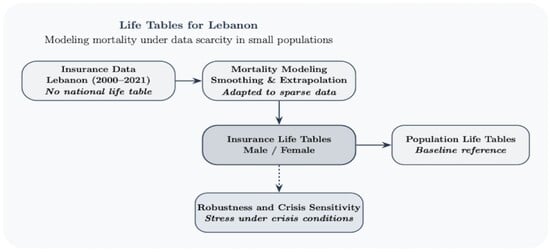
Graphical Abstract

1. Introduction

Lebanon has, since 2019, entered a severe and prolonged economic collapse that the World Bank ranks among the three most dramatic economic crises worldwide since the mid-nineteenth century (World Bank 2021). The Lebanese pound has lost more than 80% of its value, the banking sector has largely ceased to function, and the country has experienced sovereign default, hyperinflation, and institutional breakdown (Shallal et al. 2021; Snaije 2022). These structural failures were further compounded by the COVID-19 pandemic, which placed additional strain on the healthcare system and social protection mechanisms (Zahreddine et al. 2022). As a result, a large share of the population has fallen into multidimensional poverty or severe socioeconomic vulnerability (Proudfoot 2025).
Beyond its economic and social consequences, this crisis has exposed a long-standing structural weakness: the absence of reliable demographic and mortality data. In contexts of prolonged instability, this deficiency represents a source of systemic risk rather than a purely technical limitation. Without accurate mortality estimates or updated life tables, insurers, policymakers, and social institutions lack robust benchmarks for pricing, reserving, solvency assessment, and long-term planning.
However, the need for a Lebanese mortality table long predates the current crisis. Life tables constitute a fundamental tool in actuarial science and demography, providing age-specific death probabilities and forming the basis for life expectancy estimation, insurance and pension valuation, and health policy design (Preston et al. 2001). Lebanon nevertheless lacks the statistical infrastructure required to produce such references. The country has not conducted a national census since 1932, and vital registration systems remain incomplete, preventing the construction of national mortality tables (Ammar and Awar 2001). Consequently, most mortality studies rely on indirect methods or non-representative samples (Sibai et al. 2007). In practice, both the insurance sector and public institutions continue to rely on imported actuarial tables, most notably the AM80 and AF80 tables derived from insured populations in the United Kingdom in the early 1980s. These references reflect demographic, socioeconomic, and epidemiological conditions that differ substantially from those prevailing in Lebanon today, leading to potential distortions in actuarial calculations and policy assessments (Arriaga 1984; Lee and Carter 1992). From an actuarial perspective, extensive literature shows that outdated or non-representative mortality assumptions can generate material distortions in pricing, reserving, and solvency measurement. Richards and Currie (2009) demonstrate that alternative mortality calibrations may lead to markedly different liability valuations, while Cairns et al. (2006) emphasize stochastic mortality as a major source of risk affecting capital requirements. Uncertainty in longevity trends has direct implications for solvency margins (Stevens et al. 2010), and neglecting extreme mortality events can result in significant underfunding (Li and Chen 2024). Modern actuarial standards therefore stress that mortality tables must reflect the experienced mortality of the population under study in order to ensure reliable risk quantification (Salhi and Thérond 2018).
Demographic evidence further suggests that imported actuarial tables are poorly aligned with Lebanon’s current mortality structure. The country has undergone a compressed demographic transition marked by rapid declines in fertility and mortality, substantial emigration of younger cohorts, and a pronounced epidemiological shift toward non-communicable diseases (Sibai et al. 2015, 2004). Mortality dynamics also vary considerably across regions and socioeconomic groups, reflecting disparities in healthcare access, living conditions, and behavioral risk factors (Blanchet et al. 2016). In a country repeatedly exposed to conflict, economic collapse, and population displacement, reliance on external actuarial assumptions risks masking structural heterogeneity and misrepresenting the true mortality profile.
These empirical and institutional constraints point to a clear gap: the absence of a mortality table calibrated to the Lebanese context and grounded in observed data.
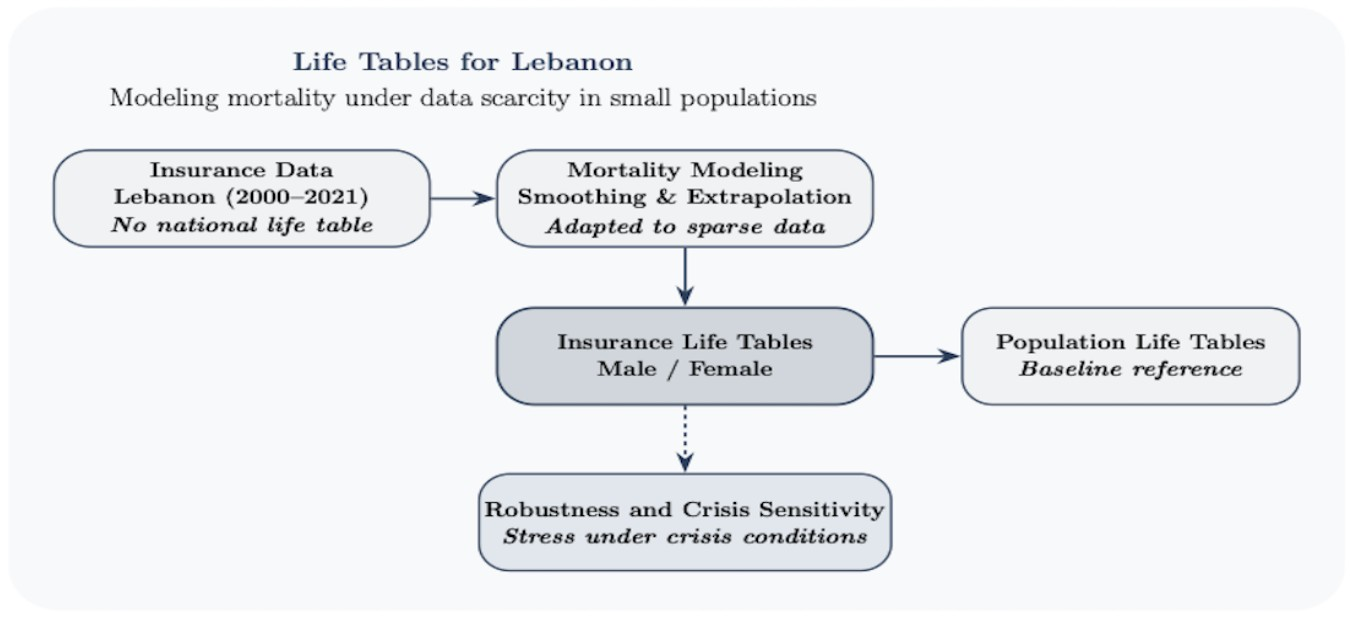
To address this gap, the present study constructs an actuarially calibrated mortality table based on Lebanese insured lives. In the persistent absence of reliable national vital statistics (IMF 2021; World Bank 2021), the analysis relies on harmonized and anonymized data obtained directly from major insurance companies, which constitute one of the few structured and longitudinal mortality data sources available in the country. Using this dataset, we estimate age-specific mortality rates, apply appropriate smoothing and extrapolation techniques, and benchmark the resulting insured-life tables against established international actuarial references to ensure demographic plausibility and methodological consistency.
Building on this insured-life reference, the study then proposes an actuarial approximation of population-level mortality. Although insured individuals do not represent the population as a whole, the insured portfolio provides a coherent empirical basis from which population mortality can be explored through structured adjustments. Where appropriate, insured-to-population differentials documented in countries with well-established statistical systems, such as France, are used to derive population-level scenarios while preserving age-specific coherence. The analysis adopts a period life table framework based on insured lives observed between 2000 and 2021, clearly separating insured mortality estimation from subsequent population-level sensitivity analyses.
By establishing an empirically grounded insured-life mortality reference and proposing a structured exploration of population-level mortality under crisis conditions, this study contributes to a better understanding of Lebanese mortality dynamics both during periods of severe economic and health shocks and in a longer-term demographic perspective. Reliable mortality references are essential for actuarial practice, social protection design, and public health analysis, particularly in fragile and crisis-prone environments.
Beyond the Lebanese case, the methodological framework developed in this study is intended to serve as a practical reference for mortality modeling in small countries and data-scarce settings. It illustrates how insurance-based data can capture the impact of major economic and health shocks on mortality dynamics.
The remainder of the paper is organized as follows. Section 2 describes the data sources, portfolio structure, and demographic characteristics of the insured population. Section 3 presents the actuarial framework used to estimate, smooth, and extrapolate mortality rates and to construct insured life tables. Section 4 analyzes the effects of the economic and health crises on insurance exposure, mortality dynamics, and insured population alignment. Section 5 summarizes the main findings and discusses their actuarial and demographic implications. The final insured and population-based life tables, including sensitivity scenarios derived from multiplier adjustments, are reported in Appendix A.

2. Foundation for Mortality Modeling: Dataset, Structure, and Demographic Insights

Constructing a mortality table for Lebanon requires addressing major limitations in national demographic data. As a small country with incomplete census and vital registration systems, Lebanon lacks comprehensive population-level mortality statistics (Ammar and Awar 2001; Sibai et al. 2007). To overcome these constraints, the present study relies on harmonized and anonymized datasets obtained directly from major Lebanese insurance companies. The data cover the period from 1 October 2000 to 31 December 2021, and include 312,863 unique insured individuals and 1408 recorded deaths, extracted from an initial pool of 672,255 records. After systematic validation, removal of duplicates and inconsistencies, and consolidation of production and claims files, the final dataset was internally coherent and suitable for actuarial mortality analysis.
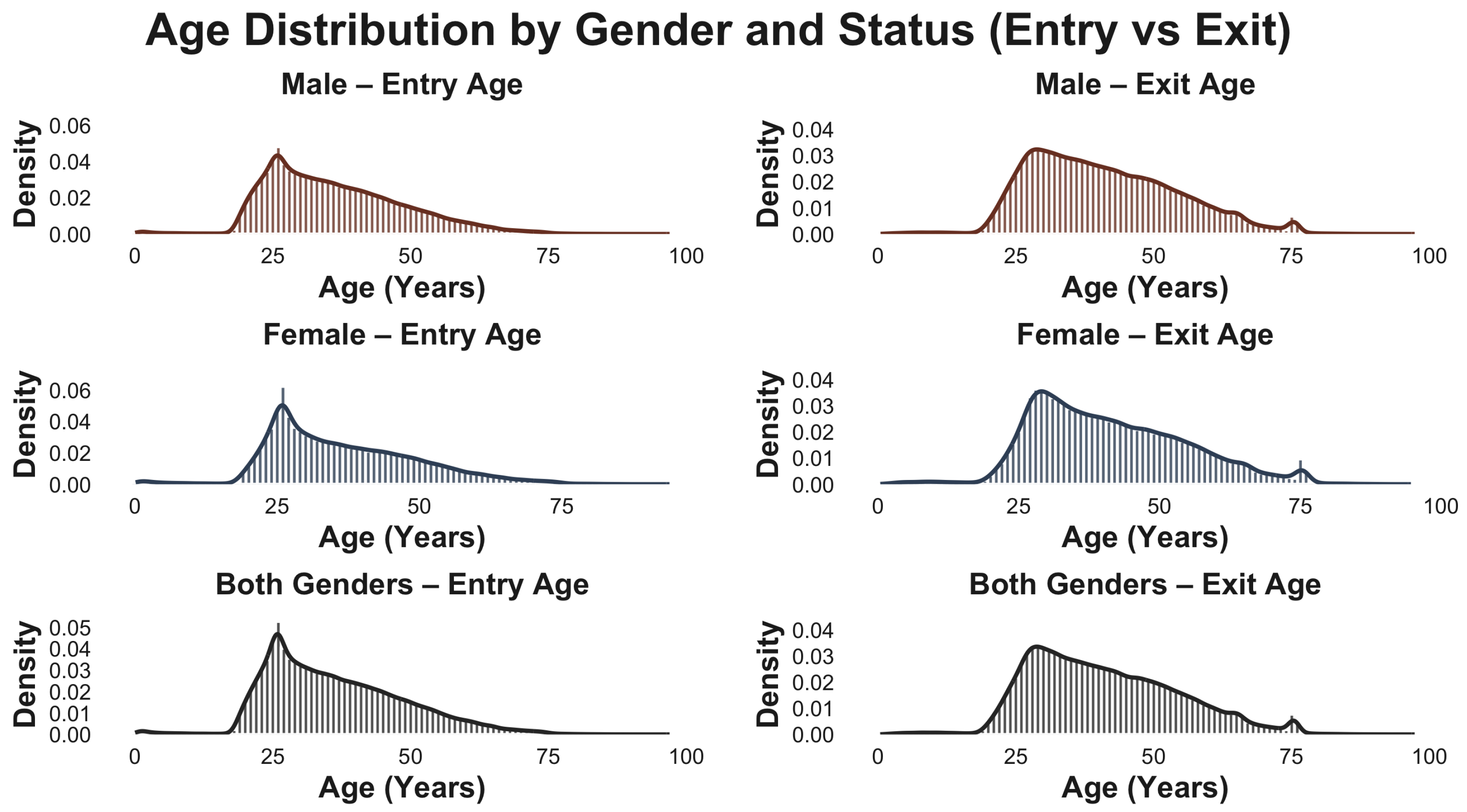
The age structure of portfolio movements is illustrated in Figure 1. Entries are concentrated at young adult ages, peaking around 26–27 years, while exits are more dispersed but display a similar concentration. A pronounced spike in exits at age 75 reflects contractual termination rules commonly applied in Lebanese insurance policies.
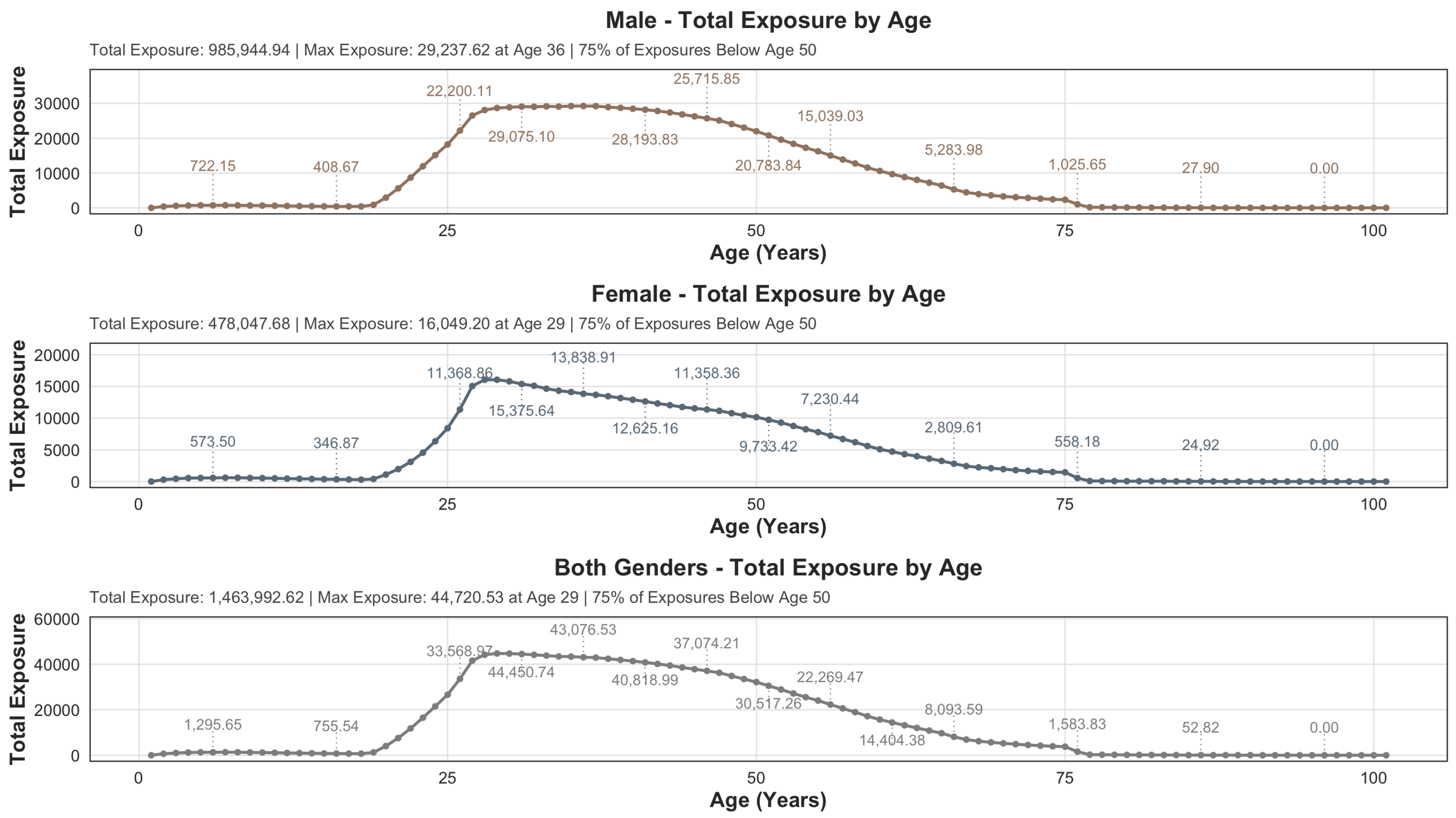
Exposure by age provides further insight into the distribution of insured coverage. Exposure, measured in cumulative person-years, peaks at age 36 for men and at age 29 for women (Figure 2). Approximately 75% of total exposure is concentrated below age 50, reflecting the relatively young structure of the insured population. This concentration directly affects the statistical stability of mortality estimates, particularly at younger and older ages where exposure is sparse.
In actuarial and demographic estimation, ages with limited exposure are known to produce highly unstable mortality rates dominated by random fluctuation (Kostaki and Zafeiris 2019; Promislow et al. 1999). Rather than imposing an arbitrary cutoff, exposure sufficiency was assessed by examining the full exposure profile relative to the maximum observed exposure,
E x = p x × E max ,
allowing identification of age ranges with dense, coherent information and those requiring smoothing or down-weighting. In the present dataset, maximum exposure reaches 29,238 for men, 16,049 for women, and 44,721 when genders are combined, producing the triangular exposure pattern typical of insured populations.
Statistical reliability was further evaluated using expected-death criteria, where the expected number of deaths at age x is given by E x = N x q x . Male mortality estimates are generally stable between ages 20 and 65, while female estimates meet reliability criteria at fewer ages due to lower exposure and mortality levels. Although aggregation across genders increases stability, it conceals gender-specific disparities. These findings motivate the use of smoothing, sample-weighted averaging, and indirect calibration techniques described in Section 3.
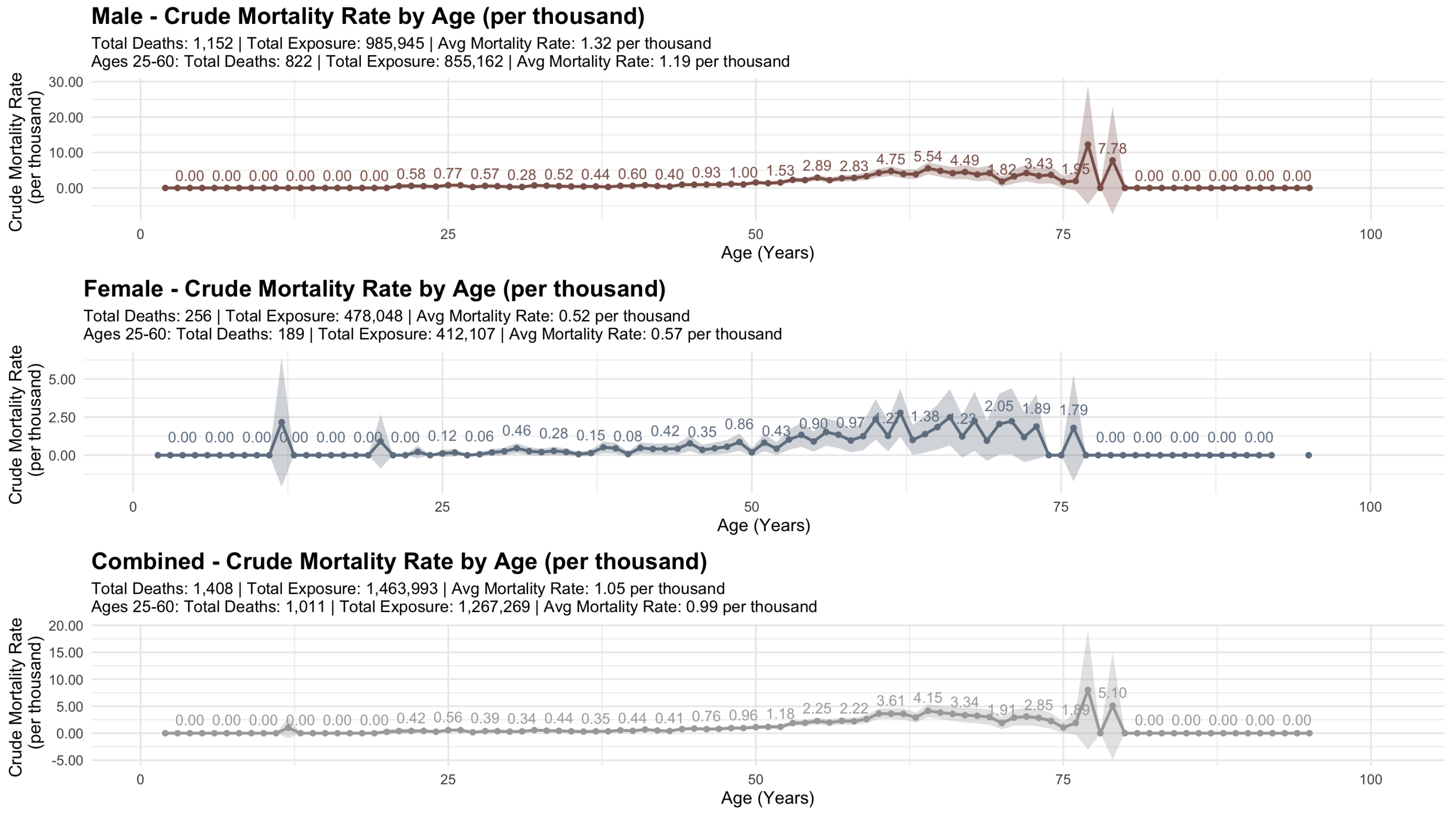
Crude mortality rates with 95% confidence intervals (Figure 3) further illustrate these patterns, with greater uncertainty at extreme ages and narrower intervals around ages 26–27, where exposure is highest.
The dataset exhibits a marked gender imbalance: men account for approximately 67% of insured lives and 82% of recorded deaths. This pattern is consistent with well-documented sex differentials in mortality driven by biological, behavioral, and social factors (Kruger and Nesse 2004; Luy and Gast 2014; Rogers et al. 2010). Mortality is therefore modeled separately for men and women in order to preserve gender-specific risk profiles.
Insurance product composition further shapes mortality selection within the portfolio. Protection products, which directly expose insurers to biometric risk, represent approximately 69% of policies, while mixed and savings products account for 15% and 16%, respectively. Protection contracts typically involve stricter medical underwriting, implying that the insured population constitutes a healthier and more socioeconomically advantaged subset of the national population. Mortality rates derived from insurance data are therefore expected to lie below population-level mortality.
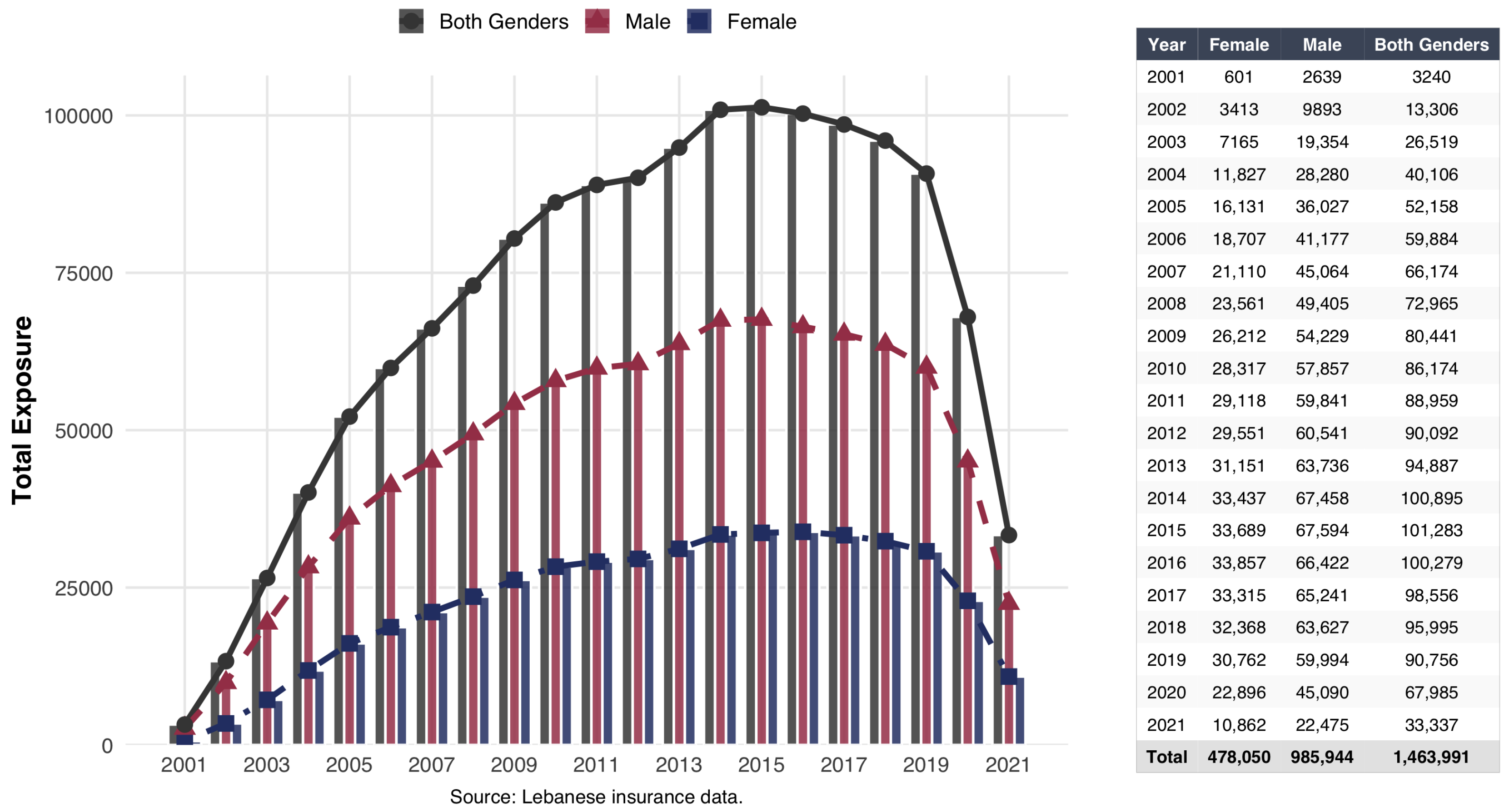
Temporal analysis highlights the central role of external shocks in shaping portfolio dynamics. As shown in Figure 4, total exposure increased steadily until 2015, declined between 2016 and 2018, and collapsed sharply after 2019. This contraction coincides with the banking system failure, currency depreciation exceeding 80%, and sovereign default (Shallal et al. 2021; Snaije 2022; Uwaydah and Kassir 2024), which substantially reduced households’ capacity to maintain insurance coverage.
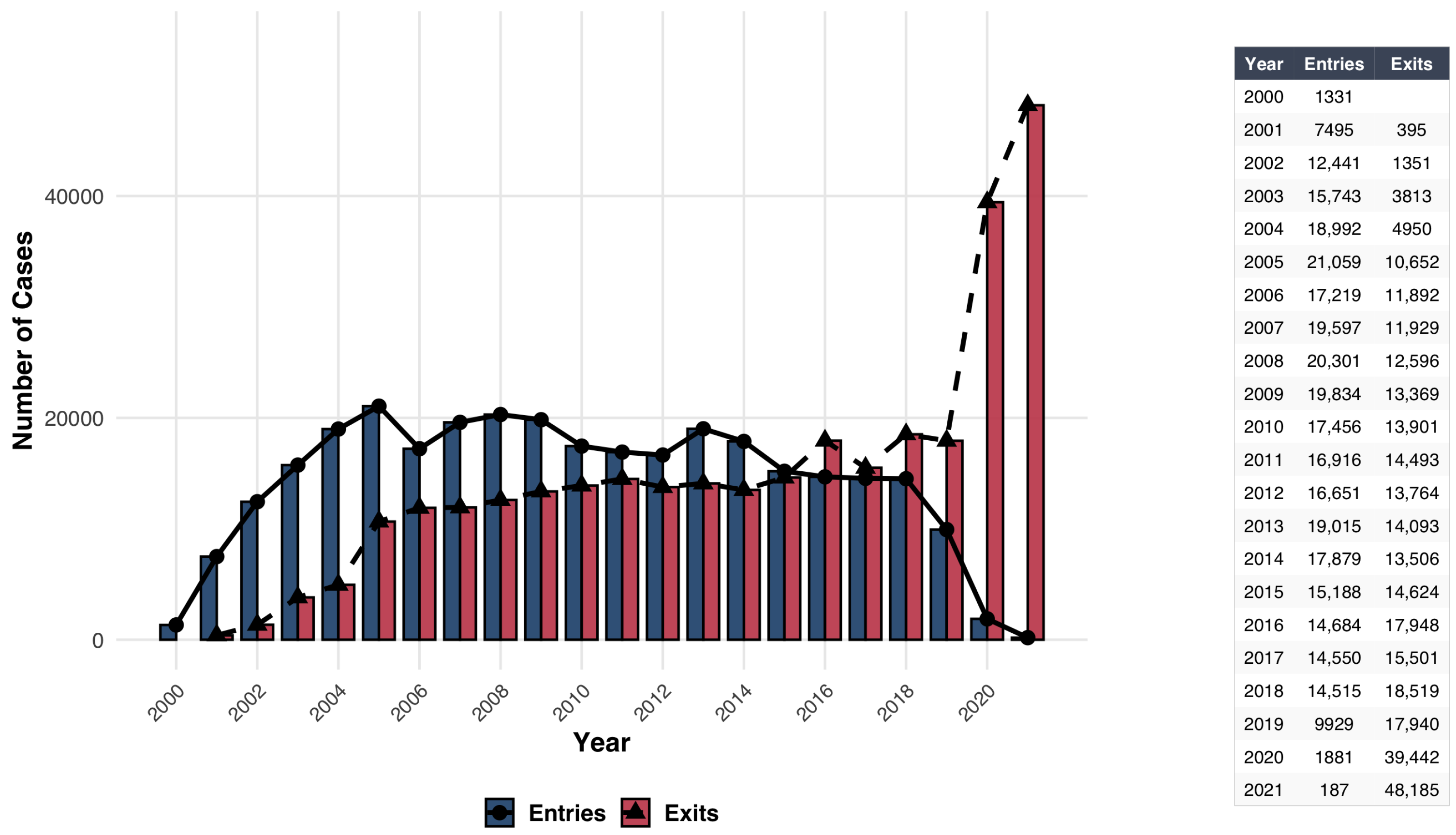
During this period, portfolio inflows and outflows diverged markedly. Exits increased by 120% between 2019 and 2020 and by a further 22% between 2020 and 2021, while new entries declined sharply (Figure 5), leading to a pronounced contraction of the exposure base.
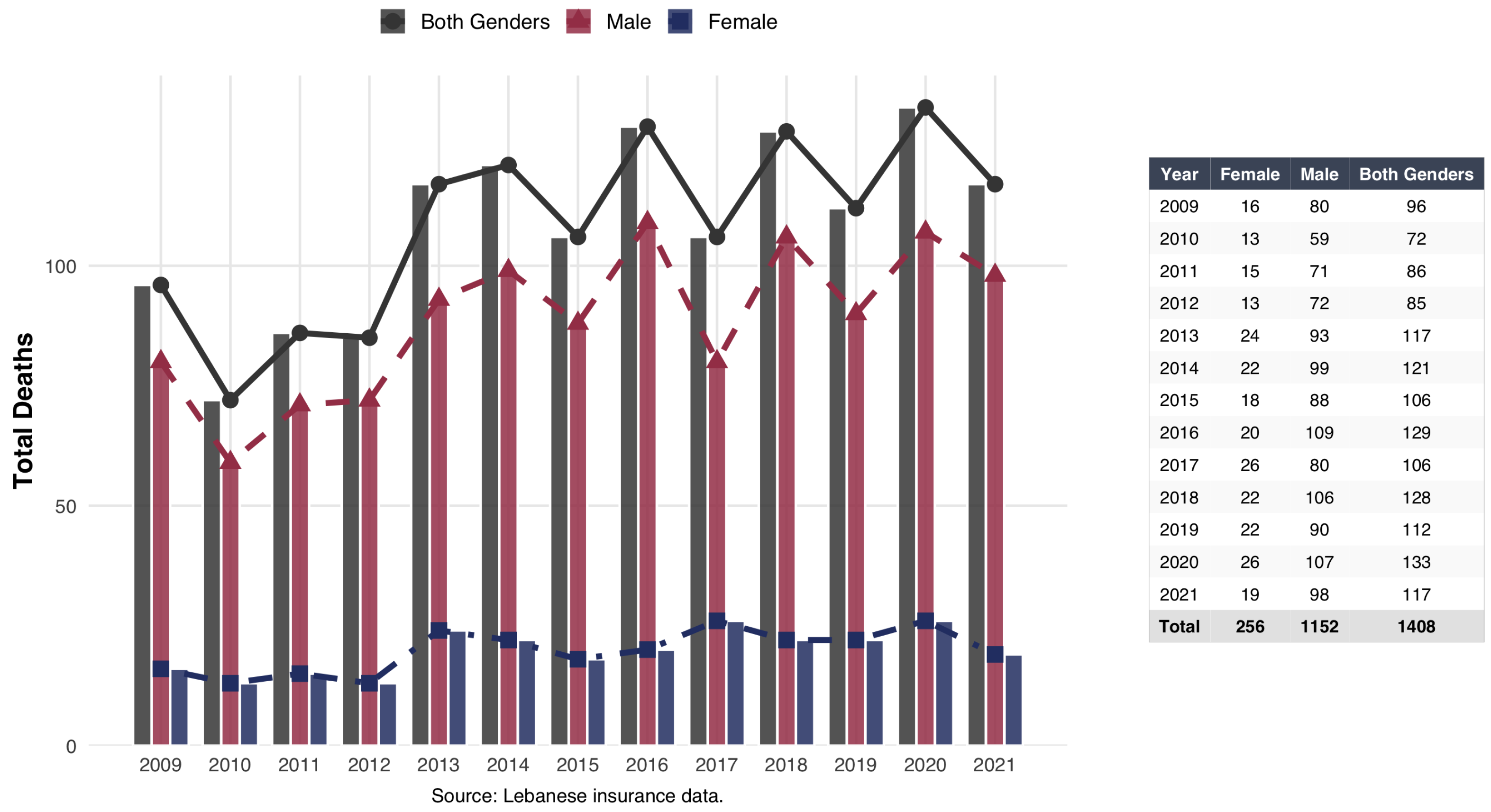
Despite this contraction, the absolute number of deaths remained relatively stable, fluctuating between 106 and 133 per year since 2013 (Figure 6). The crisis therefore did not translate into a surge in raw mortality counts within the insured pool.
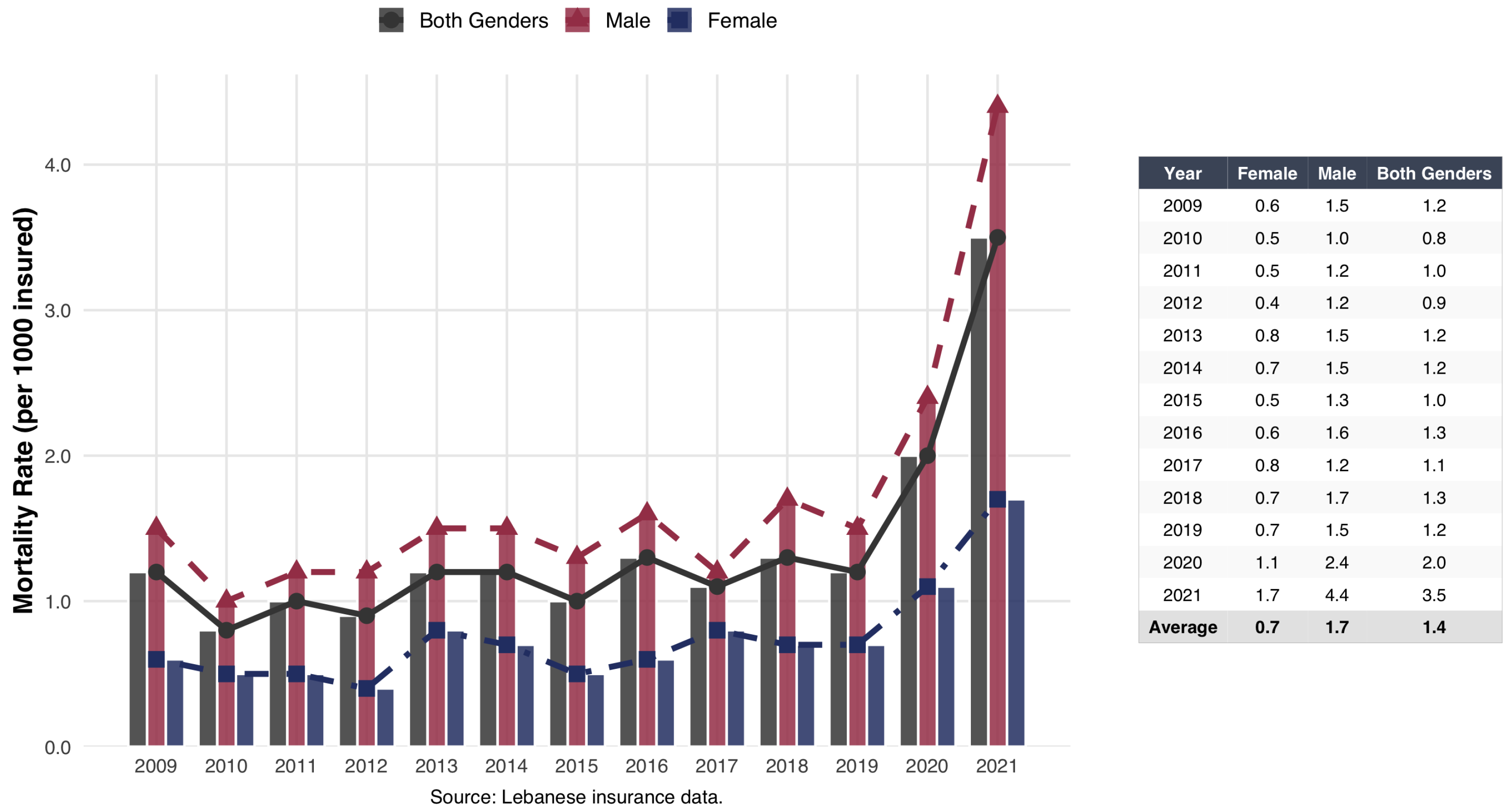
When mortality is expressed per 1000 insured individuals, rates increased sharply, rising from 0.7 to 1.1 between 2019 and 2020 (+57%) and to 1.7 in 2021 (+55%) (Figure 7). This apparent deterioration reflects a selection effect driven by portfolio contraction rather than an increase in deaths, as individuals exiting coverage during the crisis differ systematically from those remaining insured.
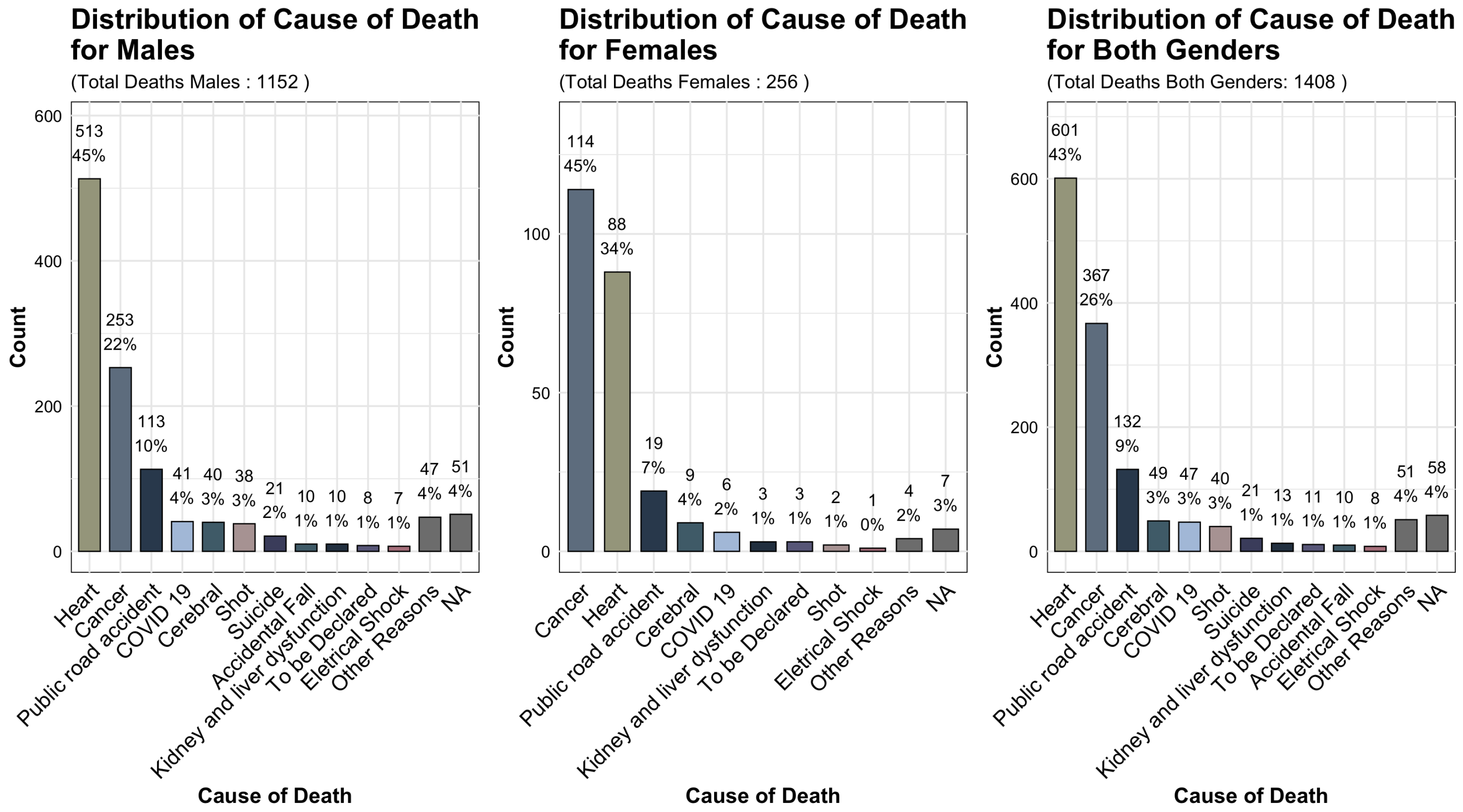
To contextualize these dynamics, the distribution of causes of death provides a useful epidemiological reference. Figure 8 shows that cardiovascular diseases and cancers are the leading causes of death among the insured population, consistent with an advanced stage of the epidemiological transition characterized by the predominance of non-communicable diseases over infectious causes (GBD 2019 Diseases and Injuries Collaborators 2020; Omran 1971, 1998; Preston et al. 2001).
External causes, and in particular road traffic accidents, represent a non-negligible share of insured mortality, ranking among the leading causes of death, especially for men. This pattern is consistent with well-documented gender differentials in exposure to external and behavioral risks, whereby men are more frequently exposed to injuries and accidents due to occupational, behavioral, and mobility-related factors (GBD 2019 Diseases and Injuries Collaborators 2020; Kruger and Nesse 2006; World Health Organization 2018). These mechanisms contribute to excess male mortality at young and middle-adult ages.
Infectious causes remain limited in the insured portfolio. COVID-19 accounts for approximately 3% of recorded deaths, a proportion that does not materially affect life table construction but illustrates how acute health shocks may temporarily influence mortality patterns (Di Bari et al. 2022; Lenz et al. 2024; Meagher 2024; Serviente et al. 2022).

3. Constructing a Period Life Table for Lebanon

We rely on period life tables to construct mortality tables for the Lebanese insured population. Period life tables summarize observed age-specific mortality over a given period and represent the standard framework in actuarial practice for pricing, reserving, and solvency analysis (Olivieri and Pitacco 2012; Pitacco 2008).

3.1. Estimating Mortality Rates

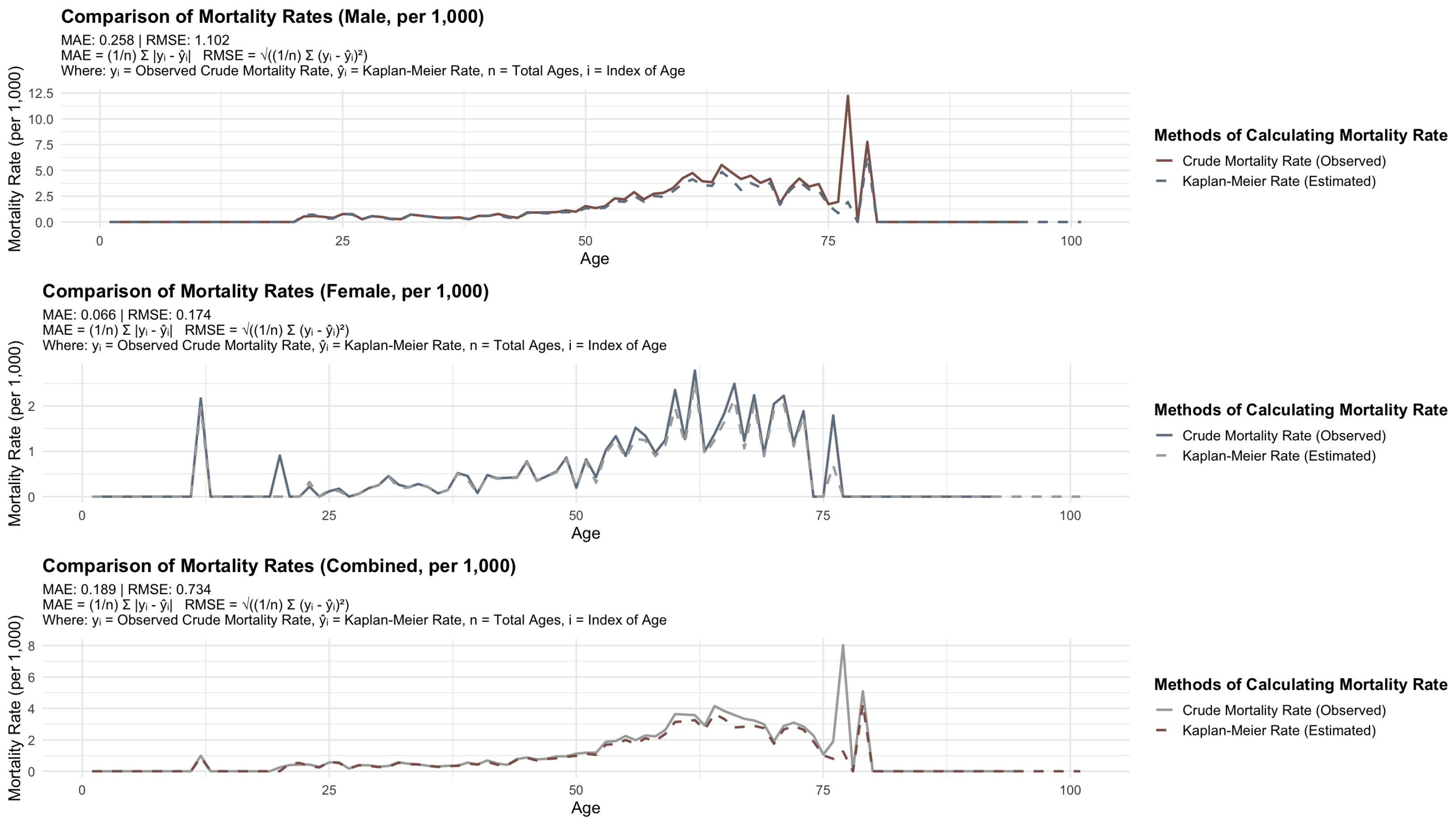
Analyses are stratified by men, women, and the combined population in order to preserve subgroup-specific mortality patterns. Age-specific mortality rates are estimated using the Kaplan–Meier estimator, a standard nonparametric method that properly accounts for right censoring (individuals alive at the end of follow-up or otherwise censored), thereby avoiding bias in mortality estimation (Kaplan and Meier 1958). Kaplan–Meier estimates closely match crude mortality rates across all groups (Figure 9), with the strongest agreement observed at ages with high exposure and only minor deviations at advanced ages where exposure becomes limited.
Estimator accuracy is quantified using the Mean Absolute Error (MAE) and the Root Mean Square Error (RMSE). Both indicators remain low across all populations, confirming strong agreement between Kaplan–Meier and crude mortality rates (men: MAE = 0.26, RMSE = 1.10; women: MAE = 0.07, RMSE = 0.17; combined population: MAE = 0.19, RMSE = 0.73).
Beyond rate-level agreement, the internal coherence of the Kaplan–Meier estimator is assessed by comparing the expected number of deaths implied by the model with the observed death counts. Across all groups, expected and observed deaths are closely aligned, confirming the consistency of the estimator. Relative discrepancies remain limited, at 6.1% for men, 12.8% for women, and 5.5% for the combined population, with the larger deviation for women reflecting smaller exposure and higher variability at older ages.
The Kaplan–Meier framework provides an accurate and statistically reliable representation of mortality dynamics in the Lebanese insured population and serves as a baseline for subsequent smoothing, extrapolation, and life table construction procedures.

3.2. Development of Smoothing and Hybrid Methods

To construct a smooth and demographically coherent mortality curve, we rely on two classical actuarial models: Makeham’s law and the Brass relational model, which are briefly recalled here for completeness and motivation.
Makeham’s law represents adult and older-age mortality as the sum of an age-independent component and an exponentially increasing age-dependent component:
μ x = A + B e C x ,
where A captures background mortality and B e C x reflects biological aging.
Makeham’s law is formulated in continuous time through the instantaneous force of mortality μ x . The corresponding annual mortality probability is given by
q x = 1 exp x x + 1 μ t d t .
Introduced in the nineteenth century (Makeham 1860, 1878), this model remains widely used because it produces smooth, monotonic mortality patterns that remain stable when exposure becomes sparse at advanced ages.
The Brass relational model adjusts observed mortality to a reference table by assuming a linear relationship between the logits of survival functions:
logit ( l x Leb ) = α + β logit ( l x Ref ) ,
where α controls the overall mortality level and β the age gradient. Since its introduction by (Brass 1971), this approach has been extensively used to stabilize mortality estimation when data are incomplete or irregular.
In this study, the two models play complementary roles: Makeham ensures actuarial smoothness at older ages, while Brass preserves demographic coherence at ages with limited exposure by borrowing strength from established references such as AM80/AF80.
Although the Kaplan–Meier estimator provides a robust nonparametric baseline, it may exhibit local irregularities, particularly at advanced ages where exposure is limited. Because actuarial applications require a smooth and continuous mortality trajectory, several smoothing strategies were explored. The Whittaker–Henderson technique was tested but failed to deliver stable tail behavior and was therefore not retained. Parametric approaches based on Makeham’s law and the Brass relational model were subsequently favored for their actuarial interpretability and demographic stability.
As neither model alone fully reconciled data limitations with demographic plausibility, we introduce a hybrid approach, the Sample Weighted Average (SWA). The SWA combines Brass and Makeham estimates through a logistic weighting scheme driven by local exposure density. Let N x denote exposure at age x, normalized as w x = N x / max x N x . The weight is defined as
ω ( x ) = 1 1 + exp [ b ( w x a ) ] ,
where the parameters a and b control the location and steepness of the transition between the two models. Specifically, a represents the exposure level (expressed as a proportion of the maximum) at which the weight shifts from favoring Brass to favoring Makeham, while b determines how abruptly this transition occurs. In this study, a = 0.3 and b = 1 were chosen after sensitivity testing to achieve a smooth, yet responsive transition. The value a = 0.3 ensures that when exposure exceeds roughly 30% of its maximum observed level, the Makeham component begins to dominate, reflecting sufficient data reliability. The moderate slope parameter b = 1 prevents abrupt switching between methods, maintaining numerical stability and demographic continuity between ages. The resulting rate is
q x SWA = ω ( x ) q x Makeham + [ 1 ω ( x ) ] q x Brass ,
which produces a continuous, demographically coherent curve. It leans on Brass when data are sparse and on Makeham when exposure is strong, ensuring smooth and stable estimates suitable for actuarial use. A simpler fixed-weight Weighted Average (WA) was also implemented as a benchmark, confirming the robustness of the SWA results.

3.3. Evaluation of Smoothing Methods

To assess the plausibility of mortality estimates derived from Lebanese insurance data, we compare them with the French insurance life tables TGH05 (males) and TGF05 (females), published by SPAC Actuaires (2005). These tables are provided as cohort life tables reporting the number of survivors l x at each age.
To ensure consistency with our period-based framework, cohort tables were converted into period mortality rates using
q x = l x l x + 1 l x ,
and values corresponding to calendar year 2005 were extracted to reconstruct the associated period life tables.
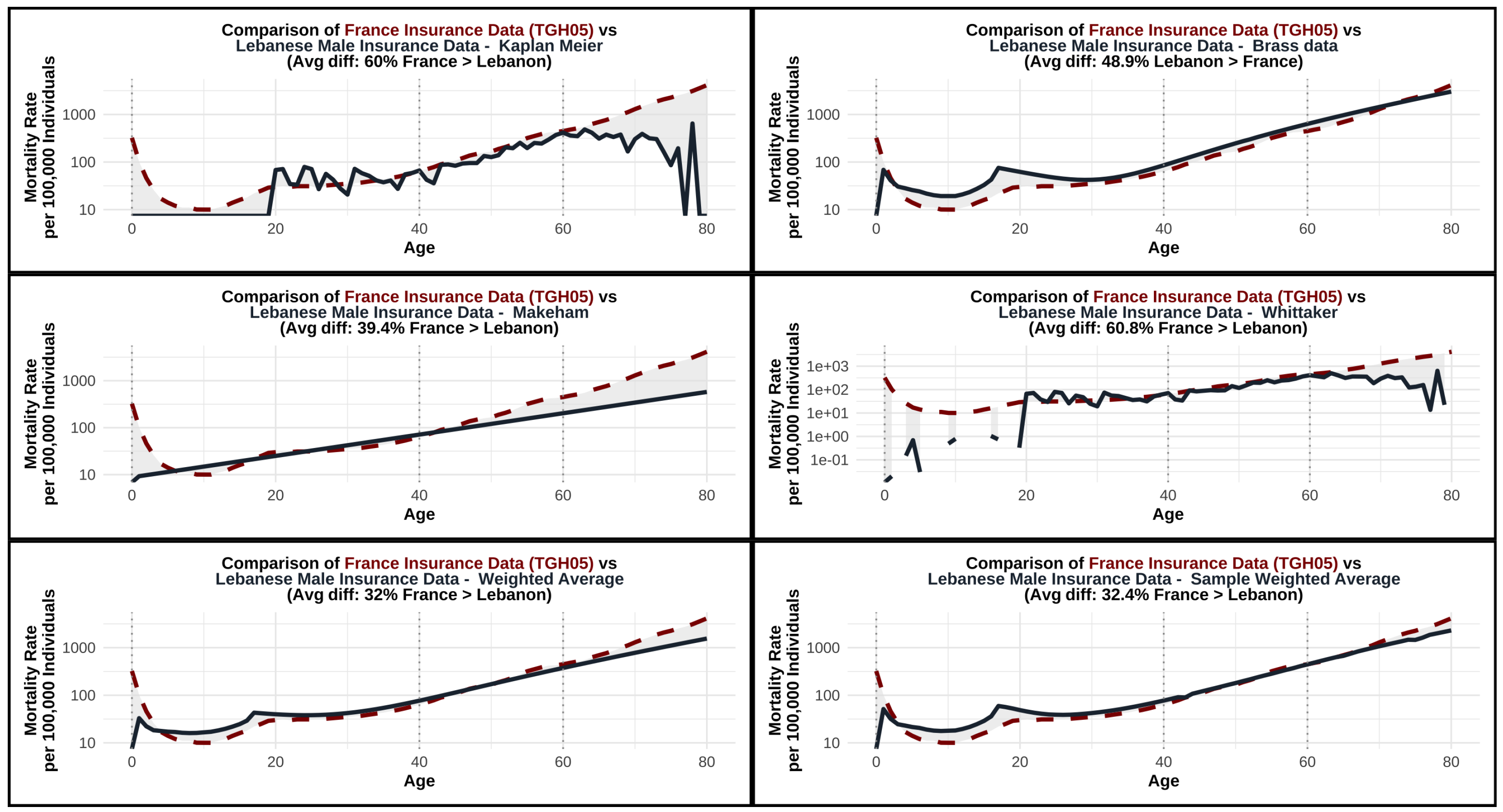
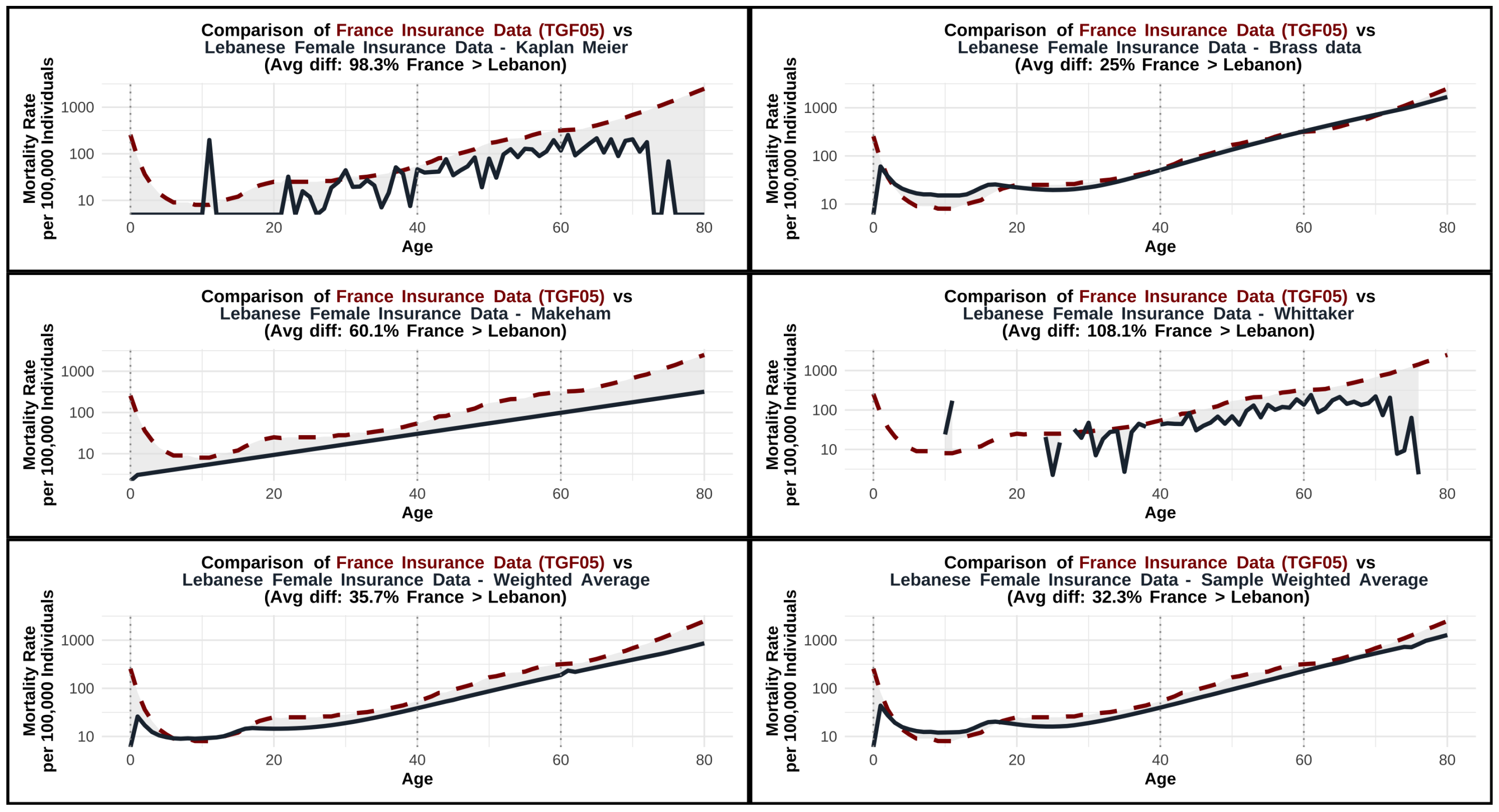
Mortality rates were expressed on a radix of 100,000 and plotted on a logarithmic scale to highlight both absolute levels and relative deviations. Figure 10 and Figure 11 compare Lebanese mortality estimates obtained from the Kaplan–Meier baseline and from the different smoothing methods (Brass, Makeham, Whittaker–Henderson, Weighted Average, and Sample Weighted Average) with the French references TGH05 and TGF05.
For men (Figure 10), both the Brass and Sample Weighted Average (SWA) methods generate smooth and monotonic mortality curves, but they differ in well-exposed age ranges. SWA closely follows the empirical Kaplan–Meier estimates and remains aligned with the French TGH05 reference between ages 30 and 70, whereas the Brass model tends to overestimate Lebanese mortality when exposure is sufficient. The Makeham model provides a reasonable fit up to about age 50 but diverges at older ages, underestimating mortality relative to TGH05 and failing to capture the early-adult mortality hump. The Weighted Average method offers a stable compromise but is less adaptive than SWA. In contrast, Kaplan–Meier and Whittaker–Henderson estimates display marked irregularities at young and old ages due to sparse exposure and censoring, limiting their actuarial applicability.
For women (Figure 11), all Lebanese mortality estimates lie below the French TGF05 reference, particularly between ages 30 and 50 where exposure is strongest (Figure 2), with average differences generally exceeding 30%. Kaplan–Meier and Whittaker–Henderson estimates are highly irregular and unsuitable for actuarial use. The Makeham model produces a smooth but systematically underestimated curve, while the Brass model follows the general shape of TGF05 but overestimates mortality relative to empirical observations. The Weighted Average method yields a coherent curve slightly below the French reference. Among all approaches, SWA provides the most consistent compromise between smoothness, empirical plausibility, and adaptability to data density.
Additional validation was conducted by comparing observed deaths with those predicted by the SWA model. Predicted deaths equal 1518 for men, 384 for women, and 1672 overall, compared with observed counts of 1152, 256, and 1408, yielding relative errors of 5.03%, 9.99%, and 4.79%, respectively. Deviations remain limited across age groups and increase only at the oldest ages, where exposure declines sharply.
On this basis, the Sample Weighted Average method is retained for the construction of the Lebanese mortality tables, as it offers a coherent balance between smoothness, empirical fidelity, and demographic consistency across the full age range.

3.4. Validation Against International References

The French insured-life tables TGH05 (males) and TGF05 (females) are used as external benchmarks to assess the plausibility and actuarial consistency of the Lebanese mortality tables constructed from insurance data. These references provide a structured comparison framework and allow the identification of potential anomalies arising from data limitations or methodological choices.
The Lebanese mortality curves obtained using the Sample Weighted Average (SWA) method (Section 3.2) reflect the selection and underwriting characteristics of the insured portfolio.
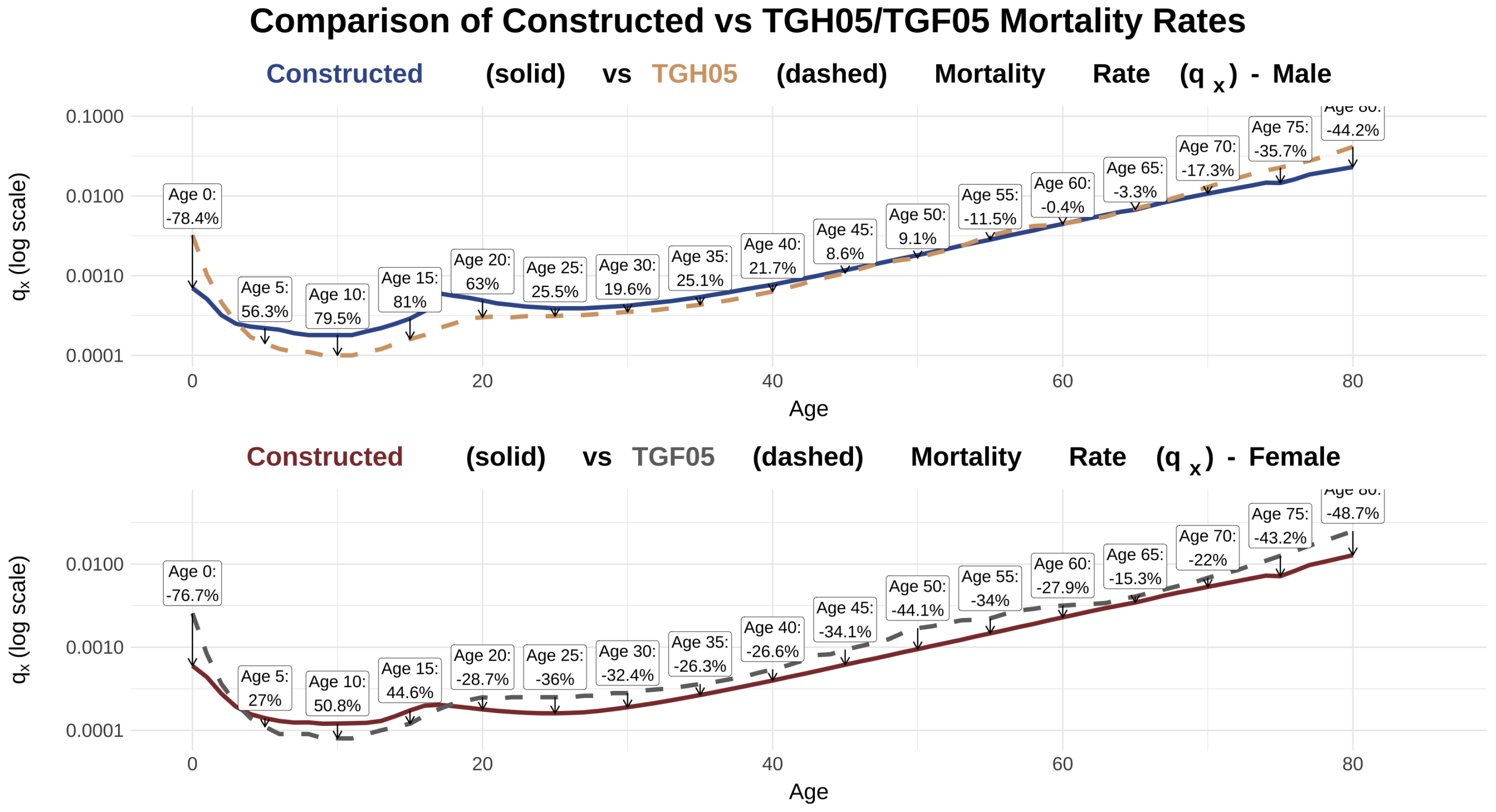
At adult and older ages, mortality levels are systematically lower than those observed in TGH05 and TGF05 (Figure 12). This pattern is consistent with actuarial evidence showing that insured populations in emerging or highly selective markets often exhibit lower mortality than insured populations in mature markets, due to stricter underwriting, stronger selection effects, and smaller portfolio sizes (Bernheim 1998; Rothschild and Stiglitz 1976). Forcing convergence toward French insured mortality at these ages would therefore distort the observed Lebanese insured experience rather than improve actuarial realism.
At younger adult ages, deviations from the French reference tables are more likely driven by data-related constraints than by genuine structural differences in mortality. Mortality estimation in this age range is sensitive to sparse exposure, entry and exit dynamics, and censoring effects inherent to insurance portfolios. Consequently, mortality rates at these ages are stabilized through internal smoothing and calibration procedures rather than direct alignment with external references.

3.5. Refinement of Early- and Mid-Life Mortality

At very young ages, mortality estimates derived from the Lebanese insured portfolio are implausibly low when compared with international benchmarks. This bias is primarily driven by extreme data scarcity, as very few insured lives are observed at these ages. Even after smoothing and hybrid estimation, insured-life data alone fail to reproduce a realistic early-age mortality profile.
At these ages, population-level information provides a more appropriate external reference. Newborns and young children are typically insured automatically under parental contracts, without individual medical underwriting. Early-age mortality therefore largely reflects public health conditions and the completeness of vital registration rather than insurance selection.
This interpretation is supported by international evidence showing that mortality in childhood and adolescence is mainly driven by environmental and epidemiological factors rather than insurance coverage (Patton et al. 2009). While insurance status significantly affects adult mortality, with uninsured individuals experiencing mortality ratios of approximately 1.2 to 1.3 relative to insured populations (Sorlie et al. 1994), its impact at young ages is limited (Dow et al. 2003).
World Bank indicators confirm this discrepancy: infant mortality in Lebanon reached 15–16 per 1000 live births in 2022–2023, compared with approximately 3 per 1000 in France (World Bank 2022). Relying directly on insured-life estimates at early ages would therefore substantially underestimate true demographic risk.
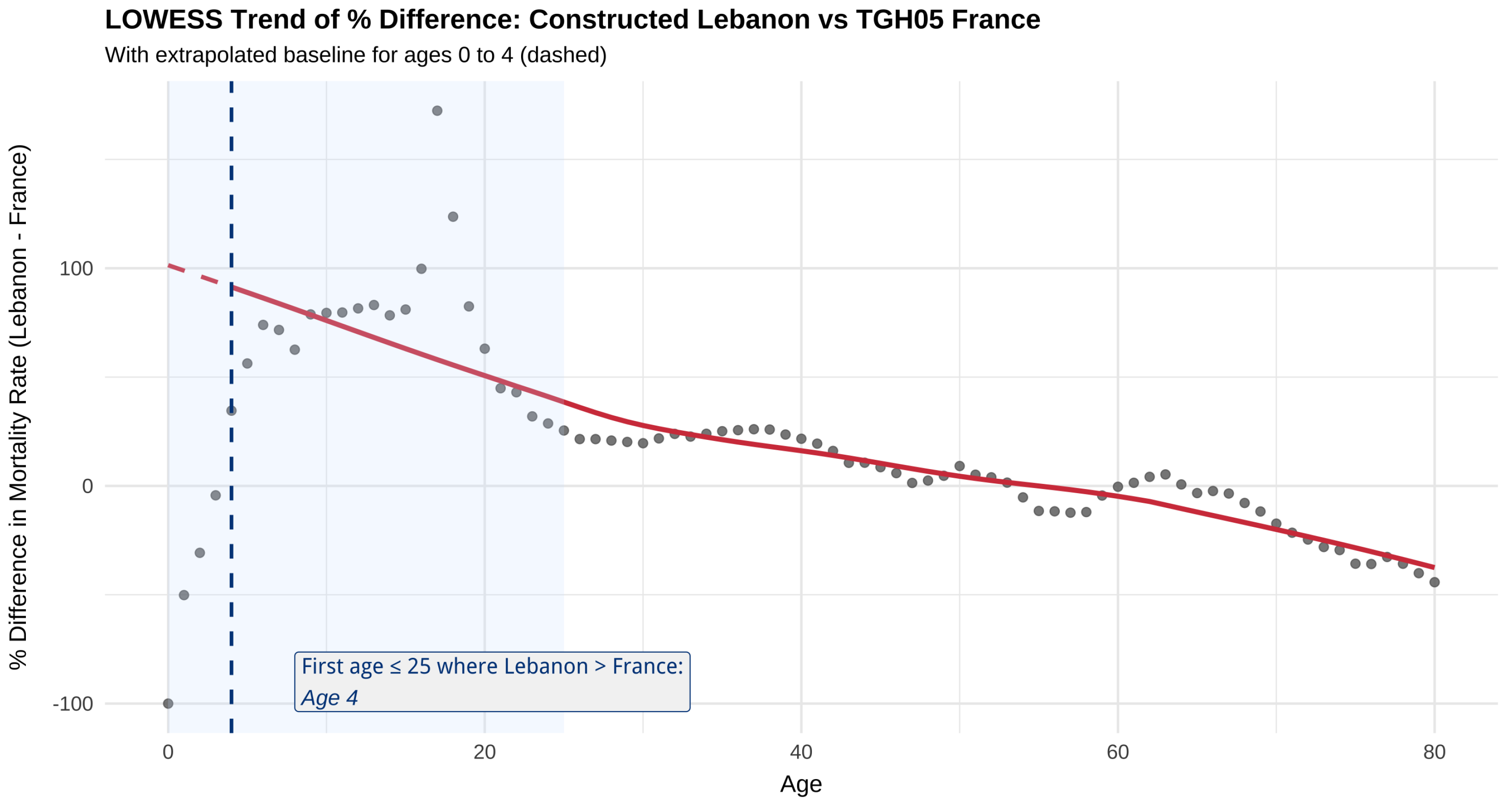
To correct this distortion, a LOWESS smoothing was applied to the age-specific percentage differences between Lebanese and French mortality rates for ages above four, where empirical estimates become more reliable (Figure 13). For ages 0–4, where differences were negative due to data scarcity, adjustments were obtained by linear extrapolation from age four, corresponding to the first age at which Lebanese mortality exceeds the French reference. This approach preserves demographic coherence while avoiding overfitting in poorly observed age ranges.
From an actuarial perspective, this refinement is essential, as infant and neonatal risks are among the most costly in life and health insurance. For instance, the lifetime incremental cost of a preterm birth was estimated at $51,800 in 2005 and $64,800 in 2016 after adjustment for inflation and medical cost growth (Waitzman et al. 2021), justifying a conservative and externally calibrated treatment of early-age mortality.
Residual irregularities during childhood and adolescence were further smoothed using a parabolic adjustment applied to log ( q x ) between ages 4 and 17. A quadratic polynomial was fitted within a moving 13-year window and exponentiated back to the mortality scale, ensuring a continuous transition between early-age adjustments and the observed adult curve.
At selected adult ages with missing or inconsistent values (notably ages 65–66 and 75–76), continuity was ensured through linear interpolation between adjacent observed ages. These targeted corrections preserve smoothness without altering the overall mortality structure.
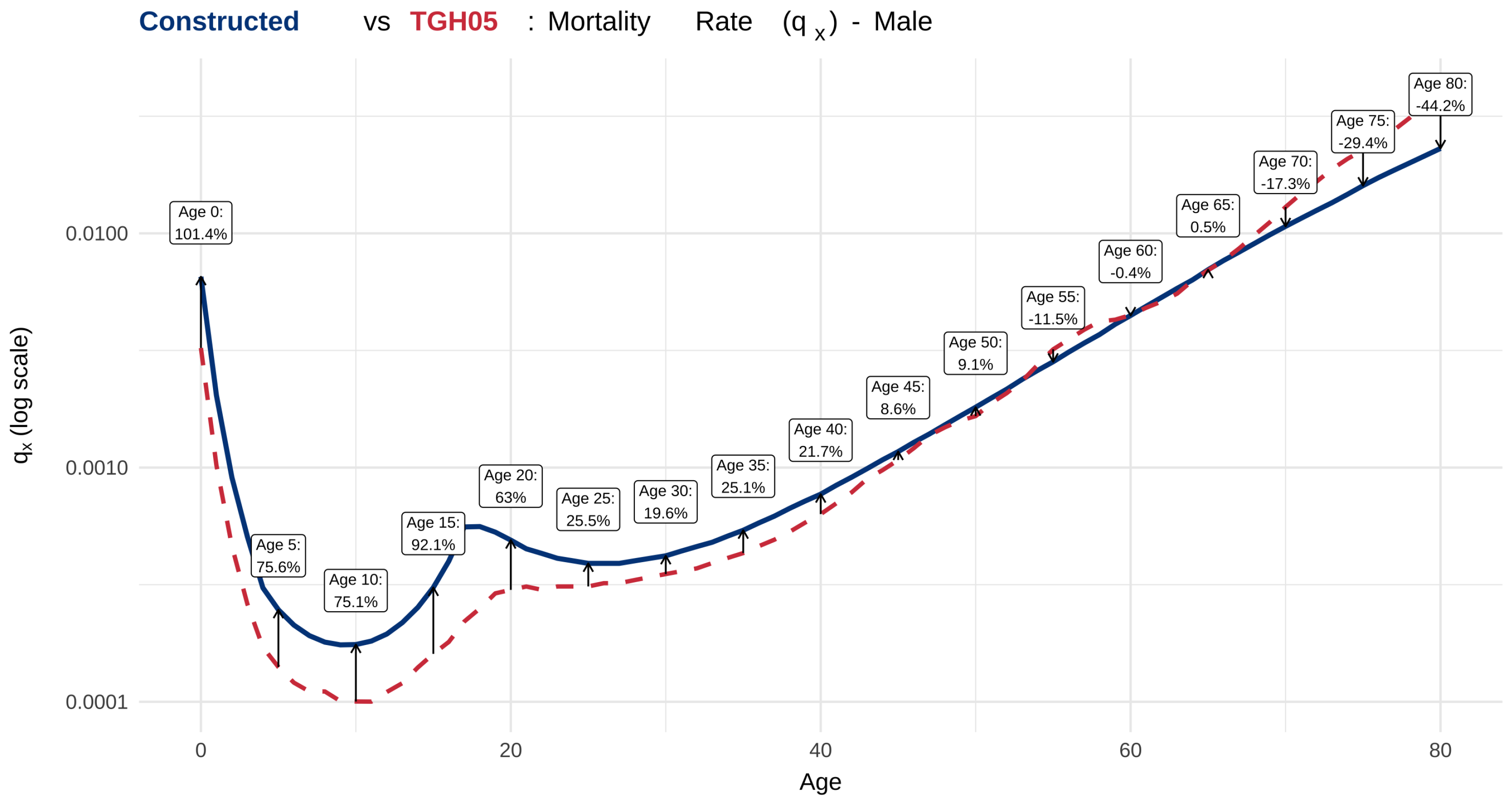
The resulting male mortality profile (Figure 14) integrates LOWESS-based correction at early ages, parabolic smoothing throughout childhood and adolescence, and targeted interpolation at specific adult ages.

3.6. Extrapolation Beyond Age 80

Beyond age 80, observed mortality in the Lebanese insured portfolio becomes sparse and statistically unstable (Brass 1975; Kinsella and Phillips 2005). Several extrapolation approaches were therefore examined to project mortality at advanced ages while preserving the empirical structure observed at ages with sufficient exposure.
Three classical extrapolation approaches were considered: the Coale–Kisker method, Makeham’s law, and a level-adjusted extrapolation based on the French TGH05 insured-life table. All methods were calibrated to the Lebanese experience and extrapolated up to age 120, after which mortality was capped at q x = 1 , consistent with standard actuarial and demographic practice (Aarssen and de Haan 1994; Richmond and Roehner 2016).
The Coale–Kisker model (Coale and Kisker 1990), specifically designed for old-age mortality extrapolation, allows for a gradual deceleration in mortality growth at very advanced ages. For ages x > 80 , mortality is defined as
q x = q 80 exp r ( x 80 ) 0.0005 ( x 80 ) 2 , r = log ( q 80 ) log ( q 65 ) 15 .
Makeham’s law (Makeham 1860) was also considered, with parameters estimated over ages 65–80. When extrapolated beyond this range, it implies a strictly exponential increase in mortality, which tends to produce conservative levels at the highest ages.
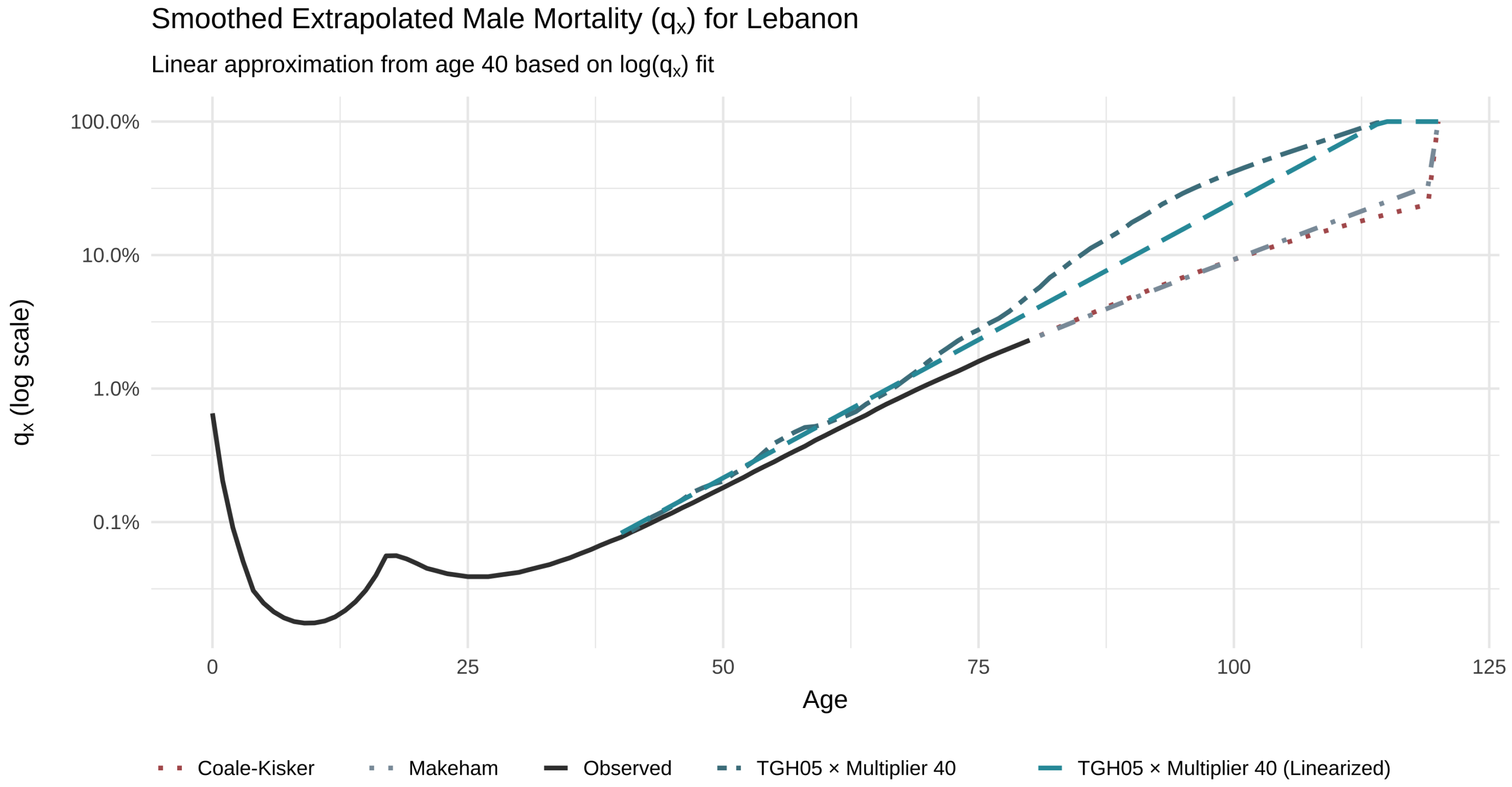
A level-adjusted extrapolation based on the French TGH05 table was used as a benchmark. The TGH05 age profile was retained and scaled to the Lebanese insured experience using a fixed multiplier computed at age 40, where exposure remains substantial and mortality estimates are statistically reliable. Figure 15 shows that this multiplier-based extrapolation already yields mortality levels above those obtained from internally constructed extrapolations, suggesting a tendency to overestimate mortality at advanced ages in an insurance context.
Among the extrapolation methods considered, Makeham and Coale–Kisker produce closely aligned trajectories. The Coale–Kisker method is therefore retained as a conservative specification, as it captures the empirically documented deceleration in the growth of mortality at advanced ages, a feature commonly observed in insured and other selected populations (Coale and Kisker 1990; Pitacco 2016; Wilmoth and Horiuchi 1995).

3.7. Female Mortality Construction and Extrapolation

Female mortality was constructed using the same methodological framework as for males. As in the male case, localized corrections and smoothing were applied at ages where mortality estimates are inherently unstable, particularly in early childhood and at advanced ages. Beyond age 80, the same extrapolation strategies as those used for males were considered, with the Coale–Kisker method ultimately retained for the final female mortality table.
Given the limited size and irregular age structure of the insured female portfolio in Lebanon, the direct construction of a standalone female mortality table is statistically fragile. To address this limitation, an indirect ratio-based strategy was adopted, deriving female mortality from the male mortality curve through empirically observed sex-specific differentials. This approach is well established in actuarial practice when female data are sparse and ensures internal coherence between male and female life tables (Cairns et al. 2006; Dickson et al. 2020; Pitacco et al. 2009).
Within this framework, the Lebanese female mortality curve was constructed using a hybrid ratio-based approach combining information from two international insured-life reference systems: the British AF80/AM80 tables and the French TGF05/TGH05 tables. These references reflect distinct historical periods and mortality regimes, separated by approximately twenty-five years, and capture different stages of longevity improvement, behavioral change, and epidemiological transition in insured populations.
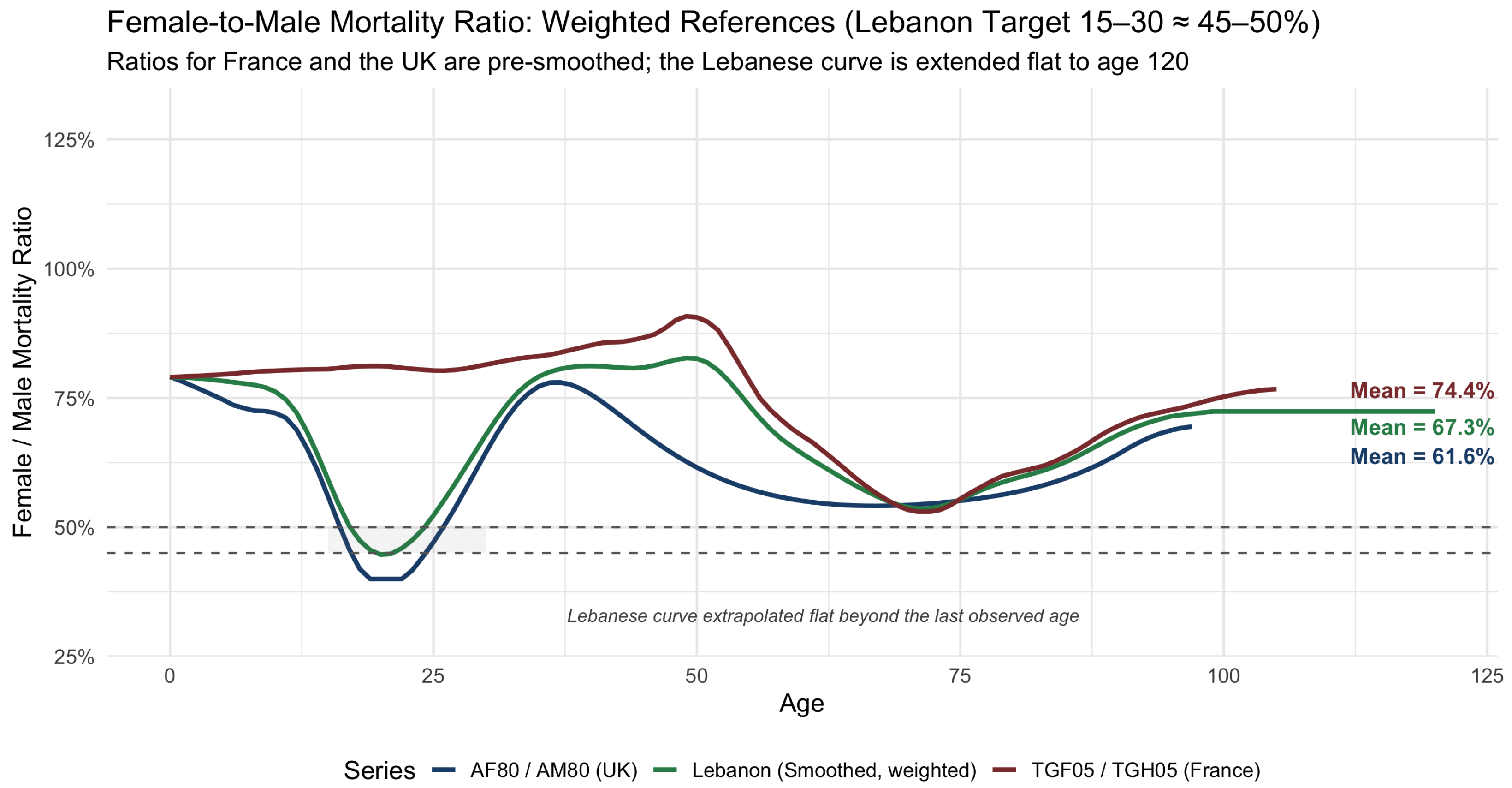
The AF80/AM80 ratios, derived from an insured population in the early 1980s, are characterized by pronounced gender differentials at younger adult ages, with female mortality falling below 50% of male mortality during adolescence and early adulthood, before stabilizing around 60% at later adult ages. This pattern reflects strong excess male mortality largely driven by behavioral and external causes. By contrast, the more recent TGF05/TGH05 ratios correspond to a more advanced longevity regime, with smoother age profiles and narrower gender gaps, especially at older ages (Figure 16).
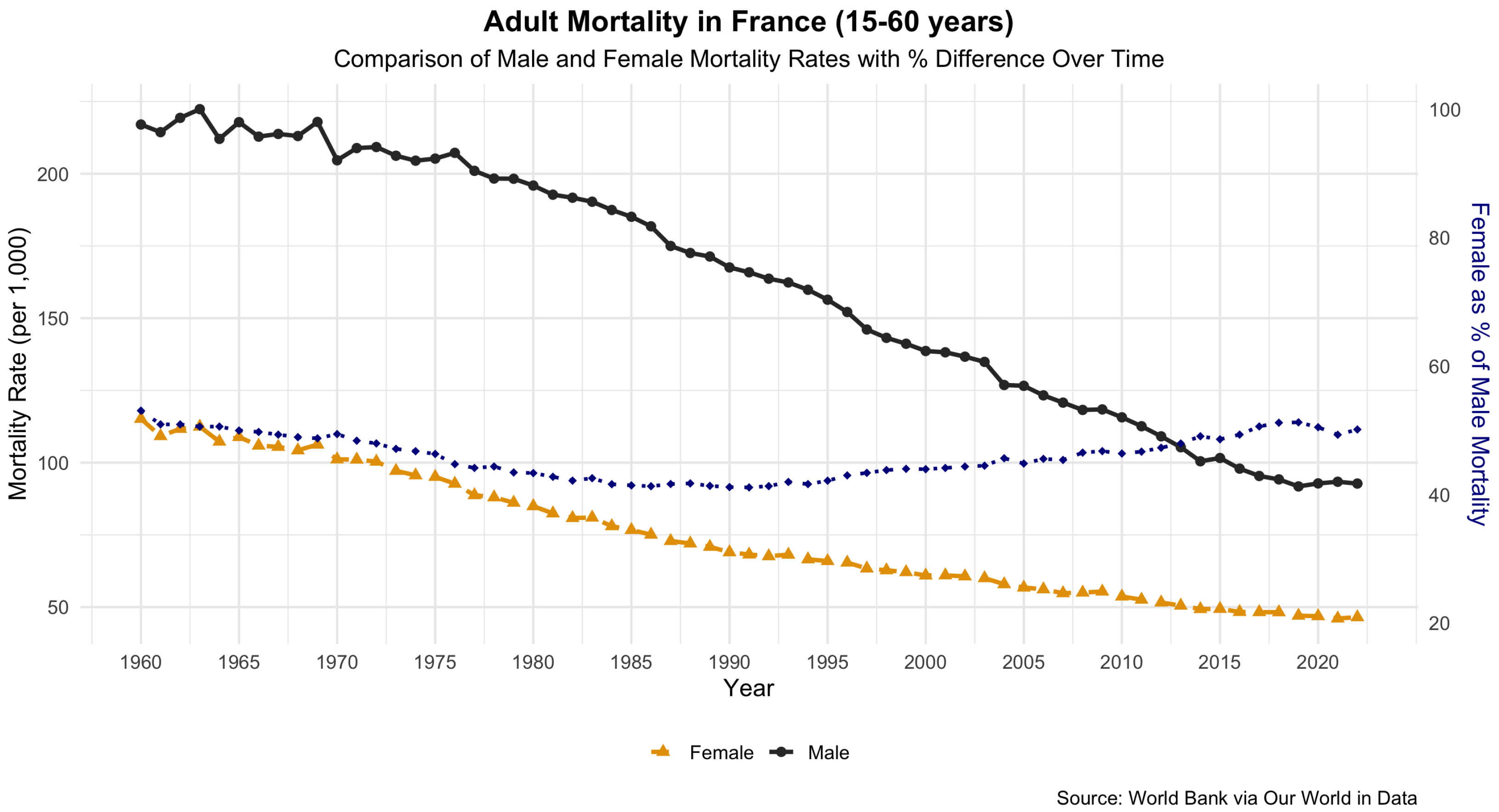
Beyond cross-country differences, long-term demographic evidence highlights the importance of the period at which gender mortality ratios are observed. As shown in Figure 17, male and female mortality rates in France have declined substantially since 1960, but at different paces. Faster relative improvements among men have led to a progressive narrowing of the gender mortality gap over time (INSEE 2024; Preston and Wang 2006). This asymmetric evolution implies that female-to-male mortality ratios are inherently period-dependent. Consequently, the differences observed between AF80/AM80 and TGF05/TGH05 primarily reflect distinct stages of demographic, behavioral, and epidemiological transition rather than purely cross-country effects. A similar, though attenuated, pattern is observed in insured populations (Milliman 2019).
Crucially, local Lebanese evidence confirms that neither international reference can be applied uniformly across all ages. National mortality data analyzed by Naja et al. (2025) for the period 2017–2022 show a pronounced excess of male mortality between ages 10 and 24, with men accounting for approximately 69% of all deaths compared to 31% among women. Given the near balance of the population by sex in this age group, these figures imply a female-to-male mortality ratio of approximately 45–50%, indicating that young men are about twice as likely to die as young women.
This pattern is epidemiologically coherent for Lebanon. National mortality statistics (Naja et al. 2025), together with the distribution of causes of death observed in the Lebanese insured population (Figure 8), indicate that external causes such as road traffic accidents, violence, and other injuries play a major role in early-adult mortality, particularly among men.
In contrast, published cause-of-death statistics for France reported in the World Health Organization Global Health Estimates show a substantially lower contribution of external causes to mortality at young adult ages, with deaths being predominantly driven by chronic and degenerative diseases (World Health Organization 2020). As a result, gender mortality differentials at young adult ages are structurally larger in Lebanon than those implied by the TGF05/TGH05 reference tables and are closer to the levels observed in the AF80/AM80 system.
At older ages, where mortality is increasingly driven by chronic and degenerative conditions, gender differentials are primarily shaped by longevity dynamics rather than external risks. In this age range, the French mortality profile becomes more representative, as the TGF05/TGH05 tables capture a mortality regime characterized by sustained longevity improvements and a progressive convergence between male and female mortality rates. This supports their relevance as a benchmark in later adulthood.
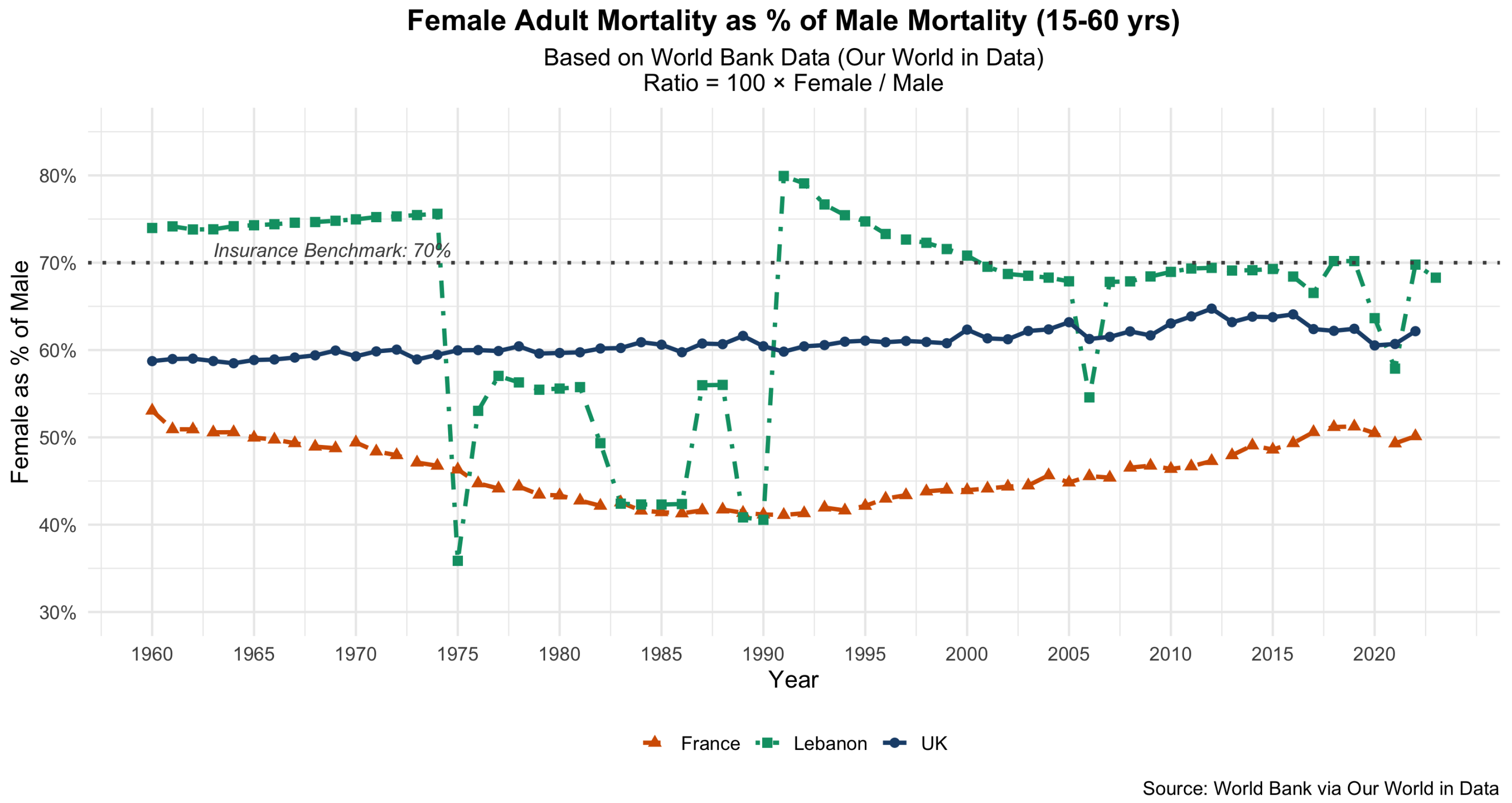
While age-specific patterns highlight the relevance of different reference systems at different stages of the life cycle, it is also informative to examine gender mortality differentials at an aggregate level. A broader international comparison further clarifies the empirical position of the commonly used 70% benchmark. As shown in Figure 18, female mortality in Lebanon has remained broadly between 60% and 70% of male mortality since 2000. A similarly stable range is observed in the United Kingdom over several decades, consistent with the AF80/AM80 calibration. In France, the female-to-male ratio in the general population declined markedly between the 1960s and the early 1990s before stabilizing around 45–50%, reflecting faster longevity gains among men. By contrast, the insured-life TGF05/TGH05 tables imply a higher average ratio (approximately 74.5%), consistent with the healthier and more affluent composition of insured populations and stronger selection effects. These comparisons confirm that the 70% benchmark is empirically plausible in aggregate while remaining sensitive to population type and historical period.
However, this age-specific relevance contrasts with current actuarial practice in Lebanon, where a constant female-to-male mortality ratio of 70% is commonly applied when female data are limited. While this benchmark is broadly consistent with the average magnitude of gender differentials observed in recent decades, it implicitly assumes that the ratio is stable across ages. Empirical evidence shows instead that gender differentials vary substantially over the life cycle, with pronounced excess male mortality at young adult ages and a gradual narrowing at older ages.
These elements indicate that neither AF80/AM80 nor TGF05/TGH05 alone provides a fully adequate representation of gender mortality differentials for the Lebanese insured population. The British ratios are more informative at younger adult ages, where mortality is strongly influenced by behavioral and external causes, whereas the French ratios better reflect mortality patterns at older ages within a longevity-driven regime. This motivates the use of an age-dependent hybrid approach rather than a single reference or a constant ratio. The final Lebanese female mortality curve was therefore constructed using an age-dependent weighted combination of the two reference systems. Greater weight was assigned to the UK AF80/AM80 ratios at younger adult ages, while the influence of the French TGF05/TGH05 ratios increases progressively with age. The resulting Lebanese ratio was smoothed to ensure biological continuity and held constant beyond the highest observed age to ensure proper closure of the life table.
Final female mortality rates were obtained by applying the smoothed Lebanese ratio to the male mortality curve at each age,
q x female = q x male × Ratio Lebanon , smoothed ,
thereby ensuring full internal consistency between male and female life tables.
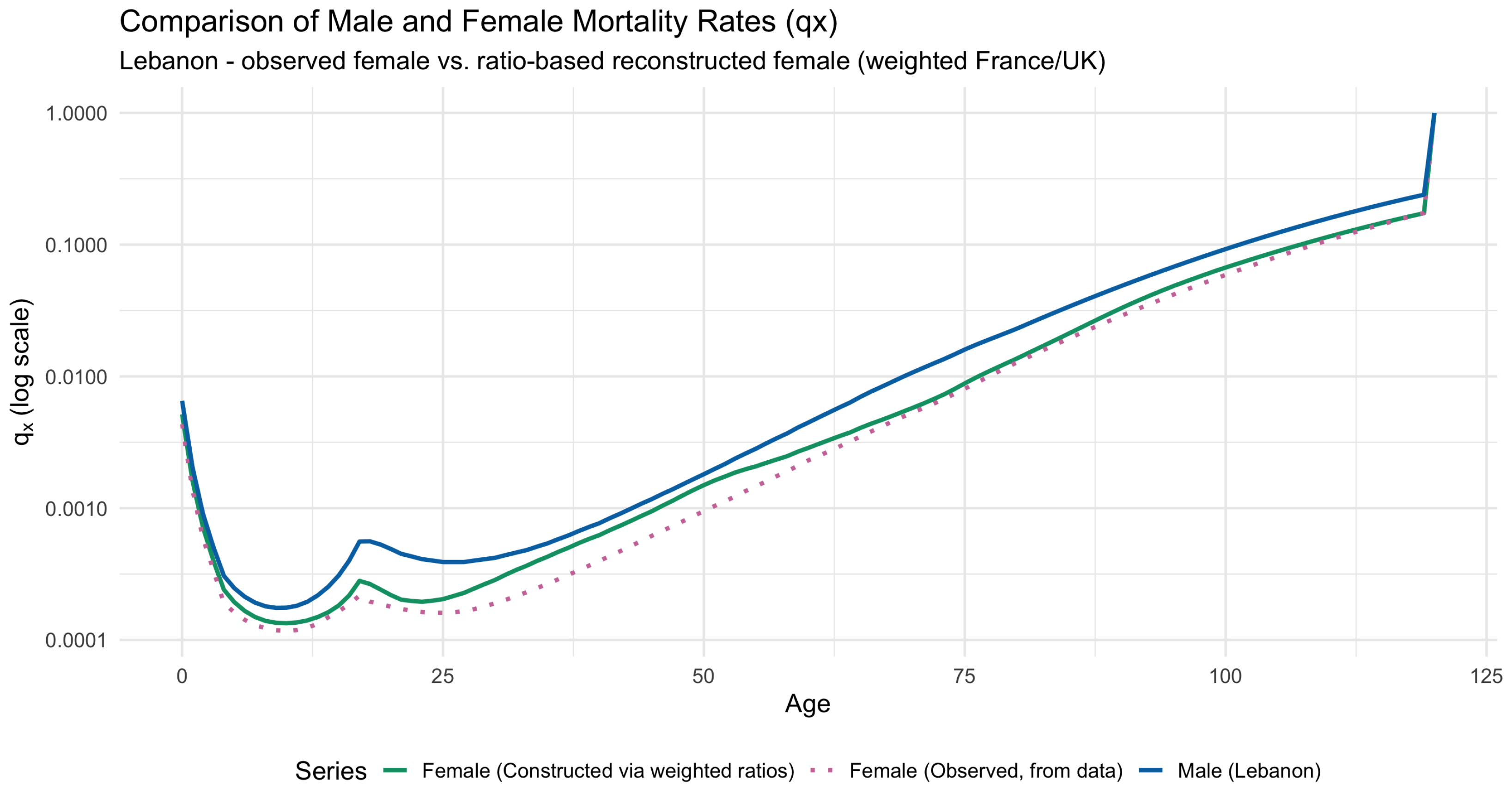
Figure 19 presents the reconstructed female mortality curve together with the male mortality curve and two alternative female estimates, all displayed on a logarithmic scale. The curve labeled ‘Female (Observed, from data)’ corresponds to the female mortality table constructed directly from the available insured female data using the same methodological framework as for males, including smoothing and extrapolation steps. The curve labeled ‘Female (Constructed via weighted ratios)’ represents the final ratio-based reconstruction, obtained by applying the age-dependent weighted female-to-male mortality ratios derived from the AF80/AM80 and TGF05/TGH05 reference systems to the male mortality curve.
Once age-specific insured mortality tables are constructed, population mortality is explored by recovering a realistic age pattern. This is achieved by applying age-specific insured-to-population mortality ratios observed in France. These ratios are used solely to transfer the age profile of mortality, while preserving the overall mortality level implied by the Lebanese insured data.
The resulting life expectancy at birth for the Lebanese male population ( e 0 = 79.12 years) is very close to external estimates for Lebanon, which report values around 78 years over the period 2015–2019 (World Bank 2024b).
A complete presentation of the resulting insured and population-based life tables for both males and females is provided in Appendix A.1 and Appendix A.3.

4. Impact of the Economic and Health Crises on Mortality and Insurance Dynamics

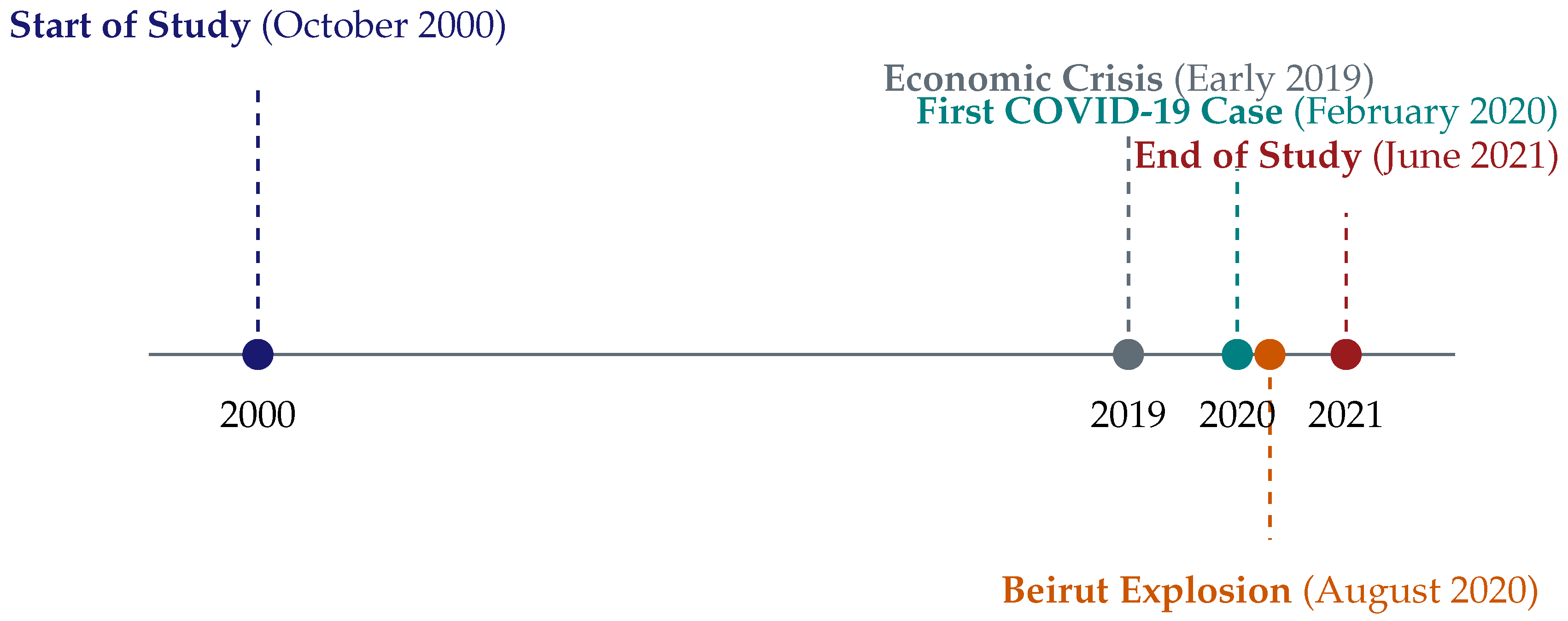
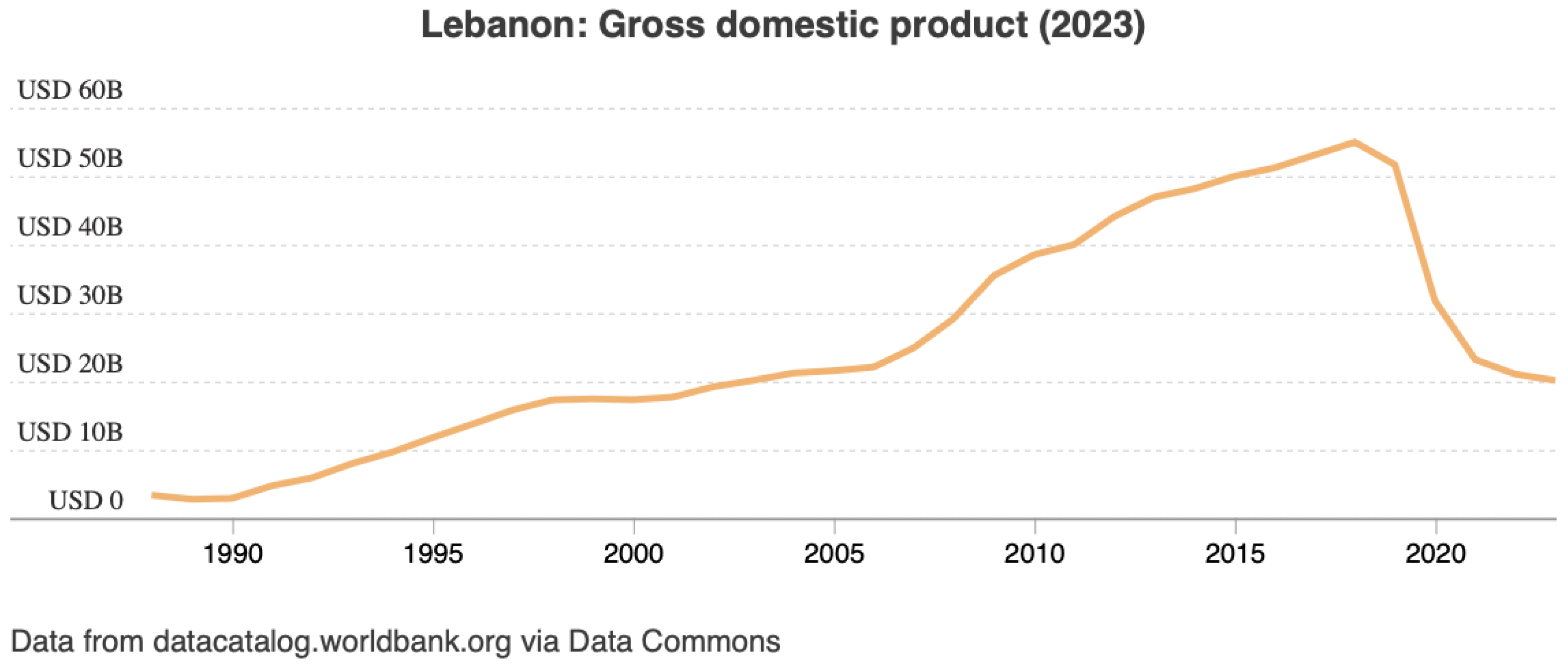
Lebanon experienced a sequence of major shocks between 2019 and 2021, including a severe economic collapse, the COVID-19 pandemic, and the Beirut port explosion. Figure 20 summarizes the timing of these events, while Figure 21 illustrates the sharp macroeconomic contraction following 2019. These shocks profoundly altered both the demographic environment and the functioning of the insurance market.
A central challenge when interpreting mortality indicators during this period is to disentangle genuine changes in mortality from mechanical effects induced by rapid contractions in insurance exposure. This section therefore examines portfolio dynamics, exposure evolution, and observed mortality jointly in order to provide a consistent actuarial interpretation of the crisis period.

4.1. Portfolio Disruptions, Exposure Dynamics, and Insurance Behaviour During the Crisis

Section 2 documents a decline in total insurance exposure prior to 2019, while annual death counts remained broadly stable, leading to rising insured mortality rates at the aggregate level. The present analysis refines this result by examining exposure dynamics by age interval in order to assess whether the change in risk profile observed for the portfolio as a whole is also reflected across age groups.
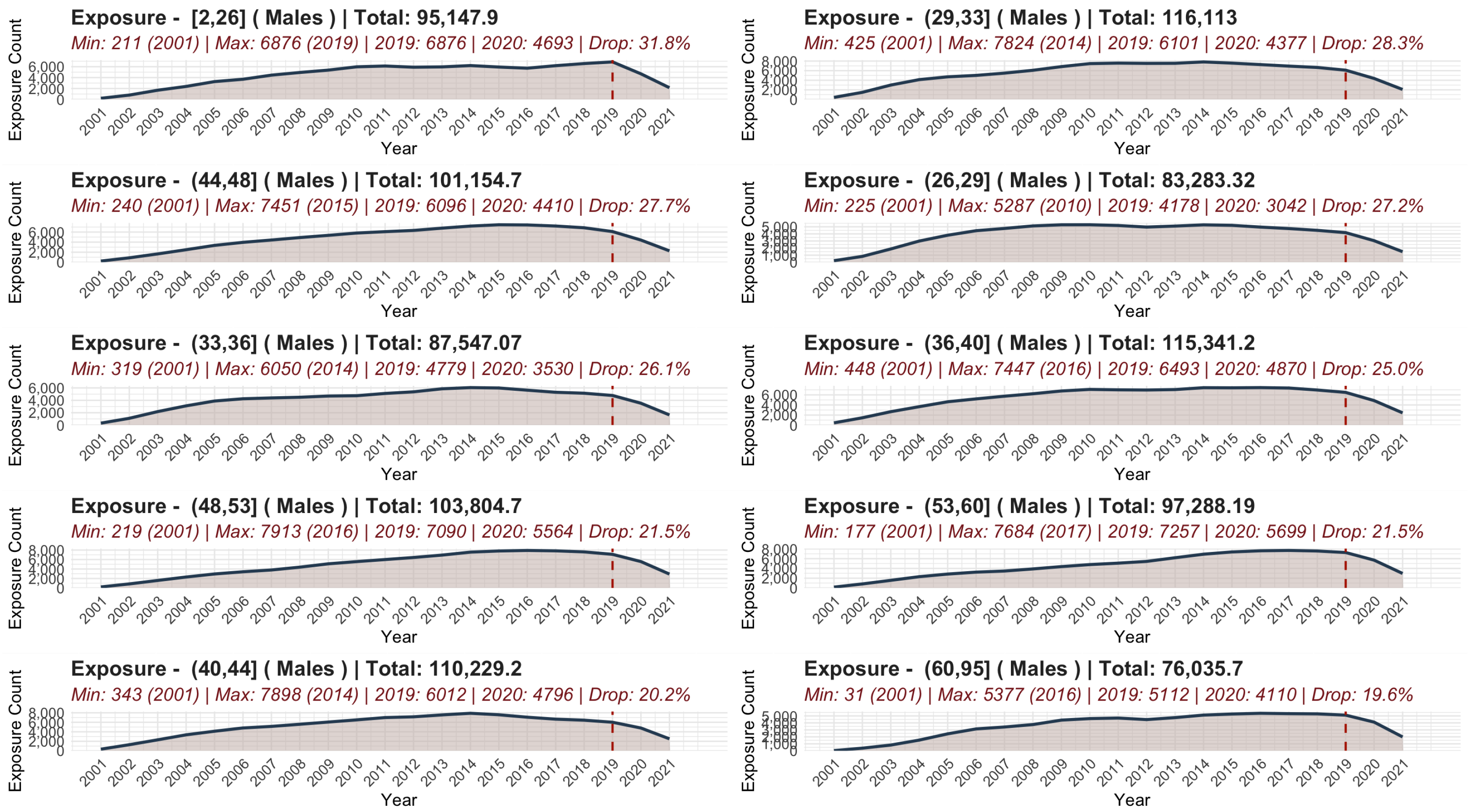
Figure 22 shows that exposure declined across all male age intervals, with markedly larger relative reductions among younger and middle-aged individuals (ages 2–26, 29–33, and 44–48), while older age groups (60–95) experienced more limited declines. This age-differentiated contraction is consistent with portfolio structure, where protection-type contracts are more prevalent and easier to discontinue at younger ages, whereas savings and mixed products exhibit greater persistence at older ages.
Despite the sharp contraction in exposure across age intervals, the annual number of recorded deaths remained relatively stable, fluctuating between approximately 100 and 130 per year. The increase in observed mortality rates after 2020 therefore reflects primarily the combined effect of exposure contraction and age-specific portfolio reallocation.
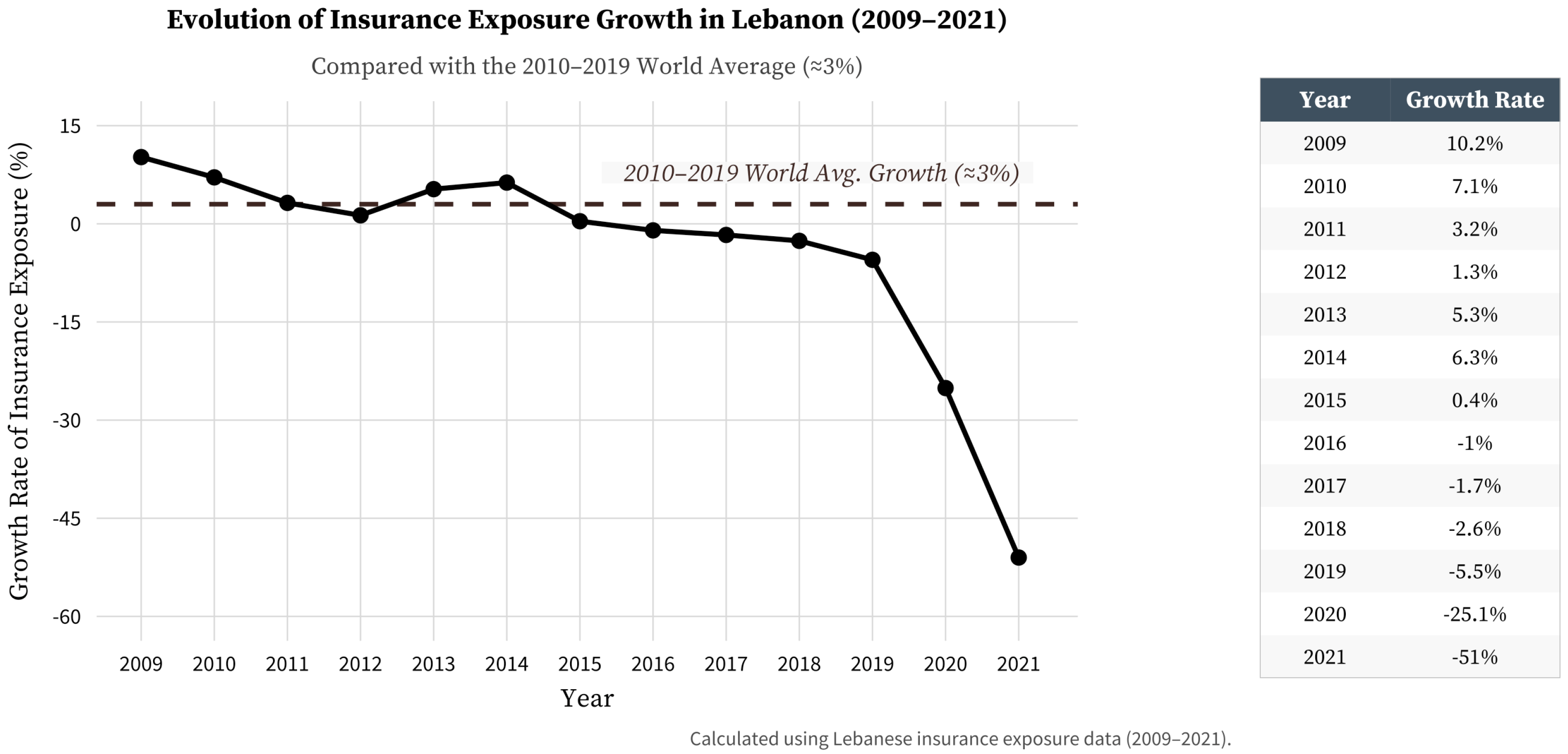
To place these portfolio disruptions in a broader context, insurance exposure dynamics are examined over a longer time horizon. Figure 23 shows that insurance exposure expanded moderately until the mid-2010s, stagnated thereafter, and declined sharply after 2019. Exposure fell by approximately 25% in 2020 and by more than 50% in 2021.
International evidence indicates that the contraction of insurance activity observed in 2020 was moderate at the global level. According to Swiss Re Institute data (Swiss Re Institute 2023), premium growth in 2020 declined by 1.8 % in advanced markets and by 2.4 % in emerging markets excluding China, while global premiums declined by 1.3 % . Over the same year, emerging markets as a whole recorded a modest positive growth of 0.8 % , driven primarily by China, where premium growth reached 3.6 % . The magnitude of the decline observed in the Lebanese insurance market therefore distinguishes it from the pandemic-related contractions recorded internationally.

4.2. Insured and Population Mortality Under Changing Conditions

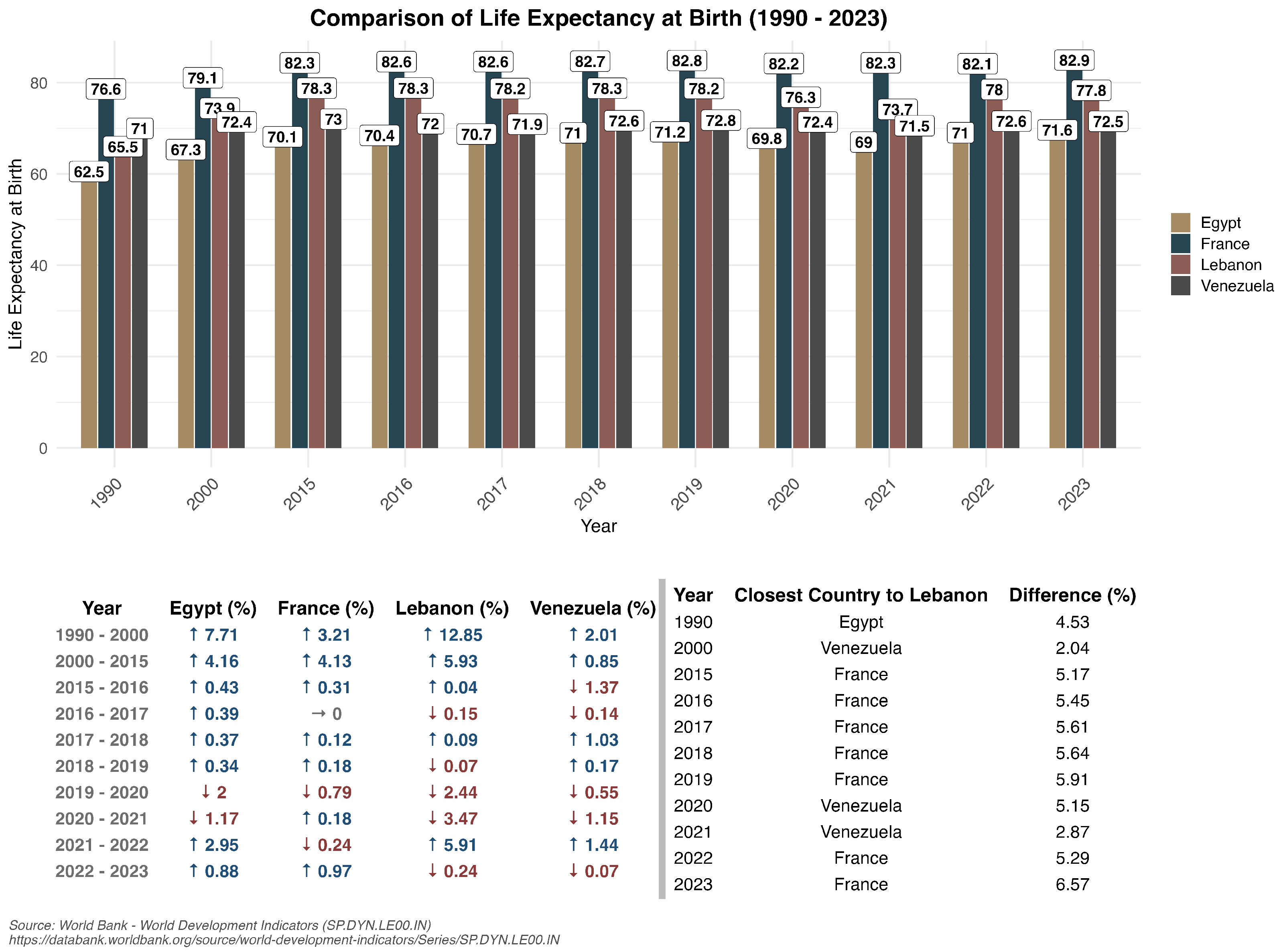
Economic and institutional conditions affect both population mortality and the composition of insured portfolios. A first aggregate perspective on this interaction is provided by national life expectancy at birth, which summarizes overall mortality conditions and their evolution over time. Figure 24 presents the evolution of life expectancy in Lebanon relative to France, Venezuela, and Egypt.
From 2015 to 2019, life expectancy in Lebanon remains relatively close to that of France, with a stable gap reflecting persistent demographic and institutional differences. Following the onset of the economic collapse and the COVID-19 shock, this pattern changes markedly. Lebanese life expectancy declines and converges toward levels observed in Venezuela, whose life expectancy remains close to 73 years over the period considered. This convergence indicates a change in the mortality regime and motivates a closer examination of mortality dynamics using complementary indicators.
While life expectancy provides a synthetic view of long-term mortality conditions, annual mortality rates offer complementary information by capturing short-term fluctuations and shock periods, for which conventional life table measures may be misleading (Alho 2025; Goldstein and Lee 2020; Luy et al. 2020).
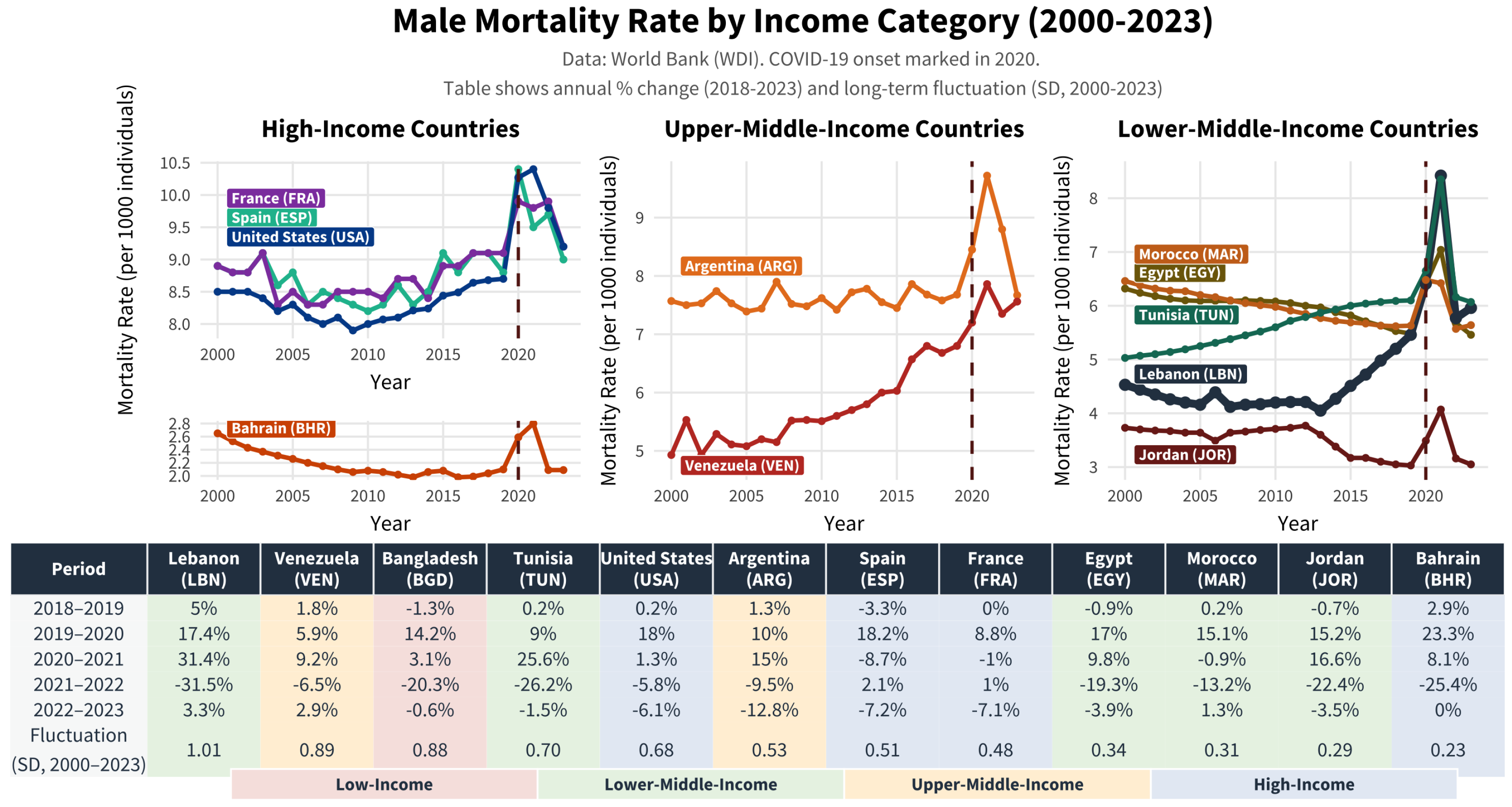
Figure 25 therefore compares male mortality rates between 2000 and 2023 across countries classified by income level.
Over the period 2000–2023, Lebanon exhibits the highest variability in annual male mortality, followed by Venezuela. During recent shock periods (2021), both countries reach comparable peaks of approximately eight deaths per 1000 individuals. This joint evidence complements the convergence observed in life expectancy and motivates further analysis of mortality patterns under crisis conditions.
Insurance data provide detailed mortality information by age for insured individuals, whereas population mortality is more commonly available in aggregated age formats. Insured mortality is therefore analysed using abridged five-year age intervals. The analysis is restricted to men due to insufficient exposure in the insured female portfolio. Five-year life tables are constructed for the Lebanese insured male population in line with standard demographic and actuarial practice (Preston et al. 2001; United Nations 1983). Internal consistency between abridged mortality rates and five-year probabilities reconstructed from annual age-specific q x estimates is confirmed by a low root mean squared error (RMSE = 0.095), indicating close agreement between the two representations.
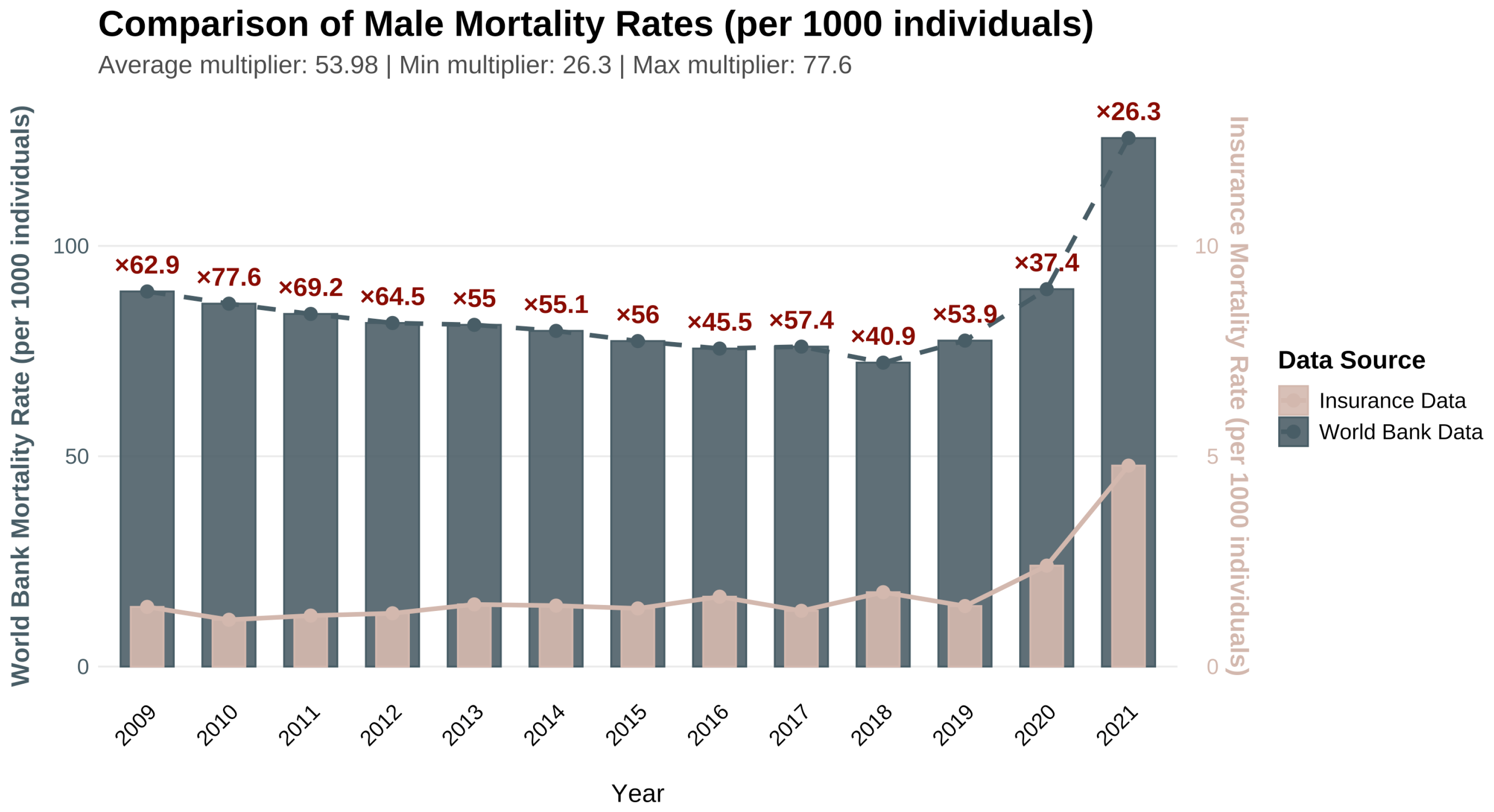
To examine how insured and population mortality evolve relative to one another over time, age-independent multipliers are derived from yearly ratios between Lebanese insured mortality and World Bank population mortality over the period 2009 to 2021. Ratios are computed over ages 15 to 59, where both insured exposure and population mortality data are considered statistically reliable. Figure 26 illustrates the temporal variability of these ratios.
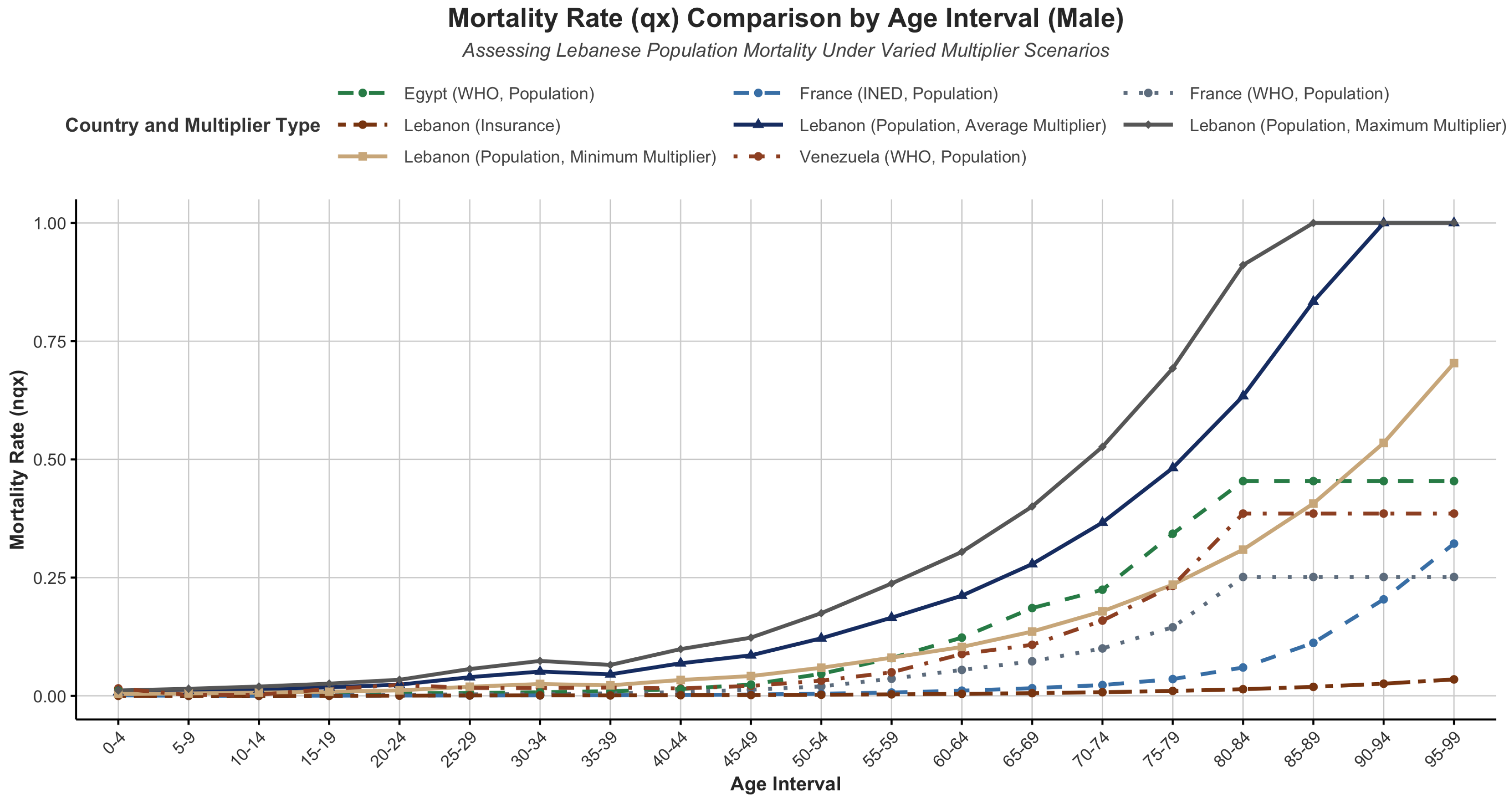
Three multiplier scenarios are retained to characterize the range of observed insured-to-population alignment conditions. The minimum scenario corresponds to crisis periods. The maximum scenario reflects earlier periods dominated by stronger selection effects. The average scenario represents an intermediate and deliberately conservative case. The median multiplier (55.1) is very close to the arithmetic mean (53.98) and does not provide additional information. Time-weighted approaches are not retained, as weighting recent or earlier years leads to values close to the minimum or maximum scenarios, respectively.
Applying these multipliers to interval-based insured mortality defines population mortality scenarios that are compared with international benchmarks (Figure 27). The crisis-related minimum scenario places Lebanese age-specific mortality at levels comparable to those observed in Venezuela, consistent with the convergence identified in life expectancy. The average scenario is associated with higher mortality levels, reflecting differences in insured-to-population alignment across economic regimes.
The validity of transposing yearly insured-to-population mortality ratios to age-specific mortality rates depends on the age structure and risk composition of the insured portfolio. In non-crisis periods, insured portfolios are predominantly composed of younger and lower-risk individuals, as documented in Section 2. Aggregate yearly ratios are therefore strongly influenced by portfolio composition and may distort mortality at older ages when applied uniformly.
During crisis periods, portfolio composition changes, with a relative increase in older and higher-risk insured individuals. In this context, annual insured mortality moves closer to population mortality, and the resulting ratios more closely reflect age-specific mortality patterns. For adult and older ages, the transposition becomes substantially more reliable.
Economic and institutional shocks substantially alter both population mortality and the composition of insured portfolios. In the Lebanese case, mortality dynamics exhibit pronounced volatility at the population level and are further amplified within insurance data through rapid changes in coverage, selection, and exposure. Variations in the insured risk profile therefore translate into marked changes in observed mortality and in the insured-to-population relationship.
This sensitivity is particularly pronounced in Lebanon, where insurance participation responds sharply to economic stress. During crisis periods, portfolio composition shifts toward older and higher-risk insured individuals, leading insured mortality to converge toward population mortality. As a result, transposition mechanisms that may appear stable in non-crisis contexts become highly dependent on prevailing socioeconomic conditions.
These findings underline that mortality estimation based on insurance data cannot be interpreted independently of portfolio dynamics and institutional context. In countries exposed to repeated economic shocks, such as Lebanon, mortality levels and trends are especially susceptible to abrupt and structurally significant fluctuations.

4.3. Scenario Testing and Actuarial Validation Under Crisis Conditions

To assess the actuarial implications of abrupt shifts in mortality dynamics observed within the Lebanese insured portfolio, the mortality table constructed in this study is evaluated through a multi-scenario sensitivity analysis. The objective is to quantify the impact of adverse mortality deviations on insurance valuations and to benchmark the resulting outcomes against commonly used international mortality references applied in the Lebanese market.
Four mortality scenarios are considered. The first scenario applies the TGH05 table (France, insured population, diagonal 2005) as a high-income insured reference. The second relies on the AM80 table (United Kingdom, insured lives, Duration 2+), which remains widely used in actuarial practice in Lebanon. The third scenario corresponds to the Lebanese mortality table developed in this study. The fourth scenario introduces a uniform mortality stress designed to reflect excess mortality observed during periods of severe economic and health disruption (Figure 28).
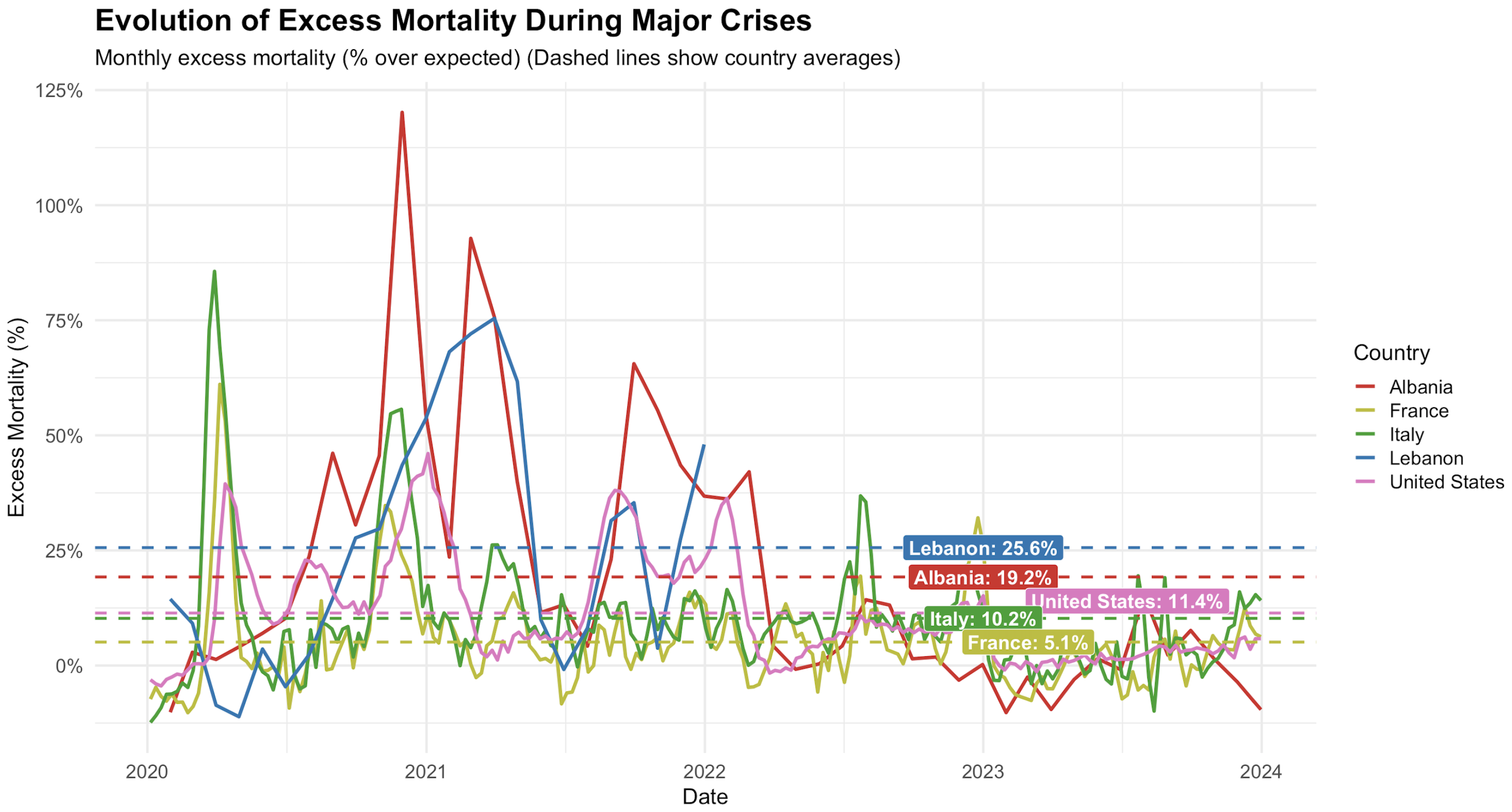
To translate observed crisis dynamics into an actuarial stress scenario, a uniform mortality increase of + 20 % is applied to the constructed Lebanese mortality table. As shown in Figure 28, excess mortality in Lebanon averaged approximately 25.6 % over the crisis period, a value partly driven by short-lived peaks associated with extreme events. From an international perspective, a 20 % stress corresponds to the upper range of excess mortality observed over prolonged crisis periods across the countries considered in this study and therefore represents a severe yet actuarially plausible adverse scenario.
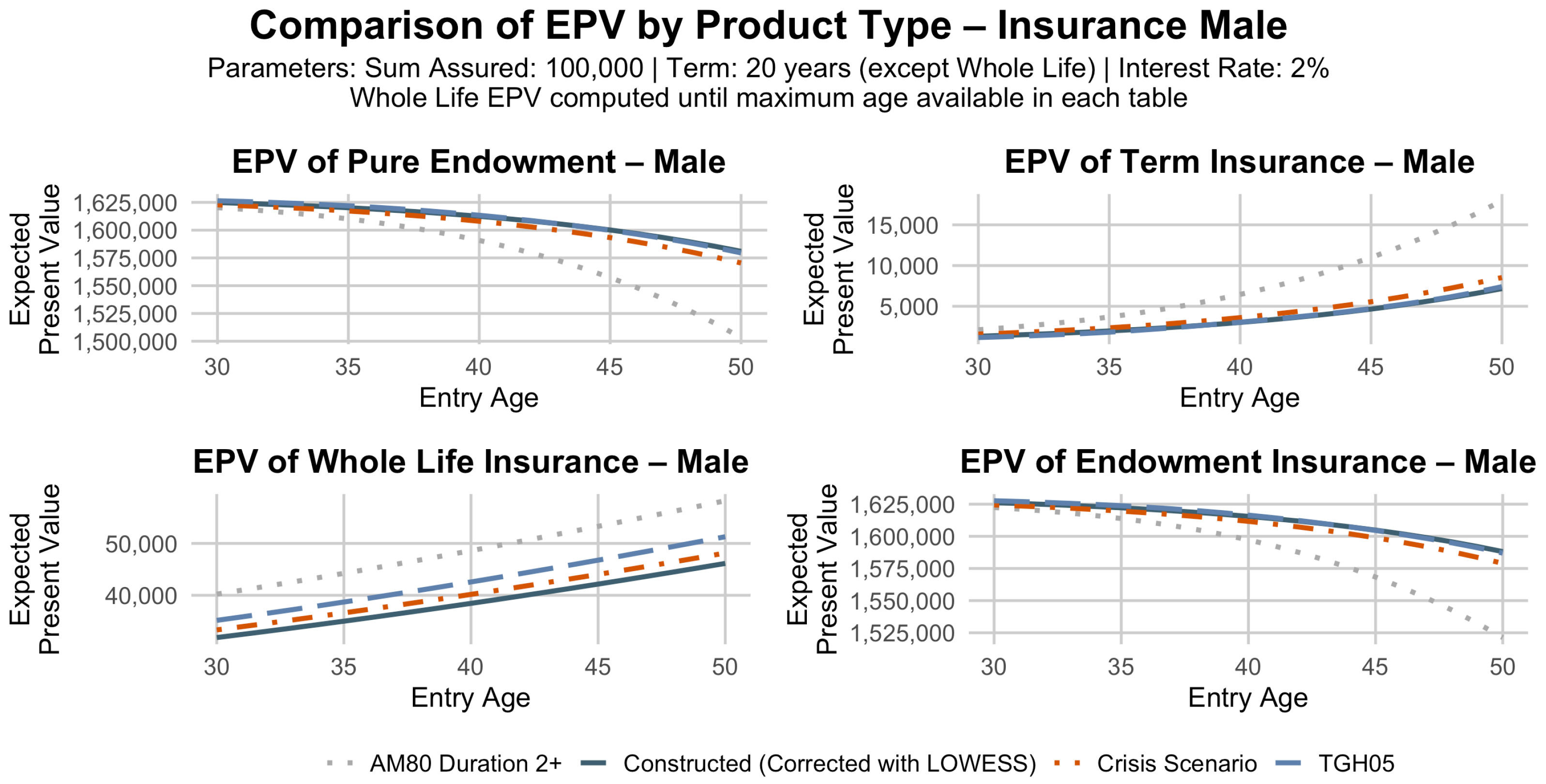
For each mortality scenario, expected present values (EPVs) are computed for four standard life insurance products: pure endowment, term insurance, whole life insurance, and endowment insurance. All valuations are performed assuming a constant annual interest rate of 2 % .
Adverse mortality conditions increase EPVs for products whose benefits are primarily triggered by death events, namely term insurance and whole life insurance, as higher mortality raises the expected frequency of benefit payments. Conversely, adverse mortality reduces EPVs for survival-oriented contracts such as pure endowment insurance, where benefits are paid only if the insured survives to maturity. Endowment insurance, which combines death and survival components, exhibits an intermediate response reflecting these opposing effects.
Figure 29 shows that across all products and entry ages, EPVs derived from the Lebanese mortality table remain close to those obtained under TGH05 and substantially less extreme than those implied by AM80. Even under the uniform crisis stress of + 20 % , valuation outcomes remain markedly closer to realistic actuarial benchmarks than to the values generated by legacy imported tables.
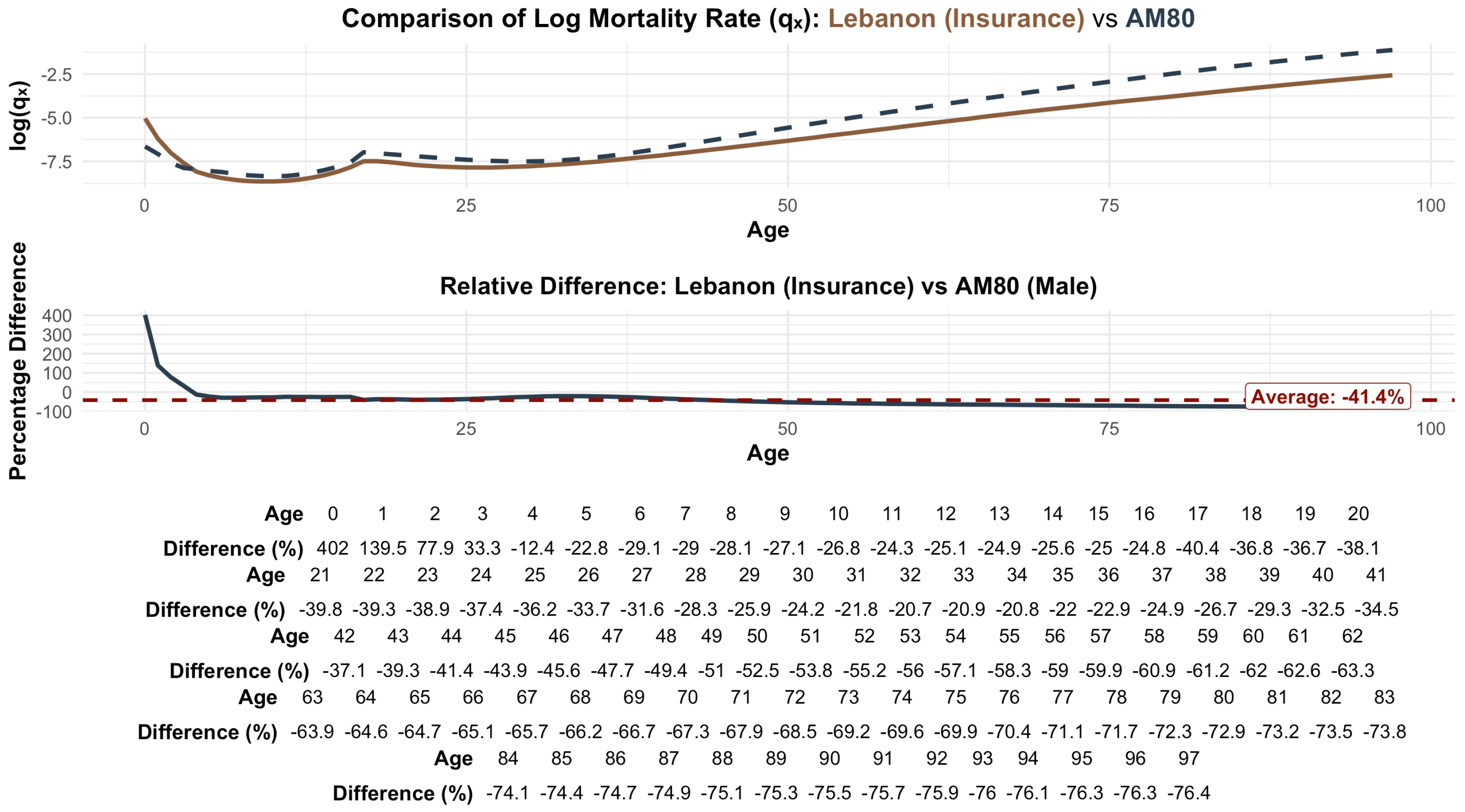
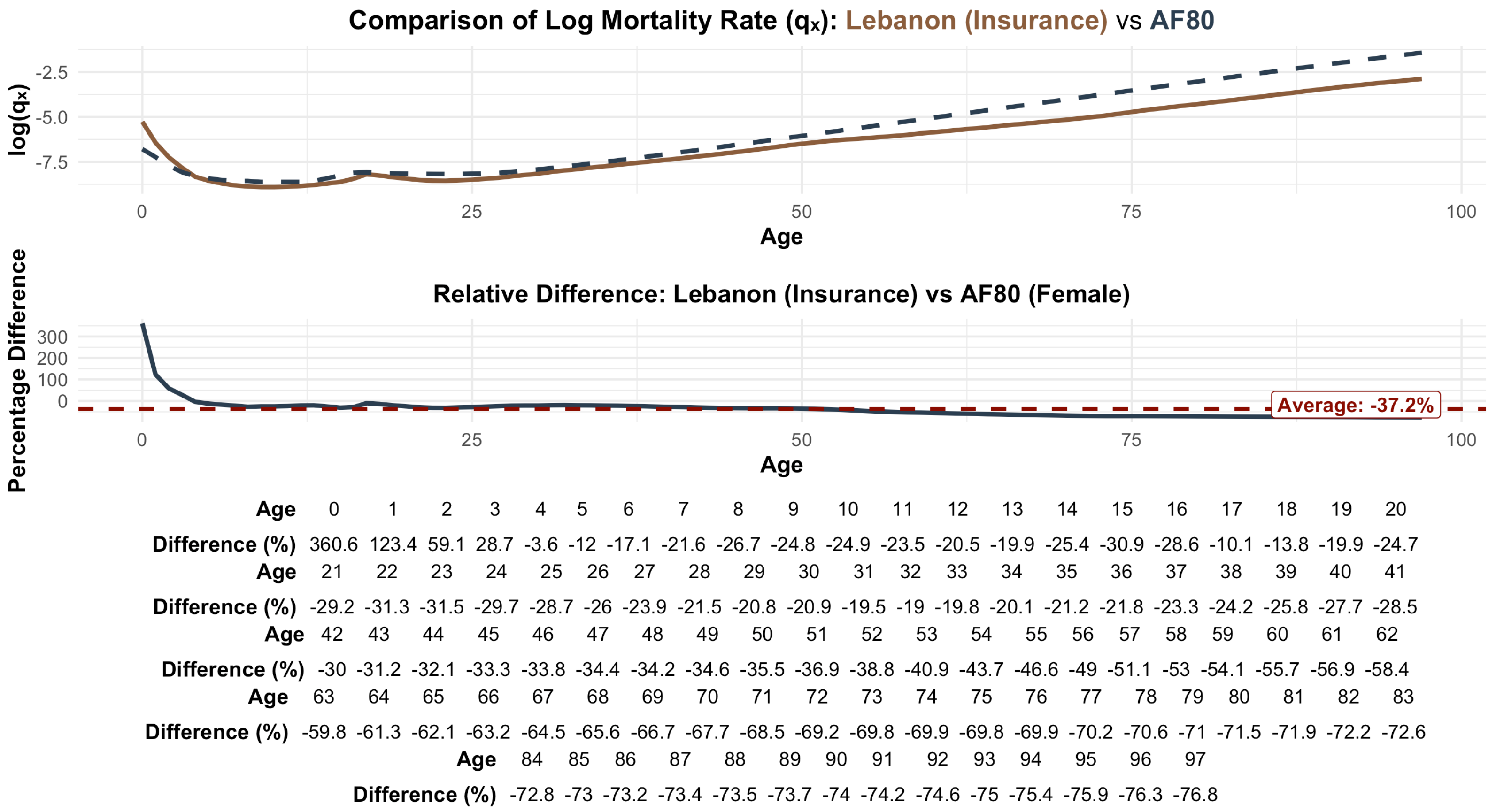
Age-specific comparisons further highlight structural discrepancies between imported mortality tables and the locally constructed Lebanese tables. Relative differences between AM80/AF80 and Lebanese mortality rates frequently exceed 20–30% at older ages (Figure 30 and Figure 31). These differences indicate that simple proportional adjustments applied to legacy tables fail to capture the true age profile of mortality in the Lebanese context.
Overall, the scenario analysis confirms that even under adverse crisis assumptions, the locally constructed Lebanese mortality table yields more realistic valuation patterns and smaller actuarial distortions than imported legacy references. This validates its suitability as a context-appropriate actuarial basis for pricing, reserving, and solvency assessment in an economy exposed to recurrent shocks.

5. Conclusions

This study addresses a structural gap in Lebanon: the absence of a locally constructed mortality table adapted to the country’s demographic, institutional, and data environment. This gap stems from the structural constraints faced by a small country with limited statistical infrastructure, including the absence of a recent census, incomplete vital registration systems, and fragmented mortality data.
In this setting, actuarial practice in Lebanon has traditionally relied on imported mortality references, such as the AM80 table developed in the United Kingdom in 1980 for insured populations with markedly different demographic, epidemiological, and institutional characteristics. While such tables provide a convenient benchmark, their application in the Lebanese context may lead to distortions in pricing, reserving, and long-term financial planning when population structure and mortality dynamics differ substantially.
As emphasized in the literature, accurate mortality measurement is not a marginal technical adjustment but a central component of fair premium calculation, sustainable pension systems, and informed public health and social policy (Murray and Lopez 1997). In this light, the development of a Lebanon-specific mortality reference represents a necessary step toward strengthening the robustness and coherence of actuarial and demographic analyses in the country.
Against this background, harmonized insurance data constitute one of the few available sources of longitudinal and internally consistent mortality information in Lebanon. By mobilizing more than two decades of insured-life data, this study constructs an actuarially coherent mortality reference designed to operate under conditions of data scarcity, sparse exposure, and strong selection effects. The objective of the construction phase is to establish a stable and methodologically sound baseline reflecting observed insured experience.
A key contribution of this work lies in the development of an estimation framework capable of producing reliable age-specific mortality rates despite these structural limitations. The Sample Weighted Average (SWA) approach combines complementary smoothing techniques and adapts locally to exposure density while ensuring demographic coherence across ages. Old-age mortality is extrapolated using the Coale–Kisker method, and early-age mortality is corrected through external calibration to preserve biological and epidemiological plausibility. Female mortality is reconstructed using an age-dependent ratio-based approach reflecting empirically observed gender differentials.
The resulting insured life tables form a coherent actuarial reference that is internally consistent, demographically plausible, and suitable for pricing, reserving, and solvency analysis. Their construction relies on observed insured experience corrected for known data limitations and selection mechanisms, and provides a stable baseline for actuarial applications.
Building on this baseline, the analysis then examines how economic and health shocks affect mortality measurement through their impact on insurance portfolio composition. The economic collapse and the COVID-19 pandemic are analyzed as stress episodes that reveal the sensitivity of insured mortality to abrupt changes in coverage, selection, and exposure.
During such periods, insurance participation contracts sharply and portfolio composition shifts toward older and higher-risk insured individuals. As a result, insured mortality rates become highly volatile and move closer to population mortality, even when absolute death counts remain relatively stable. These dynamics indicate that changes in observed insured mortality may be driven primarily by portfolio effects rather than by underlying demographic shifts alone.
Population mortality is therefore explored through scenario-based approaches designed to assess how insured-to-population alignment varies across economic and institutional regimes. Multiplier scenarios and age-specific adjustments provide interpretable representations of population mortality under different conditions, while preserving coherence with observed Lebanese insured experience.
From an actuarial perspective, the results highlight the central role of risk-profile composition in mortality modeling. Variations in underwriting practices, coverage persistence, and socioeconomic selection translate directly into changes in observed insured mortality levels. In environments exposed to recurrent instability, such as Lebanon, these effects are amplified, which makes the use of locally constructed and regularly calibrated mortality references for insured populations essential.
Beyond the Lebanese case, this study offers methodological insights for mortality modeling in small countries characterized by incomplete statistical systems. It provides a structured framework for constructing actuarially sound mortality tables from insured experience when comprehensive population mortality data are unavailable, provided that data limitations and selection effects are explicitly addressed.
The analysis further highlights that crisis effects on mortality operate through two distinct but interacting channels. First, economic stress directly affects insurance participation, leading to sharp contractions in exposure and changes in portfolio composition that amplify selection effects and mortality volatility. Second, concurrent pressures on the health system may affect population health outcomes, reinforcing observed mortality dynamics. From an actuarial perspective, this dual mechanism underscores the importance of stress-testing premiums, reserves, and long-term liabilities under adverse scenarios, using locally constructed mortality tables as a stable reference.
This work establishes a robust and actuarially coherent mortality baseline for the Lebanese insured population. Building on this foundation, a first consistent estimation of population mortality is obtained by combining insured experience with external insured-to-population ratios derived from French references. The resulting tables provide a durable reference for actuarial practice, demographic analysis, and policy evaluation in a country exposed to recurrent economic and institutional shocks.


Author Contributions

Conceptualization, N.B.S., S.L., G.M. and Y.S.; Methodology, N.B.S., S.L., G.M. and Y.S.; Software, N.B.S.; Validation, S.L., G.M. and Y.S.; Formal analysis, N.B.S.; Investigation, N.B.S.; Resources, N.B.S., S.L., G.M. and Y.S.; Data curation, N.B.S.; Writing—original draft, N.B.S.; Writing—review and editing, N.B.S., S.L., G.M. and Y.S.; Visualization, N.B.S.; Supervision, S.L., G.M. and Y.S. All authors have read and agreed to the published version of the manuscript.

Funding

This research received no external funding.

Institutional Review Board Statement

Not applicable.

Informed Consent Statement

Not applicable.

Data Availability Statement

The data presented in this study are available on request from the corresponding author. The data are not publicly available due to privacy and confidentiality restrictions imposed by the insurance companies providing the raw data.

Acknowledgments

G. Mansour and N. Bou Sakr gratefully acknowledge the Lebanese insurance companies and insurers who provided the dataset and requested anonymity for confidentiality reasons. S. Loisel and Y. Salhi thank the research chair ACTIONS sponsored by BNP Paribas as well as the JRI initiative on longevity models and changepoint detection; S. Loisel thanks the Milliman research initiative “IAAA” for partial support. The authors and sponsors underpin the fact that the illustrations provided in the research paper would need to be complemented with actuarial professionalism before use in the industry or for regulation purposes.

Conflicts of Interest

The authors declare no conflicts of interest.

Appendix A. Final Life Tables by Gender and Population Type

This appendix presents the final Lebanese life tables, disaggregated by gender and population type (insured versus general population). Mortality rates were corrected, smoothed, and extrapolated following the actuarial framework described in the previous sections. The insured tables are derived from aggregated insurance company data, while population-level tables are obtained through demographic adjustments designed to ensure coherence with external mortality benchmarks. All tables follow standard actuarial notation and report age-specific mortality, survival, exposure, and life expectancy functions.
The insured mortality tables constructed in this study are based on data pooled across multiple insurance companies operating in Lebanon. They therefore reflect the average mortality experience and socioeconomic composition of the Lebanese insured market as a whole, rather than that of any single insurer.
In actuarial applications, mortality tables serve as reference bases whose use requires calibration to the characteristics of the insurer’s own portfolio, including underwriting standards and socioeconomic composition. Empirical evidence shows that mortality levels and age profiles vary systematically across insured portfolios due to selection and socioeconomic effects. Villegas and Haberman (2014) demonstrate that incorporating socioeconomic and geodemographic information improves mortality modelling for insured lives, while Ridsdale and Gallop (2010) document a persistent socioeconomic gradient in mortality. Richards (2008) further highlight the material impact of portfolio characteristics on observed mortality experience. Portfolio-specific calibration prior to operational use thus follows standard actuarial practice.

Appendix A.1. Insurance-Based Life Tables

Table A1. Final life table—Lebanese male insured population.
Life Table—Lebanese Male Insured Population (Annual Intervals)
Age Group Mortality Rate q x Survival Probability p x = 1 q x Survivors l x = l x 1 p x 1 Deaths d x = l x q x Person-Years Lived L x = l x 1 2 d x Total Person-Years Lived (Cumulative) T x = y x L y Life Expectancy e x = T x / l x
00.00650.9935100,000652.5999,673.718,834,162.1988.34
10.00200.998099,347202.2299,246.318,734,488.4887.92
20.00090.999199,14589.9699,100.228,635,242.1787.10
30.00050.999599,05550.1899,030.148,536,141.9586.18
40.00030.999799,00530.3598,989.888,437,111.8185.22
50.00020.999898,97524.4698,962.478,338,121.9384.24
60.00020.999898,95021.0498,939.718,239,159.4783.27
70.00020.999898,92918.9698,919.728,140,219.7582.28
80.00020.999898,91017.7898,901.348,041,300.0481.30
90.00020.999898,89217.3198,883.807,942,398.6980.31
100.00020.999898,87517.3698,866.467,843,514.8979.33
110.00020.999898,85817.9698,848.807,744,648.4378.34
120.00020.999898,84019.2598,830.207,645,799.6377.36
130.00020.999898,82121.5398,809.817,546,969.4376.37
140.00030.999798,79924.9998,786.557,448,159.6275.39
150.00030.999798,77430.3998,758.867,349,373.0774.41
160.00040.999698,74439.3798,723.987,250,614.2173.43
170.00060.999498,70455.0898,676.767,151,890.2272.46
180.00060.999498,64955.2498,621.607,053,213.4671.50
190.00050.999598,59452.2598,567.856,954,591.8670.54
200.00050.999598,54248.2998,517.586,856,024.0169.57
210.00050.999698,49344.3298,471.286,757,506.4368.61
220.00040.999698,44942.3398,427.956,659,035.1567.64
230.00040.999698,40740.3598,386.616,560,607.2066.67
240.00040.999698,36639.3598,346.766,462,220.5965.70
250.00040.999698,32738.3598,307.926,363,873.8364.72
260.00040.999698,28938.3398,269.586,265,565.9263.75
270.00040.999698,25038.3298,231.256,167,296.3462.77
280.00040.999698,21239.2898,192.456,069,065.0961.80
290.00040.999698,17340.2598,152.685,970,872.6460.82
300.00040.999698,13341.2298,111.955,872,719.9659.84
310.00040.999698,09143.1698,069.765,774,608.0158.87
320.00050.999598,04845.1098,025.635,676,538.2557.90
330.00050.999598,00347.0497,979.565,578,512.6356.92
340.00050.999597,95649.9697,931.065,480,533.0755.95
350.00050.999597,90652.8797,879.645,382,602.0154.98
360.00060.999497,85356.7597,824.835,284,722.3754.01
370.00060.999497,79660.6397,766.145,186,897.5353.04
380.00070.999397,73665.4897,703.085,089,131.4052.07
390.00070.999397,67070.3297,635.184,991,428.3251.10
400.00080.999297,60075.1597,562.444,893,793.1450.14
410.00080.999297,52581.9297,483.904,796,230.7049.18
420.00090.999197,44388.6797,398.614,698,746.8048.22
430.00100.999097,35496.3897,306.084,601,348.1947.26
440.00110.998997,258105.0497,205.374,504,042.1246.31
450.00120.998897,153113.6797,096.024,406,836.7545.36
460.00130.998797,039124.2196,977.084,309,740.7344.41
470.00140.998696,915134.7196,847.614,212,763.6643.47
480.00150.998596,780147.1196,706.714,115,916.0442.53
490.00170.998396,633160.4196,552.954,019,209.3341.59
500.00180.998296,473174.6296,385.433,922,656.3940.66
510.00200.998096,298190.6796,202.793,826,270.9539.73
520.00220.997896,107207.5996,003.663,730,068.1638.81
530.00240.997695,900228.2495,785.743,634,064.5037.89
540.00260.997495,672248.7595,547.253,538,278.7636.98
550.00280.997295,423270.0595,287.853,442,731.5136.08
560.00310.996995,153295.9395,004.873,347,443.6635.18
570.00340.996694,857322.5194,695.653,252,438.7934.29
580.00370.996394,534349.7894,359.503,157,743.1433.40
590.00410.995994,185385.2293,992.013,063,383.6432.53
600.00450.995593,799418.3593,590.232,969,391.6431.66
610.00490.995193,381455.7093,153.202,875,801.4130.80
620.00530.994792,925495.2992,677.712,782,648.2129.94
630.00580.994292,430537.9492,161.092,689,970.5029.10
640.00630.993791,892581.6891,601.282,597,809.4128.27
650.00700.993091,310638.5690,991.162,506,208.1327.45
660.00770.992390,672694.2490,324.752,415,216.9726.64
670.00830.991789,978748.6189,603.332,324,892.2225.84
680.00910.990989,229808.4188,824.812,235,288.8925.05
690.00990.990188,421872.7187,984.252,146,464.0824.28
700.01070.989387,548937.6487,079.072,058,479.8323.51
710.01160.988486,6101003.8186,108.351,971,400.7622.76
720.01250.987585,6061072.6585,070.121,885,292.4122.02
730.01350.986584,5341142.9083,962.341,800,222.2921.30
740.01470.985383,3911224.1882,778.811,716,259.9520.58
750.01600.984082,1671313.5781,509.931,633,481.1419.88
760.01730.982780,8531398.2280,154.041,551,971.2119.19
770.01860.981479,4551477.8678,715.991,471,817.1818.52
780.02000.980077,9771557.2077,198.461,393,101.1817.87
790.02150.978676,4201639.2175,600.261,315,902.7217.22
800.02310.977074,7811723.6973,918.811,240,302.4616.59
810.02490.975173,0571822.4272,145.751,166,383.6515.97
820.02700.973071,2351921.1370,273.981,094,237.9015.36
830.02910.970969,3132018.9868,303.921,023,963.9214.77
840.03140.968667,2942114.9866,236.94955,660.0014.20
850.03390.966165,1792208.0864,075.42889,423.0613.65
860.03650.963562,9712297.1661,822.79825,347.6413.11
870.03920.960860,6742381.0159,483.71763,524.8512.58
880.04220.957858,2932458.3957,064.00704,041.1412.08
890.04530.954755,8352528.0154,570.80646,977.1411.59
900.04860.951453,3072588.5952,012.50592,406.3311.11
910.05200.948050,7182638.8649,398.77540,393.8310.65
920.05570.944348,0792677.6246,740.53490,995.0610.21
930.05960.940445,4022703.7544,049.84444,254.539.78
940.06360.936442,6982716.2641,339.83400,204.699.37
950.06790.932139,9822714.3238,624.54358,864.858.98
960.07240.927637,2672697.3035,918.74320,240.318.59
970.07710.922934,5702664.8233,237.68284,321.578.22
980.08200.918031,9052616.7530,596.89251,083.897.87
990.08720.912829,2892553.2628,011.89220,487.007.53
1000.09260.907426,7352474.8325,497.85192,475.117.20
1010.09820.901824,2602382.2623,069.30166,977.266.88
1020.10410.895921,8782276.6520,739.85143,907.956.58
1030.11020.889819,6022159.4218,521.82123,168.116.28
1040.11650.883517,4422032.2316,426.00104,646.296.00
1050.12310.876915,4101896.9914,461.3988,220.305.72
1060.12990.870113,5131755.7912,635.0073,758.915.46
1070.13700.863011,7571610.8210,951.7061,123.905.20
1080.14430.855710,1461464.349414.1250,172.204.94
1090.15190.848186821318.588022.6540,758.094.69
1100.15970.840373631175.686775.5232,735.434.45
1110.16770.832361881037.595668.8925,959.914.20
1120.17590.82415150906.084697.0520,291.023.94
1130.18440.81564244782.613852.7115,593.973.67
1140.19310.80693461668.353127.2311,741.263.39
1150.20200.79802793564.132510.998614.033.08
1160.21110.78892229470.451993.706103.042.74
1170.22030.77971758387.471564.744109.352.34
1180.22980.77021371315.051213.482544.601.86
1190.23940.76061056252.81929.551331.121.26
1201.00000.0000803803.14401.57401.570.50
Table A2. Final life table—Lebanese female insured population.
Life Table—Lebanese Female Insured Population (Annual Intervals)
Age Group Mortality Rate q x Survival Probability p x = 1 q x Survivors l x = l x 1 p x 1 Deaths d x = l x q x Person-Years Lived L x = l x 1 2 d x Total Person-Years Lived (Cumulative) T x = y x L y Life Expectancy e x = T x / l x
00.00520.9948100,000515.8399,742.099,420,321.0994.20
10.00160.998499,484159.9999,404.189,320,579.0093.69
20.00070.999399,32471.1399,288.629,221,174.8292.84
30.00040.999699,25339.6199,233.259,121,886.2091.91
40.00020.999899,21323.9099,201.499,022,652.9590.94
50.00020.999899,19019.2199,179.948,923,451.4589.96
60.00020.999899,17016.4599,162.118,824,271.5188.98
70.00010.999999,15414.7899,146.508,725,109.4088.00
80.00010.999999,13913.8199,132.208,625,962.9087.01
90.00010.999999,12513.4199,118.598,526,830.7086.02
100.00010.999999,11213.4099,105.188,427,712.1185.03
110.00010.999999,09813.6499,091.678,328,606.9384.04
120.00010.999999,08514.1999,077.758,229,515.2683.06
130.00020.999899,07115.0799,063.138,130,437.5182.07
140.00020.999899,05616.2699,047.468,031,374.3881.08
150.00020.999899,03917.7999,030.437,932,326.9380.09
160.00020.999899,02221.2099,010.937,833,296.5079.11
170.00030.999799,00027.2498,986.717,734,285.5678.12
180.00030.999798,97325.4198,960.387,635,298.8577.15
190.00020.999898,94823.1498,936.117,536,338.4776.16
200.00020.999898,92521.3898,913.857,437,402.3675.18
210.00020.999898,90319.8198,893.257,338,488.5174.20
220.00020.999898,88319.0998,873.807,239,595.2673.21
230.00020.999898,86418.9598,854.787,140,721.4672.23
240.00020.999898,84519.5298,835.557,041,866.6771.24
250.00020.999898,82620.0798,815.756,943,031.1370.26
260.00020.999898,80621.2198,795.116,844,215.3769.27
270.00020.999898,78522.3998,773.316,745,420.2668.28
280.00020.999898,76224.2598,749.996,646,646.9567.30
290.00030.999798,73826.1998,724.776,547,896.9666.32
300.00030.999798,71228.1798,697.596,449,172.1865.33
310.00030.999798,68430.9998,668.016,350,474.5964.35
320.00030.999798,65333.7398,635.656,251,806.5863.37
330.00040.999698,61936.3098,600.636,153,170.9362.39
340.00040.999698,58239.4098,562.786,054,570.3061.42
350.00040.999698,54342.3598,521.915,956,007.5260.44
360.00050.999598,50145.8998,477.795,857,485.6159.47
370.00050.999598,45549.3098,430.205,759,007.8258.49
380.00050.999598,40653.4598,378.825,660,577.6257.52
390.00060.999498,35257.5298,323.345,562,198.8056.55
400.00060.999498,29561.5998,263.785,463,875.4655.59
410.00070.999398,23367.0598,199.455,365,611.6954.62
420.00070.999398,16672.3198,129.775,267,412.2353.66
430.00080.999298,09478.3498,054.455,169,282.4652.70
440.00090.999198,01585.3197,972.625,071,228.0151.74
450.00090.999197,93092.4097,883.764,973,255.3950.78
460.00100.999097,838101.3097,786.914,875,371.6349.83
470.00110.998997,736110.9097,680.814,777,584.7248.88
480.00130.998797,625122.7397,563.994,679,903.9147.94
490.00140.998697,503134.9197,435.174,582,339.9247.00
500.00150.998597,368146.8597,294.294,484,904.7546.06
510.00160.998497,221158.8697,141.434,387,610.4645.13
520.00180.998297,062170.1996,976.914,290,469.0344.20
530.00190.998196,892181.5996,801.024,193,492.1243.28
540.00200.998096,710191.1696,614.654,096,691.1042.36
550.00210.997996,519200.2996,418.924,000,076.4641.44
560.00220.997896,319211.2196,213.183,903,657.5340.53
570.00230.997796,108223.8995,995.633,807,444.3639.62
580.00250.997595,884237.2895,765.043,711,448.7338.71
590.00270.997395,646255.8395,518.483,615,683.6937.80
600.00290.997195,391273.0595,254.043,520,165.2036.90
610.00310.996995,118292.6594,971.193,424,911.1636.01
620.00330.996794,825311.9694,668.883,329,939.9735.12
630.00350.996594,513332.3694,346.723,235,271.0934.23
640.00370.996394,181353.0094,004.053,140,924.3733.35
650.00410.995993,828380.8893,637.103,046,920.3232.47
660.00440.995693,447407.6093,242.862,953,283.2131.60
670.00470.995393,039433.1092,822.512,860,040.3530.74
680.00500.995092,606461.7092,375.112,767,217.8529.88
690.00540.994792,144492.9791,897.782,674,842.7429.03
700.00570.994391,651525.7991,388.392,582,944.9628.18
710.00620.993891,125562.7290,844.142,491,556.5627.34
720.00670.993390,563604.3890,260.582,400,712.4326.51
730.00720.992889,958651.3289,632.742,310,451.8425.68
740.00800.992089,307711.9688,951.102,220,819.1124.87
750.00890.991188,595784.4088,202.922,131,868.0124.06
760.00970.990387,811855.6187,382.912,043,665.0923.27
770.01060.989486,955925.5186,492.361,956,282.1822.50
780.01160.988486,030998.5885,530.311,869,789.8221.73
790.01260.987485,0311074.2284,493.911,784,259.5120.98
800.01370.986383,9571149.5483,382.041,699,765.6020.25
810.01490.985182,8071236.6882,188.921,616,383.5619.52
820.01630.983781,5711327.5080,906.831,534,194.6418.81
830.01770.982380,2431422.8179,531.681,453,287.8118.11
840.01940.980678,8201526.9078,056.821,373,756.1317.43
850.02120.978877,2931637.1076,474.821,295,699.3116.76
860.02320.976875,6561752.1674,780.191,219,224.4916.12
870.02540.974773,9041873.4472,967.391,144,444.3015.49
880.02780.972272,0311999.2971,031.031,071,476.9114.88
890.03030.969770,0312123.2868,969.751,000,445.8814.29
900.03300.967067,9082241.6666,787.28931,476.1413.72
910.03590.964165,6662355.9964,488.45864,688.8613.17
920.03890.961163,3102461.1762,079.87800,200.4112.64
930.04200.958060,8492553.1759,572.70738,120.5412.13
940.04520.954858,2962632.8956,979.67678,547.8311.64
950.04850.951555,6632700.8254,312.82621,568.1611.17
960.05210.947952,9622756.9651,583.92567,255.3410.71
970.05580.944250,2052802.1248,804.38515,671.4210.27
980.05920.940847,4032805.6046,000.52466,867.049.85
990.06310.936944,5982815.0043,190.22420,866.529.44
1000.06700.933041,7832800.4440,382.49377,676.309.04
1010.07110.928938,9822771.5737,596.49337,293.818.65
1020.07530.924736,2112728.3034,846.55299,697.328.28
1030.07980.920233,4822670.7432,147.03264,850.777.91
1040.08440.915630,8122599.3029,512.01232,703.747.55
1050.08910.910928,2122514.6326,955.04203,191.737.20
1060.09410.905925,6982417.6124,488.92176,236.696.86
1070.09920.900823,2802309.4122,125.41151,747.766.52
1080.10450.895520,9712191.3819,875.02129,622.356.18
1090.11000.890018,7792065.1017,746.78109,747.335.84
1100.11560.884416,7141932.2715,748.1092,000.555.50
1110.12140.878614,7821794.7313,884.6076,252.465.16
1120.12740.872612,9871654.3812,160.0462,367.864.80
1130.13350.866511,3331513.1310,576.2850,207.824.43
1140.13980.860298201372.849133.3039,631.534.04
1150.14620.853884471235.287829.2430,498.233.61
1160.15280.847272121102.096660.5522,669.003.14
1170.15950.84056110974.705622.1616,008.452.62
1180.16640.83365135854.354707.6310,386.292.02
1190.17340.82674280742.023909.445678.661.33
1201.00000.000035383538.441769.221769.220.50
Table A3. Abridged life table—Lebanese male insured population (2009–2021). Constructed using insurance-based data, grouped by five-year age intervals, and closed at age 100+.
Insured Life Table—Lebanese Male Insured Population (2009–2021, Five-Year Groups)
Age Group Mortality Rate q x Survival Probability p x = 1 q x Survivors l x + 5 = l x p x Deaths d x = l x q x Person-Years Lived L x = 5 2 ( l x + l x + 5 ) Total Person-Years Lived (Cumulative) T x = y x L y Life Expectancy e x = T x / l x
0–40.000001.00000100,0000500,0009,792,94797.93
5–90.000001.00000100,0000500,0009,292,94792.93
10–140.000001.00000100,0000500,0008,792,94787.93
15–190.000010.99999100,0001499,9988,292,94782.93
20–240.000360.9996499,99936499,9057,792,95077.93
25–290.000730.9992799,96373499,6337,293,04572.96
30–340.000950.9990599,89095499,2136,793,41268.01
35–390.000840.9991699,79584498,7666,294,19963.07
40–440.001270.9987399,711127498,2405,795,43358.12
45–490.001590.9984199,585158497,5285,297,19353.19
50–540.002250.9977599,426224496,5724,799,66648.27
55–590.003060.9969499,203304495,2544,303,09343.38
60–640.004150.9958598,899410493,4693,807,83938.50
65–690.005620.9943898,489554491,0593,314,37033.65
70–740.007610.9923997,935745487,8122,823,31028.83
75–790.010310.9896997,1901002483,4442,335,49824.03
80–840.013970.9860396,1881344477,5801,852,05419.25
85–890.018920.9810894,8441794469,7341,374,47414.49
90–940.025630.9743793,0502385459,286904,7409.72
95–990.034720.9652890,6653148445,454445,4544.91
100+1.000000.0000087,51787,517000.00

Appendix A.2. Population-Based Life Tables (Adjusted with Multipliers)

Population-level mortality scenarios are obtained by applying three multipliers to insured mortality. These abridged life tables are constructed for sensitivity analysis purposes, in order to assess how population mortality patterns may respond to crisis-related changes in insured-population alignment. They are not intended as definitive national life tables, but as bounded scenarios reflecting observed struc tural shifts during periods of economic and institutional stress.
Table A4. Abridged life table—Lebanese male population (minimum multiplier scenario, 2009–2021). Constructed using the minimum multiplier between deaths observed in insurance company data and those recorded for the Lebanese population (Our World in Data), based on annual observations from 2009 to 2021.
Population Life Table—Minimum Multiplier Scenario (Male, 2009–2021, Five-Year Groups)
Age Group Mortality Rate q x Survival Probability p x = 1 q x Survivors l x + 5 = l x p x Deaths d x = l x q x Person-Years Lived L x = 5 2 ( l x + l x + 5 ) Total Person-Years Lived (Cumulative) T x = y x L y Life Expectancy e x = T x / l x
0–40.003850.99615100,000385499,0386,942,41569.42
5–90.005070.9949399,615505496,8126,443,37764.68
10–140.006660.9933499,110660493,9005,946,56560.00
15–190.008760.9912498,450862490,0935,452,66555.39
20–240.011530.9884797,5871125485,1244,962,57250.85
25–290.019230.9807796,4621855477,6744,477,44846.42
30–340.025040.9749694,6072369467,1143,999,77442.28
35–390.022160.9778492,2382044456,0823,532,66038.30
40–440.033540.9664690,1943025443,4093,076,57834.11
45–490.041780.9582287,1693642426,7412,633,16930.21
50–540.059320.9406883,5274955405,2492,206,42826.42
55–590.080610.9193978,5726334377,0281,801,17822.92
60–640.103280.8967272,2397461342,5421,424,15019.71
65–690.135850.8641564,7788800301,8891,081,60916.70
70–740.178690.8213155,97810,003254,882779,72013.93
75–790.235040.7649645,97510,806202,861524,83711.42
80–840.309150.6908535,16910,873148,664321,9769.16
85–890.406640.5933624,297988096,783173,3127.13
90–940.534860.4651414,417771152,80676,5295.31
95–990.703520.296486706471821,73523,7233.54
100+1.000000.0000019881988198819881.00
Table A5. Abridged life table—Lebanese male population (average multiplier scenario, 2009–2021). Constructed using the average multiplier between deaths observed in insurance company data and those recorded for the Lebanese population (Our World in Data), based on annual observations from 2009 to 2021.
Population Life Table—Average Multiplier Scenario (Male, 2009–2021, Five-Year Groups)
Age Group Mortality Rate q x Survival Probability p x = 1 q x Survivors l x + 5 = l x p x Deaths d x = l x q x Person-Years Lived L x = 5 2 ( l x + l x + 5 ) Total Person-Years Lived (Cumulative) T x = y x L y Life Expectancy e x = T x / l x
0–40.007900.99210100,000790498,0255,707,68357.08
5–90.010390.9896199,2101031493,4735,209,65852.51
10–140.013660.9863498,1791341487,5434,716,18548.04
15–190.017970.9820396,8381740479,8404,228,64243.67
20–240.023640.9763695,0982248469,8693,748,80239.42
25–290.039430.9605792,8503661455,0963,278,93335.31
30–340.051350.9486589,1894580434,4942,823,83731.66
35–390.045450.9545584,6093845413,4312,389,34328.24
40–440.068770.9312380,7635554389,9321,975,91224.47
45–490.085660.9143475,2096442359,9401,585,98021.09
50–540.121640.8783668,7678365322,9221,226,04017.83
55–590.165280.8347260,4029983277,052903,11714.95
60–640.211790.7882150,41910,678225,399626,06512.42
65–690.278570.7214339,74111,071171,027400,66710.08
70–740.366410.6335928,67010,505117,088229,6408.01
75–790.481950.5180518,165875568,939112,5526.20
80–840.633920.366089410596532,13843,6134.63
85–890.833820.166183445287210,04411,4753.33
90–941.000000.00000572572143114312.50
95–991.000000.0000000000.00
100+1.000000.0000000000.00
Table A6. Abridged life table—Lebanese male population (maximum multiplier scenario, 2009–2021). Constructed using the maximum multiplier between deaths observed in insurance company data and those recorded for the Lebanese population (Our World in Data), based on annual observations from 2009 to 2021.
Population Life Table—Maximum Multiplier Scenario (Male, 2009–2021, Five-Year Groups)
Age Group Mortality Rate q x Survival Probability p x = 1 q x Survivors l x + 5 = l x p x Deaths d x = l x q x Person-Years Lived L x = 5 2 ( l x + l x + 5 ) Total Person-Years Lived (Cumulative) T x = y x L y Life Expectancy e x = T x / l x
0–40.011350.98865100,0001135497,1625,099,46150.99
5–90.014930.9850798,8651476490,6354,602,29846.55
10–140.019640.9803697,3891913482,1634,111,66342.22
15–190.025830.9741795,4762466471,2163,629,50138.01
20–240.033970.9660393,0103160457,1513,158,28533.96
25–290.056660.9433489,8515091436,5252,701,13330.06
30–340.073790.9262184,7606254408,1622,264,60826.72
35–390.065310.9346978,5055127379,7081,856,44623.65
40–440.098830.9011773,3787252348,7601,476,73820.13
45–490.123110.8768966,1268141310,2781,127,97817.06
50–540.174810.8251957,98510,136264,585817,70014.10
55–590.237530.7624747,84911,366210,831553,11411.56
60–640.304360.6956436,48311,104154,656342,2849.38
65–690.400340.5996625,37910,160101,495187,6277.39
70–740.526570.4734315,219801456,06086,1325.66
75–790.692620.307387205499023,55030,0724.17
80–840.911020.0889822152018602965222.94
85–891.000000.000001971974934932.50
90–941.000000.000000000
95–991.000000.000000000
100+1.000000.000000000

Appendix A.3. Population-Based Life Tables (Adjusted Using Age-Specific Ratios Between the French Insured Tables TGH05/TGF05 and the French General Population Table INED 2005)

The following tables present population-based life tables for Lebanese women and men (Table A7 and Table A8). These tables were derived from the extrapolated insurance-based mortality rates, adjusted using age-specific ratios between the French insured population (TGH05/TGF05) and the French general population (INED, 2005). For ages older than 80 years, the last observed ratio was kept constant, so the extrapolated behavior was inherited directly from the Coale–Kisker extension. The mortality rates of the female population were obtained from the mortality rates of the female insurance.
Table A7. Population-based life table—Lebanese male population (derived from insurance-based rates using TGH05/INED France ratios).
Life Table—Lebanese Male Population (Annual Intervals)
Age Group Mortality Rate q x Survival Probability p x = 1 q x Survivors l x = l x 1 p x 1 Deaths d x = l x q x Person-Years Lived L x = l x 1 2 d x Total Person-Years Lived (Cumulative) T x = y x L y Life Expectancy e x = T x / l x
00.00870.9913100,000870.1199,564.947,912,456.9679.12
10.00080.999299,13074.9399,092.427,812,892.0278.81
20.00050.999599,05548.6499,030.647,713,799.5977.87
30.00040.999699,00636.4798,988.097,614,768.9576.91
40.00030.999798,97026.6398,956.547,515,780.8675.94
50.00020.999898,94324.3298,931.067,416,824.3374.96
60.00020.999898,91922.6598,907.577,317,893.2773.98
70.00020.999898,89618.8498,886.837,218,985.7073.00
80.00020.999898,87716.0698,869.387,120,098.8772.01
90.00020.999898,86117.1998,852.767,021,229.4971.02
100.00020.999898,84419.0398,834.656,922,376.7370.03
110.00020.999898,82521.5198,814.386,823,542.0869.05
120.00020.999898,80422.7198,792.276,724,727.7068.06
130.00030.999798,78126.8798,767.486,625,935.4367.08
140.00040.999698,75437.4398,735.336,527,167.9566.10
150.00060.999498,71754.9898,689.136,428,432.6265.12
160.00090.999198,66285.1298,619.086,329,743.4964.16
170.00140.998698,577134.8598,509.096,231,124.4263.21
180.00160.998498,442156.3598,363.496,132,615.3362.30
190.00150.998598,285143.4898,213.586,034,251.8461.40
200.00150.998598,142144.0298,069.835,936,038.2660.48
210.00130.998797,998127.7897,933.935,837,968.4259.57
220.00130.998797,870125.9897,807.055,740,034.4958.65
230.00130.998797,744122.5297,682.815,642,227.4457.72
240.00110.998997,622111.8297,565.645,544,544.6356.80
250.00110.998997,510110.1097,454.675,446,978.9955.86
260.00120.998897,400113.6397,342.815,349,524.3254.92
270.00110.998997,286107.5797,232.215,252,181.5153.99
280.00110.998997,178108.0397,124.405,154,949.3153.05
290.00110.998997,070109.6997,015.545,057,824.9052.10
300.00130.998796,961121.7896,899.814,960,809.3651.16
310.00130.998796,839127.4196,775.214,863,909.5550.23
320.00140.998696,712135.4296,643.804,767,134.3349.29
330.00140.998696,576138.6096,506.784,670,490.5448.36
340.00160.998496,437153.0296,360.974,573,983.7647.43
350.00170.998396,284160.2496,204.344,477,622.7846.50
360.00190.998196,124183.5496,032.454,381,418.4445.58
370.00200.998095,941189.8695,845.754,285,385.9944.67
380.00220.997895,751212.1895,644.734,189,540.2443.75
390.00230.997795,539224.3995,426.454,093,895.5142.85
400.00260.997495,314245.8695,191.323,998,469.0741.95
410.00270.997395,068253.1894,941.803,903,277.7541.06
420.00290.997194,815277.3294,676.553,808,335.9540.17
430.00310.996994,538289.6794,393.053,713,659.4039.28
440.00360.996494,248335.8394,080.303,619,266.3538.40
450.00380.996293,912355.9893,734.403,525,186.0437.54
460.00420.995893,556389.3093,361.753,431,451.6536.68
470.00450.995593,167418.4092,957.913,338,089.8935.83
480.00490.995192,749455.2292,521.103,245,131.9934.99
490.00550.994592,293509.1092,038.943,152,610.8934.16
500.00630.993791,784576.0091,496.393,060,571.9433.35
510.00640.993691,208585.0690,915.862,969,075.5532.55
520.00660.993490,623600.1190,323.272,878,159.6931.76
530.00700.993090,023631.5189,707.462,787,836.4230.97
540.00690.993189,392618.2489,082.592,698,128.9630.18
550.00690.993188,773611.2988,467.832,609,046.3729.39
560.00740.992688,162653.3887,835.492,520,578.5528.59
570.00800.992087,509696.8487,160.382,432,743.0527.80
580.00860.991486,812743.9986,439.962,345,582.6727.02
590.00990.990186,068852.3085,641.822,259,142.7126.25
600.01090.989185,216932.9384,749.202,173,500.9025.51
610.01170.988384,283987.4283,789.032,088,751.6924.78
620.01300.987083,2951084.6582,752.992,004,962.6624.07
630.01430.985782,2111171.8981,624.721,922,209.6723.38
640.01440.985681,0391165.1180,456.221,840,584.9522.71
650.01580.984279,8741258.6879,244.331,760,128.7222.04
660.01670.983378,6151313.9077,958.041,680,884.3921.38
670.01730.982777,3011335.5076,633.351,602,926.3520.74
680.01840.981675,9661396.0975,267.551,526,293.0020.09
690.01910.980974,5701426.2473,856.381,451,025.4519.46
700.01950.980573,1431424.0472,431.251,377,169.0718.83
710.02060.979471,7191474.9770,981.741,304,737.8218.19
720.02170.978370,2441521.1469,483.681,233,756.0817.56
730.02260.977468,7231550.8467,947.691,164,272.3916.94
740.02460.975467,1721649.2566,347.651,096,324.7016.32
750.02690.973165,5231761.5264,642.261,029,977.0515.72
760.02900.971063,7621850.0062,836.50965,334.7915.14
770.03120.968861,9121931.4560,945.78902,498.2814.58
780.03280.967259,9801968.6458,995.74841,552.5014.03
790.03400.966058,0111969.5457,026.65782,556.7713.49
800.03520.964856,0421971.9855,055.89725,530.1212.95
810.03810.961954,0702059.0253,040.40670,474.2312.40
820.04120.958852,0112141.3150,940.23617,433.8311.87
830.04450.955549,8702217.5248,760.82566,493.6011.36
840.04800.952047,6522286.2646,508.93517,732.7810.86
850.05170.948345,3662346.1244,192.73471,223.8510.39
860.05570.944343,0202395.7141,821.82427,031.129.93
870.05990.940140,6242433.6539,407.14385,209.309.48
880.06440.935638,1902458.6936,960.97345,802.169.05
890.06910.930935,7322469.7034,496.77308,841.208.64
900.07410.925933,2622465.7332,029.05274,344.438.25
910.07940.920630,7962446.0729,573.15242,315.387.87
920.08500.915028,3502410.2627,144.99212,742.237.50
930.09090.909125,9402358.2024,760.76185,597.247.15
940.09710.902923,5822290.1122,436.60160,836.486.82
950.10360.896421,2922206.6120,188.24138,399.886.50
960.11050.889519,0852108.6718,030.60118,211.646.19
970.11770.882316,9761997.6915,977.42100,181.035.90
980.12520.874814,9791875.3714,040.8984,203.615.62
990.13310.866913,1031743.7812,231.3170,162.725.35
1000.14130.858711,3591605.2210,556.8157,931.405.10
1010.14990.850197541462.189023.1147,374.594.86
1020.15890.841182921317.247633.4038,351.484.63
1030.16820.831869751172.996388.2930,718.084.40
1040.17790.822158021031.945285.8224,329.794.19
1050.18790.81214770896.374321.6719,043.973.99
1060.19840.80163873768.323489.3214,722.303.80
1070.20920.79083105649.452780.4311,232.983.62
1080.22030.77972456541.042185.198452.553.44
1090.23190.76811915443.921692.716267.363.27
1100.24370.75631471358.481291.514574.653.11
1110.25600.74401112284.72969.903283.152.95
1120.26860.7314828222.26716.412313.242.80
1130.28150.7185605170.39520.091596.832.64
1140.29480.7052435128.19370.801076.742.48
1150.30830.691730794.57259.42705.952.30
1160.32220.677821268.35177.96446.532.10
1170.33640.663614448.36119.60268.571.87
1180.35080.64929533.4778.68148.961.56
1190.36550.63456222.6450.6370.281.13
1201.00000.00003939.3119.6519.650.50
Ratios based on TGH05/INED France Male.
Table A8. Population-based life table—Lebanese female population (derived from insurance-based rates using TGF05/INED France ratios).
Life Table—Lebanese Female Population (Annual Intervals)
Age Group Mortality Rate q x Survival Probability p x = 1 q x Survivors l x = l x 1 p x 1 Deaths d x = l x q x Person-Years Lived L x = l x 1 2 d x Total Person-Years Lived T x = y x L y Life Expectancy e x = T x / l x
00.00690.9931100,000693.1499,653.438,946,118.7889.46
10.00060.999499,30758.2899,277.728,846,465.3589.08
20.00040.999699,24937.3899,229.898,747,187.6388.13
30.00030.999799,21128.1899,197.118,647,957.7487.17
40.00020.999899,18320.4099,172.828,548,760.6386.19
50.00020.999899,16317.3899,153.938,449,587.8185.21
60.00020.999899,14518.1999,136.148,350,433.8984.22
70.00010.999999,12713.0799,120.508,251,297.7583.24
80.00020.999899,11415.2899,106.338,152,177.2582.25
90.00010.999999,09911.6899,092.858,053,070.9281.26
100.00010.999999,08711.7099,081.167,953,978.0780.27
110.00010.999999,07513.6299,068.507,854,896.9179.28
120.00010.999999,06214.1799,054.617,755,828.4178.29
130.00020.999899,04816.5699,039.257,656,773.8077.30
140.00020.999899,03117.7299,022.117,557,734.5576.32
150.00020.999899,01320.7399,002.887,458,712.4475.33
160.00030.999798,99328.2498,978.397,359,709.5774.35
170.00030.999798,96433.2598,947.657,260,731.1873.37
180.00030.999798,93131.4298,915.317,161,783.5372.39
190.00030.999798,90029.1298,885.047,062,868.2271.41
200.00030.999798,87025.6198,857.676,963,983.1870.44
210.00030.999798,84524.7198,832.516,865,125.5169.45
220.00020.999898,82021.3398,809.486,766,293.0168.47
230.00020.999898,79922.6998,787.476,667,483.5367.49
240.00020.999898,77620.2498,766.016,568,696.0566.50
250.00020.999898,75621.6298,745.076,469,930.0565.51
260.00030.999798,73428.7698,719.886,371,184.9764.53
270.00030.999798,70627.4798,691.776,272,465.0963.55
280.00030.999798,67830.6998,662.696,173,773.3262.56
290.00030.999798,64733.5698,630.566,075,110.6361.58
300.00040.999698,61440.1198,593.725,976,480.0760.60
310.00040.999698,57442.2198,552.565,877,886.3559.63
320.00050.999598,53152.0498,505.445,779,333.7958.65
330.00060.999498,47958.7698,450.045,680,828.3557.69
340.00070.999398,42164.6398,388.355,582,378.3156.72
350.00080.999298,35674.9498,318.565,483,989.9655.76
360.00080.999298,28180.5098,240.845,385,671.4054.80
370.00090.999198,20188.5098,156.335,287,430.5653.84
380.00100.999098,112102.6498,060.765,189,274.2352.89
390.00110.998998,009111.9497,953.475,091,213.4651.95
400.00120.998897,898116.6297,839.194,993,259.9951.00
410.00130.998797,781124.1497,718.824,895,420.8050.07
420.00140.998697,657133.8297,589.834,797,701.9849.13
430.00140.998697,523138.6297,453.614,700,112.1548.19
440.00160.998497,384156.3797,306.124,602,658.5347.26
450.00170.998397,228163.8897,146.004,505,352.4146.34
460.00190.998197,064181.2296,973.454,408,206.4245.42
470.00200.998096,883197.9896,783.854,311,232.9744.50
480.00220.997896,685211.2096,579.274,214,449.1143.59
490.00210.997996,474206.7096,370.324,117,869.8542.68
500.00220.997896,267214.1596,159.894,021,499.5341.77
510.00250.997596,053239.6695,932.993,925,339.6440.87
520.00250.997595,813239.6895,693.323,829,406.6539.97
530.00270.997395,573254.3295,446.323,733,713.3239.07
540.00290.997195,319279.2295,179.553,638,267.0038.17
550.00310.996995,040294.5694,892.663,543,087.4637.28
560.00310.996994,745290.5094,600.133,448,194.8036.39
570.00320.996894,455303.6494,303.053,353,594.6835.50
580.00340.996694,151322.7493,989.863,259,291.6234.62
590.00380.996293,828357.0093,649.993,165,301.7633.73
600.00420.995893,471395.1093,273.943,071,651.7632.86
610.00460.995493,076430.6092,861.092,978,377.8232.00
620.00530.994792,646488.4192,401.592,885,516.7331.15
630.00580.994292,157538.2291,888.282,793,115.1430.31
640.00600.994091,619552.2391,343.052,701,226.8729.48
650.00650.993591,067589.3790,772.252,609,883.8128.66
660.00690.993190,478620.0190,167.562,519,111.5727.84
670.00710.992989,858640.6989,537.222,428,944.0027.03
680.00770.992389,217689.4888,872.132,339,406.7926.22
690.00830.991788,527734.9888,159.902,250,534.6625.42
700.00870.991387,792761.1187,411.852,162,374.7524.63
710.00940.990687,031814.0686,624.272,074,962.9023.84
720.01020.989886,217882.5185,775.981,988,338.6323.06
730.01060.989485,335908.2584,880.601,902,562.6522.30
740.01160.988484,426980.9383,936.011,817,682.0521.53
750.01270.987383,4461061.4682,914.821,733,746.0320.78
760.01390.986182,3841147.7681,810.211,650,831.2120.04
770.01480.985281,2361205.1580,633.761,569,021.0019.31
780.01630.983780,0311301.4179,380.481,488,387.2418.60
790.01770.982378,7301392.3478,033.611,409,006.7617.90
800.01890.981177,3371463.1376,605.871,330,973.1617.21
810.02060.979475,8741565.7175,091.451,254,367.2916.53
820.02250.977574,3091670.9673,473.111,179,275.8415.87
830.02450.975572,6381779.6271,747.821,105,802.7315.22
840.02680.973270,8581896.6669,909.681,034,054.9014.59
850.02930.970768,9612018.2167,952.25964,145.2213.98
860.03200.968066,9432142.2065,872.04896,192.9713.39
870.03500.965064,8012269.7563,666.07830,320.9212.81
880.03840.961662,5312398.1761,332.10766,654.8612.26
890.04190.958160,1332519.1558,873.44705,322.7611.73
900.04560.954457,6142627.8656,299.94646,449.3111.22
910.04960.950454,9862725.8953,623.07590,149.3710.73
920.05370.946352,2602807.1350,856.56536,526.3110.27
930.05800.942049,4532867.1048,019.44485,669.759.82
940.06240.937646,5862907.1945,132.29437,650.319.39
950.06700.933043,6792928.3542,214.52392,518.028.99
960.07190.928140,7502931.0339,284.82350,303.518.60
970.07710.922937,8192916.5936,361.01311,018.688.22
980.08180.918234,9032854.3233,475.55274,657.677.87
990.08720.912832,0482795.1130,650.83241,182.137.53
1000.09260.907429,2532709.1427,898.71210,531.297.20
1010.09820.901826,5442607.6825,240.30182,632.586.88
1020.10410.895923,9362491.9622,690.48157,392.286.58
1030.11020.889821,4452363.5120,262.74134,701.806.28
1040.11660.883419,0812224.1817,968.90114,439.066.00
1050.12320.876816,8572076.0415,818.7996,470.165.72
1060.13000.870014,7811921.3913,820.0880,651.375.46
1070.13710.862912,8591762.6311,978.0666,831.295.20
1080.14440.855611,0971602.2410,295.6354,853.234.94
1090.15190.848194951442.648773.1944,557.604.69
1100.15970.840380521286.197408.7735,784.414.44
1110.16780.832267661135.026198.1728,375.644.19
1120.17600.82405631991.075135.1222,177.473.94
1130.18450.81554640855.944211.6117,042.353.67
1140.19320.80683784730.903418.2012,830.743.39
1150.20210.79793053616.862744.319412.543.08
1160.21120.78882436514.362178.706668.232.74
1170.22040.77961922423.581709.734489.522.34
1180.22990.77011498344.381325.752779.791.86
1190.23950.76051154276.311015.411454.041.26
1201.00000.0000877877.26438.63438.630.50
Ratios based on TGF05/INED France Female.
These tables provide essential input for the modeling of mortality, the estimation of premiums, and the calculation of technical reserves. They also form a reliable basis for directly comparing the mortality characteristics of insured individuals with those of the wider Lebanese population.

References

  1. Aarssen, Karin, and Laurens de Haan. 1994. On the maximal life span of humans. Mathematical Population Studies 4: 259–81. [Google Scholar] [CrossRef]
  2. Alho, Juha M. 2025. On life table measures of mortality shocks. Journal of the Royal Statistical Society Series A: Statistics in Society, qnaf053. [Google Scholar] [CrossRef]
  3. Ammar, Walid, and May Awar. 2001. What does the World Health Report 2000 bring to Lebanon? Le Journal Médical Libanais/The Lebanese Medical Journal 49: 123–25. [Google Scholar] [PubMed]
  4. Arriaga, Eduardo E. 1984. Measuring and explaining the change in life expectancies. Demography 21: 83–96. [Google Scholar] [CrossRef]

  5. Bernheim, Antoine. 1998. Challenges in Insurance Markets. The Geneva Papers on Risk and Insurance–Issues and Practice 23: 479–89. [Google Scholar] [CrossRef][Green Version]
  6. Blanchet, Karl, Fouad M. Fouad, and Tejendra Pherali. 2016. Syrian refugees in Lebanon: The search for universal health coverage. Conflict and Health 10: 12. [Google Scholar] [CrossRef] [PubMed]
  7. Brass, William. 1971. On the scale of mortality, biological aspects of demography. In Biological Aspects of Demography. Symposia of the Society for the Study of Human Biology. Oxford: Pergamon Press, vol. 10. [Google Scholar]
  8. Brass, William. 1975. Methods for Estimating Fertility and Mortality from Limited and Defective Data. Population Studies, No. 50. New York: United Nations, Department of Economic and Social Affairs. [Google Scholar]
  9. Cairns, Andrew J. G., David Blake, and Kevin Dowd. 2006. Pricing death: Frameworks for the valuation and securitization of mortality risk. ASTIN Bulletin 36: 79–120. [Google Scholar] [CrossRef]
  10. Coale, Ansley J., and Ellen E. Kisker. 1990. Defects in data on old-age mortality in the United States: New procedures for calculating mortality schedules and life tables at the highest ages. Asian and Pacific Population Forum 4: 1–31. [Google Scholar]
  11. Di Bari, Mauro, Francesco Tonarelli, Daniela Balzi, Antonella Giordano, Andrea Ungar, Samuele Baldasseroni, Graziano Onder, M. Teresa Mechi, and Giulia Carreras. 2022. COVID-19, vulnerability, and long-term mortality in hospitalized and nonhospitalized older persons. Journal of the American Medical Directors Association 23: 414–20.e1. [Google Scholar] [CrossRef]
  12. Dickson, David C. M., Mary R. Hardy, and Howard R. Waters. 2020. Actuarial Mathematics for Life Contingent Risks, 3rd ed. Cambridge, MA: Cambridge University Press. [Google Scholar]
  13. Dow, William H., Kristine A. Gonzalez, and Luis Rosero-Bixby. 2003. Aggregation and Insurance Mortality Estimation. NBER Working Paper No. 9827. Cambridge, MA: National Bureau of Economic Research. [Google Scholar] [CrossRef]
  14. GBD 2019 Diseases and Injuries Collaborators. 2020. Global burden of 369 diseases and injuries in 204 countries and territories, 1990–2019: A systematic analysis for the Global Burden of Disease Study 2019. The Lancet 396: 1204–22. [Google Scholar] [CrossRef]
  15. Goldstein, Joshua R., and Ronald D. Lee. 2020. Demographic perspectives on the mortality of COVID-19 and other epidemics. Proceedings of the National Academy of Sciences USA 117: 22035–41. [Google Scholar] [CrossRef]
  16. IMF. 2021. Annual Report 2021. Washington, DC: International Monetary Fund. [Google Scholar]
  17. INSEE. 2024. Insee Focus No. 320. Montrouge: Institut National de la Statistique et des Études Économiques (INSEE). Official Mortality and Life Expectancy Data by Sex for France. Available online: https://www.insee.fr/en/statistiques/8333324 (accessed on 1 December 2025).
  18. Kaplan, Edward L., and Paul Meier. 1958. Nonparametric estimation from incomplete observations. Journal of the American Statistical Association 53: 457–81. [Google Scholar] [CrossRef]
  19. Kinsella, Kevin, and David R. Phillips. 2005. Global aging: The challenge of success. In Population Bulletin. Washington, DC: Population Reference Bureau, vol. 60, Available online: https://www.prb.org/resources/global-aging-the-challenge-of-success/ (accessed on 1 December 2025).
  20. Kostaki, Anastasia, and Konstantinos N. Zafeiris. 2019. Dealing with limitations of empirical mortality data in small populations. Communications in Statistics: Case Studies, Data Analysis and Applications 5: 39–45. [Google Scholar] [CrossRef]
  21. Kruger, Daniel J., and Randolph M. Nesse. 2004. Sexual Selection and the Male:Female Mortality Ratio. Evolutionary Psychology 2: 147470490400200112. [Google Scholar] [CrossRef]
  22. Kruger, Daniel J., and Randolph M. Nesse. 2006. An evolutionary life-history framework for understanding sex differences in human mortality rates. Human Nature 17: 74–97. [Google Scholar] [CrossRef]
  23. Lee, Ronald D., and Lawrence R. Carter. 1992. Modeling and forecasting U.S. mortality. Journal of the American Statistical Association 87: 659–71. [Google Scholar] [CrossRef]
  24. Lenz, Christian, Mary P. E. Slack, Kimberly M. Shea, Ralf R. Reinert, Bülent N. Taysi, and David L. Swerdlow. 2024. Long-term effects of COVID-19: A review of current perspectives and mechanistic insights. Critical Reviews in Microbiology 50: 315–28. [Google Scholar] [CrossRef] [PubMed]
  25. Li, Han, and Hua Chen. 2024. Hierarchical mortality forecasting with EVT tails: An application to solvency capital requirement. International Journal of Forecasting 40: 549–63. [Google Scholar] [CrossRef]
  26. Luy, Marc, and Katrin Gast. 2014. Do women live longer or do men die earlier? Reflections on the causes of sex differences in life expectancy. Gerontology 60: 143–53. [Google Scholar] [CrossRef]
  27. Luy, Marc, Paola Di Giulio, Vanessa Di Lego, Primož Lazarevič, and Markus Sauerberg. 2020. Life expectancy: Frequently used, but hardly understood. Gerontology 66: 95–104. [Google Scholar] [CrossRef] [PubMed]
  28. Makeham, William Matthew. 1860. On the law of mortality and the construction of annuity tables. The Assurance Magazine, and Journal of the Institute of Actuaries 8: 301–10. [Google Scholar] [CrossRef]
  29. Makeham, William Matthew. 1878. On the law of mortality. Journal of the Institute of Actuaries 18: 317–32. [Google Scholar]
  30. Meagher, Timothy. 2024. The long-term complications of COVID-19 infection. Journal of Insurance Medicine 51: 111–15. [Google Scholar] [CrossRef]
  31. Milliman. 2019. Technical Actuarial Report on Mortality and Longevity Trends by Sex and Generation in French Insured Portfolios. Paris: Milliman. Available online: https://fr.milliman.com/fr-FR/insight (accessed on 1 December 2025).
  32. Murray, Christopher J. L., and Alan D. Lopez. 1997. Global mortality, disability, and the contribution of risk factors: Global Burden of Disease Study. The Lancet 349: 1436–42. [Google Scholar] [CrossRef] [PubMed]
  33. Naja, Cyrine, Samar Al-Hajj, Carine Sakr, Hilda L. Harb, and Salim M. Adib. 2025. Adolescent mortality in Lebanon (2017–2022): Trends, causes, and policy implications. Public Health in Practice 11: 100700. [Google Scholar] [CrossRef] [PubMed]
  34. Olivieri, Annamaria, and Ermanno Pitacco. 2012. Life tables in actuarial models: From the deterministic setting to a Bayesian approach. ASTA Advances in Statistical Analysis 96: 127–53. [Google Scholar] [CrossRef]
  35. Omran, Abdel R. 1971. The epidemiologic transition: A theory of the epidemiology of population change. The Milbank Memorial Fund Quarterly 49: 509–38. [Google Scholar] [CrossRef]
  36. Omran, Abdel R. 1998. The epidemiologic transition theory revisited thirty years later. World Health Statistics Quarterly 51: 99–119. [Google Scholar]
  37. Patton, George C., Carolyn Coffey, Susan M. Sawyer, Russell M. Viner, Dagmar M. Haller, Krishnakumar Bose, Theo Vos, Jane Ferguson, and Colin D. Mathers. 2009. Global patterns of mortality in young people: A systematic analysis of population health data. The Lancet 374: 881–92. [Google Scholar] [CrossRef]
  38. Pitacco, Ermanno. 2008. Insurance applications of life tables. In Encyclopedia of Quantitative Risk Analysis and Assessment. Edited by Edward L. Melnick and Brian S. Everitt. Hoboken: John Wiley & Sons, Ltd. [Google Scholar] [CrossRef]
  39. Pitacco, Ermanno. 2016. High Age Mortality and Frailty: Some Remarks and Hints for Actuarial Modeling. Technical Research Paper. Kensington: CEPAR (Centre of Excellence in Population Ageing Research). Available online: https://cepar.edu.au/sites/default/files/High_Age_Mortality_and_Frailty.pdf (accessed on 1 December 2025).
  40. Pitacco, Ermanno, Michel Denuit, Steven Haberman, and Annamaria Olivieri. 2009. Modelling Longevity Dynamics for Pensions and Annuity Business. Oxford: Oxford University Press. [Google Scholar]
  41. Preston, Samuel H., and Haidong Wang. 2006. Sex mortality differences in the United States: The role of cohort smoking patterns. Demography 43: 631–46. [Google Scholar] [CrossRef]
  42. Preston, Samuel H., Patrick Heuveline, and Michel Guillot. 2001. Demography: Measuring and Modeling Population Processes. Malden: Blackwell Publishers. [Google Scholar]
  43. Promislow, Daniel E. L., Marc Tatar, Scott D. Pletcher, and James R. Carey. 1999. Below-threshold mortality: Implications for studies in evolution, ecology and demography. Journal of Evolutionary Biology 12: 314–28. [Google Scholar] [CrossRef]
  44. Proudfoot, Philip. 2025. The Political Economy of Lebanon’s Financial Crisis: State Fragmentation and the Structural Limitations of Shock-Responsive Social Protection (SRSP). BASIC Research Working Paper No. 42. Brighton: Institute of Development Studies. [Google Scholar] [CrossRef]
  45. Richards, Stephen J., and Iain D. Currie. 2009. Longevity risk and annuity pricing with the Lee–Carter model. British Actuarial Journal 15: 317–43. [Google Scholar] [CrossRef]
  46. Richards, Steven J. 2008. Applying survival models to pensioner mortality data (with discussion). British Actuarial Journal 14: 257–303. [Google Scholar] [CrossRef]
  47. Richmond, Peter, and Bertrand M. Roehner. 2016. Predictive implications of Gompertz’s law. Physica A: Statistical Mechanics and Its Applications 447: 446–54. [Google Scholar] [CrossRef][Green Version]
  48. Ridsdale, Brian, and Adrian Gallop. 2010. Mortality by cause of death and by socio-economic and demographic stratification. Paper presented at International Congress of Actuaries (ICA 2010), Cape Town, South Africa, March 7–12. [Google Scholar]
  49. Rogers, Richard G., Bethany G. Everett, Jarron M. Saint Onge, and Patrick M. Krueger. 2010. Social, behavioral, and biological factors, and sex differences in mortality. Demography 47: 555–78. [Google Scholar] [CrossRef]
  50. Rothschild, Michael, and Joseph E. Stiglitz. 1976. Equilibrium in Competitive Insurance Markets: An Essay on the Economics of Imperfect Information. The Quarterly Journal of Economics 90: 629–49. [Google Scholar] [CrossRef]
  51. Salhi, Yahia, and Pierre-E. Thérond. 2018. Age-specific adjustment of graduated mortality. ASTIN Bulletin: The Journal of the IAA 48: 543–69. [Google Scholar] [CrossRef]
  52. Serviente, Corinna, Stephen T. Decker, and Gwenael Layec. 2022. From heart to muscle: Pathophysiological mechanisms underlying long-term physical sequelae from SARS-CoV-2 infection. Journal of Applied Physiology 132: 581–92. [Google Scholar] [CrossRef]
  53. Shallal, Anita, Chloe Lahoud, Marcus Zervos, and Madonna Matar. 2021. Lebanon is losing its front line. Journal of Global Health 11: 03052. [Google Scholar] [CrossRef] [PubMed]
  54. Sibai, Abla M., Mona N. Kanaan, Monique Chaaya, and Oona M. R. Campbell. 2007. Mortality among married older adults in the suburbs of Beirut: Estimates from offspring data. Bulletin of the World Health Organization 85: 482–86. [Google Scholar] [CrossRef]
  55. Sibai, Abla Mehio, Anthony Rizk, and Nabil M. Kronfol. 2015. Aging in Lebanon: Perils and prospects. Lebanese Medical Journal 63: 2–7. [Google Scholar] [CrossRef] [PubMed]
  56. Sibai, Abla Mehio, Kasturi Sen, May Baydoun, and Prem Saxena. 2004. Population ageing in Lebanon: Current status, future prospects and implications for policy. Bulletin of the World Health Organization 82: 219–25. [Google Scholar]
  57. Snaije, Bassem. 2022. Lebanon: Financial crisis or national collapse? Notes Internacionals CIDOB 275: 1–8. [Google Scholar] [CrossRef]
  58. Sorlie, Paul D., Norman J. Johnson, Eric Backlund, and Douglas D. Bradham. 1994. Mortality in the uninsured compared with that in persons with public and private health insurance. Archives of Internal Medicine 154: 2409–16. [Google Scholar] [CrossRef]
  59. SPAC Actuaires. 2005. Tables de mortalité TGH05 et TGF05. Paris: SPAC Actuaires. Available online: https://www.spac-actuaires.fr/wp-content/uploads/2018/08/TGF05-TGH05.xls (accessed on 27 August 2025).
  60. Stevens, Ralph, Anja De Waegenaere, and Bertrand Melenberg. 2010. Calculating Capital Requirements for Longevity Risk in Life Insurance Products: Using an Internal Model in Line with Solvency II. Working Paper. Tilburg: Tilburg University. Available online: https://www.planchet.net/EXT/ISFA/1226.nsf/0/80e077f95690a425c1257c7b0020fb30/$FILE/067%20ralph%20stevens.pdf (accessed on 1 December 2025).
  61. Swiss Re Institute. 2023. Global Insurance Outlook 2023: Navigating Macroeconomic and Market Uncertainty. Zurich: Swiss Re Institute. [Google Scholar]
  62. United Nations, Department of International Economic and Social Affairs, Population Division. 1983. Manual X: Indirect Techniques for Demographic Estimation. Population Studies, No. 81. New York: United Nations. [Google Scholar]
  63. Uwaydah, Leila, and Ali Kassir. 2024. Perceptions of stakeholders on the financial and economic crisis in Lebanon: An in-depth analysis. Review of Middle East Economics and Finance 20: 153–202. [Google Scholar] [CrossRef]
  64. Villegas, Andrés M., and Steven Haberman. 2014. On the modeling and forecasting of socioeconomic mortality differentials: An application to deprivation and mortality in England. North American Actuarial Journal 18: 168–93. [Google Scholar] [CrossRef]
  65. Waitzman, Norman J., Ali Jalali, and Scott D. Grosse. 2021. Preterm birth lifetime costs in the United States in 2016: An update. Seminars in Perinatology 45: 151390. [Google Scholar] [CrossRef]
  66. Wilmoth, John R., and Shiro Horiuchi. 1995. Are mortality rates falling at extremely high ages? An investigation based on a model proposed by Coale and Kisker. Population Studies 49: 281–95. [Google Scholar] [CrossRef]
  67. World Bank. 2021. Lebanon Economic Monitor—Fall 2021: The Great Denial (Vol. 1 of 2). Washington, DC: World Bank Group. Available online: https://documents.worldbank.org/en/publication/documents-reports/documentdetail/579891643035275922 (accessed on 1 December 2025).
  68. World Bank. 2022. World Development Indicators: Infant Mortality Rate (per 1000 Live Births). Data from the UN Inter-Agency Group for Child Mortality Estimation (UNICEF, WHO, World Bank, United Nations Population Division). Washington, DC: World Bank. Available online: https://data.worldbank.org/indicator/SP.DYN.IMRT.IN (accessed on 1 December 2025).
  69. World Bank. 2024a. World Development Indicators: Lebanon—Nominal Gross Domestic Product (1988–2023). Technical Report. Washington, DC: World Bank Group. Available online: https://data.worldbank.org/indicator/NY.GDP.MKTP.CD?locations=LB (accessed on 1 December 2025).
  70. World Bank. 2024b. World Development Indicators (WDI): Life Expectancy at Birth, Total (Years). Washington, DC: World Bank. Available online: https://databank.worldbank.org/source/world-development-indicators/Series/SP.DYN.LE00.IN (accessed on 1 December 2025).
  71. World Health Organization. 2018. Global Status Report on Road Safety 2018. Geneva: World Health Organization. [Google Scholar]
  72. World Health Organization. 2020. Global Health Estimates: Leading Causes of Death. Geneva: World Health Organization. [Google Scholar]
  73. Zahreddine, Nada K., Sara F. Haddad, Anthony Kerbage, and Souha S. Kanj. 2022. Challenges of coronavirus disease 2019 (COVID-19) in Lebanon in the midst of the economic collapse. Antimicrobial Stewardship & Healthcare Epidemiology 2: e67. [Google Scholar] [CrossRef] [PubMed]
Figure 1. Age distribution of entries and exits in the portfolio.
Risks 14 00034 g001
Figure 2. Total exposure by age for males, females, and both genders.
Risks 14 00034 g002
Figure 3. Crude mortality rates with 95% confidence intervals.
Risks 14 00034 g003
Figure 4. Total exposure in Lebanon’s insurance portfolio over time.
Risks 14 00034 g004
Figure 5. Annual entries and exits, 2000–2021.
Risks 14 00034 g005
Figure 6. Total deaths in Lebanon’s insured population.
Risks 14 00034 g006
Figure 7. Mortality rates per 1000 insured individuals in Lebanon.
Risks 14 00034 g007
Figure 8. Distribution of causes of death among the Lebanese insured population. NA denotes deaths for which the cause of death was not reported in the insurance records at the time of data extraction.
Risks 14 00034 g008
Figure 9. Comparison of crude and Kaplan–Meier mortality rates (male, female, and combined, per 1000). MAE and RMSE values quantify the accuracy of Kaplan–Meier estimates relative to crude rates.
Risks 14 00034 g009
Figure 10. Male mortality: Lebanese insurance data (solid lines) versus French insurance reference TGH05 (dashed lines).
Risks 14 00034 g010
Figure 11. Female mortality: Lebanese insurance data (solid lines) versus French insurance reference TGF05 (dashed lines).
Risks 14 00034 g011
Figure 12. Comparison of Lebanese constructed mortality rates with French insurance references: males (top, vs. TGH05) and females (bottom, vs. TGF05), on a logarithmic scale. Arrows indicate relative differences, with percentage values shown every five years.
Risks 14 00034 g012
Figure 13. LOWESS smoothing of the percentage difference between Lebanese and French (TGH05) mortality. Grey dots denote observed age-specific percentage differences, the red curve shows the LOWESS-smoothed trend, and the shaded area highlights the early-age range with sparse exposure. Extrapolation for ages 0–4 (dashed) is based on the initial slope of the smoothed curve.
Risks 14 00034 g013
Figure 14. Final smoothed male mortality curve for Lebanon (solid blue) compared with TGH05 (dashed red), after early-age correction and smoothing.
Risks 14 00034 g014
Figure 15. Extrapolated male mortality beyond age 80 using the Coale–Kisker method, Makeham’s law, and a level-adjusted TGH05 benchmark.
Risks 14 00034 g015
Figure 16. Weighted female-to-male mortality ratios combining UK (AF80 and AM80) and French (TGF05 and TGH05) references. Horizontal dashed lines indicate the target calibration range (approximately 45–50%) for the Lebanese female-to-male mortality ratio at ages 15–30.
Risks 14 00034 g016
Figure 17. Adult mortality in France (ages 15 to 60): male and female mortality rates (left axis) and the corresponding female-to-male mortality ratio (blue line, right axis) (World Bank).
Risks 14 00034 g017
Figure 18. Female-to-male mortality ratio (ages 15 to 60) in Lebanon, the United Kingdom, and France, 1960 to 2022. The dotted line at 70% represents a benchmark commonly used in Lebanese insurance practice.
Risks 14 00034 g018
Figure 19. Comparison between the male mortality curve, the observed female data, and the ratio-based reconstructed female mortality rates ( q x ).
Risks 14 00034 g019
Figure 20. Chronology of significant events in Lebanon (2000–2021).
Risks 14 00034 g020
Figure 21. Lebanon’s nominal gross domestic product (1988–2023), showing steady expansion until 2018 followed by a sharp contraction after 2019. Source: (World Bank 2024a).
Risks 14 00034 g021
Figure 22. Evolution of male insurance exposure by age group, ordered by magnitude of decline during the crisis period.
Risks 14 00034 g022
Figure 23. Evolution of insurance exposure growth in Lebanon (2009–2021), compared with the 2010–2019 world average of approximately 3%. Calculated using Lebanese insurance company data used in this study.
Risks 14 00034 g023
Figure 24. Life expectancy at birth in Lebanon, France, Venezuela, and Egypt (1990–2023). Upward and downward arrows indicate periods of increase and decline in life expectancy between successive observation periods. Source: World Bank, World Development Indicators (indicator SP.DYN.LE00.IN), available online: https://databank.worldbank.org/source/world-development-indicators/Series/SP.DYN.LE00.IN, accessed on 26 January 2026.
Risks 14 00034 g024
Figure 25. Male mortality rate (per 1000 individuals) between 2000 and 2023 by income category. Each panel corresponds to a World Bank income group (high-income, upper-middle-income, and lower-middle-income countries). Colored lines represent individual countries within each group, identified by their country codes shown on the curves. The vertical dashed line marks the year 2020, corresponding to the onset of the COVID-19 pandemic. Source: World Bank, World Development Indicators.
Risks 14 00034 g025
Figure 26. Yearly ratios between Lebanese population mortality (World Bank) and insured mortality (company data), 2009 to 2021.
Risks 14 00034 g026
Figure 27. Lebanese male mortality under multiplier scenarios compared with population references.
Risks 14 00034 g027
Figure 28. Evolution of excess loss ratios during crisis periods in Lebanon. Source: Our World in Data, Excess Mortality during COVID-19, available online: https://ourworldindata.org/excess-mortality-covid, accessed on 22 May 2025.
Risks 14 00034 g028
Figure 29. Comparison of expected present values by entry age and mortality table for four insurance products (male).
Risks 14 00034 g029
Figure 30. Comparison of logarithmic mortality rates and relative differences between AM80 and Lebanese male mortality rates. (Upper panel) the grey dotted curve corresponds to the AM80 reference mortality table used as a benchmark. (Lower panel) the grey dotted horizontal line represents the average relative difference (in percentage) between Lebanese insured mortality and the AM80 reference across all ages.
Risks 14 00034 g030
Figure 31. Comparison of logarithmic mortality rates and relative differences between AF80 and Lebanese female mortality rates. (Upper panel) the grey dotted curve corresponds to the AF80 reference mortality table used as a benchmark. (Lower panel) the grey dotted horizontal line represents the average relative difference (in percentage) between Lebanese insured mortality and the AF80 reference across all ages.
Risks 14 00034 g031
Disclaimer/Publisher’s Note: The statements, opinions and data contained in all publications are solely those of the individual author(s) and contributor(s) and not of MDPI and/or the editor(s). MDPI and/or the editor(s) disclaim responsibility for any injury to people or property resulting from any ideas, methods, instructions or products referred to in the content.