1. Introduction
High longevity and low fertility are shifting the population structure in many countries (
Bazzana 2020;
O’Driscoll et al. 2021).
Clements et al. (
2018) estimated that the percentage of people aged 65 and older globally will rise from 12% to 38% by the end of the century. Due to continued aging, concerns over the long-term sustainability of public pension schemes are on the rise (
Hinrichs 2021). A direct association between demographic, economic, and social factors and public pension schemes has left many countries facing challenges in addressing the sustainability of their public pension systems (
Guardiancich 2012).
The aging population in China is anticipated to surpass the working-age population, thereby widening the labor gap, which will subsequently exacerbate the challenges confronting the public pension system.
Zhang et al. (
2023) estimated that from 2016 to 2039, China’s cumulative labor gap will reach 153 million, accounting for 11% of the current total population. In other words, maintaining the public pension system will be difficult (
Lou 2021). Prompted by the concern of insufficient public pension funds to cover living costs after retirement,
Tucker (
2009) and
Wu et al. (
2017) echoed the importance of maximizing weighted income from private savings to attain optimal retirement. Unfortunately, numerous individuals face challenges in saving for retirement, often due to a prevailing belief that effective retirement planning is beyond their reach (
Mu 2020). Government initiatives to encourage participation in retirement savings schemes are not yielding favorable results, as evidenced by low participation rates (
China Aging Financial Survey 2022). Analysis of individuals’ projected retirement savings against the reality of their savings assets reveals a substantial shortfall in the average amount saved for retirement. This underscores the need for comprehensive research to explore the factors influencing retirement planning behavior.
The growing interest in retirement planning research has resulted in a surge of literature since 2010 (
Ingale and Paluri 2023). While some studies highlighted how global structural, economic, and cultural differences exert unique pressures on individuals to save for retirement, others focused on the role of social and behavioral biases, personality traits, and psychological factors in shaping financial literacy and in influencing financial planning for retirement. Nevertheless, these studies lack gender effects. Examining the gender gap in the relationship between psychological factors and financial planning for retirement clarifies how risk tolerance and time-orientation perspective may cause different effects. Women tend to be more risk-averse than men, leading to more conservative investment strategies that may not maximize retirement savings. Traditional gender roles and societal expectations can shape how men and women think about retirement. Women are often socialized to prioritize caregiving and family needs over personal financial security, which can affect their retirement planning behavior (
Friedemann and Buckwalter 2014).
Formal and informal social participation among women in China has shifted quite significantly, questioning the relevance of conventional perspectives on gender roles and societal expectations among modern women. The Outline of Women’s Development in China (2021) reveals that the proportion of female employees in the total employment has increased to 43.5%. For another perspective, that does not mean that females have more opportunities for decision-making. In 2022, for example, the proportion of women with decision-making power in government departments, enterprise staff boards, and social organizations was 11.2%, 37.1%, and 26.7%, respectively (
National Bureau of Statistics 2025). Given the structural shifts in aging and gender participation, the study examines whether gender plays an important role in the association between psychological factors and retirement planning behavior. Understanding these gender dynamics facilitates the development of inclusive financial strategies, reduces gender disparities in retirement outcomes, and promotes long-term financial well-being for all.
2. Theoretical Background and Hypotheses
The term ‘financial planning for retirement’ (FPR) encompasses a series of activities aimed at accumulating wealth to meet post-retirement life needs (
Topa et al. 2018). FPR explains decision-making concerning financial planning activities and saving tendencies. Financial goals for retirement are deeply connected to individual values, and psychological factors such as risk tolerance and future time perspective play a significant role in shaping financial behavior. Individuals may also be influenced by cognitive biases, including overestimating their financial literacy, which can affect their decision-making process. By examining these psychological factors, research can offer a more comprehensive understanding of financial behavior and decision-making in retirement planning.
The Capacity-Willingness-Opportunity (CWO) model by
Hershey et al. (
2013) attempted to further comprehend the influence of psychological factors on retirement planning. Although it initially suggested that psychological factors associated with retirement planning would remain relatively stable over time, recent evidence indicates that this continuity might not be absolute, as gender disparities could introduce changes. In contrast to other retirement planning models that consider psychological variables as an additive, the CWO model acknowledges the potential interactions among different psychological dimensions. Subjective financial literacy is one of the cognitive factors and skills necessary for retirement planning and savings in the CWO model (
Topa et al. 2018). On the other hand, motivational variables that impact retirement planning and saving tendencies make up willingness. Willingness can be linked to factors such as future-time perspective and risk tolerance. The effective achievement of financial goals within the CWO model is influenced by the opportunity dimension, which recognizes the impact of external factors, including environmental factors and constraints. In general, the CWO model is a psycho-motivational model particularly designed to clarify retirement planning. Although the CWO model focuses on understanding the influence of psychological factors on retirement planning, the interaction relationship among different dimensions should be considered when examining retirement planning behavior and saving tendency (
Wang 2007). To acquire deep insights into the retirement planning decision-making process, it is reasonable to combine the explanatory model of retirement planning with theories and models related to retirement savings (
Taylor and Doverspike 2003). This study integrated the CWO model with the decision-making theory of the 3M model to explain factors related to financial planning for retirement.
Moven’s 3M Model assumes that individuals’ personality traits are followed by a four-level hierarchy based on their abstractness. Arranged from the most abstract to the most concrete levels, the four levels of traits are known as elemental, compound, situational, and surface traits. The model proposes partial mediation at the levels of the hierarchy and was employed in this study as the theoretical foundation, especially the mediation relationship. In the context of financial retirement planning,
Hershey and Mowen (
2000) proposed that individual differences in personality traits (e.g., future time perspective) were predictive of subjective financial knowledge and retirement planning tendencies. Future time perspective, which influences retirement planning, was also supported by empirical evidence advanced in
Tomar et al. (
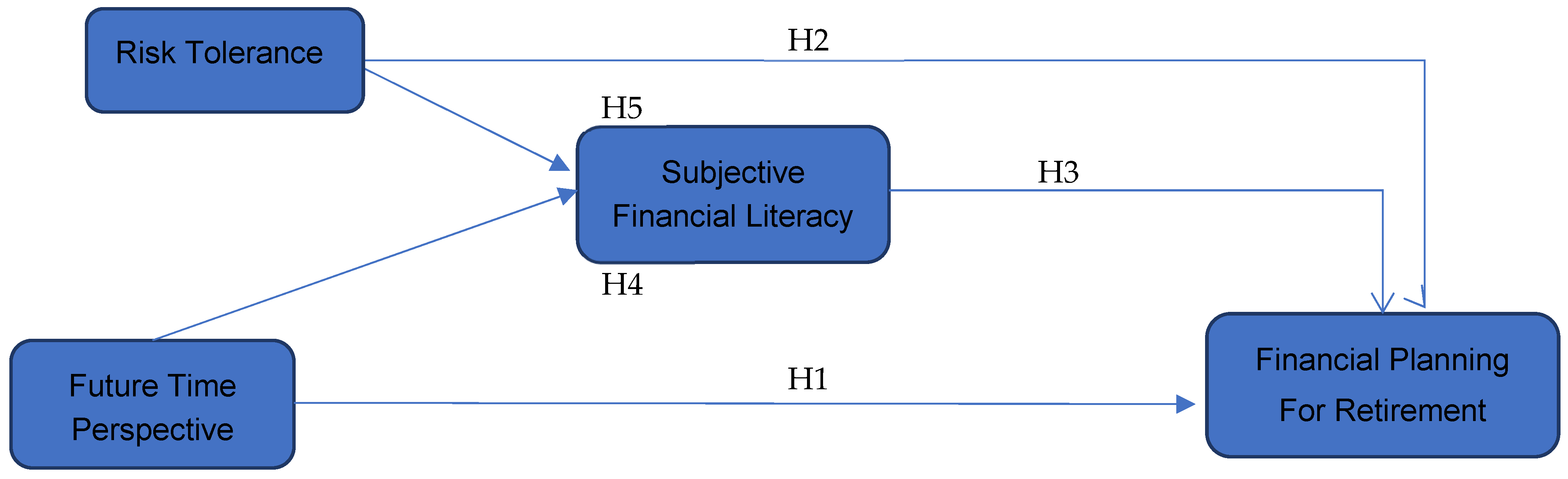
2021). Based on theoretical support, the framework of this study is shown in
Figure 1.
2.1. Future Time Perspective and FPR
Hershey et al. (
2007) proposed that future-time perspective (FTP) refers to one’s preference for taking a long-term view (as opposed to focusing on the past or present) and a long-term planning orientation. A person who thinks about the future is more likely to take proactive steps. In the context of financial planning for retirement, this involves taking more concrete steps, such as saving and investing. Research shows that people with high FTP are motivated to work toward future goals and rewards, often at the expense of current enjoyment.
Rabinovich et al. (
2010) determined that FTP can positively influence people’s attitudes toward certain behaviors. In the Hershey model (2003), FTP, a psychological factor, is posited to have a direct, positive relationship with retirement planning. Evidently,
Kerry (
2018) examined the factors influencing retirement planning and concluded that FTP is a highly related concept in the field of financial retirement planning. These findings collectively indicate that an individual’s FTP is likely to exert a substantial influence on saving behaviors. In addition, gender inequalities have been noted, with men reporting thoughts that extend further into the future, but women reporting more future goals (
Greene and DeBacker 2004). In line with sex role differences, men’s future goals tend to focus more on career-related issues, whereas women have more diverse goals, such as retirement planning. Consequently, Hypothesis 1 (H1) posits that future-time perspective is positively associated with FPR.
2.2. Risk Tolerance and FPR
The individual’s risk tolerance (RT) mainly depends on their personality traits, which will determine their risk appetite for investment or savings (
Kusairi et al. 2019). When a person has a higher risk tolerance, they tend to be more inclined to invest in high-risk assets. Therefore, individuals’ financial planning for retirement is directly influenced by their financial risk tolerance (
Rahies et al. 2022). Previous results show that the relationship between risk tolerance and FPR is mixed.
Grable (
2016) suggested that a relationship exists between risk tolerance and financial planning or investment decisions. Researchers such as
Park and Martin (
2022) found that those who are willing to invest in potential high-risk assets are more willing to develop effective plans. Thus, it can be considered that there is a positive relationship between financial risk tolerance and retirement planning. On the contrary,
Park and Martin (
2022) suggest that a higher level of risk tolerance weakens the relationship with retirement planning. In Chinese culture, people are encouraged to plan in case of a sudden loss. Thus, people who can tolerate higher risk levels prefer a better retirement plan. There are also significant differences in risk tolerance between genders. Women have a smaller risk tolerance than men, and less risky investments will account for a larger proportion in retirement planning (
Agunsoye et al. 2022). Compared to men, women’s lower risk tolerance may be determined by their lower income, which is the main reason why women are expected to have lower retirement well-being (
James and Agunsoye 2022). Consequently, Hypothesis 2 (H2) postulates that risk tolerance is positively associated with FPR.
2.3. Subjective Financial Literacy and FPR
Subjective Financial Literacy (SFL) refers to an individual’s self-beliefs regarding his/her financial skills and knowledge, i.e., what a person thinks they know (
Hadar et al. 2013) about financial matters. Normally, people with subjective financial literacy tend to pay more attention to saving a portion of their income to prevent insufficient savings when income declines, especially after retirement (
Lusardi and Mitchell 2022).
Hauff et al. (
2020) also proposed that subjective financial literacy has a significant impact on retirement planning behavior. On the contrary,
Nguyen et al. (
2022) found that subjective financial literacy can exert negative effects on retirement saving intention and behaviors, i.e., financial overconfidence led by subjective financial literacy makes individuals save less for retirement. In China, however, probably due to differences in culture, research consistently found a positive correlation between personal financial literacy and retirement planning (
Niu and Zhou 2018). As such, Hypothesis 3 (H3) anticipates that people who believe they have higher financial literacy demonstrate higher confidence in carrying out retirement planning activities.
2.4. Mediating Role of Subjective Financial Literacy
Investigation into psychological traits such as SFL and other psychological factors presents an intriguing avenue for further investigation (
Murphy 2013). As SFL differs from actual financial literacy, it can shape how individuals interpret and act on their psychological predispositions in the context of retirement planning.
Rolison et al. (
2017) revealed that individuals exhibiting a high level of FTP tend to have a positive impact on subjective financial knowledge. Based on the psychological perspective,
Kooij et al. (
2018) suggested that a positive relationship exists between FTP and self-assessed financial knowledge. Integrating the proposal by
Mowen (
2000) that subjective financial knowledge can be predicted by FTP, this provides a theoretical support suggesting that subjective financial literacy potentially exhibits a central role in the association between FTP and financial planning for retirement. It means, other than an expected direct association between FTP and FPR (H1), there is a possibility of an indirect path. When people believe they have high financial literacy, they have a tendency to think ahead, especially in terms of long-term goals like retirement planning. As such, future-oriented individuals are more likely to engage in financial planning for retirement because they feel capable of dealing with financial matters. Accordingly, the study postulates Hypothesis 4 (H4), where future-time perspectives will have a positive association with subjective financial literacy, which subsequently will have a positive association with financial planning for retirement.
Risk tolerance impacts financial planning for retirement, particularly related to investment activities. The inconsistent association between risk tolerance and financial planning for retirement from prior studies prompted suggestions to include the examination of the indirect effect of risk tolerance on retirement planning. SFL can impact the extent to which risk tolerance is associated with financial planning for retirement. People who do not tolerate risk may often find financial planning stressful. They may feel incapable of making good financial decisions, which consequently leads to postponement or even avoidance in financial planning for retirement.
Hermansson and Jonsson (
2021) indicated a significant correlation between risk tolerance and financial knowledge. Meanwhile,
Mahdzan et al. (
2017) argue that individuals with low risk tolerance and higher financial knowledge are more inclined to hold risky assets in retirement investment portfolios. This study proposes Hypothesis 5 (H5) that individuals with high risk tolerance, SFL, can further enhance their confidence in taking on riskier investment strategies, leading to more engagement in retirement planning.
2.5. Gender Gap
Gender gaps persist in how men and women engage in retirement planning, driven by economic, social, and cultural factors.
Almenberg and Dreber (
2015) argued that gender differences in risk attitudes affect the relationship with financial knowledge, while
Cupák et al. (
2021) emphasized that gender differences in financial knowledge can affect its relationship with risk tolerance. Moreover, there are significant gender differences in the relationship between SFL and RT. It is interesting to note that gender differences also exist in SFL. Several studies have found that women have lower levels of financial literacy than men (
Bucher-Koenen et al. 2017;
Fletschner and Mesbah 2011).
Gender disparity in these aspects can mold the way psychological factors affect financial planning for retirement. In financial confidence, for instance, men are often higher than women, making them more likely to convert their confidence into action, such as financial planning for retirement. Additionally, women who generally experience more financial apprehension than men can negatively impact their willingness to engage in investment activities for retirement planning. Thus, we expect psychological factors to have differentiated effects on retirement planning behaviors across genders, with stronger positive effects observed among men.
This difference is grounded in the Chinese context, where women face structural disadvantages. In China, women are less likely than men to be in the highest income quintiles and have lower labor force participation than men (
National Bureau of Statistics 2025). This may be due to a more heterogeneous work history because of caring responsibilities among women in China. Empirically,
Hershey et al. (
2003) found that men tend to have specific retirement goals and possess more financial capabilities, while women tend to have abstract goals, such as happiness or freedom.
Davis (
2003) also found that due to bridge employment, male retirees are not in a fully retired state when retired, resulting in gender differences in financial ability, with males generally outperforming females (
Peng et al. 2007). This pattern persists in China, where male retirees commonly continue working through re-employment arrangements after formal retirement, further amplifying gender differences in retirement preparedness.
3. Data Source
The study employed the survey method to source primary data. In total, nine items for Financial Planning for Retirement were used, of which four items measured retirement planning activities (
Hershey et al. 2010) and five items measured the intention to save for retirement (
Jacobs-Lawson and Hershey 2005). The items for psychological factors of Risk Tolerance, Future Time Perspective, and Subjective Financial Literacy were drawn from existing literature. The measurement of future time perspective involves a five-item scale (
Koposko and Hershey 2014) to assess individuals’ enthusiasm for contemplating and preparing for the future. Five items for Risk Tolerance are adapted from
Jacobs-Lawson and Hershey (
2003), covering respondents’ attitudes toward risk in the context of retirement financial investments. Meanwhile, six items from
Hershey and Mowen (
2000) were employed to gauge the Subjective Financial Literacy of respondents. All items applied an even six-point scale, with a rating of 1 indicating “strongly disagree” and 6 indicating “strongly agree.” The measurement items of all variables are shown in
Appendix A. The final version of the research instrument was in Chinese. It underwent a meticulous review process to ensure instrument reliability and data validity. A back-to-back translation was also conducted. Before the actual survey, the translated version was rigorously examined using qualitative pretesting methods, expert reviews, and cognitive interviews.
Several criteria are preset for respondents of the study. First, they must be adult income earners for their financial capability and suitability to provide feedback on retirement behavioral relevance. The age of the targeted respondents is between 23 and 60 years old, as they are considered sufficiently established in life/career stage and still within the savings period. As such, random sampling cannot be applied. Alternatively, the study employed a purposive sampling approach, particularly the judgment-based sampling method.
China is a large and diverse country. In order to capture a good geographical spread and diversity, the study covered the Eastern, Central, Western, and Northeast regions of the country. These four major regional divisions constitute the officially recognized economic geographical divisions by the National Bureau of Statistics (NBS) (
National Bureau of Statistics of China 2011). The questionnaire was distributed in four major cities, namely Shenzhen, Wuhan, Chongqing, and Dalian. Shenzhen, Wuhan, Chongqing, and Dalian are four major cities located in the Eastern, Central, Western, and Northeast regions of China, respectively, and were selected based on their GDP rankings within each region. Furthermore, Beijing and Shanghai were also included as they are the two super major cities in China and are important due to their administrative and business hubs. These six cities are appropriate as the locations are scattered in different parts of China. In addition, as major cities normally attract many job seekers and entrepreneurs from other districts and states, data collected from these major cities could ensure diversity in terms of respondents’ backgrounds, demographically and geographically. As such, the data includes a good mix of sub-population groups, economic levels, cultural diversity, and different situational exposures.
The required minimum sample size was 77, quantified a priori employing the G*Power 3.1 tool (effect size f
2 = 015 (medium), with 80% power, at a significance level of α = 0.05) (
Kang 2021). A platform called Wenjuanxing (China’s survey-questionnaire platform) was used for data collection. The survey took three months and successfully garnered 271 responses, of which 246 were usable. The final sample size (N = 246) is more than three times the required sample size of 77. Thus, the study’s data are sufficiently representative and statistically powerful for hypothesis testing.
Regional diversity is covered with data from the northern, eastern, southern, and western parts of China, as well as the two supermajor cities, e.g., Beijing and Shanghai. The study’s sample size of 300 exceeds the minimum. Thus, the results have sufficient statistical power. Therefore, it strengthens the argument for their generalizability to similar urban contexts in China. Derived data supporting the findings of this study are available from the corresponding author on request.
4. Results
A total of 246 Chinese between the ages of 23 and 60 participated in the study (mean age 37.9 years, SD = 10.7). Female respondents outnumbered male respondents by nearly 3:2 (42% male). Out of the sample, 13% had a secondary degree, 8% had a college diploma, 59% had a bachelor’s degree, 19% had a master’s degree, and 1% had a doctoral degree. Regarding marital status, 27% are single, 66% are married, 5% are divorced, and 2% are widowed.
4.1. Measurement Model Assessment
The measurement model was evaluated using partial least squares structural equation modeling (PLS-SEM) for its ability to deal with complex models. It offers the added advantage of estimating the measurement model and is suitable for conducting multigroup analysis (MGA) (
Hair et al. 2017). Several aspects were assessed, including internal consistency and reliability, convergent validity, indicator reliability, and discriminant validity. The results for the complete group, the male and female samples, are shown in
Table 1.
Hulland (
1999) recommended a factor loading threshold of 0.5 for indicator reliability. The factor loadings ranged from 0.603 to 1, indicating the indicators are adequately loaded to their respective constructs. The composite reliability (CR) values for the split samples and complete samples all exceeded the 0.70 threshold, confirming the establishment of internal consistency and reliability for all the constructs. Convergent validity was supported, as evidenced by the average variance extracted (AVE), which exceeded 0.50 for the female, male, and complete samples.
The discriminant validity was evaluated using
Henseler et al.’s (
2015) heterotrait-monotrait (HTMT) ratio of correlation. It examines whether the indicators are cross-loaded onto unintended constructs. An HTMT value less than 0.85 (
Hair et al. 2017) indicates establishment of discriminant validity. As evidenced in
Table 2, the model satisfies the HTMT criterion, confirming the presence of discriminant validity.
4.2. Assessment of Measurement Invariance
The permutation test was conducted to assess whether construct measurements demonstrated invariance across the two gender groups (
Henseler et al. 2016). Using the Measurement Invariance of Composite Models (MICOM) approach, Step 1 established that the indicators of all constructs were identical between the two gender groups (
Table 1 and
Table 2). In Step 2, the permutation test confirmed that the correlations of all constructs between the groups equaled 1, with
p-values exceeding 0.05, indicating insignificance. As shown in
Table 3, all permutation
p-values were insignificant, thereby establishing compositional invariance within the research model. This finding supported partial measurement invariance.
To evaluate full measurement invariance, Step 3 examined the equality of mean values and variances of constructs across the two groups. The results revealed that not all composite mean values and variances were equal, confirming that full measurement invariance was not achieved. Consequently, only partial measurement invariance was supported. With partial measurement invariance established, the study proceeded to multigroup analysis, enabling the comparison of standardized coefficients within the structural model across the two gender groups.
4.3. Structural Model Assessment
The assessment of collinearity through the variance inflation factor (VIF) is the first step in the evaluation of the structural model. There were no collinearity issues observed, as indicated by the VIF values in
Table 4, which are below the recommended threshold of 3.3 in both the overall sample and the gender samples (
Hair et al. 2021).
Bootstrap computation was employed to assess the association of constructs in the inner model. Three direct hypotheses (H1, H2, and H3) were examined. Following the guideline by
Cohen (
1988), R
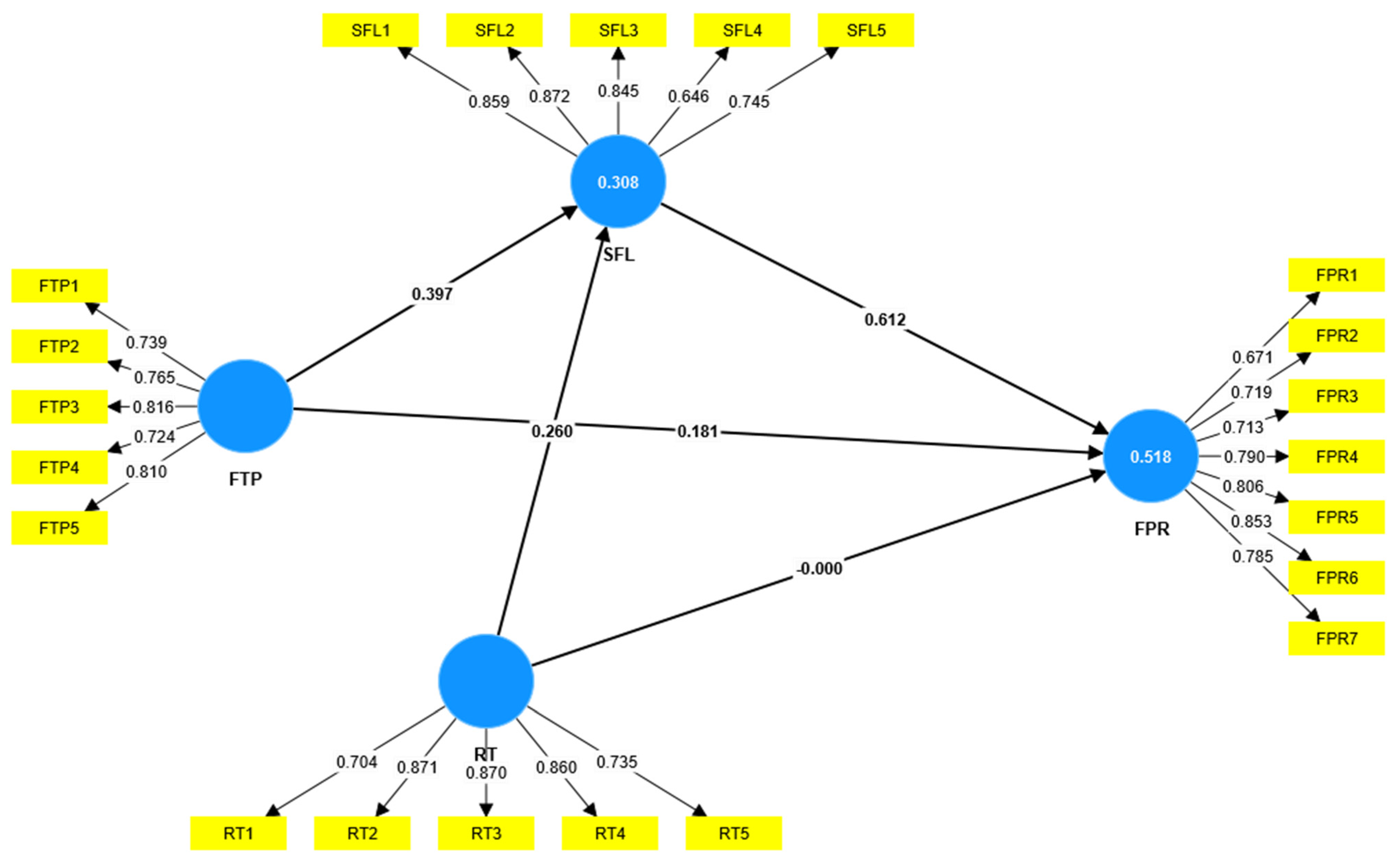
2 values of 0.26, 0.13, and 0.02 in the PLS path model were considered as substantial, moderate, and weak, respectively. The three independent constructs explain 51.8% of the variance in financial planning for retirement (
Figure 2). Hence, the R
2 value in this study is substantial. The results of the complete sample revealed that FTP was positively and significantly associated with FPR (t = 3.298,
p = 0.001). Hence, H1 was supported. The positive and significant findings are also observed in the male and female sample groups. Hypothesis 2, which examines whether risk tolerance is positively associated with FPR, is not supported for the complete sample (β = 0.388, t = 0.007,
p = 0.994). H3 hypothesized a positive and significant relationship between SFL and FPR. Evidently, H3 is supported in the complete sample (β = 0.612, t = 12.081,
p = 0.000), as well as in both the gender subsamples. Further examination of hypothesis tests on the male and female subsamples revealed similar results as the complete sample, apart from the negative coefficient in H2 for the male subsample.
The explanatory power of the model is assessed using the R
2 values.
Cohen (
1988) recommends the R
2 threshold of at least 0.26, 0.13, and 0.02, respectively, in the PLS path model for substantial, moderate, and weak levels. Across the complete and subsamples (complete, male, and female), all but one of the R
2 values for the endogenous variables were above 0.26 (the lowest being 0.250 detected in the female sample). Accordingly, it is fair to conclude that most of the explanatory powers of the models are substantial, except for one at a moderate level.
The assessment of predictive relevance was conducted using the Q
2 value. As per
Hair et al. (
2017), the model’s predictive relevance is confirmed by the Q
2 value being larger than 0. Furthermore, the degrees of predictive relevance for each effect are represented by the values of 0.02, 0.15, and 0.35, indicating weak, moderate, and strong degrees, respectively. The Q
2 values ranging from 0.186 to 0.376 were observed for the endogenous constructs. Thus, Q
2 values in this study can be described as moderate to substantial.
4.4. Mediation Analysis
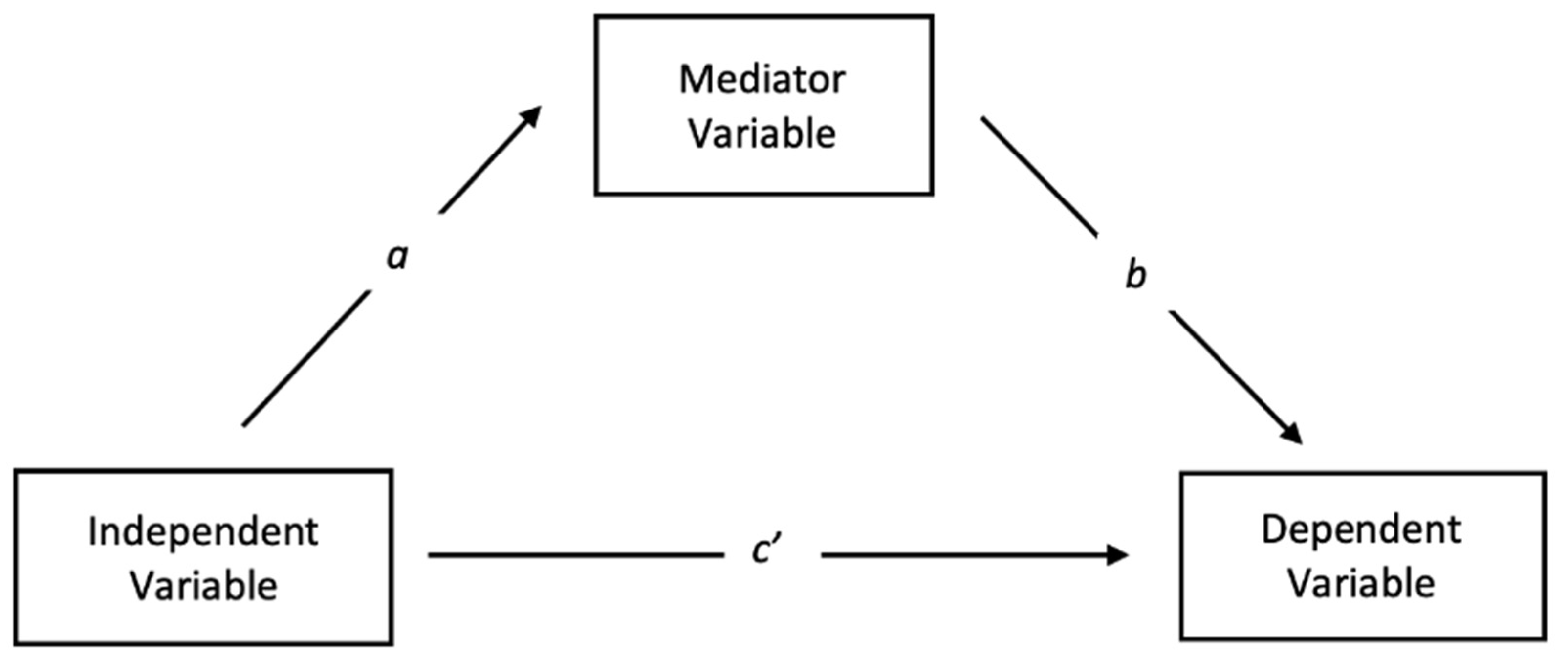
The examination for mediation was further extended to an analysis of coefficients. The indirect effect of the mediator in a simple mediation model (
Figure 3) comprises a product of a and b coefficients, while the direct effect is the c coefficient.
Accordingly, as shown in
Table 5, the indirect path coefficients for H4: FTP→SFL→FPR for the complete sample resulted in an indirect effect of 0.243 (a × b). With a direct effect of 0.181 (c’), the overall effects for this mediation model amounted to 0.424 (0.196 + 0.101), which indicated that the indirect effect accounted for a substantial portion, which amounted to 57% (0.243/0.424) of the total effects. Overall, the results indicated there is a partial mediating role of Subjective Financial Literacy in the relationship between FTP and FPR. Within the gender context, the indirect effect and direct effect are significant at the same time for the female subgroup (indirect effect = 0.262, direct effect = 0.161) and the male subgroup (indirect effect = 0.235, direct effect = 0.188), which also indicates the partial mediation of SFL in the relationship between FTP and FPR for the sub-sample. Hence, H4 was supported.
Similarly, the indirect path coefficients for H5: RT→SFL→FPR for the complete sample resulted in an indirect effect of 0.159 (a × b). However, the direct effect is not significant, which indicates a full mediating role of Subjective Financial Literacy in the relationship between RT and FPR. This full mediation relationship is also supported in the male group. As for the female group, the mediating role of SFL in the relationship between RT and FPR is not supported due to the insignificant indirect effect. Hence, H5 was supported for the complete and male sample, but not supported for the female sample.
4.5. Multigroup Analysis
Multigroup analysis is employed to examine the gender gap. The model’s validity and reliability were confirmed for both the female and male groups, as indicated in
Table 1 and
Table 2.
Table 4 presents the results of testing the predictive relevance of the structural model and examining the relationships among the constructs.
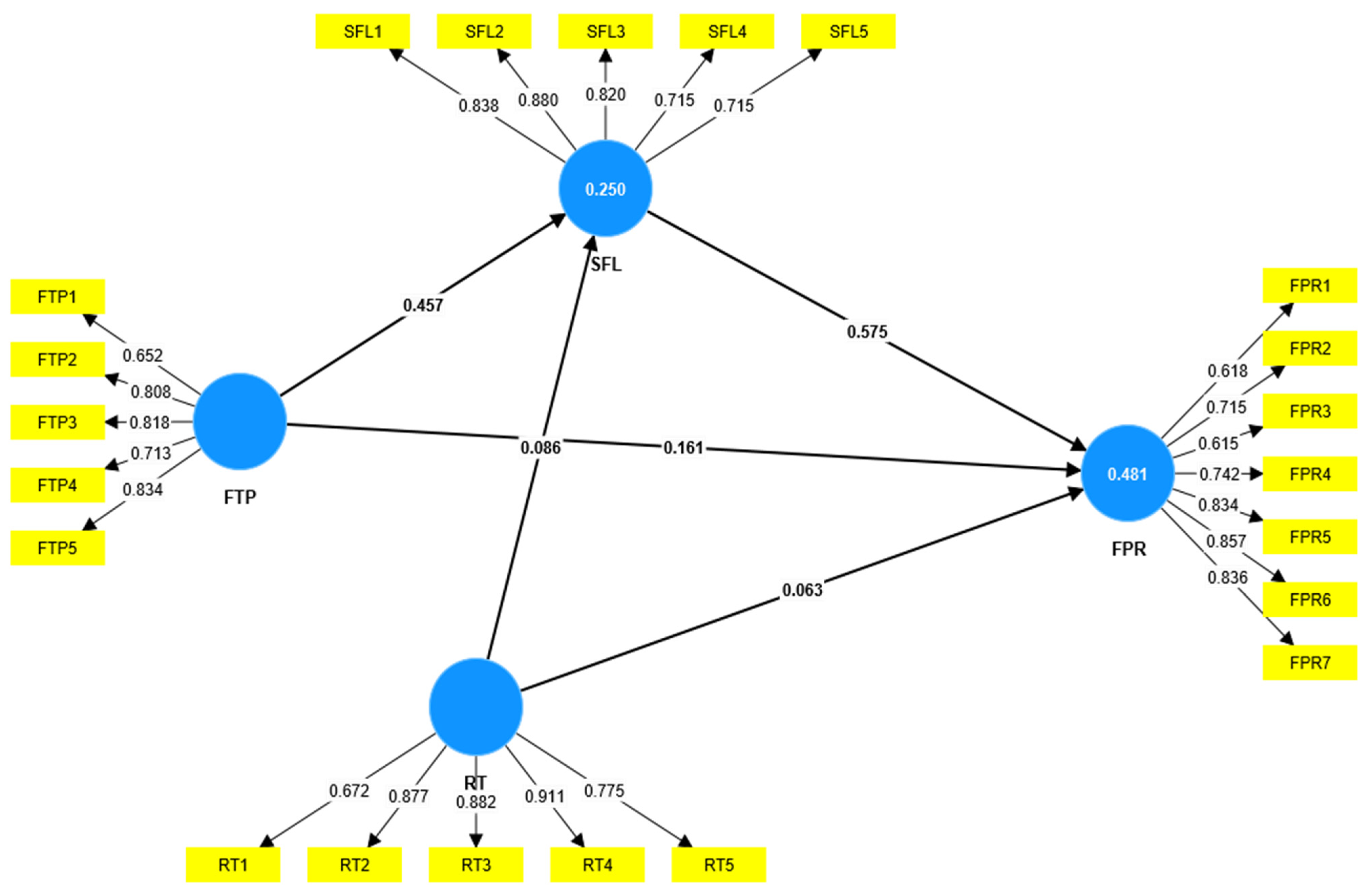
The path analysis in the female subgroup yielded similar results to the complete sample. Nevertheless, there were differences in the strength of the effects compared to the complete sample. The path with the highest significance was observed between SFL and FPR, with β = 0.575 and a
p-value of 0.000. Following
Figure 4, financial planning for retirement exhibited the lowest R
2 value (0.481).
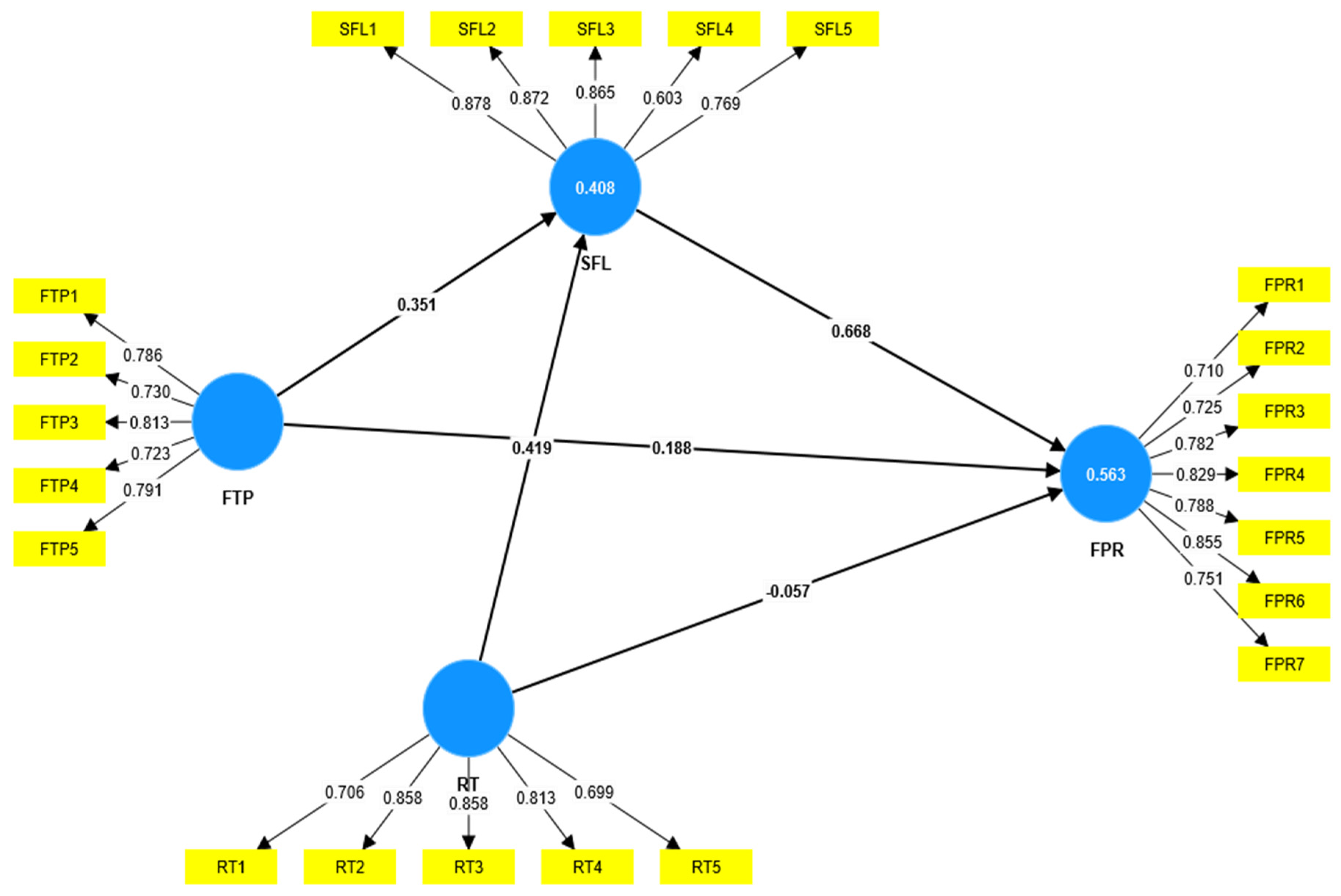
The relationships in the male subgroup also show results similar to those in the complete sample. Shown in
Table 4, the path with the strongest significance was also found between SFL and FPR (β = 0.668,
p = 0.000). According to
Figure 5, the highest R
2 value was observed for financial planning for retirement (R
2 = 0.563) and SFL (R
2 = 0.408).
Once measurement invariance was established (see
Table 3), this study continued by examining group comparisons using multigroup analysis. This study assessed permutation test values (
Table 6) to examine significant differences between females and males in their effects on FPR. The results showed that only one relationship differed between females and males: risk tolerance and subjective financial literacy (
p < 0.05).
5. Discussion
The effectiveness of financial retirement planning is highly dependent on savings and investment decisions. These decisions are influenced by psychological characteristics. The collectivist culture of Chinese individuals, which contrasts with the individualistic culture in Western countries, may limit the applicability of existing literature in explaining the impact of psychological factors on FPR in China’s context. This study examined the interactions among FTP, RT, and SFL and their effects on FPR, with a focus on gender-based differences. This is crucial, as having a clear understanding of the factors influencing retirement planning, particularly if the gender gap persists, can lead to better, gender-specific measures to address inadequate retirement savings.
The study found that the future time perspective had a significant positive relationship with FPR. The study found a significant positive impact of FTP on FPR in the overall, female, and male samples. It means individuals who have a higher level of FTP prefer savings and investing instead of spending or consuming immediately. It indicates that they are willing to engage in retirement planning and savings to maintain their living standard after retirement. The findings are consistent with
Tomar et al. (
2021) and
Clark et al. (
2019), who proposed that the relationship between FTP and saving tendency is positive. Thus, drives to shape the perspective of prioritizing future needs can be strengthened to encourage adult income earners to save for retirement. A retirement-planning advocate can exploit the wide coverage of digital platforms in China’s highly digitalized society by using short-video content on retirement savings to instill and elevate the sense of importance of accumulating adequate savings to maintain a high quality of life after retirement.
Although the study posited that risk tolerance positively affects financial planning for retirement, it fails to show that risk tolerance significantly affects individuals’ FPR across all samples (complete, female, and male). The sample was drawn from different wide geographical parts of China, and the implications of risk tolerance may be different across different places. The diversity of respondents may further affect the cause of risk tolerance as they are from various economic levels and subcultural backgrounds. The collectivist culture of the Chinese may also have altered risk appetite and its relationship to retirement planning. Perhaps the future research agenda could consider including these aspects.
Subjective financial literacy demonstrated the highest direct effect on financial planning for retirement across the complete sample (direct effect = 0.612), the female sample (direct effect = 0.575), and the male sample (direct effect = 0.668). This finding is consistent with previous research (
Zhu 2021;
Hershey et al. 2007). That is, factors that enhance their perceived financial literacy would foster retirement planning behavior among income earners. This finding raises a major concern when synthesizing with unsupported results for the RT-FPR relationship in H2. Integrating the findings of H2 and H3 indicates the presence of a financial literacy bias, where overconfidence or underconfidence may be a stronger behavioral driver than risk tolerance. Overreliance on subjective literacy in financial decision-making may be counterproductive. As such, the study raises a potential issue that both academics and policymakers need to address. Meanwhile, practitioners can use AI tools to address customers’ financial knowledge gaps, enhancing their financial literacy at minimal cost to financial institutions. The improved sense of financial literacy may assist individuals in making rational investment decisions and, subsequently, in better retirement planning.
Subjective financial literacy indirectly mediated the relationships between FTP and FPR and between RT and FPR. The mediating role of subjective financial literacy in the relationship between FTP and FPR was supported in all samples. This finding is in line with the previous literature. In the other mediating test, the mediating role of subjective financial literacy in the relationship between RT and FPR was absent in the female group. This may be due to Chinese women generally managing family asset allocation, which makes them more rational in choosing investment products regardless of their risk tolerance, ensuring stable returns after retirement. Thus, it is interesting to note that risk tolerance, whether directly or indirectly, does not have any impact on financial planning for retirement in females. Based on the findings of the mediating role, the government and financial institutions can increase individuals’ expectations for the future, enhance FTP, and improve their confidence in financial literacy through lectures and publicity. In addition, FTP and SFL can interact with each other and stimulate planning behavior. However, if financial institutions are eager to encourage individuals to plan for retirement by increasing risk tolerance, targeted measures should be provided to the male group, other than the female group. The impact will not be too significant, as men’s risk tolerance will only enhance their FPR by increasing financial literacy.
The impact of FTP, RT, and SFL on the outcome variables was examined through multigroup analysis to determine if there were any differences between the two gender groups. The results showed that only RT’s impact on SFL was higher in male groups in comparison to female groups. The
Ministry of Human Resources and Social Security of the People’s Republic of China (
2024) issued a personal pension system starting from December 2024. One of the policies is to provide different investment portfolios for residents with different risk tolerance levels toward retirement. Based on the findings, financial institutions can provide targeted consultations or lectures to male groups to enhance their risk tolerance. This proactive approach will foster their early awareness regarding retirement planning and savings, empowering them to make informed financial decisions in their future endeavors.
The multigroup analysis reveals that aside from the impact of RT on SFL, there is no gender gap. This contradicts many previous findings (
Bucher-Koenen et al. 2017;
Cupák et al. 2021;
Nguyen et al. 2022). Perhaps China’s one-child policy (only one child is allowed per family), effective from 1979 to 2016, created an avenue for women to have equal access to education and learning opportunities as men. Women subsequently gained access and participated in economic and societal activities. Their sense of equality may also influence women’s psychological factors and behavioral decisions. Therefore, this may explain why gender does not play a role in retirement financial planning.
6. Conclusions
The process of making decisions about retirement financial planning is complex. This study has successfully extended the current line of research to FPR. Theoretically, this research helps fill the existing gap and provides a new perspective on FPR from a psychological perspective, examining the influence of different gender groups. The findings of a direct effect on FPR and a significant mediating relationship support the interaction among FTP, SFL, and RT and their effects on FPR. Consequently, the study’s findings will enrich the current literature on FPR and provide empirical evidence to support the CWO model. Due to greater female participation in society compared to the past, women’s retirement planning behavior is less vulnerable than men’s. It is consistent with the finding of no gender gap. To ensure a comprehensive understanding of individuals’ retirement savings needs, policymakers and financial institutions must make additional efforts to better serve them, as suggested by the findings. Measures such as retirement counseling, programs, or financial advice should be tailored to address specific psychological factors such as FTP and SFL. Digital technology can also assist governments and institutions in enhancing individuals’ psychological factors.
The potential limitations of the study are its age-group-specificity and the lack of representation of rural-income earners. Thus, caution must be exercised when using the results to explain the rural context or the entire population of China. In addition, the study offers empirical evidence on the influence of psychological variables on FPR behavior within China. To obtain insights across diverse global cultures, future research could apply the CWO models using cross-national data from developed and developing nations to yield richer comparative evidence. Future research may also go beyond cross-sectional research and apply a longitudinal approach to examine behavioral change over time. Longitudinal research would unravel the complexity of retirement financial planning over time, an area that remains much to be learned despite extensive research on the psychological determinants of FPR.
Author Contributions
Conceptualization, H.R. and T.S.L.; methodology, H.R.; software, H.R.; validation, T.S.L.; formal analysis, H.R.; investigation, H.R.; resources, H.R.; data curation, T.S.L.; writing—original draft preparation, H.R.; writing—review and editing, T.S.L.; visualization, H.R.; supervision, T.S.L.; project administration, T.S.L.; funding acquisition, H.R. All authors have read and agreed to the published version of the manuscript.
Funding
This research was funded by [Changchun University Humanities and Social Sciences Research Fund Project] grant number [2024JBF10W31]; [Scientific Research Project of the Education Department of Jilin Province] grant number [JJKH20260264SK].
Data Availability Statement
The data presented in this study are available on request from the corresponding authors. The data presented in this study are not publicly available due to privacy concerns.
Conflicts of Interest
The authors declare no conflict of interest.
Appendix A
Table A1.
Measurement Items for Financial Planning for Retirement.
Table A1.
Measurement Items for Financial Planning for Retirement.
| Indicator | Measurement Statement | Source(s) |
|---|
| FPR1 | Calculations have been made to estimate how much I have to save to retire comfortably | Hershey et al. (2010)
and Jacobs-Lawson and Hershey (2005) |
| FPR2 | I frequently surf the internet to learn about retirement planning |
| FPR3 | I’m familiar with the level of my future pension benefits |
| FPR4 | I’m familiar with financial preparation for retirement |
| FPR5 | I have made regular contributions to a voluntary retirement savings plan |
| FPR6 | Relative to my peers, I have saved a great deal of money for post-retirement years |
| FPR7 | I regularly contribute a fixed percentage of my income to my retirement savings account |
| FPR8 | I make a conscious effort to save for retirement |
| FPR9 | Based on how I plan to live my life in retirement, I have saved accordingly |
Table A2.
Measurement Items for Subjective Financial Literacy.
Table A2.
Measurement Items for Subjective Financial Literacy.
| Indicator | Measurement Statement | Source(s) |
|---|
| FL1 | I am very knowledgeable about financial planning for retirement | Hershey and Mowen (2000)
and Mowen (2000) |
| FL2 | I know more than most people about retirement planning |
| FL3 | I am very confident in my ability to do retirement planning |
| FL4 | When I have a need for financial services, I know exactly where to obtain information on what to do |
| FL5 | I am knowledgeable about how Social Security works |
| FL6 | I am knowledgeable about how private investment plans work |
Table A3.
Measurement Items for Future Time Perspective.
Table A3.
Measurement Items for Future Time Perspective.
| Indicator | Measurement Statement | Source(s) |
|---|
| FTP1 | I like to think about what the future will hold | Koposko and Hershey (2014) |
| FTP2 | I enjoy thinking about how I will live years from now in the future |
| FTP3 | I look forward to life in the distant future |
| FTP4 | It is important to have a long-term perspective in life |
| FYP5 | My close friend would describe me as future-oriented |
Table A4.
Measurement Items for Risk Tolerance.
Table A4.
Measurement Items for Risk Tolerance.
| Indicator | Measurement Statement | Source(s) |
|---|
| RT1 | I am willing to risk financial losses | Jacobs-Lawson and Hershey (2003) |
| RT2 | I prefer investments that have higher returns, even though they are riskier |
| RT3 | The overall growth potential of a retirement investment is more important than the level of risk of the investment |
| RT4 | I am very willing to make risky investments to ensure financial stability in retirement |
| RT5 | As a rule, I would never choose the safest investment when planning for retirement |
References
- Agunsoye, Ariane, Jerome Monne, Janette Rutterford, and Dimitris P. Sotiropoulos. 2022. How gender, marital status, and gender norms affect savings goals. Kyklos 75: 157–83. [Google Scholar] [CrossRef]
- Almenberg, Johan, and Anna Dreber. 2015. Gender, stock market participation and financial literacy. Economics Letters 137: 140–42. [Google Scholar] [CrossRef]
- Bazzana, Davide. 2020. Ageing population and pension system sustainability: Reforms and redistributive implications. Economia Politica 37: 971–92. [Google Scholar] [CrossRef]
- Bucher-Koenen, Tabea, Annamaria Lusardi, Rob Alessie, and Maarten Van Rooij. 2017. How financially literate are women? An overview and new insights. The Journal of Consumer Affairs 51: 255–83. [Google Scholar] [CrossRef]
- China Aging Financial Survey. 2022. China Aging Financial Survey (CAFS). Available online: https://ciprc.pbcsf.tsinghua.edu.cn/pff50/info/1029/1985.htm (accessed on 17 July 2024).
- Clark, Robert L., Robert G. Hammond, and Christelle Khalaf. 2019. Planning for Retirement? The Importance of Time Preferences. Journal of Labor Research 40: 127–50. [Google Scholar] [CrossRef]
- Clements, Benedict, Kamil Dybczak, Vitor Gaspar, Sanjeev Gupta, and Mauricio Soto. 2018. The fiscal consequences of shrinking and ageing populations. Ageing International 43: 391–414. [Google Scholar] [CrossRef]
- Cohen, Jacob. 1988. Statistical Power Analysis for the Behavioral Sciences. Abingdon-on-Thames: Routledge. [Google Scholar]
- Cupák, Andrej, Pirmin Fessler, and Alyssa Schneebaum. 2021. Gender differences in risky asset behavior: The importance of self-confidence and financial literacy. Finance Research Letters 42: 101880. [Google Scholar] [CrossRef]
- Davis, Mark A. 2003. Factors related to bridge employment participation among private sector early retirees. Journal of Vocational Behavior 63: 55–71. [Google Scholar] [CrossRef]
- Fletschner, Diana, and Dina Mesbah. 2011. Gender disparity in access to information: Do spouses share what they know? World Development 39: 1422–33. [Google Scholar] [CrossRef]
- Friedemann, Marie-Luise, and Kathleen C. Buckwalter. 2014. Family caregiver role and burden related to gender and family relationships. Journal of Family Nursing 20: 313–36. [Google Scholar] [CrossRef] [PubMed]
- Grable, John E. 2016. Financial Risk Tolerance. In Handbook of Consumer Finance Research. Edited by Jing J. Xiao. Cham: Springer, pp. 19–31. [Google Scholar]
- Greene, Barbara A., and Teresa K. DeBacker. 2004. Gender and orientations toward the future: Links to motivation. Educational Psychology Review 16: 91–120. [Google Scholar] [CrossRef]
- Guardiancich, Igor. 2012. Pension Reforms in Central, Eastern and Southeastern Europe: From Postsocialist Transition to the Global Financial Crisis. London: Routledge. [Google Scholar]
- Hadar, Liat, Sanjay Sood, and Craig R. Fox. 2013. Subjective Knowledge in Consumer Financial Decisions. Journal of Marketing Research 50: 303–16. [Google Scholar] [CrossRef]
- Hair, Joseph F., Claudia Binz Astrachan, Ovidiu I. Moisescu, Lăcrămioara Radomir, Marko Sarstedt, Santha Vaithilingam, and Christian M. Ringle. 2021. Executing and interpreting applications of PLS-SEM: Updates for family business researchers. Journal of Family Business Strategy 12: 100392. [Google Scholar] [CrossRef]
- Hair, Joseph F., Jr., G. Tomas M. Hult, Jr., Christian M. Ringle, and Marko Sarstedt. 2017. A Primer on Partial Least Squares Structural Equation Modeling (PLS-SEM). Washington: Sage. [Google Scholar]
- Hauff, Jeanette C., Anders Carlander, Tommy Gärling, and Gianni Nicolini. 2020. Retirement financial behaviour: How important is being financially literate? Journal of Consumer Policy 43: 543–64. [Google Scholar] [CrossRef]
- Henseler, Jörg, Christian M. Ringle, and Marko Sarstedt. 2015. A new criterion for assessing discriminant validity in variance-based structural equation modeling. Journal of the Academy of Marketing Science 43: 115–35. [Google Scholar] [CrossRef]
- Henseler, Jörg, Christian M. Ringle, and Marko Sarstedt. 2016. Testing measurement invariance of composites using partial least squares. International Marketing Review 33: 405–31. [Google Scholar] [CrossRef]
- Hermansson, Cecilia, and Sara Jonsson. 2021. The impact of financial literacy and financial interest on risk tolerance. Journal of Behavioral and Experimental Finance 29: 100450. [Google Scholar] [CrossRef]
- Hershey, Douglas A., and John C. Mowen. 2000. Psychological determinants of financial preparedness for retirement. The Gerontologist 40: 687–97. [Google Scholar] [CrossRef]
- Hershey, Douglas A., John C. Mowen, and Joy M. Jacobs-Lawson. 2003. An Experimental Comparison of Retirement Planning Intervention Seminars. Educational Gerontology 29: 339–59. [Google Scholar] [CrossRef]
- Hershey, Douglas A., Joy M. Jacobs-Lawson, and James T. Austin. 2013. Effective financial planning for retirement. In The Oxford Handbook of Retirement. Edited by Mo Wang. Oxford: Oxford University Press, pp. 402–30. [Google Scholar]
- Hershey, Douglas A., Joy M. Jacobs-Lawson, John J. McArdle, and Fumiaki Hamagami. 2007. Psychological Foundations of Financial Planning for Retirement. Journal of Adult Development 14: 26–36. [Google Scholar] [CrossRef]
- Hershey, Douglas A., Kène Henkens, and Hendrik P. Van Dalen. 2010. Aging and financial planning for retirement: Interdisciplinary influences viewed through a cross-cultural lens. The International Journal of Aging and Human Development 70: 1–38. [Google Scholar] [CrossRef]
- Hinrichs, Karl. 2021. Recent pension reforms in Europe: More challenges, new directions. An overview. Social Policy & Administration 55: 409–22. [Google Scholar] [CrossRef]
- Hulland, John. 1999. Use of partial least squares (PLS) in strategic management research: A review of four recent studies. Strategic Management Journal 20: 195–204. [Google Scholar] [CrossRef]
- Ingale, Kavita Karan, and Ratna Achuta Paluri. 2023. Retirement planning—A systematic review of literature and future research directions. Management Review Quarterly 75: 1–43. [Google Scholar] [CrossRef]
- Jacobs-Lawson, Joy M., and Douglas A. Hershey. 2003. Perceptions of Financial Stability. Advances in Psychology Research 22: 123. [Google Scholar]
- Jacobs-Lawson, Joy M., and Douglas A. Hershey. 2005. Influence of Future Time Perspective, Financial Knowledge, and Financial Risk Tolerance on Retirement Saving Behaviors. Financial Services Review 14: 331–44. [Google Scholar]
- James, Hayley, and Ariane Agunsoye. 2022. The gendered construction of risk in asset accumulation for retirement. New Political Economy 28: 574–91. [Google Scholar] [CrossRef]
- Kang, Hyun. 2021. Sample size determination and power analysis using the G* Power software. Journal of Educational Evaluation for Health Professions 18: 17. [Google Scholar] [CrossRef] [PubMed]
- Kerry, Matthew J. 2018. Psychological antecedents of retirement planning: A systematic review. Frontiers in Psychology 9: 1870. [Google Scholar] [CrossRef]
- Kooij, Dorien T. A. M., Ruth Kanfer, Matt Betts, and Cort W. Rudolph. 2018. Future time perspective: A systematic review and meta-analysis. Journal of Applied Psychology 103: 867. [Google Scholar] [CrossRef]
- Koposko, Janet L., and Douglas A. Hershey. 2014. Parental and early influences on expectations of financial planning for retirement. Journal of Personal Finance 13: 17–27. [Google Scholar]
- Kusairi, Suhal, Nur Azura Sanusi, Suriyani Muhamad, Madihah Shukri, and Nadia Zamri. 2019. Financial households’ efficacy, risk preference, and saving behaviour: Lessons from lower-income households in Malaysia. Economics & Sociology 12: 301–18. [Google Scholar] [CrossRef]
- Lou, Feipeng. 2021. Problems and Suggestions on the Development of the Third Pillar Pension Insurance. The Chinese Banker 6: 92–94. [Google Scholar]
- Lusardi, Annamaria, and Olivia S. Mitchell. 2022. Financial Literacy and Planning: Implications for Retirement Wellbeing. Working Paper No. 17078. Cambridge: National Bureau of Economic Research.
- Mahdzan, Nurul Shahnaz, Amrul Asraf Mohd-Any, and Mun-Kit Chan. 2017. The influence of financial literacy, risk aversion and expectations on retirement planning and portfolio allocation in Malaysia. Gadjah Mada International Journal of Business 19: 267–88. [Google Scholar] [CrossRef]
- Ministry of Human Resources and Social Security of the People’s Republic of China. 2024. Available online: https://www.mohrss.gov.cn/SYrlzyhshbzb/shehuibaozhang/zcwj/202412/t20241212_532221.html (accessed on 12 December 2024).
- Mowen, John C. 2000. The 3M Model of Motivation and Personality: Theory and Empirical Applications to Consumer Behavior. Boston: Kluwer Academic Publishers. [Google Scholar]
- Mu, Bo. 2020. Financial Literacy and Elderly Care Planning Behavior of Urban Residents. Master’s thesis, Tiangong University, Tianjin, China. [Google Scholar]
- Murphy, Kevin J. 2013. Executive compensation: Where we are, and how we got there. In Handbook of the Economics of Finance. Amsterdam: Elsevier, vol. 2, pp. 211–356. [Google Scholar]
- National Bureau of Statistics. 2025. Available online: https://www.stats.gov.cn/sj/zxfb/202501/t20250124_1958439.html (accessed on 27 September 2025).
- National Bureau of Statistics of China. 2011. Methods for Dividing the Eastern, Central, Western and Northeastern Regions [R]. Available online: https://www.stats.gov.cn/zt_18555/zthd/sjtjr/dejtjkfr/tjkp/202302/t20230216_1909741.htm (accessed on 13 June 2011).
- Nguyen, Linh Thi My, Phong Thanh Nguyen, Quynh Nguyen Nhu Tran, and Thi Tuong Giang Trinh. 2022. Why does subjective financial literacy hinder retirement saving? The mediating roles of risk tolerance and risk perception. Review of Behavioral Finance 14: 627–45. [Google Scholar] [CrossRef]
- Niu, Geng, and Yang Zhou. 2018. Financial literacy and retirement planning: Evidence from China. Applied Economics Letters 25: 619–23. [Google Scholar] [CrossRef]
- O’Driscoll, Megan, Gabriel Ribeiro Dos Santos, Lin Wang, Derek At Cummings, Andrew S. Azman, Juliette Paireau, Arnaud Fontanet, Simon Cauchemez, and Henrik Salje. 2021. Age-specific mortality and immunity patterns of SARS-CoV-2. Nature 590: 140–45. [Google Scholar] [CrossRef]
- Park, Heejung, and William Martin. 2022. Effects of risk tolerance, financial literacy, and financial status on retirement planning. Journal of Financial Services Marketing 27: 167–76. [Google Scholar] [CrossRef]
- Peng, Tzu-Chin Martina, Suzanne Bartholomae, Jonathan J. Fox, and Garrett Cravener. 2007. The impact of personal finance education delivered in high school and college courses. Journal of Family and Economic Issues 28: 265–84. [Google Scholar] [CrossRef]
- Rabinovich, Anna, Thomas Morton, and Tom Postmes. 2010. Time Perspective and Attitude-behaviour Consistency in Future-oriented Behaviors. British Journal of Social Psychology 49: 69–89. [Google Scholar] [CrossRef] [PubMed]
- Rahies, Muhammad Khan, Mubashir Ali Khan, Mahrukh Askari, Qamber Ali, and Rabail Shoukat. 2022. Evaluation of the Impact of Risk Tolerance and Financial Literacy on Investment Intentions of Securities Investors in Pakistan using the Theory of Planned Behavior (TBP). Empirical Economic Review 5: 104–37. [Google Scholar]
- Rolison, Jonathan J., Yaniv Hanoch, and Stacey Wood. 2017. Saving for the future: Dynamic effects of time horizon. Journal of Behavioral and Experimental Economics 70: 47–54. [Google Scholar] [CrossRef]
- Taylor, Mary A., and Dennis Doverspike. 2003. Retirement planning and preparation. In Retirement: Reasons, Processes and Results. Edited by Gary A. Adams and Terry A. Beehr. New York: Springer, pp. 53–82. [Google Scholar]
- Tomar, Sweta, H. Kent Baker, Satish Kumar, and Arvid O. I. Hoffmann. 2021. Psychological Determinants of Retirement Financial Planning Behavior. Journal of Business Research 133: 432–49. [Google Scholar] [CrossRef]
- Topa, Gabriela, Marco Depolo, and Carlos-Maria Alcover. 2018. Early retirement: A meta-analysis of its antecedent and subsequent correlates. Frontiers in Psychology 8: 2157. [Google Scholar] [CrossRef]
- Tucker, Michael. 2009. Optimal retirement age under Normal and negative market conditions considering social security and private savings. Journal of Financial Planning 22: 42–50. [Google Scholar]
- Wang, Mo. 2007. Profiling Retirees in the Retirement Transition and Adjustment Process: Examining the Longitudinal Change Patterns of Retirees’ Psychological Well-being. Journal of Applied Psychology 92: 455–74. [Google Scholar] [CrossRef] [PubMed]
- Wu, Yu, Chao Yang, and Zhichao Yin. 2017. Financial Knowledge, Pension Plan and Family Insurance Decision. Economic Perspectives 12: 86–98. [Google Scholar]
- Zhang, Linlin, Jiale Gu, and Yunbi An. 2023. The optimal delayed retirement age in aging China: Determination and impact analysis. China Economic Review 79: 101972. [Google Scholar] [CrossRef]
- Zhu, Yuanxin. 2021. Influence of Financial Literacy and Risk Tolerance on Family Planning for Retirement. Master’s thesis, Lanzhou University of Finance and Economics, Lanzhou, China. [Google Scholar]
| Disclaimer/Publisher’s Note: The statements, opinions and data contained in all publications are solely those of the individual author(s) and contributor(s) and not of MDPI and/or the editor(s). MDPI and/or the editor(s) disclaim responsibility for any injury to people or property resulting from any ideas, methods, instructions or products referred to in the content. |