1. Introduction
The Indian banking sector stands at a critical juncture, shaped by a decade of transformative reforms, technological advancements, and evolving regulatory frameworks. While these developments have strengthened operational resilience and broadened financial inclusion, they have also exposed structural vulnerabilities that continue to challenge the sector’s stability. Among these, the persistent issue of deteriorating asset quality—manifested through rising Non-Performing Assets (NPAs)—remains a formidable obstacle to sustainable growth. NPAs erode profitability, constrain credit expansion, and undermine investor confidence, creating ripple effects across the financial system (
Acharya and Naqvi 2012;
Ranjan and Dhal 2003). Despite concerted efforts by regulators and policymakers, including the implementation of the Insolvency and Bankruptcy Code (IBC) and the Reserve Bank of India’s Prudential Framework for Resolution of Stressed Assets, the problem persists, raising fundamental questions about the effectiveness of existing strategies and their implications for market valuation.
The motivation for this study stems from the growing disconnect between traditional performance metrics and market realities in the Indian banking industry. Conventional wisdom suggests that profitability indicators such as Return on Equity (ROE) serve as primary drivers of shareholder value and market capitalization (
Ferrouhi 2018). However, recent trends indicate that this relationship may not be as straightforward as previously assumed. Banks with robust ROE figures have not always translated these gains into proportional market valuation, while others with moderate profitability have witnessed significant investor interest. This paradox invites a deeper exploration of the underlying factors influencing market perception and valuation beyond profitability alone. Specifically, the role of asset quality and complementary financial ratios—such as Capital Adequacy Ratio (CAR) and Net Interest Margin (NIM)—in shaping both operational performance and investor sentiment warrants systematic investigation (
Berger and Bouwman 2013).
The central problem addressed in this research is the lack of clarity regarding the pathways through which asset quality impacts market valuation. The existing literature has extensively documented the adverse effects of NPAs on profitability, yet it often assumes a linear progression wherein improved ROE automatically enhances market value. This assumption overlooks the possibility of direct linkages between asset quality and valuation, as well as the moderating influence of other financial indicators. In an era marked by heightened regulatory scrutiny, digital transformation, and shifting investor priorities, understanding these dynamics is not merely an academic exercise but a practical imperative for stakeholders seeking to optimize performance and mitigate systemic risk.
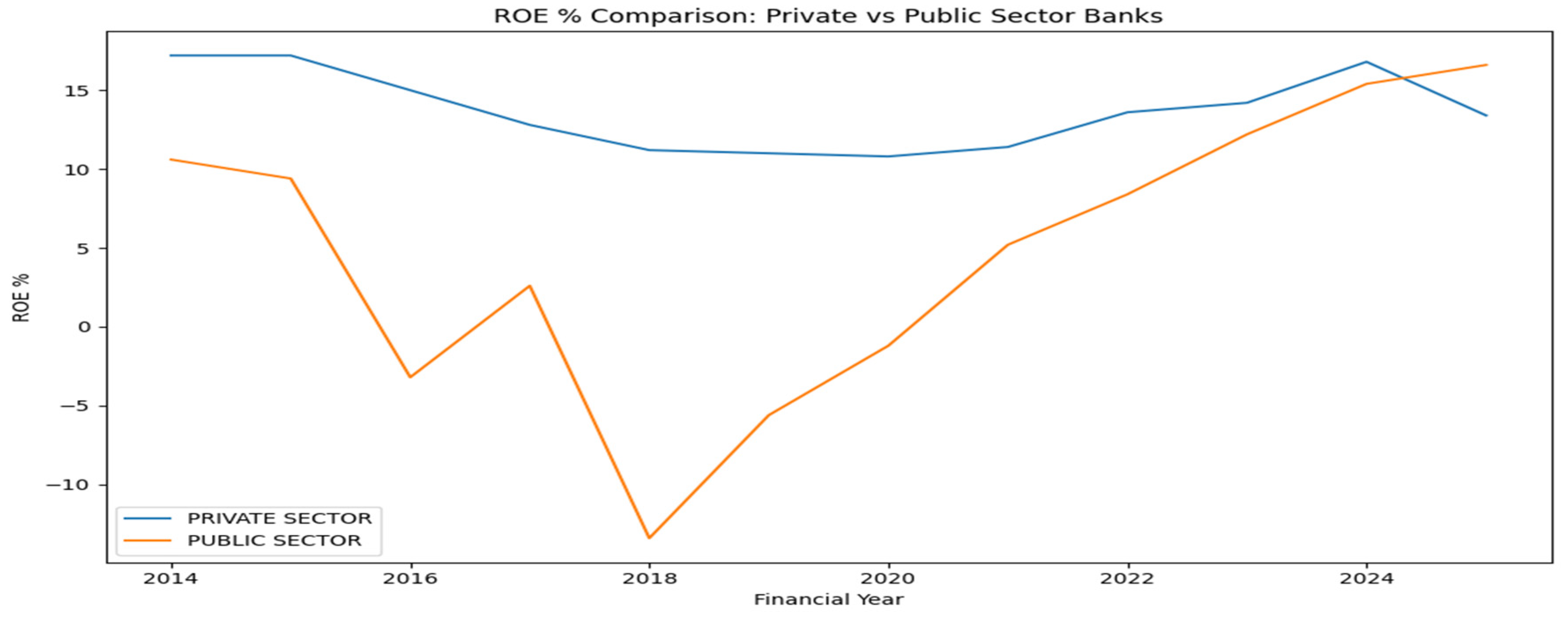
Against this backdrop, the primary objective of this study is to examine the interrelationship between asset quality, profitability, and market valuation in Indian commercial banks over a twelve-year period (2014–2025). The research seeks to determine whether NPAs influence market capitalization directly or primarily through ROE as an intermediary variable. Secondary objectives include assessing the impact of CAR and NIM on both profitability and valuation, comparing performance trends across Public and Private Sector Banks, and evaluating the role of regulatory interventions in reshaping these relationships. These objectives are pursued through a robust methodological framework encompassing Structural Equation Modeling, correlation analysis, and trend evaluation, supplemented by contextual interpretation of policy developments and strategic responses within the industry.
The justification for this inquiry lies in its potential to bridge critical gaps in the existing body of knowledge and inform evidence-based decision-making. While prior studies have illuminated the significance of asset quality and profitability in isolation, few have explored their combined effect on market valuation within the Indian context, particularly in light of recent regulatory and technological shifts. Furthermore, the findings hold practical relevance for multiple stakeholders. For policymakers, they offer guidance on designing targeted interventions that strengthen asset quality without imposing disproportionate compliance burdens. For investors, they provide a nuanced understanding of valuation drivers beyond headline profitability metrics, enabling more informed portfolio strategies. For bank management, they highlight actionable levers—such as margin optimization and capital adequacy—that can enhance resilience and shareholder value in an increasingly competitive environment.
The contribution of this study is threefold. First, it advances theoretical discourse by challenging the conventional assumption that ROE serves as the sole conduit between operational performance and market valuation. Second, it introduces a dual analytical lens that incorporates asset quality and financial ratios, thereby offering a more holistic perspective on banking performance. Third, it delivers practical insights that can inform strategic decision-making at both institutional and policy levels, fostering a more resilient and transparent financial ecosystem.
The remainder of this paper is organized as follows. The next section,
Section 2, delineates the research objectives, providing a conceptual foundation for the analysis. This is followed by
Section 3, with a comprehensive review of the relevant literature, synthesizing global and local perspectives on asset quality, profitability, and valuation. In
Section 4, the research framework and hypothesis are developed, based on literature review. The subsequent
Section 5 outlines the methodological framework, detailing the data sources, variables, and analytical techniques employed. Empirical findings are then presented and discussed in
Section 6, highlighting key trends, correlations, and causal relationships. The paper concludes in
Section 7, with concluding remarks, limitations, policy recommendations and strategic implications, underscoring the practical relevance of the study and identifying avenues for future research.
In sum, this research endeavors to unravel the complex interplay between risk and returns in the Indian banking sector, offering insights that transcend traditional performance metrics and align with the evolving contours of financial stability and market dynamics. By situating asset quality at the heart of this discourse and examining its multifaceted impact on profitability and valuation, the study contributes to a deeper understanding of the forces shaping the trajectory of Indian banking in the twenty-first century.
2. Problem Statement and Research Objectives
The Indian banking industry faces persistent challenges related to asset quality, particularly the rise of Non-Performing Assets (NPAs), which have eroded profitability and investor confidence. While prior studies acknowledge the adverse impact of NPAs on financial performance, they often assume a linear relationship wherein improved profitability automatically enhances market valuation. Recent trends, however, reveal a disconnect between traditional metrics such as Return on Equity (ROE) and market capitalization, suggesting that valuation dynamics may involve additional factors. In India’s unique banking environment—shaped by regulatory interventions, government policies, and sector-specific credit risks—understanding these multidimensional relationships is critical for stakeholders seeking to optimize performance and mitigate systemic risk.
Against this backdrop, the present study aims to examine the interplay between asset quality, profitability, and market valuation in Indian commercial banks over a twelve-year period (2014–2025), using analytical techniques such as Structural Equation Modeling (SEM) and mediation analysis. Specifically, the research pursues the following objectives:
Primary Objective:
Secondary Objectives:
To analyze the statistical relationship between NPAs, asset quality ratios (including Capital Adequacy Ratio and Net Interest Margin), and ROE over the period 2014–2025.
To evaluate the direct and indirect effects of NPAs and key financial ratios on market capitalization using mediation analysis.
To compare NPAs and other key ratios between Public and Private Sector Banks, highlighting sectoral differences and performance trends.
3. Literature Review
The relationship between asset quality, financial ratios, and bank profitability has long been a focal point in banking research.
Ranjan and Dhal (
2003) were among the earliest scholars to empirically demonstrate how non-performing assets (NPAs) undermine bank performance, particularly in India’s Public Sector Banks. Their findings laid a foundation for understanding how deteriorating asset quality restricts credit growth and weakens profitability. Globally,
Berger and Bouwman (
2013) emphasized the role of capital adequacy and return on equity (ROE) in enhancing bank performance and market valuation, especially during financial crises. Their work emphasizes the importance of strong financial ratios in maintaining investor confidence and operational resilience.
Acharya and Naqvi (
2012), along with
Diamond and Rajan (
2001), offer important theoretical insights into how liquidity risk tends to follow a cyclical pattern, influencing how banks behave, especially when financial fragility leads to a decline in asset quality. In the Indian banking landscape, several studies have explored the impact of Non-Performing Assets (NPAs). For instance,
Jain (
2021),
Patel and Shah (
2023), and
Kalpana and Padmavathi (
2020) examine how NPAs affect the profitability of both Public and Private Sector Banks. Meanwhile,
Rao and Patel (
2015) and
Sudha and Mangai (
2020) delve into the underlying causes of NPAs and the strategies banks use to manage them.
From a broader financial perspective,
Cornett et al. (
2011),
DeYoung and Jang (
2016), and
Distinguin et al. (
2013) examine liquidity risk management and regulatory capital, linking these financial ratios to credit supply and financial stability.
Adeabah et al. (
2023) introduce reputational risk as an emerging concern, suggesting its indirect influence on market valuation and profitability.
Prasanth et al. (
2020) identify macroeconomic and operational factors affecting loan performance, reinforcing the importance of asset quality in overall bank health.
Agarwal (
2025) analyzes the impact of recent regulatory changes, especially Basel III, on banking stability and performance. The paper highlights the increased monitoring costs coupled with reduced growth of credit, while appreciating improved risk management and resilience. The paper suggests balanced and more adaptive regulations for sustained banking growth.
Recent scholarships continue to deepen the understanding of asset quality and its implications for banking performance. Studies by
Adithya and Sushma (
2019),
Renuka and Divya (
2023), and
Ghaloth (
2019) consistently highlight the adverse impact of Non-Performing Assets (NPAs) on profitability, noting sectoral variations in intensity.
Satyanarayana and Krishna (
2016) and
Kandpal (
2020) provide structural analyses of the persistent rise in NPAs, while
Ahmed (
2020) examines targeted strategies adopted by Public Sector Banks to curb and manage bad loans. Complementing these perspectives,
Mukherjee and Phirangi (
2020) and
Pani (
2022) propose actionable recommendations at both institutional and policy levels to strengthen asset quality management.
Parallel to this discourse, Return on Equity (ROE) has emerged as a critical metric for evaluating profitability and market valuation in the banking industry.
Chidananda et al. (
2024) demonstrate ROE’s sensitivity to financial ratios such as Price-to-Earnings and Net Profit Margin, reinforcing its role in assessing fiscal strength.
Sinițîn and Socol (
2020) establish a positive correlation between ROE and macroeconomic indicators across European banks, underscoring its global relevance.
Pennacchi and Santos (
2018) argue that ROE offers superior explanatory power for stock market valuation compared to Earnings Per Share (EPS), positioning it as a strategic indicator for investors. Furthermore, research on financial crises reveals ROE’s dual function as both a performance and risk measure, cautioning against unadjusted interpretations.
Ferrouhi (
2018) synthesizes these insights, framing ROE as central to shareholder value creation and long-term profitability. Collectively, these studies affirm ROE’s significance in guiding strategic decisions and investor assessments.
Building on these foundations, contemporary contributions introduce new dimensions to the debate.
Ashwath and Sachindra (
2025) emphasize the interplay between capital adequacy and asset quality in shaping Public Sector Bank performance, reinforcing regulatory imperatives.
Rizvi and Singh (
2025) offer comparative insights into asset quality through Net NPA ratios, highlighting structural shifts following bank mergers.
Chaudhury (
2025) presents a case study on the State Bank of India, directly linking asset quality to profitability metrics, while
Kumar and Rastogi (
2025) empirically validate the detrimental effect of NPAs across Public and Private banks.
Thakur (
2025) and
Koley (
2025) broaden the discussion by exploring risk management strategies and governance-driven variations in NPA trends.
Ahmad et al. (
2025) examine the mitigating role of strong capital buffers against asset quality shocks, while
Yoganandham (
2025) introduces a forward-looking perspective by integrating policy reforms and AI-driven risk management into financial stability frameworks. These contributions not only corroborate earlier findings but also expand the analytical lens to include technological innovation, post-merger dynamics, and evolving regulatory landscapes.
In sum, the literature reflects a multidimensional approach to understanding asset quality, financial ratios, and market valuation in Indian banking. By bridging traditional metrics with emerging paradigms, these studies provide a robust foundation for future research and policy formulation aimed at enhancing resilience and sustainable growth in the sector.
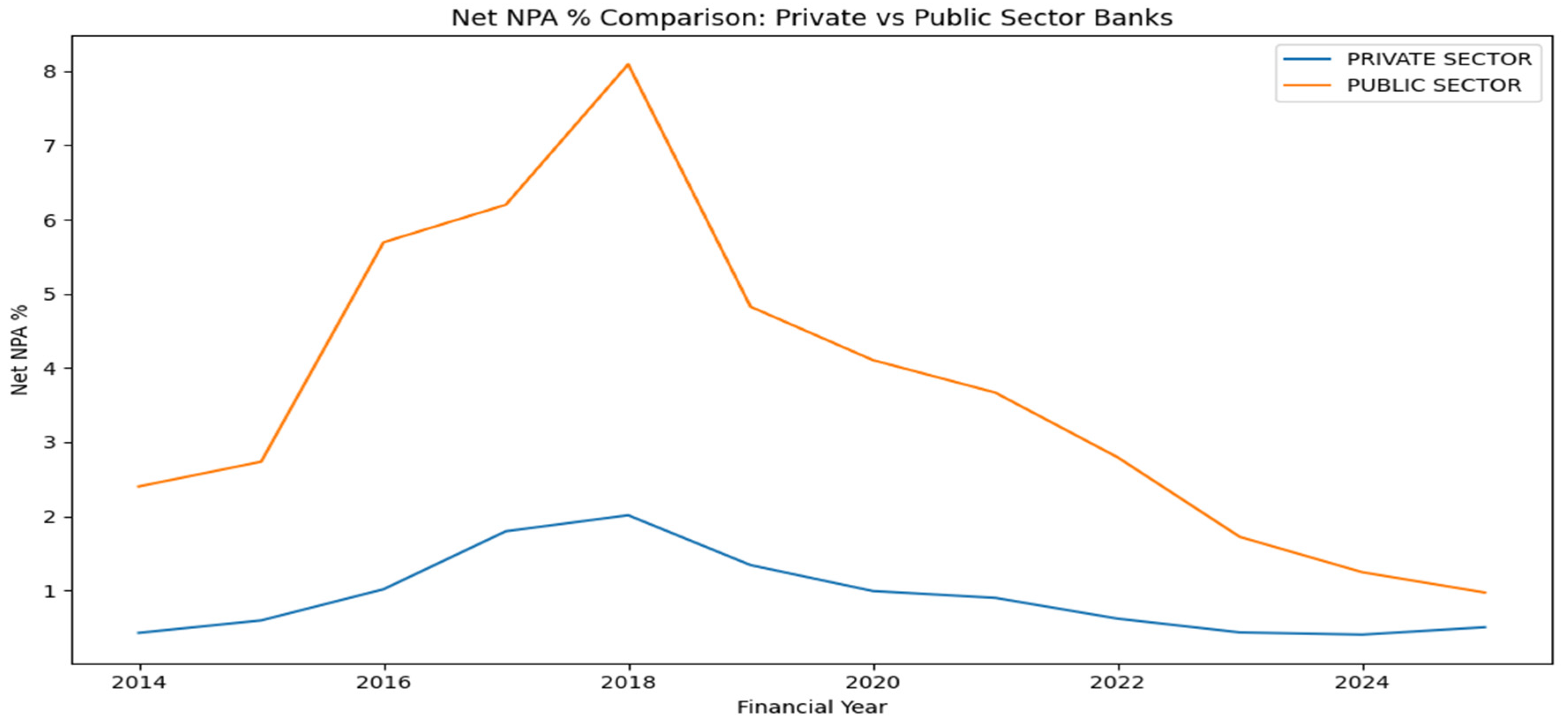
This study builds on existing research by analyzing the performance of Indian commercial banks over a 12-year period. While prior studies have largely focused on the impact of asset quality on profitability, typically measured by Return on Equity (ROE), this paper advances the discussion by examining whether ROE also influences market valuation. Specifically, it investigates how asset quality indicators, Net Non-Performing Assets (NPAs), and key financial ratios, including the Capital Adequacy Ratio (CAR) and Net Interest Margin (NIM), affect both profitability and market capitalization.
The central question addressed is whether asset quality directly impacts market value or whether its influence, along with other financial ratios, operates primarily through ROE. By integrating global theoretical frameworks with localized empirical evidence, this research offers a nuanced understanding of performance drivers within the Indian banking sector. The analysis spans the period from 2014 to 2025, incorporating major regulatory and policy interventions such as the Insolvency and Bankruptcy Code (IBC) and the Reserve Bank of India’s Prudential Framework, which have significantly shaped asset quality and financial stability.
6. Results
6.1. Verification of COVID Impact
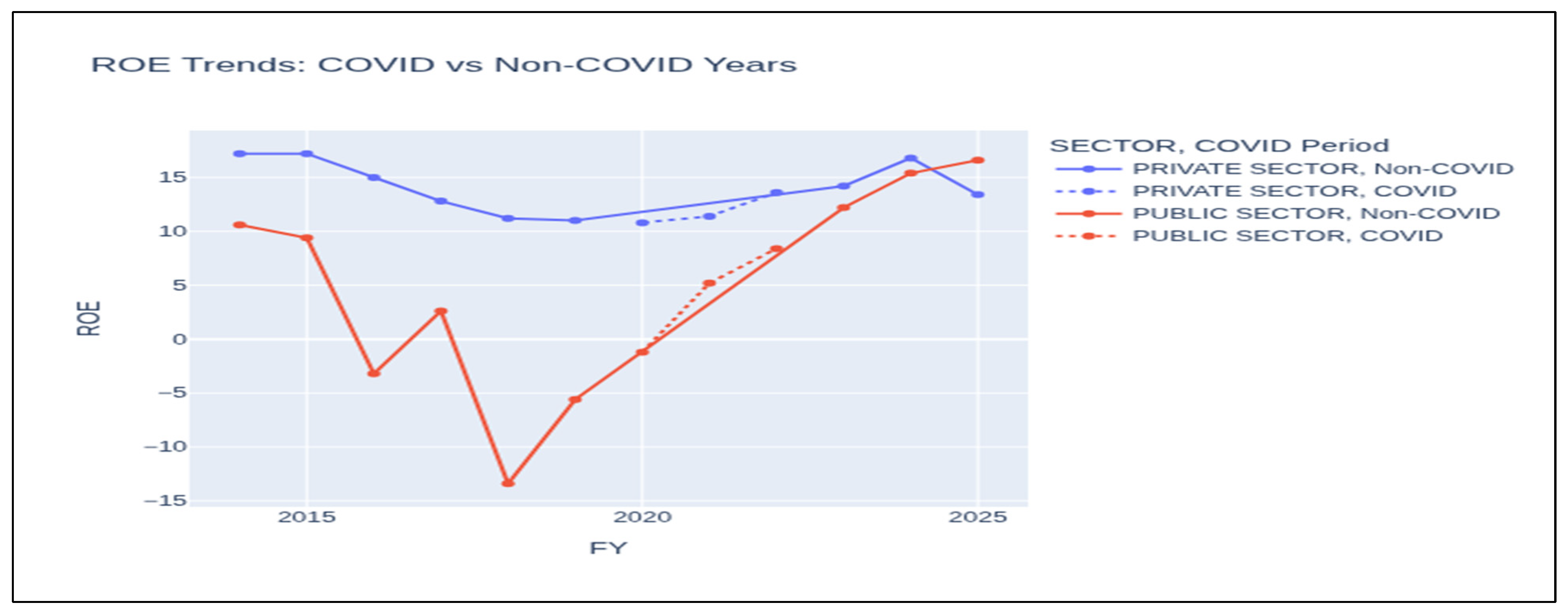
Regression analysis showed that the COVID dummy was statistically insignificant (
p ≈ 0.97), indicating that the pandemic did not materially affect ROE in the aggregate model. Private banks sustained stable ROE during 2020–2022 through strong fundamentals and risk management, while public banks improved gradually with regulatory support and capital infusion. Despite sectoral differences, the pandemic’s direct impact on ROE was negligible, emphasizing structural factors and long-term strategies (
Figure 6).
6.2. Verification of Efficiency Difference Between Public and Private Banks
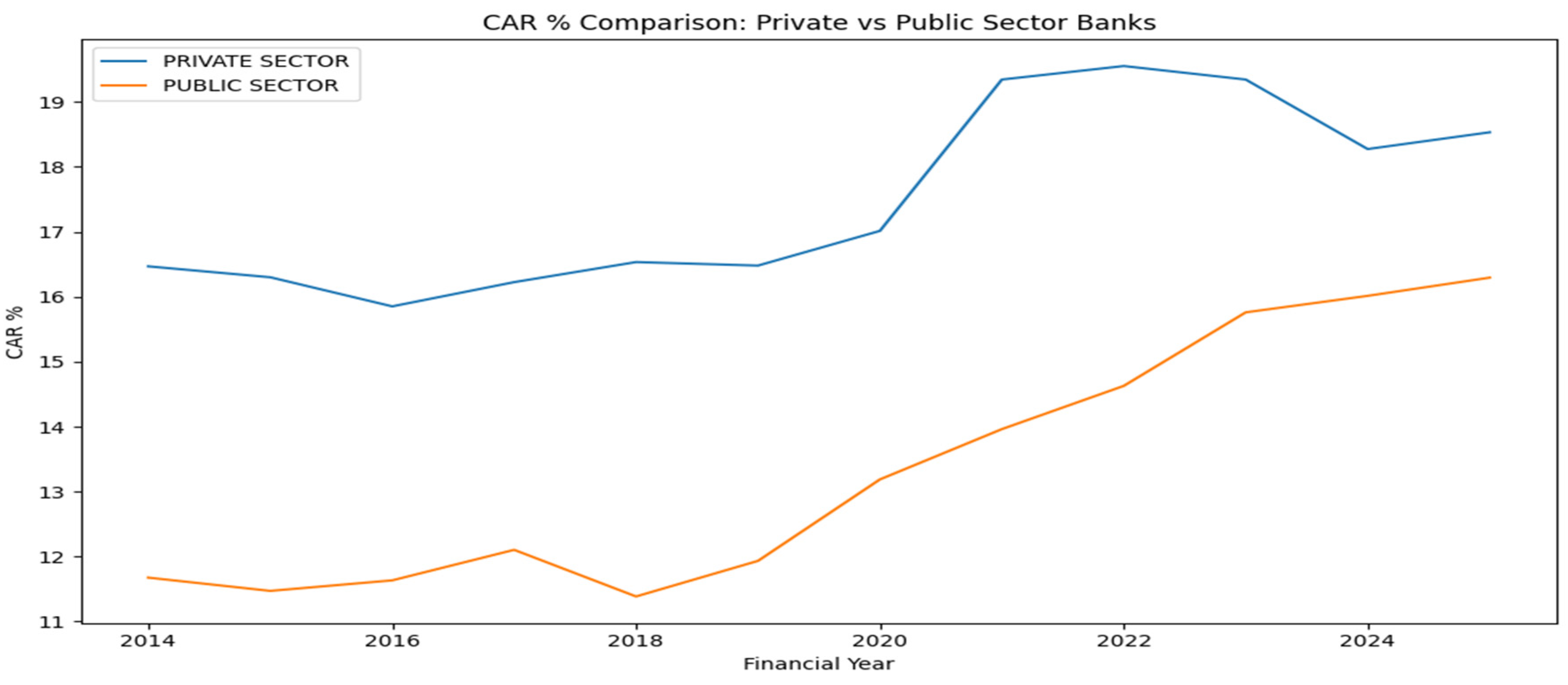
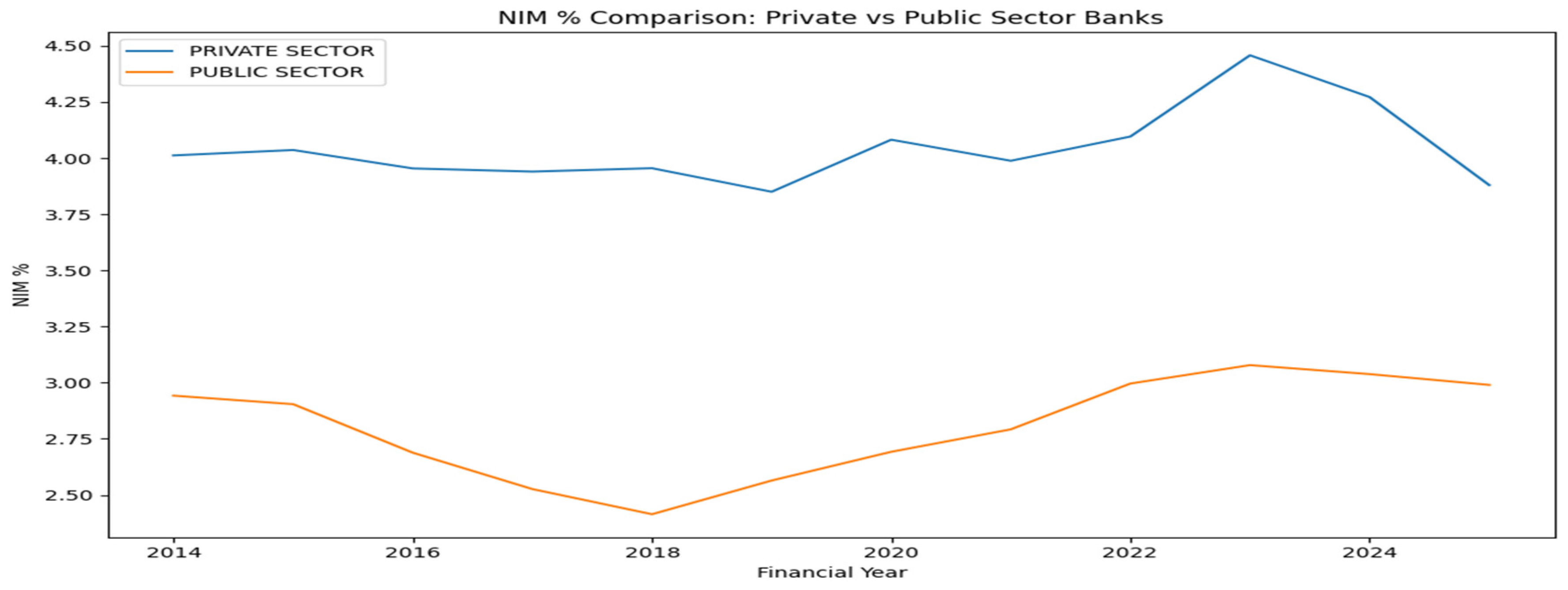
Regression analysis across FY2014–2025 for ten major Indian banks reveals nuanced efficiency patterns between the private and public sectors. Private banks demonstrate stronger valuation sensitivity to asset quality (Net NPA) and benefit from higher capital adequacy (CAR), suggesting disciplined risk management and growth signaling. Public banks, conversely, show weaker explanatory power (Adj. R2 ≈ 0.45 vs. 0.66 for private) and a negative association between CAR and valuation, reflecting structural constraints. However, profitability metrics (NIM, ROE) do not consistently favor private banks; ROE even turns slightly negative in private models after controlling other factors. Overall, while private banks appear more market-efficient in translating fundamentals into price, the evidence is mixed on operational efficiency, as some profitability indicators lack significance.
6.3. Results of the Structural Equation Model
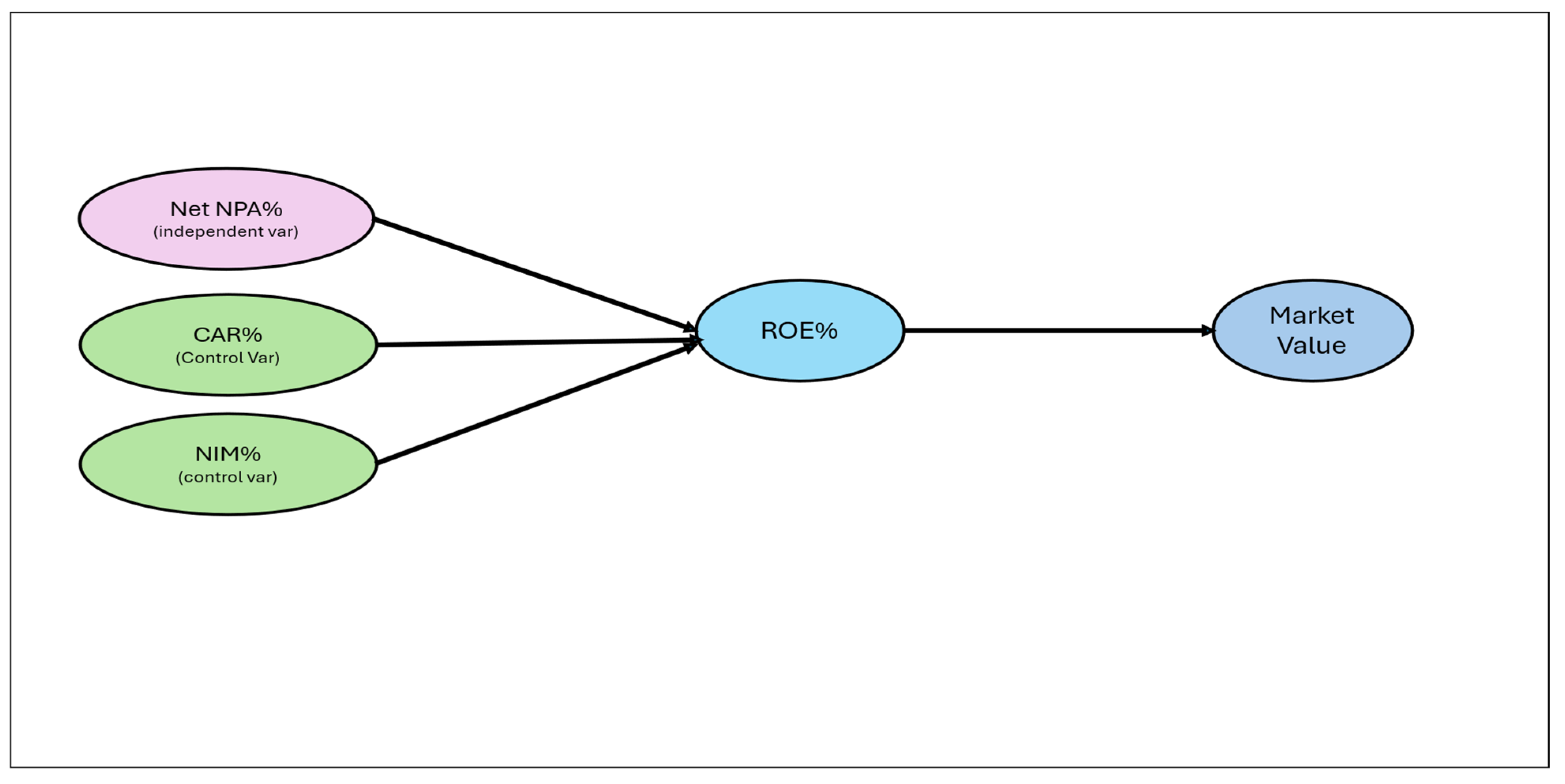
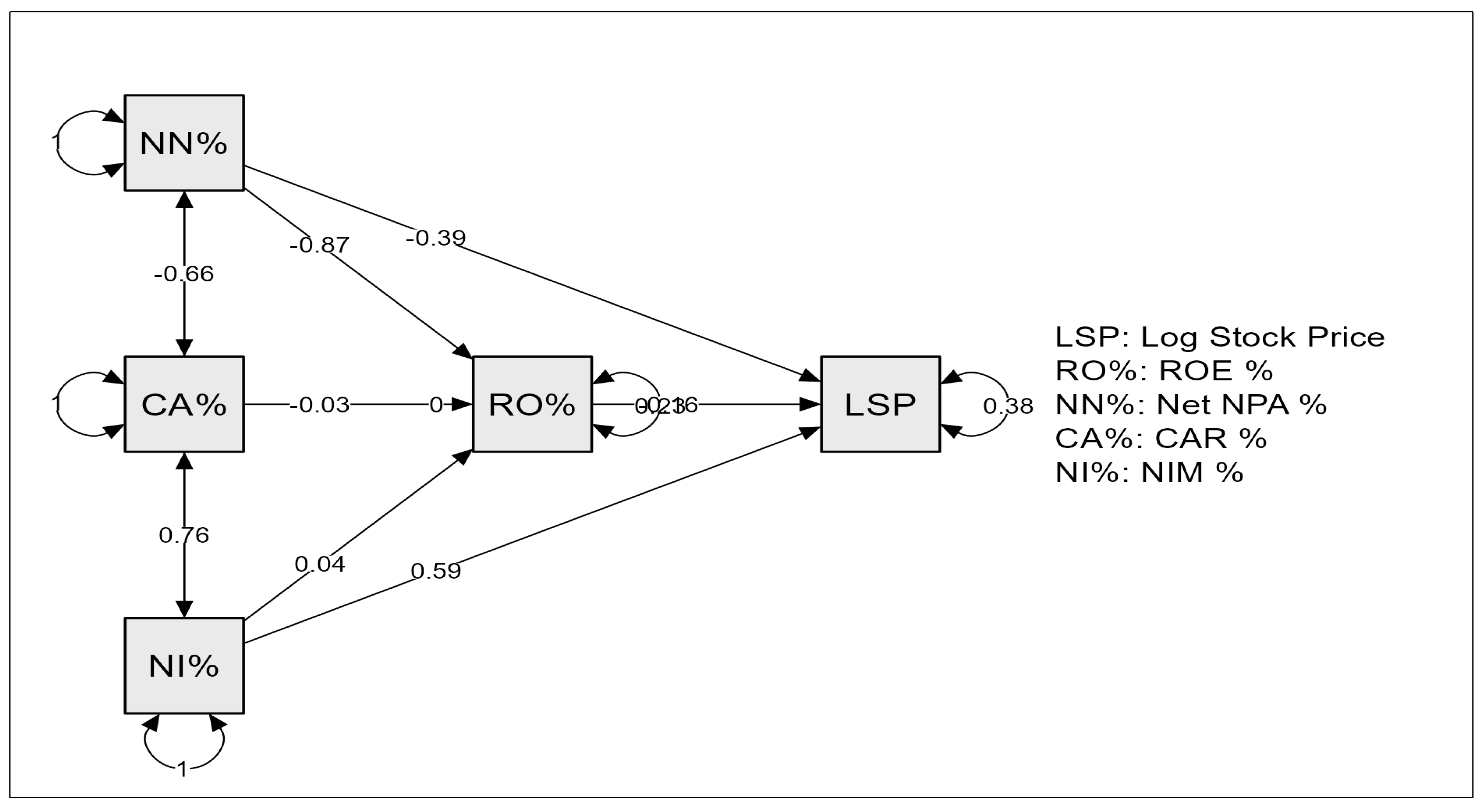
Structural Equation Modeling (SEM) examined the direct, indirect, and total effects of key financial indicators—Net NPA%, CAR%, and NIM%—on log-transformed stock prices, with ROE% as a potential mediator (
Figure 7 and
Table 5,
Table 6 and
Table 7). The model explains 61.8% of variance in log stock prices (R
2 = 0.618) and 76.6% in ROE% (R
2 = 0.766). Significant findings include the following.
Net NPA% exhibited a significant negative effect on log stock prices (β = −0.390, p = 0.003), indicating that higher non-performing assets are associated with lower stock prices. Conversely, NIM% showed a strong positive effect (β = 0.589, p < 0.001), suggesting that improved net interest margins enhance stock valuation. CAR% does not have a significant direct effect (β = −0.002, p = 0.979).
The mediation analysis revealed that none of the indirect paths through ROE% were statistically significant (e.g., Net NPA% → ROE% → Stock Price: β = 0.138, p = 0.172), indicating that ROE% does not mediate the relationship between these predictors and stock prices in this model.
The total effect of Net NPA% on stock prices remains negative and significant (β = −0.251, p = 0.002), while NIM% retains its strong positive influence (β = 0.583, p < 0.001). CAR% continues to show no meaningful impact.
6.4. Hypothesis Testing
The outcome of hypothesis testing is enumerated in
Table 8.
7. Conclusions
7.1. Concluding Remarks
This study provides critical insights into the interplay between asset quality, financial ratios, and market valuation in Indian commercial banks over a twelve-year period. The findings confirm that Net Non-Performing Assets (NPAs) exert a significant negative influence on both Return on Equity (ROE) and market capitalization, underscoring the systemic risk posed by deteriorating asset quality. Conversely, Net Interest Margin (NIM) emerges as a strong positive determinant of market value, highlighting the importance of operational efficiency and revenue optimization. Interestingly, the Capital Adequacy Ratio (CAR), while essential for regulatory compliance and financial stability, does not exhibit a direct impact on market valuation in the tested model. Furthermore, the mediation analysis reveals that ROE does not fully explain the relationship between bank fundamentals and market value, challenging conventional assumptions that profitability alone drives investor perception. These findings emphasize the multidimensional nature of valuation drivers and the need for integrated strategies that address both risk and performance metrics.
7.2. Limitations
Despite its methodology, this study is subject to certain limitations. First, the sample is restricted to the ten largest banks by sales, which, while representative of industry dynamics, may not capture the heterogeneity of smaller institutions or regional banks. Second, the reliance on secondary data from audited financial statements and market sources introduces potential reporting biases and limits the granularity of operational insights. Third, the study employs a static mediation model that does not account for time-lagged effects or dynamic interactions between variables, which could influence causal interpretations. Fourth, qualitative factors such as governance quality, technological adoption, and customer behavior—though acknowledged—are not quantitatively modeled, leaving scope for omitted variable bias. Finally, external shocks beyond COVID-19, such as geopolitical risks or global interest rate fluctuations, were not incorporated, which may affect the generalizability of results.
7.3. Policy Recommendations
To strengthen the resilience of the banking sector, a multi-pronged policy approach is essential. First, asset quality monitoring must be significantly enhanced. Regulators should mandate real-time tracking of non-performing assets (NPAs) through systems integrated with AI-driven predictive analytics. Such technology would enable early identification of stress signals and help prevent contagion across institutions.
Second, capital adequacy standards require a dynamic framework. Although the Capital Adequacy Ratio (CAR) did not exhibit a direct impact on market valuation in the analysis, its role in ensuring systemic stability remains critical. The Reserve Bank of India (RBI) could consider linking capital requirements to asset quality metrics rather than relying on static thresholds, thereby creating a more responsive and risk-sensitive capital buffer system.
Third, policies aimed at margin optimization should be prioritized. Encouraging diversification into high-yield retail segments and promoting digital lending platforms can improve Net Interest Margin (NIM), which in turn enhances profitability and market valuation. These measures would support sustainable growth while maintaining prudent risk management.
Fourth, governance and risk culture must be incentivized, particularly in Public Sector Banks. Introducing performance-linked capital infusion contingent on governance reforms and adherence to risk management benchmarks can foster accountability and operational efficiency. Such initiatives would align capital support with measurable improvements in institutional practices.
Finally, market transparency should be strengthened to bolster investor confidence. Enhanced disclosure norms around asset quality and provisioning will reduce information asymmetry and improve market discipline. Clear and timely communication of financial health indicators is vital for maintaining trust and stability in the banking system.
7.4. Future Research
Future studies should adopt a longitudinal design incorporating dynamic panel models to capture time-dependent effects and cyclical trends. Expanding the sample to include regional and cooperative banks would enhance representativeness and uncover sectoral nuances. Researchers could integrate qualitative dimensions—such as leadership effectiveness, digital transformation, and ESG compliance—into hybrid models combining financial and non-financial indicators. Additionally, exploring cross-country comparisons within emerging markets could provide global benchmarks and contextualize India’s banking performance. Finally, advanced techniques such as machine learning-based predictive modeling and scenario analysis under stress conditions would offer forward-looking insights for policymakers and practitioners.