1. Introduction and Literature Review
Precise modeling of heavy-tailed claims data is fundamental to the insurance sector, supporting risk evaluation, premium determination, and capital distribution (
Ellili et al. 2023). Effectively capturing risk is crucial in both insurance and finance because it helps financial institutions forecast and mitigate potential loss, safeguard solvency, and fortify capital stability in unstable markets. In finance, accurate risk capture supports informed investment decisions and the prevention of systemic failures; however, in insurance, it directly influences the setting of premiums that reflect true exposure levels, the allocation of capital reserves to cover unexpected claims, and the overall resilience against catastrophic events (
Chernobai et al. 2007). Without robust risk modeling, institutions face an elevated likelihood of financial crisis, as underestimated risks can deplete capital reserves and cause potential insolvency during stress periods.
For instance,
Chernobai et al. (
2007) highlight operational risks under frameworks like Basel II, where errors in risk assessment, such as flawed loss modeling or inadequate internal controls, have contributed to major financial collapses. A significant instance that triggered global bank failures and the 2008 global financial crisis was the flawed sale of mortgage-backed securities in the early 2000s, which illustrated how operational risk evaluation increased credit risk profiles (
Chernobai et al. 2007). Collapses of such magnitude bring attention to the chain reaction of poor risk management. Initial modeling errors spread to financial systems with direct and indirect connection, resulting in significant economic setbacks and reduced stakeholder assurance. Recent studies have advanced the modeling of heavy-tailed and dependent insurance losses by introducing flexible dependence structures and bimodal distributions tailored to real-life claim datasets and directly enhancing the estimation of premiums, stable reserves, and conservative quantification of risk measures required under Solvency II (
Yan et al. 2024;
Yousof et al. 2023a,
2023b).
These issues extend to insurance, where incorrectly classifying claim distributions or failure to recognize extreme outcomes in the tails can cause substantial problems. Misclassification might lead to undervaluing premium rates, creating portfolios that are profitable but yet exposed to unanticipated extreme events (
Embrechts et al. 2014). For instance,
Embrechts et al. (
2014) highlight that the downside of using a light-tailed distribution, like the normal distribution to model heavy-tailed claims, could cause underestimation of the Tail Value-at-Risk (TVaR) by a significant value (10–20%), leaving inadequate reserves for large claims. However, using an excessively heavy-tailed distribution can also cause overfunding, holding excessive funds far beyond the risk-required amounts and preventing competitive pricing. These require precise risk assessment to safeguard policyholders (
Embrechts et al. 2014). Prolonged misclassification deteriorates reputation, drives up reinsurance, and increases the probability of business failure in extreme claim volumes.
Traditional modeling, often guided by the Akaike Information Criterion (AIC) or Bayesian Information Criterion (BIC), risks overfitting or underfitting, leading to poor generalization of loss distributions (
Buckland et al. 1997). This study first discusses model averaging to mitigate model selection uncertainty that stems from over reliance on one single “best” model and secondly grid maps to balance complexity with fit for heavy-tailed insurance data and enhance forecasting (
Miljkovic and Grün 2021;
Claeskens and Hjort 2008;
Blostein and Miljkovic 2019). Model selection uncertainty, which is the discrepancy between a chosen model and the true data-generating process, poses a significant challenge in insurance modeling (
Taghizadeh-Mehrjardi et al. 2022;
Ye et al. 2010;
Hoeting et al. 1999). Selection of a single “best” model disregards competing models, resulting in inflated prediction confidence and biased risk measures, such as Value-at-Risk (VaR) and Expected Shortfall (ES) or TVaR (
Buckland et al. 1997;
Miljkovic and Grün 2021).
Model averaging counters reliance on a single model by weighting models based on their supporting evidence, using methods like Bayesian model averaging with posterior probabilities or frequentist approaches like Mallows model averaging with criteria like Mallows’ Cp (
Amini and Parmeter 2011;
Hansen 2007;
Wang et al. 2009). For instance,
Ando and Tsay (
2010) showed Bayesian model averaging improves predictive probability, while
Fragoso et al. (
2018) emphasized its systematic weighting approach.
Miljkovic and Grün (
2021) used AIC and BIC weights to create heatmaps, revealing no single model consistently excels for insurance claims (see Figure 2.2 in
Miljkovic and Grün 2021). This reduces overfitting and underfitting, ensuring robust risk estimates (
Raftery et al. 2005;
Volinsky et al. 1997). By thresholding Occam’s window, which is a model selection method used to identify a subset of plausible statistical models from a larger set of candidates in model averaging (
Madigan and Raftery 1994), they prune implausible models and focus scrutiny on viable subsets.
Heavy-tailed distributions are critical for modeling insurance claims, where extreme losses dominate outcomes. Unlike Gaussian models, which underestimate tail probabilities, mixture and composite models tend to blend or splice distributions together (e.g., lognormal for bulk, Pareto for tails) to capture diverse behaviors (
Aston 2006;
Marambakuyana and Shongwe 2024).
Grün and Miljkovic (
2019) as well as
Marambakuyana and Shongwe (
2024) evaluated such models on Danish fire and South African taxi claims, selecting the “best” via BIC but overlooking uncertainty, risking skewed assessments. Model averaging’s value extends across fields. In ecology (
Richards et al. 2011), multimodal inference improves predictions in noisy datasets (
Dormann et al. 2018;
Link and Barker 2006). In hydrology,
Diks and Vrugt (
2010) and
Singh et al. (
2010) showed it strengthens prediction. In economics,
Moral-Benito (
2015) and
Steel (
2020) used it for well-grounded forecasting, while
Posada (
2008) applied it in phylogenetics for phylogenetic trees. Financial and health applications further demonstrate their ability to reduce forecast errors (
Wright 2008;
Volinsky et al. 1997). By pruning implausible models, model averaging focuses on viable subsets, enhancing decision-making (
Madigan and Raftery 1994).
Even though improvements have been made, when modeling heavy-tailed insurance data, it remains problematic and challenging to rely on single distribution to effectively capture unpredictability and rare extreme events (
Marambakuyana and Shongwe 2024). Single-model frameworks, reliant on AIC, BIC, or Kolmogorov–Smirnov tests, amplify overconfidence, risking faulty reserve accuracy (
Miljkovic and Grün 2021), but model averaging offers integrated, uncertainty-sensitive, refining risk metrics like VaR and TVaR for conservative yet precise estimates (
Zhang et al. 2023). This framework prioritizes accuracy and resilience, strengthening insurance risk management (
Embrechts et al. 2014;
Hoeting et al. 1999).
In an effort to achieve stable risk modeling for heavy-tailed insurance data,
Blostein and Miljkovic (
2019) proposed the use of a novel grid mapping approach to integrate model selection criteria (AIC or BIC) with risk measures (VaR and TVaR) across the entire spectrum of considered models. The practical utility of the grid map approach is further illustrated through the analysis of a real dataset of left-truncated insurance losses. Grid maps facilitate comprehension by comparing AIC or BIC against VaR or TVaR at thresholds like 0.95 or 0.99, revealing fit versus tail performance trade-offs (
Blostein and Miljkovic 2019;
Taghizadeh-Mehrjardi et al. 2022).
For left-truncated data, common in claims exceeding deductibles, grid maps underscore how mixtures mitigate biases due to truncation, directing actuaries to balanced risk assessment models. Grid maps contextualize uncertainty, aiding strategic decisions in insurance by highlighting models that balance fit of the data and conservatism (
Blostein and Miljkovic 2019). Using a dataset of Secura Re insurance claims with truncation due to deductibles, the grid map was applied by
Blostein and Miljkovic (
2019) to evaluate the single distribution as well as the two-component and three-component mixture models by separately plotting their AIC and BIC scores against VaR and TVaR estimates. It was observed that the single lognormal model is the better fit based on the AIC and BIC criteria, with the gamma-Weibull mixture model as the next better option.
It is first worth mentioning that Danish fire claims data has not yet been analyzed using model averaging or grid maps. Thus, this study applies both model averaging and grid mapping to the Danish fire claims (2492 observations, millions of Danish Kroner) dataset, a classic example of heavy-tailed losses; for a more detailed account of other studies based on Danish fire claims data, see
Shongwe and Marambakuyana (
2024). Even though Danish fire claims data has been widely studied, previous research has focused on finding the single “best” distribution plausible for modeling the data. Model selection uncertainty mitigation (model averaging) and the balance between model fit and risk metrics (grid mapping) have not been studied before; this is significantly important as it gives a broader picture of the data studied and nuances that come with data modeling using various distributions. The research objective is to investigate whether model averaging and grid mapping approaches, separately, are able to capture the heavy-tailed nature of Danish fire claims data by using the distributions outlined in
Appendix A: (i) 16 single distributions—
Table A1; (ii) 256 composite distributions—
Table A2; and (iii) 256 mixture distributions—
Table A2. Consequently, the corresponding research questions (RQ) that will be addressed are as follows:
(RQ1) How do the performances of single, composite, and mixture models compare when applied to Danish fire claims data using model averaging and grid mapping techniques?
(RQ2) Does model averaging and grid mapping have a significant difference in model selection?
(RQ3) How does model averaging and grid mapping affect the overall risk assessment in heavy-tailed data?
The remaining sections of this paper are structured as follows.
Section 2 outlines the methodology used in this paper.
Section 3 provides a detailed analysis and the results of Danish fire claims data modeling. Thereafter, a detailed discussion of related publications and the results of this paper are summarized in
Section 4. The conclusions and limitations of this study are provided in
Section 5 and
Section 6, respectively.
Appendix A lists all the distributions used in this paper, and
Appendix B provides some of the theoretical characteristics of the distributions considered. Finally,
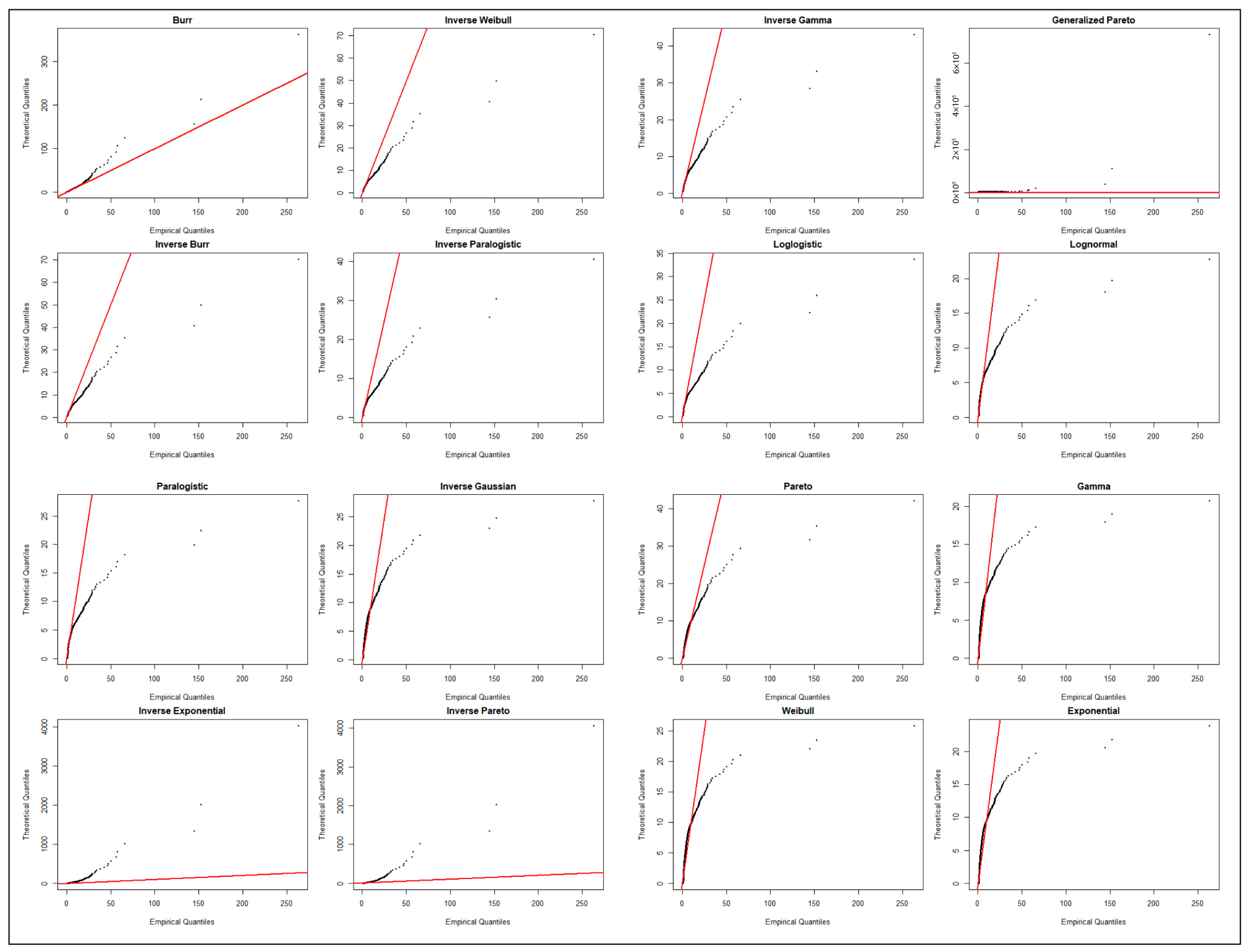
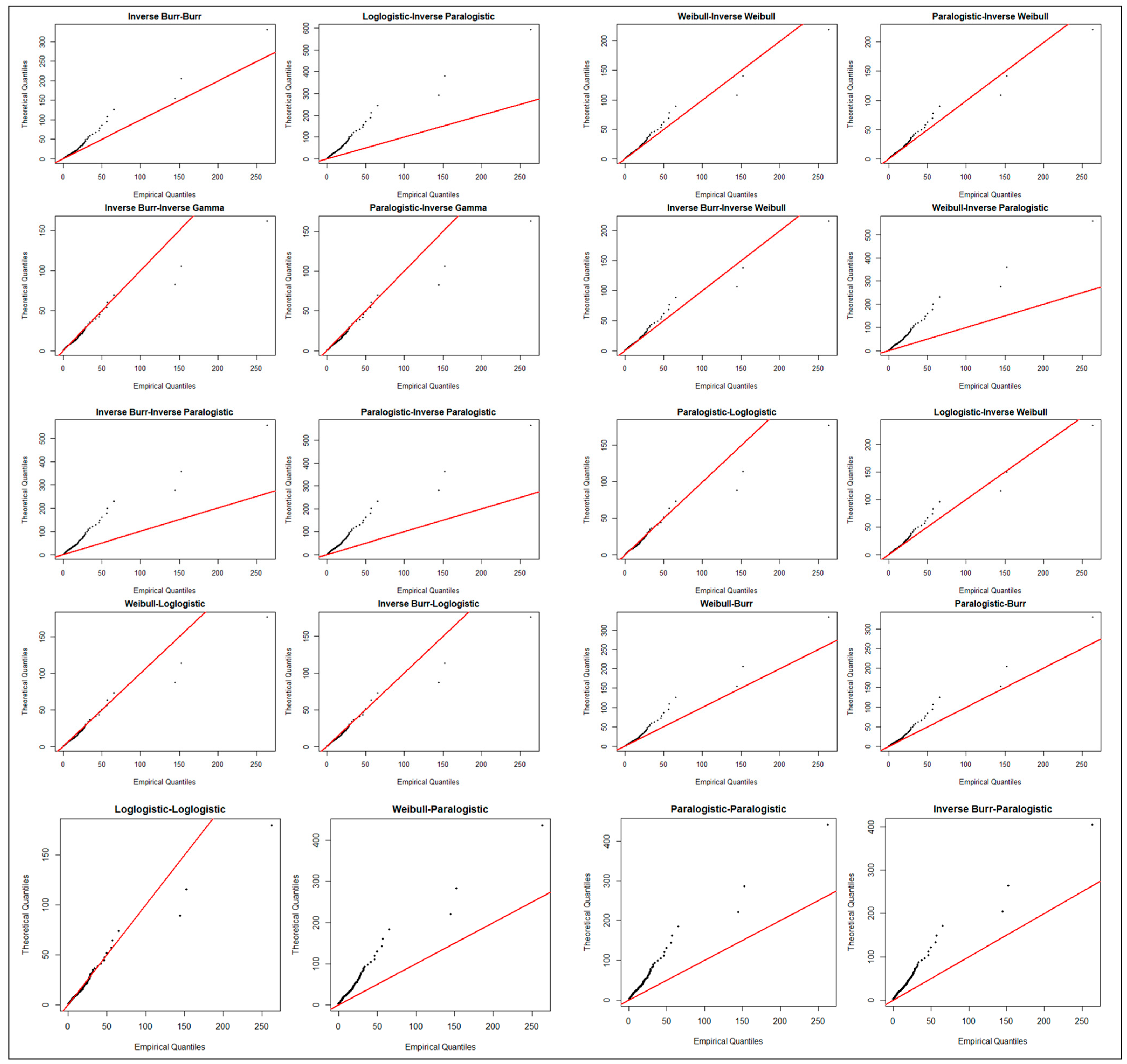
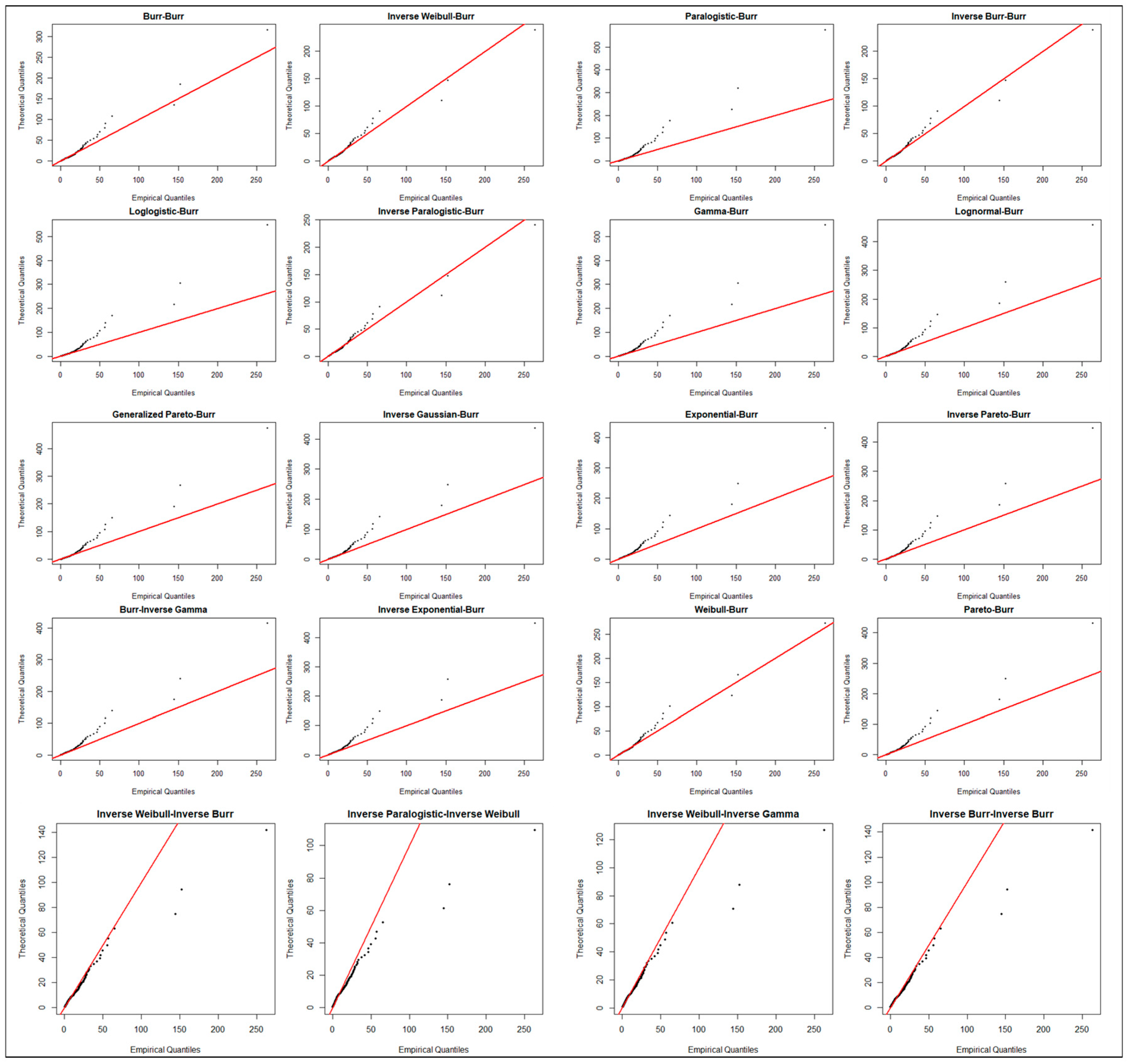
Appendix C provides the sensitivity analysis of the Occam’s window and the distribution’s Q-Q plots.
3. Analysis and Results
3.1. Data Descriptive
In our study, we use Danish fire claims data, as shown in
Table 1, consisting of 2492 claims reported in millions of Danish Krones (DKKs). Danish fire loss claims data shows that most fire insurance claims are relatively modest (with a median of 1.63 million DKK), but there are a few extremely large claims (up to 263.25 million DKK) that dramatically increase the average claim size to 3.06 million DKK. The data is extremely heavy tailed (i.e., kurtosis 549.57), meaning that, while most claims are small, rare catastrophic events cause massive losses, as we can see with the skewness (19.90). This pattern reflects very high variability (coefficient of variation 2.60), which is a ratio of the standard deviation to the mean. Previous research suggests that a coefficient of variation of 0.2 (20%) or less is often considered to resemble more stable data, while
de Campos et al. (
2018) highlight the high variability nature of Danish fire claims data.
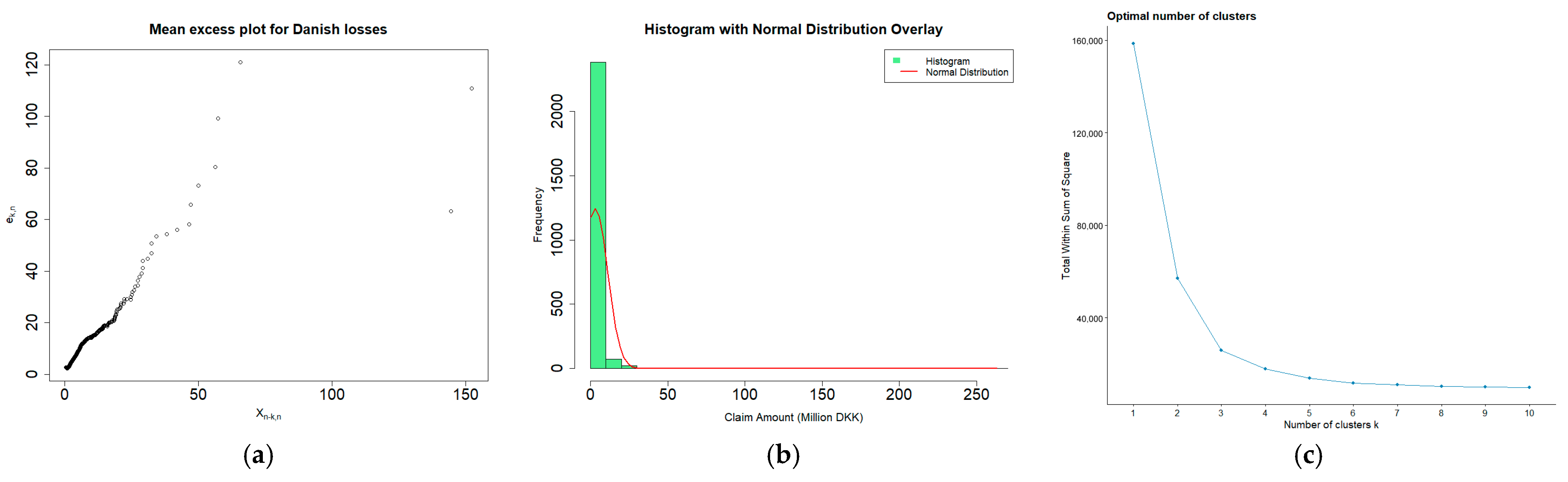
Figure 1a shows an increasing mean excess plot for Danish fire claims data, which seems to have some outliers in the extreme end of the tails, indicating that a single distribution may not easily account for the varying heavy-tailed pattern; hence, the variability in
Table 1 is very high. The histogram in
Figure 1, with an overlay of the normal distribution (in red), depicts that, indeed, the heavy-tailed data (very large kurtosis and skewness values) does not follow the normal distribution. The plot of total within-cluster sum of squares (i.e., elbow method) against the number of clusters (k) in
Figure 1c suggests clusters with elbow at
. This bending point signifies that increasing the number of clusters past three yields only minimal improvement. Accordingly,
is identified as the optimal clustering solution under the elbow method criterion.
3.2. Single Distributions Averaging
AIC weights for Danish fire claims in
Table 2 suggest that Burr is the only plausible model for modeling the data. BIC weights strongly favor Burr, indicating it provides a better trade-off between fit and simplicity. Models with near-zero weights (e.g., inverse Weibull, lognormal, etc.) are statistically very unlikely to be the most appropriate models for this dataset. The difference between AIC and BIC weights highlights the importance of considering model complexity: AIC is more forgiving of additional parameters, while BIC is stricter.
Raftery et al. (
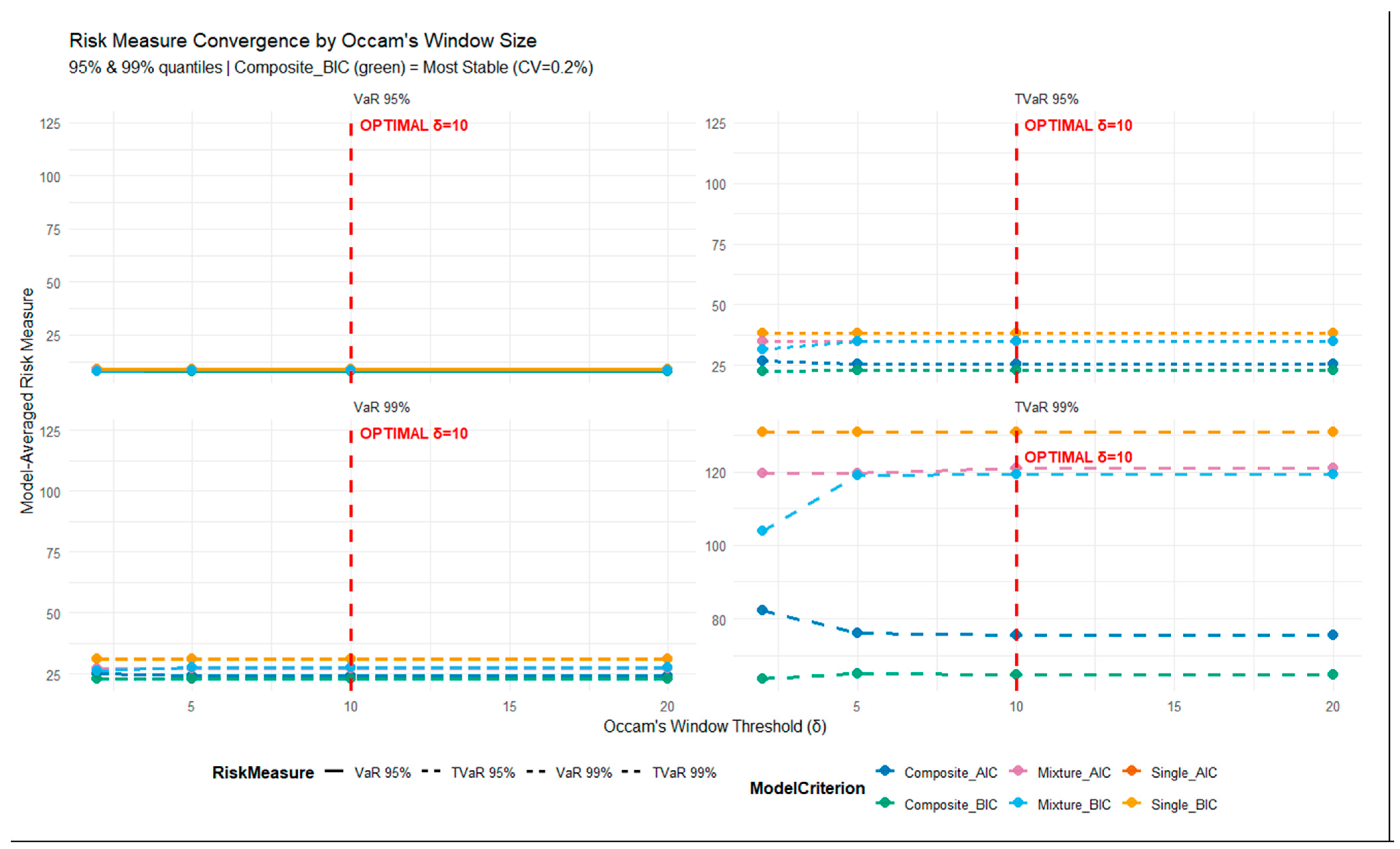
1997) demonstrated that Occam’s window avoids selecting overfit models. Also, a cut-off based on an AIC and a BIC difference of 10 (
) (see the sensitivity analysis in
Appendix C,
Figure A1) allows for a focused yet flexible set of plausible models for averaging. A smaller
value gives a stricter set of plausible models for averaging. The
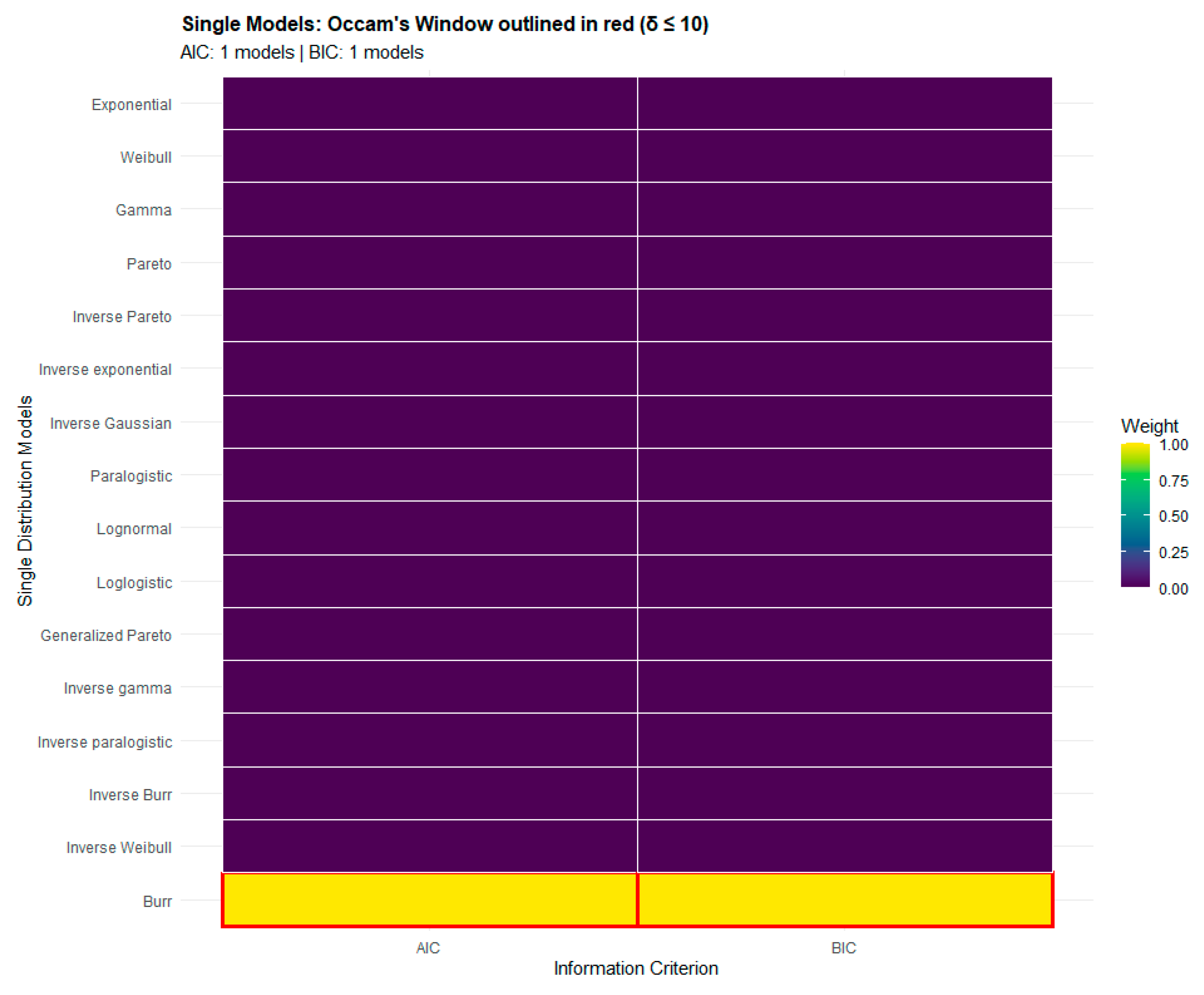
dictates that Burr is the only plausible model for selection.
The Burr distribution in
Table 3 dominates both AIC and BIC weighted averages, delivering identical point estimates. The VaR or TVaR values are 8–140% higher than empirical figures, providing a conservative (capital-safe) buffer for the heaviest tails. For Danish fire claims, the Burr model is, therefore, the single most sound parametric choice for tail-risk quantification and pricing.
Figure 2 shows that Burr out-weighs the other 15 models in model averaging, with the highest weights in both the AIC and BIC for Danish fire claims data, with all the weight concentrated in one distribution. Burr is the only competing model in the Occam’s window at
, outlined in red.
3.3. Composite Distributions Averaging
Inverse Burr-Burr leads in the lowest AIC and highest AIC weight (0.580) in
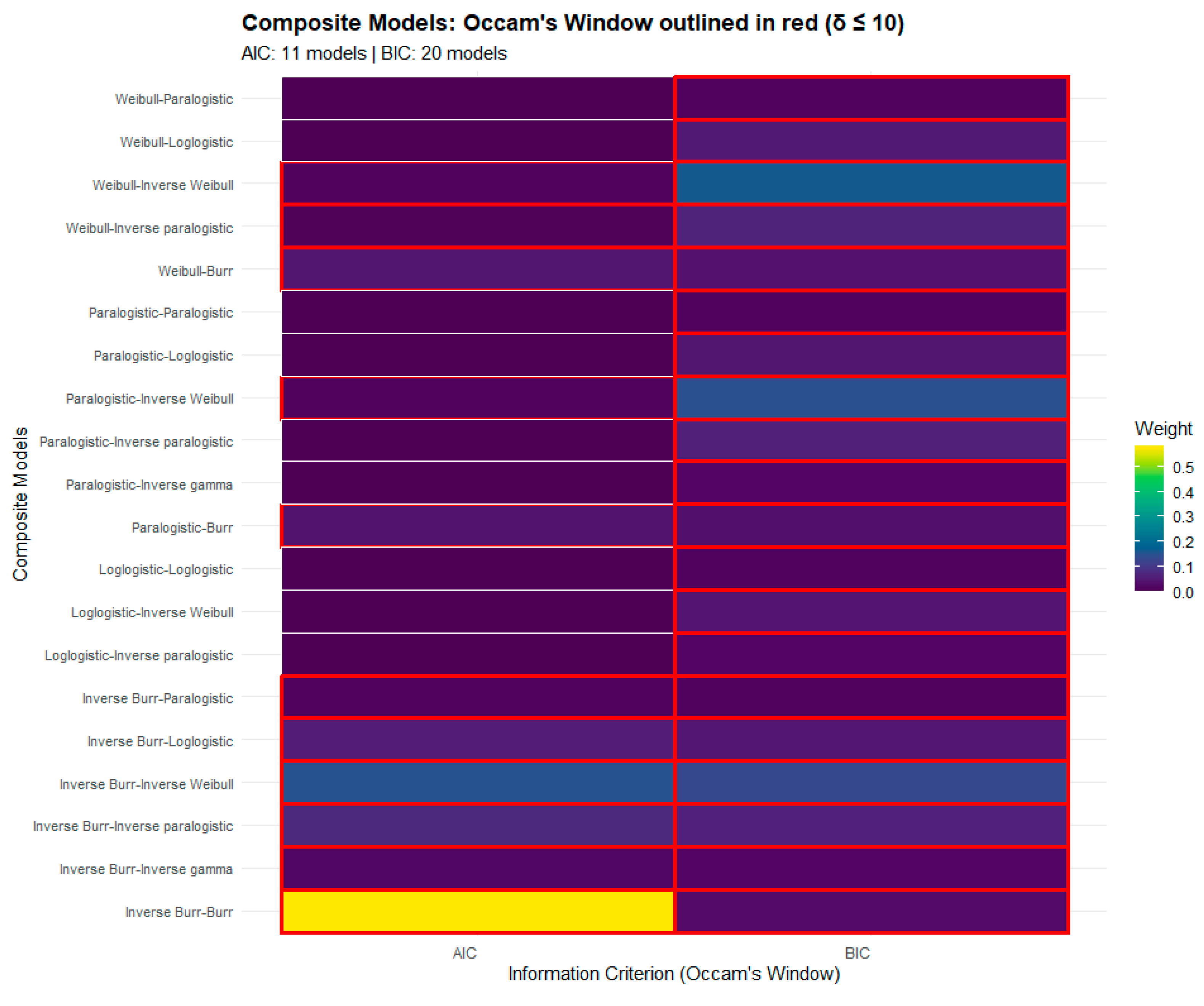
Table 4, better balancing fit and complexity. “Weibull-Inverse Weibull” has the lowest BIC, and it is favored for simplicity. Discarded models are highlighted in blue, with only 11 models in the Occam’s window at
if sorted in terms of the AIC. Models with Inverse Weibull distributions dominate, capturing data relatively better than the other considered models. AIC favors “Inverse Burr-Burr,” while BIC spreads weights more evenly (max 0.163). If the models are sorted in terms of the AIC, then Inverse Burr-Burr would be the most appropriate model, followed by Inverse Burr-Inverse Weibull.
Note that, in
Table 5, the risk measures calculated are the same as those in Table 8 of
Grün and Miljkovic (
2019), as we both used the same Danish fire claim data. Note though, in
Table 5, we are implementing the model averaging approach, and according to its methodology, only 11 models are applicable in calculating the point estimate for AIC. Most composite models in
Table 5, such as Weibull-Inverse Weibull or paralogistic-Burr, produce VaR estimates close to empirical values. Model-averaged estimates are relatively closer to empirical VaR but overestimate TVaR
0.99, with BIC being less conservative than AIC. From the top 20 composite models for Danish fire claims data (
Grün and Miljkovic 2019), model averaging dictates that there are only 11 composite models in the Occam’s window in terms of the AIC and yet has weights in all top 20 models in terms of the BIC. All weights are, therefore, incorporated in the model-averaged risk estimates. The model-averaged results mean insurers can expect the worst 1% of claims to be around 75.63 M DKK. This is valuable in premium setting and reserving.
Inverse Burr-Burr in
Figure 3 has the highest weight in the AIC only and very weak weights in the BIC for the top 20 composite models; however, Inverse Burr-Inverse Weibull shows a balance in the AIC and BIC weights, proving to be the most appropriate to represent the “true” model and trade-offs between the models.
3.4. Mixture Distributions Averaging
The Burr-Burr mixture model in
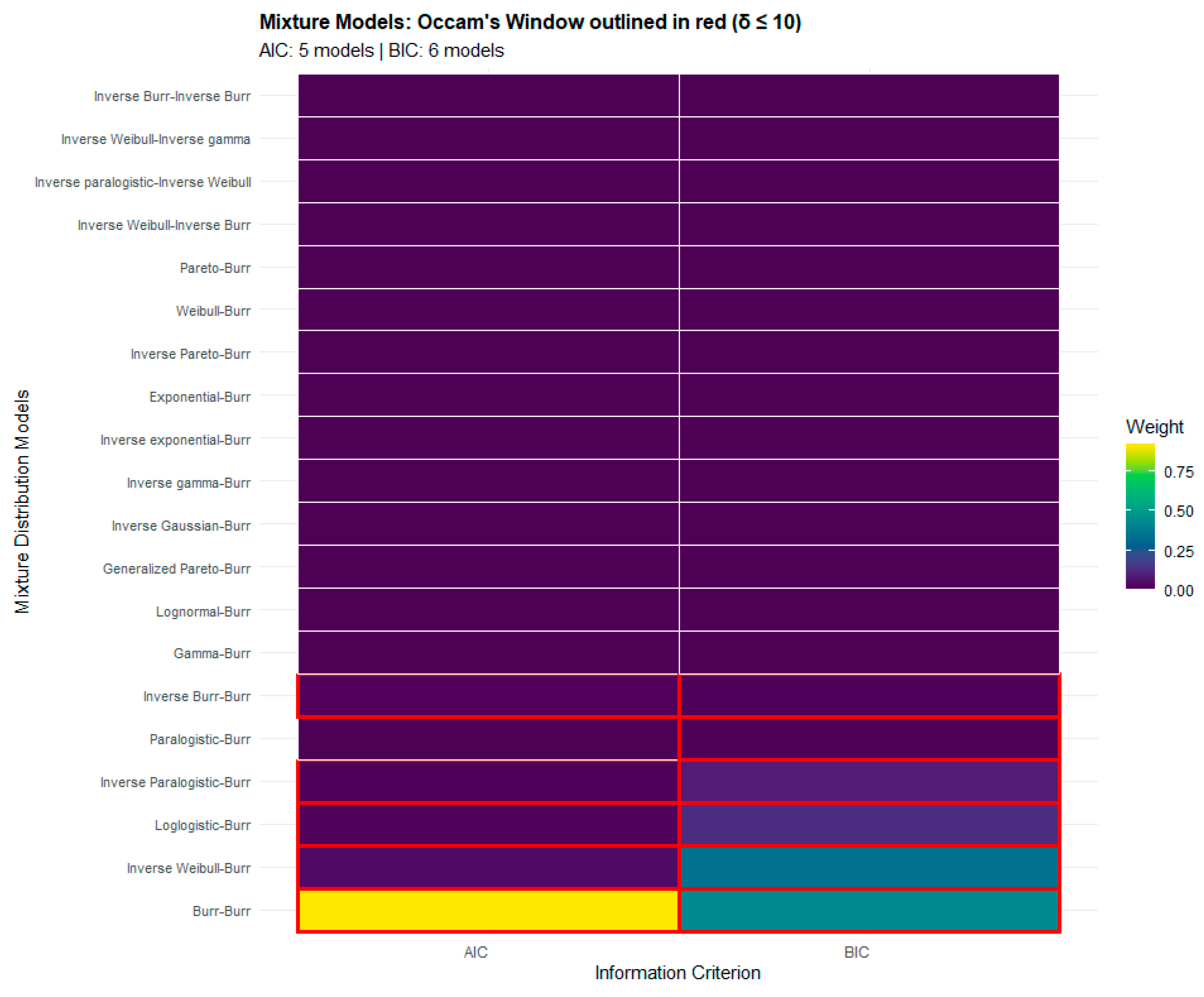
Table 6 seems to outperform the other considered models for Danish fire loss data, with AIC and BIC weights of 0.922 and 0.431, respectively, indicating the relatively better fit–complexity balance. The next competing models, Inverse Weibull-Burr (AIC: 0.040, BIC: 0.343) and Loglogistic-Burr (AIC: 0.015, BIC: 0.127), have much lower weights. Non-Burr mixtures (e.g., Inverse Weibull-Inverse Burr) have negligible weights (<0.001). The
in the top 20 mixture models for Danish loss data selects only five plausible models for modeling the data; however, paralogistic-Burr (highlighted in blue) is implausible in terms of the AIC and yet has weights in the BIC.
In
Table 7, model-averaged estimates are close to empirical VaR
0.95 but overestimate VaR
0.99 and TVaR
0.95 while underestimating TVaR
0.99. Generally, model averaging balances individual model variability, providing stable estimates that align well with empirical VaR but are conservative for TVaR, suggesting caution in predicting extreme losses, which is valuable for risk management in insurance.
Figure 4 also confirms Burr-Burr as the top model, followed by Inverse Weibull-Burr. Mixture models show Burr dominates in both AIC and BIC weights for the top 20 mixture models. Both composite and mixture models strike a balance in the number of models in the Occam’s window.
3.5. Grid Mapping Analysis
For better visualization, model names are abbreviated to prevent unreadable clustered plots.
Table 8 shows the set of single models for Danish fire claims data, which includes Burr (B), Inverse Weibull (Iw), Inverse Burr (IB), Inverse Paralogistic (IPl), Inverse Gamma (IG), Generalized Pareto (GenP), Loglogistic (Ll), Lognormal (Ln), Paralogistic (PLl), Inverse Gaussian (IGn), Inverse Exponential (IE), Inverse Pareto (IP), Pareto (P), Gamma (G), Weibull (W), and Exponential (E).
The composite models considered are Weibull-Inverse Weibull (WIW), Paralogistic-Inverse Weibull (PIW), Inverse Burr-Inverse Weibull (IBIW), Weibull-Inverse Paralogistic (WIPl), Inverse Burr-Inverse Paralogistic (IBIPl), Paralogistic-Inverse Paralogistic (PlIPl), Weibull-Loglogistic (WLl), Inverse Burr-Loglogistic (IBLl), Paralogistic-Loglogistic (PlLl), Loglogistic-Inverse Weibull (LlIW), Weibull-Burr (WB), Paralogistic-Burr (PlB), Inverse Burr-Burr (IBB), Loglogistic-Inverse Paralogistic (LlIPl), Inverse Burr-Inverse Gamma (IBIG), Paralogistic-Inverse Gamma (PlIG), Loglogistic-Loglogistic (LlLl), Weibull-Paralogistic (WPl), Paralogistic-Paralogistic (PlPl), and Inverse Burr-Paralogistic (IBPl).
Among the mixture models, there are Burr-Burr (BB), Inverse Weibull-Burr (IWB), Loglogistic-Burr (LlB), Inverse Paralogistic-Burr (IPlB), Paralogistic-Burr (PlB), Inverse Burr-Burr (IBB), Gamma-Burr (GB), Lognormal-Burr (LnB), Generalized Pareto-Burr (GenPB), Inverse Gaussian-Burr (IGnB), Inverse Gamma-Burr (IGB), Inverse Exponential-Burr (IEB), Exponential-Burr (EB), Inverse Pareto-Burr (IPB), Weibull-Burr (WB), Pareto-Burr (PB), Inverse Weibull-Inverse Burr (IWIB), Inverse Paralogistic-Inverse Weibull (IPlIW), Inverse Weibull-Inverse Gamma (IWIG), and Inverse Burr-Inverse Burr (IBIB). This notation system provides a concise and systematic way to reference the wide variety of models used in fitting Danish fire claims across single, composite, and mixture distributions.
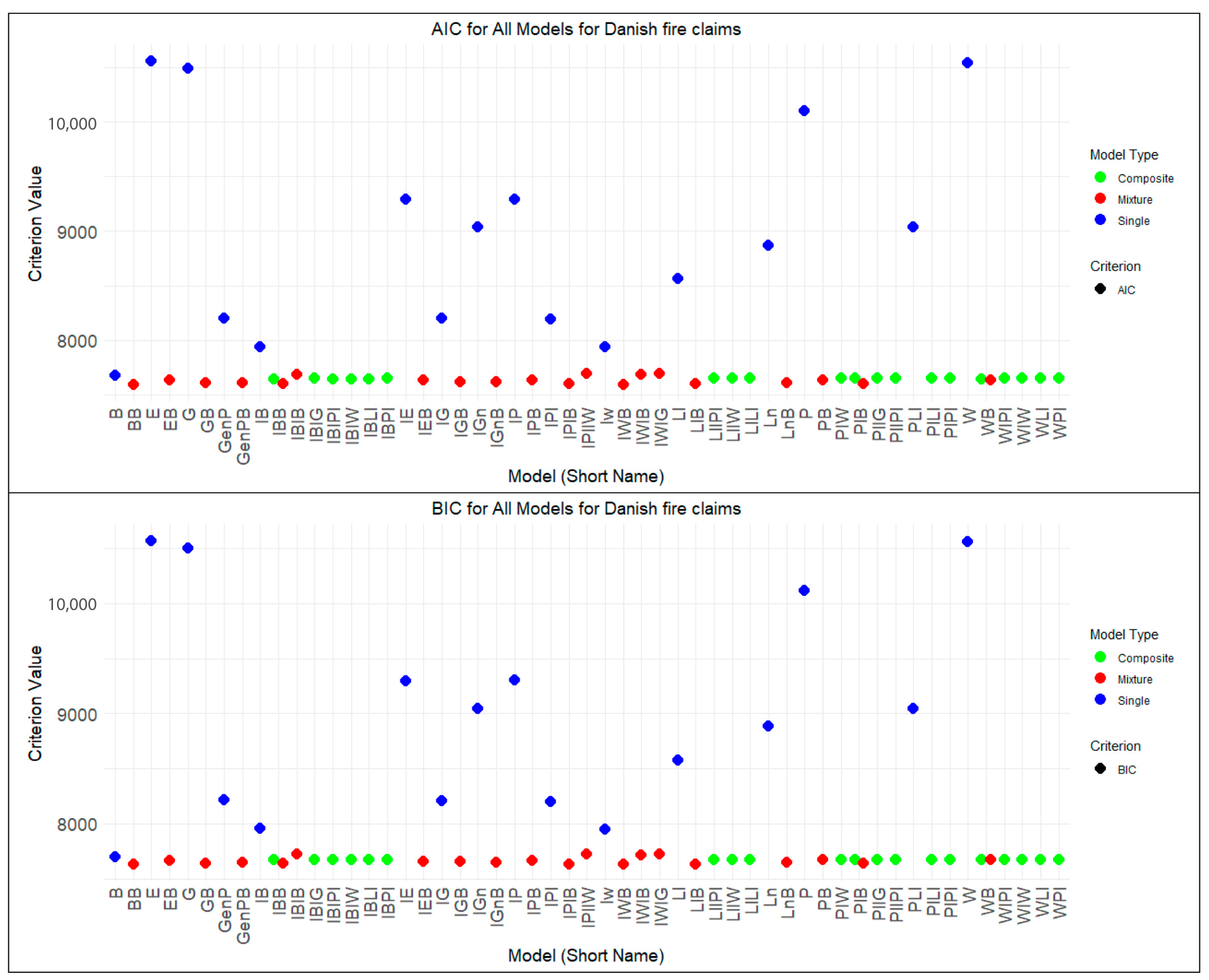
AIC for single models ranges from 7676 to 10,565, with Burr lower (~7676) and exponential and Pareto higher (>10,000) in
Figure 5. Composite models cluster at an AIC of 7640–7650 (e.g., Inverse Burr-Inverse Weibull), balancing fit and complexity. AIC for mixture models ranges from 7586 to 7620, led by Burr-Burr. BIC for single models spans from 7693 (Burr) to 10,570 (exponential), with Burr (7693.7) being stronger. Composite models have a low BIC (7640–7650), minimizing tail risk. BIC for mixture models ranges from 7586 to 7620, with Burr-Burr (7586.95) being better but riskier because, despite being the leading fit in that model class, it has a higher tail risk than most composite models. This increases capital risk by predicting extreme losses more vigorously. Composites tend to better balance the information criterion and risk measures with the lowest AIC or BIC and moderate tail risk measures; singles vary a lot in tail risk measures, and mixtures tend to have moderate AIC or BIC and moderate-to-high tail risk.
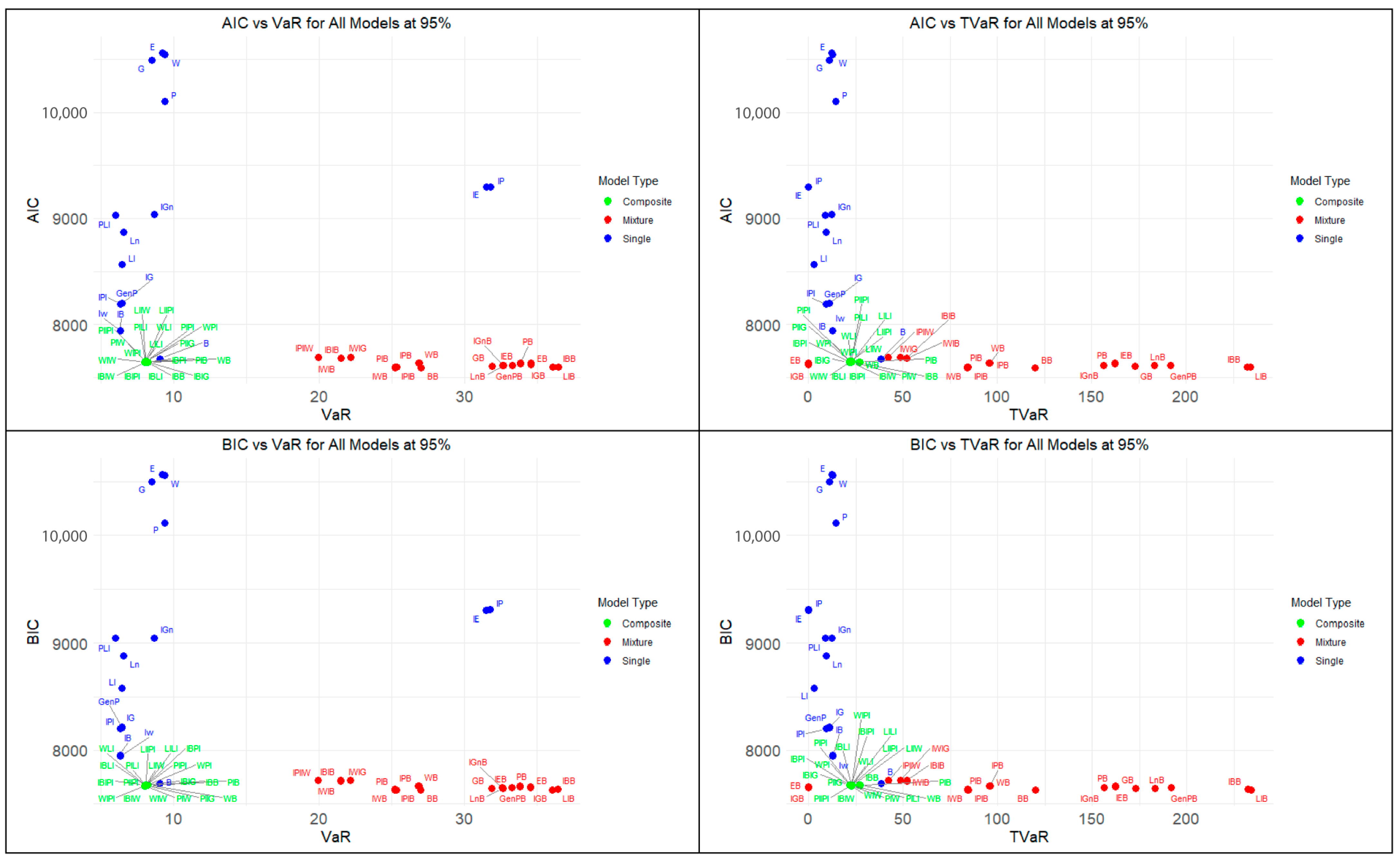
Models cluster, as shown in
Figure 6, at AIC or BIC 7640–7950, VaR 5–9M DKK, and TVaR 18–27M. Composite models (e.g., inverse Burr-inverse Weibull) balance low AIC or BIC (~7640) and moderate VaR and TVaR (~8M and 22M). Single models like Burr have higher AIC or BIC (~7676) and VaR (~9M), while inverse paralogistic has lower VaR (~5.4M) but higher AIC (~7800). Mixture Burr models show high TVaR (30–60M) and AIC or BIC. Low AIC or BIC vs. moderate VaR or TVaR (close to empirical values) shows the model fits the data points relatively well and that the use of that model will yield relatively predictable and anticipated risks. This is critical as the most appropriate model selection is required since it sets triggers and drives capital requirements, which, in turn, determine the profitability of a company.
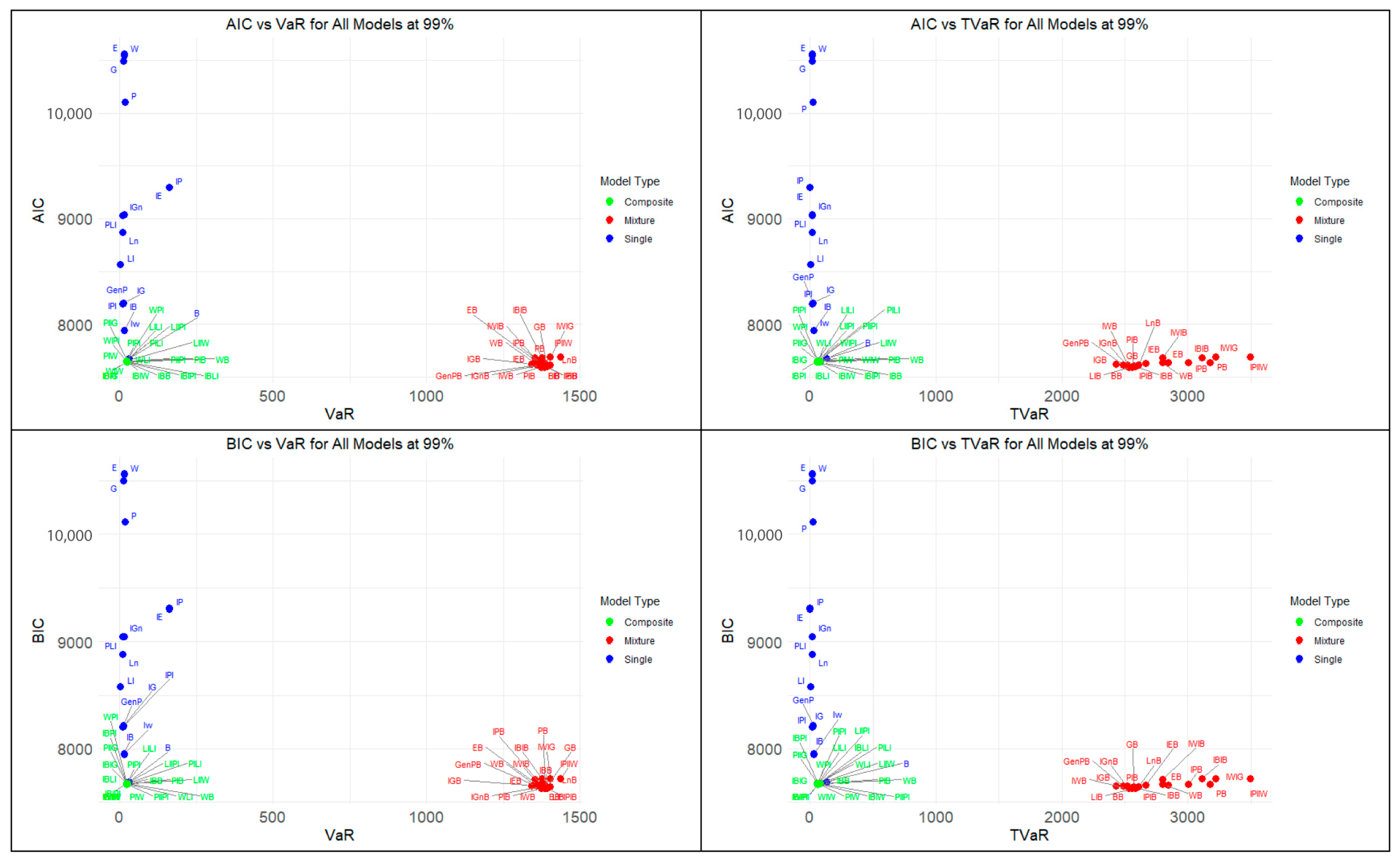
Figure 7 shows that models cluster at AIC or BIC 7640–7700, VaR 20–27M DKK, and TVaR 60–130M. Composite models (e.g., Weibull-inverse Weibull) balance low AIC or BIC (~7640) and moderate VaR and TVaR (22M and 62M). Single Burr models have higher AIC/BIC (~7690) and VaR (~30M). Burr mixtures show elevated VaR (up to 60M) and TVaR (>200M), with AIC or BIC ~7600, trading fit for higher tail risk. Composites tend to have a better tendency in balancing criteria and controlled risk. A clear distinction at 99% confidence is that mixture models set capital requirements and reserves too high. This risks the competitive edge that comes from holding over-excessive capital for almost unrealistic future extreme claims.
4. Discussion of Research Questions
This study outlines the imperfections in the single “best” model approach to loss distribution modeling, especially in heavy-tailed insurance loss data, specifically when applied to the Danish fire claims dataset. Earlier works, such as
Grün and Miljkovic (
2019) and
Marambakuyana and Shongwe (
2024), fitted models to the same data but relied exclusively on the selection of a single “best” model without considering model uncertainty and Occam’s window model trimming. The current study addresses these gaps by systematically applying weighted model averaging within Occam’s window
across all three model classes and introducing grid maps that simultaneously plot information criteria against VaR or TVaR at 95% and 99% thresholds.
To address RQ1, model averaging with both AIC and BIC weights confirms the preference for Burr-based models across categories, with composite models being the most appropriate out of the considered models in balancing interpretability and risk control most effectively within Occam’s window. Composite models closely align with empirical quantiles in grid mapping and Q-Q plots, with minor deviations reflecting their better balance, while single models vary widely, and mixture models are moderate (less efficient than composite model) in tail risk estimation.
For RQ2, model averaging complemented by grid maps produces statistically and practically significant advances over traditional single-model selection. Single-model reliance on Burr yields over-conservative TVaR0.99 (130.99M DKK, 140% above empirical 54.60), meaning very high capital requirements to protect against catastrophic claims. In contrast, AIC-weighted composite averaging depicts a TVaR0.99 of 75.41M DKK and BIC-weighted 64.96M DKK, which is relatively moderate. Under-conservative tail risk predictions can cause a great likelihood of vulnerability to financial distress when extreme events occur. Grid maps visually expose models previously hidden in Occam’s window (e.g., inverse Burr–inverse Weibull) that balance the fit of most of the data points and tail risk relatively better than any single “best” model, reducing selection bias and overconfidence in risk metrics.
Finally, for RQ3, to a greater extent than its competitors considered here, model averaging mitigates model uncertainty inherent in the over-reliance on the single “best” model by weighing competing models and using the derived weights to compute the VaR and TVaR, thus lowering overconfidence and bias. Grid mapping, on the other hand, tends to balance fit with the corresponding risk measures to establish which models have less information criterion values and do not overestimate or underestimate tail risk when compared to the empirical risk measures.
5. Conclusions
This data-driven study implements two methods, model averaging and grid maps, to fit the most appropriate distributions to Danish fire claims data, which are significantly positively heavy-tailed with extreme right tail outliers, have a large kurtosis, and have possibly two or three clusters (i.e., multimodal). The Burr distribution leads for Danish fire claims under single distributions; however, it is over-conservative when compared to empirical risk values. It is observed that the concentration of weights in one model risks overfitting. In pricing, the TVaR (131M DKK) shows more exposure, meaning higher premiums are needed due to the heavy tail behavior. This also means much larger reserves are needed to cover future extreme claims and demands significantly higher solvency capital. The Burr-Burr mixture model leads on Danish fire claims data with six plausible models and the lowest information criterion values across model classes. Model averaging, which relies on weighted point estimates, yields risk estimates that tend to be closer to the empirical ones; note though that the estimates are accurate for VaR0.95 but overestimate VaR0.99 and TVaR0.95; however, TVaR0.99 is underestimated. Even though mixture models have the lowest AIC or BIC across all model classes, model-averaged risk estimates from composite models present more stable estimates (close to empirical values).
Grid maps highlight the performance of mixture and composite models, such as Burr-Burr, which cluster tightly with low AIC or BIC and moderate VaR or TVaR, outperforming single models. Composite models provide a better balance between goodness of fit, parsimony, and tail risk control. Their moderate AIC or BIC combined with moderate VaR or TVaR indicates these models represent the heavy-tailed Danish fire claims while mitigating overly confident or risky tail estimates. This is ideal for stable risk quantification that is not too low or too high but close to empirical values. These results guide insurers in setting reserves, with Burr-based models providing conservative tail risk estimates for Danish fire claims. Overall, it is observed that mixture and composite models better capture the heavy-tailed nature of Danish fire claims data, with models like Burr-Burr and some of the composite models showing slight overestimation or underestimation of extreme tails and single models, like exponential, exhibiting a much poorer fit. Model averaging, supported by grid maps, enhances risk quantification but suggests higher reserves for extreme losses due to conservative TVaR estimates.
For a future study of Danish fire claims data, the possibility of using the train–test split scenario with the use of, say, the SMOTE (Synthetic Minority Oversampling Technique) approach, is recommended. This is to ensure that the extreme claims can be oversampled during the out-of-sample validation split and consequently build a model that has good predictive power. Also, it may be useful to investigate the quantification of deviations from the abline through tail-weighted measures. For this research work, the nlm () function and the nlminb () function in R package “stats” were used as optimization functions to find the maximum likelihood parameter estimates, and convergence was reached, that is, numerical instability was not encountered during implementation. Since, in this paper, the mixture estimations relied on direct MLE rather than explicit EM algorithms, for future research, other researchers may investigate the numerical instability or convergence when using the EM algorithms.