Next Article in Journal
Model Averaging and Grid Maps for Modeling Heavy-Tailed Insurance Data
Previous Article in Journal
Unveiling ESG Controversy Risks: A Multi-Criteria Evaluation of Whistleblowing Performance in European Financial Institutions
error_outline You can access the new MDPI.com website here. Explore and share your feedback with us.
 
 
Article

Credit Risk Management Dynamics: Evidence from Indonesian Rural Banks

by
Moch Doddy Ariefianto
1,*,
Triasesiarta Nur
1 and
Bryna Meivitawanli
2
1
Accounting Department, School of Accounting-Master Accounting, Bina Nusantara University, Jakarta 11480, Indonesia
2
Management Department, Binus Business School, Bina Nusantara University, Jakarta 11480, Indonesia
*
Author to whom correspondence should be addressed.
Submission received: 3 November 2025 / Revised: 15 December 2025 / Accepted: 23 December 2025 / Published: 4 January 2026

Abstract

This paper investigates credit risk management as a dynamic system. Panel Vector Autoregression (PVAR) is employed to model interrelationships among four key components: Non-Performing Loans (NPLs), Loan Loss Provision (LLP), loan charge-off (LCO) and capital. The Cost-to-Income ratio (CIR) and Size and Net Profit-to-Equity ratio (ROE) are used as control variables. The panel dataset comprises 1461 conventional rural banks in Indonesia with a quarterly frequency from June 2010 to March 2024. There are several key findings of this study. First, credit risk management practices in rural banks predominantly follow an incurred loss approach, although the expected loss model appears to be more commonly adopted by larger institutions. Second, capital serves a critical function as a buffer against credit losses. Third, subsample investigation reveals a significant role of accounting discretionary. This study offers significant implications for both policy development and academic research in microfinance.
JEL Classification:
G21; G32; C23; M41

1. Introduction

Rural banks are financial institutions with a limited scope of operations, primarily engaged in savings and lending activities within certain geographic areas, usually within a few provinces (Sukmana et al. 2020). In Indonesia, rural banks are regulated by the Indonesian Financial Services Authority under a more relaxed regulatory framework compared to commercial banks. There are over 1400 rural banks in Indonesia, serving niche markets, particularly populations residing in remote or underserved areas that are not catered to by commercial banks1. As such, their business model closely resembles a hybrid between traditional banking and microfinance institutions (Kumar et al. 2021; Ariefianto et al. 2024).
Given that lending constitutes the core activity of rural banks, effective credit risk management is central to their financial health and sustainability. Credit risk management is a complex decision model (Baud and Lallemand-Stempak 2024; Saiz-Sepúlveda and Hernández-Tamurejo 2025). It comprises several key components (Lundqvist and Vilhelmsson 2018; Yanenkova et al. 2021), namely (a) the recognition and measurement of NPL, (b) the calculation of LLP, (c) the determination of LCO, and (d) the provisioning of capital buffers (CAPITAL).
In theory, the management of these four components—collectively referred to as credit risk management—could follow a sequential process (Lundqvist and Vilhelmsson 2018). However, in practice, they are often addressed simultaneously, leading to potential endogeneity due to reverse causality (Zheng et al. 2024; Hansen et al. 2024). Bank managers must continuously balance profitability and risk with regulatory compliance, resulting in dynamic adjustments and inherent trade-offs (Sutrisno et al. 2024). Although the literature on credit risk management is extensive, it remains fragmented, with most studies focusing on isolated aspects. A comprehensive examination of the interactions among these four key variables—especially within a complex dynamic system—remains largely underexplored. To the best of our knowledge, this study is the first to present a comprehensive, dynamic portrayal of a rural bank credit risk management process.
Our study applies the Vector Autoregression (VAR) technique to panel data (PVAR). The model, following Abrigo and Love (2016), is estimated using a panel dataset of 1461 conventional BPRs, with quarterly observations spanning from June 2010 to March 2024 (56 quarters), resulting in a total of 81,816 observations.
An Impulse Response Function (IRF) analysis is conducted to trace the dynamic impact of shocks originating from one endogenous variable on the others. In addition, FEVD is performed to assess the relative contribution of each shock to the forecast error variance.
This study pursues several key objectives. First, building on the recommendations of Yanenkova et al. (2021) and Beatty and Liao (2014), we aim to systematically map the dynamics of credit risk management. The nature of our study object, which is an extensive panel dataset of rural banks in Indonesia, enables the application of a rigorous and robust econometric technique: Panel VAR. Second, rural banks represent the most basic form of banking institutions; thus, the dynamics of credit risk management can be examined with minimal interference from complexities typically associated with more diversified bank. The Indonesian context also presents a unique regulatory setting, wherein the incurred loss model remains the official regime (“de jure”), while commercial banks are required to adopt the expected loss model. This regulatory duality may generate spillover effects, given the close linkages between rural and commercial banking sectors. Third, our subsample-based robustness checks provide valuable variations that enhance our understanding of credit risk management dynamics across different institutional contexts.
Understanding these dynamic patterns is crucial for regulators and practitioners alike. Given rural banks’ critical role in advancing financial inclusion in Indonesia and other developing economies, the insights generated by this study carry significant implications for policy and practice at both national and global levels.
The remainder of this paper is organized as follows: Section 2 reviews the relevant literature; Section 3 outlines the data and methodology; Section 4 presents the empirical results; and Section 5 concludes the whole paper.

2. Literature Review

In Indonesia, the credit risk management framework for Rural Banks still adheres de jure to the incurred loss model, as stipulated in the Financial Services Authority Regulation (POJK No. 1/2024). Under the incurred loss paradigm, banks recognize credit losses only when there is observable evidence of a credit event, such as missed repayments, credit rating downgrades, or outright default (López-Espinosa and Penalva 2023). In contrast, commercial banks operate under a forward-looking approach—expected credit loss (ECL)—as mandated by IFRS 9 and implemented through POJK No. 40/2019. This approach allows banks to proactively set aside credit loss provisions without the occurrence of a credit event, functioning as a countercyclical buffer (Casta et al. 2019; Hansen et al. 2024). The distinction arises from the fact that rural banks are not yet required to comply with the IFRS-based financial reporting standards mandated for conventional banks under POJK No. 15/2024.
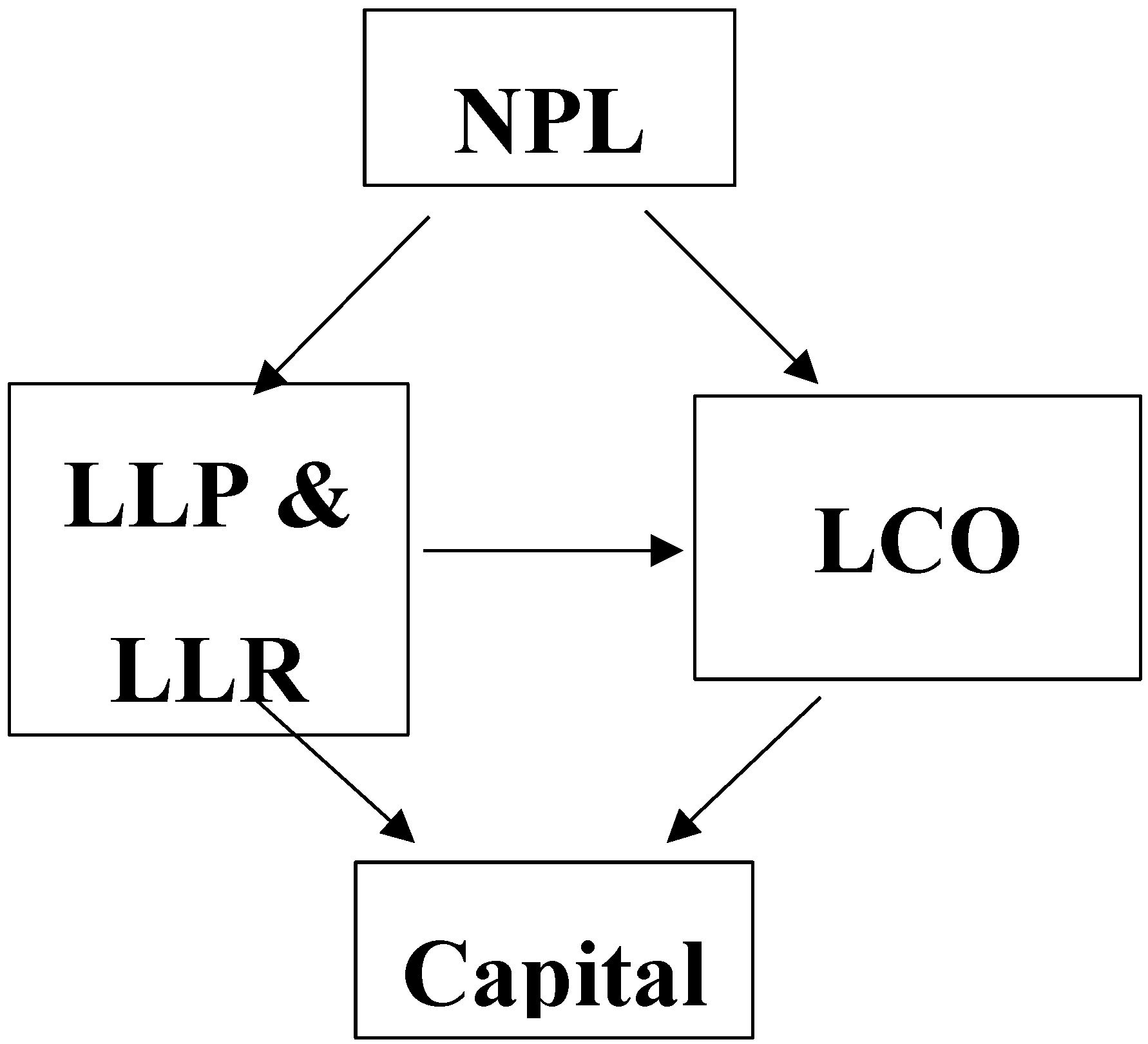
Figure 1 schematically illustrates the key phases of credit risk management in rural banks. The first phase involves the recognition of NPLs. The Financial Services Authority (OJK) has established loan quality classifications based on the timeliness of loan repayments (collectability), as outlined in POJK No. 62/2020. There are five loan quality categories: Current (1), Special Mention (2), Substandard (3), Doubtful (4), and Loss/Default (5). Loans falling under categories 3 to 5 are considered NPLs. In addition, OJK has established minimum LLP requirements corresponding to each collectability category (see Table 1).
Once a bank recognizes an NPL, it must begin provisioning for potential losses through LLP. The loan loss reserve (LLR) represents the cumulative amount of LLPs and is subject to change based on the quality of the underlying loans. The reserve can be reduced by the value of acquired collateral, resulting in what is referred to as Net LLR. The outstanding loan amount after deducting the LLR is known as the Net NPL.
If recovery is deemed impossible, the loan is charged off (Loan Charged Off—LCO)—either written down against the loan loss reserve or recognized directly as a loss in the profit and loss statement. This charge-off immediately reduces the bank’s assets and may erode its equity, as any losses exceeding the available reserves must be absorbed by capital. In some cases, the recognition of NPLs may occur too late or involve amounts that are too large (Haggard et al. 2017; Duho 2023). Under such circumstances, banks may opt to expense the NPL directly against capital.
Haggard et al. (2017) documented that many banks “delay provisioning for bad loans until it is too late, thereby potentially amplifying the adverse impact on earnings and capital”. This behavior typically occurs during the downturn phase of the business cycle, when banks, hoping for a swift recovery, postpone the recognition of loan losses (Mendicino et al. 2020). In contrast, the more recent IFRS 9 accounting regime mandates forward-looking provisioning, which has been shown to accelerate the recognition of losses and thereby mitigate the shock to capital. Indeed, recent studies (Casta et al. 2019; Ghosh 2024) have found that following IFRS 9 adoption, banks generally report lower realized losses and demonstrate stronger loss absorption capacity, indicating a timelier buildup of buffers to cover NPLs.
When credit losses begin to erode capital, regulators typically respond by tightening capital adequacy requirements, prompting banks to rebuild their capital buffers (Hansen et al. 2024). Banks may respond by retaining earnings, issuing new equity, or increasing their LLP. Under Basel regulations, LLPs are generally required to cover expected—not merely incurred—losses, leading banks to establish additional reserves for NPLs (Abad and Suarez 2018). A ‘dynamic’ provisioning approach helps smooth losses over the business cycle. Theoretical models have suggested its ability to mitigate procyclicality by spreading loss recognition over time (Saiz-Sepúlveda and Hernández-Tamurejo 2025).
In practice, the management of these key variables often occurs simultaneously, as they are all endogenously determined (Yanenkova et al. 2021; Zheng et al. 2024). Bank management seeks to optimize profitability while remaining compliant with regulatory standards (Bryce et al. 2015). Overly conservative policies may undermine profitability (Davis et al. 2022), whereas overly aggressive strategies can result in credit risk exposures that exceed available capital buffers, potentially triggering regulatory intervention (Jokipii and Milne 2008).
Better-capitalized banks tend to adopt more prudent provisioning strategies, building higher loan loss reserves and reducing the likelihood that NPLs will escalate into charge-offs (Casta et al. 2019). Empirical evidence suggests that such forward-looking provisions, along with tighter credit due diligence, help cushion future NPLs and enhance financial stability—effectively closing the loop by converting capital buffers into loss-absorbing reserves (Duho 2023; López-Espinosa and Penalva 2023). In summary, rising NPLs lead to charge-offs that erode capital, prompting banks to increase provisions. Robust provisioning frameworks, such as those under IFRS 9, can mitigate the growth of new NPLs, whereas weak capital buffers expose banks to a vicious cycle of losses and further capital deterioration (Mendicino et al. 2020; Nguyen et al. 2023).
Our model is quite generic and can be applied to other banking contexts, especially rural banks in large emerging markets (like Brazil, India and China). This applicability stems from the nature of the model, which is extracted from real-world observations (Yanenkova et al. 2021).

3. Results and Discussion

This section presents the empirical analysis. Section 3.1 provides the preliminary analysis, followed by the PVAR estimation and diagnostic tests in Section 3.2. Section 3.3 discusses the IRF simulations, and Section 3.4 summarizes the results of the robustness checks.

3.1. Preliminary Analysis

From Table 2, it can be seen that the variables are well behaved. Private, SMALL and JAVA made up dominant share of the rural banks’ sample composition (see Table A1 in Appendix A). The statistical profile resembles recent studies in Indonesia like Sukmana et al. (2020) and Ariefianto et al. (2024). All variables employed in the model are stationary; hence, the application of PVAR is valid.
As shown in Table 3, a lag length of three is recommended for the PVAR model. At this lag, the requirements of the Generalized Method of Moments (GMM) are satisfied. The J statistic of 6.545 is no longer significant. Nevertheless, Information Criteria (MBIC, MAIC and MQIC) are not the lowest.
The endogeneity assumption among the selected variable set (NPL, LLP, LCO and CAPITAL) is supported by the data. Table 4 shows that the (bivariate) Granger causality tests are soundly rejected for every pair of endogenous variables.

3.2. Baseline PVAR and Stability Check

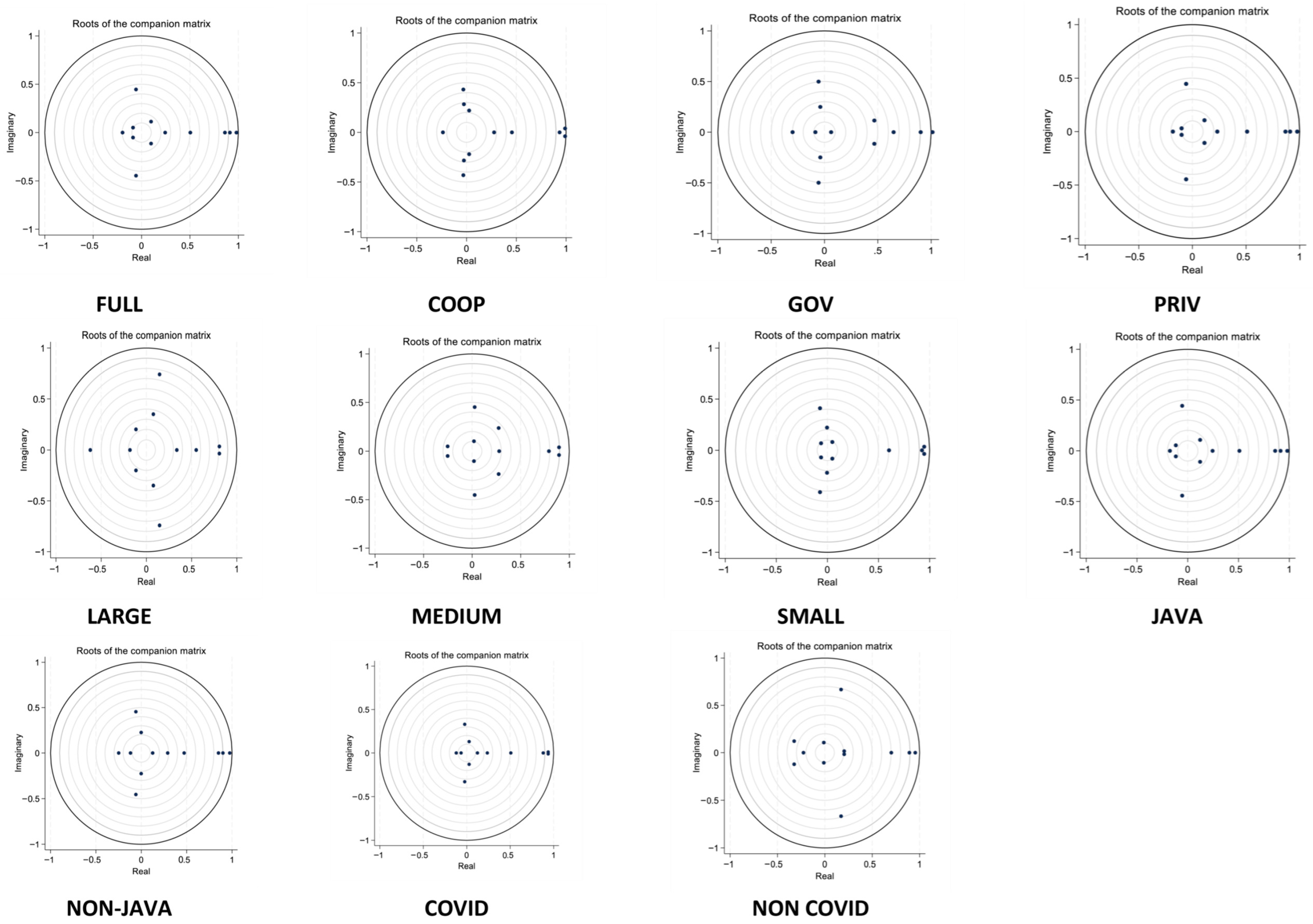
Table 5 reports Panel VAR estimates for full sample and subsampling. Qualitatively, it can be seen that there is a significant dynamic pattern in the estimated model. For example, NPLs are highly persistent, as evidenced by significance of lag 3, and there is also a lagged relationship between NPLs and LLP and LCO at lag 1 and lag 3, respectively. Stability requirements are satisfied for most subsamples, except GOV. Figure A1 in Appendix A presents this stability requirement in graphical form: except for GOV, all eigenvalues of the companion matrix lie within the unit circle.

3.3. Impulse Response Function

In this section, IRFs for endogenous variables are presented; they are the main application of a PVAR model. The selected order is NPL, LLP, LCO, and CAPITAL, as explained in Section 2. The shock is within a unit standard deviation of the impulse variable. This section focuses on full sample results.
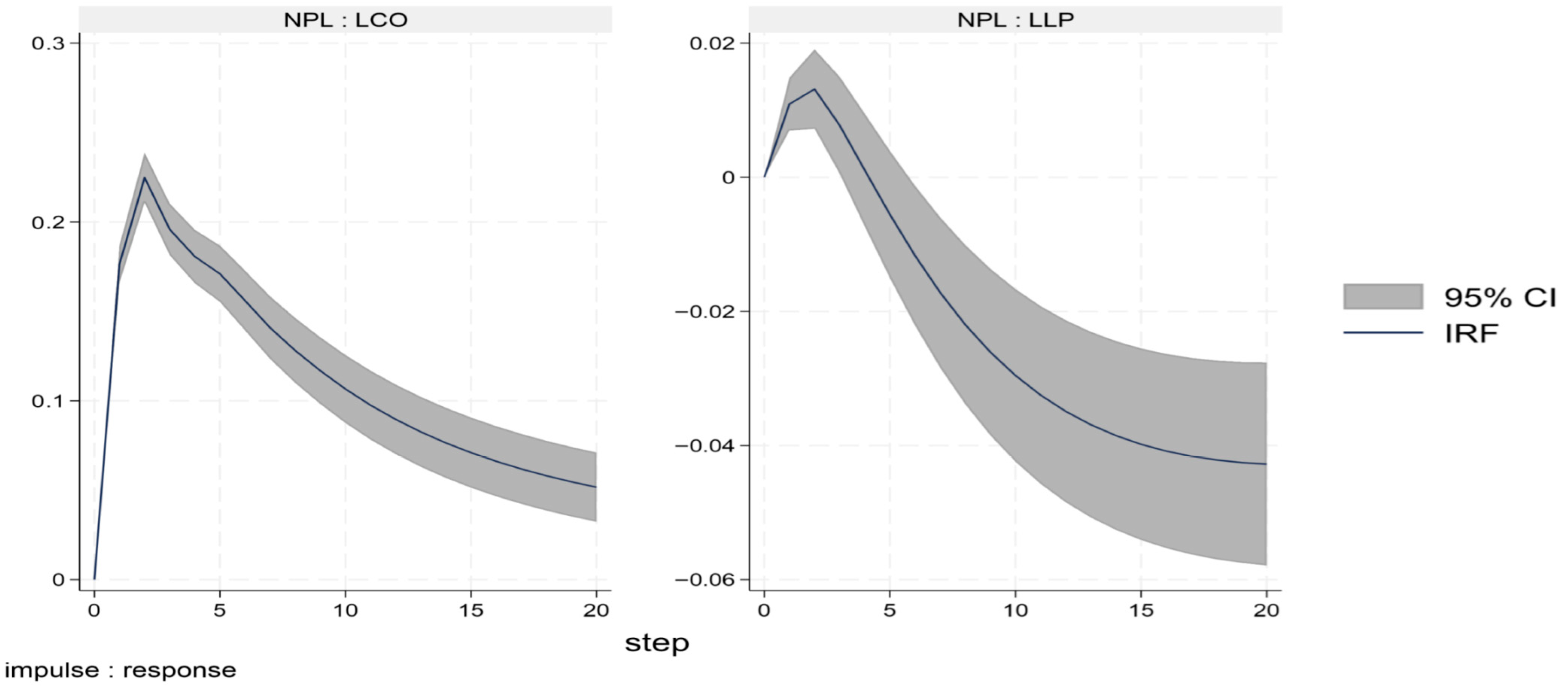
Immediately after an NPL shock, rural banks increase their LLPs (see Figure 2). This is consistent with incurred lost practices, whereby banks provision against anticipated credit losses (Lundqvist and Vilhelmsson 2018). However, the subsequent decline in LLPs, especially since it is larger than the initial increase, may indicate one or more of the following mechanisms at play. Procyclical provisioning—increasing LLPs during a business downturn but reducing them as conditions improve or due to capital pressures (Balla and Rose 2015; Yanenkova et al. 2021). The long-term decline in LLPs may reflect under-provisioning after the initial response, possibly due to a desire to boost short-term profitability or preserve capital (Abad and Suarez 2018).
From Figure 2 (left panel), it can be seen that the initial NPL shock has triggered a temporary jump in LCO, immediately followed by a gradual decline. Nevertheless, LCO remains elevated; i.e., the shock leads to permanent increase in LCO. A positive shock (Figure 2 right panel) in NPLs might have prompted banks to “front-load expend” provisions (“big bath”), to create room for future reversals in LLPs (Haggard et al. 2017). This behavior is used to signal improved future performance or to clean up balance sheets in one period to allow for smoother future earnings (Haggard et al. 2017).
When uncollectible loans stay on the balance sheet, there is an incentive to “evergreen”—roll over or restructure loans to delay recognition of loss. Timely write-offs help enforce credit discipline (Akins et al. 2016; Aristei and Gallo 2019). Conservative management and avoiding regulatory action can also help explain aggressive write-off behavior (Curcio and Hasan 2015; Aristei and Gallo 2019).
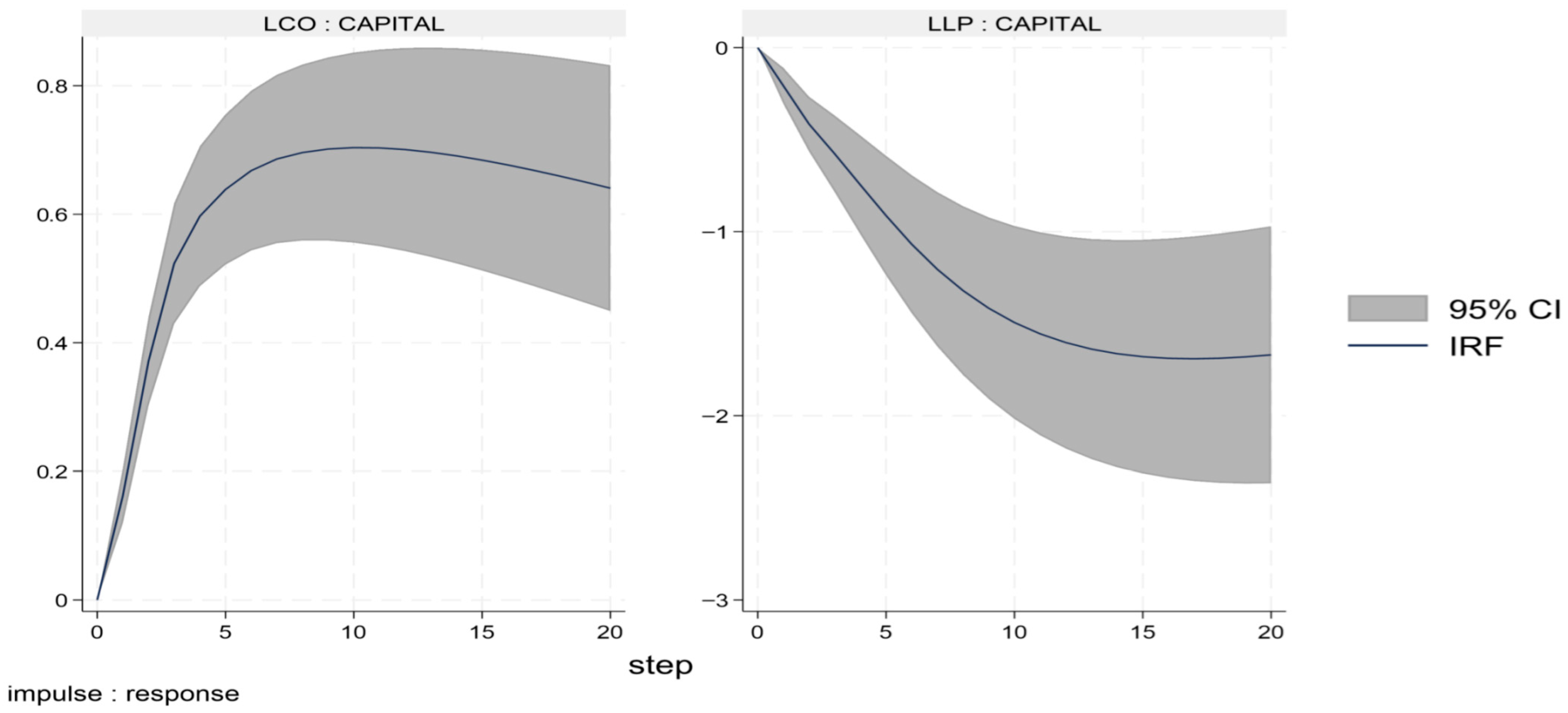
The IRFs for LCO-CAPITAL and LLP-CAPITAL reveal two contrasting dynamics (see Figure 3): (1) a positive permanent effect from a unit standard deviation shock of LCO on CAPITAL, and (2) a negative permanent effect from a unit standard deviation shock of LLP on CAPITAL. This pattern is intriguing and aligns with the nuanced role of accounting treatments and regulatory signaling in rural banks’ capital management (Zheng et al. 2024).
A shock in LCO increases (Figure 3 left panel) capital because loan charge-offs are, by accounting standards, a recognition of realized loss, effectively removing non-performing assets from the balance sheet. Once charged off, these loans no longer burden the bank’s asset quality ratios (Dagher et al. 2016). This process can free up regulatory capital and improve financial indicators, especially if the bank had previously provisioned adequately for those losses (Mendicino et al. 2020). Moreover, regulators may view charge-offs as a sign of transparent risk management, thus facilitating improved supervisory ratings or lower capital charges (Beatty and Liao 2011). In rural banks, this may trigger recapitalization efforts from stakeholders or even regulatory forbearance, leading to an observed increase in capital (Krüger et al. 2018).
On the other hand, a shock in LLP decreases capital permanently (Figure 3 right panel) because provisioning reduces retained earnings, a key component of Tier 1 capital (Kanagaretnam et al. 2005). This reflects a more forward-looking recognition of potential losses (Yanenkova et al. 2021), something that is surprising given that the incurred loss regime prevails in rural banks. LLPs signal increased credit risk and deteriorating loan quality, which erodes investor and depositor confidence and may impair the bank’s ability to raise fresh capital. Additionally, under stricter regulatory environments or weak earning profiles (typical of smaller rural banks), increased provisioning reduces internal capital accumulation, reinforcing the negative capital effect over time (Bushman and Williams 2012; Dagher et al. 2016).
This divergence between LLP and LCO impacts is further supported by the literature distinguishing between expected losses (provisions) and realized losses (charge-offs). LLPs are often procyclical, rising during downturns when banks are already under capital pressure (López-Espinosa and Penalva 2023; Ghosh 2024). On the other hand, LCOs can be used strategically by banks to cleanse the balance sheet and restore regulatory compliance (Haggard et al. 2017; Kumar et al. 2021). In the Indonesian rural banking context, where access to capital is limited and regulatory oversight varies, these dynamics look to be amplified.
The FEVD results (see Table 6) provide insight into the relative contribution of shocks from (i) NPLs to LLP and LCO and (ii) LLP and LCO to CAPITAL. Consistent with economic intuition, NPL shocks emerge as a significant source of variation for LCO (Huljak et al. 2022; Nasir et al. 2022), explaining over 24% of its FEVD at the 20-period horizon. In contrast, the contribution of NPL shocks to LLP variance remains below 3% throughout, indicating a limited direct effect on LLP dynamics. On the other hand, it looks like shocks in LCO exert more impact on CAPITAL compared to LLP (Curcio and Hasan 2015; Duho 2023). LCOs account for over 12% of CAPITAL’s forecast variance, while LLP account for only 7.8%.

3.4. Robustness Check

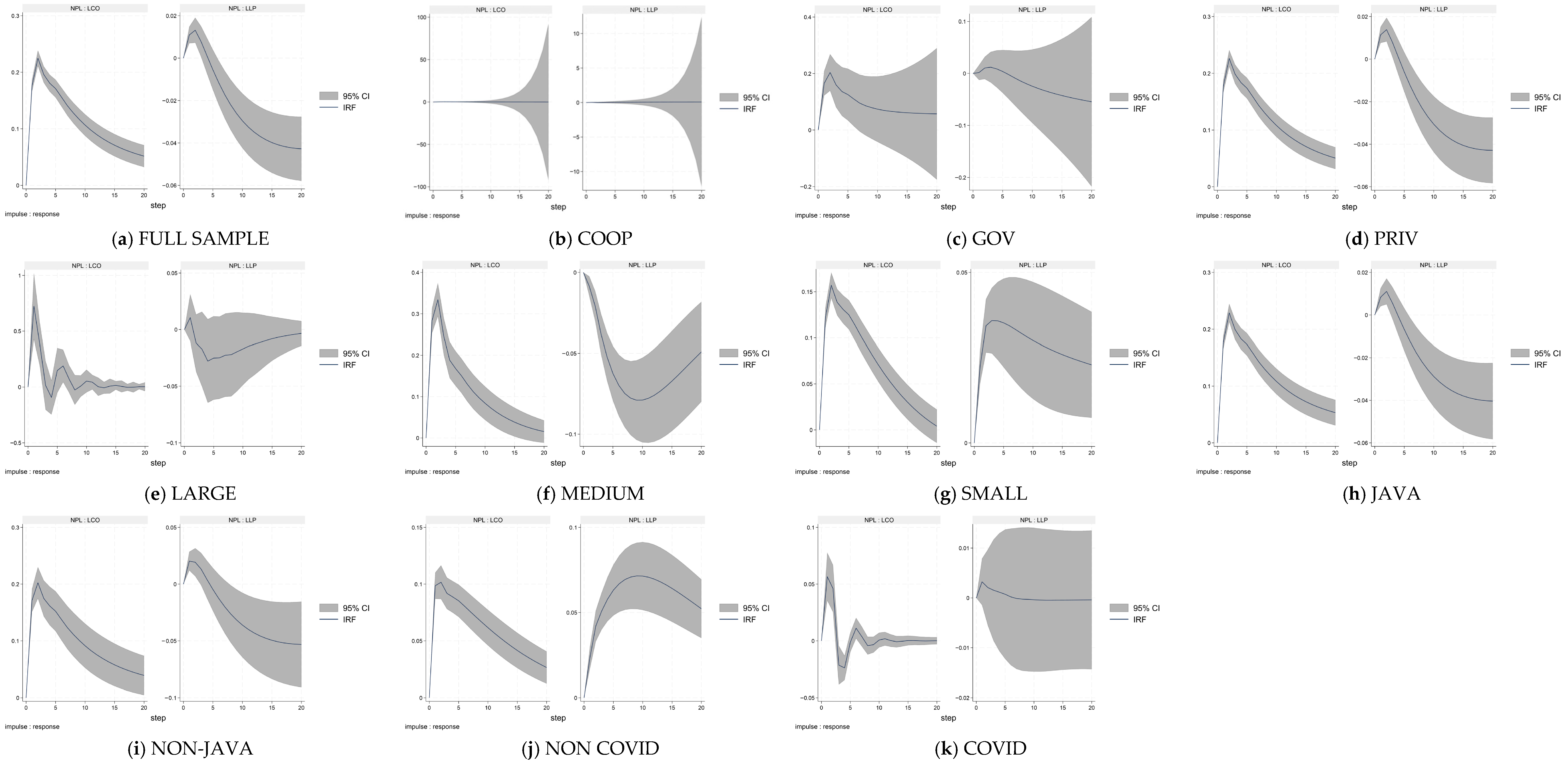
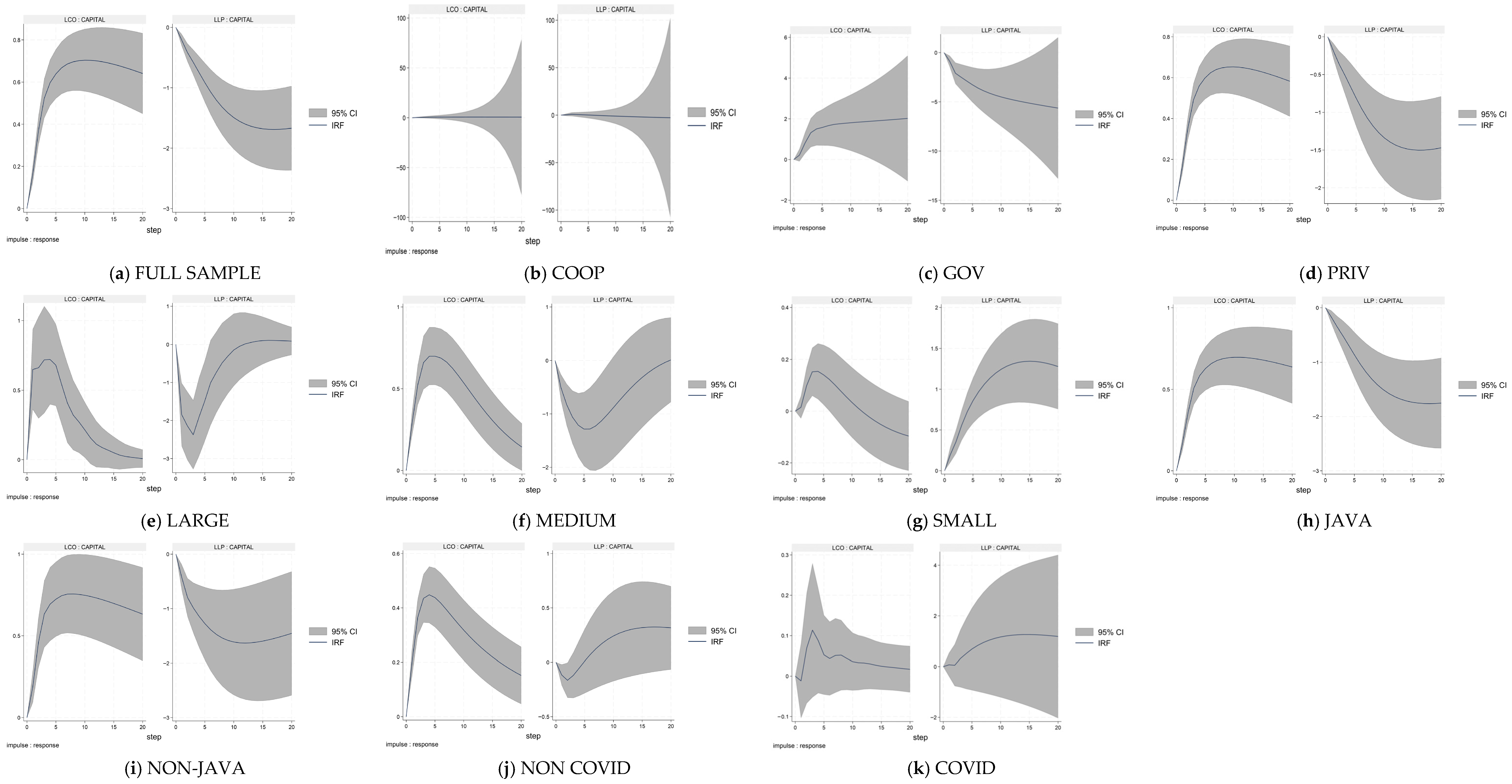
Robustness checks were conducted by applying subsampling procedures to the previous analyses. As illustrated in Figure 4, the increases in LLP and LCO following a shock to NPL appear to be nuanced. A qualitatively similar pattern, consistent with the full-sample results, was observed across the following subsamples: PRIV, SMALL, JAVA, NON-JAVA, and NON-COVID.
In the COOP subsample, neither LLP nor LCO exhibits a response to an NPL shock. This is both an interesting and concerning finding, as it suggests that cooperative banks may lack a systematic approach to provisioning and loan write-offs. Such a pattern could indicate weak governance structures or the presence of discretionary loan–loss provisioning practices (Kil et al. 2021; Nguyen et al. 2023).
In large banks, LCO exhibits a fluctuating, yet stabilizing, pattern following an NPL shock, whereas the LLP response remains subdued. These findings suggest that, in this bank category, loan quality deterioration is less predictable while credit-loss provisioning is more predictable. The response appears calculated, indicating that banks avoid unnecessary reserves (Mehdi et al. 2025). Furthermore, during the COVID period, both LLP and LCO display a flat pattern. Taken together, these results point to the influence of dominant managerial discretion (Beatty and Liao 2014; Nguyen et al. 2023).
A nuanced response pattern is also evident in the subsample IRFs for LLP, LCO, and CAPITAL (see Figure 5). Notably, the response pattern observed in the full sample is replicated only in the PRIV and JAVA subsamples. In contrast, the distinct behaviors observed in the COOP, GOV, and COVID subsamples are believed to reflect the factors discussed previously.
Interestingly, an LLP shock leads to an increase in CAPITAL, most prominently in the large and small bank categories. This finding provides strong evidence of the expected-loss principle underlying IFRS 9 in practice, particularly among large banks, where capital initially declines before rising on a sustained basis. Although rural banks in Indonesia remain under an incurred-loss regime, the observed patterns suggest that many are already applying elements of the expected-loss model in practice. This behavior indicates that capital is treated as a strategic buffer (Aristei and Gallo 2019; López-Espinosa and Penalva 2023). Furthermore, it implies that the supply of capital to support microfinance operations may be relatively sufficient, contrasting with earlier studies on capital constraints in microfinance institutions (Duho 2023).
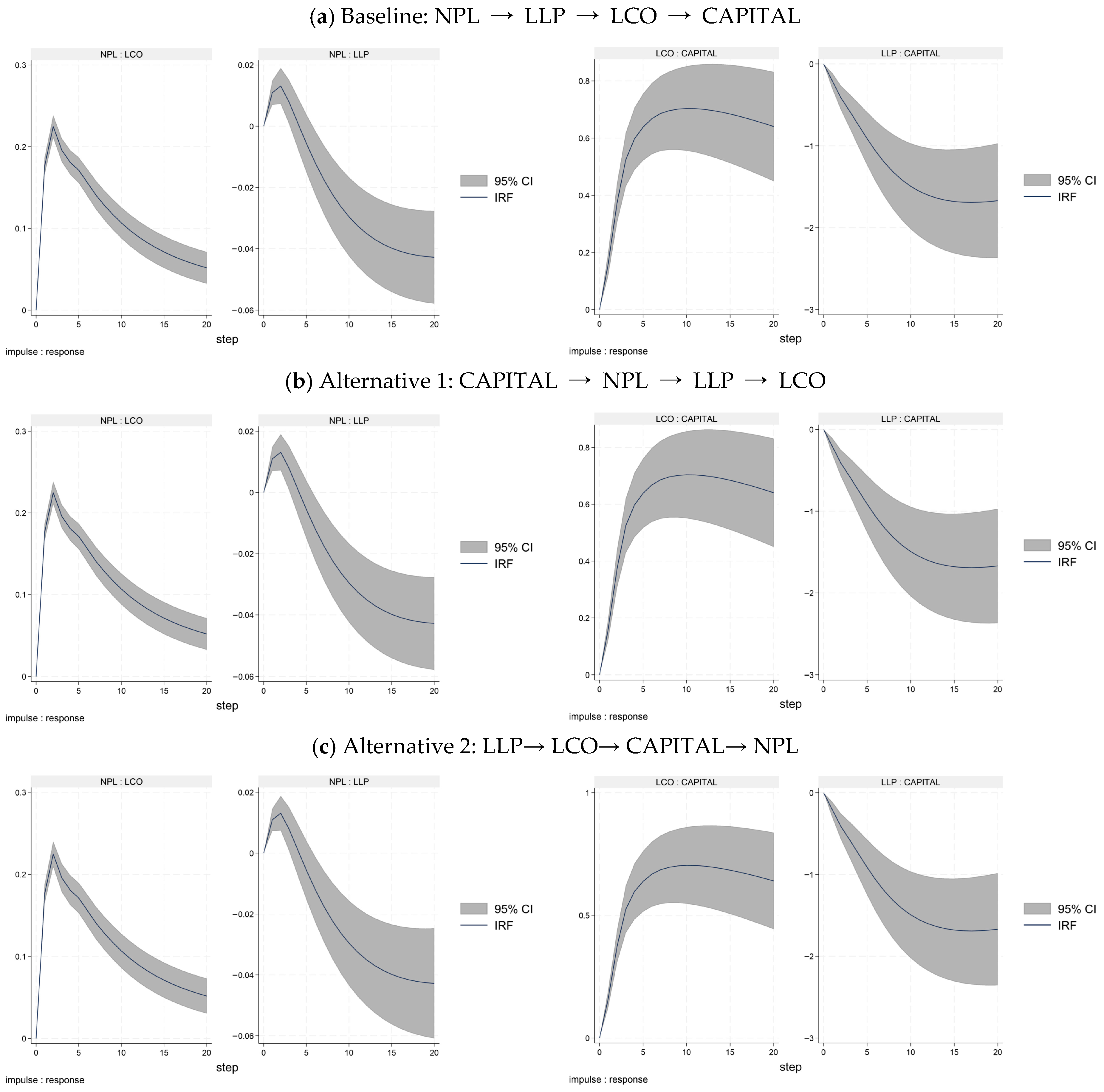
Lastly, to address concerns about the variable-ordering sensitivity inherent in Cholesky-based IRF identification, the IRFs under two alternative orderings—CAPITAL → NPL → LLP → LCO and LLP → LCO → CAPITAL → NPL—were re-estimated. Figure 6 shows that the qualitative response patterns remain broadly robust across these specifications.

4. Materials and Methods

PVAR is an econometric model that allows for examination of the dynamic relationships of a set of endogenous variables along with (optionally) a set of exogenous variables (Stock and Watson 2001). By employing this model, a more flexible relationship can be specified in terms of causal directions, and a more comprehensive understanding can be obtained, represented as a dynamic trajectory rather than a static impact. PVAR procedures developed by Abrigo and Love (2016) are followed in this study and have also been applied in prior research by Jouida (2018), Blankson et al. (2022), and Gaies and Jahmane (2022).
In matrix form, PVAR can be expressed as
Y i t = Y i t 1 A 1 + + Y i t p A p + X i t B + ε i + u i t
where Yit is a k × 1 vector of endogenous variables that can also take a lagged form in the right-hand side of the regression. A1 to Ap are the matrices of PVAR parameters to be estimated with every A 1 ; j = 1 …, p is of dimensions k × k, Xit is a vector of exogenous variables and B is the vector parameter of exogenous variables. εi is the vector of endogenous-variable panel-specific fixed effects with dimensions of 1 × k and uit is a k × 1 vector of the idiosyncratic error term. Index i in vector and matrix notation denotes a cross-section (bank) unit and t denotes the selected time lag (p).
A description of the endogenous and exogenous variables used in the study is presented as follows. LLP is measured by ratio of LLP to Total Loan. NPL is calculated as (Gross) NPL to Total Loan. LCO is obtained from Loan Loss Charge-Off divided by Total Loan. CAPITAL is the ratio of total equity divided by total assets. As control variables, the Cost-to-Income ratio (CIR) (as proxied for efficiency) is measured as the ratio of Non-Interest Cost to Total Revenue. ROE (Return on Equity) is calculated as net profit (before tax) divided by total equity. Lastly, SIZE is the log of total assets.
The selection of endogenous variables (NPL, LLP, LCO and CAPITAL) is loosely based on studies by Bryce et al. (2015), Huljak et al. (2022), and Ariefianto et al. (2024). The control variables were previously employed by Curcio and Hasan (2015), Sukmana et al. (2020) and Duho (2023).
The dataset comprises quarterly observations from 1461 rural banks, covering the second quarter of 2010 to the first quarter of 2024 (56 quarters): 81.816 bank-quarter observations. The data were extracted from the Indonesia Financial Service Authority (OJK) website. Following Sullivan et al. (2021), Winsorization was applied to variables exhibiting outlier issues. Outliers were defined as observations with absolute values exceeding the threshold, calculated as the mean plus three times the standard deviation. These extreme values were replaced with the corresponding 5th and 95th percentiles, respectively, for values below or above the lower and upper thresholds.
The analysis was initiated with the presentation of descriptive statistics, including an examination of the data’s non-stationary characteristics. As noted by Abrigo and Love (2016), the Panel VAR approach requires all variables to be stationary and an appropriate lag length to be selected. To assess stationarity, the modified Dickey–Fuller test developed by Pesaran (2003) was employed. The maximum (truncated) lag length was determined based on the Said and Dickey (1984) formula: Max Lag = ( T ) 1 / 3 , where T represents the number of time-series observations (56), resulting in a maximum lag of 4.
In estimating a VAR model, selecting the appropriate lag length and determining the ordering of endogenous variables are critical steps (Enders 2014). The moment selection method developed by Andrews and Lu (2001) was employed in this study. As the baseline, the following ordering of endogenous variables was adopted: NPL, LLP, LCO, and CAPITAL. This ordering was guided by the theoretical framework discussed in the literature section. To support the assumption of endogeneity among the variables, a Granger causality test was conducted.
IRF simulations were performed for the endogenous variables. These simulations were conducted using Monte Carlo methods with 500 draws to generate 95% confidence intervals. To assess the reliability of the IRFs, a stability check was conducted. A Panel VAR is considered stable if all eigenvalues lie within the unit circle (Enders 2014). Failure to meet this stability condition renders the IRFs unreliable.
To quantitatively assess the dynamic contribution of each innovation (e.g., NPL to LLP and LCO; LLP and LCO to CAPITAL), the FEVD was computed. According to Love and Zicchino (2006), the FEVD quantifies the proportion of the forecast error variance of each variable that can be attributed to shocks in the other endogenous variables over different time horizons. All IRF and FEVD analyses were conducted over a 20-quarter horizon.
The IRF analysis was extended using several subsamples based on ownership, scale, location, and COVID-19 periods. This extension served two primary objectives: first, to conduct robustness checks by assessing whether the baseline results are consistent across different subsamples, and second, to identify potential variations, thereby generating deeper and more nuanced insights.
For the ownership subsamples, rural banks were grouped according to their controlling shareholders. There are three types of ownership: Cooperative (COOP), Government (including regional government, GOV), and Private (PRIV). For the scale subsamples, OJK’s capital-based classification—LARGE, MEDIUM, and SMALL—was used. Banks were classified based on the latest available data (first quarter of 2024), and this classification is treated as time-invariant. For geographic location, banks were categorized based on the location of their headquarters: JAVA (the economic center of Indonesia) or NON-JAVA. Observations from the first quarter of 2020 to the first quarter of 2023—corresponding to the Ministry of Health’s COVID-19 pandemic declaration—were categorized as the COVID period; all other observations were classified as NON-COVID.
Lastly, the order invariance condition was tested. There are 24 possible orderings (4! permutations); however, following Huljak et al. (2022), not all possibilities were explored. Instead, two logically plausible alternative orderings were selected: (1) CAPITAL → NPL → LLP → LCO and (2) LLP → LCO → CAPITAL → NPL.

5. Conclusions

This study makes a significant contribution to the literature on credit risk management by offering a clear dynamic depiction of four core variables—NPL, LLP, LCO and CAPITAL—within a system framework. The model is estimated using the Panel VAR methodology developed by Abrigo and Love (2016), with control variables including CIR, ROE, and SIZE. The analysis is based on a quarterly panel dataset comprising 1461 Indonesian rural banks from the second quarter of 2010 to the first quarter of 2024, yielding a total of 81,816 bank-quarter observations.
Several key findings emerge from the analysis. First, a shock to NPLs leads to an immediate and temporary increase in both LLP and LCO; over the long run, LCO remains elevated, while provisioning turns negative. Importantly, NPL shocks exert a stronger influence on LCO than on LLP. Second, CAPITAL clearly operates as a buffer against credit losses: a shock to LCO results in a sharp and permanent increase in capital, whereas a shock to LLP induces a gradual decline. These findings indicate that LCO shocks play a more prominent role in driving capital dynamics than LLP shocks.
Third, while the results are robust across a range of robustness checks, meaningful variations are identified. In the COOP rural bank subsample, virtually no response is observed to NPL, LLP, or LCO shocks—pointing to potential governance weaknesses or unchecked managerial discretion (Mehdi et al. 2025). Among large banks, loan-quality deterioration appears more erratic, yet provisioning for credit losses is considerably more predictable. Finally, strong evidence of the expected-loss principle is observed, particularly in large banks, despite the prevailing regulatory framework, which continues to follow an incurred-loss approach.


6. Policy Implications and Future Study

These findings carry important policy implications. The dominance of loan charge-offs over provisioning suggests a reactive—rather than preemptive—approach to credit risk management, which is not sustainable for rural banks in the long term. Regulatory attention should focus on strengthening credit risk practices within cooperative-owned institutions, where practices currently diverge from established standards.
Several directions for future research are also identified. First, while the study maps out the dynamics of credit risk management, the sequencing of those dynamics merits further investigation. Second, the underlying reasons for rural banks’ reactive behavior—as opposed to a more anticipatory approach—remain an open question. Finally, the lack of responsiveness among cooperative-owned rural banks poses an unresolved puzzle, particularly given the significant role that cooperatives play in the microfinance sector.

Author Contributions

Conceptualization, M.D.A. and T.N.; methodology, M.D.A.; software, T.N. and B.M.; validation, B.M. and M.D.A.; formal analysis, T.N. and B.M.; investigation, M.D.A. and T.N.; resources, M.D.A.; data curation, T.N. and B.M.; writing—original draft preparation, T.N. and B.M.; writing—review and editing, M.D.A.; visualization, M.D.A.; supervision, M.D.A.; project administration, T.N.; funding acquisition, M.D.A. All authors have read and agreed to the published version of the manuscript.

Funding

This research was supported by the Ministry of Higher Education, Science, and Technology of Republic of Indonesia (Grant No. 0961/LL3/Al.05/2025, Year 2025).

Data Availability Statement

The data of this study is available at Zenodo repository: https://doi.org/10.5281/zenodo.16891891.

Acknowledgments

During the preparation of this work, the authors used Chat GPT 5.0 for proof reading (to improve the language quality of the manuscript). After using this tool/service, the authors reviewed and edited the content as needed and take full responsibility for the content of the publication.

Conflicts of Interest

The authors declare no conflict of interest.

Appendix A

Table A1. Sample composition by owner, scale and location.
OWNERFreq.Percent
COOP13441.64
GOV39204.79
PRIV76,55293.57
81,816100
SCALE
LARGE49656.07
MEDIUM23,67628.94
SMALL53,17564.99
81,816100
LOCATION
JAVA65,40879.95
NON JAVA16,40820.05
81,816100
This table reports the decomposition of the sample by ownership, scale and location.
Figure A1. Stability condition test: graphical form. This figure presents the stability requirements of PVAR regression for full samples and subsamples. A PVAR regression is stable if all eigenvalues of the companion matrix lie strictly within the unit circle in the complex plane.
Risks 14 00009 g0a1

Note

1
Indonesia adopts a two-tier banking system: (1) commercial banks and (2) rural banks. Commercial banks are authorized to engage in a wide range of financial activities, including in the national payment system. In contrast, rural banks operate under more restrictive mandates, with their services largely limited to deposit-taking and lending.

References

  1. Abad, Jorge, and Javier Suarez. 2018. The Procyclicality of Expected Credit Loss Provisions. CEPR Discussion Paper No. DP12993. London: Centre for Economic Policy Research (CEPR). Available online: https://papers.ssrn.com/sol3/papers.cfm?abstract_id=3244507 (accessed on 2 November 2025).
  2. Abrigo, Michael RM, and Inessa Love. 2016. Estimation of panel vector autoregression in Stata. The Stata Journal 16: 778–804. [Google Scholar] [CrossRef]
  3. Akins, Brian, Yiwei Dou, and Jeffrey Ng. 2016. Corruption in bank lending: The role of timely loan loss recognition. Journal of Accounting and Economics 63: 454–78. [Google Scholar] [CrossRef]
  4. Andrews, Donald W. K., and Biao Lu. 2001. Consistent model and moment selection procedures for GMM estimation with application to dynamic panel data models. Journal of Econometrics 101: 123–64. [Google Scholar] [CrossRef]
  5. Ariefianto, Moch Doddy, Irwan Trinugroho, and Ahmad Erani Yustika. 2024. Diversification, capital buffer, ownership and credit risk management in microfinance: An investigation on Indonesian rural banks. Research in International Business and Finance 69: 102268. [Google Scholar] [CrossRef]
  6. Aristei, David, and Manuela Gallo. 2019. Loan loss provisioning by Italian banks: Managerial discretion, relationship banking, functional distance, and bank risk. International Review of Economics and Finance 60: 238–56. [Google Scholar] [CrossRef]
  7. Balla, Eliana, and Morgan J. Rose. 2015. Loan loss provisions, accounting constraints, and bank ownership structure. Journal of Economics and Business 78: 92–117. [Google Scholar] [CrossRef]
  8. Baud, Céline, and Nathalie Lallemand-Stempak. 2024. Quantitative technologies and reflexivity: The role of tools and their layouts in the case of credit risk management. Accounting, Organizations and Society 112: 101533. [Google Scholar] [CrossRef]
  9. Beatty, Anne, and Scott Liao. 2011. Do delays in expected loss recognition affect banks’ willingness to lend? Journal of Accounting and Economics 52: 1–20. [Google Scholar] [CrossRef]
  10. Beatty, Anne, and Scott Liao. 2014. Financial accounting in the banking industry: A review of the empirical literature. Journal of Accounting and Economics 58: 339–83. [Google Scholar] [CrossRef]
  11. Blankson, Nathaniel, Godfred Amewu, Kenneth Ofori-Boateng, and Kwame Adanu. 2022. Banking reforms, efficiency and competition: New empirical evidence from a panel vector autoregressive analysis of Ghanaian banks. SN Business & Economics 2: 38. [Google Scholar] [CrossRef]
  12. Bryce, Cormac, Aristeidis Dadoukis, Maximilian Hall, Linh Nguyen, and Richard Simper. 2015. An analysis of loan loss provisioning behaviour in Vietnamese banking. Finance Research Letters 14: 69–75. [Google Scholar] [CrossRef]
  13. Bushman, Robert M., and Christopher D. Williams. 2012. Accounting discretion, loan loss provisioning, and discipline of banks’ risk-taking. Journal of Accounting and Economics 54: 1–18. [Google Scholar] [CrossRef]
  14. Casta, Jean-François, Christophe Lejard, and Eric Paget-Blanc. 2019. The implementation of the IFRS 9 in banking industry. In EUFIN 2019: The 15th Workshop on European Financial Reporting. Bengaluru: HAL. [Google Scholar]
  15. Curcio, Domenico, and Iftekhar Hasan. 2015. Earnings and capital management and signaling: The use of loan loss provisions by European banks. The European Journal of Finance 21: 26–50. [Google Scholar] [CrossRef]
  16. Dagher, Jihad, Giovanni Dell’Ariccia, Luc Laeven, Lev Ratnovski, and Hui Tong. 2016. Benefits and Costs of Bank Capital. Staff Discussion Note. Washington: International Monetary Fund. [Google Scholar] [CrossRef]
  17. Davis, E. Philip, Dilruba Karim, and Dennison Noel. 2022. The effects of macroprudential policy on banks’ profitability. International Review of Financial Analysis 80: 101989. [Google Scholar] [CrossRef]
  18. Duho, King Carl Tornam. 2023. Determinants of capital adequacy and voluntary capital buffer among microfinance institutions in an emerging market. Cogent Economics & Finance 11: 2285142. [Google Scholar] [CrossRef]
  19. Enders, Walter. 2014. Applied Econometric Time Series, 4th ed. Hoboken: John Wiley & Sons. ISBN 978-1-118-80856-6. [Google Scholar]
  20. Gaies, Brahim, and Abderrahmane Jahmane. 2022. Corporate social responsibility, financial globalization and bank soundness in Europe–Novel evidence from a GMM panel VAR approach. Finance Research Letters 47: 102772. [Google Scholar] [CrossRef]
  21. Ghosh, Saibal. 2024. IFRS-9, expected loan loss provisioning and bank liquidity creation: Early evidence. Accounting Research Journal 37: 436–52. [Google Scholar] [CrossRef]
  22. Haggard, K. Stephen, John S. Howe, and Andrew A. Lynch. 2017. The effects of big baths on bank opacity. Journal of Financial Research 40: 433–54. [Google Scholar] [CrossRef]
  23. Hansen, Smilla, Michel Charifzadeh, and Tim A. Herberger. 2024. The impact of IFRS 9 on the cyclicality of loan loss provisions. Journal of Corporate Accounting & Finance 35: 37–49. [Google Scholar] [CrossRef]
  24. Huljak, Ivan, Reiner Martin, Diego Moccero, and Cosimo Pancaro. 2022. Do non-performing loans matter for bank lending and the business cycle in euro area countries? Journal of Applied Economics 55: 1–20. [Google Scholar] [CrossRef]
  25. Jokipii, Terhi, and Alistair Milne. 2008. The cyclical behaviour of European bank capital buffers. Journal of Banking & Finance 32: 1440–51. [Google Scholar] [CrossRef]
  26. Jouida, S. 2018. Diversification, capital structure and profitability: A panel VAR approach. Research in International Business and Finance 45: 243–56. [Google Scholar] [CrossRef]
  27. Kanagaretnam, Kiridaran, Gerald J. Lobo, and Dong-Hoon Yang. 2005. Determinants of signaling by banks through loan loss provisions. Journal of Business Research 58: 312–20. [Google Scholar] [CrossRef]
  28. Kil, Krzysztof, Radosław Ciukaj, and Justyna Chrzanowska. 2021. Scoring models and credit risk: The case of cooperative banks in Poland. Risks 9: 132. [Google Scholar] [CrossRef]
  29. Krüger, Steffen, Daniel Rösch, and Harald Scheule. 2018. The impact of loan loss provisioning on bank capital requirements. Journal of Financial Stability 36: 114–29. [Google Scholar] [CrossRef]
  30. Kumar, Anil, Suneel Sharma, and Mehregan Mahdavi. 2021. Machine Learning (ML) Technologies for Digital Credit Scoring in Rural Finance: A Literature Review. Risks 9: 192. [Google Scholar] [CrossRef]
  31. Love, Inessa, and Lea Zicchino. 2006. Financial development and dynamic investment behavior: Evidence from panel VAR. The Quarterly Review of Economics and Finance 46: 190–210. [Google Scholar] [CrossRef]
  32. López-Espinosa, Germán, and Fernando Penalva. 2023. Evidence from the adoption of IFRS 9 and the impact of COVID-19 on lending and regulatory capital on Spanish Banks. Journal of Accounting and Public Policy 42: 107097. [Google Scholar] [CrossRef]
  33. Lundqvist, Sara A., and Anders Vilhelmsson. 2018. Enterprise risk management and default risk: Evidence from the banking industry. Journal of Risk and Insurance 85: 127–57. [Google Scholar] [CrossRef]
  34. Mehdi, Riyadh, Ibrahim Elsiddig Ahmed, and Elfadil A. Mohamed. 2025. Rating the Impact of Risks in Banking on Performance: Utilizing the Adaptive Neural Network-Based Fuzzy Inference System (ANFIS). Risks 13: 85. [Google Scholar] [CrossRef]
  35. Mendicino, Caterina, Kalin Nikolov, Javier Suarez, and Dominik Supera. 2020. Bank capital in the short and in the long run. Journal of Monetary Economics 115: 64–79. [Google Scholar] [CrossRef]
  36. Nasir, M. Safar, Yolanda Oktaviani, and Nur Andriyani. 2022. Determinants of Non-Performing Loans and Non-Performing Financing level: Evidence in Indonesia 2008–2021. Banks and Bank Systems 17: 116. [Google Scholar] [CrossRef]
  37. Nguyen, Tram-Anh, Phu Ha Nguyen, Hiep Ngoc Luu, Trang Nguyen Ha Cu, and Phuong-Anh Nguyen. 2023. Bank provisioning practice during the pandemic: Evidence from the COVID-19 outbreak. International Journal of Disclosure and Governance 20: 248–260. [Google Scholar] [CrossRef]
  38. Pesaran, M. Hashem. 2003. Estimation and Inference in Large Heterogenous Panels with Cross Section Dependence. Available online: https://papers.ssrn.com/sol3/papers.cfm?abstract_id=385123 (accessed on 2 November 2025).
  39. Said, Said E., and David A. Dickey. 1984. Testing for unit roots in autoregressive-moving average models of unknown order. Biometrika 71: 599–607. [Google Scholar] [CrossRef]
  40. Saiz-Sepúlveda, Álvaro, and Álvaro Hernández-Tamurejo. 2025. Exploring the impact of loans on credit risk management in Spanish systemic banks. The Journal of Risk Finance 26: 22–40. [Google Scholar] [CrossRef]
  41. Stock, James H., and Mark W. Watson. 2001. Vector autoregressions. Journal of Economic Perspectives 15: 101–15. [Google Scholar] [CrossRef]
  42. Sukmana, Raditya, Shochrul Rohmatul Ajija, Sri Cahyaning Umi Salama, and Ahmad Hudaifah. 2020. Financial performance of rural banks in Indonesia: A two-stage DEA approach. Heliyon 6: e04390. [Google Scholar] [CrossRef]
  43. Sullivan, Joe H., Merrill Warkentin, and Linda Wallace. 2021. So many ways for assessing outliers: What really works and does it matter? Journal of Business Research 132: 530–43. [Google Scholar] [CrossRef]
  44. Sutrisno, Sutrisno, Agus Widarjono, and Abdul Hakim. 2024. The Role of Green Credit in Bank Profitability and Stability: A Case Study on Green Banking in Indonesia. Risks 12: 198. [Google Scholar] [CrossRef]
  45. Yanenkova, Iryna, Yuliia Nehoda, Svetlana Drobyazko, Andrii Zavhorodnii, and Lyudmyla Berezovska. 2021. Modeling of bank credit risk management using the cost risk model. Journal of Risk and Financial Management 14: 211. [Google Scholar] [CrossRef]
  46. Zheng, Changjun, Md Mohiuddin Chowdhury, Anupam Das Gupta, and Md Nazmul Islam. 2024. Effects of competition and ownership on the simultaneous relationship between bank risk and capital: Evidence from an emerging economy of Bangladesh. PLoS ONE 19: e0311428. [Google Scholar] [CrossRef] [PubMed]
Figure 1. A simplified model of credit risk management. Source: Modified from Yanenkova et al. (2021) and Hansen et al. (2024).
Risks 14 00009 g001
Figure 2. IRFs: NPL, LCO, LLP.
Risks 14 00009 g002
Figure 3. IRF: LCO, LLP and CAPITAL.
Risks 14 00009 g003
Figure 4. Subsample IRFs: NPL, LCO and LLP.
Risks 14 00009 g004
Figure 5. Subsample IRFs: LCO, LLP and CAPITAL.
Risks 14 00009 g005
Figure 6. IRFs: order invariance condition.
Risks 14 00009 g006
Table 1. Loan quality description and corresponding minimum LLP.
Collectability CategoryDescriptionMinimum LLP
1. CurrentPayments made on time and no issues0.5% of outstanding loan
2. Special Mention Slight delay or potential issue10% of outstanding loan
3. Substandard Significant delay in payments (91–120 days past due)20% of outstanding loan
4. Doubtful Payments delayed > 120 days; legal action may be in process50% of outstanding loan
5. Loss NPL with no reasonable hope of collection100% of outstanding loan
This table describes loan quality and related minimum LLP as stipulated by POJK No 62 Year 2020.
Table 2. Descriptive statistics.
StatsNPLLLPLCOCAPITALCIRROESIZE
Mean0.1060.0240.0270.3071.0690.07523.996
SD0.0910.0280.0310.2460.6930.1711.330
p500.0760.0140.0130.2150.8530.06223.932
Min0.0090.0000.0010.0760.482−0.32216.412
Max0.3330.1060.1091.0023.4370.41836.490
p50.0090.0000.0010.0760.482−0.32221.920
p950.3330.1060.1091.0023.4370.41826.305
N81,81681,76281,22181,81681,80481,81681,815
Unit root−5.035 ***−7.313 ***−14.133 ***−10.692 ***−2.146 ***−11.485 ***−4.559 ***
This table reports the descriptive statistics for all variables (endogenous and exogenous) employed in the study. The statistics are mean, median, standard deviation, minimum, maximum, 5th and 95th percentiles, number of observations and unit root test. Significance level are denoted by *** for 1%.
Table 3. PVAR lag length selection.
LagCDJ Statsp ValueMBICMAICMQIC
10.999190.5700.000−157.18794.5700.461
20.98375.1140.010−126.72441.114−21.626
30.7466.5450.281−107.995−24.076−55.446
4−43.6987.9240.821−140.007−25.455−64.328
This table reports Andrews and Lu (2001). The optimal moment and lag length selection procedure of the Panel VAR model is described in Equation (1). The reported statistics are the number of lags, Cross-Section Dependence, J statistics and its p value, Modified Bayesian Information Criteria (MBIC), Modified Akaike Information Criteria (MBIC) and Modified Hannan–Quinn Information Criteria (MBIC).
Table 4. Granger Causality Test.
Block 1χ2 Stats
NPL Granger Cause LLP126.965 ***
NPL Granger Cause LCO145.852 ***
NPL Granger Cause CAPITAL42.608 ***
NPL Granger Cause ALL398.239 ***
Block 2
LLP Granger Cause NPL43.812 ***
LLP Granger Cause LCO167.507 ***
LLP Granger Cause CAPITAL51.303 ***
NPL Granger Cause ALL258.232 ***
Block 3
LCO Granger Cause NPL1182.023 ***
LCO Granger Cause LLP155.929 ***
NPL Granger Cause CAPITAL136.448 ***
NPL Granger Cause ALL1547.833 ***
Block 4
CAPITAL Granger Cause NPL23.504 ***
CAITAL Granger Cause LLP24.196 ***
CAPITAL Granger Cause LCO139.465 ***
CAPITAL Granger Cause ALL162.287 ***
This table reports the results of Granger causality tests on endogenous variables: NPL, LLP, LCO, CAPITAL. The significance levels of 0.01 is denoted by ***.
Table 5. Panel VAR estimates.
VARIABLES/MODELFULL COOPGOVPRIVLARGEMEDIUMSMALLJAVANON JAVANON COVIDCOVID
L.NPL0.0272 *0.07760.08360.08360.884 ***0.236 ***0.884 ***0.0299 *0.01670.003840.00891
(0.0140)(0.148)(0.0753)(0.0753)(0.230)(0.0337)(0.230)(0.0154)(0.0341)(0.0190)(0.0248)
L2.NPL−0.00599−0.02960.08370.08370.159 **−0.0003780.159 **−0.02180.0664 *−0.006760.00976
(0.0133)(0.115)(0.0556)(0.0556)(0.0677)(0.0215)(0.0677)(0.0136)(0.0394)(0.0219)(0.0174)
L3.NPL−0.0406 ***−0.128−0.135 ***−0.135 ***0.04180.007380.0418−0.0291 **−0.0902 ***−0.0481 ***−0.0191
(0.0108)(0.0874)(0.0477)(0.0477)(0.0525)(0.0193)(0.0525)(0.0115)(0.0289)(0.0150)(0.0169)
L.LLP−0.208 ***0.359−0.882 ***−0.882 ***−1.842 ***−0.506 ***−1.842 ***−0.170 ***−0.424 ***−0.116 **0.0745
(0.0496)(0.562)(0.273)(0.273)(0.407)(0.142)(0.407)(0.0547)(0.122)(0.0472)(0.229)
L2.LLP−0.01050.228−0.496 *−0.496 *0.05490.1930.0549−0.00913−0.02730.0246−0.0865
(0.0530)(0.453)(0.266)(0.266)(0.413)(0.158)(0.413)(0.0530)(0.145)(0.0593)(0.136)
L3.LLP0.0366−0.6700.571 **0.571 **−0.02760.0699−0.02760.02510.07240.04930.265 ***
(0.0395)(0.435)(0.228)(0.228)(0.343)(0.104)(0.343)(0.0398)(0.106)(0.0425)(0.100)
L.LCO0.162 ***0.2540.2150.2150.650 ***0.286 ***0.650 ***0.161 ***0.188 ***0.198 ***−0.0116
(0.0202)(0.254)(0.152)(0.152)(0.139)(0.0393)(0.139)(0.0227)(0.0485)(0.0270)(0.0450)
L2.LCO0.120 ***0.07380.506 ***0.506 ***0.265 ***0.107 ***0.265 ***0.105 ***0.179 ***0.0566 **0.0804 ***
(0.0161)(0.130)(0.121)(0.121)(0.0797)(0.0269)(0.0797)(0.0178)(0.0387)(0.0287)(0.0294)
L3.LCO0.0610 ***0.04430.240 **0.240 **0.230 ***0.0855 ***0.230 ***0.0592 ***0.0814 **0.009710.0384
(0.0164)(0.110)(0.106)(0.106)(0.0817)(0.0324)(0.0817)(0.0181)(0.0403)(0.0233)(0.0356)
L.CAPITAL0.997 ***0.994 ***0.872 ***0.872 ***0.469 ***0.938 ***0.469 ***1.019 ***0.921 ***1.045 ***0.893 ***
(0.0111)(0.112)(0.0459)(0.0459)(0.0716)(0.0201)(0.0716)(0.0112)(0.0277)(0.0160)(0.0171)
L2.CAPITAL−0.0673 ***0.0176−0.0767−0.0767−0.0173−0.106 ***−0.0173−0.0673 ***−0.0730 **−0.111 ***0.000120
(0.0131)(0.0848)(0.0554)(0.0554)(0.0249)(0.0191)(0.0249)(0.0134)(0.0299)(0.0200)(0.0142)
L3.CAPITAL−0.000624−0.05400.05350.0535−0.0230−0.00147−0.0230−0.0181 **0.0435 **0.00809−6.69 × 10⁻⁵
(0.00873)(0.0432)(0.0529)(0.0529)(0.0182)(0.0154)(0.0182)(0.00883)(0.0215)(0.0120)(0.0122)
CIR−0.00602 ***−0.00365−0.0210 ***−0.0210 ***−0.0204 **−0.00875 ***−0.0204 **−0.00471 ***−0.0143 ***−0.00422 ***0.00300
(0.00117)(0.00774)(0.00809)(0.00809)(0.0101)(0.00229)(0.0101)(0.00125)(0.00366)(0.00116)(0.00254)
ROE−0.0108 ***0.00405−0.0772 ***−0.0772 ***−0.443 ***−0.0444 ***−0.443 ***−0.0107 ***−0.0111−0.00424−0.0337 ***
(0.00312)(0.0325)(0.0243)(0.0243)(0.137)(0.00830)(0.137)(0.00330)(0.00788)(0.00318)(0.0107)
SIZE0.003590.00985−0.0178−0.0178−0.200 ***−0.0690 ***−0.200 ***0.003520.005620.0119 ***−0.000892
(0.00293)(0.0961)(0.0208)(0.0208)(0.0454)(0.00921)(0.0454)(0.00345)(0.00553)(0.00288)(0.00671)
Stability TestSatisfiedSatisfiedNot SatisfiedSatisfiedSatisfiedSatisfiedSatisfiedSatisfiedSatisfiedSatisfiedSatisfied
Observations75,364124436293629470122,473470160,23915,12553,44921,915
This table reports PVAR regression estimates for full samples and sub samples (owner, scale, location and COVID). The table includes coefficients, standard errors and conclusions of stability tests. Standard errors in parentheses. The significance levels of 0.01, 0.05, and 0.1 are denoted by ***, **, and *, respectively.
Table 6. Forecast error variance decomposition.
ImpulseNPLLLPLCO
ResponseLLPLCOCAPITAL
00000
10.0320.0050.0050.004
20.0400.0410.0070.010
30.0440.1040.0100.020
40.0440.1390.0120.033
50.0420.1640.0150.045
60.0400.1850.0190.055
70.0370.2010.0230.063
80.0340.2120.0280.071
90.0320.2210.0320.078
100.0300.2270.0370.085
110.0280.2320.0420.090
120.0260.2350.0470.095
130.0250.2380.0510.100
140.0250.2400.0560.104
150.0240.2410.0600.108
160.0240.2410.0640.111
170.0240.2420.0680.114
180.0240.2420.0710.117
190.0240.2420.0750.119
200.0240.2420.0780.122
This table reports the FEVD of the PVAR with the order: NPL → LLP → LCO → CAPITAL. The FEVD is calculated using a Monte Carlo simulation of 500 draws for 20 quarter horizons.
Disclaimer/Publisher’s Note: The statements, opinions and data contained in all publications are solely those of the individual author(s) and contributor(s) and not of MDPI and/or the editor(s). MDPI and/or the editor(s) disclaim responsibility for any injury to people or property resulting from any ideas, methods, instructions or products referred to in the content.