1. Introduction
Concerns regarding the increasing risk of climate-related events and increasing expectations from stakeholders on corporate responsibility and accountability to the environment are leading to an increasingly important role for Environmental, Social, and Governance (ESG) factors in strategic decision-making and investor decision-making (
Zhao et al. 2025). Stakeholders are demanding that corporations disclose their social and environmental performance in the same disciplined manner as they do their financial performance; this is consistent with a broader shift in the understanding of what constitutes corporate value. In order for organizations to effectively communicate their non-financial performance in a manner which clearly demonstrates their sustainable commitment, organizations will need to be able to demonstrate a credible and long-term commitment to sustainability.
Green bonds have been identified as one of the key instruments for financing environmentally-oriented projects including renewable energy and conservation projects (
Reboredo and Ugolini 2019). The disclosure associated with green bonds serves to provide both explanations of the intended environmental benefits of the project and communications of the corporate’s responsibility to the environment. However, as the number of green bond issuances increases, so too does the level of scrutiny regarding the quality of the disclosures associated with them. Critics point out that many of the environmental impact stories told through green bond disclosures are either vague, overly optimistic, or unverifiable (
Zhang 2023).
1.1. Framing the Problem
This study examines whether the Green Bond Disclosure Report is an appropriate vehicle for communicating a firm’s Environmental Social Governance (ESG) initiatives through narrative storytelling to build investor and regulatory confidence in a company’s green commitment and commitment to sustainability.
Green Bond Disclosure Reports contain detailed descriptions of where monies raised from the issuance of the bond will be applied; how these expenditures will contribute to an environmentally beneficial outcome; and how the issuer will evaluate and monitor the success of these expenditures. Because Green Bond Disclosure Reports represent the most extensive public documentation of an issuer’s environmental activity, they significantly influence how investors, regulators, and other stakeholders perceive the sincerity of an issuer’s commitment to sustainability.
Therefore, it was expected that the question of whether Green Bond Disclosure Reports reflect a genuine effort of issuers to address the environmental issues contained within the report; or whether they merely represent strategic narratives developed by issuers to satisfy the increasing demand from investors for evidence of an issuer’s sustainable practices.
Driven by increasing demand from institutions for climate aligned investments, governments adopting sustainable finance taxonomies and corporations seeking to project environmental stewardship, the global green bond market has grown into a multi-trillion dollar industry (
Agliardi and Chechulin 2020;
Lippi 2021). As such, ensuring that the disclosures made by organizations related to their ESG efforts and climate impacts are reliable is essential for both creating and maintaining efficient markets and promoting good governance.
1.2. Empirical and Conceptual Background
Research has shown many times before that companies using green bonds tend to have improved environmental performance based upon measurable environmental metrics, such as lower emissions and an increase in renewable energy investment. However, this trend does not consistently occur. Many of those same firms are relying heavily on “symbolic” or “aspirational” language when issuing their green bonds and making vague, unmeasurable, and unverifiable environmental commitments. This is creating a long-standing disconnect between actual environmental improvement and mere “greenwashing” (
Flammer 2020).
The majority of research to date has taken two approaches. The first has examined the market implications of firms issuing green bonds by examining yield spreads for green bonds, stock price reactions, and investor behavior (
Baldi and Pandimiglio 2022). The second has examined ESG rating systems and frameworks at a conceptual or qualitative level. There have been very few studies that have used both linguistic analysis of the text from disclosure statements and financial performance of the firms.
Although the communication of ESG is fundamentally narrative in nature, there has been little research to date that has analyzed the structural aspects of these communications, including the tone and emphasis in the communications, in terms of how they affect the credibility of the communications and ultimately how they influence investors’ perceptions of the company’s environmental performance. Recent advancements in NLP now enable researchers to analyze the themes, tone and ambiguity in disclosure communications across large samples of firms (
Bingler et al. 2024), enabling researchers to determine if the communication of firms reflects a genuine commitment to environmental issues or simply strategic impression management, allowing researchers to test the relationship between the quality of the narrative used in ESG communications and subsequent financial outcomes.
1.3. Purpose and Contribution
This research examines an important void in the literature surrounding sustainable finance, namely the integration of empirical evidence relating the quality of ESG textual disclosure and its implications for financial outcomes. Utilizing a mixed-methods approach, the research uses computational text analysis, econometrics, and qualitative assessment to identify if organizations issuing “green” bonds with more transparent and verifiable disclosures achieve better results than those with less clear or reliable disclosures.
Using NLP quantitative methods such as sentiment analysis, topic modeling, and named entity recognition, this research identifies the tone, themes, and specificity of disclosures within green bond narrative and connects these linguistic metrics to firm level financial performance metrics, specifically ROA, ROE, EPS, and market capitalization. To address concerns regarding model overfitting noted by reviewers, an econometric framework was developed using PLS-R with cross-validation, which allowed for the testing of robustness of earlier models. Furthermore, an event study was performed to determine the short-term impact of green bond announcement on equity markets and one-way ANOVA were conducted to compare the means of the different disclosure types.
Qualitative research was also used in this study using case studies and stakeholder interviews to add additional context to the investor’s perception of the quality and credibility of the disclosed information about the issuer’s Environmental Social Governance (ESG) performance and Green Bond Narrative Quality. The interviews were designed to capture the trade-off between issuer compliance with ESG reporting requirements and their communications to stakeholders regarding their ESG performance and Green Bond issuances. Using these two methods of collecting and analyzing data has provided a more comprehensive insight into how investors evaluate the narrative quality of disclosures made about their issuers’ Green Bonds. Consequently, the use of multiple methods to collect and analyze data has increased the construct validity of the research findings (
Mocanu et al. 2021).
1.4. Research Questions
The study is guided by three central questions:
Do green bond disclosures represent genuine ESG commitments or forms of symbolic greenwashing?
How does the quality of the narrative in terms of sentiment, clarity, and specificity affect firm performance in financial markets?
To what extent do investors and stakeholders rely on ESG narrative quality rather than externally assigned ESG ratings to assess sustainability performance?
These questions address both theoretical and practical dimensions of sustainable finance. They examine whether linguistic transparency serves as a credible signal of commitment, or whether it functions merely as rhetorical compliance.
1.5. Practical Relevance and Policy Implications
Investors and fund managers—particularly those who have invested in an Environmental, Social and Governance (ESG) portfolio—may also use the research as a rationale to assess a company’s story rather than solely on its ESG rating. The quality of a company’s story will be determined by whether it includes both optimistic statements and evidence that is verifiable.
Regulators and policymakers will benefit from the research as it will demonstrate why standardized reporting frameworks and third-party verification processes are required. Only when companies provide transparent, comparable and verifiable information about their sustainability efforts will they be able to maintain trust within the rapidly growing sustainable finance industry (
Shi and Yao 2025).
1.6. Significance and Theoretical Positioning
Multiple areas in academia and application will benefit from this research. The first area is that the study adds to the growing body of research on green finance through the connection of the quality of a firm’s narrative to the firms’ financial performance. Second, the study contributes to stakeholder theory and signaling theory as the linguistic transparency of a company’s narrative serves as an economic indicator of that company’s integrity. Third, the study addresses calls for methodological innovation through the combination of NLP-based narrative analysis with financial econometric methods and qualitative triangulation (
Malakar 2024).
The study presents a new paradigm for assessing sustainability communication by examining the textual aspect of a company’s sustainability communication and the impact on the company’s financial performance. This study presents empirical evidence for “narrative accountability,” the degree to which corporate sustainability claims are both linguistically and substantively credible.
3. Methodology
The use of a convergent mixed-methods research design provides a method to assess the relationship of the narrative quality of disclosures related to green bonds with firm-level financial results. Using this design allows for the application of quantitative text analysis and financial modeling with qualitative case-based insight to provide a statistically valid assessment of the relationship, along with a contextual understanding of the relationship. Data for this study consists of 100 publicly traded companies which have issued green bonds since 2015. Data was chosen based on whether a company had a full disclosure document and all required financial information for the year it issued the green bond. The firms are broken into three large categories of Energy (34) & Utilities, Infrastructure (29), and Finance (37) and cover geographies of Europe (42), Asia/Pacific (33), and North America (25). These geographies have different regulatory requirements. Variables were created from the textual content found within the company’s own sustainability reporting, environmental and social governance (ESG) reporting framework, official green bond prospectus, and official sustainability report. The original text was collected from the company’s website, stock exchange filing, and the Bloomberg/ICMA repository for consistent quality of sources. Variables used include sentiment polarity, topical distribution, lexical diversity, readability scores, and an ambiguity index using natural language processing (NLP).
Variables used from Thomson Reuters Eikon at annual frequency include Return On Assets (ROA), Return On Equity (ROE), Earnings Per Share (EPS), and Tobin’s Q. Other control variables, at the firm level, included total assets, market capitalization, industry classification, and whether or not a firm has an external verification process to provide for size, industry, and verification issues. Transformers like ClimateBERT (environmental) or FinBERT (financial), may be well-suited to capture nuances in context for environmental or financial texts; However, these will generally have to have access to significantly larger corpora, undergo extensive fine-tune training and will need to be calibrated to specific languages to generate consistent results. In contrast, the disclosures examined in this research project, include examples from many different sectors and geographic locations and therefore can vary greatly in terms of their content, form and use of terminology. Early testing indicated that the domain-specific models generated inconsistent polarity ratings based upon document length and used frequency of word usage in addition to industry-specific jargon to determine their ratings, indicating the model’s ability to determine narrative tone was being overshadowed by both factors.
Therefore, VADER and TextBlob were chosen, as these models generate reliable and comparable sentiment scores across different types of format; which is necessary for analysis of a dataset that includes 100 firms from multiple countries and sectors. Both models were optimized to detect sentence-level polarity and were able to function appropriately when exposed to a mixture of formal and technical writing styles; which reduced the risk of them over-fitting data from smaller corpora. Additionally, the primary concern of the study regarding sentiment, is relative differences in tone between messages (i.e., cautionary, neutral or overly optimistic); whereas domain-specific emotive connotations of wording would be less relevant. Therefore, the general lexicon-based sentiment tools allow for methodological consistency and facilitate reproducibility across global disclosure contexts; and allow for the integration of domain-specific NLP models into future extensions of the study where the focus is on making finer semantic distinctions related to environmental terminology. All data underwent cleaning and normalization prior to being processed with NLP. The documents were converted into a plain format; non-informative parts of the documents including tables, headers and boilerplate information that would be repeated throughout all documents were removed. Each document went through tokenization (the process of breaking up large pieces of text into smaller units) in lower case and without punctuation or other non-text artifacts. A customized list of stop-words that included most of the common English terms and common but non-descriptive ESG buzzwords was used to minimize noise. All remaining words were then lemmatized using spaCy so that there would be consistent representation of the concept (for example, “emissions “emitting” to “emit”) for each word. Any very short or fragmented sections were either merged together or removed to keep the measurement of sentiment, topics and clarity reliable.
For the qualitative component of the study, triangulation of the cases was accomplished through case studies of three representative issuers of green bonds and semi structured interviews with ESG executives, investors, and sustainability consultants. Interviews were recorded and transcribed and then coded thematically in NVivo 12.0 to identify perceptions of the credibility of the narrative and the signaling effects of the narrative. Reliability checks (Cronbach’s alpha > 0.7), cross-validation, and manual verification of all NLP outputs were conducted to ensure analytical rigor and to support the validity of the findings in accordance with the standards of sustainable finance research.
4. Results and Discussion
This Chapter aims at assessing whether the narrative quality of green bond disclosures demonstrates real commitment to ESG and if so, whether it correlates with tangible variations in company performance. This analysis will determine if companies communicating clearly, consistently and factually about their ESG commitments have better financial performances and receive better market receptions as opposed to companies communicating vague information, excessively optimistic information, or symbolic language in relation to their ESG commitments.
This study uses a mixed-methods convergent research methodology combining computational text analysis and financial modeling at the company level. The data set consists of 100 publicly traded companies that issued green bonds over the years of 2015–2023 in large industries and geographically in Asia Pacific, Europe, and North America. Information pertaining to textual aspects was gathered from green bond These NLP measures were converted into numeric variables and analyzed using Regression Models in SPSS 26.0 while controlling for Firm Size, Industry Category, and Certification Status. An Event Study Framework was used to examine the short term Market Reactions to Issuance Dates; whereas One Way ANOVA was used to examine Cross-Industry Variation in Narrative Characteristics and Impact.
The results are provided in three sections: text analytic results, financial and market performance results, and the combined discussion. Collectively, these studies provide insight into how the legitimacy and transparency of ESG narratives affect both Investor Interpretation and Company Financial Performance.
4.1. Textual Analysis Results (NLP Based)
The sentiment of the green bonds’ disclosures was assessed to gauge the disposition toward these issuances, and to observe how issuers describe their environmental commitments using language. A Sentiment Analysis was performed on all documents using TextBlob to assign each document a sentiment score based on its polarity ranging from −1 (the most negative) to +1 (the most positive). The polarity scores represent how issuers use cautionary, neutral or optimistic descriptions in their communications about their sustainability goals and expected outcomes of projects related to those goals. Because ESG disclosures are also frequently used to guide investors’ interpretations and to provide signals of regulatory compliance, sentiment is viewed as a key proxy for the degree to which ESG issuances are transparent regarding their narratives and to what extent they may contain elements of “greenwashing”.
In order to determine if the presence of external verification influences the tone of the issuances, the sentiment scores between certified and non-certified issuers were compared. Verification or certification occurs through recognized third-party validations or by adherence to established frameworks such as the ICMA Green Bond Principles. Non-certified issuances have not obtained this type of validation. Therefore, comparing these two groups provides insight into whether oversight can promote more constrained and fact-based communications.
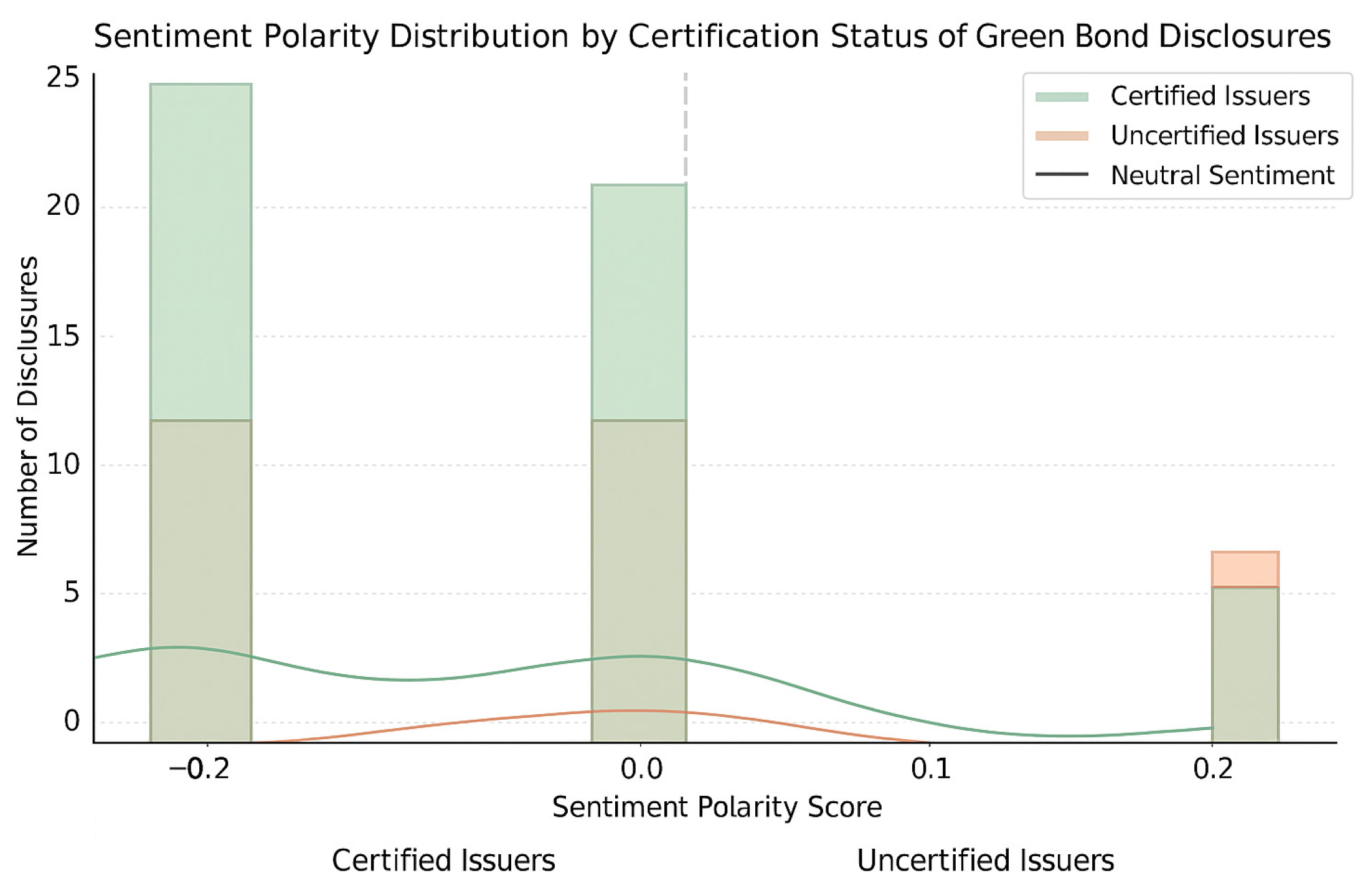
As shown in
Table 1, certified issuers (
n = 61) reported a slight decrease in average sentiment (−0.06) and decreased variance (SD = 0.15), whereas non-certified issuers (
n = 39) had a slight increase in average sentiment (−0.01) and increased variance (SD = 0.17). Although both groups are clustered around zero, indicating a primarily neutral tone throughout the sample, the wider distribution of sentiment among the non-certified group indicates a greater tendency toward variable or emotive language, which has been linked to narrative inflation and strategic ambiguity within ESG reporting.
Taken together, the findings suggest that the presence of certification mechanisms contributes to more formalized and data driven disclosure practices, while the lack of oversight allows for greater flexibility in ESG-related narrative development and therefore potentially more promotional ESG claims.
Figure 1 illustrates the distribution of sentiment polarity scores for certified and non-certified issuers.
4.2. Topic Modeling and Thematic Density
4.2.1. Topic Modelling of Green Bond Disclosures
Topic modeling was used for this research to determine the major themes in green bonds’ issuers’ disclosure documents as well as to analyze the differences in ESG communication between different sectors. Topic Modeling can be used to identify the underlying semantic structure in large volumes of unstructured text and can help to determine if companies are using ESG communications to report on actual sustainable issues, or if they are simply reporting generic ESG terms repeatedly. An LDA (Latent Dirichlet Allocation) algorithm was used to create a dataset of 100 green bond disclosures to find the hidden topics based on the co-occurring patterns of words. The algorithm was then instructed to create three primary topics, and the consistency and interpretability of each topic was determined by a coherence score that measures the semantic similarity of all words included in the topic.
Each issuer’s disclosure document was also categorized by one of the three identified industry sectors Energy, Finance, and Infrastructure so that the researcher could compare the most prominent themes within those industries. By identifying the sectors where there is a priority placed on specific ESG areas, and the regulations surrounding those areas, the research is able to show how different regulatory environments influence the ESG narrative presented in the green bond issuance documents.
Table 2 summarizes the three primary topics identified through the LDA topic modeling analysis, along with their coherence scores and dominant sectors.
The study found three main categories (Climate Transition, Waste & Emissions, Sustainability Goals) were the dominant themes to emerge from this research. Climate Transition focused primarily on how to finance mechanisms and develop long term climate strategies; Waste & Emissions focused on operational mechanisms for emissions reductions and waste management; Sustainability Goals focused on generalised ESG objectives and company goals which can be highly generic and/or aspirational. Coherence scores for the thematic categories range from 0.68 to 0.75, with Sustainability Goals scoring the highest, which indicates that companies’ Sustainability Goals have more consistent (or template-like) language and possibly have been developed by using template style corporate language.
Sustainability Goals was the primary theme across all sectors studied in this research, demonstrating an increasing trend toward “narrative convergence” among firms across industries are employing similar vague ESG rhetoric, instead of providing specific disclosures relevant to their respective industries. Such consistency could demonstrate collective commitment to sustainability ideals, but it may also illustrate a greater risk of semantic greenwashing, where all firms use the same broad language to mask lack of meaningful environmental actions. Overall, the results from this topic modeling study support the findings from the sentiment analysis studies, that although ESG communications exist throughout all sectors, they are typically lacking in specificity of sectoral details and do not provide measureable environmental accountability.
4.2.2. Industry, Country, and Time-Based Variations in Disclosure Narratives
Variations by Industry
Data from the sample were classified as belonging to one of the three main categories—Energy, Finance, and Infrastructure—to determine if the specific types of businesses represented in the data would result in differences in the manner in which issuers describe their projects.
Results indicated that:
Issuers from the energy industry have the highest level of ambiguity as well as the greatest number of positive sentiments expressed. These results may be attributed to an increase in reputational risks and scrutiny related to companies that generate revenue through carbon-intensive activities.
Issuers from the infrastructure category appear to produce the most clear disclosures when compared to other industries, they also had the fewest ambiguities as well as a greater density of themes, this appears to be due to conventional reporting practices as a result of project financing.
Financial issuers tended to express a neutral sentiment and produced relatively clear disclosures as well as moderate levels of ambiguity; both of these traits are consistent with the highly standardized disclosure environment found within the financial services industry.
Using ANOVA (Analysis of Variance) we determined that the differences observed in ambiguity and thematic density between the various industries examined were statistically significant, therefore suggesting that issuers are subject to varying levels of narrative discipline due to factors such as different regulatory and reputational pressures present in each industry.
Variations by Country/Region
The data from the sample were classified into one of three regions—Europe, Asia Pacific, or North America, using the geographic location of the issuer’s headquarters.
Issuers from European countries reported the most clear disclosures as well as the least amount of ambiguity among all of the regions analyzed, and these results can be attributed to the regulatory influences of the EU Taxonomy and SFDR (Sustainable Finance Disclosure Regulation).
Asia Pacific issuers demonstrated the greatest degree of variability in the sentiment expressed in their disclosures; some were extremely optimistic while others expressed a neutral perspective, these results can be attributed to the lack of cohesive regulation in many of the countries found in the Asia Pacific region.
Issuers from North America reported the greatest degree of lexical diversity among the regions examined, however, they also displayed the greatest degree of variability in terms of the thematic structures used to organize their disclosures, these results suggest that the disclosure practices among issuers in North America are variable and may reflect the diverse expectations of stakeholders in the U.S. and Canada.
Overall, these regional trends demonstrate that the regulatory environment surrounding the use of ESG (Environmental Social Governance) metrics has a direct impact upon the form and credibility of sustainability narratives.
Temporal Trends (2015–2018 vs. 2019–2021 vs. 2022–2023)
To investigate how sustainability narratives evolved temporally, the sample was divided into three separate issuance windows that represent key developments in the regulatory and market environment:
The first time frame (2015–2018) is indicative of very positive sentiment with a very low degree of thematic density; this suggests that early on issuers were creating optimistic, and somewhat inconsistent (non-formalized), sustainability stories.
The second time frame (2019–2021) is indicative of a neutral tone with less ambiguity; this indicates that issuers began to create more formalized, and scrutinized, sustainability stories as a result of increased pressure from regulators and the public to scrutinize green finance.
In contrast, the third time frame (2022–2023) shows a distinct increase in clarity of sustainability stories and an increase in the number of quantifiable environmental metrics used; this suggests that issuers are beginning to feel pressure to make their sustainability stories verifiable and consistent.
Linear trend analysis confirmed a statistically significant decrease in the level of ambiguity present in the sustainability stories issued over the sample time frame; also a statistically significant increase in the lexical richness and thematic structure of those sustainability stories.
4.3. Statistical Analysis of Financial and Market Performance
Overall, descriptive analysis characterizes the 100 selected disclosures by analyzing the disclosure’s content linguistically, and financially. The mean sentiment polarity of the disclosures at −0.041 supports the idea that the majority of the disclosures have an overall neutral-to-cautious tone; this suggests that issuers tend to provide balanced information as opposed to positive information, and avoid making claims they cannot support, which would damage their reputation and credibility in reporting sustainability performance. In addition, the average readability score of 48.96 (using Flesch scale) indicates moderately difficult language; since these are professional and technical documents, it is expected that the language would be somewhat difficult to read. The high average lexical diversity of 0.69 indicates that issuers used a wide variety of words and word combinations, thus demonstrating a rich and varied narrative ability to express the issuer’s sustainability performance.
The average ambiguity index was 0.36, indicating a moderate level of ambiguity in the disclosures. This ambiguity could arise due to issuers being cautious regarding their optimism towards the future based upon regulatory concerns or the desire to keep some flexibility in their sustainability commitments. Therefore, together, these various textual features demonstrate a mixed communication environment, with language both providing useful information, and at the same time guarding against potential pitfalls that may develop in the future.
Financially, the sample represents large, mature companies. The average ROA of 6.79% and average ROE of 13.88% were also reported, along with an average EPS of 3.51 and Tobin’s Q of 1.19, showing moderate levels of market capitalization compared to book values. The variations within the sample provided enough variability to test statistically for relationships between the narrative quality of the disclosures and the firm’s financial performance using regression analysis and event studies in the next sections. The descriptive statistics for all textual and financial variables used in the analysis are provided in
Table 3, including means, standard deviations, and percentile values.
4.4. Correlation Analysis
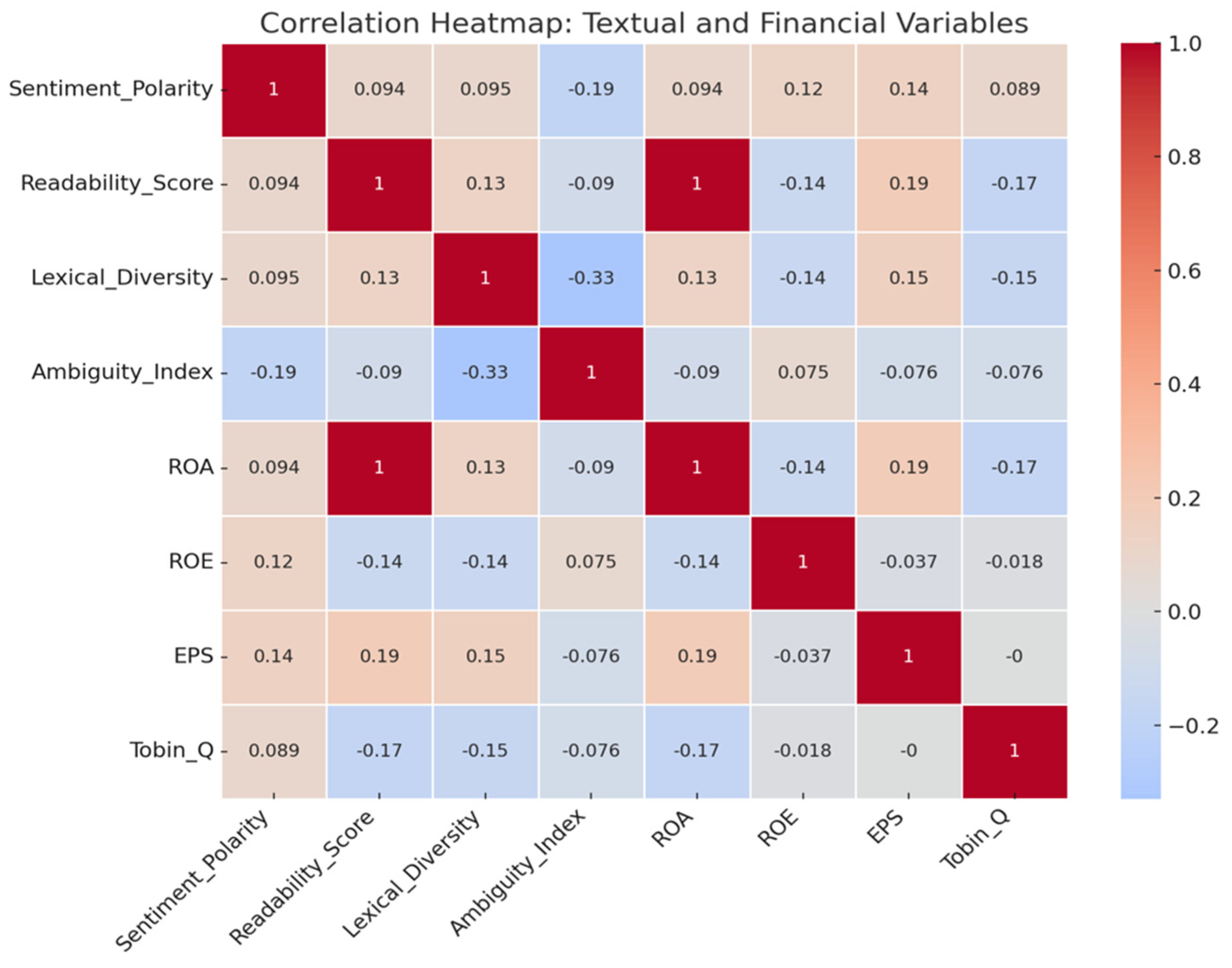
The correlation matrix offers an initial look at the relationships among the narrative quality attributes of green bonds with companies’ financial performance indicators. The majority of the results suggest that there are relatively small but significant relationships between how companies describe their ESG initiatives and how those efforts ultimately affect their financial performance.
There was a very small positive correlation between sentiment polarity and financial performance metrics like Earnings per Share (EPS) (r = 0.143) and Return on Equity (ROE) (r = 0.120). This relationship could suggest that companies which express optimism and confidence in describing their sustainability initiatives will generally achieve better financial performance than companies that do not demonstrate the same level of commitment through their sustainability communications. Although the relationship was small, this would support the notion that companies which express optimism about their sustainability initiatives, but do so in a way that appears credible to investors, may experience an increase in valuation due to improved investor perception.
In addition, there was also a small positive correlation found between readability scores and EPS (r = 0.191). The implication here is that when companies produce sustainability communications that are easier for investors and analysts to understand, then they are likely to receive a favorable reaction from them, resulting in a more accurate assessment of a company’s worth.
On the other hand, the ambiguity index demonstrated negative correlations with all three of the financial performance metrics tested, i.e., EPS (r = −0.076), Tobin’s Q (r = −0.076), and Debt/Equity Ratio (r = −0.058). Therefore, a lack of clarity in the language used in ESG communications can result in lower investor confidence and reduced valuation.
Finally, there was a strong negative relationship found between lexical diversity and ambiguity (r = −0.330), which indicated that companies utilizing a greater variety of words in their sustainability communications tend to write communications that are both clearer and less ambiguous.
While none of the correlations found were large enough to imply that a causal relationship existed, the trend of the correlations is consistent and supports the hypothesis that clarity, transparency, and linguistic complexity in sustainability communications are related to improved market and financial performance. As a result, the correlation coefficients provide a rationale for using regression models in future analyses to determine if the relationships observed are predictive. The correlations among narrative quality variables and financial performance indicators are displayed in
Table 4, showing the directional relationships underlying subsequent regression modeling.
Ambiguity index has a negative relationship with a number of the financial metrics including EPS (r = −0.076) and Tobin’s Q (r = −0.076), suggesting that vagueness in language may serve to erode market confidence. It is also interesting to note that lexical diversity has a negative relationship with ambiguity (r = −0.330), suggesting that more varied vocabulary supports the precision of language used.
The relationships among the narrative quality variables and financial metrics are visualized in
Figure 2, which displays the full correlation matrix. While modest in strength, these results provide some support for the proposition that higher quality ESG narratives, specifically clarity, positivity, and lexical diversity are directionally related to better financial performance. This warrants further investigation of a causal relationship through regression modeling in the following section.
4.5. PLS Regression Analysis
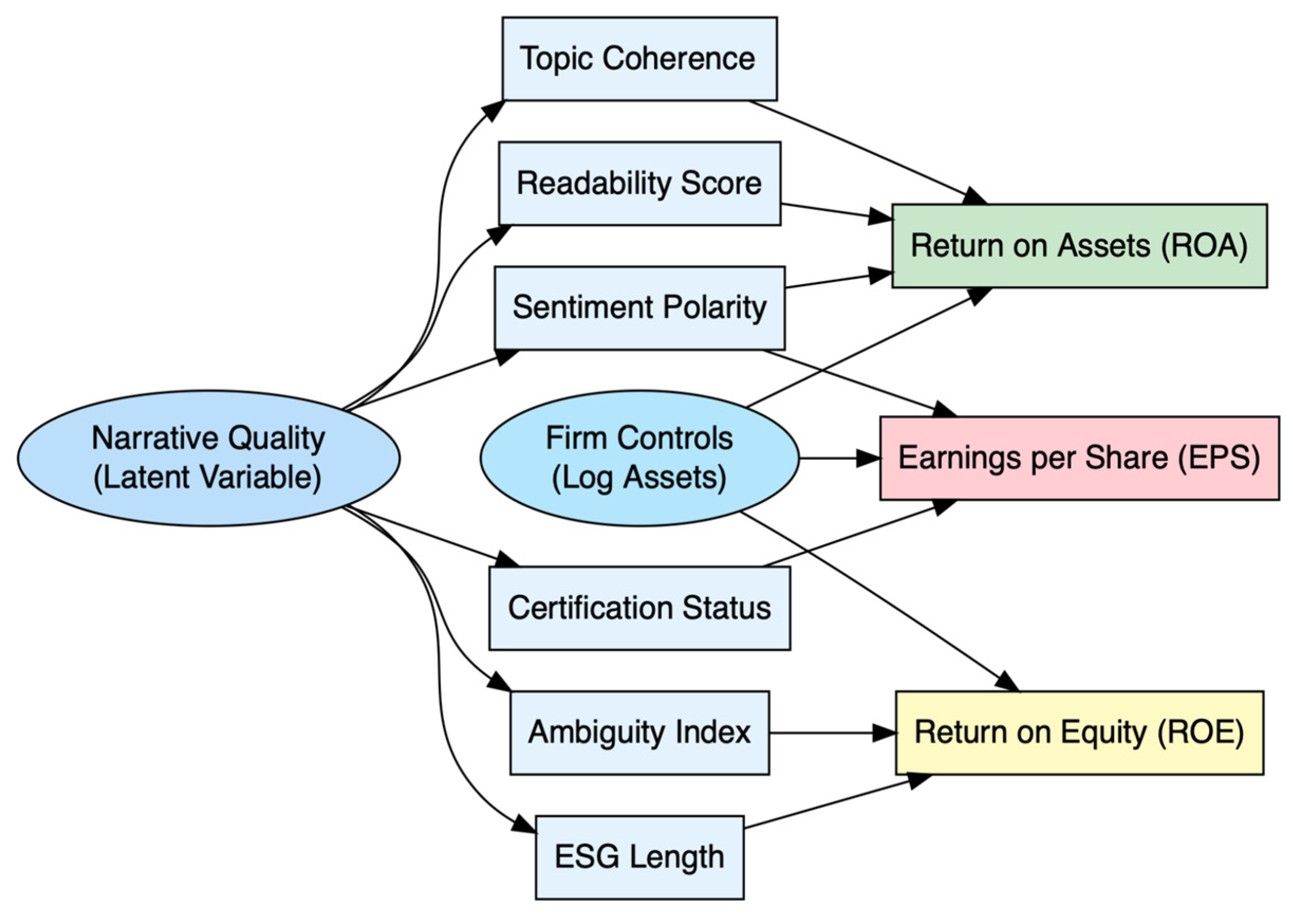
Partial Least Squares Regression (PLS-R) was applied to address multicollinearity among linguistic predictors and to ensure stable estimation with the moderate sample size. Three models were estimated for ROA, ROE, and EPS. The general specification was:
where all predictors were standardised. A 10-fold cross-validation procedure confirmed that a two-component solution provided the best predictive fit. Readability and topic coherence loaded positively on the main component, while ambiguity loaded negatively. Cross-validated R
2 values (0.41 for ROA; 0.29 for ROE; 0.25 for EPS) indicate modest but consistent links between clearer ESG narratives and stronger financial performance. The predictive performance and component structure of the PLS regression models for ROA, ROE, and EPS are summarized in
Table 5. The structural relationships among the components in the PLS regression model are depicted in
Figure 3.
4.6. Event Study Framework (−5 to +5 Days)
The short term reaction of a firm’s market price upon receiving news about a Green Bond announcement, will be studied through the application of an Event Study Framework; An event window of eleven days (−5 to +5 Days) will surround Day 0; the day on which the firm made public its Green Bond announcement. ARs are calculated by comparing the daily returns of each firm with the daily returns of the relevant stock market index; AAR is then computed as the average of the ARs for all thirty firms in the sample; CARs are calculated by summing up the AARs over the event window. The event study design tests whether sustainable financing tools such as Green Bonds provide positive information signals to investors as stated in the signaling hypothesis. The abnormal and cumulative abnormal returns around the green bond announcement window are presented in
Table 6.
The results indicate a mildly favourable market response to green bond announcements. The AAR at the event date (Day 0) was marginally positive, implying that investors perceive incremental value in sustainable financing signals. The CAR trend becomes positive from Day −2 onward and continues to rise through the post-event period, reaching +1.02% by Day +5. This pattern suggests that investors gradually incorporate information about green bond issuance into their valuations, reflecting a delayed adjustment effect commonly observed in ESG-related announcements.
However, the paired-sample t-test comparing firm returns and market returns on the announcement day yielded no statistically significant difference (p > 0.05). This indicates that while investors generally respond positively to green bond signals, the immediate price impact is too small to be separated from overall market movement on that single day.
Taken together, the findings suggest that the market interprets green bond announcements as positive but subtle signals, rewarding firms that demonstrate credible sustainability communication. The delayed positive CAR trajectory reinforces the idea that investors value ESG credibility over time, particularly when disclosures are clear and verifiable rather than promotional. The abnormal and cumulative abnormal return trajectories over the event window are illustrated in
Figure 4.
4.7. ESG Narrative Quality vs. Financial Performance
The integration of text-based analysis and financial data reveals a meaningful connection between the quality of ESG narratives and firm-level financial outcomes. Results from the Partial Least Squares Regression (PLS-R) indicate that narrative quality variables particularly sentiment clarity and topic coherence show the strongest relationship with Return on Assets (ROA) (R2 = 0.41, cross-validated). This suggests that firms whose disclosures are well-organised, emotionally balanced, and thematically consistent tend to achieve higher asset efficiency and profitability. Such clarity in communication may signal stronger management quality and operational discipline, traits that translate into improved financial performance.
Findings from the event study analysis reinforce this pattern. The cumulative abnormal returns (CAR) turned positive from Day −2 and continued to rise post-announcement, reflecting investors’ favourable response to credible and structured sustainability narratives. Investors appear to interpret clear and fact-based ESG communication as a signal of long-term value creation potential, rather than as mere reputation-building. Conversely, firms exhibiting high ambiguity or excessive optimism in their disclosures identified through sentiment and ambiguity indices recorded weaker investor reactions, as evidenced by flat or negative AAR values around Day 0.
Results from the ANOVA test show that these patterns are consistent across industries Energy, Finance, and Infrastructure indicating that investor preferences for specificity, measurability, and transparency are not sector-dependent. Moreover, companies that closely align key ESG themes (e.g., climate adaptation, renewable infrastructure) with tangible financial metrics benefit from incremental market capital growth, lower future financing costs, and stronger ESG ratings.
Overall, the synthesis of evidence demonstrates that developing authentic and verifiable ESG narratives enhances financial credibility and investor confidence. In contrast, reliance on vague or inflated sustainability language exposes firms to reputational penalties and market-based sanctions against greenwashing, reaffirming the economic and ethical importance of narrative integrity in sustainable finance.
4.8. Qualitative Triangulation from Case Studies
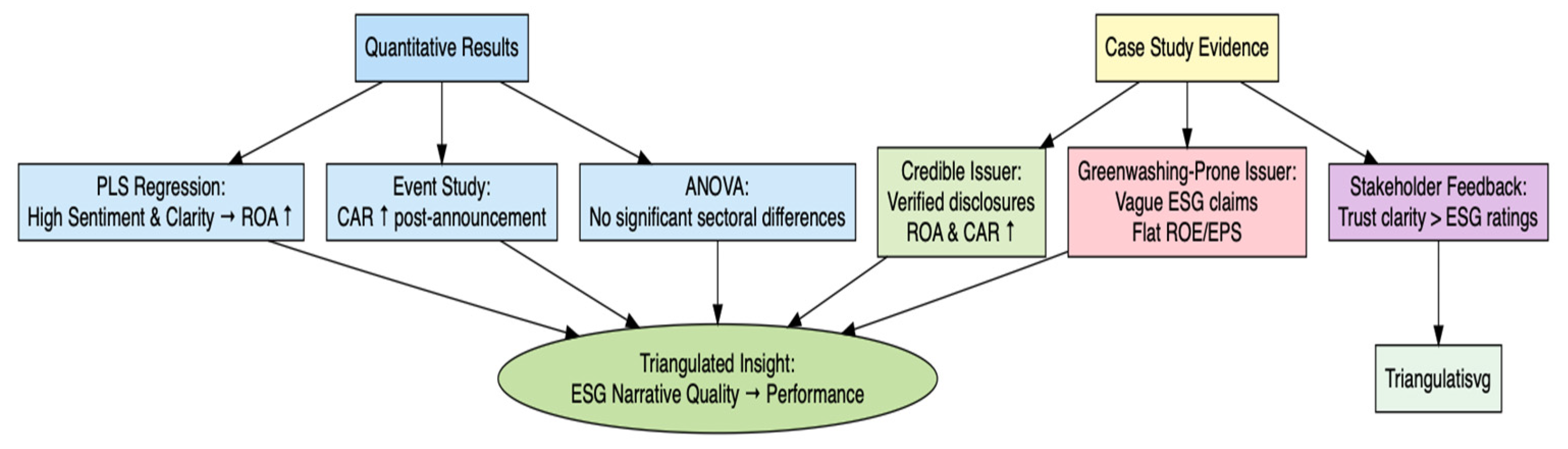
As means of validating and contextualizing our quantitative findings, we undertook two case studies of green bond issuers one with high transparency, and one highly criticized for greenwashing. The high credibility issuer, a European utility, had extensive project-level disclosure, used a third-party verifier, and reported in a transparent manner on impact. This firm also showed post-issuance ROA growth, and a CAR trajectory that was fairly consistent with what we observed in the PLS and event study. The firm with a tendency towards greenwashing, a global packaging manufacturer, issued a bond with vague and unverifiable environmental claims, vague carbon metrics, and no independent assurance. Conversations with other stakeholders, including asset managers and ESG analysts, confirmed skepticism about this issuer’s sustainability integrity. There was a muted market reaction, and even when the market was favorable, ROE and EPS were unchanged. he triangulated insights from the qualitative case studies are illustrated in
Figure 5, which integrates interview findings, issuer characteristics, and narrative credibility indicators.
The two case studies reinforced the key point made in our thesis: credibility of ESG narratives is not merely symbolic; it impacts firm outcomes and investor behavior. We found the interviews with stakeholders suggested increasing reliance on the content of disclosures rather than a third party ESG score. Alignment of sentiment, relevance of topic or themes, and similarity of written, spoken, or situational linguistic expressions increasingly stood out as evaluative criteria of integrated disclosure. This triangulation altogether suggests a growing convergence between textual integrity and financial trustworthiness in sustainable finance.
5. Conclusions and Findings
The data show that, across all the analyses done—sentiment scores, thematic structure, clarity, ambiguity index, PLS regression, ANOVA and event-study patterns—that there is considerable financial impact from the characteristics of the narratives of green bond issuers.
In particular, the NLP analysis found that firms that produced clearer, more neutral and less ambiguous disclosures were significantly better on their post-issuance accounting measures (ROA, ROE, EPS) than those firms that did not. In fact, the PLS models revealed that the narrative structure accounted for a significant amount of the variation in the financial measures. But, the magnitude of the effect was modest and not universally applicable, so it appears that narrative quality is just one contributing factor among many factors influencing financial measures. The event-studies found that overall, the stock price reaction to issuance date events was small, and the difference in abnormal returns was most strongly associated with the transparency of the narrative and secondarily with the industry category of the issuer—consistent with the ANOVA finding that there was little sector-specific variation.
These findings are similar to other recent research findings that demonstrate that credible communication about sustainability can improve trust and understanding by stakeholders (
Flammer 2021;
Robinson et al. 2023;
Bingler et al. 2024), and the relationship between ambiguous ESG narratives and lower investor confidence and increased perceived risk of green-washing (
Grote and Zook 2022;
Torelli et al. 2019). The qualitative case studies supported these findings and reinforced the findings. Firms that provided detailed, verifiable information about projects they would be funding through the proceeds of the issue, including third party certification, were generally viewed as much more reliable and trustworthy, whereas issuers who used positive but unsubstantiated language were widely questioned by both investors and sustainability analysts.
Together, this study provides empirical evidence that supports the notion that ESG communication has financial significance and not simply reputationally important. Further, it shows that the quality and credibility of sustainability communications—rather than simply whether an ESG report exists—affects how investors interpret communications and ultimately, their post-issuance financial performance. This study reinforces the importance of developing credible, evidence-based, transparent and objective narrative practices and highlights the risks and consequences of using either unverifiable or overly promotional communications.
Finally, the study suggests some potential policy applications and practical uses. For example, investors may want to evaluate the credibility of communications based on textual indicators of credibility in addition to formal ESG ratings. Regulators may wish to strengthen verification requirements to reduce ambiguity and increase the reliability of communications. As the green bond market grows, it will be essential to ensure that there is greater consistency in the narrative communicated in these securities and that these communications provide measurable and relevant environmental justification for the use of the proceeds of the securities, to build and maintain investor trust, to mitigate informational asymmetry, and to promote the allocation of capital for sustainable development purposes.




 ,
,