
Asymmetric and Time-Varying Connectedness of FinTech with Equities, Bonds, and Cryptocurrencies: A Quantile-on-Quantile Perspective

Abstract
1. Introduction
2. Literature Review
2.1. Credit Markets
2.2. Cryptocurrencies
2.3. FinTech Performance and the Macroeconomy
3. Data and Methodology
3.1. Data
3.2. Methodology
4. Empirical Findings
4.1. Total Connectedness Indices
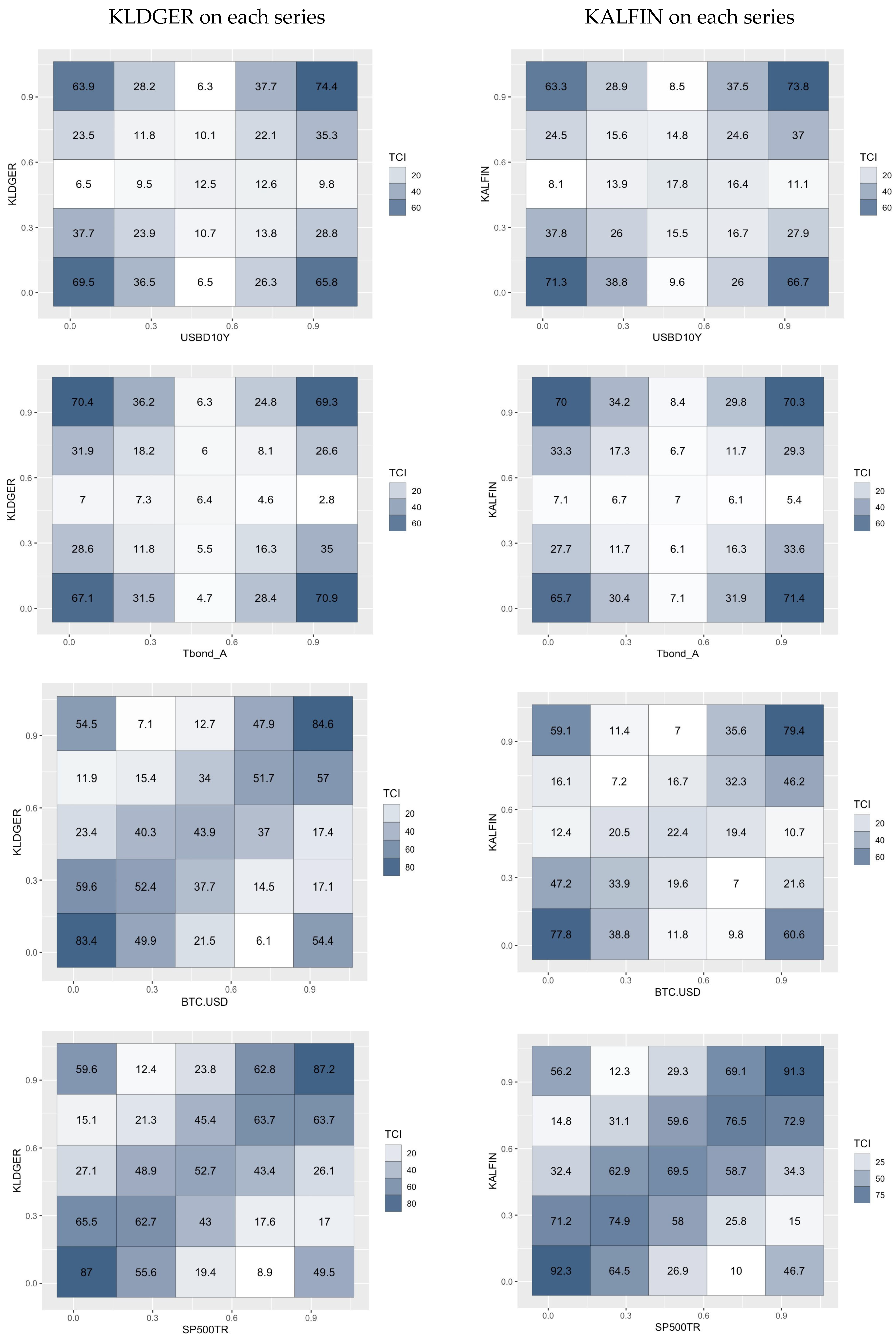
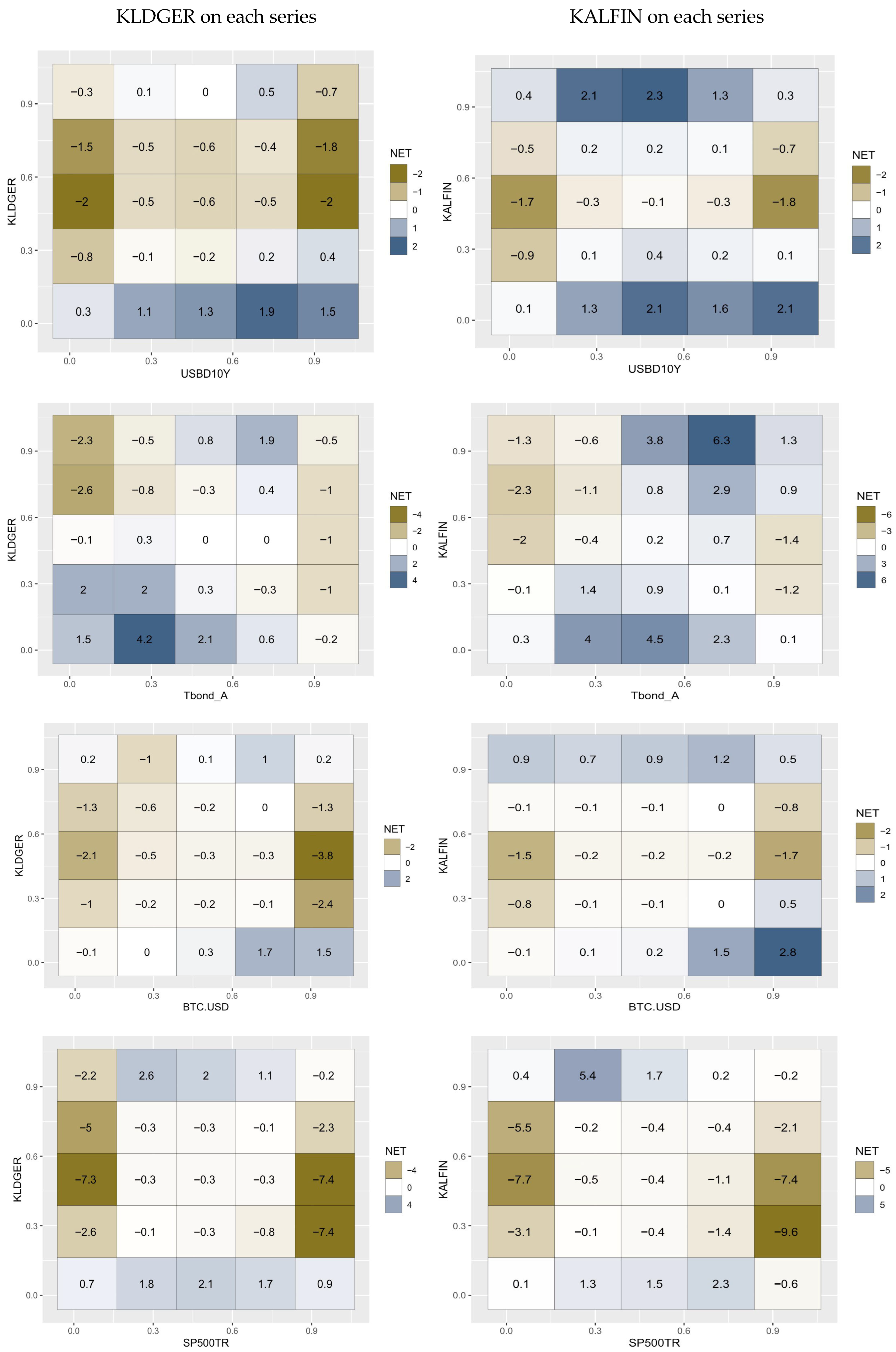
- Asymmetric Connectedness: Stronger connectedness at extreme quantiles underscores the nonlinear and tail-dependent nature of FinTech–bond interactions, consistent with financial contagion and stress-period co-movement theories.
- Equity and Crypto Alignment: FinTech indices—especially KLDGER and KALFIN—are more tightly linked to SP500TR and BTC, suggesting that these sectors behave like growth-oriented, high-risk assets rather than defensive investments.
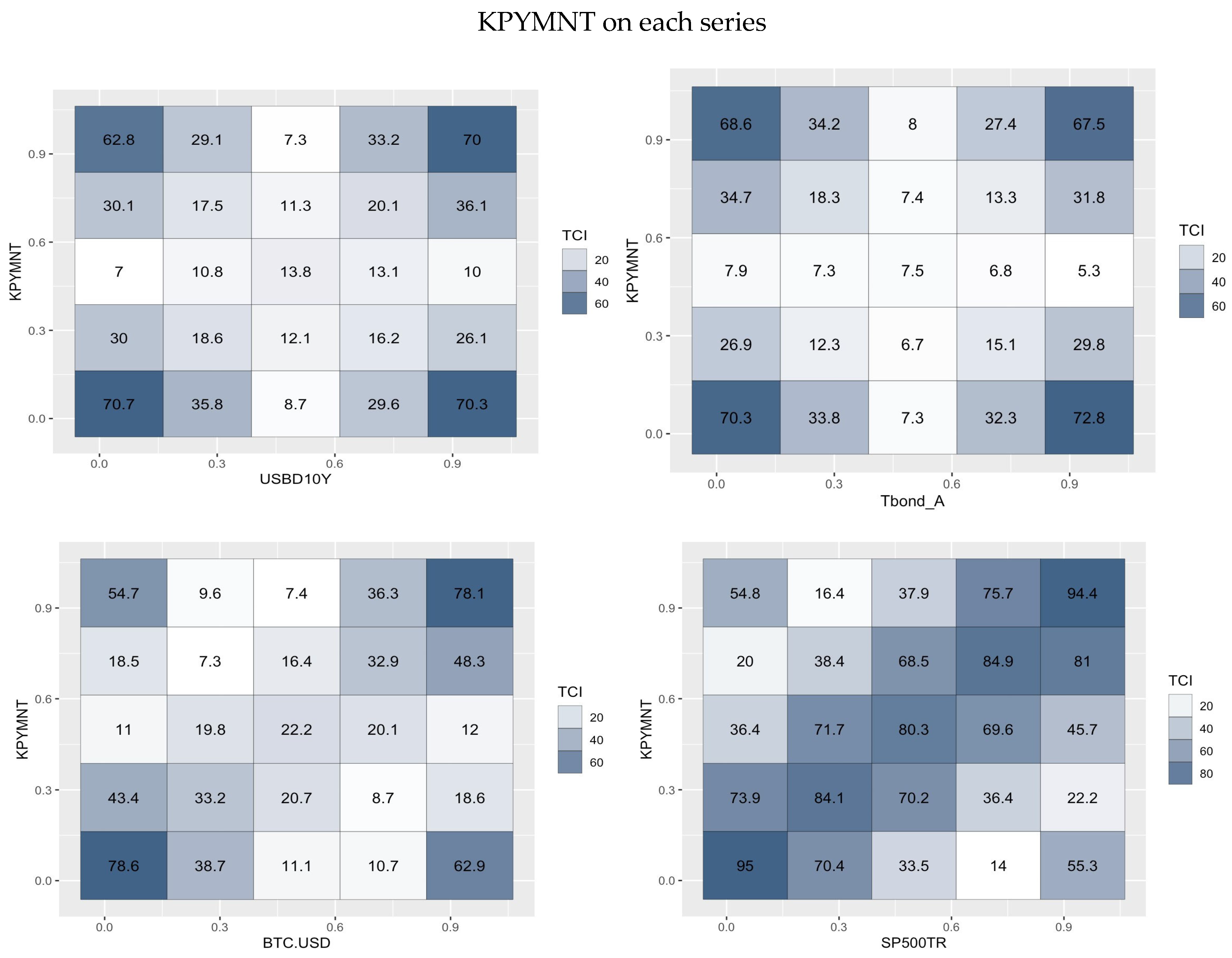
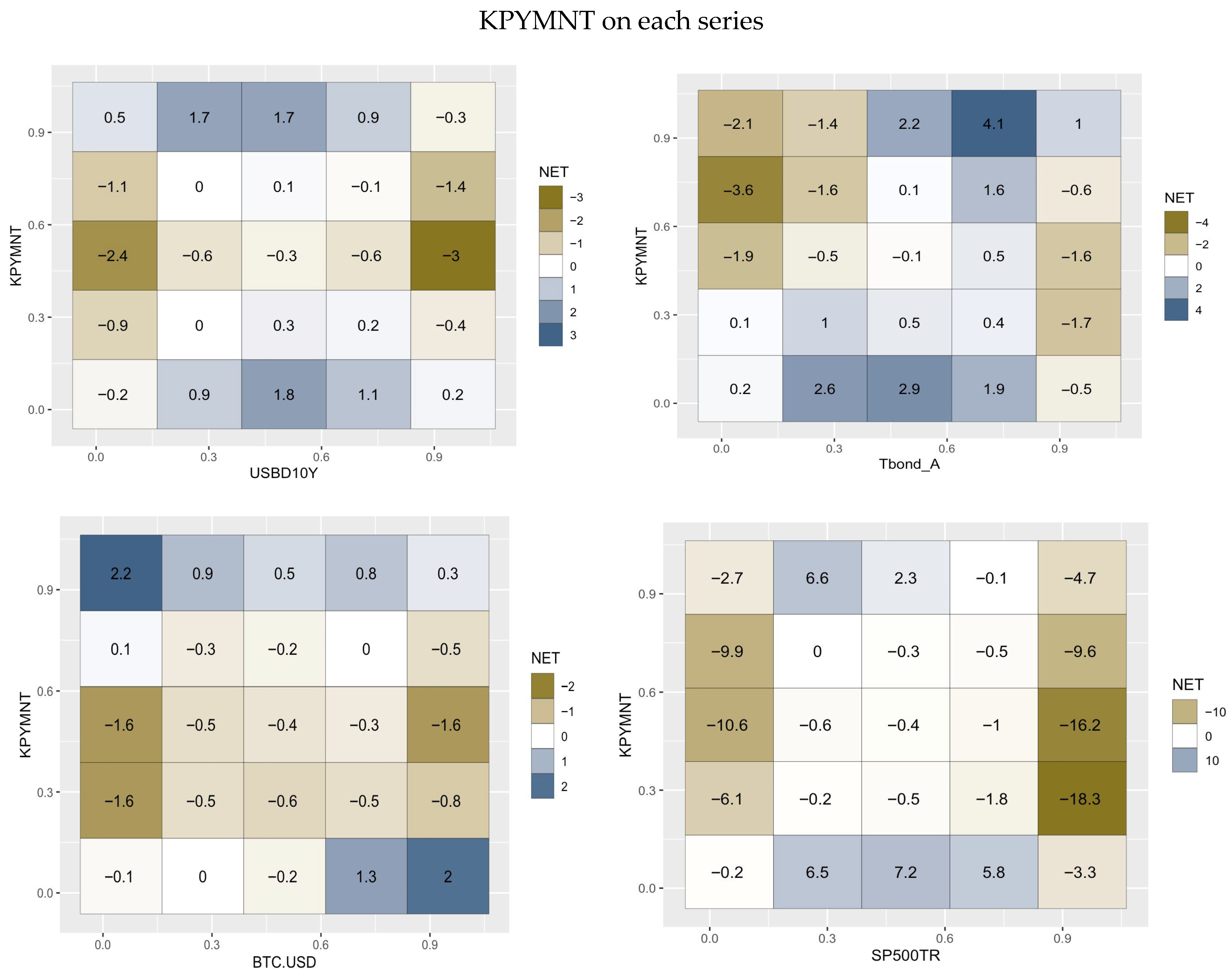
- Bond Market Divergence: The inverse quantile connectedness with A-rated bonds, especially for KPYMNT, reflects a flight-to-quality effect and highlights the risk-hedging properties of safer fixed-income securities.
- Segment-Specific Dynamics: The payments sector (KPYMNT) shows the strongest divergence from bond markets, implying that innovations in digital transactions may act as a substitute for traditional debt markets from an investor allocation perspective. From a portfolio diversification perspective, the findings suggest that FinTech assets, particularly payment-related firms, can provide diversification benefits against bond-heavy portfolios, but only under normal conditions. In times of stress, however, the strong tail dependence indicates that these assets may co-move with equities and cryptocurrencies, thereby limiting their safe-haven potential. For policymakers and regulators, the asymmetric relationships imply that shocks in the FinTech sector could propagate differently depending on the segment—posing greater systemic risks through payment platforms relative to distributed ledger or alternative finance firms.
4.2. Net Directional Connectedness
4.2.1. U.S. 10-Year Benchmark Bonds
4.2.2. Credit Risk
4.2.3. Bitcoin (BTC)
4.2.4. S&P 500 Total Return Index (SP500TR)
4.2.5. Segment-Specific Insights
- KLDGER (Distributed Ledger Technologies): More sensitive to BTC and SP500TR, reflecting blockchain–crypto–equity linkages.
- KALFIN (Alternative Finance): Exhibits the highest connectedness overall, strongly influenced by equity markets and moderately by bonds, underscoring its exposure to systemic financial risks.
- KPYMNT (Digital Payments): Shows the sharpest negative spillovers from SP500TR, suggesting strong competition or substitution effects between equity markets and payment innovations.
4.2.6. The Net Connectedness Analysis Provides Several Key Insights
- Equity dominance: SP500TR consistently emerges as the strongest net transmitter, with especially intense effects on KALFIN and KPYMNT.
- Crypto–ledger linkage: BTC spillovers are most relevant for KLDGER, consistent with blockchain-related interdependencies.
- Bond asymmetry: Treasury instruments act as conditional transmitters, with A-rated bonds transmitting risk premia at lower quantiles, while 10-year benchmark yields show more balanced but weaker effects.
- FinTech heterogeneity: Payment firms (KPYMNT) are more vulnerable to equity spillovers, alternative finance (KALFIN) to systemic shocks, and distributed ledger firms (KLDGER) to crypto-market dynamics.
4.2.7. Portfolio Implications
4.2.8. Dynamically Related Total Connectedness Indices
5. Conclusions and Policy Implications
Author Contributions
Funding
Data Availability Statement
Use of Artificial Intelligence
Conflicts of Interest
| 1 | https://www.mckinsey.com/industries/financial-services/our-insights/fintechs-a-new-paradigm-of-growth, accessed on 22 August 2025. |
References
- Abakah, Emmanuel Joel Aikins, Aviral Kumar Tiwari, Sudeshna Ghosh, and Buhari Doğan. 2023. Dynamic effect of Bitcoin, fintech and artificial intelligence stocks on eco-friendly assets, Islamic stocks and conventional financial markets: Another look using quantile-based approaches. Technological Forecasting and Social Change 192: 122566. [Google Scholar] [CrossRef]
- Abakah, Emmanuel Joel Aikins, Nader Trabelsi, Aviral Kumar Tiwari, and Samia Nasreen. 2024. Bitcoin, Fintech stocks and Asian Pacific equity markets: A dependence analysis with implications for portfolio management. The Journal of Risk Finance 25: 792–839. [Google Scholar] [CrossRef]
- Agustin, Grisvia. 2023. The Rise of Financial Technology and Its Credit Risk in Indonesia. International Journal of Accounting and Finance in Asia Pasific 6: 98–109. [Google Scholar] [CrossRef]
- Anginer, Deniz, and Celim Yildizhan. 2010. Is There a Distress Risk Anomaly?: Corporate Bond Spread as a Proxy for Default Risk. Development Research Group, Finance and Private Sector Development Team. Washington, DC: World Bank. [Google Scholar] [CrossRef]
- Assefa, Tibebe A., Omar A. Esqueda, and André Varella Mollick. 2017. Stock returns and interest rates around the World: A panel data approach. Journal of Economics and Business 89: 20–35. [Google Scholar] [CrossRef]
- Aydoğan, Berna, Gülin Vardar, and Caner Taçoğlu. 2022. Volatility spillovers among G7, E7 stock markets and cryptocurrencies. Journal of Economic and Administrative Sciences 40: 364–87. [Google Scholar] [CrossRef]
- Chan, Stephanie, and Yang Ji. 2020. Do interest rate liberalization and fintech mix? Impact on shadow deposits in China. China & World Economy 28: 4–22. [Google Scholar] [CrossRef]
- Chatziantoniou, Ioannis, David Gabauer, and Alexis Stenfors. 2021. Interest rate swaps and the transmission mechanism of monetary policy: A quantile connectedness approach. Economics Letters 204: 109891. [Google Scholar] [CrossRef]
- Chava, Sudheer, and Amiyatosh Purnanandam. 2010. Is Default Risk Negatively Related to Stock Returns? The Review of Financial Studies 23: 2523–59. [Google Scholar] [CrossRef]
- Chiu, Tzu-Ting, Yuyan Guan, and Jeong-Bon Kim. 2018a. The Effect of Risk Factor Disclosures on the Pricing of Credit Default Swaps. Contemporary Accounting Research 35: 2191–224. [Google Scholar] [CrossRef]
- Chiu, Wan-Chien, Chih-Wei Wang, and Juan Ignacio Peña. 2018b. Does the source of debt financing affect default risk? Review of Financial Economics 36: 232–51. [Google Scholar] [CrossRef]
- Chu, Yinxiao, and Jianxing Wei. 2023. Fintech Lending and Credit Market Competition. Journal of Financial and Quantitative Analysis 59: 2199–225. [Google Scholar] [CrossRef]
- Diebold, Francis X., and Kamil Yilmaz. 2012. Better to give than to receive: Predictive directional measurement of volatility spillovers. International Journal of Forecasting 28: 57–66. [Google Scholar] [CrossRef]
- Diebold, Francis X., and Kamil Yılmaz. 2014. On the network topology of variance decompositions: Measuring the connectedness of financial firms. Journal of Econometrics 182: 119–34. [Google Scholar] [CrossRef]
- Elliott, Graham, Thomas Rothenberg, and James Stock. 1992. Efficient Tests for an Autoregressive Unit Root. Cambridge: National Bureau of Economic Research. [Google Scholar] [CrossRef]
- Elroukh, Ahmed W. 2023. Does banning cryptocurrencies affect stock markets? Studies in Economics and Finance 41: 998–1011. [Google Scholar] [CrossRef]
- Field, Jack, and A. Can Inci. 2023. Risk translation: How cryptocurrency impacts company risk, beta and returns. Journal of Capital Markets Studies 7: 5–21. [Google Scholar] [CrossRef]
- Finkelstein-Shapiro, Alan, Federico S. Mandelman, and Victoria Nuguer. 2022. Fintech Entry, Firm Financial Inclusion, and Macroeconomic Dynamics in Emerging Economies. IDB Working Paper Series. Available online: https://papers.ssrn.com/sol3/papers.cfm?abstract_id=4221531 (accessed on 29 August 2025).
- Gabauer, David, and Alexis Stenfors. 2024. Quantile-on-quantile connectedness measures: Evidence from the US treasury yield curve. Finance Research Letters 60: 104852. [Google Scholar] [CrossRef]
- Ghaemi Asl, Mahdi, Muhammad Mahdi Rashidi, and Seyed Ali Hosseini Ebrahim Abad. 2021. Emerging digital economy companies and leading cryptocurrencies: Insights from blockchain-based technology companies. Journal of Enterprise Information Management 34: 1506–50. [Google Scholar] [CrossRef]
- Gilchrist, Simon, and Egon Zakrajšek. 2012. Credit Spreads and Business Cycle Fluctuations. American Economic Review 102: 1692–720. [Google Scholar] [CrossRef]
- Gil-Corbacho, Azahara, María Mar Miralles-Quirós, and José Luis Miralles-Quirós. 2023. Stock market performance differences between fintech and traditional financial firms. Studies of Applied Economics 41. [Google Scholar] [CrossRef]
- Horobeţ, Alexandra, Irina Mnohoghitnei, Lucian Belaşcu, and Ionuț Marius Croitoru. 2023. ESG Reporting and Capital Market Investors: Insights from the Global Technology and Fintech Industries. Studies in Business and Economics 18: 178–95. [Google Scholar] [CrossRef]
- Indarwati, Septiana, and Agus Widarjono. 2021. The Determinant of Indonesian Stock Returns’ Volatility: Evidence from Islamic and Conventional Stock Market. Shirkah: Journal of Economics and Business 6: 277–96. [Google Scholar] [CrossRef]
- Iqbal, Muhammad, Arianto Muditomo, and Alindha Farezha. 2022. The Existence of Islamic Fintech in Encouraging National Economic Growth. Jurnal Ilmiah Ekonomi Islam 8: 3145–52. [Google Scholar] [CrossRef]
- Iqbal, Muhammad, Prameswara Samofa Nadya, and Saripudin Saripudin. 2021. Islamic Fintech Growth Prospects in Accelerating MSMEs Growth during the COVID-19 pandemic: Evidence in Indonesia. International Journal of Islamic Economics and Finance Studies 7: 126–40. [Google Scholar] [CrossRef]
- Jarque, Carlos M., and Anil K. Bera. 1980. Efficient tests for normality, homoscedasticity and serial independence of regression residuals. Economics Letters 6: 255–59. [Google Scholar] [CrossRef]
- Kassner, Andreas Joel. 2024. Factors influencing investment into PropTech and FinTech—Only new rules or a new game? Journal of European Real Estate Research 17: 395–411. [Google Scholar] [CrossRef]
- Khan, Muhammad Tahir, Asaf Khan, Adnan Ahmad, and Obaid Ullah Bashir. 2018. Impact of Macroeconomic Factors on Stock Returns of KSE 100 Index. Journal of Business & Tourism 4: 133–45. [Google Scholar] [CrossRef]
- Klein, Tony, Hien Pham Thu, and Thomas Walther. 2018. Bitcoin is not the New Gold—A comparison of volatility, correlation, and portfolio performance. International Review of Financial Analysis 59: 105–16. [Google Scholar] [CrossRef]
- Koop, Gary, M. Hashem Pesaran, and Simon M. Potter. 1996. Impulse response analysis in nonlinear multivariate models. Journal of Econometrics 74: 119–47. [Google Scholar] [CrossRef]
- Li, Yinqiao, Renée Spigt, and Laurens Swinkels. 2017. The impact of FinTech start-ups on incumbent retail banks’ share prices. Financial Innovation 3: 26. [Google Scholar] [CrossRef]
- Ljung, M. Greta, and George E. P. Box. 1978. On a measure of lack of fit in time series models. Biometrika 65: 297–303. [Google Scholar] [CrossRef]
- McKinsey and Company. 2023. Fintechs: A New Paradigm of Growth. New York: McKinsey and Company, October 24, Available online: https://www.mckinsey.com/industries/financial-services/our-insights/fintechs-a-new-paradigm-of-growth (accessed on 22 August 2025).
- Moro-Visconti, Roberto. 2021. FinTech Valuation. In Handbook of Digital Finance and Financial Inclusion. Amsterdam: Elsevier, pp. 245–79. [Google Scholar] [CrossRef]
- Najaf, Khakan, Christophe Schinckus, and Liew Chee Yoong. 2021. VaR and market value of Fintech companies: An analysis and evidence from global data. Managerial Finance 47: 915–36. [Google Scholar] [CrossRef]
- Peltomäki, Jarkko. 2025. The Fintech Sector as an Investment: Old Wine in a New Bottle? Economic Notes 54: e70011. [Google Scholar] [CrossRef]
- Sadorsky, Perry. 2024. Using Precious Metals to Reduce the Downside Risk of FinTech Stocks. FinTech 3: 537–50. [Google Scholar] [CrossRef]
- Sharma, Meena, and Sakshi Khurana. 2025. Impact of Effective Generic Business Strategies on Probability of Default: A Study of NSE Listed Firms. NMIMS Management Review 33: 29–39. [Google Scholar] [CrossRef]
- Singh, Gurmeet, and Ravi Singla. 2023. Default Risk and Stock Returns: Evidence from Indian Corporate Sector. Vision: The Journal of Business Perspective 27: 347–59. [Google Scholar] [CrossRef]
- Smales, Lee A. 2019. Bitcoin as a safe haven: Is it even worth considering? Finance Research Letters 30: 385–93. [Google Scholar] [CrossRef]
- Xu, Lei, Qian Liu, Bin Li, and Chen Ma. 2022. Fintech business and firm access to bank loans. Accounting & Finance 62: 4381–421. [Google Scholar] [CrossRef]
- Zhang, Wenqi. 2021. Explain the Determinants of Credit Spreads in the US. Open Journal of Business and Management 9: 775–94. [Google Scholar] [CrossRef]
- Zhang, Ying, and Zixin Tong. 2023. Comparing the ARIMA and LSTM Models on the Stock Price of FinTech Companies. Academic Journal of Business & Management 5: 38–43. [Google Scholar] [CrossRef]



| Code | Full Name | Description |
|---|---|---|
| KLDGER | S&P Kensho Distributed Ledger Index | Measures the performance of companies engaged in the development and commercialization of distributed-ledger and blockchain technologies. |
| KALFIN | S&P Kensho Alternative Finance Index | Tracks firms providing innovative and digital-based financial services such as peer-to-peer lending, crowdfunding, and online wealth management. |
| KPYMNT | S&P Kensho Future Payments Index | Represents companies offering digital payment platforms, transaction-processing technologies, and payment-automation solutions. |
| BTC.USD | Bitcoin Price (USD) | Market price of Bitcoin denominated in U.S. dollars, representing cryptocurrency market dynamics. |
| SP500TR | S&P 500 Total Return Index | Captures the performance of the 500 largest U.S. companies, including dividends reinvested. |
| USBD10Y | 10-Year U.S. Treasury Bond Yield | Benchmark yield on U.S. government bonds with a 10-year maturity, reflecting the risk-free interest rate. |
| Credit Risk | Corporate Bond Spread | Defined as the yield spread between A-rated corporate bonds and the 10-year U.S. Treasury yield, representing default risk premium. |
| Statistic | KLDGER | KALFIN | KPYMNT | USBD10Y | BTC.USD | SP500TR | Tbond A |
|---|---|---|---|---|---|---|---|
| Mean | 0.0007 | 0.0001 | 0.0004 | 0.0009 | 0.0022 | 0.0005 | 0.0004 |
| Variance | 0.0014 | 0.0004 | 0.0003 | 0.0012 | 0.0017 | 0.0002 | 0.0007 |
| Skewness | 0.4622 | −0.1153 | −0.3724 | 2.0861 | −0.1806 | −0.3192 | 0.4206 |
| Kurtosis | 2.1836 | 2.7182 | 5.6526 | 41.7339 | 7.1571 | 13.8792 | 1.9922 |
| JB | 406.354 a | 537.804 a | 2345.969 a | 126824.3 a | 3705.434 a | 13922.034 a | 338.083 a |
| ERS | −14.197 a | −11.269 a | −9.588 a | −14.301 a | −17.847 a | −7.931 a | −18.149 a |
| Q(20) | 60.553 a | 78.489 a | 134.99 a | 227.84 a | 49.816 a | 436.21 a | 308.69 a |
| Q2(20) | 744.68 a | 1610.2 a | 2085.9 a | 1829.4 a | 107.97 a | 3472.1 a | 837.12 a |
| KLDGER | KALFIN | KPYMNT | USBD10Y | BTC.USD | SP500TR | Tbond A | |
|---|---|---|---|---|---|---|---|
| KLDGER | 1.000 | 0.503 | 0.485 | 0.063 | 0.362 | 0.418 | −0.028 |
| KALFIN | 0.503 | 1.000 | 0.624 | 0.095 | 0.213 | 0.539 | −0.044 |
| KPYMNT | 0.485 | 0.624 | 1.000 | 0.049 | 0.205 | 0.612 | −0.038 |
| USBD10Y | 0.063 | 0.095 | 0.049 | 1.000 | 0.013 | 0.090 | −0.316 |
| BTC.USD | 0.362 | 0.213 | 0.205 | 0.013 | 1.000 | 0.175 | 0.017 |
| SP500TR | 0.418 | 0.539 | 0.612 | 0.090 | 0.175 | 1.000 | −0.071 |
| Tbond A | −0.028 | −0.044 | −0.038 | −0.316 | 0.017 | −0.071 | 1.000 |
Disclaimer/Publisher’s Note: The statements, opinions and data contained in all publications are solely those of the individual author(s) and contributor(s) and not of MDPI and/or the editor(s). MDPI and/or the editor(s) disclaim responsibility for any injury to people or property resulting from any ideas, methods, instructions or products referred to in the content. |
© 2025 by the authors. Licensee MDPI, Basel, Switzerland. This article is an open access article distributed under the terms and conditions of the Creative Commons Attribution (CC BY) license (https://creativecommons.org/licenses/by/4.0/).
Share and Cite
Karimi, M.S.; Esqueda, O.; Weerasinghe, N.M. Asymmetric and Time-Varying Connectedness of FinTech with Equities, Bonds, and Cryptocurrencies: A Quantile-on-Quantile Perspective. Risks 2025, 13, 246. https://doi.org/10.3390/risks13120246
Karimi MS, Esqueda O, Weerasinghe NM. Asymmetric and Time-Varying Connectedness of FinTech with Equities, Bonds, and Cryptocurrencies: A Quantile-on-Quantile Perspective. Risks. 2025; 13(12):246. https://doi.org/10.3390/risks13120246
Chicago/Turabian StyleKarimi, Mohammad Sharif, Omar Esqueda, and Naveen Mahasen Weerasinghe. 2025. "Asymmetric and Time-Varying Connectedness of FinTech with Equities, Bonds, and Cryptocurrencies: A Quantile-on-Quantile Perspective" Risks 13, no. 12: 246. https://doi.org/10.3390/risks13120246
APA StyleKarimi, M. S., Esqueda, O., & Weerasinghe, N. M. (2025). Asymmetric and Time-Varying Connectedness of FinTech with Equities, Bonds, and Cryptocurrencies: A Quantile-on-Quantile Perspective. Risks, 13(12), 246. https://doi.org/10.3390/risks13120246