Article

Neglected Monteggia Fractures in Children—A Retrospective Study
1
Faculty of Medicine, University of Nis, 18000 Nis, Serbia
2
Clinic for Pediatric Surgery, Pediatric Orthopedics and Traumatology, University Clinical Centre Nis, 18000 Nis, Serbia
3
Clinic for Anesthesia and Intensive Therapy, University Clinical Centre Nis, 18000 Nis, Serbia
*
Author to whom correspondence should be addressed.
Children 2022, 9(8), 1100; https://doi.org/10.3390/children9081100

Submission received: 3 June 2022 / Revised: 18 July 2022 / Accepted: 19 July 2022 / Published: 22 July 2022
(This article belongs to the Section Pediatric Orthopedics & Sports Medicine)

Abstract

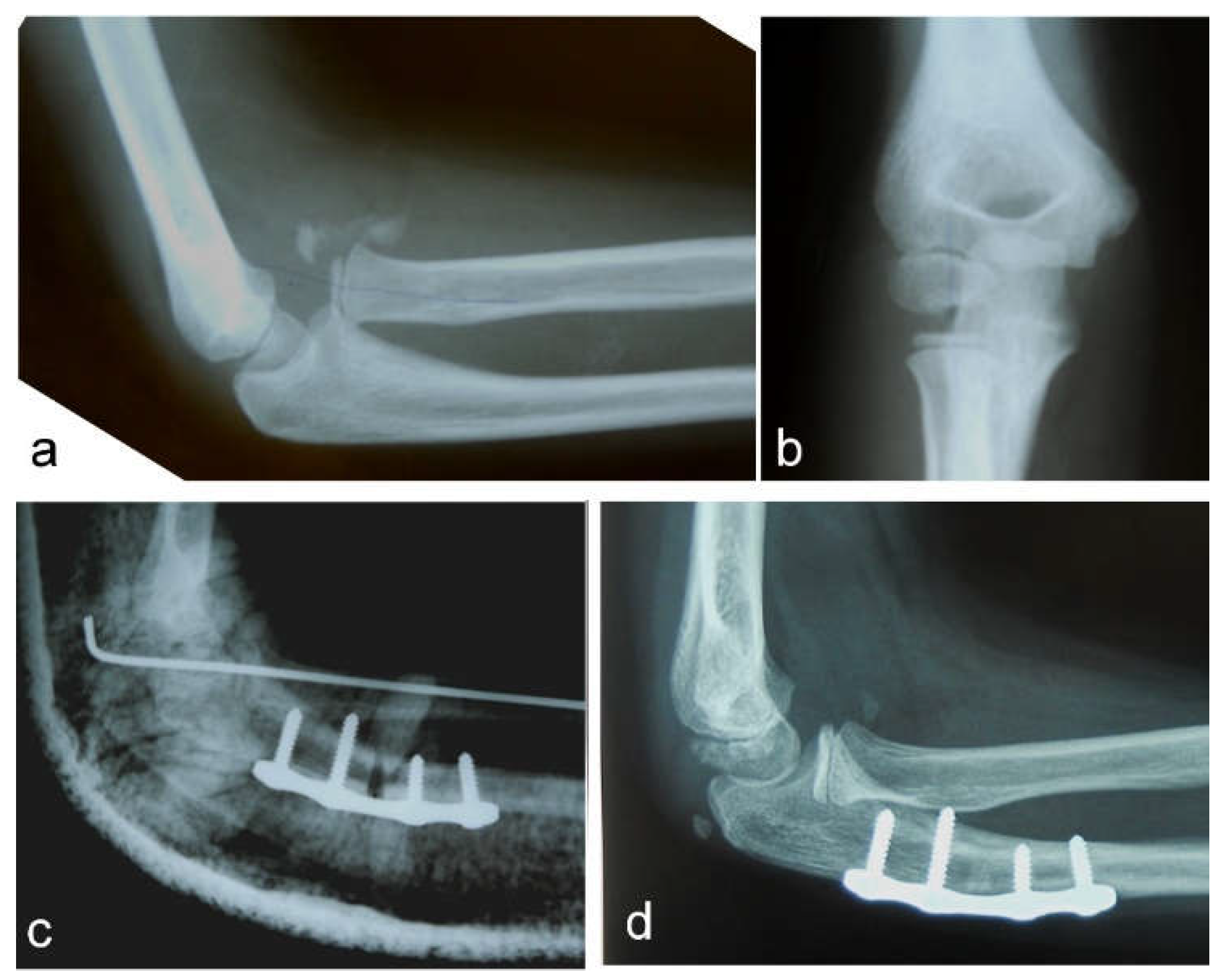
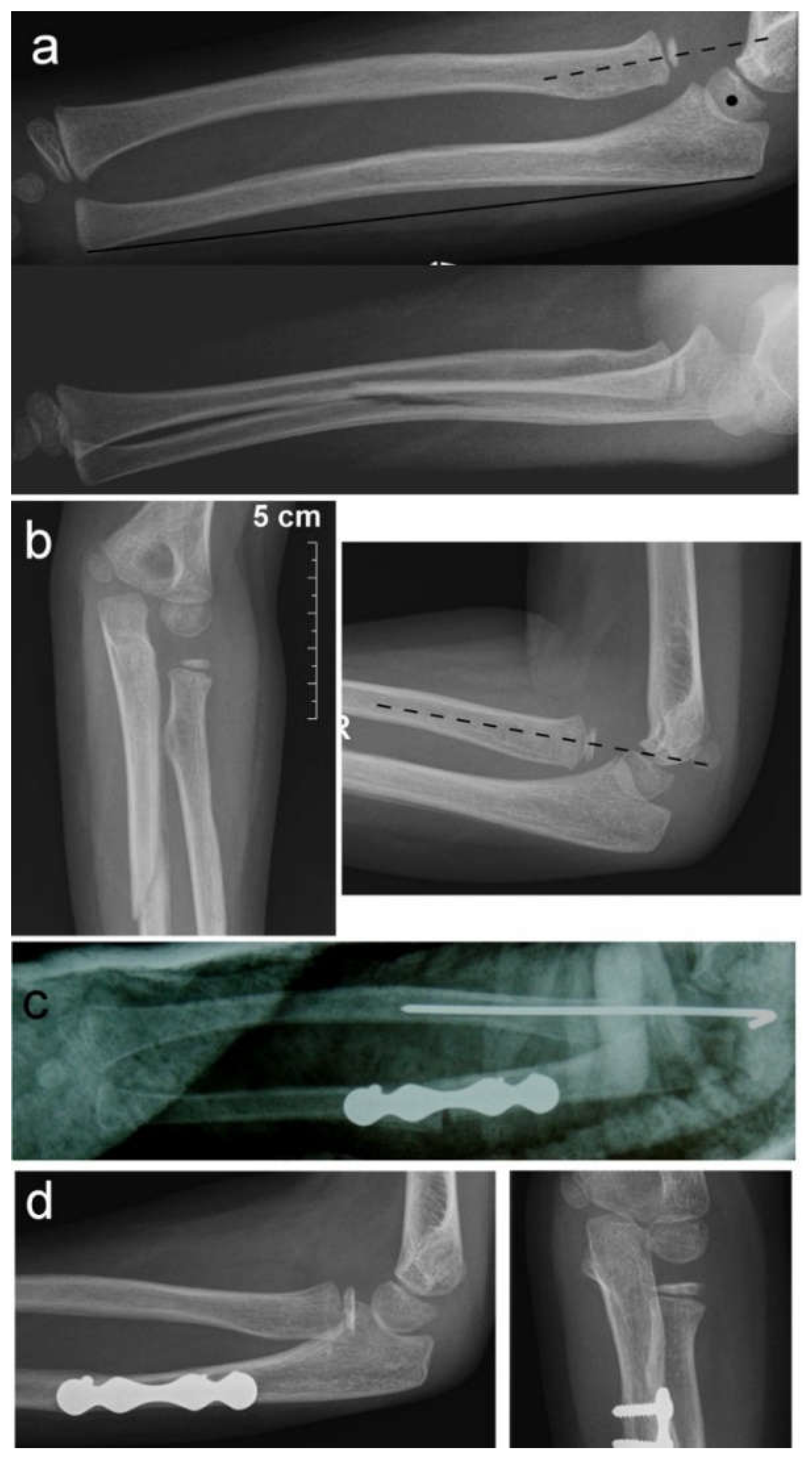
(1) Background: A Monteggia fracture is an infrequent injury in children. It can be missed during an initial consultation in 20–50% of patients. Chronic radial head dislocation may lead to several complications. Thus, surgical reconstruction of chronic Monteggia injuries is justified. The aim of this study is to analyze the single tertiary center experience in the treatment of neglected Monteggia fractures. (2) Methods: A retrospective study of patients treated for missed Monteggia fractures was conducted. Hospital records, operative charts, follow-up records and a set of X-rays were analyzed for each patient. Radiographic results were graded as good, moderate or poor. The functional status of elbows was estimated using the Mayo Elbow Performance Index. (3) Results: A total of 13 patients (8 boys and 5 girls) aged 4–12 years (mean 7.15) were treated during the study period. An angulation osteotomy of the ulna was performed in ten patients and a radial shortening osteotomy in three patients. A Bell–Tawse annular ligament reconstruction was performed in five patients, and a direct repair was performed in two patients. Eight patients had radiocapitellar trans-fixation. There were nine good radiographic results, three moderate and one poor. The functional result was excellent in nine patients, good in three and poor in one. (4) Conclusions: Our work has many limitations (only 13 patients and different types of operations), and conclusions should be drawn very carefully from such a small and diverse group. The surgical reconstruction of neglected Monteggia fractures in children should be attempted in all patients. Angulation and elongation osteotomies of the ulna are suitable for most patients. If there is a marked overgrowth of the radius, gradual ulnar lengthening and radial head reduction using the Ilizarov method may be a better option. Annular ligament reconstruction is not mandatory.
Keywords: Monteggia fracture; children; neglected; chronic; ulnar osteotomy; annular ligament Monteggia fracture; children; neglected; chronic; ulnar osteotomy; annular ligament