Article

Mental Well-Being during the COVID-19 Confinement among Adolescents in Catalonia: The Role of Demographic and Other COVID-Related Variables

by
Cinta Folch
1,2,*,
Helena González-Casals
3,
Joan Colom
4,
Marina Bosque-Prous
5,
Tivy Barón-Garcia
3,
Anaís Álvarez-Vargas
3,
Jordi Casabona
1,2,6 and
Albert Espelt
2,3,7
1
Centre d’Estudis Epidemiològics sobre les Infeccions de Transmissió Sexual i Sida de Catalunya (CEEISCAT), Departament de Salut, Generalitat de Catalunya, 08916 Badalona, Spain
2
Centro de Investigación Biomédica en Red de Epidemiología y Salud Pública (CIBERESP), C/Monforte de Lemos, 3 Pabellón 11, 28029 Madrid, Spain
3
Department of Epidemiology and Methodology of Social and Health Sciences, Faculty of Health Sciences of Manresa, Universitat de Vic—Universitat Central de Catalunya (UVic-UCC), Av. Universitària 4-6, 08242 Manresa, Spain
4
Sub-Direcció General de Drogodependències, Agència de Salut Pública de Catalunya, 08005 Barcelona, Spain
5
Faculty of Health Sciences, Universitat Oberta de Catalunya, Rambla del Poblenou, 156, 08018 Barcelona, Spain
6
Departament de Pediatria, Obstetricia i Ginecologia i de Medicina Preventiva, Universitat Autònoma de Barcelona, 08193 Barcelona, Spain
7
Departament de Psicobiologia i Metodologia en Ciències de la Salut, Universitat Autònoma de Barcelona (UAB), C/de Ca n’Altayó s/n, 08193 Bellaterra, Spain
*
Author to whom correspondence should be addressed.
Children 2022, 9(6), 783; https://doi.org/10.3390/children9060783

Submission received: 5 April 2022 / Revised: 20 May 2022 / Accepted: 24 May 2022 / Published: 26 May 2022
(This article belongs to the Special Issue Children’s Emotion and Learning during COVID-19 Pandemic)

Abstract

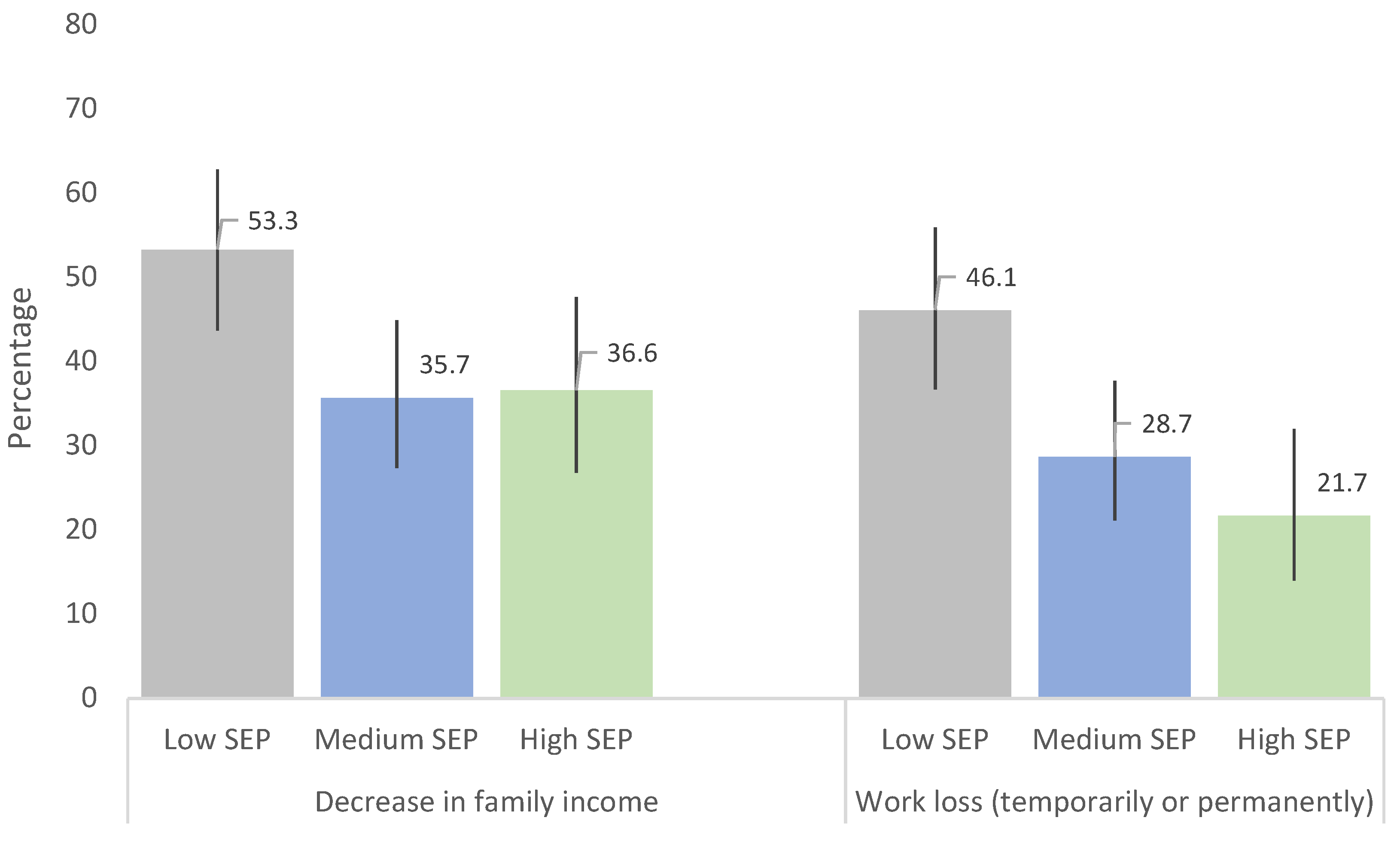
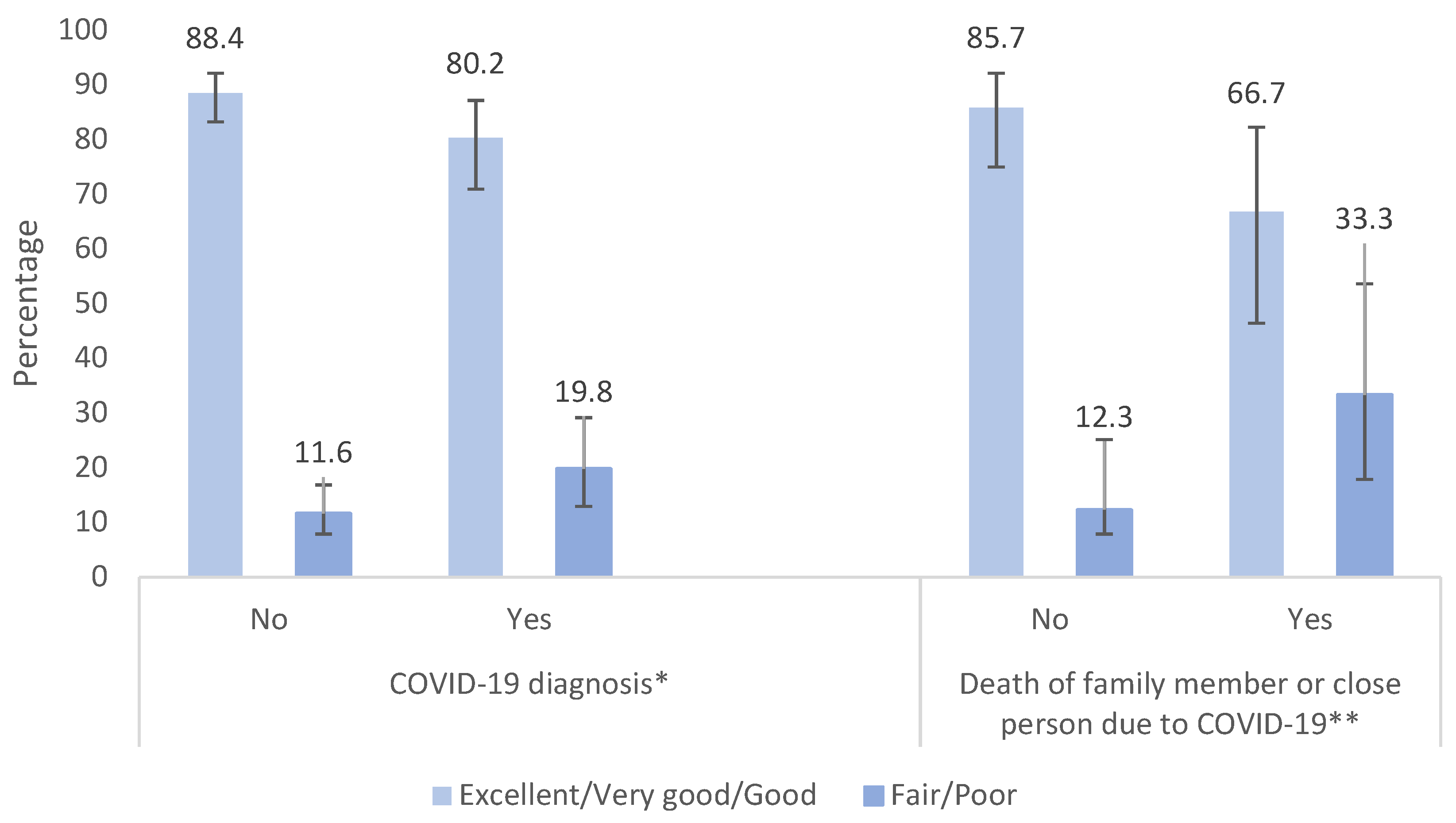
This study aimed to describe the impact of the COVID-19 pandemic on the social situation, self-perceived health status, and mental well-being of adolescents in Catalonia during home confinement, and to evaluate factors that are associated with poor overall mental well-being. An online cross-sectional study among a cohort of students (14–18 years old) of central Catalonia (DESKcohort) was performed during June–July 2020. Poisson regression models with robust variance were used to identify variables associated with “poor overall well-being,” measured by the short version of the Warwick–Edinburgh Mental Wellbeing Scale. Out of 303 participants, 42.1% reported a decrease in family income, and 32.8% a loss of parental employment due to the COVID-19 pandemic, and these percentages were higher among people living in low socioeconomic neighborhoods (53.3% and 43.2%, respectively). Overall, 56.8% presented a poor overall well-being. Participants reporting a decrease in their family’s income (aPR = 1.33) and those knowing a close person or family who died of COVID-19 (aPR = 1.42) were more likely to report a poor overall well-being. This study highlights the patterns of inequality and social vulnerability for COVID-19 pandemic outcomes. Considering social inequalities, interventions are needed to mitigate the impact of COVID-19 pandemic on the physical and the psychological wellbeing of children and their families.
Keywords: adolescents; COVID-19; impact; inequalities; pandemic; prevention; mental wellbeing adolescents; COVID-19; impact; inequalities; pandemic; prevention; mental wellbeing