This is an early access version, the complete PDF, HTML, and XML versions will be available soon.
Article

BMI, Vitamin D Status, and Biochemical Markers of Mineralization in Children with Low-Energy Fractures: A Prospective Case–Control Study


by
Andrea Cosentino
1,2,3,*,
Daniel Weghuber
4,
Pier Francesco Indelli
5,6,7,
Nicole Fantini
8,
Wilhelm Berger
3,
Olaf Stefan Schmidt
3 and
Wolfgang Högler
9
1
Doctoral Program Medical Science, Paracelsus Medical University, Strubergasse 21, 5020 Salzburg, Austria
2
Dolomiti Sportclinic, Via J.B. Purger 181, 39046 St. Ulrich, Italy
3
Department of Orthopedics and Traumatology, Hospital of Merano (SABES-ASDAA), Teaching Hospital of the Paracelsus Medical University, 39012 Merano-Meran, Italy
4
Department of Pediatrics, Paracelsus Medical University, Strubergasse 21, 5020 Salzburg, Austria
5
School of Medicine, University of Trento, Via S. Maria Maddalena 1, 38122 Trento, Italy
6
Institute of Biomechanics, Paracelsus Medical University, Strubergasse 21, 5020 Salzburg, Austria
7
The Breyer Center for Overseas Studies in Florence, Stanford University, 50125 Florence, Italy
8
Department of Pediatrics, Hospital of Merano (SABES-ASDAA), Teaching Hospital of the Paracelsus Medical University, 39012 Merano-Meran, Italy
9
Centre for Growth and Osteology, Department of Paediatrics and Adolescent Medicine, Johannes Kepler University Linz, Krankenhausstrasse 26-30, 4020 Linz, Austria
*
Author to whom correspondence should be addressed.
Children 2026, 13(9), 1276; https://doi.org/10.3390/children13091276 (registering DOI)

Submission received: 22 August 2026 / Revised: 16 September 2026 / Accepted: 18 September 2026 / Published: 20 September 2026
(This article belongs to the Section Pediatric Orthopedics & Sports Medicine)

Abstract

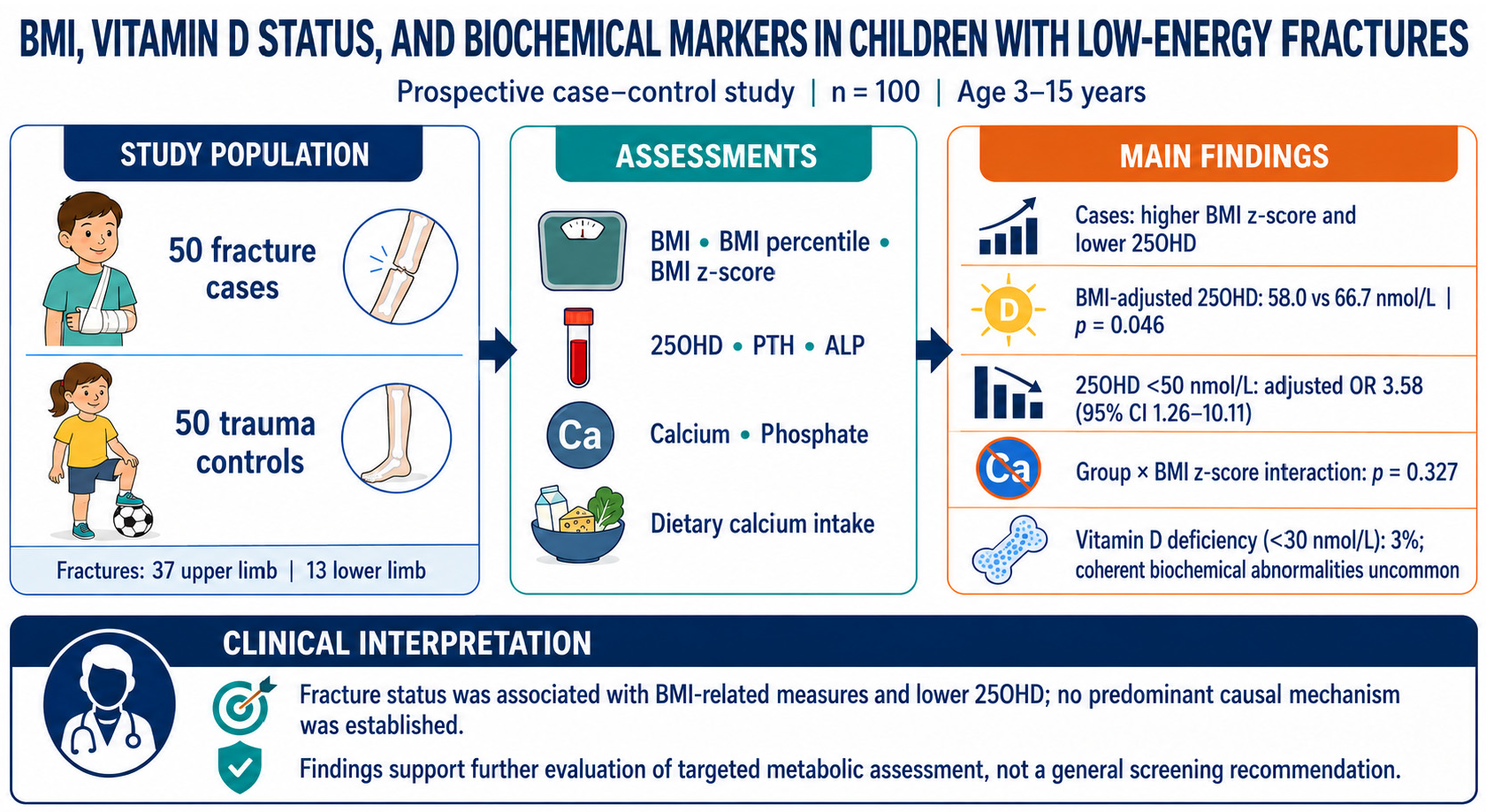
Background: Pediatric fractures are common, but the relative contributions of BMI-related body size and vitamin D–calcium metabolism remain uncertain. This study examined anthropometric and biochemical factors associated with fracture status in otherwise healthy children after low-energy trauma. Methods: This prospective case–control study included 100 children aged 3–15 years: 50 with radiographically confirmed fractures and 50 trauma controls without fracture. BMI and age- and sex-standardized BMI measures were recorded. Serum 25OHD, PTH, ALP, calcium, and phosphate were measured within seven days of injury, and dietary calcium intake was estimated. Associations were evaluated using correlation analyses, logistic regression, and BMI-adjusted analysis of covariance. Results: Fracture cases had higher BMI z-scores than controls (median 0.53 [IQR −0.53 to 1.44] versus −0.16 [IQR −0.89 to 0.38]; p = 0.006) and lower 25OHD concentrations. After adjustment for BMI z-score, the estimated geometric mean 25OHD concentration was 58.0 nmol/L (95% CI 53.0–64.1) in cases and 66.7 nmol/L (95% CI 60.3–73.7) in controls (p = 0.046). The Group × BMI z-score interaction was not significant (p = 0.327). Vitamin D deficiency (<30 nmol/L) affected only 3% of participants, and consistent biochemical abnormalities of mineralization were uncommon. Conclusions: Fracture status was associated with higher standardized BMI measures and lower 25OHD concentrations, but there was no evidence that the BMI–25OHD relationship differed by fracture status. These observational findings do not establish a predominant causal mechanism and support cautious, clinically targeted metabolic evaluation.
Keywords: pediatric fracture; adiposity; body mass index; vitamin D; bone mineralization; parathyroid hormone; alkaline phosphatase; low-energy trauma; calcium metabolism; pediatric bone health pediatric fracture; adiposity; body mass index; vitamin D; bone mineralization; parathyroid hormone; alkaline phosphatase; low-energy trauma; calcium metabolism; pediatric bone health
Graphical Abstract