Emotional and Behavioral Profiles in Neurodevelopmental and Neuromuscular Disorders: A Comparative Study Using the Child Behavior Checklist

 ,
,  , , ,
, , ,
Highlights
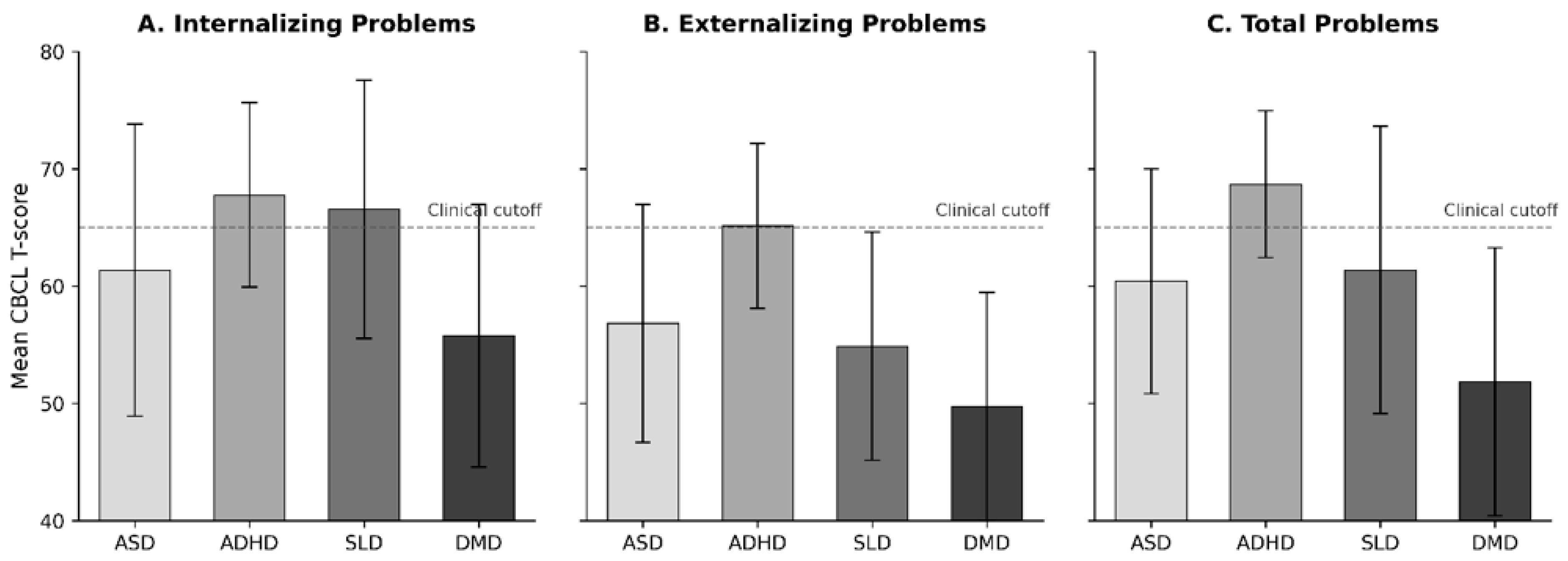
- Children with ADHD showed the highest overall emotional–behavioral burden, whereas ASD and SLD were characterized by greater internalizing difficulties and DMD by a distinct emotional–behavioral profile.
- Using the same standardized CBCL/6–18 assessment enabled direct comparison of emotional and behavioral functioning across neurodevelopmental and neuromuscular conditions.
- A transdiagnostic assessment framework may facilitate the identification of both shared and disorder-specific emotional–behavioral patterns across heterogeneous pediatric populations.
- Integrating standardized behavioral screening with individualized clinical assessment may support more targeted psychosocial care and multidisciplinary decision-making.
Abstract
1. Introduction
2. Materials and Methods
2.1. Participants
2.2. Procedure
2.3. Measures
2.3.1. Demographic Information
2.3.2. Assessment of Emotional and Behavioral Problems
2.4. Statistical Analysis
3. Results
3.1. Preliminary Statistical Analysis
3.2. Demographic Characteristics
3.3. Emotional and Behavioral Problems
3.4. Comparative Analysis of Emotional and Behavioral Problems
4. Discussion
4.1. Comparative Profiles Across Neurodevelopmental and Neuromuscular Conditions
4.2. Clinical Implications for Screening and Assessment
- Children with ADHD may particularly benefit from structured behavioral observations and multi-informant assessments to facilitate the early identification of disruptive behaviors and support timely behavioral and parent-focused interventions [46].
- For SLD, considering somatic symptoms within psychoeducational evaluations may help identify children experiencing substantial emotional distress and guide interventions aimed at strengthening coping skills and resilience [49].
- For DMD, longitudinal monitoring combining standardized measures with caregiver interviews may facilitate the identification of emotional difficulties that could otherwise remain overshadowed by the physical manifestations of the disease, thereby supporting comprehensive multidisciplinary care.
4.3. Comparison with Previous Literature and Potential Contextual Factors
4.4. Strengths, Limitations, and Future Directions
5. Conclusions
Supplementary Materials
Author Contributions
Funding
Institutional Review Board Statement
Informed Consent Statement
Data Availability Statement
Acknowledgments
Conflicts of Interest
References
- American Psychiatric Association. Diagnostic and Statistical Manual of Mental Disorders, 5th ed.; American Psychiatric Association Publishing: Arlington, VA, USA, 2013. [Google Scholar]
- Kim, H.; Song, D.H. Comparison of the K-WISC-IV Profiles of Boys with Autism Spectrum Disorder and Attention-Deficit/Hyperactivity Disorder. Res. Dev. Disabil. 2020, 97, 103539. [Google Scholar] [CrossRef] [PubMed]
- Polanczyk, G.V.; Salum, G.A.; Sugaya, L.S.; Caye, A.; Rohde, L.A. Annual Research Review: A Meta-Analysis of the Worldwide Prevalence of Mental Disorders in Children and Adolescents. J. Child Psychol. Psychiatry 2015, 56, 345–357. [Google Scholar] [CrossRef] [PubMed]
- Achenbach, T.M.; Rescorla, L.A. Manual for the ASEBA School-Age Forms & Profiles; University of Vermont, Research Center for Children, Youth, and Families: Burlington, VT, USA, 2001. [Google Scholar]
- Achenbach, T.M.; Becker, A.; Döpfner, M.; Heiervang, E.; Roessner, V.; Steinhausen, H.C.; Rothenberger, A. Multicultural Assessment of Child and Adolescent Psychopathology with ASEBA and SDQ Instruments: Research Findings, Applications, and Future Directions. J. Child Psychol. Psychiatry 2008, 49, 251–275. [Google Scholar] [CrossRef] [PubMed]
- Havdahl, K.A.; von Tetzchner, S.; Huerta, M.; Lord, C.; Bishop, S.L. Utility of the Child Behavior Checklist as a Screener for Autism Spectrum Disorder. Autism Res. 2016, 9, 33–42. [Google Scholar] [CrossRef] [PubMed]
- Hellebrekers, D.M.J.; Lionarons, J.M.; Faber, C.G.; Klinkenberg, S.; Vles, J.S.H.; Hendriksen, J.G.M. Instruments for the Assessment of Behavioral and Psychosocial Functioning in Duchenne and Becker Muscular Dystrophy: A Systematic Review of the Literature. J. Pediatr. Psychol. 2019, 44, 1205–1223. [Google Scholar] [CrossRef] [PubMed]
- Ooi, Y.P.; Rescorla, L.; Ang, R.P.; Woo, B.; Fung, D.S. Identification of Autism Spectrum Disorders Using the Child Behavior Checklist in Singapore. J. Autism Dev. Disord. 2011, 41, 1147–1156. [Google Scholar] [CrossRef] [PubMed]
- Bauminger, N.; Solomon, M.; Rogers, S.J. Externalizing and Internalizing Behaviors in ASD. Autism Res. 2010, 3, 101–112. [Google Scholar] [CrossRef] [PubMed]
- Arnold, E.M.; Goldston, D.B.; Walsh, A.K.; Reboussin, B.A.; Daniel, S.S.; Hickman, E.; Wood, F.B. Severity of Emotional and Behavioral Problems among Poor and Typical Readers. J. Abnorm. Child Psychol. 2005, 33, 205–217. [Google Scholar] [CrossRef] [PubMed]
- Franklin, A.M.; Giacheti, C.M.; Silva, N.C.D.; Campos, L.M.G.; Pinato, L. Correlation between Sleep Profile and Behavior in Individuals with Specific Learning Disorder. CoDAS 2018, 30, e20170104. [Google Scholar] [CrossRef] [PubMed]
- Sorrenti, L.; Spadaro, L.; Mafodda, A.V.; Scopelliti, G.; Orecchio, S.; Filippello, P. The Predicting Role of School-Learned Helplessness in Internalizing and Externalizing Problems: An Exploratory Study in Students with Specific Learning Disorder. Mediterr. J. Clin. Psychol. 2019, 7, 1–14. [Google Scholar] [CrossRef]
- Biederman, J.; Petty, C.R.; Day, H.; Goldin, R.L.; Spencer, T.; Faraone, S.V.; Surman, C.B.; Wozniak, J. Severity of the Aggression/Anxiety-Depression/Attention Child Behavior Checklist Profile Discriminates between Different Levels of Deficits in Emotional Regulation in Youth with Attention-Deficit Hyperactivity Disorder. J. Dev. Behav. Pediatr. 2012, 33, 236–243. [Google Scholar] [CrossRef] [PubMed]
- Yoshimasu, K.; Barbaresi, W.J.; Colligan, R.C.; Voigt, R.G.; Killian, J.M.; Weaver, A.L.; Katusic, S.K. Childhood ADHD Is Strongly Associated with a Broad Range of Psychiatric Disorders during Adolescence: A Population-Based Birth Cohort Study. J. Child Psychol. Psychiatry 2012, 53, 1036–1043. [Google Scholar] [CrossRef] [PubMed]
- Operto, F.F.; Smirni, D.; Scuoppo, C.; Padovano, C.; Vivenzio, V.; Quatrosi, G.; Carotenuto, M.; Precenzano, F.; Pastorino, G.M.G. Neuropsychological Profile, Emotional/Behavioral Problems, and Parental Stress in Children with Neurodevelopmental Disorders. Brain Sci. 2021, 11, 584. [Google Scholar] [CrossRef] [PubMed]
- Operto, F.F.; Abbate, C.S.; Piscitelli, F.T.; Olivieri, M.; Rizzo, L.; Sica, G.; Labate, A.; Roccella, M.; Carotenuto, M.; Pastorino, G.M.G. Adolescents with Neuropsychiatric Disorders during the COVID-19 Pandemic: Focus on Emotional Well-Being and Parental Stress. Healthcare 2022, 10, 2368. [Google Scholar] [CrossRef] [PubMed]
- Shea, C.K.S.; Lee, M.M.C.; Lai, K.Y.C.; Luk, E.S.L.; Leung, P.W.L. Prevalence of Anxiety Disorders in Hong Kong Chinese Children with ADHD. J. Atten. Disord. 2018, 22, 403–413. [Google Scholar] [CrossRef] [PubMed]
- Cristofani, P.; Di Lieto, M.C.; Casalini, C.; Pecini, C.; Baroncini, M.; Pessina, O.; Gasperini, F.; Lang, M.B.D.; Bartoli, M.; Chilosi, A.M.; et al. Specific Learning Disabilities and Emotional-Behavioral Difficulties: Phenotypes and Role of the Cognitive Profile. J. Clin. Med. 2023, 12, 1882. [Google Scholar] [CrossRef] [PubMed]
- Rescorla, L.A.; Ginzburg, S.; Achenbach, T.M.; Ivanova, M.Y.; Almqvist, F.; Begovac, I.; Bilenberg, N.; Bird, H.; Chahed, M.; Dobrean, A.; et al. Cross-Informant Agreement between Parent-Reported and Adolescent Self-Reported Problems in 25 Societies. J. Clin. Child Adolesc. Psychol. 2013, 42, 262–273. [Google Scholar] [CrossRef] [PubMed]
- Guerrera, S.; Menghini, D.; Napoli, E.; Di Vara, S.; Valeri, G.; Vicari, S. Assessment of Psychopathological Comorbidities in Children and Adolescents With Autism Spectrum Disorder Using the Child Behavior Checklist. Front. Psychiatry. 2019, 10, 535. [Google Scholar] [CrossRef] [PubMed]
- Hartley, S.L.; Sikora, D.M. Sex Differences in Autism Spectrum Disorder: An Examination of Developmental Functioning, Autistic Symptoms, and Coexisting Behavior Problems in Toddlers. J. Autism Dev. Disord. 2009, 39, 1715–1722. [Google Scholar] [CrossRef] [PubMed]
- Bushby, K.; Finkel, R.; Birnkrant, D.J.; Case, L.E.; Clemens, P.R.; Cripe, L.; Kaul, A.; Kinnett, K.; McDonald, C.; Pandya, S.; et al. Diagnosis and Management of Duchenne Muscular Dystrophy, Part 1: Diagnosis, and Pharmacological and Psychosocial Management. Lancet Neurol. 2010, 9, 77–93. [Google Scholar] [CrossRef] [PubMed]
- Hendriksen, J.G.; Vles, J.S. Neuropsychiatric Disorders in Males with Duchenne Muscular Dystrophy: Frequency Rate of Attention-Deficit Hyperactivity Disorder (ADHD), Autism Spectrum Disorder, and Obsessive–Compulsive Disorder. J. Child Neurol. 2008, 23, 477–481. [Google Scholar] [CrossRef] [PubMed]
- Hinton, V.J.; Nereo, N.E.; Fee, R.J.; Cyrulnik, S.E. Social Behavior Problems in Boys with Duchenne Muscular Dystrophy. J. Dev. Behav. Pediatr. 2006, 27, 470–476. [Google Scholar] [CrossRef] [PubMed]
- Ricotti, V.; Mandy, W.P.L.; Scoto, M.; Pane, M.; Deconinck, N.; Messina, S.; Mercuri, E.; Skuse, D.H.; Muntoni, F. Neurodevelopmental, Emotional, and Behavioural Problems in Duchenne Muscular Dystrophy in Relation to Underlying Dystrophin Gene Mutations. Dev. Med. Child Neurol. 2016, 58, 77–84. [Google Scholar] [CrossRef] [PubMed]
- Colombo, P.; Nobile, M.; Tesei, A.; Civati, F.; Gandossini, S.; Mani, E.; Molteni, M.; Bresolin, N.; D’Angelo, G. Assessing Mental Health in Boys with Duchenne Muscular Dystrophy: Emotional, Behavioural and Neurodevelopmental Profile in an Italian Clinical Sample. Eur. J. Paediatr. Neurol. 2017, 21, 639–647. [Google Scholar] [CrossRef] [PubMed]
- Aldırmaz, E.; Bulut, N.; Yılmaz, Ö.; Alemdaroğlu-Gürbüz, İ. Cognitive and emotional-behavioural outcomes of Turkish Duchenne muscular dystrophy population and its association with motor function. Eur. J. Paediatr. Neurol. 2024, 52, 86–94. [Google Scholar] [CrossRef] [PubMed]
- Cohen, J. Statistical Power Analysis for the Behavioral Sciences, 2nd ed.; Routledge: New York, NY, USA, 1988. [Google Scholar] [CrossRef]
- Lord, C.; Rutter, M.; DiLavore, P.C.; Risi, S.; Gotham, K.; Bishop, S.L. Autism Diagnostic Observation Schedule, Second Edition (ADOS-2); Western Psychological Services: Torrance, CA, USA, 2012. [Google Scholar]
- Rutter, M.; Le Couteur, A.; Lord, C. Autism Diagnostic Interview–Revised (ADI-R); Western Psychological Services: Los Angeles, CA, USA, 2003. [Google Scholar]
- Conners, C.K. Conners’ Rating Scales–Revised: Technical Manual; Multi-Health Systems: North Tonawanda, NY, USA, 2001. [Google Scholar]
- Cornoldi, C.; Colpo, G. Prove di Lettura MT per la Scuola Primaria; Giunti O.S.: Firenze, Italy, 2011. [Google Scholar]
- Cornoldi, C.; Colpo, G. Prove di Lettura MT per la Scuola Secondaria di I Grado; Giunti O.S.: Firenze, Italy, 2011. [Google Scholar]
- Cornoldi, C.; Pra Baldi, A. MT Avanzate-3-Clinica. Prove di Lettura e Matematica per il Biennio della Scuola Secondaria di II Grado e Adulti; Giunti EDU: Firenze, Italy, 2022. [Google Scholar]
- Cornoldi, C.; Candela, M. Prove di Lettura e Scrittura MT 16–19. Batteria per la Verifica degli Apprendimenti e la Diagnosi di Dislessia e Disortografia; Erickson: Trento, Italy, 2015. [Google Scholar]
- Cornoldi, C.; Lucangeli, D.; Bellina, M. AC-MT 6–11. Test di Valutazione delle Abilità di Calcolo e Problem Solving; Erickson: Trento, Italy, 2012. [Google Scholar]
- Cornoldi, C.; Cazzola, C. AC-MT 11–14. Test di Valutazione delle Abilità di Calcolo e Problem Solving; Erickson: Trento, Italy, 2004. [Google Scholar]
- Tressoldi, P.E.; Cornoldi, C. BVSCO-2. Batteria per la Valutazione della Scrittura e della Competenza Ortografica; Giunti O.S.: Firenze, Italy, 2013. [Google Scholar]
- von Elm, E.; Altman, D.G.; Egger, M.; Pocock, S.J.; Gøtzsche, P.C.; Vandenbroucke, J.P. The Strengthening the Reporting of Observational Studies in Epidemiology (STROBE) Statement: Guidelines for Reporting Observational Studies. PLoS Med. 2007, 4, e296. [Google Scholar] [CrossRef] [PubMed]
- Engel, G.L. The Need for a New Medical Model: A Challenge for Biomedicine. Science 1977, 196, 129–136. [Google Scholar] [CrossRef] [PubMed]
- Sameroff, A.J. The Transactional Model: How Children and Contexts Shape Each Other; American Psychological Association: Washington, DC, USA, 2009. [Google Scholar] [CrossRef]
- Doorenweerd, N.; Straathof, C.S.; Dumas, E.M.; Spitali, P.; Ginjaar, I.B.; Wokke, B.H.; Schrans, D.G.; van den Bergen, J.C.; van Zwet, E.W.; Webb, A.; et al. Reduced Cerebral Gray Matter and Altered White Matter in Boys with Duchenne Muscular Dystrophy. Ann. Neurol. 2014, 76, 403–411. [Google Scholar] [CrossRef] [PubMed]
- Baron-Cohen, S.; Ring, H.A.; Bullmore, E.T.; Wheelwright, S.; Ashwin, C.; Williams, S.C. The Amygdala Theory of Autism. Neurosci. Biobehav. Rev. 2000, 24, 355–364. [Google Scholar] [CrossRef] [PubMed]
- Zakopoulou, V.; Vlaikou, A.M.; Darsinou, M.; Papadopoulou, Z.; Theodoridou, D.; Papageorgiou, K.; Alexiou, G.A.; Bougias, H.; Siafaka, V.; Zoccolotti, P.; et al. Linking Early Life Hypothalamic-Pituitary-Adrenal Axis Functioning, Brain Asymmetries, and Personality Traits in Dyslexia: An Informative Case Study. Front. Hum. Neurosci. 2019, 13, 327. [Google Scholar] [CrossRef] [PubMed]
- Arnsten, A.F.T. The Emerging Neurobiology of Attention Deficit Hyperactivity Disorder: The Key Role of the Prefrontal Association Cortex. J. Pediatr. 2009, 154, I-S43. [Google Scholar] [CrossRef] [PubMed]
- Jensen, P.S.; Hinshaw, S.P.; Swanson, J.M.; Greenhill, L.L.; Conners, C.K.; Arnold, L.E.; Abikoff, H.B.; Elliott, G.; Hechtman, L.; Hoza, B.; et al. Findings from the NIMH Multimodal Treatment Study of ADHD (MTA): Implications and Applications for Primary Care Providers. J. Dev. Behav. Pediatr. 2001, 22, 60–73. [Google Scholar] [CrossRef] [PubMed]
- White, S.W.; Albano, A.M.; Johnson, C.R.; Kasari, C.; Ollendick, T.; Klin, A.; Oswald, D.; Scahill, L. Development of a Cognitive-Behavioral Intervention Program to Treat Anxiety and Social Deficits in Teens with High-Functioning Autism. Clin. Child Fam. Psychol. Rev. 2010, 13, 77–90. [Google Scholar] [CrossRef] [PubMed]
- White, S.W.; Ollendick, T.; Albano, A.M.; Oswald, D.; Johnson, C.; Southam-Gerow, M.A.; Kim, I.; Scahill, L. Randomized Controlled Trial: Multimodal Anxiety and Social Skills Intervention for Adolescents with Autism Spectrum Disorder. J. Autism Dev. Disord. 2013, 43, 382–394. [Google Scholar] [CrossRef] [PubMed]
- Margalit, M.; Al-Yagon, M. The Loneliness Experience of Children with Learning Disabilities. In The Social Dimensions of Learning Disabilities; Wong, B.Y.L., Donahue, M.L., Eds.; Routledge: New York, NY, USA, 2002; pp. 24–42. [Google Scholar] [CrossRef]
- Banihani, R.; Smile, S.; Yoon, G.; Dupuis, A.; Mosleh, M.; Snider, A.; McAdam, L. Cognitive and Neurobehavioral Profile in Boys with Duchenne Muscular Dystrophy. J. Child Neurol. 2015, 30, 1472–1482. [Google Scholar] [CrossRef] [PubMed]
- Totsika, V.; Hastings, R.P.; Emerson, E.; Berridge, D.M.; Lancaster, G.A. Behavior Problems at 5 Years of Age and Maternal Mental Health in Autism and Intellectual Disability. J. Abnorm. Child Psychol. 2011, 39, 1137–1147. [Google Scholar] [CrossRef] [PubMed]
- Willcutt, E.G.; Pennington, B.F. Psychiatric Comorbidity in Children and Adolescents with Attention-Deficit Hyperactivity Disorder. J. Child Psychol. Psychiatry 2000, 41, 1037–1048. [Google Scholar] [CrossRef]
- Klassen, R.M.; Lynch, S.L. Self-Efficacy from the Perspective of Adolescents with LD and Their Specialist Teachers. J. Learn. Disabil. 2007, 40, 494–507. [Google Scholar] [CrossRef] [PubMed]
- Bronfenbrenner, U. The Ecology of Human Development: Experiments by Nature and Design; Harvard University Press: Cambridge, MA, USA, 1979. [Google Scholar]
- Holmbeck, G.N.; Devine, K.A. Psychosocial and Family Functioning in Spina Bifida. Dev. Disabil. Res. Rev. 2010, 16, 40–46. [Google Scholar] [CrossRef] [PubMed]
- Kazak, A.E.; Schneider, S.; Didonato, S.; Pai, A.L. Family Psychosocial Risk Screening Guided by the Pediatric Psychosocial Preventive Health Model (PPPHM) Using the Psychosocial Assessment Tool (PAT). Acta Oncol. 2015, 54, 574–580. [Google Scholar] [CrossRef] [PubMed]


| Variables | Total Sample (n = 197) n (%) or Mean (SD) * | ASD (n = 47) n (%) or Mean (SD) * | ADHD (n = 50) n (%) or Mean (SD) * | SLD (n = 50) n (%) or Mean (SD) * | DMD (n = 50) n (%) or Mean (SD) * | Statistic F or χ2° | p |
|---|---|---|---|---|---|---|---|
| Age, Years * | 10.8 (3.03) | 8.7 (3.82) | 9.5 (2.92) | 13.2 (2.70) | 11.5 (2.59) | 16.31 | <0.001 |
| Sex, n (%)° | |||||||
| Male | 164 (83.2) | 41 (87) | 45 (90) | 29 (58) | 49 (98) | 37.73 | <0.001 |
| Female | 33 (16.8) | 6 (13) | 5 (10) | 21 (42) | 1 (2) |
| Variables | ASD (n = 47) n (%) or Mean (SD) * | ADHD (n = 50) n (%) or Mean (SD) * | SLD (n = 50) n (%) or Mean (SD) * | DMD (n = 50) n (%) or Mean (SD) * |
|---|---|---|---|---|
| Internalizing * | 60.9 (11.8) | 67.0 (8.77) | 66.3 (10.7) | 55.7 (11.2) |
| Clinical Level | 14 (30) | 38 (76) | 33 (66) | 13 (26) |
| Borderline Level | 12 (26) | 5 (10) | 2 (4) | 8 (16) |
| Externalizing * | 56.2 (9.81) | 64.9 (7.19) | 55.5 (10.3) | 49.7 (9.69) |
| Clinical Level | 10 (22) | 30 (60) | 9 (18) | 2 (4) |
| Borderline Level | 12 (27) | 8 (16) | 8 (16) | 7 (14) |
| Total Problems * | 60.7 (8.74) | 68.4 (6.64) | 61.4 (12.3) | 51.7 (11.3) |
| Clinical Level | 14 (30) | 38 (76) | 23 (46) | 7 (14) |
| Borderline Level | 12 (27) | 5 (10) | 9 (18) | 5 (10) |
| Subscales | ASD (n = 47) n (%) | ADHD(n = 50) n (%) | SLD (n = 50) n (%) | DMD (n = 50) n (%) |
|---|---|---|---|---|
| Anxiety/Depression (I) | ||||
| Clinical Level | 6 (13) | 16 (32) | 19 (38) | 2 (4) |
| Borderline Level | 2 (4) | 17 (34) | 6 (12) | 6 (12) |
| Withdrawn/Depression (II) | ||||
| Clinical Level | 2 (4) | 4 (8) | 14 (28) | 7 (14) |
| Borderline Level | 3 (6) | 8 (16) | 8 (16) | 2 (4) |
| Somatic Complaints (III) | ||||
| Clinical Level | 2 (4) | 10 (20) | 27 (54) | 4 (8) |
| Borderline Level | 2 (4) | 6 (12) | 7 (14) | 3 (6) |
| Social Problems (IV) | ||||
| Clinical Level | 1 (2) | 7 (14) | 7 (14) | 0 (0) |
| Borderline Level | 2 (4) | 12 (24) | 12 (24) | 6 (12) |
| Thought Problems (V) | ||||
| Clinical Level | 1 (2) | 8 (16) | 12 (24) | 1 (2) |
| Borderline Level | 1 (4) | 7 (14) | 5 (10) | 3 (6) |
| Attention Problems (VI) | ||||
| Clinical Level | 1 (2) | 12 (24) | 9 (18) | 1 (2) |
| Borderline Level | 2 (4) | 10 (20) | 9 (18) | 2 (4) |
| Rule-Breaking Behavior (VII) | ||||
| Clinical Level | 1 (2) | 5 (10) | 3 (6) | 0 (0) |
| Borderline Level | 0 (0) | 3 (6) | 3 (6) | 1 (2) |
| Aggressive Behavior (VIII) | ||||
| Clinical Level | 0 (0) | 5 (10) | 5 (10) | 1 (2) |
| Borderline Level | 1 (2) | 5 (10) | 7 (14) | 2 (4) |
| Variables | Test | F-Value (df1, df2) | p-Value | η2 | ADHD vs. ASD | ASD vs. SLD | ASD vs. DMD | ADHD vs. SLD | ADHD vs. DMD | SLD vs. DMD |
|---|---|---|---|---|---|---|---|---|---|---|
| Internalizing | Welch ANOVA | 14.26 (3, 104.84) | <0.001 | 0.168 | ||||||
| p-value | 0.018 | 0.141 | 0.102 | 0.916 | <0.001 | <0.001 | ||||
| Externalizing | One-way ANOVA | 24.12 (3, 193) | <0.001 | 0.273 | ||||||
| p-value | <0.001 | 0.732 | 0.001 | <0.001 | <0.001 | 0.028 | ||||
| Total Problems | Welch ANOVA | 30.53 (3, 102.77) | <0.001 | 0.264 | ||||||
| p-value | <0.001 | 0.973 | <0.001 | 0.002 | <0.001 | <0.001 |
Disclaimer/Publisher’s Note: The statements, opinions and data contained in all publications are solely those of the individual author(s) and contributor(s) and not of MDPI and/or the editor(s). MDPI and/or the editor(s) disclaim responsibility for any injury to people or property resulting from any ideas, methods, instructions or products referred to in the content. |
© 2026 by the authors. Licensee MDPI, Basel, Switzerland. This article is an open access article distributed under the terms and conditions of the Creative Commons Attribution (CC BY) license.
Share and Cite
Chieffo, D.P.R.; Moriconi, F.; Delle Donne, V.; Arcangeli, V.; Massaroni, V.; Marfoli, A.; Liberati, L.; Settimi, G.; Martelli, B.; Vannuccini, S.; et al. Emotional and Behavioral Profiles in Neurodevelopmental and Neuromuscular Disorders: A Comparative Study Using the Child Behavior Checklist. Children 2026, 13, 996. https://doi.org/10.3390/children13080996
Chieffo DPR, Moriconi F, Delle Donne V, Arcangeli V, Massaroni V, Marfoli A, Liberati L, Settimi G, Martelli B, Vannuccini S, et al. Emotional and Behavioral Profiles in Neurodevelopmental and Neuromuscular Disorders: A Comparative Study Using the Child Behavior Checklist. Children. 2026; 13(8):996. https://doi.org/10.3390/children13080996
Chicago/Turabian StyleChieffo, Daniela Pia Rosaria, Federica Moriconi, Valentina Delle Donne, Valentina Arcangeli, Valentina Massaroni, Angelica Marfoli, Luca Liberati, Giulia Settimi, Brenno Martelli, Sofia Vannuccini, and et al. 2026. "Emotional and Behavioral Profiles in Neurodevelopmental and Neuromuscular Disorders: A Comparative Study Using the Child Behavior Checklist" Children 13, no. 8: 996. https://doi.org/10.3390/children13080996
APA StyleChieffo, D. P. R., Moriconi, F., Delle Donne, V., Arcangeli, V., Massaroni, V., Marfoli, A., Liberati, L., Settimi, G., Martelli, B., Vannuccini, S., Veredice, C., Sani, G., & Mercuri, E. M. (2026). Emotional and Behavioral Profiles in Neurodevelopmental and Neuromuscular Disorders: A Comparative Study Using the Child Behavior Checklist. Children, 13(8), 996. https://doi.org/10.3390/children13080996