
Functional and Angiographic Outcomes Following Surgical Revascularization in Pediatric Moyamoya Disease: A Single-Centre Cohort Study from Central Asia

 , , , , , , , ,
Highlights
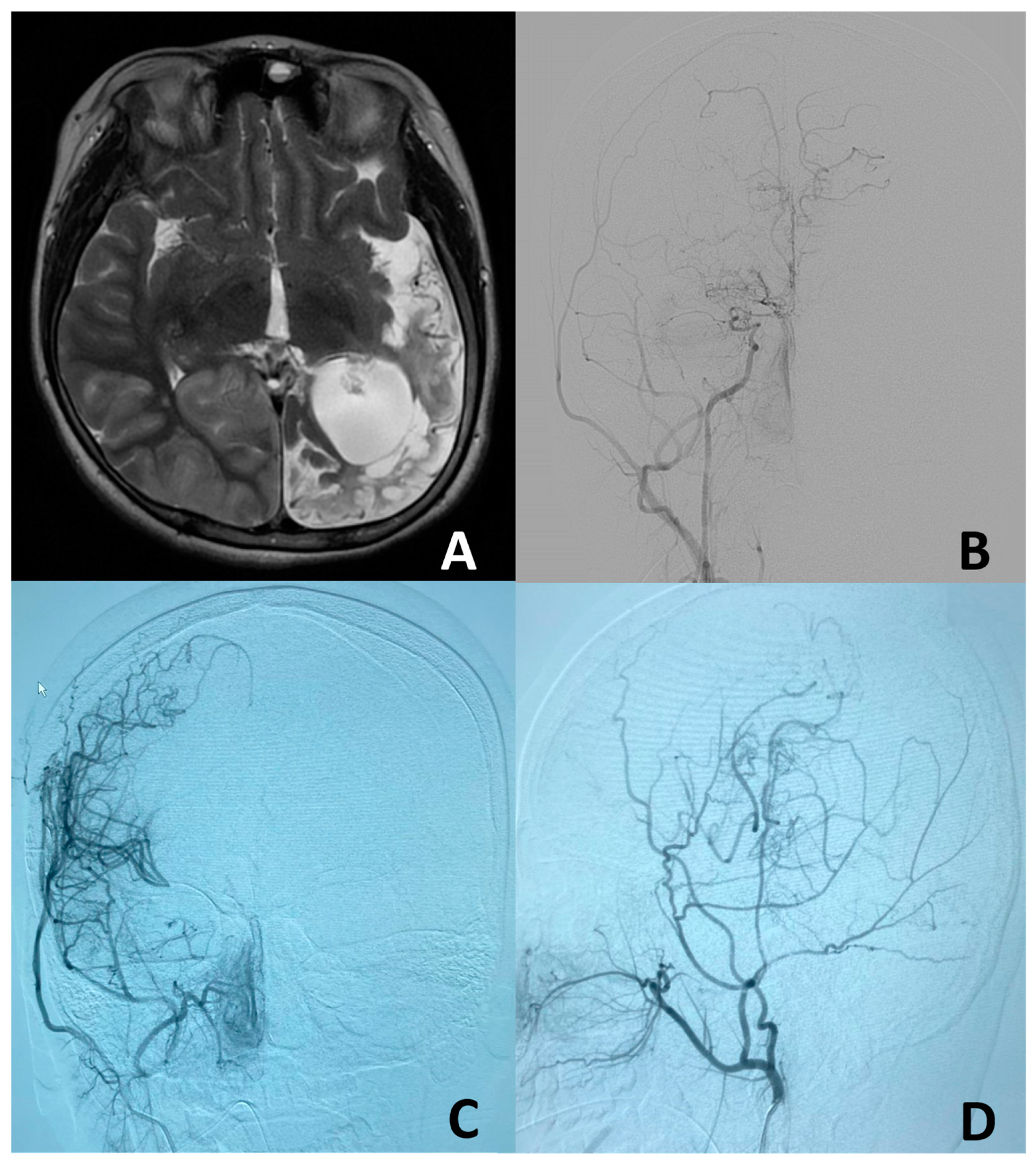
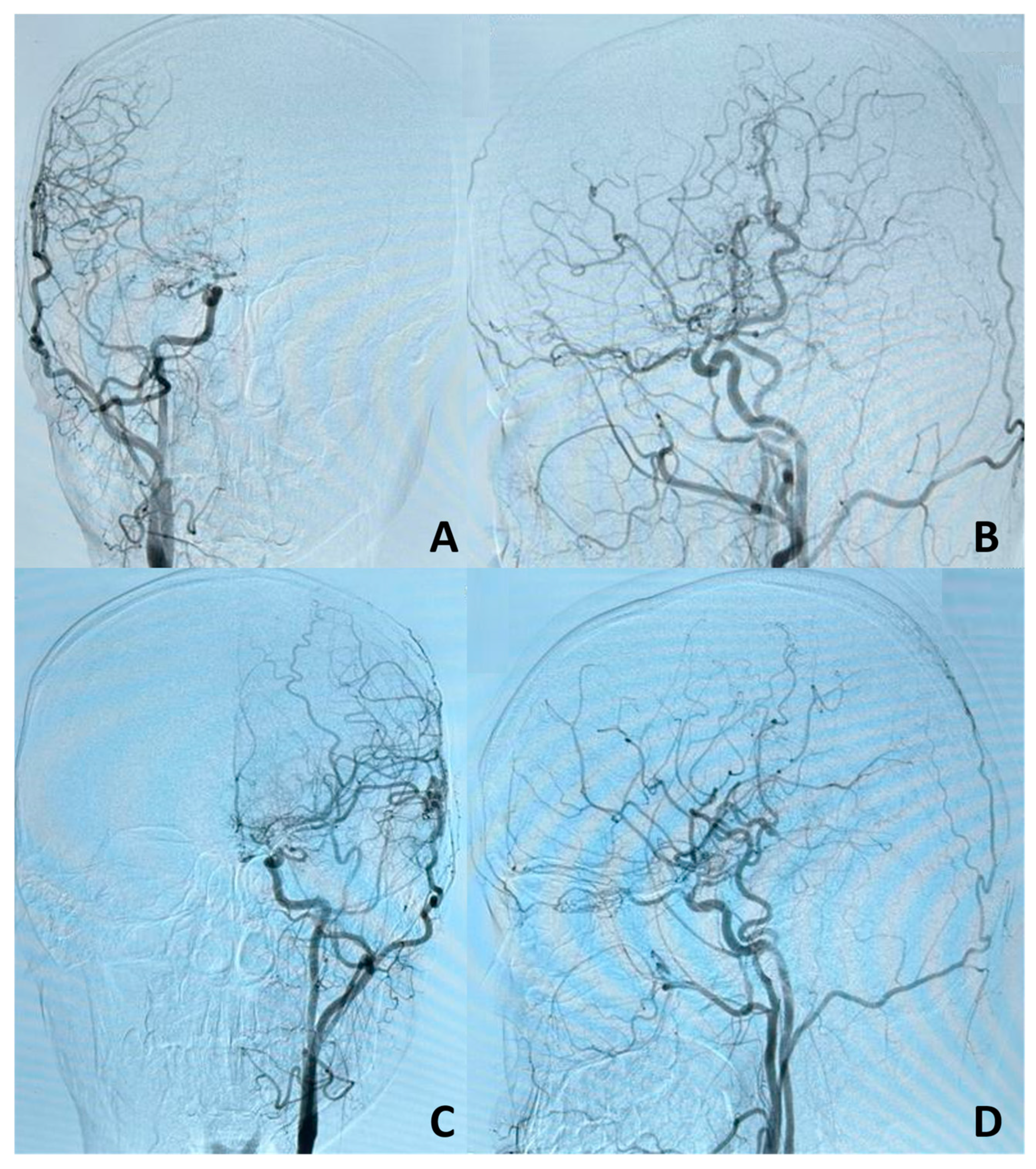
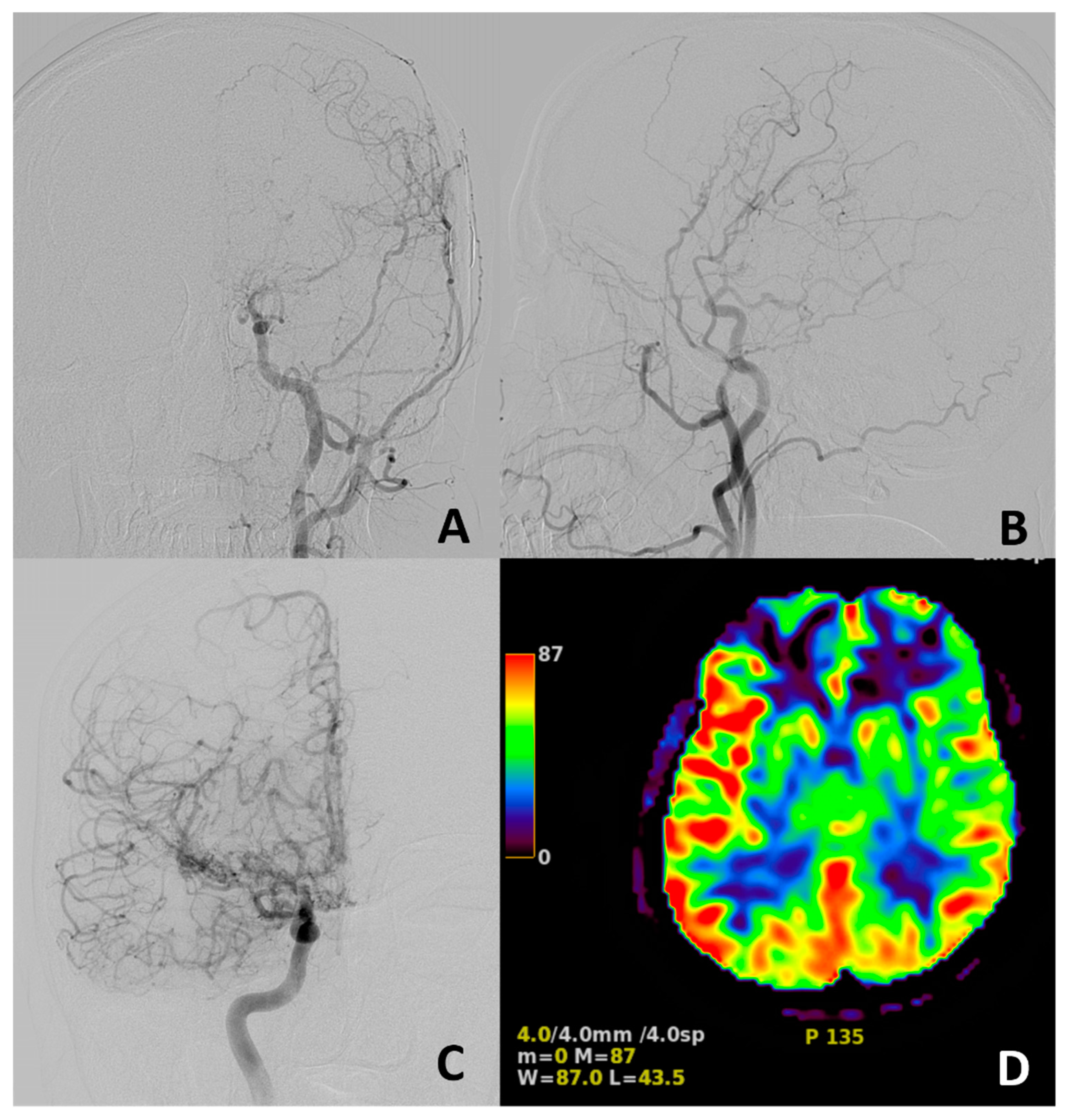
- Surgical revascularization in pediatric moyamoya disease was associated with significant functional improvement and a low rate of recurrent cerebrovascular events.
- Favourable postoperative collateral formation (Matsushima grade A–B) was strongly associated with improved neurological outcomes, whereas poor collateralization was linked to worse functional recovery.
- The quality of postoperative revascularization may be more important for clinical outcome than the specific surgical technique used.
- These findings support surgical revascularization as an effective treatment strategy for pediatric moyamoya disease and provide novel data from an underrepresented Central Asian population.
Abstract
1. Introduction
2. Materials and Methods
2.1. Study Design and Participants
2.2. Treatment
2.3. Follow-Up and Outcomes
2.4. Statistical Analysis
2.5. Ethical Considerations
3. Results
4. Discussion
5. Conclusions
Author Contributions
Funding
Institutional Review Board Statement
Informed Consent Statement
Data Availability Statement
Conflicts of Interest
References
- Suzuki, J.; Takaku, A. Cerebrovascular “Moyamoya” Disease. Disease Showing Abnormal Net-like Vessels in Base of Brain. Arch. Neurol. 1969, 20, 288–299. [Google Scholar] [CrossRef] [Scilit] [PubMed]
- Scott, R.M.; Smith, E.R. Moyamoya Disease and Moyamoya Syndrome. N. Engl. J. Med. 2009, 360, 1226–1237. [Google Scholar] [CrossRef] [Scilit] [PubMed]
- Smith, J.L. Understanding and Treating Moyamoya Disease in Children. Neurosurg. Focus 2009, 26, E2. [Google Scholar] [CrossRef] [Scilit] [PubMed]
- Savoldi, A.M.; Demartini, Z.; Cordeiro, M.L. Indirect Revascularization for Pediatric Moyamoya Angiopathy: Insights from a Brazilian Cohort. J. Clin. Med. 2025, 14, 7739. [Google Scholar] [CrossRef] [Scilit] [PubMed]
- Lee, S.; Rivkin, M.J.; Kirton, A.; deVeber, G.; Elbers, J. International Pediatric Stroke Study Moyamoya Disease in Children: Results from the International Pediatric Stroke Study. J. Child Neurol. 2017, 32, 924–929. [Google Scholar] [CrossRef] [Scilit] [PubMed]
- Han, D.H.; Nam, D.H.; Oh, C.W. Moyamoya Disease in Adults: Characteristics of Clinical Presentation and Outcome after Encephalo-Duro-Arterio-Synangiosis. Clin. Neurol. Neurosurg. 1997, 99, S151–S155. [Google Scholar] [CrossRef] [Scilit] [PubMed]
- Wakai, K.; Tamakoshi, A.; Ikezaki, K.; Fukui, M.; Kawamura, T.; Aoki, R.; Kojima, M.; Lin, Y.; Ohno, Y. Epidemiological Features of Moyamoya Disease in Japan: Findings from a Nationwide Survey. Clin. Neurol. Neurosurg. 1997, 99, S1–S5. [Google Scholar] [CrossRef] [Scilit] [PubMed]
- Baba, T.; Houkin, K.; Kuroda, S. Novel Epidemiological Features of Moyamoya Disease. J. Neurol. Neurosurg. Psychiatry 2008, 79, 900–904. [Google Scholar] [CrossRef] [Scilit] [PubMed]
- Ihara, M.; Yamamoto, Y.; Hattori, Y.; Liu, W.; Kobayashi, H.; Ishiyama, H.; Yoshimoto, T.; Miyawaki, S.; Clausen, T.; Bang, O.Y.; et al. Moyamoya Disease: Diagnosis and Interventions. Lancet Neurol. 2022, 21, 747–758. [Google Scholar] [CrossRef] [Scilit] [PubMed]
- Zanoni, P.; Steindl, K.; Sticht, H.; Oneda, B.; Joset, P.; Ivanovski, I.; Horn, A.H.C.; Cabello, E.M.; Laube, J.; Zweier, M.; et al. The Genetic Landscape and Clinical Implication of Pediatric Moyamoya Angiopathy in an International Cohort. Eur. J. Hum. Genet. 2023, 31, 784–792. Available online: https://www.nature.com/articles/s41431-023-01320-0 (accessed on 27 April 2026). [CrossRef] [Scilit] [PubMed]
- Karsonovich, T.; Lui, F. Moyamoya Disease. In StatPearls; StatPearls Publishing: Treasure Island, FL, USA, 2026. [Google Scholar]
- Kuroda, S.; Fujimura, M.; Takahashi, J.; Kataoka, H.; Ogasawara, K.; Iwama, T.; Tominaga, T.; Miyamoto, S. Research Committee on Moyamoya Disease (Spontaneous Occlusion of Circle of Willis) of the Ministry of Health, Labor, and Welfare, Japan Diagnostic Criteria for Moyamoya Disease—2021 Revised Version. Neurol. Med. Chir. 2022, 62, 307–312. [Google Scholar] [CrossRef] [Scilit] [PubMed]
- Nurimanov, C.; Menlibayeva, K. A Novel Intraoperative “Faucet” Technique for Assessing Patency of Superficial Temporal Artery to Middle Cerebral Artery Bypass and for Prevention of Microemboli. Acta Neurochir. 2024, 166, 405. [Google Scholar] [CrossRef] [Scilit] [PubMed]
- Kaseka, M.L.; Rafay, M.F.; Bertamino, M.; Harrar, D.B.; Mailo, J.; Davila-Williams, D.; Lim, M.; Sabanathan, S.; Parakh, M.; Lehman, L. Clinical Characteristics and Approach to Evaluation of Moyamoya in Children. Pediatr. Stroke J. 2025, 11, 227–247. [Google Scholar]
- Rosi, A.; Riordan, C.P.; Smith, E.R.; Scott, R.M.; Orbach, D.B. Clinical Status and Evolution in Moyamoya: Which Angiographic Findings Correlate? Brain Commun. 2019, 1, fcz029. [Google Scholar] [CrossRef] [Scilit] [PubMed]
- Seol, H.J.; Wang, K.-C.; Kim, S.-K.; Hwang, Y.-S.; Kim, K.J.; Cho, B.-K. Headache in Pediatric Moyamoya Disease: Review of 204 Consecutive Cases. J. Neurosurg. 2005, 103, 439–442. [Google Scholar] [CrossRef] [Scilit] [PubMed]
- Gatti, J.R.; Penn, R.; Ahmad, S.A.; Sun, L.R. Seizures in Pediatric Moyamoya: Risk Factors and Functional Outcomes. Pediatr. Neurol. 2023, 145, 36–40. [Google Scholar] [CrossRef] [Scilit] [PubMed]
- Kelly, M.E.; Bell-Stephens, T.E.; Marks, M.P.; Do, H.M.; Steinberg, G.K. Progression of Unilateral Moyamoya Disease: A Clinical Series. Cerebrovasc. Dis. 2006, 22, 109–115. [Google Scholar] [CrossRef] [Scilit] [PubMed]
- Kawano, T.; Fukui, M.; Hashimoto, N.; Yonekawa, Y. Follow-up Study of Patients with “Unilateral” Moyamoya Disease. Neurol. Med. Chir. 1994, 34, 744–747. [Google Scholar] [CrossRef] [Scilit] [PubMed]
- Joshi, S.B.; Sharma, R.; Manjunath, N.; Dhanakshirur, R.R.; Ganesh, V.L.; Jain, S.; Raheja, A.; Devrajan, L.J.; Nehra, A.; Suri, A. Functional and Neuropsychological Outcome After Surgical Treatment of Moyamoya Disease. World Neurosurg. 2024, 185, e397–e406. [Google Scholar] [CrossRef] [Scilit] [PubMed]
- Xie, Y. Editorial for “Pre-Surgical Magnetic Resonance Imaging Indicators of Revascularization Response in Adults With Moyamoya Vasculopathy”. J. Magn. Reson Imaging 2022, 56, 995–996. [Google Scholar] [CrossRef] [Scilit] [PubMed]
- Kawabori, M.; Kuroda, S.; Nakayama, N.; Hirata, K.; Shiga, T.; Houkin, K.; Tamaki, N. Effective Surgical Revascularization Improves Cerebral Hemodynamics and Resolves Headache in Pediatric Moyamoya Disease. World Neurosurg. 2013, 80, 612–619. [Google Scholar] [CrossRef] [Scilit] [PubMed]
- Ogawa, S.; Ogiwara, H. Indirect Revascularization for Pediatric Moyamoya Disease. J. Neurosurg. Pediatr. 2024, 34, 111–117. [Google Scholar] [CrossRef] [Scilit] [PubMed]
- Matsushima, Y.; Inaba, Y. Moyamoya Disease in Children and Its Surgical Treatment. Introduction of a New Surgical Procedure and Its Follow-up Angiograms. Childs Brain 1984, 11, 155–170. [Google Scholar] [CrossRef] [Scilit] [PubMed]
- Shahbandi, A.; Sattari, S.A.; Azad, T.D.; Xia, Y.; Lehner, K.; Yang, W.; Feghali, J.; Reynolds, R.A.; Akbari, S.H.A.; Groves, M.L.; et al. The Management of Symptomatic Moyamoya Disease in Pediatric Patients: A Systematic Review and Meta-Analysis. Neurosurgery 2024, 97, 65–81. [Google Scholar] [CrossRef] [Scilit] [PubMed]
- Zheng, J.; Yu, L.-B.; Dai, K.-F.; Zhang, Y.; Wang, R.; Zhang, D. Clinical Features, Surgical Treatment, and Long-Term Outcome of a Multicenter Cohort of Pediatric Moyamoya. Front. Neurol. 2019, 10, 14. [Google Scholar] [CrossRef] [Scilit] [PubMed]
- Veeravagu, A.; Guzman, R.; Patil, C.G.; Hou, L.C.; Lee, M.; Steinberg, G.K. Moyamoya Disease in Pediatric Patients: Outcomes of Neurosurgical Interventions. Neurosurg. Focus 2008, 24, E16. [Google Scholar] [CrossRef] [Scilit] [PubMed]
- Alhumaid, A.; Taher, N.; Alanazi, R.; Bensaeed, N.Z. Clinical Outcomes and Stroke Recurrence in Moyamoya Disease Post-Revascularization: A Retrospective Analysis. J. Pharm. Bioallied Sci. 2024, 16, S4628–S4633. [Google Scholar] [CrossRef] [Scilit] [PubMed]


| Characteristics | No of Patients/Procedure (%) |
|---|---|
| Baseline characteristics (n = 45 patients) | |
| Age at diagnosis, years (mean ± SD) | 9.5 ± 3.8 (1.7–17.0) |
| Female:male ratio, no (%) | 23 (51.1)/22 (48.9) |
| Follow-up, months (mean ± SD) | 20.6 ± 17.5 (6–79) |
| mRS before (mean ± SD) | 2.09 ± 1.26 |
| mRS after (mean ± SD) | 1.64 ± 1.00 |
| Suzuki stage (mean ± SD) | 4.11 ± 0.89 |
| Radiological evaluation (n = 42) | |
| Matsushima Grade A | 16 (38.1) |
| Matsushima Grade B | 21 (50.0) |
| Matsushima Grade C | 5 (11.9) |
| Clinical manifestation (n = 45) | |
| Headache, n (%) | 35 (77.8) |
| Limb paresis, n (%) | 25 (55.6) |
| Seizures, n (%) | 7 (15.6) |
| Speech disturbances, n (%) | 9 (20.0) |
| Cognitive impairment, n (%) | 3 (6.7) |
| Surgical details (n = 74) | |
| One side surgery | 16 (35.6) |
| Bilateral surgery | 29 (64.4) |
| Direct bypass | 32 (43.3) |
| Indirect bypass | 15 (20.3) |
| Combined bypass | 27 (36.5) |
| Clinical outcome | |
| Recurrent stroke | 2 (4.4) |
| Postoperative wound complications | 2 (4.4) |
| Variable | Favorable (n = 37) | Moderate (n = 7) | Poor (n = 1) | p-Value |
|---|---|---|---|---|
| Age, years (mean ± SD) | 9.82 ± 3.79 | 8.43 ± 3.69 | 5.0 | 0.62 |
| Sex | ||||
| Male, n (%) | 18 (81.8%) | 3 (13.6%) | 1 (4.5%) | 0.98 |
| Female, n (%) | 19 (82.6%) | 4 (17.4%) | 0 (0%) | |
| Prior cerebrovascular history | ||||
| No prior stroke | 10 (90.9%) | 1 (9.1%) | 0 (0%) | 0.838 |
| Ischemic stroke | 25 (78.1%) | 6 (18.8%) | 1 (3.1%) | |
| TIA | 2 (100%) | 0 (0%) | 0 (0%) | |
| Clinical presentation | ||||
| Headache, n (%) | 30 (85.7%) | 4 (11.4%) | 1 (2.9%) | 0.28 |
| Limb paresis, n (%) | 20 (80.0%) | 4 (16.0%) | 1 (4.0%) | 0.29 |
| Seizures, n (%) | 5 (71.4%) | 1 (14.3%) | 1 (14.3%) | 0.31 |
| Surgical characteristics | ||||
| Unilateral surgery | 12 (75.0%) | 3 (18.8%) | 1 (6.3%) | 0.48 |
| Bilateral surgery | 25 (86.2%) | 4 (13.8%) | 0 (0%) | |
| Surgical technique (procedures, n = 74) | ||||
| Direct bypass | 28 (87.5%) | 4 (12.5%) | 0 (0%) | 0.613 |
| Indirect bypass | 12 (80.0%) | 3 (20.0%) | 0 (0%) | |
| Combined bypass | 20 (74.1%) | 6 (22.2%) | 1 (3.7%) | |
| Radiological outcome | ||||
| Matsushima Grade A | 15 (93.75%) | 1 (6.25%) | 0 (0%) | 0.005 |
| Matsushima Grade B | 15 (71.4%) | 6 (28.6%) | 0 (0%) | |
| Matsushima Grade C | 2 (40.0%) | 2 (40.0%) | 1 (20.0%) | |
Disclaimer/Publisher’s Note: The statements, opinions and data contained in all publications are solely those of the individual author(s) and contributor(s) and not of MDPI and/or the editor(s). MDPI and/or the editor(s) disclaim responsibility for any injury to people or property resulting from any ideas, methods, instructions or products referred to in the content. |
© 2026 by the authors. Licensee MDPI, Basel, Switzerland. This article is an open access article distributed under the terms and conditions of the Creative Commons Attribution (CC BY) license.
Share and Cite
Nurimanov, C.; Menlibayeva, K.; Mammadinova, I.; Turzhanova, A.; Aidarov, S.; Batyrkhanov, D.; Kabykenova, A.; Makhambetov, Y.; Pochivalov, D.; Surdin, D.; et al. Functional and Angiographic Outcomes Following Surgical Revascularization in Pediatric Moyamoya Disease: A Single-Centre Cohort Study from Central Asia. Children 2026, 13, 865. https://doi.org/10.3390/children13070865
Nurimanov C, Menlibayeva K, Mammadinova I, Turzhanova A, Aidarov S, Batyrkhanov D, Kabykenova A, Makhambetov Y, Pochivalov D, Surdin D, et al. Functional and Angiographic Outcomes Following Surgical Revascularization in Pediatric Moyamoya Disease: A Single-Centre Cohort Study from Central Asia. Children. 2026; 13(7):865. https://doi.org/10.3390/children13070865
Chicago/Turabian StyleNurimanov, Chingiz, Karashash Menlibayeva, Iroda Mammadinova, Ainur Turzhanova, Seitzhan Aidarov, Daultay Batyrkhanov, Assel Kabykenova, Yerbol Makhambetov, David Pochivalov, Dmitriy Surdin, and et al. 2026. "Functional and Angiographic Outcomes Following Surgical Revascularization in Pediatric Moyamoya Disease: A Single-Centre Cohort Study from Central Asia" Children 13, no. 7: 865. https://doi.org/10.3390/children13070865
APA StyleNurimanov, C., Menlibayeva, K., Mammadinova, I., Turzhanova, A., Aidarov, S., Batyrkhanov, D., Kabykenova, A., Makhambetov, Y., Pochivalov, D., Surdin, D., Akshulakov, S., & Kaliyev, A. (2026). Functional and Angiographic Outcomes Following Surgical Revascularization in Pediatric Moyamoya Disease: A Single-Centre Cohort Study from Central Asia. Children, 13(7), 865. https://doi.org/10.3390/children13070865