Effects of Music Genres Reflecting Maternal Listening Preferences During Pregnancy on Distress Markers in Italian Preterm Infants

 , , ,
, , ,  and
and
Highlights
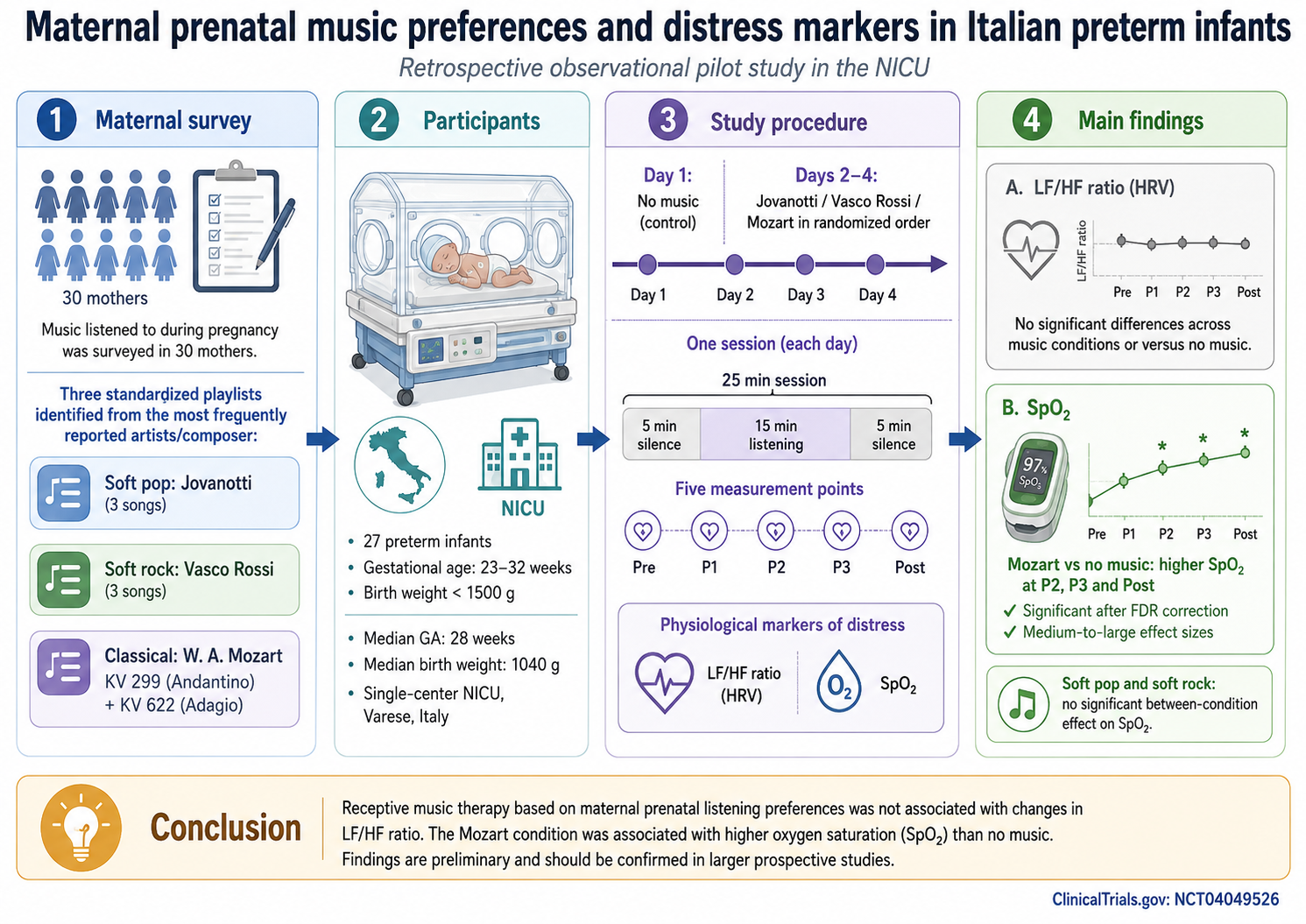
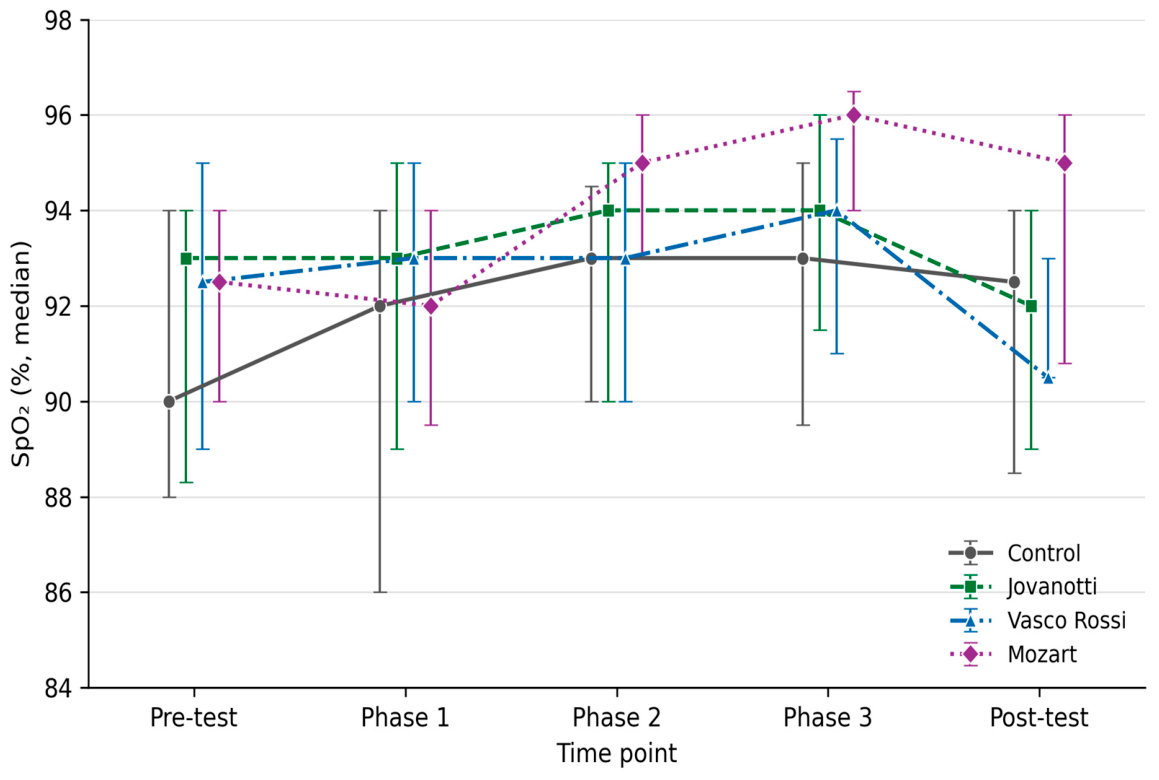
- Classical music (Mozart) was associated with significantly higher peripheral oxygen saturation (SpO2) than the no-music condition at three of the five time points; the effect remained significant after correction for multiple comparisons, with medium-to-large effect sizes. No comparable effect emerged for soft pop or soft rock music.
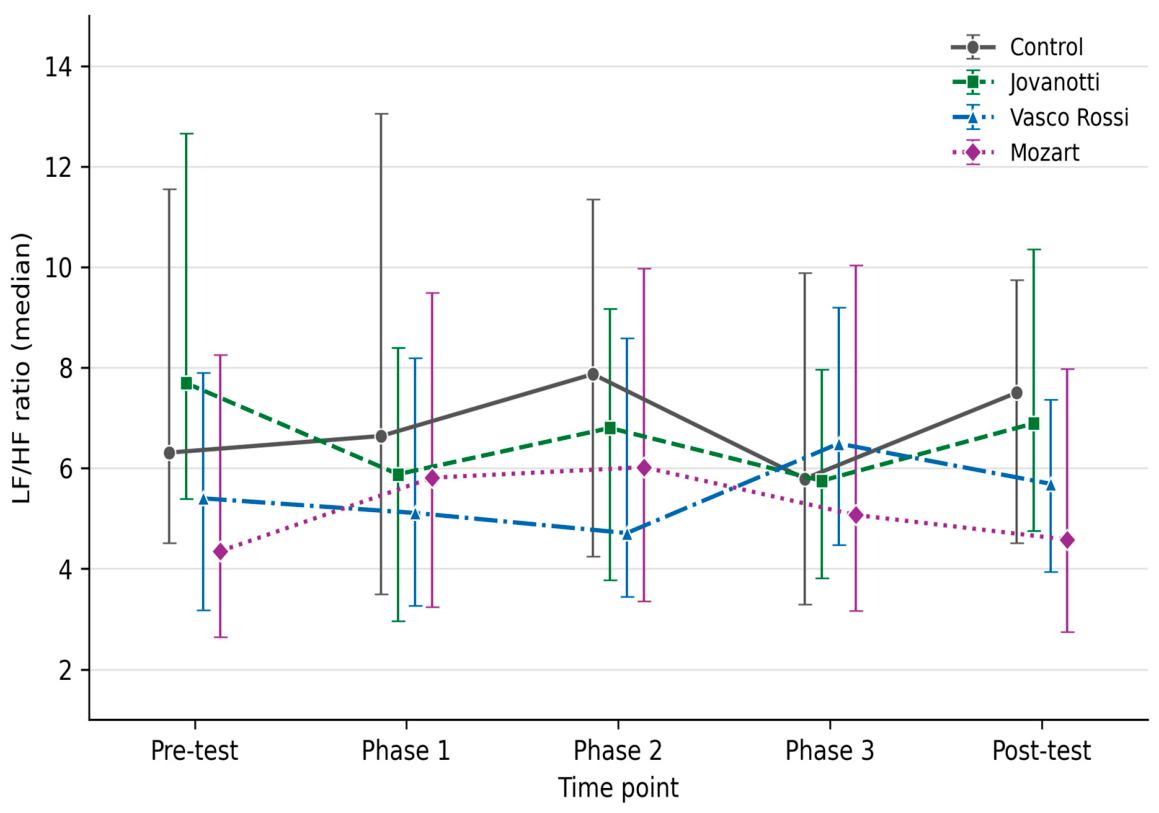
- Music genre was not associated with the LF/HF ratio derived from heart rate variability (HRV) analysis, indicating no measurable genre-specific effect on autonomic distress.
- A structured, acoustically monitored receptive music intervention can be delivered to preterm infants in the NICU without signs of overstimulation; the classical-music signal on oxygenation warrants confirmation in larger prospective trials.
- SpO2 appears more sensitive than HRV-based measures in detecting the physiological responses of preterm infants to music interventions.
Abstract
1. Introduction
Aim
2. Materials and Methods
2.1. Participants
2.2. Materials
2.3. Procedure
2.4. Data Analysis
3. Results
4. Discussion
4.1. The LF/HF Ratio
4.2. Peripheral Oxygen Saturation (SpO2)
4.3. Clinical Implications
4.4. Strengths
4.5. Limitations
5. Conclusions
Supplementary Materials
Author Contributions
Funding
Institutional Review Board Statement
Informed Consent Statement
Data Availability Statement
Acknowledgments
Conflicts of Interest
Abbreviations
| HF | High frequency |
| HRV | Heart Rate Variability |
| LF | Low frequency |
| LF/HF | Low-frequency/high-frequency ratio |
| NICU | Neonatal Intensive Care Unit |
| SpO2 | Peripheral oxygen saturation |
Appendix A
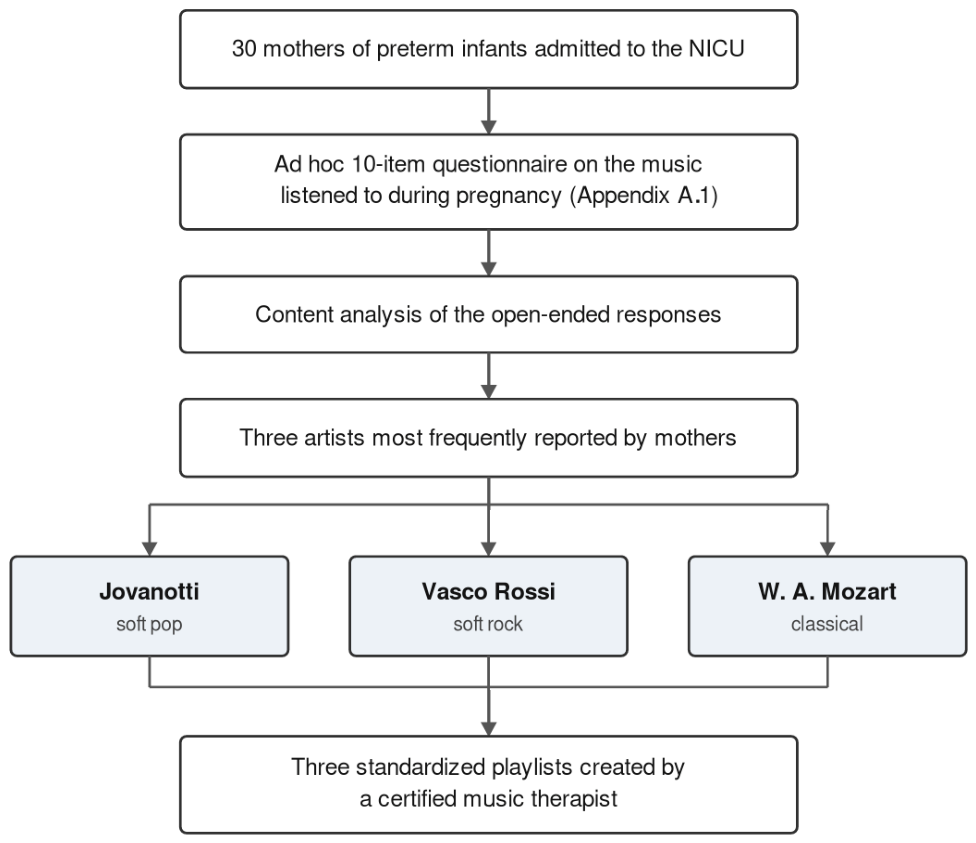
Appendix A.1
- What is your favorite music genre?
- POP
- POP ROCK
- POP RAP
- CLASSIC
- Other
- Did you listen to music for your baby during pregnancy? (Yes/no)
- Did you listen to classical music for your baby during pregnancy? (Yes/no)
- Which classical music composer did you listen to during your pregnancy? Please write the name of one composer that you listened to more.
- Please write n. Three classical pieces for the composer you listened to for your baby during pregnancy.
- Please write n. Four modern composers that you listened to more for your baby during pregnancy.
- Please write n. Three songs for each composer you listened to for your baby during pregnancy.
- Would you like to use prerecorded music for your baby inside the incubator? (Yes/no)
- Would you like to sing and record for your baby in the incubator? (Yes/no)
- Would you like to play an instrumental live for your baby in the incubator? (Yes/no)
Appendix A.2

| Tempo | Song Structure | Voice | Instruments | Songs | |
|---|---|---|---|---|---|
| Jovanotti Soft pop | Adagio-Allegretto Sustained regular. Repetitive. Same time. No variations in the refrain. | (A-B-A): harmonic range I-IV-V-I, intro, verse, bridge, chorus equal harmonically. | Voice, 1 octave baritone. | Male voice. Electric bass. Electric and acoustic guitar. Piano. Drums and percussion. Accordion. Live string orchestra. | Per te—key C major; Allegretto; tempo 4/4; 5 min. A te—key C major; Adagio; tempo 4/4; 5 min. Baciami ancora—key E-flat major; Allegretto; tempo 4/4; 5 min. Acoustic version. Album “Back Up”. |
| Vasco Rossi Soft rock | Adagio-Allegretto Lively. Regular in the verse. Change in tempo and rhythmic-harmonic variation in the refrain. | (A-A-B-A-C-A): intro, verse, bridge. Refrain rhythmic–harmonic variation. Melody and countermelody. | Voice 2-octave baritone. | Male voice. Piano. Harp. Drums. Chorus. Timpani. Keyboard and synthesizer. Percussion. Symphony orchestra. | Alba Chiara—key C major; Allegretto; tempo 4/4; 5 min. Anima fragile—key D major; Adagio; tempo 4/4; 5 min. Una canzone per te—key C major; Adagio; tempo 4/4; 5 min. Teatro la Scala string orchestra. Album “L’altra metà del cielo”. |
| W. A. Mozart Classical | Andantino Adagio | Andantino, KV 299. Form (A-B-C-D-C-B-A). Repetitive. Harp and flute solo. Adagio, KV 622. Form (A-B-A’). Repetitive. Clarinet solo. | No voice. Symphony orchestra. | Symphony orchestra, flute, harp, 2 oboes, 2 horns, strings. Harp. Flute. Symphony orchestra, flutes, bassoons, horns, strings. Clarinet solo. | Mozart KV 299 (movt. 2)—key F major; Andantino; tempo 3/4; 7 min 30 s’. Mozart KV 622 (movt. 2)—key D major, Adagio; tempo 3/4; 7 min 30 s. Maestro Hebert von Karajan (conductor). Berliner Philharmoniker Orchestra |
References
- Zahr, L.K.; Balian, S. Responses of premature infants to routine nursing interventions and noise in the NICU. Nurs. Res. 1995, 44, 179–185. [Google Scholar] [CrossRef] [PubMed]
- Coppola, G.; Cassibba, R.; Costantini, A. What can make the difference? Premature birth and maternal sensitivity at 3 months of age: The role of attachment organization, traumatic reaction and baby’s medical risk. Infant Behav. Dev. 2007, 30, 679–684. [Google Scholar] [CrossRef]
- Schappin, R.; Wijnroks, L.; Uniken Venema, M.M.; Jongmans, M.J. Rethinking stress in parents of preterm infants: A meta-analysis. PLoS ONE 2013, 8, e54992. [Google Scholar] [CrossRef]
- Als, H.; Gilkerson, L.; Duffy, F.H.; McAnulty, G.B.; Buehler, D.M.; Vandenberg, K.; Sweet, N.; Sell, E.; Parad, R.B.; Ringer, S.A.; et al. A three-center, randomized, controlled trial of individualized developmental care for very low birth weight preterm infants: Medical, neurodevelopmental, parenting, and caregiving effects. J. Dev. Behav. Pediatr. 2003, 24, 399–408. [Google Scholar] [CrossRef]
- Vanderveen, J.A.; Bassler, D.; Robertson, C.M.; Kirpalani, H. Early interventions involving parents to improve neurodevelopmental outcomes of premature infants: A meta-analysis. J. Perinatol. 2009, 29, 343–351. [Google Scholar] [CrossRef]
- Haslbeck, F.B.; Bassler, D. Music from the very beginning—A neuroscience-based framework for music as therapy for preterm infants and their parents. Front. Behav. Neurosci. 2018, 12, 112. [Google Scholar] [CrossRef]
- Bieleninik, Ł.; Ghetti, C.; Gold, C. Music therapy for preterm infants and their parents: A meta-analysis. Pediatrics 2016, 138, e20160971. [Google Scholar] [CrossRef]
- Loewy, J.; Stewart, K.; Dassler, A.; Telsey, A.; Homel, P. The effects of music therapy on vital signs, feeding, and sleep in premature infants. Pediatrics 2013, 131, 902–918. [Google Scholar] [CrossRef] [PubMed]
- Standley, J.M. Music therapy research in the NICU: An updated meta-analysis. Neonatal Netw. 2012, 31, 311–319. [Google Scholar] [CrossRef]
- Van der Heijden, M.J.E.; Oliai Araghi, S.; Jeekel, J.; Reiss, I.K.M.; Hunink, M.G.M.; van Dijk, M. Do hospitalized premature infants benefit from music interventions? A systematic review of randomized controlled trials. PLoS ONE 2016, 11, e0161848. [Google Scholar] [CrossRef] [PubMed]
- Mikulis, N.; Inder, T.E.; Erdei, C. Utilising recorded music to reduce stress and enhance infant neurodevelopment in neonatal intensive care units. Acta Paediatr. 2021, 110, 2921–2936. [Google Scholar] [CrossRef]
- Johnson, A.A.; Berry, A.; Bradley, M.; Daniell, J.A.; Lugo, C.; Schaum-Comegys, K.; Villamero, C.; Williams, K.; Yi, H.; Scala, E.; et al. Examining the effects of music-based interventions on pain and anxiety in hospitalized children: An integrative review. J. Pediatr. Nurs. 2021, 60, 71–76. [Google Scholar] [CrossRef]
- Almadhoob, A.; Ohlsson, A. Sound reduction management in the neonatal intensive care unit for preterm or very low birth weight infants. Cochrane Database Syst. Rev. 2020, 1, CD010333. [Google Scholar] [CrossRef] [PubMed]
- Jarjour, I.T. Neurodevelopmental outcome after extreme prematurity: A review of the literature. Pediatr. Neurol. 2015, 52, 143–152. [Google Scholar] [CrossRef] [PubMed]
- Granier-Deferre, C.; Bassereau, S.; Ribeiro, A.; Jacquet, A.Y.; Decasper, A.J. A melodic contour repeatedly experienced by human near-term fetuses elicits a profound cardiac reaction one month after birth. PLoS ONE 2011, 6, e17304. [Google Scholar] [CrossRef]
- Movalled, K.; Sani, A.; Nikniaz, L.; Ghojazadeh, M. The impact of sound stimulations during pregnancy on fetal learning: A systematic review. BMC Pediatr. 2023, 23, 183. [Google Scholar] [CrossRef]
- Chorna, O.; Filippa, M.; De Almeida, J.S.; Lordier, L.; Monaci, M.G.; Hüppi, P.; Grandjean, D.; Guzzetta, A. Neuroprocessing mechanisms of music during fetal and neonatal development: A role in neuroplasticity and neurodevelopment. Neural Plast. 2019, 2019, 3972918. [Google Scholar] [CrossRef] [PubMed]
- Amini, E.; Rafiei, P.; Zarei, K.; Gohari, M.; Hamidi, M. Effect of lullaby and classical music on physiologic stability of hospitalized preterm infants: A randomized trial. J. Neonatal-Perinat. Med. 2013, 6, 295–301. [Google Scholar] [CrossRef]
- Lubetzky, R.; Mimouni, F.B.; Dollberg, S.; Reifen, R.; Ashbel, G.; Mandel, D. Effect of music by Mozart on energy expenditure in growing preterm infants. Pediatrics 2010, 125, e24–e28. [Google Scholar] [CrossRef]
- Cassirame, J.; Stuckey, M.I.; Sheppard, F.; Tordi, N. Accuracy of the Minicardio system for heart rate variability analysis compared to ECG. J. Sports Med. Phys. Fit. 2013, 53, 248–254. [Google Scholar]
- Smith, S.L.; Lux, R.; Haley, S.; Slater, H.; Beachy, J.; Moyer-Mileur, L.J. The effect of massage on heart rate variability in preterm infants. J. Perinatol. 2013, 33, 59–64. [Google Scholar] [CrossRef]
- Malik, M.; Bigger, J.T.; Camm, A.J.; Kleiger, R.E.; Malliani, A.; Moss, A.J.; Schwartz, P.J. Heart rate variability: Standards of measurement, physiological interpretation, and clinical use. Eur. Heart J. 1996, 17, 354–381. [Google Scholar] [CrossRef]
- Committee on Environmental Health. Noise: A hazard for the fetus and newborn. Pediatrics 1997, 100, 724–727. [Google Scholar] [CrossRef]
- Graven, S.N. Sound and the developing infant in the NICU: Conclusions and recommendations for care. J. Perinatol. 2000, 20, S88–S93. [Google Scholar] [CrossRef] [PubMed]
- Jaschke, A.C.; Bos, A.F. Concept and considerations of a medical device: The active noise cancelling incubator. Front. Pediatr. 2023, 11, 1187815. [Google Scholar] [CrossRef]
- Cohen, J. Statistical Power Analysis for the Behavioral Sciences, 2nd ed.; Lawrence Erlbaum Associates: Hillsdale, NJ, USA, 1988. [Google Scholar]
- Bradt, J. Review of Music Therapy for Premature and Newborn Infants by M. Nöcker-Ribaupierre. Music Ther. Perspect. 2005, 23, 152–154. [Google Scholar] [CrossRef]
- Alipour, Z.; Eskandari, N.; Ahmari-Tehran, H.; Eshagh-Hossaini, S.K.; Sangi, S. Effects of music on physiological and behavioral responses of premature infants: A randomized controlled trial. Complement. Ther. Clin. Pract. 2013, 19, 128–132. [Google Scholar] [CrossRef]
- Loewy, J. NICU music therapy: Song of kin as critical lullaby in research and practice. Ann. N. Y. Acad. Sci. 2015, 1337, 178–185. [Google Scholar] [CrossRef] [PubMed]
- Standley, J.M. A meta-analysis of the efficacy of music therapy for premature infants. J. Pediatr. Nurs. 2002, 17, 107–113. [Google Scholar] [CrossRef] [PubMed]
- Filippa, M.; Lordier, L.; De Almeida, J.S.; Monaci, M.G.; Adam-Darque, A.; Grandjean, D.; Kuhn, P.; Hüppi, P.S. Early vocal contact and music in the NICU: New insights into preventive interventions. Pediatr. Res. 2020, 87, 249–264. [Google Scholar] [CrossRef]
- Shin, H.J.; Park, J.; Oh, H.K.; Kim, N. Comparison of effects of mothers’ and Mozart’s lullabies on physiological responses, feeding volume, and body weight of premature infants in NICU. Front. Public Health 2022, 10, 870740. [Google Scholar] [CrossRef] [PubMed]
- Haslbeck, F.B.; Mueller, K.; Karen, T.; Loewy, J.; Meerpohl, J.J.; Bassler, D. Musical and vocal interventions to improve neurodevelopmental outcomes for preterm infants. Cochrane Database Syst. Rev. 2023, 9, CD013472. [Google Scholar] [CrossRef] [PubMed]


| Characteristic | Value |
|---|---|
| Gender, n (%) | |
| Male | 19 (70.4) |
| Female | 8 (29.6) |
| Gestational age (weeks), median [IQR] | 28 [26–30] |
| 23–27 weeks, n (%) | 13 (48.1) |
| 28–32 weeks, n (%) | 14 (51.9) |
| Birth weight (g), median [IQR] | 1040 [870–1280] |
| Apgar score at 1 min, median [IQR] | 6 [5–7] |
| Apgar score at 5 min, median [IQR] | 8 [8–8] |
| Condition/Time Point | LF/HF Ratio | SpO2 | ||
|---|---|---|---|---|
| N | Median [IQR] | N | Median [IQR] | |
| Control | ||||
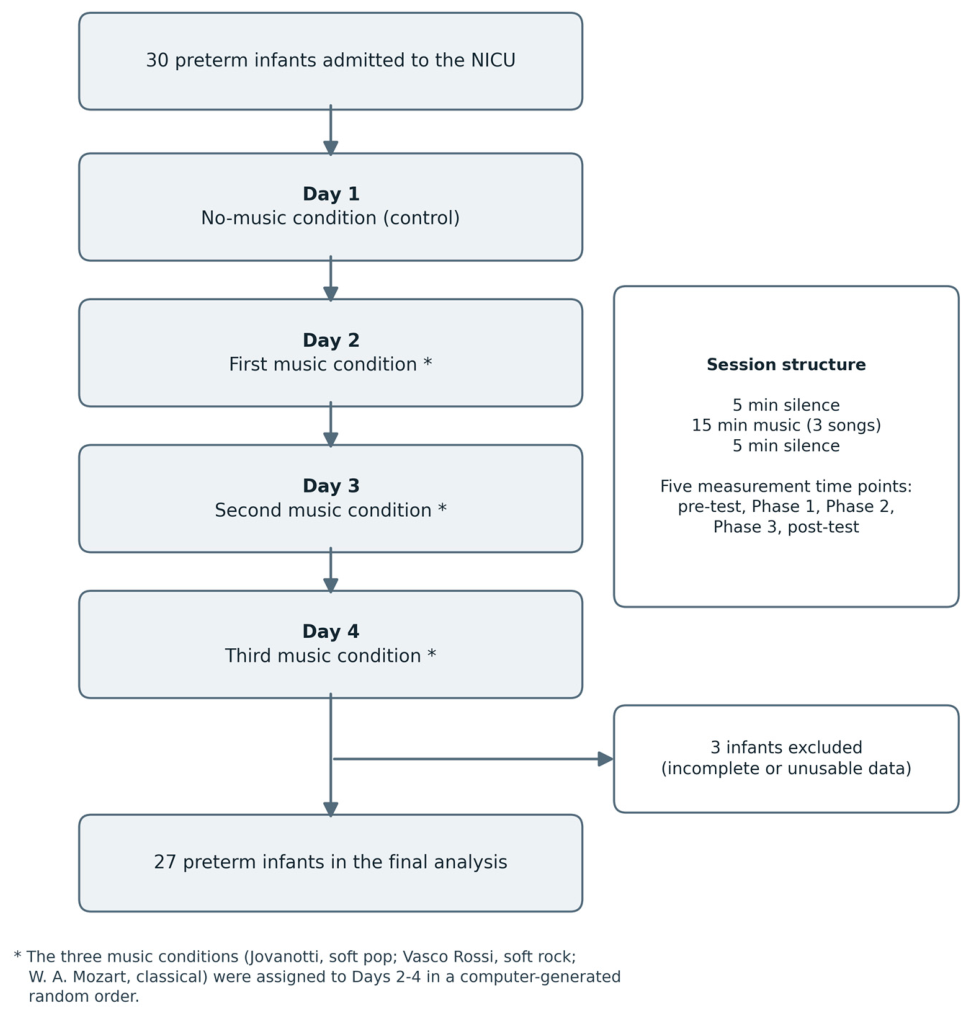
| Pre-test | 23 | 6.31 [4.52–11.55] | 27 | 90.0 [88.0–94.0] |
| Phase 1 | 24 | 6.64 [3.49–13.05] | 27 | 92.0 [86.0–94.0] |
| Phase 2 | 24 | 7.87 [4.25–11.35] | 27 | 93.0 [90.0–94.5] |
| Phase 3 | 23 | 5.79 [3.29–9.89] | 27 | 93.0 [89.5–95.0] |
| Post-test | 24 | 7.50 [4.51–9.74] | 27 | 92.5 [88.5–94.0] |
| Jovanotti | ||||
| Pre-test | 26 | 7.69 [5.39–12.66] | 25 | 93.0 [88.3–94.0] |
| Phase 1 | 26 | 5.88 [2.96–8.40] | 25 | 93.0 [89.0–95.0] |
| Phase 2 | 26 | 6.80 [3.77–9.17] | 25 | 94.0 [90.0–95.0] |
| Phase 3 | 25 | 5.75 [3.81–7.96] | 25 | 94.0 [91.5–96.0] |
| Post-test | 26 | 6.89 [4.76–10.36] | 25 | 92.0 [89.0–94.0] |
| Vasco Rossi | ||||
| Pre-test | 25 | 5.40 [3.18–7.90] | 25 | 92.5 [89.0–95.0] |
| Phase 1 | 25 | 5.11 [3.27–8.19] | 25 | 93.0 [90.0–95.0] |
| Phase 2 | 25 | 4.71 [3.45–8.59] | 25 | 93.0 [90.0–95.0] |
| Phase 3 | 24 | 6.49 [4.47–9.20] | 25 | 94.0 [91.0–95.5] |
| Post-test | 25 | 5.69 [3.94–7.37] | 25 | 90.5 [90.5–93.0] |
| Mozart | ||||
| Pre-test | 27 | 4.35 [2.64–8.25] | 27 | 92.5 [90.0–94.0] |
| Phase 1 | 27 | 5.81 [3.24–9.49] | 27 | 92.0 [89.5–94.0] |
| Phase 2 | 27 | 6.02 [3.35–9.97] | 27 | 95.0 [93.0–96.0] |
| Phase 3 | 26 | 5.07 [3.16–10.04] | 27 | 96.0 [94.0–96.5] |
| Post-test | 27 | 4.58 [2.75–7.97] | 27 | 95.0 [90.8–96.0] |
| Comparison | LF/HF Ratio | SpO2 | ||||||
|---|---|---|---|---|---|---|---|---|
| Z | p | p(FDR) | r | Z | p | p(FDR) | r | |
| Pre-test | ||||||||
| Jovanotti | −0.80 | 0.426 | 0.776 | 0.17 | −0.20 | 0.843 | 0.958 | 0.04 |
| Vasco Rossi | −1.38 | 0.168 | 0.776 | 0.29 | −1.45 | 0.146 | 0.415 | 0.29 |
| Mozart | −1.73 | 0.083 | 0.208 | 0.36 | −0.59 | 0.558 | 0.693 | 0.11 |
| Phase 1 | ||||||||
| Jovanotti | −0.61 | 0.543 | 0.776 | 0.13 | −0.05 | 0.958 | 0.958 | 0.01 |
| Vasco Rossi | −0.82 | 0.412 | 0.776 | 0.17 | −1.39 | 0.166 | 0.415 | 0.28 |
| Mozart | −1.09 | 0.278 | 0.463 | 0.22 | −0.40 | 0.693 | 0.693 | 0.08 |
| Phase 2 | ||||||||
| Jovanotti | −0.70 | 0.484 | 0.776 | 0.15 | −0.07 | 0.943 | 0.958 | 0.01 |
| Vasco Rossi | −1.52 | 0.128 | 0.776 | 0.32 | −0.17 | 0.863 | 0.958 | 0.03 |
| Mozart | −0.46 | 0.648 | 0.783 | 0.09 | −2.31 | 0.021 | 0.035 | 0.45 |
| Phase 3 | ||||||||
| Jovanotti | −0.43 | 0.664 | 0.830 | 0.09 | −1.86 | 0.063 | 0.415 | 0.37 |
| Vasco Rossi | −0.30 | 0.768 | 0.853 | 0.07 | −1.52 | 0.128 | 0.415 | 0.30 |
| Mozart | −0.28 | 0.783 | 0.783 | 0.06 | −3.11 | 0.002 | 0.010 | 0.60 |
| Post-test | ||||||||
| Jovanotti | −0.03 | 0.976 | 0.976 | 0.01 | −0.36 | 0.716 | 0.958 | 0.07 |
| Vasco Rossi | −1.10 | 0.274 | 0.776 | 0.23 | −0.67 | 0.501 | 0.958 | 0.13 |
| Mozart | −1.80 | 0.072 | 0.208 | 0.37 | −2.73 | 0.006 | 0.015 | 0.53 |
| Comparison | LF/HF Ratio | SpO2 | ||||||
|---|---|---|---|---|---|---|---|---|
| Z | p | p(FDR) | r | Z | p | p(FDR) | r | |
| Control | ||||||||
| Phase 1 | −0.43 | 0.670 | 0.838 | 0.09 | −0.50 | 0.618 | 0.696 | 0.10 |
| Phase 2 | −0.55 | 0.584 | 0.834 | 0.12 | −1.35 | 0.178 | 0.580 | 0.26 |
| Phase 3 | −0.93 | 0.355 | 0.775 | 0.20 | −0.72 | 0.475 | 0.696 | 0.14 |
| Post-test | −0.73 | 0.465 | 0.775 | 0.15 | −0.46 | 0.647 | 0.696 | 0.09 |
| Jovanotti | ||||||||
| Phase 1 | −1.88 | 0.060 | 0.200 | 0.37 | −0.34 | 0.737 | 0.819 | 0.07 |
| Phase 2 | −2.02 | 0.043 | 0.200 | 0.40 | −2.13 | 0.033 | 0.082 | 0.43 |
| Phase 3 | −1.90 | 0.058 | 0.200 | 0.38 | −3.11 | 0.002 | 0.020 | 0.62 |
| Post-test | −0.72 | 0.469 | 0.938 | 0.14 | −0.14 | 0.891 | 0.891 | 0.03 |
| Vasco Rossi | ||||||||
| Phase 1 | −0.26 | 0.798 | 0.841 | 0.05 | −1.06 | 0.290 | 0.488 | 0.21 |
| Phase 2 | −0.34 | 0.737 | 0.841 | 0.07 | −0.15 | 0.882 | 0.896 | 0.03 |
| Phase 3 | −0.71 | 0.475 | 0.841 | 0.14 | −1.12 | 0.263 | 0.488 | 0.22 |
| Post-test | −0.35 | 0.726 | 0.841 | 0.07 | −0.82 | 0.414 | 0.591 | 0.16 |
| Mozart | ||||||||
| Phase 1 | −0.79 | 0.428 | 0.869 | 0.15 | −0.08 | 0.939 | 0.939 | 0.01 |
| Phase 2 | −1.01 | 0.313 | 0.869 | 0.19 | −3.89 | <0.001 | 0.001 | 0.75 |
| Phase 3 | −0.37 | 0.713 | 0.869 | 0.07 | −3.71 | <0.001 | 0.001 | 0.71 |
| Post-test | −0.17 | 0.869 | 0.869 | 0.03 | −2.70 | 0.007 | 0.012 | 0.52 |
Disclaimer/Publisher’s Note: The statements, opinions and data contained in all publications are solely those of the individual author(s) and contributor(s) and not of MDPI and/or the editor(s). MDPI and/or the editor(s) disclaim responsibility for any injury to people or property resulting from any ideas, methods, instructions or products referred to in the content. |
© 2026 by the authors. Licensee MDPI, Basel, Switzerland. This article is an open access article distributed under the terms and conditions of the Creative Commons Attribution (CC BY) license.
Share and Cite
Sgobbi, B.; Antichi, L.; Bolis, M.E.; Morlacchi, L.; Donati, D.; Bresesti, I.; Agosti, M. Effects of Music Genres Reflecting Maternal Listening Preferences During Pregnancy on Distress Markers in Italian Preterm Infants. Children 2026, 13, 771. https://doi.org/10.3390/children13060771
Sgobbi B, Antichi L, Bolis ME, Morlacchi L, Donati D, Bresesti I, Agosti M. Effects of Music Genres Reflecting Maternal Listening Preferences During Pregnancy on Distress Markers in Italian Preterm Infants. Children. 2026; 13(6):771. https://doi.org/10.3390/children13060771
Chicago/Turabian StyleSgobbi, Barbara, Lorenzo Antichi, Maria Elena Bolis, Laura Morlacchi, Daniele Donati, Ilia Bresesti, and Massimo Agosti. 2026. "Effects of Music Genres Reflecting Maternal Listening Preferences During Pregnancy on Distress Markers in Italian Preterm Infants" Children 13, no. 6: 771. https://doi.org/10.3390/children13060771
APA StyleSgobbi, B., Antichi, L., Bolis, M. E., Morlacchi, L., Donati, D., Bresesti, I., & Agosti, M. (2026). Effects of Music Genres Reflecting Maternal Listening Preferences During Pregnancy on Distress Markers in Italian Preterm Infants. Children, 13(6), 771. https://doi.org/10.3390/children13060771