Applicability, Validity, and Reliability of the Japanese Version of the Behavioral Pain Scale for Critically Ill Mechanically Ventilated Pediatric Patients: A Prospective Cross-Sectional Observational Study
 ,
,  , , and
Highlights
- The Japanese version of the Behavioral Pain Scale (BPS) demonstrated acceptable validity and interrater reliability in mechanically ventilated pediatric patients.
- Deep sedation (median RASS score ≤ −4) caused a pronounced floor effect, significantly masking behavioral pain responses even during painful procedures.
- Future research is needed to investigate whether the BPS, with adequate training, can serve as a common multidisciplinary language in mixed adult–pediatric intensive care units.
- Clinicians must carefully interpret low BPS scores in deeply sedated children as they may reflect sedation-induced masking rather than true analgesia.
Abstract
1. Introduction
2. Materials and Methods
2.1. Study Design and Setting
2.2. Participants
2.3. Sample Size
2.4. Measurement Tools
2.4.1. Behavioral Pain Scale (BPS)
2.4.2. Face, Legs, Activity, Cry, Consolability (FLACC) Scale
2.4.3. COMFORT Behavior (COMFORT-B) Scale
2.4.4. Richmond Agitation–Sedation Scale (RASS)
2.5. Evaluation and Collection of Data
2.6. Statistical Analysis
2.7. Sensitivity Analysis
3. Results
3.1. Participant Characteristics
3.2. Associations Between BPS Score, Painful Procedure and Deep Sedation
3.3. The Frequency Distributions of Assessed Scores
3.4. Validity
3.5. Validity and Impact of Observer Experience
3.6. Reliability
4. Discussion
5. Limitations
6. Conclusions
Supplementary Materials
Author Contributions
Funding
Institutional Review Board Statement
Informed Consent Statement
Data Availability Statement
Acknowledgments
Conflicts of Interest
References
- Harris, J.; Ramelet, A.S.; van Dijk, M.; Pokorna, P.; Wielenga, J.; Tume, L.; Tibboel, D.; Ista, E. Clinical recommendations for pain, sedation, withdrawal and delirium assessment in critically ill infants and children: An ESPNIC position statement for healthcare professionals. Intensive Care Med. 2016, 42, 972–986. [Google Scholar] [CrossRef] [PubMed]
- Johansson, M.; Kokinsky, E. The comfort behavioural scale and the modified flacc scale in paediatric intensive care. Nurs. Crit. Care 2009, 14, 122–130. [Google Scholar] [CrossRef]
- Puntillo, K.A.; Morris, A.B.; Thompson, C.L.; Stanik-Hutt, J.; White, C.A.; Wild, L.R. Pain behaviors observed during six common procedures: Results from Thunder Project II. Crit. Care Med. 2004, 32, 421–427. [Google Scholar] [CrossRef]
- Hadjistavropoulos, T.; Craig, K.D.; Duck, S.; Cano, A.; Goubert, L.; Jackson, P.L.; Mogil, J.S.; Rainville, P.; Sullivan, M.J.L.; Williams, A.C.d.C.; et al. A Biopsychosocial Formulation of Pain Communication. Psychol. Bull. 2011, 137, 910–939. [Google Scholar] [CrossRef]
- Treede, R.D. The International Association for the Study of Pain definition of pain: As valid in 2018 as in 1979, but in need of regularly updated footnotes. Pain Rep. 2018, 3, 3–5. [Google Scholar] [CrossRef] [PubMed]
- J-PAD Guideline Committee of the Japanese Society of Intensive Care Medicine Japanese guidelines for the management of Pain Agitation, and Delirium in intensive care unit (J-PAD). J. Jpn. Soc. Intensive Care Med. 2014, 21, 539–579. (In Japanese) [CrossRef]
- Van Dijk, M.; De Boer, J.B.; Koot, H.M.; Duivenvoorden, H.J.; Passchier, J.; Bouwmeester, N.; Tibboel, D. The association between physiological and behavioral pain measures in 0- to 3-year-old Infants after major surgery. J. Pain Symptom Manag. 2001, 22, 600–609. [Google Scholar] [CrossRef] [PubMed]
- Bai, J.; Hsu, L.; Tang, Y.; Van Dijk, M. Validation of the COMFORT Behavior Scale and the FLACC Scale for Pain Assessment in Chinese Children after Cardiac Surgery. Pain Manag. Nurs. 2012, 13, 18–26. [Google Scholar] [CrossRef]
- Boerlage, A.A.; Ista, E.; De Jong, M.; Tibboel, D.; Van Dijk, M. The COMFORT behavior scale: Is a shorter observation period feasible? Pediatr. Crit. Care Med. 2012, 13, 124–125. [Google Scholar] [CrossRef]
- Boerlage, A.A.; Ista, E.; Duivenvoorden, H.J.; De Wildt, S.N.; Tibboel, D.; Van Dijk, M. The COMFORT behaviour scale detects clinically meaningful effects of analgesic and sedative treatment. Eur. J. Pain 2015, 19, 473–479. [Google Scholar] [CrossRef]
- Valkenburg, A.J.; Boerlage, A.A.; Ista, E.; Duivenvoorden, H.J.; Tibboel, D.; Van Dijk, M. The COMFORT-Behavior scale is useful to assess pain and distress in 0- to 3-year-old children with Down syndrome. Pain 2011, 152, 2059–2064. [Google Scholar] [CrossRef] [PubMed]
- Merkel, S.; Voepel-Lewis, T.; Malviya, S. Pain Assessment in Infants and Young Children: The FLACC Scale: A behavioral tool to measure pain in young children. AJN Am. J. Nurs. 2002, 102, 55. [Google Scholar] [CrossRef] [PubMed]
- Sedighi, L.; Shirozhan, S.; Talebi-Ghane, E.; Taher, A.; Eliasi, E.; Gomar, R.; Mollai, Z. Comparison of the accuracy and the response time to behavioral pain scales (BPS and CPOT) during painful procedures in the intensive care unit. J. Educ. Health Promot. 2024, 13, 334. [Google Scholar] [CrossRef]
- Payen, J.F.; Bru, O.; Bosson, J.L.; Lagrasta, A.; Novel, E.; Deschaux, I.; Lavagne, P.; Jacquot, C. Assessing pain in critically ill sedated patients by using a behavioral pain scale. Crit. Care Med. 2001, 29, 2258–2263. [Google Scholar] [CrossRef]
- Aantaa, R.; Pudas-Tähkä, S.M.; Axelin, A.; Lund, V.; Salanterä, S. Pain assessment tools for unconscious or sedated intensive care patients: A systematic review. J. Adv. Nurs. 2009, 65, 946–956. [Google Scholar] [CrossRef] [PubMed]
- Aïssaoui, Y.; Zeggwagh, A.A.; Zekraoui, A.; Abidi, K.; Abouqal, R. Validation of a behavioral pain scale in critically ill, sedated, and mechanically ventilated patients. Anesth. Analg. 2005, 101, 1470–1476. [Google Scholar] [CrossRef]
- Young, J.; Siffleet, J.; Nikoletti, S.; Shaw, T. Use of a Behavioural Pain Scale to assess pain in ventilated, unconscious and/or sedated patients. Intensive Crit. Care Nurs. 2006, 22, 32–39. [Google Scholar] [CrossRef]
- Cade, C.H. Clinical tools for the assessment of pain in sedated critically ill adults. Nurs. Crit. Care 2008, 13, 288–297. [Google Scholar] [CrossRef]
- Gélinas, C. Pain assessment in the critically ill adult: Recent evidence and new trends. Intensive Crit. Care Nurs. 2016, 34, 1–11. [Google Scholar] [CrossRef]
- Pudas-Tähkä, S.M.; Salanterä, S. Reliability of three linguistically and culturally validated pain assessment tools for sedated ICU patients by ICU nurses in Finland. Scand. J. Pain 2018, 18, 165–173. [Google Scholar] [CrossRef]
- J-PAD Guideline Review Committee of the Japanese Society of Intensive Care Medicine Survey on the current status of the management of pain agitation, and delirium in intensive care units. J. Jpn. Soc. Intensive Care Med. 2017, 24, 199–207. (In Japanese) [CrossRef] [PubMed][Green Version]
- Sulla, F.; La Chimia, M.; Barbieri, L.; Gigantiello, A.; Iraci, C.; Virgili, G.; Artioli, G.; Sarli, L. A first contribution to the validation of the Italian version of the Behavioral Pain Scale in sedated, intubated, and mechanically ventilated paediatric patients. Acta Bio Medica Atenei Parm. 2018, 89, 19. [Google Scholar] [CrossRef]
- Tamvaki, E.; Efstratiou, F.; Nteli, C.; Matziou, V.; Pavlopoulou, I.; Myrianthefs, P.; Papathanassoglou, E.; Giannakopoulou, M. Validation of the Greek Version of Comfort-B, FLACC, and BPS Scales in Critically Ill Children and Their Association with Clinical Severity. Pain Manag. Nurs. 2020, 21, 468–475. [Google Scholar] [CrossRef]
- Guasconi, M.; Granata, C.; Sulla, F.; Rubbi, I.; Artioli, G.; Sarli, L.; Scelsi, S. Validation of the Italian version of Behavioral Pain Scale in sedated, intubated, and mechanically ventilated pediatric patients. Acta Biomed. 2021, 92, e2021370. [Google Scholar] [CrossRef]
- Evans, J.D. Straightforward Statistics for the Behavioral Sciences; Marcel Dekker: New York, NY, USA, 1996. [Google Scholar]
- Koo, T.K.; Li, M.Y. A Guideline of Selecting and Reporting Intraclass Correlation Coefficients for Reliability Research. J. Chiropr. Med. 2016, 15, 155–163. [Google Scholar] [CrossRef] [PubMed]
- Cohen, J. A Coefficient of Agreement for Nominal Scales. Educ. Psychol. Meas. 1960, 20, 37–46. [Google Scholar] [CrossRef]
- Fleiss, J.L.; Cohen, J.; Everitt, B.S. Large sample standard errors of kappa and weighted kappa. Psychol. Bull. 1969, 72, 323–327. [Google Scholar] [CrossRef]
- Flack, V.; Afifi, A.; Lachenbruch, P.; Schouten, H. Sample size determinations for two rater kappa statistic. Psychometrika 1988, 53, 321–325. [Google Scholar] [CrossRef]
- Kanda, Y. Investigation of the freely available easy-to-use software “EZR” for medical statistics. Bone Marrow Transplant. 2013, 48, 452–458. [Google Scholar] [CrossRef]
- van Dijk, M.; Peters, J.W.B.; van Deventer, P.; Tibboel, D. The COMFORT Behavior Scale: A tool for assessing pain and sedation in infants. Am. J. Nurs. 2005, 105, 33–36. [Google Scholar] [CrossRef]
- Ely, E.W.; Truman, B.; Shintani, A.; Thomason, J.W.W.; Wheeler, A.P.; Gordon, S.; Francis, J.; Speroff, T.; Gautam, S.; Margolin, R.; et al. Monitoring Sedation Status over Time in ICU Patients Reliability and Validity of the Richmond Agitation-Sedation Scale (RASS). JAMA 2003, 289, 2983–2991. [Google Scholar] [CrossRef] [PubMed]
- Matsuishi, Y.; Hoshino, H.; Shimojo, N.; Enomoto, Y.; Kido, T.; Hoshino, T.; Sumitani, M.; Inoue, Y. Verifying the validity and reliability of the Japanese version of the Face, Legs, Activity, Cry, Consolability (FLACC) Behavioral Scale. PLoS ONE 2018, 13, e0194094. [Google Scholar] [CrossRef] [PubMed]
- Unoki, T.; Sakuramoto, H.; Okimura, A.; Takeshima, C.; Aoki, K.; Otani, N.; Mochizuki, T.; Yanagisawa, Y. Development of a Japanese version of Richmond Agitation-Sedation Scale (RASS). J. Jpn. Soc. Intensive Care Med. 2010, 17, 73–74. [Google Scholar] [CrossRef]
- Tapia, R.; López-Herce, J.; Arias, Á.; del Castillo, J.; Mencía, S. Validity and Reliability of the Richmond Agitation-Sedation Scale in Pediatric Intensive Care Patients: A Multicenter Study. Front. Pediatr. 2022, 9, 795487. [Google Scholar] [CrossRef]
- Mukaka, M.M. Statistics corner: A guide to appropriate use of correlation coefficient in medical research. Malawi Med. J. 2012, 24, 69–71. [Google Scholar]
- Landis, J.R.; Koch, G.G. Landis amd Koch1977_agreement of categorical data. Biometrics 1977, 33, 159–174. [Google Scholar] [CrossRef] [PubMed]
- Voepel-Lewis, T.; Zanotti, J.; Dammeyer, J.A.; Merkel, S. Reliability and validity of the face, legs, activity, cry, consolability behavioral tool in assessing acute pain in critically ill patients. Am. J. Crit. Care 2010, 19, 55–61. [Google Scholar] [CrossRef]



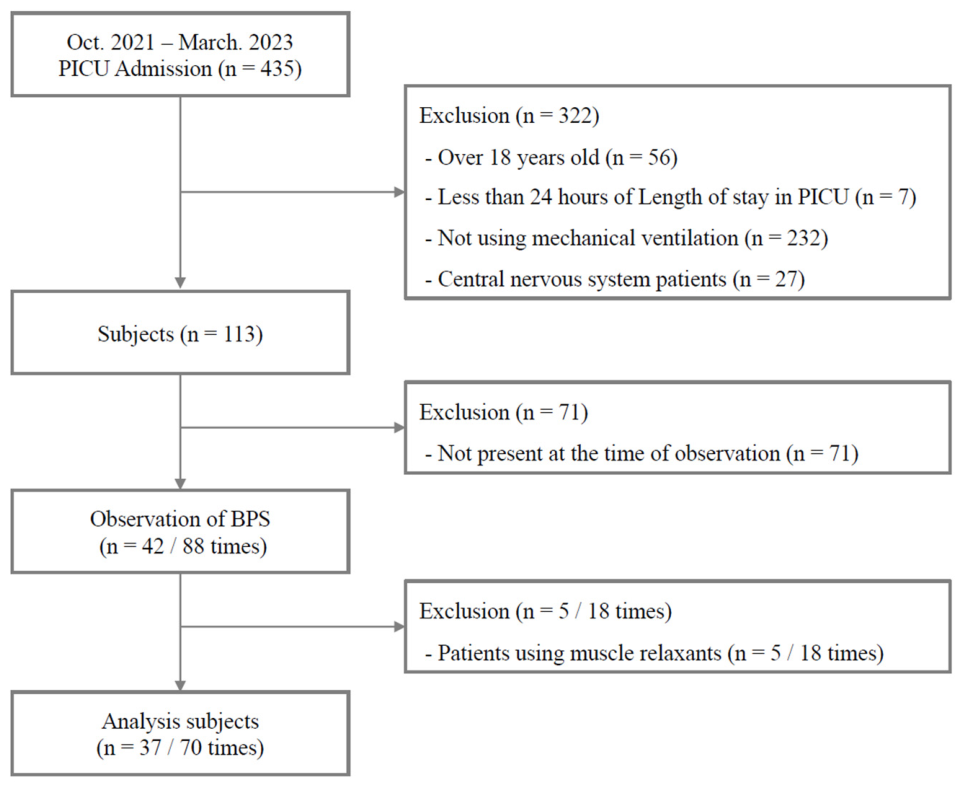
| Observations: 70 | |
|---|---|
| Male, n | 50 (71.4) |
| Age, Years | 1.7 ± 4.6 |
| Age, Months | 1 [0–8] |
| Age Category, n | |
| Neonate | 21 (30.0) |
| Neonate–Under 1 year old | 32 (45.6) |
| 1–2 years old | 7 (10.0) |
| 3–5 years old | 2 (2.9) |
| 6–12 years old | 2 (2.9) |
| 13–18 years old | 6 (8.6) |
| Body weight, kg | 4.4 [3.1–5.7] |
| Classification, n | |
| Cardiovascular disease | 51 (72.9) |
| Respiratory disease | 9 (12.9) |
| Infection | 6 (8.6) |
| Cerebrovascular disease | 4 (5.6) |
| pSOFA score | 6.8 ± 2.8 |
| Sedation use, n | |
| Fentanyl | 63 (90.0) |
| Midazolam | 58 (82.9) |
| Dexmedetomidine | 40 (57.1) |
| Deep sedation a, n | 48 (68.6) |
| Procedures b, n | 15 (21.4) |
| ICC (95% CI) | p | Weighted κ (95% CI) | p | |
|---|---|---|---|---|
| Observations: 70 | ||||
| All observations | 0.66 (0.55–0.76) | <0.01 | 0.53 (0.39–0.66) | <0.01 |
| Observers A–B | 0.69 (0.55–0.80) | <0.01 | 0.69 (0.50–0.90) | <0.01 |
| Observers B–C | 0.72 (0.58–0.82) | <0.01 | 0.71 (0.48–0.86) | <0.01 |
| Observers C–A | 0.60 (0.42–0.73) | <0.01 | 0.63 (0.28–0.81) | <0.01 |
| Compliance with ventilation | ||||
| All observations | - | - | 0.53 (0.41–0.65) | <0.01 |
| Observers A–B | - | - | 0.65 (0.51–0.79) | <0.01 |
| Observers B–C | - | - | 0.68 (0.48–0.85) | <0.01 |
| Observers C–A | - | - | 0.51 (0.23–0.68) | <0.01 |
| Movements of upper limbs | ||||
| All observations | - | - | 0.08 (−0.03–0.24) | 0.174 |
| Observers A–B | - | - | 0.49 (0.00–0.80) | <0.01 |
| Observers B–C | - | - | 0.00 (0.00–0.00) a | 1.00 |
| Observers C–A | - | - | 0.00 (0.00–0.00) a | 1.00 |
| Facial expression | ||||
| All observations | - | - | 0.38 (−0.03–0.69) b | <0.01 |
| Observers A–B | - | - | 0.38 (−0.04–1.00) b | <0.01 |
| Observers B–C | - | - | 0.36 (−0.05–0.74) b | <0.01 |
| Observers C–A | - | - | 0.42 (0.00–0.79) b | <0.01 |
Disclaimer/Publisher’s Note: The statements, opinions and data contained in all publications are solely those of the individual author(s) and contributor(s) and not of MDPI and/or the editor(s). MDPI and/or the editor(s) disclaim responsibility for any injury to people or property resulting from any ideas, methods, instructions or products referred to in the content. |
© 2026 by the authors. Licensee MDPI, Basel, Switzerland. This article is an open access article distributed under the terms and conditions of the Creative Commons Attribution (CC BY) license.
Share and Cite
Ikeda, M.; Hoshino, H.; Matsuishi, Y.; Kotani, M.; Kobayashi, S.; Kido, T.; Enomoto, Y.; Shimojo, N.; Inoue, Y. Applicability, Validity, and Reliability of the Japanese Version of the Behavioral Pain Scale for Critically Ill Mechanically Ventilated Pediatric Patients: A Prospective Cross-Sectional Observational Study. Children 2026, 13, 719. https://doi.org/10.3390/children13060719
Ikeda M, Hoshino H, Matsuishi Y, Kotani M, Kobayashi S, Kido T, Enomoto Y, Shimojo N, Inoue Y. Applicability, Validity, and Reliability of the Japanese Version of the Behavioral Pain Scale for Critically Ill Mechanically Ventilated Pediatric Patients: A Prospective Cross-Sectional Observational Study. Children. 2026; 13(6):719. https://doi.org/10.3390/children13060719
Chicago/Turabian StyleIkeda, Mitsuki, Haruhiko Hoshino, Yujiro Matsuishi, Misaki Kotani, Shunsuke Kobayashi, Takahiro Kido, Yuki Enomoto, Nobutake Shimojo, and Yoshiaki Inoue. 2026. "Applicability, Validity, and Reliability of the Japanese Version of the Behavioral Pain Scale for Critically Ill Mechanically Ventilated Pediatric Patients: A Prospective Cross-Sectional Observational Study" Children 13, no. 6: 719. https://doi.org/10.3390/children13060719
APA StyleIkeda, M., Hoshino, H., Matsuishi, Y., Kotani, M., Kobayashi, S., Kido, T., Enomoto, Y., Shimojo, N., & Inoue, Y. (2026). Applicability, Validity, and Reliability of the Japanese Version of the Behavioral Pain Scale for Critically Ill Mechanically Ventilated Pediatric Patients: A Prospective Cross-Sectional Observational Study. Children, 13(6), 719. https://doi.org/10.3390/children13060719