Article

Is Intravenous Magnesium Sulfate Beneficial in Children with Acute Asthma Exacerbation and Acute Bronchiolitis? A Retrospective Cohort Study


by
Yasin Selcuk Yardibi
1,
Begum Baris Cetinkaya
1,
Zeynep Tobcu
1,
Sevim Orum
1,
Dondu Ulker Ustebay
2 and
Sefer Ustebay
1,*
1
Department of Pediatrics, Faculty of Medicine, Bandırma Onyedi Eylül University, 10200 Bandırma, Türkiye
2
Department of Pediatric Neurology, Faculty of Medicine, Bandırma Onyedi Eylül University, 10200 Bandırma, Türkiye
*
Author to whom correspondence should be addressed.
Children 2026, 13(5), 704; https://doi.org/10.3390/children13050704 (registering DOI)
Submission received: 7 April 2026 / Revised: 6 May 2026 / Accepted: 19 May 2026 / Published: 20 May 2026
(This article belongs to the Section Pediatric Pulmonary and Sleep Medicine)

Highlights

What are the main findings?
  • Intravenous magnesium sulfate improved oxygen saturation in children with acute asthma exacerbations.
  • It reduced tachypnea in children with acute asthma exacerbations.
What are the implications of the main findings?
  • Early administration of IV magnesium sulfate is safe and effective for children with acute asthma exacerbations.
  • It may serve as a useful supportive treatment for children with severe respiratory distress.

Abstract

Background/Objectives: Asthma, one of the most common chronic diseases in childhood, and acute bronchiolitis, a leading cause of hospitalization in early childhood, remain significant contributors to morbidity and mortality. Methods: This retrospective cohort study evaluated the efficacy and safety of intravenous magnesium sulfate (IV MgSO4) as a secondary treatment in pediatric patients with acute asthma exacerbation unresponsive to first-line therapy and in patients with acute bronchiolitis unresponsive to supportive care. A total of 450 patients aged 6 months to 18 years, including 252 with acute asthma exacerbation and 198 with acute bronchiolitis, were included. Results: Significant improvements in peripheral capillary oxygen saturation were observed after IV MgSO4 administration in both groups (p < 0.001). In the acute asthma exacerbation group, IV MgSO4 also significantly reduced tachypnea compared to the acute bronchiolitis group (p < 0.001). No adverse effects related to IV MgSO4 were observed. Conclusions: These findings suggest that IV MgSO4 may be both beneficial and safe as an early secondary treatment in acute asthma exacerbations.

1. Introduction

Acute asthma exacerbations and acute bronchiolitis are common pediatric respiratory diseases causing substantial morbidity and health care costs. Asthma accounts for roughly 750,000 emergency department visits and 200,000 hospitalizations annually in the United States, while acute bronchiolitis, primarily of viral origin, is a leading cause of respiratory distress and hospitalization in children under 24 months [1,2,3,4,5].
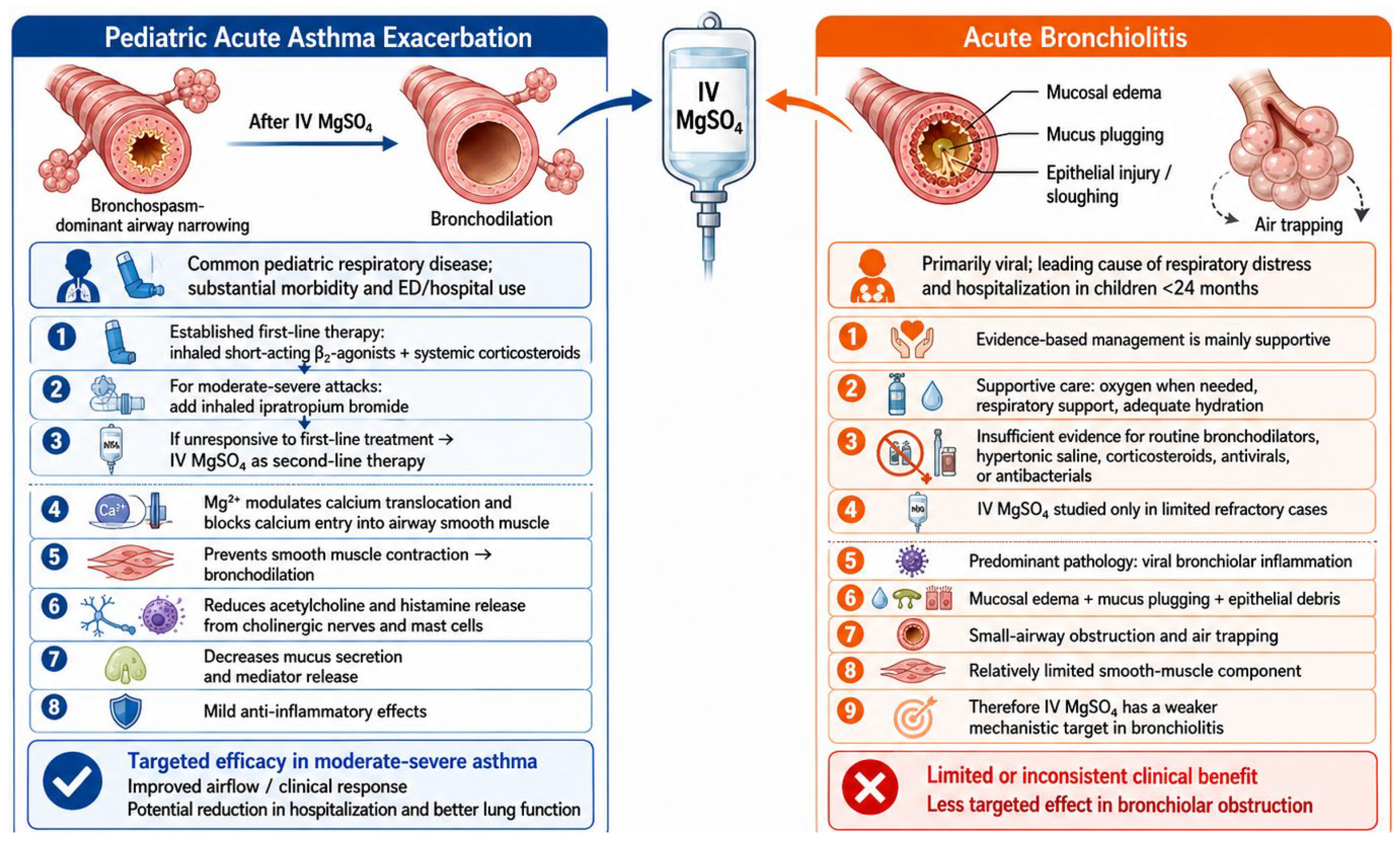
Magnesium plays a key role in calcium translocation across cell membranes and serves as a cofactor in numerous enzymatic reactions. It blocks calcium channels linked to N-methyl-D-aspartate (NMDA) receptors, preventing calcium entry into smooth muscle cells, thereby inhibiting contraction and producing a bronchodilator effect. Magnesium also reduces mucus secretion by inhibiting acetylcholine and histamine release from cholinergic nerves and mast cells and exhibits anti-inflammatory properties [4] (Figure 1).
First-line treatment of pediatric acute asthma exacerbations is well established and evidence-based. Initial management includes inhaled short-acting beta-2 agonists and systemic corticosteroids. In children and adolescents with moderate to severe exacerbations, inhaled ipratropium bromide is recommended in addition to beta-2 agonists as standard therapy [6,7].
Studies show that intravenous magnesium sulfate (IV MgSO4), a second-line therapy for children unresponsive to first-line treatment, is effective in managing moderate to severe asthma exacerbations [1,8,9,10]. Although some systematic reviews suggest that IV MgSO4 as a second-line therapy in pediatric acute asthma exacerbations may reduce hospitalization and improve lung function, a recent Cochrane review highlights limited evidence regarding its efficacy and safety due to small sample sizes and few studies [11,12,13,14].
Acute bronchiolitis usually follows a benign course, with most patients managed as outpatients; however, some cases may deteriorate rapidly, requiring respiratory support and admission to a pediatric intensive care unit. Current evidence-based management is primarily supportive, including oxygen therapy when needed, respiratory support, and adequate hydration. There is insufficient evidence to support other interventions, such as inhaled bronchodilators, hypertonic saline, corticosteroids, or antiviral and antibacterial agents [2,3]. The use of IV MgSO4 in pediatric patients with acute bronchiolitis unresponsive to supportive care has been evaluated in a limited number of studies [15,16,17].
The primary objective of this study was to assess the efficacy and safety of early IV MgSO4 as a second-line treatment in children with acute asthma exacerbations. The secondary objective was to evaluate its effects on clinical outcomes in moderate to severe acute bronchiolitis refractory to supportive treatment. The rationale for including both distinct disease entities in the same study was to directly contrast their differential clinical responses to IV MgSO4, thereby highlighting the targeted efficacy of the treatment in asthma compared to its limited benefit in bronchiolar obstruction.

2. Materials and Methods

2.1. Study Design and Setting

This retrospective observational cohort study was conducted in the emergency department of a tertiary care university hospital between 2021 and 2024.

2.2. Patient Selection

The medical records of a total of 1326 patients presenting with acute asthma exacerbation (n = 462) or acute bronchiolitis (n = 864) were retrospectively reviewed. Among these, 252 pediatric patients with acute asthma exacerbation who did not respond to first-line treatment (including inhaled short-acting beta-2 agonists and systemic corticosteroids) within the first two hours and subsequently received intravenous magnesium sulfate (MgSO4) as second-line therapy were included. Additionally, 198 patients with acute bronchiolitis who showed an inadequate response to supportive care and were treated with IV MgSO4 were also included. An inadequate response was defined as persistent hypoxemia, ongoing severe tachypnea, or lack of clinical improvement in respiratory distress despite standard oxygen therapy and adequate hydration. Patients diagnosed with asthma who had received initial treatment at other centers prior to presentation were excluded. The diagnosis of acute asthma exacerbation and the management of first-line treatment were defined in accordance with international guidelines (e.g., Global Initiative for Asthma—GINA). For the bronchiolitis group, only previously healthy patients with no history of prematurity were included. Based on these criteria, a total of 450 patients aged between 6 months and 18 years were included in the final analysis. IV MgSO4 was administered at a dose of 40 mg/kg (maximum 2 g). In patients who required a second dose due to ongoing respiratory distress, the time interval between the two doses was 1 h. The use of IV MgSO4 for the management of respiratory distress increased over the study period, with 26 patients (5.8%) in 2021, 96 patients (21.3%) in 2022, 149 patients (33.1%) in 2023, and 179 patients (39.8%) in 2024. This trend is consistent with previously reported literature [18,19,20,21,22,23].

2.3. Data Collection

Demographic characteristics, including age and gender, were recorded for all patients. Baseline assessments included blood gas parameters, peripheral capillary oxygen saturation (SpO2), heart rate, respiratory rate, and body temperature. Serum magnesium, sodium, and C-reactive protein (CRP) levels were measured prior to treatment. SpO2 and respiratory rate were re-evaluated after treatment. Pulmonary findings, including bronchospasm and auscultation findings, were assessed before and after treatment. Pre-treatment chest radiographs were evaluated for the presence of lung infiltration. Nasal swab polymerase chain reaction results for respiratory syncytial virus (RSV), influenza, and Severe Acute Respiratory Syndrome Coronavirus 2 (SARS-CoV-2) were analyzed to determine viral etiology.

2.4. Outcome Measures

Clinical improvement was primarily assessed based on changes in lung auscultation findings, as documented in medical records before and 1 h after the completion of IV MgSO4 treatment. Peripheral oxygen saturation levels measured before and 1 h after the treatment were analyzed statistically to evaluate treatment response. Additionally, respiratory rate (breaths per minute) prior to and 1 h following the infusion was compared to assess clinical improvement. Furthermore, patients were closely monitored during and after the infusion for potential adverse effects specific to IV MgSO4, including hypotension, bradycardia, flushing, and hypotonia. Patients were also evaluated according to the number of IV MgSO4 administrations, and its association with clinical response was analyzed. Hospitalization status was not included as an outcome measure, as all patients were admitted either to the pediatric ward or the intensive care unit.

2.5. Ethical Approval

The study was approved by the Non-Interventional Research Ethics Committee of Bandırma Onyedi Eylül University Faculty of Medicine (approval no. 2025-03-06; meeting date: 12 May 2025; decision no. 2025-6). The study was conducted in accordance with the Declaration of Helsinki.

2.6. Statistical Analysis

Data were summarized using descriptive statistics. Continuous variables were expressed as mean ± standard deviation or median (minimum–maximum), depending on the distribution. Categorical variables were presented as numbers and percentages. Normality of distribution was assessed using the Shapiro–Wilk test. The Mann–Whitney U test was used to compare continuous variables between two independent groups when parametric assumptions were not met. The Wilcoxon signed-rank test was used for paired comparisons (pre- and post-treatment measurements). Associations between categorical variables were evaluated using the chi-square (χ2) test. Statistical analyses were performed using MedCalc® Statistical Software version 22.009 (MedCalc Software Ltd., Ostend, Belgium), and a p-value of <0.05 was considered statistically significant.

3. Results

Among the 252 children with acute asthma exacerbation, 88 (35%) were female and 164 (65%) were male. Among the 198 children with moderate-to-severe acute bronchiolitis, 59 (30%) were female and 139 (70%) were male. The mean age was 88.0 ± 43.3 months in the asthma group and 14.2 ± 5.1 months in the bronchiolitis group (Table 1).
In the acute asthma exacerbation group, blood gas analysis showed normal oxygenation in 52% of patients, mild hypoxemia in 36.1%, moderate hypoxemia in 6.7%, and severe hypoxemia in 5.2%. In the moderate to severe bronchiolitis group, normal oxygenation was observed in 45.5% of patients, mild hypoxemia in 38.9%, moderate hypoxemia in 11.1%, and severe hypoxemia in 4.5%. Hyponatremia was observed in 29.8% of patients across both groups. Low serum magnesium levels were detected in 4.4% of patients with acute asthma exacerbation and 3.5% of patients with acute bronchiolitis (Table 2). Among patients with acute asthma exacerbation, 68 had mild hyponatremia (130–135 mEq/L), and 7 had moderate hyponatremia (125–130 mEq/L). In the acute bronchiolitis group, 50 out of 59 patients had mild hyponatremia, and 9 had moderate hyponatremia. No cases of severe hyponatremia (<125 mEq/L) were observed in either group (Table 2).
Intravenous MgSO4 was administered as a single dose in 194 (77%) patients with acute asthma exacerbation and as two doses in 58 (23%) patients. In the bronchiolitis group, 160 (80.8%) patients received a single dose and 38 (19.2%) received two doses. Improvement in lung auscultation findings was observed in 66.7% (n = 168) of asthma patients and 49.5% (n = 96) of bronchiolitis patients following IV MgSO4 administration (Table 2).
In both groups, a significant increase in SpO2 levels was observed following IV MgSO4 administration (p < 0.001) (Table 3). After treatment, improvement in respiratory rate was observed in 83.3% (n = 210) of asthma patients and 49.5% (n = 96) of bronchiolitis patients (Table 3).
In the asthma group, the number of IV MgSO4 doses did not have a significant effect on the reduction in respiratory rate (p = 0.255). However, a significantly greater reduction in tachypnea was observed in asthma patients compared to those with bronchiolitis, depending on the timing of IV MgSO4 administration (p < 0.001) (Table 4).

4. Discussion

The literature demonstrates considerable variability in secondary treatment approaches for pediatric acute asthma exacerbations, including regional differences in the use of intravenous albuterol/salbutamol, intravenous magnesium sulfate (IV MgSO4), and aminophylline [1,6,24,25,26]. Multicenter surveys of pediatric emergency physicians in the UK, Ireland, Australia, and New Zealand have reported differing preferences, reflecting regional practice patterns. Consistent with previous reports [18,19,20,21,22,23], the use of IV MgSO4 as a second-line treatment for acute asthma exacerbations has increased over the years in our single-center cohort, highlighting its growing role in pediatric asthma management.
In our study, early administration of IV MgSO4 as a second-line treatment for acute asthma exacerbation was associated with clinical improvement in approximately two-thirds of patients. Improvements were observed in bronchospasm, lung auscultation findings, oxygenation, and tachypnea. These results are consistent with prior studies indicating that early IV MgSO4 administration is safe and effective in pediatric asthma exacerbations [11,20,22]. In contrast, children with moderate-to-severe acute bronchiolitis exhibited a more limited response to IV MgSO4, with no significant effect on bronchospasm or lung auscultation findings, which aligns with previous reports [15,16,17]. While a modest improvement in oxygenation was noted, the overall clinical benefit appeared less pronounced compared with asthma exacerbations.
Although no significant difference was observed in respiratory rate reduction according to the number of IV MgSO4 administrations in children with acute asthma exacerbation, early administration was associated with a greater reduction in tachypnea compared to children with moderate-to-severe bronchiolitis. This suggests that early IV MgSO4 may be particularly effective in relieving respiratory distress in acute asthma, but its clinical benefit in bronchiolitis appears limited. The lack of significant improvement in tachypnea in patients with moderate-to-severe bronchiolitis, independent of dosing, is consistent with previous reports showing a lower response to magnesium treatment in bronchiolar obstruction [15,16,17]. All patients were admitted to either the pediatric ward or the intensive care unit following emergency department intervention, which prevented assessment of potential effects after hospital discharge. Importantly, consistent with previous studies, no adverse effects were observed with IV MgSO4, supporting its safety in pediatric populations [1].
Epidemiological studies indicate a higher incidence of asthma in males during early childhood (0–9 years) [27], which aligns with the gender distribution observed in our cohort. Viral infections, particularly RSV, have been increasingly linked to bronchiolitis and subsequent preschool wheezing or asthma [28]. In line with previous studies, RSV remained the most common viral cause of bronchiolitis in our cohort, followed by influenza and SARS-CoV-2 [29]. These findings reinforce the central role of RSV in pediatric bronchiolitis and highlight the need for further investigation of SARS-CoV-2 in this context.
Hyponatremia in acute asthma exacerbations and moderate-to-severe bronchiolitis was generally mild to moderate and transient. Although all patients were normovolemic, inappropriate antidiuretic hormone (ADH) secretion may have contributed, but serum and urine osmolality measurements were not available to confirm this mechanism. Other factors, such as hypotonic fluid administration and excessive hydration, may worsen sodium imbalance. While usually asymptomatic, hyponatremia can cause neurological complications in susceptible patients. Careful monitoring of fluid and electrolyte balance is therefore recommended [30,31,32].
Serum magnesium levels have been investigated in relation to asthma, with some studies suggesting a protective effect of higher dietary magnesium intake, while others report no significant differences between patients and controls [33,34]. In our cohort, no significant decrease in serum magnesium levels was detected in children with acute asthma exacerbation or acute bronchiolitis.
This study has several limitations. The retrospective, observational design precluded assessment of the superiority of IV MgSO4 over alternative second-line therapies, and the lack of standardized clinical scores limited detailed comparative analyses. Importantly, the absence of a comparator group limits our ability to definitively isolate the specific effect of IV MgSO4, as the observed clinical improvements could partially reflect natural disease progression, the delayed effects of ongoing first-line therapies (such as bronchodilators and corticosteroids), or standard supportive care (including oxygen therapy). Reliance on physician-documented lung auscultation findings as a primary outcome is inherently subjective and may introduce observer bias. Moreover, due to the retrospective nature of the study based on emergency department visits, detailed data on atopic history and pulmonary function test results were not routinely available for all patients during the acute attack. Furthermore, data on the impact of IV MgSO4 on hospital length of stay could not be evaluated. Additionally, CRP, lung infiltration findings, temperature, and serum sodium and magnesium levels were reported proportionally, preventing correlation with other clinical parameters.
Despite these limitations, our study has several strengths. Unlike most previous studies, our relatively large cohort provides valuable evidence regarding IV MgSO4 as a second-line treatment for pediatric acute asthma exacerbation and bronchiolitis. Furthermore, our study is among the few evaluating early IV MgSO4 administration, investigating viral etiologies, and reporting serum sodium and magnesium levels, enhancing its contribution to the literature.

5. Conclusions

Intravenous magnesium sulfate administration as a second-line treatment in children with acute bronchiolitis who did not respond to supportive therapy did not result in significant clinical improvement, consistent with previous studies. In contrast, early administration of IV MgSO4 in children with acute asthma exacerbations was associated with significant improvements in tachypnea, lung auscultation findings, and oxygen saturation. No adverse effects related to IV MgSO4 were observed in either patient group.
These findings indicate that early IV MgSO4 administration may be both safe and beneficial in pediatric acute asthma exacerbations. Further prospective, controlled studies are needed to confirm its efficacy and safety profile across different pediatric respiratory conditions.

Author Contributions

Conceptualization, S.U. and Y.S.Y.; Formal Analysis, S.U.; Methodology, S.U., Y.S.Y. and D.U.U.; Data Curation, Y.S.Y., Z.T., S.O., B.B.C. and D.U.U.; Writing—Original Draft, S.U.; Writing—Review and Editing, S.U., Y.S.Y., Z.T., S.O., B.B.C. and D.U.U. All authors have read and agreed to the published version of the manuscript.

Funding

This research received no external funding.

Institutional Review Board Statement

This study was approved by the Ethics Committee of Bandırma Onyedi Eylül University Faculty of Medicine on 12 May 2025 (Approval Number: 2025-03-06), and all procedures were conducted in accordance with the Declaration of Helsinki.

Informed Consent Statement

Patient consent was waived due to the retrospective nature of the study.

Data Availability Statement

The data presented in this study are available upon request from the corresponding author. Data are not publicly available for confidentiality and ethical reasons.

Acknowledgments

The authors thank the emergency department clinical staff for their support in patient management.

Conflicts of Interest

The authors declare no conflicts of interest.

Abbreviations

The following abbreviations are used in this manuscript:
IV MgSO4İntravenous magnesium sulfate
SpO2Peripheral capillary oxygen saturation
CRPC-reactive protein
RSVRespiratory syncytial virus

References

  1. Ambrożej, D.; Adamiec, A.; Forno, E.; Orzołek, I.; Feleszko, W.; Castro-Rodriguez, J.A. Intravenous magnesium sulfate for asthma exacerbations in children: Systematic review with meta-analysis. Paediatr. Respir. Rev. 2024, 52, 23–30. [Google Scholar] [CrossRef]
  2. Şık, N.; Çitlenbik, H.; Öztürk, A.; Yılmaz, D.; Duman, M. Intravenous Magnesium Sulfate for Acute Bronchiolitis: Evaluation of the Effect on Clinical Course and Outcomes. Clin. Pediatr. 2023, 63, 208–213. [Google Scholar] [CrossRef]
  3. Ralston, S.; Comick, A.; Nichols, E.; Parker, D.; Lanter, P. Effectiveness of Quality Improvement in Hospitalization for Bronchiolitis: A Systematic Review. Pediatrics 2014, 134, 571–581. [Google Scholar] [CrossRef] [PubMed]
  4. Nurmagambetov, T.; Kuwahara, R.; Garbe, P. The economic burden of asthma in the United States, 2008–2013. Ann. Am. Thorac. Soc. 2018, 15, 348–356. [Google Scholar] [CrossRef] [PubMed]
  5. Zhang, L.; Mendoza-Sassi, R.A.; Wainwright, C.; Klassen, T.P. Nebulised hypertonic saline solution for acute bronchiolitis in infants. Cochrane Database Syst. Rev. 2017, 12, CD006458. [Google Scholar] [CrossRef] [PubMed]
  6. Global Initiative for Asthma. Global Initiative for Asthma 2023. Available online: www.ginasthma.org (accessed on 1 May 2026).
  7. Rodrigo, G.J.; Castro-Rodriguez, J.A. Anticholinergics in the treatment of children and adults with acute asthma: A systematic review with meta-analysis. Thorax 2005, 60, 740–746, Correction in Thorax 2005, 65, 1118. [Google Scholar] [CrossRef]
  8. Mohammed, S.; Goodacre, S. Intravenous and nebulised magnesium sulphate for acute asthma: Systematic review and meta-analysis. Emerg. Med. J. 2007, 24, 823–830. [Google Scholar] [CrossRef]
  9. Shan, Z.; Rong, Y.; Yang, W.; Wang, D.; Yao, P.; Xie, J.; Liu, L. Intravenous and nebulized magnesium sulfate for treating acute asthma in adults and children: A systematic review and meta-analysis. Respir. Med. 2013, 107, 321–330. [Google Scholar] [CrossRef]
  10. Griffiths, B.; Kew, K.M.; Normansell, R. Intravenous magnesium sulfate for treating children with acute asthma in the emergency department. Paediatr. Respir. Rev. 2016, 20, 45–47. [Google Scholar] [CrossRef]
  11. Ciarallo, L.; Sauer, A.H.; Shannon, M.W. Intravenous magnesium therapy for moderate to severe pediatric asthma: Results of a randomized, placebo-controlled trial. J. Pediatr. 1996, 129, 809–814. [Google Scholar] [CrossRef]
  12. Ciarallo, L.; Brousseau, D.; Reinert, S. Higher-Dose Intravenous Magnesium Therapy for Children with Moderate to Severe Acute Asthma. Arch. Pediatr. Adolesc. Med. 2000, 154, 979–983. [Google Scholar] [CrossRef]
  13. Scarfone, R.J.; Loiselle, J.M.; Joffe, M.D.; Mull, C.C.; Stiller, S.; Thompson, K.; Gracely, E.J. A randomized trial of magnesium in the emergency department treatment of children with asthma. Ann. Emerg. Med. 2000, 36, 572–578. [Google Scholar] [CrossRef]
  14. Kassisse, E.; Jimenez, J.; Mayo, N.; Limongi, J.K. Magnesium sulfate vs aminophylline as a second line of treatment in children with severe acute asthma: Randomized clinical trial. Andes Pediatr. 2021, 92, 367–374. [Google Scholar] [CrossRef]
  15. Modaresi, M.R.; Faghihinia, J.; Kelishadi, R.; Reisi, M.; Mirlohi, S.; Pajhang, F.; Sadeghian, M. Nebulized Magnesium Sulfate in Acute Bronchiolitis: A Randomized Controlled Trial. Indian J. Pediatr. 2015, 82, 794–798. [Google Scholar] [CrossRef]
  16. Kose, M.; Ozturk, M.A.; Poyrazoğlu, H.; Elmas, T.; Ekinci, D.; Tubas, F.; Kurt, T.; Goktas, M.A. The efficacy of nebulized salbutamol, magnesium sulfate, and salbutamol/magnesium sulfate combination in moderate bronchiolitis. Eur. J. Pediatr. 2014, 173, 1157–1160. [Google Scholar] [CrossRef]
  17. Alansari, K.; Sayyed, R.; Davidson, B.L.; Al Jawala, S.; Ghadier, M. IV Magnesium Sulfate for Bronchiolitis. Chest 2017, 152, 113–119. [Google Scholar] [CrossRef]
  18. Lyttle, M.D.; O’SUllivan, R.; Doull, I.; Hartshorn, S.; Morris, I.; Powell, C.V.E. Variation in treatment of acute childhood wheeze in emergency departments of the United Kingdom and Ireland: An international survey of clinician practice. Arch. Dis. Child. 2014, 100, 121–125. [Google Scholar] [CrossRef] [PubMed]
  19. Babl, F.E.; Sheriff, N.; Borland, M.; Acworth, J.; Neutze, J.; Krieser, D.; Ngo, P.; Schutz, J.; Thomson, F.; Cotterell, E.; et al. Paediatric acute asthma management in Australia and New Zealand: Practice patterns in the context of clinical practice guidelines. Arch. Dis. Child. 2008, 93, 307–312. [Google Scholar] [CrossRef] [PubMed]
  20. Johnson, M.D.; Zorc, J.J.; Nelson, D.S.; Casper, T.C.; Cook, L.J.; Finkelstein, Y.; Babcock, L.; Bajaj, L.; Chamberlain, J.M.; Grundmeier, R.W.; et al. Intravenous Magnesium in Asthma Pharmacotherapy: Variability in Use in the PECARN Registry. J. Pediatr. 2020, 220, 165–174.e2. [Google Scholar] [CrossRef] [PubMed]
  21. Mittal, V.; Hall, M.; Antoon, J.; Gold, J.; Kenyon, C.; Parikh, K.; Morse, R.; Quinonez, R.; Ii, R.J.T.; Shah, S.S. Trends in Intravenous Magnesium Use and Outcomes for Status Asthmaticus in Children’s Hospitals from 2010 to 2017. J. Hosp. Med. 2020, 15, 403–406. [Google Scholar] [CrossRef]
  22. DeLaroche, A.M.; Mowbray, F.I.; Bohsaghcheghazel, M.; Zalewski, K.; Obudzinski, K. Early versus delayed administration of intravenous magnesium sulfate for pediatric asthma. Am. J. Emerg. Med. 2021, 50, 36–40. [Google Scholar] [CrossRef]
  23. Johnson, M.D.; Barney, B.J.; Rower, J.E.; Finkelstein, Y.; Zorc, J.J. Intravenous Magnesium: Prompt Use for Asthma in Children Treated in the Emergency Department (IMPACT-ED): Protocol for a Multicenter Pilot Randomized Controlled Trial. JMIR Res. Protoc. 2023, 12, e48302. [Google Scholar] [CrossRef]
  24. National Asthma Education and Prevention Program. Expert Panel Report 3 (EPR-3): Guidelines for the diagnosis and man-agement of asthma—Summary report. J. Allergy Clin. Immunol. 2007, 120, 94–138. [Google Scholar] [CrossRef]
  25. Australia NAC. Australian Asthma Handbook. 2023. Available online: http://www.asthmahandbook.org.au (accessed on 1 April 2026).
  26. Scottish Intercollegiate Guidelines Network BTS. British Guideline on the Management of Asthma: A National Clinical Guideline. 2003. Available online: https://www.sign.ac.uk/media/1773/sign158-updated.pdf (accessed on 15 April 2026).
  27. Honkamäki, J.; Hisinger-Mölkänen, H.; Ilmarinen, P.; Piirilä, P.; Tuomisto, L.E.; Andersén, H.; Huhtala, H.; Sovijärvi, A.; Backman, H.; Lundbäck, B.; et al. Age- and gender-specific incidence of new asthma diagnosis from childhood to late adulthood. Respir. Med. 2019, 154, 56–62. [Google Scholar] [CrossRef] [PubMed]
  28. Makrinioti, H.; Hasegawa, K.; Lakoumentas, J.; Xepapadaki, P.; Tsolia, M.; Castro-Rodriguez, J.A.; Feleszko, W.; Jartti, T.; Johnston, S.L.; Bush, A.; et al. The role of respiratory syncytial virus- and rhinovirus-induced bronchiolitis in recurrent wheeze and asthma—A systematic review and meta-analysis. Pediatr. Allergy Immunol. 2022, 33, e13741. [Google Scholar] [CrossRef] [PubMed]
  29. Kenmoe, S.; Kengne-Nde, C.; Ebogo-Belobo, J.T.; Mbaga, D.S.; Modiyinji, A.F.; Njouom, R. Systematic review and meta-analysis of the prevalence of common respiratory viruses in children <2 years with bronchiolitis in the pre-COVID-19 pandemic era. PLoS ONE 2020, 15, e0242302. [Google Scholar] [CrossRef]
  30. Al Shibli, A.; Abukhater, D.; Al Kuwaiti, N.; Noureddin, M.B.; Al Harbi, M.; Al Kaabi, A.; Al Kaabi, S.; Hamie, M.; Al Amri, A.; Narchi, H. Hyponatraemia and neurological complications in children admitted with bronchiolitis. Ann. Trop. Paediatr. 2016, 36, 175–180. [Google Scholar] [CrossRef]
  31. Hanna, S.; Tibby, S.; Durward, A.; Murdoch, I. Incidence of hyponatraemia and hyponatraemic seizures in severe respiratory syncytial virus bronchiolitis. Acta Paediatr. 2003, 92, 430–434. [Google Scholar] [CrossRef]
  32. Shirane, S.; Hamada, R.; Morikawa, Y.; Harada, R.; Hamasaki, Y.; Ishikura, K.; Honda, M.; Hataya, H. Frequency and severity of hyponatremia in healthy children with acute illness. Pediatr. Nephrol. 2024, 40, 765–772. [Google Scholar] [CrossRef]
  33. Kakish, K.S. Serum Magnesium Levels in Asthmatic Children During and Between Exacerbations. Arch. Pediatr. Adolesc. Med. 2001, 155, 181–183. [Google Scholar] [CrossRef]
  34. Kazaks, A.G.; Uriu-Adams, J.Y.; Albertson, T.E.; Stern, J.S. Multiple Measures of Magnesium Status Are Comparable in Mild Asthma and Control Subjects. J. Asthma 2006, 43, 783–788. [Google Scholar] [CrossRef]
Figure 1. Differential rationale and response to early intravenous magnesium sulfate in pediatric acute asthma exacerbation and acute bronchiolitis.
Children 13 00704 g001
Table 1. Demographic data.
Asthma (n, %)Bronchiolitis (n, %)
GenderMale88 (34.9%)59 (29.8%)
Female164 (65.1%)139 (70.2%)
Age (months)Median (min-max)88.0 ± 43.314.2 ± 5.1
Mean ± SD73.5 (24–178)13 (5–29)
Table 2. Patient data.
Asthma
(n, %)
Bronchiolitis
(n, %)
Nasal swabRSV (+)2 (0.8%)114 (57.6%)
SARS-CoV-2 (+)7 (2.8%)1 (0.5%)
Influenza (+)30 (12%)32 (16.2%)
Negative174 (69%)40 (20.2%)
No result37 (14.6%)4 (2%)
RSV + SARS-CoV-20 (0%)5 (2.5%)
RSV + Influenza1 (0.4%)2 (1%)
SARS-CoV-2 + Influenza1 (0.4%)0(0%)
Blood gas acid-base statusNormal107(42.5%)64 (32.3%)
Respiratory acidosis100 (39.7%)129 (65.2%)
Respiratory Alkalosis45 (17.8%)5 (2.5%)
Blood gas oxygenationNormal131 (52%)90 (45.5%)
Mild hypoxemia91 (36.1%)77 (38.9%)
Moderate hypoxemia17 (6.7%)22 (11.1%)
Severe hypoxemia13 (5.2%)9 (4.5%)
SodiumNormal175 (69.4%)137 (69.2%)
Hyponatremia75 (29.8%)59 (29.8%)
Hypernatremia2 (0.8%)2 (1%)
MagnesiumNormal241 (95.6%)191 (96.5%)
Hypomagnesemia11 (4.4%)7 (3.5%)
CRPNegative158 (62.7%)118 (59.6%)
Positive94 (37.3%)80 (40.4%)
FeverNone193 (76.6%)66 (33.3%)
Yes59 (23.4%)132 (66.7%)
Heart RateNormal173 (68.7%)116 (58.6%)
Tachycardia79 (31.3%)82 (41.4%)
Infiltration on chest X-rayNo pathology176 (69.8%)163 (82.3%)
Pathology present76 (30.2%)35 (17.7%)
Number of IV MgSO4 Applications1194 (77%)160 (80.8%)
258 (23%)38 (19.2%)
Lung auscultation findingsNo response84 (33.3%)102 (51.5%)
Response present168 (66.7%)96 (49.5%)
Table 3. IV MgSO4 treatment, SpO2, and respiratory rate changes.
Acute Asthma Exacerbation
SpO2
BeforeAfterDifferencep
Mean ± SD92.7 ± 2.296.2 ± 2.53.5 ± 2.2<0.001
Median (min-max)93 (84–96)97 (88–100)4 (−2–9)
Acute Bronchiolitis
SpO2
BeforeAfterDifferencep
Mean ± SD92.3 ± 2.195.1 ± 2.92.9 ± 2.1<0.001
Median (min-max)92 (85–96)96 (88–99)3 (−3–8)
Respiratory rate per minuteAcute Asthma Attack
(n = 252)
Acute Bronchiolitis
(n = 198)
Tachypnea subsided210 (83.3%)96 (49.5%)
Tachypnea persists 42 (16.7%)102 (51.5%)
Table 4. Tachypnea response according to disease group and number of IV MgSO4 administrations.
Number of IV MgSO4Disease GroupClinical Response
(−)
n (%)
Clinical Response
(+)
n (%)
Intergroup
p-Value
Intragroup
p-Value
First ApplicationAcute asthma exacerbation29 (14.9%)165 (85.1%)<0.001 a0.255 c
Acute bronchiolitis72 (45.0%)88 (55.0%) 0.067 c
Second ApplicationsAcute asthma exacerbation13 (22.4%)45 (77.6%)<0.001 b
Acute bronchiolitis24 (63.2%)14 (36.8%)
IV MgSO4, intravenous magnesium sulfate. Intergroup p-values compare acute asthma exacerbation and acute bronchiolitis within the same IV MgSO4 administration sequence. Intragroup p-values compare one and two IV MgSO4 administrations within each disease group. a Pearson chi-square test for intergroup comparisons; b Yates continuity correction; c Pearson chi-square test for intragroup comparisons.
Disclaimer/Publisher’s Note: The statements, opinions and data contained in all publications are solely those of the individual author(s) and contributor(s) and not of MDPI and/or the editor(s). MDPI and/or the editor(s) disclaim responsibility for any injury to people or property resulting from any ideas, methods, instructions or products referred to in the content.