Advanced Resuscitation with an Intact Cord in Preterm Lambs: A Feasibility Trial
 , ,
, ,
Highlights
- Direct umbilical venous epinephrine administration during delayed cord clamping significantly shortened the time to first epinephrine compared to immediate cord clamping with umbilical vein catheter (UVC) placement.
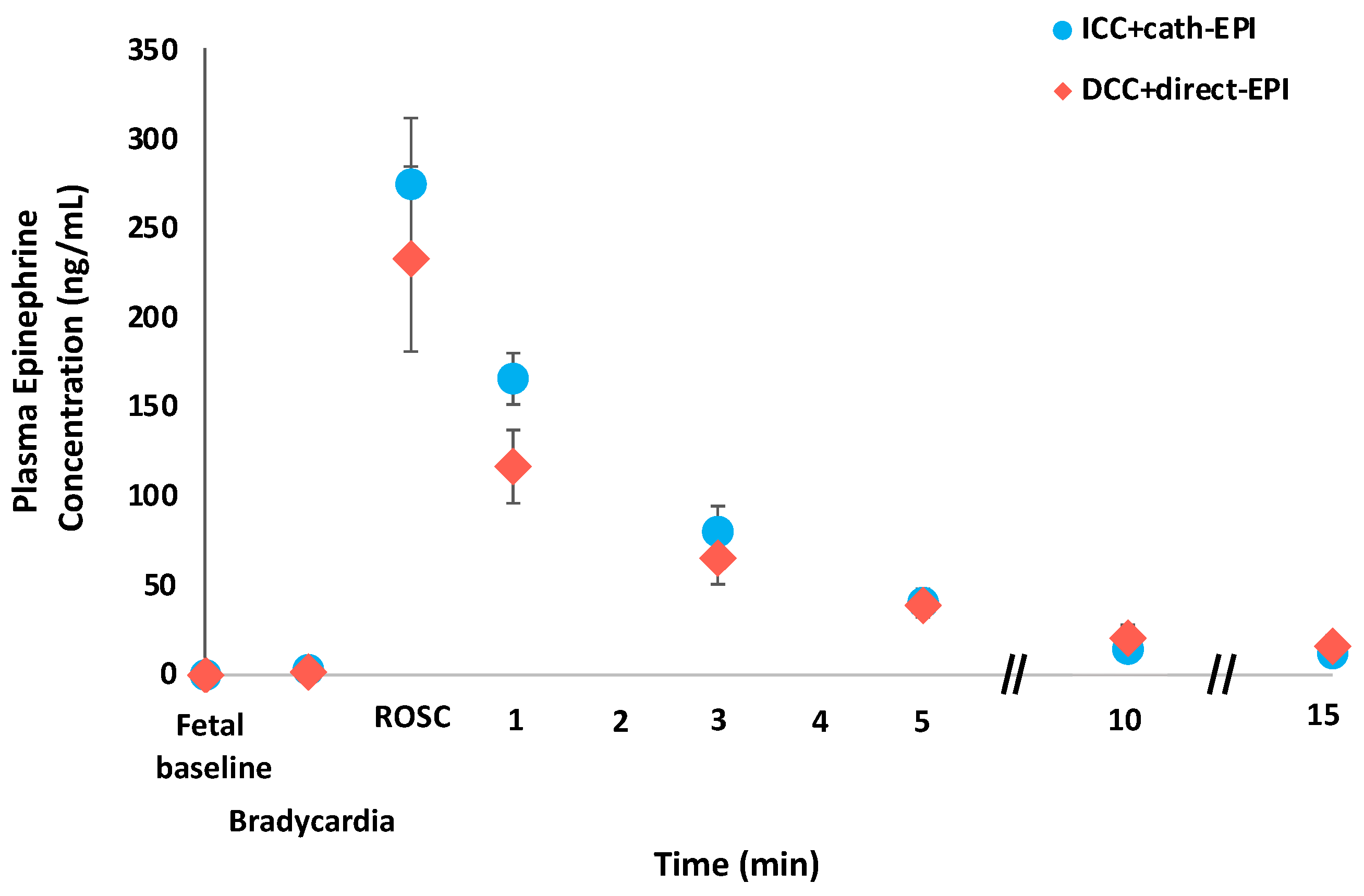
- Resuscitation with an intact cord achieved similar return of spontaneous circulation rates and epinephrine plasma concentrations compared to immediate cord clamping and UVC epinephrine.
- Advanced resuscitation with an intact cord using direct umbilical venous epinephrine is feasible and may allow earlier pharmacologic intervention without delaying stabilization.
- This approach has the potential to minimize chest compressions and improve hemodynamic stability, supporting further investigation as an alternative resuscitation strategy in preterm infants.
Abstract
1. Introduction
2. Materials and Methods
2.1. Animal Preparation
2.2. Experimental Protocol
- (1)
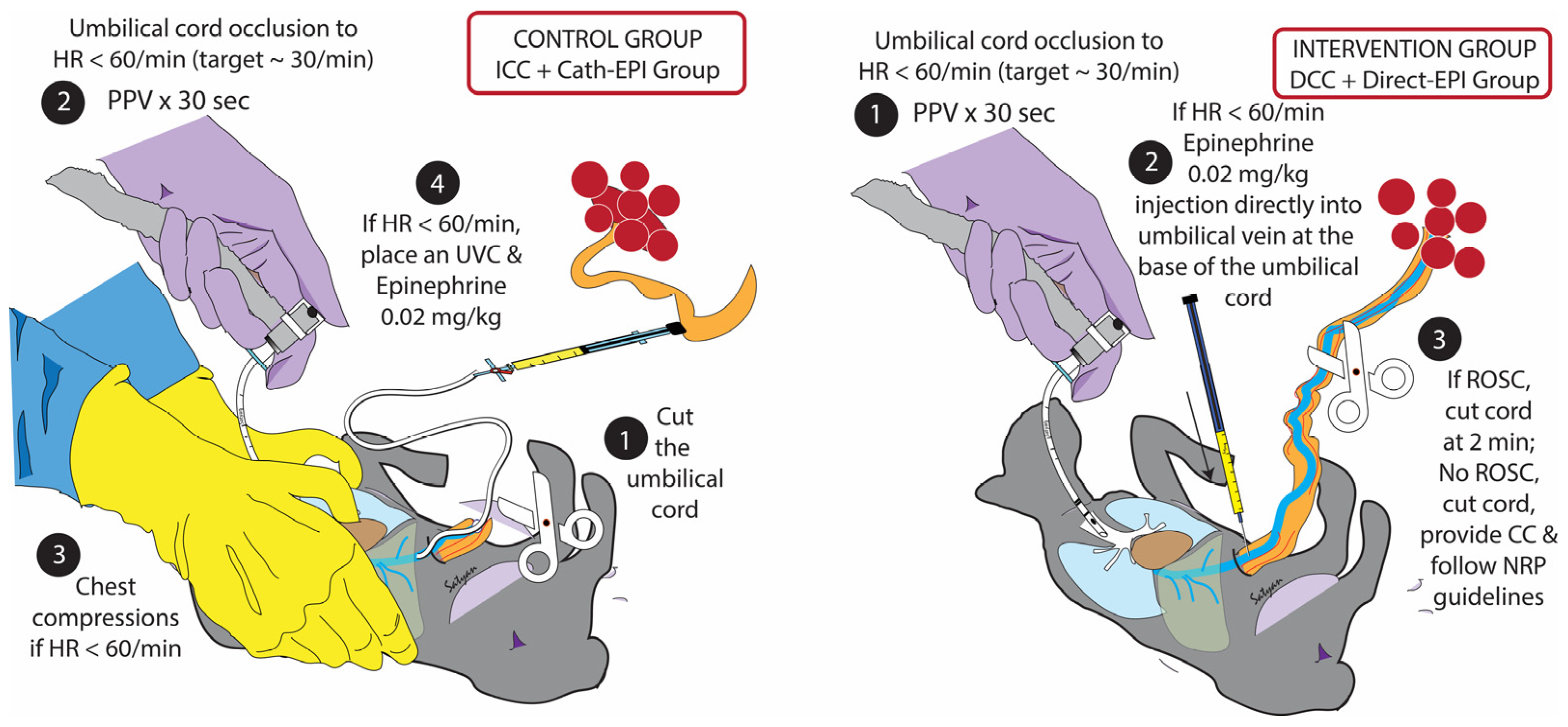
- Control group (ICC + cath-EPI): The umbilical cord was immediately tied, the lamb delivered and placed on the radiant warmer. Positive pressure ventilation (PPV) was initiated with a T-piece resuscitator at 35/5 cm H2O and 30% O2. If the heart rate remained below 60 bpm after 30 s of effective ventilation, chest compressions were started at a compression-to-ventilation ratio (C:V) of 3:1 and oxygen increased to 100%. Preparations to place a UV catheter (UVC) began upon initiation of chest compressions. Once the UVC was inserted and if the heart rate remained <60 bpm, EPI at 0.02 mg/kg (followed by a flush of 3 mL of normal saline) was administered. EPI was repeated every three minutes until ROSC or a maximum of 4 doses.
- (2)
- Intervention group (DCC + direct-EPI): The pinch to compress the umbilical cord was released, and the lamb was ventilated as described above with an intact cord. If the heart rate remained <60 bpm, EPI at 0.02 mg/kg (reconstituted in 3 mL of normal saline) was directly injected into the UV at the base of the umbilicus utilizing a 25-gauge butterfly needle. If the heart rate increased over 100 bpm, DCC was continued for a total of two minutes. If the heart rate remained between 60 and 100 bpm, the umbilical cord was clamped and cut at one minute, and the lamb was delivered onto the radiant warmer. If the heart rate remained <60 bpm, chest compressions were started, and after one minute, the umbilical cord was clamped and cut, and the lamb was delivered. Resuscitation continued per NRP guidelines with chest compressions provided in a 3:1 ratio to ventilation. Preparations were made to place a UVC, and subsequent EPI was administered through the UVC. EPI was repeated every three minutes until ROSC or a maximum of 4 doses.
2.3. Euthanasia
2.4. Statistical Analysis
3. Results
3.1. Return of Spontaneous Circulation and Need for Chest Compressions
3.2. EPI Plasma Concentrations
3.3. Hemodynamic Parameters
3.4. Hematologic Parameters
3.5. Secondary Analysis
4. Discussion
5. Conclusions
Supplementary Materials
Author Contributions
Funding
Institutional Review Board Statement
Informed Consent Statement
Data Availability Statement
Conflicts of Interest
Abbreviations
| CCs | chest compressions |
| DCC | delayed cord clamping |
| EPI | epinephrine |
| ICC | immediate cord clamping |
| PPV | positive pressure ventilation |
| ROSC | return of spontaneous circulation |
| UV | umbilical vein |
References
- Martin, J.A.; Hamilton, B.E.; Osterman, M.J.K. Births in the united states, 2017. NCHS Data Brief 2018, 318, 1–8. [Google Scholar]
- DeMauro, S.B.; Roberts, R.S.; Davis, P.; Alvaro, R.; Bairam, A.; Schmidt, B.; Caffeine for Apnea of Prematurity Trial Investigators. Impact of delivery room resuscitation on outcomes up to 18 months in very low birth weight infants. J. Pediatr. 2011, 159, 546–550.e541. [Google Scholar] [CrossRef]
- Shah, P.S. Extensive cardiopulmonary resuscitation for vlbw and elbw infants: A systematic review and meta-analyses. J. Perinatol. 2009, 29, 655–661. [Google Scholar] [CrossRef]
- Fischer, N.; Soraisham, A.; Shah, P.S.; Synnes, A.; Rabi, Y.; Singhal, N.; Ting, J.Y.; Creighton, D.; Dewey, D.; Ballantyne, M.; et al. Extensive cardiopulmonary resuscitation of preterm neonates at birth and mortality and developmental outcomes. Resuscitation 2019, 135, 57–65. [Google Scholar] [CrossRef] [PubMed]
- Wyckoff, M.H.; Salhab, W.A.; Heyne, R.J.; Kendrick, D.E.; Stoll, B.J.; Laptook, A.R.; National Institute of Child Health and Human Development Neonatal Research Network. Outcome of extremely low birth weight infants who received delivery room cardiopulmonary resuscitation. J. Pediatr. 2012, 160, 239–244.e232. [Google Scholar] [CrossRef]
- Katheria, A.C.; Rich, W.D.; Bava, S.; Lakshminrusimha, S. Placental transfusion for asphyxiated infants. Front. Pediatr. 2019, 7, 473. [Google Scholar] [CrossRef] [PubMed]
- Aziz, K.; Lee, H.C.; Escobedo, M.B.; Hoover, A.V.; Kamath-Rayne, B.D.; Kapadia, V.S.; Magid, D.J.; Niermeyer, S.; Schmölzer, G.M.; Szyld, E.; et al. Part 5: Neonatal resuscitation: 2020 american heart association guidelines for cardiopulmonary resuscitation and emergency cardiovascular care. Circulation 2020, 142, S524–S550. [Google Scholar] [CrossRef]
- Lee, H.C.; Strand, M.L.; Finan, E.; Illuzzi, J.; Kamath-Rayne, B.D.; Kapadia, V.; Mahgoub, M.; Niermeyer, S.; Schexnayder, S.M.; Schmölzer, G.M.; et al. Part 5: Neonatal resuscitation: 2025 american heart association and american academy of pediatrics guidelines for cardiopulmonary resuscitation and emergency cardiovascular care. Circulation 2025, 152, S385–S423. [Google Scholar] [CrossRef]
- Polglase, G.R.; Blank, D.A.; Barton, S.K.; Miller, S.L.; Stojanovska, V.; Kluckow, M.; Gill, A.W.; LaRosa, D.; Te Pas, A.B.; Hooper, S.B. Physiologically based cord clamping stabilises cardiac output and reduces cerebrovascular injury in asphyxiated near-term lambs. Arch. Dis. Child. Fetal Neonatal Ed. 2018, 103, F530–F538. [Google Scholar] [CrossRef] [PubMed]
- Bhatt, S.; Alison, B.J.; Wallace, E.M.; Crossley, K.J.; Gill, A.W.; Kluckow, M.; te Pas, A.B.; Morley, C.J.; Polglase, G.R.; Hooper, S.B. Delaying cord clamping until ventilation onset improves cardiovascular function at birth in preterm lambs. J. Physiol. 2013, 591, 2113–2126. [Google Scholar] [CrossRef]
- Katheria, A.C.; Brown, M.K.; Faksh, A.; Hassen, K.O.; Rich, W.; Lazarus, D.; Steen, J.; Daneshmand, S.S.; Finer, N.N. Delayed cord clamping in newborns born at term at risk for resuscitation: A feasibility randomized clinical trial. J. Pediatr. 2017, 187, 313–317.e311. [Google Scholar] [CrossRef] [PubMed]
- Blank, D.A.; Badurdeen, S.; Omar, F.; Kamlin, C.; Jacobs, S.E.; Thio, M.; Dawson, J.A.; Kane, S.C.; Dennis, A.T.; Polglase, G.R.; et al. Baby-directed umbilical cord clamping: A feasibility study. Resuscitation 2018, 131, 1–7. [Google Scholar] [CrossRef] [PubMed]
- Katheria, A.C.; Sorkhi, S.R.; Hassen, K.; Faksh, A.; Ghorishi, Z.; Poeltler, D. Acceptability of bedside resuscitation with intact umbilical cord to clinicians and patients’ families in the united states. Front. Pediatr. 2018, 6, 100. [Google Scholar] [CrossRef]
- Mercer, J.; Erickson-Owens, D.; Rabe, H.; Jefferson, K.; Andersson, O. Making the argument for intact cord resuscitation: A case report and discussion. Children 2022, 9, 517. [Google Scholar] [CrossRef]
- Seidler, A.L.; Aberoumand, M.; Hunter, K.E.; Barba, A.; Libesman, S.; Williams, J.G.; Shrestha, N.; Aagerup, J.; Sotiropoulos, J.X.; Montgomery, A.A.; et al. Deferred cord clamping, cord milking, and immediate cord clamping at preterm birth: A systematic review and individual participant data meta-analysis. Lancet 2023, 402, 2209–2222. [Google Scholar] [CrossRef]
- Agrawal, V.; Lakshminrusimha, S.; Chandrasekharan, P. Chest compressions for bradycardia during neonatal resuscitation-do we have evidence? Children 2019, 6, 119. [Google Scholar] [CrossRef]
- Kilkenny, C.; Browne, W.J.; Cuthill, I.C.; Emerson, M.; Altman, D.G. Improving bioscience research reporting: The arrive guidelines for reporting animal research. PLoS Biol. 2010, 8, e1000412. [Google Scholar] [CrossRef]
- Zeinali, L.; Giusto, E.; Knych, H.; Lesneski, A.; Joudi, H.; Hardie, M.; Sankaran, D.; Lakshminrusimha, S.; Vali, P. Caffeine pharmacokinetics following umbilical vein injection during delayed cord clamping in preterm lambs. Pediatr. Res. 2024, 96, 663–667. [Google Scholar] [CrossRef]
- Yamaoka, K.; Nakagawa, T.; Uno, T. Application of akaike’s information criterion (aic) in the evaluation of linear pharmacokinetic equations. J. Pharmacokinet. Biopharm. 1978, 6, 165–175. [Google Scholar] [CrossRef]
- Schwarz, G. Estimating the dimension of a model. Ann. Stat. 1978, 6, 461–464. [Google Scholar] [CrossRef]
- Bhatt, S.; Polglase, G.R.; Wallace, E.M.; Te Pas, A.B.; Hooper, S.B. Ventilation before umbilical cord clamping improves the physiological transition at birth. Front. Pediatr. 2014, 2, 113. [Google Scholar] [CrossRef] [PubMed]
- Andersson, O.; Rana, N.; Ewald, U.; Målqvist, M.; Stripple, G.; Basnet, O.; Subedi, K.; Kc, A. Intact cord resuscitation versus early cord clamping in the treatment of depressed newborn infants during the first 10 minutes of birth (nepcord iii)—A randomized clinical trial. Matern. Health Neonatol. Perinatol. 2019, 5, 15. [Google Scholar] [CrossRef]
- Katheria, A.C.; Ines, F.; Lee, H.C.; Sollinger, C.; Vali, P.; Morales, A.; Sanjay, S.; Dorner, R.; Koo, J.; Gollin, Y.; et al. Deferred cord clamping with high oxygen in extremely preterm infants: A randomized clinical trial. JAMA Pediatr. 2025, 179, 971–978. [Google Scholar] [CrossRef]
- Fairchild, K.D.; Petroni, G.R.; Varhegyi, N.E.; Strand, M.L.; Josephsen, J.B.; Niermeyer, S.; Barry, J.S.; Warren, J.B.; Rincon, M.; Fang, J.L.; et al. Ventilatory assistance before umbilical cord clamping in extremely preterm infants: A randomized clinical trial. JAMA Netw. Open 2024, 7, e2411140. [Google Scholar] [CrossRef] [PubMed]
- Sankaran, D.; Chandrasekharan, P.K.; Gugino, S.F.; Koenigsknecht, C.; Helman, J.; Nair, J.; Mathew, B.; Rawat, M.; Vali, P.; Nielsen, L.; et al. Randomised trial of epinephrine dose and flush volume in term newborn lambs. Arch. Dis. Child. Fetal Neonatal Ed. 2021, 106, 578–583. [Google Scholar] [CrossRef] [PubMed]



| Groups | Control (n = 5) | Intervention (n = 6) |
|---|---|---|
| Weight (kg) | 3.5 (3.0, 3.6) | 2.79 (2.3, 3.0) |
| Gestation (days) | 126 (125, 126) | 125 (125, 125) |
| Sex (F:M) | 2:3 | 4:2 |
| Arterial pH | ||
| Baseline | 7.21 (7.21, 7.23) | 7.23 (7.22, 7.26) |
| Asphyxia | 6.87 (6.84, 6.94) | 6.86 (6.85, 6.90) |
| ROSC | 6.78 (6.76, 6.80) | 6.82 (6.79, 6.84) |
| 5 min post ROSC | 6.71 (6.69, 6.73) | 6.77 (6.74, 6.77) * |
| 15 min post ROSC | 6.75 (6.74, 6.76) | 6.74 (6.73, 6.85) |
| Arterial PO2 (mm Hg) | ||
| Baseline | 23 (18, 24) | 21 (18, 26) |
| ROSC | 18 (17, 23) | 14 (10, 28) |
| 5 min post ROSC | 33 (32, 34) | 20 (16, 26) |
| 15 min post ROSC | 68 (54, 88) | 62 (39, 86) |
| Arterial PCO2 (mm Hg) | ||
| Baseline | 71 (70, 76) | 63 (61, 68) |
| Asphyxia (mm Hg) | 136 (120, 136) | 137 (126, 138) |
| ROSC (mm Hg) | 139 (132, 146) | 139 (115, 139) |
| 5 min post ROSC (mm Hg) | 158 (152, 165) | 131 (118, 144) * |
| 15 min post ROSC (mm Hg) | 137 (136, 142) | 127 (122, 142) |
| Arterial Lactate (mmol/L) | ||
| Baseline | 2.6 (2.1, 3.2) | 2.5 (1.7, 3.6) |
| Asphyxia | 7.3 (7, 7.5) | 8.3 (7.3, 8.6) |
| ROSC | 9.5 (9.4, 9.9) | 9.0 (8.3, 9.9) |
| 5 min post ROSC | 8.7 (8.5, 9.6) | 9.3 (8.7, 10) |
| 15 min post ROSC | 8.3 (8.0, 9.3) | 8.9 (8.1, 9.9) |
| FIO2 | ||
| At ROSC | 1 (1, 1) | 0.60 (0.6, 0.9) * |
| 5 min post ROSC | 0.85 (0.6, 1) | 1 (1, 1) |
| 15 min post ROSC | 0.60 (0.5, 0.7) | 1 (0.8, 1) |
| Time to HR <30/min (min) | 18 (11.4, 22.2) | 22 (14.6, 24.6) |
| Time to first EPI (min) | 3.7 (3.4, 5.2) | 1.0 (0.7, 1.6) * |
| Got chest compressions (%) | 5 (100%) | 2 (33%) |
| ROSC success | 4 (80%) | 6 (100%) |
| >one EPI dose | 1 (20%) | 1 (17%) |
| Time to ROSC (min) | 5.7 (4.4, 5.7) | 2.4 (1.6, 3.9) |
| Time | Heart Rate (bpm) | Mean BP (mmHg) | Left QCA (ml/kg/min) | DO2 (ml O2/kg/min) | ||||
|---|---|---|---|---|---|---|---|---|
| Control | Intervention | Control | Intervention | Control | Intervention | Control | Intervention | |
| Fetal baseline | 133 (115, 163) | 143 (139, 154) | 45 (42, 50) | 49 (43, 52) | 34 (30, 34) | 34 (30, 38) | 3.3 (2.9, 3.5) | 3.3 (2.9, 4.9) |
| Bradycardia | 45 (41, 47) | 46 (44, 51) | 5 (4, 14) | 18 (17, 21) | 1 (1, 3) | 2 (2, 2) | 0.0 (0, 0) | 0.0 (0, 0) |
| ROSC | 183 (174, 191) | 115 (102, 137) * | 36 (30, 38) | 63 (56, 64) * | 13 (9, 20) | 26 (16, 34) | 0.4 (0.4, 1.5) | 0.5 (0.2, 1.5) |
| 1 min post-ROSC | 194 (189, 203) | 154 (147, 170) * | 65 (56, 66) | 58 (56, 72) * | 18 (16, 24) | 34 (25, 42) | 0.9 (0.6, 1.1) | 0.4 (0.3, 1.6) |
| 2 min post-ROSC | 186 (179, 196) | 163 (158, 166) | 64 57, 67) | 59 (50, 67) | 22 (15, 25) | 28 (20, 40) | 1.2 (0.9, 1.9) | 0.5 (0.3, 1.2) |
| 3 min post-ROSC | 178 (174, 185) | 153 (136, 170) * | 67 (64, 70) | 53 (49, 61) * | 23 (14, 24) | 29 (19, 39) | 1.4 (1.0, 2.1) | 1.1 (0.4, 2.3) |
| 4 min post-ROSC | 172 (172, 173) | 164 (145, 171) | 64 (62, 67) | 51 (49, 58) * | 20 (14, 25) | 31 (21, 42) | 1.5 (1.2, 1.9) | 0.6 (0.7, 1.9) |
| 5 min post-ROSC | 170 (169, 172) | 165 (160, 167) | 68 (63, 71) | 55 (49, 55) * | 26 (13, 27) | 28 (21, 42) | 1.7 (1.1, 2.2) | 1.2 (1.8, 4.0) |
| 10 min post-ROSC | 172 (170, 177) | 145 (128, 161) | 62 (61, 64) | 55 (48, 58) | 25 (15, 29) | 35 (26, 37) | 3.3 (1.9, 4.6) | 2.0 (1.8, 4.0) |
| 15 min post-ROSC | 186 (174, 196) | 146 (137, 152) * | 61 (60, 62) | 46 (37, 52) * | 26 (20, 28) | 28 (28, 30) | 3.3 (2.3, 4.4) | 4.4 (3.7, 5.0) |
Disclaimer/Publisher’s Note: The statements, opinions and data contained in all publications are solely those of the individual author(s) and contributor(s) and not of MDPI and/or the editor(s). MDPI and/or the editor(s) disclaim responsibility for any injury to people or property resulting from any ideas, methods, instructions or products referred to in the content. |
© 2026 by the authors. Licensee MDPI, Basel, Switzerland. This article is an open access article distributed under the terms and conditions of the Creative Commons Attribution (CC BY) license.
Share and Cite
Zeinali, L.; Giusto, E.; Knych, H.; Lesneski, A.; Hardie, M.; Joudi, H.; Sankaran, D.; Lakshminrusimha, S.; Vali, P. Advanced Resuscitation with an Intact Cord in Preterm Lambs: A Feasibility Trial. Children 2026, 13, 651. https://doi.org/10.3390/children13050651
Zeinali L, Giusto E, Knych H, Lesneski A, Hardie M, Joudi H, Sankaran D, Lakshminrusimha S, Vali P. Advanced Resuscitation with an Intact Cord in Preterm Lambs: A Feasibility Trial. Children. 2026; 13(5):651. https://doi.org/10.3390/children13050651
Chicago/Turabian StyleZeinali, Lida, Evan Giusto, Heather Knych, Amy Lesneski, Morgan Hardie, Houssam Joudi, Deepika Sankaran, Satyan Lakshminrusimha, and Payam Vali. 2026. "Advanced Resuscitation with an Intact Cord in Preterm Lambs: A Feasibility Trial" Children 13, no. 5: 651. https://doi.org/10.3390/children13050651
APA StyleZeinali, L., Giusto, E., Knych, H., Lesneski, A., Hardie, M., Joudi, H., Sankaran, D., Lakshminrusimha, S., & Vali, P. (2026). Advanced Resuscitation with an Intact Cord in Preterm Lambs: A Feasibility Trial. Children, 13(5), 651. https://doi.org/10.3390/children13050651