Pegzilarginase in Arginase 1 Deficiency: Clinical and Biochemical Effects of Treatment Initiation, Discontinuation and Re-Initiation
 , , , ,
Highlights
- Early dietary restriction may not prevent neurological deterioration in arginase-1-deficiency.
- Real-world data of clinical and biochemical response to pegzilarginase, including biochemical and clinical deterioration after pegzilarginase discontinuation.
- Pegzilarginase as a disease-modifying therapy for ARG1-D.
Abstract
1. Introduction
2. Materials and Methods
2.1. Setting
2.2. Clinical Data
- Biochemical parameters: Plasma arginine, quantified by Ion Exchanged Chromatography, guanidino compounds, was monitored via serial plasma assays during the trial, including argininic acid (ARGA), guanidinoacetic acid (GAA), blood urea nitrogen and ammonia, orotic aciduria. Dedicated blood collection tubes for post-pegzilarginase plasma arginine and guanidino compound assays (e.g., nor-NOHA-specific blood collection tubes) were used to avoid degradation of arginine into the vial.
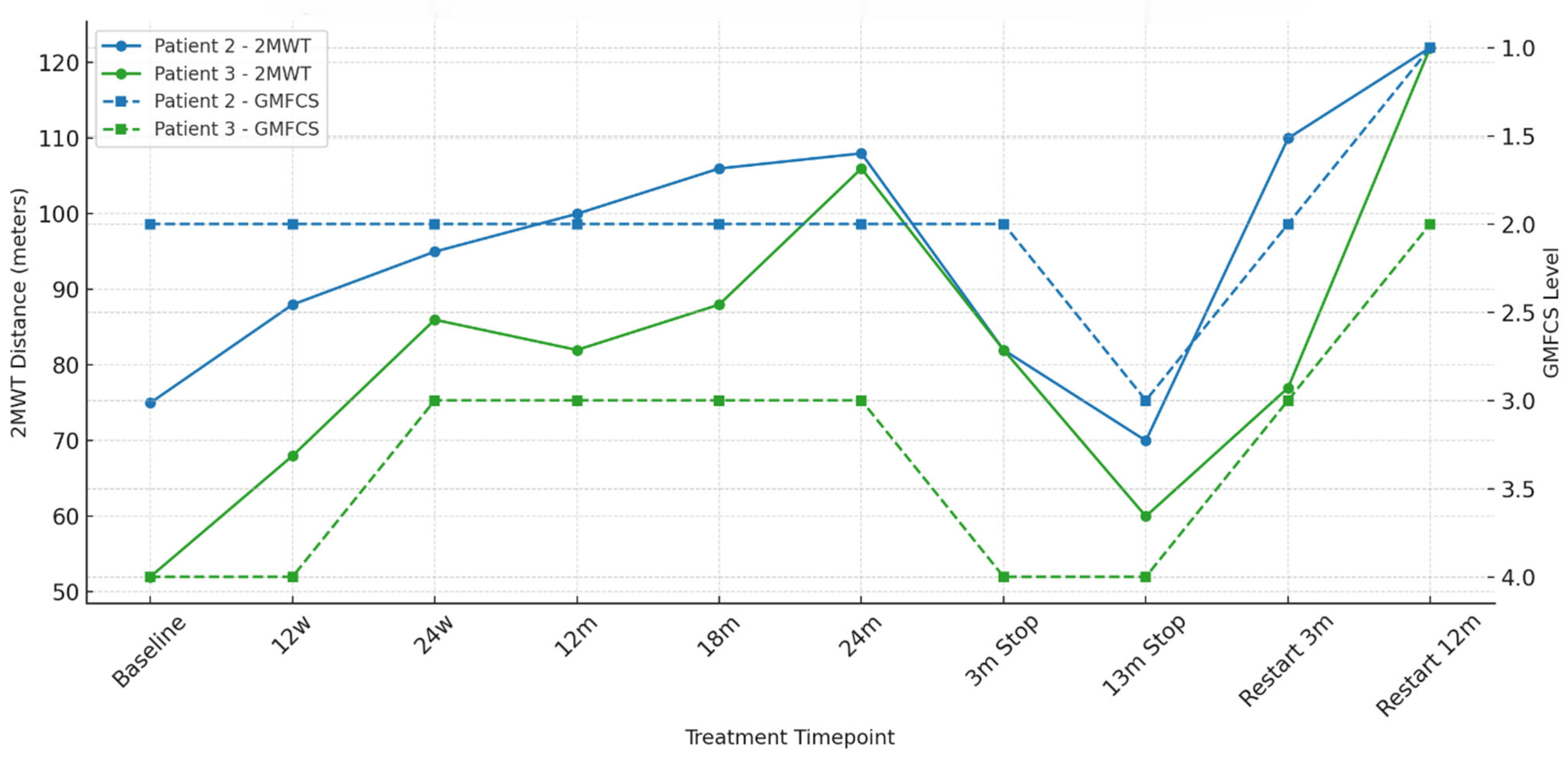
- Neuromotor and functional assessments: Gross Motor Function Classification System (GMFCS), Gross Motor Function Measure 88 (GMFM-88), Subsections Dimension D (Standing) and E (Walking, Running, Jumping), 2-Minute Walk Test (2MWT), Functional Mobility Scale (FMS).
- Cognitive assessments, including age-appropriate Wechsler Intelligence Scale for Children (WISC).
- Nutritional and bone health parameters, including height, weight, lean body mass index, Dual-Energy X-ray Absorptiometry (DEXA) reports, dietary diary and bromatologic analysis.
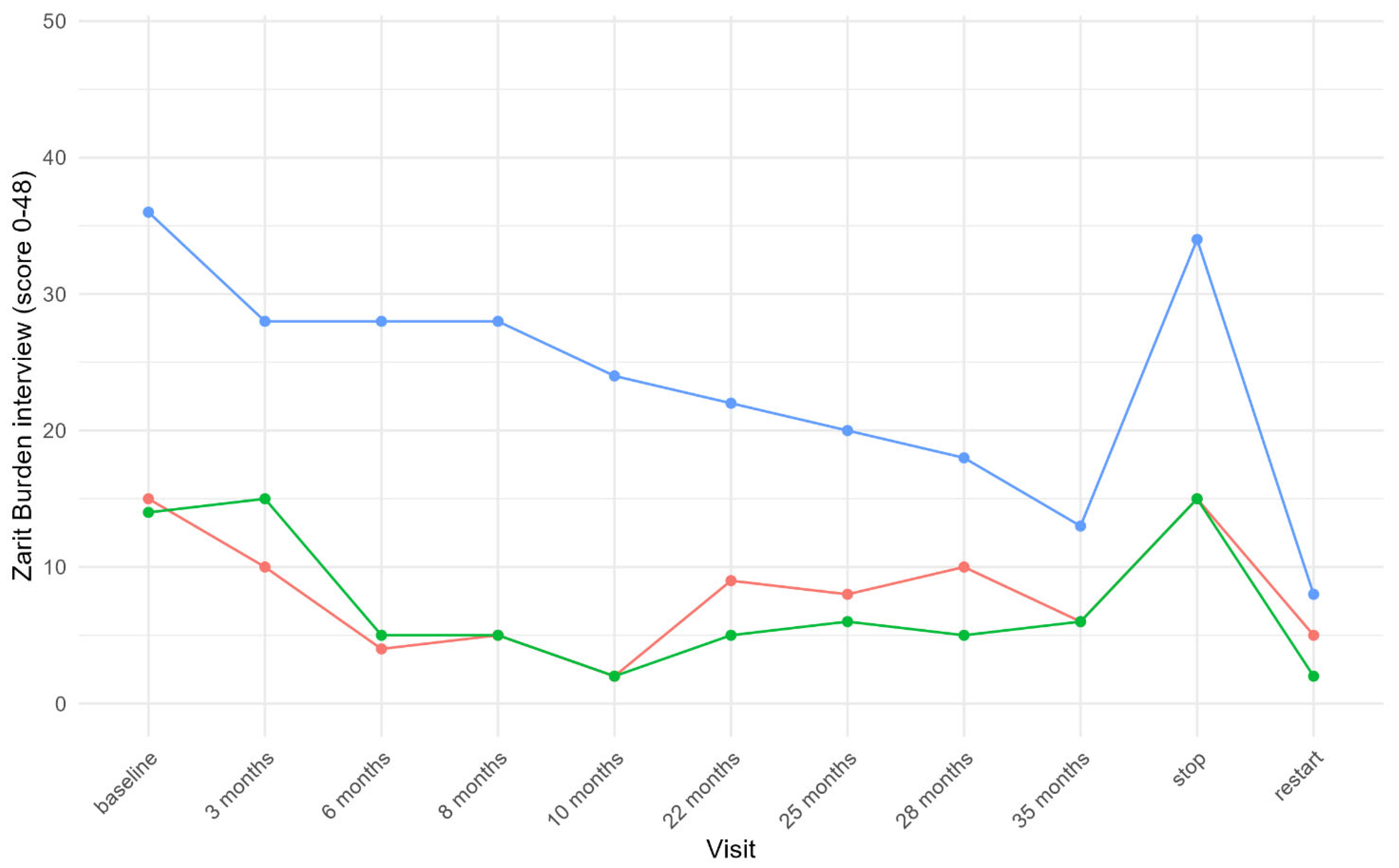
- Quality of Life and Functional Autonomy, assessed by Gillette Functional Assessment Questionnaire and Custom QoL questionnaires administered to both families and medical staff. A short 12-items version of the Zarit Burden Interview was used, self-administered by the caregiver (Score range 0–48: 0–10 no to mild burden, 10–20 mild to moderate burden, >20 high burden).
3. Results
3.1. Baseline Assessment
3.1.1. Patient 1
3.1.2. Patient 2
3.1.3. Patient 3
3.2. Pegzilarginase Recombinant Enzyme Therapy
3.2.1. Biochemical Response
3.2.2. Neurological Response
3.2.3. Skeletal and Mineralization Outcomes
3.2.4. Dietary Treatment
3.2.5. Quality of Life Measures
3.2.6. Caregiver-Reported Outcomes
3.2.7. Patient-Reported Outcomes (PROs)
3.2.8. Clinician Observations and Multidisciplinary Consensus
4. Discussion
5. Conclusions
Author Contributions
Funding
Institutional Review Board Statement
Informed Consent Statement
Data Availability Statement
Acknowledgments
Conflicts of Interest
References
- Burlina, A.; Ardissone, A.; Battini, R.; Burlina, A.; Gasperini, S.; Pession, A.; Porta, F.; Vici, C.D. Arginase 1 deficiency: A treatable form of spastic paraplegia. Neurol. Sci. 2025, 46, 4219–4228. [Google Scholar] [CrossRef] [PubMed]
- Bin Sawad, A.; Jackimiec, J.; Bechter, M.; Trucillo, A.; Lindsley, K.; Bhagat, A.; Uyei, J.; Diaz, G.A. Epidemiology, methods of diagnosis, and clinical management of patients with arginase 1 deficiency (ARG1-D): A systematic review. Mol. Genet. Metab. 2022, 137, 153–163. [Google Scholar] [CrossRef] [PubMed]
- Panza, E.; Martinelli, D.; Magini, P.; Vici, C.D.; Seri, M. Hereditary Spastic Paraplegia Is a Common Phenotypic Finding in ARG1 Deficiency, P5CS Deficiency and HHH Syndrome: Three Inborn Errors of Metabolism Caused by Alteration of an Interconnected Pathway of Glutamate and Urea Cycle Metabolism. Front. Neurol. 2019, 10, 131. [Google Scholar] [CrossRef] [PubMed] [PubMed Central]
- Nteli, D.; Nteli, M.; Konstantinidis, K.; Foka, A.; Charisi, F.; Michailidou, I.; De Lorenzo, S.S.; Boziki, M.; Tzitiridou-Chatzopoulou, M.; Spandou, E.; et al. Argininemia: Pathophysiology and Novel Methods for Evaluation of the Disease. Appl. Sci. 2024, 14, 1647. [Google Scholar] [CrossRef]
- Scaglia, F.; Lee, B. Clinical, biochemical, and molecular spectrum of hyperargininemia due to arginase I deficiency. Am. J. Med. Genet. Part C Semin. Med. Genet. 2006, 142, 113–120. [Google Scholar] [CrossRef] [PubMed] [PubMed Central]
- Rudebeck, M.; Braverman, N.; Chang, R.; Enns, G.M.; Ghosh, A.; Gorce, M.; Karall, D.; Sharma, R.; Shelkowitz, E.; Zori, R.; et al. Clinical characteristics of arginase 1 deficiency: Natural history insights from international clinical trials. J. Inherit. Metab. Dis. 2026, 49, e70156. [Google Scholar] [CrossRef] [PubMed] [PubMed Central]
- Diez-Fernandez, C.; Rüfenacht, V.; Gemperle, C.; Fingerhut, R.; Häberle, J. Mutations and common variants in the human arginase 1 (ARG1) gene: Impact on patients, diagnostics, and protein structure considerations. Hum. Mutat. 2018, 39, 1029–1050. [Google Scholar] [CrossRef] [PubMed]
- Russo, R.S.; Gasperini, S.; Bubb, G.; Neuman, L.; Sloan, L.S.; Diaz, G.A.; Enns, G.M.; PEACE Investigators. Efficacy and safety of pegzilarginase in arginase 1 deficiency (PEACE): A phase 3, randomized, double-blind, placebo-controlled, multi-centre trial. eClinicalMedicine 2024, 68, 102405. [Google Scholar] [CrossRef] [PubMed] [PubMed Central]
- Carvalho, D.R.; Brum, J.M.; Speck-Martins, C.E.; Ventura, F.D.; Navarro, M.M.; Coelho, K.E.; Portugal, D.; Pratesi, R. Clinical features and neurologic progression of hyperargininemia. Pediatr. Neurol. 2012, 46, 369–374. [Google Scholar] [CrossRef] [PubMed]
- McNutt, M.; Rutsch, F.; Russo, R.S.; Gasperini, S.; Batzios, S.; Teles, E.L.; Brassier, A.; Ganesh, J.; Schulze, A.; Enns, G.M.; et al. Long-Term Efficacy and Tolerability of Pegzilarginase in Arginase 1 Deficiency: Results of Two International Multicentre Open-Label Extension Studies. J. Inherit. Metab. Dis. 2025, 48, e70066, Erratum in J. Inherit. Metab. Dis. 2025, 48, e70087. https://doi.org/10.1002/jimd.70087. [Google Scholar] [CrossRef] [PubMed]
- Immedica Pharma AB. Loargys 5 mg/mL Solution for Injection/Infusion. Summary of Product Characteristics. European Medicines Agency (EMA). 2023. Available online: https://www.ema.europa.eu/en/documents/product-information/loargys-epar-product-information_en.pdf (accessed on 8 January 2026).
- Ditters, I.A.M.; van der Beek, N.A.M.E.; Brusse, E.; van der Ploeg, A.T.; van den Hout, J.M.P.; Huidekoper, H.H. Home-based enzyme replacement therapy in children and adults with Pompe disease; a prospective study. Orphanet J. Rare Dis. 2023, 18, 108. [Google Scholar] [CrossRef] [PubMed] [PubMed Central]
- Toscano, A.; Musumeci, O.; Sacchini, M.; Ravaglia, S.; Siciliano, G.; Fiumara, A.; Verrecchia, E.; Fischetto, R.; Crescimanno, G.; Taurisano, R.; et al. Long-term safety outcomes and patient preferences for home-based intravenous enzyme replacement therapy (ERT) in Pompe disease and Mucopolysaccharidosis Type I (MPS-I): Final results of two-year observation. Orphanet J. Rare Dis. 2025, 20, 639. [Google Scholar] [CrossRef] [PubMed]
- Demirdas, S.; E Coakley, K.; Bisschop, P.H.; Hollak, C.E.M.; Bosch, A.M.; Singh, R.H. Bone health in phenylketonuria: A systematic review and meta-analysis. Orphanet J. Rare Dis. 2015, 10, 17. [Google Scholar] [CrossRef] [PubMed] [PubMed Central]
- Brassier, A.; Arion, A.; Arnoux, J.; Barth, M.; Dobbelaere, D.; Gorce, M.; Grövdal, M.; Laroche, C.; Rime, O.; Schiff, M.; et al. Real-World Effectiveness and Safety of Pegzilarginase Treatment in Arginase 1 Deficiency. JIMD Rep. 2026, 67, E70081. [Google Scholar] [CrossRef]


| Parameter | Patient 1 (Pre-Treatment) | Patient 1 (Post-Treatment) | Patient 2 (Pre-Treatment) | Patient 2 (Post-Treatment) | Patient 3 (Pre-Treatment) | Patient 3 (Post-Treatment) |
|---|---|---|---|---|---|---|
| Plasma arginine (µmol/L) | 460–520 | 105 | 300–400 | 100–150 | 300–350 | <120 |
| GAA (µmol/L) | n/a | n/a | n/a | n/a | 6.73 (during stop phase) | Normalized |
| Ammonia | Normal | Normal | Normal | Normal | Slightly increased (no symptoms) | Normal |
| Dietary protein intake (g/kg/day) | 0.5 EAA supplementation | 1.0–1.2 | 0.5 | 1.0–1.2 | 0.5 | 1.0–1.2 |
| Scavenger therapy | Sodium Benzoate/glycerol phenylbutyrate | Reduced dose | Sodium Benzoate/glycerol phenylbutyrate | Reduced dose | Glycerol phenylbutyrate | Reduced dose |
| Seizure control | Controlled on VPA | Stable, no relapse | Controlled on LEV/ETS | Stable, no relapse | Controlled on LEV | Stable |
| Spasticity/Motor phenotype | Severe paraparesis, wheelchair dependent | Partial lower-limb extension, walks a few steps, improved trunk control | Spastic diplegia, scissoring gait | Fully ambulatory, smooth gait | Bradykinesia, hypomimia, spastic diplegia | Reduced bradykinesia, smoother gait, climbs the stairs with support |
| GMFCS level | IV | III | II | I | IV | II–III |
| Functional mobility (FMS) | Wheelchair, assisted walking | Able to walk few steps with brace | Orthoses, limited ambulation | Independent walking, stair climbing | Limited ambulation: scoring 1 at 500 m | Increased endurance: scoring 5 at 500 m |
| Postural/facial control | Hypotonic, trunk instability | Improved trunk and hand control | Asymmetric posture | Symmetric, improved balance | Hypomimia | Facial reactivity restored |
| 2MWT (meters) | Not testable | 10 | 75 | 122 (+62%) | 52 | 122 (+134%) |
| Total body DEXA Z-score | −3.9 | −2.2 | −1.5 | −1.1 | −5.8 | −4.2 |
| Fractures | None | None | None | None | History of fractures | No new fractures |
| Quality of Life (QoL) | Low; high caregiver burden | Improved motivation, socialization | Anxiety, motor frustration | Increased autonomy, mood stability | Dependent, limited affectivity | Improved engagement, cooperation |
| School/Social function | Poor participation | Moderate, increased engagement | Limited, physical barriers | Full participation | Poor | More cooperative, attentive |
| Adverse events | - | Mild injection site erythema on one occasion | - | None | - | None |
Disclaimer/Publisher’s Note: The statements, opinions and data contained in all publications are solely those of the individual author(s) and contributor(s) and not of MDPI and/or the editor(s). MDPI and/or the editor(s) disclaim responsibility for any injury to people or property resulting from any ideas, methods, instructions or products referred to in the content. |
© 2026 by the authors. Licensee MDPI, Basel, Switzerland. This article is an open access article distributed under the terms and conditions of the Creative Commons Attribution (CC BY) license.
Share and Cite
Faraguna, M.C.; Crescitelli, V.; Pretese, R.; Bolgè, M.V.; Marchetti, V.; Sgroi, G.; Sala, S.; Gigante, S.; Bonfanti, C.; Balduzzi, A.; et al. Pegzilarginase in Arginase 1 Deficiency: Clinical and Biochemical Effects of Treatment Initiation, Discontinuation and Re-Initiation. Children 2026, 13, 610. https://doi.org/10.3390/children13050610
Faraguna MC, Crescitelli V, Pretese R, Bolgè MV, Marchetti V, Sgroi G, Sala S, Gigante S, Bonfanti C, Balduzzi A, et al. Pegzilarginase in Arginase 1 Deficiency: Clinical and Biochemical Effects of Treatment Initiation, Discontinuation and Re-Initiation. Children. 2026; 13(5):610. https://doi.org/10.3390/children13050610
Chicago/Turabian StyleFaraguna, Martha Caterina, Viola Crescitelli, Roberta Pretese, Maria Valvassori Bolgè, Vera Marchetti, Giusi Sgroi, Stefania Sala, Silvia Gigante, Cristina Bonfanti, Adriana Balduzzi, and et al. 2026. "Pegzilarginase in Arginase 1 Deficiency: Clinical and Biochemical Effects of Treatment Initiation, Discontinuation and Re-Initiation" Children 13, no. 5: 610. https://doi.org/10.3390/children13050610
APA StyleFaraguna, M. C., Crescitelli, V., Pretese, R., Bolgè, M. V., Marchetti, V., Sgroi, G., Sala, S., Gigante, S., Bonfanti, C., Balduzzi, A., & Gasperini, S. (2026). Pegzilarginase in Arginase 1 Deficiency: Clinical and Biochemical Effects of Treatment Initiation, Discontinuation and Re-Initiation. Children, 13(5), 610. https://doi.org/10.3390/children13050610