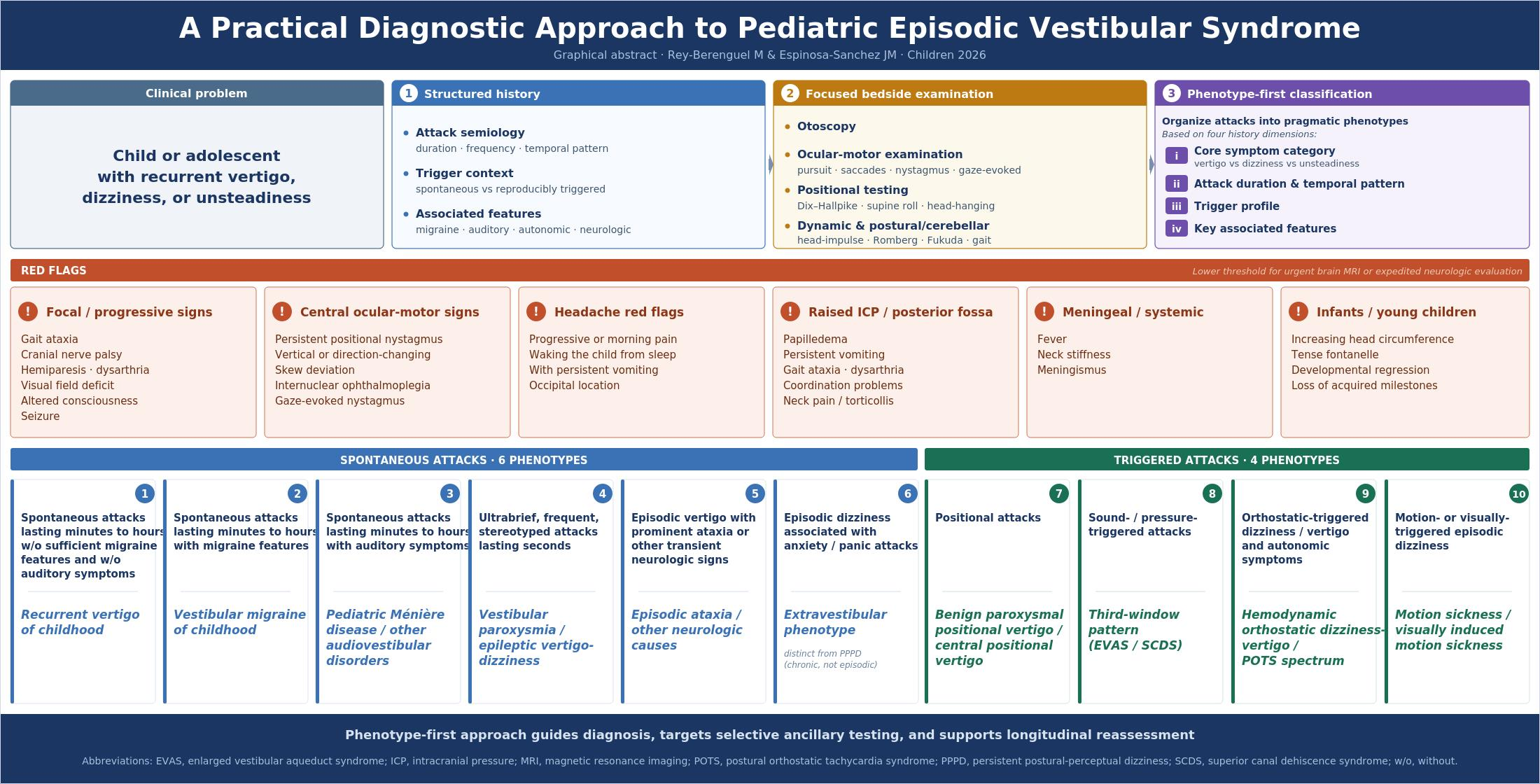
A Practical Diagnostic Approach to Pediatric Episodic Vestibular Syndrome

Highlights
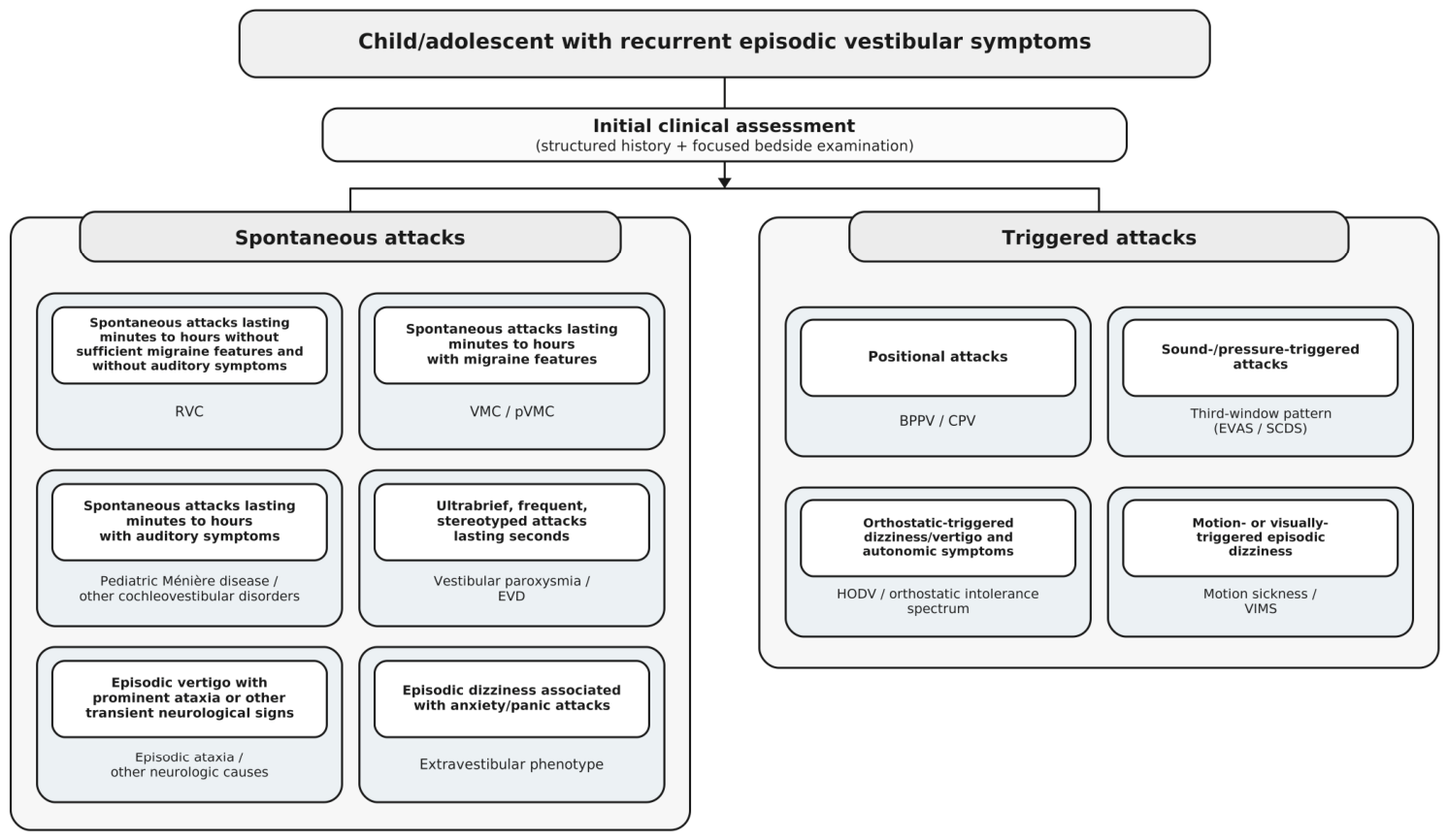
- A phenotype-first framework can organize recurrent pediatric vestibular symptoms into clinically actionable phenotypes.
- Targeted history, focused bedside examination, and selective ancillary testing improve diagnostic orientation and help identify red flags.
- The approach may improve diagnostic accuracy, support more rational use of ancillary testing, and facilitate earlier recognition of clinically important disorders.
- Longitudinal reassessment is essential because phenotypes may evolve and require diagnostic reclassification over time.
Abstract
1. Introduction
2. Diagnostic Approach to Pediatric Episodic Vestibular Syndrome
3. Operationalizing a Phenotype-Driven Approach
4. Phenotype-Driven Differential Diagnosis
4.1. Spontaneous Attacks Lasting Minutes to Hours Without Sufficient Migraine Features and Without Auditory Symptoms
Recurrent Vertigo of Childhood
4.2. Spontaneous Attacks Lasting Minutes to Hours with Migraine Features
Vestibular Migraine of Childhood and Probable Vestibular Migraine of Childhood
4.3. Spontaneous Attacks Lasting Minutes to Hours with Auditory Symptoms
Pediatric Meniere Disease
4.4. Ultrabrief, Frequent, Stereotyped Attacks Lasting Seconds
4.4.1. Vestibular Paroxysmia
4.4.2. Vestibular Epilepsy/Epileptic Vertigo and Dizziness
4.5. Trigger-Related Attacks
4.5.1. Positional Attacks
- Benign paroxysmal positional vertigo in children
4.5.2. Sound-/Pressure-Triggered Attacks
- Enlarged Vestibular Aqueduct Syndrome
- Superior Canal Dehiscence Syndrome
4.5.3. Orthostatic-Triggered Dizziness/Vertigo and Autonomic Symptoms
4.5.4. Motion- or Visually-Triggered Episodic Dizziness
4.6. Episodic Vertigo with Prominent Ataxia or Other Transient Neurologic Signs
4.7. Episodic Dizziness Associated with Anxiety/Panic Attacks (Extravestibular Phenotype)
5. Key Pitfalls in pEVS Classification
6. Conclusions
Author Contributions
Funding
Institutional Review Board Statement
Informed Consent Statement
Data Availability Statement
Conflicts of Interest
Abbreviations
| ABR | auditory brainstem response |
| BPPV | benign paroxysmal positional vertigo |
| BPV | benign paroxysmal vertigo |
| BPVC | benign paroxysmal vertigo of childhood |
| CPN | central positional nystagmus |
| CPV | central positional vertigo |
| CT | computed tomography |
| cVEMP | cervical vestibular evoked myogenic potentials |
| DFNB4 | deafness, autosomal recessive 4 |
| EA | episodic ataxia |
| EA1 | episodic ataxia type 1 |
| EA2 | episodic ataxia type 2 |
| ECG | electrocardiogram |
| EEG | electroencephalography |
| EVA | enlarged vestibular aqueduct |
| EVAS | enlarged vestibular aqueduct syndrome |
| EVD | epileptic vertigo/dizziness |
| HODV | hemodynamic orthostatic dizziness/vertigo |
| IAC/CPA | internal auditory canal/cerebellopontine angle |
| ICHD | International Classification of Headache Disorders |
| ICVD | International Classification of Vestibular Disorders |
| IHS | International Headache Society |
| MD | Meniere disease |
| MRI | magnetic resonance imaging |
| MS | motion sickness |
| MSD | motion sickness disorder |
| OH | orthostatic hypotension |
| oVEMP | ocular vestibular evoked myogenic potentials |
| pEVS | pediatric episodic vestibular syndrome |
| POTS | postural orthostatic tachycardia syndrome |
| PPPD | persistent postural-perceptual dizziness |
| pVMC | probable vestibular migraine of childhood |
| pVP | probable vestibular paroxysmia |
| RVC | recurrent vertigo of childhood |
| SCDS | superior canal dehiscence syndrome |
| SLC26A4 | solute carrier family 26 member 4 |
| VEMP | vestibular evoked myogenic potentials |
| vHIT | video head impulse test |
| VIMS | visually induced motion sickness |
| VIMSD | visually induced motion sickness disorder |
| VMC | vestibular migraine of childhood |
| VP | vestibular paroxysmia |
References
- Brodsky, J.R.; Lipson, S.; Bhattacharyya, N. Prevalence of pediatric dizziness and imbalance in the United States. Otolaryngol. Head Neck Surg. 2020, 162, 241–247. [Google Scholar] [CrossRef]
- Li, C.M.; Hoffman, H.J.; Ward, B.K.; Cohen, H.S.; Rine, R.M. Epidemiology of Dizziness and Balance Problems in Children in the United States: A Population-Based Study. J. Pediatr. 2016, 171, 240–247.E3. [Google Scholar] [CrossRef]
- Bisdorff, A.; von Brevern, M.; Lempert, T.; Newman-Toker, D.E. Classification of vestibular symptoms: Towards an international classification of vestibular disorders. J. Vestib. Res. 2009, 19, 1–13. [Google Scholar] [CrossRef]
- Bisdorff, A.R.; Staab, J.P.; Newman-Toker, D.E. Overview of the International Classification of Vestibular Disorders. Neurol. Clin. 2015, 33, 541–550. [Google Scholar] [CrossRef]
- Zhang, J.; Zhu, Q.; Shen, J.; Chen, J.; Jin, Y.; Zhang, Q.; Duan, M.; Yang, J. Etiological classification and management of dizziness in children: A systematic review and meta-analysis. Front. Neurol. 2023, 14, 1125488. [Google Scholar] [CrossRef]
- Pellegrino, N.; Di Stefano, V.; Rotondo, E.; Graziosi, A.; Rispoli, M.G.; Torrente, A.; Lupica, A.; Brighina, F.; Raucci, U.; Parisi, P. Neurological vertigo in the emergency room in pediatric and adult age: Systematic literature review and proposal for a diagnostic algorithm. Ital. J. Pediatr. 2022, 48, 125. [Google Scholar] [CrossRef]
- van de Berg, R.; Widdershoven, J.; Bisdorff, A.; Evers, S.; Wiener-Vacher, S.; Cushing, S.L.; Mack, K.J.; Kim, J.S.; Jahn, K.; Strupp, M.; et al. Vestibular migraine of childhood and recurrent vertigo of childhood: Diagnostic criteria consensus document of the Classification Committee of Vestibular Disorders of the Bárány Society and the International Headache Society. J. Vestib. Res. 2021, 31, 1–9. [Google Scholar] [CrossRef]
- Batuecas-Caletrío, A.; Martín-Sánchez, V.; Cordero-Civantos, C.; Guardado-Sánchez, L.; Marcos, M.R.; Fabián, A.H.; González, J.J.B.; Cruz-Ruiz, S.S. Is benign paroxysmal vertigo of childhood (BPVC) a precursor of migraine? Eur. J. Paediatr. Neurol. 2013, 17, 397–400. [Google Scholar] [CrossRef] [PubMed]
- Božanić Urbančič, N.; Mladenov, D.; Battelino, S. The Impact of Follow-Up on Etiological Classification of Pediatric Vertigo. Children 2026, 13, 376. [Google Scholar] [CrossRef] [PubMed]
- Teggi, R.; Colombo, B.; Familiari, M.; Cangiano, I.; Bussi, M.; Filippi, M. Phenotypes, bedside examination, and video head impulse test in vestibular migraine of childhood compared with probable vestibular migraine and recurrent vertigo in childhood. Front. Pediatr. 2023, 11, 1152928. [Google Scholar] [CrossRef] [PubMed]
- Rey-Berenguel, M.; Vallecillo-Zorrilla, J.; Burgueño-Uriarte, E.K.; Olvera-Porcel, M.C.; Espinosa-Sanchez, J.M. Diagnostic Yield of the New Bárány Society Criteria for Pediatric Episodic Vestibular Syndrome. J. Clin. Med. 2025, 14, 5971. [Google Scholar] [CrossRef] [PubMed]
- Zhang, Q.; Du, Y.; Liu, X.; Xu, Z.; Wang, Y.; Ren, L.; Wu, Z. Vestibular Migraine and Recurrent Vertigo in Children: A Diagnostic Focus from a Tertiary Hospital Study. Pediatr. Neurol. 2024, 158, 86–93. [Google Scholar] [CrossRef] [PubMed]
- Basser, L.S. Benign paroxysmal vertigo of childhood: A variety of vestibular neuronitis. Brain 1964, 87, 141–152. [Google Scholar] [CrossRef]
- Dunker, K.; Schnabel, L.; Grill, E.; Filippopulos, F.M.; Huppert, D. Recurrent vertigo of childhood: Clinical features and prognosis. Front. Neurol. 2022, 13, 1022395. [Google Scholar] [CrossRef]
- Zhang, Q.; Wu, Q.; Chen, J.; Wang, X.; Zhang, Y.; Liu, S.; Wang, L.; Shen, J.; Shen, M.; Tang, X.; et al. Characteristics of vestibular migraine, probable vestibular migraine, and recurrent vertigo of childhood in caloric and video head impulse tests. Front. Neurol. 2022, 13, 1050282. [Google Scholar] [CrossRef]
- Lempert, T.; Olesen, J.; Furman, J.; Waterston, J.; Seemungal, B.; Carey, J.; Bisdorff, A.; Versino, M.; Evers, S.; Kheradmand, A.; et al. Vestibular migraine: Diagnostic criteria (Update). J. Vestib. Res. 2022, 32, 1–6. [Google Scholar] [CrossRef]
- Langhagen, T.; Landgraf, M.N.; Huppert, D.; Heinen, F.; Jahn, K. Vestibular migraine in children and adolescents. Curr. Pain Headache Rep. 2016, 20, 67. [Google Scholar] [CrossRef]
- Saniasiaya, J. (Ed.) Vestibular Migraine in Children and Adolescents; Springer Nature: Singapore, 2025. [Google Scholar] [CrossRef]
- Chinn, R.N.; Marusic, S.; Wang, A.; Vyas, N.; Staffa, S.J.; Brodsky, J.R.; Raghuram, A.R. Vergence and accommodation deficits in children and adolescents with vestibular disorders. Optom. Vis. Sci. 2022, 99, 859–867. [Google Scholar] [CrossRef]
- Staab, J.P.; Eckhardt-Henn, A.; Horii, A.; Jacob, R.; Strupp, M.; Brandt, T.; Bronstein, A. Diagnostic criteria for persistent postural-perceptual dizziness (PPPD): Consensus document of the committee for the Classification of Vestibular Disorders of the Bárány Society. J. Vestib. Res. 2017, 27, 191–208. [Google Scholar] [CrossRef]
- Brodsky, J.R.; Cusick, B.A.; Zhou, G. Evaluation and management of vestibular migraine in children: Experience from a pediatric vestibular clinic. Eur. J. Paediatr. Neurol. 2016, 20, 85–92. [Google Scholar] [CrossRef] [PubMed]
- Wang, C.; Wu, C.H.; Cheng, P.W.; Young, Y.H. Pediatric Meniere’s disease. Int. J. Pediatr. Otorhinolaryngol. 2018, 105, 16–19. [Google Scholar] [CrossRef] [PubMed]
- Lopez-Escamez, J.A.; Carey, J.; Chung, W.H.; Goebel, J.A.; Magnusson, M.; Mandalà, M.; Newman-Toker, D.E.; Strupp, M.; Suzuki, M.; Trabalzini, F.; et al. Diagnostic criteria for Menière’s disease. J. Vestib. Res. 2015, 25, 1–7. [Google Scholar] [CrossRef] [PubMed]
- Gopen, Q.; Zhou, G.; Whittemore, K.; Kenna, M. Enlarged vestibular aqueduct: Review of controversial aspects. Laryngoscope 2011, 121, 1971–1978. [Google Scholar] [CrossRef] [PubMed]
- Brodsky, J.R.; Choi, S.S. Should children with an enlarged vestibular aqueduct be restricted from playing contact sports? Laryngoscope 2018, 128, 2219–2220. [Google Scholar] [CrossRef]
- Strupp, M.; Lopez-Escamez, J.A.; Kim, J.S.; Straumann, D.; Jen, J.C.; Carey, J.; Bisdorff, A.; Brandt, T. Vestibular paroxysmia: Diagnostic criteria. J. Vestib. Res. 2016, 26, 409–415. [Google Scholar] [CrossRef]
- Tarnutzer, A.A.; Lee, S.H.; Robinson, K.A.; Kaplan, P.W.; Newman-Toker, D.E. Clinical and electrographic findings in epileptic vertigo and dizziness: A systematic review. Neurology 2015, 84, 1595–1604. [Google Scholar] [CrossRef]
- Wood, A.M.; Thompson-Harvey, A.; Kesser, B.W. Vertiginous epilepsy in the pediatric population. Front. Neurol. 2024, 15, 1403536. [Google Scholar] [CrossRef]
- Reynard, P.; Thai-Van, H.; Mustea, E.; Neagu, A.; Idriss, S.A.; Ionescu, E.C. Sodium Channel Blockers for Vestibular Paroxysmia in Children. Audiol. Res. 2025, 15, 65. [Google Scholar] [CrossRef]
- Idriss, S.A.; Thai-Van, H.; Altaisan, R.; Ltaief-Boudrigua, A.; Reynard, P.; Ionescu, E.C. The Narrowed Internal Auditory Canal: A Distinct Etiology of Pediatric Vestibular Paroxysmia. J. Clin. Med. 2022, 11, 4300. [Google Scholar] [CrossRef]
- Hüfner, K.; Barresi, D.; Glaser, M.; Linn, J.; Adrion, C.; Mansmann, U.; Brandt, T.; Strupp, M. Vestibular paroxysmia: Diagnostic features and medical treatment. Neurology 2008, 71, 1006–1014. [Google Scholar] [CrossRef]
- Papadopoulou, A.-M.; Bakogiannis, N.; Sofokleous, V.; Skrapari, I.; Bakoyiannis, C. The Impact of Vascular Loops in the Cerebellopontine Angle on Audio-Vestibular Symptoms: A Systematic Review. Audiol. Neurootol. 2022, 27, 200–207. [Google Scholar] [CrossRef]
- Dieterich, M.; Brandt, T. Vestibular paroxysmia: A systematic review. J. Neurol. 2025, 272, 188. [Google Scholar] [CrossRef]
- von Brevern, M.; Bertholon, P.; Brandt, T.; Fife, T.; Imai, T.; Nuti, D.; Newman-Toker, D.E. Benign paroxysmal positional vertigo: Diagnostic criteria. J. Vestib. Res. 2015, 25, 105–117. [Google Scholar] [CrossRef]
- Galluzzi, F.; Garavello, W. Benign paroxysmal positional vertigo in children: A narrative review. J. Int. Adv. Otol. 2022, 18, 177–182. [Google Scholar] [CrossRef]
- Zhang, J.; Guan, J.; Wang, H.; Zhang, J.; Wang, D.; Yang, D.; Zhou, H.; Wang, Q. A non-negligible role of benign paroxysmal positional vertigo in pediatric vertigo: A systematic review and meta-analysis. Clin. Otolaryngol. 2025, 50, 808–820. [Google Scholar] [CrossRef]
- Brodsky, J.R.; Lipson, S.; Wilber, J.; Zhou, G. Benign paroxysmal positional vertigo (BPPV) in children and adolescents: Clinical features and response to therapy in 110 pediatric patients. Otol. Neurotol. 2018, 39, 344–350. [Google Scholar] [CrossRef]
- Wang, A.; Zhou, G.; Brodsky, J.R. Benign paroxysmal positional vertigo in young children: Clinical characteristics and diagnostic considerations. Laryngoscope 2023, 133, 694–699. [Google Scholar] [CrossRef]
- Balzanelli, C.; Spataro, D.; Redaelli de Zinis, L.O. Benign Positional Paroxysmal Vertigo in Children. Audiol. Res. 2021, 11, 47–54. [Google Scholar] [CrossRef]
- An, J.B.; Kim, J.; Park, S.H.; Yoon, J.; Choo, O.S.; Park, S.-K.; Chang, J. Pediatric benign paroxysmal positional vertigo: Degree of nystagmus and concurrent dizziness differs from adult BPPV. J. Clin. Med. 2024, 13, 1997. [Google Scholar] [CrossRef]
- Macdonald, N.K.; Kaski, D.; Saman, Y.; Sulaiman, A.A.-S.; Anwer, A.; Bamiou, D.-E. Central positional nystagmus: A systematic literature review. Front. Neurol. 2017, 8, 141. [Google Scholar] [CrossRef]
- Lemos, J.; Strupp, M. Central positional nystagmus: An update. J. Neurol. 2022, 269, 1851–1860. [Google Scholar] [CrossRef]
- Ward, B.K.; van de Berg, R.; van Rompaey, V.; Bisdorff, A.; Hullar, T.E.; Welgampola, M.S.; Carey, J.P. Superior semicircular canal dehiscence syndrome: Diagnostic criteria consensus document of the committee for the classification of vestibular disorders of the Bárany Society. J. Vestib. Res. 2021, 31, 131–141. [Google Scholar] [CrossRef]
- Merchant, S.N.; Rosowski, J.J. Conductive hearing loss caused by third-window lesions of the inner ear. Otol. Neurotol. 2008, 29, 282–289. [Google Scholar] [CrossRef]
- Bonnard, A.; Karltorp, E.; Verrecchia, L. Vestibular Function in Children with Enlarged Vestibular Aqueduct and Incomplete Partition Type II After Cochlear Implantation. Audiol. Res. 2023, 13, 130–142. [Google Scholar] [CrossRef]
- Zalewski, C.K.; Chien, W.W.; King, K.A.; Muskett, J.A.; Baron, R.E.; Butman, J.A.; Griffith, A.J.; Brewer, C.C. Vestibular dysfunction in patients with enlarged vestibular aqueduct. Otolaryngol. Head Neck Surg. 2015, 153, 257–262. [Google Scholar] [CrossRef]
- Zhou, G.; Gopen, Q. Characteristics of vestibular evoked myogenic potentials in children with enlarged vestibular aqueduct. Laryngoscope 2011, 121, 220–225. [Google Scholar] [CrossRef]
- Dasgupta, S.; Ratnayake, S.A.B. Functional and objective audiovestibular evaluation of children with apparent semicircular canal dehiscence: A case series in a pediatric vestibular center. Front. Neurol. 2019, 10, 306. [Google Scholar] [CrossRef]
- Kim, H.A.; Bisdorff, A.; Bronstein, A.M.; Lempert, T.; Rossi-Izquierdo, M.; Staab, J.P.; Strupp, M.; Kim, J.-S. Hemodynamic orthostatic dizziness/vertigo: Diagnostic criteria. Consensus document of the Committee for the Classification of Vestibular Disorders of the Bárány Society. J. Vestib. Res. 2019, 29, 45–56. [Google Scholar] [CrossRef]
- Boris, J.R.; Moak, J.P. Pediatric postural orthostatic tachycardia syndrome: Where we stand. Pediatrics 2022, 150, e2021054945. [Google Scholar] [CrossRef]
- Qubty, W.; Kedia, S. Dizziness and Orthostatic Intolerance in the Pediatric Headache Patient. Semin. Pediatr. Neurol. 2016, 23, 71–78. [Google Scholar] [CrossRef]
- Cha, Y.-H.; Golding, J.F.; Keshavarz, B.; Furman, J.; Kim, J.-S.; Lopez-Escamez, J.A.; Magnusson, M.; Yates, B.J.; Lawson, B.D.; Staab, J.; et al. Motion sickness diagnostic criteria: Consensus Document of the Classification Committee of the Bárány Society. J. Vestib. Res. 2021, 31, 327–344. [Google Scholar] [CrossRef]
- Huppert, D.; Grill, E.; Brandt, T. Survey of motion sickness susceptibility in children and adolescents aged 3 months to 18 years. J. Neurol. 2019, 266, 65–73. [Google Scholar] [CrossRef]
- Lipson, S.; Wang, A.; Corcoran, M.; Zhou, G.; Brodsky, J.R. Severe motion sickness in infants and children. Eur. J. Paediatr. Neurol. 2020, 28, 176–179. [Google Scholar] [CrossRef]
- Filippopulos, F.M.; Schnabel, L.; Dunker, K.; Strobl, R.; Huppert, D. Episodic ataxias in children and adolescents: Clinical findings and suggested diagnostic criteria. Front. Neurol. 2022, 13, 1016856. [Google Scholar] [CrossRef]
- Jen, J.; Kim, G.W.; Baloh, R.W. Clinical spectrum of episodic ataxia type 2. Neurology 2004, 62, 17–22. [Google Scholar] [CrossRef]
- Baloh, R.W. Episodic ataxias 1 and 2. Handb. Clin. Neurol. 2012, 103, 595–602. [Google Scholar] [CrossRef]
- Strupp, M.; Kalla, R.; Dichgans, M.; Freilinger, T.; Glasauer, S.; Brandt, T. Treatment of episodic ataxia type 2 with the potassium channel blocker 4-aminopyridine. Neurology 2004, 62, 1623–1625. [Google Scholar] [CrossRef] [PubMed]
- Strupp, M.; Kalla, R.; Claassen, J.; Adrion, C.; Mansmann, U.; Klopstock, T.; Freilinger, T.; Neugebauer, H.; Spiegel, R.; Dichgans, M.; et al. A randomized trial of 4-aminopyridine in EA2 and related familial episodic ataxias. Neurology 2011, 77, 269–275. [Google Scholar] [CrossRef] [PubMed]
- Muth, C.; Teufel, J.; Schols, L.; Synofzik, M.; Franke, C.; Timmann, D.; Mansmann, U.; Strupp, M. Fampridine and acetazolamide in EA2 and related familial EA: A prospective randomized placebo-controlled trial. Neurol. Clin. Pract. 2021, 11, e438–e446. [Google Scholar] [CrossRef]
- Herskowitz, J. Neurologic presentations of panic disorder in childhood and adolescence. Dev. Med. Child Neurol. 1986, 28, 617–623. [Google Scholar] [CrossRef] [PubMed]
- Szirmai, A. Vestibular disorders in childhood and adolescents. Eur. Arch. Otorhinolaryngol. 2010, 267, 1801–1804. [Google Scholar] [CrossRef]
- Langhagen, T.; Schroeder, A.S.; Rettinger, N.; Borggraefe, I.; Jahn, K. Migraine-related vertigo and somatoform vertigo frequently occur in children and are often associated. Neuropediatrics 2013, 44, 55–58. [Google Scholar] [CrossRef] [PubMed]
- Wang, A.; Zhou, G.; Lipson, S.; Kawai, K.; Corcoran, M.; Brodsky, J.R. Multifactorial Characteristics of Pediatric Dizziness and Imbalance. Laryngoscope 2021, 131, E1308–E1314. [Google Scholar] [CrossRef] [PubMed]
- Wang, A.; Fleischman, K.M.; Kawai, K.; Corcoran, M.; Brodsky, J.R. Persistent postural-perceptual dizziness in children and adolescents. Otol. Neurotol. 2021, 42, e1093–e1100. [Google Scholar] [CrossRef] [PubMed]


| Domain | Red Flags |
|---|---|
| New focal or progressive neurologic signs | Persistent, progressive, or clearly new gait ataxia; cranial nerve palsy (e.g., diplopia, facial weakness); hemiparesis, dysarthria, language disturbance, or visual field deficit; altered consciousness; seizure |
| Central ocular-motor/positional signs | Persistent positional nystagmus; vertical or direction-changing nystagmus; nystagmus not suppressed by visual fixation; gaze-evoked nystagmus; skew deviation; internuclear ophthalmoplegia |
| Headache red flags | Progressively worsening headache; morning headache or headache waking the child from sleep; headache with persistent/recurrent vomiting; occipital headache, especially if recurrent or associated with neurologic signs |
| Signs of raised intracranial pressure or posterior fossa disease | Papilledema; persistent vomiting; gait ataxia or coordination problems; dysarthria; neck pain or torticollis |
| Meningeal/systemic red flags | Fever; neck stiffness or meningismus |
| Infants/younger children | Increasing head circumference; tense fontanelle; developmental regression or loss of previously acquired milestones |
| Clinical Presentation/Phenotype | Most Useful Ancillary Tests | Main Caveats/Limitations |
|---|---|---|
| Spontaneous attacks without sufficient migraine features and without auditory symptoms (RVC phenotype) | Usually no ancillary testing beyond clinical assessment; consider audiometry and vestibular testing (vHIT, caloric testing, VEMP) in atypical, persistent, or diagnostically uncertain cases | vHIT, caloric testing, and VEMP may reveal abnormalities, but do not reliably distinguish RVC from pVMC/VMC |
| Spontaneous attacks with migraine features (VMC/pVMC phenotype) | Audiometry when auditory complaints are reported; consider vestibular testing in selected cases; brain MRI if red flags | vHIT, caloric testing, and VEMP may reveal abnormalities, but do not reliably distinguish pVMC/VMC from RVC |
| Spontaneous attacks with auditory symptoms | Pure-tone audiometry first-line; consider VEMP and caloric testing; IAC/CPA MRI if asymmetrical hearing loss; temporal bone CT if EVAS or third-window pathology is suspected | Transient auditory symptoms may also occur in VMC/pVMC; ancillary findings must be interpreted in clinical context |
| Ultrabrief, frequent, stereotyped attacks | Audiometry; ABR; high-resolution MRI of the cerebellopontine angle and internal auditory canals | Neurovascular contact or vascular loops on MRI are not diagnostic in isolation; vestibular function tests are often normal or only mildly abnormal |
| Ultrabrief attacks with altered awareness or other ictal features | EEG and brain MRI; vestibular testing only as needed to exclude peripheral mimics | |
| Positional attacks | Positional bedside testing is mandatory (Dix–Hallpike, supine roll test, deep head-hanging); brain MRI when central positional nystagmus is suspected | Video-oculography may be useful in documenting and reviewing positional nystagmus |
| Sound-/pressure-triggered attacks | Pure-tone audiometry, tympanometry, VEMP, and high-resolution temporal bone CT | Imaging alone does not establish the diagnosis; audiovestibular findings must be concordant with symptoms |
| Orthostatic-triggered dizziness/vertigo and autonomic symptoms | Orthostatic heart rate and blood pressure measurements; ECG when indicated; tilt testing in selected cases | Orthostatic abnormalities may coexist with vestibular migraine or other causes of episodic vertigo/dizziness; findings should be interpreted in the full clinical context |
| Episodic vertigo with prominent ataxia or other transient neurologic signs | Brain MRI; genetic testing when clinical suspicion is moderate to high; vestibular testing as needed | Vestibular findings are not specific; neurologic and ocular-motor examination often contribute more than vestibular testing |
| Episodic dizziness associated with anxiety/panic attacks | Diagnosis is usually clinical; consider symptom diaries, orthostatic assessment, and targeted testing only to exclude alternative diagnoses | Ancillary testing is used mainly to exclude alternative vestibular, orthostatic, neurologic, cardiovascular, or metabolic causes; normal results do not by themselves establish PPPD, which is chronic rather than episodic |
| Clinical Entity | Diagnostic Criteria |
|---|---|
| RVC | A. At least three episodes with vestibular symptoms of moderate or severe intensity, lasting between 1 min and 72 h B. None of the criteria B and C for Vestibular Migraine of Childhood C. Age < 18 years D. Not better accounted for by another headache disorder, vestibular disorder, or other condition |
| VMC | A. At least five episodes with vestibular symptoms of moderate or severe intensity, lasting between five minutes and 72 h B. A current or past history of migraine with or without aura C. At least half of episodes are associated with at least one of the following three migraine features: 1. Headache with at least two of the following four characteristics: (a) One-sided location (b) Pulsating quality (c) Moderate or severe pain intensity (d) Aggravation by routine physical activity 2. Photophobia and phonophobia 3. Visual aura D. Age < 18 years E. Not better accounted for by another headache disorder, vestibular disorder, or other condition |
| pVMC | A. At least three episodes with vestibular symptoms of moderate or severe intensity, lasting between five minutes and 72 h B. Only one of the criteria B and C for Vestibular Migraine of Childhood C. Age < 18 years D. Not better accounted for by another headache disorder, vestibular disorder, or other condition |
| Clinical Entity | Diagnostic Criteria |
|---|---|
| VP | A. At least ten attacks of spontaneous spinning or non-spinning vertigo B. Duration less than 1 min. C. Stereotyped phenomenology in a particular patient D. Response to a treatment with carbamazepine/oxcarbazepine E. Not better accounted for by another diagnosis. |
| pVP | A. At least five attacks of spinning or non-spinning vertigo B. Duration less than 5 min C. Spontaneous occurrence or provoked by certain head movements D. Stereotyped phenomenology in a particular patient E. Not better accounted for by another diagnosis. |
| BPPV | CPV/CPN | |
|---|---|---|
| Latency | Typically, 1–5 s; shorter with rapid positional transitions and in some horizontal-canal phenotypes. | Often 0–5 s; latency alone is not decisive. |
| Duration of positional nystagmus | Usually <60 s; may be longer in cupulolithiasis. | Often persistent (>60 s) or sustained while the provoking position is maintained |
| Direction/canal congruence | Canal-congruent (plausible for a semicircular canal plane). | Canal-incongruent vector, or pure vertical/torsional patterns not attributable to a canal plane. |
| Within-trial spontaneous decay (damping) | Typically damps/decays spontaneously (classically crescendo–decrescendo) while the provoking position is maintained. | May be persistent or show atypical evolution (including direction reversal while holding position). |
| Fatigability on repetition | Often present in posterior/anterior canal BPPV; less typical in many horizontal-canal presentations. | Often poor/absent in central disorders (variable). |
| Associated central ocular-motor/neurologic signs | Absent by definition (or clearly separable). | Common (e.g., gaze-evoked nystagmus, saccadic pursuit, dysmetric saccades, ataxia). |
| Response to appropriate repositioning maneuvers | Typically improves/resolves; immediate disappearance supports diagnosis. | Often refractory to liberatory maneuvers; lack of response should prompt reconsideration. |
| Clinical Entity | Diagnostic Criteria |
|---|---|
| SCDS | A. At least one symptom consistent with the presence of a third mobile window in the inner ear: 1. Bone-conduction hyperacusis 2. Sound-induced vertigo and/or oscillopsia time-locked to the stimulus 3. Pressure-induced vertigo and/or oscillopsia time-locked to the stimulus 4. Pulsatile tinnitus |
| B. At least one sign or diagnostic test indicating a third mobile window in the inner ear: 1. Nystagmus characteristic of excitation or inhibition of the affected superior semicircular canal evoked by sound or by changes in middle ear pressure or intracranial pressure 2. Low-frequency negative bone-conduction thresholds on pure-tone audiometry 3. Enhanced VEMP responses (low cervical VEMP thresholds or high ocular VEMP amplitudes) | |
| C. High-resolution temporal bone CT imaging with multiplanar reconstruction demonstrating dehiscence of the superior semicircular canal | |
| D. Not better accounted for by another vestibular disease or disorder |
| Category | Criteria |
|---|---|
| HODV—definite | A. ≥5 episodes of dizziness, unsteadiness, or vertigo triggered by arising or during upright posture, relieved by sitting/lying. B. OH, POTS, or syncope documented on standing or head-up tilt. C. Not better accounted for by another disorder. |
| HODV—probable | A. Same as definite. B. ≥1 associated symptom: weakness/tiredness; difficulty thinking/concentrating; blurred vision; tachycardia/palpitations. C. Not better accounted for by another disorder. |
| Clinical Entity | Diagnostic Criteria |
|---|---|
| MS/VIMS | A. Physical motion of the person or visual motion elicits sign(s) and/or symptom(s) in at least one of the following categories, experienced at greater-than-minimal severity: 1. Nausea and/or gastrointestinal disturbance 2. Thermoregulatory disruption 3. Alterations in arousal 4. Dizziness and/or vertigo 5. Headache and/or ocular strain B. Sign(s) and/or symptom(s) appear during motion and build as exposure is prolonged C. Sign(s) and/or symptom(s) eventually stop after cessation of motion D. Sign(s) and/or symptom(s) are not better accounted for by another disease or disorder |
| MSD/VIMSD | A. At least five episodes of motion sickness/VIMS triggered by the same or similar motion stimuli B. Sign(s) and/or symptom(s) are reliably triggered by the same or similar motion stimuli C. Sign(s) and/or symptom(s) severity does (do) not significantly decrease after repeated exposure to the same or similar motion stimuli D. Sign(s) and/or symptom(s) lead to one or more of the following behavioral or emotional responses a. Activity modification to reduce sickness sign(s)/symptom(s) b. Avoidance of the motion stimulus that triggers sickness c. Aversive anticipatory emotions prior to exposure to the motion stimulus E. Sign(s) and/or symptom(s) are not better accounted for by another disease or disorder |
| Clinical Entity | Suggested Diagnostic Criteria |
|---|---|
| Probable EA | A. At least three episodes with vertigo, dizziness, and/or ataxia symptoms lasting between 1 min and 72 h |
| B. At least half of episodes are associated with at least two of the following features: 1. Speech disturbances 2. Limb ataxia 3. Walking difficulties/having to lie down 4. Double vision/oscillopsia 5. Pallor/weakness | |
| C. At least one of the following clinical findings in the attack-free interval: 1. Nystagmus (e.g., provocation nystagmus, gaze-holding nystagmus, downbeat or upbeat nystagmus, rebound nystagmus) 2. Impaired smooth pursuit 3. Impaired fixation suppression 4. Impaired optokinetic nystagmus 5. Myokymia or myotonia | |
| D. Age < 18 years | |
| E. Not better accounted for by another vestibular or metabolic condition. * |
Disclaimer/Publisher’s Note: The statements, opinions and data contained in all publications are solely those of the individual author(s) and contributor(s) and not of MDPI and/or the editor(s). MDPI and/or the editor(s) disclaim responsibility for any injury to people or property resulting from any ideas, methods, instructions or products referred to in the content. |
© 2026 by the authors. Licensee MDPI, Basel, Switzerland. This article is an open access article distributed under the terms and conditions of the Creative Commons Attribution (CC BY) license.
Share and Cite
Rey-Berenguel, M.; Espinosa-Sanchez, J.M. A Practical Diagnostic Approach to Pediatric Episodic Vestibular Syndrome. Children 2026, 13, 583. https://doi.org/10.3390/children13050583
Rey-Berenguel M, Espinosa-Sanchez JM. A Practical Diagnostic Approach to Pediatric Episodic Vestibular Syndrome. Children. 2026; 13(5):583. https://doi.org/10.3390/children13050583
Chicago/Turabian StyleRey-Berenguel, Mar, and Juan Manuel Espinosa-Sanchez. 2026. "A Practical Diagnostic Approach to Pediatric Episodic Vestibular Syndrome" Children 13, no. 5: 583. https://doi.org/10.3390/children13050583
APA StyleRey-Berenguel, M., & Espinosa-Sanchez, J. M. (2026). A Practical Diagnostic Approach to Pediatric Episodic Vestibular Syndrome. Children, 13(5), 583. https://doi.org/10.3390/children13050583