Mind the Gap: A Nationwide Analysis of Case Distribution, Resident Exposure and Institutional Variation in German Pediatric Surgery Training


Highlights
- •
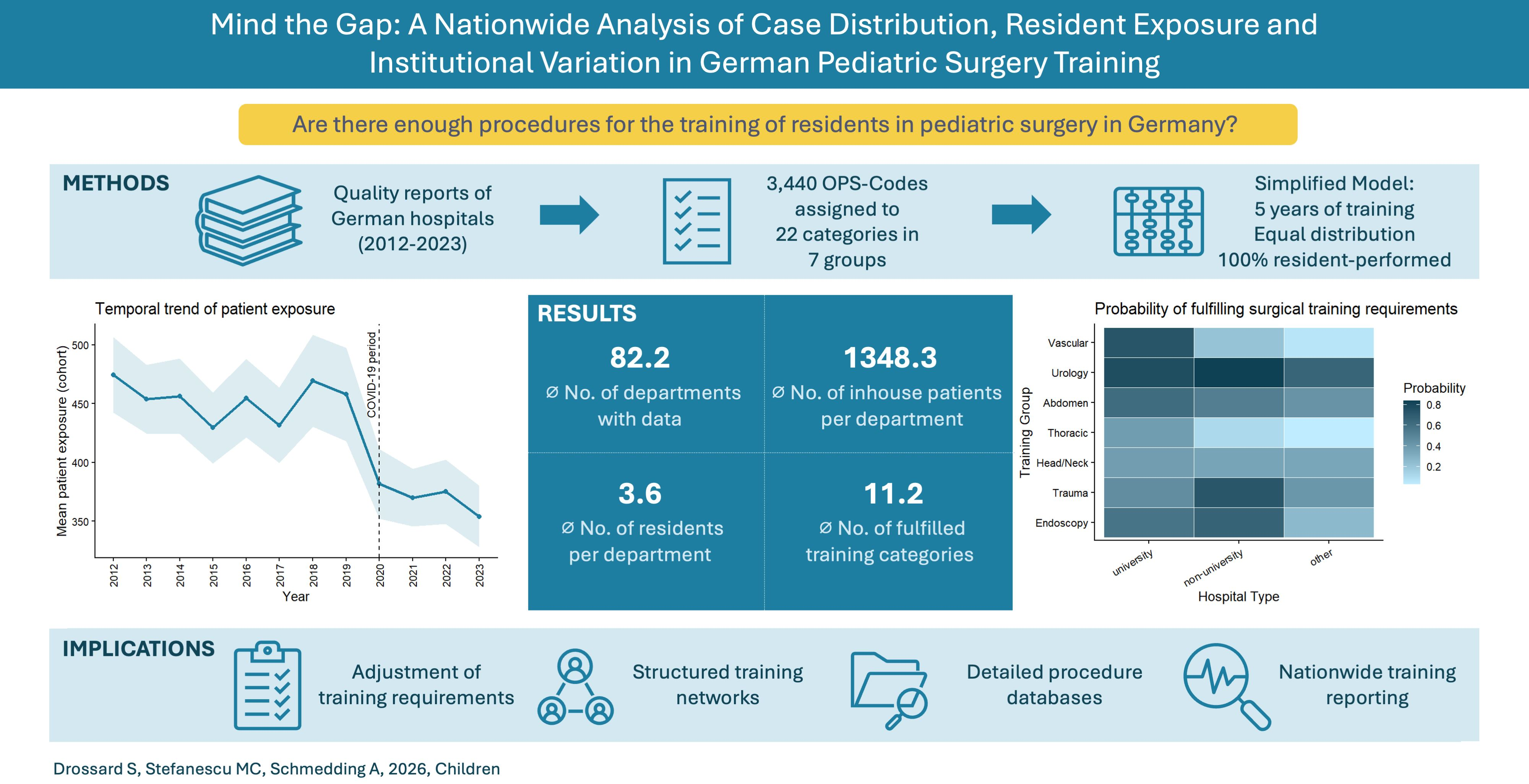
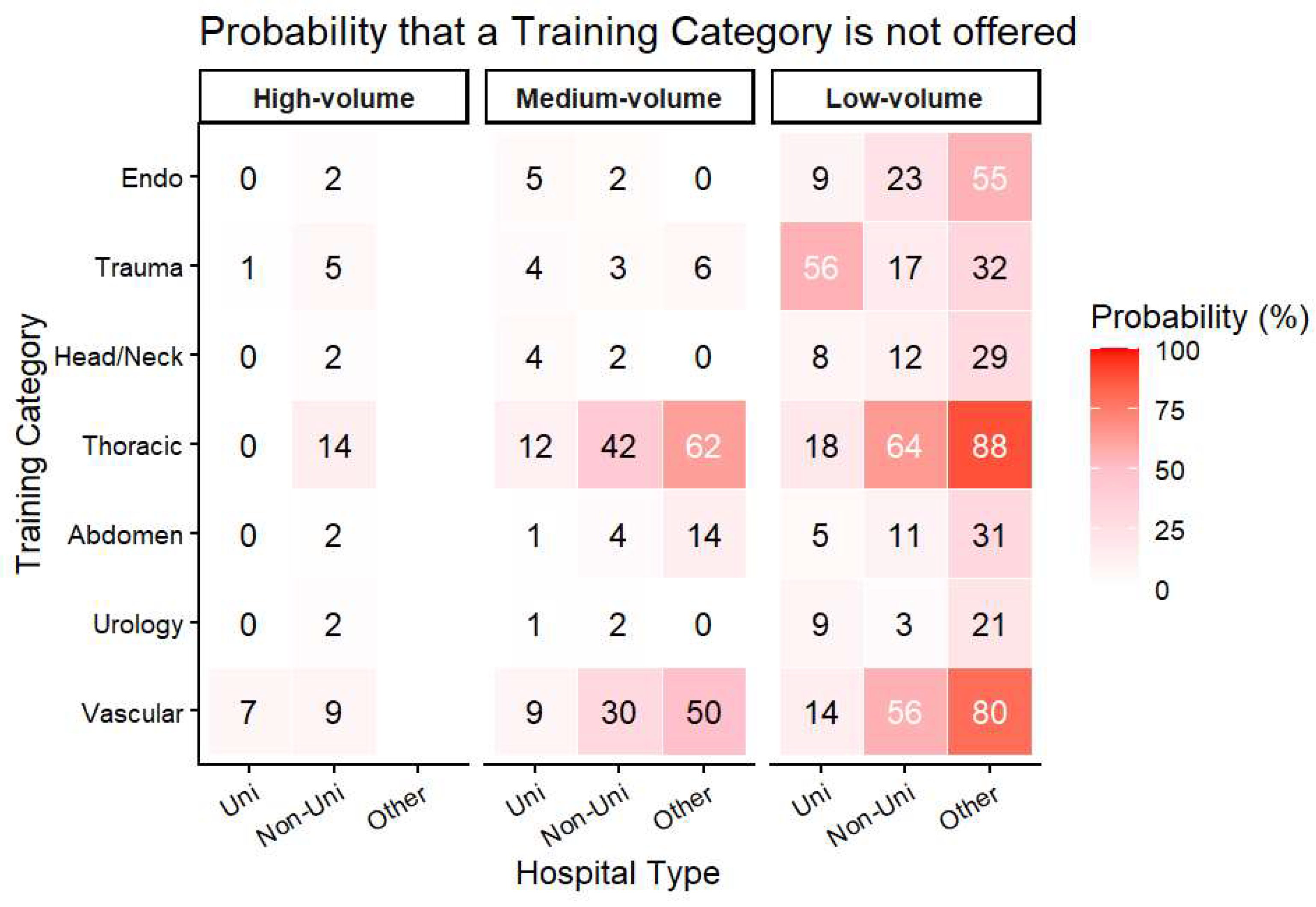
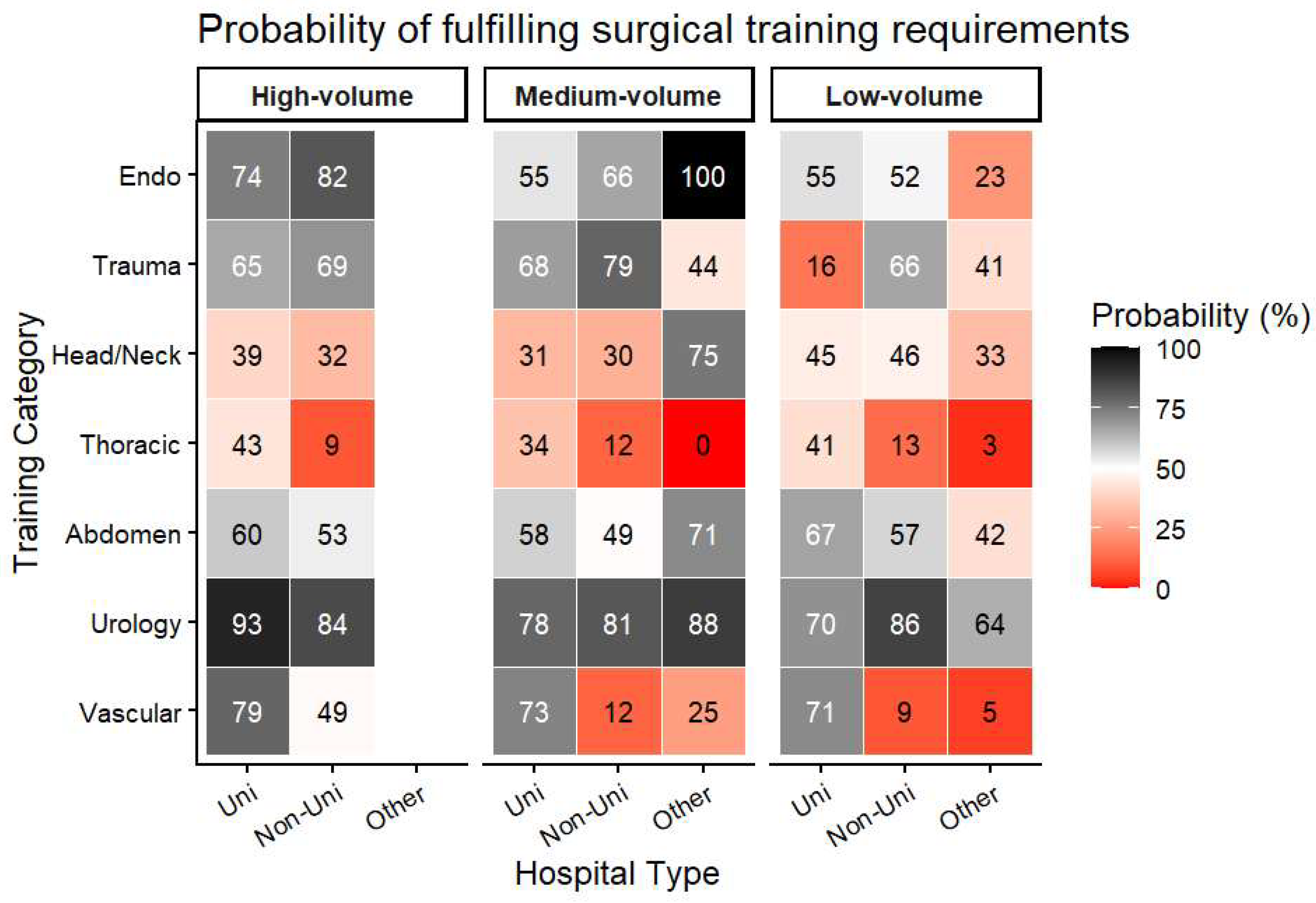
- This German nationwide analysis (2012–2023) mapping OPS codes to training categories in pediatric surgery shows that training-category coverage varies by hospital type and trended downward over time, with the greatest strain in very low-frequency domains.
- •
- Higher surgical volume correlates with broader category coverage and more residents, but rare procedures remain difficult to distribute evenly across training sites.
- •
- Pediatric surgical training capacity in Germany faces structural challenges, leading to risk of delayed qualification and uneven access to specialized care for children. The results highlight structural challenges and underscore the need to organize resident exposure to low-frequency procedures.
- •
- Transparent national documentation, coordinated inter-hospital rotation networks, and guidance on designated centers for rare procedures are needed to align training with service needs and support workforce stability.
Abstract
1. Introduction
2. Materials and Methods
Statistical Analysis
3. Results
3.1. Structure
3.2. Patient Exposure
3.3. Training Procedures
3.4. Specialization of Departments
3.5. Total Number of Procedures and Residents
4. Discussion
4.1. Recommendations
- (1)
- In the short term, minor MWBO adjustments would improve alignment: (i) reducing the assistance in thoracotomy target to 10 procedures; (ii) merge head-and-neck subcategories by omitting the separate branchial cleft/cyst requirement and subsuming all head-and-neck procedures under one category together with other procedures of the body’s surface.
- (2)
- To ensure comprehensive training, structured training networks should be established [56], facilitating mandatory rotations between different hospitals and outpatient settings to enhance trainees’ surgical exposure and competency development.
- (3)
- All national procedure databases should include information on the medical specialties performing these procedures in order to provide stronger evidence base for planning pediatric surgical care and training.
- (4)
- In the long term, fundamental reforms are needed to strengthen surgical education and align training needs with clinical realities [65]. A crucial first step toward improving surgical training would be nationwide, mandatory documentation tracking all pediatric surgery trainees and their procedural experience. Such a system would allow for transparent monitoring, facilitate benchmarking across institutions, and help identify structural gaps in training opportunities.
4.2. Strengths and Limitations
4.3. Recommendations for Future Research
5. Conclusions
Supplementary Materials
Author Contributions
Funding
Institutional Review Board Statement
Informed Consent Statement
Data Availability Statement
Acknowledgments
Conflicts of Interest
Abbreviations
| FTE | Full-Time Equivalent |
| GBA | Gemeinsamer Bundesausschuss (Federal Joint Committee) |
| MWBO | Musterweiterbildungsordnung (Model Training Regulations) |
| OPS | Operationen- und Prozedurenschlüssel (Procedure Classification) |
References
- German Society of Pediatric Surgery. The Spectrum of Pediatric Surgery. Available online: https://www.dgkjch.de/kinder-jugendchirurgie/spektrum-der-kinder-und-jugendchirurgie (accessed on 13 February 2026).
- Cruess, S.R.; Cruess, R.L.; Steinert, Y. Supporting the Development of a Professional Identity: General Principles. Med. Teach. 2019, 41, 641–649. [Google Scholar] [CrossRef] [PubMed]
- Rickham, P.P. (Ed.) Historical Aspects of Pediatric Surgery; Progress in Pediatric Surgery; Springer: Berlin/Heidelberg, Germany, 1986; Volume 20. [Google Scholar]
- German Society of Pediatric Surgery. Timeline of Pediatric Surgery in Germany. Available online: https://www.dgkjch.de/?view=article&id=56:zeitleiste&catid=56 (accessed on 1 April 2026).
- Hecker, W.C. The History of Pediatric Surgery in Germany. In Historical Aspects of Pediatric Surgery. Progress in Pediatric Surgery; Springer: Berlin/Heidelberg, Germany, 1986; Volume 20, pp. 1–8. [Google Scholar] [CrossRef]
- Holschneider, A.M.; Lesener, B.; Zachariou, Z. Paediatric Surgical Reality in Germany and Visions for the Future. Eur. J. Pediatr. Surg. 2001, 11, 75–81. [Google Scholar] [CrossRef] [PubMed]
- Höpner, F. Pediatric surgery in the Federal Republic of Germany after 1945. Monatsschrift Kinderheilkd. 2016, 164, 98–102. [Google Scholar] [CrossRef]
- Gdaniez, K. Pediatric surgery in the German Democratic Republic (GDR). Monatsschrift Kinderheilkd. 2016, 164, 92–97. [Google Scholar]
- Schmedding, A. Versorgungssituation in der deutschen Kinderchirurgie unter besonderer Berücksichtigung der Versorgung von angeborenen Fehlbildungen. Habilitation Thesis, Johann Wolfgang Goethe-Universität, Frankfurt, Germany, 2023. [Google Scholar]
- Federal Joint Committee (G-BA). Qualitätssicherungs-Richtlinie Früh-Und Reifgeborene. Available online: https://www.g-ba.de/downloads/62-492-4030/QFR-RL_2025-10-16_iK-2026-01-17.pdf (accessed on 3 April 2026).
- Schmedding, A.; Rolle, U. Decentralized Rather than Centralized Pediatric Surgery Care in Germany. Eur. J. Pediatr. Surg. 2017, 27, 399–406. [Google Scholar] [CrossRef]
- German Society of Pediatric Surgery. Departments and Private Practice of Pediatric Surgery. Available online: https://www.dgkjch.de/kinder-jugendchirurgie/kinder-und-jugendchirurgische-kliniken-und-praxen (accessed on 31 January 2025).
- Federal Statistical Office of Germany. Number of Hospitals, Hospitals Beds and Patients. Available online: https://www.destatis.de/DE/Themen/Gesellschaft-Umwelt/Gesundheit/Krankenhauser/Tabellen/gd-krankenhaeuser-jahre.html (accessed on 6 April 2026).
- Bundesärztekammer. Ärztestatistik zum 31.12.2023. Available online: https://www.bundesaerztekammer.de/fileadmin/user_upload/BAEK/Ueber_uns/Statistik/AErztestatistik_2023_Update_Juni_2024.pdf (accessed on 18 February 2026).
- Federal Ministry of Health. Bundes-Klinikatlas. Available online: https://bundes-klinik-atlas.de (accessed on 9 March 2026).
- Bundesärztekammer. (Muster-)Weiterbildungsordnung 2018 in der Fassung vom 29.06.2023. Available online: https://www.bundesaerztekammer.de/fileadmin/user_upload/BAEK/Themen/Aus-Fort-Weiterbildung/Weiterbildung/20250703_Muster-Weiterbildungsordnung-2018.pdf (accessed on 11 January 2025).
- Drossard, S. Structured Surgical Residency Training in Germany: An Overview of Existing Training Programs in 10 Surgical Subspecialties. Innov. Surg. Sci. 2019, 4, 15–24. [Google Scholar] [CrossRef]
- Drossard, S.; Schuffert, L. Challenges and Opportunities in Pediatric Surgery Training in Germany: A View from the Trenches. BMC Med. Educ. 2025, 25, 183. [Google Scholar] [CrossRef]
- Reismann, M.; Ellerkamp, V.; Dingemann, J. Working and Training Conditions of Residents in Pediatric Surgery: A Nationwide Survey in Germany. Eur. J. Pediatr. Surg. 2010, 20, 294–297. [Google Scholar] [CrossRef]
- Omer, M.; Machetanz, K.; Lawson McLean, A.C.; Ahmed, M.; Fadlalla, M.; Farzullayev, J.; Maurer, S.; Alhamdan, A.A.; Nguyen, T.L.; Beck, J.; et al. Challenges and Aspirations of Neurosurgery Residents in Germany: Insights from a Questionnaire-Based Survey. Clin. Neurol. Neurosurg. 2024, 245, 108477. [Google Scholar] [CrossRef]
- Helms, S.; Rost, S.; Linden, A.V.; Beckmann, A.; Dohle, D.-S. Karriere Und Perspektiven Assistentenbefragung 2016 Des Jungen Forums Der DGTHG Alles Beim Alten Oder Neue Erkenntnisse? Z. Herz Thorax Gefäßchirurgie 2018, 32, 510–519. [Google Scholar] [CrossRef]
- Cerqueira, R.J.; Heuts, S.; Gollmann-Tepeköylü, C.; Syrjälä, S.O.; Keijzers, M.; Zientara, A.; Jarral, O.A.; Jacob, K.A.; Haunschild, J.; Ariyaratnam, P.; et al. Challenges and Satisfaction in Cardiothoracic Surgery Residency Programmes: Insights from a Europe-Wide Survey. Interact. Cardiovasc. Thorac. Surg. 2021, 32, 167–173. [Google Scholar] [CrossRef] [PubMed]
- Kaufman, T.; Ad-El, D. Satisfaction from Plastic Surgery Residency: A National Survey. Ann. Plast. Surg. 2020, 85, 344–351. [Google Scholar] [CrossRef] [PubMed]
- Li, X.; Pagani, N.; Curry, E.J.; Alolabi, B.; Dickens, J.F.; Miller, A.N.; Mesfin, A. Factors Influencing Resident Satisfaction and Fellowship Selection in Orthopaedic Training Programs: An American Orthopaedic Association North American Traveling Fellowship Project. J. Bone Jt. Surg. 2019, 101, e46. [Google Scholar] [CrossRef] [PubMed]
- Federal Statistical Office of Germany. Hospital Patients: Germany, Years, Gender, Age-Groups, Diagnoses (ICD). Available online: https://www-genesis.destatis.de/datenbank/online/statistic/23131/table/23131-0002 (accessed on 7 April 2026).
- Directive 2003/88/EC of the European Parliament and of the Council of 4 November 2003 Concerning Certain Aspects of the Organisation of Working Time; Publications Office of the European Union: Luxembourg, 2003; Volume 299.
- Marburger Bund. Agreement in the Collective Bargaining for Physicians (TV-Ärzte): New Regulations on Working Hours, Additional Leave, and Salary Increases. Available online: http://www.marburger-bund.de/bundesverband/tarifpolitik/tarifeinigung-zum-tv-aerzte-neue-vorgaben-zur-arbeitszeit-zusatzurlaub (accessed on 21 January 2026). (In Germany)
- Huber, T.; Richardsen, I.; Klinger, C.; Mille, M.; Roeth, A.A.; Dörner, J.; Drewes, S.; Fabig, S.; Gaedcke, J.; Günter, P.J.; et al. See (n)One, Do (n)One, Teach (n)One: Reality of Surgical Resident Training in Germany. World J. Surg. 2020, 44, 2501–2510. [Google Scholar] [CrossRef]
- Borgmann, H.; Arnold, H.K.; Meyer, C.P.; Bründl, J.; König, J.; Nestler, T.; Ruf, C.; Struck, J.; Salem, J. Training, Research, and Working Conditions for Urology Residents in Germany: A Contemporary Survey. Eur. Urol. Focus 2018, 4, 455–460. [Google Scholar] [CrossRef]
- Kearse, L.; Zeineddin, A.; Schmiederer, I.; Korndorffer, J.; Lau, J. A 20-Year Review of Surgical Training Case Logs: Is General Surgery Still General? Surgery 2021, 170, 1347–1352. [Google Scholar] [CrossRef]
- Malangoni, M.; Biester, T.; Jones, A.; Klingensmith, M.; Lewis, F. Operative Experience of Surgery Residents: Trends and Challenges. J. Surg. Educ. 2013, 70, 783–788. [Google Scholar] [CrossRef]
- Abdullah, F.; Salazar, J.H.; Gause, C.D.; Gadepalli, S.; Biester, T.W.; Azarow, K.S.; Brandt, M.L.; Chung, D.H.; Lund, D.P.; Rescorla, F.J.; et al. Understanding the Operative Experience of the Practicing Pediatric Surgeon: Implications for Training and Maintaining Competency. JAMA Surg. 2016, 151, 735–741. [Google Scholar] [CrossRef]
- Pakarinen, M.P.; Luoto, T.; Nuutinen, S.; Raitio, A.; Tahkola, E.; Koivusalo, A. Finnish Pediatric Surgery Hub—From Centralization to Collective Learning and Sharing of Expertise. J. Pediatr. Surg. 2024, 59, 161642. [Google Scholar] [CrossRef]
- Khaleghnejad Tabari, A.; Mohajerzadeh, L.; Ebrahimian, M.; Rouzrokh, M.; Jahangiri, F.; Rouzrokh, S.; Eghbali Zarch, R.; Ahmadi Amoli, A. Pediatric Surgery Workforce Around the World: A Need to Revise Residency Programs? Glob. Pediatr. Health 2024, 11, 2333794X241263169. [Google Scholar] [CrossRef]
- Ziegler, M.M. Pediatric Surgical Training: An Historic Perspective, a Formula for Change. J. Pediatr. Surg. 2004, 39, 1159–1172. [Google Scholar] [CrossRef] [PubMed]
- Joint Committee on Surgical Training (JCST). Paediatric Surgery Curriculum. Available online: https://www.iscp.ac.uk/iscp/curriculum/paediatric-surgery-curriculum/2-purpose/ (accessed on 7 April 2026).
- UEMS Education & Training. Available online: https://www.uemspaedsurg.org/education-training/european-registry/10-education-training (accessed on 7 April 2026).
- Holschneider, A.M.; Driller, C. Training in Pediatric Surgery in Europe. Eur. J. Pediatr. Surg. 1999, 9, 2–3. [Google Scholar] [CrossRef] [PubMed]
- UEMS. European Syllabus in Paediatric Surgery. Available online: http://www.uemspaedsurg.org/downloads/European%20Syllabus-1-2.pdf (accessed on 30 October 2022).
- Schmedding, A.; Rolle, U.; Czauderna, P. European Pediatric Surgical Training. Eur. J. Pediatr. Surg. 2017, 27, 245–250. [Google Scholar] [CrossRef] [PubMed]
- UEMS. European Training Requirements for Pediatric Surgery. Available online: https://www.uemspaedsurg.org/images/Announcements/ETR_Paediatric_Surgery_102020.pdf (accessed on 30 October 2022).
- Livergant, R.J.; Bednarek, O.L.; Rangel, A.G.; Puhama, A.; Binda, C.J.; Ackermann, A.; Zivkovic, I.; Magzoub, A.; Joos, E.; Pilkington, M.; et al. Who’s Training Tomorrow’s Pediatric Surgeons? A Global Review of Pediatric Surgery Postgraduate Training Programs in Low- and Middle-Income Countries. J. Pediatr. Surg. 2026, 61, 162993. [Google Scholar] [CrossRef]
- Maruthappu, M.; Gilbert, B.J.; El-Harasis, M.A.; Nagendran, M.; McCulloch, P.; Duclos, A.; Carty, M.J. The Influence of Volume and Experience on Individual Surgical Performance: A Systematic Review. Ann. Surg. 2015, 261, 642–647. [Google Scholar] [CrossRef]
- Maruthappu, M.; Duclos, A.; Lipsitz, S.R.; Orgill, D.; Carty, M.J. Surgical Learning Curves and Operative Efficiency: A Cross-Specialty Observational Study. BMJ Open 2015, 5, e006679. [Google Scholar] [CrossRef]
- Akmaz, B.; Van Kuijk, S.M.J.; Sardari Nia, P. Association between Individual Surgeon Volume and Outcome in Mitral Valve Surgery: A Systematic Review. J. Thorac. Dis. 2021, 13, 4500–4510. [Google Scholar] [CrossRef]
- Jensen, R.M.; Anand, A.; Kearse, L.E.; Korndorffer, J.R. Looking Beyond the Numbers: A Comparison of Operative Self-Efficacy, Supervision, and Case Volume in General Surgery Residency. J. Grad. Med. Educ. 2024, 16, 280–285. [Google Scholar] [CrossRef]
- Shaban, L.; Mkandawire, P.; O’Flynn, E.; Mangaoang, D.; Mulwafu, W.; Stanistreet, D. Quality Metrics and Indicators for Surgical Training: A Scoping Review. J. Surg. Educ. 2023, 80, 1302–1310. [Google Scholar] [CrossRef]
- McAteer, J.P.; LaRiviere, C.A.; Drugas, G.T.; Abdullah, F.; Oldham, K.T.; Goldin, A.B. Influence of Surgeon Experience, Hospital Volume, and Specialty Designation on Outcomes in Pediatric Surgery: A Systematic Review. JAMA Pediatr. 2013, 167, 468–475. [Google Scholar] [CrossRef]
- Biedma-Velázquez, L.; Serrano-Del-Rosal, R.; García-De-Diego, J.M.; Cerrillo-Vidal, J.A. Dissatisfaction with Residency: A Discrepancy between Preferences and Expectations? Med. Teach. 2012, 34, e772–e778. [Google Scholar] [CrossRef] [PubMed]
- Hope, C.; Reilly, J.J.; Griffiths, G.; Lund, J.; Humes, D. Factors Associated with Attrition and Performance Throughout Surgical Training: A Systematic Review and Meta-Analysis. World J. Surg. 2021, 45, 429–442. [Google Scholar] [CrossRef] [PubMed]
- Khoushhal, Z.; Hussain, M.A.; Greco, E.; Mamdani, M.; Verma, S.; Rotstein, O.; Tricco, A.C.; Al-Omran, M. Prevalence and Causes of Attrition Among Surgical Residents: A Systematic Review and Meta-Analysis. JAMA Surg. 2017, 152, 265–272. [Google Scholar] [CrossRef] [PubMed]
- Todd, A.R.; Cawthorn, T.R.; Temple-Oberle, C. Pregnancy and Parenthood Remain Challenging During Surgical Residency: A Systematic Review. Acad. Med. J. Assoc. Am. Med. Coll. 2020, 95, 1607–1615. [Google Scholar] [CrossRef]
- Gregory, S.; Demartini, C. Satisfaction of Doctors with Their Training: Evidence from UK. BMC Health Serv. Res. 2017, 17, 851. [Google Scholar] [CrossRef]
- Schmedding, A.; Assion, C.; Mayer, S.; Brunner, A. Challenges of the COVID-19 Pandemic for the Work–Family Balance of Pediatric Surgeons. Surgeries 2022, 3, 248–258. [Google Scholar] [CrossRef]
- Cui, C.L.; Reilly, M.A.; Pillado, E.B.; Li, R.D.; Eng, J.S.; Jiang, Y.; Grafmuller, L.E.; DiLosa, K.L.; Conway, A.M.; Escobar, G.A.; et al. Trainee Autonomy Is Associated with Well-Being. Ann. Vasc. Surg. 2026, 122, 688–697. [Google Scholar] [CrossRef]
- Schlottmann, F.; Schaaf, S.; Rösch, R.M.; Dey Hazra, M.E.; Herbolzheimer, M.; Drossard, S.; Schuffert, L.; Braun, B.J.; Keller, S.L.; Motekallemi, A.; et al. Time for change: What must the high-quality surgical training network of tomorrow offer?: Perspectives and demands of the Young Forums of the Surgical Societies in Germany. Chirurgie 2025, 96, 568–573. [Google Scholar] [CrossRef]
- Allan, C. Determinants of Good Outcome in Pyloric Stenosis. J. Paediatr. Child Health 2006, 42, 86–88. [Google Scholar] [CrossRef]
- Tejwani, R.; Wang, H.-H.S.; Young, B.J.; Greene, N.H.; Wolf, S.; Wiener, J.S.; Routh, J.C. Increased Pediatric Sub-Specialization Is Associated with Decreased Surgical Complication Rates for Inpatient Pediatric Urology Procedures. J. Pediatr. Urol. 2016, 12, 388.e1–388.e7. [Google Scholar] [CrossRef]
- Weyersberg, A.; Roth, B.; Woopen, C. Pädiatrie: Folgen der Ökonomisierung. Available online: https://www.aerzteblatt.de/archiv/paediatrie-folgen-der-oekonomisierung-5c040162-6e91-4605-a49a-88138f9040ab (accessed on 7 April 2026).
- Knowlin, L.T.; Laskay, N.M.B.; Jules, N.P.; Godzik, J.; Chang, T.P.; Spurrier, R.G. Advances in Pediatric Surgery Simulation-Based Training. Children 2024, 11, 34. [Google Scholar] [CrossRef]
- Schuffert, L.; Drossard, S. The Role of Simulation in Mastering Highly Specialized Pediatric Surgery: Current Trends and Future Perspectives. Innov. Surg. Sci. 2025, 10, 203–210. [Google Scholar] [CrossRef]
- Gnatzy, R.; Schwab-Eckhardt, B.; Brunner, A.; Drossard, S. Establishing an Online Training Program for Pediatric Surgery Residents during and after the COVID-19 Pandemic—Lessons Learned. GMS J. Med. Educ. 2024, 41, Doc57. [Google Scholar] [CrossRef]
- Huber, T.; Bartsch, F.; Lang, H.; Kneist, W. Viszeralchirurgische Weiterbildungseingriffe Und Teilschritte—Die Erste Situationsanalyse. Z. Gastroenterol. 2015, 53, KC061. [Google Scholar] [CrossRef]
- Schardey, J.; Hüttl, F.; Jacobsen, A.; Brunner, S.; Tripke, V.; Wirth, U.; Werner, J.; Kalff, J.C.; Sommer, N.; Huber, T. The new continuing education regulations-A challenge for visceral surgery: Results of a survey among DGAV members and solution strategies of the Young Surgeons. Chirurgie 2024, 95, 563–577. [Google Scholar] [CrossRef]
- Schlottmann, F.; Mulorz, J.; Braun, B.; Huber, T.; Schuffert, L.; Kröplin, J.; Drossard, S.; Böhm, S.L.; Dey Hazra, M.E.; Herbolzheimer, M.; et al. Quality indicators for advanced surgical training: An analysis of current concepts and implementation options from the Young Surgeons’ Forum of the German Society of Surgery. Chirurgie 2026, 97, 293–300. [Google Scholar] [CrossRef]



| No. | Training Category | Reference No. of Procedures | No. of Codes | No. of Proc. (Inhouse/Outpatient) |
|---|---|---|---|---|
| 100 | Gastrointestinal Endoscopies (GI) | |||
| 101 | Esophago-gastro-duodenoscopy | 20 | 53 | 31,887/515 |
| 102 | Rectosigmoidoscopy | 10 | 53 | 16,501/722 |
| 110 | Traumatology (Tr) | |||
| 111 | Conservative Treatment including fracture reduction | 50 | 27 | 17,437/5691 |
| 112 | Osteosynthesis of fractures: | |||
| 113 | -diaphyseal | 25 | 183 | 33,103/420 |
| 114 | -meta- and epiphyseal | 25 | 408 | 59,231/2044 |
| 115 | Metal implant removal | 25 | 347 | 21,446/48,977 |
| 120 | Head and Neck (HN) | |||
| 121 | Excision of benign tumors, desmoids, ear tags | 15 | 24 | 7594/509 |
| 122 | Excison of branchial cleft cysts and fistulas, lymph nodes | 10 | 36 | 5749/519 |
| 130 | Thoracic Surgery (Tho) | |||
| 131 | Thoracotomy as surgical access route, thoracoscopy | 10 | 49 | 8089/0 |
| 132 | Thoracic procedures of higher complexity (1st assistance) | 15 | 256 | 11,339/3 |
| 140 | Abdomen and Abdominal Wall (Abd) | |||
| 141 | Correction of congenital malformations (1st assistance) | 20 | 187 | 10,638/0 |
| 142 | Procedures in the abdominal cavity, of which | 60 | 423 | 65,875/489 |
| 143 | Appendectomy | 25 | 22 | 66,283/0 |
| 144 | Laparotomy as surgical access route | 15 | 170 | 20,414/5 |
| 145 | Laparotomies of higher complexity (1st assistance) | 30 | 456 | 7989/3 |
| 146 | Inguinal herniotomy, of which | 75 | 31 | 62,731/28,238 |
| 147 | Herniotomy of abdominal wall hernias | 15 | 61 | 7963/6851 |
| 150 | Kidney, Urinary Tract and Genital Organs (Uro) | |||
| 151 | Basic urologic procedures | 50 | 126 | 52,377/43,685 |
| 152 | Orchidopexy and funicolysis | 30 | 20 | 54,070/15,056 |
| 153 | Cystoscopy | 15 | 83 | 44,228/2829 |
| 154 | Urologic procedures of higher complexity (1st assistance) | 20 | 414 | 45,872/88 |
| 180 | Vascular Surgery (Vasc) | |||
| 181 | Insertion of central venous access systems | 10 | 11 | 20,215/907 |
| Year | University Departments | Non-University Departments | Other | ||||||
|---|---|---|---|---|---|---|---|---|---|
| Units | Inhouse Patients | Residents | Units | Inhouse Patients | Residents | Units | Inhouse Patients | Residents | |
| 2012 | 37 (24) | 1168.5 (93.0/2623.0) | 4.5 (0.0/11.5) | 47 (47) | 1673.0 (365.0/6469.0) | 3.0 (0.0/12.0) | 43 (9) | 476.0 (0.0/1086.0) | 0.0 (0.0/2.1) |
| 2013 | 37 (23) | 1114.0 (187.0/2585.0) | 4.5 (0.0/10.0) | 50 (48) | 1504.0 (458.0/4755.0) | 3.6 (0.0/9.8) | 47 (10) | 279.0 (0.0/1077.0) | 0.0 (0.0/0.0) |
| 2014 | 38 (25) | 1097.0 (31.0/2607.0) | 5.0 (0.0/10.0) | 53 (49) | 1557.0 (427.0/4533.0) | 3.3 (0.0/12.7) | 48 (10) | 303.0 (0.0/1016.0) | 0.0 (0.0/0.2) |
| 2015 | 38 (25) | 1078.0 (58.0/2893.0) | 3.6 (0.0/11.2) | 53 (49) | 1517.0 (377.0/4505.0) | 3.7 (0.0/10.7) | 49 (9) | 366.0 (0.0/939.0) | 0.0 (0.0/0.0) |
| 2016 | 38 (25) | 1076.0 (108.0/2492.0) | 3.8 (0.0/11.1) | 53 (48) | 1590.0 (395.0/4752.0) | 3.8 (0.0/13.0) | 49 (9) | 376.0 (78.0/900.0) | 0.0 (0.0/2.8) |
| 2017 | 38 (24) | 1088.5 (129.0/2500.0) | 4.6 (0.0/10.4) | 53 (49) | 1538.0 (403.0/4576.0) | 3.6 (0.0/14.8) | 48 (9) | 425.0 (36.0/966.0) | 0.0 (0.0/2.0) |
| 2018 | 39 (24) | 1212.0 (101.0/2531.0) | 3.9 (0.0/9.4) | 54 (49) | 1515.0 (384.0/4299.0) | 3.8 (0.0/13.0) | 47 (9) | 418.0 (39.0/750.0) | 0.0 (0.0/2.8) |
| 2019 | 39 (24) | 1377.5 (129.0/2780.0) | 4.5 (0.2/11.7) | 54 (47) | 1504.0 (417.0/4013.0) | 3.6 (0.0/15.9) | 47 (9) | 439.0 (48.0/776.0) | 0.0 (0.0/3.3) |
| 2020 | 38 (25) | 1135.0 (73.0/2384.0) | 4.3 (0.8/9.3) | 55 (49) | 1290.0 (479.0/3773.0) | 3.5 (0.0/13.0) | 47 (9) | 344.0 (51.0/613.0) | 0.0 (0.0/1.1) |
| 2021 | 38 (24) | 1179.5 (85.0/2343.0) | 4.5 (0.2/10.2) | 55 (49) | 1232.0 (446.0/3398.0) | 3.9 (0.0/12.9) | 50 (11) | 330.0 (0.0/552.0) | 0.0 (0.0/1.6) |
| 2022 | 38 (24) | 1124.0 (105.0/2396.0) | 4.3 (0.0/10.8) | 55 (48) | 1306.0 (285.0/3135.0) | 3.2 (0.0/15.2) | 48 (11) | 298.0 (49.0/541.0) | 0.0 (0.0/1.7) |
| 2023 | 38 (26) | 1108.0 (0.0/2437.0) | 4.3 (0.0/9.9) | 53 (49) | 1417.0 (198.0/3691.0) | 4.3 (0.0/14.4) | 43 (10) | 349.0 (47.0/598.0) | 0.0 (0.0/1.8) |
| Procedure Category | 2012 | 2013 | 2014 | 2015 | 2016 | 2017 | 2018 | 2019 | 2020 | 2021 | 2022 | 2023 | |
|---|---|---|---|---|---|---|---|---|---|---|---|---|---|
| 101 | Eso.-gastro-duodenoscopy | 2.1 | 2.0 | 2.0 | 2.2 | 2.0 | 2.2 | 2.0 | 2.3 | 2.6 | 2.2 | 2.5 | 2.4 |
| 102 | Rectosigmoidoscopy | 1.6 | 1.5 | 1.6 | 1.8 | 1.7 | 2.0 | 2.0 | 2.3 | 2.6 | 2.6 | 3.1 | 3.2 |
| 111 | Fracture reduction | 6.0 | 6.1 | 6.7 | 7.1 | 6.9 | 8.1 | 7.1 | 8.4 | 8.7 | 9.5 | 7.9 | 12.0 |
| 113 | Osteosynth.: diaphyseal | 3.1 | 3.1 | 2.9 | 2.8 | 2.6 | 2.6 | 2.4 | 2.6 | 2.5 | 2.7 | 2.5 | 2.4 |
| 114 | Osteosynth.: meta-/epiphyseal | 1.6 | 1.6 | 1.5 | 1.5 | 1.5 | 1.5 | 1.4 | 1.5 | 1.4 | 1.4 | 1.3 | 1.4 |
| 115 | Metal implant removal | 1.3 | 1.3 | 1.4 | 1.3 | 1.3 | 1.3 | 1.2 | 1.2 | 1.2 | 1.2 | 1.2 | 1.5 |
| 121 | Exc. benign tumors, desm., ear tags | 4.7 | 5.6 | 5.8 | 5.7 | 5.6 | 6.4 | 6.4 | 7.1 | 8.4 | 8.0 | 9.2 | 8.5 |
| 122 | Exc. Branch. cysts/fistulas, l.-nodes | 5.2 | 4.8 | 5.0 | 5.4 | 5.3 | 6.0 | 5.7 | 5.9 | 6.5 | 7.2 | 6.1 | 5.9 |
| 131 | Thoracotomy as surgical access | 3.8 | 3.7 | 4.1 | 4.0 | 5.4 | 4.0 | 4.1 | 4.5 | 6.7 | 4.7 | 6.3 | 5.6 |
| 132 | Complex thor. proc. (1st ass.) | 3.3 | 3.4 | 3.9 | 4.1 | 8.8 | 4.0 | 4.4 | 4.6 | 9.1 | 5.4 | 9.6 | 7.9 |
| 141 | Cong. malformation (1st ass.) | 6.6 | 6.1 | 6.1 | 6.3 | 5.9 | 6.2 | 6.0 | 6.7 | 7.7 | 7.5 | 7.6 | 8.3 |
| 142 | Abdominal procedures | 3.0 | 3.0 | 3.0 | 3.1 | 3.0 | 3.1 | 3.1 | 3.2 | 3.3 | 3.6 | 3.5 | 4.1 |
| 143 | Appendectomy | 1.1 | 1.1 | 1.2 | 1.2 | 1.3 | 1.3 | 1.3 | 1.5 | 1.4 | 1.6 | 1.5 | 1.8 |
| 144 | Laparotomy as surgical access | 2.6 | 2.7 | 2.6 | 2.6 | 2.4 | 2.4 | 2.5 | 2.5 | 2.9 | 2.7 | 2.8 | 3.2 |
| 145 | Lap. higher complex. (1st ass.) | 10.7 | 12.7 | 10.5 | 10.9 | 12.5 | 14.0 | 12.5 | 14.3 | 14.3 | 16.4 | 17.5 | 18.7 |
| 146 | Inguinal herniotomy | 2.4 | 2.4 | 2.7 | 2.6 | 2.7 | 2.8 | 2.8 | 3.1 | 3.4 | 3.5 | 3.6 | 3.9 |
| 147 | Abdominal wall hernias | 2.7 | 2.6 | 2.8 | 2.9 | 3.3 | 3.7 | 3.8 | 4.2 | 5.2 | 4.8 | 4.9 | 4.3 |
| 151 | Simple urologic procedures | 1.6 | 1.6 | 1.7 | 1.7 | 1.8 | 1.9 | 1.8 | 1.8 | 2.2 | 2.0 | 2.2 | 2.1 |
| 152 | Orchidopexy and funicolysis | 1.4 | 1.5 | 1.5 | 1.4 | 1.4 | 1.5 | 1.4 | 1.6 | 1.7 | 1.7 | 1.7 | 1.8 |
| 153 | Cystoscopy | 1.0 | 1.0 | 1.0 | 1.0 | 1.1 | 1.2 | 1.2 | 1.2 | 1.3 | 1.2 | 1.2 | 1.2 |
| 154 | Complex urol. proc. (1st ass.) | 1.9 | 1.6 | 1.8 | 1.7 | 1.6 | 1.6 | 1.2 | 1.4 | 1.5 | 1.5 | 1.6 | 1.6 |
| 181 | Ins. of central ven. access | 1.5 | 1.5 | 1.5 | 1.7 | 1.7 | 1.9 | 1.6 | 1.7 | 1.5 | 1.7 | 2.2 | 2.0 |
Disclaimer/Publisher’s Note: The statements, opinions and data contained in all publications are solely those of the individual author(s) and contributor(s) and not of MDPI and/or the editor(s). MDPI and/or the editor(s) disclaim responsibility for any injury to people or property resulting from any ideas, methods, instructions or products referred to in the content. |
© 2026 by the authors. Licensee MDPI, Basel, Switzerland. This article is an open access article distributed under the terms and conditions of the Creative Commons Attribution (CC BY) license.
Share and Cite
Drossard, S.; Stefanescu, M.C.; Schmedding, A. Mind the Gap: A Nationwide Analysis of Case Distribution, Resident Exposure and Institutional Variation in German Pediatric Surgery Training. Children 2026, 13, 554. https://doi.org/10.3390/children13040554
Drossard S, Stefanescu MC, Schmedding A. Mind the Gap: A Nationwide Analysis of Case Distribution, Resident Exposure and Institutional Variation in German Pediatric Surgery Training. Children. 2026; 13(4):554. https://doi.org/10.3390/children13040554
Chicago/Turabian StyleDrossard, Sabine, Maria Christina Stefanescu, and Andrea Schmedding. 2026. "Mind the Gap: A Nationwide Analysis of Case Distribution, Resident Exposure and Institutional Variation in German Pediatric Surgery Training" Children 13, no. 4: 554. https://doi.org/10.3390/children13040554
APA StyleDrossard, S., Stefanescu, M. C., & Schmedding, A. (2026). Mind the Gap: A Nationwide Analysis of Case Distribution, Resident Exposure and Institutional Variation in German Pediatric Surgery Training. Children, 13(4), 554. https://doi.org/10.3390/children13040554