Tracking Current Evidence and Future Perspectives of Children’s Motor Development



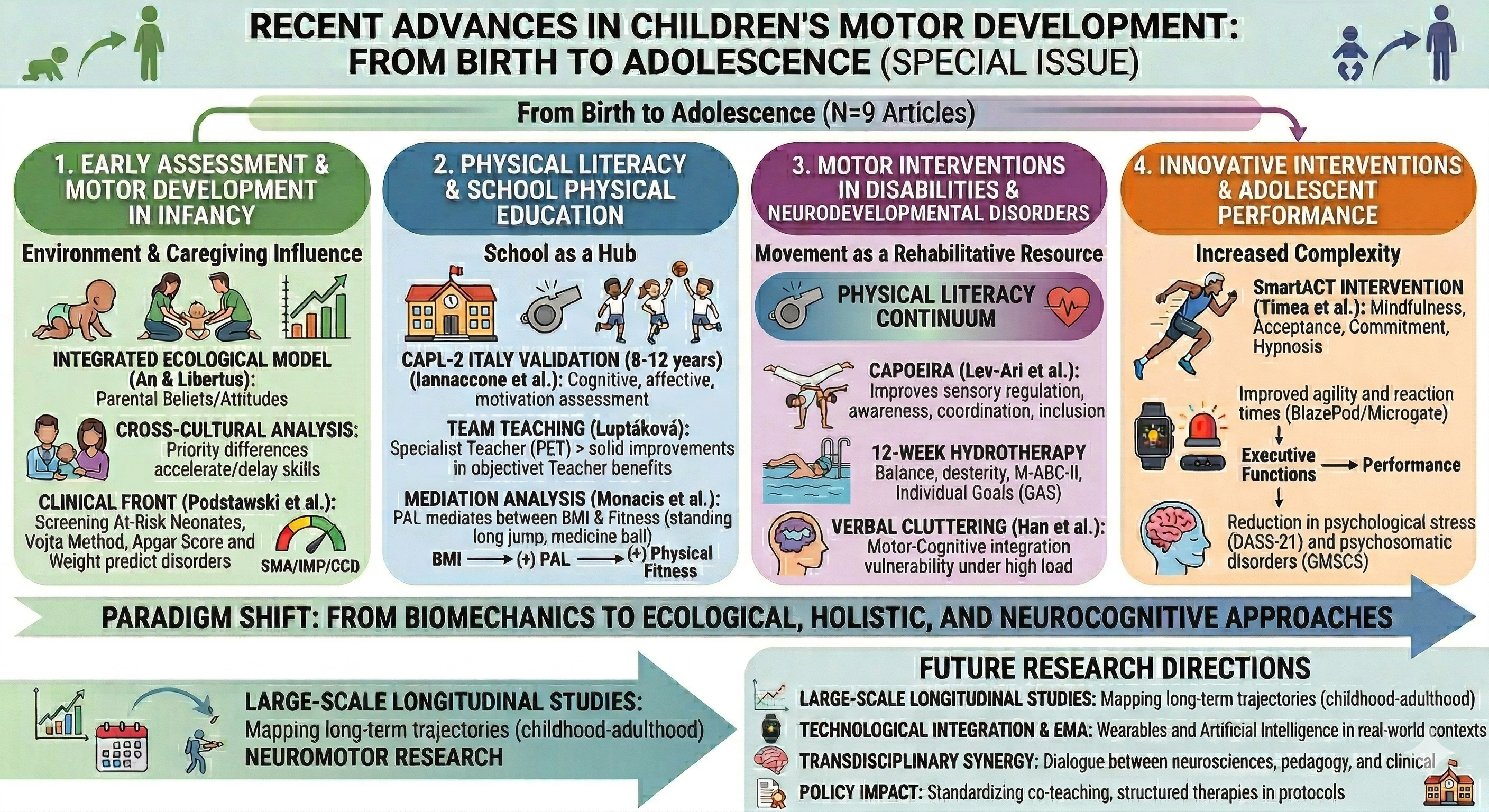
- The Developmental Ecosystem: Early Determinants and School Dynamics
- 2.
- Neurocognitive Synergies: Epistemological Continuity Between Developmental Disorders and High Performance
- 3.
- Movement as an Immersive Medium for Inclusion and Systemic Adaptation
- 4.
- Concluding Reflections and Future Research Perspectives
- Longitudinal and multicenter designs: Tracking motor development trajectories over the long term and investigating how early determinants and parenting styles predict adherence to physical activity and motor competence in adulthood;
- Technology assessment tools: advances in wearable technologies and artificial intelligence must be leveraged to collect kinematic and behavioral data in real-world settings, overcoming the inherent limitations of laboratory evaluations and self-report measures;
- Transdisciplinary synergy: promoting a research framework that structurally integrates cognitive neuroscience, movement sciences, and educational disciplines, in order to validate multi-component interventions that support the well-documented link between motor skills, executive functions, and emotional domains;
- Translation into health policy and education paradigms: the robust evidence emerging from this Special Issue must be translated into stringent policy guidelines, incentivizing structural presence of movement specialists starting in elementary school and promoting the integration of inclusive motor experiences (such as adapted martial arts or aquatic activities) into the Essential Levels of Care (LEAs) and public health promotion programs.
Conflicts of Interest
List of Contributions
- An, R.; Libertus, K. Parental Perspectives and Infant Motor Development: An Integrated Ecological Model. Children 2025, 12, 724. https://doi.org/10.3390/children12060724.
- Han, W.; Zhou, L.; Lu, J.; Pill, S. Cluttering in Children and Adolescents: Speech Motor Development, Neurocognitive Mechanisms, and Allied Health Implications. Children 2026, 13, 97. https://doi.org/10.3390/children13010097.
- Iannaccone, A.; Cudicio, A.; Falese, L.; Federico, B.; Crotti, M.; Lovecchio, N.; Digennaro, S.; Agosti, V. Validation of the Italian Translation and Cultural Adaptation of the Canadian Assessment of Physical Literacy-2 (CAPL-2) Questionnaire for Children. Children 2025, 12, 1290. https://doi.org/10.3390/children12101290.
- Lev-Ari, R.; Lotan, M.; Korn, L. The Role of Capoeira in Improving Motor and Social Skills in Children with Autism. Children 2025, 12, 1305. https://doi.org/10.3390/children12101305.
- Lotan, M.; Weiss, M. Balance and Coordination Improvements in Children and Adolescents with Autism Spectrum Disorder (ASD), Resulting from a Hydrotherapy Intervention. Children 2026, 13, 94. https://doi.org/10.3390/children13010094.
- Luptáková, G.; Argajová, J.; Balga, T.; Augustovičová, D.; Sobotová, P.; Balint, G.; Antala, B. Team Teaching Models in Primary Physical Education: Effects on Basic Motor Competencies and Self-Reported Physical Literacy. Children 2025, 12, 1595. https://doi.org/10.3390/children12121595.
- Monacis, D.; Sannicandro, I.; Colella, D. Exploring Self-Reported Physical Activity Levels and Physical Fitness in Italian Children: A Mediation and Moderation Analysis. Children 2025, 12, 204. https://doi.org/10.3390/children12020204.
- Podstawski, R.; Balewska-Juras, K.; Borysławski, K.; Szabo, A.; Snarska, J. An Assessment of Motor Skills in Infants at Risk of Atypical Psychomotor Development Using the Vojta Method. Children 2025, 12, 976. https://doi.org/10.3390/children12080976.
- Timea, B.M.; Carmen, C.-B.; Nicolae, O.M.; Nicola, M.; Teodor, G.V.; Maria, S.A.; Cornelia, P.; Hervás-Gómez, C.; Florina, G.E.; Dan, M. Effects of the SmartACT Intervention on Motor and Psychological Variables in Adolescent Athletes: A Controlled Trial Using BlazePod and Microgate. Children 2025, 12, 1338. https://doi.org/10.3390/children12101338.
References
- Adolph, K.E.; Hoch, J.E. Motor Development: Embodied, Embedded, Enculturated, and Enabling. Annu. Rev. Psychol. 2019, 70, 141–164. [Google Scholar] [CrossRef] [PubMed]
- Green, D.; Lingam, R.; Mattocks, C.; Riddoch, C.; Ness, A.; Emond, A. The Risk of Reduced Physical Activity in Children with Probable Developmental Coordination Disorder: A Prospective Longitudinal Study. Res. Dev. Disabil. 2011, 32, 1332–1342. [Google Scholar] [CrossRef] [PubMed]
- Dapp, L.C.; Gashaj, V.; Roebers, C.M. Physical Activity and Motor Skills in Children: A Differentiated Approach. Psychol. Sport Exerc. 2021, 54, 101916. [Google Scholar] [CrossRef]
- Getchell, N.; Schott, N.; Brian, A. Motor Development Research: Designs, Analyses, and Future Directions. J. Mot. Learn. Dev. 2020, 8, 410–437. [Google Scholar] [CrossRef]
- Hulteen, R.M.; Morgan, P.J.; Barnett, L.M.; Stodden, D.F.; Lubans, D.R. Development of Foundational Movement Skills: A Conceptual Model for Physical Activity Across the Lifespan. Sports Med. 2018, 48, 1533–1540. [Google Scholar] [CrossRef] [PubMed]
- Salvatierra-Calderón, V.; Romero-Pérez, E.M.; Lemes, V.; Sadarangani, K.P.; Reyes-Molina, D.; Delgado-Floody, P.; Soto-Sánchez, J.; Ferrari, G.; Brand, C.; Cristi-Montero, C. The Multiple Mediation Impact of Adolescents’ Physical Fitness and Cognitive Perceptions on Their Objective Measures—The Cogni-Action Project. Psychol. Sport Exerc. 2024, 75, 102721. [Google Scholar] [CrossRef] [PubMed]
- Martins, C.; Valentini, N.C.; Sääkslahti, A.; Africa, E.K.; Webster, E.K.; Nobre, G.; Robinson, L.E.; Duncan, M.; Tortella, P.; Bandeira, P.F.; et al. Motor Competence as Key to Support Healthy Development of 3-to 5-Year-Old Children: An Expert Statement on Behalf of the International Motor Development Research Consortium. J. Mot. Learn. Dev. 2024, 12, 437–454. [Google Scholar] [CrossRef]
- Wang, X.; Zhou, B. Motor Development-Focused Exercise Training Enhances Gross Motor Skills More Effectively than Ordinary Physical Activity in Healthy Preschool Children: An Updated Meta-Analysis. Front. Public Health 2024, 12, 1414152. [Google Scholar] [CrossRef] [PubMed]
Disclaimer/Publisher’s Note: The statements, opinions and data contained in all publications are solely those of the individual author(s) and contributor(s) and not of MDPI and/or the editor(s). MDPI and/or the editor(s) disclaim responsibility for any injury to people or property resulting from any ideas, methods, instructions or products referred to in the content. |
© 2026 by the authors. Licensee MDPI, Basel, Switzerland. This article is an open access article distributed under the terms and conditions of the Creative Commons Attribution (CC BY) license.
Share and Cite
Monacis, D.; Colella, D. Tracking Current Evidence and Future Perspectives of Children’s Motor Development. Children 2026, 13, 492. https://doi.org/10.3390/children13040492
Monacis D, Colella D. Tracking Current Evidence and Future Perspectives of Children’s Motor Development. Children. 2026; 13(4):492. https://doi.org/10.3390/children13040492
Chicago/Turabian StyleMonacis, Domenico, and Dario Colella. 2026. "Tracking Current Evidence and Future Perspectives of Children’s Motor Development" Children 13, no. 4: 492. https://doi.org/10.3390/children13040492
APA StyleMonacis, D., & Colella, D. (2026). Tracking Current Evidence and Future Perspectives of Children’s Motor Development. Children, 13(4), 492. https://doi.org/10.3390/children13040492