
Emotion Regulation and Attachment Style as Predictors of Psychiatric Hospitalization Duration in Suicidal Adolescents
 , ,
, ,
Highlights
- Greater difficulties in emotion regulation are associated with longer psychiatric hospitalization among suicidal adolescents, independent of depression, anxiety, and suicidality severity.
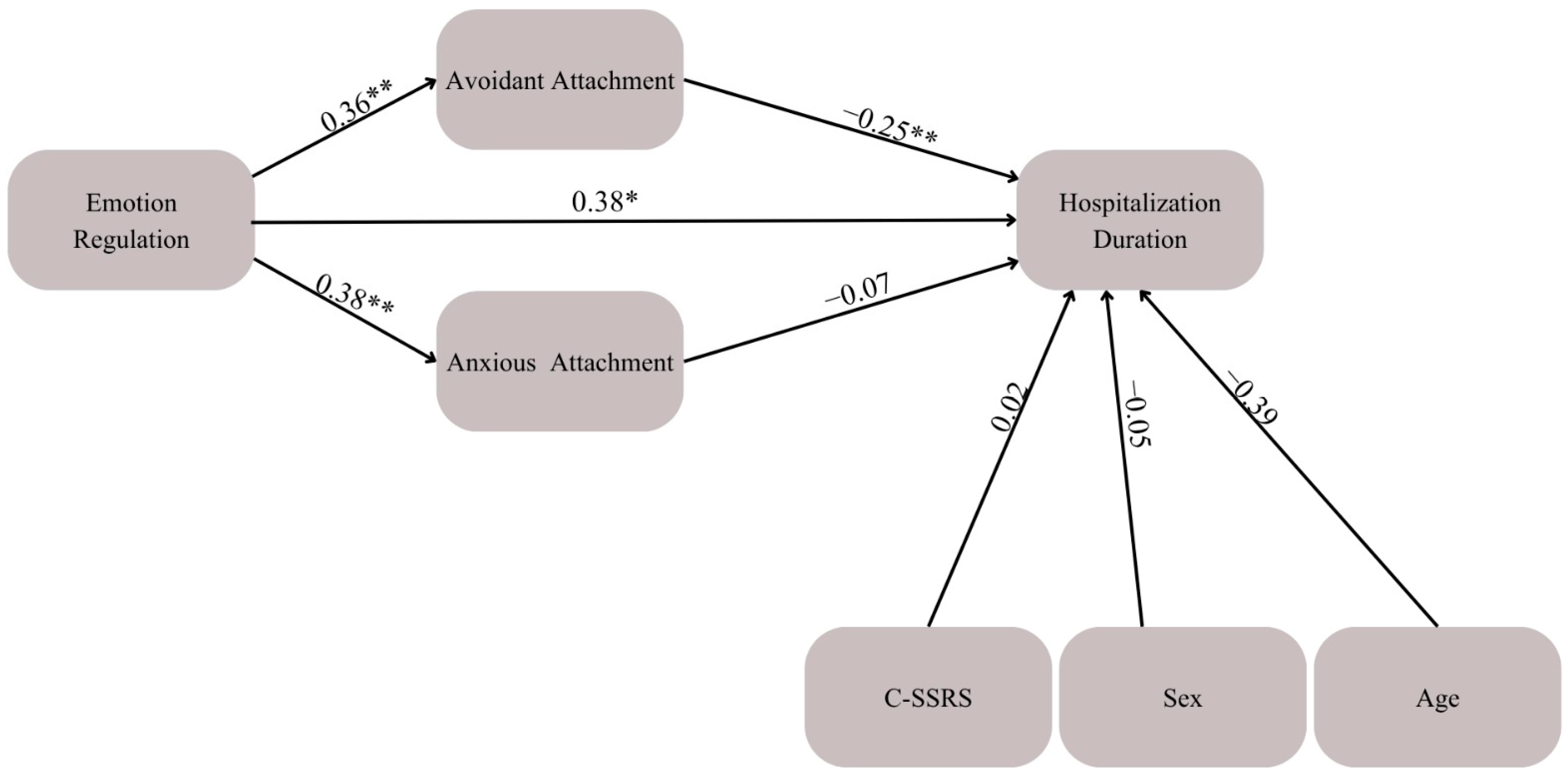
- Avoidant attachment is associated with shorter hospitalization and partially mediates the association between emotion regulation difficulties and length of stay.
- Emotion regulation and attachment style are important factors in understanding individual differences in psychiatric hospitalization duration among suicidal adolescents.
- Integrating emotion-focused and attachment-informed approaches into inpatient care may enhance treatment engagement and support more appropriate hospitalization duration.
Abstract
1. Introduction
2. Materials and Methods
2.1. Participants
Sample and Procedure
2.2. Measures
2.3. Statistical Analysis
3. Results
3.1. Multivariate Regression Model Predicting Hospitalization Duration
3.2. Mediation Model 1. Emotion Regulation, Attachment, and Hospitalization Duration
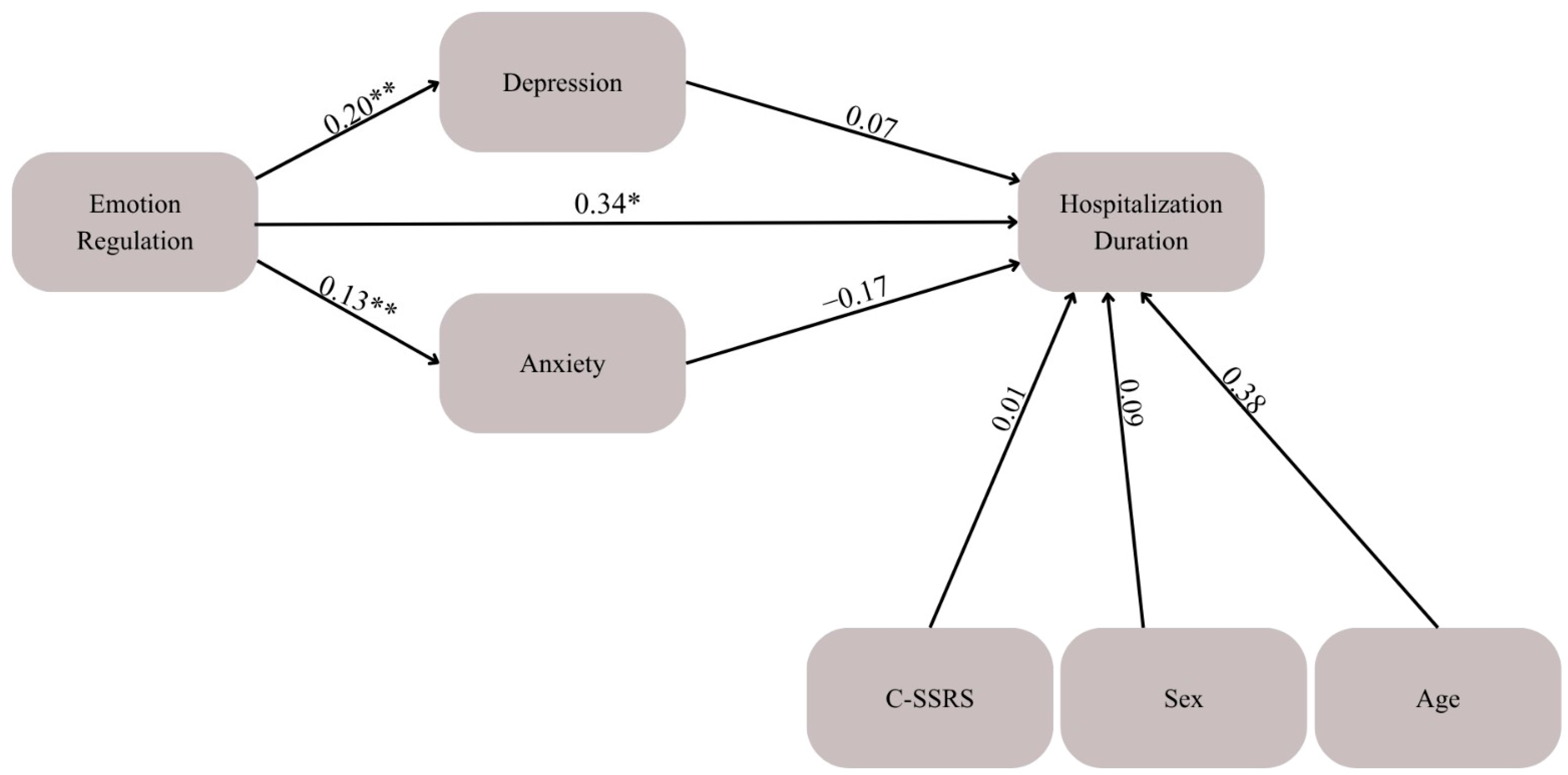
3.3. Mediation Model 2. Emotion Regulation, Depression/Anxiety, and Hospitalization Duration
4. Discussion
Limitations
5. Conclusions
Author Contributions
Funding
Institutional Review Board Statement
Informed Consent Statement
Data Availability Statement
Acknowledgments
Conflicts of Interest
References
- Nolen-Hoeksema, S. Emotion Regulation and Psychopathology: The Role of Gender. Annu. Rev. Clin. Psychol. 2012, 8, 161–187. [Google Scholar] [CrossRef]
- Sloan, E.; Hall, K.; Moulding, R.; Bryce, S.; Mildred, H.; Staiger, P.K. Emotion regulation as a transdiagnostic treatment construct across anxiety, depression, substance, eating and borderline personality disorders: A systematic review. Clin. Psychol. Rev. 2017, 57, 141–163. [Google Scholar] [CrossRef]
- Southam-Gerow, M.A.; Kendall, P.C. Emotion regulation and understanding: Implications for child psychopathology and therapy. Clin. Psychol. Rev. 2002, 22, 189–222. [Google Scholar] [CrossRef] [PubMed]
- Preece, D.A.; Ditzer, J.; Gross, J.J. Emotion Regulation. In Oxford Research Encyclopedia of Psychology; Oxford University Press: Oxford, UK, 2025; Available online: https://oxfordre.com/psychology/display/10.1093/acrefore/9780190236557.001.0001/acrefore-9780190236557-e-923 (accessed on 29 August 2025).
- Gross, J.J.; Sheppes, G.; Urry, H.L. Cognition and Emotion Lecture at the 2010 SPSP Emotion Preconference: Emotion generation and emotion regulation: A distinction we should make (carefully). Cogn. Emot. 2011, 25, 765–781. [Google Scholar] [CrossRef] [PubMed]
- Aldao, A.; Nolen-Hoeksema, S.; Schweizer, S. Emotion-regulation strategies across psychopathology: A meta-analytic review. Clin. Psychol. Rev. 2010, 30, 217–237. [Google Scholar] [CrossRef]
- Gruhn, M.A.; Compas, B.E. Effects of maltreatment on coping and emotion regulation in childhood and adolescence: A meta-analytic review. Child Abuse Negl. 2020, 103, 104446. [Google Scholar] [CrossRef]
- Kim, J.; Cicchetti, D. Longitudinal pathways linking child maltreatment, emotion regulation, peer relations, and psychopathology. J. Child Psychol. Psychiatry 2010, 51, 706–716. [Google Scholar] [CrossRef]
- Peng, W.; Liu, Z.; Liu, Q.; Chu, J.; Zheng, K.; Wang, J.; Wei, H.; Zhong, M.; Lin, Y.; Yi, J. Insecure attachment and maladaptive emotion regulation mediating the relationship between childhood trauma and borderline personality features. Depress. Anxiety 2021, 38, 28–39. [Google Scholar] [CrossRef] [PubMed]
- Gross, J.J.; Jazaieri, H. Emotion, Emotion Regulation, and Psychopathology: An Affective Science Perspective. Clin. Psychol. Sci. 2014, 2, 387–401. [Google Scholar] [CrossRef]
- Sheppes, G.; Suri, G.; Gross, J.J. Emotion Regulation and Psychopathology. Annu. Rev. Clin. Psychol. 2015, 11, 379–405. [Google Scholar] [CrossRef] [PubMed]
- Aldao, A.; Sheppes, G.; Gross, J.J. Emotion Regulation Flexibility. Cogn. Ther. Res. 2015, 39, 263–278. [Google Scholar] [CrossRef]
- Bonanno, G.A.; Burton, C.L. Regulatory Flexibility: An Individual Differences Perspective on Coping and Emotion Regulation. Perspect. Psychol. Sci. 2013, 8, 591–612. [Google Scholar] [CrossRef] [PubMed]
- Schäfer, J.Ö.; Naumann, E.; Holmes, E.A.; Tuschen-Caffier, B.; Samson, A.C. Emotion Regulation Strategies in Depressive and Anxiety Symptoms in Youth: A Meta-Analytic Review. J. Youth Adolesc. 2017, 46, 261–276. [Google Scholar] [CrossRef]
- Bowlby, J. Attachment and Loss, 2nd ed.; Random House: New York, NY, USA, 1982. [Google Scholar]
- Fraley, R.C.; Heffernan, M.E.; Vicary, A.M.; Brumbaugh, C.C. The experiences in close relationships—Relationship Structures Questionnaire: A method for assessing attachment orientations across relationships. Psychol. Assess. 2011, 23, 615. [Google Scholar] [CrossRef] [PubMed]
- Brennan, K.A.; Clark, C.L.; Shaver, P.R. Self-report measurement of adult attachment: An integrative overview. Attach. Theory Close Relatsh. 1998, 46, 70–100. [Google Scholar]
- Fraley, R.C.; Shaver, P.R. Adult Romantic Attachment: Theoretical Developments, Emerging Controversies, and Unanswered Questions. Rev. Gen. Psychol. 2000, 4, 132–154. [Google Scholar] [CrossRef]
- Pascuzzo, K.; Moss, E.; Cyr, C. Attachment and Emotion Regulation Strategies in Predicting Adult Psychopathology. Sage Open 2015, 5, 2158244015604695. [Google Scholar] [CrossRef]
- Mikulincer, M.; Shaver, P.R. Attachment in Adulthood: Structure, Dynamics, and Change, 2nd ed.; The Guilford Press: New York, NY, USA, 2016. [Google Scholar]
- Bekker, M.H.J.; Croon, M.A. The roles of autonomy-connectedness and attachment styles in depression and anxiety. J. Soc. Pers. Relatsh. 2010, 27, 908–923. [Google Scholar] [CrossRef]
- Brumariu, L.E.; Kerns, K.A. Parent–child attachment and internalizing symptoms in childhood and adolescence: A review of empirical findings and future directions. Dev. Psychopathol. 2010, 22, 177–203. [Google Scholar] [CrossRef]
- Suicide Worldwide in 2021: Global Health Estimates. Available online: https://www.who.int/publications/i/item/9789240110069 (accessed on 22 February 2026).
- Suicide in Israel. Available online: https://www.gov.il/he/pages/suicides (accessed on 22 February 2026).
- Mcevoy, D.; Brannigan, R.; Cooke, L.; Butler, E.; Walsh, C.; Arensman, E.; Clarke, M. Risk and protective factors for self-harm in adolescents and young adults: An umbrella review of systematic reviews. J. Psychiatr. Res. 2023, 168, 353–380. [Google Scholar] [CrossRef] [PubMed]
- Cha, C.B.; Franz, P.J.; MGuzmán, E.; Glenn, C.R.; Kleiman, E.M.; Nock, M.K. Annual Research Review: Suicide among youth—Epidemiology, (potential) etiology, and treatment. J. Child Psychol. Psychiatry 2018, 59, 460–482. [Google Scholar] [CrossRef] [PubMed]
- Pisani, A.R.; Wyman, P.A.; Petrova, M.; Schmeelk-Cone, K.; Goldston, D.B.; Xia, Y.; Gould, M.S. Emotion Regulation Difficulties, Youth–Adult Relationships, and Suicide Attempts Among High School Students in Underserved Communities. J. Youth Adolesc. 2013, 42, 807–820. [Google Scholar] [CrossRef]
- Anestis, M.D.; Bagge, C.L.; Tull, M.T.; Joiner, T.E. Clarifying the role of emotion dysregulation in the interpersonal-psychological theory of suicidal behavior in an undergraduate sample. J. Psychiatr. Res. 2011, 45, 603–611. [Google Scholar] [CrossRef]
- Turton, H.; Berry, K.; Danquah, A.; Pratt, D. The relationship between emotion dysregulation and suicide ideation and behaviour: A systematic review. J. Affect. Disord. Rep. 2021, 5, 100136. [Google Scholar] [CrossRef]
- Cohen-Bausi, O.; Shahnovsky, O.; Haruvi-Catalan, L.; Benaroya-Milshtein, N.; Fennig, S.; Barzilay, S. The Mediating Role of Emotional Dysregulation in the Relationship Between Anxious Attachment and Suicidal Behavior in Children Admitted to an Emergency Department. Child Psychiatry Hum. Dev. 2025, 1–9. [Google Scholar] [CrossRef]
- Falgares, G.; Marchetti, D.; De Santis, S.; Carrozzino, D.; Kopala-Sibley, D.C.; Fulcheri, M.; Verrocchio, M.C. Attachment styles and suicide-related behaviors in adolescence: The mediating role of self-criticism and dependency. Front. Psychiatry 2017, 8, 36. [Google Scholar] [CrossRef] [PubMed]
- Sheftall, A.H.; Schoppe-Sullivan, S.J.; Bridge, J.A. Insecure Attachment and Suicidal Behavior in Adolescents. Crisis 2014, 35, 426–430. [Google Scholar] [CrossRef] [PubMed]
- Silva Filho, O.C.D.; Avanci, J.Q.; Pires, T.D.O.; De Vasconcellos Carvalhaes Oliveira, R.; Assis, S.G. Attachment, suicidal behavior, and self-harm in childhood and adolescence: A study of a cohort of Brazilian schoolchildren. BMC Pediatr. 2023, 23, 403. [Google Scholar] [CrossRef]
- Longobardi, C.; Morese, R.; Fabris, M.A. COVID-19 Emergency: Social Distancing and Social Exclusion as Risks for Suicide Ideation and Attempts in Adolescents. Front. Psychol. 2020, 11, 551113. [Google Scholar] [CrossRef]
- Marengo, D.; Settanni, M.; Mastrokoukou, S.; Fabris, M.A.; Longobardi, C. Social Media Linked to Early Adolescent Suicidal Thoughts via Cyberbullying and Internalizing Symptoms. Int. J. Bullying Prev. 2024, 1–10. [Google Scholar] [CrossRef]
- Green, J.; Jacobs, B.; Beecham, J.; Dunn, G.; Kroll, L.; Tobias, C.; Briskman, J. Inpatient treatment in child and adolescent psychiatry—A prospective study of health gain and costs. J. Child Psychol. Psychiatry 2007, 48, 1259–1267. [Google Scholar] [CrossRef] [PubMed]
- Lee, Y.; Martin, P.; Hembry, P.; Lewis, S. Outcomes of inpatient psychiatric treatment for adolescents: A multiple perspectives evaluation. Clin. Child Psychol. Psychiatry 2018, 23, 409–424. [Google Scholar] [CrossRef] [PubMed]
- Setoya, Y.; Saito, K.; Kasahara, M.; Watanabe, K.; Kodaira, M.; Usami, M. Evaluating outcomes of the child and adolescent psychiatric unit: A prospective study. Int. J. Ment. Health Syst. 2011, 5, 7. [Google Scholar] [CrossRef]
- Alho, J.; Gutvilig, M.; Niemi, R.; Komulainen, K.; Böckerman, P.; Webb, R.T.; Elovainio, M.; Hakulinen, C. Transmission of mental disorders in adolescent peer networks. JAMA Psychiatry 2024, 81, 882–888. [Google Scholar] [CrossRef]
- Colton, A.; Pistrang, N. Adolescents’ experiences of inpatient treatment for anorexia nervosa. Eur. Eat. Disord. Rev. 2004, 12, 307–316. [Google Scholar] [CrossRef]
- Tierney, S. The Individual Within a Condition: A Qualitative Study of Young People’s Reflections on Being Treated for Anorexia Nervosa. J. Am. Psychiatr. Nurses Assoc. 2008, 13, 368–375. [Google Scholar] [CrossRef] [PubMed]
- Vandereycken, W. Can Eating Disorders Become ‘Contagious’ in Group Therapy and Specialized Inpatient Care? Eur. Eat. Disord. Rev. 2011, 19, 289–295. [Google Scholar] [CrossRef]
- Zuccala, M.; Webb, S.; Yong, C.S. When hospital harms more than helps: Iatrogenic processes in adolescent inpatient settings. Clin. Child Psychol. Psychiatry 2025, 30, 670–682. [Google Scholar] [CrossRef]
- Bardeen, J.R.; Kumpula, M.J.; Orcutt, H.K. Emotion regulation difficulties as a prospective predictor of posttraumatic stress symptoms following a mass shooting. J. Anxiety Disord. 2013, 27, 188–196. [Google Scholar] [CrossRef]
- Berking, M.; Ebert, D.; Cuijpers, P.; Hofmann, S.G. Emotion regulation skills training enhances the efficacy of inpatient cognitive behavioral therapy for major depressive disorder: A randomized controlled trial. Psychother. Psychosom. 2013, 82, 234–245. [Google Scholar] [CrossRef] [PubMed]
- Gratz, K.L.; Gunderson, J.G. Preliminary data on an acceptance-based emotion regulation group intervention for deliberate self-harm among women with borderline personality disorder. Behav. Ther. 2006, 37, 25–35. [Google Scholar] [CrossRef]
- Moltrecht, B.; Deighton, J.; Patalay, P.; Edbrooke-Childs, J. Effectiveness of current psychological interventions to improve emotion regulation in youth: A meta-analysis. Eur. Child Adolesc. Psychiatry 2021, 30, 829–848. [Google Scholar] [CrossRef] [PubMed]
- Czyz, E.K.; Berona, J.; King, C.A. Rehospitalization of Suicidal Adolescents in Relation to Course of Suicidal Ideation and Future Suicide Attempts. Psychiatr. Serv. 2016, 67, 332–338. [Google Scholar] [CrossRef]
- Noehles, V.B.; Jaite, C.; Rubarth, K.; Heuer, F.H.; Bödeker, K.; Golz, L.; Winter, S.M.; Correll, C.U. Magnitude and Correlates of Symptomatic, Global Illness, and Social Functioning Response; Out-of-Home Placement; and Length of Stay in 1189 Consecutively Hospitalized Children and Adolescents with Mental Disorders. J. Clin. Psychiatry 2024, 85, 23m14897. [Google Scholar] [CrossRef]
- Kennard, B.D.; Goldstein, T.; Foxwell, A.A.; McMakin, D.L.; Wolfe, K.; Beirnsser, C.; Moorehead, A.; Douaihy, A.; Zullo, L.; Wentroble, E.; et al. As Safe as Possible (ASAP): A Brief App-Supported Inpatient Intervention to Prevent Postdischarge Suicidal Behavior in Hospitalized, Suicidal Adolescents. Am. J. Psychiatry 2018, 175, 864–872. [Google Scholar] [CrossRef]
- Kaufman, J.; Birmaher, B.; Brent, D.; Rao, U.; Flynn, C.; Moreci, P.; Williamson, D.; Ryan, N. Schedule for Affective Disorders and Schizophrenia for School-Age Children-Present and Lifetime Version (K-SADS-PL): Initial reliability and validity data. J. Am. Acad. Child Adolesc. Psychiatry 1997, 36, 980–988. [Google Scholar] [CrossRef] [PubMed]
- Gratz, K.L.; Roemer, L. Multidimensional Assessment of Emotion Regulation and Dysregulation: Development, Factor Structure, and Initial Validation of the Difficulties in Emotion Regulation Scale. J. Psychopathol. Behav. Assess. 2004, 26, 41–54. [Google Scholar] [CrossRef]
- Mikulincer, M.; Florian, V. Exploring individual differences in reactions to mortality salience: Does attachment style regulate terror management mechanisms? J. Pers. Soc. Psychol. 2000, 79, 260–273. [Google Scholar] [CrossRef] [PubMed]
- Mikulincer, M.; Gillath, O.; Shaver, P.R. Activation of the attachment system in adulthood: Threat-related primes increase the accessibility of mental representations of attachment figures. J. Pers. Soc. Psychol. 2002, 83, 881–895. [Google Scholar] [CrossRef]
- Marganska, A.; Gallagher, M.; Miranda, R. Adult attachment, emotion dysregulation, and symptoms of depression and generalized anxiety disorder. Am. J. Orthopsychiatry 2013, 83, 131–141. [Google Scholar] [CrossRef]
- Donbaek, D.; Elklit, A. A validation of the Experiences in Close Relationships-Relationship Structures scale (ECR-RS) in adolescents. Attach. Hum. Dev. 2013, 16, 58–76. [Google Scholar] [CrossRef]
- Wongpakaran, T.; DeMaranville, J.; Wongpakaran, N. Psychometric Assessment of the 10-Item Experience of Close Relationship- Revised for Adolescents (ECR-R-10-AD). Res. Sq. 2023. [Google Scholar] [CrossRef]
- Birmaher, B.; Khetarpal, S.; Brent, D.; Cully, M.; Balach, L.; Kaufman, J.; Neer, S.M. The screen for child anxiety related emotional disorders (SCARED): Scale construction and psychometric characteristics. J. Am. Acad. Child Adolesc. Psychiatry 1997, 36, 545–553. [Google Scholar] [CrossRef] [PubMed]
- Kroenke, K.; Spitzer, R.L.; Williams, J.B.W. The PHQ-9: Validity of a brief depression severity measure. J. Gen. Intern. Med. 2001, 16, 606–613. [Google Scholar] [CrossRef]
- Posner, K.; Brown, G.K.; Stanley, B.; Brent, D.A.; Yershova, K.V.; Oquendo, M.A.; Currier, G.W.; Melvin, G.A.; Greenhill, L.; Shen, S.; et al. The Columbia–Suicide Severity Rating Scale: Initial Validity and Internal Consistency Findings from Three Multisite Studies with Adolescents and Adults. Am. J. Psychiatry 2011, 168, 1266–1277. [Google Scholar] [CrossRef] [PubMed]
- Parker, G.; Tupling, H.; Brown, L.B. A Parental Bonding Instrument. Br. J. Med. Psychol. 1979, 52, 1–10. [Google Scholar] [CrossRef]
- Enders, C.; Bandalos, D. The Relative Performance of Full Information Maximum Likelihood Estimation for Missing Data in Structural Equation Models. Struct. Equ. Model. Multidiscip. J. 2001, 8, 430–457. [Google Scholar] [CrossRef]
- Mueller, R.O.; Hancock, G.R. Structural equation modeling. In The Reviewer’s Guide to Quantitative Methods in the Social Sciences; Routledge: Oxfordshire, UK, 2018; pp. 445–456. Available online: https://www.taylorfrancis.com/chapters/edit/10.4324/9781315755649-33/structural-equation-modeling-ralph-mueller-gregory-hancock (accessed on 16 September 2025).
- Preacher, K.J.; Hayes, A.F. Asymptotic and resampling strategies for assessing and comparing indirect effects in multiple mediator models. Behav. Res. Methods 2008, 40, 879–891. [Google Scholar] [CrossRef] [PubMed]
- Ben-Naim, S.; Hirschberger, G.; Ein-Dor, T.; Mikulincer, M. An experimental study of emotion regulation during relationship conflict interactions: The moderating role of attachment orientations. Emotion 2013, 13, 506–519. [Google Scholar] [CrossRef] [PubMed]
- Mehlum, L.; Tørmoen, A.J.; Ramberg, M.; Haga, E.; Diep, L.M.; Laberg, S.; Larsson, B.S.; Stanley, B.H.; Miller, A.L.; Sund, A.M.; et al. Dialectical behavior therapy for adolescents with repeated suicidal and self-harming behavior: A randomized trial. J. Am. Acad. Child Adolesc. Psychiatry 2014, 53, 1082–1091. [Google Scholar] [CrossRef] [PubMed]
- Diamond, G.S.; Wintersteen, M.B.; Brown, G.K.; Diamond, G.M.; Gallop, R.; Shelef, K.; Levy, S. Attachment-based family therapy for adolescents with suicidal ideation: A randomized controlled trial. J. Am. Acad. Child Adolesc. Psychiatry 2010, 49, 122–131. [Google Scholar] [CrossRef] [PubMed]
- Rossouw, T.I.; Fonagy, P. Mentalization-based treatment for self-harm in adolescents: A randomized controlled trial. J. Am. Acad. Child Adolesc. Psychiatry 2012, 51, 1304–1313.e3. [Google Scholar] [CrossRef] [PubMed]
- Fritz, M.S.; MacKinnon, D.P. Required Sample Size to Detect the Mediated Effect. Psychol. Sci. 2007, 18, 233–239. [Google Scholar] [CrossRef] [PubMed]


| Variable | N | % | M | SD |
|---|---|---|---|---|
| Sex | ||||
| Female | 69 | 87.34 | ||
| Male | 10 | 12.66 | ||
| Age | 15.35 | 2.03 | ||
| Country of origin | ||||
| Israel | 72 | 91.14 | ||
| Other countries | 7 | 8.86 | ||
| Level of religiosity | ||||
| Secular | 38 | 48.1 | ||
| Traditional | 7 | 8.86 | ||
| Religious | 20 | 25.32 | ||
| Ultra-orthodox | 8 | 10.13 | ||
| Hospitalization duration (days) | 126.29 | 87.01 | ||
| Active psychiatric diagnosis a | ||||
| Major Depressive Disorder (MDD) | 38 | 48.1 | ||
| Post-Traumatic Stress Disorder (PTSD) | 4 | 5.06 | ||
| Attention-Deficit/Hyperactivity Disorder (ADHD) | 4 | 5.06 | ||
| Social Anxiety | 1 | 1.27 | ||
| Anorexia | 7 | 8.86 | ||
| Generalized Anxiety Disorder (GAD) | 4 | 5.06 | ||
| Obsessive–Compulsive Disorder (OCD) | 4 | 5.06 | ||
| Borderline Personality Disorder (BPD) | 2 | 2.53 | ||
| Trichotillomania | 2 | 2.53 | ||
| Tic Disorder | 1 | 1.27 | ||
| Other | 6 | 7.59 | ||
| Columbia- Suicide Severity Rating Scale (C-SSRS) | ||||
| Intensity Score | 14.94 | 4.13 | ||
| Behavior Score | 3.26 | 2.12 |
| 1 | 2 | 3 | 4 | 5 | 6 | |
| Avoidant Attachment | - | - | - | - | - | - |
| Anxious Attachment | 0.356 ** | - | - | - | - | - |
| PHQ9 score (depression) | 0.290 ** | 0.425 ** | - | - | - | - |
| SCARED (Anxiety) | 0.569 ** | 0.524 ** | 0.673 ** | - | - | - |
| DERS (Emotion Regulation) | 0.358 ** | 0.381 ** | 0.255 ** | 0.426 ** | - | - |
| Hospitalization Duration | −0.171 * | −0.023 | −0.042 | −0.071 | 0.326 ** | - |
| Predictor | B | SE B | Β | t | p |
|---|---|---|---|---|---|
| Constant | 274.71 | 181.08 | - | 1.52 | 0.14 |
| Sex (Male) | 22.95 | 33.78 | 0.08 | 0.68 | 0.5 |
| Age at enrollment | −12.45 | 6.11 | −0.3 | −2.04 | 0.05 |
| Avoidance (ECR) | −17.72 | 10.54 | −0.25 | −1.68 | 0.1 |
| Anxiety (ECR) | −16.28 | 13.61 | −0.18 | −1.2 | 0.24 |
| Baseline PHQ-9 | −0.11 | 1.99 | −0.01 | −0.05 | 0.96 |
| Baseline SCARED | 0.33 | 1.05 | 0.06 | 0.31 | 0.76 |
| Baseline DERS | 2.06 | 0.63 | 0.49 | 3.27 | 0 |
| Medication (yes) | −35.17 | 27.48 | −0.17 | −1.28 | 0.21 |
| PBI Father Care | 0.13 | 3.67 | 0.01 | 0.04 | 0.97 |
| PBI Father Over-Protective | −0.56 | 2.07 | −0.05 | −0.27 | 0.79 |
| PBI Mother Care | −1.88 | 3.95 | −0.07 | −0.47 | 0.64 |
| PBI Mother Over-Protective | −0.33 | 1.81 | −0.03 | −0.18 | 0.86 |
Disclaimer/Publisher’s Note: The statements, opinions and data contained in all publications are solely those of the individual author(s) and contributor(s) and not of MDPI and/or the editor(s). MDPI and/or the editor(s) disclaim responsibility for any injury to people or property resulting from any ideas, methods, instructions or products referred to in the content. |
© 2026 by the authors. Licensee MDPI, Basel, Switzerland. This article is an open access article distributed under the terms and conditions of the Creative Commons Attribution (CC BY) license.
Share and Cite
Isack, E.; Ben-David, S.; Goltser-Dubner, T.; Segman, R.; Kianski, E.; Giesser, R.; Rahmani, S.; Blum Weinberg, P.; Ben-Ari, A.; Sela, Y.; et al. Emotion Regulation and Attachment Style as Predictors of Psychiatric Hospitalization Duration in Suicidal Adolescents. Children 2026, 13, 448. https://doi.org/10.3390/children13040448
Isack E, Ben-David S, Goltser-Dubner T, Segman R, Kianski E, Giesser R, Rahmani S, Blum Weinberg P, Ben-Ari A, Sela Y, et al. Emotion Regulation and Attachment Style as Predictors of Psychiatric Hospitalization Duration in Suicidal Adolescents. Children. 2026; 13(4):448. https://doi.org/10.3390/children13040448
Chicago/Turabian StyleIsack, Einav, Shiri Ben-David, Tanya Goltser-Dubner, Ronen Segman, Ella Kianski, Ruth Giesser, Shlomo Rahmani, Pnina Blum Weinberg, Amichai Ben-Ari, Yaron Sela, and et al. 2026. "Emotion Regulation and Attachment Style as Predictors of Psychiatric Hospitalization Duration in Suicidal Adolescents" Children 13, no. 4: 448. https://doi.org/10.3390/children13040448
APA StyleIsack, E., Ben-David, S., Goltser-Dubner, T., Segman, R., Kianski, E., Giesser, R., Rahmani, S., Blum Weinberg, P., Ben-Ari, A., Sela, Y., Bar Nitsan, M., Lotan, A., Schechter, T., Daninos, M., Yishai, S., Avraham, Y., Benarroch, F., & Shalev, A. (2026). Emotion Regulation and Attachment Style as Predictors of Psychiatric Hospitalization Duration in Suicidal Adolescents. Children, 13(4), 448. https://doi.org/10.3390/children13040448