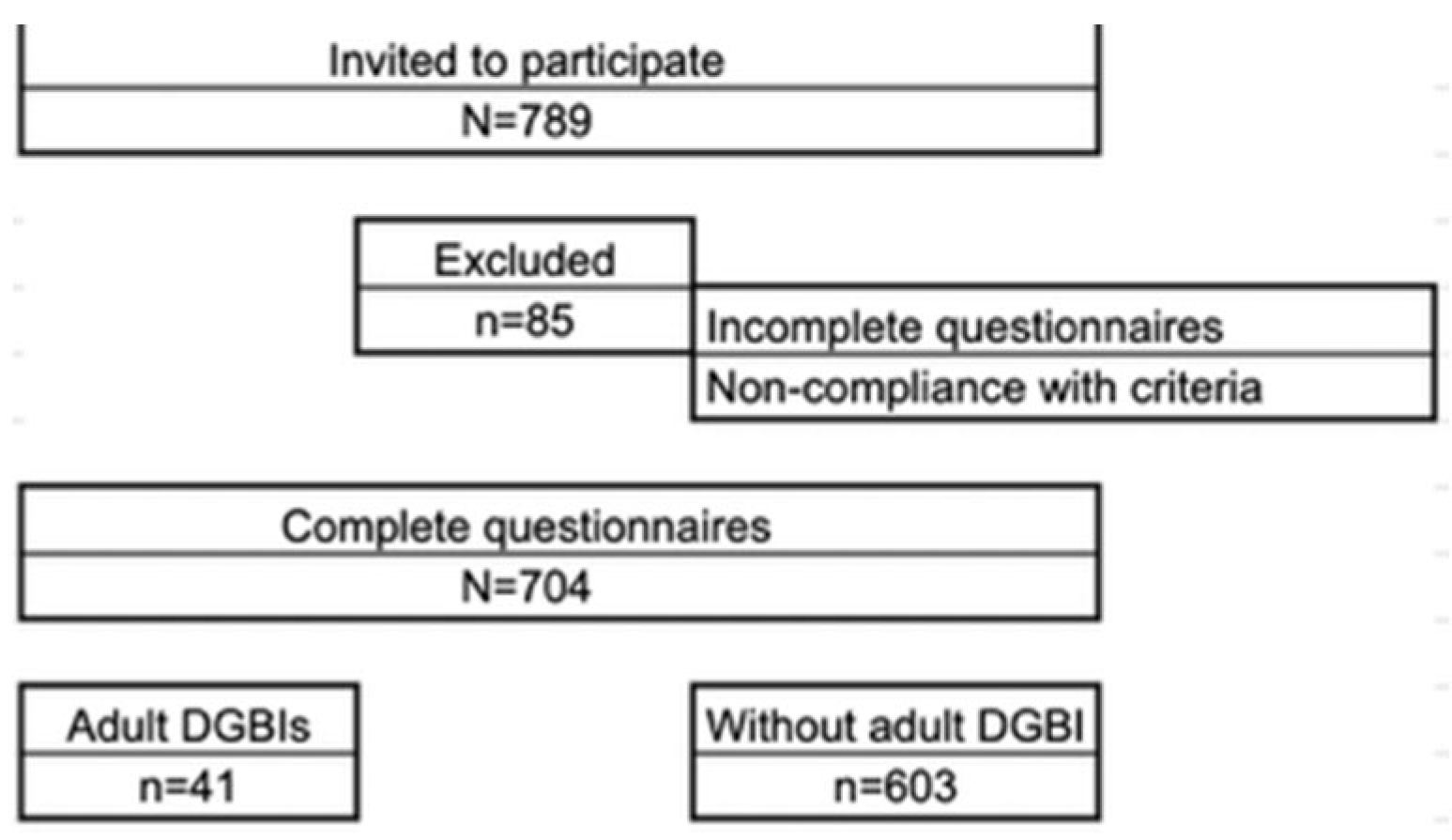
Adult Rome IV Disorders of Gut–Brain Interaction in a Pediatric Population †

 , ,
, ,
Abstract
1. Introduction
2. Materials and Methods
3. Results
3.1. DGBIs
3.2. Possible Associations with the Presence of Adult DGBIs According to the Rome IV Criteria
3.3. Logistic Regression Analysis
4. Discussion
5. Conclusions
Author Contributions
Funding
Institutional Review Board Statement
Informed Consent Statement
Data Availability Statement
Conflicts of Interest
Abbreviations
| DGBIs | Disorders of the gut–brain interaction |
| QPGS-IV | Questionnaire for Pediatric Gastrointestinal Symptoms Rome IV |
| GERD | Gastroesophageal reflux disease |
| PedsQL | Pediatric Quality of Life Inventory™ Questionnaire |
| PROMIS | Patient-Reported Outcomes Measurement Information System |
| 95%CIs | 95% confidence intervals |
| ORs | Odds ratios |
| SD | Standard deviation |
References
- Ginton, L.; Budhathoki, R.; Saps, M. Reliability of pediatric Rome IV criteria for the diagnosis of disorders of gut–brain interaction. Neurogastroenterol. Motil. 2024, 36, e14813. [Google Scholar] [CrossRef] [PubMed]
- Velasco-Benítez, C.A.; Velasco-Suárez, D.A.; Palma, N.; Arrizabalo, S.; Saps, M. The Relationship Between Prematurity and Mode of Delivery with Disorders of Gut-Brain Interaction in Children. Children 2025, 12, 799. [Google Scholar] [CrossRef]
- Vernon-Roberts, A.; Alexander, I.; Day, A.S. Systematic Review of Pediatric Functional Gastrointestinal Disorders (Rome IV Criteria). J. Clin. Med. 2021, 10, 5087. [Google Scholar] [CrossRef] [PubMed]
- Fritz, J.; Coffey, R.; Bloch, J.; Cutler, A.; Gabrielson, S.; DiGiovanni, S.; Faherty, L.J. The relationship between adverse childhood experiences and disorders of the gut-brain interaction. J. Pediatr. Gastroenterol. Nutr. 2025, 80, 100–107. [Google Scholar] [CrossRef]
- Hyams, J.S.; Di Lorenzo, C.; Saps, M.; Shulman, R.J.; Staiano, A.; van Tilburg, M. Childhood Functional Gastrointestinal Disorders: Child/Adolescent. Gastroenterology 2016, 150, 1456–1468.e2. [Google Scholar] [CrossRef]
- Aziz, Q.; Fass, R.; Gyawali, C.P.; Miwa, H.; Pandolfino, J.E.; Zerbib, F. Esophageal disorders. Gastroenterology 2016, 150, 1368–1379. [Google Scholar] [CrossRef]
- Lanzoni, G.; Sembenini, C.; Gastaldo, S.; Leonardi, L.; Bentivoglio, V.P.; Faggian, G.; Bosa, L.; Gaio, P.; Cananzi, M. Esophageal dysphagia in children: State of the art and proposal for a symptom-based diagnostic approach. Front. Pediatr. 2022, 10, 885308. [Google Scholar] [CrossRef]
- Sciumè, G.D.; Berti, G.; Lambiase, C.; Paglianiti, I.; Villanacci, V.; Rettura, F.; Grosso, A.; Ricchiuti, A.; Bortoli, N.; Satta, P.U.; et al. Misinterpreting diarrhea-predominant irritable bowel syndrome and functional diarrhea: Pathophysiological highlights. J. Clin. Med. 2023, 12, 5787. [Google Scholar] [CrossRef]
- Bhardwaj, R.; Knotts, R.; Khan, A. Functional Chest Pain and Esophageal Hypersensitivity: A Clinical Approach. Gastroenterol. Clin. N. Am. 2021, 50, 843–857. [Google Scholar] [CrossRef]
- Behar, J.; Corazziari, E.; Guelrud, M.; Hogan, W.; Sherman, S.; Toouli, J. Functional gallbladder and sphincter of odi disorders. Gastroenterology 2006, 130, 1498–1509. [Google Scholar] [CrossRef] [PubMed]
- Carrington, E.V.; Popa, S.L.; Chiarioni, G. Proctalgia Syndromes: Update in Diagnosis and Management. Curr. Gastroenterol. Rep. 2020, 22, 35. [Google Scholar] [CrossRef] [PubMed]
- Baumann, A.; Katz, P.O. Functional disorders of swallowing. Handb. Clin. Neurol. 2016, 139, 483–488. [Google Scholar] [CrossRef]
- Drossman, D.A. Rome IV: Functional Gastrointestinal Disorders—Disorders of Gut-Brain Interaction, 1st ed.; The Rome Foundation: Raleigh, NC, USA, 2016. [Google Scholar]
- Velasco-Benítez, C.A.; Collazos-Saa, L.I.; García-Perdomo, H.A. A systematic review and meta-analysis in schoolchildren and adolescents with functional gastrointestinal disorders according to Rome IV criteria. Arq. Gastroenterol. 2022, 59, 304–313. [Google Scholar] [CrossRef]
- Tran, D.L.; Sintusek, P. Functional constipation in children: What physicians should know. World J. Gastroenterol. 2023, 29, 1261–1288. [Google Scholar] [CrossRef] [PubMed]
- Velasco-Benítez, C.A.; Ramírez-Hernández, C.R.; Moreno-Gómez, J.E.; Játiva-Mariño, E.; Zablah, R.; Rodríguez-Reynosa, L.L.; Leyva-Jiménez, S.A.; Chanís, R.; Mejía-Castro, M. Superposición de desórdenes gastrointestinales funcionales en escolares y adolescentes latinoamericanos. Rev. Chil. Pediatr. 2018, 89, 726–731. [Google Scholar] [CrossRef]
- Flannery, J.; Callaghan, B.; Sharpton, T.; Fisher, P.; Pfeifer, J. Is adolescence the missing developmental link in Microbiome–Gut–Brain axis communication? Dev. Psychobiol. 2019, 61, 783–795. [Google Scholar] [CrossRef]
- Velasco-Benítez, C.A.; Velasco-Suárez, D.A.; Balda, A.; Arrizabalo, S.; Saps, M. Prevalence of functional diarrhea in children and adolescents. Neurogastroenterol. Motil. 2025, 37, e14950. [Google Scholar] [CrossRef]
- Sperber, A.D.; Bangdiwala, S.I.; Drossman, D.A.; Ghoshal, U.C.; Simren, M.; Tack, J.; Whitehead, W.E.; Dumitrascu, D.L.; Fang, X.; Fukudo, S.; et al. Worldwide prevalence and burden of functional gastrointestinal disorders: Results of the Rome Foundation global study. Gastroenterology 2021, 160, 99–114.e3. [Google Scholar] [CrossRef] [PubMed]
- Sagawa, T.; Okamura, S.; Kakizaki, S.; Zhang, Y.; Morita, K.; Mori, M. Functional gastrointestinal disorders in adolescents and quality of school life. J. Gastroenterol. Hepatol. 2013, 28, 285–290. [Google Scholar] [CrossRef]
- Horst, S.; Shelby, G.; Anderson, J.; Acra, S.; Polk, D.B.; Saville, B.R.; Garber, J.; Walker, L.S. Predicting persistence of functional abdominal pain from childhood into young adulthood. Clin. Gastroenterol. Hepatol. 2014, 12, 2026–2032. [Google Scholar] [CrossRef]
- Zanchi, C.; Pintaldi, S.; Di Leo, G.; Ronfani, L.; Zamagni, G.; Viel, M.; Barbi, E.; Cozzi, G. Fifteen-years follow-up in a cohort of children with functional gastrointestinal disorders. Children 2021, 8, 838. [Google Scholar] [CrossRef]
- Azmy, D.J.; Qualia, C.M. Review of abdominal migraine in children. Gastroenterol. Hepatol. 2020, 16, 632–639. [Google Scholar]
- Drossman, D.A.; Hasler, W.L. Rome IV—Functional GI disorders: Disorders of gut-brain interaction. Gastroenterology 2016, 150, 1257–1261. [Google Scholar] [CrossRef]
- Saad, R.C. Anorectal functional disorders: Towards a better diagnosis and treatment. Arq. Gastroenterol. 2019, 56, 1–2. [Google Scholar] [CrossRef] [PubMed]
- Jeyarajah, S.; Purkayastha, S. Proctalgia fugax. CMAJ 2013, 185, 417. [Google Scholar] [CrossRef][Green Version]
- Rao, S.S.; Bharucha, A.E.; Chiarioni, G.; Felt-Bersma, R.; Knowles, C.; Malcolm, A.; Wald, A. Anorectal disorders. Gastroenterology 2016, 150, 1430–1442.e4. [Google Scholar] [CrossRef]
- Palsson, O.S.; Whitehead, W.; Törnblom, H.; Sperber, A.D.; Simren, M. Prevalence of Rome IV functional bowel disorders among adults in the United States, Canada, and the United Kingdom. Gastroenterology 2020, 158, 1262–1273.e3. [Google Scholar] [CrossRef]
- Xiong, N.-N.; Wei, J.; Ke, M.-Y.; Hong, X.; Li, T.; Zhu, L.-M.; Sha, Y.; Jiang, J.; Fischer, F. Illness perception of patients with functional gastrointestinal disorders. Front. Psychiatry 2018, 9, 122. [Google Scholar] [CrossRef] [PubMed]
- van Tilburg, M.A.L.; Drossman, D.A.; Knowles, S.R. Psychogastroenterology: The brain-gut axis and its psychological applications. J. Psychosom. Res. 2022, 155, 110684. [Google Scholar] [CrossRef] [PubMed]
- Reed-Knight, B.; Claar, R.L.; Schurman, J.V.; van Tilburg, M.A.L. Implementing psychological therapies for functional GI disorders in children and adults. Expert. Rev. Gastroenterol. Hepatol. 2016, 10, 981–984. [Google Scholar] [CrossRef]
- Zia, J.K.; Lenhart, A.; Yang, P.-L.; Heitkemper, M.M.; Baker, J.; Keefer, L.; Saps, M.; Cuff, C.; Hungria, G.; Videlock, E.J.; et al. Risk factors for abdominal pain-related disorders of gut-brain interaction in adults and children. Gastroenterology 2022, 163, 995–1023.e3. [Google Scholar] [CrossRef]
- de Bruijn, C.M.A.; Rexwinkel, R.; Gordon, M.; Benninga, M.; Tabbers, M.M. Antidepressants for functional abdominal pain disorders in children and adolescents. Cochrane Database Syst. Rev. 2021, a, CD008013. [Google Scholar] [CrossRef]
- Santucci, N.R.; Velasco-Benítez, C.A.; Cunningham, N.; Li, J.; Fei, L.; Sun, Q.; Saps, M. Psychological distress and coping efficacy in children with disorders of gut–brain interaction. Neurogastroenterol. Motil. 2024, 36, e14724. [Google Scholar] [CrossRef]
- Liu, L.; Wang, H.; Chen, X.; Zhang, Y.; Zhang, H.; Xie, P. Gut microbiota and its metabolites in depression: From pathogenesis to treatment. eBioMedicine 2023, 91, 104527. [Google Scholar] [CrossRef] [PubMed]
- Baaleman, D.F.; Di Lorenzo, C.; Benninga, M.A.; Saps, M. The Effects of the Rome IV Criteria on Pediatric Gastrointestinal Practice. Curr. Gastroenterol. Rep. 2020, 22, 21. [Google Scholar] [CrossRef]
- Tersteeg, S.M.; Borowitz, S.M. School absenteeism as a predictor of functional gastrointestinal disorders in children. Front. Pediatr. 2024, 12, 1503783. [Google Scholar] [CrossRef]
- Garr, K.; Stough, C.O.; Flannery, M.; Yacob, D.; Puri, N.B.; van Diest, A.K. The impact of pediatric disorders of gut-brain interaction on the family. Neurogastroenterol. Motil. 2025, 37, e70014. [Google Scholar] [CrossRef]
- Varni, J.W.; Shulman, R.J.; Self, M.M.; Nurko, S.; Saps, M.; Saeed, S.A.; Patel, A.S.; Dark, C.V.; Bendo, C.B.; Pohl, J.F. Gastrointestinal symptoms predictors of health-related quality of life in pediatric patients with functional gastrointestinal disorders. Qual. Life Res. 2017, 26, 1015–1025. [Google Scholar] [CrossRef] [PubMed]
- Varni, J.W.; Bendo, C.B.; Nurko, S.; Shulman, R.J.; Self, M.M.; Franciosi, J.P.; Saps, M.; Pohl, J.F. Pediatric Quality of Life Inventory (PedsQL) Gastrointestinal Symptoms Module Testing Study Consortium. Health-related quality of life in pediatric patients with functional and organic gastrointestinal diseases. J. Pediatr. 2015, 166, 85–90.E2. [Google Scholar] [CrossRef]


| Disorder | Definition According to the Rome Criteria in Adults | Questions and Answers Added to the Pediatric QPGS-IV, Present During the Past Month… |
|---|---|---|
| Functional dysphagia | 1. Persistent or recurrent sensation of difficulty in the passage of solid and/or liquid foods 2. Absence of evidence of structural, mucosal, or motor abnormalities explaining the symptom 3. The symptoms are not explained by GERD * or major esophageal motility disorders 4. Symptoms must be present during the last 3 months, with onset at least 6 months prior to diagnosis | Choking sensation Does food or drink get stuck in your chest after swallowing, or does it pass slowly through your chest? How many days? = 4 or more days And For how long? = 2 or more months |
| Functional diarrhea | 1. Predominantly loose or liquid stools without predominant stomachache 2. Increased frequency of bowel movements 3. Absence of criteria for irritable bowel syndrome with diarrhea 4. Symptoms must be present during the last 3 months, with onset at least 6 months prior to diagnosis | Diarrhea How often does he/she poop?
How is poop according to the Bristol Stool Scale? = Type 6 or 7 And Does it hurt when you poop? = No And What is your main complaint?
Does he/she gain weight normally? = Yes |
| Functional chest pain | 1. Recurrent retrosternal pain or discomfort 2. No evidence of heart disease as the cause of the pain 3. Absence of structural, inflammatory, or motor esophageal disease that explains the symptoms 4. The symptoms are not explained by GERD * 5. Symptoms must be present during the last 3 months, with onset at least 6 months prior to diagnosis | Chest pain or discomfort How many days? = 4 or more days And For how long? = 2 months or more, And How often does he/she experience a burning sensation? = Never And How frequently is it associated with food choking when swallowing?
|
| Functional biliary pain | 1. Recurrent episodes of pain located in the epigastrium and/or right upper quadrant 2. The pain reaches a steady intensity and lasts ≥30 min 3. The pain interferes with daily activities or leads to medical consultation 4. It is not relieved by bowel movements, postural changes, or antacids 5. Absence of gallstones or other structural pathology 6. Symptoms must be present during the last 3 months, with onset at least 6 months prior to diagnosis | Pain or discomfort in the right upper abdomen quadrant, even if of short duration: How many days? = 4 or more days And For how long? = 2 months or more, And As the hours go by, does he/she improve? = No And As the hours go by, does he/she get worse? = Yes And Does the pain occur at the same time as pooping? = Never And Was the poop softer, or more liquid, than usual? = Never And Was the stool harder or in pieces, than usual? = Never And Does he/she poop more times, than usual? = Never And Does he/she poop less times, than usual? = Never And Does it improve with medications? = Never And Suspension of activities or visit to a doctor or emergency room? = Yes And For how long were the activities suspended?
Does it improve by changing position from lying down to sitting? = No And/or Does it improve by changing position from sitting to standing? = No And How long does it take before it repeats?
|
| Functional heartburn | 1. Recurrent retrosternal burning sensation 2. Absence of evidence of GERD * 3. Absence of esophageal motility disorders or structural disease 4. Symptoms do not respond adequately to antisecretory therapy 5. Symptoms must be present during the last 3 months, with onset at least 6 months prior to diagnosis | Heartburn (burning, stinging, discomfort) in the chest: How many days? = 4 or more days And For how long? = 2 months or more, And Medications for reflux? = Yes And Does it improve with medication?
|
| Proctalgia fugax | 1. Recurrent episodes of intense, short-duration rectal pain (seconds to minutes) 2. Absence of anorectal pain between episodes 3. Absence of anorectal structural or inflammatory cause 4. It is not related with bowel movements 5. Symptoms must be present during the last 3 months, with onset at least 6 months prior to diagnosis | Pain, discomfort, or pressure in the rectum without having a bowel movement: How many days? = 4 or more days And For how long? = 2 months or more, And How long does it last? = More than a minute, but less than 30 min And How long does it take before it repeats?
|
| DGBIs in Adults According to the Rome IV Criteria Presented in Children | 95%CI | |
|---|---|---|
| No | 663 (94.2) | 0.92–0.95 |
| Yes | 41 (5.8) | 0.04–0.07 |
| Proctalgia fugax | 20 (2.8) | 0.01–0.04 |
| Functional heartburn | 7 (1.0) | 0.00–0.02 |
| Functional diarrhea | 6 (0.9) | 0.00–0.01 |
| Functional dysphagia | 4 (0.6) | 0.00–0.01 |
| Functional chest pain | 3 (0.4) | 0.00–0.01 |
| Functional biliary pain | 1 (0.1) | 0.00–0.00 |
| All (n = 789) | Functional Chest Pain (n = 3) | Functional Biliary Pain (n = 1) | Proctalgia Fugax (n = 20) | Functional Heartburn (n = 7) | Functional Dysphagia (n = 4) | Functional Diarrhea (n = 6) | |
|---|---|---|---|---|---|---|---|
| Sociodemographic variables | |||||||
| Age (years) | |||||||
| X ± SD | 13.7 ± 2.8 | 14.2 ± 2.6 | 16.1 | 13.8 ± 3.7 | 13.7 ± 2.5 | 15.3 ± 2.3 | 14.4 ± 1.6 |
| Range | 4–18 | 11–16 | n/a | 4–18 | 10–17 | 13–18 | 12–16 |
| Age groups | |||||||
| Toddlers | 9 (1.1) | 0 (0.0) | 0 (0.0) | 1 (5.0) | 0 (0.0) | 0 (0.0) | 0 (0.0) |
| School-aged children | 214 (27.1) | 1 (33.3) | 0 (0.0) | 4 (20.0) | 3 (42.9) | 0 (0.0) | 0 (0.0) |
| Adolescents | 566 (71.8) | 2 (66.7) | 1 (100.0) | 15 (75.0) | 4 (57.1) | 4 (100.0) | 6 (100.0) |
| Sex | |||||||
| Female | 372 (47.2) | 2 (66.7) | 0 (0.0) | 12 (60.0) | 2 (28.6) | 4 (100.0) | 3 (50.0) |
| Male | 417 (52.8) | 1 (33.3) | 1 (100.0) | 8 (40.0) | 5 (71.4) | 0 (0.0) | 3 (50.0) |
| City | |||||||
| Cucuta | 358 (45.4) | 1 (33.3) | 0 (0.0) | 9 (45.0) | 5 (71.4) | 1 (25.0) | 0 (0.0) |
| Corozal | 270 (34.2) | 1 (33.3) | 0 (0.0) | 9 (45.0) | 0 (0.0) | 0 (0.0) | 6 (100.0) |
| Maicao | 161 (20.4) | 1 (33.3) | 1 (100.0) | 2 (10.0) | 2 (28.6) | 3 (75.0) | 0 (0.0) |
| Race | (n = 716) | (n = 3) | (n = 1) | (n = 20) | (n = 7) | (n = 4) | (n = 6) |
| Mixed race | 364 (50.8) | 3 (100.0) | 1 (100.0) | 4 (20.0) | 1 (14.3) | 2 (50.0) | 1 (16.7) |
| White | 221 (30.9) | 0 (0.0) | 0 (0.0) | 9 (45.0) | 6 (85.7) | 1 (25.0) | 2 (33.3) |
| Indigenous | 102 (14.3) | 0 (0.0) | 0 (0.0) | 7 (35.0) | 0 (0.0) | 1 (25.0) | 3 (50.0) |
| Afro-descendant | 29 (4.0) | 0 (0.0) | 0 (0.0) | 0 (0.0) | 0 (0.0) | 0 (0.0) | 0 (0.0) |
| Clinical Variables | |||||||
| COVID-19 | (n = 704) | (n = 3) | (n = 1) | (n = 20) | (n = 7) | (n = 4) | (n = 6) |
| History of COVID-19 | |||||||
| No | 658 (93.5) | 1 (33.3) | 1 (100.0) | 19 (95.0) | 6 (85.7) | 4 (100.0) | 6 (100.0) |
| Yes | 46 (6.5) | 2 (66.7) | 0 (0.0) | 1 (5.0) | 1 (14.3) | 0 (0.0) | 0 (0.0) |
| COVID-19 vaccination | (n = 660) | (n = 3) | (n = 1) | (n = 19) | (n = 7) | (n = 4) | (n = 6) |
| No | 356 (53.9) | 0 (0.0) | 0 (0.0) | 15 (78.9) | 4 (57.1) | 1 (25.0) | 5 (83.3) |
| Yes | 304 (46.1) | 3 (100.0) | 1 (100.0) | 4 (21.1) | 3 (42.9) | 3 (75.0) | 1 (16.7) |
| School/social absenteeism | |||||||
| School absenteeism | (n = 704) | (n = 3) | (n = 1) | (n = 20) | (n = 7) | (n = 4) | (n = 6) |
| No | 527 (74.9) | 1 (33.3) | 0 (0.0) | 8 (40.0) | 4 (57.1) | 1 (25.0) | 5 (83.3) |
| Si | 177 (25.1) | 2 (66.7) | 1 (100.0) | 12 (60.0) | 3 (42.9) | 3 (75.0) | 1 (16.7) |
| Reason for school absenteeism | |||||||
| Abdominal pain | 18 (10.2) | 1 (50.0) | 0 (0.0) | 5 (41.7) | 1 (33.3) | 1 (33.3) | 1 (100.0) |
| Headache | 16 (9.0) | 1 (50.0) | 0 (0.0) | 2 (16.7) | 0 (0.0) | 1 (33.3) | 0 (0.0) |
| Nausea | 11 (6.2) | 0 (0.0) | 0 (0.0) | 3 (25.0) | 1 (33.3) | 0 (0.0) | 0 (0.0) |
| Colic | 11 (6.2) | 0 (0.0) | 1 (100.0) | 1 (8.3) | 1 (33.3) | 1 (33.3) | 0 (0.0) |
| Vomiting | 9 (5.1) | 0 (0.0) | 0 (0.0) | 1 (8.3) | 0 (0.0) | 0 (0.0) | 0 (0.0) |
| Other | 112 (63.3) | 0 (0.0) | 0 (0.0) | 0 (0.0) | 0 (0.0) | 0 (0.0) | 0 (0.0) |
| Social absenteeism | (n = 704) | (n = 3) | (n = 1) | (n = 20) | (n = 7) | (n = 4) | (n = 6) |
| No | 552 (78.4) | 1 (33.3) | 0 (0.0) | 8 (40.0) | 3 (42.9) | 4 (100.0) | 5 (83.3) |
| Yes | 152 (21.6) | 2 (66.7) | 1 (100.0) | 12 (60.0) | 4 (57.1) | 0 (0.0) | 1 (16.7) |
| Social activity | |||||||
| Go out with friends | 35 (23.0) | 0 (0.0) | 0 (0.0) | 4 (20.0) | 1 (25.0) | 0 (0.0) | 0 (0.0) |
| Go out with family | 21 (13.8) | 0 (0.0) | 0 (0.0) | 4 (20.0) | 1 (25.0) | 0 (0.0) | 1 (50.0) |
| Play | 32 (21.0) | 0 (0.0) | 1 (100.0) | 2 (10.0) | 2 (50.0) | 0 (0.0) | 0 (0.0) |
| Play a sport | 37 (24.3) | 1 (50.0) | 0 (0.0) | 2 (10.0) | 0 (0.0) | 0 (0.0) | 0 (0.0) |
| Other | 27 (17.8) | 1 (50.0) | 0 (0.0) | 0 (0.0) | 0 (0.0) | 0 (0.0) | 0 (0.0) |
| Quality of life | |||||||
| Quality of life according to PedsQL 4.0 | (n = 580) | (n = 3) | (n = 1) | (n = 17) | (n = 4) | (n = 4) | (n = 6) |
| Normal | 414 (71.4) | 0 (0.0) | n/a | 11 (64.7) | 2 (50.0) | 1 (25.0) | 4 (66.7) |
| Altered | 166 (28.6) | 3 (100.0) | 6 (35.3) | 2 (50.0) | 3 (75.0) | 2 (33.3) | |
| Anxiety traits | (n = 451) | (n = 2) | (n = 13) | (n = 3) | (n = 3) | (n = 6) | |
| None to mild | 335 (74.3) | 1 (50.0) | n/a | 6 (46.2) | 1 (33.3) | 0 (0.0) | 2 (33.3) |
| Mild | 80 (17.7) | 1 (50.0) | 3 (23.1) | 1 (33.3) | 1 (33.3) | 3 (50.0) | |
| Moderate | 31 (6.9) | 0 (0.0) | 4 (30.8) | 1 (33.3) | 2 (66.7) | 1 (16.7) | |
| Severe | 5 (1.1) | 0 (0.0) | 0 (0.0) | 0 (0.0) | 0 (0.0) | 0 (0.0) | |
| Depressive traits | (n = 462) | (n = 2) | (n = 16) | (n = 3) | (n = 3) | (n = 6) | |
| None to mild | 314 (68.0) | 1 (50.0) | n/a | 6 (37.5) | 2 (66.7) | 0 (0.0) | 2 (33.3) |
| Mild | 98 (21.2) | 0 (0.0) | 7 (43.8) | 0 (0.0) | 1 (33.3) | 4 (66.7) | |
| Moderate | 46 (10.0) | 0 (0.0) | 3 (18.8) | 1 (33.3) | 2 (66.7) | 0 (0.0) | |
| Severe | 4 (0.9) | 1 (50.0) | 0 (0.0) | 0 (0.0) | 0 (0.0) | 0 (0.0) | |
| DGBIs in Adults | |||||
|---|---|---|---|---|---|
| No | Yes | OR | 95%CI | p | |
| n = 663 | n = 41 | ||||
| Race | |||||
| Indigenous | |||||
| No | 574 (86.6) | 30 (73.2) | 1.00 | 0.0170 | |
| Yes | 89 (13.4) | 11 (26.8) | 2.36 | 1.02–5.06 | |
| School absenteeism | |||||
| No | 508 (76.6) | 19 (46.3) | 1.00 | p < 0.001 | |
| Yes | 155 (23.4) | 22 (53.7) | 3.79 | 1.90–7.60 | |
| Social absenteeism | |||||
| No | 535 (80.7) | 17 (41.5) | 1.00 | p < 0.001 | |
| Yes | 128 (19.3) | 24 (58.5) | 5.90 | 2.93–12.03 | |
| Depressive traits | (n = 419) | (n = 30) | |||
| No | 292 (69.7) | 11 (36.7) | 1.00 | 0.0002 | |
| Yes | 127 (30.3) | 19 (63.3) | 3.97 | 1.73–9.49 | |
| Quality of life | (n = 534) | (n = 34) | |||
| Normal | 388 (72.7) | 18 (52.9) | 1.00 | 0.0135 | |
| Altered | 146 (27.3) | 16 (47.1) | 2.36 | 1.09–5.04 | |
| OR | 95%CI | p | |
|---|---|---|---|
| Depressive traits | 4.08 | 1.82–9.12 | 0.001 |
| School absenteeism | 2.51 | 1.06–5.98 | 0.036 |
| Social absenteeism | 4.04 | 1.70–9.62 | 0.002 |
Disclaimer/Publisher’s Note: The statements, opinions and data contained in all publications are solely those of the individual author(s) and contributor(s) and not of MDPI and/or the editor(s). MDPI and/or the editor(s) disclaim responsibility for any injury to people or property resulting from any ideas, methods, instructions or products referred to in the content. |
© 2026 by the authors. Licensee MDPI, Basel, Switzerland. This article is an open access article distributed under the terms and conditions of the Creative Commons Attribution (CC BY) license.
Share and Cite
González Rozo, N.; Velasco-Benítez, C.A.; Higuera Carrillo, M.; Velasco-Suárez, D.A. Adult Rome IV Disorders of Gut–Brain Interaction in a Pediatric Population. Children 2026, 13, 438. https://doi.org/10.3390/children13030438
González Rozo N, Velasco-Benítez CA, Higuera Carrillo M, Velasco-Suárez DA. Adult Rome IV Disorders of Gut–Brain Interaction in a Pediatric Population. Children. 2026; 13(3):438. https://doi.org/10.3390/children13030438
Chicago/Turabian StyleGonzález Rozo, Natali, Carlos Alberto Velasco-Benítez, Michelle Higuera Carrillo, and Daniela Alejandra Velasco-Suárez. 2026. "Adult Rome IV Disorders of Gut–Brain Interaction in a Pediatric Population" Children 13, no. 3: 438. https://doi.org/10.3390/children13030438
APA StyleGonzález Rozo, N., Velasco-Benítez, C. A., Higuera Carrillo, M., & Velasco-Suárez, D. A. (2026). Adult Rome IV Disorders of Gut–Brain Interaction in a Pediatric Population. Children, 13(3), 438. https://doi.org/10.3390/children13030438