Buprenorphine for Children and Adolescents with Sickle Cell Disease: A Scoping Review
 ,
,
Highlights
- There is limited pediatric specific data on the use of buprenorphine for managing sickle cell pain.
- Despite this limitation, there is growing interest in this medication, and small studies have shown it is effective for pain control and may potentially have an improved side-effect profile over full agonist μ-opioids.
- Further studies are required to understand the use and utility of buprenorphine for pediatric patients with sickle cell disease.
- Creation of guidelines for use of buprenorphine for children with sickle cell disease may expand use.
Abstract
1. Introduction
2. Materials and Methods
2.1. Search Strategy
2.2. Study/Source of Evidence Selection
2.3. Data Extraction
3. Results

3.1. Quantitative Analysis
3.2. Buprenorphine Strengths and Formulations
3.3. Case Reports
3.4. Retrospective Analyses
3.5. Cross-Sectional Analyses
3.6. Patient Level Data
3.7. Qualitative Assessment
4. Discussion
5. Conclusions
Author Contributions
Funding
Institutional Review Board Statement
Informed Consent Statement
Data Availability Statement
Acknowledgments
Conflicts of Interest
Abbreviations
| SCD | Sickle Cell Disease |
| OSF | Open Science Framework |
| JBI | Joanna Briggs Institute |
| OME | Oral Morphine Equivalent |
| PCA | Patient-Controlled Analgesia |
| BID | Twice daily (bis in die) |
| HbSS | Homozygous Sickle Cell Disease Genotype “SS” |
| HbSC | Compound Heterozygous Sickle Cell Disease Genotype “SC” |
| HbSβ- | Sickle-Beta naught Thalassemia |
| US | United States |
| COT | Chronic Opioid Therapy |
| LOS | Length of Stay |
| ASH | American Society of Hematology |
Appendix A
Appendix A.1. Boolean Search Strategy

| Sickle Cell | Buprenorphine | Pediatrics |
|---|---|---|
| “sickle cell” | buprenorphine | pediatric* |
| “Hemoglobin S Disease*” | acimaphin | newborn* |
| “Sickling Disorder” | suboxone | neonat* |
| “HbS Disease” | subutex | infant* |
| drepanocytemia | child* | |
| “drepanocytic anaemia” | adolescent* | |
| “drepanocytic anemia” | teen* | |
| drepanocytosis | “young adult*” | |
| “haemoglobin SS” | pediatric* | |
| “haemoglobin SS” |
Appendix A.2. Qualitative Thematic Analysis
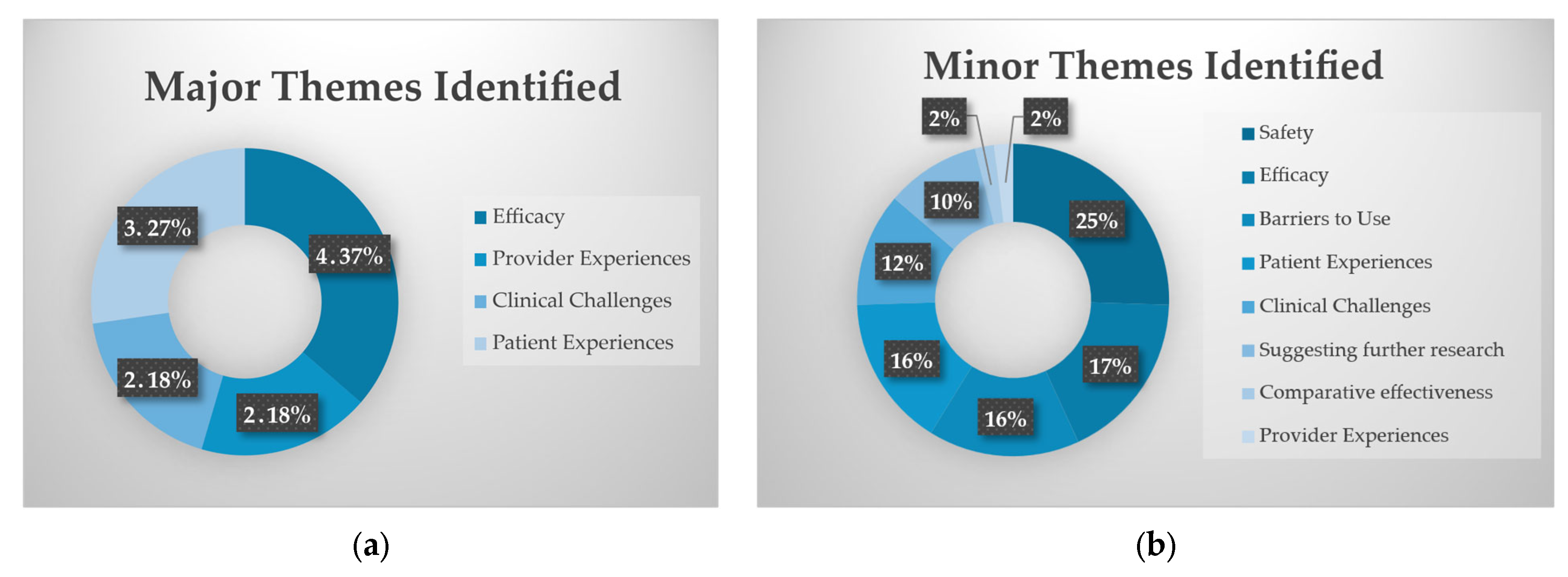
| Themes |
| Safety |
| Efficacy |
| Comparative effectiveness |
| Barriers to Use |
| Provider Experiences |
| Patient Experiences |
| Clinical Challenges |
| Suggesting further research |
Appendix A.3. Areas Identified for Future Study
| Study Citation | Areas Identified for Further Research |
|---|---|
| Patel, A et al. 2025 [12] | Need for prospective clinical trial |
| Afranie-Sakyi, J et al. 2024 [30] | Need for buprenorphine education |
| Tiako, M et al. 2024 [31] | Need for buprenorphine education |
| Sabharwal, B et al. 2024 [29] | Need for guidelines on rotating patients to buprenorphine and determining equianalgesic dosing |
| Admiraal, M et al. 2023 [22] | Need for prospective clinical trial |
| Jacob, P et al. 2022 [25] | Need for standardized management strategies for patients with chronic pain |
| Leyde, S et al. 2022 [25] | Need for guidelines on rotating patients to buprenorphine and determining equianalgesic dosing |
| Irwin, M et al. 2021 [24] | Need for prospective clinical trial |
| Buchheit, B 2021 [27] | Need for prospective clinical trials and long-term outcome data |
| Osunkwo, I et al. 2020 [27] | Need for larger prospective trials |
| Osunkwo, I et al. 2010 [23] | Need for standardized management strategies for hyperalgesia syndrome |
Appendix B


References
- Piel, F.B.; Steinberg, M.H.; Rees, D.C. Sickle Cell Disease. N. Engl. J. Med. 2017, 376, 1561–1573. [Google Scholar] [CrossRef] [PubMed]
- Piel, F.B.; Hay, S.I.; Gupta, S.; Weatherall, D.J.; Williams, T.N. Global Burden of Sickle Cell Anaemia in Children under Five, 2010–2050: Modelling Based on Demographics, Excess Mortality, and Interventions. PLoS Med. 2013, 10, e1001484. [Google Scholar] [CrossRef] [PubMed]
- Arzoun, H.; Srinivasan, M.; Sahib, I.; Fondeur, J.; Escudero Mendez, L.; Hamouda, R.K.; Mohammed, L. Opioid Use in Patients with Sickle Cell Disease During a Vaso-Occlusive Crisis: A Systematic Review. Cureus 2022, 14, e21473. [Google Scholar] [CrossRef] [PubMed]
- Sinha, C.B.; Bakshi, N.; Ross, D.; Krishnamurti, L. Management of Chronic Pain in Adults Living with Sickle Cell Disease in the Era of the Opioid Epidemic: A Qualitative Study. JAMA Netw. Open 2019, 2, e194410. [Google Scholar] [CrossRef]
- David, M.S.; Jones, J.; Lauriello, A.; Nnake, I.; Plazas Montana, M.; Lasko, K.; Buri-Nagua, C.; Olagbaju, Y.; Williams, E.; Sears, M.; et al. Converting Adults with Sickle Cell Disease from Full Agonist Opioids to Buprenorphine: A Reliable Method with Safety and Early Evidence of Reduced Acute Care Utilization. Am. J. Hematol. 2022, 97, 1435–1442. [Google Scholar] [CrossRef]
- Spreen, L.A.; Dittmar, E.N.; Quirk, K.C.; Smith, M.A. Buprenorphine Initiation Strategies for Opioid Use Disorder and Pain Management: A Systematic Review. Pharmacother. J. Hum. Pharmacol. Drug Ther. 2022, 42, 411–427. [Google Scholar] [CrossRef]
- White, L.D.; Hodge, A.; Vlok, R.; Hurtado, G.; Eastern, K.; Melhuish, T.M. Efficacy and Adverse Effects of Buprenorphine in Acute Pain Management: Systematic Review and Meta-Analysis of Randomised Controlled Trials. Br. J. Anaesth. 2018, 120, 668–678. [Google Scholar] [CrossRef]
- Walsh, S.L.; Preston, K.L.; Stitzer, M.L.; Cone, E.J.; Bigelow, G.E. Clinical Pharmacology of Buprenorphine: Ceiling Effects at High Doses. Clin. Pharmacol. Ther. 1994, 55, 569–580. [Google Scholar] [CrossRef]
- Walsh, S.L.; Eissenberg, T. The Clinical Pharmacology of Buprenorphine: Extrapolating from the Laboratory to the Clinic. Drug Alcohol Depend. 2003, 70, S13–S27. [Google Scholar] [CrossRef]
- Torres, C.; Galadanci, N.; Osborn, J.; Kanter, J. Real-World Implementation of the David–Carroll Buprenorphine Protocol for Pain Management in Sickle Cell Disease. Am. J. Hematol. 2024, 99, 1834–1836. [Google Scholar] [CrossRef]
- Prince, E.; Loeser, P.; Early, M.; Carroll, C.P.; Lanzkron, S.; Pecker, L.H. “Buprenorphine, It Works so Differently”: Adults with Sickle Cell Disease Describe Transitioning to Buprenorphine for Treatment of Chronic Pain. J. Pain 2024, 25, 632–641. [Google Scholar] [CrossRef] [PubMed]
- Patel, A.; Kalmus, G.; Dampier, C.; Osunkwo, I.; New, T.; Gee, B.; Saah, E. Treatment Experience Using a Micro-Induction Buprenorphine Protocol for Chronic Pain in Pediatric Sickle Cell Disease. Pediatr. Blood Cancer 2025, 72, e31731. [Google Scholar] [CrossRef] [PubMed]
- Pancekauskaitė, G.; Jankauskaitė, L. Paediatric Pain Medicine: Pain Differences, Recognition and Coping Acute Procedural Pain in Paediatric Emergency Room. Medicina 2018, 54, 94. [Google Scholar] [CrossRef] [PubMed]
- Vichinsky, E.P.; Styles, L.A.; Colangelo, L.H.; Wright, E.C.; Castro, O.; Nickerson, B. Acute Chest Syndrome in Sickle Cell Disease: Clinical Presentation and Course. Blood 1997, 89, 1787–1792. [Google Scholar] [CrossRef][Green Version]
- Peters, M.D.; Godfrey, C.; McInerney, P.; Munn, Z.; Tricco, A.C.; Khalil, H. Scoping Reviews. In JBI Manual for Evidence Synthesis; Aromataris, E., Lockwood, C., Porritt, K., Pilla, B., Jordan, Z., Eds.; JBI: Adelaide, Australia, 2024. [Google Scholar] [CrossRef]
- PRISMA 2020 Statement. PRISMA Statement. Available online: https://www.prisma-statement.org/prisma-2020 (accessed on 10 February 2026).
- Tricco, A.C.; Lillie, E.; Zarin, W.; O’Brien, K.K.; Colquhoun, H.; Levac, D.; Moher, D.; Peters, M.D.J.; Horsley, T.; Weeks, L.; et al. PRISMA Extension for Scoping Reviews (PRISMA-ScR): Checklist and Explanation. Ann. Intern. Med. 2018, 169, 467–473. [Google Scholar] [CrossRef]
- deBettencourt, J. Buprenorphine for Pediatric Patients with Sickle Cell Disease: A Scoping Review. OSF Registries. 2025. Available online: https://osf.io/waty6 (accessed on 9 February 2026).
- Lipke, L. Subject Guides: Scoping Review: Step 7: Data Extraction. Available online: https://libraryguides.binghamton.edu/scopingreview/dataextraction (accessed on 13 January 2026).
- Naeem, M.; Ozuem, W.; Howell, K.; Ranfagni, S. A Step-by-Step Process of Thematic Analysis to Develop a Conceptual Model in Qualitative Research. Int. J. Qual. Methods 2023, 22, 16094069231205789. [Google Scholar] [CrossRef]
- Haddaway, N.R.; Page, M.J.; Pritchard, C.C.; McGuinness, L.A. PRISMA2020: An R Package and Shiny App for Producing PRISMA 2020-compliant Flow Diagrams, with Interactivity for Optimised Digital Transparency and Open Synthesis. Campbell Syst. Rev. 2022, 18, e1230. [Google Scholar] [CrossRef]
- Admiraal, M.; van Daalen, J.; Ritt, M.W.J.; Dekker, J.; van Tuijn, C.F.J.; Nur, E.; Hollmann, M.W.; Hermanns, H.; Hermanides, J.; Biemond, B.J. A Multimodal Pain Protocol for Treatment of Vaso-Occlusive Crisis in Patients with Sickle Cell Disease: Implementation and Evaluation. Eur. J. Haematol. 2023, 111, 382–390. [Google Scholar] [CrossRef]
- Osunkwo, I.; Griffin, A.; James-Herry, A.; Johnson, A.; Eckman, J.E. A Case of Chronic Pain Syndrome from Hyperalgesia in Sickle Cell Disease. Am. J. Hematol. 2010, 85, E51–E52. [Google Scholar] [CrossRef]
- Irwin, M.; Gunther, W.; Keefer, P.; Saul, D.; Singh, S.A.; Wright, J.; Smith, M.A. Buprenorphine for Chronic Pain in a Pediatric Patient With Sickle-Cell Disease. J. Pain Symptom Manag. 2021, 62, 1086–1091. [Google Scholar] [CrossRef]
- Jacob, P.; Chang, A. Treatment of Chronic Pain in An Adolescent with Sickle Cell Using An Inpatient Rehabilitation Model. Pediatr. Blood Cancer 2022, 69, S148–S149. [Google Scholar] [CrossRef]
- Leyde, S.; Suen, L.; Pratt, L.; DeFries, T. Transition from Oxycodone to Buprenorphine/Naloxone in a Hospitalized Patient with Sickle Cell Disease: A Case Report. J. Gen. Intern. Med. 2022, 37, 1281–1285. [Google Scholar] [CrossRef]
- Osunkwo, I.; O’Connor, H.F.; Saah, E. Optimizing the Management of Chronic Pain in Sickle Cell Disease. Hematol. Am. Soc. Hematol. Educ. Program 2020, 2020, 562–569. [Google Scholar] [CrossRef] [PubMed]
- Buchheit, B.M.; Joslin, T.; Turner, H.N.; Wong, T.E. Ambulatory Microdose Induction of Buprenorphine-Naloxone in Two Adolescent Patients with Sickle Cell Disease. Pediatr. Blood Cancer 2021, 68, e28766. [Google Scholar] [CrossRef] [PubMed]
- Sabharwal, B.; Lawal, N.O.; Smith, M.A. Rotating Palliative Care Patients From Full Agonist Opioids to Low Dose Milligram Buprenorphine. J. Pain Symptom Manag. 2024, 68, e156–e158. [Google Scholar] [CrossRef] [PubMed]
- Afranie-Sakyi, J.A.; Nguemeni Tiako, M.J.; Vasquez, K.S.; Van Doren, L.N.; Calhoun, C. Buprenorphine & Sickle Cell: How Pediatric and Adult Providers Differ in Prescribing Habits and Evolving Pain Management Styles. Blood 2024, 144, 3628. [Google Scholar] [CrossRef]
- Nguemeni Tiako, M.J.; Afranie-Sakyi, J.A.; Van Doren, L.N.; Vasquez, K.S.; Calhoun, C. Buprenorphine Knowledge and Attitudes Among Sickle Cell Disease Providers. Blood 2024, 144, 2442. [Google Scholar] [CrossRef]
- Johnson, R.E.; Fudala, P.J.; Payne, R. Buprenorphine: Considerations for Pain Management. J. Pain Symptom Manag. 2005, 29, 297–326. [Google Scholar] [CrossRef]
- Center for Substance Abuse Treatment. Clinical Guidelines for the Use of Buprenorphine in the Treatment of Opioid Addiction; SAMHSA/CSAT Treatment Improvement Protocols; Substance Abuse and Mental Health Services Administration (US): Rockville, MD, USA, 2004. [Google Scholar]
- Kumar, R.; Viswanath, O.; Saadabadi, A. Buprenorphine. In StatPearls; StatPearls Publishing: Treasure Island, FL, USA, 2025. [Google Scholar]
- Yokell, M.A.; Zaller, N.D.; Green, T.C.; Rich, J.D. Buprenorphine and Buprenorphine/Naloxone Diversion, Misuse, and Illicit Use: An International Review. Curr. Drug Abuse Rev. 2011, 4, 28–41. [Google Scholar] [CrossRef]
- Jonan, A.B.; Kaye, A.D.; Urman, R.D. Buprenorphine Formulations: Clinical Best Practice Strategies Recommendations for Perioperative Management of Patients Undergoing Surgical or Interventional Pain Procedures. Pain Physician 2018, 21, E1–E12. [Google Scholar]
- Adler, J.; Mallick-Searle, T.; Garofoli, M.; Zimmerman, A. Frontline Perspectives on Buprenorphine for the Management of Chronic Pain. J. Multidiscip. Healthc. 2024, 17, 1375–1383. [Google Scholar] [CrossRef]
- UpToDate Inc. Buprenorphine and Naloxone: Drug Information. In UpToDate Lexidrug; UpToDate Inc.: Waltham, MA, USA, 2024. Available online: https://www.ncbi.nlm.nih.gov/books/NBK603725/ (accessed on 10 January 2026).
- UpToDate Inc. Buprenorphine: Drug Information. In UpToDate Lexidrug; UpToDate Inc.: Waltham, MA, USA, 2024. Available online: https://www.ncbi.nlm.nih.gov/books/NBK459126/ (accessed on 10 January 2026).
- Asghar, M.S.; Babu, P.; Lee, W.J.; Aziz, K.T.; Aziz, S.; Ahmed, S. Sex Disparities in Sickle Cell Disease Admissions in United States: A National in-Patient Sample Study from 2016–2022. Blood 2025, 146, 6520. [Google Scholar] [CrossRef]
- Maunuksela, E.L.; Korpela, R.; Olkkola, K.T. Comparison of Buprenorphine with Morphine in the Treatment of Postoperative Pain in Children. Anesth. Analg. 1988, 67, 233–239. [Google Scholar] [CrossRef]
- Olkkola, K.T.; Maunuksela, E.L.; Korpela, R. Pharmacokinetics of Intravenous Buprenorphine in Children. Br. J. Clin. Pharmacol. 1989, 28, 202–204. [Google Scholar] [CrossRef]
- Carroll, C.P.; Prince, E.J.; Lauriello, A.; Pecker, L.H.; Lanzkron, S.M. Acute Pain Treatment in Patients with Sickle Cell Disease Transitioned to Buprenorphine: Evidence of Equivalent Pain Relief. J. Sick. Cell Dis. 2025, 2, yoaf014. [Google Scholar] [CrossRef]
- Brandow, A.M.; Carroll, C.P.; Creary, S.; Edwards-Elliott, R.; Glassberg, J.; Hurley, R.W.; Kutlar, A.; Seisa, M.; Stinson, J.; Strouse, J.J.; et al. American Society of Hematology 2020 guidelines for sickle cell disease: Management of acute and chronic pain. Blood Adv. 2020, 4, 2656–2701. [Google Scholar] [CrossRef] [PubMed]

| First Author | Number of Participants | Setting | Buprenorphine Formulation | Summary |
|---|---|---|---|---|
| Osunkwo, I et al. 2010 [23] | 1 | Inpatient | Not specified | Pain not responsive to chronic opioid therapy should prompt consideration of alternate therapies, including buprenorphine. |
| Irwin, M et al. 2021 [24] | 1 | Inpatient | Sublingual | Buprenorphine proved to be a safe and efficacious alternate to chronic opioid therapy with full-agonists. |
| Jacob, P et al. 2022 [25] | 1 | Inpatient | Sublingual | Inpatient multimodal intensive pain management with buprenorphine is successful at decreasing acute care utilization and hospitalizations. |
| Leyde, S et al. 2022 [26] | 1 | Inpatient | Transdermal and sublingual | Inpatient microdose induction during a pain episode is feasible and safe and may lead to improved outcomes over full-agonist opioids. |
| Osunkwo, I et al. 2020 [27] | 1 * | Outpatient | Sublingual buprenorphine/naloxone | In combination with increased psychosocial support, buprenorphine can be an effective for transitioning patients off chronic opioid therapy. |
| Buchheit, B 2021 [28] | 2 | Outpatient | Sublingual buprenorphine/naloxone | Ambulatory buprenorphine/naloxone induction is feasible and tolerable in adolescent patients and may lead to improved quality of life after transition. |
| Admiraal, M et al. 2023 [22] | 131 | Emergency Room | Intravenous | Implementation of a standardized pain protocol resulted in overall shorter time to first dose of opioid. Length of stay and admission rates were comparable to published averages. |
| Sabharwal, B et al. 2024 [29] | 19 | Inpatient | Sublingual | For patients on high doses of opioids, low-dose buprenorphine can be equally efficacious. |
| Patel, A et al. 2025 [12] | 14 | Inpatient | Transdermal patch, sublingual or buccal | Micro-dose induction followed by buprenorphine maintenance dosing is both safe and effective for use in pediatric patients with SCD and chronic pain. |
| Afranie-Sakyi, J et al. 2024 [30] | 52 † | Not applicable | Not applicable | Many providers do not feel comfortable prescribing buprenorphine, particularly pediatric providers. |
| Tiako, M et al. 2024 [31] | 52 † | Not applicable | Not applicable | Providers have some baseline knowledge about buprenorphine but may be unsure about dosing and prescribing. |
| Formulation | Brand(s) (US) * | Common Dosages Available * | Typical Starting Dose for Pain (Adult Unless Specified) † | Time to Peak Plasma Concentration ‡ | Mean Half-Life ‡ |
|---|---|---|---|---|---|
| Transdermal patch (7-day) | Butrans, generic | 5, 7.5, 10, 15, and 20 mcg/h patches | FDA-approved for chronic pain; opioid-naïve or <30 mg oral MME/day: 5 mcg/h once weekly; 30–80 mg MME/day: 10 mcg/h once weekly, not to exceed 20 mcg/h. | 72 h to steady state | ~26 h after patch removal |
| Buccal film | Belbuca | 75, 150, 300, 450, 600, 750, and 900 mcg films (q12 h dosing) | FDA-approved for chronic pain; 75 mcg once daily or q12 h for ≥4 days, then increase, not to exceed 900 mcg/12 h. | 2.5–3 h | ~27–28 h |
| Buccal/sublingual film (buprenorphine/naloxone) | Generic | 2 mg/0.5 mg, 4 mg/1 mg, 8 mg/2 mg, and 12 mg/3 mg | Off-label for pain, with a typical starting dose of 2 mg/0.5 mg § | Not available | 16.4–27.5 mg (buprenorphine); 1.9–2.4 mg (naloxone) |
| Injection IV/IM | Buprenex, generic | 0.3 mg/mL solution in 1 mL | FDA-approved for acute pain in children >2 years of age; acute pain (>2 y <12 y) 2–6 mcg/kg q4–6 h; acute pain (≥13 y): 0.3 mg IV or IM q6 h PRN; or 2–6 mcg/kg for children q4–6 h. | IV: rapid; IM: ~60 min | 1.2–7.2 h (may be shorter in children) |
| Sublingual tablet | Zubsolv, Subutex, generic | 2 and 8 mg | Off-label for pain, with a typical starting dose of 2–4 mg q6–8 h § | 1.3–1.8 h | 31–35 h |
| Sublingual tablet (buprenorphine with naloxone) | Suboxone, generic | 2 mg/0.5 mg and 8 mg/2 mg | Off-label for pain, with a typical starting dose of 2–4 mg q6–8 h § | 24–42 (buprenorphine); 2–12 (naloxone) | Not specified |
| (a) | |||||
|---|---|---|---|---|---|
| Study (Year) | Genotype | N | Age (Years) | Sex | Baseline Opioid Dose |
| Osunkwo et al., 2010 [23] | HbSS | 1 | 18 | F | Methadone 270 mg/day |
| Osunkwo et al., 2020 [27] | HbSS | 1 | 25 | F | 120 mg OME/day |
| Buchheit et al., 2021 (Case 1) [28] | HbSC | 1 | 17 | M | Methadone 12.5 mg/day + oxycodone 37.5 mg/day |
| Buchheit et al., 2021 (Case 2) [28] | HbSC | 1 | 19 | M | 270 mg OME/day (oxycodone) |
| Irwin et al., 2021 [24] | HbSC | 1 | 11 | F | Methadone 5 mg TID + hydromorphone 4 mg PO every 4 h |
| Patel et al., 2025 [12] | 12 HbSS; 2 HbSβ0 | 14 | 18 (14.8–18.9) | 9 F; 5 M | 24.4 mg OME/day (IQR 18–40) |
| (b) | |||||
| Study (Year) | N | Pre-Intervention Healthcare Utilization | Post-Intervention Opioid/Buprenorphine Regimen | Post-Intervention Healthcare Utilization | Follow-Up/Notes |
| Osunkwo et al., 2010 [23] | 1 | Single 90-day hospitalization | Buprenorphine during admission; 0 opioid dose at discharge | No acute exacerbations requiring admission | 6 months; methadone stopped by day 65, buprenorphine stopped by day 85 |
| Osunkwo et al., 2020 [27] | 1 | 25 ED visits/year; 5 admissions/year; mean LOS 3 days | Sublingual buprenorphine/naloxone (dose not specified) | No ED visits | 12 months; authors report acute care use “dropped dramatically” |
| Buchheit et al., 2021 (Case 1) [28] | 1 | High ED utilization; estimated 13–17 ED visits/year | Buprenorphine/naloxone SL 2 mg/0.5 mg TID → 1 mg/0.25 mg SL * | No ED or acute care visits | 5 months; improved pain reported |
| Buchheit et al., 2021 (Case 2) [28] | 1 | 6 admissions/year; 63 inpatient days/year | Buprenorphine/naloxone SL 4 mg/1 mg TID → 4 mg/1 mg film daily * | Fewer acute care visits (number not reported); 1 admission (11 days) | 6 months |
| Irwin et al., 2021 [24] | 1 | 1.57 hospitalizations/month (11 admissions/7 months) | Buprenorphine/naloxone SL films titrated to 2 mg QID (8 mg/day) + hydromorphone PRN (OME 96 mg/day *) | 0.86 hospitalizations/month (6 admissions/7 months) | OME excludes buprenorphine; full-agonist opioids weaned to PRN |
| Patel et al., 2025 [12] | 14 | Median 11 acute care encounters/person-year | Transdermal buprenorphine 10 → 20 mcg/h, then SL/buccal buprenorphine or buprenorphine/naloxone; median discharge dose 8 mg/day (range 2.5–16) | Median 8 acute care encounters/person-year; median decrease of 3.5 inpatient admissions/person-year; median decrease of 40 hospital days | 12 months; 3 patients discontinued buprenorphine |
| Number of Quotes | Themes Identified |
|---|---|
| N = 32 | |
| 8 | Patient Experiences |
| 6 | Barriers to Use |
| 4 | Need for Guidance/Guidelines |
| 2 | Increased Interest |
| 2 | Provider Experiences |
| 2 | Equivalency of Dosing/Effect |
| 2 | Knowledge Gap |
| 2 | Need for Multimodal Therapy |
| 1 | Clinical Challenges |
| 1 | Need for Multidisciplinary Team |
| 1 | Efficacy |
| 1 | Feasibility |
| Exemplar Quotes: Patient Experiences | |
| Citation | Quote |
| Leyde, S et al. 2022 [26] | [Patient reflection] “With the buprenorphine I feel more energy, more clear-headed and some sort of relief … I feel that the switch was very helpful and necessary. I would recommend it for anybody.” |
| Buchheit, B 2021 [28] | “…[The patient, after rotation to buprenorphine] consistently reports feeling like a normal teenage, and plans to return to playing soccer.” |
| Exemplar Quotes: Need for Guidance/Guidelines | |
| Citation | Quote |
| Jacob, P et al. 2022 [25] | “Despite a high prevalence of CPS [Chronic Pain Syndrome] in pediatric patients with SCD, there is a paucity of standardized management tools and a scarcity of resources to address chronic pain in the SCD population.” |
| Sabharwal, B et al. 2024 [29] | “What is missing is a more clear understanding of the potential conversion ratios to better target dosing for patients with pain rotated to buprenorphine using a low dose initiation strategy” |
Disclaimer/Publisher’s Note: The statements, opinions and data contained in all publications are solely those of the individual author(s) and contributor(s) and not of MDPI and/or the editor(s). MDPI and/or the editor(s) disclaim responsibility for any injury to people or property resulting from any ideas, methods, instructions or products referred to in the content. |
© 2026 by the authors. Licensee MDPI, Basel, Switzerland. This article is an open access article distributed under the terms and conditions of the Creative Commons Attribution (CC BY) license.
Share and Cite
deBettencourt, J.; Nagy, M.; Rotman, C.; Greco, C.; Berde, C.; Archer, N.M. Buprenorphine for Children and Adolescents with Sickle Cell Disease: A Scoping Review. Children 2026, 13, 388. https://doi.org/10.3390/children13030388
deBettencourt J, Nagy M, Rotman C, Greco C, Berde C, Archer NM. Buprenorphine for Children and Adolescents with Sickle Cell Disease: A Scoping Review. Children. 2026; 13(3):388. https://doi.org/10.3390/children13030388
Chicago/Turabian StyledeBettencourt, Joseph, Matthew Nagy, Chloe Rotman, Christine Greco, Charles Berde, and Natasha M. Archer. 2026. "Buprenorphine for Children and Adolescents with Sickle Cell Disease: A Scoping Review" Children 13, no. 3: 388. https://doi.org/10.3390/children13030388
APA StyledeBettencourt, J., Nagy, M., Rotman, C., Greco, C., Berde, C., & Archer, N. M. (2026). Buprenorphine for Children and Adolescents with Sickle Cell Disease: A Scoping Review. Children, 13(3), 388. https://doi.org/10.3390/children13030388