Early Postoperative Analgesic Outcomes Following Pre-Induction Intravenous Ibuprofen in Children Undergoing Hypospadias Repair: A Randomized Controlled Study

 , and
, and
Highlights
- Pre-induction intravenous ibuprofen was associated with a lower proportion of children requiring rescue opioid analgesia in the postanesthesia care unit after hypospadias repair.
- Intravenous ibuprofen was associated with a lower incidence of moderate-to-severe pain in the immediate postoperative period without an increase in adverse events.
- Intravenous ibuprofen administered during anesthesia induction may be considered as a potential addition to postoperative pain management strategies for short-duration pediatric urological surgery.
- Integrating pain and emergency delirium scales may improve the interpretation of early postoperative pain outcomes in young children.
Abstract
1. Introduction
2. Materials and Methods
2.1. Trial Design
2.2. Ethics Approval and Study Conduct
2.3. Participants and Eligibility Criteria
2.3.1. Inclusion Criteria
2.3.2. Exclusion Criteria
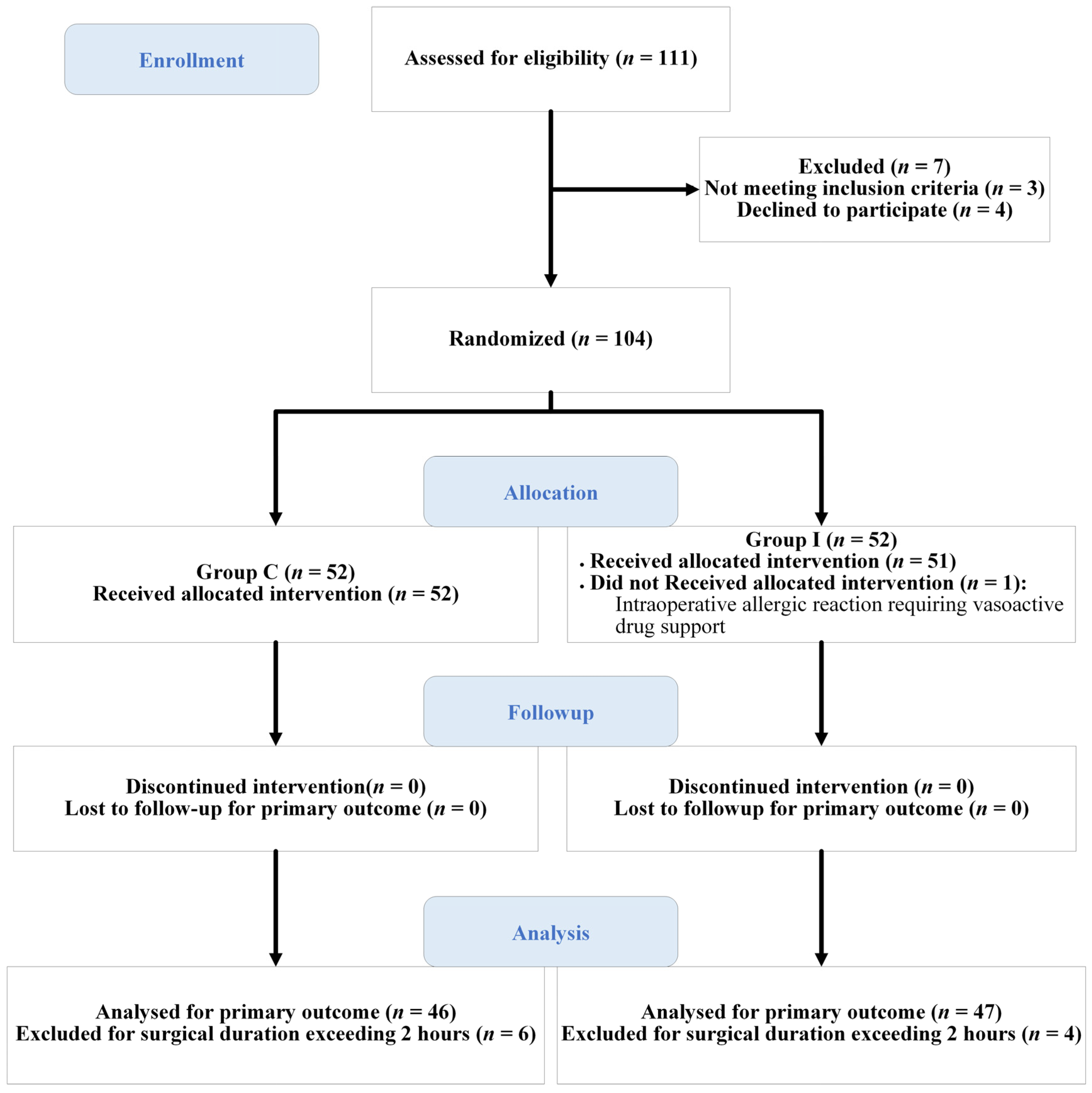
2.4. Handling of Participants and Impact on Study Power
2.5. Patient and Public Involvement
2.6. Standardized Procedure
2.6.1. Induction and Maintenance of Anesthesia
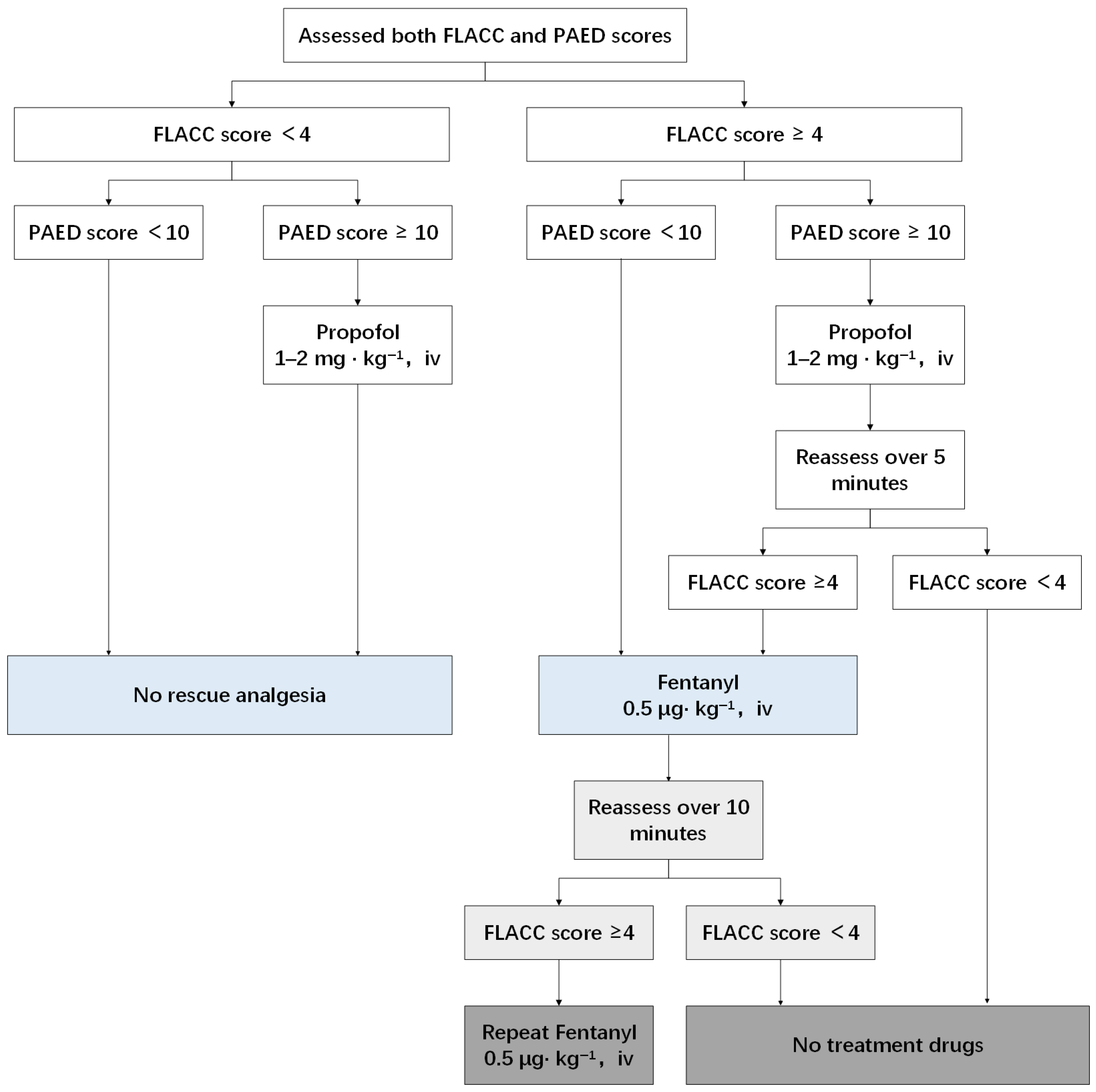
2.6.2. Postoperative and Rescue Analgesia
2.7. Study Outcomes
- The proportion of patients with a postoperative FLACC score of 4 or greater.
- The proportion of patients with a postoperative PAED score of 10 or higher.
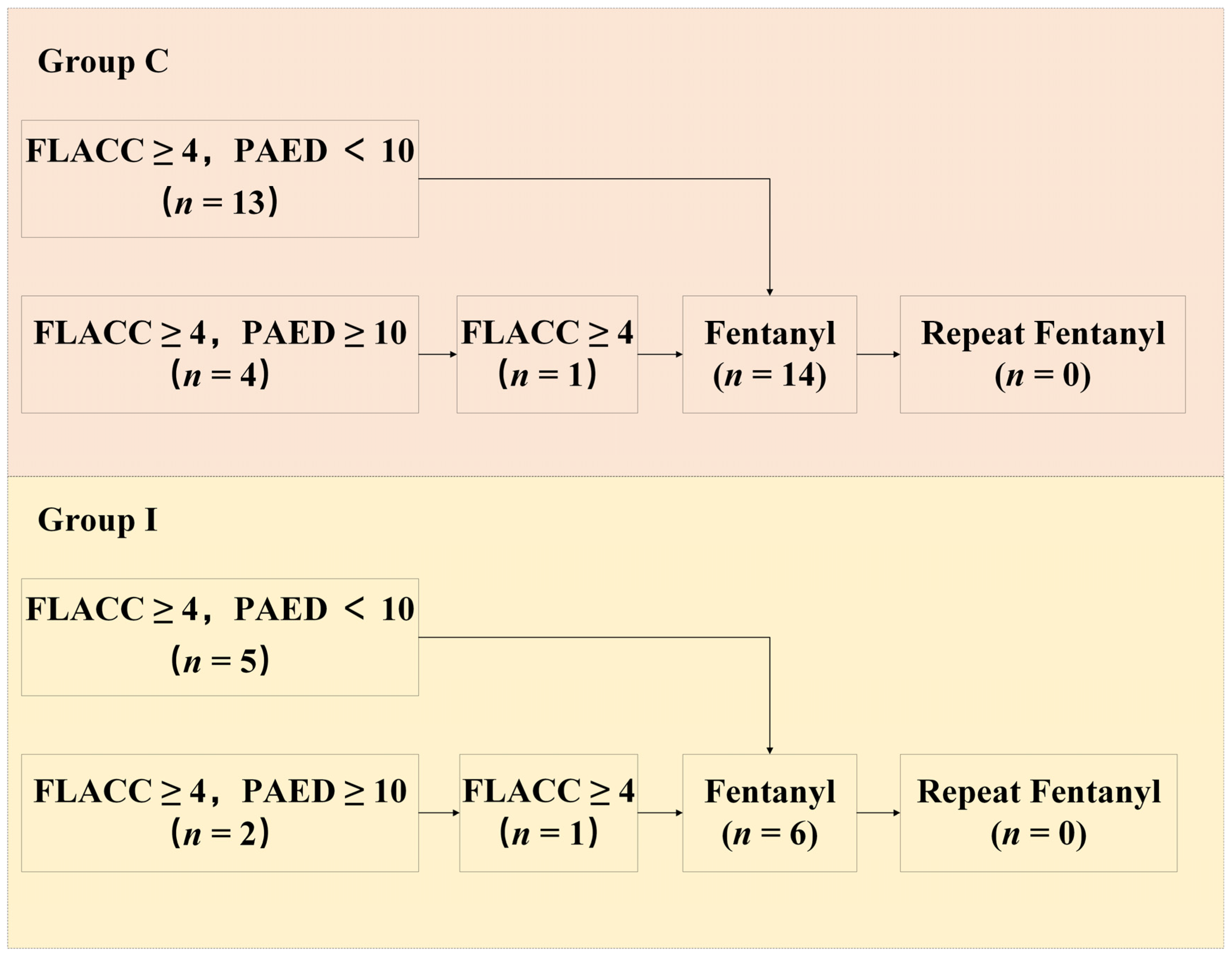
- The proportion of patients requiring repeat fentanyl in the PACU.
- Pain scores on postoperative days 1 and 2 were assessed using two validated scales: the FLACC scale for all patients and NRS-11 reported by caregivers.
- Intraoperative remifentanil consumption.
- The LMA removal time, defined as the interval from the discontinuation of maintenance anesthetic agents to removal of the laryngeal mask airway.
- The incidence of adverse events, including nausea, vomiting, constipation, intra- and postoperative bleeding, and abdominal bloating, was also recorded.
2.8. Sample Size
2.9. Randomization and Blinding
2.10. Statistical Analysis
3. Results
3.1. Efficacy Outcomes Based on Per-Protocol Analysis
3.1.1. Rescue Analgesia
3.1.2. Postoperative Pain and Emergence Behavior
3.1.3. Intraoperative Medication and Recovery
3.2. Safety Outcomes
4. Discussion
5. Conclusions
Author Contributions
Funding
Institutional Review Board Statement
Informed Consent Statement
Data Availability Statement
Acknowledgments
Conflicts of Interest
Abbreviations
| ASA | American Society of Anesthesiologists |
| PACU | postanesthesia care unit |
| FLACC | Face, Legs, Activity, Cry, Consolability |
| NRS-11 | numerical rating scale-11 |
| PAED | Pediatric Anesthesia Emergence Delirium |
| LMA | laryngeal mask airway |
| NSAID | nonsteroidal anti-inflammatory drug |
| BIS | bispectral index |
| SpO2 | blood oxygen saturation |
References
- Xu, Y.; Chen, Q.; Li, P.; Song, X. Safety and efficacy of esketamine for postoperative analgesia in pediatric patients with hypospadias. Front. Surg. 2023, 10, 1131137. [Google Scholar] [CrossRef] [PubMed]
- Chou, R.; Gordon, D.B.; De Leon-Casasola, O.A.; Rosenberg, J.M.; Bickler, S.; Brennan, T.; Carter, T.; Cassidy, C.L.; Chittenden, E.H.; Degenhardt, E.; et al. Management of postoperative pain: A clinical practice guideline from the American Pain Society, the American Society of Regional Anesthesia and Pain Medicine, and the American Society of Anesthesiologists’ Committee on Regional Anesthesia, Executive Committee, and Administrative Council. J. Pain 2016, 17, 131–157. [Google Scholar] [CrossRef]
- Thbeet, H.N.; Shoq, A.H. Non-Pharmacological Pain Management and its Effect on Pain of Children Postoperatively. Pak. J. Med. Health Sci. 2022, 16, 497–499. [Google Scholar] [CrossRef]
- Wong, J.H.; Na, Y.; Parsa, F.D. Evolving toward non-narcotic perioperative enhanced recovery after surgery and opioid-free analgesia in the management of postoperative pain. Cureus 2024, 16, e76605. [Google Scholar] [CrossRef]
- Alansary, A.M.; Badawy, A.; Elbeialy, M.A.K. Ultrasound-guided trans-incisional quadratus lumborum block versus ultrasound-guided caudal analgesia in pediatric open renal surgery: A randomized trial. Korean J. Anesthesiol. 2023, 76, 471–480. [Google Scholar] [CrossRef]
- Sisay, A.; Girma, B.; Negusie, T.; Abdi, S.; Horsa, B.; Ayele, K. Inadvertent life-threatening total spinal anesthesia following caudal block in a preschool child underwent urologic surgery: A rare case report. Int. J. Surg. Case Rep. 2021, 88, 106541. [Google Scholar] [CrossRef]
- Kalava, A.; Pribish, A.M.; Wiegand, L.R. Pudendal nerve blocks in men undergoing urethroplasty: A case series. Rom. J. Anaesth. Intensive Care 2017, 24, 159–162. [Google Scholar] [CrossRef]
- Zhang, W.; Zhao, Q.; Yang, G.; Han, N.; Peng, C.; Chen, H. Efficacy and safety of preoperative versus postoperative NSAIDs on pain relief in patients undergoing hip arthroscopy surgery: A multicentre, randomized, controlled trial. J. Clin. Pharm. Ther. 2022, 47, 2091–2100. [Google Scholar] [CrossRef]
- Shukla, D.; Bhola, N.D.; Bhola, R.D.; Nimje, A.M. Efficacy of preoperative piroxicam, diclofenac, paracetamol with tramadol and placebo tablets for relief of postoperative pain after the removal of impacted mandibular third molars: A randomized controlled trial. Cureus 2022, 14, e26839. [Google Scholar] [CrossRef]
- Maurice-Szamburski, A.; Quemeneur, C.; Rozier, R.; Cuvillon, P.; Ecoffey, C. Intravenously administered nonsteroidal anti-Inflammatory drugs in clinical practice: A narrative review. Pharmacy 2025, 13, 18. [Google Scholar] [CrossRef]
- Moss, J.R.; Watcha, M.F.; Bendel, L.P.; McCarthy, D.L.; Witham, S.L.; Glover, C.D. A multicenter, randomized, double-blind placebo-controlled, single dose trial of the safety and efficacy of intravenous ibuprofen for treatment of pain in pediatric patients undergoing tonsillectomy. Paediatr. Anaesth. 2014, 24, 483–489. [Google Scholar] [CrossRef]
- Cui, X.; Zhang, J.; Gao, Z.; Sun, L.; Zhang, F. A randomized, double-blinded, placebo-controlled, single dose analgesic study of preoperative intravenous ibuprofen for tonsillectomy in children. Front. Pediatr. 2022, 10, 956660. [Google Scholar] [CrossRef]
- Alshehri, A.A. Comparative evaluation of postoperative pain scores and opioid consumption in septorhinoplasty after administration of single-dose preemptive paracetamol and ibuprofen: A randomized controlled trial. Int. Arch. Otorhinolaryngol. 2023, 27, e471–e477. [Google Scholar] [CrossRef]
- Barbagallo, M.; Sacerdote, P. Ibuprofen in the treatment of children’s inflammatory pain: A clinical and pharmacological overview. Minerva Pediatr. 2019, 71, 82–99. [Google Scholar] [CrossRef]
- Pessano, S.; Gloeck, N.R.; Tancredi, L.; Ringsten, M.; Hohlfeld, A.; Ebrahim, S.; Albertella, M.; Kredo, T.; Bruschettini, M. Ibuprofen for acute postoperative pain in children. Cochrane Database Syst. Rev. 2024, 1, CD015432. [Google Scholar] [CrossRef]
- Xuan, C.; Yan, W.; Wang, D.; Mueller, A.; Ma, H.; Wang, J. Effect of Preemptive Acetaminophen on Opioid Consumption: A Meta-Analysis. Pain Physician 2021, 24, E153–E160. [Google Scholar] [CrossRef]
- Thung, A.K.; Elmaraghy, C.A.; Barry, N.; Tumin, D.; Jatana, K.R.; Rice, J.; Raman, V.; Bhalla, T.; Martin, D.P.; Corridore, M.; et al. Double-Blind Randomized Placebo-Controlled Trial of Single-Dose Intravenous Acetaminophen for Pain Associated with Adenotonsillectomy in Pediatric Patients with Sleep-Disordered Breathing. J. Pediatr. Pharmacol. Ther. 2017, 22, 344–351. [Google Scholar] [CrossRef]
- Kim, Y.J.; Kim, H.J.; Kim, S.; Kim, H.; Lee, C.S.; Hwang, C.J.; Cho, J.H.; Ro, Y.J.; Koh, W.U. Comparison of preemptive and preventive intravenous acetaminophen on opioid consumption in pediatrics undergoing posterior spinal fusion surgery: A randomized controlled trial. Korean J. Anesthesiol. 2024, 77, 326–334. [Google Scholar] [CrossRef]
- Ziesenitz, V.C.; Welzel, T.; van Dyk, M.; Saur, P.; Gorenflo, M.; van den Anker, J.N. Efficacy and Safety of NSAIDs in Infants: A Comprehensive Review of the Literature of the Past 20 Years. Paediatr. Drugs 2022, 24, 603–655. [Google Scholar] [CrossRef]
- Somaini, M.; Engelhardt, T.; Fumagalli, R.; Ingelmo, P.M. Emergence delirium or pain after anaesthesia--how to distinguish between the two in young children: A retrospective analysis of observational studies. Br. J. Anaesth. 2016, 116, 377–383. [Google Scholar] [CrossRef]
- Bong, C.L.; Ng, A.S. Evaluation of emergence delirium in Asian children using the Pediatric Anesthesia Emergence Delirium Scale. Paediatr. Anaesth. 2009, 19, 593–600. [Google Scholar] [CrossRef]
- Abu-Shahwan, I. Effect of propofol on emergence behavior in children after sevoflurane general anesthesia. Paediatr. Anaesth. 2008, 18, 55–59. [Google Scholar] [CrossRef] [PubMed]
- Sikich, N.; Lerman, J. Development and psychometric evaluation of the pediatric anesthesia emergence delirium scale. Anesthesiology 2004, 100, 1138–1145. [Google Scholar] [CrossRef]
- Voepel-Lewis, T.; Zanotti, J.; Dammeyer, J.A.; Merkel, S. Reliability and validity of the face, legs, activity, cry, consolability behavioral tool in assessing acute pain in critically ill patients. Am. J. Crit. Care 2010, 19, 55–61. [Google Scholar] [CrossRef] [PubMed]
- Somaini, M.; Sahillioğlu, E.; Marzorati, C.; Lovisari, F.; Engelhardt, T.; Ingelmo, P.M. Emergence delirium, pain or both? a challenge for clinicians. Paediatr. Anaesth. 2015, 25, 524–529. [Google Scholar] [CrossRef] [PubMed]
- Algyar, M.F.; Abdelghany, A.M.; Arafa, S.K.; Elsayed, A.A. A placebo-controlled randomized trial comparing oral midazolam, dexmedetomidine, and gabapentin on prophylaxis of emergence agitation after sevoflurane anesthesia in adenotonsillectomy. Pain Physician 2025, 28, 31–38. [Google Scholar]
- Moore, A.D.; Anghelescu, D.L. Emergence Delirium in Pediatric Anesthesia. Paediatr. Drugs 2017, 19, 11–20. [Google Scholar] [CrossRef]
- Vlajkovic, G.P.; Sindjelic, R.P. Emergence Delirium in Children: Many Questions, Few Answers. Anesth. Analg. 2007, 104, 84–91. [Google Scholar] [CrossRef]
- Yousef, G.T.; Elsayed, K.M. A clinical comparison of ketofol (ketamine and propofol admixture) versus propofol as an induction agent on quality of laryngeal mask airway insertion and hemodynamic stability in children. Anesth. Essays Res. 2013, 7, 194–199. [Google Scholar] [CrossRef]
- Tan, T.; Bhinder, R.; Carey, M.; Briggs, L. Day-surgery patients anesthetized with propofol have less postoperative pain than those anesthetized with sevoflurane. Anesth. Analg. 2010, 111, 83–85. [Google Scholar] [CrossRef]
- Cheng, S.S.; Yeh, J.; Flood, P. Anesthesia matters: Patients anesthetized with propofol have less postoperative pain than those anesthetized with isoflurane. Anesth. Analg. 2008, 106, 264–269. [Google Scholar] [CrossRef]
- Alshami, A.A.; Alhamed, S.A.; Almahri, J.R.; AlSaggabi, F.A.; Alshahrani, A.S. Effect of pre-operative administration of ibuprofen in children undergoing extraction for reducing post-operative pain: A double-blind randomised controlled clinical trial. Br. Dent. J. 2021. [Google Scholar] [CrossRef]
- Simon, J.D.H.P.; Schepers, S.A.; Grootenhuis, M.A.; Mensink, M.; Huitema, A.D.; Tissing, W.J.E.; Michiels, E.M.C. Reducing pain in children with cancer at home: A feasibility study of the KLIK pain monitor app. Support Care Cancer 2021, 29, 7617–7626. [Google Scholar] [CrossRef]
- Baugh, R.F.; Archer, S.M.; Mitchell, R.B.; Rosenfeld, R.M.; Amin, R.; Burns, J.J.; Darrow, D.H.; Giordano, T.; Litman, R.S.; Li, K.K.; et al. Clinical practice guideline: Tonsillectomy in children. Otolaryngol. Head Neck Surg. 2011, 144, S1–S30. [Google Scholar] [CrossRef]
- Kim, S.H.; Kang, H.; Jun, I.J.; Park, H.W.; Yoo, B.H.; Lim, Y.H.; Kim, K.M. Effect of perioperative intravenous ibuprofen versus acetaminophen on postoperative opioid consumption and pain after general anesthesia: A systematic review and meta-analysis with trial sequential analysis of randomized controlled trials. Korean J. Anesthesiol. 2024, 77, 455–467. [Google Scholar] [CrossRef] [PubMed]
- Yaman, H.; Belada, A.; Yilmaz, S. The effect of ibuprofen on postoperative hemorrhage following tonsillectomy in children. Eur. Arch. Otorhinolaryngol. 2011, 268, 615–617. [Google Scholar] [CrossRef] [PubMed]
- Manasyan, A.; Gasho, J.O.; Kim, M.I.; Stanton, E.W.; Johnson, M.B.; Gillenwuater, T.J. Ibuprofen is Not Associated with an Elevated Bleeding Risk or Transfusion Requirement in Skin Grafting for Patients with Burn Injuries. J. Burn Care Res. 2025, 46, 642–645. [Google Scholar] [CrossRef] [PubMed]



| Group C | Group I | p | |
|---|---|---|---|
| Age, year * | 3.0 (2.0, 4.3) | 3.0 (2.0, 4.0) | 0.34 |
| Weight, kg * | 15.3 (12.8, 17.6) | 14.3 (13.0, 17.7) | 0.84 |
| High, cm * | 95.5 (88.8, 102.3) | 94.0 (90.0, 102.0) | 0.98 |
| BMI | 17.03 ± 2.18 | 17.01 ± 2.74 | 0.98 |
| Surgery duration, min * | 65.0 (45.0, 94.3) | 70.0 (55.0, 91.0) | 0.70 |
| The LMA removal time, min ** | 18.0 (15.0, 23.5) | 19.0 (16.0, 25.0) | 0.37 |
| Blood loss, mL * | 5.0 (2.8, 5.0) | 5.0 (3.0, 5.0) | 0.71 |
| Mean remifentanil, μg·kg−1·min−1 | 0.26 ± 0.03 | 0.27 ± 0.03 | 0.71 |
| Per-Protocol (PP) Analysis | Intent-To-Treat Analysis | |||
|---|---|---|---|---|
| Group C (n = 46) | Group I (n = 47) | Group C (n = 52) | Group I (n = 51) | |
| Incidence of rescue fentanyl, n (%) | ||||
| 14 (30.43%) | 6 (12.77%) | 17(32.69%) | 7(13.73%) | |
| p-value | 0.038 | 0.023 | ||
| Odds Ratio (OR) | 0.334 | 0.328 | ||
| 95% Confidence Interval | (0.116, 0.968) | (0.122, 0.878) | ||
| Risk Difference (RD) | −17.66% | −18.96% | ||
| Incidence of a FLACC score ≥ 4, n (%) | ||||
| 17 (36.96%) | 7 (14.89%) | 21 (40.38%) | 9 (17.65%) | |
| p-value | 0.015 | 0.011 | ||
| Odds Ratio (OR) | 0.299 | 0.316 | ||
| 95% Confidence Interval | (0.110, 0.813) | (0.128, 0.785) | ||
| Risk Difference (RD) | −22.07% | −22.73% | ||
| Incidence of a PAED score ≥ 10, n (%) | ||||
| 5 (10.87%) | 5 (10.64%) | 7 (13.46%) | 6 (11.76%) | |
| p-value | 1 | 0.795 | ||
| Odds Ratio (OR) | 0.976 | 0.857 | ||
| 95% Confidence Interval | (0.263, 3.626) | (0.267, 2.751) | ||
| Risk Difference (RD) | −0.23% | −1.70% | ||
| Incidence of a FLACC score ≥ 4 on day 1, n (%) | ||||
| 5 (10.87%) | 1 (2.13%) | * | ||
| p-value | 0.11 | |||
| Odds Ratio (OR) | 0.178 | |||
| 95% Confidence Interval | (0.020, 1.589) | |||
| Risk Difference (RD) | −8.74% | |||
| Incidence of a NRS-11 score ≥ 4 on day 1, n (%) | ||||
| 6 (13.04%) | 2 (4.26%) | * | ||
| p-value | 0.16 | |||
| Odds Ratio (OR) | 0.296 | |||
| 95% Confidence Interval | (0.057, 1.552) | |||
| Risk Difference (RD) | −8.78% | |||
| Incidence of a FLACC score ≥ 4 on day 2, n (%) | ||||
| 2 (4.30%) | 4 (8.50%) | * | ||
| p-value | 0.68 | |||
| Odds Ratio (OR) | 2.047 | |||
| 95% Confidence Interval | (0.356, 11.761) | |||
| Risk Difference (RD) | 4.20% | |||
| Incidence of a NRS-11 score ≥ 4 on day 2, n (%) | ||||
| 2 (4.30%) | 4 (8.50%) | * | ||
| p-value | 0.68 | |||
| Odds Ratio (OR) | 2.047 | |||
| 95% Confidence Interval | (0.356, 11.761) | |||
| Risk Difference (RD) | 4.20% | |||
Disclaimer/Publisher’s Note: The statements, opinions and data contained in all publications are solely those of the individual author(s) and contributor(s) and not of MDPI and/or the editor(s). MDPI and/or the editor(s) disclaim responsibility for any injury to people or property resulting from any ideas, methods, instructions or products referred to in the content. |
© 2026 by the authors. Licensee MDPI, Basel, Switzerland. This article is an open access article distributed under the terms and conditions of the Creative Commons Attribution (CC BY) license.
Share and Cite
Cui, X.; Zhang, J.; Gao, Z.; Cai, J.; Wang, F.; Li, L.; Zhang, S. Early Postoperative Analgesic Outcomes Following Pre-Induction Intravenous Ibuprofen in Children Undergoing Hypospadias Repair: A Randomized Controlled Study. Children 2026, 13, 342. https://doi.org/10.3390/children13030342
Cui X, Zhang J, Gao Z, Cai J, Wang F, Li L, Zhang S. Early Postoperative Analgesic Outcomes Following Pre-Induction Intravenous Ibuprofen in Children Undergoing Hypospadias Repair: A Randomized Controlled Study. Children. 2026; 13(3):342. https://doi.org/10.3390/children13030342
Chicago/Turabian StyleCui, Xiaohuan, Jianmin Zhang, Zhengzheng Gao, Jingjing Cai, Fang Wang, Lijing Li, and Shanshan Zhang. 2026. "Early Postoperative Analgesic Outcomes Following Pre-Induction Intravenous Ibuprofen in Children Undergoing Hypospadias Repair: A Randomized Controlled Study" Children 13, no. 3: 342. https://doi.org/10.3390/children13030342
APA StyleCui, X., Zhang, J., Gao, Z., Cai, J., Wang, F., Li, L., & Zhang, S. (2026). Early Postoperative Analgesic Outcomes Following Pre-Induction Intravenous Ibuprofen in Children Undergoing Hypospadias Repair: A Randomized Controlled Study. Children, 13(3), 342. https://doi.org/10.3390/children13030342