1. Introduction
The transition into formal schooling is a critical developmental juncture during which children are required to meet increasingly complex academic expectations, adapt to structured classroom routines, and navigate broader peer networks. Unlike early childhood settings, elementary school environments place greater demands on children’s ability to sustain attention, inhibit impulsive responses, comply with explicit rules, and manage multifaceted learning tasks that require persistence and goal-directed behavior. These heightened expectations underscore the centrality of executive function (EF)—a constellation of higher-order cognitive processes, including inhibitory control, working memory, and cognitive flexibility—which enables children to regulate behavior in situations involving novelty, challenge, or cognitive load [
1]. As children encounter these academic and socioemotional demands, EF becomes a foundational mechanism supporting school readiness, learning engagement, and overall adjustment.
Extensive empirical research indicates that deficits in EF are associated with elevated levels of both externalizing behaviors (e.g., aggression, impulsivity, hyperactivity) and internalizing difficulties (e.g., anxiety, social withdrawal, depression) throughout childhood. Further, meta-analytic evidence demonstrates that children with externalizing behavior problems exhibit deficits in executive functioning, particularly in inhibitory control [
2]. Prospective evidence indicates that lower EF skills in early childhood are associated with increases in internalizing problems, including anxiety and withdrawal, over time [
3]. From a developmental perspective, early caregiving environments characterized by warmth and sensitive scaffolding play a critical role in shaping EF by supporting children’s gradual transition from external regulation to self-regulation [
4]. In this regard, EF provides children with essential cognitive resources for managing emotional reactivity, navigating peer interactions, and sustaining adaptive engagement in classroom contexts.
Warm parenting provides an emotionally secure foundation that supports regulatory development and is associated with secure attachment, emotion regulation, and fewer behavioral problems [
5,
6,
7,
8,
9], whereas harsh or inconsistent parenting practices are linked to elevated risks of both externalizing and internalizing symptoms [
10,
11,
12]. Combined, these findings underscore warm caregiving as a salient socioemotional protective factor and highlight the relative paucity of empirical research from the Korean context.
Early emerging behavioral challenges can increase risks of maladaptive developmental trajectories and later psychopathology [
13]. In particular, externalizing behaviors display notable developmental stability and have been shown to undermine children’s peer relationships, classroom engagement, and socioemotional competence [
14]. Various familial stressors—such as parenting stress, parental depression, and marital conflict—have been identified as predictors of behavioral maladjustment [
15,
16,
17,
18,
19,
20]. Nevertheless, warm and supportive parenting consistently emerges as a robust buffer against behavioral risk across diverse samples and developmental periods [
21,
22,
23,
24,
25,
26].
EF—encompassing inhibitory control, working memory, and cognitive flexibility—supports behavioral regulation in response to situational demands [
27]. Deficits in EF have been associated with elevated externalizing behaviors and, to a lesser extent, internalizing symptoms [
28,
29,
30,
31]. Longitudinal studies indicate that early inhibitory control predicts future behavioral outcomes [
32,
33,
34,
35].
EF development reflects an ongoing interaction between neurobiological maturation and environmental influences [
36,
37,
38]. Within this context, parenting processes characterized by scaffolding, cognitive stimulation, sensitivity, and balanced behavioral control have been consistently identified as key contributors to the growth of EF [
39]. Scaffolding refers to parents’ intentional efforts to provide verbal or nonverbal support when children encounter challenging tasks, thereby enabling the latter to articulate their ideas and engage in problem-solving activities. Emotionally supportive parenting provides children with everyday opportunities to develop and exercise regulatory and attentional skills [
40]. In addition, parental sensitivity and responsiveness contribute to the internalization of self-regulatory strategies, while appropriate parenting practices facilitate the development of desirable self-control in children [
41].
Evidence from Korean studies aligns with this literature, indicating that maternal warmth is associated with children’s delayed gratification, planning abilities, inhibitory control, and attentional flexibility [
42,
43]. Recent longitudinal analyses also indicate that warm, supportive caregiving reduces EF-related difficulties [
44,
45].
Despite extensive theoretical and empirical evidence linking parenting, EF, and behavioral outcomes, relatively few studies have examined EF as a mediating mechanism connecting warm parenting to behavioral adjustment among early school-aged children, particularly in Korea. Existing work has focused on younger preschool populations [
46], children living in rural poverty [
47], older adolescents [
5], and/or clinically referred groups such as children with ADHD [
46,
48].
In these international studies, longitudinal evidence consistently indicates that positive parenting practices are associated with the development of children’s self-regulatory capacities, which in turn contribute to subsequent reductions in externalizing problem behaviors. In studies involving clinical populations, the relative influence of symptom severity on behavioral outcomes has been revealed to vary across conditions; however, these findings also highlight the importance of lower levels of parenting stress and the presence of supportive and adaptive parenting practices within the family context. As expectations for behavioral regulation intensify during the early school years, understanding EF as a cognitive mechanism that links caregiving environments to children’s behavioral adjustment is both theoretically compelling and practically consequential.
With EF assessed for the first time in the nationally representative Panel Study on Korean Children (PSKC), the present study leverages a unique opportunity to examine developmental pathways underlying children’s socioemotional adjustment within a large-scale, population-based context. By drawing on a nationally representative sample, this study extends prior research that has predominantly relied on smaller or clinically focused samples and provides broader insight into the role of EF as a developmental mechanism in normative populations.
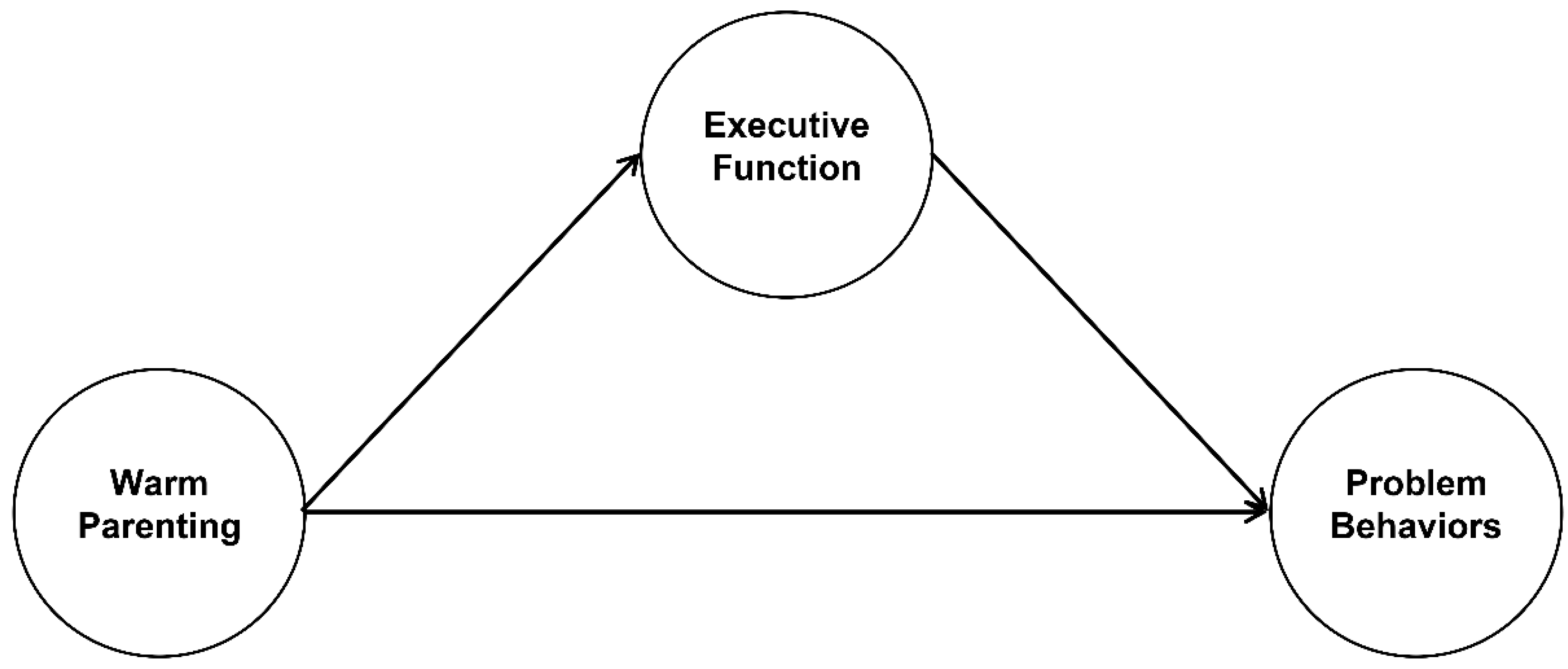
In particular, this study investigates whether EF mediates the association between maternal warm parenting and children’s problem behaviors, thereby contributing to a more comprehensive understanding of the cognitive–affective processes through which caregiving shapes behavioral development. Findings from this research may inform early intervention efforts aimed at strengthening regulatory capacities and promoting adaptive functioning during the foundational years of schooling. Accordingly, a research model was developed to examine the proposed relationships among the study variables (
Figure 1).
4. Discussion and Conclusions
4.1. Main Findings
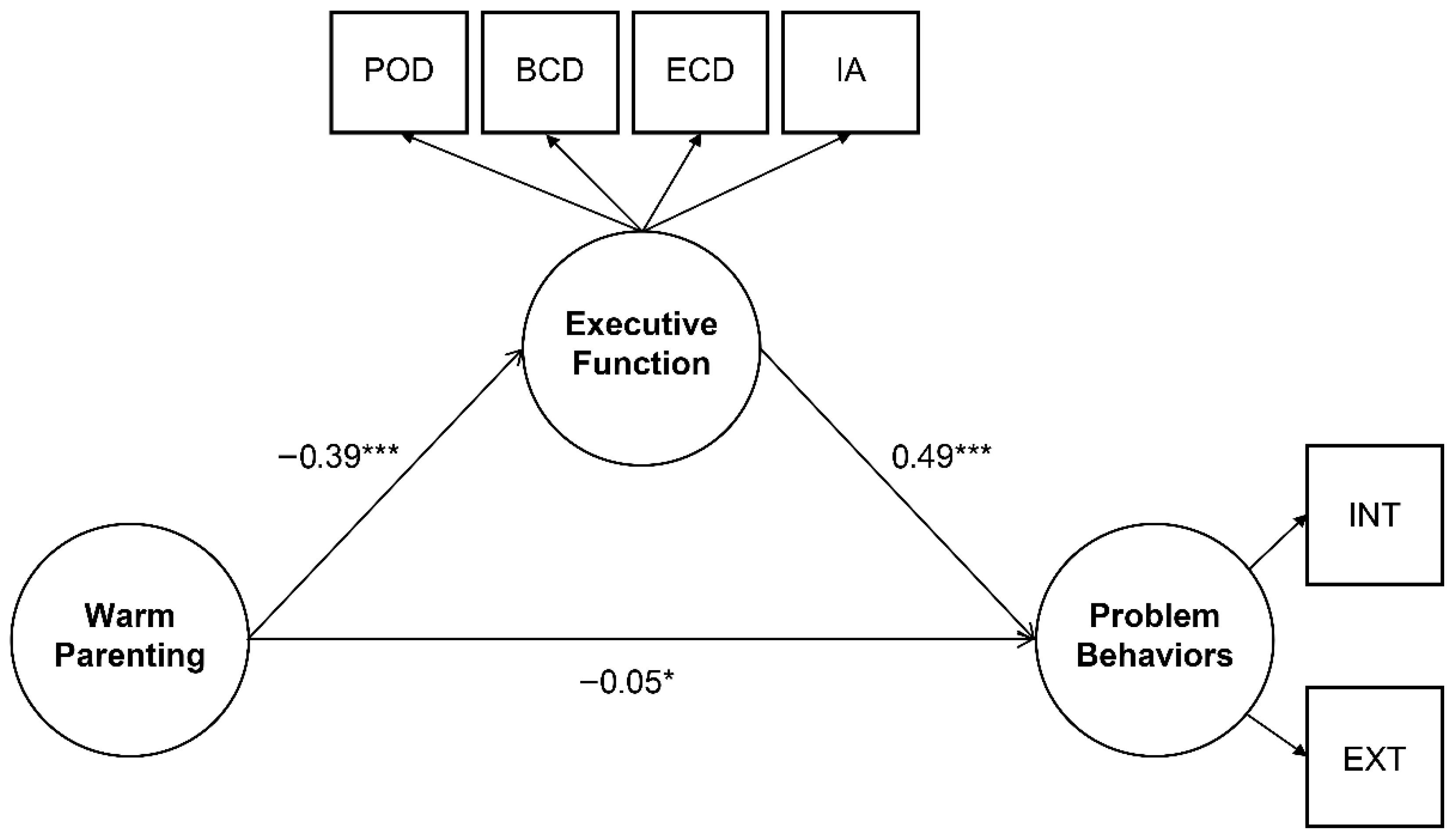
The present study investigated how maternal warm parenting contributes to children’s behavioral adjustment, with particular attention to the mediating role of children’s EF. Using nationally representative data from the PSKC and applying an SEM framework, the current study identified both direct and indirect pathways linking warm parenting to children’s problem behaviors.
The first major finding indicates that maternal warm parenting is directly associated with fewer problem behaviors in children. This pattern is aligned with a substantial body of research showing that warm, affectionate, and responsive caregiving helps protect children from early emotional and behavioral difficulties [
5,
22,
54,
55,
56,
57,
58]. Parenting characterized by sensitivity and emotional attunement promotes a secure relational environment that mitigates children’s arousal and reduces dysregulated behavioral expressions, thereby fostering adaptive socioemotional competencies that buffer against both internalizing and externalizing tendencies. This result also aligns with long-term evidence demonstrating that warm caregiving environments can reduce adolescents’ risk for delinquency, substance use, and other maladaptive outcomes.
The second major contribution of this study concerns the mediating role of EF. Maternal warmth was strongly associated with children’s EF skills, and EF, in turn, predicted children’s behavioral outcomes. This pattern is consistent with prior studies highlighting that emotionally supportive parenting fosters children’s regulatory capacities [
42,
59,
60]. Longitudinal work from diverse cultural settings similarly indicates that stable, warm caregiving supports the development of attention, working memory, and self-regulation in children, particularly among those exposed to socioeconomic adversity [
4,
61]. From a developmental perspective, warm parenting grants children opportunities to practice decision-making, impulse control, and emotional regulation, while caregivers’ modeling of adaptive regulatory strategies further supports EF development [
62]. Notably, the SEM approach enabled a clear decomposition of direct and indirect effects, revealing that the mediational pathway through EF accounted for a substantial portion of the association between warm parenting and behavioral adjustment.
EF was also strongly associated with children’s problem behaviors. Prior empirical and neuropsychological evidence has consistently shown that deficits in inhibitory control and self-regulation contribute to aggression, impulsivity, and behavioral dysregulation [
3,
63,
64]. Difficulties in EF, particularly those reflecting prefrontal inefficiencies, may also distort children’s interpretation of social cues or lead to ineffective problem-solving strategies, resulting in maladaptive social responses [
65,
66]. Meta-analytic research has further highlighted that behavioral inhibition tends to exhibit especially strong associations with problem behavior [
2], which is consistent with the findings of the present study considering that many indicators of the EF measure assessed inhibitory processes. Complementing prior research, the current findings also support the idea that broader regulatory disruptions—encompassing attentional and emotional control difficulties—may contribute to chronic behavior dysregulation [
48].
Combined, the results indicate that maternal warmth influences children’s behavioral adjustment through both direct mechanisms and, more prominently, through its impact on EF. This underscores the importance of conceptualizing EF as not only a cognitive skill but also a relationally shaped developmental competency that enables children to navigate increasingly complex social and academic demands.
4.2. Educational Implications
The results of the present study indicate that EF plays a critical role in supporting children’s development in educational settings during the early elementary school years. This period is characterized by a substantial increase in demands for behavioral regulation skills. Within this context, teachers can function as not only providers of academic instruction but also emotionally supportive educators who foster children’s self-regulatory capacities through warm and responsive interactions. Such associations have been supported by prior empirical research on teacher-child interaction quality and children’s executive function in early schooling contexts [
67].
In particular, clear boundary setting combined with consistent positive reinforcement from teachers may help children develop internal reference frameworks and provide effective modeling of emotional and behavioral regulation. Considering that difficulties in school adjustment during the early elementary years can have far-reaching consequences, including school refusal [
68], educational interventions that support children in regulating impulsive behavior and sustaining engagement with classroom tasks are particularly important.
The educational landscape in Korea has gradually shifted away from punitive, discipline-centered approaches toward greater emphasis on student rights, early identification of difficulties, and preventive intervention. The expansion of after-school programs and targeted support for academically struggling students reflects this broader transition toward proactive support within schools. In this context, homeroom teachers of first- and second-grade students often assume roles that extend beyond academic instruction to include caregiving and socioemotional support. As demonstrated by the present findings, warm and responsive teacher–child interactions in the classroom may function as a protective factor by supporting children’s EF and thereby reducing problem behaviors. This perspective is consistent with a previous study indicating that teachers view socioemotional approaches as important for preventing and addressing problem behaviors in elementary classrooms [
69].
Nevertheless, within the Korean educational context, formalized programs that systematically enhance the quality of teacher–child interactions with the explicit aim of reducing problem behaviors through EF remain limited. Although recent studies have begun examining the effectiveness and feasibility of EF training programs for clinical samples of elementary school children [
70], the adaptation and implementation of such approaches within general elementary school settings represent an important direction for future educational practice and research.
4.3. Social Implications
From a social perspective, the present study notes that supporting parents’ caregiving capacities is a critical component of efforts to reduce children’s problem behaviors. Whereas family support policies and parent education programs have traditionally focused on caregiving skills, strategies, and attitudes, the findings of this study indicate the importance of extending such efforts to encompass parents’ emotional stability, receptiveness, and stress management capacities. Strengthening these dimensions of parenting may be particularly relevant for families experiencing high levels of caregiving stress or socioeconomic risk.
Early intervention targeting such families may play an important role in supporting children’s EF development and prevent the escalation of problem behaviors. These findings support an integrated approach that situates children’s behavioral difficulties within broader familial and social contexts.
Considering the cumulative and long-term nature of development, early elementary school years can still be considered part of an early developmental period. Therefore, identifying parenting-related difficulties during this stage and providing direct or indirect support through schools or community-based services may maximize preventive effects. From an EF perspective, children who experience difficulties with behavioral inhibition, inattention, or impulsivity may benefit from early identification through standardized screening procedures and from access to supportive interventions. Policy approaches that facilitate EF support without imposing social stigma and/or excessive financial burden may contribute to the remediation of regulatory difficulties and, in the long term, help reduce societal costs associated with persistent behavior problems.
4.4. Limitations
A few study limitations should be acknowledged. First, although EF was revealed to mediate the association between warm parenting and children’s problem behaviors, the relatively small magnitude of the direct effect indicates that additional contextual or individual factors may also play a role in shaping these associations. Second, the present study did not examine potential differences across sociodemographic characteristics, such as child gender, birth order, or maternal educational level, which may represent important contextual factors influencing the observed associations. Future research incorporating these variables may further refine the interpretation and applicability of the findings. Third, the reliance on maternal reports for both EF and problem behaviors increases the likelihood of shared method variance. To address this limitation, future research should consider including teacher reports, observational assessments, and/or performance-based EF tasks to strengthen the robustness of the findings. In particular, teacher reports may provide a more objective perspective on children’s behavioral regulation and social adjustment within structured classroom environments. Finally, examining higher-risk subgroups, such as children of parents experiencing depression or chronic socioeconomic hardship, will help clarify whether the protective function of warm parenting and EF generalizes across diverse contexts. Despite these limitations, this study provides novel evidence—derived from a rigorous SEM framework and a large, nationally representative sample—that EF serves as a key mechanism linking warm parenting to children’s behavioral adjustment.
4.5. Recommendations for Future Research
Several directions for future research emerge from the findings of the present study. First, future research should incorporate sociodemographic characteristics of the study population as potential moderating factors to more precisely examine the conditions under which the associations among warm parenting, EF, and children’s problem behaviors may differ.
Second, future studies will benefit from moving beyond reliance on a single informant by adopting varied informants combined with diverse assessment methods. For example, parenting behaviors may be assessed through maternal questionnaire reports, children’s EF through performance-based tasks or experimental observations, and problem behaviors through combined reports from both mothers and teachers. Such approaches are likely to enhance the reliability and validity of research findings.
Third, longitudinal research beyond the early school years is needed to elucidate how EF links caregiving environments to behavioral adjustment over time. Research designs that capture developmental change in later childhood and adolescence may provide a more comprehensive understanding of the conditions and processes through which EF operates as a developmental mechanism.